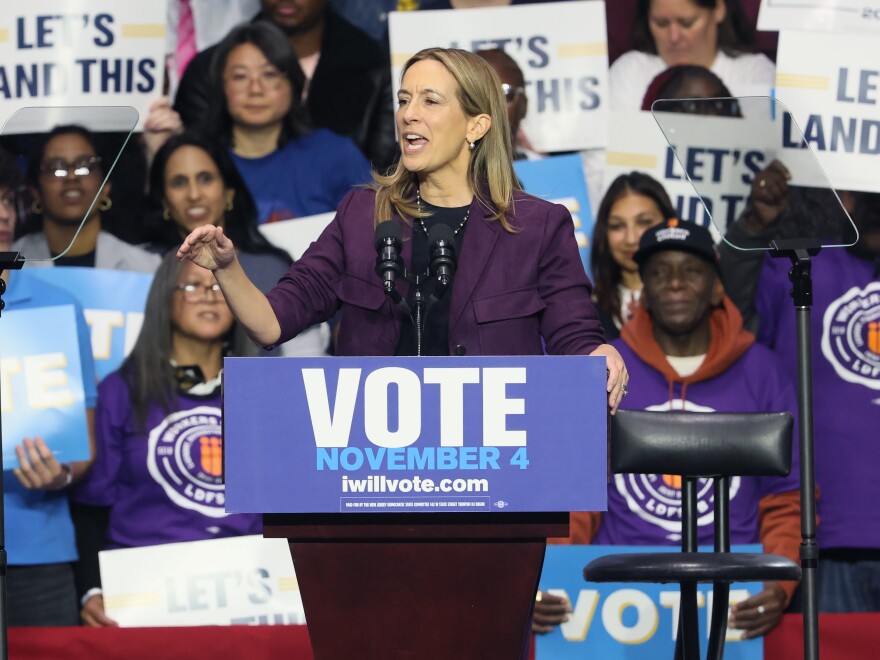
Congresswoman Mikie Sherrill, the Democratic candidate for governor of New Jersey, catapulted to victory on November 4 on the strength of her opposition to President Donald Trump after a hard-fought race against Jack Ciattarelli, a Republican whose energetic campaign could not outrun national politics in a liberal-leaning state. Congresswoman Sherrill, a former Navy helicopter pilot and federal prosecutor, will become New Jersey’s 57th governor and its second female leader.
2. Zohran Mamdani Wins New York City Mayoral Election
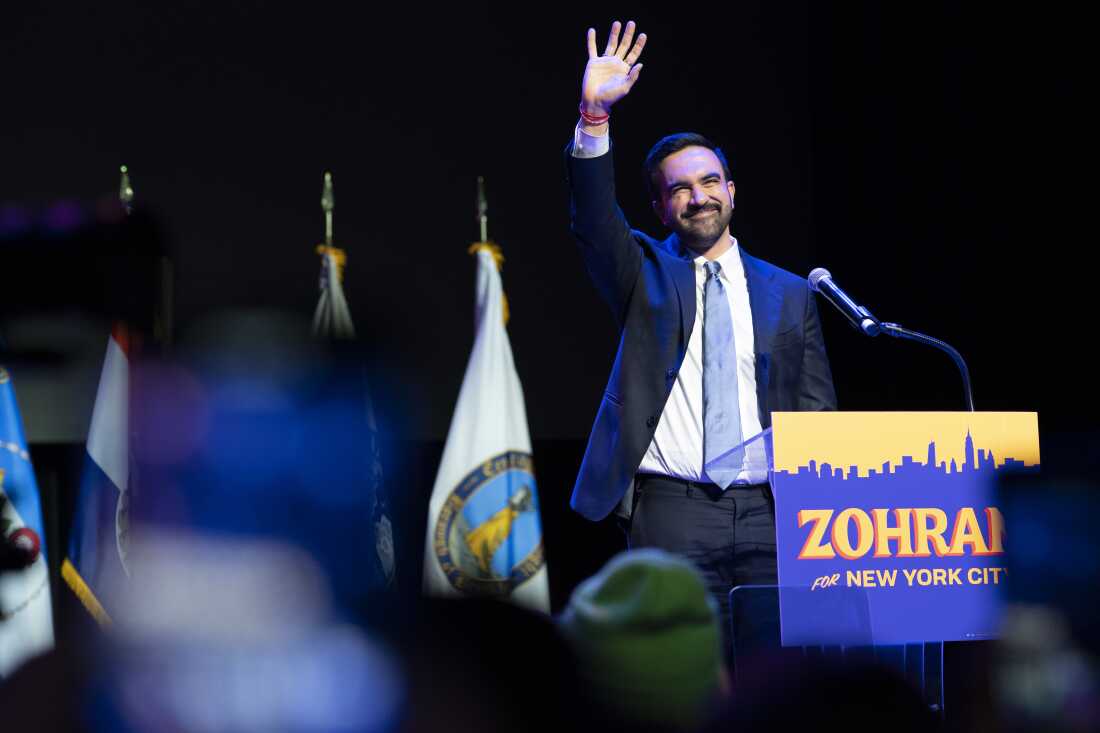
Zohran Mamdani was elected mayor of New York on November 4, capping a stunning ascent for the 34-year-old, Demcoratic Socialist-aligned state lawmaker who promised to transform city government to restore power to the working class and fight back against a hostile Trump administration.
Zohran Mamdani was elected mayor of New York on November 4, capping a stunning ascent for the 34-year-old, Democratic Socialist-aligned state lawmaker who promised to transform city government to restore power to the working class and fight back against a hostile Trump administration. In a victory for the Democratic Party’s progressive wing, Mamdani defeated former Governor Andrew Cuomo and Republican Curtis Sliwa. With his commanding win, Mamdani will etch his place in history as the city’s first Muslim mayor, the first of South Asian heritage, and the first born in Africa. He will also become New York’s youngest mayor in more than a century when he takes office on January 1, 2026. “The conventional wisdom would tell you that I am far from the perfect candidate. I am young, despite my best efforts to grow older. I am Muslim. I am a democratic socialist. And most damning of all, I refuse to apologize for any of this,” Mamdani declared to a roaring crowd at his victory party. He cast his win as a boon for blue-collar workers struggling to get by. “New York, tonight you have delivered a mandate for change,” he said, vowing to “wake up each morning with a singular purpose: To make this city better for you than it was the day before.”
3. California Voters Approve Democratic-drawn Congressional Map as National Redistricting Battle Spreads
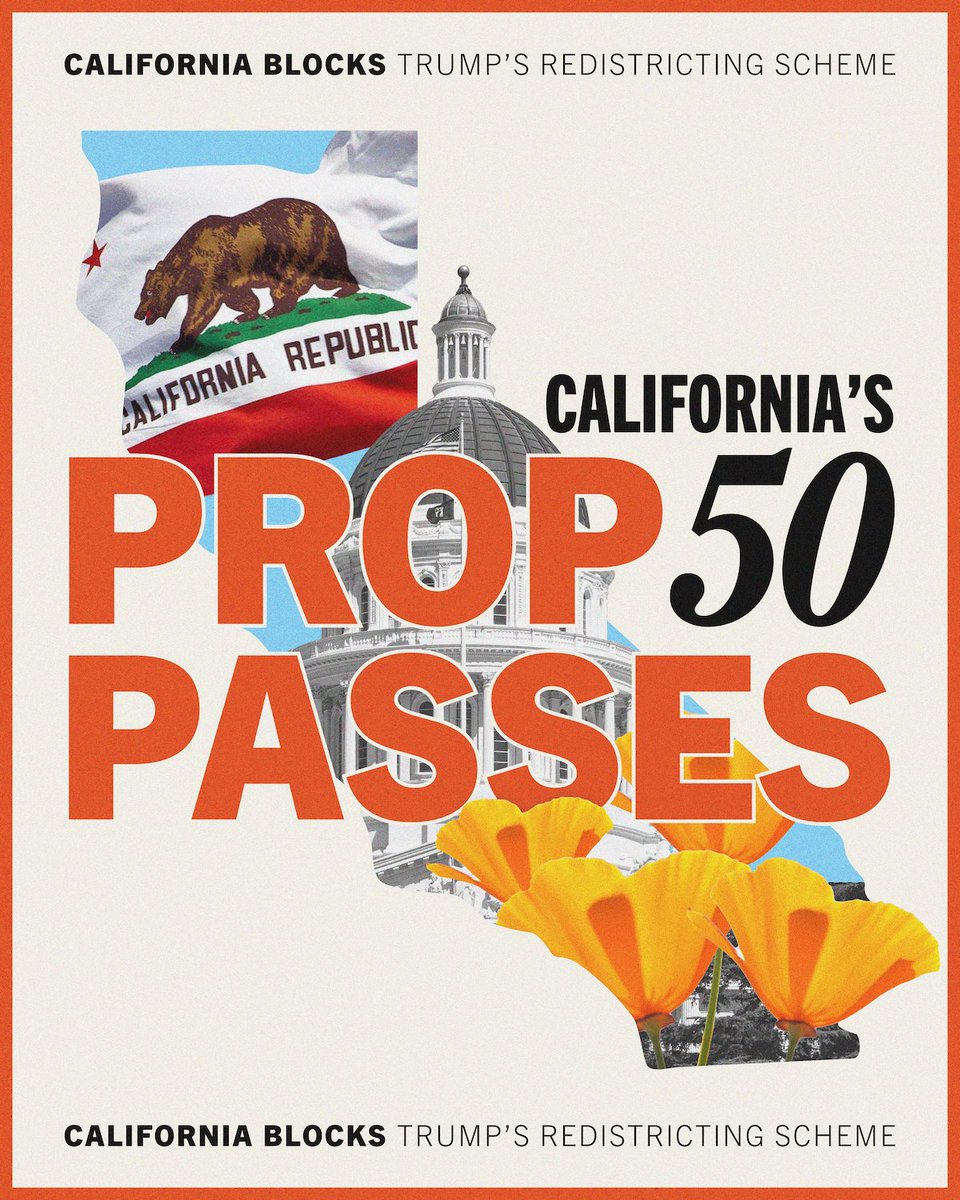
California voters have approved a new congressional map drawn by state Democrats on November 4. This gives the party the chance to gain up to five House seats in the 2026 midterm elections and counter Republican redistricting efforts in other states
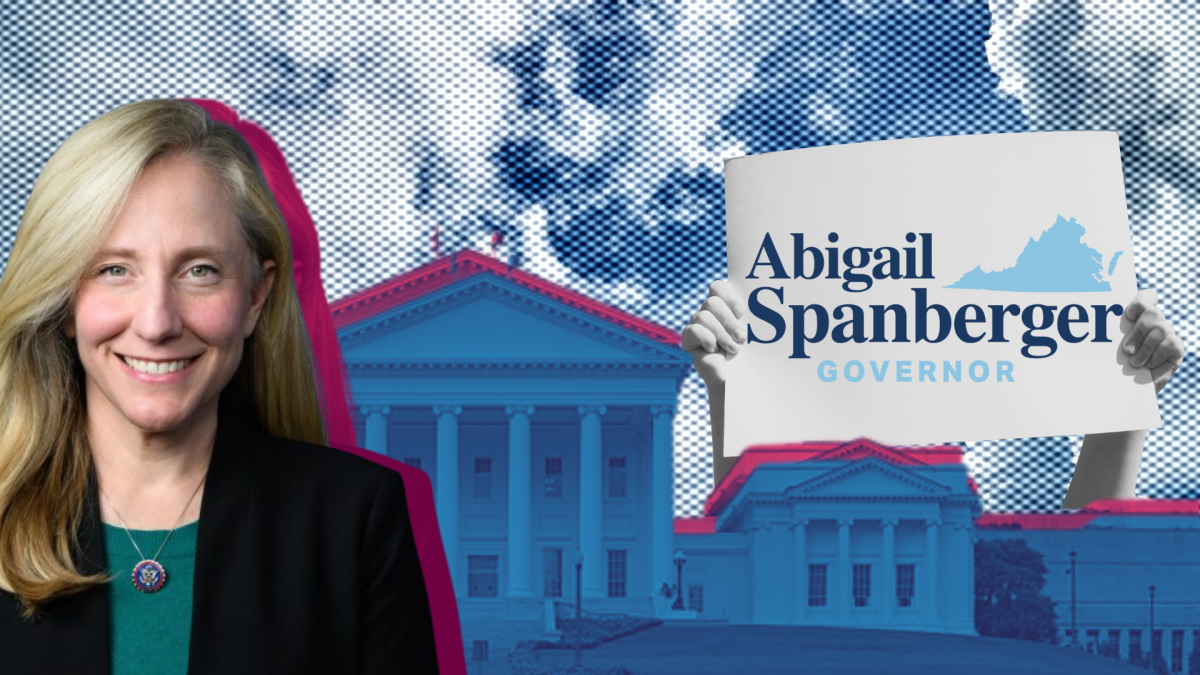
4. Democrat Abigal Spanberger Wins Virgnia Gubernatorial Election By A Comfortable Margin
Democrat Abigail Spanberger won the Virginia Gubernatorial election on November 4, with her victory being called almost immediately after the polls closed. Spanberger’s victory delivered a potent repudiation of President Trump’s policies after a campaign laser-focused on attacking them.
Democrat Abigail Spanberger won the Virginia Gubernatorial election on November 4, with her victory being called almost immediately after the polls closed. Spanberger’s victory delivered a potent repudiation of President Trump’s policies after a campaign laser-focused on attacking them. The former CIA officer and three-term Congresswoman, who entered politics in the 2018 Democratic wave, defeated her Republican opponent, Lieutenant Governor Winsome Earle-Sears, in a race that drew national attention as an early test of voter sentiment toward the Trump administration. At 46, Spanberger will be Virginia’s first female governor, following a streak of 65 men who have served in that office since Virginia became part of the US in 1788. Spanberger replaces popular outgoing Republican Governor Glenn Youngkin, who won in 2021 with 50.6% of the vote to Democrat Terry McAuliffe’s 48.7% but cannot seek consecutive re-election.
Here are the main events that occurred in Politics this week:
1. President Donald Trump Attacks UN and Lectures Nations in Address to General Assembly
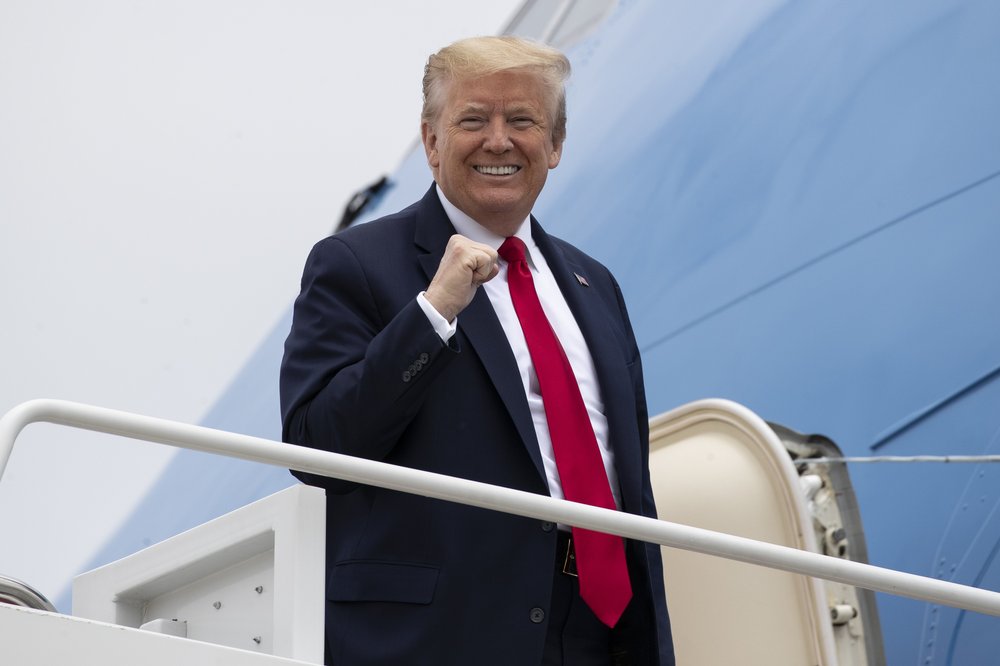
Despite pushing policies that have stirred controversy among voters, President Donald Trump’s approval rating has remained remarkably resilient, according to a recent survey conducted by The New York Times and Siena University from September 22-27, 2025
Despite pushing policies that have stirred controversy among voters, President Donald Trump’s approval rating has remained remarkably resilient, according to a recent survey conducted by The New York Times and Siena University from September 22-27, 2025. The poll, based on a random sample of 1,313 registered voters with a margin of error of plus or minus 3.2 percentage points, reveals that 43 percent of voters approve of Trump’s job performance, while 54 percent disapprove. These figures are nearly identical to those from April 2025, when 42 percent approved and 54 percent disapproved, suggesting that Trump’s support base has not wavered significantly despite ongoing debates over his administration’s actions.
2. US Labor Market Faces Slowdown Amid Government Shutdown Uncertainty
Private payrolls in the US took a significant hit in September, adding complexity to an already uncertain economic landscape. With the government shutdown halting the release of the Bureau of Labor Statistics’ (BLS) monthly jobs report, policymakers and investors are left grappling for insights into the labor market’s health
Private payrolls in the US took a significant hit in September, adding complexity to an already uncertain economic landscape. With the government shutdown halting the release of the Bureau of Labor Statistics’ (BLS) monthly jobs report, policymakers and investors are left grappling for insights into the labor market’s health. In the absence of official data, attention has turned to alternative sources, such as the private-sector jobs report from payroll processor ADP, released on October 1.
3. UN Sanctions Reimposed on Iran Amid Nuclear Deal Tensions
The United Nations has reinstated comprehensive economic and military sanctions on Iran, a significant development a decade after their initial suspension under the 2015 Joint Comprehensive Plan of Action (JCPOA).
The United Nations has reinstated comprehensive economic and military sanctions on Iran, a significant development a decade after their initial suspension under the 2015 Joint Comprehensive Plan of Action (JCPOA). This decision stems from accusations by the UK, France, and Germany, collectively referred to as the E3, that Iran has engaged in “persistent nuclear escalation” and failed to comply with its international obligations. The E3 invoked the JCPOA’s “snapback” mechanism last month, providing Iran a 30-day period to address concerns regarding its nuclear activities. That deadline lapsed on September 27, prompting the immediate reinstatement of sanctions.
On October 1, the US federal government shut down, marking the first such closure since 2019. The shutdown, triggered by a contentious spending dispute between President Donald Trump and congressional Democrats, has disrupted federal services and furloughed many federal workers.
On October 1, the US federal government shut down, marking the first such closure since 2019. The shutdown, triggered by a contentious spending dispute between President Donald Trump and congressional Democrats, has disrupted federal services and furloughed many federal workers. The current shutdown echoes a 35-day closure in 2018/2019, when President Donald Trump and congressional Democrats clashed over funding for a southern border wall. The central issue behind this most recent government shutdown is the Democrats’ insistence that President Trump agree to extend expiring health care subsidies and reverse Medicaid cuts included in his signature tax cut and domestic policy law passed earlier in 2025. These health care provisions, particularly the Affordable Care Act (ACA) subsidies set to expire by year’s end, are critical to millions of Americans’ access to affordable insurance.
Here are the main events that occurred in Politics this week:
1. President Donald Trump Attacks UN and Lectures Nations in Address to General Assembly
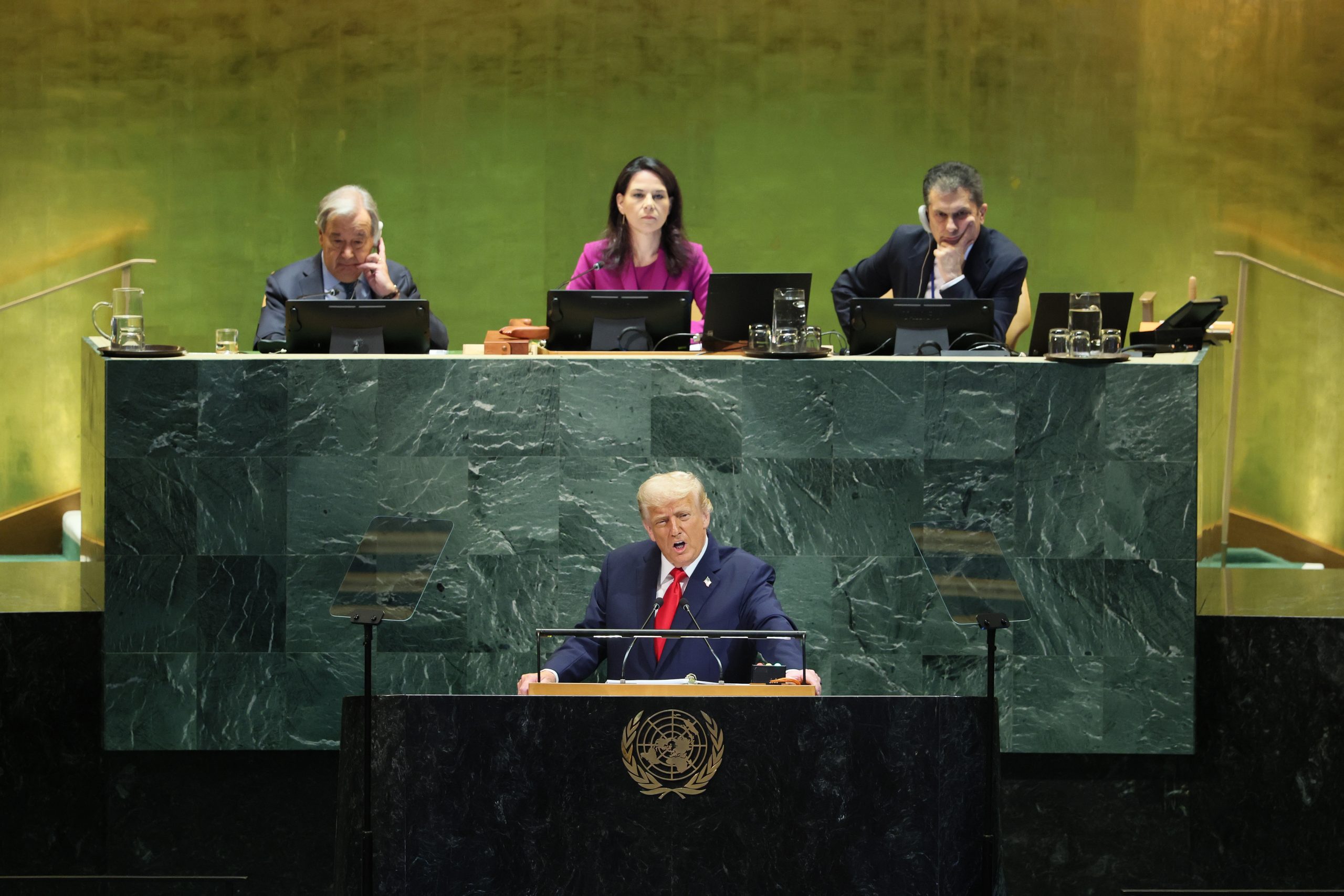
On September 23, President Donald Trump delivered a nearly hour-long address to the UN General Assembly, blending sharp criticism of the global body with self-congratulation for his administration’s achievements.
On September 23, President Donald Trump delivered a nearly hour-long address to the UN General Assembly, blending sharp criticism of the global body with self-congratulation for his administration’s achievements. In a speech that oscillated between grievance and optimism, President Trump touted his “America First” agenda, warned European nations of economic and cultural ruin, and positioned himself as a global peacemaker while questioning the UN’s effectiveness.
2. The UK, Canada, Australia, and Portugal Recognize Palestinian Statehood
On September 21, 2025, the UK, Canada, Australia, and Portugal formally recognized Palestine as a sovereign state, marking a significant shift in their long-standing diplomatic positions.
3. Supreme Court to Review Presidential Authority Over Independent Agencies
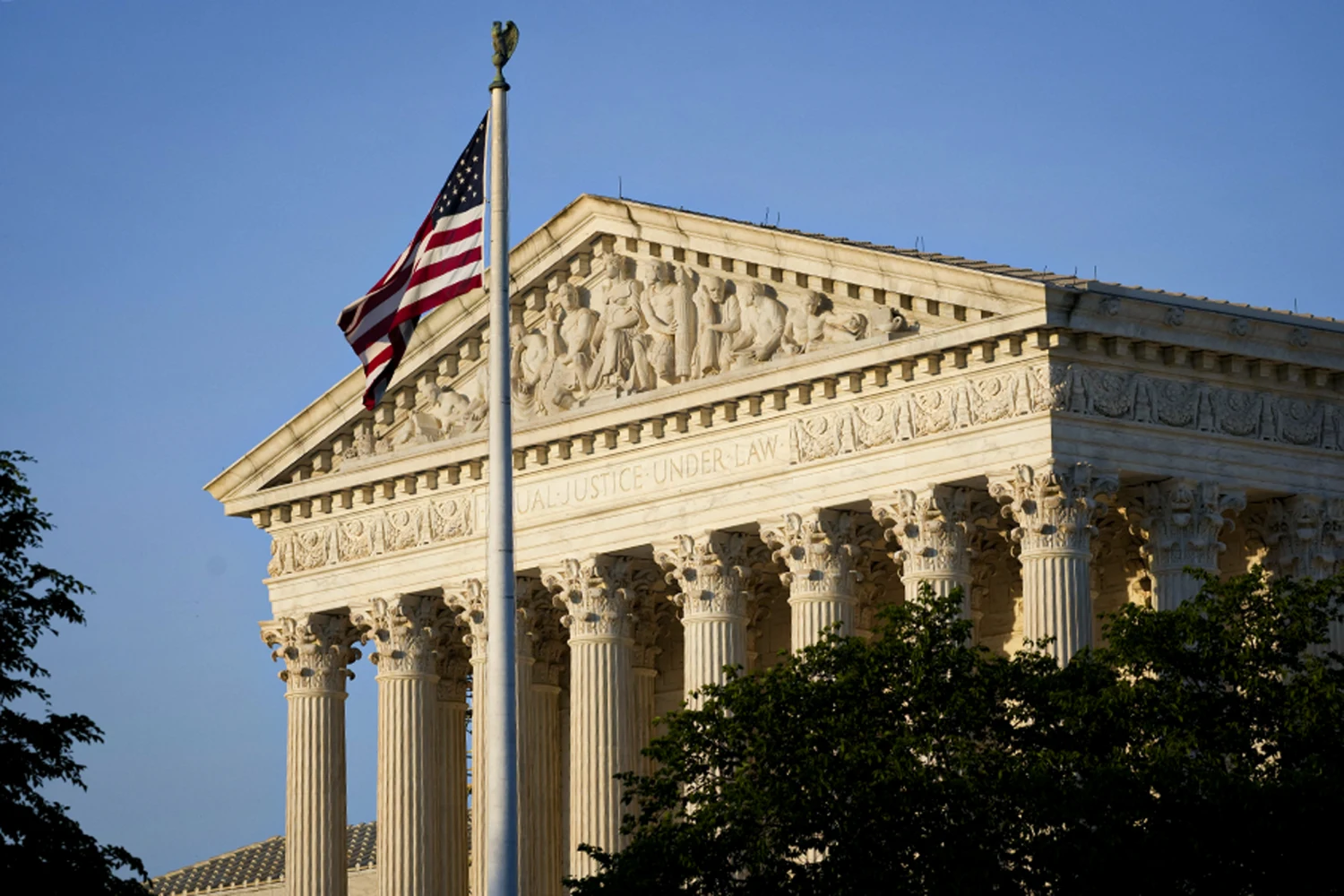
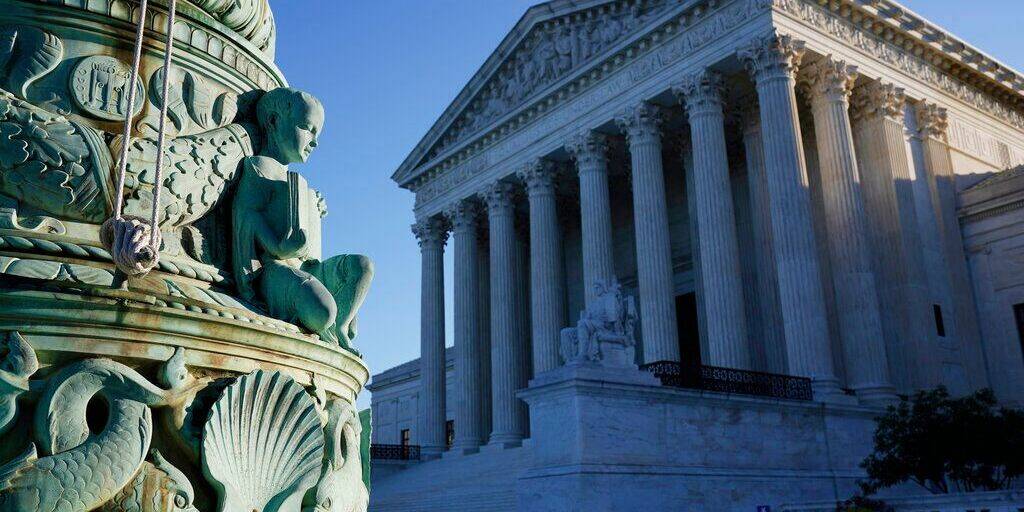
On September 22, 2025, the US Supreme Court announced it would consider a significant expansion of President Donald Trump’s power over independent federal agencies, potentially overturning a nearly century-old precedent that limits when presidents can remove agency board members.
4. President Donald Trump Moves to Designate Antifa as a Major Terrorist Organization
On September 22, President Donald Trump signed an executive order designating the decentralized anti-fascist movement known as Antifa a domestic terrorist organization.
Here are the main events that occurred in Politics this week:
1. Conservative Political Activist Charlie Kirk Assassinated In Utah Campus Shooting
On September 10, Charlie Kirk, a prominent conservative activist and founder of Turning Point USA, was fatally shot while speaking at Utah Valley University in Orem, Utah
On September 10, Charlie Kirk, a prominent conservative activist and founder of Turning Point USA, was fatally shot while speaking at Utah Valley University in Orem, Utah. The 31-year-old, known for his influential role in mobilizing young conservative voters and his close ties to President Donald Trump, was addressing students as part of Turning Point USA’s college campus tour when the attack occurred. Authorities have described the incident as a targeted political assassination, prompting widespread condemnation and calls for an end to political violence in the United States.
2. President Donald Trump Announces Midterm Convention to Rally Support for Republicans Ahead of 2026 Elections
On September 16, President Donald Trump took to TruthSocial to announce a Republican “Midterm Convention” aimed at energizing the party ahead of the 2026 midterm elections.
On September 16, President Donald Trump took to TruthSocial to announce a Republican “Midterm Convention” aimed at energizing the party ahead of the 2026 midterm elections. The event, with its time and place yet to be determined, promises to be a significant and exciting gathering for the Republicans. President Trump wrote, “The Republicans are going to do a Midterm Convention in order to show the great things we have done since the Presidential Election of 2024. Stay tuned, it will be quite the Event, and very exciting!”
3. In A Major Defeat For Opponents of Gerrymandering, the Missouri State Legislature Approves Congressional Map To Give Republicans an Additional Congressional Seat Ahead Of 2026 Midterm Elections
Missouri lawmakers have approved a new congressional voting map for the 2026 midterm elections, responding to former President Donald Trump’s call to secure a Republican majority in Congress
Missouri lawmakers have approved a new congressional voting map for the 2026 midterm elections, responding to former President Donald Trump’s call to secure a Republican majority in Congress. The state Senate passed the redistricting plan with a 21-11 vote, aiming to flip a Democratic-held seat to Republican control. The map now awaits the signature of Republican Governor Mike Kehoe, who introduced the plan last month, describing it as a “Missouri First” map that aligns with the state’s conservative values.
4. Democratic Support Grows for Zohran Mamdani in NYC Mayoral Race
Zohran Mamdani, the Democratic nominee for mayor of New York City, is gaining significant endorsements from party leaders as concerns mount over President Donald Trump’s attempts to influence the race
Zohran Mamdani, the Democratic nominee for mayor of New York City, is gaining significant endorsements from party leaders as concerns mount over President Donald Trump’s attempts to influence the race. Mamdani, a state assemblyman and democratic socialist, secured the Democratic primary victory in June 2025, defeating former Governor Andrew Cuomo, who is now running as an independent.
5. New Jersey Gubernatorial Race Heats Up as Jack Ciattarelli Closes Gap on Mikie Sherrill
The race for New Jersey’s next governor has tightened dramatically, with Republican Jack Ciattarelli now trailing Congresswoman Mikie Sherrill by a mere two points, according to a recent poll conducted by National Research Inc. from September 8 to 10, 2025
The race for New Jersey’s next governor has tightened dramatically, with Republican Jack Ciattarelli now trailing Congresswoman Mikie Sherrill by a mere two points, according to a recent poll conducted by National Research Inc. from September 8 to 10, 2025. The survey, which included 600 likely voters and carries a margin of error of plus or minus 4 percent, shows Sherrill leading Ciattarelli 47 to 45 percent, signaling a statistical dead heat as the November 4 election approaches. This development underscores the high stakes of the contest, as New Jersey, alongside Virginia, is one of only two states electing a governor this year, making it a critical barometer for national political trends.
California Democrats have unveiled a bold proposal for a new congressional map that could secure up to five additional seats for their party in the House of Representatives. This move, spearheaded by Governor Gavin Newsom, is a strategic response to Republican redistricting efforts in states like Texas, intensifying the national battle for House control ahead of the 2026 midterm elections. The proposal has sparked heated debate, with critics arguing it undermines the state’s independent redistricting process, while supporters claim it’s a necessary countermeasure to maintain political balance. The proposed map targets five Republican-held districts, making them more favorable to Democrats. The affected representatives, Kevin Kiley, Doug LaMalfa, David Valadao, Darrell Issa, and Ken Calvert, now face significantly bluer constituencies. Democrats currently hold 43 of California’s 52 congressional seats, and this redistricting effort aims to solidify their dominance further.
Governor Newsom has framed the plan as a direct response to Texas Republicans’ redistricting, which is expected to add up to five Republican seats. He argues that California must “fight fire with fire” to counter what he describes as aggressive gerrymandering in red states. To ensure public input, Newsom has proposed a special election on November 4, 2025, allowing California voters to decide on the new map, bypassing the state’s independent Citizens Redistricting Commission. “We have the opportunity to de facto end the Trump presidency in less than 18 months. That’s what’s at stake,” Newsom said at a recent press conference, emphasizing the potential for a Democratic-controlled House to check Republican influence. The state legislature is set to vote on the proposal on August 21, 2025. If approved, the new districts would apply to the 2026, 2028, and 2030 elections, with the Citizens Redistricting Commission resuming its authority after the 2030 census.
The proposal has drawn sharp criticism from Republicans and advocates for transparent governance. Republican Representative Kevin Kiley has been vocal in his opposition, introducing federal legislation to ban mid-decade redistricting and accusing Newsom of undermining California’s independent redistricting process. “This is a moment for every Californian and every American of decency, regardless of party affiliation, to speak out against the abject corruption that our governor is attempting,” Kiley declared on the House floor. Good government groups echo these concerns, arguing that bypassing the Citizens Redistricting Commission, established by voters in 2008 and expanded in 2010 to include congressional districts, erodes transparency and public trust. Jeanne Raya, a former Democratic member of the commission, warned that the lack of openness in Newsom’s plan could disenfranchise voters. “Somebody’s going to be drawing maps, whether behind a real door or a virtual door,” Raya said. “There will not be that transparency that is written into the independent commission’s work, and voters will suffer for that. California Governor Gavin Newsom defended the proposal as a transparent process, emphasizing that voters will have the final say through the special election, a step not taken in Texas, where Republican-drawn maps face no such public vote. He also noted that California’s plan includes a trigger clause, meaning it would only take effect if Texas or other red states proceed with their redistricting efforts.
California’s redistricting proposal highlights the escalating partisan battle over congressional representation. While Governor Gavin Newsom argues it is a necessary defense against Republican tactics, critics warn it risks further politicizing a process meant to be impartial. The outcome of the November 4 special election, if approved by the legislature, will determine whether California adopts this contentious new map, and could set a precedent for how states navigate redistricting in this polarized era. As the debate unfolds, all eyes are on California and Texas, where these dueling strategies could reshape the US House for years to come.
Here are the main events that occurred in Politics this week:
1. Mike Johnson Narrowly Re-Elected House Speaker
On January 3, 2025, Congressman Mike Johnson narrowly secured reelection as House Speaker on the first ballot, overcoming resistance from hard-right Republican holdouts.
On January 3, 2025, Congressman Mike Johnson narrowly secured reelection as House Speaker on the first ballot, overcoming resistance from hard-right Republican holdouts. The tense proceedings marked a turbulent beginning to the new Congress, as a small faction of Republicans declined to vote for Johnson or backed other candidates. His struggles reflected the challenges of leading a fractured party, even with President-elect Donald Trump’s support. Trump, who will return to the White House with Republican control of both the House and Senate, personally called dissenting lawmakers to secure Johnson’s victory. The final tally stood at 218-215, highlighting Johnson’s slim margin of support.
2. President Biden Celebrates Judicial Milestone, Outpacing Trump’s First-Term Total Of Appointed Federal Judges
On January 2, 2025, President Joe Biden highlighted the confirmation of 235 federal judges during his presidency, a landmark achievement that narrowly surpassed the 234 lifetime judicial appointments made under President-elect Donald Trump in his first term.
On January 2, 2025, President Joe Biden highlighted the confirmation of 235 federal judges during his presidency, a landmark achievement that narrowly surpassed the 234 lifetime judicial appointments made under President-elect Donald Trump in his first term. Among Biden’s confirmations was one Supreme Court justice, marking the culmination of a determined effort by Democrats to shape the judiciary in the final months of his term.
3. Congress Certifies President-elect Trump’s 2024 Victory in Peaceful Transition
On January 6, 2025, a joint session of Congress certified President-elect Donald Trump’s victory in the 2024 election, fulfilling a vital democratic tradition that was violently disrupted four years ago.
On January 6, 2025, a joint session of Congress certified President-elect Donald Trump’s victory in the 2024 election, fulfilling a vital democratic tradition that was violently disrupted four years ago. This time, there was no sign of unrest, though security at the Capitol was heightened. Unlike President-elect Trump in 2020, Vice President Kamala Harris did not dispute her loss in the November election, and Democrats refrained from raising any objections during the certification of Electoral College votes.
4. Iran’s Execution Rate Surges In 2024: UN Reports Record Numbers
Iran reportedly executed at least 901 people in 2024, the highest total recorded in nine years and a 6% increase from the 853 executions in 2023, according to the UN human rights chief, Volker Türk.
Iran reportedly executed at least 901 people in 2024, the highest total recorded in nine years and a 6% increase from the 853 executions in 2023, according to the UN human rights chief, Volker Türk. The alarming rise includes about 40 executions in a single week in December, sparking fresh concerns over the country’s escalating use of the death penalty. “It is deeply disturbing that yet again we see an increase in the number of people subjected to the death penalty in Iran year-on-year,” Türk said, calling for a moratorium on executions with a view to eventual abolition.
Happy New Year! Here are the main events that occurred in Politics this week:
1. Republican-Run States See Opportunity To Push Extreme Policies Under Trump
Republican state lawmakers and conservative leaders around the United States see Donald Trump’s re-election as a mandate that will help them enact right-wing policies in Republican-run states across the US.
Republican state lawmakers and conservative leaders around the United States see Donald Trump’s re-election as a mandate that will help them enact right-wing policies in Republican-run states across the US. The policies include steep tax cuts, environmental legislation, religion in schools, and legislation concerning transgender medical care and education, among other hot-button social issues. Next year, Republicans will have trifecta control, meaning both legislative bodies and the governorship in a state, in 23 states, while Democrats will only control the three entities in 15 states. The other states have a divided government.
2. Former President Jimmy Carter Dies At The Age Of 100
Jimmy Carter, the 39th president of the United States, died on December 29, 2024, at the age of 100. Though he served only one term in office, he went on to a distinguished second act of humanitarian work, and he lived long enough to become the oldest former president in U.S. history.
Jimmy Carter, the 39th president of the United States, died on December 29, 2024, at the age of 100. Though he served only one term in office, he went on to a distinguished second act of humanitarian work, and he lived long enough to become the oldest former president in U.S. history. Carter “died peacefully Sunday, Dec. 29, at his home in Plains, Georgia, surrounded by his family,” the Carter Center announced in a statement.
3. Russia Rejects President-elect Donald Trump’s Peace Proposal To End Russia-Ukraine War
Russia is dissatisfied with the reported peace deal proposals on Ukraine from U.S. President-elect Donald Trump’s team, Russian Foreign Minister Sergey Lavrov said on December 29, according to state-owned TASS.
Russia is dissatisfied with the reported peace deal proposals on Ukraine from U.S. President-elect Donald Trump’s team, Russian Foreign Minister Sergey Lavrov said on December 29, according to state-owned TASS. Earlier reports from the Wall Street Journal indicated that Trump’s team is considering a plan to delay Ukraine’s NATO membership by at least 20 years in exchange for continued Western arms supplies and the deployment of European peacekeepers to monitor a ceasefire. Lavrov said the proposal, as outlined in leaks and Trump’s December 12 Time interview, suggests “freezing hostilities along the current line of contact and transferring the responsibility of confronting Russia to Europe.” “We are certainly not satisfied with the proposals sounding on behalf of representatives of the president-elect’s team,” Lavrov said, specifically rejecting the idea of introducing European peacekeepers in Ukraine.
4. Biden Administration Sanctions Russia, Iran Over Interference In The 2024 Presidential Election
The Biden Administration announced on December 31, 2024 that it is leveling sanctions on entities in Iran and Russia over attempted election interference.
The Biden Administration announced on December 31, 2024 that it is leveling sanctions on entities in Iran and Russia over attempted election interference. The Treasury Department said the entities, a subordinate organization of Iran’s Islamic Revolutionary Guard Corps and a Moscow-based affiliate of Russia’s military intelligence agency, the GRU, attempted to interfere in the 2024 elections.
5. President-elect Donald Trump Endorses Mike Johnson To Continue As House Speaker
President-elect Donald J. Trump endorsed House Speaker Mike Johnson for another term in his post on December 30, moving to shore up the fortunes of a leader whose fate he threw into question this month when he sank a bipartisan spending deal Speaker Johnson had struck to avert a government shutdown.
President-elect Donald J. Trump endorsed House Speaker Mike Johnson for another term in his post on December 30, moving to shore up the fortunes of a leader whose fate he threw into question this month when he sank a bipartisan spending deal Speaker Johnson had struck to avert a government shutdown. The announcement from Trump on his website, Truth Social, ended days of private discussions by the president-elect and his allies about whether to try to save Johnson or find another candidate, as some conservatives have been agitating for. It followed a concerted, monthslong effort by Johnson to ingratiate himself with the president-elect in hopes of winning his backing and averting another messy fight for the speakership at the start of the 119th Congress on Friday.
Here are the main events that occurred in Politics this week
1.Iran Executes First Protestor Linked To Ongoing Revolution
Iran has executed a man for allegedly injuring a paramilitary officer in the first known execution linked to the revolution that has swept the country since September, state media reported on December 8.
Iran has executed a man for allegedly injuring a paramilitary officer in the first known execution linked to the revolution that has swept the country since September, state media reported on December 8. Mizan Online, a news agency affiliated with Iran’s judiciary, and the semi-official Tasmin news agency both named the protester as Mohsen Shekari. He was reportedly convicted of “waging war against god” for allegedly stabbing a member of the Basij paramilitary force at a protest in Tehran on September 23. Shekari was sentenced to death on October 23, and executed by hanging on December 8, according to Mizan Online. It was the first execution connected to the protests to be publicly reported by state media.
2. UN Removes Iran From Women’s Rights Commission Due To Human Rights Violations
The United Nations voted to oust Iran from the Commission on the Status of Women because it “continuously undermines and increasingly suppresses the human rights of women and girls,’’ according to the resolution adopted on December 14.
The United Nations voted to oust Iran from the Commission on the Status of Women because it “continuously undermines and increasingly suppresses the human rights of women and girls,’’ according to the resolution adopted on December 14. A majority of the 54 members of the U.N.’s Economic and Social Council (ECOSOC) voted on a US-drafted resolution to expel Iran from the Commission on the Status of Women for the remaining of its 2022-2026 elected term. A total of 29 countries elected to the Council voted in favor of expelling Iran. “There are few obviously right and wrong answers in diplomacy,” Linda Thomas-Greenfield, the US Ambassador to the United Nations, said ahead of the vote. “But today – today – we have an opportunity to do something that is clearly the right thing to do.”
3. Senator Krysten Sinema Switches Parties From Democrat To Independent, Dealing A Major Blow To Demcoratic Senate Control
Arizona Senator Kyrsten Sinema is changing her party affiliation to independent, delivering a jolt to Democrats’ narrow majority and Washington along with it.
Arizona Senator Kyrsten Sinema is changing her party affiliation to independent, delivering a jolt to Democrats’ narrow majority and Washington along with it. In a 45-minute interview, the first-term senator said that she will not caucus with Republicans and suggested that she intends to vote the same way she has for four years in the Senate. “Nothing will change about my values or my behavior,” Senator Sinema said. Provided that Sinema sticks to that vow, Democrats will still have a workable Senate majority in the next Congress, though it will not exactly be the neat and tidy 51 seats they assumed. The Democrats expected to also have the votes to control Senate committees. And Sinema’s move means that Senator Joe Manchin (D-WV), a pivotal swing vote in the 50-50 chamber the past two years, will hold onto some but not all of his outsized influence in the Democratic caucus.
The US is poised to approve sending its most advanced ground-based air defense system to Ukraine, responding to the country’s urgent request to help defend against an onslaught of Russian missile and drone attacks, two US officials said on December 13.
The US is poised to approve sending its most advanced ground-based air defense system to Ukraine, responding to the country’s urgent request to help defend against an onslaught of Russian missile and drone attacks, two US officials said on December 13. Defense Secretary Lloyd Austin could approve a directive as early as this week to transfer one Patriot battery already overseas to Ukraine, the officials said, speaking on the condition of anonymity to discuss internal deliberations. Final approval would then rest with President Joe Biden.
Here are the main events that occurred in Politics this week:
1. Raphael Warnock Wins Re-election In Runoff Race, Officially Closing Out 2022 Election Season
Senator Raphael Warnock has won reelection in Georgia, the Associated Press reports, giving the Democrats a 51-49 majority in the US Senate.
Senator Raphael Warnock has won reelection in Georgia, the Associated Press reports, giving the Democrats a 51-49 majority in the US Senate. Senator Warnock defeated first-time candidate Herschel Walker, whose campaign was beset by allegations that he paid two women to have abortions. Senator Warnock finished ahead of Walker in the election on November 8, but fell short of the majority needed to avoid a runoff. Former President Barack Obama, who had campaigned for Warnock earlier in the race, returned to Georgia during the runoff to urge voters to come back to the polls.
2. Protesters Detail Mass Sexual Abuse In Iranian Prisons By Regime
Women in Iran detained for protesting against the ruling regime are suffering sexual violence carried out by agents of the Islamic Revolutionary Guard Corps’ (IRGC) intelligence agency, as reported on December 1.
Women in Iran detained for protesting against the ruling regime are suffering sexual violence carried out by agents of the Islamic Revolutionary Guard Corps’ (IRGC) intelligence agency, as reported on December 1. One woman from the city of Bukan in West Azerbaijan province had told her fellow prison detainees she had been raped while being interrogated by members of the Islamic Revolutionary Guard Corps’ (IRGC) intelligence agency, the outlet IranWire reported. The 22-year-old was transferred to a hospital because of her mental and physical condition but upon release, committed suicide, according to the outlet.
3. Iranian Regime Insiders Begin To Turn Against Government Due To Response To Protests
The former Iranian former president Mohammad Khatami has urged the current government to be more lenient with protesters, amid ongoing nationwide demonstrations representing the biggest challenge to the Islamic Republic in decades.
The former Iranian former president Mohammad Khatami has urged the current government to be more lenient with protesters, amid ongoing nationwide demonstrations representing the biggest challenge to the Islamic Republic in decades. Khatami, who previously served as Iranian President from 1997-2005 and was aligned with the reformist wing of the Iranian government said the government must listen to the demonstrators before it is too late, in a message ahead of Students’ Day, which marks the anniversary of the murder of three university students in 1953 by Iranian police under Shah Mohammad Reza Pahlavi’s regime. “I advise the officials to appreciate this presence and instead of dealing with it inappropriately, take a softer approach and listen to them and with their help, recognize the wrong aspects of governance before it is too late for them to move towards good governance,” said Khatami, regarding the government’s handling of the protests.
4. US Economy Adds Over 250,00 New Jobs In November As Inflation Begins To Slow
The US Economy added 263,000 jobs in November, defying aggressive action from the Federal Reserve to cool the economy and bring down decades-high inflation.
The US Economy added 263,000 jobs in November, defying aggressive action from the Federal Reserve to cool the economy and bring down decades-high inflation. The unemployment rate held steady at 3.7%, according to the Labor Department, which released the latest monthly jobs snapshot on December 2. Economists surveyed by Refinitiv had expected the pace of hiring to slow to a gain of only 200,000 jobs in November and the unemployment rate to stay flat at 3.7%. Some of the largest monthly job gains were in the leisure and hospitality sector, as well as health care. The hot jobs report also showed an unexpected spike in average hourly earnings, another knock against the Fed’s efforts to rein in inflation by cooling demand. Officials at the central bank have expressed concern about rising wages keeping inflation elevated.
Here are the main events that occurred in Politics this week:
1. Senator Leader Mitch McConnel Re-elected Senate Republican Leader Despite Disappointing Midterm Election Performance By Republicans
Mitch McConnell of Kentucky on November 16 overwhelmingly won re-election as his party’s Senate leader, holding off Senator Rick Scott of Florida in the first challenge Senator McConnell has faced since assuming the post in 2007.
Mitch McConnell of Kentucky on November 16 overwhelmingly won re-election as his party’s Senate leader, holding off Senator Rick Scott of Florida in the first challenge Senator McConnell has faced since assuming the post in 2007. Despite a disappointing election performance that left them demoralized and still mired in the minority, Senate Republicans stuck with their longtime leader, opting for an experienced hand rather than a change at the top that could add to the post-election turmoil engulfing their party. “I think the most important thing we can do is get these differences behind us,” said Senator John Cornyn, Republican of Texas and a leading McConnell ally.
2. Nancy Pelois Steps Down As House Democratic Leader
House Speaker Nancy Pelosi said on November 17 that she will not seek a leadership position in the new Congress, ending a historic run as the first woman with the gavel and making way for a new generation to steer the party after Democrats lost control of the House to Republicans in the midterm elections.
House Speaker Nancy Pelosi said on November 17 that she will not seek a leadership position in the new Congress, ending a historic run as the first woman with the gavel and making way for a new generation to steer the party after Democrats lost control of the House to Republicans in the midterm elections. In a spirited speech on the House floor, Pelosi announced that she will step aside after leading Democrats for nearly 20 years and in the aftermath of the brutal attack on her husband, Paul, last month in their San Francisco home, and after having done “the people’s work.” The California Democrat, a pivotal figure in US history and perhaps the most powerful speaker in modern times, said she would remain in Congress as the representative from San Francisco, a position she has held for 35 years, when the new Congress convenes in January. “I will not seek reelection to Democratic leadership in the next Congress,” she said. “For me, the hour has come for a new generation to lead the Democratic caucus that I so deeply respect.” Now, she said, “we must move boldly into the future.”
3. Iran Intensifies Violent Crackdown Against Anti-Government Protestors
Iran’s clerical rulers have stepped up suppression of persistent anti-government protests in the country’s Kurdish region, deploying troops and killing at least four demonstrators on November 20, social media posts and rights groups said.
Iran’s clerical rulers have stepped up suppression of persistent anti-government protests in the country’s Kurdish region, deploying troops and killing at least four demonstrators on November 20, social media posts and rights groups said. Nationwide protests, sparked by the death of 22-year-old Iranian Kurdish woman Mahsa Amini in September in the custody of morality police, have been at their most intense in the areas where the majority of Iran’s 10 million Kurds live. Videos on social media, showed a convoy of military vehicles with heavily armed troops, purportedly in the western city of Mahabad, located in Iranian Kurdistan. The sounds of heavy weaponry could be heard in several other videos. The Norway-based human rights group Hengaw said military helicopters carried members of the widely feared Islamic Revolutionary Guard Corps (IRGC) to quell the protests in the Sunni-dominated Kurdish city of Mahabad.
Here are the main events that occurred in Politics this week:
1. Defying The Odds, The Democrats Keep Control of The US Senate
Democrats kept control of the Senate in the midterm elections, repelling Republican efforts to retake the chamber and making it harder for them to thwart President Joe Biden’s agenda
Democrats kept control of the Senate in the midterm elections, repelling Republican efforts to retake the chamber and making it harder for them to thwart President Joe Biden’s agenda. The House of Representatives elections, on the other hand, resulted in a very narrow Republican majority. Senator Catherine Cortez Masto’s shock victory in Nevada gave Democrats the 50 seats they needed to keep the Senate. Her win reflects the surprising strength of Democrats across the US this election year. Seeking reelection in an economically challenged state that has some of the highest gas prices in the nation, Cortez Masto was considered the Senate’s most vulnerable member, adding to the frustration of Republicans who were confident she could be defeated.
“We got a lot done and we’ll do a lot more for the American people,” Senate Majority Leader Chuck Schumer (D-NY) said in response to the results. “The American people rejected — soundly rejected — the anti-democratic, authoritarian, nasty and divisive direction the MAGA Republicans wanted to take our country.” With the results in Nevada now decided, Georgia is the only state where both parties are still competing for a Senate seat. Democratic incumbent Senator Raphael Warnock faces Republican challenger Herschel Walker in a December 6 runoff. Alaska’s Senate race has advanced to ranked-choice voting, though the seat will stay in Republican hands.
2. Republicans Gain Control Of The House Of Representatives
The Republican Party have won back control of the House of Representatives, giving the creating a toehold to check President Joe Biden and Congressional Democrats despite a disappointing midterm election.
The Republican Party have won back control of the House of Representatives, giving the creating a toehold to check President Joe Biden and Congressional Democrats despite a disappointing midterm election. Republicans are on track for one of the smallest Congressional majorities since the 2000 House of Representatives elections despite pre-election predictions that a red wave was coming. Instead, it took more than a week of vote-counting after Election Day for it to be clear the party had won the majority. And that majority could be difficult to manage for a Republican speaker next year. The decisive call came in a California race, with Congressman Mike Garcia being declared the winner in his reelection bid in the state’s 27th District over Democratic challenger Christy Smith. Redistricting in states like Florida, Tennessee, Texas, and Kentucky, open-seat victories and a surprisingly strong showing in New York State carried the Republicans back to power. But President Joe Biden’s middling approval ratings and a lackluster economy largely failed to propel Republican candidates over battle-tested Democratic members and a wider majority. In the end, only six Democratic incumbents fell.
3. Democrats Hold Key Gubernatorial Races, Increase Gound In State Government
Dispelling predictions of a red wave, Democrats seized complete control of the legislatures in Michigan and Minnesota, and held on to governorships in Michigan, Pennsylvania, and Wisconsin, maintaining a bulwark against Republican-dominated legislatures in the latter two states.
Dispelling predictions of a red wave, Democrats seized complete control of the legislatures in Michigan and Minnesota, and held on to governorships in Michigan, Pennsylvania, and Wisconsin, maintaining a bulwark against Republican-dominated legislatures in the latter two states. Democrats also won historic victories in Maryland, where voters elected Wes Moore as the state’s first Black governor, and Massachusetts, where they chose Maura Healey as the state’s first openly gay governor. With those two victories, Democrats increased the number of states where they control the governor’s office and both legislative chambers to 18. Republicans had unified control of 23 states heading into yesterday’s election. “Tonight, I want to say something to every little girl and every LGBTQ person out there.
4. Former President Donald Trump Announces 2024 Presidential Bid
Former President Donald Trump, aiming to become only the second commander-in-chief ever elected to two nonconsecutive terms, announced on November 15 night that he will seek the Republican presidential nomination in 2024.
Former President Donald Trump, aiming to become only the second commander-in-chief ever elected to two nonconsecutive terms, announced on November 15 night that he will seek the Republican presidential nomination in 2024. “In order to make America great and glorious again, I am tonight announcing my candidacy for president of the United States,” Trump told a crowd gathered at Mar-a-Lago, his waterfront estate in Florida, where his campaign will be headquartered. Surrounded by allies, advisers, and conservative influencers, Trump delivered a relatively subdued speech, rife with spurious and exaggerated claims about his four years in office.
Despite a historically divisive presidency and his own role in inciting an attack on the US Capitol on January 6, 2021, President Donald Trump aimed to evoke nostalgia for his time in office, frequently contrasting his first-term accomplishments with the Biden administration’s policies and the current economic climate. Many of those perceived accomplishments, from strict immigration actions to corporate tax cuts and religious freedom initiatives, remain deeply polarizing to this day. As Trump spoke to a roomful of Republicans who expect him to face primary challengers in the coming months, he also claimed the party cannot afford to nominate “a politician or conventional candidate” if it wants to win back the White House. “This will not be my campaign, this will be our campaign all together,” Trump said.
5. Iran Protests Heat Up, With General Strikes Planned Amid Continued Government Crackdown
Protests swelled in cities across Iran on November 15 following a day of general strikes marking the anniversary of one of the deadliest uprisings in the country’s history.
Protests swelled in cities across Iran on November 15 following a day of general strikes marking the anniversary of one of the deadliest uprisings in the country’s history. Sources on the ground in Iran showed protests in multiple districts across the capital, Tehran, and in other cities like Shiraz, Esfahan, Hamedan, Bushehr, Bukan, Rasht, Qom, Mashhad, and Sanandaj. Sparked by the death in police custody of 22-year-old Kurdish-Iranian woman Mahsa Amini, the protests are now in their ninth week and represent one of the strongest public rebukes against the Islamic Republic and its leadership since the 1979 revolution. The Kurdish rights group Hengaw Human Rights Organization said two men had been killed by security forces during protests in the Kurdish town of Kamyaran in western Iran on November 14.
Footage showed security forces such as the IRGC and the Basij responding with overwhelming and brutal force against the protestors that violates all the established norms regarding human rights. One video taken from the platform of a Tehran metro station, showed commuters screaming and trying to run as they were being fired on by security forces. A barrage of shots could be heard even as trains were leaving and approaching the platform. Another video from Shiraz showed someone being shot at close range by an armed and uniformed security officer.
Here are the main events that occurred in Politics this week:
1. Iranian “Parliament” Urges Judiciary To Sentence Protesters To Death
A group of 227 members of the Iranian parliament (Majles) has called on the Judiciary to issue death sentences for people arrested during the ongoing anti-government protests.
A group of 227 members of the Iranian parliament (Majles) has called on the Judiciary to issue death sentences for people arrested during the ongoing anti-government protests. A few token Iranian “reformists” and members of the ultra-conservative branch of the Iranian Principlist political alliance make up the majority of the parliament, which was chosen in a non-competitive, sham vote in February of 2020. The demonstrators were referred to as “mohareb” in a declaration that was read aloud in the parliament on November 6. This Arabic word literally translates to “warrior,” but in Islamic law, or sharia, it signifies “enemy of God,” which is punishable by death. Additionally, they compared the demonstrators to ISIS fighters who “destroy people’s lives and property.” For taking part in the demonstrations, thousands of individuals have already been accused by the Iranian government of “moharebeh,” “corruption on earth,” “assembly and cooperation against national security,” and “confrontation with the Islamic Republic.”
2. President Joe Biden, Former President Donald Trump Rally On Safe Turf On Election Eve
President Joe Biden is staying away from the toughest races on Election Day eve, opting to campaign in safe Democratic territory before what’s expected to be a difficult night for his party.
President Joe Biden is staying away from the toughest races on Election Day eve, opting to campaign in safe Democratic territory before what’s expected to be a difficult night for his party. Mired in low approval ratings, President Biden will spend election eve in Columbia, Maryland, stumping for the state’s likely first Black governor, Wes Moore. Throughout the weekend, Biden hit the road for candidates in California, Illinois, and New York, a trio of deep-blue states where some races, particularly the New York governor’s race, narrowed significantly in recent weeks. Biden’s not the only one playing on what should be friendly turf as voting nears. First lady Jill Biden is in Northern Virginia, campaigning with Congresswoman Jennifer Wexton (D-VA) in a congressional district the President won by nearly 20 points in 2020. Meanwhile, former President Donald Trump is scheduled to rally alongside Republican J.D. Vance on election eve in Dayton, Ohio, a deep-red state where Democrat Tim Ryan has forced a tighter contest for the open Senate seat.
3. Voters Give President Joe Biden, Democrats, Historically Low Approvals Ahead of Midterm Election
Voters’ approval of President Joe Biden remains deep in negative territory and 70 percent of voters say the country is on the wrong track, both results that bode ill for Democrats as Election Day approaches.
Voters’ approval of President Joe Biden remains deep in negative territory and 70 percent of voters say the country is on the wrong track, both results that bode ill for Democrats as Election Day approaches. Fifty-five percent of registered voters said they disapprove of the job Biden is doing as president, and just 42 percent said they approve in the last POLITICO-Morning Consult poll conducted in advance of the midterm election.
Voters often treat midterm elections as a referendum on the president and his party, which suggests that support for Democrats is on the wane, and many polling averages indicate that voters are more inclined to vote for Republicans as a result. The POLITICO-Morning Consult poll is an outlier on this question, showing support for Democratic congressional candidates at 48 percent, five points above support for Republican candidates. The poll continued to show economic issues at top of mind for voters, with 78 percent saying both the economy and inflation will play a “major role” in how they cast their ballots. By contrast, 61 percent of voters said crime would play a major role in their voting decisions this year and 57 percent said the same about abortion access.
4. US Job Growth Declines, Inflation Surges In October
The strong US labor market is showing signs of cooling, with the Labor Department reporting on November 4 a slower pace of hiring and higher unemployment.
The strong US labor market is showing signs of cooling, with the Labor Department reporting on November 4 a slower pace of hiring and higher unemployment. While the closely watched October jobs report was strong by historical standards, it suggests a series of rate hikes by the Federal Reserve meant to cool the economy has, as yet, had only a limited impact on employers’ desire to hire more workers. The report shows employers added 261,000 jobs in October and the unemployment rate rose to 3.7% from 3.5% in September, a lower monthly jobs gain than the revised September number of 315,000, though it is above the 200,000 forecast from economists surveyed by Refinitiv.
October marks the smallest monthly jobs gain for the US economy since December 2020. But it is also a solid gain by historical standards. The economy added an average of 183,000 jobs a month over the course of the decade before the pandemic. “Today’s stronger than expected report illustrates the difficult task that still lies ahead for the Fed wrestling a resilient labor market and sticky inflation,” said Mike Loewengart, head of model portfolio construction for Morgan Stanley Global Investment Office. “While the number may be disappointing for investors hoping for a dovish Fed sooner rather than later, keep in mind it was the lowest reading in nearly two years.”
Here are the main events that occurred in Politics this week
1. New York, New Jersey, & Several Other States Rollback Mask Mandates, Other COVID Mandates as Omicron Surge Recedes
Governor Kathy Hochul will drop New York’s stringent indoor mask mandate on February 9, ending a requirement that businesses ask customers for proof of full vaccination or require mask-wearing at all times, and marking a turning point in the state’s Coronavirus response, according to three people briefed on her decision.
Governor Kathy Hochul will drop New York’s stringent indoor mask mandate on February 9, ending a requirement that businesses ask customers for proof of full vaccination or require mask-wearing at all times, and marking a turning point in the state’s Coronavirus response, according to three people briefed on her decision. The decision will eliminate a rule that prompted legal and interpersonal clashes over mask-wearing, especially in conservative parts of New York. It was set to expire on February 10 and would have required renewing. Governor Hochul is expected to let the mask mandate lapse just as a crushing winter surge in coronavirus cases is finally receding. But it was as yet unclear whether the Governor would renew or drop a separate mask mandate in New York schools that expires in two weeks.
2. House of Representatives Passes Bill to Avert Temporary Government Shutdown
The US House of Representatives on February 8 approved legislation to fund federal government agencies through March 11 and avoid a chaotic shutdown of many of the government’s operations when existing money expires at midnight on February 18.
The US House of Representatives on February 8 approved legislation to fund federal government agencies through March 11 and avoid a chaotic shutdown of many of the government’s operations when existing money expires at midnight on February 18. The House voted 272-162 to approve the stop-gap measure that will give Democratic and Republican negotiators in the House and Senate an additional three weeks to work out a deal on a full-year funding bill. The temporary measure, the third since the start of the fiscal year that began on October 1 now goes to the Senate, where Majority Leader Chuck Schumer has promised prompt action.
3. January Jobs Report Indicates Improving Economic Outlook Despite Omicron
Job growth rose far more than expected in January despite surging Omicron cases that seemingly sent millions of workers to the sidelines, the Labor Department reported February 4.
Job growth rose far more than expected in January despite surging Omicron cases that seemingly sent millions of workers to the sidelines, the Labor Department reported February 4. Nonfarm payrolls surged by 467,000 for the month, while the unemployment rate edged higher to 4%, according to the Bureau of Labor Statistics. The Dow Jones estimate was for payroll growth of 150,000 and a 3.9% unemployment rate. The stunning gain came a week after the Biden Administration warned that the numbers could be low due to the pandemic. COVID cases, however, have plunged nationally in recent weeks, with the seven-day moving average down more than 50% since peaking in mid-January, according to the CDC. Most economists had expected January’s number to be tepid due to the virus, though they were looking for stronger gains ahead.
4. Supreme Court Upholds Alabama Challenge To Voting Rights Act
The Supreme Court, in a 5-4 decision, allowed a congressional map drawn by Alabama Republicans to remain in place on February 7, freezing a lower court ruling that said the map likely violates the Voting Rights Act by diluting the political power of African American voters.
The Supreme Court, in a 5-4 decision, allowed a congressional map drawn by Alabama Republicans to remain in place on February 7, freezing a lower court ruling that said the map likely violates the Voting Rights Act by diluting the political power of African American voters. The lower court had ordered a new map to be drawn, which could have led to Democrats gaining another seat in the House in the fall. Chief Justice John Roberts joined the three liberal justices in dissent. The justices also said they would hear arguments over the map, adding another potentially explosive issue, concerning the scope of a key provision of the Voting Rights Act, to the court’s docket.
Here are the main events that occurred in Politics this week:
1. President Joe Biden Announces Deployment of 3,000 US Troops To Europe As Tensions Between Ukraine & Russia Increase
President Biden has approved the deployment of roughly 3,000 additional American troops to Europe “in the coming days”, NBC News and The Wall Street Journal confirmed on February 2.
President Biden has approved the deployment of roughly 3,000 additional American troops to Europe “in the coming days“, NBC News and The Wall Street Journal confirmed on February 2. It is “the first major movement of US forces in Russia’s military standoff with Ukraine,” intended to shore up the defense of European allies, the Journal writes. According to a senior administration official, 2,000 soldiers from the US will join troops already in Poland and Germany, while 1,000 troops in Europe will move to join US troops currently in Romania, as reported by NBC News. The deployment was confirmed by Pentagon spokesperson John Kirby, who assured the moves are not permanent and that forces are not going to fight in Ukraine; rather, they are going to bolster NATO allies.
2. US Economic Growth Surged In 2021, Reaching Highest Level Since 1984
The US economy grew 5.7 percent last year, the biggest increase since 1984, according to a January 27 Commerce Department report.
The US economy grew 5.7 percent last year, the biggest increase since 1984, according to a January 27 Commerce Department report. That said, however, the growth “wasn’t a straight line,” notes Mark Zandi, chief economist at Moody’s Analytics. “The economy remains tethered to the pandemic.” For example, though gross domestic product expanded at a whopping 6.9 percent annual rate in the final three months of 2021, it “recently lost momentum” explains The Wall Street Journal, “with business activity undermined by pandemic-induced shortages of supplies and workers.” Still, as a whole, “2021 marked the strongest economic rebound in decades.”
3. Supreme Court Justice Stephen Breyer Announces Retirement After 27 Years On The Court
Justice Stephen Breyer will step down from the Supreme Court at the end of the current term, according to people familiar with his thinking.
Justice Stephen Breyer will step down from the Supreme Court at the end of the current term, according to people familiar with his thinking. President Joe Biden and Breyer are scheduled to appear together at the White House on January 26 as the Supreme Court justice is set to announce his retirement, a source familiar with the matter confirmed to NBC News. Justice Breyer is one of the three remaining liberal justices, and his decision to retire after more than 27 years on the court allows Biden to appoint a successor who could serve for decades and, in the short term, maintain the current 6-3 split between conservative and liberal justices.
Here are the main events that occurred in Politics this week:
1. CDC: Omicron Cornavirus Variant Less Severe Compared To Earlier Variants
Federal health officials reported on January 25 that the Omicron COVID variant caused less severe illness in hospitalized patients than earlier virus lineages.
Federal health officials reported on January 25 that the Omicron COVID variant caused less severe illness in hospitalized patients than earlier virus lineages, even though its explosive transmissibility has caused far more infections and led to more than 2,200 deaths a day on average, one of the highest tolls since early last year. Researchers at the Centers for Disease Control and Prevention said that people hospitalized with the omicron variant had shorter stays and less frequent admission to intensive care compared with those hospitalized with other coronavirus variants.
2. Atlanta Prosecutor Begins Investigation Into Former President Donald Trump’s Election Interference Efforts
The Atlanta area prosecutor weighing whether former President Donald Trump and others committed crimes by trying to pressure Georgia election officials has been granted a special purpose grand jury to aid in her investigation.
The Atlanta area prosecutor weighing whether former President Donald Trump and others committed crimes by trying to pressure Georgia election officials has been granted a special purpose grand jury to aid in her investigation. Fulton County Superior Court judges on January 24 approved the request made last week by Fulton County District Attorney Fani Willis and said she will be allowed to seat a special grand jury on May 2, the Atlanta Journal-Constitution reported. The special grand jury can continue for a period “not to exceed 12 months,” Christopher Brasher, chief judge of Fulton County Superior Court, wrote in an order. “The special purpose grand jury shall be authorized to investigate any and all facts and circumstances relating directly or indirectly to alleged violations of the laws of the State of Georgia, as set forth in the request of the District Attorney referenced hereinabove,” he added. “The special purpose grand jury … may make recommendations concerning criminal prosecution as it shall see fit.”
3. Supreme Court Clears Way For Release Of Trump Presidential Records To January 6 House Select Committee
The Supreme Court cleared the way on January 26 for the release of presidential records from the Trump White House to a congressional committee investigating the January 6, 2021, attack on the US Capitol.
The Supreme Courtcleared the way on January 26 for the release of presidential records from the Trump White House to a congressional committee investigating the January 6, 2021, attack on the US Capitol. The court’s order means that more than 700 documents will be transferred to Congress that could shed light on the events leading up to the insurrection when hundreds of rioters converged on the Capitol attempting to stop certification of the 2020 presidential election results. Only Justice Clarence Thomas said publicly that he would have granted former President Donald Trump’s request to block the document handover from the National Archives to the House select committee. No other justices made an objection public. The Biden White House supports releasing the records to the committee, after determining the disclosure is in the nation’s best interest and declining to assert executive privilege.
4. President Joe Biden Discusses First Year Record, Agenda For 2022 In First News Conference In 10 Months
President Joe Biden escalated his partisan rhetoric on January 19 during his first news conference in 10 months, laying the blame for his stalled agenda at the feet of Republicans and suggesting on the eve of his first anniversary that he has been surprised by their intransigence.
President Joe Biden escalated his partisan rhetoric on January 19 during his first news conference in 10 months, laying the blame for his stalled agenda at the feet of Republicans and suggesting on the eve of his first anniversary that he has been surprised by their intransigence. “I honest to God don’t know what they’re for,” Biden said at one point during his nearly two-hour exchange with reporters. “What is their agenda?” He said the Republican Party is thoroughly cowed by former president Donald Trump. “Did you ever think that one man out of office could intimidate an entire party where they’re unwilling to take any vote?” Biden asked.
Here are the main events that occurred in Politics this week:
1. In A Major Defeat For The Democratic Party, Voting Rights Legislation Narrowly Fails In Senate
Voting legislation that the Democratic Party and civil rights leaders say is vital to protecting democracy collapsed late on January 19 when two senators refused to join their party in changing Senate rules to overcome a Republican filibuster after a raw, emotional debate.
Voting legislation that the Democratic Party and civil rights leaders say is vital to protecting democracy collapsed late on January 19 when two senators refused to join their party in changing Senate rules to overcome a Republican filibuster after a raw, emotional debate. The outcome was a stinging defeat for President Joe Biden and his party, coming at the tumultuous close to his first year in office. Despite a day of piercing debate and speeches that often carried echoes of an earlier era when the Senate filibuster was deployed by opponents of civil rights legislation, Democrats could not persuade holdout senators Kyrsten Sinema of Arizona and Joe Manchin of West Virginia to change the Senate procedures on this one bill and allow a simple majority to advance it. “I am profoundly disappointed,” Biden said in a statement after the vote. However, the president said he is “not deterred” and vowed to “explore every measure and use every tool at our disposal to stand up for democracy.”
2. Omicron Surge Spurs New Coronavirus Relief Push In Congress
Hotels, fitness clubs, tour bus companies, and minor league baseball clubs are part of a long line of businesses seeking billions of dollars in new COVID relief aid in response to the Omicron variant surge, if they can overcome opposition from many Republicans who say Congress has already given enough.
Hotels, fitness clubs, tour bus companies, and minor league baseball clubs are part of a long line of businesses seeking billions of dollars in new COVID relief aid in response to the Omicron variant surge, if they can overcome opposition from many Republicans who say Congress has already given enough. Lobbyists for the businesses say their campaign has taken on new urgency as the Omicron variant sweeps across the country, forcing many companies to scale back or shut down operations as employees call in sick and customers cancel orders and reservations. A few Republican lawmakers support more relief funding for targeted industries, but most are generally opposed to spending more funds to help struggling businesses. These opponents say that the government has already provided sufficient relief, including more than $900 billion through the Paycheck Protection Program, and that more government spending will fuel inflation and budget deficits. “The U.S. government has no money to give anyone,“ said Senator Rand Paul (R-KY). ”In the past two years, Congress piled on several trillion dollars to our already substantial deficit. This unprecedented accumulation of debt is causing today’s inflation and will continue to wreak havoc in the future.”
3. Gallup Poll: Republican Party Overtakes Democratic Party In Party Identification For The First Time Since 1991
According to data from the Gallup polling organization, the percentage of Americans identifying as members of the Republican Party reached its highest level since 1991.
On average, Americans’ political party preferences in 2021 looked similar to prior years, with slightly more US adults identifying as Democrats or leaning Democratic (46%) than identified as Republicans or leaning Republican (43%) overall. However, the general stability for the full-year average obscures a dramatic shift over the course of 2021, from a nine-percentage-point Democratic advantage in the first quarter to a rare five-point Republican edge in the fourth quarter, the largest advantage for the Republican Party since 1991.
4. Inflation Rate In US Hits Highest Level Since 1982
The US Inflation rate hit its fastest pace in nearly four decades last year as pandemic-related supply and demand imbalances, along with stimulus intended to shore up the economy, pushed prices up at a 7% annual rate.
The US Inflation rate hit its fastest pace in nearly four decades last year as pandemic-related supply and demand imbalances, along with stimulus intended to shore up the economy, pushed prices up at a 7% annual rate. The Labor Department said on January 12 that the consumer-price index, which measures what consumers pay for goods and services, rose 7% in December from the same month a year earlier, up from 6.8% in November. That was the fastest since 1982 and marked the third straight month in which inflation exceeded 6%. The so-called core price index, which excludes the often-volatile categories of food and energy, climbed 5.5% in December from a year earlier. That was a bigger increase than November’s 4.9% rise, and the highest rate since 1991. On a monthly basis, the CPI increased a seasonally adjusted 0.5% in December from the preceding month, decelerating from October and November.
1. Republican Party Cements Control Over Competitive States Through Gerrymandering Going Into 2022 Elections
The Republican Party is locking in newly gerrymandered maps for the legislatures in four battleground states that are set to secure the party’s control in the statehouse chambers over the next decade, fortifying the Republicans against even the most sweeping potential Democratic wave elections.
The Republican Party is locking in newly gerrymandered maps for the legislatures in four battleground states that are set to secure the party’s control in the statehouse chambers over the next decade, fortifying the Republicans against even the most sweeping potential Democratic wave elections. In Texas, North Carolina, Ohio, and Georgia, Republican state lawmakers have either created supermajorities capable of overriding a governor’s veto or whittled down competitive districts so significantly that Republicans’ advantage is virtually impenetrable, leaving voters in narrowly divided states powerless to change the leadership of their legislatures.
2. Negotiations Resume Between Iran, Major World Powers To Revive 2015 Nuclear Agreement
Negotiators in Vienna resumed talks on November 29 over reviving Iran’s 2015 nuclear deal with world powers, with the US taking part at arm’s length as in previous rounds since the Trump administration pulled out of the accord three years ago.
Negotiators in Vienna resumed talks on November 29 over reviving Iran’s 2015 nuclear deal with world powers, with the US taking part at arm’s length as in previous rounds since the Trump administration pulled out of the accord three years ago. Hopes of quick progress were muted after a hard-line new government in Iran led to a more than five-month hiatus in negotiations. But the European Union official chairing the talks sounded an upbeat note after the first meeting concluded. “I feel positive that we can be doing important things for the next weeks,” EU diplomat Enrique Mora told reporters. All participants showed a willingness to listen to the positions and “sensibilities” of the new Iranian delegation, Mora said. At the same time, Iran’s team made clear it wanted to engage in “serious work” to bring the accord back to life, he said.
3. Voter Enthusiasm For Democratic Party Sharply Declines Ahead of 2022 Midterm Elections
Democrats across the party are raising alarms about sinking support among some of their most loyal voters, warning the Biden Administration and congressional leadership that they are falling short on campaign promises and leaving their base unsatisfied and unmotivated ahead of next year’s midterm elections.
Democrats across the party are raising alarms about sinking support among some of their most loyal voters, warning the Biden Administration and congressional leadership that they are falling short on campaign promises and leaving their base unsatisfied and unmotivated ahead of next year’s midterm elections. President Joe Biden has achieved some major victories, signing a bipartisan $1 trillion infrastructure bill and moving a nearly $2 trillion social policy and climate change bill through the House. But some in the Democratic Party are warning that many of the voters who put them in control of the federal government last year may see little incentive to return to the polls in the midterms, reigniting a debate over electoral strategy that has been raging within the party since 2016. As the administration focuses on those two bills, a long list of other party priorities, expanding voting rights, enacting criminal justice reform, enshrining abortion rights, raising the federal minimum wage to $15, fixing a broken immigration system, have languished or died in Congress.
4. President Joe Biden Announces New US Coronavirus Strategy Regarding Omicron Variant
President Joe Biden on November 29 said the new Omicron coronavirus variant is “a cause for concern, not a cause for panic,” as federal health officials brace for the first cases of the new variant to be detected in the US.
President Joe Biden on November 29 said the new Omicron coronavirus variant is “a cause for concern, not a cause for panic,” as federal health officials brace for the first cases of the new variant to be detected in the US. “Sooner or later we’re going to see cases of this new variant here in the United States. We’ll have to face this new threat just as we face those who have come before it,” Biden said, speaking from the White House. The President noted scientists and officials are learning more every day about the new variant. He said the new travel restrictions his administration put in place, which went into effect on November 29 and restricted travel from several countries in Southern Africa, gives the US more time to respond. Biden said on December 2 he would put forward a “detailed strategy outlining how we’re going to fight Covid this winter. Not with shutdowns or lockdowns, but with more widespread vaccinations, boosters, testing and more.”
Here are the main events that occurred in Politics this week:
1. Biden Administration Announces Plan To Invest Billions In Expanded Coronavirus Vaccine Manufacturing
The Biden Administration is planning to invest billions of dollars to expand US manufacturing capabilities of coronavirus vaccines to increase the supply of doses for poorer nations and better prepare the country for future pandemics.
2.House of Representatives January 6 Select Committee Subpoenas Far-Right Leaders & Groups
The House of Representatives Select Committee investigating the Capitol attack issued subpoenas on November 23 to the leaders of the far-right Proud Boys and Oath Keepers militia, directly focusing for the first time on the instigators of the violence at the January 6 Insurrection.
The House of Representatives Select Committee investigating the Capitol attack issued subpoenas on November 23 to the leaders of the far-right Proud Boys and Oath Keepers militia, directly focusing for the first time on the instigators of the violence at the January 6 Insurrection. The subpoenas demanding documents and testimony targeted both the leaders of the paramilitary groups on the day of the Capitol attack that sought to stop the certification of President-elect Joe Biden’s election win, as well as the organizations behind the groups. House investigators in total issued five subpoenas to Proud Boys International LLC and its chairman, Henry “Enrqiue” Tarrio, the Oath Keepers group and its president, Stewart Rhodes, as well as Robert Patrick Lewis, the chairman of the 1st Amendment Praetorian militia.
President Joe Biden said on November 23 that the administration will tap the Strategic Petroleum Reserve as part of a global effort by energy-consuming nations to calm 2021′s rapid rise in fuel prices.
President Joe Biden said on November 23 that the administration will tap the Strategic Petroleum Reserve as part of a global effort by energy-consuming nations to calm 2021′s rapid rise in fuel prices. The coordinated release between the US, India, China, Japan, Republic of Korea, and the United Kingdom is the first such move of its kind. The US will release 50 million barrels from the SPR. Of that total, 32 million barrels will be exchanged over the next several months, while 18 million barrels will be an acceleration of a previously authorized sale. US oil dipped 1.9% to a session low of $75.30 per barrel following the announcement, before recovering those losses and moving into positive territory. The contract last traded 2.5% higher at $78.67 per barrel. International benchmark Brent crude stood at $82.31 per barrel, for a gain of 3.2%.
4. Biden Administration Seeks To Reinstate Workplace Coronavirus Vaccine Requirement
The Biden administration asked a federal appeals court on November 23 to lift a court-ordered stay on a sweeping workplace coronavirus vaccine rule to avoid serious harm to public health, or to allow a masking-and-testing requirement.
The Biden administration asked a federal appeals court on November 23 to lift a court-ordered stay on a sweeping workplace coronavirus vaccine rule to avoid serious harm to public health, or to allow a masking-and-testing requirement. Delaying the rule by the Occupational Safety and Health Administration (OSHA) that requires employees to be vaccinated or tested weekly would lead to thousands of hospitalizations and deaths, the administration said in a filing with the 6th US Circuit Court of Appeals. The White House asked for the rule to be reinstated immediately, but the court set a briefing schedule that runs through December 10.
Here are the main events that occurred in Politics this week:
1. Appeals Court Slows January 6 House Select Committee’s Effort To Access Trump White House Records
A federal appeals court on November 11 granted a short-term delay in the January 6 select committee’s access to former President Donald Trump’s White House records.
A federal appeals court on November 11 granted a short-term delay in the January 6 select committee’s access to former President Donald Trump’s White House records. A three-judge panel of the US Court of Appeals for the DC Circuit, including President Joe Biden’s first and only appointee to that court, Ketanji Brown Jackson, will instead hear arguments in the matter on November 30. The delay is a minor setback for the House January 6 Committee, which had prevailed in US District Court against Trump’s legal effort to block access to his records altogether. The National Archives, which house Trump’s records, had been preparing to deliver the first batch of requested files to the committee.
2. Amid Rising Tensions Between Both Countries, US President Joe Biden and Chinese President Xi Jinping Hold First Summit Meeting
US President Joe Biden and his Chinese counterpart Xi Jinping did not produce any big breakthroughs in their more than three-hour virtual summit on November 15, but they managed to lower the temperature in a bilateral relationship buffeted by rising tensions over Taiwan, trade, and security in the Indo-Pacific region.
US President Joe Biden and his Chinese counterpart Xi Jinping did not produce any big breakthroughs in their more than three-hour virtual summit on November 15, but they managed to lower the temperature in a bilateral relationship buffeted by rising tensions over Taiwan, trade, and security in the Indo-Pacific region. The video meeting was the first opportunity for the two leaders to meet face to face since Biden took office. This helped facilitate a “different kind of conversation,” according to a senior Biden administration official, speaking on condition of anonymity, who described discussions as “respectful, and straightforward and open.”
3. IAE Report: Iran Resuming Production of Advanced Nuclear-Program Parts
Iran has resumed production of equipment for advanced centrifuges at a site the United Nations’ atomic-energy agency has been unable to monitor or gain access to for months, diplomats familiar with the activities said, presenting a new challenge for the Biden administration as it prepares for nuclear talks.
Iran has resumed production of equipment for advanced centrifuges at a site the United Nations’ atomic-energy agency has been unable to monitor or gain access to for months, diplomats familiar with the activities said, presenting a new challenge for the Biden administration as it prepares for nuclear talks. The renewed work has raised concerns among Western diplomats who say it could allow Iran to start secretly diverting centrifuge parts if the Iranian government chooses to build a covert nuclear-weapons program, although they say there is no evidence at this point that it has done so.
Here are the main events that occurred in Politics this week:
1. Bipartisan Infrastructure Bill Passes House of Representatives, To Be Signed Into Law By President Biden
The House of Representatives passed a more than $1 trillion Bipartisan Infrastructure Bill late on November 5, sending it to President Joe Biden’s desk in a critical step toward enacting sprawling Democratic economic plans.
A federal appeals court temporarily blocked President Joe Biden’s Covid vaccine and testing requirements for private businesses on November 6, just a day after they had officially gone into effect.
A federal appeals court temporarily blocked President Joe Biden’s Covid vaccine and testing requirements for private businesses on November 6, just a day after they had officially gone into effect. The Republican attorneys general of Texas, South Carolina, Louisiana, Mississippi, and Utah, as well as several private companies, filed petitions on November 5 challenging the mandate in the US Fifth Circuit Court of Appeals. The court on November 6 ordered the vaccine and testing requirements halted pending review “because the petitions give cause to believe there are grave statutory and constitutional issues with the Mandate.” The three judges who issued the order, Stuart Kyle Duncan, Kurt Damian Englehardt, and Edith Hollan Jones, were appointed by former Presidents Donald Trump and Ronald Reagan.
3. At COP 26 Conference, US and China Issue Joint Pledge To Slow Climate Change
The US and China jolted the United Nations climate summit here with a surprise announcement on November 10, pledging the two countries would work together to slow global warming during this decade and ensure that the Glasgow talks result in meaningful progress.
The US and China jolted the United Nations climate summit here with a surprise announcement on November 10, pledging the two countries would work together to slow global warming during this decade and ensure that the Glasgow talks result in meaningful progress. The world’s two biggest greenhouse gas emitters said they would take “enhanced climate actions” to meet the central goals of the 2015 Paris climate accord, limiting warming to “well below” 2 degrees Celsius (3.6 Fahrenheit) beyond preindustrial levels, and if possible, not to exceed 1.5 degrees Celsius. Still, the declaration was short on firm deadlines or specific commitments, and parts of it restated policies both nations had outlined in a statement in April of 2021. To try to keep those temperature limits “within reach,” Chinese and American leaders agreed to jointly “raise ambition in the 2020s”and said they would boost clean energy, combat deforestation and curb emissions of methane, a potent greenhouse gas.
4. US Economy Rebounds For The Month Of October, With ~500,000 Jobs Added & Unemployment Rate Dropping To 4.6%
The US Economy and job market snapped back in October, with nonfarm payrolls rising more than expected while the unemployment rate fell to 4.6%, the Labor Department reported on November 5.
The US Economy and job market snapped back in October, with nonfarm payrolls rising more than expected while the unemployment rate fell to 4.6%, the Labor Department reported on November 5. Nonfarm payrolls increased by 531,000 for the month, compared with the Dow Jones estimate of 450,000. The jobless rate had been expected to edge down to 4.7%. Private payrolls were even stronger, rising 604,000 as a loss of 73,000 government jobs pulled down the headline number. October’s gains represented a sharp pickup from September, which gained 312,000 jobs after the initial Bureau of Labor Statistics estimate of 194,000 saw a substantial upward revision in the report.
Here are the main events that occurred in Politics this week:
1. Republican Glenn Youngkin Narrowly Wins Virginia Gubernatorial Election
Republican Glenn Youngkin defeated former Democratic Governor Terry McAuliffe in Virginia’s high-profile election on November 2 for governor, flipping control of a state that President Joe Biden won handily just a year ago.
Republican Glenn Youngkin defeated former Democratic Governor Terry McAuliffe in Virginia‘s high-profile election on November 2 for governor, flipping control of a state that President Joe Biden won handily just a year ago. The results there and in other states holding off-year elections sent a warning shot to Democrats, suggesting that trouble may be brewing ahead of next year’s midterm elections. “This is the spirit of Virginia coming together like never before,” Governor-elect Glenn Youngkin told supporters well after midnight, joking breakfast would soon be served. “For too long, we’ve been expected to shelve our dreams, to shelve our hope, to settle for low expectations. We will not be a commonwealth of low expectations. We’ll be a commonwealth of high expectations.” Terry McAuliffe congratulated Youngkin in a statement Wednesday morning conceding defeat. “While last night we came up short, I am proud that we spent this campaign fighting for the values we so deeply believe in,” he said, thanking his family and supporters. Virginia will also get its first woman of color lieutenant governor, with the victory of Republican Winsome Sears, a former Marine born in Jamaica.
2. Democratic Candidate Eric Adams Wins New York City Mayoral Election In Landslide
Democrat Eric Adams has been elected New York City mayor, defeating Republican Curtis Sliwa on November 2 in a contest far easier than his next task: steering a damaged city through its recovery from the coronavirus pandemic.
Democrat Eric Adamshas been elected New York City mayor, defeating Republican Curtis Sliwa on November 2 in a contest far easier than his next task: steering a damaged city through its recovery from the coronavirus pandemic. Adams, a former New York City police captain and the Brooklyn borough president, will become the second African American mayor of the nation’s most populous city. David Dinkins, who served from 1990 to 1993, was the first. “Tonight, New York has chosen one of you — one of our own. I am you. I am you,” Adams told a jubilant crowd at his victory party at a hotel in his hometown borough of Brooklyn. “After years of praying and hoping and struggling and working, we are headed to City Hall.” Adams’ victory seemed all but assured after he emerged as the winner from a crowded Democratic primary this summer in a city where Democrats outnumber Republicans 7 to 1.
3. Demcoratic Incumbent Phil Murphy Narrowly Wins Re-Election In New Jersey
Democratic New Jersey Governor Phil Murphy narrowly fended off an election challenge from Republican former State Senator Jack Ciattarelli, returns showed on November 3, a day after voting ended in an unexpected nail-biter for the incumbent.
Democratic New Jersey Governor Phil Murphynarrowly fended off an election challenge from Republican former State Senator Jack Ciattarelli, returns showed on November 3, a day after voting ended in an unexpected nail-biter for the incumbent. Murphy became the first Democratic governor since Brendan Byrne in 1977 to win re-election in New Jersey, even though registered Democratic voters outnumber Republicans by more than 1 million in the densely populated northeastern coastal US state. The incumbent struck a triumphant but politically inclusive tone in a brief victory speech he delivered at an Asbury Park convention hall to supporters chanting, “Four more years!””If you want to be governor of all of New Jersey, you must listen to all of New Jersey. And New Jersey, I hear you,” he told the crowd.
4. In A Bright Spot For The Democratic Party, Georgia Democratic Party Makes Gains In Municipal & Local Elections
Despite losses elsewhere in the country, the Democratic Party gained a net total of more than 40 seats in the local and municipal elections held in Georgia on November 2.
Despite losses elsewhere in the country, the Democratic Party gained a net total of more than 40 seats in the local and municipal elections held in Georgia on November 2, including mayorships in Cairo, Stone Mountain, Hampton, and McDonough and crucial city council seats in Lawrenceville, Peachtree Corners, Sandy Springs, Tucker, Stone Mountain, Dunwoody, Brookhaven, Kennesaw, and Powder Springs. While local elections are often immune to partisan trends and are of lower turnout, the results of the election in Georgia are a relatively good sign for the statewide Demcoratic Party in one of the nation’s key battleground states.
Here are the main events that occurred in Politics this week
1. President Joe Biden Announces Sweeping Coronavirus Vaccine Mandate Covering Nearly 100 Million Americans
In his most forceful pandemic actions and words, President Joe Biden, on September 9 ordered sweeping new federal vaccine requirements for as many as 100 million American private-sector employees as well as health care workers and federal contractors in an all-out effort to curb the surging COVID-19 delta variant
In his most forceful pandemic actions and words, President Joe Biden, on September 9 ordered sweeping new federal vaccine requirements for as many as 100 million American private-sector employees as well as health care workers and federal contractors in an all-out effort to curb the surging COVID-19 delta variant. Speaking at the White House, President Biden sharply criticized the tens of millions of Americans who are not yet vaccinated, despite months of availability and incentives. “We’ve been patient. But our patience is wearing thin, and your refusal has cost all of us,” he said, all but biting off his words. The unvaccinated minority “can cause a lot of damage, and they are.”
2. In Major Victory For Democratic Party, California Governor Gavin Newsom Survives Recall Election
A Republican-led bid to recall Governor Gavin Newsom of California ended in defeat, as Democrats in the nation’s most populous state closed ranks against a small grass-roots movement that accelerated with the spread of COVID-19
A Republican-led bid to recall Governor Gavin Newsom of California ended in defeat, as Democrats in the nation’s most populous state closed ranks against a small grass-roots movement that accelerated with the spread of COVID-19. Voters affirmed their support for Governor Newsom, whose lead grew insurmountable as the count continued in Los Angeles County and other large Democratic strongholds after the polls had closed. Larry Elder, a conservative talk radio host, and Donald Trump accolade led 46 challengers hoping to become the next governor. The vote spoke to the power liberal voters wield in California, as no Republican has held statewide office in California since Governor Arnold Schwartzenegger left office in 2010. Additionally, the vote also reflected the state’s recent progress against the coronavirus pandemic, which has claimed more than 67,000 lives in California. California has one of the nation’s highest vaccination rates and one of its lowest rates of new virus cases, which Governor Newsom tirelessly argued to voters were the results of his vaccine and mask requirements.
3. Pennsylvania Republican Lawmakers Approve Wide-Ranging Subpoenas For Personal Information Of 2020 Voters
Republican lawmakers in Pennsylvania on September 15 approved subpoenas for a wide range of data and personal information on voters, advancing a probe of the 2020 election in a key battleground state former president Donald Trump has repeatedly targeted with baseless claims of fraud
Republican lawmakers in Pennsylvania on September 15 approved subpoenas for a wide range of data and personal information on voters, advancing a probe of the 2020 election in a key battleground state former president Donald Trump has repeatedly targeted with baseless claims of fraud. The move drew a sharp rebuke from Democrats who described the effort as insecure and unwarranted and said they would consider mounting a court fight. Among other requests, Republicans are seeking the names, dates of birth, driver’s license numbers, last four digits of Social Security numbers, addresses, and methods of voting for millions of people who cast ballots in the May primary and the November general election.
4. Report: US Top General Secretly Called China Over Fears Donald Trump Could Spark War During His Final Days In Office
The top US general secretly called his Chinese counterpart twice over concerns then-President Donald Trump could spark a war with China as his potential election loss loomed and in its aftermath, the Washington Post reported on September 14.
The top US general secretly called his Chinese counterpart twice over concerns then-President Donald Trump could spark a war with China as his potential election loss loomed and in its aftermath, the Washington Post reported on September 14. US General Mark Milley, chairman of the Joint Chiefs of Staff, called General Li Zuocheng of the People’s Liberation Army on October 30, 2020, four days before the election, and again on January 8, two days after Trump supporters led a deadly riot at the US Capitol, the newspaper reported. In the calls, Milley sought to assure Li the US was stable and not going to attack and, if there were to be an attack, he would alert his counterpart ahead of time, the report said. The report was based on “Peril,” a new book by journalists Bob Woodward and Robert Costa, which they said relied on interviews with 200 sources and is due to be released next week. Former President Donald Trump, in a statement, cast doubt in the story, calling it “fabricated.” He said if the story was true Milley should be tried for treason. “For the record, I never even thought of attacking China,” Trump said.
Here are the main events that occurred in Politics this week:
1. In A Rare Bipartisan Vote, US Senate Passes $1.2 Trillion Infrastructure Bill
The Senate gave overwhelming bipartisan approval on August 11 to a $1 trillion infrastructure bill to rebuild the nation’s deteriorating roads and bridges and fund new climate resilience and broadband initiatives, delivering a key component of President Joe Biden’s agenda
The Senate gave overwhelming bipartisan approval on August 11 to a $1 trillion infrastructure bill to rebuild the nation’s deteriorating roads and bridges and fund new climate resilience and broadband initiatives, delivering a key component of President Joe Biden’s agenda. The vote, 69 to 30, was uncommonly bipartisan. The yes votes included Senator Mitch McConnell of Kentucky, the Republican leader, and 18 others from his party who shrugged off increasingly shrill efforts by former President Donald Trump to derail it. “This historic investment in infrastructure is what I believe you, the American people, want, what you’ve been asking for for a long, long time,” President Biden said from the White House as he thanked Republicans for showing “a lot of courage.” Senator McConnell, who publicly declared that his priority was stopping the Biden agenda, said in a statement that “I was proud to support today’s historic bipartisan infrastructure deal and prove that both sides of the political aisle can still come together around common-sense solutions.” The measure faces a potentially rocky and time-consuming path in the House, where Speaker Nancy Pelosi and a majority of the nearly 100-member Progressive Caucus have said they will not vote on it unless and until the Senate passes a separate, even more ambitious $3.5 trillion social policy bill this fall. That could put the infrastructure bill on hold for weeks, if not months.
Ebrahim Raisi was sworn in as the new President of Iran on August 5 during an inauguration ceremony in the country’s parliament. The 60-year-old cleric is Iran’s eighth president since the 1979 revolution.
Ebrahim Raisi was sworn in as the new President of Iran on August 5 during an inauguration ceremony in the country’s parliament. The 60-year-old cleric is Iran’s eighth president since the 1979 revolution. The inauguration came two days after Raisi received the endorsement of Iran’s supreme leader, Ayatollah Ali Khamenei, who previously served as the Iranian President from 1981-1989. Raisi’s victory in June’s presidential election was seen as notably lacking by observers, as a record number of reformist candidates were barred from standing by the Guardian Council.
In his inaugural address, Ebrahim Raisi appealed to conservative values and laid out his foreign policy beliefs during his inaugural address. “I will dedicate myself to the service of the people, the honor of the country, the propagation of religion and morality, and the support of truth and justice,” Raisi said during the ceremony. Raisi also promised to stand up against regional and western adversaries. “Wherever there is oppression and crime in the world, in the heart of Europe, in the US, Africa, Syria, Yemen, Palestine,” Raisi said. “The message of this election was resistance against arrogant powers.” At the same time, Iran’s new President promised to improve relations with other countries in the Middle East. “I extend the hand of friendship and brotherhood to all countries in the region, especially our neighbors,” Raisi said, while adding that there is “no obstacle” to improving strained ties with Saudi Arabia.
3. US Economy Adds 900,000 Jobs, Unemployment Falls To 5.4% During The Month of July
Job growth in the US rose in July at its fastest pace in nearly a year despite fears over the Coronavirus Delta variant and a tightening labor supply, the Labor Department reported on August 6.
Job growth in the US rose in July at its fastest pace in nearly a year despite fears over the Coronavirus Delta variant and a tightening labor supply, the Labor Department reported on August 6. Nonfarm payrolls increased by 943,000 for the month while the unemployment rate dropped to 5.4%, according to the Bureau of Labor Statistics. The payroll increase was the best since August 2020. Most economists expected 845,000 new jobs and a headline unemployment rate of 5.7% for July, thus the overall jobs gains exceeded their expectations. However, estimates were diverse amid conflicting headwinds and tailwinds and an uncertain path ahead for the economy. Additionally, average hourly earnings also increased more than expected, rising 0.4% for the month and are up 4% from the same period a year ago, at a time when concerns are increasing about persistent inflationary pressures. “The data for recent months suggest that the rising demand for labor associated with the recovery from the pandemic may have put upward pressure on wages,” the BLS said in the report, though it cautioned that the Coronavirus impact is still skewing data and wage gains are uneven across industries.
Here are the main events that occurred in Politics this week:
1. CDC Ends Mask Mandate For Individuals Fully Vaccinated Against Coronavirus
People fully vaccinated against Coronavirus do not need to wear masks or practice social distancing indoors or outdoors, except under certain circumstances, the US Centers for Disease Control and Prevention (CDC)announced on May 13.
People fully vaccinated against Coronavirusdo not need to wear masks or practice social distancing indoors or outdoors, except under certain circumstances, the US Centers for Disease Control and Prevention (CDC)announced on May 13. “If you are fully vaccinated, you can start doing the things that you had stopped doing because of the pandemic,” Dr. Rochelle Walensky, the head of the CDC said during a White House Coronavirus briefing. “We have all longed for this moment when we can get back to some sense of normalcy.”
2. Iranian Presidential Elections Heats Up As Two Main Contenders Register
Two of the main contenders to become the next Iranian President, Iranian judiciary chief Ebrahim Raisi and former parliament speaker Ali Larijani, registered on May 15 to run in next month’s election.
Two of the main contenders to become the next Iranian President, Iranian judiciary chief Ebrahim Raisi and former parliament speaker Ali Larijani, registered on May 15 to run in next month’s election. The June 18 election to succeed President Hassan Rouhani is seen as a test of the legitimacy of the country’s rulers who are hoping for a high turnout. Term limits bar Rouhani from running again. But voter interest may be hit by rising discontent over an economy that has been crippled by US sanctions reimposed after the Trump Administration exited a nuclear deal between Iran and major powers three years ago.
3. House of Representatives Passed Bill Establishing Independent Commission To Investigate January 6 Insurrection
The House of Representatives voted on May 19 to approve legislation to establish an independent commission to investigate the violent insurrection on January 6 at the US Capitol, with 35 Republicans breaking with their party to support the bill.
The House of Representatives voted on May 19 to approve legislation to establish an independent commission to investigate the violent insurrection on January 6 at the US Capitol, with 35 Republicans breaking with their party to support the bill. The final vote was 252-175. The Republican defections showcased a significant break with Republican leadership in the chamber and former President Donald Trump, who urged members to vote against the legislation. The bill now moves to the Senate where it faces an uncertain fate as Republican resistance is growing.
Here are the main events that occurred in Politics this week:
1.Former President Donald Trump To Decide On 2024 Presidential Run After Midterm Elections
Former President Donald Trump said on March 16 he would decide whether to make another run for the Presidency after congressional elections in November 2022.
Former President Donald Trump said on March 16 he would decide whether to make another run for the Presidency after congressional elections in November 2022. Trump has said he is committed to helping fellow Republicans try to win back control of the House of Representatives and the Senate in the 2022 elections, which will be an early referendum on Democratic President Joe Biden’s leadership.“I think we have a very, very good chance of taking back the House,” Trump said in an interview with Fox News. “You have a good chance to take back the Senate and frankly, we’ll make our decision after that.” Trump told Fox News host Maria Bartiromo that his supporters appeared ready to back him again if he ran. “Based on every poll, they want me to run again, but we’re going to take a look and we’ll see,” Trump said.
2. New Jersey Governor Phil Murphy Announces School Reopening Plan
New Jersey Governor Phil Murphy urged more New Jersey schools to return to in-person learning on March 17, just days after rallying parents placed blame for lingering closures squarely at the Governor’s feet.
New Jersey Governor Phil Murphy urged more New Jersey schools to return to in-person learning on March 17, just days after rallying parents placed blame for lingering closures squarely at the Governor’s feet. “Now is the time for all of our schools to meaningfully move forward with a return to in-person instruction, whether it be full-time or with a hybrid schedule,” Governor Murphy said during his regular coronavirus briefing in Trenton. The Governor pointed to billions in federal funding headed to schools from the American Rescue Plan and said his administration is doing everything in its power “to get as many kids back safely and responsibly into a classroom.”
3. Biden Administration Crafting Plan To Reset US Ties With Palestine
According to an internal draft memo, the Biden administration is crafting a plan aimed at resetting US ties with Palestine that all but collapsed under former President Donald Trump.
According to an internal draft memo, the Biden administration is crafting a plan aimed at resetting US ties with Palestine that all but collapsed under former President Donald Trump. Two people familiar with the State Department document, which was first reported by the United Arab Emirates-based newspaper The National, said it was still in an early “working stage” but could eventually form the basis for rolling back parts of Trump’s approach that Palestinians denounced as heavily biased in favor of Israel.
Since President Joe Biden took office on January 20, his aides have said they intend to repair relations with the Palestinians. The administration has pledged to resume hundreds of millions of dollars in economic and humanitarian assistance and work toward reopening the Palestinians’ diplomatic mission in Washington. President Biden’s aides have also made clear they want to re-establish the goal of a negotiated two-state solution as a priority in US policy on the Israeli-Palestinian conflict. But they have moved cautiously with Israel’s March 23 elections looming, followed by Palestinian elections scheduled in coming months.
Here are the main events that occurred in Politics over the past two weeks:
1. Congress Gives Final Approval Of Coronavirus Relief Bill
The US House of Representatives gave final approval on March 10 to one of the most significant economic stimulus measures in American history, a sweeping $1.9 trillion Coronavirus relief bill that gives President Joe Biden his first significant victory in office.
The US House of Representatives gave final approval on March 10 to one of the most significant economic stimulus measures in American history, a sweeping $1.9 trillion Coronavirus relief bill that gives President Joe Biden his first significant victory in office. The measure provides $400 billion for $1,400 direct payments to most Americans, $350 billion in aid to state and local governments, an expansion of the child tax credit, and increased funding for vaccine distribution. Forecasters expect it to supercharge the US economic recovery. “Help is here,” President Biden wrote in a tweet after the vote. The White House said he plans to sign the bill on March 12.
2. Amid Surge In Border Crossings, Biden Administration Reinstitutes Program To Help Migrant Minors Reunite With Families
President Joe Biden moved to help children fleeing violence in Central America on March 10 even as he grappled with a surge of migrants at the US southern border that is taxing resources and exposing him to bipartisan criticism.
President Joe Biden moved to help children fleeing violence in Central America on March 10 even as he grappled with a surge of migrants at the US southern border that is taxing resources and exposing him to bipartisan criticism. White House border coordinator Roberta Jacobson told reporters the Biden administration is restarting the Central American Minors (CAM) program for children, which between 2014 and 2017 allowed children fleeing violence in El Salvador, Guatemala, and Honduras to apply in their home countries to settle in the US. Then-President Donald Trump ended the program in 2017. It had allowed children under 21 years old with parents lawfully living in the US to apply for a refugee resettlement interview as a way to avoid making the dangerous journey by themselves to the US.
3. US Economy Adds 379,000 Jobs In February, Unemployment Drops To 6.2%
The US Economy added 379,000 jobs in February, roundly beating economists’ estimates of 210,000, and indicating that one year into the Coronavirus pandemic, the labor market is finally showing signs of recovery.
The US Economyadded 379,000 jobs in February, roundly beating economists’ estimates of 210,000, and indicating that one year into the Coronavirus pandemic, the labor market is finally showing signs of recovery. In the first full monthly employment report under President Joe Biden, the unemployment rate fell to 6.2 percent, from 6.3 percent in January, according to data released Friday by the Bureau of Labor Statistics. “The ship is pointed in the right direction, and the additional stimulus coming from Congress should be the wind in the sails to get the economy back on track,” said Charlie Ripley, Senior Investment Strategist for Allianz Investment Management. The latest jobs report comes after a month of stumbles in the Coronavirus vaccine deployment and frigid weather that plunged Texas and large parts of the South into a deep freeze that froze oil rigs, ruptured household plumbing, and cost lives. The January jobs report, which showed just 49,000 jobs were added, was revised upwards on Friday to 166,000. Although the economy has been adding jobs, those gains mask the extent to which the labor market is still being held back, and the number of people who have been sidelined for a diverse array of reasons, from child care obligations to health concerns to a lack of job opportunities in fields still devastated by the pandemic.
4. Former President Donald Trump Teases 2024 Presidential Run In CPAC Speech
In a February 28 speech to close out the Conservative Political Action Conference, former President Donald Trump teased his political future and repeated the lie that he won the 2020 election.
In a February 28 speech to close out the Conservative Political Action Conference, former President Donald Trumpteased his political future and repeated the lie that he won the 2020 election.“I stand before you today to declare that the incredible journey we began together four years ago is far from over,” the former president said in his first speech since leaving the White House. “We are gathered this afternoon to talk about the future — the future of our movement, the future of our party, and the future of our beloved country.” The former president began his roughly 90-minute address by asking the crowd: “Do you miss me?” before reviving false claims that he had beaten President Joe Biden in November, lies that inspired the deadlypro-Trump riot at the Capitol on January 6. “Actually, as you know they just lost the White House,” Trump said of Democrats. “Who knows, I may even decide to beat them for a third time,” he added, stopping precise of declaring his 2024 plans.
Here are the main events that occurred in Politics this week:
1. Supreme Court Sets Stage For Release Of Trump Tax Returns
Former President Donald Trump suffered a major setback on February 22 in his long quest to conceal details of his finances as the US Supreme Court paved the way for a New York City prosecutor to obtain the former president’s tax returns and other records as part of an accelerating criminal investigation.
Former President Donald Trump suffered a major setback on February 22 in his long quest to conceal details of his finances as the US Supreme Court paved the way for a New York City prosecutor to obtain the former president’s tax returns and other records as part of an accelerating criminal investigation. The justices without comment rebuffed Trump’s request to put on hold an October 7 lower court ruling directing Trump’s longtime accounting firm, Mazars USA, to comply with a subpoena to turn over the materials to a grand jury convened by Manhattan District Attorney Cyrus Vance, a Democrat. “The work continues,” Vance said in a statement issued after the court’s action. Trump issued a statement describing Vance’s investigation as part of “the greatest political witch hunt in the history of our country,” accusing New York Democrats of expending their energy on taking down a political opponent instead of tackling violent crimes. “That’s fascism, not justice – and that is exactly what they are trying to do with respect to me, except that the people of our Country won’t stand for it,” Trump added.
2. Supreme Court denies election appeal from Pennsylvania Republicans
The US Supreme Court on February 22 brought a formal end to eight lingering disputes pursued by former President Donald Trump and his allies related to the Presidential election including a Republican challenge to the extension of Pennsylvania’s deadline to receive mail-in ballots
The US Supreme Court on February 22 brought a formal end to eight lingering disputes pursued by former President Donald Trump and his allies related to the Presidential election including a Republican challenge to the extension of Pennsylvania’s deadline to receive mail-in ballots. The justices turned away appeals by the Republican Party of Pennsylvania and Republican members of the state legislature of a ruling by Pennsylvania’s top court ordering officials to count mail-in ballots that were postmarked by Election Day and received up to three days later. Three of the nine-member court’s six conservative justices, Clarence Thomas, Samuel Alito, and Neil Gorsuch, dissented from the decision not to hear the Pennsylvania case.
3. New Jersey Ratifies Legislation Legalizing Marijuana
New Jersey Governor Phil Murphy signed legislation on February 22 making New Jersey the latest state to legalize marijuana for recreational use, but it is expected to take up to a year before dispensaries will begin selling cannabis to the public
4. President Joe Biden Draws A Sharp Contrast With Trump Era In Presidential Debut On World Stage
US President Joe Biden, on February 19, drew a sharp contrast with the foreign policy of his much-derided predecessor, Donald Trump, and urged democracies to work together to challenge abuses by autocratic states such as China and Russia.
US President Joe Biden, on February 19, drew a sharp contrast with the foreign policy of his much-derided predecessor, Donald Trump, and urged democracies to work together to challenge abuses by autocratic states such as China and Russia. In his first big appearance as President on the global stage, an online “virtual visit” to Europe, President Biden sought to re-establish the US as a multilateral team player after four years of divisive “America First” policies under Trump. Speaking to the Munich Security Conference, the Democratic president distanced himself from the more transactional foreign policy of Republican Trump, who angered allies by breaking off global accords and threatening to end defense assistance unless they toed his line. “I know the past few years have strained and tested our transatlantic relationship, but the US is determined – determined – to re-engage with Europe, to consult with you, to earn back our position of trusted leadership,” he said.
Here are the main events that occurred in Politics this week:
1.Former President Donald Trump Acquitted In Second Impeachment Trial
On February 13, the US Senate voted to acquit former President Donald Trump on a charge of incitement of insurrection despite significant Republican support for conviction, bringing an end to the fourth impeachment trial in US history and the second for Trump.
On February 13, the US Senate voted to acquit former President Donald Trump on a charge of incitement of insurrection despite significant Republican support for conviction, bringing an end to the fourth impeachment trial in US history and the second for Trump. As opposed to the lack of Republican support in Trump’s first impeachment trial, seven Republicans voted to convict Trump for allegedly inciting the deadly Jan. 6 riot at the Capitol, when a mob of pro-Trump supporters tried to disrupt the electoral vote count formalizing Joe Biden’s election win before a joint session of Congress. That is by far the most bipartisan support for conviction in impeachment history. The final vote was 57 to 43, 10 short of the 67 votes needed to secure a conviction. Republican Senators Richard Burr of North Carolina, Susan Collins of Maine, Bill Cassidy of Louisiana, Lisa Murkowski of Alaska, Mitt Romney of Utah, Ben Sasse of Nebraska, and Pat Toomey of Pennsylvania all voted guilty. The vote means the Senate cannot bar Trump from holding future federal offices.
2. Iranian Government Demands ‘Action’ From Biden Administration To Revive Nuclear Deal
Iranian Supreme Leader Ayatollah Ali Khamenei demanded “action, not words” from the US if it wants to revive the Joint Comprehensive Plan of Action (JCPOA), the 2015 nuclear deal between Iran and several other world powers, challenging President Joe Biden to take the first step toward a thaw.
Iranian Supreme Leader Ayatollah Ali Khamenei demanded “action, not words” from the US if it wants to revive the Joint Comprehensive Plan of Action (JCPOA), the 2015 nuclear deal between Iran and several other world powers, challenging President Joe Biden to take the first step toward a thaw. Iran has set a deadline of next week for President Biden to begin reversing sanctions imposed by his predecessor Donald Trump, or it will take its biggest step yet to breach the deal, banning short-notice inspections by the UN nuclear watchdog. “We have heard many nice words and promises which in practice have been broken and opposite actions have been taken,” Khamenei said in a televised speech. “Words and promises are no good. This time (we want) only action from the other side, and we will also act.”
3. President Joe Biden Begins Process To Close Down Guantanamo Bay Military Prison
President Joe Biden’s aides have launched a formal review of the US military prison at Guantanamo Bay in Cuba, reviving the Obama-era goal of closing the controversial facility with the aim of doing so before he leaves office, the White House said on February 12.
President Joe Biden’s aides have launched a formal review of the US military prison at Guantanamo Bay in Cuba, reviving the Obama-era goal of closing the controversial facility with the aim of doing so before he leaves office, the White House said on February 12. Aides involved in internal discussions are considering an executive action to be signed by President Biden in coming weeks or months, two people familiar with the matter told Reuters, signaling a new effort to remove what human rights advocates have called a stain on America’s global image. Asked whether President Biden would shut the high-security prison located at the Guantanamo Naval Station by the time his presidency ends, White House spokeswoman Jen Psaki told reporters: “That certainly is our goal and our intention.” But such an initiative is unlikely to bring down the curtain anytime soon on the offshore facility, due largely to the steep political and legal obstacles that also frustrated efforts by his ex-boss, former President Barack Obama, to close it.
4. With Trump’s impeachment trial over, President Joe Biden Discusses His Ambitious Agenda In CNN Town Hall Address
President Joe Biden expressed optimism on February 16 that most US schools would be open by late spring and vowed to continue accelerating the country’s Coronavirus vaccination program, as he sought to elevate his agenda now the drama of Donald Trump’s impeachment trial is over.
President Joe Biden expressed optimism on February 16 that most US schools would be open by late spring and vowed to continue accelerating the country’s Coronavirus vaccination program, as he sought to elevate his agenda now the drama of Donald Trump’s impeachment trial is over. In a wide-ranging televised town hall that touched on the pandemic, economic relief, China-US relations, and race and policing, Biden also aimed to build public support for his $1.9 trillion Coronavirus relief plan, which is awaiting congressional action. “Now’s the time to go big,” he said during a CNN prime-time broadcast, as he fielded questions from voters at the landmark Pabst Theater in Milwaukee, Wisconsin. “If we pass this bill alone, we’ll create 7 million jobs this year.”
5. Biden Administration Begins Exploring The Concept Of Slavery Reparations
President Joe Biden supports a study on whether descendants of enslaved people in the United States should receive Reparations, White House spokeswoman Jen Psaki said on February 17, as the issue was being debated on Capitol Hill. Psaki told reporters that Biden “continues to demonstrate his commitment to take comprehensive action to address the systemic racism that persists today.”
Reparations have been used in other circumstances to offset large moral and economic debt, paid to Japanese Americans interned during World War Two, to families of Holocaust survivors, and to Blacks in post-apartheid South Africa. But the US has never made much headway in discussions of whether or how to compensate African Americans for more than 200 years of slavery and help make up for racial inequality. HR-40, a bill to fund the study of “slavery and discrimination in the colonies and the United States from 1619 to the present and recommend appropriate remedies” has been floated in Congress for more than 30 years, but never taken up for a full vote. Democratic Congresswoman Sheila Jackson Lee reintroduced it in January. Fellow Democratic Congressman Steve Cohen, who chairs the House Subcommittee on the Constitution, Civil Rights, and Civil Liberties, told a hearing on February 17 it was fitting to consider HR-40 at a time when the country is reckoning with police violence against African Americans and a pandemic that has disproportionately affected African Americans.
Here are the main events that occurred in Politics this week:
1. Democrats Being Formulating Coronavirus Relief Package
Democrats in Congress on February 2 took the first steps toward advancing President Joe Biden’s proposed $1.9 trillion Coronavirus aid plan without Republican support.
Democrats in Congress on February 2 took the first steps toward advancing President Joe Biden’s proposed $1.9 trillion Coronavirus aid plan without Republican support. The Senate voted along party lines, with Democrats edging out Republicans 50-49, to open debate on a fiscal 2021 budget resolution with coronavirus aid spending instructions. Using this strategy unlocks a legislative tool needed for Democrats to enact Biden’s package in the face of Republican opposition. Republicans used the ploy when they controlled Congress in 2017 to pass then-President Donald Trump’s tax cut bill without Democratic support. Republicans have pushed back on the plan’s price tag, which follows $4 trillion in Coronavirus aid last year. Later on February 2, the House followed the Senate to begin debate on the budget resolution, voting 216-210, with no Republicans joining in support. The debates are expected to last through the week. Once the budget resolution is passed, Democrats will still have to write a separate, detailed Coronavirus relief bill, meaning it could be early to mid-March before final votes are cast on a bill for President Biden to sign into law.
2. President Joe Biden Begins Rollback Of Hardline Trump-Era Immigration Policies
US President Joe Biden on February 2 ordered a review of asylum processing at the US-Mexico border and the immigration system as he seeks to undo some of former President Donald Trump’s hardline policies
US President Joe Biden on February 2 ordered a review of asylum processing at the US-Mexico border and the immigration system as he seeks to undo some of former President Donald Trump’s hardline policies. President Biden also created a task force to reunite migrant families who were separated at the border by Trump’s 2018 “zero tolerance” strategy. “We are going to work to undo the moral and national shame of the previous administration that literally, not figuratively, ripped children from the arms of their families,” Biden said, as he signed the three immigration-related executive orders at the White House. The executive orders called for a dizzying array of reviews and reports that could trigger policy changes in the weeks and months ahead, but provide limited immediate relief to immigrants barred by Trump-era rules.
3. CDC Implements Sweeping Order Mandating Masks On Public Transportation AS Coronavirus Cases Surge
The US Centers for Disease Control and Prevention (CDC) issued a sweeping order late on January 28 requiring the use of face masks on nearly all forms of public transportation as of February 1 as the country continues to report thousands of daily Coronavirus deaths
The US Centers for Disease Control and Prevention (CDC) issued a sweeping order late on January 28 requiring the use of face masks on nearly all forms of public transportation as of February 1 as the country continues to report thousands of daily Coronavirus deaths. The order, which takes effect at 11:59 p.m. EST on February 1, requires face masks to be worn by all travelers on airplanes, ships, trains, subways, buses, taxis, and ride-shares and at transportation hubs like airports, bus or ferry terminals, train and subway stations and seaports. President Joe Biden on January 21 ordered government agencies to “immediately take action” to require masks in airports and on commercial aircraft, trains and public maritime vessels, including ferries, intercity bus services and all public transportation. Under former President Donald Trump, a CDC push to mandate masks in transit was blocked, and the agency instead only issued strong recommendations for mask use. President Trump also rejected efforts by Congress to mandate mask use. “Requiring masks on our transportation systems will protect Americans and provide confidence that we can once again travel safely even during this pandemic,” said the 11-page order signed by Marty Cetron, director for CDC’s Division of Global Migration and Quarantine.
4. Dozens of Former Bush Administration Officials Leave Republican Party, Calling It A “Trump Cult
Dozens of Republicans who served in former President George W. Bush’s administration are leaving the party, dismayed by a failure of many elected Republicans to disown former President Donald Trump after his false claims of election fraud sparked a deadly storming of the US Capitol last month
Happy 2021! Here are the main events that occurred in Politics this week:
1. 117th Congress Sworn In
The 117th US Congress was sworn in this week, with Nancy Pelosi being re-elected House Speaker with perhaps the slimmest House Majority in over a century.
House Speaker Nancy Pelosi was reelected to lead the chamber as the 117th Congress convened on January 4, with the California Democrat set to shepherd her party through a new Congress with the slimmest majority of any political party since 1917. Members cast their votes for speaker ahead of their swearing in Sunday evening, with Pelosi earning support from 216 Democrats and clearing the threshold of 214 to secure the House’s top position. The proceedings at the Capitol were marked by the Coronavirus pandemic, which led to a changing of procedures to ensure the new Congress could gather safely. Two Democrats, Jared Golden of Maine and Conor Lamb of Pennsylvania, cast votes for Senator Tammy Duckworth of Illinois and Congressman Hakeem Jeffries of New York, respectively. Three Democratic House members voted “present.” Notably, Congresswoman Alexandria Ocasio-Cortez, a Democrat from New York, and other members of “The Squad” backed Pelosi in her bid for the speakership. House Minority Leader Kevin McCarthy won 209 votes from Republicans.
2. In A Surprising Upset, Democrats Score Double-Barreled Win In Georgia Senate Runoff Elections
Democrats won both Georgia Senate seats, and with them, the US Senate majority, as final votes were counted on January 6, serving President Donald Trump a stunning defeat in his turbulent final days in office while dramatically improving the fate of President-elect Joe Biden’s progressive agenda.
3. Pro-Donald Trump Rioters Storm Capitol In Attempted Coup
Pro-Donald Trump rioters overwhelmed the Capitol Police and stormed Congress on January 6, interrupting the certification of Joe Biden’s Electoral College win and throwing the US Capitol into a spiral of chaos and violence
Pro-Donald Trump rioters overwhelmed the Capitol Police and stormed Congress on January 6, interrupting the certification of Joe Biden’s Electoral College win and throwing the US Capitol into a spiral of chaos and violence. Shortly after 2:30 p.m., lawmakers, staff, and reporters were forced to shelter in place, and several House office buildings were evacuated due to potential bomb threats. Vice President Mike Pence was pulled from the Senate chamber. But the situation quickly spun out of control. Protesters breached the Capitol, entering the Senate chamber and streaming through Statuary Hall. They broke windows, and one man sat in the very seat Pence had been sitting in just a few minutes before, while another was in Speaker Nancy Pelosi’s office. Lawmakers, reporters, and staffers sheltered throughout the building as pro-Trump rioters banged on doors and shouted. House Speaker Nancy Pelosi (D-CA), House Minority Leader Kevin McCarthy (R-CA), Senate Majority Leader Mitch McConnell (R-KY) and Senate Minority Leader Chuck Schumer (D-NY) were quickly whisked away to undisclosed locations as the violent protesters broke through the Capitol, busting through secure doors, shattering windows and even scaling scaffolding outside of Senate leadership offices. One person was injured when they fell more than 30 feet from the scaffolding. By mid-afternoon, the National Guard was called up to help suppress the unrest, nearly two hours after the first reports of a breach.
Here are the main events that occurred in Politics this week:
1. 2020 Election: Supreme Court Rules In Favor Of Democrats Regarding Vote-By-Mail Challenges In North Carolina, Pennsylvania
The US Supreme Court on October 28 dealt setbacks to Republicans by allowing extended deadlines for receiving mail-in ballots in next Tuesday’s election in Pennsylvania and North Carolina, states pivotal to President Donald Trump’s re-election chances
The US Supreme Court on October 28 dealt setbacks to Republicans by allowing extended deadlines for receiving mail-in ballots in next Tuesday’s election in Pennsylvania and North Carolina, states pivotal to President Donald Trump’s re-election chances. With their new colleague, Amy Coney Barrett immediately recusing herself, the justices’ action means a September 17 ruling by Pennsylvania’s top court allowing mail-in ballots that are postmarked by Election Day and received up to three days later to be counted will remain in place for now. The Supreme Court already had rejected a prior Republican request to block the lower court ruling on October 19. This time, the justices opted not to fast-track their consideration of an appeal of the state court ruling by the Republican Party of Pennsylvania to hear and decide the case before the election. The conservative-majority court on October 28 also rejected a request by Trump’s campaign to block North Carolina’s extension of the deadline for receiving mail-in ballots, in another key battleground legal loss for Republicans.
2. 2020 Election: Backers of QAnon On Path To Congress
More than two dozen candidates for Congress in the November 3rd elections have endorsed or given credence to QAnon or promoted QAnon content online, the non-profit watchdog group Media Matters says. Two are independents; the rest are Republicans.
More than two dozen candidates for Congress in the November 3rd elections have endorsed or given credence to QAnon or promoted QAnon content online, the non-profit watchdog group Media Matters says. Two are independents; the rest are Republicans. At least one of them is expected to be elected to the House of Representatives next week, and a second has a good chance. The FBI has listed QAnon as a domestic terrorism threat. The unfounded conspiracy theory, which began in 2017 with anonymous web postings from “Q,” posits that President Donald Trump is secretly fighting a global cabal of child-sex predators that includes prominent Democrats, Hollywood elites, and “deep state” allies. Messages pushed online by its adherents aim to vilify and criminalize political rivals with unfounded allegations. The ADL civil rights group called it “an amalgam of both novel and well-established theories, with marked undertones of antisemitism and xenophobia.”
3. Trump Administration Sets Record Low Limit For New US Refugees
The Trump Administration has slashed the number of refugees it will allow to resettle in the US in the coming year, capping the number at 15,000, a record low in the country’s refugee program’s history
4. 2020 Election: Promising Early Vote Numbers Boost Joe Biden’s Chances In Texas
Less than a week before Election Day, Joe Biden is tantalizingly close to a prize that has eluded generations of Democratic presidential candidates: Texas. Public opinion polls show Biden and Republican President Donald Trump tied in the state.
Less than a week before Election Day, Joe Biden is tantalizingly close to a prize that has eluded generations of Democratic presidential candidates: Texas. Public opinion polls show Biden and Republican President Donald Trump tied in the state. They also suggest the former vice president is leading among those helping to set its staggering early vote totals. As of October 27, nearly 8 million Texans had cast ballots, approaching 90% of the entire 2016 vote, a higher percentage than any state in the country, according to the US Elections Project at the University of Florida. Trump appears to have the edge with voters planning to cast ballots on November 3, according to polls, which also show him improving his standing among Hispanics in Texas, a huge constituency, mirroring modest gains he has made with that demographic nationally since 2016. Texans do not register by party, which makes it difficult to say with certainty who is leading in early voting. A Biden win in Texas, which has not voted for a Democratic nominee for president since Jimmy Carter narrowly won the state in 1976, would end any chance of Trump’s re-election. Since 1976, the only elections years when the Democrats came close in Texas were 1992 and 1996.
Here are the main events that occurred in Politics this week:
1. 2020 Elections: Republicans On Offense In Senate Elections
Republicans are running short of time, money, and options to stop Democrats from winning a majority of seats in the US Senate in an election that is now only two weeks away.
Republicans are running short of time, money, and options to stop Democrats from winning a majority of seats in the US Senate in an election that is now only two weeks away. President Donald Trump’s slide in opinion polls weighs on Senate Republicans in 10 competitive races, while Democrats are playing defense over two seats, increasing the odds of Trump’s Republicans losing their 53-47 majority. That gives Democrats a good chance of adding a Senate majority to their control of the House of Representatives, which could either stymie President Trump in a second term or usher in a new era of Democratic dominance in Washington if Democratic presidential candidate Joe Biden wins the White House. “The Republican Party probably has to start thinking about what it can salvage between now and Nov. 3,” said Republican strategist Rory Cooper, a one-time aide to former House Majority Leader Eric Cantor. While demographic changes were long expected to work against Republican incumbents, including North Carolina’s Thom Tillis, Arizona’s Martha McSally, and Colorado’s Cory Gardner, powerful Republican senators, including South Carolina’s Lindsey Graham and Iowa’s Joni Ernst, are also facing strong challengers.
2. 2020 Election: Early Voting, Absentee Votes, Exceed 2016 Total In Majority Of States
Early Voting counts show a record level of civic participation before Election Day. The tens of millions of ballots already cast show highly enthusiastic voters are making sure their votes are counted amid a pandemic.
Early Voting counts show a record level of civic participation before Election Day. The tens of millions of ballots already cast show highly enthusiastic voters are making sure their votes are counted amid a pandemic. Democrats hope this energy leads to a decisive victory in the Presidential election. Registered Democrats are outvoting Republicans by a large margin in states that provide partisan breakdowns of early ballots. Republicans, however, are more likely to tell pollsters they intend to vote in person, and the Republican party is counting on an overwhelming share of the Election Day vote going to President Donald Trump. Voting before Election Day has been expanded this year because of the coronavirus pandemic, an option that more than 60 percent of registered voters want, according to a Washington Post-University of Maryland poll in September.
3. Coronavirus Relief Negotiations Stall As Senate Majority Leader Mitch McConnell Comes Out Against Proposed Relief Bill
Congressional negotiations on a substantial Coronavirus relief bill took a modest step forward on October 20, though time is running out and Senate Majority Leader Mitch McConnell, President Donald Trump’s most powerful Senate ally, is pressing the White House against going forward.
Congressional negotiations on a substantial Coronavirus relief bill took a modest step forward on October 20, though time is running out and Senate Majority Leader Mitch McConnell, President Donald Trump’s most powerful Senate ally, is pressing the White House against going forward. Senator McConnell on October 20 told fellow Republicans that he has warned the Trump administration not to divide Republicans by sealing a lopsided $2 trillion relief deal with House Speaker Nancy Pelosi before the election — even as he publicly said he would slate any such agreement for a vote. Pelosi’s office said talks with Treasury Secretary Steven Mnuchin on October 19 and 20 were productive. However, other veteran lawmakers said there is still too much work to do and not enough time to do it to enact a relief bill by Election Day.
4. In Victory For Voting Rights Advocates, US Supreme Court Rules In Favor Of Pennsylvania’s Mail-In Ballot Counting Procedures
The Supreme Court turned down an appeal from Pennsylvania’s Republican leaders on October 19 and left in place a ruling that says late-arriving mail ballots will be counted as long as they were mailed by election day.
The Supreme Court turned down an appeal from Pennsylvania’s Republican leaders on October 19 and left in place a ruling that says late-arriving mail ballots will be counted as long as they were mailed by election day. The justices were split 4-4, with four conservatives on one side, and Chief Justice John Roberts joining liberals on the other. Both of President Donald Trump’s appointees, Neil Gorsuch and Brett Kavanaugh, sided with the Pennsylvania Republican party and felt that it was justified for the Supreme Court to hear their argument. The decision has the effect of upholding a state supreme court ruling that allowed for counting mail ballots that arrive up to three days after November 3 as long as they are postmarked or mailed by election day. Pennsylvania is a battleground state, crucial to both President Donald Trump and former Vice President Joe Biden. Election officials anticipate the outcome there may turn on the nearly 3 million ballots that are likely to be sent by mail. The October 19 decision is a victory for Democrats and voting rights advocates. They feared postal delays could result in mail ballots arriving after election day. Justices Clarence Thomas, Samuel Alito, Neil Gorsuch, and Brett Kavanaugh said they would have granted the appeals filed by Republican leaders in the state legislature and the Pennsylvania Republican Party, which said mail ballots should not be counted unless they arrived by election day. It takes a majority to issue such an order, and with the death of Justice Ruth Bader Ginsburg last month, the court now has just eight justices.
Here Are the main events that occurred in Politics this week
1.Amy Coney Barrett Addresses Various Constitutional Issues, Obamacare Lawsuit In Confirmation Hearings
President Donald Trump’s Supreme Court nominee, Amy Coney Barrett, said on October 14 it was an “open question” whether President Donald Trump could pardon himself and added that the top US judicial body “can’t control” whether a president obeys its decisions.
President Donald Trump’s Supreme Court nominee, Amy Coney Barrett, said on October 14 it was an “open question” whether President Donald Trump could pardon himself and added that the top US judicial body “can’t control” whether a president obeys its decisions. She also sought to allay Democratic fears that she would be an automatic vote to strike down the Obamacare healthcare law in a case due to be argued November 10, promising an “open mind.” Barrett wrapped up about eight hours of questioning on the third day of her four-day Senate Judiciary Committee confirmation hearing. The committee will hear on October 15 from witnesses both for and against her confirmation, but Barrett herself will not be present.
2. Ethics Groups Calls For The Impeachment Of Attorney General William Barr
Two private groups focused on US government ethics on October 12 accused Attorney General William Barr of misusing his office to support President Donald Trump’s political goals and called on the House of Representatives to begin impeachment proceedings against him.
Two private groups focused on US government ethics on October 12 accused Attorney General William Barr of misusing his office to support President Donald Trump’s political goals and called on the House of Representatives to begin impeachment proceedings against him. The University of Pennsylvania’s Center for Ethics and the Rule of Law and Washington-based Citizens for Responsibility and Ethics in Washington said Barr could not be trusted to represent his department’s work accurately and that there were problems with the truthfulness of Barr’s public statements. Justice Department officials did not immediately respond to requests for comment.
3. US Imposes Sweeping New Sanctions On Iranian Financial Sector
The Trump Administration unilaterally imposed sweeping Sanctions on Iran’s financial sector in a move that critics say could have unintended consequences, including a detrimental impact on the ability of the Iranian people to access humanitarian resources.
The Trump Administration unilaterally imposed sweeping Sanctions on Iran’s financial sector in a move that critics say could have unintended consequences, including a detrimental impact on the ability of the Iranian people to access humanitarian resources. October 8th’s tranche of sanctions, coming less than a month before the US presidential election, are the latest in the Trump administration’s “maximum pressure” campaign that they say is aimed at causing the Iranian government to change its policies. In a press release, the Treasury Department said it sanctioned 16 banks “for operating in Iran’s financial sector,” one bank “for being owned or controlled by a sanctioned Iranian bank,” and another bank affiliated with the Iranian military. Under the new sanctions, “all property and interests in property of designated targets that are in the United States or in the possession or control of U.S. persons must be blocked and reported to” the Office of Foreign Assets Control. “In addition, financial institutions and other persons that engage in certain transactions or activities with the sanctioned entities after a 45-day wind-down period may expose themselves to secondary sanctions or be subject to enforcement action,” the Treasury Department said.”Today’s action to identify the financial sector and sanction eighteen major Iranian banks reflects our commitment to stop illicit access to U.S. dollars,” Treasury Secretary Steven Mnuchin said in a statement. “Our sanctions programs will continue until Iran stops its support of terrorist activities and ends its nuclear programs.
4. In Major Victory For Pro-Choice Advocates, Supreme Court Reject South Carolina’s Bid To Cut Public Funding For Planned Parenthood
The US Supreme Court on October 13 turned away South Carolina’s bid to cut off public funding to Planned Parenthood, the latest case involving a conservative state seeking to deprive the women’s healthcare and abortion provider of government money.
The US Supreme Court on October 13 turned away South Carolina’s bid to cut off public funding to Planned Parenthood, the latest case involving a conservative state seeking to deprive the women’s healthcare and abortion provider of government money. The justices declined to hear South Carolina’s appeal of a lower court ruling that prevented the state from blocking funding under the Medicaid program to Planned Parenthood South Atlantic, the organization’s regional affiliate. Planned Parenthood South Atlantic operates clinics in Charleston and Columbia, South Carolina, where it provides physical exams, cancer, and other health screenings, as well as abortions. Each year the clinics serve hundreds of patients who receive Medicaid, a government health insurance program for low-income Americans.
Here are the main events that occurred in Politics this week:
1. September Jobs Report Reveals Slowing Economy Ahead of Presidential Election
Nonfarm payrolls rose by a lower than expected 661,000 in September, and the unemployment rate was 7.9%, the Labor Department said on October 2 in the final jobs report before the November election.
Nonfarm payrolls rose by a lower than expected 661,000 in September, and the unemployment rate was 7.9%, the Labor Department said on October 2 in the final jobs report before the November election. Economists surveyed had been expecting a net job gain of 800,000, and the unemployment rate to fall to 8.2% from 8.4% in August. The payrolls miss was mainly due to a drop in government hiring as at-home schooling continued, and Census jobs fell. “The issue is momentum, and I think we’re losing it,” said Drew Matus, chief market strategist for MetLife Investment Management. “When you go through a significant disruption to the labor market, it takes time to fix itself. That’s without regard to whether there’s a virus.”
2. DHS: White Supremacists ‘The Most Persistent and Lethal Threat’ Within the US
White Supremacists “remain the most persistent and lethal threat in the homeland,” the Department of Homeland Security concluded in its inaugural threat assessment released on October 6, following widespread concern that President Donald Trump did not do enough to condemn such groups at a debate last week.
White Supremacists “remain the most persistent and lethal threat in the homeland,” the Department of Homeland Security concluded in its inaugural threat assessment released on October 6, following widespread concern that President Donald Trump did not do enough to condemn such groups at a debate last week. “I am particularly concerned about white supremacist violent extremists who have been exceptionally lethal in their abhorrent, targeted attacks in recent years,” acting DHS secretary Chad Wolf wrote in a letter accompanying the report, which resembles similar annual documents the Pentagon and intelligence community produce that highlight their top priorities and concerns for protecting American interests. The report categorizes white supremacist militants as part of broader domestic violent extremists or DVEs, and says spikes in the threats they pose “probably will depend on political or social issues that often mobilize other ideological actors to violence, such as immigration, environmental, and police-related policy issues.”
3. Mike Pence, Kamala Harris, Spar Over Policy In Vice Presidential Debate
On October 7, Vice President Mike Pence and California Senator Kamala Harris met for the only Vice Presidential Debate. In contrast to last week’s debate between President Donald Trump and former Vice President Joe Biden, both Vice President Pence and Senator Harris sought to discuss actual public policy.
On October 7, Vice President Mike Pence and California Senator Kamala Harris met for the only Vice Presidential Debate. In contrast to last week’s debate between President Donald Trump and former Vice President Joe Biden, both Vice President Pence and Senator Harris sought to discuss actual public policy. Both Pence and Harris sparred over topics ranging from climate change, taxes, foreign policy, the Coronavirus pandemic, and the Supreme Court. Both candidates were on the defense at times. Pence found himself in the hot seat when he had to answer for the Trump Administration’s response to the Coronavirus pandemic, which polling shows most Americans deem lackluster at best. Pence, who leads the White House’s Coronavirus Task Force, unequivocally defended the Trump Administration’s handling of Coronavirus and argued that the deaths of more than 210,000 Americans were effectively inevitable, despite scientific studies showing otherwise.
4. 2020 Election: Joe Biden Leads President Donald Trump by 16% In Recent Polling
CNN poll released on October 6 found Democratic presidential nominee Joe Biden leading President Donald Trump by 16 points, his most comprehensive lead of the election cycle. Biden leads Trump 57 to 41 percent in the survey conducted after the first presidential debate and partially after the President’s Coronavirus diagnosis.
A CNN poll released on October 6 found Democratic presidential nominee Joe Biden leading President Donald Trump by 16 points, his most comprehensive lead of the election cycle. Biden leads Trump 57 to 41 percent in the survey conducted after the first presidential debate and partially after the President’s Coronavirus diagnosis. The survey also found likely voters supporting Biden by wide margins on several issues. Voters prefer the former Vice President on Supreme Court nominations, 57 to 41 percent. Biden also leads on health care, 59 to 39 percent, and on the Coronavirus pandemic, 59 to 38 percent. Biden’s lead is 62 to 36 percent on racial inequality, and he leads on crime and public safety at 55 to 43 percent. The two are statistically tied on the economy, with 50 percent preferring Biden versus 48 percent preferring Trump.
Here are the main events that occurred in Politics this week:
1.President Donald Trump Nominates Amy Coney Barret To The Supreme Court
President Donald Trump announced September 26 that he will nominate federal appeals court Judge Amy Coney Barrett to the Supreme Court, a choice that would lock a conservative majority on the high court and that could help turn out Republican voters in the election less than six weeks away.
President Donald Trump announced September 26 that he will nominate federal appeals court Judge Amy Coney Barrett to the Supreme Court, a choice that would lock a conservative majority on the high court and that could help turn out Republican voters in the election less than six weeks away. Judge Barrett would fill the vacancy left by the death of Justice Ruth Bader Ginsburg, preserving the court’s gender balance of three women and six men while potentially tipping its ideological balance for decades. President Trump introduced Barrett in a Rose Garden ceremony attended by conservative activists, a reminder that shifting the Supreme Court to the ideological right has been a decades-long focus for Republicans.
2. President Donald Trump Announces Economic Empowerment Plan For African Americans
President Donald Trump unveiled a plan to win over the African American vote on September 25, less than two months before Election Day, primarily expanding upon the existing economic-related initiatives the President established in his first term.
President Donald Trump unveiled a plan to win over the African American vote on September 25, less than two months before Election Day, primarily expanding upon the existing economic-related initiatives the President established in his first term. The proposals include prosecuting the Ku Klux Klan and Antifa as terrorist organizations, making Juneteenth a federal holiday, and bolstering Black economic prosperity. During an Atlanta event announcing what was deemed the Black Economic Empowerment “Platinum Plan,” Trump sought to draw contrasts between his plan for the African American community and Joe Biden’s proposals, arguing that the former vice president “inflicted” damage on the Black community over the last 47 years he’s spent working in Washington. Trump garnered just 8% of the African American electorate in 2016, and an average of recent 2020 polls shows Biden leading Trump with African American voters by an 83% to 8%, or 75-point, margin. “They only care about power for themselves, whatever that means. My opponent is offering Black Americans nothing but the same old, tired, empty slogans,” President Donald Trump argued.
3. 2020 Election: US Intelligence Reports Warn Of Extremist Threat Around Election
US security officials warn that violent domestic extremists pose a threat to the presidential election next month, amid what one official called a “witch’s brew” of rising political tensions, civil unrest, and foreign disinformation campaigns.
US security officials warn that violent domestic extremists pose a threat to the presidential election next month, amid what one official called a “witch’s brew” of rising political tensions, civil unrest, and foreign disinformation campaigns. A joint FBI and US Department of Homeland Security (DHS) memo issued on September 29 says that domestic extremists’ threats to election-related targets will likely increase in the run-up to the Presidential election. Those warnings so far have primarily remained internal. But New Jersey’s homeland security office took the unusual step of publicly highlighting the threat in a little-noticed report on its website last week. “You have this witch’s brew that hasn’t happened in America’s history. And if it has, it’s been decades if not centuries,” said Jared Maples, director of the New Jersey Office of Homeland Security and Preparedness, which published the threat assessment.
4. 2020 Election: President Donald Trump Gives Unhinged Performance At First Presidential Debate
President Donald Trump decided on September 29 to bring his chaotic and confrontational style directly to the debate stage at his first face-off with Democrat Joe Biden, seemingly unconcerned that his approach has alienated many independent and moderate voters. Despite his confidence in this approach, President Trump’s performance is likely to be remembered as one of the worst debate performances of any politician in recent memory.
President Donald Trump decided on September 29 to bring his chaotic and confrontational style directly to the debate stage at his first face-off with Democrat Joe Biden, seemingly unconcerned that his approach has alienated many independent and moderate voters. Despite his confidence in this approach, President Trump’s performance is likely to be remembered as one of the worst debate performances of any politician in recent memory. Trump’s frequent interruptions and personal barbs during the roughly 90-minute showdown were the personifications of his re-election strategy, which has mainly focused on exciting a core group of die-hard supporters who revel in his willingness to insult and shock while giving no ground. And he at times flustered Biden, who Trump has for months attempted to paint as senile, with unrelenting attacks on his family and policies. But Biden never looked out-of-touch, and he did match Trump attack for attack, calling the President a “clown,” a “racist” and “the worst president America’s ever had.”
Here are the main events that occurred in Politics this week:
1. Justice Department Threatens To Cut Funding To Cities Allowing “Anarchy”
The US Justice Department on September 21 threatened to revoke federal funding for New York City, Seattle, and Portland, saying the three cities were allowing anarchy and violence on their streets
The US Justice Department on September 21 threatened to revoke federal funding for New York City, Seattle, and Portland, saying the three cities were allowing anarchy and violence on their streets. “We cannot allow federal tax dollars to be wasted when the safety of the citizenry hangs in the balance,” Attorney General William Barr said in a statement. In a joint statement, New York City Mayor Bill de Blasio, Portland Mayor Ted Wheeler, and Seattle Mayor Jenny Durkan accused the Trump administration of playing politics and said withholding federal funds would be illegal. “This is thoroughly political and unconstitutional. The president is playing cheap political games with congressionally directed funds. Our cities are bringing communities together; our cities are pushing forward after fighting back a pandemic and facing the worst financial crisis since the Great Depression, all despite recklessness and partisanship from the White House,” they said.
2. Joe Biden Condemns President Trump’s, Senate Republicans, Push To Quickly Confirm Supreme Court Justice Before Presidential Election
Democratic presidential candidate Joe Biden urged Senate Republicans on September 21 not to vote on any candidate nominated to the US Supreme Court as the November election nears, calling President Donald Trump’s plan an “exercise of raw political power.”
Democratic presidential candidate Joe Biden urged Senate Republicans on September 21 not to vote on any candidate nominated to the US Supreme Court as the November election nears, calling President Donald Trump’s plan an “exercise of raw political power.” Biden said that if he wins the Presidential election, he should have the chance to nominate the next Supreme Court justice. The former Vice President rejected the idea of releasing the names of potential nominees, saying that doing so, as President Trump did, could improperly influence those candidates’ decisions in their current court roles as well as subject them to “unrelenting political attacks.” He reiterated his pledge to nominate an African-American woman to the court, which would be a historic first if he has the opportunity.
3. President Donald Trump Refuses To Commit To Peaceful Transfer Of Power If He Loses Presidential Election
President Donald Trump declined on September 23 to commit to a peaceful transfer of power if he loses the Presidential election to Democratic rival Joe Biden and said he expected the election battle to end up before the Supreme Court.
President Donald Trump declined on September 23 to commit to a peaceful transfer of power if he loses the Presidential election to Democratic rival Joe Biden and said he expected the election battle to end up before the Supreme Court. “We’re going to have to see what happens,” President Trump told reporters at the White House when asked whether he would commit to transferring power. Trump, who substantially trails Biden in national opinion polls, has repeatedly cast doubt on the legitimacy of the election, asserting without evidence that mail-in voting would lead to fraud and a “rigged” outcome. “The ballots are a disaster,” Trump said. Democrats have encouraged voting by mail as a way to cast ballots safely during the coronavirus pandemic. Millions of Americans, including much of the military, have cast absentee ballots by mail for years without problems. In 2016, Trump also raised questions about whether he would accept the results of the election. He went on to win the presidency.
Here are the main events that occurred in Politics this week:
1.In A Sign Of A Shifting Middle East Dynamic, Israel & Bahrain Sign Agreement Normalizing Diplomatic Ties
President Donald Trump announced on September 11 that Bahrain would establish full diplomatic relations with Israel, following the United Arab Emirates, in another sign of shifting Middle East dynamics that are bringing Arab nations closer to Israel.
President Donald Trump announced on September 11 that Bahrain would establish full diplomatic relations with Israel, following the United Arab Emirates, in another sign of shifting Middle East dynamics that are bringing Arab nations closer to Israel. President Trump announced the news on Twitter, releasing a joint statement with Bahrain and Israel and calling the move “a historic breakthrough to further peace in the Middle East.” Speaking to reporters, the President said the 9/11 attacks‘ anniversary was a fitting day for the announcement. “There’s no more powerful response to the hatred that spawned 9/11,” he said. The announcement came after a similar one last month by Israel and the United Arab Emirates that they would normalize relations on the condition that Prime Minister Benjamin Netanyahu of Israel did not follow through with plans to annex portions of the West Bank. Trump administration officials said they hoped that agreement would encourage other Arab countries with historically hostile, though recently thawing, relations with Israel to take similar steps. The deal, which isolates the Palestinians, comes as Trump tries to position himself as a peacemaker before the elections in November.
Joint Statement of the United States, the Kingdom of Bahrain, and the State of Israel pic.twitter.com/xMquRkGtpM
2. US Median Income Hit Record Level In 2019, Census Data Shows
US median household income hit a record high in 2019, and the poverty rate fell, according to a government survey released on September 15 that offered a snapshot of the economy before millions of American jobs were destroyed by the Coronavirus pandemic
US median household income hit a record high in 2019, and the poverty rate fell, according to a government survey released on September 15 that offered a snapshot of the economy before millions of American jobs were destroyed by the Coronavirus pandemic. Census officials cautioned, however, that the Coronavirus pandemic impacted their data collection, which was conducted after lockdowns this year, and may have skewed the results. “Given data-collection challenges during the pandemic, we are concerned about bias in the 2019 estimate,” the census agency officials wrote in a blog post, explaining that lower-income and minority household response to the survey dropped.
3. US Appeals Court Rules In Favor Of President Trump’s Plan To Phase Out Immigrant Humanitarian Protections
A US appeals court on September 14 sided with President Donald Trump over his administration’s decision to end humanitarian protections for hundreds of thousands of immigrants, many of whom have lived in the US for decades.
A US appeals court on September 14 sided with President Donald Trump over his administration’s decision to end humanitarian protections for hundreds of thousands of immigrants, many of whom have lived in the US for decades. In a 2-1 ruling, a panel of three judges in the California-based 9thCircuit Court of Appeals reversed a lower court decision that had blocked President Trump’s move to phase out so-called Temporary Protected Status (TPS) for people from El Salvador, Haiti, Nicaragua, and Sudan. The ruling is expected to affect the status of people from Honduras and Nepal, who filed a separate lawsuit that was suspended last year pending the outcome of the broader case. The appeals court ruling means that those immigrants will be required to find another way to remain in the US legally or depart after a wind-down period at least until early 2021. Judge Consuelo Callahan, an appointee of former President George W. Bush, wrote in a 54-page opinion that the Trump administration decisions to phase out the protections were not reviewable and, therefore, should not have been blocked. Judge Callahan also rejected a claim by plaintiffs that President Trump’s past criticism of non-white, non-European immigrants influenced the TPS decisions. “While we do not condone the offensive and disparaging nature of the president’s remarks, we find it instructive that these statements occurred primarily in contexts removed from and unrelated to TPS policy or decisions,” she wrote.
4. In Major Victory For Coronavirus Lockdown Opponents, Federal Judge Rules Unconstitutional Lockdown Measures Put In Place In Pennsylvania
On September 14, a federal judge ruled as unconstitutional some of Pennsylvania Governor Tom Wolf’s orders to control the Coronavirus outbreak, including limits on crowd sizes, requirements that people stay home, and non-essential businesses close down.
Here are the main events that occurred in Politics this week:
1. US Economy Adds 1.4 Million Jobs In August, Unemployment Rate Declines To Single-Digits
The US Economy added around 1.4 million jobs last month, reflecting a slow return to labor market growth, according to data released on September 4 by the Bureau of Labor Statistics
The US Economyadded around 1.4 million jobs last month, reflecting a slow return to labor market growth, according to data released on September 4 by the Bureau of Labor Statistics. The unemployment rate fell into the single digits for the first time since the Coronavirus pandemic began, dropping from 10.2 percent to 8.4 percent (still the highest rate since 2011), the monthly report showed. Before the coronavirus’ stranglehold on the economy, the rate was at 3.5 percent, the lowest since 1970. “Great Jobs Numbers!” President Donald Trump Tweeted after the numbers were released. “1.37 Million Jobs Added In August. Unemployment Rate Falls To 8.4% (Wow, much better than expected!). Broke the 10% level faster and deeper than thought possible.”
Great Jobs Numbers! 1.37 Million Jobs Added In August. Unemployment Rate Falls To 8.4% (Wow, much better than expected!). Broke the 10% level faster and deeper than thought possible.
2. 2020 Election: President Donald Trump Raises $210 Million In August, Well Short Of Joe Biden & The Democrats
President Donald Trump and the Republican Party jointly raised $210 million in August, a robust sum but one dwarfed by the record $364.5 million raised by Democrats and their nominee, Joe Biden
President Donald Trump and the Republican Party jointly raised $210 million in August, a robust sum but one dwarfed by the record $364.5 million raised by Democrats and their nominee, Joe Biden. Trump’s campaign released its figure on September 9, several days later than usual, and nearly a week after the Biden campaign unveiled its total, the highest for any one month during a presidential campaign. The President’s reelection team said it brought in more money during its party’s convention than the Democrats did in theirs, and officials insisted they “will have all the resources we need” ahead of November. “Both campaigns are raising massive amounts of money but have very different priorities about how to spend it,” said Trump campaign manager Bill Stepien. “In addition to advertising, President Trump’s campaign has invested heavily in a muscular field operation and ground game that will turn out our voters, while the Biden campaign is waging almost exclusively an air war. We like our strategy better.” The noticeable fundraising gap between the two candidates was certain to further rattle Republicans already nervous about Biden’s advantage over Trump in some battleground states that could decide the election. And whispers about a financial disadvantage led President Trump himself this week to suggest he may put some of his own fortunes into the race.
3. According To Whistleblower Complaint, US Intelligence Officials Told To Halt Russian 2020 Election Meddling Threat Assessments
Acting US Homeland Security Secretary Chad Wolf told a former top aide to stop providing assessments of the threat of Russian interference in the 2020 Election and to play down US white supremacist activity, according to a whistleblower complaint released on September 9
Acting US Homeland Security Secretary Chad Wolf told a former top aide to stop providing assessments of the threat of Russian interference in the 2020 Election and to play down US white supremacist activity, according to a whistleblower complaint released on September 9. Brian Murphy, a former Homeland Security deputy undersecretary for intelligence, said in the complaint that Wolf told him in mid-May to begin reporting instead on political interference threats posed by China and Iran and to highlight the involvement of left-wing groups in domestic disorder. The instruction had come to Wolf from White House national security adviser Robert O’Brien, Murphy cited Wolf as saying. The White House and Department of Homeland Security denied the claims. “Ambassador O’Brien has never sought to dictate the Intelligence Community’s focus on threats to the integrity of our elections or on any other topic; any contrary suggestion by a disgruntled former employee, who he has never met or heard of, is false and defamatory,” said White House spokeswoman Sarah Matthews. Homeland Security spokesman Alexei Woltornist added: “We flatly deny that there is any truth to the merits of Mr. Murphy’s claim.”
4. 2020 Election: Joe Biden Leads Donald Trump By 12% In Latest Polling
Democrat Joe Biden leads President Donald Trump by 12 percentage points nationally among likely US voters, according to a Reuters/Ipsos opinion poll that also showed the number of persuadable voters had shrunk compared with four years ago
Democrat Joe Biden leads President Donald Trump by 12 percentage points nationally among likely US voters, according to a Reuters/Ipsos opinion poll that also showed the number of persuadable voters had shrunk compared with four years ago. The most recent polling poll, released on September 8, found that 52% of likely voters planned to support Biden, while 40% would back Trump. Three percent said they would vote for another candidate, and just 5% said they remained undecided with less than two months to go until the Presidential Election. The survey showed the number of voters who had not yet backed a major-party candidate to be less than half of what it was in 2016, and that Biden currently had the advantage in securing the national popular vote. Even if the remaining undecided voters threw their support behind Trump, the poll showed, he would still lose the popular vote to Biden.
Here are the main events that occurred in Politics this week:
1. In Republican National Convention Speech, President Donald Trump Denounces Joe Biden, Makes Case For Re-Election
President Donald Trump warned that Joe Biden would usher in violence and chaos if elected, making the case for his own re-election as he formally accepted his party’s nomination on August 27 on the final night of the Republican National Convention.
President Donald Trump warned that Joe Biden would usher in violence and chaos if elected, making the case for his own re-election as he formally accepted his party’s nomination on August 27 on the final night of the Republican National Convention. “This election will decide whether we will defend the American way of life or whether we allow a radical movement to completely dismantle and destroy it,” President Trump said, speaking to a crowd on the White House South Lawn. “In the left’s backward view, they do not see America as the most free, just and exceptional nation on Earth. Instead, they see a wicked nation that must be punished for its sins.” “Joe Biden is not the savior of America’s soul,” Trump continued. “And if given the chance, he will be the destroyer of American greatness.” Trump accepted the nomination trailing his Democratic rival in the polls. Facing criticism for his handling of the coronavirus pandemic, which has killed over 180,000 people in the US and devastated the economy, President Trump is leading an America roiled by national protests against racial injustice, with the latest wave originating in Kenosha, Wisconsin, after police shot Jacob Blake, an African-American man. The four-day convention, forced by the pandemic to abandon the original North Carolina location and relocate to Washington, tried to drive a consistent message: Trump is due credit for his coronavirus response and, if re-elected, will quash protests and rescue the injured economy.
2. In Pittsburgh Speech, Joe Biden Accuses President Donald Trump Of Encouraging Civil Unrest, Political Violence
Democratic Presidential nominee Joe Biden on August 31 issued a forceful rebuttal to President Donald Trump’s claim that the former Vice President would preside over a nation overwhelmed by disorder and lawlessness, asserting that it was President Trump who had made the country unsafe through his erratic and incendiary governing style
Democratic Presidential nominee Joe Biden on August 31 issued a forceful rebuttal to President Donald Trump’s claim that the former Vice President would preside over a nation overwhelmed by disorder and lawlessness, asserting that it was President Trump who had made the country unsafe through his erratic and incendiary governing style. condemned the violence that has occasionally erupted amid largely peaceful protests over racial injustice, and noted that the chaos was occurring on the president’s watch. He said Trump had made things worse by stoking division amid a national outcry over racism and police brutality. “Does anyone believe there will be less violence in America if Donald Trump is re-elected?” he said. “We need justice in America. We need safety in America. We’re facing multiple crises — crises that, under Donald Trump, have kept multiplying.” Biden also pressed a broader argument that the President was endangering Americans with his response to the public health and economic challenges the country confronts.
3. 2020 Election: Joe Biden Campaign Raises $364 Million In August
Joe Biden’s presidential campaign and the Democratic National Committee announced it raised $364.5 million in August, an astonishing haul that Democrats believe was propelled by fundraising around the selection of California Senator Kamala Harris as Biden’s running mate and the Democratic convention.
Joe Biden’s presidential campaign and the Democratic National Committee announced it raised $364.5 million in August, an astonishing haul that Democrats believe was propelled by fundraising around the selection of California Senator Kamala Harris as Biden’s running mate and the Democratic convention. The Biden campaign said that 57% of the haul, or more than $205 million, came from online, small-dollar donors, a figure that signals the Democratic base is animated by the Biden-Harris ticket and the prospect of defeating President Donald Trump in November. The Biden campaign claimed in its announcement that the haul represents “the best month of online fundraising in American political history.” “In August, together, we raised $364.5 million,” Biden said in an email to supporters. “That figure blows me away.” Biden said his campaign “raised it the right way, from people across the country stepping up to own a piece of this campaign, investing in the future we want to see for our kids and grandkids.” The Trump campaign has yet to release their August fundraising totals.
4. President Donald Trump Threatens To Cut Federal Funds To “Lawless” Cities
President Donald Trump has ordered the Office of Budget Management to look into cutting federal funding to cities where he says “weak mayors” are allowing “anarchists” to “harm people, burn buildings, and ruin lives and businesses.”
President Donald Trump has ordered the Office of Budget Management to look into cutting federal funding to cities where he says “weak mayors” are allowing “anarchists” to “harm people, burn buildings, and ruin lives and businesses.” The official memo sent by President Trump to the OBM chief and Attorney General William Barr on September 2 accuses Democratic state leaders and mayors in cities including Portland, Seattle, and New York of allowing “persistent and outrageous acts of violence and destruction.” Trump has portrayed people attending the wave of protests across the nation, demanding social justice and fair treatment of minorities by law enforcement, as “thugs” and criminals as he campaigns for re-election on a tough “law and order” platform. On September 2, Trump said his administration would “do everything in its power to prevent weak mayors and lawless cities from taking Federal dollars while they let anarchists harm people, burn buildings, and ruin lives and businesses. We’re putting them on notice today.” “My Administration will not allow Federal tax dollars to fund cities that allow themselves to deteriorate into lawless zones,” he said in the memo to the OMB.
Here are the main events that occurred in Politics this week:
1. Israel & United Arab Emirates Sign Landmark Peace Agreement
In a major shake-up in Middle Eastern politics, Israel and the United Arab Emirates signed a peace agreement this week.
Israel and the United Arab Emirates (UAE) reached a landmark accord sealed by President Donald Trump on August 13 that could presage a broader realignment in the region as the two agreed to “full normalization of relations” in exchange for Israel suspending annexation of occupied West Bank territory. The deal was announced by President Trump, who told reporters in the Oval Office that he had a “very special call” with leaders from both countries, Israel Prime Minister Benjamin Netanyahu and UAE Crown Prince Mohammed bin Zayed, and that they had agreed to a peace agreement. Trump also tweeted a lengthy joint statement between the US, UAE and Israel, calling the agreement to “full normalization of relations” between Israel and the UAE a “historic diplomatic breakthrough.” The UAE and Israel plan to exchange embassies and ambassadors, according to the statement. It will be the third Arab country to overtly open relations with Israel, after Egypt and Jordan. “This deal is a significant step towards building a more peaceful, secure, and prosperous Middle East,” Trump said of the agreement. “It will be known as the Abraham Accord,” Trump said of the agreement, which, US Ambassador to Israel David Friedman said, is named for “the father of all three great faiths,” Christian, Muslim, and Jewish. “I wanted it to be called the Donald J. Trump Accord but I didn’t think the press would understand that,” Trump said to laughter.
Joint Statement of the United States, the State of Israel, and the United Arab Emirates pic.twitter.com/oVyjLxf0jd
2. 2020 Election: Trump Campaign Sues New Jersey Over Vote By Mail Plan
Continuing his crusade against vote by mail efforts, President Donald Trump sued New Jersey Governor Phil Murphy over New Jersey’s plan to conduct the 2020 Election largely by vote by mail due to the Coronavirus pandemic.
Accusing New Jersey Governor Phil Murphy of a “brazen power grab,” President Donald Trump’s re-election campaign has asked a federal judge to overturn New Jersey’s plan to send ballots to all 6.2 million registered voters this fall. The suit was filed in US District Court by the Trump campaign, joined by the Republican National Committee and the New Jersey Republican State Committee. Among their lawyers is state Senator Michael Testa (R-Cumberland County), a frequent critic of Governor Phil Murphy. “In the state of New Jersey, where their universal vote-by-mail system has already resulted in fraud and disenfranchisement, Governor Murphy continues to remove safeguards against abuse,” Trump campaign counsel Matt Morgan said. “With a stroke of his pen, the governor told his people their votes may not count – they may even be stolen – and that’s fine by him.”
3. Senate Releases Final Report On Trump-Russia Connections
The Trump campaign’s interactions with Russian intelligence services during the 2016 presidential election posed a “grave” counterintelligence threat, a Senate panel concluded on August 18 as it detailed how associates of President Donald Trump had regular contact with Russians and expected to benefit from the Kremlin’s help. The nearly 1,000-page report, the fifth and final one from the Republican-led Senate intelligence committee on the Russia investigation, details how Russia launched an aggressive effort to interfere in the election on Trump’s behalf. It says the Trump campaign chairman had regular contact with a Russian intelligence officer and that other Trump associates were eager to exploit the Kremlin’s aid, particularly by maximizing the impact of the disclosure of Democratic emails hacked by Russian intelligence officers.
4. On The First Night Of Democratic National Convention, Michelle Obama Steals Show With Scathing Indictment of President Donald Trump
During the first night of the Demcoratic national convention, former First Lady Michelle Obama delivered a scathing indictment of President Donald Trump’s policies, character, and handling of the Coronavirus pandemic.
Michelle Obama delivered a scathing indictment of President Donald Trump’s policies and character August 17 on the first night of the all-virtual Democratic National Convention accusing the White House of sowing “chaos” and “division” and showing a “total and utter lack of empathy.” Coming at the end of a jam-packed two-hour program that tackled the coronavirus crisis, racial justice and the nation’s economic woes, Obama began by acknowledging Americans’ weariness with the current state of affairs. “I know a lot of folks are reluctant to tune into a political convention right now or to politics in general. Believe me, I get that,” she said. “You know I hate politics.” But the former first lady, who has never entertained calls to run for office despite being one of the most popular women in the world, said now is no time to check out. “If you think things cannot possibly get worse, trust me, they can, and they will if we don’t make a change in this election,” she said.
5. In Powerful Democratic National Convention Speech, Former Republican Candidate John Kasich Denounces President Trump, Endorses Joe Biden For President
In inspiring Democratic National Convention Speech, former Republican Presidential candidate John Kasich denounces President Trump, endorses Joe Biden for President.
Former Governor John Kasich of Ohio, the last candidate standing against then-candidate Donald Trump for the Republican nomination four years ago, crossed the partisan divide on August 17 to speak at the Democratic National Convention and call on fellow Republicans to abandon the president in November. In a move that would have once been unthinkable for a committed Republican who toiled for decades in the Ohio statehouse and Congress for conservative causes, Kasich declared that the country could not afford four more years of President Trump in the White House because he was pitting Americans against each other. “I’m a lifelong Republican, but that attachment holds second place to my responsibility to my country,” Kasich said in his speech, which was recorded at a literal country crossroads in Westerville, Ohio, to signify the choice he sees facing the nation. “That’s why I’ve chosen to appear at this convention. In normal times, something like this would probably never happen. But these are not normal times.”
Here are the main events that occurred in Politics this week:
1. 2020 Election: Joe Biden Selects Kamala Harris As Running Mate
Democratic nominee Joe Biden selected California Senator Kamala Harris as his running mate this week.
Joe Biden has selected California senator Kamala Harris as his Vice-Presidential running mate, a historic choice he believes will bolster his chances of beating Donald Trump in an election year shaped by the Coronavirus pandemic and a national reckoning on race. Senator Harris, Biden’s one-time presidential rival and a barrier-breaking former prosecutor, is the daughter of immigrants from Jamaica and India and is the first African-American woman and the first Asian-American to be nominated for a major party’s presidential ticket. “I have the great honor to announce that I’ve picked Kamala Harris – a fearless fighter for the little guy, and one of the country’s finest public servants – as my running mate,” Biden wrote on Twitter. In a tweet, Harris said she was “honored” to join Biden on the Democratic ticket and pledged to “do what it takes to make him our Commander-in-Chief”. Biden announced his selection in a text and email message to supporters. His campaign said the two would hold their first event together on August 12, in Biden’s home town of Wilmington, Delaware.
I have the great honor to announce that I’ve picked @KamalaHarris — a fearless fighter for the little guy, and one of the country’s finest public servants — as my running mate.
2. President Donald Trump Signs Four Executive Orders Providing Economic Relief Amid Coronavirus Pandemic
Amid a breakdown in congressional negotiations, President Donald Trump signed several executive orders this week providing economic relief amid the Coronavirus pandemic.
At his Bedminster, New Jersey golf resort on August 8, President Donald Trumpsigned four executive actions to provide economic relief amid the coronavirus pandemic. The actions amount to a stopgap measure, after failing to secure an agreement with Congress. The three memorandums and one executive order called for extending some enhanced unemployment benefits, taking steps to stop evictions, continuing the suspension of student loan repayments, and deferring payroll taxes. President Trump promised that funds would be “rapidly distributed” to Americans in need, although it remains unclear whether the president has the authority to do certain steps unilaterally, without congressional approval. In any case, legal challenges are expected, which could delay any disbursement of funds.
3. July Jobs Numbers Reveal Mixed Economic Outlook
The July jobs report, which was released this week, revealed a still weakened US economy reeling with the Coronavirus pandemic and an uneven recovery.
The US economy added another 1.8 million jobs in July, a sharp slowdown from June and a small step for an economy that is still down almost 13 million jobs since the start of the Coronavirus pandemic. It was the third straight month of improvement after the spring lockdown that decimated the labor market, and the July job gain exceeded economists’ expectations. Even so, it was far fewer than the 4.8 million jobs added in June. The unemployment rate fell to 10.2%, the Bureau of Labor Statistics reported August 9 but remains above the recent highs of 10% that were recorded in November of 1982 and October of 2009.
4. 2020 Election: NAACP Announces Initiative to Boost African-American Voter Turnout in Key Swing States
The NAACP this week annoucned a major voter registration initiative ahead of the 2020 Presidential election.
The NAACP, the largest US civil rights organization, is launching a drive ahead of November’s presidential election to boost African-American voter turnout in six key states, it said on August 12. The initiative aims to enlist the services of about 200,000 “high-propensity” African-American voters, or people who turned out to vote in a high number of recent local, state and presidential elections. Those voters, in turn, will seek to mobilize so-called “low-frequency” African-American voters, people who were registered to vote, but who had not voted in the most recent election cycle or several election cycles, in Florida, Georgia, Michigan, North Carolina, Texas, Pennsylvania, and Wisconsin, all competitive states in the 2020 Presidential election that recently saw Joe Biden leading in the polls. The goal is to increase African-American turnout by more than 5% compared to 2016. That year, African-American voter turnout declined to its lowest level since 1996, according to the Pew Research Center. “We’ve seen the outcome of when we have a drop in voter activity in the Black community,” said NAACP President Derrick Johnson. “We have racism germinating from the White House,” he said, stressing the urgency of getting African American voters to the polls.
Here are the main events that occurred in Politics this week:
1. President Donald Trump Proposes Delaying Presidential Election Due To Coronavirus Pandemic
President Donald Trump Proposes Delaying Presidential Election Due To Coronavirus Pandemic
President Donald Trump explicitly floated delaying November’s presidential election on July 30, lending an extraordinary voice to persistent concerns that he will seek to circumvent voting in a contest where he currently trails his opponent by double digits. Hours later, President Trump seemed to acknowledge the move was meant to be a “trial balloon” of sorts primarily to inject uncertainty into an election he appears determined to undermine, though he did not entirely back away from the notion of a delay. Trump has no authority to delay an election, and the Constitution gives Congress the power to set the date for voting. Lawmakers from both parties said almost immediately there was no likelihood the election would be delayed and even some of Trump’s allies said his message reflected the desperate flailing of a badly losing candidate. Yet as toothless as it was, Trump’s message did provide an opening, long feared by Democrats, that both he and his supporters might refuse to accept the presidential results. In questioning it ahead of time, Trump is priming those in his camp to doubt the legitimacy of whatever outcome emerges in the first weeks of November.
2. US Economy Declines Nearly 33% In The Second Quarter Of 2020
US Economy Declines Nearly 33% In The Second Quarter Of 2020
The US economy contracted at a 32.9% annual ratefrom April through June, its worst drop on record, the Bureau of Economic Analysis said on July 30. Business ground to a halt during the pandemic lockdown inbeginnign in early March of 2020, and America plunged into its first recession in 11 years, putting an end to the longest economic expansion in US history and wiping out five years of economic gains in just a few months. A recession is commonly defined as two consecutive quarters of declining gross domestic product, the broadest measure of the economy. Between January and March, GDP declined by an annualized rate of 5%. But this is no ordinary recession. The combination of public health and economic crises is unprecedented, and numbers cannot fully convey the hardships millions of Americans are facing. In April alone, more than 20 million American jobs vanished as businesses closed and most of the country was under stay-at-home orders. It was the biggest drop in jobs since record-keeping began more than 80 years ago. Claims for unemployment benefits skyrocketed and have still not recovered to pre-pandemic levels. While the labor market has been rebounding since some states began to reopen, bringing millions back to work, the country is still down nearly 15 million jobs since February.
3. 2020 Election: Joe Biden To Accept Democratic Nomination Virtually As DNC Scales Back 2020 Convention
Joe Biden To Accept Democratic Nomination Virtually As DNC Scales Back 2020 Convention
Joe Biden will not travel to Milwaukee to formally accept the Democratic 2020 presidential nomination at his party’s convention due to concerns over the coronavirus pandemic, the Democratic National Committee said on August 5. Biden will accept his nomination virtually from his home state of Delaware, the DNC said. The other scheduled speakers, including Biden’s eventual running mate, will now address the convention, remotely through Zoom as well, the committee said,a move that, in effect, makes the event all-virtual. “From the very beginning of this pandemic, we put the health and safety of the American people first. We followed the science, listened to doctors and public health experts, and we continued making adjustments to our plans in order to protect lives. That’s the kind of steady and responsible leadership America deserves. And that’s the leadership Joe Biden will bring to the White House,” said DNC Chair Tom Perez. Perez said that the decision to make the August 17-20 convention all-virtual came after “ongoing consultation with public health officials and experts” who he said “underscored the worsening coronavirus pandemic.”
4. Trump Campaign Sues Nevada Over Mail-in Voting Plan
Trump Campaign Sues Nevada Over Mail-in Voting Plan
The Trump campaign filed a lawsuit on August 3 against the state of Nevada over its plan to send absentee ballots to all active voters this November in a major expansion of mail-in voting in the battleground state. “The RNC has a vital interest in protecting the ability of Republican voters to cast, and Republican candidates to receive, effective votes in Nevada elections and elsewhere,” the lawsuit, filed by the Trump campaign, the Republican National Committee and the Nevada Republican Party, said. As the coronavirus pandemic continues to spread throughout the country, some states have looked to expand mail-in voting options ahead of November’s election. President Donald Trump, however, has falsely claimed that expanded mail-in voting will lead to fraud in the election.
Senate Republicans this week unveiled a $1 trillion Coronavirus economic stimulus package.
Senate Republicans on July 27 proposed a $1 trillion coronavirus aid package hammered out with the Trump administration, paving the way for talks with Democrats on how to help Americans as expanded unemployment benefits for millions of workers expire this week. Senate Majority Leader Mitch McConnell (R-KY) called the proposal a “tailored and targeted” plan focused on getting children back to school and employees back to work and protecting corporations from lawsuits while slashing the expiring supplemental unemployment benefits of $600 a week by two-thirds. The plan sparked immediate opposition from both Democrats and Republicans. Democrats decried it as too limited compared to their $3 trillion proposal that passed the House of Representatives in May, while some Republicans called it too expensive.
2. 2020 Election: Joe Biden Announces That He Is Close To Naming His Running-Mate
Presumptive Democratic nominee Joe Biden announced that he is close to naming his Vice Presidential choice and will likely unveil his choice in a week.
Presumptive Democratic nominee Joe Biden said on July 28 he will choose his Vice Presidential running mate next week. The former Vice President’s comment came during a news conference after a speech in Wilmington, Delaware. Asked by CNN whether he will meet in person with finalists for the role, Biden said, “We’ll see.” Biden has said he will choose a female running mate, and has faced pressure within the party to choose a woman of color. His campaign’s vetting process has played out amid the Coronavirus pandemic, making meetings that could allow Biden to better get to know those being considered more difficult. Noting that news crews were stationed outside his home in Delaware, Biden joked that he is “going to try to figure out how to trick you all so I can meet with them in person.” “I don’t think it matters, actually,” he said.
3. Trump Administration Rolls Back Fair Housing Provision Intended On Combatting Racial Segregation In Housing
Trump Administration this week rolled back a fair housing provision intended tp combatting racial segregation in housing.
The Trump administration moved on July 23 to eliminate an Obama-era program intended to combat racial segregation in suburban housing, saying it amounted to federal overreach into local communities. The rule, introduced in 2015, requires cities and towns to identify patterns of discrimination, implement corrective plans, and report results. The administration’s decision to complete a process of rescinding it culminates a yearslong campaign to gut the rule by conservative critics and members of the administration who claimed it overburdened communities with complicated regulations. A new rule, which removes the Obama administration’s requirements for localities, will become effective 30 days after it is published in the Federal Register.
4. US Senate Introduces Legislation To Curb Big Tech’s Ad Business Activities
US Senator Josh Hawley this week introduced legislation to curb big tech’s ad business activities.
On July 28 Senator Josh Hawley (R-MO), a major critic of the big tech industry, introduced legislation that would penalize large tech companies that sell or show targeted advertisements by threatening a legal immunity enjoyed by the industry, the latest onslaught on Big Tech’s business practices. The bill, titled “Behavioral Advertising Decisions Are Downgrading Services (Bad Ads) Act,” aims to crack down on invasive data gathering by large technology companies such as Facebook and Google that target users based on their behavioral insights. It does so by threatening Section 230, part of the Communications Decency Act, that shields online businesses from lawsuits over content posted by users. The legal shield has recently come under scrutiny from both Democrat and Republican lawmakers concerned about online content moderation decisions by technology companies. On July 28, Senator Brian Schatz (D-HI)and Senate Majority Whip John Thune (R-SD) will hold a hearing to examine the role of Section 230. The senators recently introduced legislation to reform the federal law.
In May, President Donald Trump signed an executive order that seeks new regulatory oversight of tech firms’ content moderation decisions, and he backed legislation to scrap or weaken Section 230 in an attempt to regulate social media platforms. “Big Tech’s manipulative advertising regime comes with a massive hidden price tag for consumers while providing almost no return to anyone but themselves,” said Hawley, an outspoken critic of tech companies and a prominent Trump ally. “From privacy violations to harming children to suppression of speech, the ramifications are very real.” His recent legislation to ban federal employees from using Chinese social media app TikTok on their government-issued phones was passed unanimously by the US Senate Committee on Homeland Security and will be taken up by the US Senate for a vote.
Here are the main events that occurred in Politics this week:
1.In Fox News Interview, President Donald Trump Refuses To Commit To Accepting Results Of 2020 Election
In a stunning Fox News interview, President Donald Trump announced that he may not accept the results of the 2020 election and seek to remain in power despite the results.
President Donald Trump refused to commit to accepting the results of the 2020 election and ensuring a peaceful transition of power in an interview with “Fox News Sunday” host Chris Wallace. In the interview, which aired on July 19, President Trump undermined confidence in the result of the 2020 election by falsely claiming that mail-in ballots are “rigged,” and opened the door to later contesting the results if he loses to Democratic nominee Joe Biden. “In general, not talking about November, are you a good loser?” Wallace asked. “I’m not a good loser, I don’t like to lose, I don’t lose too often” Trump replied. “But are you gracious?” Wallace pressed. “You don’t know until you see, I think it depends. I think mail-in voting is going to rig the election,” Trump said. “I really do.” “But are you suggesting you might not accept the results of the election?” Wallace continued. “I have to see,” Trump said. Wallace then reminded Trump that he asked him a similar question as to whether he would concede the election if he lost in an October 19, 2016 presidential debate. At the time, Trump told Wallace he would “tell you at the time” and “keep you in suspense.” “The American people will decide this election. And the United States government is perfectly capable of escorting trespassers out of the White House,” Joe Biden campaign spokesman Andrew Bates told the Washington Post in response to Trump’s comments.
2. President Donald Trump Announces Plan To Send Federal Agents To Chicago, Albuquerque To Crack Down On Violent Crime, Protests
President Donald Trump announced this week a plan to send federal agents to Chicago, Albuquerque to crack down on violent crime and protests.
President Donald Trump announced a plan on July 22 to send federal agents to the Democratic-run cities of Chicago and Albuquerque to crack down on violent crime in an escalation of his “law and order” theme heading into the final months before the presidential election. President Trump joined at a White House event by Attorney General William Barr, unveiled an expansion of the “Operation Legend” program to more cities in a further effort by federal officials to tackle violence. “Today I’m announcing a surge of federal law enforcement into American communities plagued by violent crime,” said Trump, who has accused Democratic mayors and governors of tolerating crime waves. “This bloodshed must end; this bloodshed will end,” he said. The program involves deploying federal law enforcement agents to assist local police in combating what the Justice Department has described as a “surge” of violent crime.
3. President Donald Trump Signs Memorandum Excluding Undocumented Immigrants From US Census Population Totals
President Donald Trump signed a memorandum this week excluding undocumented immigrants from US census population totals
President Donald Trump signed a memorandum on July 21 instructing the US Census Bureau to exclude undocumented immigrants from the population totals that determine how many seats in Congress each state gets. It is an unprecedented move that seems to be an attempt to preserve white political power. The American Civil Liberties Union said immediately that it would sue and the action is likely to be met with a flood of legal challenges. The Trump administration appears to be on shaky legal ground, as the US constitution requires seats in Congress to be apportioned based on the “whole number of persons” counted in each state during each decennial census. The constitution vests Congress with power over the census, though Congress has since designated some of that authority to the executive. Republicans in recent years have been pushing to exclude non-citizens and other people ineligible to vote from the tally used to draw electoral districts. In 2015, Thomas Hofeller, a top Republican redistricting expert, explicitly wrote that such a change “would be advantageous to Republicans and non-Hispanic whites”. The White House memo, titled “Excluding Illegal Aliens From the Apportionment Base Following the 2020 Census,” argues that the term “person” in the constitution really means “inhabitant” and that the president has the discretion to define what that means. The memo also argues that allowing undocumented people to count rewards states with high numbers of undocumented people.
4. 2020 Election: Democratic Senate Candidates Raised $34 Million More Than Republican Challengers In Second Quarter
Democratic Senate candidates raised $34 million more than Republican challengers in second quarter according to data unveiled this week.
A surge of campaign contributions in the second quarter gave Democrats seeking to flip Republican-held Senate seats in those races $86 million for the three months ending on June 30, according to Federal Election Commission filings. Republican incumbents raised $52 million in the same 10 states: Alaska, Arizona, Colorado, Georgia, Iowa, Kentucky, Maine, Montana, North Carolina, and South Carolina. But they maintained a significant cash advantage over their challengers, with nearly $100 million in hand as the campaign entered its final months. The combined Democratic cash position equaled the quarterly fundraising total of $86 million. While the general election away, the flood of campaign contributions shows Democrats benefiting from voter discontent over President Donald Trump’s responses to the Coronavirus pandemic and race relations, among other issues, analysts say.
Here are the main events that occurred in Politics this week:
1. President Trump Rolls Back Landmark Environmental Law To Speed Up Approval Of Federal Projects
President Donald Trump this week announced that he will roll back the National Energy Policy Act as a way to speed up federal infrastructure product construction.
President Donald Trump announced regulatory changes to the National Environmental Policy Act on July 15, a change that will speed up approval of federal projects such as mines, highways, water infrastructure, and gas pipelines, effectively weakening what’s considered to be a landmark conservation law. President Trump announced the implementation of the newly revised regulations in Georgia at the UPS Hapeville Airport Hub, which is set to benefit from the expedited review of a highway expansion project that will allow the hub’s operations to be more efficient. Trump claimed that “mountains and mountains of red tape” slowed the approval and development of infrastructure projects, but added that “all of that ends today.” “Today’s action completely modernizes the environmental review process under the National Environmental Policy Act of 1969. We are cutting the federal permitting timeline … for a major project from up to 20 years or more … down to two years or less,” Trump said, later adding that at “the same time, we’ll maintain America’s gold standard environmental protections.”
2. Coronavirus Hospital Data To Now Be Sent To Trump Administration Instead Of CDC
Amid a worsening Coronavirus pandemic, the Trump administration this week announced that hospital data on Coronavirus patients will be directly sent to the Trump administration instead of the CDC.
Hospital data on coronavirus patients will now be rerouted to the Trump administration instead of first being sent to the US Centers for Disease Control and Prevention, the Department of Health and Human Services confirmed on July 14. The move could make data less transparent to the public at a time when President Donald Trump is downplaying the spread of the pandemic, and threatens to undermine public confidence that medical data is being presented free of political interference. Michael Caputo, the assistant secretary for public affairs at the department, confirmed the change first reported by The New York Times earlier in the day, saying in a statement that the “new faster and complete data system is what our nation needs to defeat the coronavirus and the CDC, an operating division of HHS, will certainly participate in this streamlined all-of-government response. They will simply no longer control it.” “The CDC’s old hospital data gathering operation once worked well monitoring hospital information across the country, but it’s an inadequate system today,” Caputo said in the statement. The New York Times also said hospitals are to begin reporting the data to HHS on July 15, noting also that the “database that will receive new information is not open to the public, which could affect the work of scores of researchers, modelers and health officials who rely on C.D.C. data to make projections and crucial decisions.”
3. President Donald Trump signs Executive Order Placing Sanction On China For Its Hong Kong Policy
President Donald Trump this week signed an executive order placing sanctions on China for its Hong Kong policy.
President Donald Trump on July 14 signed legislation and an executive order that he said will hold China accountable for its oppressive actions against the people of Hong Kong, then quickly shifted his speech in the Rose Garden into a campaign rally-style broadside against Democratic rival Joe Biden. The legislation and order are part of the Trump administration’s offensive against China for what he calls unfair treatment by the rising Asian superpower, which hid details about the human-to-human transition of the Coronavirus. The almost daily administration broadsides against China come as Trump is defending his response to the virus, despite a surge in Coronavirus cases, in the US and as he works to portray Joe Biden, the presumptive Democratic nominee, as weak on China. “So Joe Biden and President Obama freely allowed China to pillage our factories, plunder our communities and steal our most precious secrets,” Trump said, adding, “I’ve stopped it largely.” Trump added: “As vice president, Biden was a leading advocate of the Paris Climate accord, which was unbelievably expensive to our country. It would have crushed American manufacturers while allowing China to pollute the atmosphere with impunity, yet one more gift from Biden to the Chinese Communist Party.”
4. Facebook Considering Ban On Political Advertising On Its Social Network
Facebook this week accounced that it is considering a ban on political advertising on its social network.
Facebook is considering imposing a ban on political ads on its social network in the days leading up to the US Presidental election in November, according to people familiar with the company’s thinking. The potential ban is still only being discussed and has yet been finalized, said the people, who asked not to be named talking about internal policies. A halt on ads could defend against misleading election-related content spreading as people prepare to vote. Still, there are concerns that an ad blackout may hurt “get out the vote” campaigns, or limit a candidate’s ability to respond widely to breaking news or new information. Such an action would amount to a major change for Facebook, which has so far stuck to a policy of not fact-checking ads from politicians or their campaigns. That has prompted criticism from lawmakers and advocates, who say the policy means ads on the platform can be used to spread lies and misinformation. Civil rights groups also argue the company does not do enough to remove efforts to limit voter participation, and a recent audit found Facebook failed to enforce its own voter-suppression policies when it comes to posts from President Donald Trump.
Here are the main events that occurred in Politics this week:
1. US Economy Adds Record 4.8 Million Jobs In June
According to data released on July 2, the US economy added 4.8 million jobs in the month of June.
The US economy added a record 4.8 million jobs in June, according to federal data released on July 2, but a surge in new Coronavirus infections and a spate of new closings threatens the nascent recovery. Two key federal measurements showed the precarious place the economy finds itself in three and a half months into the pandemic as the country struggles to hire back the more than 20 million workers who lost their jobs in March and April. While companies have continued to reopen, a large number of Americans are finding their jobs are no longer available. The unemployment rate in June was 11.1 percent, the Bureau of Labor Statistics said, down from a peak of 14.7 percent in April but still far above the 3.5 percent level notched in February. And another 1.4 million Americans applied for unemployment insurance for the first time last week and more than 19 million people are still receiving unemployment benefits, stubbornly high levels that show how many people are struggling to find or keep work. The Congressional Budget Office said the Coronavirus pandemic gave such a shock to the labor market that it would not fully recover for more than 10 years.
2. President Donald Trump Withdraws The US From The World Health Organization
President Donald Trump announced this week that the US would be withdrawing from the World Health Organization.
The US has formally notified the United Nations that it is withdrawing from the World Health Organization, following through on an announcement President Donald Trump made in late May. The move, however, would not be effective until July 6, 2021, officials said, leaving open the possibility that, should President Trump lose reelection, a Joe Biden administration could reverse the decision. The former vice president promptly indicated he would do so. “Americans are safer when America is engaged in strengthening global health. On my first day as President, I will rejoin the WHO and restore our leadership on the world stage,” Biden announced on Twitter.
Americans are safer when America is engaged in strengthening global health. On my first day as President, I will rejoin the @WHO and restore our leadership on the world stage. https://t.co/8uazVIgPZB
3. Supreme Court Rules In Favor of Trump Administration On Obamacare Birth Control Mandate
Supreme Court ruled in favor of the Trump Administration this week on its interpretation of the Obamacare birth control mandate.
The Supreme Court ruled on July 8 that the Trump administration may allow employers and universities to opt-out of the Affordable Care Act requirement to provide contraceptive care because of religious or moral objections. The issue has been at the heart of an intense legal battle for nine years, first with the Obama administration sparring with religious organizations who said offering contraceptive care to their employees violated their beliefs, and then with the Trump administration broadening an exemption, angering women’s groups, health organizations, and Democratic-led states. July 8th’s decision greatly expands the ability of employers to claim the exception, and the government estimates that between 70,000 and 126,000 women could lose access to cost-free birth control as a result.
4. House of Representatives Passes Landmark $1.5 Trillion Infrastructure Reform Bill
The House or Representatives this week passed a landmark $1.5 trillion infrastructure package.
The House of Representatives on July 1 passed a $1.5 trillion infrastructure bill that would sharply increase spending on roads and transit, push for deep reductions in pollution, direct billions to water projects, affordable housing, broadband and schools, and upgrade hospitals and US Postal Service trucks. House Speaker Nancy Pelosi (D-CA) said Democrats were making good on a promise to rebuild America with “green, resilient, modern and job-creating infrastructure,” adding that the Moving Forward Act “shows that everything in our country is connected, from the education of our children to the technologies of the future to the road map to get there.” The bill is meant, in part, to address the expiration in September of a law authorizing spending on highways, transit, and other transportation programs. Backers, including Transportation Committee Chairman Peter DeFazio (D-OR), said the bill represents an ambitious, years-in-the-making push to buttress and expand aging infrastructure in a sustainable way. The bill’s passage “is proof that finally, there is a majority of us in Congress who won’t accept the status quo and instead are willing to fight for a new vision” that puts “millions of people to work in jobs that cannot be exported, while harnessing American-made materials, ingenuity, and innovation,” DeFazio said.
Here are the main events that occurred in Politics this week:
1. House of Represenatatives Passes Bill Granting Statehood For Washington DC
The House of Represenatatives this week voted to make Washington DC the 51st state on a party-line vote.
The House of Representatives voted nearly along party lines on June 28 to grant statehood to Washington, D.C., the first time a chamber of Congress has approved establishing the nation’s capital as a state. The legislation, which is unlikely to advance in the Republican-led Senate, would establish a 51st state, Washington, Douglass Commonwealth, named in honor of Frederick Douglass, and allow it two senators and a voting representative in the House. The National Mall, the White House, Capitol Hill, and some other federal property would remain under congressional jurisdiction, with the rest of the land becoming the new state. The vote was 232 to 180, with every Republican and one Democrat voting “no.”
2. Iranian Government Issues Arrest Warrant Against President Trump In Response To General Qasem Soleimani’s Killing By US Drone Strike
The Iranian government this week issues an arrest warrant for President Donald Trump in response to his role in the killing of top Iranian general Qasem Soleimani earlier this year.
Iran has issued an arrest warrant for US President Donald Trump over the drone strike that killed a top Iranian general in January, as reported by Fars News Agency on June 30. President Trump is one of 36 people Iran has issued arrest warrants for in relation to the death of Qasem Soleimani, commander of the Islamic Revolution Guard Corps (IRGC), according to Fars, but the Tehran attorney general Ali Alqasi Mehr said President Trump was at the top of the list. Mehr claimed Trump would be prosecuted as soon as his term as President ends, Fars reported. Iran also said it had asked Interpol to issue a Red Notice for these 36 individuals, semi-official state news agency ISNA reported, though it was unlikely that Interpol would grant the request. In a statement to CNN, Interpol said it “would not consider requests of this nature.” It explained that it was not in accordance with its rules and constitution, which states “it is strictly forbidden for the organization to undertake any intervention or activities of a political, military, religious or racial character.”
3. Mississippi Passes Resolution Removing Confederate Symbols From Its State Flag
In a surprising move, the Mississippi state legislature this week voted to remove Confederate symbols from its state flag, becoming the last state in the South to do so.
Mississippi Governor Tate Reeves signed a bill on June 30 abandoning the state’s flag and stripping the Confederate battle flag symbol from it, capping a remarkable turnaround on a banner that had flown over the state for more than a century. With Reeves’s move, Mississippi will take down one of the country’s most prominent Confederate tributes, withdrawing the only state flag that still bears such an emblem. The new flag’s design will be determined later, but lawmakers have barred it from including the most recognizable icon of the Confederacy, which many people associate with racism, slavery, and oppression. “This is not a political moment to me but a solemn occasion to lead our Mississippi family to come together and move on,” Reeves said at a ceremony at which he signed the measure. “A flag is a symbol of our past, our present and our future. For those reasons, we need a new symbol.” Reeves’s signature came two days after Mississippi lawmakers, facing a nationwide campaign for racial justice, passed the measure removing the state’s flag and calling for a replacement.
4. 2020 Election: Hundreds of George W. Bush administration officials to Endorse Joe Biden In Coming Weeks
Signaling increasing dissatisfaction with President Donald Trump amongst members of his own party, a group of several hundred officials who worked for Republican President George W. Bush announced their intention to back Democratic nominee Joe Biden.
Hundreds of officials who worked for former Republican President George W. Bush as a July 1 are set to endorse Democratic Presidential nominee, Joe Biden, people involved in the effort said, the latest Republican-led group coming out to oppose the re-election of Donald Trump. The officials, who include Cabinet secretaries and other senior members of the Bush administration, have formed a political action committee, 43 Alumni for Biden, to support former Vice President Joe Biden as opposed to President Donald Trump. The Super PAC will launch on July 1 with a website and Facebook page, they said. It plans to release “testimonial videos” praising Biden from high-profile Republicans and will hold get-out-the-vote efforts in the most competitive states.
Here are the main events that occurred in Politics this week:
1.Supreme Court Blocks President Trump’s Efforts To Eliminate DACA Program
The Supreme Court this week detemrined that President Donald Trump’s 2017 plan to overturn the 2012 Deferred Action for Childhood Arrivals program is unconstitutional.
In a major rebuke to President Donald Trump, the US Supreme Court has blocked the Trump administration’s plan to dismantle a program implemented by President Barack Obama in 2012 that has protected 700,000 so-called DREAMers from deportation. The vote was 5-4, with Chief Justice John Roberts writing the opinion. Under the Obama-era program, qualified individuals brought to the US as children were given temporary legal status if they graduated from high school or were honorably discharged from the military, and if they passed a background check. Just months after taking office, President Trump moved to revoke the program, only to be blocked by lower courts, and now the Supreme Court. Roberts’ opinion for the court was a narrow but powerful rejection of the way the Trump administration went about trying to abolish the program known as Deferred Action for Childhood Arrivals, or DACA. “We do not decide whether DACA or its rescission are sound policies,” Roberts wrote. “The wisdom of those decisions is none of our concern. Here we address only whether the Administration complied with the procedural requirements in the law that insist on ‘a reasoned explanation for its action.’ “
2. President Donald Trump Announces Year-Long Suspension of Emplyoment-Based Immigration Visas
President Donald Trump this week signed an executive order suspending employment-based immigration visas for the rest of the year amid the growing Coronavirus pandemic.
President Donald Trump on June 22 issued a proclamation suspending some employment-based visas, including H-1B visas for highly skilled workers, through the end of the year as the US struggles to weather the widening coronavirus pandemic. The Trump administration is touting the move as a way to protect American jobs amid the highest unemployment rate since 1939, but the decision has been panned by a broad range of companies who say they cannot access the labor they need in the US and who warn that the move could lead them to move operations abroad. The order is part of a broad effort by the Trump administration to severely limit immigration into the US during the pandemic. It suspends H-1B visas for highly skilled workers, most H-2B visas for non-agricultural guest workers, many J-1 visas for exchange visitors like teachers, interns, au pairs and camp counselors, and L-1 visas used by companies to transfer foreign workers to locations in the US, officials told reporters on June 22. Food supply chain workers are exempt, as are workers whom the government deems essential to the fight against coronavirus The order will also extend Trump’s April 2020 edict barring green cards for family members of US citizens.
The Senate this week failed to pass a police reform package due to divisions between both parties over the issue of qualified immunity for police officers.
A Republican-sponsored bill meant to rein in police misconduct in the aftermath of George Floyd’s death in Minneapolis failed in the US Senate on June 24, leaving congressional efforts to address racial inequities in American policing at an impasse. Democrats, denouncing the measure as irrevocably flawed, defeated a Republican push to move to final debate by a vote of 55-45, short of the 60 votes needed, a month after Floyd’s death in police custody set off weeks of worldwide protests against police brutality. The legislative fight over reform now moves to the House of Representatives, which plans to vote on a more sweeping Democratic bill on June 25. Senate Minority Leader Chuck Schumer and other Senate Democrats said they believed the June 24 vote makes it more likely that Senate Majority Leader Mitch McConnell, the chamber’s top Republican, will agree to negotiations on a stronger bipartisan measure. McConnell said he would schedule another vote if there was enough progress on closing Republican-Democratic differences. President Donald Trump said he would not accept Democratic reforms and suggested the issue could end in stalemate. “If nothing happens with it, it’s one of those things. We have different philosophies,” he told reporters.
4. Amid A Worsening Coronavirus Pandemic In US, President Donald Trump Announces Plan To Eliminate Federal Funding Of Coronavirus Testing Sites
Amid A Worsening Coronavirus Pandemic In US, President Donald Trump Announces Plan To Eliminate Federal Funding Of Coronavirus Testing Sites
As Coronavirus cases continue to spike across the US, the nation on June 24 saw its largest daily increase in confirmed new infections since the pandemic began, the Trump administration is reportedly planning to cut off federal funding for 13 coronavirus testing sites in five states at the end of the month, a move that is in keeping with the President’s vow to slow screenings for the virus. As reported by Politico on June 24, the federal government is ending its support for 13 drive-thru coronavirus testing sites on June 30, urging states to take over their operations, even as cases spike in several parts of the country. Seven of the sites set to lose federal funding and support are located in Texas, which has seen new Coronavirus cases and hospitalizations skyrocket during the reopening process, a spike that Texas Governor Greg Abbott (one of President Donald Trump’s strongest supporters at the state level) predicted last month in a private call that leaked to reporters. Texas was one of six states that saw a record increase in new infections on Wednesday. The other testing sites that will lose federal support next week are located in Colorado, Pennsylvania, Illinois, and New Jersey.
Here are the main events that occurred in Politics this week:
1.President Donald Trump Signs Executive Order Outlining Better Police Practices
President Donald Trump this week signed an executive order outlining better police practices in the wake of George Floyd’s killing by the Minneapolis police department last month.
Following weeks of national protests since the death of George Floyd, President Donald Trump signed an executive order on June 16 that he said would encourage better police practices. President Trump met privately with the families of several African-Americans killed in interactions with police before his Rose Garden signing ceremony and said he grieved for the lives lost and families devastated. But then he quickly shifted his tone and devoted most of his public remarks to a need to respect and support “the brave men and women in blue who police our streets and keep us safe.” He characterized the officers who have used excessive force as a “tiny” number of outliers among “trustworthy” police ranks. “Reducing crime and raising standards are not opposite goals,” he said before signing the order, flanked by police officials. President Donald Trump and Republicans in Congress have been rushing to respond to the mass demonstrations against police brutality and racial prejudice that have raged for weeks across the country in response to the deaths of Floyd and other black Americans. It is a sudden shift that underscores how quickly the protests have changed the political conversation and pressured Congress to act. But President Trump, who has faced criticism for failing to acknowledge systemic racial bias and has advocated for rougher police treatment of suspects in the past as well as mass incarceration and the death penalty for even the most minor crimes, has continued to hold his ’law and order” line. At the signing event, he railed against those who committed violence during the largely peaceful protests while hailing the vast majority of officers as selfless public servants.
2. Supreme Court Rules That Federal Civil Rights Law Protects LGBTQ Workers From Discrimination
The Supreme Court this week ruled that the Civil Rights Act of 1964 protects LGBTQ workers from employment discrimination in a landmark decision
Federal civil rights law protects gay, lesbian and transgender workers, the Supreme Court ruled on June 14. The landmark ruling will extend protections to millions of workers nationwide and is a defeat for the Trump administration, which argued that Title VII of the Civil Rights Act of 1964 that bars discrimination based on sex did not extend to claims of gender identity and sexual orientation. The 6-3 opinion was written by Justice Neil Gorsuch, President Donald Trump’s first Supreme Court nominee, and joined by Chief Justice John Roberts and the court’s four liberal justices. “An employer who fires an individual for being homosexual or transgender fires that person for traits or actions it would not have questioned in members of a different sex. Sex plays a necessary and undisguisable role in the decision, exactly what Title VII forbids,” Gorsuch wrote. “There is simply no escaping the role intent plays here: Just as sex is necessarily a but-for cause when an employer discriminates against homosexual or transgender employees, an employer who discriminates on these grounds inescapably intends to rely on sex in its decisionmaking,” the opinion read.
3. 2020 Election: Joe Biden Opens Up 13 Point Lead Against President Trump
According to polling released earlier this week, Joe Biden has opened up a 13 point lead against President Donald Trump in the 2020 Presidential election
Democratic Presidential candidate Joe Biden has opened up a 13-point lead over President Donald Trump, the widest margin this year, according to the latest Reuters/Ipsos poll as Americans grow more critical of President Trump over the coronavirus pandemic and protests against police brutality. In the June 10-16 poll, 48% of registered voters said they would back Biden, the presumptive Democratic nominee, in the Presidential election, while 35% said they would support Trump. Biden’s advantage is the biggest recorded by the Reuters/Ipsos poll since Democrats began their state nominating contests this year to pick their party’s nominee to challenge Trump in November. A similar CNN poll from earlier this month showed Biden with a 14-point lead over Trump among registered voters. The Reuters/Ipsos poll also showed that 57% of adults disapproved of Trump’s performance in office, while just 38% approved, marking Trump’s lowest approval rating since November of 2019 when Congress was conducting its impeachment inquiry into the Republican President. In a clear warning sign for Trump, his own support base appears to be eroding. Republicans’ net approval of Trump is down 13 points from March to June, declining every month in that span.
4. Amid Rising Tensions With NATO, President Trump Announces US Troop Cutbacks In Germany
President Donald Trump announced this week that the US would begin withdrawing roughly 10,000 groups from Germany despite the growing threat that Russia poses to Germany and other NATO members.
President Donald Trump said on June 14 that he plans on cutting back the number of US troops in Germany to 25,000, faulting the close US ally for failing to meet NATO’s defense spending target and accusing it of taking advantage of America on trade. The reduction of about 9,500 troops would be a remarkable rebuke to one of the closest US trading partners and could erode faith in a pillar of postwar European security: that U.S. forces would defend alliance members against Russian aggression. It was not clear whether Trump’s stated intent, which first emerged in media reports on June 5, would actually come to pass given criticism from some of the President’s fellow Republicans in Congress who have argued a cut would be a gift to Russia. Speaking to reporters, Trump accused Germany of being “delinquent” in its payments to the North Atlantic Treaty Organization and vowed to stick with the plan unless the German government changed course. “So we’re protecting Germany and they’re delinquent. That doesn’t make sense. So I said, we’re going to bring down the count to 25,000 soldiers,” Trump said, adding that “they treat us very badly on trade” but providing no details. NATO in 2014 set a target that each of its 30 members should spend 2% of GDP on defense. Most, including Germany, do not.
Federal civil rights law protects gay, lesbian and transgender workers, the Supreme Court ruled on June 14. The landmark ruling will extend protections to millions of workers nationwide and is a defeat for the Trump administration, which argued that Title VII of the Civil Rights Act of 1964 that bars discrimination based on sex did not extend to claims of gender identity and sexual orientation. The 6-3 opinion was written by Justice Neil Gorsuch, President Donald Trump’s first Supreme Court nominee, and joined by Chief Justice John Roberts and the court’s four liberal justices. “An employer who fires an individual for being homosexual or transgender fires that person for traits or actions it would not have questioned in members of a different sex. Sex plays a necessary and undisguisable role in the decision, exactly what Title VII forbids,” Gorsuch wrote. “There is simply no escaping the role intent plays here: Just as sex is necessarily a but-for cause when an employer discriminates against homosexual or transgender employees, an employer who discriminates on these grounds inescapably intends to rely on sex in its decisionmaking,” the opinion read.
Speaking at a press conference, President Donald Trump called the decision “very powerful” and acknowledged it was surprising to some. “They’ve ruled and we live with the decision,” Trump said. “We live with the decision of the Supreme Court.” Presumptive Democratic Presidential nominee Joe Biden called the ruling “a momentous step forward for our country.” “The Supreme Court has confirmed the simple but profoundly American idea that every human being should be treated with respect and dignity. That everyone should be able to live openly, proudly, as their true selves without fear,” Biden said. Justice Samuel Alito, one of the court’s conservatives, wrote in his dissent that “even if discrimination based on sexual orientation or gender identity could be squeezed into some arcane understanding of sex discrimination, the context in which Title VII was enacted would tell us that this is not what the statute’s terms were understood to mean at that time.” Meanwhile, Justice Brett Kavanaugh, President Donald Trump’s second Supreme court appointee, acknowledged the social and political progress achieved by members of the LGBTQ community, but nonetheless dissented. “They have advanced powerful policy arguments and can take pride in today’s result. Under the Constitution’s separation of powers, however, I believe that it was Congress’s role, not this Court’s, to amend Title VII. I therefore must respectfully dissent from the Court’s judgment,” Kavanaugh wrote.
A number of LGBTQ groups celebrated the court’s ruling, including the Human Rights Campaign, whose president, Alphonso David, said in a tweet that the decision is a “landmark victory for #LGBTQ equality.” Sarah Kate Ellis, the president of the LGBTQ advocacy group GLAAD, said in a statement that the decision “is a step towards affirming the dignity of transgender people, and all LGBTQ people.” But the ruling was also sharply criticized by the conservative Judicial Crisis Network, whose president issued a blistering statement about Justice Neil Gorsuch, who replaced the late Justice Antonin Scalia. “Justice Scalia would be disappointed that his successor has bungled textualism so badly today, for the sake of appealing to college campuses and editorial boards,” said Carrie Severino, a former clerk of Justice Clarence Thomas. “This was not judging, this was legislating — a brute force attack on our constitutional system.” Gorsuch grounded his opinion in the plain text of the law. He acknowledged that when the law was passed, Congress may not have been thinking of gay, lesbian and transgender rights. The conservative justice said Congress might not have “anticipated their work would lead to this particular result,” but, he said, the “express terms of the statute give us one answer.” “Only the written word is the law, and all persons are entitled to its benefit,” he wrote in the ruling.
Huge news: #SCOTUS affirms that sexual orientation and gender identity discrimination are prohibited under Title VII of the Civil Rights Act. This is a landmark victory for #LGBTQ equality.
The court’s ruling was on separate cases: one concerning whether the law encompasses claims of sexual orientation brought by Gerald Bostock, and the estate of Donald Zarda, and the other concerning a transgender woman, Aimee Stephens, whose challenge marked the first time the court heard arguments regarding the civil rights of a transgender individual. Stephens, who died in May, mustered the courage back in 2013 to tell her co-workers about something that she had struggled with her entire life: her gender identity. Not long after, she was fired as the director of a funeral home. Stephens’ former boss, Thomas Rost, testified in the lower court that she was fired because she was “no longer going to represent himself as a man.” A lower court ruled in her favor, holding it is “analytically impossible to fire an employee based on that employee’s status as a transgender person without being motivated, at least in part, by the employee’s sex.” Aimee Stephens’ wife, Donna Stephens, also welcomed the court’s ruling, saying in a statement that Aimee was “a leader who fought against discrimination against transgender people.” “I am grateful for this victory to honor the legacy of Aimee, and to ensure people are treated fairly regardless of their sexual orientation or gender identity,” Donna Stephens said.
Following weeks of national protests since the death of George Floyd, President Donald Trumpsigned an executive order on June 16 that he said would encourage better police practices. President Trump met privately with the families of several African-Americans killed in interactions with police before his Rose Garden signing ceremony and said he grieved for the lives lost and families devastated. But then he quickly shifted his tone and devoted most of his public remarks to a need to respect and support “the brave men and women in blue who police our streets and keep us safe.” He characterized the officers who have used excessive force as a “tiny” number of outliers among “trustworthy” police ranks. “Reducing crime and raising standards are not opposite goals,” he said before signing the order, flanked by police officials. President Donald Trump and Republicans in Congress have been rushing to respond to the mass demonstrations against police brutality and racial prejudice that have raged for weeks across the country in response to the deaths of Floyd and other black Americans. It is a sudden shift that underscores how quickly the protests have changed the political conversation and pressured Congress to act. But President Trump, who has faced criticism for failing to acknowledge systemic racial bias and has advocated for rougher police treatment of suspects in the past as well as mass incarceration and the death penalty for even the most minor crimes, has continued to hold his ’law and order” line. At the signing event, he railed against those who committed violence during the largely peaceful protests while hailing the vast majority of officers as selfless public servants.
President Donald Trump’s executive order would establish a database that tracks police officers with excessive use-of-force complaints in their records. Many officers who wind up involved in fatal incidents have long complaint histories, including Derek Chauvin, the white Minneapolis police officer who has been charged with murder in the death of George Floyd. Those records are often not made public, making it difficult to know if an officer has such a history. The order would also give police departments a financial incentive to adopt best practices and encourage co-responder programs, in which social workers join the police when they respond to nonviolent calls involving mental health, addiction, and homeless issues. President Trump said that, as part of the order, the use of chokeholds, which have become a symbol of police brutality, would be banned “except if an officer’s life is at risk.” The order instructs the Justice Department to push local police departments to be certified by a “reputable independent credentialing body” with use-of-force policies that prohibit the use of chokeholds, except when the use of deadly force is allowed by law.
While President Donald Trump hailed his executive order as “historic,” Democrats and other critics said that the order does not go far enough overall. Senate Minority Leader Chuck Schumer said, “One modest inadequate executive order will not make up for his decades of inflammatory rhetoric and his recent policies designed to roll back the progress that we’ve made in previous years.” House Speaker Nancy Pelosi said the order “falls sadly and seriously short of what is required to combat the epidemic of racial injustice and police brutality that is murdering hundreds of Black Americans. Kristina Roth at Amnesty International USA said the order “amounts to a Band-Aid for a bullet wound.” In contrast, President Trump said that other efforts at police reform are overly broad. Trump framed his plan as an alternative to the “defund the police” movement to fully revamp departments that have emerged from the protests and which he slammed as “radical and dangerous.” “Americans know the truth: Without police there is chaos. Without law there is anarchy and without safety, there is a catastrophe,” he said.
The Trump Administration’s action came as Democrats and Republicans in Congress have been rolling out their own packages of policing changes. Senator Tim Scott of South Carolina, the sole African American Republican in the Senate, has been crafting the legislative package, which will include new restrictions on police chokeholds and greater use of police body cameras, among other provisions. While the emerging Republican proposal is not as extensive as sweeping Democratic proposals, which are headed for a House vote next week, it includes perhaps the most far-reaching proposed changes ever from a party that often echoes Trump’s “law and order” rhetoric. It remains unclear whether the parties will be able to find common ground. Though their proposals share many similar provisions, both would create a national database so officers cannot transfer from one department to another without public oversight of their records, for example, several key differences remain. The Republican bill does not go as far as the Democrats’ on the issue of eliminating qualified immunity, which would allow those injured by law enforcement personnel to sue for damages. The Trump Administration has said that is a step too far. As an alternative, Senator Scott has suggested a “decertification” process for officers involved in misconduct.
Here are the main events that occurred in Politics this week:
1. Minneapolis City Council Announces Plan To Dispand City Police Department In Wake Of George Floyd’s Killing
The Minneapolis city council announced an ambitious plan this week to defund its police department in response to the police killing of George Floyd two weeks ago.
The Minneapolis city council has pledged to disband the city’s police department and replace it with a new system of public safety, a historic move that comes as calls to defund law enforcement are sweeping the US. Speaking at a community rally on June 7, a veto-proof majority of council members declared their intent to “dismantle” and “abolish” the embattled police agency responsible for George Floyd’s death, and build an alternative model of community-led safety. The decision is a direct response to the massive protests that have taken over American cities in the last two weeks, and is a major victory for abolitionist activists who have long fought to disband police and prisons. “In Minneapolis and in cities across the US, it is clear that our system of policing is not keeping our communities safe,” said Lisa Bender, the Minneapolis city council president, at the event. “Our efforts at incremental reform have failed, period. Our commitment is to do what’s necessary to keep every single member of our community safe and to tell the truth: that the Minneapolis police are not doing that. Our commitment is to end policing as we know it and to recreate systems of public safety that actually keep us safe.” Nine council members announced their support and represent a supermajority on the 12-person council, meaning the mayor, who earlier this weekend opposed disbanding the department, cannot override them.
2. US Unemployment Rate Declines By 2.5 Million In May
The US unemployment rate this week declined by 2.5 million amid a decline in social distancing measures as the Coronavirus pandemic slows down in certain areas of the country.
The American economy defied forecasts for a Depression-style surge in unemployment this week, signaling the economy is picking up faster than anticipated from the coronavirus-inflicted recession amid reopenings and government stimulus. A broad gauge of payrolls rose by 2.5 million in May, trouncing forecasts for a sharp decline following a 20.7 million decrease during the prior month that was the largest in records back to 1939, according to Labor Department data released on June 5. The figures were so astonishing that President Donald Trump held a news conference, where he called the numbers “outstanding” and predicted further improvement before he is up for re-election in November. While the overall picture improved, there remain several underlying issues facing the economy. For example, 21 million Americans remain unemployed with a jobless rate higher than any other time since 1939, indicating a full recovery remains far off with many likely to suffer for some time. And the return to work is uneven, with unemployment ticking up among African Americans to 16.8%, matching the highest since 1984, even as unemployment rates declined among white and Hispanic Americans. That comes amid nationwide protests over police mistreatment of African-Americans, which have drawn renewed attention to race-based inequality.
3. House Speaker Nancy Pelosi Announces Renewed Efforts To Remove Confederate Symbols From US Capitol
House Speaker Nancy Pelosi announced this week that she will seek to remove Confederate symbols from the US Capitol.
House Speaker Nancy Pelosi renewed a years-long quest to remove the remaining Confederate statues from the US Capitol as calls to erase monuments to the Confederacy increase amid the nation’s reckoning with its racist past. Nancy Pelosi wrote in a letter on June 10 to her colleagues who co-chair the Joint Committee on the Library that Congress should “lead by example.” “The statues in the Capitol should embody our highest ideals as Americans, expressing who we are and who we aspire to be as a nation,” Pelosi wrote. “Monuments to men who advocated cruelty and barbarism to achieve such a plainly racist end are a grotesque affront to these ideals. Their statues pay homage to hate, not heritage. They must be removed.” Pelosi, then the House Minority Leader, led this charge in 2017 after the violent white supremacist marches in Charlottesville that began over plans to remove a statue of Confederate General Robert E. Lee. But Republicans rejected her entreaty, saying it is up to the states to decide the likenesses they want representing them in Washington.
5. According To Google Analytics Data, Chinese and Iranian Hackers Targeted The Biden And Trump Campaigns
Senior Google security officials announced this week that the Iranian and Chinese governments have attempted to hack into the Trump and Biden campaign websites and servers.
State-backed hackers from China have targeted staffers working on the US presidential campaign of Democrat Joe Biden, a senior Google security official said on June 4. The same official said Iranian hackers had recently targeted email accounts belonging to Republican President Donald Trump’s campaign staff. The announcement, made on Twitter by the head of Google’s Threat Analysis Group, Shane Huntley, is the latest indication of the digital spying routinely aimed at top politicians. Huntley said there was “no sign of compromise” of either campaign. Iranian attempts to break into Trump campaign officials’ emails have been documented before. Last year, Microsoft announced that a group often nicknamed Charming Kitten had tried to break into email accounts belonging to an unnamed US presidential campaign, which sources identified as Trump’s. Google declined to offer details beyond Huntley’s tweets, but the unusually public attribution is a sign of how sensitive Americans have become to digital espionage efforts aimed at political campaigns. “We sent the targeted users our standard government-backed attack warning and we referred this information to federal law enforcement,” a Google representative said.
State-backed hackers from China have targeted staffers working on the US presidential campaign of Democrat Joe Biden, a senior Google security official said on June 4. The same official said Iranian hackers had recently targeted email accounts belonging to Republican President Donald Trump’s campaign staff. The announcement, made on Twitter by the head of Google’s Threat Analysis Group, Shane Huntley, is the latest indication of the digital spying routinely aimed at top politicians. Huntley said there was “no sign of compromise” of either campaign. Iranian attempts to break into Trump campaign officials’ emails have been documented before. Last year, Microsoft announced that a group often nicknamed Charming Kitten had tried to break into email accounts belonging to an unnamed US presidential campaign, which sources identified as Trump’s. Google declined to offer details beyond Huntley’s tweets, but the unusually public attribution is a sign of how sensitive Americans have become to digital espionage efforts aimed at political campaigns. “We sent the targeted users our standard government-backed attack warning and we referred this information to federal law enforcement,” a Google representative said.
Hacking to interfere in elections has become a concern for governments, especially since US intelligence agencies concluded that Russia ran a hacking and propaganda operation to disrupt the American democratic process in 2016 to help then-candidate Donald Trump become president. Among the targets was digital infrastructure used by the 2016 Democratic presidential candidate Hillary Clinton’s campaign. The Russian government has denied any meddling. Attempts by foreign adversaries to break into presidential campaigns are commonplace but the unusually public attribution offered by Google is a sign of how sensitive Americans have become to digital espionage efforts aimed at candidates. “We are aware of reports from Google that a foreign actor has made unsuccessful attempts to access the personal email accounts of campaign staff,” a Biden campaign spokesman said. “We have known from the beginning of our campaign that we would be subject to such attacks and we are prepared for them.” The Trump campaign, the Chinese Embassy in Washington, and the Iranian mission to the United Nations in New York did not immediately respond to requests for comment.
Charming Kitten, the group identified by Google as being responsible for the targeting of the Trump campaign, has also recently hit the headlines over other exploits, including the targeting of the pharmaceutical company Gilead Sciences Inc. Earlier this year, Reuters tied the group to attempts to impersonate high-profile media figures and journalists. John Hultquist, senior director of intelligence analysis with US cybersecurity firm FireEye Inc., described the two hacking groups as “espionage actors” and said they were likely attempting to collect intelligence rather than steal material to leak online.
The Republican Party’s nominating convention has also been impacted by the pandemic, with current public health rules preventing President Donald Trump from delivering his acceptance speech before a full house of delegates and supporters in Charlotte, North Carolina as initially planned. On June 8, a separate campaign adviser said the President and the Republican National Committee were leaning toward moving Trump’s speech to Jacksonville, Florida, where they expect to be allowed to gather in larger numbers. Florida Governor Ron DeSantis, one of President Trump’s strongest supporters, has endorsed the idea of having the Republican convention in his home state despite the rapid increase in Coronavirus cases in Florida over the past few weeks.
President Donald Trump is under pressure to reverse his tumbling prospects for re-election and is counting on a rebound in the US economy, which was rocked by the global pandemic. He also is grappling with mass protests that erupted after African-American George Floyd died in police custody. A number of public opinion polls show Joe Biden with a substantial lead over President Trump nationally and in some of the battleground states where the election will be decided. Trump’s political advisers, however, see active Republican enthusiasm for his candidacy based on a record of victories by the 64 party candidates he has endorsed in special elections since the 2018 midterms.
House Speaker Nancy Pelosi renewed a years-long quest to remove the remaining Confederate statues from the US Capitol as calls to erase monuments to the Confederacy increase amid the nation’s reckoning with its racist past. Nancy Pelosi wrote in a letter on June 10 to her colleagues who co-chair the Joint Committee on the Library that Congress should “lead by example.” “The statues in the Capitol should embody our highest ideals as Americans, expressing who we are and who we aspire to be as a nation,” Pelosi wrote. “Monuments to men who advocated cruelty and barbarism to achieve such a plainly racist end are a grotesque affront to these ideals. Their statues pay homage to hate, not heritage. They must be removed.” Pelosi, then the House Minority Leader, led this charge in 2017 after the violent white supremacist marches in Charlottesville that began over plans to remove a statue of Confederate General Robert E. Lee. But Republicans rejected her entreaty, saying it is up to the states to decide the likenesses they want representing them in Washington.
Each state is allowed to choose two statues to decorate the halls of Congress. There are, according to House Speaker Nancy Pelosi’s letter, 11 Confederate statutes, including Jefferson Davis and Alexander Stephens, the President and Vice President of the Confederate States of America, respectively. Some states have taken it upon themselves to remove statues honoring those who sided with the Confederacy. In 2019, Arkansas replaced two figures from the Civil War with statues of music legend Johnny Cash and civil rights icon Daisy Lee Gatson Bates, though at the time Republican Governor Asa Hutchinson said the reason for the swap was to have a more modern representation of the state. Now, the debate over whether to remove Confederate monuments from public and private spaces has raged anew in the aftermath of George Floyd’s death, which spawned a national reckoning over the history of racism in the US.
Unlike other attempts to remove Confederate monuments, a societal awareness around issues of systemic racism could lead to more action. This week, institutions including NASCAR and the US Marine Corps banned the use of the Confederate symbols, and there’s increasing pressure to rename military bases that are named for Confederate generals. Congresswoman Zoe Lofgren (D-CA), the vice chairwoman of the Joint Committee on the Library, said in response to House Speaker Nancy Pelosi’s letter that the Confederate statues displayed around the US Capitol should be replaced. “I agree that the Joint Committee and Architect of the Capitol should expediently remove these symbols of cruelty and bigotry from the halls of the Capitol,” Lofgren said. “I stand ready, and call on the Chair of the Joint Committee to swiftly approve the removal of these statues. The Capitol building belongs to the American people and cannot serve as a place of honor for the hatred and racism that tears at the fabric of our nation, the very poison that these statues embody.”
The Minneapolis city council has pledged to disband the city’s police department and replace it with a new system of public safety, a historic move that comes as calls to defund law enforcement are sweeping the US. Speaking at a community rally on June 7, a veto-proof majority of council members declared their intent to “dismantle” and “abolish” the embattled police agency responsible for George Floyd’s death, and build an alternative model of community-led safety. The decision is a direct response to the massive protests that have taken over American cities in the last two weeks, and is a major victory for abolitionist activists who have long fought to disband police and prisons. “In Minneapolis and in cities across the US, it is clear that our system of policing is not keeping our communities safe,” said Lisa Bender, the Minneapolis city council president, at the event. “Our efforts at incremental reform have failed, period. Our commitment is to do what’s necessary to keep every single member of our community safe and to tell the truth: that the Minneapolis police are not doing that. Our commitment is to end policing as we know it and to recreate systems of public safety that actually keep us safe.” Nine council members announced their support and represent a supermajority on the 12-person council, meaning the mayor, who earlier this weekend opposed disbanding the department, cannot override them.
The formal effort to abolish a major-city police department in America and replace it with a different model of safety would have been almost unthinkable even weeks ago and is a testament to the impact of the protests that began with George Floyd’s death on May 25. “This is a moment that’s going to go down in history as a landmark in the police and prison abolition movement,” said Tony Williams, a member of MPD150, a Minneapolis group whose literature on building a “police-free future” has been widely shared during the protests. “There’s a groundswell of support for this. People are grounded in the history of policing in a way that has never happened before. It’s visible that police are not able to create safety for communities.” The council members are expected to face opposition from law enforcement officials and the police union, though activists emphasize that the veto-proof majority has the authority to move forward regardless of opposition. President Donald Trump tweeted his opposition to the Minneapolis move on June 8, stating “LAW & ORDER, NOT DEFUND AND ABOLISH THE POLICE. The Radical Left Democrats have gone Crazy!”
LAW & ORDER, NOT DEFUND AND ABOLISH THE POLICE. The Radical Left Democrats have gone Crazy!
While the effort in Minneapolis is the most radical, a number of other US mayors and local leaders have reversed their positions on police funding. The mayor of Los Angeles said he would look to cut as much as $150 million from the police this week, just days after he pushed forward a city budget that was increasing it by 7%. Following days of protests and widespread accounts of police misconduct in New York City, Mayor Bill de Blasio said on June 7 that some funding would be moved from the police to “youth initiatives and social services”. Some council members and others, however, have been pushing for a $1 billion divestment from the New York Police Department. “The details will be worked out in the budget process in the weeks ahead, but I want people to understand that we are committed to shifting resources to ensure that the focus is on our young people,” Mayor De Blasio said. “And I also will affirm while doing that, we will only do it in a way that we are certain continues to ensure that this city will be safe.” De Blasio also announced that enforcement of regulations involving street vendors – many of whom are persons of color and, or immigrants, should not be handled by police. “Civilian agencies can work on proper enforcement and that’s what we’ll do going forward,” he said.
For years, police abolitionist groups have advocated for governments to take money away from police and prisons and reinvesting the funds in other services. The basic principle is that government budgets and “public safety” spending should prioritize housing, employment, community health, education and other vital programs, instead of police officers. Advocates for defunding argue that recent police reform efforts have been unsuccessful, noting that de-escalation training, body cameras, and other moves have not stopped racist brutality and killings. Amid the current protests, abolitionist groups have put forward concrete steps toward dismantling police and prisons, arguing that defunding police is the first move and that cities need to remove police from schools, repeal laws that “criminalize survival” such as anti-homelessness policies, provide safe housing for people and more. Colleges, public school systems, museums, and other institutions have also increasingly announced plans to divest from the police.
Here are the main events that occurred in Politics this week:
1.President Trump Threatens To Deploy Military In Response To Protests Against Police Brutality, Systemic Racism in the US
To the surprise of few, President Donald Trump this week threatened to use the military to crack down on the ongoing series of protests in the US against police brutality and systemic racism.
As the nation prepared for another series of violent protests sparked by the police killing of George Floyd, President Donald Trump on June 1 threatened to deploy the military if states and cities failed to quell the demonstrations. “I am mobilizing all federal and local resources, civilian and military, to protect the rights of law-abiding Americans,” President Trump said during a hastily arranged address at the White House. “Today I have strongly recommended to every governor to deploy the National Guard in sufficient numbers that we dominate the streets. Mayors and governors must establish an overwhelming presence until the violence is quelled,” Trump said. “If a city or state refuses to take the actions necessary to defend the life and property of their residents, then I will deploy the United States military and quickly solve the problem for them,” said the president. Trump stopped short of invoking the Insurrection Act, an archaic law from 1807 that would allow Trump to deploy active-duty U.S. troops to respond to protests in cities across the country. “During his address, Trump said he was taking “swift and decisive action to protect our great capital, Washington DC,” adding, “What happened in this city last night was a total disgrace.” “As we speak, I am dispatching thousands and thousands of heavily armed soldiers, military personnel and law enforcement officers to stop the rioting, looting, vandalism, assaults, and the wanton destruction of property.”
2. Senate Republicans Block Measure Condemning President Trump’s Response To Anti-Racism Protesters
Senate Majority Leader Mitch McConnell this week block a measure condemning President Trump’s response to anti-racism protesters
Senate Majority Leader Mitch McConnell (R-KY) blocked a resolution proposed by Senate Democrats that would have censured President Trump’s response to protesters in Washington, D.C., on June 1, when federal law enforcement officers forcefully removed demonstrators from a park across from the White House. Senate Minority Leader Chuck Schumer (D-NY), introduced the resolution on June 2, saying on the Senate floor that the removal of the protesters was “appalling” and “an abuse of presidential power.” Schumer attempted to pass the measure by unanimous consent, which does not require a vote by the whole Senate but can be blocked by any member. McConnell objected, accusing Democrats of pulling a political stunt in the middle of the crisis sparked by the death of George Floyd, who died after a Minneapolis police officer pinned his knee to his neck.
3. Presumptive Democratic Nominee Joe Biden Denounces President Trump For His Response To US Protests Over Racism & Police Brutality
In powerful remarks earlier this week, presumptive Democratic nominee Joe Biden denounced President Trump for his racial policies and called for an end to police brutality and institutional racism in the US.
Presumptive Democratic Presidential nominee Joe Biden on June 2 blasted President Donald Trump’s response to US protests over racism and police misconduct, vowing to try to heal the country’s racial divide and not “fan the flames of hate.” Speaking in Philadelphia, a city rocked by sometimes violent demonstrations in recent days, the former Vice President sought to draw a vivid contrast between himself and President Trump, whom he will face in the general election. Biden, who served eight years as Vice President under Barack Obama, the first African-American US President, cast himself as the candidate who best understands the longstanding pain and grief in the country’s African-American communities. He said the killing of George Floyd, the African-American man who died at the hands of Minneapolis police last week, was a “wake-up call” for the nation that must force it to address the stain of systemic racism.“We can’t leave this moment thinking we can once again turn away and do nothing,” Biden said. “We can’t.” He accused Trump of turning the nation into “a battlefield riven by old resentments and fresh fears.” “Is this who we want to be?” he asked. “Is this what we want to pass on to our children and grandchildren? Fear, anger, finger-pointing, rather than the pursuit of happiness? Incompetence and anxiety, self-absorption, selfishness?” Biden pledged he would “not traffic in fear or division.”
4. Trump Administration Announces Intentions To Declare Antifa A Terrorist Organization
President Donald Trump this week announced that his administration is considering the left-wing group Antifa a terrorist organization.
President Donald Trump tweeted on May 31 that the US will designate Antifa as a terrorist organization, even though the US government has no existing legal authority to label a wholly domestic group in the manner it currently designates foreign terrorist organizations. Current and former government officials say it would be unconstitutional for the US government to proscribe First Amendment-protected activity inside the US based on its ideology. US law allows terrorist designations for foreign groups since belonging to those groups does not enjoy the same protections. Antifa (short for anti-fascists), describes a broad group of people whose political beliefs lean toward the left-wing of the political spectrum, but do not conform with the Democratic Party platform. Antifa positions can be hard to define, but many members support anti-imperialist viewpoints and policies and protest the amassing of wealth by corporations and elites. Some employ radical or militant tactics to get out their messages. An additional problem with Trump’s is that groups who identify as Antifa are amorphous and lack a centralized leadership structure, though some local activists are highly organized, according to federal law enforcement officials. That has made it difficult for US law enforcement to deal with violence from members of groups that label themselves as Antifa.
The United States of America will be designating ANTIFA as a Terrorist Organization.
President Donald Trumptweeted on May 31 that the US will designate Antifa as a terrorist organization, even though the US government has no existing legal authority to label a wholly domestic group in the manner it currently designates foreign terrorist organizations. Current and former government officials say it would be unconstitutional for the US government to proscribe First Amendment-protected activity inside the US based on its ideology. US law allows terrorist designations for foreign groups since belonging to those groups does not enjoy the same protections. Antifa (short for anti-fascists), describes a broad group of people whose political beliefs lean toward the left-wing of the political spectrum, but do not conform with the Democratic Party platform. Antifa positions can be hard to define, but many members support anti-imperialist viewpoints and policies and protest the amassing of wealth by corporations and elites. Some employ radical or militant tactics to get out their messages. An additional problem with Trump’s is that groups who identify as Antifa are amorphous and lack a centralized leadership structure,though some local activists are highly organized, according to federal law enforcement officials. That has made it difficult for US law enforcement to deal with violence from members of groups that label themselves as Antifa.
The United States of America will be designating ANTIFA as a Terrorist Organization.
President Donald Trump’s call to declare Antifa a terrorist designation comes as Attorney General William Barr and other administration officials have pointed to far-left groups as responsible for many of the violent protests across the country. Federal law enforcement officials stated they are aware of outside groups who are behind some of the property destruction and violence, using the cover of the legitimate protests in Minneapolis and elsewhere. Those domestic extremist groups include anarchists, white supremacists and far-left extremists, some of whom have overlapping affiliations. An announcement by the Justice Department on May 31 to use Joint Terrorism Task Forces around the country to investigate some of the violence in major cities singles out leftist Antifa activity, though US law enforcement officials say there are groups from both the extremist left and right involved in the riots and attacks on police.
President Donald Trump’s and Attorney General William Barr’s focus on left-leaning groups also stands in contrast with repeated warnings in recent years from US law enforcement that the rise of white supremacist groups has become the biggest domestic terrorism challenge. Christopher Wray, the FBI director, has raised concerns about the increase of white supremacist activity driving the domestic terror threat, in some cases surpassing that from foreign terrorist groups. In response to the President’s tweet, ACLU National Security Project Director Hina Shamsi said there is “no legal authority for designating a domestic group” as a terrorist organization. “As this tweet demonstrates, terrorism is an inherently political label, easily abused and misused. There is no legal authority for designating a domestic group. Any such designation would raise significant due process and First Amendment concerns.” The Justice Department has studied the issue of creating a domestic terrorism law to apply to people involved in violence and who belong to domestic extremist groups, but the constitutional issues have been a hurdle to that effort. Despite threats by the President to designate various groups as terrorists, the closest the Trump administration has come is, in recent weeks, the State Department’s designation of a white supremacist group called Russian Imperial Movement, which is a foreign group but has some domestic US supporters, as a specially designated global terrorist group.
Presumptive Democratic Presidential nominee Joe Biden on June 2 blasted President Donald Trump’s response to US protests over racism and police misconduct, vowing to try to heal the country’s racial divide and not “fan the flames of hate.” Speaking in Philadelphia, a city rocked by sometimes violent demonstrations in recent days, the former Vice President sought to draw a vivid contrast between himself and President Trump, whom he will face in the general election. Biden, who served eight years as Vice President under Barack Obama, the first African-American US President, cast himself as the candidate who best understands the longstanding pain and grief in the country’s African-American communities. He said the killing of George Floyd, the African-American man who died at the hands of Minneapolis police last week, was a “wake-up call” for the nation that must force it to address the stain of systemic racism.“We can’t leave this moment thinking we can once again turn away and do nothing,” Biden said. “We can’t.” He accused Trump of turning the nation into “a battlefield riven by old resentments and fresh fears.” “Is this who we want to be?” he asked. “Is this what we want to pass on to our children and grandchildren? Fear, anger, finger-pointing, rather than the pursuit of happiness? Incompetence and anxiety, self-absorption, selfishness?” Biden pledged he would “not traffic in fear or division.”
Joe Biden’s speech on June 2 at Philadelphia’s City Hall marked the first time he has left his home state of Delaware to campaign in person since mid-March when the outbreak of the Coronavirus forced him to halt in-person campaigning indefinitely. While Biden had made public appearances in Delaware in recent days and convened a virtual conference of big-city mayors on June 1, his most recent speech suggested he may soon begin to again move about the country as states slowly re-open. Biden formally launched his White House bid in Philadelphia last year, and it is also where his campaign headquarters, currently empty because of the pandemic, is located. The city was also the birthplace of the US Constitution, which Biden cited in his speech as support of the right to peacefully protest. “Our freedom to speak is the cherished knowledge that lives inside every American,” he said.
Senate Majority Leader Mitch McConnell (R-KY) blocked a resolution proposed by Senate Democrats that would have censured President Trump’s response to protesters in Washington, D.C., on June 1, when federal law enforcement officers forcefully removed demonstrators from a park across from the White House. Senate Minority Leader Chuck Schumer (D-NY), introduced the resolution on June 2, saying on the Senate floor that the removal of the protesters was “appalling” and “an abuse of presidential power.” Schumer attempted to pass the measure by unanimous consent, which does not require a vote by the whole Senate but can be blocked by any member. McConnell objected, accusing Democrats of pulling a political stunt in the middle of the crisis sparked by the death of George Floyd, who died after a Minneapolis police officer pinned his knee to his neck.
Speaking after the resolution was introduced, Senate Majority Leader Mitch McConnell called George Floyd’s death a “heinous act of criminal violence,” and said that “there’s no doubt that residual racism continues to be a stain on our country.” But the Republican leader argued that peaceful protests had been “hijacked” by violent riots and looting, and said the Democratic resolution would do nothing to ease tensions. “Those are the two issues that Americans want to address: racial justice, and ending riots. Unfortunately, this resolution from my friend the Democratic leader does not address either one of them. Instead, it just indulges in the myopic obsession with President Trump that has come to define the Democratic side of the aisle,” McConnell said. McConnell also proposed a resolution affirming the right to peaceful protest and condemning riots which were then blocked by Senate Minority Leader Chuck Schumer.
The Democratic-sponsored resolution would have affirmed the constitutional rights of Americans to peacefully protest, as well as state that violence and looting are unacceptable. It also would have condemned President Donald Trump “for ordering Federal officers to use gas and rubber bullets against the Americans who were peaceably protesting in Lafayette Square in Washington, DC on the night of June 1, 2020, thereby violating the constitutional rights of those peaceful protestors.” A Justice Department official said in a statement that Attorney General William Barr was part of the decision to expand the perimeter around the White House, pushing protesters who were assembled there from the area before President Trump delivered remarks from the Rose Garden. Protesters had gathered for the fourth day of demonstrations in response to George Floyd’s death and other instances of police brutality. The protests were described as peaceful before law enforcement deployed tear gas and rubber bullets against demonstrators and cleared them from the area. After walking across the cleared-out Lafayette Park, Trump posed for photographs in front of St. John’s Episcopal Church while holding the Bible, joined by several members of his cabinet, including Attorney General William Barr, Press Secretary Kayleigh McEnany and Chief of Staff Mark Meadows.
Senate Republicans largely shied away from criticizing President Donald Trump’s June 1 visit to St. John’s Episcopal Church. Senator Ron Johnson of Wisconsin told reporters he “didn’t see it” when asked about the President’s photo-op. Senator John Kennedy (R-LA), one of President Trump’s strongest Congressional supporters, told reporters at the Capitol that he believed Trump’s visit was “needed.” “I thought what the president did in visiting the church was not only appropriate, it was needed, it sent a message to the American people that its government is going to protect the innocent,” Kennedy said. The church was damaged in a small basement fire set by protesters on Sunday. A handful of Republicans also criticized Trump’s behavior however. Senator Ben Sasse (R-NE) released a statement saying he was “against clearing out a peaceful protest for a photo op that treats the Word of God as a political prop.” Senator Lisa Murkowski (R-AK) told reporters that “I did not think that what we saw last night was the America that I know.” Trump’s visit to the church was also condemned by Reverend Mariann Edgar Budde, who oversees the church and the Episcopal Diocese of Washington, D.C.
As the nation prepared for another series of violent protests sparked by the police killing of George Floyd, President Donald Trump on June 1 threatened to deploy the military if states and cities failed to quell the demonstrations. “I am mobilizing all federal and local resources, civilian and military, to protect the rights of law-abiding Americans,” President Trump said during a hastily arranged address at the White House. “Today I have strongly recommended to every governor to deploy the National Guard in sufficient numbers that we dominate the streets. Mayors and governors must establish an overwhelming presence until the violence is quelled,” Trump said. “If a city or state refuses to take the actions necessary to defend the life and property of their residents, then I will deploy the United States military and quickly solve the problem for them,” said the president. Trump stopped short of invoking the Insurrection Act, an archaic law from 1807 that would allow Trump to deploy active-duty U.S. troops to respond to protests in cities across the country. “During his address, Trump said he was taking “swift and decisive action to protect our great capital, Washington DC,” adding, “What happened in this city last night was a total disgrace.” “As we speak, I am dispatching thousands and thousands of heavily armed soldiers, military personnel and law enforcement officers to stop the rioting, looting, vandalism, assaults, and the wanton destruction of property.”
As President Donald Trump spoke, riot police and military police outside the White House were using tear gas to clear protesters out of Lafayette Square, a public square in front of the president’s residence. Following his remarks, President Trump left the White House and walked through the square, and it appeared strongly as though the riot police had forcibly cleared the square for the sole purpose of clearing a path for the President. Once he reached the far side of the square, Trump raised a bible in front of St. John’s Church, which had been set on fire by protesters the night before. The President did not try to talk to any of the protesters, however, leaving little doubt as to where his sympathies lay.
President Donald Trump’s address followed a weekend where he threatened the protesters gathered outside the gates of the White House with the promise of “vicious dogs” and “ominous weapons.” During a teleconference with governors on June 1, President Trump berated them for not using harsher tactics to quell the protests that have lit up dozens of American cities since last week, when George Floyd, an unarmed African-American man, was killed by Minneapolis police. “You have to dominate if you don’t dominate you’re wasting your time. They’re going to run over you. You’re going to look like a bunch of jerks. You have to dominate,” the President told governors. Trump pressured the governors to mobilize more National Guard units, called for 10-year prison sentences for violent protesters, and effectively blamed the governors themselves for the racial unrest in their states. “The only time [violent protests are] successful is when you’re weak. And most of you are weak,” Trump can be heard saying on the audio recording. Trump also told the governors he was putting the nation’s highest-ranking military officer “in charge.” “General Milley is here who’s head of Joint Chiefs of Staff, a fighter, a warrior, and a lot of victories and no losses. And he hates to see the way it’s being handled in the various states. And I’ve just put him in charge,” Trump told the governors.
As of June 1, 23 states and the District of Columbia have mobilized more than 17,000 National Guard personnel in support of state and local authorities. More than 45,000 members of the National Guard are already supporting Coronavirus response efforts at their governors’ direction. Inside the White House, there was little consensus over what President Donald Trump should do next. Some aides advised the president to deliver a formal address to the nation, urging calm and unity. Other advisers recommended that Trump take the opposite tack, and escalate the federal response, up to and including Trump invoking the 1807 Insurrection Act to order federal troops into Washington D.C. Proponents of involving the Insurrection Act to quell the protests (the most notable of which being Republican Senator Tom Cotton of Arkansas) have pointed to the fact that Presidents Dwight Eisenhower, John F. KennedyLyndon Johnson, and George H.W. Bush invoked the Act in response to racial disturbances during their Presidencies. On the other hand, opponents of such measures argue that they will do little more than to inflame the racial tensions that have steadily increased since President Trump took office and may set negative precedence that may encourage future Presidents to utilize the military to crack down on their political opponents.
To those who claim the military has no role in stopping anarchists and other criminals from tearing apart our cities: read a book.
The military has intervened to maintain public order since the Whiskey Rebellion. Here are a few recent examples.
On May 30, President Donald Trump had attempted to empathize with protesters and with George Floyd’s family during remarks he delivered at a SpaceX launch in Florida.“I understand the pain that people are feeling,” Trump said. “We support the right of peaceful protesters, and we hear their pleas. But what we are now seeing on the streets of our cities has nothing to do with justice or with peace. “The memory of George Floyd is being dishonored by rioters, looters, and anarchists. The violence and vandalism is being led by Antifa and other radical left-wing groups who are terrorizing the innocent, destroying jobs, hurting businesses, and burning down buildings.” But even in his scripted sympathy, Trump politicized the protests to a great extent by blaming “radical left-wing groups” as the main culprits behind the civil disturbances.
Here are the main events that occurred in Politics this week:
1. President Trump Threatens To Shut Down Social Media Sources Critical Of His Policies
President Donald Trump this week threatened to shut down social media so
President Donald Trump on May 27 threatened to regulate or shut down social media companies for stifling conservative voices, a day after Twitter attached a warning to some of his tweets prompting readers to fact check the president’s claims. Without offering evidence, President Trump accused such platforms of bias, tweeting: “Republicans feel that Social Media Platforms totally silence conservatives voices. We will strongly regulate, or close them down before we can ever allow this to happen.” Trump, a heavy user of Twitter with more than 80 million followers, added: “Clean up your act, NOW!!!! Trump’s threat to shut down platforms such as Twitter and Facebook was his strongest yet within a broader conservative backlash against Big Tech.
2. Former Deputy Attorney General Rosenstein To Testify In Senate Regarding Trump-Russia Probe
Amid increasing questions regarding the connection between President Donald Trump and the Russian government, former Deputy AG Rod Rosenstein has agreed to testify before the Senate next week to shed some new light on the matter.
A key figure behind the US investigation into links between Russia and President Donald Trump’s 2016 election campaign will testify next week before a Republican-led Senate committee examining the origins of the probe, the panel said on May 27. Former Deputy Attorney General Rod Rosenstein, who appointed former Special Counsel Robert Mueller in 2017, will testify on June 3 as part of a Senate Judiciary Committee examination of an FBI probe of Trump campaign officials code-named “Crossfire Hurricane,” which led to the Mueller investigation. Senate Judiciary Committee Chairman Lindsey Graham (R-SC), one of President Trump’s strongest congressional allies, said Rosenstein would offer “new revelations” about federal surveillance practices.
3. US Congress Passes Bill Authorizing President Trump To Place Sanctions On China Regarding Human Rights Abuses Committed Against Uighur Muslims
The House of Representatives this week approved legislation authorizing President Donald Trump to place sanctions on the Chinese government in response to China’s escalating human rights abuses against the Uighur Muslims
The House of Representatives on May 27 passed legislation calling on President Donald Trump’s administration to impose sanctions on Chinese officials responsible for the oppression of the country’s Uighur Muslim minority. The tally was 413 in favor, and just one opposed. Since the legislation has passed the Senate, approval sent the bill to the White House where congressional aides said they expected President Trump would sign it into law. The vote was historic, the first use of a new system allowing proxy voting because of the coronavirus pandemic.
4. 2020 Election: Joe Biden Leads President Trump By Six Points In Latest Poll
New [olling released this week shows former Vice President Joe Biden with a continued lead over President Donald Trump.
Former Vice President Joe Biden’s lead over President Donald Trump has fallen by three points over the last week, according to new polling data. The latest survey by Reuters and Ipsos found that Biden led Trump by six points among registered voters, with 45% backing him and 39% favoring Trump. The former Vice President also had a four-point lead among Independent voters. A third of the group (33%) said they would back Biden, while 29% said the same of Trump. When the same poll was published last week, the presumptive Democratic nominee had a nine-point lead on the president, with 47% of polled voters saying they would back Biden as only 38% opted for Trump. The former Vice President also had a stronger eight-point lead among Independent voters polled last week.
Former Vice President Joe Biden’s lead over President Donald Trump has fallen by three points over the last week, according to new polling data. The latest survey by Reuters and Ipsos found that Biden led Trump by six points among registered voters, with 45% backing him and 39% favoring Trump. The former Vice President also had a four-point lead among Independent voters. A third of the group (33%) said they would back Biden, while 29% said the same of Trump. When the same poll was published last week, the presumptive Democratic nominee had a nine-point lead on the president, with 47% of polled voters saying they would back Biden as only 38% opted for Trump. The former Vice President also had a stronger eight-point lead among Independent voters polled last week.
Despite the fact that he lost some ground compared to last week, former Vice President Joe Biden is polling well in the twelve battleground states in the 2020 campaign. For example Joe Biden is polling well ahead of President Donald Trump in Pennsylvania, Michigan, New Hampshire, Maine, Minnesota, Wisconsin, Florida, North Carolina, and Arizona. Additionally, Biden is polling narrowly ahead of Trump in the battleground states of Texas, Georgia, and Utah. Assuming that his lead continues to remain, is likely that former Vice President Joe Biden will win the 2020 election with a substantial electoral college margin and solid popular vote margin.
In their latest survey on the 2020 election, Ipsos pollsters also found that President Donald Trump’s Coronavirus approval rating remained steady this week as the US death toll in the growing Coronavirus pandemic topped 100,000 on May 27. 41% of polled US adults said they approved of the President’s handling of the COVID-19 pandemic, down by just a single point on last week. 53% told Ipsos they disapproved of Trump’s handling of the outbreak, giving the commander-in-chief a net disapproval rating of 12%. When the same poll was conducted the week before, the President’s net coronavirus disapproval rating was at 10%. President Trump’s rating on healthcare reform will make harder reading for the President and his team, with just 38% of polled Americans approving of his handling of the issue and 52% disapproving. However, the President recorded net approval ratings on the economy and employment, despite almost 40 million Americans filing initial jobless claims since March.
A key figure behind the US investigation into links between Russia and President Donald Trump’s 2016 election campaign will testify next week before a Republican-led Senate committee examining the origins of the probe, the panel said on May 27. Former Deputy Attorney General Rod Rosenstein, who appointed former Special Counsel Robert Mueller in 2017, will testify on June 3 as part of a Senate Judiciary Committee examination of an FBI probe of Trump campaign officials code-named “Crossfire Hurricane,” which led to the Mueller investigation. Senate Judiciary Committee Chairman Lindsey Graham (R-SC), one of President Trump’s strongest congressional allies, said Rosenstein would offer “new revelations” about federal surveillance practices.
President Donald Trump and his Republican allies have long claimed that the Trump-Russia probe was intended to undermine his candidacy and presidency, whereas supporters of the investigation note that there is clear and convincing evidence that members of the 2016 Trump campaign conspired with Russian President Vladimir Putin to release damaging information against Democratic nominee Hillary Clinton as a way to sway the election in Trump’s favor. In December of 2019, a Justice Department watchdog found evidence of numerous errors but no political bias when the FBI opened the probe. “Even the best law enforcement officers make mistakes and … some engage in willful misconduct,” Rosenstein said in a statement announcing his senate testimony. “We can only hope to maintain public confidence if we correct mistakes, hold wrongdoers accountable and adopt policies to prevent problems from recurring,” he added.
The Rosenstein hearing is set a day before the Senate Judiciary Committee will vote whether to subpoena Rosenstein, former FBI Director James Comey, and other former top officials from the Obama administration, as part of its probe. The panel’s top Democrat, Senator Dianne Feinstein (D-CA), has sharply criticized the committee investigation as an effort to attack President Donald Trump political rival Joe Biden, the presumptive 2020 Democratic presidential nominee. The Mueller probe found that Russia sought to interfere in the 2016 election to boost Trump’s candidacy and that the Trump campaign had numerous contacts with Russians. But Mueller concluded that there was not enough evidence to establish a criminal conspiracy between the Trump campaign and the Russian government.
President Donald Trump on May 27 threatened to regulate or shut down social media companies for stifling conservative voices, a day after Twitter attached a warning to some of his tweets prompting readers to fact check the president’s claims. Without offering evidence, President Trump accused such platforms of bias, tweeting: “Republicans feel that Social Media Platforms totally silence conservatives voices. We will strongly regulate, or close them down before we can ever allow this to happen.” Trump, a heavy user of Twitter with more than 80 million followers, added: “Clean up your act, NOW!!!! Trump’s threat to shut down platforms such as Twitter and Facebook was his strongest yet within a broader conservative backlash against Big Tech.
Republicans feel that Social Media Platforms totally silence conservatives voices. We will strongly regulate, or close them down, before we can ever allow this to happen. We saw what they attempted to do, and failed, in 2016. We can’t let a more sophisticated version of that….
Twitter for the first time attached fact-check labels on President Donald Trump’s tweets after he made unsubstantiated claims on May 26 about mail-in voting. In a pair of early morning posts on May 27, the Republican president again blasted mail-in ballots. President Trump falsely claims that mail-in ballots lead to vote fraud and ineligible voters getting ballots. Twitter and Facebook declined to comment on Trump’s tweets. Asked during Twitter’s annual meeting why the company decided to affix the label to Trump’s mail-in ballot tweets, General Counsel Sean Edgett said decisions about handling misinformation are made as a group. “We have a group and committee of folks who take a look at these things and make decisions on what’s getting a lot of visibility and traction…,” he said. In recent years Twitter has tightened its policies amid criticism that its hands-off approach allowed fake accounts and misinformation to thrive. Tech companies have been accused of anti-competitive practices and violating user privacy. Apple, Google, Facebook, and Amazon face antitrust probes by federal and state authorities and a US congressional panel. The Internet Association, which includes Twitter and Facebook among its members, said online platforms do not have a political bias and they offer “more people a chance to be heard than at any point in history.”
Republican and Democratic lawmakers, along with the Justice Department, have been considering changes to Section 230 of the Communications Decency Act, a federal law largely exempting online platforms from legal liability for the material their user’s post. Such changes could expose tech companies to more lawsuits. Republican Senator Josh Hawley, a frequent critic of Big Tech companies and strong supporter of President Donald Trump, sent a letter to Twitter Chief Executive Jack Dorsey asking why the company should continue to receive legal immunity after “choosing to editorialize on President Trump’s tweets.”
Here are the main events that occurred in Politics this week:
1.House of Representatives Approves Fourth Coronavirus Stimulus Bill Amid Deepening Of Pandemic In US
Amid a worsening Coronavirus outbreak in the US, the House of Representatives this week approved a $3 trillion stimulus packaged aimed at proving the American people relief.
On May 15, the House of Representatives passed a $3 trillion tax cut and spending bill aimed at addressing the devastating economic fallout from the coronavirus outbreak by directing huge sums of money into all corners of the economy. The Trump Administration and Senate Republicans have decried the measure’s design and said they will cast it aside, leaving uncertain what steps policymakers might take as the economy continues to face severe strains. The sweeping legislation, dubbed the “Heroes Act, passed 208-199. Fourteen Democrats defected and opposed the bill, reflecting concerns voiced both by moderates and liberals in the House Democratic caucus about the bill’s content and the leadership-driven process that brought it to the floor. The bill won support from just one Republican, Congressman Peter King of New York, generally regarded as a relatively moderate Republican. House Speaker Nancy Pelosi (D-CA) pushed forward despite the divisions in her caucus and Republican opposition, arguing that the legislation will put down a marker for Democrats’ priorities and set the stage for negotiations on the next bipartisan relief bill. Americans “are suffering so much, in so many ways. We want to lessen their pain,” Pelosi said during the House floor debate. “Not to act now is not only irresponsible in a humanitarian way, it is irresponsible because it’s only going to cost more, more in terms of lives, livelihood, cost to the budget, cost to our democracy.”
2. Iranian Parliament Approves Sweeping Anti-Israel Bill
The Iranian Parliament approved a sweeping anti-Israel bill this week amid increasing tensions between both countries in recent weeks.
The Iranian parliament approved a bill on May 18 including a list of measures against Israel, such as the establishment of an Iranian consulate or embassy in Jerusalem to Palestine, boycott measures, and bans on contact and agreements between Iran and Israel. The bill, featuring 14 articles, passed with 43 votes in favor and no votes against, according to the Iranian IRNA news agency. The bill will be brought before the National Security and Foreign Policy Committee so that the parliament can vote on the law at the beginning of next week.
3. According To Recent Study, The Coronavirus Lockdowns Worldwide Have Caused A 17% Decrease In Global Carbon Emissions
A study published in the Nature Climate Change journal shows that the ongoing Coronavirus lockdown throughout the world have resulted in a sustained decrease in global carbon emissions.
The coronavirus pandemic has forced countries around the world to enact strict lockdowns, seal borders and scale back economic activities. Now, an analysis published May 19 finds that these measures contributed to an estimated 17 percent decline in daily global carbon dioxide emissions compared to daily global averages from 2019. It is a worldwide drop that scientists say could be the largest in recorded history. At the height of coronavirus confinements in early April, daily carbon dioxide emissions around the world decreased by roughly 18.7 million tons compared to average daily emissions last year, falling to levels that were last observed in 2006, according to the new study, published in the journal Nature Climate Change.
4. Federal Judge OKs Lawsuit Alleging That President Trump, Trump Family Collaborated In Fraudulent Marketing Schemes.
A federal judge this week approved a lawsuit against President Donald Trump and his family alleging that they collaborated in a fraudulent marketing scheme to prey on Trump Organization inestors.
A federal judge on May 18 allowed a federal lawsuit accusing President Donald Trump, his three eldest children and his company of collaborating with a fraudulent marketing scheme to prey on investors to proceed. The lawsuit, originally filed in October 2018 and amended a few months later, alleges that in exchange for “secret” payments, Trump and three of his adult children used his former reality TV show “The Celebrity Apprentice” and other promotional events as vehicles to boost ACN Opportunity, a telecommunications marketing company linked to a nonprofit that used Trump’s brand to appeal to teens. The lawsuit also accuses the Trumps of having profited off the poor and vulnerable, as people looking “to enrich themselves by systematically defrauding economically marginalized people looking to invest in their educations, start their own small business, and pursue the American dream.” “Weighing the two ‘most critical’ factors — likelihood of success on the merits and irreparable harm — against each other, any prejudice that Defendants and ACN may suffer from proceeding with the litigation during the pendency of the appeal does not outweigh the strong likelihood that Defendants and ACN will not succeed on appeal,” US District Court Judge Lorna Schofield wrote in her opinion.
A federal judge on May 18 allowed a federal lawsuit accusing President Donald Trump, his three eldest children and his company of collaborating with a fraudulent marketing scheme to prey on investors to proceed. The lawsuit, originally filed in October 2018 and amended a few months later, alleges that in exchange for “secret” payments, Trump and three of his adult children used his former reality TV show “The Celebrity Apprentice” and other promotional events as vehicles to boost ACN Opportunity, a telecommunications marketing company linked to a nonprofit that used Trump’s brand to appeal to teens. The lawsuit also accuses the Trumps of having profited off the poor and vulnerable, as people looking “to enrich themselves by systematically defrauding economically marginalized people looking to invest in their educations, start their own small business, and pursue the American dream.” “Weighing the two ‘most critical’ factors — likelihood of success on the merits and irreparable harm — against each other, any prejudice that Defendants and ACN may suffer from proceeding with the litigation during the pendency of the appeal does not outweigh the strong likelihood that Defendants and ACN will not succeed on appeal,” US District Court Judge Lorna Schofield wrote in her opinion.
In response to the new allegations regarding fraudulent marketing schemes, President Donald Trump and his children intent to bring the ruling to an appeals court. A lawyer for the Trumps, Joanna Hendon, said “We intend to promptly move the 2nd Circuit for a stay pending appeal.” Four anonymous plaintiffs brought the suit, including what court papers describe as a hospice caregiver, a self-employed man who was once homeless and a food delivery driver. The Trumps “deliberately misled” consumers about the likely success of their investments, the suit claims, and engaged in “a pattern of racketeering activity.” According to CNN suit is being funded by the nonprofit Tesseract Research Center, which has ties to Democratic candidates.
The Iranian parliament (Majlis) approved a bill on May 18 including a list of measures against Israel, such as the establishment of an Iranian consulate or embassy in Jerusalem to Palestine, boycott measures, and bans on contact and agreements between Iran and Israel. The bill, featuring 14 articles, passed with 43 votes in favor and no votes against, according to the Iranian IRNA news agency. The bill will be brought before the National Security and Foreign Policy Committee so that the parliament can vote on the law at the beginning of next week.
“During seven decades of its formation, the Zionist regime has created numerous difficulties for the Muslims in the region,” said the chairman of the Iranian Parliament’s National Security and Foreign Policy Commission Mojtaba Zonnour, according to the Iranian Fars News Agency. “Spying, terrorism, and martyrdom of Iranian nuclear scientists, cyber and electronic warfare, and cyber-attacks on nuclear and economic centers are among the Zionist regime’s actions against the Iranian nation.” Zonnour encouraged Iranian lawmakers to approve the anti-Zionist motion as a substitute for Quds Day rallies that have been canceled due to the Coronavirus outbreak. The bill bans the use of Israeli flags, symbols, or signs for “propaganda purposes in favor of the regime“; direct and indirect financial assistance from Iranian nationals to the State of Israel is prohibited, according to the IRGC-affiliated Tasnim News Agency.
The Iranian bill claimed that the “historical and integrated land of Palestine belongs to the original Palestinian peoples, including Muslims, Christians, and Jews,” adding that the Iranian government is obliged to treat Jerusalem as the “permanent capital of Palestine.” Within six months of the adoption of the law, the Ministry of Foreign Affairs must make arrangements for the establishment of a “consulate or virtual embassy of the Islamic Republic of Iran to the Capital of Jerusalem in Palestine.” The proposed law obligates the Iranian government to boycott all economic, commercial, financial, and governmental institutions of Israel whose shares belong to Israeli citizens or companies registered in Israel. Any activity of commercial companies that operate in the security, military, and infrastructure sectors is banned within Iran according to the new law as well, according to Tasnim. Cooperation between Iranian universities, medical and scientific centers, public and private centers, and government employees and their Israeli counterparts is banned as well, as is participation in conferences affiliated with the Jewish state.
Affected by the ban include any companies or entities directly created by Israel, entities that “work for the goals of the Zionist regime and international Zionism all over the world” and companies in which over half their shares belong to Israeli citizens. All hardware and software developed in Israel or by companies that have production branches in Israel are banned from use in Iran. All negotiations, political agreements or exchanges of information with official and unofficial Israeli entities are also banned by the new law. The penalties for breaking the law range from fines to imprisonment to dismissal from public service. All Israeli citizens are prohibited from entering Iran. Iranian nationals are prohibited from traveling to the “occupied Palestinian territories.” It is unclear what areas are referred to under the law. Non-incidental contact and communications between Iranian nationals and Israeli nationals are also prohibited. The perpetrator would have the burden of proof concerning proving the communication is accidental.
The announcement of the new law comes amid heightened tensions between Iran and Israel as plans for the annexation of much of the Palestinian-held territories are pushed forward by Israeli Prime Minister Benjamin Netanyahu. An alleged Iranian cyberattack on Israeli water and sewage facilities last month was the subject of the first Israeli cabinet meeting since the beginning of the coronavirus outbreak, contributing to some of the recent tensions between Israel and Iran. Additionally, Israel in recent weeks has launched a series of airstrikes throughout Syria against targets connected to the Iranian military and the Lebanese Shi’a militia group Hezbollah. Many foreign policy observers note that the Israeli airstrikes against Iranian military assets and Iranian allies may lead to an open military conflict between Iran and Israel
Here are the main events that occurred in Politics this week
1.US Unemployment Rate Hits Highest Level In 80 Years
The Labor Department announced this week that the unemployment rate in the US has hit its highest level since 1939 amid measures to limit the spread of the Coronavirus.
As the Coronavirus spread accelerated in March, President Donald Trump and a number of state and local leaders put forth restrictions that led businesses to suddenly shut down and shed millions of workers. Many businesses and households also canceled all travel plans. Analysts warn it could take as long as five years to return to the 3.5% unemployment rate the nation recorded in February, in part because it is unclear what the post-pandemic economy will look like, even if scientists make progress on a vaccine. President Trump, though, claimed in a Fox News interview that there would be a quick rebound. “Those jobs will all be back, and they’ll be back very soon,” Trump said. Former Vice President Joe Biden, Trump’s expected opponent in November’s presidential election, said that the jobs report illustrated “an economic disaster” that was “made worse” in part by a slow and uneven response to the crisis earlier this year.
The stark employment data could create even more urgency for a number of governors who are debating when to reopen parts of their state economies. Many are weighing the health risks and the economic toll, a harrowing choice, analysts say. Some hope that reopening quickly will get people back to work, but it will be difficult with many businesses operating at partial capacity and parents wrestling with child-care challenges. The sudden economic contraction has already forced millions of Americans to turn to food banks, seek government aid for the first time,or stop paying rent and other bills. As they go without paychecks for weeks, some have also lost health insurance and even put their homes up for sale. There is a growing concern that the damage will be permanent as people fall out of the middle class and young people struggle to launch careers. “The impact on women and youth is particularly shocking and disproportionate,” said Lisa Cook, a professor at Michigan State University and former economic adviser to President Barack Obama. “Those who grew up during the Great Depression were hesitant to spend for the rest of their lives.”
Job losses began in the hospitality sector, which shed 7.7 million jobs in April, but other industries were also heavily affected. Retail lost 2.1 million jobs, and manufacturing shed 1.3 million jobs. White-collar and government jobs that typically prove resilient during downturns were also slashed, with companies shedding 2.1 million jobs and state and local governments losing nearly a million. More state and local government jobs could be cut in the coming weeks as officials deal with severe budget shortfalls. April’s unemployment rate was horrific by any standard, yet economists say it underestimates the extent of the pain. The Labor Department said the unemployment rate would have been about 20 percent if workers who said they were absent from work for “other reasons” had been classified as unemployed or furloughed. The official figure also does not count millions of workers who left the labor force entirely and the 5 million who were forced to scale back to part time.
There is a growing consensus that the economy is not going to bounce back quickly, as President Donald Trump wants, even as more businesses reopen this month. Many restaurants, gyms, and other businesses will be able to operate only at limited capacities, and customers, fearful of venturing out, are proving to be slow to return. And many businesses will not survive. All of this means the economy is going to need far fewer workers for months, or possibly years, to come. “It’s not like turning a light switch and everything goes back to where it was in February,” Loretta Mester, president of the Federal Reserve Bank of Cleveland, said in an interview. “We depopulated everything quickly. Repopulating it will take a lot longer.” Mester said the best cure for the economy at this point is probably more virus testing, monitoring, and investment in a COVID-19 treatment. Without those measures, people are unlikely to go out and spend again, even if stores and restaurants reopen. “There’s still a lot of uncertainty about the second half of the year,” Mester said. “Consumer confidence has been really, really bad since mid-March.”
2. 2020 Election Polling: Joe Biden Leads Donald Trump Nationwide
2020 Election polling released this week shows former Vice President Joe Biden with a clear lead over President Donald Trump.
Presumptive Democratic nominee Joe Biden‘s lead over President Donald Trump now stands at five points, but Trump has an edge in the critical battleground states that could decide the electoral college, according to a new CNN poll. In the new poll, 51% of registered voters nationwide back Biden, while 46% say they prefer Trump, while in the battlegrounds, 52% favor Trump and 45% Biden. Partisans are deeply entrenched in their corners, with 95% of Democrats behind Biden and the same share of Republicans behind Trump. The two are close among independents (50% back Trump, 46% Biden, not a large enough difference to be considered a lead), but Biden’s edge currently rests on the larger share of voters who identify as Democrats. The former Vice President continues to hold healthy leads among women (55% Biden to 41% Trump) and African-Americans (69% Biden to 26% Trump). The two run more closely among men (50% Trump to 46% Biden) and Trump holds a clear edge among whites (55% Trump to 43% Biden). Surprisingly, the poll suggests Biden outpaces Trump among voters over age 45 by a 6-point margin, while the two are near even among those under age 45 (49% Biden to 46% Trump).
Though other recent polling has shown some signs of concern for Joe Biden among younger voters and strength among older ones, few have pegged the race as this close among younger voters. The results suggest that younger voters in the battleground states are tilted in favor of President Donald Trump, a stark change from the last CNN poll in which battleground voters were analyzed in March, even as other demographic groups shifted to a smaller degree. Given the small sample size in that subset of voters, it is difficult to determine with certainty whether the movement is significant or a fluke of random sampling. Nationally, Biden holds a lead over Trump among voters age 65 and older, a group that has been tilted Republican in recent presidential elections.
President Donald Trump’s biggest advantage over Joe Biden in the poll comes on his handling of the economy. Most voters, 54%, say they trust the President to better handle the nation’s economy, while 42% say they prefer Biden. An earlier release from the same CNN poll found the public’s ratings of the economy at their worst level since 2013, as a growing share said the economic damage wrought by the coronavirus outbreak could be permanent. But Biden does have the advantage as more trusted to handle the response to the coronavirus outbreak (51% Biden to 45% Trump) and health care (54% Biden to 42% Trump). Voters divide over which of the two has the stamina and sharpness to be President (49% say Trump, 46% Biden), a frequent attack Donald Trump levels against the former Vice President. But Biden outpaces Trump across five other tested attributes. His advantage is the largest on which candidate would unite the country and not divide it (55% say Biden would, 38% Trump), followed by being honest and trustworthy (53% choose Biden, 38% Trump). Biden is seen as caring more about people like you (54% Biden vs. 42% Trump), better able to manage the government effectively (52% Biden to 45% Trump) and more trusted in a crisis (51% Biden to 45% Trump).
The recent CNN polling shows that a majority of Americans say they have an unfavorable view of President Donald Trump (55%) while fewer feel negative about Joe Biden (46%). Among the 14% of registered voters who say they have a negative impression of both Trump and Biden, the former Vice President is the clear favorite in the presidential race: 71% say they would vote for Biden, 19% for Trump. Congressman Justin Amash (I-MI), who announced he is exploring a run for the presidency on the Libertarian ticket, is unknown to 80% of Americans and is viewed more unfavorably (13%) than favorably (8%). As Biden’s campaign moves closer to the selection of a Vice Presidential running mate, 38% of Democratic voters say choosing a candidate who brings racial and ethnic diversity to the Democratic ticket is one of the top two traits they would like to see in Biden’s choice, 34% name executive experience as a top-two trait, 32% say bringing ideological balance to the ticket is one of their top two criteria, and 31% say representing the future of the Democratic Party is that important. Proven appeal to swing voters and the legislative experience was a top tier concern for about a quarter of voters.
3. House Democrats Unveil $3 Trillion Coronavirus Relief Package
Amid Republican opposition, House Speaker Nancy Pelosi announced a $3 trillion Coronavirus relief package this week.
House Democrats on May 12 unveiled a $3 trillion Coronavirus relief measure, an ambitious package with aid for struggling states and another round of direct payments to Americans that Republicans instantly dismissed as an exorbitantly priced and overreaching response to the Coronavirus crisis. The proposal, which spanned 1,815 pages, would add a fifth installment to an already sweeping assistance effort from the federal government, although its cost totaled more than the four previous measures combined. And unlike those packages, which were the product of intense bipartisan negotiations among lawmakers and administration officials who agreed generally on the need for rapid and robust action, the House bill represents an opening gambit in what is likely to be a bracing fight over what is needed to counter the public health and economic tolls of the pandemic. The new proposal includes nearly $1 trillion for state, local and tribal governments and territories, an extension of unemployment benefits, and another round of $1,200 direct payments to American families. The measure would also provide a $25 billion bailout for the Postal Service, which the beleaguered agency has called a critical lifeline, but President Trump has opposed, and $3.6 billion to bolster election security.
“There are those who said, ‘Let’s just pause,’ ” said House Speaker Nancy Pelosi, invoking a word used by Senate Majority Leader Mitch McConnell (R-KY), who has said lawmakers should “push the pause button” on further coronavirus aid. “The families who are suffering know that hunger doesn’t take a pause. The rent doesn’t take a pause. The bills don’t take a pause. The hardship of losing a job or tragically losing a loved one doesn’t take a pause.” Senate Republicans immediately rejected the measure. But the House will return to session on May 15 to approve it, Democratic leaders said, along with historic changes to the chamber’s rules that will allow lawmakers for the first time to vote without being physically present in the Capitol.
The measure from House Democrats underscored the gulf between the two parties over how to respond to the coronavirus crisis. Economists and policy experts warn that the government’s relief efforts to date, as unparalleled and far-reaching as they have been, have barely sustained individuals and companies affected by the pandemic, and that abandoning them could result in a deep and protracted recession. But Republicans and the White House have begun to argue that a new round of relief should wait, and Senate Majority Leder Mitch McConnell has said any such aid must be paired with a measure to give companies sweeping protections from a wide range of potential lawsuits as they try to reopen during the pandemic. President Donald Trump and White House officials have also indicated they want any further economic aid legislation to contain tax cuts, although they have yet to agree on which ones to pursue. Democrats are headed in the other direction, as Nancy Pelosi suggested in a letter this week in which she encouraged her colleagues to “think big” about additional federal aid.
Even before Democrats presented their proposal on May 12, top Senate Republicans were voicing vehement opposition, urging restraint in doling out another substantial round of taxpayer dollars as the federal government and banks scramble to distribute the funds from the $2.2 trillion stimulus law enacted in March. And with the US recording its largest monthly deficit in history last month, some Republicans have begun to balk at the prospect of another multitrillion-dollar package, calling for more limited relief. Some Republicans, however, are exploring the possibility of broadening the terms of the stimulus law as an alternative to doling out more funds, but still supporting state and local governments. A small group of Republican senators met with President Donald Trump and top administration officials to discuss giving more flexibility in spending previously allocated funds. Senator John Kennedy (R-LA), a close congressional ally of President Donald Trump, said in a statement that he had requested the meeting to discuss his proposal, which would eliminate guardrails set on the $150 billion in the stimulus law, but prohibit the use of the aid for shoring up pension programs. “This is not something designed to deal with reality, but designed to deal with aspirations,” Senate Majority Leader Mitch McConnell said of the Democrats’ proposal, adding that he would begin discussions with them once Republicans and the White House agreed on how to proceed. “We’re going to insist on doing narrowly targeted legislation
In the legislation unveiled on May 12, Democrats included provisions intended to provide more protections for essential workers. The bill would also provide for $75 billion in mortgage relief and $100 billion for rental assistance. It would substantially expand eligibility and increase the value of some tax credits targeted to the poorest Americans, like the earned-income tax credit. The bill would temporarily suspend a limit on the deduction of state and local taxes from federal income taxes, a move that would disproportionately benefit high-income taxpayers in high-tax areas, and which Democrats have pushed for since the limit was imposed by President Donald Trump’s signature 2017 tax overhaul. The bill also proposes rolling back a widely-criticized tax break for the wealthy included in the stimulus package. That provision permits married couples making at least $500,000 a year to use losses in their business to wipe out their tax bills from gains in the stock market.
Some of the most liberal members of the Democratic caucus, however, balked at the proposal, arguing that it fell short of what was needed to salvage the American economy and support vulnerable populations. The Congressional Progressive Caucus urged its members to officially inform party leaders that they were undecided on the measure, effectively threatening to block it. They also called for the vote to be delayed by a week, and for a meeting of all Democrats to discuss the legislation. “In no circumstance are we ready to vote on this on Friday,” Congresswoman Pramila Jayapal (D-WA), the co-chairwoman of the Congressional Progressive Caucus, said in an interview that “We need a full caucus conversation, an open dialogue, and we need to figure out how to address the crisis with a solution that matches its scale.” Congresswoman Jayapal has called for the federal government to guarantee business payrolls, extend emergency health coverage for the uninsured and tie relief funding for states to requirements that they follow guidelines from health experts as they begin to reopen. She said she grew frustrated when House Speaker Nancy Pelosi informed Democrats on a conference call that a payroll guarantee program would not be included in the proposal.
4. In A Major Defeat For Civil Liberty Advocates, Senate Rejects Proposal Limiting Federal Law Enforcement Officials From Obtaining Internet Search History Data Without A Warrant
The Senate this week rejected a proposal by Senator Ron Wyden (D-OR) to limit federal law enforcement officials from obtaining internet search history data without a warrant.
The Senate came one vote short on May 12 of approving a proposal to prevent federal law enforcement from obtaining internet browsing information or search history without seeking a warrant. The bipartisan amendment won a solid majority of the Senate but just shy of the 60 votes needed for adoption. The 59-37 vote to allow such warrantless searches split both parties, with Republicans and Democrats voting for and against. The amendment’s authors, Democratic Senator Ron Wyden of Oregon and Republican Senator Steve Daines of Montana, have long opposed the expansion and renewal of surveillance laws that the government uses to track and fight terrorists. They say the laws can infringe on people’s rights. “Should law-abiding Americans have to worry about their government looking over their shoulders from the moment they wake up in the morning and turn on their computers to when they go to bed at night?” Wyden asked. “I believe the answer is no. But that’s exactly what the government has the power to do without our amendment.”
The amendment vote came as the Senate considered the renewal of three surveillance provisions that expired in March before Congress left due to the Coronavirus pandemic. The legislation is a bipartisan, House-passed compromise that has the backing of President Donald Trump, Attorney General William Barr, and House Speaker Nancy Pelosi. It would renew the authorities and impose new restrictions to try and appease civil liberties advocates. Senate Majority Leader Mitch McConnell (R-KY), encouraged senators to vote against Wyden and Daines’ amendment, saying the legislation was already a “delicate balance.” He warned changing it could mean the underlying provisions won’t be renewed. “We cannot let the perfect become the enemy of the good when key authorities are currently sitting expired and unusable,” McConnell said on the Senate floor before the vote. The House passed the compromise legislation shortly before the chamber left town two months ago, but McConnell could not find enough support to approve the measure in the Senate, and instead passed a simple extension of the surveillance laws. The close outcome on the Wyden and Daines amendment indicates that a majority of the Senate would like to see the House legislation changed to better protect civil liberties.
Julian Sanchez, a senior fellow at the Cato Institute, a Libertarian think tank, said it was striking that the amendment failed by only one vote and said the vote total would have been “inconceivable” five years ago. “It suggests a sea change in attitudes” following revelations in problems with how the FBI has used its secret surveillance powers, Sanchez said. “It goes to the sort of collapse in trust in the intelligence community to deploy these authorities in a restrained way.” The Senate did adopt an amendment by Republican Senator Mike Lee of Utah and Democratic Senator Patrick Leahy of Vermont that would boost third-party oversight to protect individuals in some surveillance cases. If the Senate passes the legislation with that amendment intact, the bill would then have to go back to the House for approval instead of to the president’s desk for signature. A third amendment by Kentucky Senator Rand Paul, a Republican who is a longtime skeptic of surveillance programs, is expected to be considered before a final vote. Paul’s amendment would require the government to go to a traditional federal court, instead of the secretive Foreign Intelligence Surveillance Court, to get a warrant to eavesdrop on an American.
Here are the main events that occurred in Politics this week:
1.Bernie Sander Drops Out Of Democratic Primary Race Amid Declining Poll Numbers
Amid declining poll numbers, Senator Bernie Sanders suspended his campaign for the Democratic Presidential nomination.
Senator Bernie Sanders ended his presidential campaign on April 8, clearing Joe Biden’s path to the Democratic nomination and a showdown with President Donald Trump in November. Sanders first announced his decision in a call with his staff, his campaign said. “I wish I could give you better news, but I think you know the truth, and that is that we are now some 300 delegates behind Vice President Biden, and the path toward victory is virtually impossible,” Sanders said in a Livestream after the call. “So while we are winning the ideological battle and while we are winning the support of so many young people and working people throughout the country, I have concluded that this battle for the Democratic nomination will not be successful. And so today I am announcing the suspension of my campaign.” Sanders’ exit caps a stunning reversal of fortune following a strong performance in the first three states that voted in February. The nomination appeared his for the taking until, on the last day of February, Biden surged to a blowout victory in South Carolina that set off a consolidation of moderate voters around the former Vice President. The contest ends now as the country continues to grapple with the coronavirus pandemic, which halted in-person campaigning for both Sanders and Biden and has led many states to delay their primary elections.
Senator Bernie Sanders ended his presidential campaign on April 8, clearing Joe Biden’s path to the Democratic nomination and a showdown with President Donald Trump in November. Sanders first announced his decision in a call with his staff, his campaign said. “I wish I could give you better news, but I think you know the truth, and that is that we are now some 300 delegates behind Vice President Biden, and the path toward victory is virtually impossible,” Sanders said in a Livestream after the call. “So while we are winning the ideological battle and while we are winning the support of so many young people and working people throughout the country, I have concluded that this battle for the Democratic nomination will not be successful. And so today I am announcing the suspension of my campaign.” Sanders’ exit caps a stunning reversal of fortune following a strong performance in the first three states that voted in February. The nomination appeared his for the taking until, on the last day of February, Biden surged to a blowout victory in South Carolina that set off a consolidation of moderate voters around the former Vice President. The contest ends now as the country continues to grapple with the coronavirus pandemic, which halted in-person campaigning for both Sanders and Biden and has led many states to delay their primary elections.
Senator Bernie Sanders’ departure from the race is a sharp blow to progressives, who rose up during and after the 2016 campaign and commanded the Democratic Party’s Trump era debates over issues like health care, climate change and the effects of growing economic inequality. “Few would deny that over the course of the past five years, our movement has won the ideological struggle,” Sanders said. “It was not long ago that people considered these ideas radical and fringe. Today, they are mainstream ideas. Many of them are already being implemented in cities and states across the country.” But even as his policies grew more popular over the years and into the primary season, the Vermont senator struggled to broaden his own support and galvanize a winning coalition. Now, as he did after leaving the 2016 primary, Sanders will seek to influence the presumptive nominee through the means he knows best, from the outside-in.
In a statement after Bernie Sanders’ announcement, Joe Biden called the senator a “powerful voice for a fairer and more just America” and said his campaign’s impact on the election is far from over. He also made an explicit call for Sanders’ supporters to join him. “And to (Sanders’) supporters I make the same commitment: I see you, I hear you, and I understand the urgency of what it is we have to get done in this country. I hope you will join us. You are more than welcome. You’re needed,” Biden said. Bernie Sanders also acknowledged on April 8 that some of his supporters would be disappointed by his exit. “I know that there may be some in our movement who disagree with this decision, who would like us to fight on until the last ballot cast at the Democratic convention. I understand that position,” he said. “But as I see the crisis gripping the nation, exacerbated by a President unwilling or unable to provide any kind of credible leadership, and the work that needs to be done to protect people in this most desperate hour, I cannot in good conscience continue to mount a campaign that cannot win, and which would interfere with the important work required of all of us in this difficult hour.”
Less than two months ago, Senator Bernie Sanders appeared poised to run away with the nomination after a strong performance in Iowa and victories in New Hampshire and Nevada, the latter by more than 25 percentage points, on the strength of his popularity with Latino voters, which had been courted relentlessly by his campaign. But Sanders’ momentum was dashed in South Carolina. Joe Biden routed the field and then cleared it. The anti-Sanders vote rallied around him and, even with Sanders’ win in California, put Biden in the driver’s seat on Super Tuesday. The wind at his back, the former Vice President duplicated the feat a week later, delivering the hammer blow in Michigan, a state Sanders won in 2016 and viewed as crucial to his prospects in 2020. A day earlier, public safety measures in response to the coronavirus effectively ended the campaign roadshow. Sanders would return to Vermont, where he has spent most of his time since, while Biden set up headquarters at home in Delaware. The Sanders fundraising machine, the most successful grassroots donor effort in American political history, was over the last month re-purposed into a feeder for public health groups.
2. Saudi Arabia Announces Temporary Ceasefire In The Yemen Civil War
In a surprising move, Saudi Arabia announced a temporary ceasefire in the Yemen Civil War this week.
While Yemen is one of the few countries in the world yet to have a confirmed case of COVID-19, the disease caused by the virus, aid workers fear that an outbreak there would be devastating for the war-torn country. Saudi Arabia itself has struggled to stop the virus from spreading, including inside its own sprawling royal family. The cease-fire, the Saudi officials said, would last for two weeks and include Saudi Arabia’s Arab allies and the internationally recognized Yemeni government, which was effectively toppled in 2014 when the Houthis, a Shi’a sociopolitical group, took over much of the Northern part of Yemen. Saudi Arabia and its allies have been fighting since March 2015 to push the Houthis back and restore the Yemeni government, with little success.
After the cease-fire was announced, Khalid bin Salman, Saudi Arabia’s deputy defense minister, wrote on Twitter that the kingdom would give the United Nations $500 million for humanitarian work in Yemen and $25 million to fight the coronavirus. Despite the cease-fire’s tenuousness, Martin Griffiths, the United Nations special envoy to Yemen, hailed the announcement in a statement, saying it should create a fertile environment for peace talks. “The parties must now utilize this opportunity and cease immediately all hostilities with the utmost urgency, and make progress towards comprehensive and sustainable peace,” Griffiths said. Even before the coronavirus pandemic, the United Nations described Yemen as the world’s worst man-made humanitarian disaster. A large majority of the country’s 28 million people face hunger, disease and other deprivations.
3. Due To Coronavirus, International Economy Likely To Enter Into Steepest Downturn Since Great Depression
Due to the Coronavirus, the international economy is expected to enter into the steepest economic downturn in nearly a century in 2020-21.
The global economy will this year likely suffer the worst financial crisis since the Great Depression, the International Monetary Fund said on April 14, as governments worldwide grapple with the COVID-19 pandemic. The Washington-based organization now expects the global economy to contract by 3% in 2020. By contrast, in January it had forecast a global GDP (gross domestic product) expansion of 3.3% for this year. “It is very likely that this year the global economy will experience its worst recession since the Great Depression, surpassing that seen during the global financial crisis a decade ago [as well as the recession of 1980-82],” Gita Gopinath, the IMF’s chief economist, said in the latest World Economic Outlook report. In January, the IMF had an estimated 3.4% growth for global GDP in 2021; this has now been revised up to 5.8% (although growth is expected to be coming from a lower base following 2020′s projected contraction).
Speaking to CNBC, Gita Gopinath said: “This is a crisis where the economic shock is something that is not exactly controlled by economic policy,” as it’s unclear when the pandemic will end. The IMF’s chief economist also said that in comparison to the Great Depression,“we are (now) better off on the health front. On the economic front, I think it makes a big difference that there are lenders of last resort, that monetary policy is proactively able to come in and ensure enough liquidity in markets, that fiscal policy is able to play a major role in supporting firms and households.” The IMF expects a “partial recovery” in 2021, provided that the pandemic eases throughout this year.
The dramatic downgrade in this year’s growth expectations comes as other institutions also warn that the coronavirus outbreak is bringing massive economic challenges. The World Trade Organization said last week that global trade will contract by between 13% and 32% this year. The Organization for Economic Coordination and Development has also warned the economic hit from the virus will be felt “for a long time to come.” To contain the spread of the virus, many governments have implemented lockdown measures, only allowing people to leave their houses to purchase groceries, medicines and, in some cases, to exercise. As a result, business activity has stalled in many countries. Speaking at a press conference, Gita Gopinath explained: “the magnitude and speed of collapse in the [economic] activity that has followed (the lockdown) are unlike anything we’ve experienced in our lifetimes.”
There is severe uncertainty about the duration and intensity of the economic shock, and stimulating economic activity is more challenging given the required social distancing and isolation policies. The IMF said it had received “an unprecedented number of calls for emergency funding.” Out of its 189 members, more than 90 of them have asked for financial support. The fund, which provides financing to members who are struggling economically, has $1 trillion in lending capacity. When speaking to CNBC, Gita Gopinath said: “When you have a deep recession of this kind, there is always, unfortunately, tremendous loss of income for people at the lower end of the income scale, so poverty can go up, inequality can go up.”
The latest forecasts from the IMF suggest that the US economy will contract by 5.9% this year. In comparison, the eurozone is expected to shrink by 7.5%, but China is seen growing by 1.2% in 2020. The economic situation will be particularly difficult in Italy and Spain, where GDP is set to contract by 9.1% and 8%, respectively. These two countries are the worst hit in Europe by COVID-19. Both have higher numbers of infections and deaths than China, where the virus first emerged in late 2019. The IMF is advising countries to focus on the health crisis first, by spending on testing, medical equipment, and other healthcare-related costs. It also said that governments should provide tax deferrals, wage subsidies and cash transfers to the most-affected citizens and firms; as well as to prepare for the lifting of lockdown measures.
4. New York, Six Other States Announce Joint Coordination Efforts To Ease Restrictions When Coronavirus Pandemic Ends
In a major rebuke to President Donald Trump, New York Governor Andrew Cuomo announced this week that he would be working with six neighboring states to coordinate efforts to ease economic restrictions put into place due to the spread of the Coronavirus.
On April 13, it was announced that officials in New York and six neighboring states will collaborate on plans to ease restrictions that have ground life to a halt amid the Coronavirus pandemic. The governors of New York, New Jersey, Connecticut, Pennsylvania, Rhode Island, Massachusetts, and Delaware said that they will work together to coordinate plans to reopen the region’s economies, the same day New York passed the grim milestone of 10,000 deaths from COVID-19, with more than 195,000 cases statewide. “State boundaries mean very little to this virus,” Governor Andrew Cuomo (D-NY) said during a press conference announcing the coordinated effort. “Let’s be smart and let’s be cooperative, and let’s learn from one another. Starting on April 14, top health and economic officials from across the Northeast will form a working group to “study the data, study the research, study the experience of other countries, and give us guidelines and parameters to go forward,” Cuomo said. Other nearby states, such as Vermont, are in talks with the coalition, which will result in a plan within the coming weeks, officials said.
The governors, all of whom are Democrats with the exception of Massachusetts, stressed the importance of coordinating their efforts as not to cause an unintentional flare-up of the virus by relaxing restrictions too quickly or in isolation of other neighboring governments. “If the protocols on one side of the Hudson for a restaurant or a bar are different than the other, you could have inadvertent unintended consequences which could be grave,” said New Jersey Governor Phil Murphy. “Reopening ourselves back up will be equally challenging.” In another example of the states’ interconnected economies, Connecticut Governor Ned Lamont noted that the bulk of his state’s COVID-19 cases have emerged along the I-95 and Metro-Noth corridor, which he called the “commuter corridor but also the COVID corridor.”
The collaboration is seemingly a rebuke to President Donald Trump who insisted in a Twitter Post that he alone can declare the United States reopen for business. Asked whether the collaboration would supersede a federal plan, Andrew Cuomo acknowledged that federal action would “trump the state plan, pardon the pun if it fits within the constitution of the law.” Governors across the region emphasized that officials’ decisions will be based on facts and science, and chiefly, that economic recovery can only occur in the wake of public health recovery. “The sequence,” said Governor Tom Wolf of Pennsylvania, “is you’ve got to get people healthy first, and then you can reopen the economy.”
For the purpose of creating conflict and confusion, some in the Fake News Media are saying that it is the Governors decision to open up the states, not that of the President of the United States & the Federal Government. Let it be fully understood that this is incorrect….
Bernie Sanders rebounded late in the evening in delegate-rich Western states: He was quickly declared the winner in Colorado and Utah after polls closed there, and he also claimed the largest delegate lode of the primary race, California. Sanders also easily carried his home state of Vermont. Yet Joe Biden’s sweep of states across the South and the Midwest showed he had the makings of a formidable coalition that could propel him through the primaries. As he did in South Carolina, Biden rolled to victory in several states with the support of large majorities of African-Americans. And he also performed well with a demographic that was crucial to the party’s success in the 2018 midterm elections: college-educated white voters. “We were told, well, when you got to Super Tuesday, it’d be over,” a triumphant Biden said at a celebration in Los Angeles. “Well, it may be over for the other guy!” After a trying stretch in February, even Biden appeared surprised at the extent of his success. “I’m here to report we are very much alive!’’ he said. “And make no mistake about it, this campaign will send Donald Trump packing.”
For his part, Bernie Sanders continued to show strength with the voters who have made up his political base: Latinos, liberals and those under age 40. But he struggled to expand his appeal with older voters and African-Americans. The results also called into question Sanders’s decision to spend valuable time over the past week campaigning in both Minnesota and Massachusetts, two states where he had hoped to embarrass rivals on their home turf. The gambit proved badly flawed, as it was Joe Biden who pulled off upset wins in both states, with the help of a last-minute endorsement from Senator Amy Klobuchar that upended the race in Minnesota.
2. President Donald Trump Announces Support For Economic Stimulus Package To Assist Business, Individuals Hurt By Coronavirus
Amid increasing criticism over his response to the Coronavirus outbreak and handling of the slowing economy, President Donald Trump announced his support for an economic stimulus package this week.
President Donald Trump’s decision to push for a stimulus package represented a departure for the administration, which has insisted that the fundamentals of the economy are solid and that the coronavirus would cause only a short-term blip in growth. But the coronavirus threat continues to rattle financial markets. American stocks collapsed on March 9, with the Dow Jones industrial average plummeting by more than 2,000 points for its worst day since 2008 after a free fall in oil prices and a growing number of coronavirus cases. Total coronavirus cases around the globe surpassed 111,000, with confirmed US cases exceeding 600. The worldwide death toll approached 4,000 and rose to 26 in the US
On March 6, President Donald Trump signed an $8.3 billion package of emergency funding to help treat and slow the spread of the virus. The package includes funding for research and development of vaccines as well as money for prevention, preparedness, and response. Treasury Secretary Steven Mnuchin, who appeared alongside President Trump at the news conference, said the US has “the most resilient economy in the world.” But, “there are parts of the economy that are going to be impacted, especially workers that need to be at home, hard-working people who are at home under quarantine and are taking care of their family,” he said. “We’ll be working on a program to address that.”
At the congressional level Senator Chuck Grassley (R-IA), the chairman of the Senate Finance Committee and a strong ally of President Donald Trump, also has begun exploring the possibility of a stimulus package. “While we continue to assess the economic impacts, Senator Grassley is exploring the possibility of targeted tax relief measures that could provide a timely and effective response to the coronavirus,” said Grassley’s spokesman, Michael Zona. “Several options within the committee’s jurisdiction are being considered as we learn more about the effects on specific industries and the overall economy.” Some economists are recommending broader steps Congress can take in the short term to aid those immediately affected by the virus, such as defraying the health care costs of those infected and reducing the Social Security payroll tax for all workers.
3. The US Begins Withdrawing Troops From Afghanistan
The US military began withdrawing from Afghanistan this week after signing a tentative peace agreement with the Taliban two weeks ago.
US troops have started to leave Afghanistan for the initial troop withdrawal required in the US-Taliban agreement, a spokesman for US Forces in Afghanistan announced on March 9, amid political chaos in the country that threatens the deal. The US will cut the number of forces in the country to 8,600, according to a statement by US Forces Afghanistan spokesman Colonel Sonny Leggett. “In accordance with the US-Islamic Republic of Afghanistan Joint Declaration and the US-Taliban Agreement, US Forces Afghanistan (USFOR-A) has begun its conditions-based reduction of forces to 8,600 over 135 days,” Leggett said in the statement quoted by. “USFOR-A maintains all the military means and authorities to accomplish our objectives -including conducting counterterrorism operations against al-Qaeda and ISIS-K and providing support to the Afghan National Defense and Security Forces,” he added. “USFOR-A is on track to meet directed force levels while retaining the necessary capabilities. The pullout came as Afghanistan’s rival leaders were each sworn in as president in separate ceremonies on March 9, creating a complication for the US as it figures out how to move forward on the agreement, signed late last month, and end the 18-year war. The sharpening dispute between President Ashraf Ghani, who was declared the winner of last September’s election, and his rival Abdullah Abdullah, who charged fraud in the vote along with the elections complaints commission, threatens to wreck the next key steps and even risks devolving into new violence.
The US has not tied the withdrawal to political stability in Afghanistan or any specific outcome from the all-Afghan peace talks. Instead, it depends on the Taliban meeting its commitment to preventing “any group or individual, including al-Qaeda, from using the soil of Afghanistan to threaten the security of the US and its allies.” Under the peace agreement, the US troop withdrawal had to begin within 10 days after the deal was signed on February 29. Defense Secretary Mark Esper said on March 2 that he had already approved the start of the withdrawal, which would then be coordinated by military commanders in Afghanistan. The US official said that the troops leaving now had been scheduled to depart, but they will not be replaced. Esper has said General Scott Miller, the US commander in Afghanistan, will pause the withdrawal and assess conditions once the troop level goes down to 8,600. The long-term plan is for the US to remove all troops within 14 months if security conditions are met. The agreement with the Taliban followed a seven-day “reduction in violence” period that, from the Trump administration’s viewpoint, was meant to test the Taliban’s seriousness about moving towards a final peace agreement.
4. U.N. Announces Sharp Increase In Iran’s Uranium Stockpile In Violation Of The JCPOA
The UN this week announced that Iran has dramatically increased its uranium production in the wake of the Trump Administration’s decision to abandon the JCPOA and reimpose sanctions on the Iranian economy.
Iran is dramatically ramping up production of enriched uranium in the wake of the Trump administration’s decision to abandon the 2015 nuclear deal, the International Atomic Energy Agency confirmed on March 4 while also criticizing the Iranian government for blocking access to possible nuclear-related sites. Inspectors from the IAEA reported a near-tripling of Iran’s stockpile of low-enriched uranium just since November of 2019, with total holdings more than three times the 300-kilogram limit set by the nuclear accord. Iran also substantially increased the number of machines it is using to enrich uranium, the agency said, allowing it to make more of the nuclear fuel faster. The confidential report provided to member states is the first since Iran announced it would no longer adhere to any of the nuclear pact’s restrictions on uranium fuel production, in a protest of the Trump administration’s decision to walk away from the deal. Iran has declined to formally pull out of the agreement, known as the Joint Comprehensive Plan of Action, in which it had to sharply curtail its nuclear activities and submit to intrusive inspections in exchange for relief from economic sanctions.
Inspectors confirmed that Iran now possesses more than 1,020 kilograms of low-enriched uranium, up from 372 kilograms in the fall, although the IAEA found no evidence that Iran is taking specific steps toward nuclear weapons production. Independent analysts said the bigger stockpile and faster enrichment rate has substantially decreased Iran’s theoretical “breakout” time, the span needed for acquiring enough weapons-grade material for a single nuclear bomb. When the Iranian nuclear was fully implemented in 2015, US officials said that Iran would need about a year to reach the “breakout” point if it chose to make a bomb. Based on the new figures, one Iran analyst calculated that the window has been reduced to about 3½ months. Iran’s enriched uranium soared to “levels not expected just a few weeks ago,” said the analyst, David Albright, president of the Institute for Science and International Security, a Washington nonprofit specializing in nuclear weapons research.
The IAEA reports are certain to rekindle debate over President Donald Trump’s decision to walk away from the accord, which the Trump administration says failed to address long-term concerns over Iran’s nuclear intentions. Critics of the deal pointed to Iran’s lack of cooperation with IAEA inspectors as evidence that Iran cannot be trusted. “The problem is not breakout at known facilities; it is sneakout at clandestine facilities through advanced centrifuges permitted by JCPOA,” Mark Dubowitz, chief executive of the Foundation for Defense of Democracies, said in a Twitter posting, using the acronym for the nuclear deal. Other experts said the report highlighted the administration’s folly in torpedoing a deal that was demonstrably working, without having a viable alternative plan for keeping Iran’s nuclear activities in check. “The bottom line: Iran is closer to being able to build a bomb now than under JCPOA and the previous administration, and we are less capable of addressing that danger,” said Jon Wolfsthal, the senior director for arms control on the Obama White House’s National Security Council, in an email.
Here are the main events that occurred in Politics this week:
1. Former Vice President Joe Biden Wins South Carolina Democratic Primary
Former Vice President Joe Biden this week won a resounding victory in the South Carolina Democratic Primary, cementing himself as one of the new front-runners for the Democratic nomination.
Former Vice President Joe Biden’s resounding victory in the South Carolina primary was a major win for a politician who has been in public life for nearly 50 years, and his first primary victory in his three presidential runs. Cheers went up at a Biden election-night rally in Columbia when MSNBC called the race, Biden cast the win as the first of many number of dominoes that will now fall his way, noting that some were counting him out just days ago. “Now, thanks to all of you — the heart of the Democratic Party — we just won and we won big . . . and we are very much alive,” Biden said in a victory speech that was pointed directly at Sanders. “We have the option of winning big or losing big. That’s our choice,” Biden told a raucous crowd in Columbia. “We have to beat Donald Trump and the Republican Party, but here’s the deal: We can’t become like them. . . . We can’t have a never-ending war.” The Biden campaign hopes to use Saturday’s win to consolidate support from many of his rivals, hoping that several drop out, which one of them, businessman Tom Steyer, did shortly after the polls closed. “Honestly, I can’t see a path where I can win the presidency,” Steyer said in announcing his decision. Biden also plans a series of high-profile endorsements over the coming days. Congressman Robert C. “Bobby” Scott (D-VA) and former Virginia governor Terry McAuliffe announced shortly after Biden’s win that they were backing the former vice president. Nearly half of South Carolina voters said Congressman James Clyburn’s (D-SC) final-week endorsement of Biden was an important factor in their vote, according to exit poll results from Edison Research.
Bernie Sanders, speaking at a February 28 rally in Virginia sought to put the results in perspective, ticking off his previous strong performances in Iowa, New Hampshire, and Nevada. “But you cannot win ’em all . . . and tonight we did not win in South Carolina,” Sanders said. “And that will not be the only defeat. There are a lot of states in this country, and nobody wins them all.” After congratulating Biden, he proclaimed, “And now we enter Super Tuesday — and Virginia!” For all the candidates but Sanders, a further winnowing of the field is crucial to winning the nomination. Sanders is broadly expected to come out of Super Tuesday with a substantial delegate lead in the race, anchored in his huge polling advantage in California. Under party rules, such leads can be difficult to overcome as the race moves on.
With most precincts reporting, Joe Biden was poised to win about half the vote, giving him a symbolic victory over Bernie Sanders, who did not win more than 34% of the vote in any of the first three states. Under party rules, nominees need to secure more than 50 percent of delegates to win the nomination at the convention in Milwaukee. But the continued viability of so many candidates has increased the likelihood that no candidate will be able to secure such a victory with initially pledged delegates alone, setting up the potential for either a brokered convention or a pre-convention horse-trading of delegates by the candidates. Complicating the hunt for the nomination is former New York mayor Mike Bloomberg, who has spent hundreds of millions of dollars advertising his candidacy to the Super Tuesday states, after deciding not to compete in the first four contests. Although his rise in polls had slowed since his first debate performance, Bloomberg still appears positioned to win delegates in many early states, as he continues to swamp his rivals in spending. His advisers vowed Saturday night that Bloomberg will stay in the race at least through Super Tuesday when he will appear on the ballot for the first time. They cited internal campaign data showing that if Bloomberg dropped out it would strengthen Sanders, whose left-leaning policies the former mayor abhors “Mike Bloomberg has not been on the ballot yet,” said Bloomberg campaign manager Kevin Sheekey. “Our campaign is focused on organizing Democrats and building infrastructure in states all around the country.”
After Saturday’s outcome became clear, President Donald Trump tweeted, “Sleepy Joe Biden’s victory in the South Carolina Democratic primary should be the end of Mini Mike Bloomberg’s Joke of a campaign.” Biden’s support among black voters, who made up most of the electorate in South Carolina, appeared ready to lift a campaign that has struggled to find its footing for more than a year. Biden, a national polling leader in 2019, finished in fourth place in Iowa, fifth place in New Hampshire and second place in Nevada. African American voters have been a crucial part of the Democratic Party Coalition since the New Deal era, and Biden, along with other Sanders critics, have argued that it will be hard for the Democratic nominee to defeat Trump if he does not have enthusiastic support from the black community. Sanders has replied that he alone among the Democratic contenders has shown the ability to electrify voters and draw big crowds from a broad portion of the electorate.
Sleepy Joe Biden’s victory in the South Carolina Democrat Primary should be the end of Mini Mike Bloomberg’s Joke of a campaign. After the worst debate performance in the history of presidential debates, Mini Mike now has Biden split up his very few voters, taking many away!
2. In A Bid To Unite Democratic Party, Pete Buttigieg and Amy Klobuchar Drop Out, Endorse Joe Biden’s Candidacy
In a bid to unite the Democratic Party against President Donald Trump, Pete Buttigieg and Amy Klobuchar drop out of the Democratic Primary, endorse Former Vice President Joe Biden.
In a last-minute bid to unite the moderate wing of the Democratic Party, Senator Amy Klobuchar and Pete Buttigieg on March 2 threw their support behind former Vice President Joe Biden, giving him an extraordinary boost ahead of the Super Tuesday primaries that promised to test his strength against the liberal front-runner, Senator Bernie Sanders. Even by the standards of the tumultuous 2020 campaign, the dual endorsement from Klobuchar and Buttigieg, and their joint appearances with Biden at campaign events in Dallas on March 2, was remarkable. Rarely, if ever, have opponents joined forces so dramatically, as Klobuchar and Buttigieg went from campaigning at full tilt in the South Carolina primary on Saturday to joining on a political rescue mission for a former competitor, Joe Biden, whom they had once regarded as a spent force.
Amy Klobuchar, who sought to appeal to the same moderate voters as Joe Biden and Pete Buttigieg, and focused her campaign on calling the Democratic Party’s attention to Midwestern states like her native Minnesota, withdrew from the race after intensive conversations with her aides following Biden’s thumping victory in South Carolina. Rather than delivering a traditional concession speech, Klobuchar told associates she wanted to leverage her exit to help Biden and headed directly for the joint rally. Before a roaring crowd in Dallas, she hailed her former rival as a candidate who could “bring our country together” and restore “decency and dignity” to the presidency. Pete Buttigieg, for his part, endorsed Biden at a pre-rally stop, saying that Biden would “restore the soul” of the nation as president. And Biden offered Buttigieg the highest compliment in his personal vocabulary, several times likening the young politician to his own son, Beau, who died of brain cancer in 2015.
For the three moderates, as well as for Bernie Sanders and other remaining candidates, the crucial question hanging over the fast-moving events was whether any of it would make a difference in Tuesday’s primaries across 15 states and territories, including the critical battlegrounds of California and Texas. Millions of voters are expected to go to the polls, but many states have had early voting underway; more than 2.3 million Democratic and independent ballots have already been processed in California. Bernie Sanders has significant head starts in many of the Super Tuesday states and beyond: His popularity has risen in recent weeks, and so has Democratic voters’ estimation of his electability in a race with President Donald Trump. The Vermont senator has a muscular national grass-roots organization, backed by the most fearsome online fund-raising machine in Democratic politics, one that collected more than $46 million last month, far outdistancing every other candidate in the race.
As news emerged of the shift of centrist support toward Joe Biden, Bernie Sanders projected confidence and defiance, dismissing it as a phenomenon of “establishment politicians” supporting one another. On Twitter, Sanders posted a video criticizing Biden for having supported the 2003 invasion of Iraq, linking him to unpopular Republicans like former President George W. Bush and former Vice President Dick Cheney. Additionally, Sanders assailed Biden’s record on the Iraq war and Social Security. “It is no surprise they do not want me to become president,‘’ Sanders said, referring to his moderate opponents.
I do not believe we will defeat Donald Trump with a candidate like Joe Biden who supported the Iraq War. pic.twitter.com/8tII7O3Mal
3. Trump Administration Orders Four Chinese News Outlets in The US to Reduce Staffs
In a major escalation of the ongoing tensions between China and the US, the Trump administration on March 2 ordered four Chinese news outlets operating in the US to reduce the number of Chinese nationals working on their staffs by more than a third
In a major escalation of the ongoing tensions between China and the US, the Trump administration on March 2 ordered four Chinese news outlets operating in the US to reduce the number of Chinese nationals working on their staffs by more than a third. The action comes on the heels of a State Department decision on February 18 requiring five Chinese news organizations considered organs of the government to register as foreign missions and provide the names of employees. China responded by expelling three Beijing-based Wall Street Journal reporters, condemning as “racist” an essay that ran in the news outlet’s opinion section criticizing China’s response to the coronavirus outbreak. American officials said that by March 13, the Chinese news outlets can have no more than 100 Chinese citizens on staff, down from 160 currently employed by the five outlets. The officials said it was an effort to bring “reciprocity” to the US-China relationship and to encourage the ruling Chinese Communist Party to show a greater commitment to a free press. “As we have done in other areas of the US-China relationship, we seek to establish a long-overdue level playing field,” Secretary of State Mike Pompeo said in a statement. “It is our hope that this action will spur Beijing to adopt a more fair and reciprocal approach to US and other foreign press in China. We urge the Chinese government to immediately uphold its international commitments to respect freedom of expression, including for members of the press.”
In announcing the move, senior Trump administration officials cited the disappearance of citizen journalists chronicling the outbreak of the coronavirus in Wuhan. In a report by the Foreign Correspondents’ Club of China, called “Control, Halt, Delete,” 8 in 10 correspondents said they had encountered interference, harassment or violence while arriving and described the environment for journalists as deteriorating. “We’re witnessing an assault on free speech inside of China that goes even beyond what it was a decade ago,” said an administration official, who like others spoke on the condition of anonymity under administration rules for briefing reporters. Other officials sought to distinguish the US action from China’s expulsion of nine foreign reporters since 2013 when Xi Jinping ascended to power. The expulsions were usually attributed to the government’s unhappiness with news coverage. American officials said it will be up to the designated outlets to determine which employees to cut and said there will be no restrictions placed on their content or choice of what to cover. But they said they are considering imposing duration limits on Chinese nationals working for the outlets, similar to those used by China on foreign correspondents. The officials pointedly refused to refer to the affected employees as journalists, calling it an insult to free and independent reporters who are not working for “propaganda outlets.”
Every year, hundreds of Chinese citizens are granted visas allowing them to report in the US, though it was not immediately clear how many are currently working as reporters. The move against employees of China’s government-controlled media comes amid an escalating series of critical statements by Secretary of State Mike Pompeo about the Chinese government. He has repeatedly criticized the government’s maltreatment and detention of Muslim Uighurs, warned US allies of risks associated with technology from the Chinese company Huawei and castigated China’s expanding economic influence in developing countries. Pompeo has said China is intent on international domination, and during a January visit to London, he called the Chinese Communist Party “the central threat of our times.” Now, as the world braces for the spreading coronavirus that originated in China, the Trump Administration has taken the battle to the journalistic arena.
4. Israeli Prime Minister Benjamin Netanyahu Wins Third Israeli Election Held Since 2019
During the third election held in the country since last year, Israeli Prime Minister Benjamin Netanyahu and the right-wing coalition won another victory, setting the stage for a coalition government to be formed.
As counting gets underway in Israel’s unprecedented third election in 11 months, initial exit polls projected Prime Minister Benjamin Netanyahu’s Likud party as the winners. But even if the final results bear out these projections from Israel’s three main news channels, Netanyahu will still need to find partners to form a coalition government with a majority in the 120-seat parliament. Just after polling stations closed across Israel, the Israeli TV stations flashed the result of their individual exit polls, all showing Netanyahu’s right-wing Likud party ahead of former military chief, Benny Gantz’s centrist Blue and White Party. Exit polls in Israel, as elsewhere, come with a disclaimer. Sometimes they prove to be extremely prescient, while other times they are woefully wide of the mark. Even so, politicians and voters alike still take them seriously and watch them closely. With almost one-quarter of the votes counted, all three main TV stations are projecting Prime Minister Benjamin Netanyahu’s Likud party will finish between three and five seats ahead of its main rival, the Blue and White party of Benny Gantz. But all three channels continue to project that a bloc made up of Likud plus Netanyahu’s preferred coalition partners, the hardline right-wing Yamina, along with the two religious parties, would win 59 seats, which is two seats short of an overall majority.
Israel’s third election in less than a year reflects a political system in deadlock. Following the last poll in September of 2019, both Netanyahu and Gantz were given the chance to try to form a government but neither man was successful in building a coalition with a 61-seat majority. Gantz refused point-blank to sit in a government with Netanyahu due to the charges against the prime minister, while Netanyahu refused to go second in any rotating prime ministership with Gantz. This third campaign saw barbs traded between the two leaders and the release of several secret recordings aimed at damaging both the main campaigns, though particularly that of Blue and White. Casting his vote Monday, Israeli President Reuven Rivlin castigated the country’s politicians. “We don’t deserve another awful and grubby election campaign like the one that ends today, and we don’t deserve this never-ending instability. We deserve a government that works for us.” As the exit polls suggest, the two largest parties are likely to be Netanyahu’s Likud and Gantz’s Blue and White.
Another issue during the campaign was the Trump administration’s “Deal of the Century.” The US president delivered his “Peace to Prosperity” plan at the end of January 2020, with Benjamin Netanyahu standing next to him at the White House. The proposal effectively gives US approval to Israeli annexation of all Jewish settlements in the West Bank, along with the Jordan Valley. Netanyahu has embraced the plan and has talked about a “window of opportunity” to deliver on it, widely seen as meaning before the US presidential election in November. For his part, Gantz also welcomed the plan but said annexation should happen with international coordination. Perhaps the biggest immediate electoral effect of the Trump plan has been to motivate Israel’s Arab community to vote. The Kan News exit poll projects the Joint Arab List, an alliance of the four main Arab parties, on track to win 15 seats. List leader Ayman Odeh hailed it as the best result ever for Arab parties in Israeli elections.
Here are the main events that occurred in Politics this week:
1. President Donald Trump Announces 2021 Fiscal Year Budget
President Donald Trump unveiled his proposed $4.8 trillion budget for the fiscal year 2021 this week.
On January 10, President Donald Trump proposed a $4.8 trillion election-year budget that would slash major domestic and safety net programs, setting up a stark contrast with President Trump’s rivals as voting gets underway in the Democratic presidential primary. The budget would cut Medicaid and the Children’s Health Insurance Program and also wring savings from Medicare despite Trump’s repeated promises to safeguard Medicare and Social Security. It aims domestic spending with cuts that are sure to be rejected by Congress, including slashing the Environmental Protection Agency budget by 26.5% over the next year and cutting the budget of the Health and Human Services department by 9%. HHS includes the National Institutes of Health and the Centers for Disease Control and Prevention, which will see a budget cut even as the coronavirus spreads, although officials said funding aimed at combating the coronavirus would be protected.
The budget is a proposal to Congress, and lawmakers have mostly rejected President Donald Trump’s proposed cuts in the past. Still, the budget plan sets up the Trump administration’s policy priorities heading into the November elections and is likely to draw scrutiny. It would target the Education Department is for a nearly 8% cut, the Interior Department would be cut 13.4%, and Housing and Urban Development would be cut 15.2%. The State Department and US Agency for International Development would be cut by 22%. The proposed cuts stand in contrast to proposals by major Democratic candidates to expand environmental, education and health care spending, setting up a clash between President Trump and his 2020 rivals over their major campaign priorities. Not all agencies would face cuts, however. Trump proposes to increase spending for the Department of Homeland Security while keeping military spending at roughly the same level as in last year’s budget. The NASA budget would also increase by 12% as Trump has said he wants the agency to prepare for space travel to Mars. Even with all the proposed spending cuts, the budget would fail to eliminate the federal deficit over the next 15 years, only if the economy grows at an unprecedented, sustained 3% clip through 2025, levels the administration has failed to achieve for even one year so far.
During President Donald Trump’s first year in office, his advisers said their budget plan would eliminate the deficit by around 2028. This new trend shows how little progress the White House is making in dealing with ballooning government debt, something Republican party leaders had made a top goal during the Obama administration. Trump’s first budget projected the deficit in 2021 would be $456 billion. Instead, it is projected to be more than double that amount. Trump has shown little interest in dealing with the deficit and debt, though some Republican leaders say it remains a priority. The $4.8 trillion budget for 2021 would represent a $700 billion surge over levels from 2018. White House officials have blamed congressional Democrats for inaction on the federal deficit. However, Trump has agreed to increase spending throughout the government because it was the condition on which Democrats accepted a higher military budget. “Trying to balance the budget in 10 years is very difficult, so having a longer time horizon makes a lot of sense,” said Marc Goldwein, a senior vice president at the Committee for a Responsible Federal Budget, which advocates reducing the deficit. “Fifteen years is still very aggressive.”
President Donald Trump’s budget aims to cut spending on safety-net programs such as Medicaid and food stamps, cutting food stamp spending by $181 billion over a decade. It proposes to squeeze hundreds of billions of dollars from Medicare over a decade through cost-saving proposals such as reforming medical liability and modifying payments to hospitals for uncompensated care. The budget cuts Medicaid spending by about $920 billion over 10 years, a change Democrats and administration critics warn would lead to reductions in benefits and the number of people on the health care program. A senior administration official defended the cut, noting it reflects a decrease in the rate at which Medicaid spending would grow rather than a reduction from current spending levels. The official said the administration would save money on Medicaid spending through new work requirements and recouping payments incorrectly spent by the federal government. Liberal economists rejected that argument. “This is a budget that would cause many millions of people to lose health care coverage. That is unambiguous,” said Aviva Aron-Dine, a former Obama official and vice president at the Center on Budget and Policy Priorities, a left-leaning think-tank.
Democrats such as Congressman John Yarmuth (D-KY), chairman of the House Budget Committee, said early reports indicate the budget includes “destructive changes … while extending [Trump’s] tax cuts for millionaires and wealthy corporations.” During the last year that President Barack Obama was in office, the deficit was less than $600 billion, but it has grown significantly since then. The 2017 tax cuts and new domestic spending approved by bipartisan majorities in Congress have widened this gap markedly. However, the Trump administration’s new budget summary contains the line: “All administration policies will pay for themselves, including extending tax cut provisions expiring in 2025.” Without action by Congress and the administration, tax cuts for families and individuals would expire at the end of 2025. Budget experts have projected that extending those tax cuts would reduce revenue by roughly $1 trillion.
2. Federal Judge Dismisses Lawsuit Against Trump Administration For Its Failure To Preserve Records Of The President’s Meetings With Foreign Leaders
A federal judge this week dismissed a potential lawsuit against the Trump Administration for its failure to preserve adequate records of the President’s meetings anc calls with foreign leaders.
A federal judge on February 10 dismissed a lawsuit brought by historians and watchdog groups to compel the White House to preserve records of President Trump’s calls and meetings with foreign leaders, saying that Congress would have to change presidential archiving laws to allow the courts to do so. Federal courts have ruled that the Presidential Records Act is one of the rare statutes that judges cannot review and that another law, the Federal Records Act, does not specify exactly how agency heads should preserve records, US District Judge Amy Berman Jackson said in a 22-page opinion. “The Court is bound by Circuit precedent to find that it lacks authority to oversee the President’s day-to-day compliance with the statutory provisions involved in this case,” Jackson wrote of the US Court of the Appeals for the District of Columbia Circuit. However, the judge added pointedly, “This opinion will not address, and should not be interpreted to endorse, the challenged practices; nor does it include any finding that the Executive Office is in compliance with its obligations.” Jackson said that though those who brought the lawsuit allege Congress expressed “grave concerns” about the practices at issue, it is Congress that has the power to “revisit its decision to accord the executive such unfettered control or to clarify its intentions.”
The lawsuit was filed against the Trump Administration for its record-keeping policies was in May of 2019 by three organizations, government watchdog group Citizens for Responsibility and Ethics in Washington (CREW), the National Security Archive at George Washington University, and the Society for Historians of American Foreign Relations (SHAFR). The groups alleged that the White House was failing to create and save records as required of Trump’s meetings and communications with foreign leaders, including Russian President Vladimir Putin and North Korean leader Kim Jong Un. The lawsuit preceded Congress’s impeachment inquiry into the White House, which ended last week in a Senate acquittal, that was triggered by a July 25 phone call in which Trump asked his Ukrainian counterpart to investigate unsubstantiated corruption allegations against former vice president Joe Biden, a leading Democratic presidential candidate, and his son Hunter Biden. The groups suing had asked unsuccessfully for an emergency ruling, citing allegations that the episode exposed record-keeping practices “specifically designed to conceal the president’s abuse of his power,” CREW said in a statement. The groups sought a court order to ensure records are not destroyed, misfiled or never created. In a statement, CREW spokesman Jordan Libowitz said the watchdog was “disappointed to see today’s ruling” but is reviewing an appeal.
Thomas Blanton, director of the National Security Archive at George Washington University said it would “certainly appeal.” “Congress assumed presidents would want to save their records. Even [Richard M. Nixon] saved the tapes,” Blanton said, referring to Oval Office audio recordings that helped expose the Watergate scandal. Lawmakers also must decide whether they will give archiving laws “teeth,” making them enforceable and subject to congressional oversight, he said. The Justice Department had moved to dismiss the lawsuit, saying appeals courts have precluded courts from weighing in on presidents’ compliance with the archiving law. Without conceding their arguments for dismissal, department lawyers in October of 2019 promised the court that the White House would not destroy records of Trump’s calls and meetings with foreign leaders while the lawsuit was pending. Justice Department lawyers also said the government had “instructed relevant personnel to preserve the information” sought. They include records of communications with foreign leaders, record-keeping policies and practices, White House or agency investigations into such matters and efforts to return, “claw back” or “lock down” such records.
3. Joe Biden Plummets, Bernie Sanders & Michael Bloomberg Surge In Democratic Primary Polling
Recent polling released this week shows Bernie Sanders and Michael Bloomberg surging ahead of the New Hampshire Democratic Primary on February 11.
Former Vice President Joe Biden has plummeted in a new national poll out on February 10 that also shows Bernie Sanders with a clear lead among Democratic voters heading into the February 11 New Hampshire primary. The new Quinnipiac University poll, conducted after Sanders’ strong showing in the Iowa caucuses a week ago, has the Vermont senator boasting the support of 25% of Democratic voters, making an 8-point lead over Biden and a 4-point increase over the last national survey taken before the caucuses. Biden dropped 9 points to 17% after his dismal performance in Iowa, followed close behind by former New York Mayor Mike Bloomberg, who rose 7 points to 15%, and Senator Elizabeth Warren, who dropped 1 point to 14%. While former South Bend Mayor Pete Buttigieg got a 4-point bump after appearing to narrowly edge Sanders out for first place in the Iowa state delegate count, results which Buttigieg and Sanders are both challenging, Buttigieg came in at fifth place nationally in the Quinnipiac poll, with 10% of the vote. Senator Amy Klobuchar rounds out the top six with 4%, a drop of 3 points, while no other candidate broke 2% in the poll.
The Quinnipiac survey is the latest yet to show a still-fluid race in the Democratic primary but continues a trend in which both Bernie Sanders and Michael Bloomberg are on the rise, while Joe Biden, once considered the prohibitive frontrunner, is losing standing. Sanders looks likely to continue gaining momentum, heading into Tuesday’s primary as the candidate to beat in New Hampshire. Bloomberg’s steady rise, meanwhile, comes as he has continued to pour hundreds of millions of dollars into advertising nationally. He has also shirked the critical spotlight of the debate stage thus far and has been banking on mixed results for his rivals out of the first four early-voting states before the Super Tuesday contests he’s staked his candidacy on.
The February 10 poll finds the former Vice President with his lowest national numbers yet in a poll, but his weakened stance nationally is likely not the only cause for concern for the Biden campaign. The survey also shows that Michael Bloomberg is successfully eating into Joe Biden’s popularity among black voters, a key Democratic voting bloc that had been considered the Vice President’s firewall should he falter in New Hampshire. While Biden is still holding onto his lead among black voters, according to the poll, his support has plummeted from 49% before the caucuses to 27%. Bloomberg, meanwhile, has rocketed into second place among black voters, with 22% support compared to 7% late last month. The poll also brings Bloomberg one step closer toward qualifying for the next Democratic primary debate, which is on February 19 in Nevada. He needs to hit at least 10% in two more polls by February 18 to qualify. So far, Biden, Buttigieg, Klobuchar, Sanders, and Warren have qualified for the debate.
4. US Economy Adds 225,000 Jobs In January In A Surprising Sign Of Continued Economic Strength
The American economy in January added 225,000 jobs, signaling continued economic growth heading into the first quarter of the year.
The US economy added 225,000 jobs in January, a surprising sign of continued strength for the economy. The unemployment rate ticked up slightly to 3.6%, mostly due to more people rejoining the labor force. The jobless rate remains near a 50-year low. The areas of strongest job growth came in construction and health care, as well as transportation and warehousing, according to the Bureau of Labor Statistics. Retail and manufacturing were the two areas with the most significant job losses. “I can say that it pretty much blew estimates out of the water,” said Beth Ann Bovino, the chief economist at S&P Global. “It’s just a really nice report. I’d also say that the recession fears of last year seem to be a thing of the past when you look at this report.”
President Donald Trump is staking his reelection campaign in part on the strength of the economy, touting the job creation under his administration repeatedly during the State of the Union address. But analysts have urged caution, pointing to other economic measures. Relatively modest wage growth, around 3%, remains a puzzle for economists who say it has not grown as expected given the increasingly tight labor market. Business investment has fallen for three straight quarters. And problems at Boeing as well as fears about the coronavirus have raised fears about more economic headwinds on the horizon. “It’s a powerful antidote, in many ways, with respect to what’s been happening in Washington,” said Mark Hamrick, an economic analyst at Bankrate. “In many ways, we’ve seen a political environment that is violently ill, and yet the economy appears to be very robust. … A year or so ago we were thinking we could be on the precipice of a recession. The reality is that the expansion looks good for some time to come for the future.”
5. President Donald Trump’s Approval Rating Hits Highest Level Yet In His Presidency
In the aftermath of his acquittal, President Donald Trump’s approval rating hits the highest level yet seen in his Presidency.
President Donald Trump’s job approval rating has risen to 49%, his highest in Gallup polling since he took office in 2017. The new poll finds 50% of Americans disapproving of President Trump, leaving just 1% expressing no opinion. The average percentage not having an opinion on Trump has been 5% throughout his presidency. Trump’s approval rating has risen because of higher ratings among both Republicans and independents. His 94% approval rating among Republicans is up six percentage points from early January and is three points higher than his previous best among his fellow partisans. The 42% approval rating among independents is up five points and ties three other polls as his best among that group. Democratic approval is 7%, down slightly from 10%. The 87-point gap between Republican and Democratic approval in the current poll is the largest Gallup has measured in any Gallup poll to date, surpassing the prior record, held by Trump and Barack Obama, by one point.
As President Donald Trump’s job approval rating has improved, so has the image of the Republican Party. 51% of Americans view the Republican Party favorably, up from 43% in September of 2019. It is the first time Republican favorability has exceeded 50% since 2005. Meanwhile, 45% of Americans have a positive opinion of the Democratic Party, a slight dip from 48% in September of last year. Additionally, the poll finds 48% of Americans identifying as Republicans or leaning toward that party, compared with 44% Democratic identification or leaning. Recent Gallup polls had shown a fairly even partisan distribution after the Democratic Party held advantages for much of 2019.
Whether the rise in Trump’s approval rating and the Republican Party’s image is being driven by a backlash against impeachment, the strong economy or other factors may become clearer in the near future. If it is mostly impeachment-based, his approval rating may revert quickly back to pre-impeachment levels, as it did for Clinton. Within two months of his acquittal in February 1999, Clinton’s approval rating returned to where it was before he was impeached, as did the Democratic Party’s advantage in party identification and leaning. If Trump’s higher approval rating is being driven by Americans giving him credit for improvements in the economy, his support may increase over the course of the year, as it did for Ronald Reagan in 1984, Bill Clinton in 1996 and Barack Obama in 2012. All of those recent presidents held office during periods of sustained economic improvement and were re-elected with job approval ratings of better than 50%.
The Presidential impeachment trial, the nation’s third in its history, grew out of a July 25, 2019 phone call in which President Donald Trump asked Ukraine’s president to announce certain investigations just as he was holding up US aid to the country. President Trump has defended the call as “perfect” and has said he did nothing wrong regarding Ukraine. The aid was later released after a bipartisan outcry from lawmakers. “The American people, and frankly, people all over the world, know it’s a hoax,” Trump told supporters at a recent rally in Des Moines, Iowa. Trump had hoped for vindication in the Senate trial after a House investigation that he had decried as politically motivated. What he got was something less: Amid strong support for his acquittal from his party, several Republicans also said Democrats had proved that he acted improperly regarding Ukraine.
President Donald Trump was also denied a unanimous verdict from Republican senators, with Mitt Romney of Utah voting to convict the President on abuse of power. “The president is guilty of an appalling abuse of public trust,” Senator Mitt Romney said on the Senate floor before the vote. The action by Senator Romney, the 2012 GOP presidential nominee, made him the first senator in US history to vote to convict a president of his own party. In the impeachment trials of Democratic presidents Andrew Johnson and Bill Clinton, no Democratic senators voted to convict. The Trump administration, which had been predicting that all Republican senators would vote to acquit the President, was caught off-guard by Romney’s announcement, aides said.
Democrats said the acquittal amounted to a defeat for both their party and the institution of Congress, and they warned that leaving President Donald Trump in office would make him free to abuse power again. “He has compromised our elections and he will do so again,“ said Congressman Adam Schiff, the California Democrat who led the team of impeachment managers. “You will not change him. You cannot constrain him.” House Speaker Nancy Pelosi (D-CA) opened the inquiry in September of 2019 over President Trump’s push for Ukraine to announce investigations into former Vice President Joe Biden, a potential election opponent this year, and his son, Hunter. Trump and his allies have argued that it was corrupt for Hunter Biden to serve on the board of a Ukrainian gas company while his father as vice president was spearheading an anti-corruption effort in the country. The Bidens have denied any wrongdoing. Hunter Biden has said it was poor judgment to take the board position while his father was involved with Ukraine policy.
The Democratic-led House called 17 witnesses and hundreds of documents to build its case, formally impeaching the President in December. A month later, it handed the articles to the Senate, which heard arguments from House impeachment managers and President Donald Trump’s defense team over about three weeks but rejected calling additional witnesses or documents, speeding President Trump’s acquittal. Trump’s impeachment trial, the first not to include witnesses, was shorter than its predecessors. Former President Bill Clinton’s trial lasted two weeks longer than Trump’s after senators voted to allow new depositions. The tightly choreographed Senate trial was upended late last month by new revelations from former national security adviser John Bolton about the President’s pressure campaign on Ukraine. The former official’s revelations in a yet-unpublished memoir briefly raised the possibility a sufficient number of Republicans would join with Democrats to vote in favor of new witness testimony. But Republicans ultimately voted nearly in unison to oppose hearing from Bolton and other witnesses, moving the trial along to the expected acquittal.
The trial’s political impact remains to be determined. House Speaker Nancy Pelosi spent much of last year avoiding impeachment, telling her caucus it needed to be a bipartisan process and last spring describing the effort as “not worth it.” Her mind changed after The Wall Street Journal reported in September that President Donald Trump had pressed Ukraine’s president in the July call to investigate the Bidens. When centrists in her caucus backed an impeachment inquiry, she announced it would move forward. A majority of voters said they believed President Trump abused his power and obstructed Congress, according to a Wall Street Journal/NBC News poll. Some 49% of respondents said he should be allowed to finish his term, compared with 46% who said he should be removed. Impeachment also made little impact on Trump’s job-approval rating, which stood at 46% in the January poll—in line with his rating throughout his presidency.
2. Iowa Caucuses Ends In Deadlock Between Bernie Sanders and Pete Buttigieg
The preliminary results for the Iowa Democratic caucuses resulted in a virtual tie between Senator Bernie Sanders and South Bend, Indiana Mayor Pete Buttigieg.
In an early Iowa Democratic caucus vote count, Senator Bernie Sander held a slight popular-vote lead, while former South Bend, Indiana Mayor Pete Buttigieg led in a measure of state delegates. With 62 percent of precincts counted, Sanders earned 26 percent of the popular vote; Buttigieg hit 25. By both measures, Sen. Elizabeth Warren (D-MA) was in third place with 20 percent of the vote, and former Vice President Joe Biden placed fourth at 13 percent. The results were released nearly a day after the caucuses were held, thanks to widespread reporting issues. The Iowa Democratic Party blamed inconsistencies in reporting for the delay. A New York Times analysis of the data, however, said that the results were “riddled with inconsistencies. Technical glitches in an app used to report caucus data delayed results typically released the night of the Iowa presidential caucuses, which took place on February 3. Candidates started to move on to New Hampshire on February 4 ahead of its February 11 primary, but not before they put a positive spin on the Hawkeye State outcome in the absence of official numbers.
Iowa Democratic Party spokeswoman Mandy McClure said this week that the party would “continue to release the results as we can.” The first set of data from more than half of the precincts came at about 5 p.m. on February 4, followed by more results just before midnight. New chunks of numbers came throughout the day on February 5. Adding to confusion and frustration, Iowa Democrats had to update one batch of data after acknowledging they needed to make a “minor correction.” The figures the party initially released showed Buttigieg jumping barely ahead of Sanders in one of its three data sets, reallocated preference. But Sanders once again had an edge in that category when the numbers were reissued. Just before the party released its first batch of data, its chairman, Troy Price, apologized for the botched reporting process. He called it “unacceptable.” Price said Iowa Democrats would undertake a “thorough, transparent and independent examination of what occurred.” Price said the party faced “multiple reporting challenges” including a “coding error” in the app used at caucus sites. He noted that Iowa Democrats have taken their time out of an “abundance of caution” to make sure the data is accurate. Price said the party has a paper trail to verify electronically reported data.
Multiple Democratic campaigns criticized the delay in releasing results. The chaos fueled more calls from observers to do away with caucuses or Iowa’s first-in-the-nation status. In the absence of results, campaigns announced internal tallies, which can skew toward their candidates. The data suggested some combination of Sanders, Buttigieg and Warren were competing at the top of the caucus field. Buttigieg declared victory early on February 5, the only candidate to do so before the state party released any data. Speaking in New Hampshire after Iowa Democrats released results, he said a campaign that “some said should have no business even making this attempt has taken its place at the front of this race.” Speaking before results were released, Sanders said “we’re not declaring victory.” After the Iowa results started to come out, he said to reporters in New Hampshire, “I’m very proud to tell you that last night in Iowa we received more votes on the first and second round than any other candidate.” “For some reason in Iowa, they’re having a little bit of trouble counting votes,” he continued. “But I am confident that here in New Hampshire I know you’ll be able to count those votes on election night.”
"And I'm very proud to tell you that last night in Iowa we received more votes on the first and second round than any other candidate. That is with 62% of the vote in, for some reason in Iowa they're having a little bit of trouble counting votes…https://t.co/TTnpXt0kl8pic.twitter.com/xOCGlVyp4M
3. Amid Much Criticism By The UN For Its One-Sided Nature, Trump Administration Releases Its Long-Awaited Middle East Plan
The Trump Administration released its long-awaited Israel-Palestine conflict peace proposal this week to much criticism by the UN and human rights organizations.
President Donald Trump announced his administration’s ‘Vision for Peace, Prosperity and a Brighter Future’ at the White House on January 28, which would legalize Israeli settlements in the West Bank and East Jerusalem. Israel also would be allowed to annex around 30 percent of the West Bank. In response, the UN underlined its longstanding commitment to realizing a two-State solution, with Israelis and Palestinians “living side by side in peace and security, within recognized borders, on the basis of the pre-1967 lines.” However, what the US plan offers is “a one and a half state solution”, according to Michael Lynk, the UN Special Rapporteur on the situation of human rights in the occupied Palestinian territory. “This is not a recipe for a just and durable peace but rather endorses the creation of a 21st century Bantustan in the Middle East”, he said, referring to the homelands established for black South Africans during the apartheid era. “The Palestinian statelet envisioned by the American plan would be scattered archipelagos of non-contiguous territory completely surrounded by Israel, with no external borders, no control over its airspace, no right to a military to defend its security, no geographic basis for a viable economy, no freedom of movement and with no ability to complain to international judicial forums against Israel or the United States.”
Michael Lynk deplored the proposal to legalize Israeli settlements, and he urged countries to condemn any call to annex Palestinian territory, which is prohibited under international law. “This unilateral act undermines the Palestinians’ right to self-determination, and it threatens to drag the world back to darker times, when conquest was acceptable, borders could be redrawn and territorial integrity was regularly undermined”, he stated. Under the Trump plan, Jerusalem would remain Israel’s undivided capital, which Lynk called distressing as it “recognizes the conquest and illegal annexation of East Jerusalem, which remains occupied territory under international law, as embedded in scores of United Nations resolutions”.
The rights expert also took issue with proposals that would prevent Palestinian refugees from returning to their homes in Israel. “Nothing in the Trump plan alters the continuing prevalence of the laws of occupation, the human rights of the Palestinians under occupation, and the absolute obligation on the international community to redouble its efforts to achieve a just, equitable and durable solution on the basis of equal rights for Palestinians and Israelis alike,” said Lynk.
https://youtu.be/JZVvQ-_C6Ns
4. President Donald Trump Delivers Third “State of the Union Address”
On the eve of the Senate impeachment vote, PResident Donald Trump delivered his third and potentially final “State of the Union” address this week.
President Donald Trump highlighted economic gains and his reelection bid in a sweeping State of the Union address on February 4, but his impeachment overshadowed the text as the traditional address to a joint session of Congress devolved into theatrical outbursts and unmasked partisan disdain. Republican lawmakers loudly chanted “four more years!” before President Trump began speaking, setting an intensely political tone for an address that offered few major policy proposals but presented a triumphant view of the nation’s changes under his administration, especially emphasizing areas that excite his supporters: curbing illegal immigration, limiting access to abortion and imposing tougher trade policies. “The state of our union is stronger than ever before,” Trump declared, adding hyperbole to the standard presidential claim.
President Donald Trump stood in the House rostrum seven weeks after House Democrats voted to impeach him for abuse of office and obstruction of Congress. He did not mention his impeachment in the speech, but when House Speaker Nancy Pelosi (D-CA) extended her hand in greeting before he began, he did not take it, a break with protocol that spoke volumes about the bitter divisions that have deepened during his turbulent presidency. Apparently in response, Pelosi, who sat behind the president, stood up and dramatically ripped her printed copy of his speech in half when he finished speaking, a sign of disrespect equally stunning for the most powerful Democrat in Congress, as he paced just in front of her, basking in applause from the Republican side of the chamber.
President Donald Trump invited a Venezuelan opposition leader to sit in the audience, awarded a Medal of Freedom on the spot to cancer-stricken controversial talk radio host Rush Limbaugh, and orchestrated a surprise reunion of a soldier who had been on his fourth deployment to the Middle East with his tearful wife, who was seated in the gallery. By the time of the reunion, at least two Democratic lawmakers had already walked out, noting their departures on Twitter. “I’ve had enough,” tweeted Congressman Tim Ryan (D-OH). “It’s like watching professional wrestling. It’s all fake.”
I just walked out of the #StateOfTheUnion. I’ve had enough. It’s like watching professional wrestling. It’s all fake.
In his remarks, President Donald Trump contrasted his record with President Obama’s, blaming his predecessor for a decline in the workforce that was largely triggered by the recession that began before Obama took office in 2009, and taking credit for recent gains. “From the instant I took office, I moved rapidly to revive the U.S. economy — slashing a record number of job-killing regulations, enacting historic and record-setting tax cuts, and fighting for fair and reciprocal trade agreements,” Trump said. Democrats sat without clapping as the president recited a litany of economic and jobs numbers. “This is a blue-collar boom,” Trump said, pointing to a rise in median household income and the steady rise of the nation’s stock market since he took office. “In just three short years, we have shattered the mentality of American decline and we have rejected the downsizing of America’s destiny,” he said. “We are moving forward at a pace that was unimaginable just a short time ago, and we are never going back!”
Drawing another battle line ahead of the November election, President Donald Trump promoted school voucher programs that have long been a priority for traditional conservatives, derisively labeling public schools as “government schools” and calling on Congress to pass a bill that would allow the use of vouchers at the federal level “to rescue” students left on waiting lists for state scholarships. He panned the “Medicare for all” proposals backed by two Democratic presidential hopefuls, Senators Bernie Sanders of Vermont and Elizabeth Warren of Massachusetts. “We will never let socialism destroy American healthcare!” he said, before pivoting to an even more controversial assertion, claiming that support for a government takeover of healthcare would lead to “free government healthcare for illegal aliens.” He also cited milestone accomplishments on trade talks and national security, including the CIA-led raid that left ISIS founder Abu Bakr Baghdadi dead in Syria, and the US drone strike that killed Iranian General Qassem Soleimani in Iraq, whom he called “a ruthless butcher.” Trump also reaffirmed his administration’s support for the surprise guest, Venezuelan opposition leader Juan Guaido, whose attempts to remove Venezuelan President Nicolas Maduro have failed so far.
In the Democratic response to President Donald Trump’s address, Michigan Governor Gretchen Whitmer said she wanted to focus on working-class struggles and healthcare. “It doesn’t matter what the president says about the stock market. What matters is that millions of people struggle to get by or don’t have enough money at the end of the month after paying for transportation, student loans, or prescription drugs,” she said.
Here are the main events that occurred in Politics this week
1. President Donald Trump’s Defense Team Begins Their Opening Arguments
President Donald Trump’s impeachment defense team began their opening arguments this week as the impeachment trial got underway in the Senate.
President Donald Trump’s lawyers began their opening arguments in the impeachment trial on January 25, accusing Democrats of asking senators to “tear up” the ballots of the upcoming election while having “no evidence” to support the president’s removal from office. White House counsel Pat Cipollone indicated to senators that the initial arguments would seek to directly rebut the evidence presented by Democratic impeachment managers the previous three days. He also sought to portray the consequences of impeaching Trump in grave terms. “They’re asking you not only to overturn the results of the last election but, as I’ve said before, they’re asking you to remove President Trump from the ballot in an election that’s occurring in approximately nine months,” Cipollone said. “I don’t think they spent one minute of their 24 hours talking to you about the consequences of that for our country.” President Trump’s defense team has 24 hours over three days to make its arguments. While Democrats used nearly the full time allotted for their opening arguments this week, Cipollone said he did not expect the defense to do the same and that their presentations would be “efficient.”
Pat Cipollone, his deputies Michael Purpura and Patrick Philbin, and President Donald Trump’s personal attorney Jay Sekulow handled the speaking roles on January 25. They came armed with video clips of selected testimony to undercut specific arguments presented by House managers, seeking to paint the case against Trump as flimsy and based on cherry-picked evidence. “I am not going to continue to go over and over and over again the evidence that they did not put before you because we would be here for a lot longer than 24 hours,” Sekulow said. Trump’s team made the rough transcript of his July 25 call with Ukrainian President Volodymyr Zelensky a central part of its early arguments. House impeachment managers similarly relied on the transcript in building their case, turning the five-page document into a Rorschach test for those trying to determine the President’s fate. Cipollone claimed that Democrats misrepresented the call, including by ignoring portions that showed Trump talking about burden-sharing and corruption.
The lawyers also zeroed in on storylines that will satisfy President Donald Trump. They raised questions about the credibility of the anonymous whistleblower who raised concerns about the Ukraine call, attacked lead impeachment manager House Intelligence Committee Chairman Adam Schiff (D-CA), and painted the President as a victim of the agents who investigated his campaign’s contacts with Russia. The attorneys quickly showed a clip of Schiff reading a parody account of the call, claiming it was “fake,” an early indication they would focus on criticizing Democrats in an effort to drive home their claim that the impeachment inquiry was motivated by partisan interests. The use of the clip is likely to satisfy Trump. The president spent the days after Schiff made the comments calling for the congressman’s resignation and suggesting he committed treason. Even months after the September hearing, Trump continues to bring up Schiff’s comments in interviews when railing against the impeachment proceedings.
2. Major Protests Break Out In Iraq In Response To Continued US Presence In The Country
Major protests commenced in Iraq this week in response to the continued US military presence in the country, as well as the recent American assaults against both Iranian and Iraqi sovereignty.
Hundreds of thousands of protesters marched through Baghdad on January 24 calling for US troops to leave Iraq, heeding the call of powerful Shia cleric Muqtada al-Sadr who called for a “Million Man March.” Families and children held aloft signs that read “no, no to America” and “no, no to occupation” amid a sea of Iraqi flags. A heavy security presence surrounded the path of the march, as well as the Green Zone which houses the US embassy. The Green Zone has been the site of multiple rocket attacks that have increased in frequency since a US attack in Baghdad killed Iran’s most powerful military general, Qasem Soleimani, and the Iran-backed Iraqi commander, Abu Mahdi al-Muhandis. The targeted killing of both Qasem Soleimani and Abu Mahdi al-Muhandis on January 3 sparked growing calls for US troops to leave the country, as many Iraqis criticized what they see as a breach of its sovereignty. Iraq’s parliament voted to expel the US military from the country following the attack, but the Trump administration has said it does not intend to pull troops out.
At the rally, Muqtada al-Sadr reiterated calls for US troops to leave the country in a bid to steer clear of “another war.” Iraqi President Barham Salih tweeted an image of the protest. “Iraqis insist on a state with complete sovereignty that will not be breached,” tweeted Salih. Protesters carried posters with caricatures of US President Donald Trump. One showed Trump on the back of a tank, his head sticking out of a ballot box, an apparent reference to the upcoming US election.
العراقيون مصرون على دولة ذات سيادة كاملة غير منتهكة، خادمة لشعبها ومعبرة عن إرادتهم الوطنية المستقلة بعيدا عن التدخلات و الإملاءات من الخارج، دولة ضامنة لأمنهم وحقوقهم في الحياة الحرة الكريمة، دولة في أمن و سلام مع جيرانه. pic.twitter.com/C3xo7d2Ovg
Thurgham al-Tamimi arrived at the protests from the Shi’a holy city of Karbala with his two children, his wife, and his father. “We came here to answer the call of the nation,” he said. “Our country is exposed to foreign interference from East and West,” an apparent reference to both Iran, which has developed a reputation as Iraq’s strongest ally and defender since the overthrow of Saddam Hussein, and the US. “We don’t want any country to decide the fate of Iraq. We want to see Iraq with full sovereignty,” he added. Some protesters said they also wished to shake off Iran’s political influence in the country. “We don’t want Iran in Iraq either. We respect them as a neighbor but they should not have a say in Iraq and no one should interfere in our internal affairs,” said Um Ahmed, who declined to disclose her full name. “No to America, and no to Iran. Iraq is for Iraqis,” she added.
At the rally, Iraqi citizens criticized President Donald Trump’s targeted killing of Qasem Soleimani and said they feared becoming caught in the middle of a war between the US and Iran. Many across Iraq’s political divide have called on their government to avoid turning the country into a “battleground state.” Iran responded to the US targeted killing by firing more than a dozen ballistic missiles at US positions in Iraq, resulting in the deaths of some 80 American soldiers. Iraq has also been mired in an internal political crisis, with thousands of anti-government protesters taking to the streets. The demonstrators have protested against corruption perceived as widespread, and object to Iran’s growing influence in the country.
3. In Another Sign Of The Growing Ties Between Both Countries, Israel Announces That It Will Permit Its Citizens To Freely Travel To Saudi Arabia
Ahead of the revelation of the Trump Administration’s Middle East peace proposal and as another sign of the growing relationship between both countries, the Israeli government announced this week that it will permit its citizens to freely travel to Saudi Arabia.
In an apparent sign of the improving relationship between both countries, Israel on January 25 announced it would permit Israeli citizens to travel to Saudi Arabia for the first time, under certain conditions. Israel’s Minister of the Interior Aryeh Deri, after consulting with the country’s security establishment, issued a statement saying Israelis would be allowed to travel to Saudi Arabia under two circumstances: For religious reasons, on a pilgrimage for the Hajj, or up to 90 days for business reasons. Travelers would still need permission from Saudi authorities, the statement said. Israelis, mostly from among the country’s Arab citizens, currently do travel to Saudi Arabia. But Israel had never granted official approval for travel by both Jewish and Muslim Israelis.
The statement comes after US President Donald Trump invited Israel’s Prime Minister Benjamin Netanyahu and his main political rival Benny Gantz, leader of the Blue and White Party, to Washington, DC. The Israeli leaders are set to hear details of the Trump Administration’s long-delayed peace plan ahead of an Israeli election in March of 2020, the third in less than a year. The launch of Trump’s plan to end the decades-long conflict between Israel and Palestine has been delayed numerous times over the past two years. The political aspects of the initiative have been closely guarded. Only the economic proposals, including a $50 billion investment plan put forward by President Trump’s close adviser Jared Kushner, have been unveiled. Palestinian leaders have thus far been critical of the plan, noting that it is one-sided in nature and, in effect, will legitimize Israel’s human rights abuses against the Palestinian people.
4. Supreme Court Allows Trump Administration to Implement Income-Based Restrictions on Immigration
In a major victory for the Trump Administration, the Supreme Court this week ruled in favor of President Trump’s proposal to implement income-based restrictions on immigration.
The Department of Homeland Security announced in August of 2019 that it would expand the definition of “public charge,” to be applied to people whose immigration to the US could be denied because of a concern that they would primarily depend on the government for their income. In the past, that was largely based on an assessment that an immigrant would be dependent upon cash benefits. But the Trump administration proposed to broaden the definition to include noncash benefits, such as Medicaid, supplemental nutrition and federal housing assistance. Anyone who would be likely to require that broader range of help for more than 12 months in any three-year period would be swept into the expanded definition. But in response to a lawsuit filed by New York, Connecticut, Vermont, New York City and immigrant aid groups, a federal judge in New York imposed a nationwide injunction, blocking the government from enforcing the broader rule. Congress never meant to consider the kind of time limit the government proposed, the judge said, and the test has always been whether an immigrant would become primarily dependent on cash benefits.
The government has long had the authority to block immigrants who were likely to become public charges, but the term has never been formally defined. The DHS proposed to fill that void, adding noncash benefits and such factors as age, financial resources, employment history, education, and health. The acting deputy secretary of the DHS, Ken Cuccinelli, said the proposed rules would reinforce “the ideals of self-sufficiency and personal responsibility, ensuring that immigrants are able to support themselves and become successful here in America.” Two federal appeals courts, the 9th Circuit in the West and the 4th Circuit in the Mid-Atlantic, declined to block the new rule. They noted that the law allows designating someone as inadmissible if “in the opinion of” the Secretary of Homeland Security, that person would be “likely at any time to become a public charge,” which the courts said gives the government broad authority.
Here are the main events that occurred in Politics this week:
1. Impeachment Trial Of President Donald Trump Commences
The impeachment trial against President Donald Trump officially commenced this week in the Senate.
In what may prove a relatively swift proceeding, US senators began to decide on January 21 whether to take the unprecedented step of removing a sitting president from office as President Donald Trump’s impeachment trial got underway. While senators in the Republican-held chamber have promised to pursue impartial justice as jurors, the proceeding was fraught with partisan rancor from the start as rules unveiled by Senate Majority Leader Mitch McConnell set a speedy timetable that could see the third impeachment trial in US history concluded ahead of the President’s State of the Union address in two weeks. Senator McConnell had previously indicated that he would use the impeachment trial of President Bill Clinton as a blueprint for proceedings. The rules for the Clinton trial were passed by the chamber in a unanimous vote, but critical differences in McConnell’s resolution made such a display of bipartisanship unlikely this time around. The proposed rules initially put forward by McConnell were a sharp departure from those that governed the Clinton impeachment trial. However, by the time the resolution was read out in the Senate, a couple of crucial changes had brought proceedings more in line with those used in the 1999 trial. The initial draft rules would have given both House impeachment managers and the president’s defense team 24 hours to make their case to the chamber over two days. With proceedings set to be at 1 PM each day, this could have seen arguments continue until well past midnight and be wrapped up by the weekend.
Senate Minority Leader Chuck Schumer accused McConnell of orchestrating a “cover-up” and said that the proposed rules would see key evidence heard “in the wee hours of the morning.” This was later extended to give both sides three days to present their arguments, mirroring the proceedings of the Clinton trial. In another about-face, the draft resolution published would have required a separate vote at the tail end of the trial to admit evidence gathered by House impeachment investigators. But the resolution put forth would see the House’s evidence automatically entered into the record of the Senate trial, as happened during the Clinton impeachment trial. The changes were made after Republican senators, including possible swing voter Susan Collins of Maine, raised concerns about the two provisions, according to the New York Times.
Once both sides have presented their evidence, Senators will have 16 hours to put their questions to either side, which is likely to take place early next week. Questions will be submitted through Chief Justice John Roberts, who will preside over the trial. After four more hours of arguments, lawmakers will weigh whether to subpoena further witnesses or documents. The Democrats are keen to hear from witnesses close to the President such as his acting chief of staff Mick Mulvaney and former National Security Advisor John Bolton. They have argued that these senior officials or ex-officials could give key evidence about President Donald Trump’s involvement in efforts to pressure Ukrainian authorities to announce corruption investigations that could aid his 2020 reelection chances. It is unclear whether Senate Minority Leader Chuck Schumer would be able to convince the four Republican votes needed to support calling further witnesses, as well a to convince wavering Democrats such as Joe Manchin to support such an action.
In a 110-page brief submitted to the Senate, President Donald Trump’s lawyers outlined their defense of the President, describing the impeachment as a “brazenly political act.” Without disputing the underlying facts of the case, the President’s legal defense team argued that the articles of impeachment were baseless, as he did not break the law and had acted within the bounds of executive privilege. Legal scholars have challenged the notion that an impeachable offense must also be a criminal one. Last week the Government Accountability Office, an independent federal watchdog, concluded that the President had broken the law by temporarily withholding almost $400 million in military aid to Ukraine, which had already been appropriated by Congress. The decision was just the latest new development to emerge in recent weeks.
2. Chinese Economic Growth Slows To Three-Decade Low In 2019
According to data released this week, China’s economic growth rate declined to a three-decade law in 2019.
Chinese economic growth slowed to 6.1% last year, according to figures released on January 15, as sagging trade and business confidence pulled the country’s growth to its lowest level in nearly three decades. The slowdown, which has become more severe since the economy peaked in 2011 following years of double-digit growth, rippled through many sectors of the Chinese economy last year and was made worse by the Trump administration’s trade pressure and tariffs. Even so, the growth rate of 6.1%, down from a revised 6.6% rate for 2018, fell within the government’s target of 6% to 6.5% for 2019. China’s official statistics bureau described the national economy as being “generally stable” last year. The economy grew by 6% in the fourth quarter. China’s main development targets were met, the National Bureau of Statistics said in its economic report, which it said “laid a solid foundation for completing the building of a moderately prosperous society,” invoking a favored term of President Xi Jinping to describe his goal of building a solid middle class.
The government is counting on improving consumer confidence and consumption to play a major role in boosting growth this year, Ning Jizhe, China’s chief statistician, said in a statement. The government-led stimulus is becoming increasingly apparent in economic figures and anecdotal signs of new projects in China and authorities say they are working to lower borrowing costs. But they have also refrained from flooding the economy with money that might have adverse effects in other sectors of the economy, for example, further inflating the value of homes.
3. Coupled With A Series Of High Profiles Endorsements, Bernie Sanders Surges In Democratic Primary Polling
Coupled with a series of high-profile endorsements, Senator Bernie Sanders surged in the polls for the Democratic nomination this week.
Amid a series of endorsements from key groups and allies in crucial primary states this week, new national polling shows Senator Bernie Sanders now in the lead over former Vice President Joe Biden and the rest of the Democratic primary field. According to the Reuters/Ipsos poll, Sanders received support from 20% of registered Democratic primary voters surveyed. That figure was enough to edge out former Vice President Biden who received 19% and the 12% of voters who say they back Senator Elizabeth Warren. Rounding out the top five finishers in the nationwide poll, conducted this week before January 15, were former New York City Mayor Mike Bloomberg (9%) and former South Bend, Indiana Mayor Pete Buttigieg (6%).
While the poll has a 5-point margin of error that puts Joe Biden and Bernie Sanders in a statistical tie, the results show Sanders gaining steam and Joe Biden remaining flat compared to a similar poll taken last week. In addition, Reuters noted in its reporting, “The poll shows that standing does not appear to have been hurt by his recent confrontation with Elizabeth Warren” that captured political headlines throughout the week. “Warren, who is aligned with Sanders on a variety of issues, has accused him of telling her in 2018 that a woman could not be elected president,” noted Reuters. “Sanders disputes that claim, and the two sniped at each other after this week’s presidential debate about how they were framing the conversation in public.”
Bernie Sanders has been experiencing a surge in both national and state-level polling for weeks, a show of momentum that coincides with a raft of new endorsements by national groups and allies in key primary states that include Iowa, New Hampshire, Nevada, California, and Wisconsin. The Clark County Black Caucus in Nevada officially endorsed Sanders. The CCBC represents members in the state’s largest county and cited Sanders’ commitment to social, economic, and racial justice as the key reason for offering their support. “Bernie Sanders has been a lifelong advocate for civil rights and economic justice. His presidential campaign goes the furthest in addressing issues that impact the African American community nationally and here in Nevada,” caucus chairwoman Yvette Williams said in a statement. “As representatives of this community, CCBC looks forward to working with Sen. Bernie Sanders to ensure our political system works for everyone.”
In addition to the endorsements coming from the key early primary state of Nevada, Congressman Mark Pocan, a Democrat from the key mid-western state of Wisconsin who also co-chairs the Congressional Progressive Caucus, issued his endorsement of Sanders. “Sanders’ authenticity, honesty, and movement for equality is the antidote our nation needs now,” Pocan said. “I am proud to endorse a candidate that shares my progressive values and has long been an advocate for the issues Wisconsinites care most about. From health care to a living wage, it’s time we work for working people, and with Bernie Sanders as president, we can do just that.
Thus far, Bernie Sanders continues to poll the best against President Donald Trump in general election polling. According to a recent SurveyUSA poll, Sanders leads President Trump by 9% in a prospective general election matchup (52%-43%). Next was Former Vice President Joe Biden at 50 percent to Trump’s 43 percent, a seven-point lead. Michael Bloomberg, the media and financial data billionaire, also led Trump by seven points at 49 percent to 42 percent. Democratic Massachusetts Senator Elizabeth Warren leads Trump 48 percent to 45 percent, a three-point advantage. Pete Buttigieg, the former mayor of South Bend, Indiana, is also ahead of Trump by three points, at 47 percent to 44 percent. The tech entrepreneur Andrew Yang is ahead of Trump by two points, at 46 percent to 44 percent. The billionaire hedge fund manager Tom Steyer is tied with Trump at 44 percent apiece, Democratic Minnesota Senator Amy Klobuchar loses to Trump by two points at 43 percent to 45 percent. Democratic Hawaii Congresswoman Tulsi Gabbard, who is generally a more conservative Democrat and opposed to the impeachment efforts against President Trump, loses to Trump by five points at 39 percent to 44 percent.
4. Recently Released Economic Data Points To Moderate US Economic Growth In Late 2019
According to data released on January 16, the US economy remains strong going into 2020, with moderate levels of growth in a majority of economic sectors reported.
According to a January 16 report, US retail sales increased for a third straight month in December, with households buying a range of goods even as they cut back on purchases of motor vehicles, suggesting the economy maintained a moderate growth pace at the end of 2019. Other data released showed the number of Americans filing claims for unemployment benefits dropped for a fifth straight week last week, indicating the labor market remained strong despite a recent slowdown in job growth. These indices should help sustain consumer spending and keep the longest economic expansion on record, now in its 11th year, on track.
The Federal Reserve on January 15 described the economy as having continued to expand modestly in the final six weeks of 2019. The Federal Reserve has signaled that it could keep interest rates unchanged at least through this year after reducing borrowing costs three times in 2019. “There’s more fuel in the tank of this economic expansion,” said Chris Rupkey, chief economist at MUFG in New York. The Commerce Department said retail sales increased 0.3% last month. Data for November was revised up to show retail sales gaining 0.3% instead of rising 0.2% as previously reported. Economists polled by Reuters had forecast retail sales would gain 0.3% in December. Compared to December of last year, retail sales accelerated by 5.8%. Sales increased by 3.6% in 2019.
In a separate report, the Labor Department said initial claims for state unemployment benefits dropped 10,000 to a seasonally adjusted 204,000 for the week ended January 11. Economists had forecast claims would rise to 216,000 in the latest week. While claims are trending lower, some worrying signs are emerging. The claims data showed layoffs in manufacturing, transportation and warehousing, construction, educational services and accommodation, and food services industries in late 2019 and early 2020. Some of the job losses in manufacturing, which were spread across at least eight states, could be related to the 18-month trade war between the US and China, which has hurt business confidence and undercut capital expenditure. US President Donald Trump and Chinese Vice Premier Liu He signed a “Phase 1” trade deal on January 14, a first step toward defusing the trade war. But with U.S. duties remaining in effect on $360 billion of Chinese imports, about two-thirds of the total, economists do not expect the initial deal to provide a boost to manufacturing, which is in recession.
Here are the main events that occurred in Politics this week:
1. House of Representatives Votes To Send Trump Impeachment Articles To Senate
The House of Representatives this week voted to send the impeachment articles against President Donald Trump to the Senate.
The House of Representatives voted on January 15 to send the impeachment articles against President Donald Trump to the Senate, and Speaker Nancy Pelosi announced the seven House Democrats who will serve as the “managers” in the trial, which is set to start next week. The measure passed 228-193, with one Democrat opposing the resolution, Congressman Collin Peterson of Minnesota, who also voted last month against both articles of impeachment. The two articles, charging abuse of power and obstruction of Congress, were signed by Speaker Pelosi at a historic engrossment ceremony and then hand-delivered to the Senate in a procession through the Capitol that was led by the House clerk and sergeant at arms and included the House managers. The trial is expected to begin on January 21. “This is about the Constitution of the United States, and it’s important for the president to know and Putin to know that American voters, voters in America, should decide who our president is,” Speaker Pelosi said, referring to the Russian president at a press conference with the managers. Congressman Jerrold Nadler said on the floor ahead of the resolution vote that Speaker Pelosi had “led our fight for a fair trial in the Senate.” “Above all, a fair trial must include additional documents and relevant witnesses,” he said. “The American people have common sense. They know that any trial that does not allow witnesses is not a trial. It is a cover-up.
During House Speaker Nancy Pelosi’s news conference, President Donald Trump called the impeachment a “Con Job” in a Twitter post and Senate Majority Leader Mitch McConnell (R-KY), spoke on the Senate floor. President Trump told Republican lawmakers who attended the signing of his trade deal with China, including Congressman Kevin McCarthy (R-CA), the minority leader, that he would understand if they had to leave for the vote on the impeachment resolution. “They have a hoax going on over there, so let’s take care of it,” Trump said. “It undoes the people’s decision in a national election,” Senator McConnell said. “Going about it in this subjective, unfair and rushed way is corrosive to our institutions. It hurts national unity, and it virtually guarantees — guarantees, that future Houses of either party will feel free, free to impeach any future president because they don’t like him.”
Here we go again, another Con Job by the Do Nothing Democrats. All of this work was supposed to be done by the House, not the Senate!
House Speaker Nancy Pelosi also reiterated her call for witness testimony at the trial. “Time has been our friend in all of this, because it has yielded incriminating evidence, more truth into the public domain,” Speaker Pelosi said. Earlier, she spoke about newly released documents linking Trump directly to his attorney Rudy Giuliani’s political digging in Ukraine, saying they highlighted the need for witness testimony at the impeachment trial. “There can be no full & fair trial in the Senate if Leader McConnell blocks the Senate from hearing witnesses and obtaining documents President Trump is covering up,” Pelosi said in one Twitter post. “The President has fought tooth-and-nail to keep thousands of documents away from the public,” the speaker said in another Twitter post. “And no wonder — each time new pieces come out, they show President Trump right at the center of the effort to pressure Ukraine to investigate his political rivals.”
The documents, part of the evidence turned over to House impeachment investigators by lawyers for Lev Parnas, a Giuliani associate who is awaiting trial on campaign finance charges, include a letter from Giuliani requesting a private meeting with Volodymyr Zelenskiy, then the president-elect of Ukraine, with Trump’s “knowledge and consent.” The letter, written on Giuliani’s letterhead, was dated May 10, 2018. President Trump has previously tried to distance himself from his attorney’s Ukraine work, saying in November, “I didn’t direct him.” But the documents, which were released on January 14 by House Democrats, appear to bolster House Democrats’ claim that Trump was more than aware of Giuliani’s efforts to find dirt in Ukraine on political rival Joe Biden and the Democratic National Committee.
2. Remaining Parties To JCPOA Trigger Dispute Mechanism, Which Could Lead To The Unraveling Of Agreement
The remaining parties to the JCPOA agreement this week triggered the agreement’s dispute mechanism in response to the Iranian government reducing some of its commitments under the accord in recent months.
On January 14, France, Germany and the UK have triggereda dispute mechanism in the Iran nuclear deal that could lead to the further unraveling of the pact, just days after the Iranian government took another step back from some of its commitments under the landmark agreement. The foreign ministers of the three European signatories to the nuclear pact issued a statement, saying that while they remain committed to the Joint Comprehensive Plan of Action (JCPOA), as the deal is formally known, the dispute mechanismoutlined in Paragraph 36 had been activated. German Foreign Minister Heiko Maas said in a statement that the three countries “could no longer leave the growing Iranian violations of the nuclear agreement unanswered.” “After intensive consultations with France and Great Britain, we, therefore, decided to trigger the dispute settlement mechanism provided for in the agreement. Our goal is clear: we want to preserve the agreement and come to a diplomatic solution within the agreement,” Maas said.
Iran’s Foreign Ministry responded to the announcement by saying that it “will give decisive response to unconstructive actions by the three countries.” Under the mechanism, the Joint Commission, which contains representatives from every signatory and is designed to safeguard the deal, will now review the situation. The commission will have 15 days to resolve the situation. If it cannot reach a consensus, the issue would be discussed by the foreign ministers of the signatory countries and, if either side requests it, by a special advisory board. If there is still no agreement after a further 20 days, the agreement could face its end. UK Prime Minister Boris Johnson said during the meeting that “if we are going to get rid of [the nuclear deal], then we need a replacement.” “The problem with the agreement is that from the American perspective is that it is a flawed agreement, it is expired and plus it was negotiated by President Obama and from their point of view it has many, many faults,” Johnson said, adding that it could be replaced “with the Trump deal.” “That’s what we need to see and I think that will be a great way forward,” he added.
3. President Donald Trump Signs Interm Trade Agreement With China
After nearly two years of negotiations, the Trump Administration signed an interim trade agreement with China, signaling a potential truce in the ongoing trade war between both countries.
President Donald Trump signed an interim trade agreement with China on January 15, portraying it as a major win for American business ahead of his 2020 reelection bid. The move was the first tangible sign of de-escalation in a trade dispute that has rattled the world’s largest economies for nearly two years. “As a candidate for president, I vowed strong action — it’s probably the biggest reason I ran for president,” President Trump said in a freewheeling speech alongside Chinese Vice Premier Liu He in the East Room of the White House. “I more than kept my promise. Now our efforts have yielded a transformative deal that will bring tremendous benefits to both countries.”
The so-called phase-one deal has been widely welcomed by companies, investors, and policymakers who have warned that punitive tariffs have upended global supply chains through higher costs and cast deep uncertainty on business plans. But it is only the start of negotiations to defuse a broader economic standoff between the two sides. As part of the phase-one agreement, which was announced late last year, the Trump administration agreed to reduce a portion of tariff rates for China if it adjusted some of the ways it manages its state-run economy.
The White House had said the 86-page text would include commitments from China on American agricultural purchases, tighter intellectual-property protections, increased scrutiny of currency movements, and a more open financial sector. More details of the agreement were set to be released on the day of the signing ceremony. But critics were swift to question whether those concessions were enough to justify the costs that have piled up from tariffs, which researchers recently concluded fell almost entirely on Americans. “By now we should recognize this as the usual Trump process: create chaos, end chaos, declare a great victory,” said Jared Bernstein, who was a senior economist in the Obama administration. “In reality, there’s no victory here, just some squishy, minor promises from China, unnecessarily disrupted trade flows, and assorted pain for no gain.” Trump was also met with pushback from unlikely critics who said the phase-one deal left out economic aggressions at the center of a Section 301 investigation that ignited the dispute. The second round of negotiations could address those issues, including large-scale subsidies China provides to companies.
Meanwhile, tariffs are likely to remain on thousands of products. The Trump administration has agreed to lower tariffs on $110 billion worth of products targeted in September, but tariff rates of separate tranches with a total trade value of roughly $250 billion will remain. Trump suggested that those tariffs would be lifted following a phase-two deal with China, which he has said is unlikely to be finalized until after the November election. However, it was unclear whether tariff rollbacks had been officially agreed upon. “There is no agreement for future reduction in tariffs,” Treasury Secretary Steve Mnuchin and US Trade Representative Robert Lighthizer said in a joint statement to Business Insider on Tuesday. In a letter to Trump this week, Scott N. Paul, the president of Alliance for American Manufacturing, said that “nearly all the major structural issues” were unresolved. The factory group has supported tariffs and opposed a process designed to allow some companies to receive exemptions. “For American manufacturing and its workers, the phase one agreement is completely inadequate,” Paul said. “The agreement does not level the playing field for American workers in the US or global market.”
4. Russian Government Resigns As Vladimir Putin Proposes Reforms To Extend His Grip On Power
The Russian government resigned on Wednesday after President Vladimir Putin proposed a series of constitutional reforms, that would shift the balance of power in the country.
Russian President Vladimir Putin on January 15 launched a major political shake-up, replacing his prime minister Dmitry Medvedev and proposing a series of changes to Russia’s constitution, in what was seen as an attempt to create options for retaining power after his presidential term expires in 2024. President Putin used his annual state of the nation address in Moscow to announce several proposed amendments to the constitution, which would transfer power to Russia’s parliament and which he said would be put to a national vote. Then a few hours after the speech, Prime Minister Medvedev announced he and the entire cabinet were stepping down at Putin’s request. Putin said Medvedev, a long-time ally who held the Russian Presidency for him between 2008 and 2012, will now become deputy chairman of Russia’s national security council.
Observers immediately interpreted the moves that stunned Russians as part of efforts by Vladimir Putin to prepare for his looming transition in 2024, when constitutional term limits mean he must leave the presidency. At 67, Putin has ruled Russia for two decades, and the question of how he will handle the deadline when it arrives in four years’ time has been growing ever larger recently. In his speech, Putin framed the changes as necessary to give the parliament greater responsibility for policy-making, but in reality, experts said the proposed changes seemed designed to open up possibilities for allowing him to stay in power after leaving office and to weaken any successor in the presidency.
Dimitry Medvedev, who announced the cabinet’s resignation while with Putin at a meeting broadcast on state television, said he was stepping down so Putin could appoint a new government to help carry through the constitutional reforms. “In this context it’s obvious that we as the government of the Russian Federation must give the president of our country the opportunity to do everything necessary for this decision,” Medvedev said. Shortly afterward Putin named Medvedev’s successor as prime minister, Mikhail Mishustin, the relatively little-known head of the Federal Tax Service, saying his candidacy had been sent to parliament for approval. Mishustin is not thought of as a major power broker or a member of Putin’s inner circle, although as head of the tax agency he has been praised for overhauling Russia’s backward tax collection system, introducing data technologies that have made it one of the most advanced in the world.
The changes to the constitution that Vladimir Putin suggested in his speech would transfer powers away from the presidency and strengthen the parliament, known as the Duma, as well as the Federation Council, Russia’s equivalent of the Senate, and the Supreme Court. One key change would take the power of selecting a cabinet from the presidency and pass it to the parliament. Currently, the prime minister and ministers are appointed by the president. But under Putin’s proposal, parliament would now select the prime minister who would then nominate his own ministers for approval by members of parliament. Another change would grant the Federation Council the authority to confirm the appointments of the head of Russia’s security agencies. The parliament’s deputy speaker, Alexander Zhukov told reporters after the speech that the national vote on the amendments would likely take place this year, perhaps in September.
Vladimir Putin has long avoided saying whether he will stay on after 2024, but experts said the proposed changes indicated the potential routes the Russian government was now considering for getting out of his transition problem. Russia’s constitution currently sets a two consecutive term limit on presidencies, and Putin, who has effectively ruled the country since 1999, is now in his fourth. In 2008, he sidestepped the limit on consecutive terms by temporarily passing the presidency to Medvedev while he became prime minister before returning to office in 2012. But Putin has suggested this time he will not repeat the trick and suggested that the word “consecutive” be removed from the constitutional article on term limits.
Happy 2020! Here are the main events that occurred in Politics this week:
1. Iranian General Qassem Soleimani Killed In US Airstrike In Iraq
The Trump administration this week announced this week that it had killed Qassem Soleimani, the commander of the Iranian Revolutionary Guard Corps Quds Force in an airstrike in Iraq.
The US killed General Qassem Soleimani, the commander of the Iranian Revolutionary Guard Corps Quds Force in a drone strike in Iraq early on January 3. “At the direction of the President, the U.S. military has taken decisive defensive action to protect U.S. personnel abroad,” the Defense Department said in a statement announcing the death of General Qassem Soleimani, a commander of Iran’s military forces in Iraq, Syria, Lebanon and elsewhere throughout the Middle East. The deadly airstrike will likely raise tensions between the US and Iran, which were already heightened by the New Year’s attacks on the US Embassy compound in Baghdad. Another man, Abu Mahdi al-Muhandis, said to be the deputy of the militias known as the Popular Mobilization Units (PMU) and a close adviser to Soleimani, was also killed in the airstrike near Baghdad’s airport, according to Iraqi television reports. The PMU tweeted that al-Muhandis and Soleimani were killed when their vehicle was hit on the road to the airport.
Generally considered by many to be one of the most well-known military tacticians in recent history, Qasem Soleimani was born in 1957 in Iran’s southeastern province of Kerman. He was raised in a poor farmer’s family and worked as a construction worker. Soleimani continued his education until high school and then worked in Kerman city municipality until the Iranian Revolution broke out in 1978. After the conclusion of the Iranian Revolution in February of 1979, Soleimani joined the Revolutionary Guards in the Summer of 1979 shortly after its founding by Iranian Supreme Leader Ayatollah Ruhollah Khomeini. Soleimani then joined the Iranian forces in its war against Iraq between 1980 and 1988, where he was an officer for an Iranian military service company. After the Iranian victory over Iraq in 1988, Soleimani was appointed as the commander of the Quds Force. In this role, Soleimani was tasked to protect the Iranian revolution against any coup attempt in addition to training several anti-US/anti-Israel militia groups such as Hamas, Hezbollah, and the Houthis and working to combat Sunni terrorist groups such as ISIS and Al-Qaeda.
The US strike comes amid heightened tensions between the US and Iran over rocket attacks in Iraq that US officials had blamed on Iranian-backed forces, as well as the attempted breach of the embassy compound in Iraq. The conflict at the embassy occurred after US fighter jets struck weapons depots in Iraq and Syria that the US said were linked with a group called Kataeb Hezbollah, which it blames for attacks on bases of the US-led coalition fighting ISIS in recent months. At least 25 militia fighters were killed in the airstrikes. The strikes followed the death of an American contractor who was killed on December 27 in a rocket attack on an Iraqi military base in Kirkuk that also hosted coalition forces. Several American service members were also injured. The Defense Department said in announcing the strike that Soleimani had orchestrated attacks on coalition bases in Iraq over several months, including the December 27 attack that killed the contractor. He “also approved the attacks on the US Embassy in Baghdad that took place this week,” the Defense Department said in the statement.
Iranian Foreign Minister Javad Zarif called the US action “an extremely dangerous and foolish escalation.” “The U.S. bears responsibility for all consequences of its rogue adventurism,” Zarif wrote on Twitter. The former head of Iran’s Islamic Revolutionary Guard Corps, Mohsen Rezaee, vowed “strong revenge against the United States” on Twitter. General Hossein Dehghan, a top military adviser to Iran’s Supreme Leader Ayatollah Khamenei, further stated that his country planned to retaliate against the US military targets for the killing of Qasem Soleimani. “The response for sure will be military and against military sites,” he said. “It was America that has started the war. Therefore, they should accept appropriate reactions to their actions,” Dehghan argued.
The US' act of international terrorism, targeting & assassinating General Soleimani—THE most effective force fighting Daesh (ISIS), Al Nusrah, Al Qaeda et al—is extremely dangerous & a foolish escalation.
The US bears responsibility for all consequences of its rogue adventurism.
President Donald Trump warned Iran in a Twitter thread not to retaliate for the US strike, threatening that his administration had a list of 52 cultural sites in Iran that would be targeted if there was any military response. “The United States just spent Two Trillion Dollars on Military Equipment,” President Trump said in a follow-up tweet. “We are the biggest and by far the BEST in the World! If Iran attacks an American Base or any American, we will be sending some of that brand new beautiful equipment their way…and without hesitation!” Many critics have raised alarm with President Trump’s threat to strike Iranian cultural sites in retaliation against a potential Iranian strike against American forces in the Middle East, noting that such a decision would be considered a war crime under international law and would do little to defuse the long-standing tensions between the US and Iran and only serve as further justification for the Iranian government to carry out human rights abuses against its own people under the guise of “national security.”
2. In Response To The Killing Of Qassem Soleimani, Iran Announces That It Will Withdraw From JCPOA
In response to the killing of Qassem Soleimani, the Iranian government announced that it will withdraw from the JCPOA.
Iran has announced that it will withdraw from the Joint Comprehensive Plan of Action (JCPOA), commonly known as the Iran nuclear deal, following the US targeted strike that killed the country’s Quds Force Commander Qassem Soleimani in Iraq. “From now on Iran will no longer commit to any limits on the level of uranium enrichment, stockpile of nuclear fuel and also nuclear research and development,” Iran’s local English daily The Tehran Times reported, citing a government announcement. Iran’s Foreign Minister Javad Zarif later tweeted about his country’s decision to end its commitments under the deal, arguing that other signatories were to blame. “As 5th & final REMEDIAL step under paragraph 36 of JCPOA, there will no longer be any restriction on the number of centrifuges,” Zarif wrote. “This step is within JCPOA & all 5 steps are reversible upon EFFECTIVE implementation of reciprocal obligations,” he added.
Although President Donald Trump walked away from the landmark nuclear treaty in May 2018, Germany, France, Italy, the United Kingdom, Russia, and China attempted to keep the international agreement alive. The deal offered Iran sanctions relief and investment in exchange for curbing its nuclear program. Consistent reports from the United Nations’ atomic watchdog had found that Iran remained in compliance with the JCPOA’s terms, but Trump had long been critical of the agreement, arguing that it emboldened Iran to act against American interests throughout the region. Iran remained committed to the pact until May 2019, despite the reimplementation of American sanctions, as it negotiated with international leaders to preserve the agreement. However, it began taking steps to disregard some of the deal’s terms last year, one year after the US withdrawal.
https://youtu.be/Jwh_ZApsa3Q
3. Iran Launches Missile Strikes Against US Military Bases In Iraq In Response To Qasem Soleimani’s Killing
The Iranian military this week launched wide-scale airstrikes against US military installations in Iraq in response to the death of Qassem Soleimani in an American airstrike.
“Last night they received a slap,” Iranian Supreme Leader Ayatollah Ali Khamenei said of the Americans in a speech after the missile strikes. He made clear that Iran’s actions were in response to the US killing of Revolutionary Guard General Qassem Soleimani, whose death last week in a drone strike in Iraq prompted angry calls for vengeance and drew a crowd of at least 1 million Iranians to the streets in mourning. Satellite imagery showed at least five impact sites on the Ain al-Asad base in Iraq’s western Anbar province, each leaving charred blast marks that damaged or destroyed buildings.
Iranian Foreign Minister Mohammed Javad Zarif posted on Twitter that Iran had taken and “concluded proportionate measures in self-defense,” adding that Iran did “not seek escalation” but would defend itself against further aggression. Iraqi Prime Minister Adel Abdul-Mahdi said he received notification from Iran just after midnight that its retaliation “was starting or would start soon” and would focus only on US positions. The militaries of Finland and Lithuania, which had personnel at one of the targeted bases, said they received information about an imminent attack and had time to move to shelters or leave the base. Iran’s attacks “appeared designed for maximum domestic effect with minimum escalation risk,” said Henry Rome, an analyst with Eurasia Group. “For a president who wants to avoid a war in the Middle East during an election year, the Iranians have provided an off-ramp he will likely take,” Rome said.
4. Senate Establishes Rules For Trump Impeachment Trial
Senate Majority Leader Mitch McConnel announced that the Senate has the votes to establish the rules governing President Donald Trump’s impeachment trial.
Senate Majority Leader Mitch McConnell (R-KY) says he has the votes to establish rules for the Senate impeachment trial of President Trump without support from Democrats. Senator McConnell told reporters on January 7 that he has abandoned attempts to reach an agreement with Senate Minority Leader Chuck Schumer (D-NY) after weeks of public bickering over Democrats’ demands to agree on a set of witnesses and rules for evidence in the trial. The decision to move ahead with the rules puts new pressure on House Speaker Nancy Pelosi (D-CA) to release the House-passed articles of impeachment so that a trial may begin.
“We have the votes once the impeachment trial has begun to pass a resolution essentially the same, very similar to the 100-to-nothing vote in the Clinton trial, which sets up as you may recall what could best be described as a maybe a phase one,” Senate Majority Leader Mitch McConnell said about the process. He said the resolution would lay out a process for arguments from the prosecution, arguments from the President’s defense team, and written questions from senators. McConnell noted he is modeling the rules on the 1999 trial of President Bill Clinton. At the time, senators voted unanimously to approve a basic outline of how the trial would be conducted. They saved the question of witnesses and evidence for the second set of rules that were later approved along party lines. McConnell said he anticipated addressing questions about witnesses after the first phase of the trial was complete.
But Senate Democrats say the facts and circumstances of the Trump impeachment process cannot be compared to the Clinton trial. They say that the White House blocked key witnesses from appearing before the House and that they need to be vetted in the Senate. “Democrats believe that a fair trial means that all of the relevant facts come out,” Senate Minority Leader Chuck Schumer said. “And witnesses and documents are part of that fair process.”Senate Democrats have refused to agree to that two-step process, saying it makes it less likely that any new witnesses will be called. Schumer has called it “a poorly disguised trap.”
Chuck Schumer and other Democrats say they need to hear from four witnesses who refused to testify before the House. The list includes acting White House Chief of Staff Mick Mulvaney and former national security adviser John Bolton. Their demands were heightened this week after Bolton announced he would testify under a Senate subpoena. “Momentum for uncovering the truth in a Senate trial continues,” Schumer said in a statement following Bolton’s announcement. “If any Senate Republican opposes issuing subpoenas to the four witnesses and documents, we have requested they would make absolutely clear they are participating in a cover-up,” McConnell said the Senate could not move ahead with a vote on the resolution until Pelosi sends the articles over from the House. Schumer suggested that he believes Pelosi will do so soon and maintained that her strategy helped put pressure on Republicans to answer questions about witnesses. Under existing Senate rules, Democrats can still try to call witnesses once a trial has begun, but they would need 51 votes to do so. That means persuading four Republicans to agree, a high bar in the political trial of a Republican president.
Here are the main events that occurred in Politics this week:
1. House of Represenatatives Approves Impeachment Articles Against President Donald Trump
The House of Representatives this week voted along party lines to impeach President Donald Trump
President Donald Trump was impeached by the U.S. House of Representatives on December 18, becoming only the third American President to be formally charged under the Constitution’s ultimate remedy for high crimes and misdemeanors. The historic vote split along party lines, much the way it has divided the nation, over a charge that the 45th president abused the power of his office by enlisting a foreign government to investigate a political rival ahead of the 2020 election. The House then approved a second charge, that he obstructed Congress in its investigation. The Articles of Impeachment, the political equivalent of an indictment, now go to the Senate for trial. If President Trump is acquitted by the Republican-led chamber, as expected, he still would have to run for reelection carrying the enduring stain of impeachment on his purposely disruptive presidency. “The president is impeached,” House Speaker Nancy Pelosi declared after the vote. She called it “great day for the Constitution of the United States, a sad one for America that the president’s reckless activities necessitated us having to introduce articles of impeachment.”
President Donald Trump, who began December 18 by tweeting his anger at the proceedings, pumped his fist before an evening campaign rally in Battle Creek, Michigan, boasting of “tremendous support” in the Republican Party. “By the way,” he told the crowd, “it doesn’t feel like I’m being impeached.” The mood in the House chamber shifted throughout the day as the lawmakers pushed toward the vote. Democrats spun lofty speeches, framing impeachment as what many said was their duty to protect the Constitution and uphold the nation’s system of checks and balances. Republicans mocked and jeered the proceedings, as they stood by their party’s leader, who has frequently tested the bounds of civic norms. The start of Trump’s Michigan rally was delayed as the voting was underway in Washington but once he took the stage he boasted of accomplishments and complained bitterly about his foes for two hours, defiant rather than contrite. He called Pelosi names and warned the impeachment would be politically disastrous for Democrats.
….They want to Impeach me (I’m not worried!), and yet they were all breaking the law in so many ways. How can they do that and yet impeach a very successful (Economy Plus) President of the United States, who has done nothing wrong? These people are Crazy!
No Republicans voted for impeachment, and Democrats had only slight defections on their side, with Jeff Van Drew (D-NJ), Collin Peterson (D-MN), Jared Golden (D-ME), and Tulsi Gabbard (D-HI) being the only Democrats who voted against impeachment. While Democrats had the majority in the House to impeach Trump, a vote of two-thirds is necessary for conviction in the Republican-controlled Senate. The trial is expected to begin in January of 2020, but House Speaker Pelosi was noncommittal about sending the House articles over, leaving the start date uncertain. Senate leaders are expecting to negotiate details of the trial, but Democrats are criticizing Senate Majority Leader Mitch McConnell for saying he will not be an impartial juror and already knows the outcome.
The House impeachment resolution laid out in stark terms the articles of impeachment against Trump stemming from his July 2019 phone call when he asked the Ukrainian president for a “favor,” to announce he was investigating Democrats including potential 2020 rival Joe Biden. At the time, Ukrainian President Zelenskiy, new to politics and government, was seeking a coveted White House visit to show backing from the U.S. as he confronted a hostile Russia at his border. He was also counting on $391 million in military aid already approved by Congress. The White House delayed the funds, but Trump eventually released the money once Congress intervened. Narrow in scope but broad in its charges, the impeachment resolution said President Donald Trump “betrayed the nation by abusing his high office to enlist a foreign power in corrupting democratic elections,” and then obstructing Congress’ oversight like “no president” in American history. “President Trump, by such conduct, has demonstrated that he will remain a threat to national security and the Constitution if allowed to remain in office,” it said.
Republicans argued that Democrats were impeaching President Donald Trump because they cannot defeat him in 2020. “They want to take away my vote and throw it in the trash,” said Congressman Chris Stewart (R-UT). But Democrats warned the country cannot wait for the next election to decide whether President Trump should remain in office because he has shown a pattern of behavior, particularly toward Russia, and will try to corrupt US elections again. “The president and his men plot on,” said Congressman Adam Schiff (D-CA), the chairman of the Intelligence Committee that led the inquiry. “The danger persists. The risk is real.”
Thus far, it is likely that the Senate will vote to acquit President Donald Trump. Whereas some Republican Senators including Mitt Romney (R-UT), Ben Sasse (R-NE),Richard Burr (R-NC), Susan Collins (R-ME), and Lisa Murkowski (R-AK), are moving in the direction to vote to impeach President Trump, arch-conservative Democratic Senator Joe Manchin of West Virginia is reluctant at best to support the Senate’s impeachment efforts. Based on this factor, the Senate will likely vote to acquit Trump assuming that Republican defections are kept at a minimum.
2. In A Rare Showing of Bipartisanship, The House of Representatives Approves USMCA, A Landmark Trade Bill Promoted By The Trump Administration
The House of Representatives this week voted to approve the USMCA trade agreement in a major victory for the Trump Administration.
The House of Representatives passed a new North American trade deal on December 19, ending a more than year long slog to iron out Democratic concerns about the agreement. The chamber approved the United States-Mexico-Canada Agreement, one of President Donald Trump’s economic and political priorities, in an overwhelming 385-41 vote. Thirty-eight Democrats opposed it. The trade pact now heads to the Senate, which is expected to ratify it next year. Most Republicans and Democrats have praised the latest version of the three-nation deal, which replaces the North American Free Trade Agreement. Republican lawmakers and key business groups said it will follow through on Trump’s promise to refresh NAFTA, though they have criticized concessions to the Democratic-held House on intellectual property standards.
Even before the House passed the agreement, Trump started to bill it as a political win as he campaigns for reelection in 2020. Democrats also wanted to show they can work with Trump only a day after they voted to make him the third president impeached in American history. “This vote today is a reminder that, even while the House was working to hold the President accountable for his abuses of office, we were still working hard to deliver on our promises to the American people to focus on economic opportunity,” House Majority Leader Steny Hoyer (D-MD) said ahead of the vote. Speaking to reporters December 19 only hours after the impeachment vote, House Speaker Nancy Pelosi aimed to move focus away from the chamber charging Trump with abuse of power and obstruction of Congress. She cheered the trade deal and said it took time because “we weren’t going forward until we had the strongest possible enforcement.”
After Democrats pushed for tougher labor enforcement mechanisms, the key labor group AFL-CIO gave the deal its blessing. But at least one major union , the United Food and Commercial Workers International Union, said the bill did not do enough to protect food workers from “unfair competition from foreign companies not playing by the same rules.” Major business groups largely backed the revised USMCA agreement as companies sought market certainty amid Trump’s trade war with China. While the US Chamber of Commerce has pushed for the deal’s ratification, it took issue with the Trump administration removing a provision that protected makers of so-called biologic drugs from generic competitors for at least 10 years. Democrats pushed to remove that measure, saying it would increase drug costs for consumers.
Republicans have used the deal as a political tool for months, arguing Democrats focused on impeaching Trump rather than replacing NAFTA. Democrats in districts reliant on trade with America’s northern and southern neighbors now aim to put pressure on Senate Majority Leader Mitch McConnell to ratify USMCA. In a statement following the House vote, Senate Finance Committee Chairman Chuck Grassley (R-IA), one of President Donald Trump’s strongest Senate allies said the Senate would not ratify the agreement in 2019. “Impeaching the president and passing USMCA in the same week makes immediate action impossible. But I look forward to getting USMCA passed in the Senate and ratified early next year,” he said.
3. Senate Confirms 13 Of President Trump’s Judicial Nominees
The Senate this week voted to confirm 13 of President Donald Trump’s judicial nominees, cementing President Trump’s long-term political legacy in the judicial branch.
While the House of Representatives debated articles of impeachment against President Donald Trump, the Senate confirmed 13 of the president’s judicial nominees. The continued churn of President Trump’s judicial confirmation machine ensures that the impact of his soon-to-be-tainted presidency will be felt for decades. Because Senate Republicans unilaterally changed the chamber’s rules, the Senate can expedite the confirmation of these nominations in little more than a day. It remains unclear whether Democrats will force every vote or minute of available debate to slow the process down, even a little. Each nominee will be elevated to a lifetime appointment on a federal district court. Trump has already placed 120 judges on district courts; after December 18’s vote, he will have appointed nearly one-fifth of all district court judges.
Several of December 18th’s nominees are part of a package deal made between the Trump Administration and Democratic senators. For instance, President Barack Obama first nominated Gary Richard Brown and Robert J. Colville, but Republicans blocked their confirmation. Other nominees, including Stephanie Dawkins Davis, Jodi W. Dishman, John M. Gallagher, Bernard Maurice Jones II, Kea Whetzal Riggs, and Lewis J. Liman, have drawn support from both parties, as well as their home-state senators. Other nominees, however, are controversial. Matthew Walden McFarland, currently a state judge in Ohio, has a conservative jurisprudential record and a history of donations to Republican politicians. He has been a member of the Federalist Society, a conservative network of lawyers whose leader, Leonard Leo, runs a massive dark money operation to stack the courts with jurists who share the goals of the Republican Party. McFarland has also been a member of the National Rifle Association and the Scioto County Right to Life, an anti-abortion group. A majority of the American Bar Association’s Judiciary Committee rated MacFarland “Qualified,” while a minority rated him “Not Qualified.”
Anuraag Hari Singhal, currently a state judge in Florida, appointed by former Governor and current Senator Rick Scott, has a somewhat similar background. Singhal is also a member of the Federalist Society and a past supporter of Republican politicians. Moreover, he is also a member of the St. Thomas More Society, a conservative organization that fights against abortion, surrogacy, and in vitro fertilization. Daniel Mack Traynor, nominated to the district court of North Dakota, is heavily involved with the state’s Republican Party. He is also a member of the Federalist Society as well as the St. Thomas More Society of North Dakota, which advocated for a failed ballot measure that would have blocked access to abortion, surrogacy, in vitro fertilization, and some forms of birth control. And he was a member of the Christian Legal Society, a conservative legal group that unsuccessfully sued for the right to discriminate against gay students at public universities. The two remaining nominees, Mary Kay Vyskocil of New York and Karen Marston, have both been members of the Federalist Society. Vyskocil currently serves as a bankruptcy judge; Marston is a federal prosecutor.
As lawmakers in the House of Representatives vote to impeach the president for high crimes and misdemeanors, their counterparts in the Senate will be voting to confirm that same President’s nominees to the federal bench. As Senator Tom Cotton (R-AR) stated, the Senate “is doing real work confirming judges.” Senate Majority Leader Mitch McConnell is pushing through as many confirmations as he can before the chamber holds an impeachment trial early next year. Democrats have decided to play ball, apparently because they support some of the nominees. But other individuals on the brink of confirmation, like McFarland, are quintessential Trump nominees: arguably underqualified and deeply connected to conservative organizations that strongly oppose abortion, gun control, and other progressive goals. And there is a strange disconnect between the work of each legislative chamber when one is effectively indicting the president of criminal conduct while the other rams through his judicial picks. The string of confirmations further ensures that, no matter how and when Trump’s presidency ends, his judges will carry on his legacy from the bench well into the future.
Here are the main events that occurred in Politics this week:
1. House Judiciary Committee Approves Articles of Impeachment Against President Trump
The House of Representatives this week approved articles of impeachment against President Donald Trump, formally commencing the process that will lead to Congressional votes on whether to impeach the President or not.
On December 13, the House Judiciary Committee approved two articles of impeachment against President Donald Trump, making him the fourth President in American history to face potential impeachment. In contrast to the previous day’s contentious back-and-forth between the two parties, the December 13 session was devoid of rancor, or even any debate. Immediately after calling the meeting to order, Congressman Jerrold Nadler (D-NY) the Judiciary Committee Chairman, ordered two votes, one for each article. Both were approved 23-17 along party lines. In brief remarks after the votes, Nadler said, “Today is a solemn and sad day. For the third time in a little over a century and a half, the House Judiciary Committee has voted articles of impeachment against the president for abuse of power and obstruction of Congress.” Nadler promised the House “will act expeditiously.” House Democratic leaders are planning to hold the full House vote on articles of impeachment on December 18, according to two Democratic leadership aides.
Speaking to reporters after the vote, President Donald Trump said Democrats were “trivializing impeachment.” “It’s a witch hunt, It’s a sham, It’s a hoax,” President Trump told reporters as he began an unrelated meeting in the Oval Office with Paraguayan President Mario Abdo Benitez. Commenting on the next stage of impeachment, the Senate’s impeachment trial, Trump said he would not mind a lengthy trial and would like to see the whistleblower testify. Judiciary Committee member Debbie Lesk (R-AZ), told reporters that the committee’s action was “a travesty for America, and it’s really tearing America apart.” She added, “I have never in my entire life seen such an unfair, rigged railroad job against the President of the United States.”
The House Judiciary Committee had been expected to approve the articles late on December 12, but later in the day, Congressman Jerrold Nadler pushed the vote to the next morning. “It is now very late at night,” Nadler said, adjourning the hearing. “I want the members on both sides of the aisle to think about what has happened over these last two days and to search their consciences before we cast our final votes.” Nadler’s decision led to vocal objection from Republicans on the committee, including ranking member Doug Collins (R-GA). “You’ve just blown up schedules for everyone,” Collins said. “This is the kangaroo court that we’re talking about.” Throughout the day on December 12, committee members delivered partisan talking points in support of or in opposition to Trump’s impeachment. Republicans offered several amendments that were rejected.
Assuming that the House of Representatives votes to impeach President Donald Trump, the Senate would then begin a trial to determine whether to remove President Trump from office or, much more likely in the Republican-led chamber, acquit him. Senate Majority Leader Mitch McConnell (R-KY) said in a December 12 interview on Fox News that there is “zero chance the president will be removed from office.” McConnell said he was hoping that there would be no Republican defections in the Senate trial and that he was working closely with White House lawyers, pledging “total coordination.”
Thus far, the only Republican Senators who may potentially vote to impeach President Trump are Mitt Romney, Ben Sasse, and Richard Burr. All three are considered to be “Never Trump” conservatives who are particularly opposed to the President’s conduct regarding foreign policy. On the other hand, Democratic Senator Joe Manchin of West Virginia will likely vote to acquit President Trump because he represents a state in which President Trump has his highest approval ratings, as well as the fact that he is arguably the most conservative Democrat currently in Congress, and routinely votes to the right of several moderate Republican Senators including Susan Collins and Lisa Murkowski. For example, Joe Manchin voted in favor of President Trump’s agenda a majority of the time and expressed an openness to support Trump’s re-election campaign in 2020.
2. UK Prime Minister Boris Johnson, Conservative Party Win Overwhelming Electoral Victory, Setting Up The UK’s Removal From The European Union By Late 2020
Defying the opinions of international observers, UK Prime Minister Boris Johnson and the Conservative Party won an overwhelming victory in the UK general elections, setting up the conclusion of the Brexit process.
UK prime minister Boris Johnson, secured a crushing victory in the December 12 UK general election as voters backed his promise to “get Brexit done” and take the country out of the European Union by the beginning of 2020. The Conservative Party captured 364 of the 650 seats in the House of Commons, a comfortable majority of 80 seats and the party’s best showing in a parliamentary election since 1987. Prime Minister Boris Johnson will now move swiftly to ratify the Brexit deal he sealed with the European Union, allowing the UK to exit the bloc, more than 40 years after it originally joined, at the end of next month, nearly a year later than initially planned and three-and-a-half years after UK voters held a referendum on the issue. Prime Minister Boris Johnson must now negotiate a multi-part deal governing the UK’s future relationship with the world’s largest trading bloc, a process most experts think could take years, but he has promised can be completed during an 11-month transition period due to end in December 2020.
The Labor Party, whose leader, the veteran socialist Jeremy Corbyn, had presented voters a manifesto offering a second Brexit referendum and a radical expansion of the state, was plunged into bitter recriminations after the party won just 203 seats, its worst result since 1935. Labour lost seats it had held for long decades in former industrial areas in the Midlands and north of the country England as voters who had overwhelmingly backed Brexit in the June 2016 referendum swung towards the Conservatives. His critics blamed the party’s losses on Corbyn’s ambiguity over Brexit and said voters had expressed antipathy to him during the campaign. Corbyn, who was elected leader in 2015, has alienated moderates by shifting the party firmly away from the center that brought Labour three successive election victories under Tony Blair.
As well as promising to “get Brexit done”, Prime Minister Boris Johnson pledged to increase spending on health, education and the police and was handed a boost early in the campaign when arch-Eurosceptic Nigel Farage said his Brexit party, which failed to win any seats, would not compete in hundreds of seats to avoid splitting the pro-Brexit vote. His thumping majority should now allow him to ignore the threat of rebellion by Eurosceptics in his own party, possibly opening up the prospect of a softening in the hardline approach he has so far adopted towards Brexit.
3. Amnesty International Report Reveals That At Least 300 Individuals Were Killed In Last Months Economic Protests In Iran
Amnesty International this week released a report alleging that the Iranian government killed over 300 protesters during last month’s series of riots regarding the Iranian government’s decision to ration gasoline.
Other Democratic priorities included in the bill are a 3.1 percent pay raise for civilian federal employees, $7.6 billion in funding for the 2020 Census and record funding for education programs including Head Start Approval of the pay raise, which would be the largest since 2009, ends a year of back and forth over a boost for some 2.1 million executive branch workers. Trump initially recommended no increase, but then in late summer backed a 2.6 percent increase to be paid across the board. “Federal employees have many allies in Congress and we commend all of them for their persistence in getting House and Senate negotiators to include the average 3.1 percent raise in their final compromise spending agreement,” National Treasury Employees Union President Tony Reardon said in a statement.
Republicans highlighted a $22 billion increase in defense spending, which Democrats agreed to over the summer as part of a two-year, $2.7 trillion budget accord that also suspended the federal debt cap for the remainder of President Donald Trump’s first term. Other Republican wins included funding to advance a Republican-supported Veterans Affairs program aimed at privatizing some VA health care delivery, as well as the preservation of several policy restrictions related to abortion and gun rights. President Trump has yet to send a clear signal of support for the spending deal, though Treasury Secretary Steven Mnuchin has played a personal role in shepherding the deal to the finish, meeting with congressional leaders twice last week. Trump, however, initially rejected a tentative 2019 spending deal negotiated on Capitol Hill a year ago, plunging the federal government into the record shutdown.
Here are the main events that occurred in Politics this week:
1. House of Representatives Passes Impeachment Inquiry Resolution on Party-line Vote
The House of Representatives this week voted to formalize the impeachment inquiry into President Donald Trump’s actions regarding Ukraine
On October 31, the House of Representatives voted to formalize the impeachment inquiry into President Donald Trump, paving the way for public hearings from officials after weeks of closed-door proceedings that have yielded damning testimony for the President. During a floor speech before the historic vote, House Speaker Nancy Pelosi (D-CA), cast the issue facing Congress in dire terms, saying President Trump’s assertion that the Constitution provides him the leeway to do whatever he wants as an existential threat to the US government.“This is a solemn occasion. Nobody, I doubt anybody in this place or anybody you know comes to congress … To impeach the president of the United States, unless his actions are jeopardizing our oath of office,” Speaker Pelosi said, standing next to a print of the US flag.
Democrats have argued that the impeachment inquiry, with or without a vote, is well within their constitutional powers, and have said that the initial hearings are just the beginning of what is to come. On October 30, Speaker Pelosi said that the work of House investigators had prepared them to formally open the impeachment inquiry, even as she swatted away the suggestion that Republican pressure had pushed her to do so. “We’ve had to gather so much information to take us to this next step,” Pelosi said of the resolution, which lays out the process for the introduction of articles of impeachment, open hearings and the procedures by which President Donald Trump and his lawyers can respond to evidence. Later, Pelosi continued that “Every member should support allowing the American people to hear the facts for themselves. That is really what this vote is about. It is about the truth. And what is at stake? What is at stake in all this is nothing less than our democracy.”
As the House of Representatives voted, President Donald Trump responded on Twitter, calling the impeachment inquiry “the greatest witch hunt in American history,” and urged House Republicans to stand united to fight against impeachment efforts. Additionally, several of President Donald Trump’s closest congressional allies, including House Minority Leader Kevin McCarthy (R-CA), Jim Jordan (R-OH), Mark Meadows (R-NC), and Doug Collins (R-GA), similarly condemned the House impeachment inquiry resolution. Thus far, it seems likely that President Donald Trump will be impeached by the House of Representatives by a party-line vote, but will be acquitted by the Senate. Even though there are three Republican Senators, who would likely endorse impeachment (Mitt Romney, Ben Sasse, and Richard Burr), the arch-conservative Democrat Joe Manchin of West Virginia will likely vote against impeachment. As such, it is likely that President Donald Trump will be acquitted by the Senate by a 51-49 margin.
2. Mixed Results in Off-Year Elections in Kentucky, Virginia, and Several Other States Reveal Continued Polarization Going Into 2020 Elections
The 2019 off-year elections held in Kentucky, Virginia, New Jersey, and several other states this week point to continued political polarization going into the 2020 general election season.
During the off-year elections held in several states on November 5, the Republican Party suffered unexpected setbacks despite President Donald Trump’s efforts to rally supporters to the defense of Republican candidates. The most striking loss occurred in Kentucky, a state that makes up one of President Trump’s core bases of electoral support. In the Kentucky Gubernatorial race, incumbent Republican Matt Bevin lost to Andy Beshear, the son of former Kentuck governor Steve Beshear, by a slim 5,000 vote margin despite Trump’s efforts to campaign in support of Bevin. The losses were primarily attributable to local forces. Bevin was profoundly unpopular, and other Republican officeholders did reasonably well in the state, home to Senate Majority Leader Mitch McConnell. Even though he is presently behind in the final results, Bevin has announced (with the encouragement of President Trump) that he will not concede the race until a recount is carried out.
In addition to winning back the Kentucky Gubernatorial seat, the Democratic Party did well in elections held in Virginia, regaining full control of the state legislature for the first time since 1993. Despite the Republican losses in Kentucky and Virginia, the Republican Party was able to regain some lost ground in the New Jersey Legislature and hold onto the Missippi Governor’s seat, albeit by an underwhelming margin. Moreover, the upcoming Lousiana governor election run-off signals a tight race between Democrat John Bel Edwards and Republican Eddie Rispone. Due to President Donald Trump’s still-strong popularity in Louisiana, the President’s presence on the campaign trail may play a significant role in influencing the final results of the race. Overall, the results of the 2019 off-year elections signal a continuing trend that the Republican Party is in jeopardy of losing its once-strong presence in suburban and urban areas, but will continue to cement its strength in rural parts of the country. Additionally, the election results continue to reveal how President Trump’s policies have deeply polarized the country to a level not seen in many decades.
3. Saudi Arabia, UAE, Reach Power-Sharing Agreement With Several Sunni Groups Involved in the Civil War in Yemen, Boosting Chances To End The Five-Year Long Conflict.
In a way to better unify Sunni-aligned groups and boost chances to wind down the Yemen Civil War, Saudi Arabia and the UAE this week reached a power-sharing agreement with several Sunni militia groups involved in the Civil War in Yemen.
Yemen’s Saudi-backed government and southern separatists signed an agreement on November 5 to end a power struggle in the south of Yemen that Saudi Arabia’s Crown Prince Mohammed bin Salman (MbS) hailed as a step toward a wider political solution to end the multifaceted conflict. The stand-off had opened a new front in the more than four-year-old war and fractured a Saudi-led coalition battling the Houthi movement that ousted the government of Abd-Rabbu Mansour Hadi from the capital, Sanaa, in the north in late 2014.
Saudi Arabia’s envoy to Yemen told reporters that the pact, reached after more than a month of indirect talks in the kingdom, would see the separatist Southern Transitional Council (STC) join a new cabinet along with other southerners and all armed forces would be placed under government control. “This agreement will open, God willing, broader talks between Yemeni parties to reach a political solution and end the war,” Crown Prince Mohammed bin Salman said in a televised signing ceremony in Riyadh. US President Donald Trump praised the agreement on Twitter, calling it “A very good start! Please all work hard to get a final deal.”
Separatist forces, supported by Riyadh’s main coalition partner, the United Arab Emirates (UAE), are part of the Sunni Muslim alliance that intervened in Yemen in March 2015 against the Houthis, a Shi’a sociopolitical group that seeks to overthrow the Sunni dominated government of Yemen and replace it with a Shi’a-run government (Shi’a Muslims make up a slight majority of the Muslim population in Yemen). But the STC, which seeks self-rule in the south and a say in Yemen’s future, turned on Hadi’s government in August of 2019, seizing its interim seat in the southern port of Aden and trying to extend its reach in the south. The most recent deal calls for the formation of a new cabinet of no more than 24 ministers within 30 days that would have equal representation for northerners and southerners. STC would join any political talks to end the war. Military and security forces from both sides, including tens of thousands of UAE-backed STC forces, would be placed under the defense and interior ministries. To pave the way for the deal, Emirati forces last month left Aden for home, handing control of the port city and other southern areas to Saudi Arabia.
https://youtu.be/5uglF7Oe-nE
4. Twitter Announces Ban On All Political Advertising On Its Website
In a suprising announcement, Twitter this week announced that is intends on banning all political advertising from its website.
On October 31, Twitter, reacting to growing concern about misinformation spread on social media, announced that is banning all political advertising from its service. Its move strikes a sharp contrast with Facebook, which continues to defend running paid political ads, even false ones, as a free speech priority. “While internet advertising is incredibly powerful and very effective for commercial advertisers, that power brings significant risks to politics, where it can be used to influence votes to affect the lives of millions,” Twitter CEO Jack Dorsey said in a series of tweets announcing the new policy. Facebook has taken fire since it reiterated in September that it will not fact-check ads by politicians or their campaigns, which could allow them to lie freely. CEO Mark Zuckerberg told Congress in October that politicians have the right to free speech on Facebook. Google did not have an immediate comment on Twitter’s policy change.
We’ve made the decision to stop all political advertising on Twitter globally. We believe political message reach should be earned, not bought. Why? A few reasons…🧵
In response to Twitter’s announcement, Brad Parascale, President Donald Trump’s campaign manager, called the change a “very dumb decision” in a statement. “This is yet another attempt to silence conservatives since Twitter knows President Trump has the most sophisticated online program ever,” Parscale further added. Additionally, the campaign of former Vice President Joe Biden said that it was “unfortunate” that companies would think the only option was to ban political ads completely. “When faced with a choice between ad dollars and the integrity of our democracy, it is encouraging that, for once, revenue did not win out,” Bill Russo, the deputy communications director for Biden’s campaign, said in a statement. Critics have called on Facebook and Twitter repeatedly to ban all political ads. These include CNN chief Jeff Zucker, who recently called the company’s policy of allowing lies “absolutely ludicrous” and advised the social media giant to sit out the 2020 election until it can figure out something better. Misleading political ads on social media played a role in Russian disinformation efforts during the 2016 presidential election.
Here are the main events that occurred in Politics this week:
1. US, Turkey Reach Temporary Cease-fire Agreement Regarding The Turkish Invasion of Northern Syria
Amid increasing international criticism, the Trump Administration this week worked to broker a temporary ceasefre between Turkey and the Kurdish forces in Northern Syria
On October 17, Vice President Mike Pence announced that the US reached a temporary cease-fire agreement with Turkey to suspend its military operation in Syria to allow Kurdish forces to retreat from a designated safe zone. Pence said that Turkey will suspend its military operations for five days to let the Kurdish forces to leave the zone and that US forces will aid in the retreat. The agreement comes amid growing global concern over Turkey’s military incursion in Syria after President Donald Trump ordered American forces to withdraw from the country, leaving the Kurdish People’s Protection Units, a US ally in the fight against ISIS without support. “I’m grateful for the president’s leadership. I’m grateful for the more than five hours of negotiations with President Erdogan,” Pence said, adding that the parties “arrived at a solution that we believe will save lives.” President Trump told reporters ahead of an event in Texas that his unorthodox approach to the conflict helped make the deal possible, calling Turkish President Recep Tayyip Erdoğan “very smart” and a “friend.” “Everybody agreed to things that three days ago they would have never agreed to, that includes the Kurds,” Trump said. “This is a situation where everyone is happy.”
Vice Pres. Pence: "I'm grateful for the president's leadership. I'm grateful for the more than five hours of negotiations with Pres. Erdogan…that arrived at a solution that we believe will save lives." https://t.co/o4UjO7BtjEpic.twitter.com/Q0nP5C1rVT
The temporary cease-fire agreement appears to be a significant embrace of Turkey’s position in the conflict, giving the Turkish government what they had sought to achieve with their military operation. After the Kurdish forces are cleared from the safe zone, Turkey has committed to a permanent cease-fire but is under no obligation to withdraw its troops. In addition, the deal gives Turkey relief from sanctions the Trump Administration had imposed and threatened to impose since the invasion began, meaning there will be no penalty for the operation. Kurdish forces were not a party to the agreement, and it was not immediately clear whether they would comply.
The announcement of a cease-fire comes against the backdrop of the widespread condemnation from both parties of President Donald Trump’s withdrawal of American troops from Northern Syria. On October 16, the House of Representatives passed a resolution 354-60 opposing the withdrawal. Senate Majority Leader Mitch McConnell (R-KY), who sharply criticized Trump’s decision, said he wanted to pass a stronger resolution rebuking the move. Senate Minority Leader Chuck Schumer (D-NY) attempted to pass a Senate resolution by unanimous consent, but it was blocked by Senator Rand Paul (R-KY). At least one prominent Republican, Senator Mitt Romney of Utah, blasted the administration following the announcement, casting the cease-fire as “far from a victory” and demanding public hearings over why and how the US pulled out of Syria and allowed Turkey to launch its military action. “Are we so weak and so inept diplomatically that Turkey forced the hand of the United States of America? Turkey?” Senator Romney asked in an impassioned speech from the Senate floor. Romney said that the administration’s “decision to abandon” the Kurds “strikes at American honor” and “will stand as a bloodstain in the annals of American history.”
2. Democratic Party Begins To Resign Itself To A Long And Drawn Out Impeachment Process Against President Trump
This week, the Democratic Party leadership began to realize that the impeachment process against President Donald Trump is expected to take longer than expected if they want to increase public opinion in favor of impeachment.
This week, House Democrats began to resign themselves to the likelihood that impeachment proceedings against President Donald Trump will extend into the holiday season, as they plan a series of public hearings intended to make the simplest and most devastating possible public case in favor of removing President Trump from office. Democratic leaders initially hoped to move as soon as Thanksgiving to wrap up a narrow inquiry focused around Trump’s dealings with Ukraine, buoyed by polling data that shows that the public supports the investigation, even if voters are not yet sold on impeaching Trump. But after a complicated web of revelations about the President emerged from private hearings, Democratic leaders have now begun plotting a full-scale effort to lay out their case in a set of high-profile public hearings. Their goal is to convince the public and undecided Republicans that the President committed an impeachable offense when he demanded that Ukraine investigate his political rivals. “Just the facts baby,” said Congressman Hakeem Jeffries (D-NY), the chairman of the House Democratic Caucus. “If we tell that story with simplicity and repetition, the American people will understand why the President must be held accountable. If we don’t, then there is great uncertainty, and in that vacuum, Donald Trump may find himself escaping accountability again.”
President Donald Trump, embittered by the impeachment inquiry, complained on October 21 that Republicans were not defending him aggressively enough. “Republicans have to get tougher and fight,” President Trump said during a rambling, hourlong question-and-answer session with reporters at a cabinet meeting. “We have some that are great fighters, but they have to get tougher and fight because the Democrats are trying to hurt the Republican Party for the election, which is coming up, where we’re doing very well.” In particular, Trump attacked Senator Mitt Romney (R-UT), one of the only members of the Republican Party (along with Ben Sasse and possibly Croy Gardner, Susan Collins, and Lisa Murkowski) who has signaled he may be open to impeaching Trump, underscoring how anxious the Senator’s defection has made him about possible cracks in support from his own party. President Donald Trump’s Congressional allies this week attempted to ramp up their defense of the President by forcing a vote in the House to censure Congressman Adam Schiff (D-CA), who is leading the impeachment inquiry. The vote, which failed in the Democratic-led chamber, was a display of Republican solidarity for President Trump.
3. Israeli Prime Minister Netanyahu Announces He Does Not Have Support To Form Coalition Government
Israeli Prime Minister Benjamin Netanyahu announced this week that he does not have the support to form a coalition government, turning over the responsibility for setting up a coalition government to his political rival Benny Gantz.
Announcing the decision to abandon his efforts, Prime Minister Benjamin Netanyahu stressed that he had tried repeatedly to form a majority coalition but had been rebuffed. “I have made all efforts to bring Benny Gantz to the negotiating table, all efforts to form a broad national unity government, all efforts to prevent another election. Unfortunately, time after time, he simply refused,” he said. Israel’s President, Reuven Rivlin, said he would give Gantz 28 days to carry out the same negotiations. Israeli Arab lawmakers pledged their backing, but Gantz, who leads a center-right alliance, remains more than a dozen seats short of the 61 seats he would need for a majority in the 120-seat Parliament. President Rivlin said he would try to avoid calling another election in a country that had already held two this year. If Benny Gantz also fails at forming a government, the Israeli Parliament could put forward a third candidate in a final bid to avoid another election.
Statement from @Kachollavan19 – “The time for spin is over and it‘s now time for action. Blue and White is determined to form the liberal unity government, led by Benny Gantz, that the people of Israel voted for a month ago.”
The most recent Israeli Election saw Benjamin Netanyahu’s Likud party win 32 seats and Benny Gantz’s Blue and White party 33. President Reuven Rivlin initially selected Netanyahu as the candidate with the best chance of successfully forming a coalition. Reacting to Netanyahu’s message, Blue and White said: “The time for spin is over and it’s now time for action.” Rivlin has suggested the two main parties form a national unity government. That arrangement could see Gantz as de facto prime minister, while Netanyahu holds onto the position in name only. Despite the prospect of a coalition government forming, most Israelis believe that a third election is the only way to break the ongoing political deadlock within the country.
4. In A Relatively Close Election, Canadian Prime Minister Justin Trudeau Wins Second Term
Canadian Prime Minister Justin Trudeau, one of the last remaining liberal world leaders, was re-elected this week by a narrow margin due to a fractured Conservative Party and lack of strong opposition political leaders.
In the Canadia elections held on October 20, Prime Minister Justin Trudeau won a second term as Canada’s leader, losing the majority but delivering unexpectedly strong results despite having been weakened by a series of scandals that tarnished his image as a liberal icon. Trudeau’s Liberal party took the most seats in Parliament, giving it the best chance to form a government. However, falling short of a majority meant the Liberals would have to rely on an opposition party to pass legislation. With results still trickling in, the Liberal Party had 156 seats, 14 short of the 170 needed for a majority in the 338-seat House of Commons. “Tonight Canadians rejected division and negativity. They rejected cuts and austerity. They elected a progressive agenda and strong action on climate change,” Prime Minister Trudeau said early on October 21. His address to supporters came, unusually, as his Conservative rival, Andrew Scheer, had just begun speaking to his own supporters, forcing networks to tear away from Scheer’s speech. But the prime minister struck a conciliatory note: “To those who did not vote for us, know that we will work every single day for you, we will govern for everyone,” Trudeau said.
Prime Minister Justin Trudeau reasserted liberalism in 2015 after almost ten years of Conservative Party government in Canada, simply scandals combined with high expectations damaged his prospects. Perhaps sensing Trudeau was in trouble, former President Barack Obama made an unprecedented endorsement in urging Canadians to re-elect Trudeau and saying the world needs his progressive leadership now. Trudeau, son of the liberal icon and late Prime Minister Pierre Trudeau, is one of the few remaining progressive world leaders in the Trump era. On the other hand, Conservative Party leader Andrew Scheer is a career politician who was seen as a possible antidote to Trudeau’s persona, but it is now widely expected that he will resign from his position due to his party’s election loss. In his concession speech, Scheer said the results showed Trudeau was much weakened since his 2015 election. “Tonight Conservatives have put Justin Trudeau on notice,” Scheer said. “And Mr. Trudeau when your government falls, Conservatives will be ready and we will win.” Trudeau also was hurt by a scandal that erupted this year when his former attorney general said he pressured her to halt the prosecution of a Quebec company. Trudeau has said he was standing up for jobs, but the damage gave a boost to the Conservative Party.
Congratulations to @JustinTrudeau on a wonderful and hard fought victory. Canada is well served. I look forward to working with you toward the betterment of both of our countries!
Here are the main events that occurred in Politics this week:
1. Vice President Mike Pence, Other Trump Admin. Members, Refuse To Cooperate With House Impeachment Inquiry Against Pres. Trump
The ongoing impeachment inquiry into President Donald Trump’s actions regarding Ukraine took an interesting turn this week with Vice President Mike Pence’s refusal to cooperate with the investigations, leading to questions that the inquiry will continue to widen in scope.
Vice President Mike Pence and President Donald Trump’s personal lawyer Rudy Giuliani said on October 15 that they would not cooperate with the House of Representative’s impeachment inquiry into President Trump, prompting a leading Democrat to say that would strengthen the case against the President. The Defense Department also said it would not comply with lawmakers’ request for documents related to Trump’s effort to pressure Ukraine to investigate a political rival, further illustrating Trump’s determination to stonewall the Democratic-led impeachment effort, which threatens to consume his Presidency. “The evidence of obstruction of Congress continues to build,” Congressman Adam Schiff (D-CA), one of the leaders of the impeachment effort, said at a news conference.
Other US government officials have not been as reluctant to cooperate with turning over documents to the House of Representatives regarding the investigation into President Trump’s actions regarding Ukraine, however. A senior US diplomat, George Kent, said in closed-door testimony that he had been alarmed by efforts by Giuliani and others to pressure Ukraine, according to one lawmaker who heard his testimony. “He was pretty detailed in talking about some of the shady characters Giuliani was dependent on for misinformation,” Democratic Representative Gerry Connolly told reporters. Kent, who has spent much of his career fighting corruption in Ukraine and elsewhere, is the second career diplomat to testify as part of the probe after being subpoenaed. The Trump Administration and State Department had ordered them not to appear. His testimony backed up accounts from other US government insiders who have said they were unnerved by Trump’s efforts to pressure Ukraine.
In their impeachment inquiry, House Democrats are focusing on President Donald Trump’s request to Ukrainian President Volodymyr Zelenskiy in a July 25 phone call to look into unsubstantiated allegations about Joe Biden, the former Vice President and the front runner for the 2020 Democratic nomination. If the Democratic-controlled House votes to approve articles of impeachment, the Republican-controlled Senate would then hold a trial on whether to remove President Trump from office. In the Senate, however, the impeachment and removal of President Trump is far from certain. Even though there are three Republican Senators who would likely vote to impeach President Donald Trump (Mitt Romney, Ben Sasse, and Corey Gardner), there are two Republican Senators who are undecided (Lisa Murkowski and Susan Collins) and one Democratic member of the Senate, Joe Manchin of West Virginia will likely vote against impeachment due to the fact that he agrees with Trump on a vast majority of policy issues. Assuming that Senators Murkowski, Collins, and Manchin all vote against impeachment, the Senate will likely acquit President Trump and allow him to remain in office. Despite the Senate’s reluctance to vote to impeach President Trump, recent polling by Reuters/Ipsos shows that a plurality (43%) of US adults surveyed favor impeachment.
2. Turkish Invasion of Northern Syria Widens As Syrian Government Reenters Northern Syria, Launches Counterassualt Against Turkey
The Turkish invasion of the Kurdish regions of Nothern Syria expanded this week as the Syrian government reached an agreement with the Kurds to enter in that region to fight alongside each other.
Syrian troops arrived on October 14 in the Northern province of Raqqa aboard buses and pickup trucks with mounted heavy machineguns. Turkey has pressed on with its invasion of Northern Syria, warning its NATO allies in Europe and the United States not to stand in its way. Turkish troops and Syrian proxy forces have steadily pushed their way south of the border, clashing with the Kurdish fighters over a stretch of 125 miles. The offensive has displaced at least 130,000 people. “We are about to implement our decision on Manbij,” Turkish President Recep Tayyip Erdogan told reporters. He added that Turkey’s aim would be to return the city to Arab populations whom he said where its rightful owners. Erdogan has already said Turkey will not negotiate with the Syrian Kurdish fighters, which it considers “terrorists” for links to a long-running Kurdish insurgency within its own borders.
3. Iranian President Rouhani Agrees To Have Pakistan Mediate Between Iran and Saudi Arabia To Settle Both Countries Longstanding Disputes
In an October 13 meeting, Iranian President Hassan Rouhani agreed to have Pakistan serve as a mediator to help settle the longstanding disputes between Iran and Saudi Arabia.
Pakistan’s Prime Minister Imran Khan and Iranian president Hassan Rouhani have held talks in the Iranian capital of Tehran on October 13 as part of a Pakistani initiative to defuse rising tensions in the Gulf and mediate between regional foes, Iran and Saudi Arabia. “The reason for this trip is that we do not want a conflict between Saudi Arabia and Iran,” Khan told reporters as he stood alongside President Rouhani. Emphasizing the visit to the two countries were Pakistan’s “initiative”, he said: “We recognize that it’s a complex issue … but we feel that this can be resolved through dialogue. But what should never happen, is war between Saudi Arabia and Iran.”
Here are the main events that occurred in Politics this week:
1. Trump Impeachment Inquiry Widens
The growing impeachment inquiry into President Donald Trump’s actions regarding Ukraine took another turn this week when top Congressional Democrats added Vice President Mike Pence to the growing list of Trump Administration officials they want information from. On October 3, Congressmen Adam Schiff (D-CA), Eliot Engel (D-NY), and Elijah Cummings (D-MD) sent a letter to Vice President Pence requesting documents that could shed light on whether he knew anything about President Trump’s intentions towards Ukraine. The letter specifically requested that Pence turn over all documents related to “the Administration’s attempts to press the Ukrainian President to open an investigation into former Vice President Biden or election interference in 2016,” as well as “the reasons behind the White House’s decision to delay critical military assistance to Ukraine.”
On October 2, it was reported that President Donald Trump used Vice President Mike Pence to exert pressure on the Ukrainian government to convince it to open an investigation into former Vice President Joe Biden and his son Hunter Biden. For example, President Trump told Vice President Pence not to attend the inauguration of Ukranian President Volodymyr Zelensky, knowing the Ukrainian leader desires close ties with the US in the face of continued threats by the Russian government. Additionally, the Washington Post reported that Pence met with Zelensky to convey to him that hundreds of millions of dollars in US aid would not be released to the country amid concerns about the country’s lack of efforts to investigate former Vice President Joe Biden.
As such, the most likely outcome at this point is….
A bigger fight between the House Democrats and President Trump and his Congressional allies.
2. US Military Begins To Withdraw From Northern Syria Amid Reports of Turkish Offensive In The Area
The US military this week began to withdraw from the predominantly Kurdish regions of Northern Syria in response to the Turkish government planning a military offensive in that region of the country.
President Donald Trump’s decision to withdraw troops has been criticized not only by Syrian Kurds but also by some of Trump’s closest allies in Congress, with Republican Senator Lindsey Graham calling the decision “a disaster” and “unnerving to its core.” Senate Majority Leader Mitch McConnell issued a statement saying that the pullback would only benefit Russia, Iran, and Syrian President Bashar Assad. Lawmakers from both major parties have warned that clearing the way for a Turkish attack could lead to a massacre of the Kurds and send disconcerting signals to US allies across the world. President Trump, who is in need of his party’s support amid the impeachment inquiry against him, took to Twitter to explain his rationale, saying he had wanted to get out of Syria for the past three years. He accused Europe of frontloading its captured ISIS fighters on the US and said the Kurds had been given a lot of money and equipment, noting that they had been fighting the Turkish state for a long time. He later threatened to “destroy and obliterate” the Turkish economy if Turkish President Recep Tayyip Erdoğan took any action he considered “off-limits,” saying he had taken such measures before, without giving details of which country was meant.
The United States was supposed to be in Syria for 30 days, that was many years ago. We stayed and got deeper and deeper into battle with no aim in sight. When I arrived in Washington, ISIS was running rampant in the area. We quickly defeated 100% of the ISIS Caliphate,…..
In response to the news of the US pullout, the UN regional humanitarian coordinator for Syria, Panos Moumtzis, said: “We don’t know what is going to happen,” clarifying that the US had not notified the UN of the decision to withdraw in advance. “We are preparing for the worst,” said Moumtzis, adding that the UN already had a contingency plan in place to protect civilians in the area. France, a major player in the US coalition fighting in Syria and Iraq, also warned on the pullback, saying that the withdrawal and any action by Turkey could pave the way for a revival of ISIS in the region.”We must be extremely vigilant that a maneuver of this kind can not, contrary to the goal of the coalition, strengthen” ISIS rather than eradicating it, said France’s armed forces minister, Florence Parly.
3. Saudi Arabia and Iran Take Steps Towards Indirect Talks To Defuse Their Longstanding Tensions
This week it was announced that Saudi Arabia and Iran were planning to enter into talks, with Iraq and Pakistan serving as potential mediators.
The recent moves for dialogue between Saudi Arabia and Iran show that any reconciliation between the two regional powers would have far-reaching consequences, particularly regarding the efforts by the Trump Administration, Israel, and many Arab countries to isolate Iran and overturn the mandate of the 1978-79 Iranian Revolution. Iranian President Hassan Rouhani turned down a meeting with Donald Trump at the UN General Assembly, ruling out any talks between the two countries until the Trump Administration lifted its crippling sanctions against Iran. Rouhani also invited regional countries to join a “coalition for hope,” which he said would pledge non-aggression and non-interference in one another’s affairs. Iraqi Prime Minister Abdul Mahdi stated in an interview with Al Jazeera last week that he believes Saudi Arabia is looking to de-escalate tensions with Iran. “Nobody possesses the weapons necessary to deal their adversary a fatal blow. Chaos and destruction will hit the region in its entirety,” he said. “Everybody is open to dialogue,” Mahdi said. “Iran says it is willing to negotiate if sanctions are lifted; the US [also] asks for dialogue … neither does Saudi Arabia close the door for dialogue.” “There are many countries, and Iraq is one of them, that can offer a solution or a place for a solution to be found.”
As such, the most likely outcome at this point is….
that Saudi-Iran tensions are beginning to decline after many years of direct and indirect conflicts.
4. The US and North Korea Agree To Resume Talks After A Months-Long Stalemate
The Trump Administration and North Korea announced this week that they would resume negotiations regarding the North Korean nuclear program after several months of a standstill.
North Korea and the US have agreed to resume nuclear negotiations this weekend following a months-long stalemate over the withdrawal of sanctions in exchange for disarmament, a senior North Korean diplomat said on October 2. Choe Son Hui, North Korea’s first vice minister of foreign affairs, said the two nations would hold a preliminary meeting on October 4 before holding working-level talks the next day. In a statement released by North Korea’s official Korean Central News Agency, Choe expressed optimism over the outcome of the meeting but did not say where it would take place. “It is my expectation that the working-level negotiations would accelerate the positive development of the DPRK-US relations,” Choe said in the statement. The US further confirmed the talks will take place. “I can confirm that US and DPRK officials plan to meet within the next week. I do not have further details to share on the meeting,” said State Department spokeswoman Morgan Ortagus, who is traveling with Secretary of State Mike Pompeo in Italy.
Here are the main events that occurred in Politics this week:
1. House of Representatives Launches Formal Impeachment Inquiry Against President Donald Trump
The House of Representatives this week launched a formal impeachment inquiry against President Donald Trump due to him asking the Ukranian government to investigate former Vice President Joe Biden.
House Speaker Nancy Pelosi announced on September 24 that the House of Representatives would begin a formal impeachment inquiry against President Donald Trump, accusing him of betraying his oath of office by seeking to enlist a foreign country to tarnish one of his political rivals. House Speaker Pelosi’s declaration, after months of reluctance by Democrats who had feared the political consequences of impeaching a President many of them long ago concluded was unfit for office, was a stunning turn of events that set the stage for a history-making confrontation between the Democrat-led House and a defiant President. “The actions taken to date by the president have seriously violated the Constitution,” Pelosi said in a brief speech invoking the nation’s founding principles. President Trump, she added, “must be held accountable, no one is above the law. She said Trump’s conduct revealed the “betrayal of his oath of office, betrayal of our national security and betrayal of the integrity of our elections.”
House Speaker Nancy Pelosi’s decision to push forward with the most severe action that Congress can take against a sitting president could usher in a remarkable new chapter in American history, touching off a constitutional and political showdown, reshape Donald Trump’s presidency, and carry heavy risks both for him and for the Democrats who have decided to weigh his removal. For example, an impeachment inquiry could either result in President Donald Trump’s supporters rallying behind him or cause his base of support to shrink to the point in which his re-election chances are in jeopardy. Though the outcome is uncertain, it also raised the possibility that Donald Trump could become only the fourth President in American history to face the threat of impeachment. Presidents Andrew Johnson and Bill Clinton were both impeached but later acquitted by the Senate. President Richard Nixon resigned in the face of a House impeachment vote that was likely to come in early 1975.
President Donald Trump, who for months has dared Democrats to impeach him, issued a defiant response on Twitter while in New York for the UN General Assembly, with a series of fuming posts that culminated with a simple phrase: “PRESIDENTIAL HARASSMENT!” Meanwhile, Trump’s re-election campaign and House Republican leaders launched a vociferous defense, accusing Democrats of a partisan rush to judgment. “Such an important day at the United Nations, so much work and so much success, and the Democrats purposely had to ruin and demean it with more breaking news Witch Hunt garbage,” President Trump wrote. “So bad for our Country!.” Additionally, House Republican leader Kevin McCarthy similarly denounced the Democrats recent push for impeachment proceedings against President Trump, claiming that they are trying to overturn the results of the 2016 Election and that their actions go directly against the will of the American people.
Such an important day at the United Nations, so much work and so much success, and the Democrats purposely had to ruin and demean it with more breaking news Witch Hunt garbage. So bad for our Country!
For the past two years, talk of impeachment had centered around the investigation led by Robert Mueller into then-candidate Donald Trump’s connection to Russian election meddling efforts during the 2016 Election. On September 24, House Speaker Nancy Pelosi told the press that the new revelations about President Donald Trump’s dealings with Ukraine and his stonewalling of Congress about them have finally left the House of Representatives with no other choice but to proceed with a formal impeachment inquiry. “Right now, we have to strike while the iron is hot,” Speaker Pelosi told House Democrats in a closed-door meeting.
At issue are allegations that President Donald Trump pressured the President of Ukraine to open a corruption investigation against former Vice President Joe Biden, a leading contender for the 2020 Democratic presidential nomination. The conversation is said to be part of a whistle-blower complaint that the Trump administration has withheld from Congress. The conversation in question occurred just a few days after President Trump had ordered his administration to freeze more than $391 million in aid to Ukraine. President Trump has confirmed aspects of his conversation with the Ukrainian leader in recent days, but he continues to insist he acted appropriately. Trump also stated that he would authorize the release of a transcript of the conversation, part of an effort to pre-empt Democrats’ impeachment push. But Democrats, after months of holding back, were unbowed, demanding the full whistle-blower complaint and other documentation about White House dealings with Ukraine, even as they pushed toward an impeachment inquiry that could encompass unrelated charges.
2. President Donald Trump Delivers Third UN General Assembly Speech, Denouncing Globalism and Praising Nationalism
President Donald Trump delivered his third UN General Assembly speech this week, denouncing the idea of globalism and endorsing nationalism and unilateralism in foreign affairs.
President Donald Trump delivered one of his harshest critiques of globalism and multilateralism on September 24 at the UN General Assembly, promoting the “America First” ideology that has defined his Presidency on issues ranging from national defense, trade, and immigration before a body built on international cooperation. President Trump read his address in a somber tone, rarely punctuating words or pausing for emphasis, but his message for the 74th UN General Assembly was clear as he argued that a view of the world as a global commons had “exerted a religious pull over past leaders” at the expense of their own nations. President Trump’s speech before the UN, an organization founded on the principle that multilateral cooperation can stop international conflicts, underscored that his administration sees little benefit in assuming much of the global leadership responsibility embraced by his predecessors.
In his 37-minute address, President Donald Trump stressed that all nations must take care of themselves first while adding that the US would get involved abroad only when its own interests were threatened. He also used his platform to take a hard line against Iran as tensions between both the US and Iran continued to escalate following an attack on a Saudi oil facility this month. “All nations have a duty to act. No responsible government should subsidize Iran’s bloodlust,” Trump said. “As long as Iran’s menacing behavior continues, sanctions will not be lifted. They will be tightened.” But Trump’s reluctance to escalate the standoff with Iran into a military confrontation was on display shortly after his speech when he teased a potential meeting with Iranian President Hassan Rouhani, saying that Iran “would like to negotiate” but that the two sides had not agreed to that “yet.”
For a majority of his address, President Donald Trump highlighted his nationalist perspective in a multitude of areas, particularly trade and immigration, two issues that helped catapult him into the White House. Regarding immigration, President Trump issued his characteristic warnings to migrants from Central America making the journey to the US southern border, saying that “If you make it here, you will not be allowed in; you will be promptly returned home.” His message for those who he claims are advocates of “open border” policies was starker. “Your policies are not just. Your policies are cruel and evil,” Trump said. “You put your own false sense of virtue before the lives, well-being, and countless innocent people. When you undermine border security, you are undermining human rights and human dignity.”
President Donald Trump said his approach to trade could be best understood through his policies toward China, a country with which the US is embroiled in an escalating trade war. China, Trump said, has “embraced an economic model dependent on massive market barriers, heavy state subsidies, currency manipulation, product dumping, forced technology transfers, and theft of intellectual property.” He called for an overhaul of the World Trade Organization, arguing that China should not be able to use it to “game the system at other’s expense.” “I will not accept a bad deal for the American people,” Trump said.
3. UK Supreme Court Censures PM Boris Johnson For Actions Regarding Brexit Plan, Threatening His Hold On Power
The UK Supreme Court this week struck down Prime Minister Boris Johnson’s plan to suspend parliament in the face of the looming deadline to reach a deal to leave the European Union.
The UK Supreme Court dealt Prime Minister Boris Johnson a staggering blow on September 24, unanimously ruling that he acted unlawfully in suspending Parliament this month during a crucial countdown to the country’s departure from the European Union (EU). The ruling, which immediately sparked calls for Johnson’s resignation, throws the already messy Brexit process into a next-level degree of disarray. Prime Minister Boris Johnson, in New York for the UN General Assembly meeting, announced that he would follow the ruling although he “profoundly” disagreed with it. Even in a three-year Brexit saga filled with extraordinary twists and turns, the Supreme Court confrontation stood out, raising questions about the rule of law, the role of Parliament and the government’s relationship with the UK’s long-serving monarch, Queen Elizabeth II. The queen is supposed to remain above the political fray and serve as a symbol of national unity, but Johnson’s tenure as Prime Minister has seen her drawn into the Brexit drama. The monarch, by long tradition, grants permission for a parliamentary suspension requested by the prime minister. The Supreme Court ruling, however, strongly suggested that Johnson misled the queen about his reasons for suspending lawmakers’ work, which was, in the eyes of some critics, an unforgivable offense.
The UK is scheduled to leave the EU in roughly one month, and Prime Minister Boris Johnson has insisted he wants to negotiate a withdrawal accord with the bloc. But the Prime Minister, who took office two months ago, has not committed to obeying a law passed by Parliament this month saying that if he cannot produce such an accord, he must seek a delay. Johnson’s seeming game of chicken with EU officials alarmed lawmakers, including many from the Prime Minister’s Conservative Party. Leaving without a withdrawal agreement could threaten supplies of some food and medicines and impact supply chains, according to scenarios produced by Johnson’s own government. Economists, who generally say that even a negotiated departure would harm the British economy, say a no-deal exit would be a shock that could plunge the country into recession.
Brexit has caused enormous upheaval in British politics, driving out two Prime Ministers and putting unprecedented strains on the country’s democratic institutions. Now Johnson’s grip on power could be imperiled. Michael Gordon, a professor of constitutional law at the University of Liverpool, called the ruling “astonishing,” adding that “It’s difficult to imagine how it could be more disastrous” for Johnson’s government. Even as Johnson’s allies insisted he would not change course on Brexit, his political opponents said his position had become untenable. Labor Party leader Jeremy Corbyn interrupted his party conference in the seaside city of Brighton to call for the election of “a government that respects democracy.” “I invite Boris Johnson … to consider his position and become the shortest-serving prime minister there has ever been,” he said. Jo Swinson, the leader of the opposition Liberal Democrats, said Johnson was “not fit to be prime minister.”
4. Israeli Election Results Point To Split Parliament, Possibility of Unity Government
The Israeli elections this week led to a deadlock result, leading to the possibility of a national unity government being formed without Prime Minister Benjamin Netanyahu at the helm.
Israel’s second election in fewer than six months has ended in political deadlock, leaving Prime Minister Benjamin Netanyahu facing an uncertain future and paving the way for protracted coalition negotiations. As the official count filtered in on September 28, neither side emerged with a clear path to government. As pre-election polls had predicted, Prime Minister Benjamin Netanyahu’s far-right-wing Likud party together with allied right-wing nationalist and religious parties fell well short of securing the 61 seats required for a parliamentary majority. But so did his principal opponent Benny Gantz, who leads the nominally centrist Blue and White political party. With 91% of the votes counted, Blue and White had 32 seats, with Likud on 31. It remains to be seen which of the two leaders Israel’s President Reuven Rivlin, who occupies a largely ceremonial role, will ask to form a coalition.
Because of the extremely close results of the Israeli elections, it is likely that a national unity government would be formed, bringing together the two largest political parties as well as a few minor political parties. Benny Gantz and secular nationalist leader Avigdor Lieberman, who polled strongly, have endorsed the idea of a liberal national unity government coming into power. A possible roadblock to this from occurring is the fact that Gantz has refused to sit in a government with Benjamin Netanyahu, who is currently being investigated for corruption in three separate charges. Another possible outcome would be for a third election to be held assuming that the political deadlock cannot be solved.
Overall, despite the possibility of Prime Minister Benjamin Netanyahu being forced to step down from power, the next Israeli government will likely keep a majority of his foreign policy decisions in place. While expressing opposition to the current Israeli proposal to annex Palestinian territories in the occupied West Bank, Benny Gantz has yet to outright endrose a two state solution with the Palestinian people and instead has called for an independent Palestinian state alongside Israel with limited sovereignty. Additionally, Gantz similarly has expressed support for launching a pre-emptive strike against Iranian nuclear and military facilities and is accused of encouraging war crimes against the Palestinian people during the 2012 and 2014 Gaza Wars in his capacity as the Israeli military chief of staff.
Here are the main events that occurred in Politics this week:
1. Iran Backs Off Of More JCPOA Commitments, Increasing Concerns About the JCPOA’s Future
The Iranian government this week announced that it was backing off more JCPOA commitments in response to the EU’s failure to shield the country from unilateral American sanctions.
Since May of this year, Iran has begun to exceed limits on its nuclear capacity set by the pact in retaliation for US pressure on Iran to negotiate restrictions on its ballistic missile program and support for Shi’a-aligned violent extremist groups throughout the Middle East. Iran says its measures are reversible if European signatories to the accord manage to restore its access to foreign trade promised under the nuclear deal but blocked by the reimposition of US sanctions. The deal capped the level of purity to which Iran can enrich uranium at 3.67 percent, suitable for civilian power generation and far below the 90% threshold of nuclear weapons-grade. UN nuclear inspectors reported in July that Iran had cranked up enrichment to 4.5% purity. Behrouz Kamalvandi said Iran could now exceed the 20% level, a significant leap toward the critical 90%, “but right now there is no need for that.” Kamalvandi added, however, that “European parties to the deal should know that there is not much time left, and if there is some action to be taken (to rescue the pact), it should be done quickly.”
https://youtu.be/a6nUwHTUSm0
2. House Judiciary Committee Lays Out Procedures For Potential Impeachment Hearings Against President Donald Trump
House Judiciary Chairman and longtime Trump opponent Jerrold Nadler put forward procedures governing potential impeachment hearings against President Trump.
The vote, expected to take place on September 12, will include language that is expected to follow the procedures the Judiciary Committee used in 1974 during the Nixon impeachment proceedings. The resolution, should it pass, would make the following four changes to the committee rules governing hearings:
It would allow the chairman to designate full committee or subcommittee hearings as part of the impeachment probe.
It would allow staff to question witnesses for an additional hour, equally divided between the majority and minority.
It would allow for secret grand jury material to be reviewed in a closed executive session.
It would allow for the president’s counsel to respond to information and testimony presented in committee in writing and give the chairman authority to invite the president’s counsel to review and respond in writing to executive session materials.
These procedures are expected to follow those the Judiciary Committee used in 1974 during the Nixon impeachment proceedings.
“President Trump went to great lengths to obstruct Special Counsel [Robert] Mueller’s investigation, including the President’s attempts to remove the Special Counsel and encourage witnesses to lie and to destroy or conceal evidence,” Congressman Jerrold Nadler said in a statement accompanying the release. “Anyone else who did this would face federal criminal prosecution.” “No one is above the law,” Nadler added. “The unprecedented corruption, coverup, and crimes by the President are under investigation by the Committee as we determine whether to recommend articles of impeachment or other Article 1 remedies. The adoption of these additional procedures is the next step in that process and will help ensure our impeachment hearings are informative to Congress and the public while providing the President with the ability to respond to evidence presented against him.” The committee has also filed two lawsuits against the Trump administration after senior officials blocked the panel from obtaining documents and testimony.
The procedural vote comes as the panel broadens its impeachment probe beyond Mueller’s report, which has consumed most of the committee’s energy since it was released in April. The Judiciary panel, along with the House Oversight and Government Reform Committee, announced on September 6 that they are demanding information about the spending of taxpayer money at President Donald Trump’s hotels and properties, partly to inform the impeachment investigation. The committees said there have been “multiple efforts” by Trump and administration officials to spend federal money at his properties, including Vice President Mike Pence’s stay last week at a Trump resort in Ireland.
3. The CIA Pulled A Clandestine Officer from Russia in 2017 Amid Concerns They Would Be Impacted Due To Mishandling Of Intelligence by President Trump
A CNN report issued this week revealed that the CIA pulled a clandestine officer from Russia two years ago due to concerns that President Trump’s “questionable” relationship with Russian President Vladimir Putin would compromise their mission.
CNN cited “a source with knowledge of the intelligence community’s response” to the Trump-Putin meeting as saying: “Officials again expressed concern that the president may have improperly discussed classified intelligence with Russia.” It also said Trump and “a small number of senior officials” were “informed in advance of the extraction.” The report added: “Details of the extraction itself remain secret and the whereabouts of the asset today is unknown to.” The leak in 2010 of classified US diplomatic cables revealed how successive US administrations have struggled to find high-level assets inside the Russian government with a genuine awareness of key decisions and players. Generally speaking, US diplomats have relied on a public network of scholars and Russian journalists to make sense of Russian affairs. On September 9, John Sipher, a former member of the CIA Senior Intelligence Service, wrote on Twitter that “Supplying a source with key access is extremely hard. A source in a key position may happen once a generation, if ever. Keeping him or her safe is daunting work. It is a big deal to lose these kinds of sources.”
The Russian government under the leadership of Vladimir Putin is paranoid about spies, especially American ones. The penalty for cooperating with Western intelligence services has been laid bare in a series of extraterritorial assassinations, including the 2006 polonium murder in the UK of Alexander Litvinenko, and the 2018 attack on the former GRU military intelligence officer Sergei Skripal also in the UK. In 2017 Russia arrested two top cybersecurity officials in the FSB security services and charged them with treasonous links to the CIA. Russian media reported that one of the men had been marched out of a gathering at the FSB with a bag over his head. The last-known US intelligence asset to be exfiltrated from Russia was Alexander Poteyev, a deputy director of the “illegals” program of spies operating in the US run by Russia’s foreign intelligence service. He escaped Russia in 2010, shortly before the FBI rounded up 10 Russian agents in the US whose identities it is believed he gave away to the US.
In response to the report, White House Press Secretary Stephanie Grisham said that CNN’ reporting was “not only incorrect, it has the potential to put lives in danger”. The CIA director of public affairs, Brittany Bramell, said its “narrative that the Central Intelligence Agency makes life-or-death decisions based on anything other than objective analysis and sound collection is simply false. “Misguided speculation that the president’s handling of our nation’s most sensitive intelligence, which he has access to each and every day, drove an alleged exfiltration operation is inaccurate.” Shortly after the CNN report was released, President Donald Trump attacked the network in a Twitter post. President Trump did not immediately mention the report, instead of commenting on the network’s corporate fortunes and adding: “But most importantly, CNN is bad for the USA.”
…But most importantly, @CNN is bad for the USA. Their International Division spews bad information & Fake News all over the globe. This is why foreign leaders are always asking me, “Why does the Media hate the U.S. sooo much?” It is a fraudulent shame, & all comes from the top!
4. Congressional Democrats Release Comprehensive Prescription Drug Price Reform Plan
Congressional Democrats this week unveiled a comprehensive prescription drug price reform plan meant to roll back the influence of big pharma on the American medical system.
House Speaker Nancy Pelosi is expected to release an ambitious drug-pricing bill as early as this week that would allow the federal government to negotiate drug prices on hundreds of drugs in Medicare that do not have competitors and would offer those prices to all consumers, according to a summary of the bill released on September 9. The proposal is unlikely to gain support from Congressional Republicans, who oppose allowing the federal government to negotiate because they say it violates free-market principles and is unlikely to be taken up by the Republican-controlled Senate. “We continue to engage members across the caucus as the committees of jurisdiction work to develop the boldest, toughest possible bill to lower prescription drug prices for all Americans,” said Pelosi spokesperson Henry Connelly.
Despite much opposition to prescription drug reform within the Republican party as a whole, President Donald Trump is eager to sign legislation taking action on drug prices as he ramps up his 2020 reelection bid. The Trump administration has engaged with Pelosi’s office on the drug-pricing initiative for several months, but senior House Democratic aides said the discussions were to keep the White House informed, rather than engage in negotiations. It remains unclear whether Trump supports the House proposal and, if he does, whether he will be able to pressure Republicans to get on board.
The bill would allow the HHS Secretary to directly negotiate prices on the 250 drugs that pose the greatest total cost to Medicare and the US health system that do not have at least two competitors. That would include some insulins, cancer treatments, and specialty drugs. Those negotiated prices would then be available to all consumers, not just Medicare beneficiaries, according to the bill summary. “Speaker Pelosi put forward a more progressive bill than anticipated and one she knows is dead on arrival in the Senate,” said Chris Meekins, a research analyst at Raymond James, a financial services company and former Health and Human Services official. “This proposal reiterates our belief that nothing on drug pricing will be done before the 2020 election,” he said.
These elements of the House proposal echo a drug-pricing package in the Senate, which was unveiled in July and has been endorsed by the Trump administration. The Senate bill would cap seniors’ out-of-pocket costs in Medicare Part D and would limit price increases to the rate of inflation. It also limits price increases in Medicare Part B. The Senate bill passed through the Senate Finance Committee, but a majority of Republicans on the committee voted against the bill, and it is not yet clear whether Senate Majority Leader Mitch McConnell, who opposes fundamental elements of the bill, will bring it to the Senate floor for a vote.
Here are the main events that occurred in Politics this week:
1. US, Taliban, Reach Preliminary Peace Deal To End Afghan War Hostilities
The Trump administration reached a preliminary deal this week with the Taliban to put an end to hostilities and pave the way for a US withdrawal from Afghanistan.
The Trump administration’senvoy toAfghanistan said on September 2 that the US had reached a preliminary peace deal with the Taliban that will pave the way for a phased withdrawal of US military forces from Afghanistan and bring an end to America’s longest war. US negotiators have agreed to remove approximately 5,000 American troops from five bases over the next five months if the Taliban fulfills promises to reduce violence and prevent Afghanistan from becoming a haven for terrorists, the US Special Envoy to Afghanistan Zalmay Khalilzad, told the news channelTOLO. The deal, the product of months of negotiations between Trump administration officials and Taliban leaders, could allow President Donald Trump to declare victory on a core campaign promise as he enters the 2020 reelection cycle.
In a series of Twitter posts, Special Envoy Zalmay Khalilzad said he concluded negotiations with the Taliban over the weekend and then traveled to Kabul to briefAfghan leaders. An aide toAfghanistan’s PresidentAshraf Ghani said officials were reviewing the deal and talks were ongoing. “President Ghani … met with Amb Khalilzad today,” Waheed Omer, Afghanistan’s director-general for public and strategic affairs, said in a tweet. “We will look into the document and discussions with Amb Khalilzad and team will continue.”
موږ په قطر کې له طالبانو سره د خبرو دغه دور پاې ته ورساوه. زه به نن وروسته د سلامشورو لپاره کابل ته سفر وکړم.
The move to reduce America’s military presence in Afghanistan is fraught with political and military peril. Critics, including some of President Donald Trump’s strongest supporters, fear a US withdrawal will open the door for a resurgence of al-Qaeda, as well as other terrorist groups operating in Afghanistan, such as ISIS. “There will be another 9/11 if we pull the plug,” Senator Lindsey Graham (R-SC), a strong supporter of President Trump, said in a Fox News interview. Graham and others argue that the Taliban, itself is a militant fundamentalist group, cannot be trusted to keep Afghanistan free of terrorists. “Trump is repeating now the mistakes of Obama: appearing to reestablish artificial deadlines rather than matching conditions,” said James Cunningham, who served as the Ambassador to Afghanistan in President Barack Obama’s administration. While Cunningham has not seen the details of the deal, he said the emerging outline is worrisome and suggests Trump is “not using all efforts to get a genuine peace negotiation,” which would require more time than the Trump administration has invested.
It has been nearly 18 years since the US military began military activities against the Taliban forces, who were then providing sanctuary to Osama bin Laden, the perpetrator of the 9/11 Attacks. The war has claimed the lives of around 2,500 American service members and at least 38,000 Afghan civilians and has also cost US taxpayers $975 billion, according to an estimate by researchers at Brown University. Additionally, in an October 2018 poll conducted by the Pew Research Center, 49% of respondents said the US had “mostly failed” in achieving its goals in Afghanistan.
2. Trump Administration Announces Nearly $2 Billion In Grant Funding To Bolser Efforts To Battle Against The Opioid Epidemic
President Donald Trump this week announced that his administration will begin awarding nearly $2 billion in grants to state and local governments to bolster treatment and prevention efforts in the ongoing battle against opioids.
The Trump Administration announced on September 3 that it will award $1.8 billion in grant funding to state and local governments to bolster treatment and prevention efforts in the battle against the opioid epidemic. President Donald Trump formally announced the funding, secured through Congress last year, would be distributed through a pair of grant programs. “These funds will be delivered to the communities where their help is most needed,” he said at the White House. The Substance Abuse and Mental Health Services Administration awarded $932 million in state opioid response grants, which were appropriated by Congress through a sweeping legislation package in 2018, while the Centers for Disease Control and Prevention (CDC) will receive $900 million over three years to improve opioid overdose tracking and other drug-related data.
President Donald Trump, joined by Health and Human Services (HHS) Secretary Alex Azar, highlighted his administration’s efforts to combat the opioid epidemic, which include reducing the high cost of drug prescriptions, increasing illegal drug seizures, raising awareness through national anti-drug campaigns as well as improving reporting of opioid-related deaths. “So many lives are stopped cold by drugs,” Trump said. “Whether it’s death or just a ruined life. In many cases, you have just a ruined life because of drugs. They never recover.” President Trump said the funds would be used to increase medication-assisted treatment as well as mental health services. “My administration is determined to use every resource at our disposal to smash the grip of addiction,” he said. He added his administration was spending a “great deal of money at my request” to find a non-addictive painkiller.
The $932 million will be awarded to all 50 states and several territories, ranging in “everything from expanding the use of medication-assisted treatment in criminal justice settings, or in rural areas, via telemedicine, to youth-focused, community-based prevention efforts,” Azar told reporters. The CDC is expected to award $301 million in the first year to 47 states, 16 local municipalities, the District of Columbia and two US territories. About 130 Americans die every day from drug overdoses related to opioids, according to the CDC.
3. Federal Judge Blocks Missouri’s Ban On Abortions After 8 Weeks, Signaling Pushback Against Strict State Abortion Laws By The Judiciary
A federal judge this week blocked the full implementation of Missouri’s strict, draconian, anti-abortion bill, perhaps signaling a backlash against recent Republican efforts to restrict a womans right to choose.
A federal judge on August 27 blocked a Missouri ban on abortions after eight weeks from going into effect. “The various sections specifying prohibitions on abortions at various weeks before viability cannot be allowed to go into effect on August 28, as scheduled,” writes US District Judge Howard Sachs in an 11-page opinion. “However formulated, the legislation on its face conflicts with the Supreme Court ruling that neither legislative or judicial limits on abortion can be measured by specified weeks or development of a fetus; instead, ‘viability’ is the sole test for a State’s authority to prohibit abortions where there is no maternal health issue,” Sachs wrote. The August 27 ruling comes after two other federal judges blocked similar abortion restrictions in Arkansas and Ohio earlier this summer, as a slew of state laws looking to challenge Roe v. Wade, the 1973 landmark ruling legalizing abortion nationwide, make their way through the courts.
The Missouri law in question would penalize medical professionals who perform abortions after eight weeks into a pregnancy, before many women know that they are pregnant, and well before the 24-week viability standard established by Roe, with up to 15 years in prison. The law does not include exceptions for instances of rape or incest, only for instances of “medical emergency,” such to prevent a pregnant woman’s death or “substantial and irreversible physical impairment.” Alexis McGill Johnson, acting president and CEO of Planned Parenthood, praised the ruling and vowed to continue to fight the law in court. “Today’s decision blocks a harmful law that bans abortion before many know they’re pregnant,” she wrote in a statement. “What little abortion access in Missouri is left, will stay in place for the time being.” “Let’s be very clear: these severe restrictions on abortion access do nothing to address disability rights or discrimination,” Johnson added. “They only stigmatize abortion and shame the people who seek that care.”
Republican Governor Mike Parson praised the court decision to uphold sections of the law preventing abortions based on sex, race or Down syndrome, which are separate from the eight-week ban struck down by the judge. He said the state would continue to argue its case on the ban. “We sent a strong message that Missouri stands for life, protection of women’s health, and advocates for the unborn with the passage and signing of HB 126,” Parson said in a statement. “We are encouraged that today’s court ruling upheld the anti-discrimination provisions of the law, and we look forward to litigating the remaining issues.” “As Governor, I am honored to lead a state that is committed to standing up for those without a voice and will continue to fight for the unborn,” he added in a Twitter statement.
4. San Francisco City Council Declares The NRA A Domestic Terror Organization In The Wake Of Mass Shootings In US
In the wake of several mass shootings in the US, San Francisco becomes the first city to declare the NRA a “domestic terrorist organization” due to its opposition to even the most basic forms of gun control.
The San Francisco Board of Supervisors passed a resolution on September 3 that declares the National Rifle Association a “domestic terrorist organization.”After connecting the NRA to an “epidemic of gun violence” in the US, the resolution urges San Francisco to distance itself from the organization by examininglocal vendors’ and contractors’ ties to the NRA. It also says the local government should avoid doing business with the NRA or organizations associated with it. “The National Rifle Association spreads propaganda that misinforms and aims to deceive the public about the dangers of gun violence,” the resolution reads.
While supervisors will be examining San Francisco’s connections to the NRA, the resolution is also meant to pave the way for similar legislation at the local, state or federal level, said Supervisor Catherine Stefani. The designation of a domestic terrorist organization is justified because the NRA’s opposition to gun control is “standing in the way of saving lives,” Stefani said. She said the resolution calls the “absolutely disgraceful” organization “out for what they really are.” The resolution says 100 Americans are killed daily by gun violence, making the US’s gun homicide rate 25 times higher than any other “high-income” country. The resolution passed unanimously, according to Daniel Herzstein, a spokesperson for Stefani’s office.
The NRA condemned the resolution in a statement. “This is just another worthless and disgusting ‘soundbite remedy’ to the violence epidemic gripping our nation,” spokeswoman Amy Hunter said in an emailed response. “This is a reckless assault on a law-abiding organization, its members, and the freedoms they all stand for. We remain undeterred – guided by our values and belief in those who want to find real solutions to gun violence,” the statement says.
This is a reckless assault on a law-abiding organization, it’s members, and the freedoms they all stand for. We remain undeterred – guided by our values and belief in those who want to find real solutions to violence. https://t.co/KlRretjxAe
Here are the main events that occurred in Politics this week:
1. President Donald Trump Places Expanded Tarrifs On China, Encourages American Businesses To Cease Cooperating With China
President Donald Trump this week went through with his planned tariffs on China and further demanded that American companies cease doing business with China.
On August 23, President Donald Trump said he would increase taxes on all Chinese goods and demanded that American companies stop doing business with China as his anger toward Beijing and his Federal Reserve chair increased. Twelve hours after China said it would retaliate against President Trump’s next round of tariffs by raising taxes on American goods, Trump said he would bolster existing tariffs on $250 billion worth of Chinese goods to 30 percent from 25 percent on October 1st. And he said the US would tax an additional $300 billion worth of Chinese imports at a 15 percent rate, rather than the 10 percent he had initially planned. These levies go into effect on September 1st.
Behind the tirade was the growing reality that the type of trade war President Donald Trump once called “easy to win” is proving to be more difficult and economically damaging than the President envisioned. President Trump’s stiff tariffs on Chinese goods have been faced with reciprocal levies, hurting American farmers and companies and contributing to a global slowdown. In response to the increase in tariffs on Chinese goods, the Chinese government said it would increase tariffs on $75 billion worth of American goods, including crude oil, automobiles and farm products like soybeans, pork, and corn in response to Trump’s plan to tax an additional $300 billion worth of Chinese goods in September and December.
Talks between China and the US regarding the new tariffs have largely stalled, with China refusing to accede to the US’ trade demands. As economic damage from the yearlong dispute mounts, President Donald Trump has taken an inconsistent approach to help the slowing economy: clamoring for the Federal Reserve to cut interest times, teasing the idea of tax cuts, and commanding American companies to do his bidding against China. “Our great American companies are hereby ordered to immediately start looking for an alternative to China, including bringing our companies HOME and making your products in the USA,” Trump tweeted, adding, “We don’t need China and, frankly, would be far better off without them.” President Trump also said he was directing the US Postal Service and private American companies like FedEx, Amazon, and UPS to search packages from China for the opioid fentanyl and refuse delivery. It was not yet clear on how Trump planned to carry out his demands, including ordering companies to begin seeking alternatives to producing in China.
….better off without them. The vast amounts of money made and stolen by China from the United States, year after year, for decades, will and must STOP. Our great American companies are hereby ordered to immediately start looking for an alternative to China, including bringing..
Business groups reacted with deep concern and pushed back against the notion that American companies would sever ties with China at President Donald Trump’s request. “U.S. companies have been ambassadors for positive changes to the Chinese economy that continue to benefit both our people,” said Myron Brilliant, the head of international affairs at the US Chamber of Commerce. “While we share the president’s frustration, we believe that continued constructive engagement is the right way forward.” Farmers, who have borne the brunt of China’s retaliation, said President Trump’s tactics were only making things worse. “Every time Trump escalates his trade war, China calls his bluff — and why would we expect any different this time around?” said Roger Johnson, the President of the National Farmers Union. “It’s no surprise that farmers are again the target.”
2. Amid Increasing Criticism Of His International Policies, President Trump Strikes Conciliatory Tone At G7 Conference
Despite mounting international criticism, President Donald Trump announced that he was willing to compromise to an extent on many of his policies at the G7 Summit in France.
President Donald Trump’s third G7 summit, which began with trade strife and Iran discord, ended on August 26 with the President expressing enthusiastic optimism that a deal with China is near and the remarkable prospect he could meet in the coming weeks with Iranian President Hassan Rouhani. “There was tremendous unity. There was great unity,” Trump said as he was preparing to depart. “I will tell you, we would have stayed for another hour. Nobody wanted to leave.” In dinners and meetings throughout the weekend, leaders confronted Trump on numerous political issues. The consensus document that was produced at the end was only one-page long, and contained broad statements of agreement like a commitment to the “stability of the global economy” and a shared objective “that Iran can never acquire nuclear weapons.” President Trump made little effort to disguise his differing opinions, saying at a news conference that tariffs were working and the 2015 Iranian Nuclear Deal was “stupid.” But he sought to place those views within the realm of opinions that might be accepted by his fellow leaders, even as they expressed concern about the global consequences.
When French President Emmanuel Macron, announced he was working to arrange a meeting between President Donald Trump and Iranian President Hassan Rouhani, President Trump initially declined to commit to a meeting, saying that Iran’s supposedly destabilizing actions would be met with “violent force.” But later he said he thought it was realistic to think such a meeting could occur. “I think there’s a really good chance that we would meet,” he said. That would reflect a momentous occasion amid increasing tensions in the Persian Gulf following Trump’s decision to withdraw from the Obama-era nuclear deal. The time frame spelled out by Macron could place the meeting at the yearly United Nations General Assembly in New York. French President Emmanuel Macron said the proposed US-Iran meeting would come as a precursor to a new nuclear agreement, one that extended the window Iran would be required to curtail its nuclear program and included limits on ballistic missiles.
President Donald Trump’s protracted trade battle with China and other leaders’ anxiety over a weakening global economy provided the summit a constant subtext, with fears the additional tariffs Trump has threatened could cause further contraction. French President Emmanuel Macron himself said the uncertainty was dragging down the global economy. But President Trump brushed off the concerns. “Sorry, it’s the way I negotiate,” he said. Still, Trump sought to apply positive spin to the trade war on his final day here, a turnabout after ratcheting up tensions in the lead-up to the summit. “I think they want to make a deal very badly. I think that was elevated last night, very late in the night,” Trump told reporters in France. He was apparently cheered by comments from China’s vice premier, who said China would “adopt a calm attitude” in trade negotiations. That gave Trump confidence a deal is in the offing. “I believe it more strongly now,” Trump said.
Despite some conciliatory measures on his part, there exists little evidence that President Donald Trump was preparing any actual acts of conciliation that might have helped the group of leaders put on a show of unity on their final day of talks. Trump did not say he was considering removing any existing tariffs or stalling the ones due to take effect this week. Additionally, Trump was absent from the start of a session devoted to climate change. Ahead of the G7, US officials said the President viewed sessions devoted to climate change and oceans a poor use of time, preferring instead to focus on the economy. Asked whether he considers climate change a priority during his concluding press conference, Trump said the US has “tremendous” wealth that he does not want to lose on “dreams” or “windmills.”
Interactions throughout the summit have been tense, according to officials from multiple countries. President Donald Trump has harangued his counterparts on topics from Iran to trade to Russia, which he ardently argued should be readmitted to the summit next year. There have been plenty of friendly moments, however. President Trump was thrilled to meet the new British Prime Minister Boris Johnson, considering him a closer political ally than any of the other leaders. And Trump eagerly announced an “agreement in principle” on trade with Japanese Prime Minister Shinzo Abe, though final details were still being put down on paper. But the strife between Trump and fellow leaders was still apparent. Even Prime Minister Boris Johnson revealed he opposed Trump’s trade war with China. Trump’s aides huffed ahead of time that the summit’s agenda was an attempt to bolster Macron politically while isolating the US. The President, however, insisted the summit proceeded happily.
3. US Government Planning Direct Talks With Yemen’s Houthi Leaders As A Way To End Yemeni Civil War
The Trump administration this week announced that it was planning on holding direct talks with the Houthi sociopolitical group as a way to work to bring about an end to the Yemeni Civil War.
The US government is planning to open direct talks with Yemen’s Houthi rebels in a bid to end the country’s four-year conflict. Officials familiar with the matter stated that the Trump administration was pushing Saudi Arabia, who leads the coalition fighting the Houthis in Yemen, to take part in secret talks in Oman with the group’s leaders in an attempt to broker a ceasefire and a lasting resolution to the conflict that has engulfed much of the Middle East for nearly five years. Officials from former President Barack Obama’s administration secretly met with Houthi leaders in 2015 shortly after the war began to secure the release of US hostages. US officials also met with Houthi leaders in Sweden during UN-led peace talks held in December 2018. However, Trump Administration officials said that there had been no significant direct discussions with the Houthis since late 2017.
The Civil War in Yemen began in January of 2015, when the Houthis, a Shi’a socio-political group, captured Yemen’s Capital Sanaa from the Yemeni’s President Abdrabbuh Mansur Hadi. In response to the Houthi takeover, a coalition primarily led by Saudi Arabia, the US, Israel, and the Gulf States intervened in Yemen to overthrow the Houthi-led government and reinstall a primarily Sunni (who make up a minority of the population of Yemen) dominated government. The UN has repeatedly warned that the Civil War in Yemen, has created the world’s worst humanitarian crisis, risking a famine and leaving tens of thousands dead. The US, Israel, Saudi Arabia, and the Gulf States view the Houthis as a proxy group under the control of Iran, who has declared public support for the group and see the conflict as part of the wider regional conflict between Shi’a Islam on one hand, and Sunni Islam on the other hand.
The World Food Program, which says it feeds around 11 million people a month in Yemen, halted distributions to Houthi-controlled territory in June following accusations of “diversion of food” meant for Yemeni civilians. In early August, WFP reached a deal to resume deliveries after the Houthis offered guarantees concerning the beneficiaries, the UN agency said. Over three million people have been displaced and some two-thirds of the country’s population are in need of aid, the organization says. A WFP spokesperson told AFP that the agency distributes more than 130,000 metric tons of food each month in Yemen despite “operational challenges” linked to the complex conflict.
https://youtu.be/I1dKpORaRqo
4. Trump Administration Confirms The US, Venezuela, Engaging In Talks Meant To Resolve Impasse Between Both Countries
The Trump Administration confirmed this week that it was engaged in talks with Venezuelan President Nicolas Maduro to settle the political impasses within the country.
The leaders of the US and Venezuela have confirmed high-ranking officials from their respective governments have been engaged in talks “for months.” Speaking at the White House during a meeting with Romanian President on Klaus Iohannis on August 21, President Donald Trump said that “We are talking to various representatives of Venezuela … I don’t want to say who but we are talking at a very high level.” Shortly thereafter, Venezuela’s embattled President Nicolas Maduro said during a televised address: “I can confirm that for months that we have had contact.” Maduro said the discussions are aimed to “normalize and resolve this conflict” between the two countries. However, like Trump, Maduro did not wish to disclose which officials had been engaged in the talks, citing: “various contacts through various channels.” “Just as I have sought dialogue in Venezuela, I have sought a way for President Donald Trump to really listen to Venezuela,” he added.
Overall, many international observers question the nature of the ongoing negotiations between Venezuela and the US. Maduro is using “the same tactic that he has used with the opposition, opening backchannels in an effort to gain time,” Diego Moya-Ocampos, principal political analyst for Latin America at IHS Markit said. He is trying to show that his administration is “engaging with different international actors in an effort to exhaust them,” so that the Venezuelan topic loses momentum and regime change is no longer on the agenda, Moya-Ocampos said.
The 837-page rule could be the most drastic of all the administration’s policies that target the legal immigration system, experts have said. Advocates for immigrants have criticized the plan as an effort to cut legal immigration without going through Congress to change federal law. The new rule is derived from the Immigration Act of 1882, which allows the US government to deny a visa to anyone likely to become a “public charge”. Most immigrants are ineligible for the major aid programs until they qualify for green cards, which grant legal permanent residence status. However, the new rule published in the Federal Register by the Department of Homeland Security expands the definition of a public charge and stands to disqualify more people.
Ken Cuccinelli, the acting director of US Citizenship and Immigration Services (USCIS), said at a White House briefing announcing the rule that “the law has required foreign nationals to rely on their own capabilities and the resources of their families, sponsors and private organizations in their communities to succeed.” “However,” Cuccinelli said, “Congress has never defined the term ‘public charge’ in the law and that term hadn’t been clearly defined by regulation. “That is what changes today with this rule.”
The new rule defines public charge as an immigrant who receives one or more designated public benefits for more than 12 months within any 36-month period, according to a fact sheet from USCIS. The benefits would count in the aggregate, so that a receipt of two benefits in a single month would count as two months, according to the fact sheet. The definition of public benefits is cash aid, including Supplemental Security Income, Temporary Assistance for Needy Families, the Supplemental Nutrition Assistance Program, most forms of Medicaid, and a variety of public housing programs. The regulation also excludes benefits for individuals in the US armed forces, as well as their spouses and children.
2. At The Urging of President Donald Trump, Israeli Government Bans Congresswomen Ilhan Omar, Rashida Talib From Entering Country
At the urging of President Donald Trump, the Israeli government this week banned Congresswomen Rashida Talib and Ilhan Omar from entering in the country, citing their criticism of Israeli Prime Minster Benjamin Netanyahu’s policies.
Israel announced on August 15 it was barring the entry of two American Congresswomen after President Donald Trump encouraged the move, a remarkable step both by the US President and his ally, Israeli Prime Minister Benjamin Netanyahu, to punish political opponents. Deputy Foreign Minister Tzipi Hotovely announced Israel’s decision to ban Congresswoman Rashida Tlaib (D-MI) and Ilhan Omar (D-MN) from entering the country. The announcement came shortly after Trump said Israel would be showing “great weakness” by allowing them to enter the country. “The plan of the two Congresswomen is only to damage Israel and to foment against Israel,” Prime Minister Netanyahu said in a statement following the decision. The intervention by Trump into Israel’s decision-making was extraordinary enough. But the move by Netanyahu’s government lent the longstanding US-Israel alliance a new partisan tinge and opened the door for fresh criticism.
Congresswoman Ilhan Omar responded to the decision by calling it “an affront” and “an insult to democratic values.” “It is an affront that Israeli Prime Minister Netanyahu, under pressure from President Trump, would deny entry to representatives of the U.S. government,” Omar said in a statement. “Trump’s Muslim ban is what Israel is implementing, this time against two duly elected Members of Congress.” Omar further added, “As a member of the House Committee on Foreign Affairs, it is my job to conduct oversight of foreign aid from the United States of America and to legislate on human rights practices around the world. The irony of the ‘only democracy’ in the Middle East making such a decision is that it is both an insult to democratic values and a chilling response to a visit by government officials from an allied nation.” President Donald Trump has long criticized the two lawmakers, who are the first two Muslim women elected to Congress, in harsh and racist terms. But his move to call for their ban in Israel reflects a new chapter in his grudge and an erosion of presidential norms, which in the past sought to avoid instilling partisanship in foreign affairs.
In considering the ban, Israel cited the congresswomen’s support for a boycott against Israel. “The State of Israel respects the American Congress in the framework of the close alliance between the two countries, but it is unthinkable that entry to Israel would be allowed to those who seek to damage the State of Israel, even during a visit,” said Interior Minister Aryeh Deri. The boycott efforts supported by Omar and Talib, formally known as the Boycott, Divest, and Sanctions (BDS) movement, is a socio-political movement aimed to end international support for Israel due to its Nazi-esque human rights violations against both the Palestinian people and Shi’a Muslims throughout the Middle East. The BDS movement began in the wake of the carnage the Israeli military brought about against thousands of Palestinian people as well as Shi’a Muslims during both the 2009-Israel Gaza War and the 2006 Israel-Hezbollah War and is primarily supported at the international level by countries such as Iran, Syria, and Lebanon as well as Middle Eastern socio-political groups including Hamas, Hezbollah, and the Houthis.
The decision on the part of the Israeli government was met with condemnation from Democratic lawmakers, including House Speaker Nancy Pelosi (D-CA), who said in a statement she was “deeply saddened” by the news. “Israel’s denial of entry to Congresswomen Tlaib and Omar is a sign of weakness, and beneath the dignity of the great State of Israel,” Pelosi said. “The President’s statements about the Congresswomen are a sign of ignorance and disrespect, and beneath the dignity of the Office of the President.” In a statement, Senate Minority Leader Chuck Schumer (D-NY), called the decision a “sign of weakness, not strength,” and said, “It will only hurt the U.S.-Israeli relationship and support for Israel in America. … Many strong supporters of Israel will be deeply disappointed in this decision, which the Israeli government should reverse.”
3. President Donald Trump Backtracks From Proposal To Expand Background Checks For Gun Purchases
President Donald Trump dropped his support for expanded background checks on firearm purchases early this week due to pressure from the NRA, Republicans in Congress
President Donald Trump moved further away from supporting expanded background checks for gun purchases on August 20, touting the popular narrative of critics who claim such new rules will somehow lead to the total erosion of the constitutional right to bear arms. “The Democrats would, I believe — I think they’d give up the Second Amendment,” he told reporters during a press conference. “A lot of the people that put me where I am are strong believers in the Second Amendment, and I am, also. And we have to be very careful about that. You know, they call it the ‘slippery slope,’ and all of a sudden, everything gets taken away. We’re not going to let that happen.”
Earlier this month, in the wake of two mass shootings in El Paso, Texas, and Dayton, Ohio, President Donald Trump pointed to a “very strong appetite” for “background checks like we’ve never had before.” He teased that a “really, really good” deal could be reached on the issue in Congress. Calling background checks “important,” President Trump said, “I don’t want to put guns into the hands of mentally unstable people or people with rage or hate, sick people. I don’t want to ― I’m all in favor of it.” A presidential push for enhanced checks is viewed by most analysts as essential to the passage of any such legislation, given traditional opposition to the measures by Republicans and the political clout wielded against the proposals by the National Rifle Association (NRA).
As the shock caused by the recent shooting have worn off, so has President Donald Trump’s interest in the issue. His latest remarks indicate that he has no serious intention of making tougher background checks a priority. “We have very, very strong background checks right now,” he said. “But we have, sort of, missing areas and areas that don’t complete the whole circle, and we’re looking at different things.” Trump then steered the conversation back to mental health, a common Republican talking point when it comes to gun control. “I have to tell you that it is a mental problem, and I’ve said it a hundred times: It’s not the gun that pulls the trigger; it’s the person that pulls the trigger. These are sick people, and it is also that kind of a problem.” It was reported that Trump, in an August 20 phone conversation, told embattled NRA chief executive Wayne LaPierre that universal background checks were off the table.
On August 19, Senate Minority Leader Chuck Schumer (D-NY) slammed the President’s apparent retreat on stricter gun control measures, calling his initial remarks meaningless. “We’ve seen this movie before: President Trump, feeling public pressure in the immediate aftermath of a horrible shooting, talks about doing something meaningful to address gun violence, but inevitably, he backtracks in response to pressure from the NRA and the hard-right,” Schumer said. “These retreats from President Trump are not only disappointing but also heartbreaking, particularly for the families of the victims of gun violence.” Though Schumer and other Democrats have called on Senate Majority Leader Mitch McConnell (R-KY) to reconvene the chamber so that it can consider gun legislation, he has refused to cancel the lawmakers’ summer break.
4. Amid Economic Uncertainty, PResident Trump Toys With The Idea Of A Temporary Payroll Tax Cut
President Donald Trump this week announced that his administration was considering a payroll tax cut as a way to spur the economy, lessen the impacts of a potential recession.
Amid recession fears, President Donald Trump on August 20 confirmed that his administration is discussing a temporary payroll tax cut as a strategy to boost the economy, even as he maintains the country’s economic outlook remains strong. “Payroll tax is something that we think about, and a lot of people would like to see that,” Trump said during an exchange with reporters at the White House. “We’re looking at various tax reductions. But I’m looking at that all the time anyway,” he added. The President said that the administration is also looking at doing something on the capital gains tax, but cautioned that nothing has been decided. He suggested that he could index the capital gains to inflation unilaterally, though such a move would likely face challenges from Democrats in Congress.
President Trump disputed that a recession was looming after reports circulated that the temporary payroll tax cut was being discussed as one way to boost the economy amid anxieties of a looming recession. The White House on August 19 denied those reports and insisted talk of a downturn was overblown. Individuals pay payroll taxes to finance Social Security and Medicare. Former President Barack Obama had enacted a temporary payroll tax cut in mid-2011 as an effort to boost the economy at the time, which was struggling to emerge from the 2007-2010 Recession. Cutting those taxes could temporarily help the middle class, but could also increase the deficit and possibly hurt the social safety net programs they fund.
Throughout his Presidency, Donald Trump has projected confidence and insisted the US is in a strong economic position, but his calls for an interest rate cut and possible tax cut are moves typically taken to jump-start a sluggish economy. The President has sought to cast blame on the media for stoking speculation of a recession, and reiterated his suggestion that the Federal Reserve was holding back the economy and should cut interest rates by a full percent “over a period of time.” He added that the central bank is “psychologically important” for the tone of the economy.
Some economists have suggested that Trump’s trade war with China has spurred on signs of a potential recession. They have noted that businesses and consumers are bearing the brunt of tariffs and that President Donald Trump’s unpredictability further hampers growth. President Trump pledged to levy additional tariffs on China beginning next month, but later delayed some of the tariffs amid fears it would affect US consumers during the holiday season. On August 20, President Donald became animated when defending his posture toward China, insisting that the fight with Beijing is more significant than any potential economic drawbacks in the shot-term. “I am doing this whether it’s good or bad for your statement about ‘will we fall into a recession for two months,’” he said. “The fact is, somebody had to take China on.”
5. Elizabeth Warren Surges, Bernie Sanders Declines, in Most Recent Democratic Primary Polling
Senator Elizabeth Warren surges in Democratic primary polling, now firmly in second place.
Senator Elizabeth Warren has overtaken Senator Bernie Sanders for second place nationally in the Democratic Presidential primary, according to a poll released on August 15. The Fox News poll of registered voters who say they plan to participate in the Democratic primary or caucus in their state shows that although Warren still trails former Vice President Joe Biden, pulling in 20 percentage points to his 31, she posted an 8-point gain over the previous survey conducted last month. Sanders dropped 5 points in the poll, good for third place with 10 percent support.
The poll shows remarkable growth for Elizabeth Warren over the last five months, she has gained 16 points overall. On the other hand, Joe Biden has remained somewhat steady over the same period. Bernie Sanders’ second-place lead has diminished steadily over the same period, with the recent poll being the first in which he dropped into third place. He has dropped 13 points since May. Senator Kamala Harris is not far behind him in fourth place, with 8 percent of support among likely Democratic primary voters. The most recent poll has no bearing on next months Democratic primary debate in Houston, Texas since every candidate polling above 2 percent has already reached the polling threshold for the debate stage.
The Fox News poll surprisingly shows that any of the top four Democratic contenders would easily defeat President Donald Trump in a hypothetical head-to-head matchup. Joe Biden opens up the widest lead against Trump, beating him 50-38, while Harris would have the closest contest, though still outside the margin of sampling error, beating Trump 45-39. The poll also shows a nearly even split in what Democratic primary voters are looking for in a presidential candidate. Forty-eight percent of voters said they would like a Democratic nominee to build upon the legacy of former President Barack Obama, while 47 percent said they’d prefer a new approach. The survey was conducted August 11-13 among a random national sample of ~1,000 registered voters and has a margin of sampling error of plus or minus 3 percentage for all registered voters. It has a margin of error of plus or minus 4.5 percentage points for the 483 Democratic primary voters surveyed.
Here are the main events that occurred in Politics this week:
1. Mass Shootings in US States of Ohio and Texas Stun Nations, Reignite Gun Control Debate
Two mass shootings occurred this week in the US states of Ohio and Texas, reigniting the gun control debate and criticism over President Donald Trump’s divisive and hateful rhetoric.
Twenty people were killed and dozens more injured in a shooting at a Walmart in El Paso, Texas, where thousands were shopping early in the morning on August 3. Witnesses described hearing endless gunshots as they fled or took cover inside the store. Shortly before opening fire, the El Paso shooter, a 21-year-old from suburban Dallas named Patrick Crusius, appears to have posted a manifesto on 8chan, a message board popular with far-right political groups in the US. The manifesto opens with a statement of support for Brenton Tarrant, who earlier this year killed 50 people at two mosques in Christchurch, New Zealand, and Tarrant’s manifesto, which propounded a belief in “The Great Replacement”, a far-right conspiracy theory that holds that feckless Western elites are “replacing” those of European descent with non-white immigrants.
Patrick Crusius wrote that his attack was “a response to the Hispanic invasion of Texas”, a state that until 1836 was part of Mexico. El Paso itself has long been majority Latino. It forms part of a huge binational conurbation, of which Juárez, just across the border in Mexico, comprises the larger part. He claimed that Texas risks becoming “a Democrat stronghold”, but condemned both major political parties. (He suggested, however, that “At least with Republicans, the process of mass immigration and citizenship could be greatly reduced.”) He also sounded anti-corporatist themes and warned of environmental collapse and automation of jobs. He objected to being called a white supremacist, but railed against immigration, diversity and “race-mixing.” Crusius further advocated dividing the US “into a confederacy of territories with at least 1 territory for each race.”
Barely 13 hours after the slaughter in El Paso, a lone gunman in Dayton, Ohio, attacked the Oregon District, a popular downtown nightlife spot, on August 4, killing nine people and wounding an additional 27. Nearby officers heard gunfire and responded within approximately 20 seconds of the first shot, according to Dayton Police Chief Richard Biehl. The suspected gunman, 24-year-old Connor Stephen Betts, was killed by police. His younger sister, 22-year-old Megan Betts, was among the first victims. Authorities do not believe the attack was motivated by bias or linked to the El Paso shooting, but they are looking at the connection Betts had with his sister and a companion she was with, who was shot and injured.
The brutal and callous nature of the shootings was met with immediate condemnation by political leaders on both sides of the aisle. President Donald Trump offered his condolences to the victims of both shootings, telling reporters after leaving his golf club in Bedminster, New Jersey, on August 4 that “Hate has no place in our country.” But some Democrats have laid responsibility for the shooting at President Trump’s feet, blaming his rhetoric for inciting violence. “He doesn’t just tolerate, he encourages the kind of open racism and the violence that necessarily follows, that we saw here in El Paso, Texas,” Beto O’Rourke, a Democratic presidential candidate and former Texas congressman who lives in El Paso, said regarding President Trump’s reaction to the shootings
President Donald Trump, who praised the work of his administration in combating mass shootings but also suggested that “perhaps more has to be done,” said he would deliver another statement on the attacks on August 5. Some of the solutions mentioned by President Trump and the Republican Party include limiting the spread of violent video games (which many social conservatives falsely view as a motivating factor for mass shootings), promoting traditional family values, and increasing the presence of armed security officers in public places. On the contrary, Democratic lawmakers have called for the implementation of stronger gun control measures such as expanded background checks and limiting sales of firearms to individuals with mental health issues. Additionally, Democratic lawmakers have called on Senate Majority Leader Mitch McConnell to bring the Senate back from August recess and hold a vote on gun control legislation, something that Senator McConnell has been unwilling to do.
….this legislation with desperately needed immigration reform. We must have something good, if not GREAT, come out of these two tragic events!
2. In Second Democratic Debates, Biden, Warren, Sanders surge, Harris Loses Ground
Former Vice President Joe Biden (in center of picture), and Senators Bernie Sanders and Elizabeth Warren surge in polls after this weeks Democratic primary debate.
On July 30 and July 31, the Democratic Presidential candidates gathered in Detroit for the second of an estimated twelve debates that will play a role in determining the Democratic Presidential nominee in 2020. Due to the sheer number of candidates running (31 in total as of August 2019). the Democratic National Committee (DNC) agreed to split the first few debates into two nights, with ten candidates included assuming that they meet criteria related to donors and polling. The candidates included in the first debate night included Bernie Sanders, Elizabeth Warren, Amy Klobuchar, John Delaney, Pete Buttigieg, John Hickenlooper, Marianne Williamson, Beto O’ Rourke, Tim Ryan, and Steve Bullock. On the other hand, the candidates included in the second night of debates included Joe Biden, Kamala Harris, Julian Castro, Cory Booker, Andrew Yang, Tulsi Gabbard, Kirsten Gillibrand, Jay Inslee, Michael Bennet, and Bill de Blasio.
Bernie Sanders and Elizabeth Warren were at the forefront of the first debate, and defended their progressive ideologies and fought back against the more moderate wing of the Democratic Party. Both Sanders and Warren represent some of the most progressive ideologies of the Democratic Party, and are known best for their unapologetic embrace of aggressive plans to overhaul health care, higher education, childcare, and the economy. Representing the moderate wing of the Democratic Party in the debate were Congressman Tim Ryan and former Congressman John Delaney, who attacked progressive policies such as the Green New Deal and Medicare-For-All as impractical, instead calling for more gradual reforms in the area of healthcare and environmental policy.
During the second night of the debates, the focus was on former Vice President Joe Biden and California Senator Kamala Harris, who at last month’s debate assailed Biden’s past record on Civil Rights issues and propelled herself into the top tier of candidates. Harris was back with fresh ammunition about Biden’s stances on criminal justice reform and other key issues, but the former Vice President was prepared this time. Biden began his new approach with a rather cryptic aside to Harris during the introductions, saying with a grin: “Go easy on me, kid.” Harris was in no mood to take it easy, highlighting among other issues the number of deportations carried out while Biden was vice president. Biden came back with a defense of former President Barack Obama’s overall approach to immigration, including his Deferred Action for Childhood Arrivals initiative for DREAMers. But Biden did not directly answer her accusation regarding deportations. Instead, he compared his own position on busing in an earlier decade to a position Harris herself had advocated at one time. When she criticized him for supporting legislation that swelled the ranks of federal prisoners, Biden came back at Harris’ reputation as a tough criminal prosecutor in California.
According to post-debate polling, former Vice President Joe Biden remains the clear front-runner from the Democratic nomination, with anywhere from 21-33% of overall support. Bernie Sanders and Elizabeth Warren are currently ranked in second and third place respectively and saw their poll numbers increased due to their strong debate performances. On the other hand, Kamala Harris has seen her poll numbers decline, perhaps due to the lack of a breakout moment in the most recent debate. Additionally, several commentators declared that Marianne Williamson and Cory Booker had breakout performances as well that may translate into higher poll numbers. The next Democratic debate is scheduled for early September and has a higher qualifying threshold than the first two. The qualification to appear in the next debate is that an individual candidate needs to hit 2 percent in four recent polls from approved organizations and to have at least 130,000 donors. Currently, only eight candidates say that they have met that threshold: Biden, Sanders, Warren, Harris, Buttigieg, Booker, Beto O’Rourke, and Amy Klobuchar. A few more may make the cut too, but several will surely miss it, and with no future national platform likely, they may decide to bring their campaigns to an end.
3. Trump Administration Places Sanctions on Iranian Foreign Minister Mohammed Javad Zarif in the latest Escalation of Tensions Between the US & Iran
In a largely symbolic move, the Trump administration imposed sanctions on Iranian Foreign Minister Mohammed Javad Zarif, accusing him of involvement in terrorist activities and human rights violations.
On July 31, the Trump administration has imposed sanctions on Iran’s foreign minister, Mohammad Javad Zarif, striking at the main diplomatic channel between Iran and the US. Secretary of State Mike Pompeo said Zarif had been targeted because he acted on behalf of Iran’s Supreme Leader, Ayatollah Ali Khamenei. “Foreign Minister Zarif is a key enabler of Ayatollah Khamenei’s policies throughout the region and around the world,” Pompeo said in a written statement. “The designation of Javad Zarif today reflects this reality.” In a Twitter post, Pompeo added: “He’s just as complicit in the regime’s outlaw behavior as the rest of [Khamenei’s] mafia.”
Recently, President @realDonaldTrump sanctioned Iran’s Supreme Leader, who enriched himself at the expense of the Iranian people. Today, the U.S. designated his chief apologist @JZarif. He’s just as complicit in the regime’s outlaw behavior as the rest of @khamenei_ir’s mafia. pic.twitter.com/XhDdqR6rik
Iranian Foreign Minister Mohammed Javad Zarif responded quickly to the new sanctions, shrugging off the significance of the US move. “The US’ reason for designating me is that I am Iran’s ‘primary spokesperson around the world’ Is the truth really that painful?” he asked in a Twitter post. “It has no effect on me or my family, as I have no property or interests outside of Iran. Thank you for considering me such a huge threat to your agenda.” Additionally, Iranian President Hassan Rouhani said the move was “childish” and a barrier to diplomacy.
The US' reason for designating me is that I am Iran's "primary spokesperson around the world" Is the truth really that painful? It has no effect on me or my family, as I have no property or interests outside of Iran. Thank you for considering me such a huge threat to your agenda.
Shortly after the Trump Administration announced the sanctions on Zarif, National Security Advisor John Bolton said the US would renew sanctions waivers for Iranian nuclear programs that allow Russia, China, and European countries to continue their civilian nuclear cooperation with Iran. “I think the idea here is we are watching those nuclear activities very, very closely,” Bolton said in an interview on Fox Business Network. “So this is a short 90-day extension,” he said. A report in the Washington Post last week said Treasury Secretary Steven Mnuchin, had argued for renewing the waivers over the objections of Pompeo and Bolton because if they were not renewed, the US would have to sanction Russian, Chinese and European firms involved in projects inside Iran as part of the 2015 nuclear deal.
The administration had first threatened to sanction Mohammed Javad Zarif last month but relented to allow him to, while strictly limiting his freedom of movement when traveling to the US. During his stay in New York, the Iranian Foreign Minister is reported to have met Senator Rand Paul, who Donald Trump had said was seeking to help negotiations between the two countries. Zarif was the chief Iranian negotiator of the 2015 Joint Comprehensive Plan of Action (JCOPA), which President Donald Trump withdrew from last May. In the face of mounting US efforts to kill the agreement, the Iranian diplomat continued to meet his counterparts from countries such as France, Germany, Italy, Russia, and China, who have been anxious to keep the deal afloat and expand trade and cultural ties with Iran.
Here are the main events that occurred in Politics this week:
1. Robert Mueller Gives Sweeping Congressional Testimony Regarding Trump Campaign’s Connection to Russia
In his long-awaited Congressional testimony this week, Special Counsel Robert Mueller announced that his findings did not exonerate President Trump for colluding with Russia in the 2016 Presidential election.
In his long-awaited Congressional testimony on July 24 Special Counsel Robert Mueller told Congress that his investigation into the 2016 Trump Campaign’s connections to Russia did not completely exonerate President Donald Trump of wrongdoing and found that Russia worked to boost his election in a “sweeping and systematic fashion” as the former special counsel defended his nearly two-year probe. “It is not a witch hunt,” Robert Mueller said after Intelligence Committee Chairman Adam Schiff (D-CA) noted that President Trump had often condemned the probe as just that. Offering little new information, Robert Mueller declined to answer questions at least 200 times, according to an NBC News tally, and he would not read out loud from his report, as lawmakers requested, instead urging them to do it instead. He often said questions were beyond the “purview” of his probe and was wary of saying much that could be construed as opinion.
Robert Mueller’s highly anticipated testimony began with the Judiciary Committee when Chairman Jerry Nadler (D-NY) asked the former special counsel if his investigation had indeed cleared Trump, as the President has often claimed. “No,” Mueller answered flatly. The former special counsel, who testified under oath, also detailed why his team did not decide if President Donald Trump could be criminally charged, despite some evidence that the White House might have attempted to obstruct the investigation. “Based on Justice Department policy and principles of fairness, we decided we would not make a determination as to whether the president committed a crime,” Mueller said.
Republicans followed President Donald Trump’s lead in trying to discredit Mueller’s probe and used their allotted questioning time during the hearing to sow doubts about the probe’s origins, alleging that the special counsel overreached and asserting anti-Trump bias among the investigators. Congressman Doug Collins (R-GA), the ranking Republican on the Judiciary Committee, used his opening statement to say the investigation was started based on “baseless gossip.” Additionally, President Donald Trump repeatedly attacked Mueller on Twitter and suggests Democrats backfired by putting so much stock in such a reluctant witness. ” I would like to thank the Democrats for holding this morning’s hearing. Now, after 3 hours, Robert Mueller has to subject himself to #ShiftySchiff – an Embarrassment to our Country!,” said Trump in a Twitter post. Multiple sources familiar with President Trump’s thinking characterize him as annoyed but not overly enraged ahead of the former special counsel’s testimony. Trump, on one hand, sees the prospect of Democrats overreaching on impeachment post-Mueller as a political winner, but he still finds it “incredibly annoying” and would rather the page be turned on this chapter of his administration, the sources said.
I would like to thank the Democrats for holding this morning’s hearing. Now, after 3 hours, Robert Mueller has to subject himself to #ShiftySchiff – an Embarrassment to our Country!
Overall, the long-awaited Mueller hearings thus far have had little impact on public opinion regarding impeaching President Donald Trump. An ABC News/Ipsos poll found that 47% of Americans said hearing from Mueller made no difference regarding their opinion on impeachment. Although 48% of Democrats polled said they were more likely to support impeachment following Mueller’s testimony, just 3% of Republicans said the same. The testimony seemed to convince Republicans that grounds for impeachment do not exist; 42% of Republicans said Mueller’s words caused them to be less likely to support impeachment than they were ahead of the testimony. Only 8% of Democrats shared this view. A majority of Republicans (54%) said the hearings did not change their views on impeachment at all, however, as did 44% of Democrats.
2. Recent GDP Report Indicates Potential Slowdown in US Economy
According to a report issued by the Commerce Department on July 26, economic growth slowed during the second quarter of 2019, sparking fears that the decade-long economic expansion is coming to an end.
US economic growth fell to a 2.1% annual rate in the second quarter, down from a ~3.0% pace in the first three months of 2019, the Commerce Department said in a July 26 report. But growth came in slightly stronger than many analysts had expected. President Donald Trump has targeted a growth rate of 3% or above, citing the Republican tax cuts passed in 2017. A 5.2% drop in exports, amid economic weakness in Europe and elsewhere as well as the US trade war with China and other countries, contributed to the slowdown. In addition to weaker exports, the Commerce Department cited a number of other factors for the slowdown, including drops in business investment and investments in commercial and residential real estate. But consumer spending jumped 4.3% in the second quarter and government spending surged 5%. The economic slowdown comes even as unemployment, at 3.7%, is at near 50-year lows. Over the past three months, employers have added an average of slightly less than 200,000 jobs per month.
President Donald Trump, whose administration has sought to boost the economy through a combination of massive tax cuts, government spending, and deregulation, downplayed the slowdown in growth and blamed the Federal Reserve for the loss of momentum “Not bad considering we have the very heavy weight of the Federal Reserve anchor wrapped around our neck,” Trump wrote on Twitter. “Almost no inflation. USA is set to Zoom!” Revisions to growth data published by the government also confirmed the economy missed the White House’s 3.0% target in 2018, growing at a rate of 2.9%. When measured on a year-on-year basis the economy only expanded 2.5%, instead of 3.0% as previously estimated. President Trump, who likes to brag about the economy being one of the biggest successes of his first term, had highlighted the year-on-year growth figure as evidence of the effectiveness of his policies. Economists, who are forecasting growth this year around 2.5%, say the massive fiscal stimulus, which included a $1.5 trillion tax cut package, had no lasting impact on growth while driving up the country’s debt. “The data makes one thing clear, the tax cuts did not result in a permanent shift upward in the growth path of the US economy,” said Joe Brusuelas, chief economist at RSM in New York.
Q2 GDP Up 2.1% Not bad considering we have the very heavy weight of the Federal Reserve anchor wrapped around our neck. Almost no inflation. USA is set to Zoom!
The July 26 GDP report is a key indicator ahead of the Federal Reserve’s expected interest rate cut in the coming weeks. “Today’s data provides more ammunition for those arguing that the Fed should cut interest rates at its next meeting,” Josh Bivens, research director at the Economic Policy Institute, said in a statement. “A growth slowdown is clearly happening.” Ian Shepherdson, chief economist at Pantheon Macroeconomics, said the economy is not so weak that it needs the Fed to cut rates aggressively. “This economy is not broken, and it does not need Fed action to fix it,” he said in a statement. Shepherdson noted that economic growth averaged 2.6% in the first half of the year, topping the 2.4% average for the previous five years.
https://youtu.be/q_TDCfr9qao
3. Nigerian Government Bans the Islamic Movement in Nigeria Organization, Launches Crackdown Against Shi’a Muslim Communities
The Nigerian government this week lauched a major crackdown against its Shi’a Muslim community, banned the Islamic Movement in Nigeria (IMN) Shi’a socio-political organization.
A Nigerian court ruled on July 26, 2019 that activities of the Shi’a Islamic Movement in Nigeria (IMN) amount to “acts of terrorism and illegality” and ordered the government to ban the religious group. Nigeria’s President, Muhammadu Buhari, formally announced the ban on July 28. “The sweeping court ruling against the Shi’a movement threatens the basic human rights of all Nigerians,” said Anietie Ewang, Nigeria researcher at Human Rights Watch. “The government should seek to reverse the ban, which prohibits the religious group’s members from exercising their right to meet and carry out peaceful activities.”
The Islamic Movement In Nigeria (IMN) is a Shi’a organization with close ties to Iran, operating mostly in northern Nigeria, where a majority of the Muslim population identifies as Shi’a. It was first formed in the early 1980s and is led by Sheik Ibrahim El Zakzaky, who was inspired by the 1978-79 Iranian Revolution due to his travels to Iran for religious study during the late 1970s. IMN has at least 4 million followers and has been known as a non-violent Islamic movement for decades. The movement has organized demonstrations on an annual basis across Nigeria for over 33 years, primarily in the state of Kaduna, and has organized the annual Ashura ceremonies within Nigeria. The move to ban the group came less than a week after police violently cracked down on members of the Shi’a movement in Abuja, the capital, as they protested Zakzaky’s detention since 2015 and called for the authorities to allow him proper medical care. At least 15 protesters, a journalist, and a police officer were killed, while dozens of other protesters were wounded or arrested.
In its July 26 ruling, Nigeria’s solicitor general had brought a motion, called an ex parte application, before the court, seeking to have the group declared a terrorist organization and banned. The group’s representatives were not given an opportunity to participate in the hearing, as such an application is intended for emergency proceedings that do not require the opposing party to respond or be present. In announcing the ban on the movement, President Muhammadu Buhari stated that the government had “outlawed the criminality of the group,” which has engaged in terrorist activities, “including attacking soldiers, killing policemen and a youth corps member, destroying public property, consistently defying State authority.” The statement further specified that the ban was not against peaceful and law-abiding Shia Muslims in the country who are practicing their religion.
Overall, the reaction to the banning of the Islamic Movement in Nigeria (IMN) has been mixed. The strongest condemnation of the ban came from Iran, who traditionally has had close ties with the Shi’a community in Nigeria. A group calling itself “students and seminary scholars of the world of Islam” held a protest in front of the Nigerian embassy in Tehran. Carrying banners, they demanded the release of Sheik Ibrahim El Zakzaky and called upon the Nigeria government to overturn the ban on IMN. Additionally, Sayyed Ammar Nakshawani, one of the worlds most well-known Shi’a scholars, similarly condemned the actions on the part of the Nigerian government and called on the international community to defend the rights.
4. At The Urging of GOP Senators, The Trump Administration Considers Giving The Wealthiest Americans Another Tax Cut
Led by Senator Ted Cruz, a group of 20 Republican Senators have begun to urge the Trump Administration to implement another tax cut for the wealthiest Americans.
A group of over 20 Republican senators on July 29 urged President Donald Trump’s Treasury Department to bypass Congress to unilaterally give the wealthiest Americans another massive tax cut. In a letter written by Senator Ted Cruz (R-Texas), the Republican senators called on Treasury Secretary Steve Mnuchin to index capital gains to inflation, a move that would reward rich investors. According to Bloomberg News, the Trump White House is “developing a plan” to cut taxes for the rich by indexing capital gains to inflation. “Indexing capital gains would slash tax bills for investors when selling assets such as stock or real estate by adjusting the original purchase price so no tax is paid on appreciation tied to inflation,” Bloomberg reported last month. The Republican Senators called on Mnuchin to use his “authority to eliminate inflationary gains from the Department of the Treasury’s calculation of capital gains tax liability.”
Critics have questioned whether the Trump Administration has the authority to take such an action. As the New York Times reported last July, when President Donald Trump first considered going around Congress to index capital gains to inflation, senior Treasury Department officials from former presidential administrations determined the move “would be illegal.” Chye-Ching Huang, director of federal fiscal policy at the Center on Budget and Policy Priorities, said that 86 percent of the benefits of indexing capital gains to inflation would go to the top one percent. “The GOP push for more tax cuts for the rich comes as the Trump administration is working to take food stamps from three million low-income Americans, Seth Hanlon, a senior fellow at the Center for American Progress, noted on Twitter.
The Republicans sent their letter as mounting data shows Trump’s $1.5 trillion tax cut legislation, which took effect last year, has done virtually nothing for workers while further enriching wealthy Americans and large corporations. Earlier this month, a group of Democratic lawmakers led by Senator Sherrod Brown (D-OH) sent their own letter pressing Mnuchin to “reject reported plans to use questionable authority to—yet again—lavish tax cuts upon our country’s wealthiest, while middle-class families and working people continue to see costs rise and wages stagnate.” The letter was signed by Senators Jack Reed (D-RI), Ron Wyden (D-OR), Jeff Merkley (D-OR), Bernie Sanders (I-VT), and a dozen others. “We remain concerned this administration’s relentless preoccupation with cutting taxes for our country’s wealthiest taxpayers while leaving behind middle-class families and working people,” wrote the senators, “even to the extent that it would consider exceeding its legal authority to do so.”
Here are the main events that occurred in Politics this week:
1. US Court of Appeals Finds President Trump’s Blocking of Twitter Critics Unconstitutional
The Second Circut Appeals Court this week found President Trump in violation of the First Amendment through his blocking of critics through his Twitter account.
President Donald Trump has made his @RealDonaldTrump account, which he opened in early 2009, a central and controversial part of his presidency, using it to promote his rabid, racist, far-right agenda and to ruthlessly attack even his most minor critics. President Trump’s blocking of critics was challenged by the Knight First Amendment Institute at Columbia University, as well as seven Twitter users he had blocked. “The decision will help ensure the integrity and vitality of digital spaces that are increasingly important to our democracy,” said Jameel Jaffer, Knight’s executive director.
The decision by the Second Circuit Court of Appeals upheld a May 2018 ruling by District Judge Naomi Reice Buchwald, which prompted Trump to unblock some accounts. The Justice Department had called her ruling “fundamentally misconceived,” saying that President Trump used Twitter to express his views, not to offer a public forum for discussion. Parker, however, said Trump’s account bears “all the trappings of an official, state-run account” and is “one of the White House’s main vehicles for conducting official business.” He said Trump and his aides have characterized the President’s tweets as official statements, and that even the National Archives considers them official records. Parker also found it ironic that Trump censored speech at a time the conduct of the US government and its officials is subject to intense, passionate and wide-open debate. “This debate, as uncomfortable and as unpleasant as it frequently may be, is nonetheless a good thing,” he wrote. “We remind the litigants and the public that if the First Amendment means anything, it means that the best response to a disfavored speech on matters of public concern is more speech, not less.”
2. Iran Exceeds Uranium Enrichment Limit in 2015 Nuclear Deal
The Iranian government this week announced that it will begin enriching uranium at a rate of 4.5% in response to the unitlateral withdrawl of the US
Under the terms of the JCPOA, Iran has been closely monitored by inspectors from the IAEA, which on July 8 verified “that Iran is enriching uranium above 3.67%.” Behrouz Kamalvandi, a spokesman for Iran’s nuclear agency, confirmed the increased enrichment. “At the moment our enrichment is at around 4.5%,” Kamalvandi said. Kamalvandi separately hinted in a state TV interview that Iran might consider going to 20% enrichment or higher as a third step if the material is needed and the country still has not gotten what it wants from Europe. That would worry nuclear nonproliferation experts because 20% is a short technical step away from reaching weapons-grade levels of 90%. Kamalvandi also suggested using new or more centrifuges, which are limited by the deal. Foreign Ministry spokesman Abbas Mousavi said Iran appreciated the efforts of some nations to save the deal but offered a jaded tone on whether Tehran trusted anyone in the negotiations. “We have no hope nor trust in anyone, nor any country, but the door of diplomacy is open,” Mousavi said.
3. House of Representatives Votes to Condemn President Trump for Racist Twitter Remarks
The House of Representatives this week voted along party lines to condemn President Donald Trump for bigoted remarks towards four Democratic Congresswomen.
A divided House of Representatives voted late on July 16 to condemn President Donald Trump’s racist remarks telling four minority congresswomen to “go back” to their ancestral countries, with all but a handful of Republicans dismissing the rebuke as harassment while many Democrats pressed their leaders for harsher punishment of the President. The vote in favor of the resolution was 240-187. Ultimately, only four Republicans broke ranks: Will Hurd (R-TX), the lone black Republican in the House; Brian Fitzpatrick (R-PA), Susan Brooks (R-IN) and Fred Upton (R-MI) joined Democrats in backing the resolution. Independent Congressman Justin Amash, who left the Republican Party several weeks ago, also voted for it. Six Republicans did not vote.
In response to the proceedings by Congress, President Donald Trump insisted in a string of tweets that he is not a racist. “I don’t have a Racist bone in my body!” he wrote, and the top two Republicans in Congress, Senate Majority Leader Mitch McConnell (R-KY)) and House Minority Leader Kevin McCarthy (R-CA) made identical statements when pressed on Trump’s remarks. President Trump also lashed out at the four Democratic congresswomen who were the target of his initial racist tweet: Alexandria Ocasio-Cortez (D-NY), Ilhan Omar (D-MI), Ayanna Pressley (D-MA) and Rashida Tlaib (D-MI), accusing them of “spewing some of the most vile, hateful, and disgusting things ever said by a politician in the House or Senate.” The Republican National Committee provided a list of comments to bolster Trump’s contention, but in none did the four women say they hate America, as the President has asserted. Three of the lawmakers were born in the US, and Omar is a naturalized US citizen who was born in Somalia. “I know racism when I see it. I know racism when I feel it. And at the highest levels of government, there is no room for racism,” Congressman John Lewis (D-GA), who fought for civil rights in the 1960s, said in the final minutes of the House debate.
In his latest tweets, President Donald Trump accused the four lawmakers of being “Horrible anti-Israel, anti-USA, pro-terrorist” and took issue with the “public shouting of the F . . . word, among many other terrible things.” Speaking to reporters at the end of a Cabinet meeting at the White House on July 16, President Trump held up papers and claimed to have “a list of things here said by the Congresswomen that is so bad, so horrible that I almost don’t want to read it.” Asked where the four House Democratic congresswomen should go if they did leave the United States, Trump said “wherever they want, or they can stay.” “But they should love our country. They shouldn’t hate our country,” he said. All four lawmakers have called for President Trump’s impeachment, and Tlaib has done so using profane language.
In a Tweet on July 16, Congresswoman Alexandria Ocasio-Cortez, who represents a district that includes part of the borough where President Donald Trump was born (Queens) took issue with the President’s contention that he is not a racist. “You’re right, Mr. President — you don’t have a racist bone in your body,” she wrote. “You have a racist mind in your head, and a racist heart in your chest.” While Democrats united behind the resolution, with Pelosi casting it as backing “our sisters,” many rank-and-file members said they wanted to do more. Dozens signed on to a censure resolution filed by Congressman Steve Cohen (D-TN), who called Trump’s comments “opprobrious” and deserving of serious rebuke. Censure, Congressman Cohen said, would put Trump alongside President Andrew Jackson, who was censured by the Senate in 1834. “We should put him where he wants to be — with a president who was racist, who had slaves, and led to the Trail of Tears against Native American Indians,” he said.
You’re right, Mr. President – you don’t have a racist bone in your body.
You have a racist mind in your head, and a racist heart in your chest.
That’s why you violate the rights of children and tell the Congresswoman who represents your home borough, to “go back to my country.” https://t.co/adlCUO7r0v
4. Federal Judge Signs Order Blocking a Citizenship Question From the 2020 Census
A federal judge this week permanently blocked the inclusion of citizenship question on 2020 census.
A federal judge in New York on July 16 signed an order permanently blocking the Trump administration from adding a citizenship question to the 2020 census, days after President Donald Trump gave up on his efforts to get such a question on next year’s census. The order, signed by Judge Jesse Furman, was jointly drafted by the parties opposing the citizenship question. It stops administration officials “from including a citizenship question on the 2020 decennial census questionnaire; from delaying the process of printing the 2020 decennial census questionnaire after June 30, 2019 for the purpose of including a citizenship question; and from asking persons about citizenship status on the 2020 census questionnaire or otherwise asking a citizenship question as part of the 2020 decennial census.” The order also states that Furman, an Obama appointee, will be able to enforce the order “until the 2020 census results are processed and sent to the President by December 31, 2020.”
The parties in the case, including the state of New York and the American Civil Liberties Union, told Furman in a letter filed that they had written the proposed order and that the Justice Department “does not oppose” the judge signing it. The letter points to an executive order issued by Trump last week that directs federal agencies to provide records relating to citizenship to the Commerce Department, after determining there was “no practical mechanism for including the [citizenship] question on the 2020 decennial census.” Furman had initially ruled against the question’s inclusion on the 2020 census, an order upheld by the Supreme Court last month. Chief Justice John Roberts wrote in last month’s 5-4 decision that the reason for the question’s inclusion, enforcing the Voting Rights Act, was “contrived” and blocked it from appearing on the census for the time being, unless officials provided a rationale in line with the evidence in the case.
Opponents of the citizenship question have argued that including it on the census would lead to an undercount of minority groups, particularly Hispanics and immigrants, and an overall inaccurate count of the US population. Disputes over the question are not over quite yet, as the House of Representatives is set to vote this week on a resolution to hold Attorney General William Barr and Commerce Secretary Wilbur Ross in criminal contempt for failing to comply with congressional subpoenas relating to the citizenship question.
Here are the main events that occurred in Politics this week:
1. President Trump Announces Deal With Mexico to Forestall Planned Tariff Increases
In a surprising turn of events, President Donald Trump announced that the US and the Mexican government reached a deal forestalling the planned tariff increases on Mexican imports to the US.
President Donald Trump backed off his plan to impose tariffs on all Mexican goods and announced through Twitter on June 7 that the US had reached an agreement with Mexico to reduce the flow of migrants to the Southwestern border. President Trump tweeted the announcement only hours after returning from Europe and following several days of intense and sometimes difficult negotiations between American and Mexican officials. Trump’s threat that he would impose potentially crippling tariffs on the US’ largest trading partner and one of its closest allies brought both countries to the brink of an economic and diplomatic crisis, only to be yanked back from the precipice nine days later. The threat had rattled companies across North America, including automakers and agricultural firms, which have built supply chains across Mexico, the US, and Canada.
I am pleased to inform you that The United States of America has reached a signed agreement with Mexico. The Tariffs scheduled to be implemented by the U.S. on Monday, against Mexico, are hereby indefinitely suspended. Mexico, in turn, has agreed to take strong measures to….
Business leaders in the US, Mexico, and Canada had warned that the Trump Administration’s proposed tariffs would increase costs for American consumers, who import a whole host of goods ranging from automobiles to appliances from Mexico, and prompt retaliation from the Mexican government in the form of new trade barriers that would damage the US economy. But the trade war ended before it began, forestalling that economic reckoning and an intraparty war that President Donald Trump had created by threatening tariffs to leverage immigration policy changes. Trump’s tactic had drawn protests from Republicans, including many Senators who have long opposed tariffs and worried the measure would hurt American companies and consumers. In an unusual show of force against their own party’s President, Republican Senators had threatened to block the tariffs if President Trump moved ahead with them, and had demanded a face-to-face meeting with Trump before any action. For Mexico, Trump’s threat was a replay of past episodes in which he ranted about the country’s lack of immigration enforcement. This year, he threatened to shut down the entire Southwestern border, backing off only after aides showed him evidence that Mexican authorities were taking aggressive action to stop migrants.
According to a US-Mexico Joint Declaration distributed late on June 7, Mexico agreed to, “take unprecedented steps to increase enforcement to curb irregular migration,” including the deployment of its national guard throughout the country to stop migrants from reaching the US. The declaration, distributed by the State Department, said Mexico had also agreed to accept an expansion of a Trump administration program that makes some migrants wait in Mexico while their asylum claims are heard in the US. “The United States looks forward to working alongside Mexico to fulfill these commitments so that we can stem the tide of illegal migration across our southern border and to make our border strong and secure,” Secretary of State Mike Pompeo said in a statement. But the declaration by the two countries included an ominous warning, as well, stating that if Mexico’s actions “do not have the expected results,” additional measures could be taken. The declaration said the two countries would continue talking about other steps that could be announced within 90 days to increase enforcement to curb irregular migration,” including the deployment of its national guard throughout the country to stop migrants from reaching the US.
2. House of Representatives Votes to Hold AG Barr, White House Counsel McGahn in Contempt of Congress.
The House of Representatives this week voted to hold Attorney General William Barr and White House Counsel Don McGahn in contempt of Congress for refusing to turn over documents related to the Mueller investigation.
The House of Representatives voted on June 11 to allow a congressional committee to enforce subpoenas by taking uncooperative executive-branch officials to court using a civil-contempt resolution. A civil-contempt resolution is different from criminal contempt of Congress, which can result in lofty fines and even jail time. The move comes after the House Judiciary Committee advanced contempt of Congress resolutions for both Attorney General William Barr and former White House counsel Don McGahn, marking the most severe congressional action against President Donald Trump’s administration since Democrats gained a majority in the House of Representatives.
The 229-191 vote fell straight along party lines. The resolution required only a simple majority and needed to be passed in only one chamber of Congress. It came after the House Judiciary Committee hammered out the details of the contempt resolution in a marathon hearing. Democrats on the committee had issued a subpoena for Attorney General Barr to hand over a full, unredacted copy of the special counsel report detailing the investigation into Russian interference in the 2016 election, as well as the underlying evidence. But Barr refused to comply with the committee’s demands. In McGahn’s case, President Donald Trump instructed him to not testify before the committee, angering Democrats clamoring to haul in the central figure in Mueller’s obstruction case and the one official named more times than anyone else in Mueller’s report.
Being held in contempt of Congress is a rare but severe penalty, which has happened fewer than 30 times throughout US history. The most recent case of an Attorney General being found in contempt was when Republicans went after Eric Holder during the tail end of President Barack Obama’s first term in 2012. Attorney General Holder had refused to turn over documents relating to the Bureau of Alcohol, Tobacco, Firearms, and Explosives’ gun-walking scandal known as “Fast and Furious.” A federal judge ultimately tossed out the case in 2014. In William Barr’s case, he could face a lengthy legal battle as Holder did. Whether he will or not is up to the US attorneys, who could very well not pursue the criminal contempt of Congress.
3. Amid Increasing Political Tensions With US, China Boosts Relationship with Russia in Recent Summit Meeting
In a June 5 summit meeting, Russian President Vladimir Putin and Chinese President Xi Jinping announced their intentions to boost economic and military ties in the face of increased US pressures.
China and Russia have signed more than US$20 billion of deals to boost economic ties in areas such as technology and energy following Xi Jinping’s summit with Russian President Vladimir Putin. The June 5 meeting between the two leaders, who have spoken of their desire to boost practical cooperation in the face of increasing rivalry with the US, marked the start of Xi Jinping’s three-day visit to Russia to commemorate the 70th anniversary of the establishment of diplomatic relations between both countries.
On June 6, the Chinese Commerce Ministry said that the two sides aimed to increase the volume of trade between the two countries to US$200 billion a year following last year’s 24.5 percent rise to a record level of US$108 billion. Gao Feng, a spokesman for the ministry, said the deals covered areas such as nuclear power, natural gas, automobiles, hi-tech development, e-commerce, and 5G communications. The deals were the first concrete results of the warm words exchanged between the leaders, who agreed to deepen their “unprecedented” strategic partnership for “mutual advantage.” “We discussed the current state of, and prospects for, bilateral cooperation in a businesslike and constructive manner, and reviewed, in substance, important international issues while paying close attention to Russia-China cooperation in areas that are truly important for both countries,” Putin said in a joint press statement with Xi.
Xi Jinping, who had previously told Russian media that he “treasured” the relationship with Putin, whom he described as “my best friend”, said the two countries would work to “build mutual support and assistance in issues that concern our key interests in the spirit of innovation, cooperation for the sake of mutual advantage, and promote our relations in the new era for the benefit of our two nations and the peoples of the world”. Putin also highlighted the energy cooperation between the two countries, adding that Russia was China’s leading oil exporter and the Eastern route of a gas pipeline between Russia and China will enter service later this year.
Steve Tsang, director of the SOAS China Institute at the University of London, said China’s efforts to edge closer to Russia underlined changes in their relations with the US. “The context has changed. The restart of the trade war, the US measures against Huawei as well as China’s responses suggest that China and the US are entering a process of decoupling, not only in the economic relationship but more generally,” Tsang said. “This implies a structural change in the global strategic line-up. As this progresses, China under Xi will need to strengthen its capacity to face the US and its allies. Putin’s Russia comes in handy in this context.”
4. Newest Jobs Report Shows US Job, Wage Growth Declining Dramatically, Sparking Fears of Recession
Job growth declined sharply during May, according to data released by the Labor Department.
Job growth in the US declined dramatically in May, with nonfarm payrolls up by just 75,000 even as the unemployment rate remained at a 50-year low, according to a Labor Department Report issued on June 7. The decline was the second in four months that payrolls increased by less than 100,000 as the labor market continues to show signs of weakening. In addition to the weak total for May, the previous two months’ reports saw substantial downward revisions. March’s count fell from 189,000 to 153,000 and the April total was taken down to 224,000 from 263,000, for a total reduction of 75,000 jobs.
The unemployment rate remained at 3.6%, in line with forecasts and the lowest since early 1957. A broader measure that encompasses discouraged workers and the underemployed holding part-time jobs for economic reasons, sometimes called the real unemployment rate, fell further, from 7.3% to 7.1%, its lowest reading since December 2000. That decline came to a sharp drop of 299,000 in the part-time for economic reasons category. Among individual groups, the rate for African Americans fell sharply, from 6.7% to 6.2%, while Asian Americans saw a gain from historically low levels, up from 2.2% to 2.5%. Wages gains also slowed a bit. Average hourly earnings year over year were up 3.1%, one-tenth of a point lower than expectations. The average work week held steady at 34.4 hours.
The weak May jobs report comes at a time in which the US economy is at a critical crossroad point for the first time in nearly a decade. Investors have been worried about slowing growth amid an escalating trade war between the US and its biggest global partners, China and Mexico. Global growth is slowing as well, with the World Bank earlier this week revising its forecasts lower. Federal Reserve officials have been watching the data closely. In recent days, comments from several central bank leaders seem to have opened the door for rate cuts, though the timing remains uncertain. Markets are now pricing in a summer reduction, likely in July, followed by another cut in September or October followed by a third in early 2020. Economic data points, though, have remained positive if slowing a bit. The Atlanta Fed expects second-quarter GDP to be up 1.5% after the 3.1% growth in the first quarter.
Here are the main events that occurred in Politics this week:
1. Alabama Legislature Passes Controversial Anti-Abortion Bill
Alabama Governor Kay Ivey signed into law the nations most restrictive anti-abortion bill this week.
On May 15, Alabama Governor Kay Ivey signed into law a controversial abortion bill that would punish doctors who perform abortions with life in prison. “Today, I signed into law the Alabama Human Life Protection Act, a bill that was approved by overwhelming majorities in both chambers of the Legislature,” said Ivey. “To the bill’s many supporters, this legislation stands as a powerful testament to Alabamians’ deeply held belief that every life is precious and that every life is a sacred gift from God.” Governor Ivey noted in her statement that the new law might be unenforceable due to the Supreme Court’s 1973 Roe v. Wade decision that legalized abortion in all 50 states. But, the new law was passed with the aim of challenging that decision, Ivey said.
The Alabama state Senate passed the bill by a 25-6 with little opportunity for debate. The law only allows exceptions “to avoid a serious health risk to the unborn child’s mother,” for ectopic pregnancy and if the “unborn child has a lethal anomaly.” Democrats re-introduced an amendment to exempt rape and incest victims, but the motion failed on an 11-21 vote. Alabama lawmakers now lead the pack of legislators across several states who are producing measures to restrict abortion, such as Georgia’s recent fetal heartbeat bill. Many women do not yet know for sure that they are pregnant at six weeks into a pregnancy, the earliest a fetal heartbeat can be detected. Republican state senator Clyde Chambliss, who ushered the bill through the chamber, repeatedly referred on the Senate floor to a “window” of time between conception and when a woman knows for sure that she is pregnant. The state senator said he believed that time was between about seven and ten days.
Overall, the reaction to the Alabama abortion law has been mixed, with pro-life activists praising its passage and pro-choice groups similarly condemning it. Yashica Robinson, an obstetrician at the Alabama Women’s Center for Reproductive Alternatives who provides abortion services, said the law would have a “devastating impact” on patients. She said that she was unclear under what circumstances the law would allow an abortion based on “reasonable medical judgment” and health of the mother. Additionally, 2020 Democratic Presidential candidates Jay Inslee, Bernie Sanders, Amy Klobuchar, Cory Booker, Beto O’Rourke, Elizabeth Warren, and Kirsten Gillibrand denounced the legislation as unconstitutional and as “the greatest threat to reproductive freedom in our lifetimes.” On the other hand, anti-abortion organizations groups such as Americans United for Life praised the bill, stating that the Alabama legislature has recognized that abortion is “the extinguishing of a unique human life.” Additionally, President Donald Trump similarly endorsed the law and urged the Republican Party to remain united on the issue of abortion rights.
As most people know, and for those who would like to know, I am strongly Pro-Life, with the three exceptions – Rape, Incest and protecting the Life of the mother – the same position taken by Ronald Reagan. We have come very far in the last two years with 105 wonderful new…..
2. Congressman Justin Amash Becomes First Republican Member of Congress to Call for President Trump’s Impeachment
Congress Justin Amash this week became the first Republican member of Congress to call for President Donald Trump’s impeachment
Congressman Justin Amash (R-MI) said on May 18 that he had concluded President Donald Trump committed “impeachable conduct” and accused Attorney General William Barr of intentionally misleading the public. Congressman Amash’s comments recommending Congress to pursue obstruction of justice charges against President Trump were the first instance of a sitting Republican in Congress saying the President’s conduct meets the “threshold for impeachment.” Congressman Amash is a rare Republican critic of Trump and previously said the President’s conduct in pressuring then-FBI Director James Comey could merit impeachment. In a Twitter post, Amash said he believed “few members of Congress even read” special counsel Robert Mueller’s report and that the report itself established “multiple examples” of Trump committing obstruction of justice. “Contrary to Barr’s portrayal, Mueller’s report reveals that President Trump engaged in specific actions and a pattern of behavior that meets the threshold for impeachment,” Amash said in a string of messages on Twitter.
Here are my principal conclusions: 1. Attorney General Barr has deliberately misrepresented Mueller’s report. 2. President Trump has engaged in impeachable conduct. 3. Partisanship has eroded our system of checks and balances. 4. Few members of Congress have read the report.
While many Democrats have called for impeachment proceedings against President Donald Trump since at least the middle of 2017, many members of the Republican party have agreed with President Trump’s assertions about the Mueller report and defended his conduct at every turn. For his part, Attorney General William Barr said the Mueller Report established no conspiracy between Trump and Russia and that he and then-Deputy Attorney General Rod Rosenstein did not believe its findings sufficient to charge Trump with obstruction of justice. Congressman Justin Amash’s comments concerning impeachment went further than even many members of House Democratic leadership. House Speaker Nancy Pelosi said on May 16 that “every day gives grounds for impeachment,” while at the same time arguing that she doesn’t want to impeach, though she did not rule out the possibility. Congresswoman Rashida Tlaib (D-MI), a staunch critic of President Donald Trump, responded to Amash’s Twitter thread and invited him to join her impeachment resolution.
Justin Amash, a Libertarian conservative elected during the Tea Party wave of 2010, was a founding member of the House Freedom Caucus, a key bloc of Republicans who worked to shift the Republican caucus to the right on many issues, but in the Trump era, he has found himself breaking with his conservative allies who have embraced the President. Amash said that he made his conclusions “only after having read Mueller’s redacted report carefully and completely, having read or watched pertinent statements and testimony, and having discussed this matter with my staff, who thoroughly reviewed materials and provided me with further analysis.” Amash said Barr misled the public in a range of venues regarding the Mueller report, a charge Democrats and others have made repeatedly that the attorney general has disputed. “Barr’s misrepresentations are significant but often subtle, frequently taking the form of sleight-of-hand qualifications or logical fallacies, which he hopes people will not notice,” Amash said.
Republican National Committee Chairwoman Ronna McDaniel criticized Justin Amash for his endorsement of impeachment efforts against President Donald Trump. “It’s sad to see Congressman Amash parroting the Democrats’ talking points on Russia,” McDaniel said in a statement. “The only people still fixated on the Russia collusion hoax are political foes of President Trump hoping to defeat him in 2020 by any desperate means possible. Voters in Amash’s district strongly support this President, and would rather their Congressman work to support the President’s policies that have brought jobs, increased wages and made life better for Americans.” Additionally, President Trump similarly condemned Amash’s comments, calling the Congressman a “total lightweight,” and a “loser” in a Twitter post.
Never a fan of @justinamash, a total lightweight who opposes me and some of our great Republican ideas and policies just for the sake of getting his name out there through controversy. If he actually read the biased Mueller Report, “composed” by 18 Angry Dems who hated Trump,….
3. President Trump Preparing Pardons for Servicemen Accused of War Crimes
President Donald Trump announced his intentions to pardon several American service members accused of committing war crimes.
President Donald Trump has indicated that he is considering pardons for several American military members accused or convicted of war crimes, including high-profile cases of murder, attempted murder, and desecration of a corpse, according to two US officials. The officials said that the Trump administration had made expedited requests this week for paperwork needed to pardon the troops on or around Memorial Day. One request is for Special Operations Chief Edward Gallagher of the Navy SEALs, who is scheduled to stand trial in the coming weeks on charges of shooting unarmed civilians and killing an enemy captive with a knife while deployed in Iraq. The officials, who spoke on condition of anonymity because they were not authorized to speak publicly, said they had not seen a complete list, and did not know if other service members were included in the request for pardon paperwork.
The White House sent requests on May 17 to the Justice Department’s Office of the Pardon Attorney, which alerted the military branches, according to one senior military official. Pardon files include background information and details on criminal charges, and in many cases include letters describing how the person in question has made amends. The official said while assembling pardon files typically takes months, the Justice Department stressed that all data would have to be complete before Memorial Day weekend because President Donald Trump planned to pardon the men then.
President Donald Trump has often bypassed traditional channels in granting pardons and wielded his power freely, sometimes in politically charged cases that resonate with him, such as the conviction of the former Arizona sheriff Joe Arpaio. Earlier this month, Trump pardoned former Army First Lieutenant Michael Behenna, who had been convicted of killing an Iraqi civilian during an interrogation in 2008. While the requests for pardon files are a strong sign of the President’s plans, Trump has been known to change his mind and it is not clear what the impetus was for the requests. But most of the troops who are positioned for a pardon have been championed by conservative lawmakers and media organizations, such as Fox News, which have portrayed them as being unfairly punished for trying to do their job. Many have pushed for Trump to intervene. The White House declined to comment. Pardoning several accused and convicted war criminals at once, including some who have not yet gone to trial, has not been done in recent history, legal experts said. Some worried that it could erode the legitimacy of military law and undercut good order and discipline in the ranks.
4. President Donald Trump Announces New Immigration Reform Proposal
President Donald Trump announced a new merit-based immigration proposal on May 16.
On May 16, President Donald Trump announced an immigration proposal that would dramatically reshape the legal immigration system in the US. The plan “puts jobs, wages and safety of American workers first,” President Trump said in the White House Rose Garden when announcing the plan. “We must implement an immigration system that will allow our citizens to prosper for generations to come,” he further said. The plan does not address the pressing challenge of what to do about the estimated 11 million people currently in the country illegally, one of the core issues that has animated Trump’s presidency. The speech was notably softer in tone for a President who has often used harsh language when describing immigrants.
President Donald Trump’s son-in-law and senior adviser Jared Kushner has been quietly working on the plan for months and briefed Republican senators on the details on May 14. A senior administration official, who spoke to reporters on the condition that his name not be used, said the proposal is a “good faith effort” intended to unify Republicans and start a discussion. “Right now this is the Trump plan, and we’re hoping this will become the Republican plan,” the official said. The plan would prioritize merit-based immigration, limiting the number of people who could get green cards by seeking asylum or based on family ties. But it would keep immigration levels static, neither increasing or decreasing the number of people allowed to enter the US each year legally. Trump described the current immigration system as being based mainly on “random chance,” insisting that the administration’s proposal would set more precise requirements for admission. “We want immigrants coming in; we cherish the open door,” Trump said. “But a big proportion of those immigrants should come in through merit and skill.”
The announcement comes as the Trump administration is struggling to deal with a dramatic increase in asylum seekers trying to enter the US along the southern border, creating what many are now calling a humanitarian crisis. Earlier this year, President Donald Trump declared a national emergency to go against the wishes of Congress and shift funds to build the border wall he promised during his presidential campaign. So White House aides see this as an ideal moment to try again to reshape the immigration system and enhance border security, something that requires a congressional buy-in.
Democrats are unlikely to support any immigration proposal that does not address the young people who came to the US as children and are now here illegally, known as Dreamers. President Trump moved to eliminate the Obama-era program to give them work permits and protection from deportation, and the program is now in limbo pending court action. House Speaker Nancy Pelosi (D-CA) said the White House proposal, “repackaged the worst of its past failed immigration plans” and described it as “dead-on-arrival” and “not a remotely serious proposal.” The last time Trump and his White House proposed an immigration overhaul, it included a path to citizenship for Dreamers. While potentially more detailed, this proposal is less comprehensive than previous offers by Trump and his administration.
Here are the main events that occurred in Politics this week:
1. President Trump’s Tax Returns Leaked, Revealing Decade of Business Losses
According to tax documents leaked this week, President Donald Trump lost over 1 billion between 1985 and 1994, calling into question the claim that he is a “brilliant businessman.”
President Donald Trump’s tax filings from 1985 to 1994 show that he had accumulated more than a billion dollars in business losses over the course of a decade, according to newly revealed tax information obtained by the New York Times on May 8. In the 10 years covered, Trump racked up nearly $1.2 billion in core business losses, according to the New York Times’ analysis of the President’s federal income tax information from those years. The loss paints what the New York Times called a bleak picture of Trump’s businesses, which he has always touted as successful. The New York Times’ analysis of the tax information includes how President Donald Trump was already deep in financial trouble in 1987 when he published his infamous book “The Art of the Deal,” a bestseller that focused on his business career as a so-called self-made billionaire. In 1985, his core businesses reported a loss of more than $46 million and carried over a $5.6 million loss from earlier years. President Trump has long blamed his first round of business reversals and bankruptcies on the 1990-93 Recession, but the New York Times analysis shows that his fortune was already on its way down much earlier.
The tax results also show that President Donald Trump appears to have lost more money during that decade than nearly any other individual taxpayer. His core businesses reportedly lost over $250 million each year in 1990 and 1991, which the New York Times said is more than double those of the nearest taxpayers in its sampling of high-income earners for those years. Notably, the investigation reveals that the president did not pay federal income taxes for eight out of the ten years analyzed. The analysis notes that President Donald Trump at one time tried to delay his collapse by playing the role of a corporate raider, in which he would acquire company shares with borrowed money, publicly announce he was contemplating a takeover and then quietly sell his shares on the resulting stock price bump.
Overall, the revelation of information shows that President Donald Trump is not the “brilliant businessperson” that he had long claimed to be. Charles Harder, one of President Trump’s financial attorneys said that the tax information was false without citing any errors and reportedly told the newspaper on May 8 that IRS transcripts “are notoriously inaccurate.” The Trump administration continued to refuse to release his federal tax returns this week, with the Treasury Department announcing on May 7 that it will not comply with House Democrats’ request for the President’s tax returns, openly defying federal law. The New York Senate is on the verge of passing a bill that would allow Congress to view Trump’s state tax returns, which are expected to have much of the same information as his federal returns.
I won the 2016 Election partially based on no Tax Returns while I am under audit (which I still am), and the voters didn’t care. Now the Radical Left Democrats want to again relitigate this matter. Make it a part of the 2020 Election!
Congressman Bill Pascrell (D-NJ), who serves on the House Ways and Means Committee working to get President Donald Trump’s tax returns, said in response to the report that the President’s “entire tenure is built upon the most colossal fraud in American political history.” “As these records make clear, Trump was perhaps the worst businessman in the world. His entire campaign was a lie,” Pascrell said in a statement. “He did not pay taxes for years and lost over one billion dollars, how is that possible? How did he keep getting more money and where on earth was it all going? We need to know now.” Congressman Pascrell also stressed that Congress must still see Trump’s actual tax returns and that the IRS is legally obligated to hand them over. “We now have another part of the truth,” Pascrell said. “We need a lot more.”
2. US Deploys Aircraft Carrier to Persian Gulf Amid Steadily Increasing Tensions with Iran
The Trump Administration ordered the deployment of several US aircraft carriers to the Persian Gulf, increasing the chances for war with Iran.
On May 6, it was announced that the Trump administration is sending an aircraft carrier group to the Persian Gulf ahead of schedule and warning that Iran and its allies are showing “troubling and escalatory” indications of a possible attack on American forces in the region. Exactly what prompted the action was unclear, but it marked a further step in sharply rising tensions between the Trump administration and the Iranian government. “The United States is not seeking war with the Iranian regime, but we are fully prepared to respond to any attack, whether by proxy, the Islamic Revolutionary Guard Corps or regular Iranian forces,” National Security Advisor John Bolton said. Neither Bolton nor other officials would provide any details about the supposed threat, which comes as the Trump administration wages a campaign of intensifying pressure against Iran and nearly a year after it withdrew from an Obama-era nuclear deal with Tehran.
With its “maximum pressure campaign,” President Donald Trump is trying to get Iran to halt activities (that many consider to be humanitarian at their core) such as supporting Shi’a socio-political groups opposed to the ideologies of Zionism and Wahhabism. “Our objective is to get the Islamic Republic of Iran to behave like a normal nation,” said Secretary of State Mike Pompeo during a visit to Finland. “When they do that, we will welcome them back.” Secretary Pompeo said the actions undertaken by the US have been in the works for a while. The request for the accelerated move came over the weekend from the military’s US Central Command after reviewing various intelligence reports for some time, according to the US official.
Since he assumed office in early 2017, President Donald Trump has advocated a hardline policy against Iran (at the urging of Israel, Saudi Arabia, and the Gulf States) with the ultimate goal of bringing about the collapse of the current Iranian government and paving the way for the reinstallation of the Pahlavi monarchy. Last month, President Trump announced the US would no longer exempt any countries from US sanctions if they continue to buy Iranian oil, a decision that primarily affects countries such as China, India, South Africa, Japan, South Korea, Italy, Greece, France, Germany, and Ireland. The US also recently designated Iran’s Revolutionary Guard Corps (IRGC) as a terrorist group, the first ever for an entire division of another government. Moreover, President Trump withdrew from the Obama administration’s landmark nuclear deal with Iran in May 2018 and, in the months that followed, reimposed punishing sanctions including those targeting Iran’s oil, shipping, manufacturing, and banking sectors.
3. Trump Administrations Proposed Peace Plan for Israel-Palestinian Conflict Revealed
The Trump Administration’s proposed plan to end the Israeli-Palestinian conflict was released this week.
The main points of President Donald Trump’s much-derided plan for the Middle East, the so-called “deal of the century,” were leaked by a Hebrew-language news outlet in Israel on May 8. Israel Hayom published the main points of the deal from a leaked document circulated by the Israeli Foreign Ministry. The main points of the agreement were put together by Trump’s son-in-law, Jared Kushner, who has extensive ties to both Saudi Arabia and Israel and proposed by the Trump administration.
The agreement would involve a tripartite treaty to be signed between Israel, the PLO, and Hamas, and a Palestinian state will be established in the West Bank and Gaza Strip. Additionally, the settlement blocs in the West Bank (which are illegal under international law) would form part of Israel, and Israel and Palestine would share Jerusalem with Israel maintaining general control. The Palestinians living in Jerusalem would be citizens of the Palestinian state but Israel would remain in charge of the municipality and therefore the land. The newly formed Palestinian state would pay taxes to the Israeli municipality in order to be in charge of education in the city for Palestinians. The status quo at the holy sites will remain and Jewish Israelis will not be allowed to buy Palestinian houses and vice versa. Egypt will offer the new Palestinian state land to build an airport, factories and for agriculture which will service the Gaza Strip.
The US, EU, and Gulf states would fund and sponsor the deal for five years to establish the Palestinian state, the leaked document claims. The proposed Palestinian state would not be allowed to form an army but could maintain a police force. Instead, a defense agreement will be signed between Israel and Palestine in which Israel would defend the new state from any foreign attacks. Upon signing the agreement, Hamas would have to disarm and its leaders would be compensated and paid salaries by Arab states while a government is established. If Hamas or any Palestinian bodies refuse this deal, the US will cancel all of its financial support to the Palestinians and pressure other countries to do the same. On the other hand, if Palestinian Authority President Mahmoud Abbas signs the deal but Hamas and Islamic Jihad do not agree to it, a war would be waged on the Gaza Strip with the full backing of the US. However, if Israel refuses the deal the US would cease its financial support. The US currently pays $3.8 billion a year to support Israel.
Overall, the international reaction to the Trump Administration’s proposed Middle East process has been mixed. Whereas the leadership of both Israel and Saudi Arabia have endorsed the plan and have pledged to work to implement it, the Palestinian leadership is likely to reject the proposal. Prior to the leaks, The Palestinian leadership in the West Bank and Hamas in Gaza have already issued statements saying that such a plan would be rejected as it does not follow the previous international agreements that grant Palestinians a future state in pre-1967 borders. The news leaks make it more likely that the deal is doomed to fail before it is even released publically as most Palestinian factions would reject such terms that favor the Israeli side.
4. Trade War Between US and China Escalates
President Donald Trump escalated the ongoing US-China trade war this week by placing a 25% tariff on all Chinese imports to the US.
President Donald Trump escalated his trade war with China on May 10 to tax nearly all of China’s imports as punishment for what he said was Beijing’s attempt to “renegotiate” a trade deal. President Trump’s decision to proceed with the tariff increase came after a pivotal round of trade talks in Washington on May 9 failed to produce an agreement to forestall the higher levies. In his comments at the White House on May 9, Trump vacillated between threatening China and suggesting a deal could still happen. Trump said he had received a “beautiful letter” from President Xi Jinping of China and would probably speak to him by phone, but said he was more than happy to keep hitting Beijing with tariffs. “I have no idea what’s going to happen,” Trump said. “They’ll see what they can do, but our alternative is, is an excellent one,” Trump added, noting that American tariffs on $250 billion worth of Chinese products were bringing “billions” into the US government. China’s Ministry of Commerce said that the government “deeply regrets that it will have to take necessary countermeasures.” It did not specify what those countermeasures might be. “It is hoped that the US and Chinese sides will meet each other halfway and work together” to resolve their dispute, the statement added.
The renewed brinkmanship has plunged the world’s two largest economies back into a trade war that had seemed on the cusp of ending. The US and China were nearing a trade deal that would lift tariffs, open the Chinese market to American companies and strengthen China’s intellectual property protections. But discussions fell apart last weekend when China called for substantial changes to the negotiating text that both countries had been using as a blueprint for a sweeping trade pact. President Donald Trump, angered by what he viewed as an act of defiance, responded by threatening to raise existing tariffs to 25 percent and impose new ones on an additional $325 billion worth of products. China has said it is prepared to retaliate should those tariffs go into effect. “We were getting very close to a deal then they started to renegotiate the deal,” President Trump said. “We can’t have that.”
Here are the main events that occurred in Politics this week:
1. Redacted Version of Mueller Report Issued To Public
The redacted version of the Mueller report was released to the public this week
Ending months of suspense, Attorney General William Barr on April 18 released a redacted version of special counsel Robert Mueller’s report about Russian interference in the 2016 presidential election and related matters. Attorney General Barr told lawmakers last month Mueller had completed his investigation and released a four-page summary of Mueller’s findings. According to Barr, Mueller concluded the Trump campaign did not directly collude with Russia to win the 2016 presidential election. Mueller did not establish whether or not President Donald Trump obstructed justice, but Barr said he and Deputy Attorney General Rod Rosenstein concluded there was insufficient evidence to charge the President with obstruction.
Robert Mueller’s nearly 400-page report describes the legal analysis and factual findings that support the conclusions previously shared by Barr. The redacted information includes grand jury material, foreign intelligence that could compromise sources and methods, information about ongoing investigations, and derogatory information about people who were not charged. The redacted report, however, is unlikely to ease tensions between Democrats and Republicans about what the findings mean for the Trump presidency. Democrats remain unconvinced that Barr is not protecting Trump from the release of damaging information. The Democrats are now planning to subpoena the complete, unredacted document. The House Judiciary Committee has already authorized a subpoena for the unredacted Mueller report but has not sent it to the Justice Department. House Democrats are likely to send the subpoena quickly if they did not like what they see in the report, which could tee up a lengthy court battle.
2. President Donald Trump’s Approval Rating Declining
Despite the fact that the Mueller report partially exonerated him, President Donald Trump’s approval ratings fell nearly 5% this week according to a POLITICO/Morning Consultant poll.
President Donald Trump’s approval rating has dropped 5 points, equaling his Presidency’s low-water mark, since last week’s release of the special counsel report into the 2016 election, according to a new POLITICO/Morning Consult poll released on April 22. Only 39 percent of voters surveyed in the poll approve of the job Donald Trump is doing as president. That is down from 44 percent last week and ties Trump’s lowest-ever approval rating, a 39 percent rating in mid-August 2017, in the wake of violence in Charlottesville, Virginia.
Despite the fact that views of President Donald Trump have tumbled since the publication of the redacted Mueller report, so has support for impeaching him. Only 34 percent of voters believe Congress should begin impeachment proceedings to remove Trump from office, down from 39 percent in January. Nearly half, 48 percent, say Congress should not begin impeachment proceedings. The split decision in public opinion, a decline in views of Trump’s job performance but fewer voters wanting Congress to pursue impeachment, mirrors the report itself, which clears Trump and his campaign of criminally conspiring with the Russian government to boost his election but documents numerous examples of Trump’s efforts to stymie the investigation.
While the report is damaging to President Donald Trump in the short term, it could also paint Democrats into a corner on impeachment. Mueller seemingly kicks the obstruction of justice case on Trump to Congress, and the Democratic-led House is squeezed between a majority of Democratic voters who want impeachment, 59 percent, and slightly more than a third of the electorate that agrees. For immediately, most Democrats are treading lightly. In a letter to her Democratic colleagues on Monday, House Speaker Nancy Pelosi (D-CA) acknowledged that her conference’s positions “range from proceeding to investigate the findings of the Mueller report or proceeding directly to impeachment.” While Democrats in Congress are split on impeachment, most party leaders, including Pelosi, are calling for the House to pull on some of the investigative threads in the Mueller report. Voters are split on whether Congress should continue to investigate whether Trump or his campaign associates and staffers obstructed the investigation: Forty-three percent say Congress should continue to investigate, while 41 percent say it should not.
3. 2020 Democratic Presidential Candidates Split on Impeaching President Trump
The 2020 Democratic candidates are split on impeaching President Donald Trump, according to a CNN candidate forum on April 22
The leading 2020 Democratic presidential candidates split during a CNN forum on April 22 over impeaching President Donald Trump, highlighting a schism in the party over whether a risky effort to expel him from office will distract them from talking about issues that voters care most about. Senator Bernie Sanders, the early front-runner for the nomination, gave his first direct answer on the question of impeachment, saying the House should carry out a “hard investigation,” but he warned that the political battle would play into the President’s hands. His stance put him at odds with some other members of the party’s progressive wing, including rival Elizabeth Warren of Massachusetts. Warren, who was joined in calling for Trump’s impeachment by Senate colleague Kamala Harris of California, made an impassioned argument that Democrats should not avoid the fight. “There is no political inconvenience exception to the United States Constitution,” Warren said at a town hall meeting in New Hampshire.
With the public far from sold on an impeachment fight, Democrats in Congress have been grappling with how to respond to the revelations in Special Counsel Robert Mueller’s report on his investigation into Russian election interference and whether the Trump campaign was involved. Elizabeth Warren was the first among the leading Democratic presidential candidates to call for Trump’s impeachment after the release of Mueller’s conclusions last week. Julian Castro also said Trump should be impeached. April 22’s back-to-back town hall events on CNN put the divisions among the presidential candidates into sharper focus. Senator Amy Klobuchar of Minnesota and South Bend, Indiana, Mayor Pete Buttigieg both deflected on the impeachment question when asked. Klobuchar called the Mueller report “appalling” and said Trump “should be held accountable” but that impeachment was up to the House. “They’re going to have to make that decision. I am in the Senate, and I believe we are the jury,” Klobuchar said. “So if the House brings the impeachment proceedings before us, we will deal with them.” Buttigieg, who has risen rapidly in polls in recent weeks, took a similar approach. “I think he’s made it pretty clear that he deserves impeachment,” he said. “I’m also going to leave it to the House and Senate to figure that out.”
Bernie Sanders’ position at the top of the Democratic field and as a leader in the progressive movement may help House Speaker Nancy Pelosi and other Democratic leaders keep a lid on impeachment talk in Congress. Like them, Sanders said he was concerned it would distract both candidates and voters. While calling Trump “the most dangerous president in the modern history of our country,’’ Sanders said that the most important goal is making sure President Trump is not re-elected. “If for the next year, year and a half, going right into the heart of the election, all that the Congress is talking about is impeaching Trump, Trump, Trump, Trump and Mueller, Mueller, Mueller” instead of health care, wages and climate change, “what I worry about is that works to Trump’s advantage,” Sanders said.
In contrast, Senator Kamala Harris joined Elizabeth Warren’s call for impeachment but downplayed its prospects of advancing in a Republican-led Senate. “I believe Congress should take the steps toward impeachment,” Harris said at the CNN town hall, arguing that the Mueller report shows “a lot of good evidence” that suggests Trump engaged in obstruction of justice. Harris predicted that Senate Republicans (as well as some Democrats such as Joe Manchin) would protect Trump and refuse to provide the two-thirds majority needed to remove him from office. “We have to be realistic about what might be the end result. But that doesn’t mean the process should not take hold,” she said.
While many Democrats worry about the politics of impeachment, Elizabeth Warren insisted that “the issue was about preserving the American system of government. This is not about politics, this is about principle. This is about what kind of democracy we have. In a dictatorship, everything in government revolves around protecting the one person in the center, but not in a democracy and not under our Constitution,” Warren said. “We have to proceed here, understanding our place in history.”
4. Iranian Parliament Declares US Military Terrorist Organization
The Iranian parliament (Majlis) declared the US military a “terrorist organization” on April 16 in response to its destabilizing, imperialistic activities in the region.
Iranian lawmakers voted on April 16 to list US forces in Western Asia as a terrorist organization in retaliation of the Trump Administration giving the Islamic Revolutionary Guard Corps the same destination earlier this month. The Iranian parliament (Majlis) vote on CENTCOM was 173-4 with 11 abstentions. Iranian media said the US declaration “undermines regional and international peace and security” and “runs contrary to the principles of international law.” “CENTCOM, as well as forces, organizations and bodies under its command, are declared terrorist and providing any assistance — including military, intelligence, economic, technical, educational, administrative and logistical — to these forces in order to counter the IRGC and the Islamic Republic of Iran amounts to collaboration in an act of terror,” the law reads. CENTCOM, established in 1983, covers the Middle East and Central Asia with significant responsibilities in Afghanistan and Iraq.
Iran Defense Minister Amir Hatami said that the Trump Administration’s move to name the IRGC as a terrorist organization was evidence that U actions against Iran were failing. “The IRGC is a glorious defense institution that along with its comrades in the Army and other forces has played a significant role in securing and preserving the territorial integrity and independence of the country and supporting the oppressed people of the region against terrorists,” Hatami said. Iranian officials further added that the terrorist designation has allegedly unified the Iranian people against the US and its aggressive, imperialistic policies in the Middle East
Here are the main events that occurred in Politics this week:
1. WikiLeaks Founder Julian Assange Arrested
WikiLeaks funder Julian Assange was arrested, ending a nearly decade-long struggle with the US government
The WikiLeaks founder Julian Assange was arrested on April 11 to face a charge in the US of conspiring to hack into a Pentagon computer network in 2010, bringing to an abrupt end an eight-year saga in which he had holed up in Ecuador’s embassy in the UK to avoid capture. The Ecuadorean government suspended the citizenship it had granted Assange and evicted him, clearing the way for his arrest. His hosts had displayed growing impatience, listing grievances including recent WikiLeaks releases they said interfered with other states’ internal affairs and personal discourtesies, like the failure of Assange to clean the bathroom and look after his cat. At a court hearing, a judge found him guilty of jumping bail, and he was detained partly in connection with an American extradition warrant. Assange indicated that he would fight extradition, and legal experts said that process could take years.
Julian Assange has been in the sights of the US government since his organization began publishing intelligence leaks in 2010, bringing to light many secrets, like revealing that more civilians had died in Iraq than official estimates showed, detailing the accusations against Guantánamo detainees, and airing American diplomats’ unvarnished takes on what was happening around the world, vaulting WikiLeaks to fame. A grand jury in Virginia began investigating people with links to WikiLeaks. Most recently, Assange has been under attack for his organization’s release during the 2016 presidential campaign of thousands of Democratic emails stolen by Russian hackers (who apparently adopted the guise of a hacker calling itself Guccifer 2.0 when providing the files to WikiLeaks). But the conspiracy charge against Assange is not related to WikiLeaks’ role in Russia’s operations to sabotage the election.
2. Omar al-Bashir, the President of Sudan, is Ousted in Military-backed Coup
Omar al-Bashir, Sudan’s longtime President, was ousted in a coup on April 11
Sudanese President Omar al-Bashir was ousted by the army on April 11, brought down by months of anti-government protests against his three decades of iron-fisted rule. “I announce as minister of defense the toppling of the regime and detaining its chief in a secure place,” Defence Minister Awad Ibnouf said in a televised address to the nation. A transitional military council would replace Bashir for two years, he said, adding that the country’s borders and airspace would be shut until further notice. Bashir, who swept to power in a 1989 coup, was one of Africa’s longest serving presidents. He is wanted on charges of genocide and war crimes by the International Criminal Court.
Since early on April 11 huge crowds had begun thronging squares across the center of Khartoum as the army promised an “important announcement.” Chanting “the regime has fallen,” thousands poured into the open ground outside army headquarters where defiant protesters have braved tear gas to keep up an unprecedented sit-in now in its sixth day. The protests, which erupted in December 2018 over the government’s tripling of the price of bread, were the most significant challenge yet to Bashir’s long rule and serve as the culmination of the Arab Spring protests that began over eight years ago. Sudan’s feared intelligence service also said it was freeing all the country’s political prisoners, state media reported. “The National Intelligence and Security Service have announced it is releasing all political detainees across the country,” the official SUNA news agency said. But in the eastern cities of Kassala and Port Sudan, protesters stormed NISS buildings after the releases failed to materialize, witnesses said. Protesters approached the NISS building in Kassala demanding that officers free their prisoners, a witness told AFP by telephone from the city.
The raids on NISS buildings came despite a call by protest organizers for demonstrators to refrain from attacking government figures or buildings. “We are calling on our people to control themselves and not to attack anybody or government and private properties,” the Alliance for Freedom and Change (AFC), the umbrella group that is spearheading the protest movement, said in a statement. “Anyone found doing this will be punished by law. Our revolution is peaceful, peaceful, peaceful. “We had enough of this regime — 30 years of repression, corruption, rights abuses, it’s enough,” said one protester at the sit-in. Officials say 49 people have died in protest-related violence since demonstrations first erupted in December. “I hope our revolution will achieve its goal,” said Alaa Salah, dubbed the protest movement’s “Nubian queen”, after a video clip went viral of her conducting chants with demonstrators outside army headquarters.
3. Death Penalty Use Declining Worldwide, According To Amnesty International Report
The use of the death penalty globally decline drastically in 2018, according to an Amnesty International Report
The number of executions carried out across the world has reached a 10-year low, according to a new report from human rights organization Amnesty International. At least 690 executions were carried out in 20 countries in 2018, which was a 31% decrease from 2017’s total of 993 executions or more. The statistics assess the use of the death penalty worldwide except in China and Saudi Arabia, where the number of people executed each year is a state secret. The figures “show that the death penalty is firmly in decline and that effective steps are being taken across the world to end the use of this cruel and inhuman punishment,” it said. Amnesty International also recorded commutations or pardons of death sentences in 29 countries last year.
The report is a moment of cautious optimism for human rights advocates who believe the death penalty to be a cruel and inhumane practice. However, along with the general decrease of executions, there are also points of concern. For example, the report shows that nearly 45 people were put to death in the US in 2018, a ~10% when compared to 2017. The increase in the number of executions likely came about due to President Donald Trump’s advocacy of the death penalty for even the most minor crimes, as well as increasing public support for the death penalty in many states. “There has been a slight increase in the number of executions [in the US], but it is still within historical lows,” Chiara Sangiorgio, Amnesty International’s Advisor on the Death Penalty, said. “Over a 10-year-period, we have seen the number of both executions and death sentences decrease.”
Despite the slight increase in executions in the US, the global trend in 2018 as a whole was positive, with most of the reductions coming from countries in the Middle East. For example, Iran has historically been one of the worlds leading execution countries, but the number of executions it carried out dropped more than 50% in 2018. “There was a significant drop in executions for drug-related offenses in Iran, because of a change in the laws from last year,” Sangiorgio says. Additionally, other countries in the Middle East such as Pakistan and Iraq saw an ease in the unusually high number of executions they carried out in 2017. “There is a reason for positive hopes, not only in the drop of executions but in the number of countries that have decided to abolish the practice,” Sangiorgio says. “Burkina Faso, Zambia and Malaysia all abolished or moved toward abolishing the death penalty this year.”
4. Ohio Passes Six-Week Abortion Ban, The Strongest Anti-Abortion Law In The US
The Ohio Satte Legislature this week passed a bill banning most abortions after 5 or 6 weeks, perhaps the strongest anti-abortion bill in the US
The six-week abortion ban known as the “heartbeat bill” is now law in Ohio, making Ohio the sixth state in the nation to attempt to outlaw abortions at the point a fetal heartbeat can be detected. Republican Governor Mike DeWine signed the bill on April 11, just one day after it passed the Republican-led General Assembly. The law is slated to take effect in 90 days unless blocked by a federal judge. Known as the “Human Rights Protection Act,” SB 23 outlaws abortions as early as five or six weeks into a pregnancy, before many women know they are pregnant. The bill does include an exception to save the life of the woman, but no exceptions for cases of rape or incest. “The essential function of government is to protect the most vulnerable among us, those who don’t have a voice,” Governor DeWine said as he signed the bill. “Government’s role should be to protect life from the beginning to the end.”
Governor Mike DeWine’s signature will set off a lengthy legal fight. The ACLU of Ohio announced it will sue to stop the law, which the group says “virtually bans all abortion care.” “This legislation is blatantly unconstitutional and we will fight to the bitter end to ensure that this bill is permanently blocked,” said ACLU of Ohio legal director Freda Levenson in a statement. The group plans to sue on behalf of Pre-Term Cleveland, Planned Parenthood of Greater Ohio, Planned Parenthood of Southwest Ohio and the Women’s Med Center of Dayton. But DeWine and lawmakers said the threat of legal action does not dissuade them. Since taking office in January, DeWine had said he planned to sign whichever version of the heartbeat bill ended up on his desk. Anti-abortion groups such as Ohio Right To Life say they intend the heartbeat bill to trigger a US Supreme Court case striking down the 1973 Roe v. Wade decision. That case legalized abortion up until viability, usually at 22-24 weeks. “If this is what it takes, we will see you at the Supreme Court,” said Planned Parenthood of Ohio President Iris Harvey at a rally on April 10.
Here are the main events that occurred in Politics this week:
1. The Trump Administration Places the IRGC, A Branch of the Iranian Military, on the List of Terrorist Organizations
In an unprecedented move, the Trump Administration placed the Revolutionary Guards (IRGC), a branch of the Iranian military, on the list of foreign terrorist organizations.
On April 8, the Trump Administration listed the Revolutionary Guards (IRGC), a branch of the Iranian military, as a foreign terrorist organization. The unprecedented designation, which takes effect next Tuesday, will allow the Trump administration to seek criminal penalties against elements of the military agency and foreign officials deemed to be aiding it, as well as allow the US military to shoot on sight at any members of the IRGC. President Donald Trump called the IRGC “the Iranian government’s primary means of directing and implementing its global terrorist campaign,” and said Iran uses the unit to promote terrorism as official state policy. American officials have long claimed that the IRGC’s opaque structure and far-flung responsibilities provided a mask for terrorist activities that threaten the US, Israel, Saudi Arabia, and many European countries, and whether to make the designation has been debated for years. The move continues the Trump Administration’s aggressive posture toward Iran, which includes US withdrawal from the JCPOA, the 2015 nuclear agreement signed between Iran and several other countries (US, UK, France, Germany, Italy, Russia, and China).
Overall, the reaction to the Trump Administration’s decision was mixed. The Iranian government immediately condemned the designation Monday and alleged that it was done to boost Israeli Prime Minister Benjamin Netanyahu’s electoral chances. “A(nother) misguided election-eve gift to Netanyahu. A(nother) dangerous U.S. misadventure in the region,” Iran’s foreign minister, Mohammad Javad Zarif, responded in a Twitter Post. Additionally, the Supreme National Security Council of Iran responded by branding “the government of the United States as a supporter of terrorism and Central Command, also known as Centcom, and all of its affiliated forces, terrorist groups,” state news agency IRNA reported. Moreover, several American intelligence and military officials, including General Joseph Dunford, the chairman of the Joint Chiefs of Staff, opposed President Trump’s action, which they argued would allow Iranian leaders to justify operations against Americans overseas, especially Special Operations units and paramilitary units working under the CIA.
A(nother) misguided election-eve gift to Netanyahu. A(nother) dangerous U.S. misadventure in the region.
Despite much criticism throughout the world, the decision by the Trump Administration was welcomed in some quarters. Israeli Prime Minister Benjamin Netanyahu, who has repeatedly called for the forcible removal of the current Iranian government from power and the reinstatement of the Pahlavi monarchy, praised the decision. “Thank you, my dear friend, President Donald Trump, for having decided to announce Iran’s Revolutionary Guard as a terrorist organization,” Netanyahu wrote in a Twitter Post. The US move was unsurprisingly also welcomed by Saudi Arabia. “The US decision translates the Kingdom’s repeated demands to the international community of the necessity of confronting terrorism supported by Iran,” said Foreign Minister Adel al-Jubeir.
Thank you, President @realDonaldTrump for your decision to designate the Islamic revolutionary guards as a terrorist organization. Once again you are keeping the world safe from Iran aggression and terrorism.
— Benjamin Netanyahu – בנימין נתניהו (@netanyahu) April 8, 2019
The designation of the IRGC as a terrorist organization is likely to complicate US actions in Iraq, where US troops work to prevent the resurgence of ISIS and where Shi’a militias tied to the IRGC operate close by. The IRGC is also tied to Hezbollah in Lebanon, where the political wing of the group is part of the government. Additionally, many observers note that the designation of the IRGC as a terrorist organization will do little to change Iranian foreign policy and will only serve to increase the chances of an open conflict between Iran and the US/Saudi Arabia/ Israel. “The unprecedented decision to designate the IRGC as a terrorist organization will not put any significant additional economic pressures on Iran,” but it does “close yet another potential door for peacefully resolving tensions with Iran. Once all doors are closed, and diplomacy is rendered impossible, war will essentially become inevitable,” said Trita Parsi, the president of the National Iranian-American Council (NIAC).
2. Saudi Arabia Launches Crackdown Against Regime Critics
The government of Saudi Arabia launched its second crackdown against regime critics in the past year this week.
Saudi Arabia detained two dual US-Saudi citizens this week during a roundup of activists, intellectuals and writers, including supporters of Saudi feminists and advocates for Palestinian rights, and human rights groups. The detentions of at least 11 people, signaled a revival of a crackdown on dissent by Saudi Crown Prince Mohammed bin Salman (MbS). Many of the latest arrests occurred on April 4. Those detained included Salah al-Haidar, a dual US-Saudi citizen and son of prominent feminist Aziza al-Yousef. Yousef, who is on trial with other Saudi women’s rights advocates on charges related to their activism, was temporarily released from custody last week. Another detainee, Bader al-Ibrahim, a doctor and writer, also holds dual US and Saudi citizenship, according to people briefed on the arrests, who spoke on the condition of anonymity because they feared retaliation by Saudi authorities. A State Department spokeswoman confirmed on April 5 that two American citizens had been arrested and that the US had “already engaged the Saudi government” on the matter, but she declined to comment further, citing privacy considerations.
Many observers were puzzled by the timing of the arrests, coming a week after the Saudi government generated a degree of goodwill by temporarily releasing Aziza al-Yousef and two other women who are on trial. Several of the women’s rights activists have said they were tortured while in custody, an accusation the Saudi government has denied. The family of yet another Saudi detainee, Walid Fitaihi, a Harvard-trained doctor who also holds dual US and Saudi citizenship, has said he has been imprisoned for more than a year without trial and has also been tortured in custody. The State Department spokeswoman said Fitaihi had been provided with consular services, adding that “we have raised and continue to raise his case consistently with the Saudi government.” “The Saudi Arabian authorities are shamelessly targeting those citizens who are part and parcel of the society’s vibrant intellectual, artistic, activist landscape,” Lynn Maalouf, Amnesty International’s Middle East director of research, said in a statement.
https://youtu.be/0ERQaTxowPI
3. Benjamin Netanyahu Wins Fifth Term As Israeli Prime Minister
Despite much criticism regarding his politics, Israeli Prime Minister Benjamin Netanyahu was elected to a historic fifth term this week.
With the vast majority of votes counted in Israeli elections by the end of April 9, Prime Minister Benjamin Netanyahu looked set to clinch a fifth term in office, despite corruption charges, criticism regarding his foreign and domestic policies, and a strong challenger. With about 97 percent of the vote counted, both Netanyahu’s Likud party and Benny Gantz’s Blue and White were set to win 35 seats in Israel’s 120-member Parliament. The Central Elections Committee, which oversees the process, said the final tally would not come until April 11. Still, Netanyahu appeared to be the one with a clear path to forming a coalition. His natural allies in the right wing were doing better overall, bringing a possible governing coalition’s predicted total to 65 seats. To create a government, Netanyahu needs to cobble together a 61-seat majority. Speaking to his supporters in the early hours of the morning, Netanyahu said he wanted to thank them “from the bottom of my heart.” “It’s an unbelievable, tremendous victory,” Netanyahu said.
If he remains in power, Netanyahu would be in a much stronger position to fight the charges and draw out the legal process, analysts said. If he forms a new government and survives until July of this year, he will become the country’s longest-serving prime minister, outstripping Israel’s first Prime Minister David Ben-Gurion (known for his leadership during the 1948-49 Arab-Israeli War, as well as his involvement in the 1953 Iranian coup). With so much at stake, Netanyahu pulled out all the stops in a campaign that attempted to strike fear into the hearts of right-wing voters that a “leftist” government may prevail, one that could team up with Israeli Arab politicians. Netanyahu pressured small right-wing parties to join with the extreme right-wing Jewish Power party, toxic for even those at the far right of Israeli politics. That appeared to have paved their way to the Knesset, with the new alliance winning five seats, according to the partial results. To woo more conservative votes to his party, he made a last-minute promise to expand Israeli settlements into the West Bank and to ultimately annex much of the territory. The partial results point to the possibility of a more extreme right-wing and religious government than ever before, with ultra-Orthodox parties coming in with around 16 seats.
Overall voter turnout stood at ~68 percent, dipping from ~73 percent in 2015, amid reports of low voter turnout among Israeli Arabs. Making up 20 percent of the population, Israeli Arab voters had been frustrated by a split in the leading Arab factions, while Israel’s controversial Nation State law, bolstered calls for a boycott. Despite the legal challenges he faces and the controversies he has courted, Netanyahu has a die-hard base that will vote for him unquestioningly. Michaela Ben Lulu, a lifetime Likud supporter, called Netanyahu a magician and said she admired his diplomacy, especially his relationship with President Trump. “He loves this nation and the nation loves him,” she said of Netanyahu. “I don’t care about the corruption claims or indictment. He doesn’t need money. He’s straight and trustworthy.”
4. Congress Passes Bipartisan Resolution Cutting Off US Support For Saudi Arabia’s War In Yemen
Congress passed a bipartisan resolution this week cutting off US support for Saudi Arabia’s ongoing intervention in Yemen.
On April 4, the House of Representatives approved a measure to cut off US support for the Saudi-led coalition in Yemen’s civil war, in yet another harsh, bipartisan criticism of President Donald Trump’s foreign policy. President Trump is expected to veto the measure, which passed with support from Republicans and Democrats in both chambers. The 247-175 vote in the House of Representatives marks the first time that a War Powers resolution will reach the President’s desk. The effort was a top priority for Democrats after they took control of the House in January amid a worsening humanitarian crisis on the ground in Yemen, where Shi’a socio-political groups such as the Houthis have sought to overthrow the country’s Sunni-dominated government, prompting a Saudi bombing campaign that has lasted nearly five years. It also reflects broad dissatisfaction on Capitol Hill with Trump’s foreign policy, in particular, his posture toward Saudi Arabia in the aftermath of the murder of journalist Jamal Khashoggi. “The president will have to face the reality that Congress is no longer going to ignore its constitutional obligations when it comes to foreign policy,” said Congressman Eliot Engel (D-NY), the chairman of the House Foreign Affairs Committee.
The Defense Department has dispatched top officials to Capitol Hill to try to dissuade lawmakers from taking up a War Powers resolution, arguing that US forces are not engaged in hostilities in Yemen and therefore the legislation would have no effect. “The problem is, there are no US forces to remove,” said Congressman Michael McCaul (R-TX), the top Republican on the Foreign Affairs Committee, who called the bill a “pro-Iran, pro-Houthi resolution.” President Donald Trump’s rejection of the bill will mark the second veto of his presidency, just a few weeks after he vetoed a resolution to overturn his declaration of a national emergency to build a wall on the southern border. Republican leaders have long tried to stifle the Democrat-led effort, but even some of Trump’s closest allies, including Congressman Mark Meadows (R-NC) and Jim Jordan (R-OH), have backed the legislation.
The House initially passed a Yemen War Powers resolution in February, but it couldn’t advance to the Senate because it included a Republican amendment condemning anti-Semitism. The Senate’s parliamentarian said the amendment was not “germane” to the underlying bill, effectively killing it. “Opponents of this measure have used every trick in the book to try to slow it down and derail it,” said Engel. The Republicans tried again to derail the bill this week. Republican leaders offered an amendment to condemn the Boycott, Divestment, and Sanctions (BDS) movement which encourages companies and individuals to cut off ties with Israel and Israeli-linked entities. That amendment failed, but not before a fiery debate on the House floor during which Democrats accused Republicans of trying to sabotage the Yemen bill. “My colleagues are trying to block us from standing in support of our human rights and American values to condemn what’s happening there,” Congressman Ted Deutch (D-FL) said to rousing applause from the Democratic side of the chamber.
Here are the main events that occurred in Politics this week:
1. President Donald Trump Announces Intentions To Close The Southern Border, Citing Increases In Illegal Immigration
President Donald Trump announced his intentions to close the Southern Border with Mexico this week.
On March 29, President Donald Trump announced that he intends on closing the Southern Border “as early as next week” if Mexico does not halt illegal immigration into the US, repeating a threat he has made over the past two years but never with a specific timetable. In a series of tweets and later during appearances before reporters, President Trump did not spell out exactly what a border closing would entail but said it could involve halting “all trade” between the two countries, a prospect that would have profound ramifications for the US economy. Trump blamed Mexico for a growing flow of “illegals” entering the US and cited two large migrant caravans making their way toward the US border. “If they don’t stop them, we’re closing the border,” Trump said at an event in Florida. “We’ll close it. And we’ll keep it closed for a long time. I’m not playing games. Mexico has to stop it.” In another afternoon appearance, Trump said, “there’s a very good likelihood” that he will close the border next week.
Despite President Donald Trump’s false claims, Mexico’s new government, under President Andrés Manuel López Obrador, has been a willing partner with the Trump administration on migration issues. Earlier this year, López Obrador allowed the implementation and expansion of a new US policy that forces asylum seekers to wait in Mexico as their cases are processed, in spite of criticism from human rights organizations. In the wake of President Trump’s tweet about the possible border closure, López Obrador reiterated that approach. “We are going to help, to collaborate. We want to have a good relationship with the government of the United States. We are not going to argue about these issues,” he said at a news conference. López Obrador has emphasized the idea that, with more development funding, Central Americans could find shelter and jobs in Southern Mexico, rather than migrating to the US. His administration has asked the US government to support that plan. But Trump has offered little in the way of such funding. He added, “There are factors of attraction and rejection, and we’re in the sandwich right now.”
A move to close the border would not be unprecedented, as several other US Presidents closed off the border on several occasions between 1963 and 2001, but would come with numerous complications, including impeding US citizens seeking to reenter the country from Mexico. Closing off access to foreigners with travel visas would invite the same kind of legal scrutiny as President Donald Trump’s Muslim Ban. And if President Trump were to shut down commerce between Mexico and the US, he would draw the ire of American manufacturers who depend on Mexican-made goods. At a rally in Grand Rapids, Michigan on March 28, Trump returned to the subject, saying if Mexico does not stop migrants from trying to enter the United States, “we will close the damn border.” In a Twitter post discussing the Issue on March 29, Trump also took aim at Democrats in Congress, saying they “have given us the weakest immigration laws anywhere in the World.” Senator Elizabeth Warren (D-MA), campaigning for President in Iowa, said Trump’s threats are “not in line with our values as a country.” “When a mama picks up her baby and sees violence and death threats the United States listens,” Warren said. “That’s part of what we do. It’s part of who we are.”
The DEMOCRATS have given us the weakest immigration laws anywhere in the World. Mexico has the strongest, & they make more than $100 Billion a year on the U.S. Therefore, CONGRESS MUST CHANGE OUR WEAK IMMIGRATION LAWS NOW, & Mexico must stop illegals from entering the U.S….
2. House of Representatives Fails To Override President Trump’s Veto, Preserving National Emergency Executive Order
The House or Representatives this week failed to override President Donald Trump’s veto of a bill overturning his national emergency declaration
On March 26, the House of Representatives failed to overturn President Donald Trump’s first veto, leaving the declaration of a national emergency at the Southern Border intact despite the bipartisan passage of a resolution attempting to nullify the President’s circumvention of Congress to fund his border wall. Despite concerns about the constitutionality of the move, the 248-to-181 vote fell short of the two-thirds majority needed to kill the national emergency declaration. Republicans in both chambers had joined Democrats in passing the resolution disapproving his national emergency just weeks ago, voicing discomfort over Trump’s intent to divert funding to the construction of a border wall without congressional approval. President Trump, issuing the first veto of his administration, had called the resolution “dangerous,” “reckless,” and a “vote against reality,” but only 14 Republicans ultimately joined House Democrats in voting to override the veto. Trump then thanked House Republicans “for sticking together.” “Today’s vote simply reaffirms Congressional Democrats are the party of Open Borders, Drugs, and Crime!” he wrote in a Twitter post.
Thank you to the House Republicans for sticking together and the BIG WIN today on the Border. Today’s vote simply reaffirms Congressional Democrats are the party of Open Borders, Drugs and Crime!
Democrats hoped that the publication of all the military construction projects that could see funding delays as President Trump pursued wall money would sway their Republican colleagues. They framed the vote around both lofty constitutional principles and parochial home-district matters. “Even when the legislative branch disagrees with the executive, we respect the office the president holds and it’s his right to veto legislation,” said House Speaker Nancy Pelosi (D-CA). “But when those decisions violate the Constitution,” she added, “then that must be stopped.” House Republican leaders, however, derided the vote as political gamesmanship and a waste of time. Democratic lawmakers say they have not ruled out the possibility of reintroducing the resolution in six months, and they could use other legislative options to block the president’s effort to take as much as $3.6 billion in military construction funds for the wall. For now, the political fight over President Donald Trump’s national emergency declaration shifts to the courts, where a number of states and organizations have joined lawsuits challenging the legal merits of the order. Xavier Becerra, California’s Attorney General, warned in a statement that the 20 states involved in legal action “are ready to fight long and hard to stop his fabricated emergency in its tracks.”
3. Trump Administration Approves Sale of Nuclear Technology to Saudi Arabia
A report issued this week reveals that the Trump Administration secretly authorized six companies to sell nuclear technology to Saudi Arabia
The Trump Administration has approved six secret authorizations by companies to sell nuclear power technology and assistance to Saudi Arabia, according to a report issued on March 28. The Trump administration has quietly pursued a broader deal on sharing US nuclear power technology with Saudi Arabia, which aims to build at least two nuclear power plants. Several countries including the United States, South Korea, and Russia are competing for that deal, and the winners are expected to be announced later this year by Saudi Arabia. The Trump Administration’s approvals, known as Part 810 authorizations, allow companies to do preliminary work on nuclear power ahead of any deal but not ship equipment that would go into a plant, a source with knowledge of the agreements said on condition of anonymity.
The Department of Energy’s National Nuclear Security Administration (NNSA) said in the document that the companies had requested that the Trump administration keep the approvals secret. “In this case, each of the companies which received a specific authorization for (Saudi Arabia) have provided us written request that their authorization is withheld from public release,” the NNSA said in the document. In the past, the Energy Department made previous Part 810 authorizations available for the public to read at its headquarters. A Department of Energy official said the requests contained proprietary information and that the clearances went through a multi-agency approval process.
Many US lawmakers are concerned that sharing nuclear technology with Saudi Arabia could eventually lead to a nuclear arms race in the Middle East. Saudi Crown Prince Mohammed bin Salman told CBS last year that Saudi Arabia would develop atomic weapons to defend itself and its allies such as Israel if Iran successfully produced a nuclear weapon. Concerns in Congress about sharing nuclear technology and knowledge with Saudi Arabia rose after US-based journalist Jamal Khashoggi was killed last October in the Saudi consulate in Istanbul. The Part 810 authorizations were made after November 2017, but it was not clear from the document whether any of them were made after Khashoggi’s killing.
Congressman Brad Sherman (D-CA), called on Secretary of State Mike Pompeo during a congressional hearing on Wednesday to release the names of the companies that got the approvals by the middle of April, and Pompeo said he would look into it. Sherman also said the Trump administration had attempted to evade Congress on sharing nuclear power with Saudi Arabia. Pompeo said the administration was working to ensure any shared technology atomic power would not present proliferation risks. Last month, Democratic House members alleged in a report that top White House aides ignored warnings they could be breaking the law as they worked with former US officials in a group called IP3 International to advance a multibillion-dollar plan to build nuclear reactors in the Middle East, including Saudi Arabia.
4. Israel-Gaza Tensions Heat Up
The tense peace between Israel and Hamas took a deadly turn this week, with both sides trading fire on March 26.
On March 26, the Israeli military bombed several targets in the Gaza Strip and bolstered its forces along the volatile frontier as a truce with Hamas showed signs of unraveling. The Izz ad-Din al-Qassam Brigades, the military force of Hamas, responded with a new barrage of late-night rocket fire, setting the stage for a fresh round of fighting less than two weeks before Israel holds national elections. The violence is likely to become a major theme in the final stretch of a tight re-election campaign for Prime Minister Benjamin Netanyahu. Netanyahu cut short a visit to the US and rushed back to Israel to deal with the crisis. After meeting with Netanyahu, Israel’s military chief, Lieutenant General Aviv Kohavi, ordered an additional troop buildup along the border.
The March 26 airstrikes came in response to a lone rocket attack. The Israeli government said it hit a Hamas military compound and a weapons manufacturing warehouse in Southern Gaza. Militants responded by firing another rocket. Israel said both projectiles landed harmlessly in open areas. The latest round of violence was triggered by a rocket fired early on March 25 from Gaza that slammed into a house in central Israel and wounded seven people. Overnight, the Israeli air force pounded militant sites of Gaza’s Hamas rulers and the smaller Islamic Jihad group. The targets included a multistory building in Gaza City that Israel said had served as a Hamas military intelligence headquarters and the office of Hamas leader Ismail Haniyeh. Gaza’s Health Ministry said seven Palestinians were wounded. Gaza militants responded by firing dozens of rockets into Southern Israel, forcing residents to spend the night in shelters and canceling school across the region.
Prime Minister Benjamin Netanyahu is locked in a tight race for re-election, and heavy fighting near the April 9 election could turn voters against him. Netanyahu has sought to campaign as the country’s most experienced statesman and security expert. Netanyahu faced the difficult task of delivering a tough blow to Hamas while avoiding protracted fighting that could work against him on election day. He has come under heavy criticism from both allies and opponents for what they say has been a failure to end the conflict between Israel and Palestine and to secure a just and lasting peace in the region. In addition Gaza, Hamas is facing perhaps the toughest domestic test of its 12-year reign. An Israeli/Egyptian/Saudi blockade, combined with sanctions by the Palestinian Authority and mismanagement by the Hamas government, have fueled an economic crisis that has left Gaza with an unemployment rate above 50 percent. The sides have conducted indirect cease-fire talks through Egyptian mediators in recent months, and Israel even allowed the delivery of millions of dollars of Qatari aid to Hamas to ease harsh conditions in the territory.
5. Supreme Court Hold Preliminary Hearings On Congressional Gerrymandering Case
Preliminary Supreme Court hearings on the issue of partisan gerrymandering began on March 26 and were highlighted by Justice Brett Kavanaugh’s probing questions.
The Supreme Court returned to the subject of partisan gerrymandering on March 26, appearing divided along ideological lines as it considered for a second time in two years whether drawing election maps to help the party in power ever violates the Constitution. Justice Brett Kavanaugh, the court’s newest member and the one who may possess the decisive vote, expressed uneasiness about the practice. “Extreme partisan gerrymandering is a real problem for our democracy,” he said. “I’m not going to dispute that.” He added, though, that recent developments around the nation, including state ballot initiatives establishing independent redistricting commissions, proposed legislation in Congress and State Supreme Court rulings, may take action from the US Supreme Court less necessary. “Have we really reached the moment, even though it would be a big lift for this court to get involved, where the other actors can’t do it?” he asked.
Justice Brett Kavanaugh was an exceptionally active participant in March 26’s arguments, asking probing questions of both sides and displaying particularly detailed familiarity with the geography and voting districts of Maryland, his home state. But his record as an appeals court judge provides few hints about how he will approach the issue. The other justices seemed largely split along the usual lines, with the more conservative ones wary of announcing constitutional limits on partisan gerrymandering and the more liberal ones prepared to try. There was certainly no consensus on how to fashion a legal standard that would separate acceptable partisanship from the kind that is unconstitutional. Justice Stephen Breyer proposed a numerical test, but it did not seem to gain traction with his colleagues. Justice Neil Gorsuch, on hearing one lawyer’s proposed standard, said it amounted to “I know it when I see it.”
Last year’s cases, from Wisconsin and Maryland, raised the possibility that the court might decide, for the first time, that some election maps were so warped by politics that they crossed a constitutional line. Challengers had pinned their hopes on Justice Anthony Kennedy, who had expressed ambivalence on the subject, but he and his colleagues appeared unable to identify a workable constitutional test. The justices instead sidestepped the central questions in the two cases. When Justice Kavanaugh replaced Justice Kennedy, many election lawyers said the prospects of a decision limiting partisan gerrymandering dropped sharply. Justice Kavanaugh’s questioning on March 26 complicated that assessment.
The North Carolina case, Rucho v. Common Cause, No. 18-422, was an appeal from a decision in August by a three-judge panel of a Federal District Court in North Carolina. The ruling found that Republican legislators there had violated the Constitution by drawing the districts to hurt the electoral chances of Democratic candidates. The Maryland case, Lamone v. Benisek, No. 18-726, was brought by Republican voters who said Democratic state lawmakers had in 2011 redrawn a district to retaliate against citizens who supported its longtime incumbent, Congressman Roscoe Bartlett, a Republican. That retaliation, the plaintiffs said, violated the First Amendment by diluting their voting power.
Here are the main events that occurred in Politics this week:
1. The Long-Awaited Mueller Report Is Released, Finding No Direct Evidence of Trump-Russia Collusion in the 2016 Election
The log-awaited Mueller report was released this week, finding no direct evidence of collusion between President Donald Trump’s 2016 Campaign and the Russian government.
The two-year long investigation led by Robert Mueller found no evidence that President Donald Trump or any of his aides coordinated with the Russian government’s 2016 election interference, according to a summary of the special counsel’s key findings made public on March 24. Mueller, who spent nearly two years investigating Russia’s effort to sabotage the 2016 Presidential Election, found no conspiracy “despite multiple offers from Russian-affiliated individuals to assist the Trump campaign,” Barr wrote in a letter to lawmakers. Mueller’s team drew no conclusions about whether President Trump illegally obstructed justice, Barr said, so he made his own decision. The Attorney General and his deputy, Rod Rosenstein, determined that the special counsel’s investigators had insufficient evidence to establish that the president committed that offense. Attorney General Barr cautioned, however, that Mueller’s report states that “while this report does not conclude that the president committed a crime, it also does not exonerate him” on the obstruction of justice issue.
The release of the findings was a significant political victory for President Donald Trump and lifted a cloud that has hung over his Presidency since before he took the oath of office. It is also likely to alter discussion in Congress about the fate of the Trump presidency, as some Democrats had pledged to wait until the special counsel finished his work before deciding whether to initiate impeachment proceedings. President Trump and his supporters trumpeted the news almost immediately, even as they mischaracterized the special counsel’s findings. “It was a complete and total exoneration,” Trump told reporters in Florida before boarding Air Force One. “It’s a shame that our country had to go through this. To be honest, it’s a shame that your president has had to go through this.” Trump added, “This was an illegal takedown that failed.”
The Fake News Media has lost tremendous credibility with its corrupt coverage of the illegal Democrat Witch Hunt of your all time favorite duly elected President, me! T.V. ratings of CNN & MSNBC tanked last night after seeing the Mueller Report statement. @FoxNews up BIG!
Attorney General William Barr’s letter was the culmination of a tense two days since Robert Mueller delivered his report to the Justice Department. Barr spent the weekend poring over the special counsel’s work, as President Donald Trump strategized with lawyers and political aides. Hours later, Barr delivered his letter describing the special counsel’s findings to Congress. Barr’s letter said that his “goal and intent” was to release as much of the Mueller report as possible, but warned that some of the reports were based on grand jury material that “by law cannot be made public.” Barr planned at a later date to send lawmakers the detailed summary of Mueller’s full report that the attorney general is required under law to deliver to Capitol Hill. Despite the comprehensive nature of the report on the Mueller investigation, many Congressional Democrats expressed concern regarding its findings. For example, shortly after the release of the Mueller findings, Congressman Jerrold Nadler (D-NY), the chairman of the House Judiciary Committee, said in a Twitter post that he planned to call Barr to testify about what he said were “very concerning discrepancies and final decision making at the Justice Department.”
There must be full transparency in what Special Counsel Mueller uncovered to not exonerate the President from wrongdoing. DOJ owes the public more than just a brief synopsis and decision not to go any further in their work.
2. Trump recognizes Golan Heights as Israeli Territory
In a widely-denounced move, President Donald Trump recognized Israeli control over the Golan Heights on March 25.
On March 25, US President Donald Trump recognized Israel’s 1981 annexation of the Golan Heights in an election boost for Israeli Prime Minister Benjamin Netanyahu, prompting a sharp response from Syria and Lebanon, which once held the strategic land. With Netanyahu looking over his shoulder at the White House, President Trump signed a proclamation officially granting US recognition of the Golan Heights as Israeli territory, a dramatic shift from decades of US policy. The move, which Trump announced in a Twitter post last Thursday, appeared to be the most overt gesture by the Republican Party to help Netanyahu, who had been pressing Trump for the move since February 2017. Israel captured the Golan in the 1967 Six-Day War and annexed it in 1981 in a move condemned by the UN. In signing the proclamation, President Donald Trump said that, “This was a long time in the making.” Netanyahu welcomed Trump’s action and said Israel had never had a better friend as US President. Additionally, Netanyahu harkened back to the 1967 Six-Day War and the 1973 Yom Kippur War in justifying Israel’s need to hang on to the Golan. “Just as Israel stood tall in 1967, just as it stood tall in 1973, Israel stands tall today. We hold the high ground and we should never give it up,” he said.
After 52 years it is time for the United States to fully recognize Israel’s Sovereignty over the Golan Heights, which is of critical strategic and security importance to the State of Israel and Regional Stability!
Overall, the international reaction to President Donald Trump’s recognition of the Golan Heights as Israeli Territory was overwlmingly negative. Both Syria and Lebanon reacted swiftly to Trump’s proclamation, calling it a “blatant attack” on their sovereignty and territorial integrity and saying it had a right to reclaim the Golan. Palestinian President Mahmoud Abbas, who has refused to talk to the United States since Trump ordered the U.S. embassy moved from Tel Aviv to Jerusalem, expressed his “absolute rejection” of the Golan move in a statement issued by the Palestinian Authority news service Wafa. “The presidency reaffirmed that sovereignty is not decided by either the US or Israel no matter how long the occupation lasts,” the statement said. Moreover, Iranian President Hassan Rouhani harshly criticized President Donald Trump for recognizing the Golan Heights as part of Israel and said the move was against international law. “No one could imagine that a person in America comes and gives the land of a nation to another occupying country, against international laws and conventions. Such action is unprecedented in the current century,” Rouhani said in a statement. Additionally, several staunch allies of the US and Israel including France, the UK, Germany, and Saudi Arabiasimilarly condemned President Trump’s Actions.
3. Trump Administration Announces Support for Judicial Efforts to Overturn Obamacare
The Trump Administration announced its intention to convince the courts to overturn the Affordable Car Act (“Obamacare”) on March 25.
In a significant shift, the Trump Administration says that it backs a full invalidation of the Affordable Care Act (“Obamacare“), the signature Obama-era health law. The Justice Department presented its position in a legal filing on March 25 with the US Court of Appeals for the 5th Circuit in New Orleans, where an appeal is pending in a case challenging the measure’s constitutionality. A federal judge in Texas ruled in December that the law’s individual mandate “can no longer be sustained as an exercise of Congress’s tax power” and further found that the remaining portions of the law are void. He based his judgment on changes to the nation’s tax laws made by Congressional Republicans in 2017.
If the Trump Administration’s position prevails, it would potentially eliminate health care for millions of people and disrupt the US health-care system, from removing no-charge preventive services for older Americans on Medicare to voiding the expansion of Medicaid in most states. A court victory would also fulfill Republican promises to undo a prized domestic accomplishment of the previous administration but leave no substitute in place.
The change comes as newly empowered Democrats in the House have vowed to protect Obamacare from Republican attacks. In midterm races last fall that restored their majority in the House of Representatives, Democrats hammered their rivals for pursuing an eight-year crusade against the law, commonly known as Obamacare. House Speaker Nancy Pelosi (D-CA) pledged in a Twitter post on March 25 that Democrats would “fight relentlessly” to preserve “affordable, dependable health care.” “Trump and his administration are trying to take health care away from tens of millions of Americans,” warned Senator Kamala Harris (D-CA), who is among the Democratic aspirants who have signaled support for a Medicare-for-all system. In 2020, Harris added, “we need to elect a president who will make health care a right.”
Tonight in federal court, the Trump Admin declared all out war on affordable, dependable health care. In the courts, in the Congress, all across America, Democrats will fight relentlessly to #ProtectOurCare! https://t.co/WLZl5X9GGr
4. Senate Blocks “Green New Deal” in Partisan Vote
The Senate this week blocked a vote on the “Green New Deal,” a progressive climate change legislative program championed by Congresswoman Alexandra Ocasio-Cortes and Senator Ed Markey
On March 26, the Senate blocked the Green New Deal, a progressive climate change resolution that Republicans view as prime fodder heading into the 2020 presidential election. The Senate voted 0-57 on taking up the resolution, with 43 Democrats voting present. The measure was widely expected to fall short of the 60 votes needed to overcome the procedural hurdle. Most Democrats were expected to vote present, a move that allowed them to avoid taking a formal position. Senators Joe Manchin (D-WV), Kyrsten Sinema (D-AZ), Doug Jones (D-AL) and Angus King (I-ME) voted with Republicans against the measure. Republicans have seized on the measure as an example of Democrats shifting to the left ahead of next year’s presidential election. Every Democratic senator running for the party’s nomination in 2020 has co-sponsored the Senate Green New Deal resolution.
Senate Majority Leader Mitch McConnell (R-KY) lashed out at the proposal ahead of the vote on Tuesday, calling it an item on the “far-left wish list that many of our Democratic colleagues have rushed to embrace.” “The American people will see, they will see which of their senators can do the common sense thing and vote no on this destructive socialist daydream. And they will see which senators are so fully committed to a radical left-wing ideology that they can’t even vote no on self-inflicted economic ruin,” he said. The resolution, introduced last month by Congressman Alexandria Ocasio-Cortez (D-NY) and Senator Ed Markey (D-MA), strives for net-zero greenhouse gas emissions in the United States while creating millions of “good, high-wage jobs.” It faced pushback from conservatives as well as some Democrats for being too broad and including wishlist items not directly related to climate change, like expanding family farming and transitioning away from air travel.
Leading into March 26’s vote, Democrats accused Senate Majority Leader Mitch McConnell of trying to set up a “gotcha” vote since no hearings were held on the fast-tracked legislation, which was widely expected to fail to get the 60 votes needed to ultimately pass the Senate. Speaking at a rally early on March 26, Senator Markey blasted Republicans for putting on a “sham vote.” “They are calling a vote without hearings, without expert testimony, without any true discussion of the costs of climate inaction and the massive potential for clean energy job creation in our country. And that is because Senator McConnell wants to sabotage the call for climate action,” Markey said. Senate Minority Leader Chuck Schumer (D-NY) added that Republicans were making “a mockery of the legislative process” by bringing the Green New Deal resolution up for a vote just to have the Senate vote it down. “Republicans want to force this political stunt to distract from the fact that they neither have a plan nor a sense of urgency to deal with the threat of climate change. … It’s a political act. It’s a political stunt,” Schumer said.