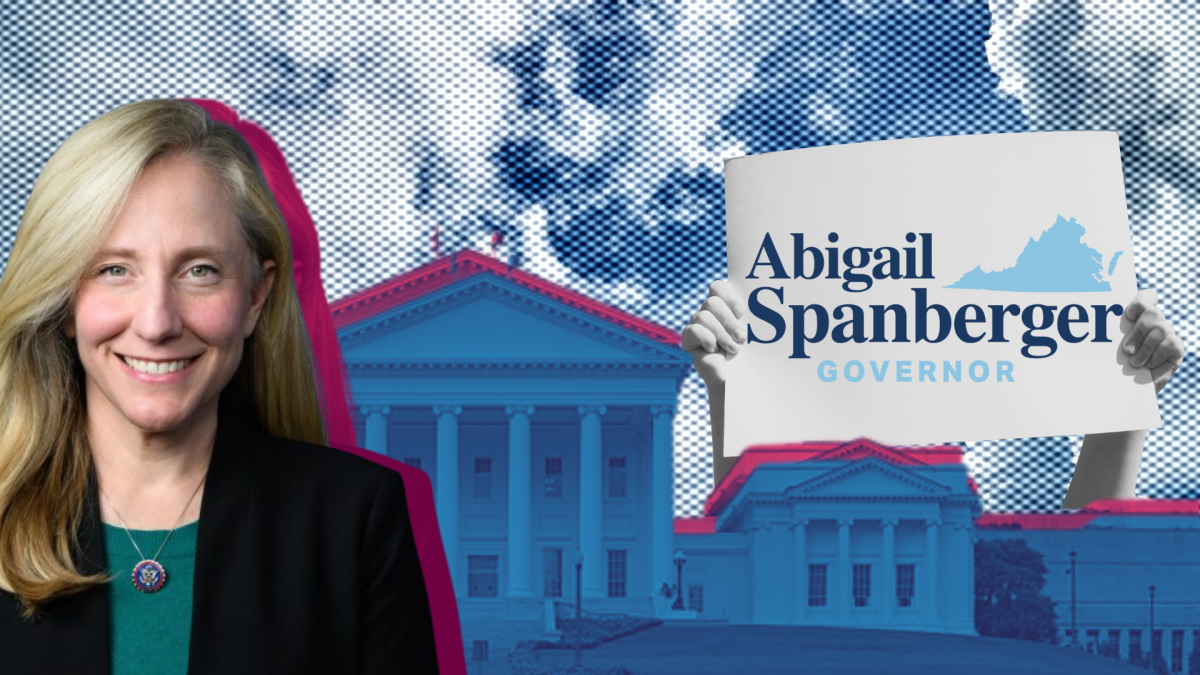
Democrat Abigail Spanberger won the Virginia Gubernatorial election on November 4, with her victory being called almost immediately after the polls closed. Spanberger’s victory delivered a potent repudiation of President Trump’s policies after a campaign laser-focused on attacking them. The former CIA officer and three-term Congresswoman, who entered politics in the 2018 Democratic wave, defeated her Republican opponent, Lieutenant Governor Winsome Earle-Sears, in a race that drew national attention as an early test of voter sentiment toward the Trump administration. At 46, Spanberger will be Virginia’s first female governor, following a streak of 65 men who have served in that office since Virginia became part of the US in 1788. Spanberger replaces popular outgoing Republican Governor Glenn Youngkin, who won in 2021 with 50.6% of the vote to Democrat Terry McAuliffe’s 48.7% but cannot seek consecutive re-election.
Governor-elect Abigail Spanberger, a pragmatic centrist who has bucked her party on occasion, voting against Nancy Pelosi for House speaker in 2019 and criticizing President Joe Biden as too progressive in 2021, cultivated a maverick image that helped her outrun a battered Democratic brand. Spanberger’s theme of “affordability” addressed rising costs for housing, utilities, pharmaceuticals and economic uncertainty from Trump’s tariffs and federal layoffs, while she harnessed anger over cuts to the federal workforce that disproportionately hit Virginia, home to around 320,000 federal workers and hundreds of thousands of contractors. On the campaign trail, she argued that federal layoffs, cutbacks by President Donald Trump’s Department of Government Efficiency (DOGE), tariffs and the federal shutdown amounted to an attack on the state’s economy, pitching herself as a way for voters to push back. “We need a governor who will recognize the hardship of this moment, advocate for Virginians, and make clear that not only are we watching people be challenged in their livelihoods and in their businesses and in communities, but Virginia’s economy is under attack,” she said during a late-October bus tour stop. Backed by national Democrats eyeing a 2026 midterm boost, including a campaign appearance by former President Barack Obama and heavy DNC spending, Spanberger raised nearly twice as much money as Winsome Earle-Sears, held double-digit leads in final polls and ran a surgical effort that scared off primary rivals, resisting calls for new ideas in favor of her 2018 playbook of Trump opposition.
At her jubilant election night watch party, where House Speaker Don Scott shouted, “Y’all ready to witness history tonight?“, Abgail Spanberger struck a bipartisan tone in her victory speech, praising Winsome Earle-Sears and pledging to serve all Virginians in a departure from President Donald Trump’s with-me-or-against-me ethos. She touched on the milestone for their three daughters, recounting her husband’s words: “Your mom is going to be the governor of Virginia—I can guarantee you that those words have never been spoken before.” She took one swipe at the administration, declaring, “Virginia’s economy doesn’t work when Washington treats our Virginia workers as expendable. And to those across the Potomac who are attacking our jobs and our economy, I will not stand by silently.” As Congresswoman Jennifer McClellan put it, “Virginians, they see the impacts of what’s happening in Washington in real time and are looking for state leaders who are going to fill in those gaps and address that harm.”
Winsome Earle-Sears, a Jamaican immigrant who became a US Marine and small business owner, portrayed herself as the American dream incarnate and pledged allegiance to President Donald Trump despite his meager late endorsement and minimal help for her cash-strapped campaign. She vowed to extend Glenn Youngkin’s business-friendly policies, accused Abigail Spanberger of supporting Biden-era moves and attacked her on transgender rights, claiming they threatened girls’ safety in school bathrooms and locker rooms. “Love is not having my daughter having to be forced to undress in a locker room with a man. That’s not love,” she said at an October rally. “Love is making sure that our girl children have opportunities in sports and are not forced to play against biological males.”
The race was jolted in its final weeks by the government shutdown, which both sides blamed on the other and shadowed early voting; a Democratic push to redistrict congressional maps for 2026 midterms favoring their candidates amid Trump’s similar efforts elsewhere; and a scandal over text messages from Democratic attorney general candidate Jay Jones, who hypothetically described shooting a Republican lawmaker. Spanberger denounced the messages, but Earle-Sears faulted her for not demanding Jones drop out. Glenn Youngkin prioritized re-electing Republican Attorney General Jason Miyares over bolstering Winsome Earle-Sears, donating only a fraction of his 2023 General Assembly spending to her effort. Despite the uproar, Jones defeated Miyares in the key post, enabling Virginia to join blue-state lawsuits against Trump. Separately, Democrat Ghazala Hashmi won the lieutenant governor race, becoming the first Muslim woman elected to statewide office in America after a low-profile campaign with few appearances and no debate against Republican talk-show host John Reid, though she trailed Spanberger amid her party’s uneven performance elsewhere.
In Texas, the Republicans hope to gain an additional five House seats under new district lines. Republicans in Missouri and North Carolina have passed maps designed to net the party a new seat in each state. A mandatory redraw in Ohio could also benefit Republicans. President Donald Trump has continued to push Republican-led states like Indiana and Kansas to help shore up the party’s narrow House majority. While some Democratic governors and lawmakers are trying to redraw their maps as well, they face additional legal and procedural hurdles that are present in red states because many of them ceded the power to redistrict in recent years to independent or bipartisan commissions.
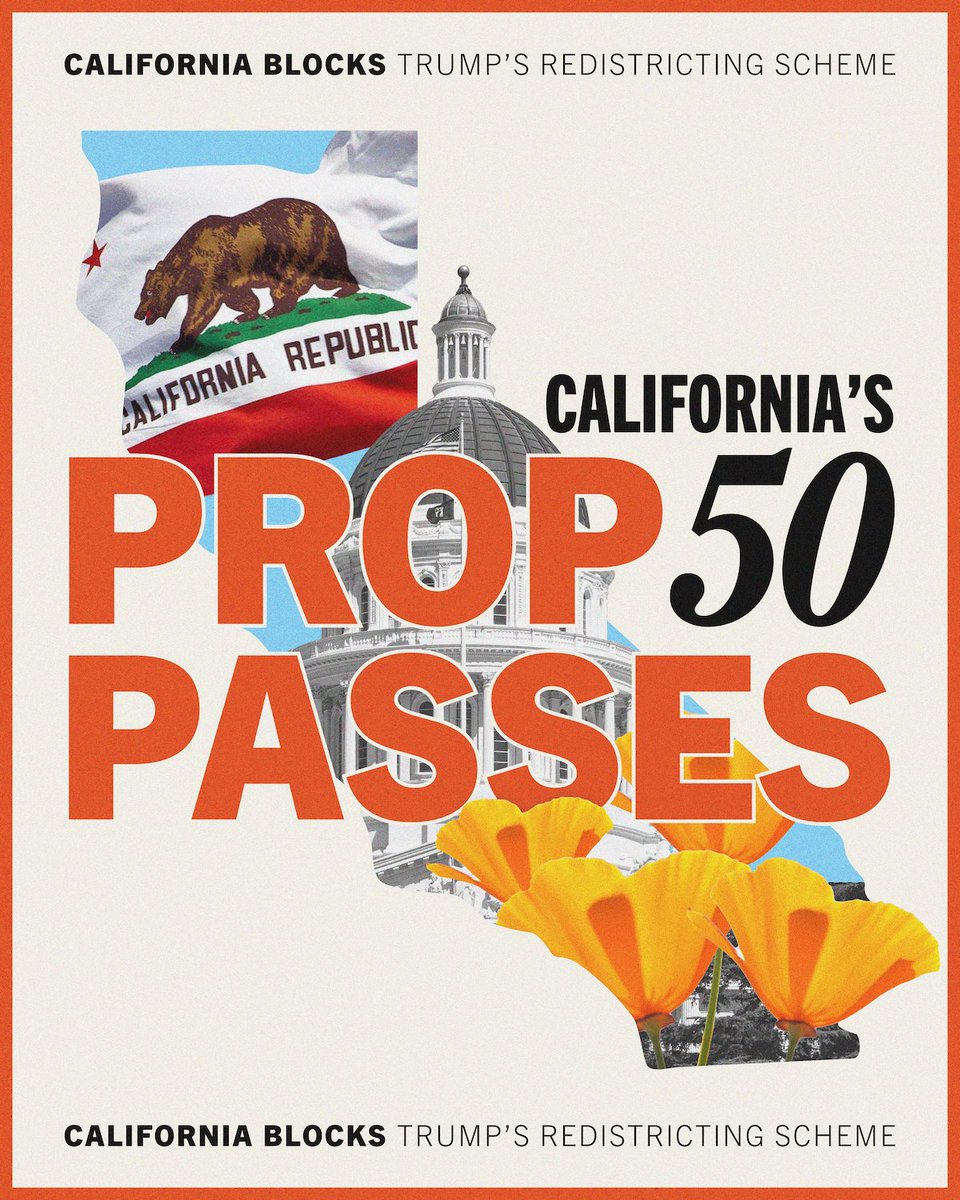
California Governor Gavin Newsom pushed hard for the Democrats’ redistricting plan, accusing Trump and Republicans of “rigging” the midterm elections with their unusual decision to redraw congressional maps for explicit partisan gain outside the regular decennial cycle linked to the census. The flurry of ads blanketing the state in support of the measure underscored that point. “Donald Trump is out of control, imposing illegal tariffs that hurt our economy and denying disaster aid to California families. Now he’s attempting an unprecedented power grab to steal congressional seats and rig the 2026 election. But we can stop him,” a narrator says in one of the major ads from a group supporting a yes vote on Prop 50. “Prop 50, the Election Rigging Response Act, thwarts Trump’s scheme. Prop 50 levels the playing field in the midterms and gives voters the power to check Trump.” There has been almost $100 million in contributions and ad spending in the race, according to campaign finance reports and data from AdImpact, a political ad tracker.
Declaring victory on November 4, California Governor Gavin Newsom framed the result as part of a strong night for Democrats across the board and a blow to President Donald Trump. “What a night for the Democratic Party, a party that’s in its ascendency, a party that’s on its toes, no longer on its heels. From coast to coast, from sea to shining sea,” Newsom said. “We’re proud here in California to be part of this narrative this evening. We’re proud of the work that the people of California did tonight to send a powerful message to a historic president. Donald Trump is an historic president; he is the most historically unpopular president in modern history.”
While Republicans began saber-rattling and promised to go toe-to-toe with the Democratic efforts, the energy and spending for the campaign to defeat the ballot initiative fizzled down the stretch. The two sides were in rough parity on spending on the airwaves in the first month after the election was announced, $16 million to $17 million on either side. Then the yes side spent $63 million on ads in the final six weeks, compared with less than $16 million from the no side. The intensity of the no side’s spending waned in the final weeks, but it had prominent backers, including former Governor Arnold Schwarzenegger, a Republican. “California voters established an independent commission led by citizens to stop rigged elections. Prop 50 cancels this historic reform, putting the politicians back in charge,” the narrator says in an ad featuring Schwarzenegger calling on voters to cast no votes to “protect” democracy.
California already sends 43 Democrats and nine Republicans to Congress, but multiple nonpartisan analyses of the new maps show that the new lines could allow Democrats to flip as many as five seats by making it harder for Republican Congressmen Doug LaMalfa, Darrell Issa, Ken Calvert, Kevin Kiley, and David Valadao to win re-election. The outcome is far from certain, and most of those Republican lawmakers have won tough races before, but redrawing the lines to add more Democratic voters in their districts will make it tough sledding next fall, especially because the party in power typically faces political headwinds in the midterms.
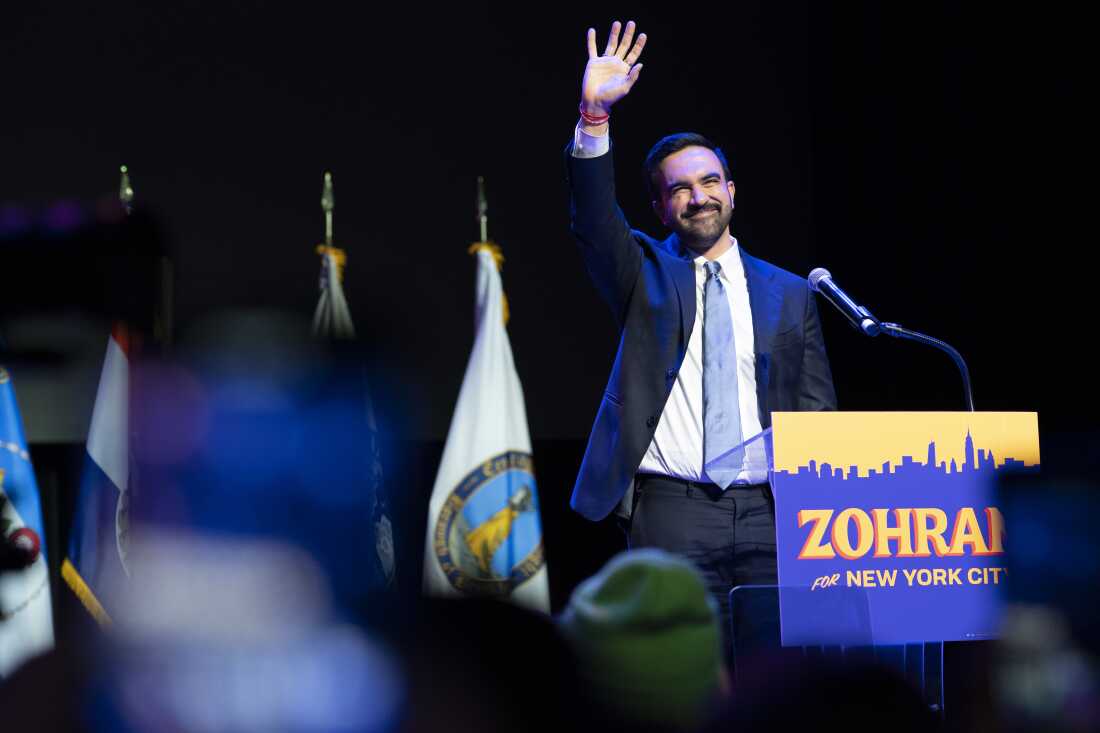
Zohran Mamdani was elected mayor of New York on November 4, capping a stunning ascent for the 34-year-old, Democratic Socialist-aligned state lawmaker who promised to transform city government to restore power to the working class and fight back against a hostile Trump administration. In a victory for the Democratic Party’s progressive wing, Mamdani defeated former Governor Andrew Cuomo and Republican Curtis Sliwa. With his commanding win, Mamdani will etch his place in history as the city’s first Muslim mayor, the first of South Asian heritage, and the first born in Africa. He will also become New York’s youngest mayor in more than a century when he takes office on January 1, 2026. “The conventional wisdom would tell you that I am far from the perfect candidate. I am young, despite my best efforts to grow older. I am Muslim. I am a democratic socialist. And most damning of all, I refuse to apologize for any of this,” Mamdani declared to a roaring crowd at his victory party. He cast his win as a boon for blue-collar workers struggling to get by. “New York, tonight you have delivered a mandate for change,” he said, vowing to “wake up each morning with a singular purpose: To make this city better for you than it was the day before.”
More than 2 million New Yorkers cast ballots in the contest, the largest turnout in a mayoral race since the 1969 Mayoral Election, which pitted incumbent Liberal Republican John Lindsay against Democrat Mario Procaccino and Conservative Party candidate John Marchi. With roughly 90% of the votes counted, Mamdani held an approximately 9 percentage point lead over Andrew Cuomo. His unlikely rise gives credence to Democrats who have urged the party to embrace more progressive candidates instead of rallying behind centrists in hopes of winning back swing voters who have abandoned the party. He has already faced scrutiny from national Republicans, including President Donald Trump, who have eagerly cast him as a threat and the face the Democratic Party. Trump has repeatedly threatened to cut federal funding to the city and even take it over if Mamdani won.
Zohran Mamdani’s grassroots campaign centered on affordability, and his charisma spoiled former Governor Andrew Cuomo’s attempted political comeback. The former governor, who resigned four years ago following allegations of sexual harassment that he continues to deny, was dogged by his past throughout the race and was criticized for running a negative campaign. Mamdani will also have to deal with President Donald Trump, who not only threatened retribution against the city but also suggested he might try to arrest and deport Mamdani if he won. Mamdani was born in Uganda, where he spent his early childhood, but was raised in New York City and became a US citizen in 2018. In his speech, Mamdani addressed Trump head on. “New York will remain a city of immigrants, a city built by immigrants, powered by immigrants and as of tonight, led by an immigrant,” he said, adding that, “If anyone can show a nation betrayed by Donald Trump how to defeat him, it is the city that gave rise to him.” President Trump appeared to acknowledge Mamdani’s challenges, posting “…AND SO IT BEGINS!” on his Truth Social site.
Zohran Mamdani began his campaign as a relatively obscure state lawmaker, little known even within New York City. Going into the Democratic primary, Andrew Cuomo was the presumed favorite, with near-universal name recognition and deep political connections. Cuomo’s chances were buoyed further when incumbent Mayor Eric Adams bowed out of the primary while dealing with the fallout of his now-dismissed federal corruption case. But as the race progressed, Mamdani’s natural charm, catchy social media videos, and populist economic platform energized voters in the notoriously expensive city. He also began drawing outside attention as his name recognition grew. Mamdani trounced Cuomo in the primary by about 13 points.
Andrew Cuomo then relaunched his campaign as an independent candidate for the general election, vowing to hit the streets with a more energetic approach. However, much of his campaign continued to focus on attacking opponents. In the race’s final stretch, he claimed Zohran Mamdani’s election would make Jews feel unsafe. Meanwhile, supporters packed Mamdani’s rallies, and he held whimsical events, including a scavenger hunt and a community soccer tournament. Cuomo also juxtaposed his deep experience in government with Mamdani’s less than five years in the state Legislature. But the former governor also faced his own political baggage, as his opponents dredged up the sexual harassment allegations that led to his resignation, as well as his decisions during the early days of the COVID-19 pandemic.
Republican nominee Curtis Sliwa, the creator of the Guardian Angels crime patrol group, also had his moments, mostly in the form of funny quips on the debate stage, but had difficulty gaining traction as a Republican in an overwhelmingly Democratic city. He conceded the race about a half hour after the polls closed, wishing Zohran Mamdani “good luck because if he does well, we do well.” But he also issued a warning: “If you try to implement socialism, if you try to render our police weak and impotent, if you forsake the people’s public safety, we will become the mayor-elect and his supporters’ worst enemies.”
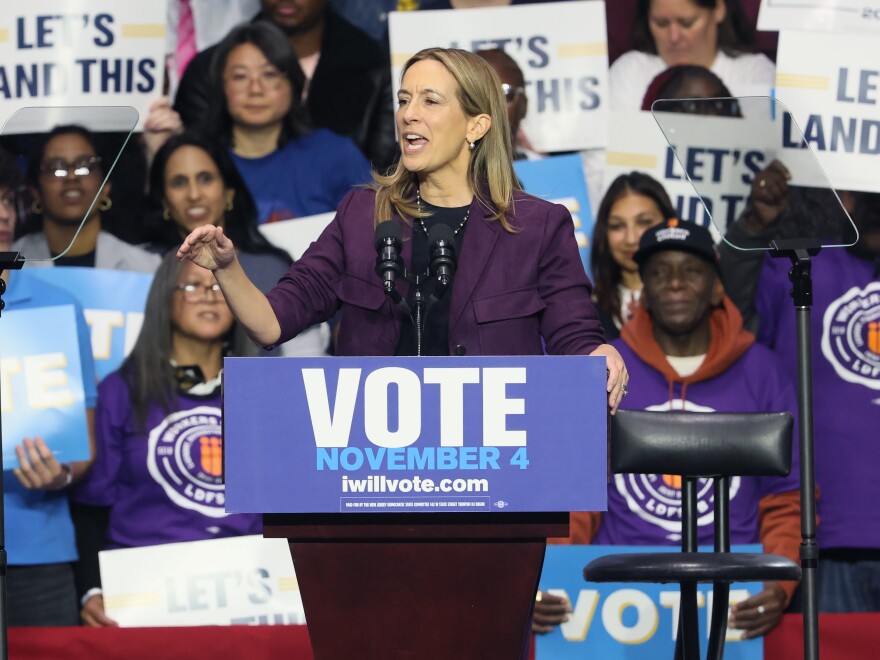
Congresswoman Mikie Sherrill, the Democratic candidate for governor of New Jersey, catapulted to victory on November 4 on the strength of her opposition to President Dona;d Trump after a hard-fought race against Jack Ciattarelli, a Republican whose energetic campaign could not outrun national politics in a liberal-leaning state. Congresswoman Sherrill, a former Navy helicopter pilot and federal prosecutor, will become New Jersey’s 57th governor and its second female leader. She was leading Ciattarelli, a former state lawmaker running his third race for governor, by a resounding 13 points with more than 95 percent of the vote counted, according to a tally by The Associated Press.
“Good government doesn’t just manage problems, it solves them,” Governor-elect Mikie Sherrill told supporters gathered in East Brunswick for a victory party. “I know not everyone voted for me,” she added, “but I’m working for everyone — every single one of you.” She said Jack Ciattarelli called her soon after the results were announced, and she recognized him for “stepping up.” Ciattarelli, in a brief concession speech, told his supporters that “life is not always fair.” “Nobody is more disappointed than I am in the result,” he said. “It is my hope that Mikie Sherrill has heard us, in terms of what needs to be done to make New Jersey that place where everybody wants to be to achieve their dreams again.” The race was largely defined by President Donald Trump, who made surprising inroads last November in New Jersey and who had endorsed Jack Ciattarelli. But in a state where Democrats outnumber Republicans by roughly 850,000 voters, the alliance always carried risk.
Senator Cory Booker predicted that Mike Sherrill’s win would ripple far beyond New Jersey. “The whole nation will see,” said Booker, the state’s senior senator, “that we can’t stop the momentum.” Governor-elect Sherrill will now have to at least coexist with the president, who has shown a willingness to punish his foes. That was an argument President Donald Trump raised in the final weeks of the campaign, in a telephone rally he held for Jack Ciattarelli. “He’s got a friend in the White House,” the President said during the call, “where she certainly doesn’t.”
Governor-elect Mikie Sherrill has pledged to freeze the state’s high electricity costs by declaring a state of emergency on her first day in office in January. She plans to get cellphones out of classrooms and hire more mental health counselors for schools. Using data gathered through a new “social media addiction observatory,” she has said, her administration will take on digital platforms that use algorithms to lure in children and teenagers.
In the 2021 campaign, Jack Ciattarelli lost by three points to Governor Phil Murphy, a Democrat barred by term limits from running for re-election. He tried hard during this race to capitalize on the stunning gains President Donald Trump made in Black and Latino communities, campaigning aggressively in churches and at cultural events. Ciattarelli develped a reputation as a moderate Republican during his time on the Somerset County board of Freeholders (2007-2011) and in the New Jersey General Assembly (2012-2018), and until this campaign he had kept President Trump at arm’s length. But after the president’s stronger-than-expected showing last year in some of New Jersey’s most diverse communities, Ciattarelli pivoted, embracing the president and some of his policies, even giving Trump an “A” grade in the final debate.
Jack Ciattarelli’a platform was focused heavily on pocketbook issues like taxes and energy costs. But Ciattarelli also leaned into issues popular with the far-right flank of the party, including publicly funded school vouchers, opposition to transgender rights, vaccine skepticism and the deportation of migrants. On the stump and in ads, Mikie Sherrill’s campaign regularly reminded voters of Ciattarelli’s cozy relationship with President Donald Trump. Then, last month, President Donald Trump said he was terminating funding for the construction of a $16 billion train tunnel considered vital to the country and to New Jersey’s 200,000 commuters, handing the Sherrill campaign an unexpected gift. “With less than 19 days until this election, the president’s punched him in the face like this. That’s pretty telling,” Sherrill said the next day, highlighting the ephemeral value of Ciattarelli’s partnership with a mercurial president. It also gave her a way to change the subject from a controversy centered on why she had been barred from participating in her 1994 graduation ceremony at the US Naval Academy. She has said that she could not participate because she had failed to “turn in” classmates caught up in a cheating scandal. But polls began to narrow as Ciattarelli publicly challenged that explanation and sought to undermine her credibility, denting a central pillar of her campaign: that nine years in the Navy had prepared her to lead the state.
Polls proved largely inaccurate. Most showed Mikie Sherrill leading throughout the race, but few had her winning by a double-digit margin. Only New Jersey and Virginia hold races for governor the year after a presidential contest, and the results are considered bellwethers heading into next year’s pivotal midterm elections, which will determine party control of Congress. In Virginia, former Congresswoman Abigail Spanberger beat her Republican opponent, Lt. Governor Winsome Earle-Sears, by 15 points; Spanberger will be the first woman to serve as governor of the state.
Ken Martin, the chairman of the Democratic National Committee who came to New Jersey repeatedly during the campaign, said victories in both states represent “the beginning of our Democratic resurgence” and proved that voters are “tired of watching the G.O.P. turn our beloved country into a playground for billionaires.” “Tonight isn’t only a warning sign to Republicans,” he said in a statement, “it’s an affirmation of the vision that Democrats have presented to voters in New Jersey and across the country.”
New Jersey’s race was always seen as far more competitive. And Mikie Sherrill’s campaign had become a cause célèbre for Democrat-aligned national groups, which committed roughly $25 million to help her win. An array of prominent Democratic leaders also traveled to New Jersey to campaign with Sherrill in the final weeks of the race. On November 1, an appearance by former President Barack Obama drew thousands of party faithful to a large gymnasium at a community college in Newark. He energized the crowd by warning, as Sherrill has, about the threat posed by President Donald Trump. “We’ve got a commander in chief who has fired decorated military officers because he thinks they might be more loyal to the Constitution than they are to him,” Obama said. “He’s deployed the National Guard in American cities and claimed to be stopping crime waves that don’t actually exist,” he added. “We’ve got masked ICE agents pulling up in unmarked vans and grabbing people off the streets.” “Don’t boo,” Obama said repeatedly as the crowd roared. “Go vote.”
More than 3.1 million New Jersey voters cast ballots, 500,000 more than in 2021. Jack Ciattarelli’s level of support this year actually exceeded his performance in 2021 by more than 100,000 votes, but he still fell short as far more voters beat a path to the polls. “I’m not retiring to Florida. We fight for another day,” Ciattarelli said to loud cheers. “You’ll find me right here on the streets of Central Jersey, or maybe at one of my favorite places on the beach in Surf City.”
The contest was the most competitive race for governor of New Jersey since 2009, when Chris Christie, a Republican, unseated the incumbent governor, Jon Corzine, a wealthy Democrat. It was also extraordinarily expensive. Mikie Sherrill and Jack Ciattarelli won their party’s nominations after spirited primaries. The state’s Election Law Enforcement Commission reported last week that spending by the two candidates and groups supporting their candidacies had already exceeded $82 million. In winning, Sherrill bucked a six-decade historical trend. Not since 1961 had either party held onto the governor’s office for three consecutive terms.
On September 16, President Donald Trump took to TruthSocial to announce a Republican “Midterm Convention” aimed at energizing the party ahead of the 2026 midterm elections. The event, with its time and place yet to be determined, promises to be a significant and exciting gathering for the Republicans. President Trump wrote, “The Republicans are going to do a Midterm Convention in order to show the great things we have done since the Presidential Election of 2024. Stay tuned, it will be quite the Event, and very exciting!”
This announcement builds on an idea President Donald Trump first floated last month, when he suggested the Republican Party hold a national convention to highlight the party’s achievements and momentum. “The Republican Party is doing really well,” President Trump stated at the time. “Millions of people have joined us in our quest to MAKE AMERICA GREAT AGAIN. We won every aspect of the Presidential Election and, based on the great success we are having, are poised to WIN BIG IN THE MIDTERMS.” Trump also praised the Republican Party’s fundraising efforts and his administration’s work to undo policies from the Biden era.
In response to President Donald Trump’s announcement, the DNC took a jab, saying, “Imitation is the sincerest form of flattery.” The spokesperson reiterated their plans, noting, “To showcase our tremendous candidates running up and down the ballot and harness the amazing grassroots energy we’re already seeing, several options are on the table for next year, including hosting a midterm convention. The sincerest form of flattery is imitation, and we’re amused the President is following our lead. As both parties gear up for the 2026 midterms, these proposed conventions signal an intensified effort to rally their bases and set the stage for a highly competitive election cycle. With the Republican Party aiming to capitalize on its 2024 momentum and the Democrats pushing back against its policies, the political landscape is heating up.
Zohran Mamdani, the Democratic nominee for mayor of New York City, is gaining significant endorsements from party leaders as concerns mount over President Donald Trump’s attempts to influence the race. Mamdani, a state assemblyman and democratic socialist, secured the Democratic primary victory in June 2025, defeating former Governor Andrew Cuomo, who is now running as an independent.
Prominent Democrats, including Congressman Jamie Raskin of Maryland and Congressman Pat Ryan of New York, have formally endorsed Zohran Mamdani. Congressman Raskin, a leading figure in countering President Donald Trump’s influence, praised Mamdani as a “significant and inspiring leader” with a “Rooseveltian” vision, comparing him to former President Franklin D. Roosevelt for his commitment to the working and middle classes. Ryan, motivated by his opposition to former New York Governor and Mayoral Candidate Andrew Cuomo, described Mamdani as a candidate “for the people,” contrasting him with Cuomo’s self-serving record. Even moderates within the Democratic party such as former Chicago Mayor Rahm Emanuel and New York Congressman Ritchie Torres have expressed support. Emanuel, after meeting Mamdani, noted his preparedness to govern effectively, while Torres called him “impressively knowledgeable and substantive.” Left-leaning Democrats, including Senators Bernie Sanders and Elizabeth Warren, and members of Congress such as Alexandria Ocasio-Cortez, Pramila Jayapa, and Jerrold Nadler, have also backed Mamdani, citing his focus on cost-of-living issues.
Despite Zohran Mamdani’s primary win, some top New York Democrats, including House Minority Leader Hakeem Jeffries, Senate Minority Leader Chuck Schumer, Senator Kirsten Gillibrand, and Governor Kathy Hochul, have not yet endorsed him. Schumer met with Mamdani recently but declined to commit, while Jeffries indicated he would soon clarify his stance. Hochul emphasized the need for pragmatic governance, reflecting her “staunch capitalist” perspective, given New York City’s role as a global financial hub.
President Donald Trump’s efforts to tilt the race toward Andrew Cuomo, including offering positions to Mayor Eric Adams and Republican candidate Curtis Sliwa to drop out, have galvanized Democrats. Party members across the ideological spectrum are urging unity to counter Trump’s influence. Congressman Jamie Raskin stressed the importance of Democratic solidarity, saying, “Democrats must stand together to defend not only our party but our constitution and our country.” Congresswoman Alexandria Ocasio-Cortez echoed this, emphasizing the party’s responsibility to support its nominees post-primary.
Some moderate Democrats, like Conresswoman Laura Gillen and Conressman Tom Suozzi from Long Island, worry that Zorhran Mamdani’s progressive stance could harm the party in the 2026 midterms by fueling Republican narratives painting Democrats as socialists. However, Mamdani’s strong lead in recent polls, particularly among young voters, suggests his appeal could energize the Democratic base. A New York Times/Siena University poll showed him commanding the race, a critical factor as Democrats seek to regain ground lost to Donald Trump in 2024.
Since his nomination, Zohran Mamdani has engaged in extensive outreach, meeting with figures like former President Barack Obama and Rahm Emanuel to discuss governance and policy priorities. His ability to connect with both moderates and progressives has impressed many, with Emanuel noting his readiness to “hit the ground running” and Torres praising his intellectual rigor.
As the mayoral race enters its final stretch, Zohran Mamdani’s campaign is gaining momentum, but the lack of endorsements from key New York Democrats remains a challenge. Meanwhile, Republicans, including Florida Governor Ron DeSantis, are using Mamdani’s candidacy to attack Democrats nationwide. Despite this, supporters like Congressman Jamie Raskin remain steadfast, advocating for party unity: “When progressives beat moderates in the primary, we want the moderates to support the progressives in the general election.”
The race for New Jersey’s next governor has tightened dramatically, with Republican Jack Ciattarelli now trailing Congresswoman Mikie Sherrill by a mere two points, according to a recent poll conducted by National Research Inc. from September 8 to 10, 2025. The survey, which included 600 likely voters and carries a margin of error of plus or minus 4 percent, shows Sherrill leading Ciattarelli 47 to 45 percent, signaling a statistical dead heat as the November 4 election approaches. This development underscores the high stakes of the contest, as New Jersey, alongside Virginia, is one of only two states electing a governor this year, making it a critical barometer for national political trends.
New Jersey has long been a Democratic stronghold, with incumbent Governor Phil Murphy nearing the end of his second term. However, the latest poll reveals a growing sense of unease among voters, with 57 percent of likely voters expressing the belief that the state is on the wrong track. Among these dissatisfied voters, a striking 78 percent attribute their concerns to Murphy’s policies, which they argue have made New Jersey more expensive and less safe. Only 14 percent point to President Donald Trump as a source of their discontent. This pessimism, described by the poll as the most severe to date, could pose a significant challenge for Democrats as they navigate the final weeks of the campaign.
Jack Ciattarelli, a former state assemblyman, has gained traction among key demographic groups, including unaffiliated voters, working-class and middle-class voters, and those who participated in the 2021 gubernatorial election, which he narrowly lost to Phil Murphy. His appeal to these swing groups has contributed to the tightening race, marking a shift from earlier polls. For instance, a Quantus Insights poll conducted from September 2 to 4 showed Sherrill leading by a wider margin of 47 to 37 percent, with a margin of error of 4.3 percent and 95 percent confidence. Another survey by Tipp/League of American Workers, conducted from August 25 to 28, had Sherrill ahead by seven points, highlighting the rapid momentum Ciattarelli has gained in recent weeks.
The significance of this race extends beyond New Jersey’s borders. As one of only two gubernatorial elections in 2025, it offers a rare glimpse into voter sentiment in an off-year election, which typically sees lower turnout and less enthusiasm compared to midterm or presidential election cycles. A Ciattarelli victory could signal challenges for Democrats heading into the 2026 midterms, particularly if voter dissatisfaction with Democratic leadership persists. Political observers note that while presidential policies and party performance often shape midterm outcomes, New Jersey’s off-cycle election may serve as an outlier, driven more by local concerns than national trends.
Commentators have weighed in on the dynamics of the race. Peter Lumaj, a former Republican US Senate candidate, said that Jack Ciattarelli’s strong polling is unsurprising to political strategists. He pointed to shifting voter registration trends, a narrowing Democratic advantage, and a robust GOP campaign capitalizing on frustration with the current administration. Lumaj also highlighted the influence of Donald Trump and historical voting patterns as factors bolstering Ciattarelli’s chances. Conversely, former New Jersey Republican Governor Christine Todd Whitman, who endorsed Mikie Sherrill, emphasized the Democratic candidate’s independence and readiness to lead. Whitman, who served two terms as governor, expressed concern about Ciattarelli’s alignment with Trump, stating that his reluctance to diverge from the President’s positions does not serve New Jersey’s needs. She praised Sherrill’s experience as a former Navy helicopter pilot and her track record in Congress, describing her as an independent voice accountable only to the people of New Jersey.
With less than 60 days until the election, both candidates face a compressed timeline to make their case to voters. Mikie Sherrill, leveraging her military background and congressional experience, is positioning herself as a steady and independent leader capable of addressing the state’s challenges from day one. Jack Ciattarelli, meanwhile, is capitalizing on voter frustration with rising costs and safety concerns, appealing to a broad coalition of swing voters who may determine the outcome. As the campaign enters its final stretch, the race remains too close to call, promising an intense and closely watched battle for the governor’s mansion.
Missouri lawmakers have approved a new congressional voting map for the 2026 midterm elections, responding to former President Donald Trump’s call to secure a Republican majority in Congress. The state Senate passed the redistricting plan with a 21-11 vote, aiming to flip a Democratic-held seat to Republican control. The map now awaits the signature of Republican Governor Mike Kehoe, who introduced the plan last month, describing it as a “Missouri First” map that aligns with the state’s conservative values.
Typically, states redraw congressional districts early in the decade following the national census, which determines the allocation of House seats. However, Missouri’s move comes mid-decade, driven by Trump’s push for Republicans to create more winnable districts. Missouri Republicans argue that the new map, which creates seven Republican-leaning seats and one strongly Democratic district, reflects the state’s political landscape, where Republicans dominate statewide and legislative elections. Currently, Missouri’s congressional delegation consists of six Republicans and two Democrats.
Republican state Senator Rick Brattin, representing the Kansas City suburbs, defended the plan, stating, “The question is, are we actually representing the constituency of Missouri with our congressional delegation? A seven-to-one map does that. Democrats in the state legislature fiercely opposed the changes but could do little to stop or slow their passage because Republicans hold supermajorities in both chambers. Democratic state Senator Stephen Webber argued during floor debate on September 12 that Republicans were surrendering their independence and bending to Trump’s will. “We’re no longer the ‘Show Me State,’” he said, referring the state’s motto. “We’re the ‘Yes, sir state.’” Democratic state Senator Barbara Washington of Kansas City called the map a “blatant political attack.” “This erases the voice of our community,” she said, her voice rising with emotion. “Carving up Kansas City and silencing our constituents is terrible.”
On September 10, thousands of activists protested at the state capitol, vowing to collect the 106,000 signatures needed within 90 days to put the measure to a statewide referendum. By September 12, two lawsuits had already been filed to challenge the plan, signaling a contentious legal battle ahead.
Missouri is not alone in redrawing its maps. President Donald Trump has urged Republican-led states, including Texas, Indiana, and Florida, to adopt district plans that favor Republican candidates. Texas approved a similar plan last month to secure five additional Republican-leaning seats. In response, Democratic-led states like California have proposed maps to bolster Democratic representation, with California’s plan awaiting voter approval on November 4, 2025. Illinois and Maryland are also considering redistricting to favor Democrats.
As Missouri’s new map heads to Governor Kehoe’s desk, its fate remains uncertain. Legal challenges and a potential referendum could delay or block its implementation. Meanwhile, the national push for redistricting continues, with both parties vying to reshape congressional districts to their advantage ahead of the 2026 midterms. The outcome of these efforts could significantly influence the balance of power in the US House.
President Donald Trump has repeatedly argued that mail-in voting undermines election integrity. He claimed, without evidence, “Mail-in ballots are corrupt,” citing unverified anecdotes of individuals receiving multiple ballots in states like California. President Trump has long maintained that mail-in voting enables tampering and multiple voting, despite lacking evidence to support widespread fraud. However, election experts have consistently refuted these claims. Debra Cleaver, founder of VoteAmerica, emphasized the security of mail-in ballots, noting that barcodes on outgoing and return envelopes ensure ballots are tracked and counted accurately. Following the 2020 election, Christopher Krebs, then-director of the Cybersecurity and Infrastructure Security Agency, declared it “the most secure in American history.” Audits and investigations, including those by Republican officials, found no evidence of significant fraud in the 2020 election.
President Donald Trump’s proposed executive order faces significant legal hurdles. He argued in a social media post that states are mere “agents” of the federal government in elections and must follow presidential directives. However, Article I, Section 4 of the US Constitution explicitly grants states the authority to regulate elections, with Congress holding the power to alter such regulations. Legal scholars note that the President lacks the constitutional authority to unilaterally ban mail-in voting, rendering the proposed executive order legally questionable.
Election experts warn that eliminating mail-in voting could disrupt electoral processes. David Becker, executive director of the Center for Election Innovation & Research, called the idea “incredibly bad,” arguing it would create chaos, especially with midterm elections just 15 months away. He noted that mail-in voting, used since the Civil War, enhances accessibility and security when properly implemented.
The White House, through spokesperson Harrison Fields, defended President Donald Trump’s stance, claiming that Democratic policies like “unfettered mail-in voting” have eroded trust in elections. Fields emphasized Trump’s goal to “secure America’s elections” through measures like voter ID requirements and stricter voting laws in states like California and New York.
President Donald Trump’s push to ban mail-in voting has sparked renewed debate over election security and accessibility. While he frames it as a safeguard against fraud, critics argue it could disenfranchise voters who rely on mail ballots due to disability, military service, or other constraints. The legal and practical challenges of implementing such a ban underscore the complexities of reforming election systems in a polarized political landscape. As the 2026 midterms approach, the debate over mail-in voting is likely to intensify, with significant implications for voter turnout and trust in democratic institutions.
California Democrats have unveiled a bold proposal for a new congressional map that could secure up to five additional seats for their party in the House of Representatives. This move, spearheaded by Governor Gavin Newsom, is a strategic response to Republican redistricting efforts in states like Texas, intensifying the national battle for House control ahead of the 2026 midterm elections. The proposal has sparked heated debate, with critics arguing it undermines the state’s independent redistricting process, while supporters claim it’s a necessary countermeasure to maintain political balance. The proposed map targets five Republican-held districts, making them more favorable to Democrats. The affected representatives, Kevin Kiley, Doug LaMalfa, David Valadao, Darrell Issa, and Ken Calvert, now face significantly bluer constituencies. Democrats currently hold 43 of California’s 52 congressional seats, and this redistricting effort aims to solidify their dominance further.
Governor Newsom has framed the plan as a direct response to Texas Republicans’ redistricting, which is expected to add up to five Republican seats. He argues that California must “fight fire with fire” to counter what he describes as aggressive gerrymandering in red states. To ensure public input, Newsom has proposed a special election on November 4, 2025, allowing California voters to decide on the new map, bypassing the state’s independent Citizens Redistricting Commission. “We have the opportunity to de facto end the Trump presidency in less than 18 months. That’s what’s at stake,” Newsom said at a recent press conference, emphasizing the potential for a Democratic-controlled House to check Republican influence. The state legislature is set to vote on the proposal on August 21, 2025. If approved, the new districts would apply to the 2026, 2028, and 2030 elections, with the Citizens Redistricting Commission resuming its authority after the 2030 census.
The proposal has drawn sharp criticism from Republicans and advocates for transparent governance. Republican Representative Kevin Kiley has been vocal in his opposition, introducing federal legislation to ban mid-decade redistricting and accusing Newsom of undermining California’s independent redistricting process. “This is a moment for every Californian and every American of decency, regardless of party affiliation, to speak out against the abject corruption that our governor is attempting,” Kiley declared on the House floor. Good government groups echo these concerns, arguing that bypassing the Citizens Redistricting Commission, established by voters in 2008 and expanded in 2010 to include congressional districts, erodes transparency and public trust. Jeanne Raya, a former Democratic member of the commission, warned that the lack of openness in Newsom’s plan could disenfranchise voters. “Somebody’s going to be drawing maps, whether behind a real door or a virtual door,” Raya said. “There will not be that transparency that is written into the independent commission’s work, and voters will suffer for that. California Governor Gavin Newsom defended the proposal as a transparent process, emphasizing that voters will have the final say through the special election, a step not taken in Texas, where Republican-drawn maps face no such public vote. He also noted that California’s plan includes a trigger clause, meaning it would only take effect if Texas or other red states proceed with their redistricting efforts.
California’s redistricting proposal highlights the escalating partisan battle over congressional representation. While Governor Gavin Newsom argues it is a necessary defense against Republican tactics, critics warn it risks further politicizing a process meant to be impartial. The outcome of the November 4 special election, if approved by the legislature, will determine whether California adopts this contentious new map, and could set a precedent for how states navigate redistricting in this polarized era. As the debate unfolds, all eyes are on California and Texas, where these dueling strategies could reshape the US House for years to come.
On January 6, 2025, a joint session of Congress certified President-elect Donald Trump’s victory in the 2024 election, fulfilling a vital democratic tradition that was violently disrupted four years ago. This time, there was no sign of unrest, though security at the Capitol was heightened. Unlike President-elect Trump in 2020, Vice President Kamala Harris did not dispute her loss in the November election, and Democrats refrained from raising any objections during the certification of Electoral College votes.
Vice President Harris presided over the certification process with dignity, even as it confirmed her loss. The session proceeded smoothly, with lawmakers from both parties reading out each state’s electoral votes in alphabetical order and declaring them “regular in form and authentic.” The only noticeable partisan divide came in the applause: Republicans celebrated the states won by Trump, while Democrats cheered for those carried by Harris. The session ended with a standing ovation from Republicans as Trump’s majority was announced.
Earlier in the day, Vice President Harris described her role as “a sacred obligation,” emphasizing her commitment to the Constitution and democracy. She told reporters in the Rotunda that the key takeaway was that “Democracy must be upheld by the people.” Aides described the peaceful transfer of power as one of the most significant acts of her vice presidency. As Harris led senators to the House chamber, she exchanged polite words with House Speaker Mike Johnson, who had played a prominent role in contesting the 2020 election results.
The calm and orderly certification process starkly contrasted to the violent events of January 6, 2021. This year, the Capitol was under heavy lockdown, with tall metal fencing and enhanced security measures designated by the Department of Homeland Security as a “national special security event.” The increased precautions reflected the lessons learned from the 2021 riot, which was tied to the deaths of seven people, including three police officers, after Trump’s false claims of a stolen election incited his supporters to storm the Capitol.
In the days leading up to the certification, President Joe Biden stressed the importance of a smooth transition of power while urging Americans to remember the events of January 6, 2021. Writing in The Washington Post, Biden accused Trump and his supporters of attempting “to rewrite — even erase — the history of that day.” Despite Trump’s campaign promises to pardon individuals convicted for their actions during the 2021 riot, Democrats refrained from challenging the election results, prioritizing constitutional norms over partisan conflict.
Senate Minority Leader Chuck Schumer underscored the importance of upholding democratic principles and warned Trump against pardoning those responsible for the January 6 violence. “It would be a dangerous endorsement of political violence,” Schumer said. “It is wrong, it is reckless, and would be an insult to the memory of those who died in connection to that day.” With the peaceful certification complete, the nation moves forward under Trump’s leadership, but the shadow of January 6 remains a potent reminder of the fragility of democracy.
The Biden Administration announced on December 31, 2024 that it is leveling sanctions on entities in Iran and Russia over attempted election interference. The Treasury Department said the entities, a subordinate organization of Iran’s Islamic Revolutionary Guard Corps and a Moscow-based affiliate of Russia’s military intelligence agency, the GRU, attempted to interfere in the 2024 elections.
“As affiliates of the IRGC and GRU, these actors aimed to stoke socio-political tensions and influence the U.S. electorate during the 2024 U.S. election,” said the Treasury Department in a news release. “The Governments of Iran and Russia have targeted our election processes and institutions and sought to divide the American people through targeted disinformation campaigns,” Acting Under Secretary of the Treasury for Terrorism and Financial Intelligence Bradley T. Smith said in the statement. “The United States will remain vigilant against adversaries who would undermine our democracy,” Smith added.
A spokesperson for Iran’s mission to the United Nations in New York said that Iran has denied interfering in US elections “on multiple occasions,” citing past statements that denied the allegations and calling them “devoid of any credibility and legitimacy,” “fundamentally unfounded” and “wholly inadmissible.” “Our reaction remains the same,” said Ali Karimi Magham, a mission spokesperson. Russia’s Embassy in Washington, D.C., denied the US allegations in a statement, saying “we respect the will of the American people.”
The Treasury sanctions announcement on December 31 said that the named Cognitive Design Production Center, acting on behalf of Iran’s Islamic Revolutionary Guard Corps, planned operations “since at least 2023 … to incite socio-political tensions among the U.S. electorate.” The Treasury also said the Moscow-based Center for Geopolitical Expertise, “at the direction of, and with financial support from, the GRU,” directed and subsidized “the creation and publication of deepfakes and circulated disinformation about candidates in the U.S. 2024 general election.” That included disinformation that was “designed to imitate legitimate news outlets to create false corroboration between the stories, as well as to obfuscate their Russian origin,” the department’s release said.
US intelligence officials said in September that propagandists in Russia, Iran and China were using artificial intelligence in efforts to deceive Americans and interfere in the 2024 presidential election. Though none of the entities sanctioned by the Treasure Department are affiliated with China, the department said in a separate letter Monday that its computers had been hacked in a state-sponsored Chinese operation in “a major incident.” China denied that allegation.
President Joe Biden on January 5 delivered a ferocious condemnation of former President Donald Trump, his likely 2024 opponent, warning in searing language that the former President had directed an insurrection and would aim to undo the nation’s bedrock democracy if he returned to power. On the eve of the third anniversary of the January 6, 2021, attack on the Capitol by former President Trump’s supporters, President Biden framed the coming election as a choice between a candidate devoted to upholding America’s centuries-old ideals and a chaos agent willing to discard them for his benefit. “There’s no confusion about who Trump is or what he intends to do,” Biden warned in a speech at a community college not far from Valley Forge in Pennsylvania, where George Washington commanded troops during the Revolutionary War. Exhorting supporters to prepare to vote this fall, he said: “We all know who Donald Trump is. The question is: Who are we?”
In an intensely personal address that at one point nearly led President Joe Biden to curse former President Donald Trump by name, the President compared his rival to foreign autocrats who rule by fiat and lies. He said former President Trump had failed the basic test of American leaders, to trust the people to choose their elected officials and abide by their decisions. “We must be clear,” Biden said. “Democracy is on the ballot. Your freedom is on the ballot.”
President Joe Biden’s harshness on his rival illustrated what his campaign believes to be the stakes of the 2024 election and his perilous political standing. Confronted with low approval ratings, bad head-to-head polling against former President Donald Trump, worries about his age, and lingering unease with the economy, President Biden is turning increasingly to the figure who has proved to be Democrats’ single best motivator. Former President Donald Trump, speaking at a campaign rally in Iowa soon after President Joe Biden’s appearance, quickly lashed back, calling the president’s comments “pathetic fearmongering” and accusing him of “abusing George Washington’s legacy.”
President Joe Biden’s remarks carried echoes of the 2020 campaign when he presented himself as the caretaker of “the soul of America” against a Trump presidency that he and Democratic supporters argued was on the verge of causing permanent damage to the country. The 31-minute speech was President Biden’s first public campaign event since he announced in April 2023 that he would seek re-election and was, in tone and content, arguably his most forceful public denunciation of former President Donald Trump since the two men became political rivals in 2019.
President Joe Biden’s appearance, meant as a kickoff to help define the 2024 campaign, was an early effort to revive the politically sprawling anti-Trump coalition that propelled Democrats to key victories in recent elections. Mr. Biden’s task now is to persuade those voters to view the 2024 contest as the same kind of national emergency that they sensed in 2018, 2020, and 2022. He began with an extensive recounting of former President Donald Trump’s actions before, during, and after the January 6 attack. The country, President Biden said, cannot afford to allow Trump and his supporters to present a whitewashed version of that day and spread falsehoods about the violent outcome of their effort to undo the 2020 election results. Upholding the nation’s democracy, Biden said, is “the central cause of my presidency.”
President Joe Biden made no mention of the 91 felony charges the former president faces in four jurisdictions, sticking to a vow to steer clear of his rival’s legal problems and focusing squarely on Trump’s actions rather than any potential criminal consequences for them. “Trump exhausted every legal avenue available to overturn the 2020 election. The legal path took him back to the truth, that I won the election and he was a loser,” Biden said. “He had one act left, one desperate act available to him, the violence of January 6.”
For a president who has faced intense scrutiny over his vigor in public appearances, the speech was a deftly delivered, focused argument about this year’s stakes. It was President Joe Biden’s latest attempt to build his political identity around the ideas of restoring national unity and upholding fairness, democracy, and collective patriotism. He has come back to those themes many times, during his brief push for voting rights legislation in early 2022, then as the midterm elections approached, and most recently in September, during a speech in Arizona honoring former Senator John McCain.
In the speech, President Joe Biden sought to frame former President Donald Trump as the leader of a cult of personality, and his Republican allies as sycophants. The president mentioned the recent $148 million judgment against Rudolph W. Giuliani for his lies about Georgia election workers, as well as the $787.5 million that Fox News was ordered to pay to settle a defamation case about its role in spreading election lies. Biden lamented that Fox News hosts and Republican officials who condemned Trump’s January 6 behavior in the moment had since changed their tune and repeated his falsehoods. “Politics, fear, and money all intervened, and now these MAGA voices who know the truth about Jan. 6 have abandoned democracy,” Biden said.
What remains unclear is how much President Joe Biden’s democracy pitch will resonate with voters who remain nervous about an improving economy, and wary of re-electing an 81-year-old who is already the oldest president in US history. Even some who have expressed deep fears about Trump’s authoritarian impulses are skeptical that the subject will be a winning message in 2024. “As a Biden campaign theme, I think the threat to democracy pitch is a bust,” 2012 Republican Presidential nominee, prominent Trump critic, and Utah Senator Mitt Romney, wrote in a text message to a New York Times reporter. “January 6 will be four years old by the election. People have processed it, one way or another. Biden needs fresh material, a new attack, rather than kicking a dead political horse.”
President Joe Biden threaded his speech with warnings that former President Donald Trump and Republicans would threaten not only democracy but also major Democratic priorities, abortion rights, voting rights, and economic and environmental justice. Ian Bassin, the executive director of Protect Democracy, a nonprofit dedicated to combating authoritarianism, said he had stressed to Biden’s aides that the president needed to connect democracy to voters’ personal experiences on other issues, in the same way Trump repeats to his supporters that prosecutions of him are persecutions of them. “Democracy is not just a way of structuring elections for order in our government,” Mr. Bassin said. “It’s a set of values about the kind of communities we want to live in and the way that we want to live as neighbors.”
President Joe Biden warned in his speech that former President Donald Trump was not being shy about what he would do in a second term. “Trump’s assault on democracy isn’t just part of his past. It’s what he’s promising for the future,” President Biden said. “He’s not hiding the ball.” Biden then recounted, in exacting detail, how a Trump campaign rally last year began with a choir of rioters who stormed the Capitol on January 6 singing the national anthem while a video of the damage played on a big screen. Trump had watched with approval. The scene, Biden suggested, would be the nation’s fate if Trump and his allies returned to power. “This is like something out of a fairy tale,” Biden said. “A bad fairy tale.”
Former President Donald Trump asked the Supreme Court on January 3 to allow him to stay on the presidential primary ballot in Colorado, saying a state ruling banning him was unconstitutional, unfair, and based on a January 6 insurrection that his appeal said did not happen. The court filing, dominated by technical and procedural challenges to the Colorado Supreme Court ruling last month, does not ask the high court to weigh in on whether the former president indeed participated in an insurrection. The state’s highest court concluded that Trump indeed engaged in the January 6 insurrection effort and thus was banned from running under an obscure, Civil War-era clause in the Constitution’s 14th Amendment banning such a person from holding office.
Former President Donald Trump’s appeal, which experts expect the high court to consider, instead argues that the Colorado court had no business getting involved in the matter at all and that keeping Trump off the ballot would deprive voters of their right in a democracy to choose their leaders. The decision is “a ruling that, if allowed to stand, will mark the first time in the history of the US that the judiciary has prevented voters from casting ballots for the leading major-party presidential candidate,” said the court papers filed late Wednesday afternoon, two days before a deadline to appeal or get booted off the Colorado Republican Party primary ballot.
The Colorado court ruled in favor of six Republican and independent voters who said the “insurrection clause of the 14th Amendment to the Constitution makes Trump ineligible to hold office and thus, not qualified to be on the ballot. That clause, originally directed at Confederates, says no one can hold office who has previously taken an oath to support the Constitution but then engaged in an insurrection or provided help to enemies of the US.
Former President Donald Trump’s team, in their legal brief, argued that Congress gets to decide a candidate’s eligibility to serve as president. And while the appeal was specific to the Colorado case, it tacitly invited the high court to offer a ruling that applied nationwide. “It would be beyond absurdity” for the ballot question to be determined by 51 separate state and District of Columbia jurisdictions rather than federal courts, the brief said. “The election of the President of the United States is a national matter, with national implications, that arises solely under the federal Constitution and does not implicate the inherent or retained authority of the states.”
The brief said former President Donald Trump was never an “officer” of the US and that the oath he took as president was different than those taken by other public servants, meaning he was not subject to the ban on insurrectionists. Further, the court papers said, the clause merely says such an individual cannot serve – not that he or she can’t run for office. The term “insurrection” is unclear, the brief said, and anyway, his lawyers said, Trump did not engage in “insurrection.” “Trump never told his supporters to enter the Capitol, either in his speech at the Ellipse or in any of his statements or communications before or during the events at the Capitol,” the appeal said. “To the contrary, his only explicit instructions called for protesting “peacefully and patriotically” to “support our Capitol Police and Law Enforcement,” to “[s]tay peaceful” and to “remain peaceful.”
Jena Griswold, Colorado’s Democratic secretary of state, urged the high court to settle the matter. “Donald Trump just filed an appeal to the US Supreme Court to consider whether he is eligible to appear on Colorado’s Presidential Primary ballot. I urge the Court to consider this case as quickly as possible,” Griswold wrote on social media.
The appeal is virtually certain to be heard by a Supreme Court whose reputation as an unbiased arbiter has suffered immensely in recent years. Questions about ethical transgressions, along with the stunning 2022 reversal of the 1973 Roe v. Wade decision guaranteeing abortion rights, have turned the court, in the eyes of many Americans, into another partisan entity. The Trump case puts the court in an extremely uncomfortable position: No matter how it may rule, and no matter the legal arguments used to justify it, the decision is likely to cause a backlash from some political segments in deeply divided America. The high court was the target of criticism after its 2000 ruling that effectively made George W. Bush president. And while the justices may not want to enter that political fray again, competing decisions on the insurrection clause likely means the Supreme Court will have no choice but to get involved.
Senator Raphael Warnock has won reelection in Georgia, the Associated Press reports, giving the Democrats a 51-49 majority in the US Senate. Senator Warnock defeated first-time candidate Herschel Walker, whose campaign was beset by allegations that he paid two women to have abortions. Senator Warnock finished ahead of Walker in the election on November 8, but fell short of the majority needed to avoid a runoff. Former President Barack Obama, who had campaigned for Warnock earlier in the race, returned to Georgia during the runoff to urge voters to come back to the polls.
Though Democrats were already guaranteed to hold onto control of the Senate, the extra seat gives them some breathing room and should make it easier to pass appointments out of Senate committees. The outcome also reinforces a disappointing year for Republicans, who had hoped for a “red wave” that would give them control of both houses of Congress. The Republicans did take control of the House of Representatives by a very narrow margin. Georgia, until recently a solidly red state, is now set to be represented by two Democrats in the Senate for at least four more years. Senator Raphael Warnock first won his seat during a special runoff election in early 2021, defeating the previous incumbent Kelly Loeffler by just under 100,000 votes. He won alongside Democrat Jon Ossoff, who defeated incumbent Republican David Perdue, giving Democrats the 50 votes needed to hold the majority, with Vice President Kamala Harris casting tie-breaking votes.
Herschel Walker, a former NFL running back who played college football for the Georgia Bulldogs NCAA team, endorsed former President Donald Trump during both of his presidential campaigns in 2016 and 2020 and spoke on Trump’s behalf at the 2020 Republican National Convention. Trump encouraged Walker to run for Senate in 2021, but Walker needed to re-establish residency in Georgia, as he was previously a Texas resident. In August 2021, Walker announced his intention to run for Warnock’s Senate seat. Walker’s campaign has been defined by controversy, often making comments that were later reported as false by media outlets, such as his involvement working with law enforcement. In early October, Walker fired his campaign political director Taylor Crowe over suspicions that Crowe was leaking unfavorable information about Walker to the media.
Former PresidentDonald Trump, aiming to become only the second commander-in-chief ever elected to two nonconsecutive terms, announced on November 15 night that he will seek the Republican presidential nomination in 2024. “In order to make America great and glorious again, I am tonight announcing my candidacy for president of the United States,” Trump told a crowd gathered at Mar-a-Lago, his waterfront estate in Florida, where his campaign will be headquartered. Surrounded by allies, advisers, and conservative influencers, Trump delivered a relatively subdued speech, rife with spurious and exaggerated claims about his four years in office.
Despite a historically divisive presidency and his own role in inciting an attack on the US Capitol on January 6, 2021, President Donald Trump aimed to evoke nostalgia for his time in office, frequently contrasting his first-term accomplishments with the Biden administration’s policies and the current economic climate. Many of those perceived accomplishments, from strict immigration actions to corporate tax cuts and religious freedom initiatives, remain deeply polarizing to this day. As Trump spoke to a roomful of Republicans who expect him to face primary challengers in the coming months, he also claimed the party cannot afford to nominate “a politician or conventional candidate” if it wants to win back the White House. “This will not be my campaign, this will be our campaign all together,” Trump said.
Donald Trump’s long-awaited campaign comes as he tries to reclaim the spotlight following the Republican parties underwhelming midterm elections performance – including the losses of several Trump-endorsed election deniers – and the subsequent blame game that has unfolded since Election Day. Republicans failed to gain a Senate majority, came up short in their efforts to fill several statewide seats, and have yet to secure a House majority, with only 215 races called in their favor so far out of the 218 needed, developments that have forced Trump and other party leaders into a defensive posture as they face reproval from within their ranks.
To the delight of aides and allies who have long advised him to mount a forward-looking campaign, Donald Trump spent only a fraction of his remarks repeating his lies about the 2020 election. Though he advocated for the use of paper ballots and likened America’s election system to that of “third world countries,” Trump also tried at times to broaden his grievances, lamenting the “massive corruption” and “entrenched interests” that in his view have consumed Washington. Many of Trump’s top advisers have expressed concern that his fixation on promoting conspiracies about the last presidential election would make it harder for him to win a national election in 2024. Throughout the hour-long speech, Trump made clear that he wants his campaign to be seen by Republicans as a sacrificial undertaking. “Anyone who truly seeks to take on this rigged and corrupt system will be faced with a storm of fire that only a few could understand,” he said at one point, describing the legal and emotional toll his presidency and post-presidential period has taken on his family members.
On the heels of last week’s midterm elections, Donald Trump has been blamed for elevating flawed candidates who spent too much time parroting his claims about election fraud, alienating key voters and ultimately leading to their defeats. He attempted to counter that criticism, noting that Republicans appear poised to retake the House majority and touting at least one Trump-endorsed candidate, Kevin Kiley of California. At one point, Trump appeared to blame his party’s midterm performance on voters not yet realizing “the total effect of the suffering” after two years of Democratic control in Washington. “I have no doubt that by 2024, it will sadly be much worse and they will see clearly what has happened and is happening to our country – and the voting will be much different,” he claimed.
Donald Trump is betting that his first-out-of-the-gate strategy will fend off potential primary rivals and give him an early advantage with deep-pocketed donors, aides say. He is widely expected to be challenged by both conservative and moderate Republicans, though the calculus of some presidential hopefuls could change now that he is running. Others, like his former Vice President, Mike Pence, may proceed anyway.
Donald Trump’s third presidential bid also coincides with a period of heightened legal peril as Justice Department officials investigating him and his associates revisit the prospect of indictments in their Trump-related probes. The former President is currently being investigated for his activities before and during the January 6, 2021, attack on the US Capitol and his retention of classified documents at his Mar-a-Lago estate after he left office. While Trump is counting on an easy path to the GOP nomination with his sustained support among the party’s base, his announcement is likely to dash the hopes of party leaders who have longed for fresh talent. In particular, top Republicans have been paying close attention to the next moves of Florida Governor Ron DeSantis, who won his reelection contest with a 19-point margin of victory and considerable support from minority and independent voters. Some Republican leaders may try to scuttle Trump’s campaign by elevating or encouraging alternative candidates, including DeSantis, who has been quietly laying the groundwork for a possible White House bid of his own.
Of course, any effort to inhibit Trump’s path to the nomination is likely to prove difficult. Despite his myriad legal entanglements and the stain of January 6, the twice-impeached 45th president remains immensely popular among most Republican voters and boasts a deep connection with his core backers that could prove difficult for other GOP hopefuls to replicate or weaken. Even leading conservatives who disliked Trump’s pugnacious politics and heterodox policies stuck with him as president because he helped solidify the rightward shift of the US Supreme Court with his nominations – one of the most far-reaching aspects of his legacy, which resulted in the conservative court majority’s deeply polarizing June decision to end federal abortion rights. In fact, while Trump ended his first term with the lowest approval rating of any president, Republicans viewed him favorably, according to a May NBC News poll. That alone could give Trump a significant edge over primary opponents whom voters are still familiarizing themselves with.
Among those potential competitors is Mike Pence, who would likely benefit from high name recognition due to his role as vice president. Pence, who has been preparing for a possible White House run in 2024, is sure to face an uphill battle courting Trump’s most loyal supporters, many of whom soured on the former vice president after he declined to overstep his congressional authority and block certification of now-President Joe Biden’s 2020 victory. Trump could also find himself pitted against DeSantis, who has risen to hero status among cultural conservatives and who is widely considered a more polished version of Trump. Even some of the former president’s advisers have voiced similar observations to CNN, noting that DeSantis also made inroads with major Republican donors during his quest for reelection and built a mountain of goodwill with GOP leaders by campaigning for federal and statewide Republican candidates in the middle of his own race.
Beyond his potential rivals, Donald Trump has another roadblock in his path as the House select committee continues to investigate his role in January 6, 2021, and Justice Department officials weigh whether to issue criminal charges. The committee, which subpoenaed him for testimony and documents in October and which Trump is now battling in court, held public hearings throughout the summer and early fall featuring depositions from those in Trump’s inner circle at the White House, including members of his family, that detailed his public and private efforts to overturn the 2020 presidential election results through a sustained pressure campaign on numerous local, state and federal officials, and on his own vice president.
From the moment Donald Trump left Washington, defeated and disgraced, in January 2021, he began plotting a return to power, devoting the bulk of his time to building a political operation intended for this moment. With assistance from numerous former aides and advisers, he continued the aggressive fundraising tactics that had become a marker of his 2020 campaign, amassing a colossal war chest ahead of the 2022 midterm elections, and worked diligently to elect steadfast allies in both Congress and state legislatures across the country. Through it all, Trump continued to falsely insist that the 2020 election was stolen from him, indulging in far-flung conspiracy theories about voter fraud and pressuring Republican leaders across the party’s election apparatus to endorse changes that would curtail voting rights. rump’s aides were pleased earlier this fall when his public appearances and rally speeches gradually became more focused on rising crime, immigration and economic woes, key themes throughout the midterm cycle and issues they hope will enable him to draw a compelling contrast with Biden as he begins this next chapter.
Despite his campaigning, there is no guarantee that Donald Trump will glide easily to a nonconsecutive second term. Not only does history offer just one example of such a feat (defeated in 1888 after his first term, President Grover Cleveland was elected again in 1892), no previously impeached president has ever run again for office. Trump was first impeached in 2019 on charges of abuse of power and obstruction of justice, and then again in 2021 for inciting the riot at the US Capitol. Though he was acquitted by the Senate both times, 10 House Republicans broke with their party the second time around to join Democrats in a vote to impeach him. Seven Republican senators voted to convict him at his Senate trial. Trump has also been the subject of a bevy of lawsuits and investigations, including a New York state investigation and a separate Manhattan district attorney criminal probe into his company’s finances, a Georgia county probe into his efforts to overturn Biden’s election win in the state, and separate Justice Department probes into his campaign’s scheme to put forth fake electors in battleground states and his decision to bring classified materials with him to Mar-a-Lago upon leaving office.
The Republican Party has won back control of the House of Representatives, giving the creating a toehold to check President Joe Biden and Congressional Democrats despite a disappointing midterm election. Republicans are on track for one of the smallest Congressional majorities since the 2000 House of Representatives elections despite pre-election predictions that a red wave was coming. Instead, it took more than a week of vote-counting after Election Day for it to be clear the party had won the majority. And that majority could be difficult to manage for a Republican speaker next year. The decisive call came in a California race, with Congressman Mike Garcia being declared the winner in his reelection bid in the state’s 27th District over Democratic challenger Christy Smith. Redistricting in states like Florida, Tennessee, Texas, and Kentucky, open-seat victories and a surprisingly strong showing in New York State carried the Republicans back to power. But President Joe Biden’s middling approval ratings and a lackluster economy largely failed to propel Republican candidates over battle-tested Democratic members and a wider majority. In the end, only six Democratic incumbents fell.
In a statement on November 16 night, President Joe Biden congratulated House Minority Leader Kevin McCarthy, who is in line to be the next speaker, on the Republican victory: “I congratulate Leader McCarthy on Republicans winning the House majority, and am ready to work with House Republicans to deliver results for working families.” For his part, House Speaker-elect McCarthy talked about using the Republicans new power to contain the Biden administration. “Think for one moment. It is official,” he told Fox News’ Sean Hannity. “One party Democrat rule in Washington is finished. We have fired Nancy Pelosi.”
Democrats held out hope of keeping the House for part of the summer and fall, as voters vented fury at the Republican Party over the end of Roe v. Wade. But while the issue of abortion gave Democrats a boost with voters and helped even up what had been developing as a Republican year, it was not enough to halt the Republican parties gains entirely. Republicans needed to net only five seats to take control of the House. The party notched early victories on election night in Florida, where strong performances at the top of the ticket by Governor Ron DeSantis and Senator Marco Rubio, coupled with a new, aggressively gerrymandered congressional map, helped the Republicans add several seats.
Despite these early wins by the Republicans, the strength shown by the Florida Republicans did not translate over to many of the most competitive districts across the country. A number of endangered Democratic incumbents survived, including Congressmembers like Abigail Spanberger of Virginia, Angie Craig of Minnesota and Chris Pappas of New Hampshire, and the party captured open toss-up seats in states including Ohio, North Carolina and Pennsylvania. Still, Republicans notched a banner victory over DCCC chairman Sean Patrick Maloney in upstate New York, one of several pickups in the state. Republican Marc Molinaro won a seat that included much of the turf he lost in a summer special election. And all of Long Island turned red as Republicans George Santos and Anthony D’Esposito captured open blue-leaning seats.
Additionally, the Republicans managed to flip seats in Virginia, where Jen Kiggans unseated Rep. Elaine Luria; Arizona where Eli Crane defeated Congressman Tom O’Halleran; New Jersey, where Tom Kean Jr. beat Congressman Tom Malinowski; and Iowa where Zach Nunn bested Congresswoman Cindy Axne. Republicans also picked up open seats in Arizona, Michigan, New York, Oregon, Texas and Wisconsin. But most of those districts were seats that Democrats walked away from, thinking they had no shot in keeping them in 2022. Several of them ended up being among the closest contests. In Michigan, Republican John James, a highly touted recruit, beat an underfunded Democrat by less than 1 point. In Arizona, Republican Juan Ciscomani had a much closer than expected contest with Democrat Kirsten Engel. Both contests saw little to no outside spending by Democratic groups.
Democrats fought back in some places, not only limiting their losses but flipping Republican-held districts in Michigan and Washington State, two places where Republicans who voted to impeach Donald Trump lost in primaries. Democrats were able to beat the eventual far-right nominees in the general elections. Democratic candidates also felled Congressman Steve Chabot (R-OH) and Congresswoman Yvette Herrell (R-NM) in seats that got bluer thanks to redistricting.
The Democratic Party kept control of the Senate in the midterm elections, repelling Republican efforts to retake the chamber and making it harder for them to thwart President Joe Biden’s agenda. The House of Representatives elections, on the other hand, resulted in a very narrow Republican majority. Senator Catherine Cortez Masto’s shock victory in Nevada gave Democrats the 50 seats they needed to keep the Senate. Her win reflects the surprising strength of Democrats across the US this election year. Seeking reelection in an economically challenged state that has some of the highest gas prices in the nation, Cortez Masto was considered the Senate’s most vulnerable member, adding to the frustration of Republicans who were confident she could be defeated.
“We got a lot done and we’ll do a lot more for the American people,” Senate Majority Leader Chuck Schumer (D-NY) said in response to the results. “The American people rejected — soundly rejected — the anti-democratic, authoritarian, nasty and divisive direction the MAGA Republicans wanted to take our country.” With the results in Nevada now decided, Georgia is the only state where both parties are still competing for a Senate seat. Democratic incumbent Senator Raphael Warnock faces Republican challenger Herschel Walker in a December 6 runoff. Alaska’s Senate race has advanced to ranked-choice voting, though the seat will stay in Republican hands.
Democratic control of the Senate ensures a smoother process for President Joe Biden’s Cabinet appointments and judicial picks, including those for potential Supreme Court openings. The party will also keep control over committees and have the power to conduct investigations or oversight of the Biden administration, and will be able to reject legislation sent over by the House of Representatives. In Phnom Penh, Cambodia, for the summit of the Association of Southeast Asian Nations, President Biden said of the election results: “I feel good. I’m looking forward to the next couple of years.” He said winning the 51st seat from the Georgia runoff would be important and allow Democrats to boost their standing on Senate committees. “It’s just simply better,” Biden said. “The bigger the number, the better.”
The fight for Senate control hinged on a handful of deeply contested seats. Both parties spent tens of millions of dollars in Pennsylvania, Arizona, New Hampshire, Washington, Connecticut, Colorado, Nevada, and Georgia, the top battlegrounds where Democrats had hoped that Republicans’ decision to nominate untested candidates, many backed by former President Donald Trump, would help them defy national headwinds. Democrats scored a big win in Pennsylvania, where Lt. Governor ohn Fetterman defeated celebrity heart surgeon Dr. Mehmet Oz, who was endorsed by Trump, to pick up a seat currently held by a Republican. Arizona Senator Mark Kelly won reelection by about 5 percentage points against Trump-supporting Republican Blake Masters.
Heading into the midterm election, Republicans focused relentlessly on the economy, a top concern for many voters amid stubborn inflation and high gas and food prices. The Republicans also hit Democrats on crime, a message that sometimes overstated the threat but nonetheless tapped into anxiety, particularly among the suburban voters who turned away from the party in 2018 and 2020. And they highlighted illegal border crossings, accusing Biden and other Democrats of failing to protect the country. But Democrats were buoyed by voters angry about the Supreme Court’s June decision overturning the constitutional right to an abortion. They also portrayed Republicans as too extreme and a threat to democracy, following January 6, 2021, insurrection at the US Capitol and Trump’s false claims, repeated by many Republican candidates, that the 2020 election was stolen from him.
Senate Majority Leader Chuck Schumer said Democratic candidates’ promises to defend abortion rights resonated with voters. He said the election results made him feel good about the country and its commitment to democracy. “We knew that the negativity, the nastiness, the condoning of Donald Trump’s big lie — and saying that the elections were rigged when there’s no proof of that at all — would hurt Republicans, not help them,” Schumer said. “But too many of them, and their candidates, fell into those traps.” Referring to Trump’s “Make America Great Again” slogan, Schumer said voters had rejected “extremist MAGA Republicans.”
Dispelling predictions of a red wave, Democratsseized complete control of the legislatures in Michigan and Minnesota, and held on to governorships in Michigan, Pennsylvania and Wisconsin, maintaining a bulwark against Republican-dominated legislatures in the latter two states. Democrats also won historic victories in Maryland, where voters elected Wes Moore as the state’s first Black governor, and Massachusetts, where they chose Maura Healey as the state’s first openly gay governor. With those two victories, Democrats increased the number of states where they control the governor’s office and both legislative chambers to 18. Republicans had unified control of 23 states heading into yesterday’s election. “Tonight, I want to say something to every little girl and every LGBTQ person out there. I hope tonight shows you that you can be whatever, whoever, you want to be,” Healey said in her victory speech.
In closely watched governor’s races in Florida and Texas, high-profile Republican incumbents cruised to reelection. Both Florida Governor Ron DeSantis and Texas Governor Greg Abbott have been outspoken opponents of President Joe Biden and have been mentioned as potential presidential candidates. DeSantis called his reelection “a win for the ages” and described Florida as “a refuge of sanity when the world went mad,” referring to his resistance to pandemic-related closures and safety measures. “We made promises to the people of Florida, and we have delivered on those promises,” DeSantis said. In Arizona’s closely fought gubernatorial race, which has attracted national attention, Democrat Katie Hobbs held a slim lead over Republican Kari Lake, who has amplified former President Donald Trump’s lies about the 2020 election.
Abortion rights supporters also had reason to celebrate. In California, Michigan and Vermont, voters approved measures to enshrine abortion rights in their state constitutions. In Kentucky, a proposed constitutional amendment to eliminate the right to an abortion appeared headed for defeat. And in Montana, voters were poised to defeat a legislatively proposed referendum that would require medical professionals to provide care to infants born alive after an induced labor, cesarean section or attempted abortion. Physicians in the state and the American College of Obstetricians and Gynecologists opposed the measure. Ballot measures to legalize recreational marijuana use had mixed results. Voters in Maryland and Missouri approved them, but legalization measures in Arkansas, North Dakota and South Dakota failed.
Michigan, a closely divided battleground state in recent elections, was an especially bright spot for Democrats. Despite talk of a tightening race in the weeks before the election, Democratic Governor Gretchen Whitmer won a second term by a comfortable margin over Republican challenger Tudor Dixon. Democrats gained a majority in the Michigan House for the first time since 2016 and won the Senate for the first time since 1983. And Democrats won in closely watched races for attorney general and secretary of state, defeating Trump-endorsed candidates who have questioned the results of the 2020 election. Governor Whitmer, who has vowed to “fight like hell” for abortion rights, and other Michigan Democrats may have been boosted by the presence of the abortion rights amendment on the ballot. According to exit polls, nearly half of Michigan voters cited abortion as their top issue, compared with about 30% who pointed to inflation.
Voters’ approval of President Joe Bidenremains deep in negative territory and 70 percent of voters say the country is on the wrong track, both results that bode ill for Democrats as Election Day approaches. Fifty-five percent of registered voters said they disapprove of the job Biden is doing as president, and just 42 percent said they approve in the last POLITICO-Morning Consult poll conducted in advance of the midterm election.
Voters often treat midterm elections as a referendum on the president and his party, which suggests that support for Democrats is on the wane, and many polling averages indicate that voters are more inclined to vote for Republicans as a result. The POLITICO-Morning Consult poll is an outlier on this question, showing support for Democratic congressional candidates at 48 percent, five points above support for Republican candidates. The poll continued to show economic issues at top of mind for voters, with 78 percent saying both the economy and inflation will play a “major role” in how they cast their ballots. By contrast, 61 percent of voters said crime would play a major role in their voting decisions this year and 57 percent said the same about abortion access.
Concerns about political violence appear to be increasing among the electorate, with more than two-thirds of voters telling pollsters they believe political violence has increased in the last year. A majority said they believe politicians, social media and the news media are to blame. A full 80 percent of Americans said they were concerned about political violence in the US, a fear that is shared across gender, age, race, and political ideologies. Eighty-seven percent of Democrats reported concerns about political violence, which is defined as an act of violence to achieve a political end, followed by 76 percent of Republicans and independents, respectively. While most voters said they do not believe the risk of political violence is increasing in their own states or local communities, 65 percent responded that they believe it has increased nationally. That majority includes more than 60 percent of Democrats, Republicans, and independents.
The poll was conducted about one week after an assault on the husband of House Speaker Nancy Pelosi by an armed intruder, and most voters in the poll said they believed that the attack was an act of political violence. Sixty-three percent of respondents said they considered the attack either definitely or probably an act of political violence, while 21 percent said it definitely or probably was not a political attack. There was a strong partisan divide between voters who considered the attack to be political in nature and those who do not: Sixty percent of Democrats said it was political while only 23 percent of Republicans agreed. Independents were closer to Republicans on this question, with 36 percent considering it an act of political violence.
Eighty-three percent of voters place the blame for political violence on the perpetrators themselves, but three-quarters of voters found fault with social media platforms, which have also faced scrutiny from members of Congress for their roles in helping people organize violent attacks and promote violent ideas. Sixty-nine percent also blamed the news media, including 76 percent of Republicans and 64 percent of Democrats. And 55 percent of voters found television hosts and political commentators responsible for political violence, with blame falling equally on conservative and liberal TV personalities. Former President Donald Trump was also found responsible for increased political violence by 57 percent of voters. Eighty-two percent of people who voted for Biden in 2020 blamed Trump as did 31 percent of his own 2020 voters.
President Joe Biden is staying away from the toughest races on Election Day eve, opting to campaign in safe Democratic territory before what’s expected to be a difficult night for his party. Mired in low approval ratings, President Biden will spend election eve in Columbia, Maryland, stumping for the state’s likely first Black governor, Wes Moore. Throughout the weekend, Biden hit the road for candidates in California, Illinois, and New York, a trio of deep-blue states where some races, particularly the New York governor’s race, narrowed significantly in recent weeks. Biden’s not the only one playing on what should be friendly turf as voting nears. First lady Jill Biden is in Northern Virginia, campaigning with Congresswoman Jennifer Wexton (D-VA) in a congressional district the President won by nearly 20 points in 2020. Meanwhile, former President Donald Trump is scheduled to rally alongside Republican J.D. Vance on election eve in Dayton, Ohio, a deep-red state where Democrat Tim Ryan has forced a tighter contest for the open Senate seat.
The late campaign swings underscore how the midterm elections could dramatically reshape the makeup of Congress and statehouses across the country. Democrats are on defense in blue-leaning House seats while Republicans are eyeing supermajority control in statehouses, like in North Carolina and Wisconsin. House Republicans need to net only five House seats to flip the chamber, while an evenly divided, 50-50 Senate means the Republicans need to turn a single seat to take over. Public polling shows margin-of-error races throughout the country, particularly in the Senate, as operatives in both parties anxiously watch how swing voters may break on election day. In recent weeks, Republicans have narrowed or surpassed Democratic candidates in a handful of races, from Georgia to Arizona to New York.
President Joe Biden, along with former President Barack Obama, rallied in Pennsylvania on November 5 for one of the highest-profile races: the contest between Democrat John Fetterman and Republican Mehmet Oz. The president has centered much of his final campaign schedule on rallying against election deniers, including in that rally, when he told voters: “We need to reaffirm the values that have long defined us.” “We are good people,” Biden continued. “I know this.”
President Joe Biden’s focus on defending democracy comes as Americans vote for the first time since the insurrection on January 6, and as a number of election-denying candidates seem poised to win office on election day. But many voters, according to public and private polling, consistently cite economic concerns, like the soaring cost of living, as the top issue that will determine their vote. That’s prompted an early round of recriminations from inside the Democratic Party about its messaging, as operatives and candidates alike brace for a difficult night. One of Biden’s pollsters, John Anzalone, told The Wall Street Journal, for whom his firm conducts polling, that Republicans appear on track to make gains with not only Latino voters but with African American voters. Democrats have also run heavily on the issue of abortion rights, following the Supreme Court overturning Roe v. Wade. And the party is hopeful that a wave of new female voters could help them have a better night than expected.
Early voting totals already show high levels of interest in the 2022 midterms, as Americans cast more ballots ahead of Election Day this year than they did ahead of the 2018 midterms, according to data collected by the United States Elections Project. But those numbers are often not reliable predictors for how an election may go and could merely be a sign that voters are more comfortable with in-person early voting or mail balloting, vote casting that became even more popular during the coronavirus pandemic. Despite the early vote numbers, election officials across the country are warning Americans that results in some states may still be slow, which could cause delays in calling races. Some states, like Pennsylvania, are not allowed, by law, to count mail-in ballots until after Election Day is over, slowing the counting process like it did in 2020. Others, like North Carolina, are processed quickly because the state’s early and absentee ballots are processed as soon as they are received.
The Supreme Court, in a 5-4 decision, allowed a congressional map drawn by Alabama Republicans to remain in place on February 7, freezing a lower court ruling that said the map likely violates the Voting Rights Act by diluting the political power of African American voters. The lower court had ordered a new map to be drawn, which could have led to Democrats gaining another seat in the House in the fall. Chief Justice John Roberts joined the three liberal justices in dissent. The justices also said they would hear arguments over the map, adding another potentially explosive issue, concerning the scope of a key provision of the Voting Rights Act, to the court’s docket.
The court’s order, the first dealing with the 2022 elections, means that the map will be used for the state’s upcoming primary, and likely be in place for the entire election cycle, while the legal challenge plays out.
The order pauses an opinion by a panel of three judges that held that the Alabama map likely violates Section 2 of the Voting Rights Act because it only includes one district where Black voters have the opportunity to elect a candidate of their choice. Justice Brett Kavanaugh, writing for himself and fellow conservative Justice Samuel Alito, said the court acted in order to maintain the status quo while the justices consider the issue. Kavanaugh said the court’s order “does not make or signal any change” to voting rights law.
Chief Justice Roberts, who again found himself siding with the court’s three liberals, said that while he agreed the court should take up the issue for next term to “resolve the wide-ranging uncertainties” in the case, he would have allowed the district court opinion to stand while the appeals process played out. The Supreme Court will hear the full case next fall.
“The District Court properly applied existing law in an extensive opinion with no apparent errors for our correction,” Roberts wrote.
Justice Elena Kagan, writing for her liberal colleagues Stephen Breyer and Sonia Sotomayor, wrote a much more strongly worded dissent. Kagan said the majority had gone “badly wrong” in granting Alabama’s request to freeze the lower court opinion and the court’s decision “forces Black Alabamians to suffer what under the law is clear vote dilution.” She said the decision will undermine a key section of the Voting Rights Act. She also said the court should not issue such an impactful order on its emergency docket (which critics refer to as its “shadow docket”) without full briefing and oral argument. “Today’s decision is one more in a disconcertingly long line of cases in which this Court uses its shadow docket to signal or make changes in the law, without anything approaching full briefing and argument,” Kagan said. She said the court’s action “does a disservice” to Black Alabamians who “have had their electoral power diminished — in violation of a law this court once knew to buttress all of American democracy.”
Alabama’s congressional redistricting plan was challenged under Section 2 of the Voting Rights Act, a VRA provision that has been a crucial tool for voting rights advocates after the Supreme Court gutted another section of the law that required certain states to get federal approval for its maps.
The lower court panel, which included two judges appointed by former President Donald Trump, said that Alabama was required to draw a second district where Blacks made up a majority of voters or close to it. Their decision pointed to Supreme Court precedent for how VRA redistricting cases should be handled. Before the Supreme Court’s ruling, US Rep. Mo Brooks complained to Alabama.com that “skin pigmentation” should not factor into the congressional redistricting process. “These liberal activist judges have tried to segregate us based on race, I find that abominable, in order to elect people in certain parts of the state based on race, which I also think is abominable. We’ve got to put the skin pigmentation issue behind us,” the Alabama Republican told the outlet Saturday, remarking later on “the concept that Blacks can only be elected in Black districts, and Whites should have districts of their own in which they get elected. I believe that is racist and I oppose it.”
Alabama, in seeking the Supreme Court’s intervention, had argued that race had been improperly used in the proceedings to determine whether Alabama was obligated under the law to draw a second minority-majority district. Alabama, in its arguments to the court, is asking the Supreme Court to “cut back significantly on the scope of Section (Two of) the Voting Rights Act in redistricting cases,” Rick Hasen, an election law expert, wrote in an analysis of the case last week. “A cutback could have major negative implications for African-American and other racial minority representation in Congress, in state legislatures, and in local bodies across the country, making it harder to require jurisdictions to draw districts where minority voters can elect representatives of their choice,” Hasen, a law professor at University of California-Irvine, wrote on the election law blog.
The Atlanta area prosecutor weighing whether former President Donald Trump and others committed crimes by trying to pressure Georgia election officials has been granted a special purpose grand jury to aid in her investigation. Fulton County Superior Court judges on January 24 approved the request made last week by Fulton County District Attorney Fani Willis and said she will be allowed to seat a special grand jury on May 2, the Atlanta Journal-Constitution reported. The special grand jury can continue for a period “not to exceed 12 months,” Christopher Brasher, chief judge of Fulton County Superior Court, wrote in an order. “The special purpose grand jury shall be authorized to investigate any and all facts and circumstances relating directly or indirectly to alleged violations of the laws of the State of Georgia, as set forth in the request of the District Attorney referenced hereinabove,” he added. “The special purpose grand jury … may make recommendations concerning criminal prosecution as it shall see fit.”
Fulton County District Attorney Fani Willis launched the criminal investigation in February of 2021. At the time, a Trump spokesman dismissed the probe, calling it “the Democrats’ latest attempt to score political points by continuing their witch hunt against President Trump.” In a letter last week, Willis, a Democrat, told the chief judge of Fulton County Superior Court the move was needed because a “significant number of witnesses and prospective witnesses have refused to cooperate with the investigation absent a subpoena requiring their testimony.” Willis cited Georgia Secretary of State Brad Raffensperger (R) as an example. Willis has previously confirmed that part of her investigation centers on the January 2, 2021, phone call between Trump and Raffensperger in which Trump asked Raffensperger to “find” enough votes to overturn Joe Biden’s win in the state’s presidential election.
Former President Donald Trump last week defended his call with Raffensperger, saying in a statement, “I didn’t say anything wrong in the call” and repeating his false claims of widespread voter fraud. Trump has baselessly alleged that the 2020 presidential election was stolen from him and focused much of his attention after the election on Georgia, where Biden became the first Democrat to win the state since 1992. At one point during his call with Raffensperger, Trump told him, “All I want to do is this. I just want to find 11,780 votes, which is one more than we have. Because we won the state.”
In an interview earlier this month with the Associated Press, Fani Willis said that her team was making solid progress in its investigation. “I believe in 2022 a decision will be made in that case,” she said. “I certainly think that in the first half of the year that decisions will be made.” In her letter, Willis called Brad Raffensperger “an essential witness to the investigation” and said he “has indicated that he will not participate in an interview or otherwise offer evidence until he is presented with a subpoena.” Willis pointed to comments Raffensperger made during an October interview with Chuck Todd, host of NBC’s “Meet the Press.”
“If she wants to interview me, there’s a process for that, and I will gladly participate in that because I want to make sure that I follow the law, follow the Constitution,” Raffensperger told Todd. “And when you get a grand jury summons, you respond to it.”
Since the 2020 election, Georgia has become a hot spot in the battle over voting rights. After the state’s Republican-led legislature passed sweeping new voting restrictions last year, several companies spoke out against the new law and Major League Baseball pulled its 2021 All-Star Game out of Atlanta. Earlier this month, President Joe Biden traveled to Atlanta to deliver a major speech that called for changing Senate filibuster rules to pass federal voting rights legislation. The party’s efforts to do so failed after two Senate Democrats, Joe Manchin of West Virginia and Kyrsten Sinema of Arizona joined with Republicans to reject changes to the filibuster.
Democrats across the party are raising alarms about sinking support among some of their most loyal voters, warning the Biden Administration and congressional leadership that they are falling short on campaign promises and leaving their base unsatisfied and unmotivated ahead of next year’s midterm elections. President Joe Biden has achieved some major victories, signing a bipartisan $1 trillion infrastructure bill and moving a nearly $2 trillion social policy and climate change bill through the House. But some in the Democratic Party are warning that many of the voters who put them in control of the federal government last year may see little incentive to return to the polls in the midterms, reigniting a debate over electoral strategy that has been raging within the party since 2016. As the administration focuses on those two bills, a long list of other party priorities, expanding voting rights, enacting criminal justice reform, enshrining abortion rights, raising the federal minimum wage to $15, fixing a broken immigration system, have languished or died in Congress.
Interviews with Democratic lawmakers, activists, and officials in Washington and in key battleground states show a party deeply concerned about retaining its own supporters. Even as strategists and vulnerable incumbents from battleground districts worry about swing voters, others argue that the erosion of crucial segments of the party’s coalition could pose more of a threat in midterm elections that are widely believed to be stacked against it. President Joe Biden’s approval ratings have taken a sharp fall among some of his core constituencies, showing double-digit declines among Black, Latino, female and young voters. Those drops have led to increased tension between the White House and progressives at a time of heightened political anxiety after Democrats were caught off-guard by the intensity of the backlash against them in elections earlier this month. President Biden’s plummeting national approval ratings have also raised concerns about whether he would, or should, run for re-election in 2024.
Not all of the blame is being placed squarely on the shoulders of President Joe Biden; a large percentage of frustration is with the Democratic Party itself. “It’s frustrating to see the Democrats spend all of this time fighting against themselves and to give a perception to the country, which the Republicans are seizing on, that the Democrats can’t govern,” said Bishop Reginald T. Jackson, who leads the A.M.E. churches across Georgia. “And some of us are tired of them getting pushed around, because when they get pushed around, African Americans get shoved.” Congresswoman Alexandria Ocasio-Cortez of New York, a leading House progressive, warned that the party is at risk of “breaking trust” with vital constituencies, including young people and people of color. “There’s all this focus on ‘Democrats deliver, Democrats deliver,’ but are they delivering on the things that people are asking for the most right now?” she said in an interview. “In communities like mine, the issues that people are loudest and feel most passionately about are the ones that the party is speaking to the least.” Congresswoman Ocasio-Cortez and other Democrats acknowledge that a significant part of the challenge facing their party is structural: With slim congressional majorities, the party cannot pass anything unless the entire caucus agrees. That empowers moderate Democrats like Senator Joe Manchin of West Virginia to block some of the biggest promises to their supporters, including a broad voting rights bill.
A more aggressive approach may not lead to the eventual passage of an immigration or voting rights law, but it would signal to Democrats that President Joe Biden is fighting for them, said Faiz Shakir, a close adviser to Senator Bernie Sanders of Vermont. Shakir and others worry that the focus on the two significant pieces of legislation, infrastructure and the spending bill, will not be enough to energize supporters skeptical of the federal government’s ability to improve their lives. “I’m a supporter of Biden, a supporter of the agenda, and I’m frustrated and upset with him to allow this to go in the direction it has,” said Shakir, who managed Sanders’s presidential run in 2020. “It looks like we have President Manchin instead of President Biden in this debate.” He added: “It’s made the president look weak.”
The divide over how much attention to devote to staunch Democratic constituencies versus moderate swing voters taps into a political debate that’s long roiled the party: Is it more important to energize the base or to persuade swing voters? And can Democrats do both things at once? White House advisers argue that winning swing voters, particularly the suburban independents who play an outsize role in battleground districts, is what will keep Democrats in power, or at least curb the scale of their midterm losses. They see the drop among core groups of Democrats as reflective of a challenging political moment, rising inflation, the continued pandemic, uncertainty about schools, rather than unhappiness with the administration’s priorities. “It’s November of 2021, not September of 2022,” John Anzalone, President Joe Biden’s pollster, said. “If we pass Build Back Better, we have a great message going into the midterms, when the bell rings on Labor Day, about what we’ve done for people.” Even pared back from the $3.5 trillion plan that President Biden originally sought, the legislation that passed the House earlier this month offers proposals transforming child care, elder care, prescription drugs, and financial aid for college, as well as making the largest investment ever to slow climate change. But some of the most popular policies will not be felt by voters until long after the midterm elections, nor will the impact of many of the infrastructure projects.
Already, Democrats face a challenging education effort with voters. According to a survey conducted by Global Strategy Group, a Democratic polling firm, only about a third of white battleground voters think that either infrastructure or the broader spending bill will help them personally. Among white Democratic battleground voters, support for the bills is only 72 percent. Congressman James Clyburn, the high-ranking House Democrat from South Carolina and a close ally of President Joe Biden, said the way the bills were negotiated and reported in the media had voters in his district asking him about money that was cut from initiatives rather than the sweeping benefits. “People stopped me on the streets saying we cut money from our H.B.C.U.s,” Congressman Clyburn said, pointing out that more funding for historically Black colleges and universities will be added in the coming years of the administration. “So while everybody keeps blaming the Democrats, Democrats, Democrats, it’s the Senate rules that are archaic, and stop us from passing these bills.” Clyburn and other lawmakers say they struggle to explain the vacillations of congressional wrangling to their voters, who expected that by electing Democrats to the majority they would be able to pass their agenda. “
Already, the national environment looks difficult for Democrats, who may lose seats in redistricting and face the historical trend of a president’s party losing seats during his first term in office. Tomás Robles, the co-chair of Lucha, a Latino civil rights group based in Phoenix that is widely credited with helping Democrats win the state in 2020, said people were “disillusioned and unmotivated” by what they had seen in the first 10 months of Democratic governance. “When you’re not passing bold progressive policies, you have to be able to show something,” Robles said. “President Biden gets the most blame because he’s the most visible, but it’s the party as a whole that has failed its voters.”
In Georgia, inaction on voting rights has fueled a steepening decline of enthusiasm for President Joe Biden among African American voters. The New Georgia Project, a progressive civil rights group, conducted a study last month of African American voters in Georgia and found that 66 percent approved of the job President Biden was doing, and 51 percent thought that his administration was working to address the concerns of the Black community. In 2020, Biden won more than 90 percent of Black voters in Georgia. Congresswoman Cori Bush, a progressive whose district includes large parts of St. Louis, said the social safety net and climate provisions included in the bill that passed the House could not be pared down any further. And, she added, the White House has to follow through on other provisions if Democrats want to excite African American voters, perhaps the party’s most loyal constituency, ahead of the midterm elections. “Do I believe Black community members will be happy to see these investments? Absolutely. Will they feel like this has changed their lives in some ways? Yes,” Congresswoman Bush said. “But will this be enough to excite? When you’re excited, that means that you feel like something else is coming. You have hope that more is happening. So what’s next?”
The Republican Party is locking in newly gerrymandered maps for the legislatures in four battleground states that are set to secure the party’s control in the statehouse chambers over the next decade, fortifying the Republicans against even the most sweeping potential Democratic wave elections. In Texas, North Carolina, Ohio, and Georgia, Republican state lawmakers have either created supermajorities capable of overriding a governor’s veto or whittled down competitive districts so significantly that Republicans’ advantage is virtually impenetrable, leaving voters in narrowly divided states powerless to change the leadership of their legislatures.
Although much of the attention on this year’s redistricting process has focused on gerrymandered congressional maps, the new maps being drafted in state legislatures have been just as distorted. And statehouses have taken on towering importance: With the federal government gridlocked, these legislatures now serve as the country’s policy laboratory, crafting bills on abortion, guns, voting restrictions, and other issues that shape the national political debate. “This is not your founding fathers’ gerrymander,” said Chris Lamar, a senior legal counsel at the Campaign Legal Center who focuses on redistricting. “This is something more intense and durable and permanent.”
This redistricting cycle, the first one in a decade, builds on a political trend that accelerated in 2011 when Republicans in swing states including Pennsylvania, Wisconsin, and Michigan drew highly gerrymandered state legislative maps. Since those maps were enacted, Republicans have held both houses of state government in all three states for the entire decade. They never lost control of a single chamber, even as Democrats won some of the states’ races for president, governor, and Senate. All three of those Northern states are likely to see some shift back toward parity this year, with a new independent commission drawing Michigan’s maps, a state legislative commission drawing maps in Pennsylvania, and a Democratic governor in Wisconsin likely to force the process to be completed by the courts.
Gerrymandering is a tool used by both parties in swing states as well as less competitive ones. Democrats in deep-blue states like Illinois are moving to increase their advantage in legislatures, and Republicans in deep-red states like Utah and Idaho are doing the same. But in politically contested states where Republicans hold full control, legislators are carefully expanding Republican electoral chances. They are armed with sharper technology, weakened federal voting statutes, and the knowledge that legal challenges to their maps may not be resolved in time for the next elections. Texas, North Carolina, and Ohio have signed into law new maps with a significant Republican advantage. Georgia is moving quickly to join them. Republicans say that the growth of such heavily skewed legislatures is both the result of the party’s electoral victories and of where voters choose to live.
As Democratic voters have crowded into cities and commuter suburbs, and voters in rural and exurban areas have grown increasingly Republican, Republican mapmakers say that they risk running afoul of other redistricting criteria if they split up those densely populated Democratic areas across multiple state legislative districts. “What you see is reflective of the more even distribution of Republican and right-leaning voters across wider geographic areas,” said Adam Kincaid, the director of the National Republican Redistricting Trust. Trying to draw more competitive legislative districts, he said, would result in “just a lot of squiggly lines.” He pointed to maps in Wisconsin that were proposed by a commission created by Governor Tony Evers, a Democrat. Under those designs, Republicans would still have a majority in both state legislative chambers, though with significantly smaller margins. “They’re limited by geography,” Kincaid said. “There’s only so many things you can do to spread that many voters across a wide area.”
Democrats note that Republicans are still cracking apart liberal communities, especially in suburbs near Akron and Cleveland in Ohio and in predominantly Black counties in northern and central North Carolina, in a way that hurts the Democrats and cuts against a geographical argument. “They are carving up Democratic voters where they can’t pack them,” said Garrett Arwa, the director of campaigns at the National Democratic Redistricting Committee. He argued that Democratic map proposals “all put forth better and fairer maps that I would say are far from a Rorschach test.”
Democrats have fewer opportunities to unilaterally draw state legislative maps, particularly in battleground states. Of the 14 states where the margin of the 2020 presidential race was fewer than 10 percentage points, Democrats are able to draw state legislative maps in just one: Nevada. Republicans control the redistricting process in six of those 14 states. But when Democrats have had an opening, they have also enacted significant gerrymanders at the state legislative level. In Nevada, Democrats are close to finalizing a map that would give them supermajorities in both chambers of the Legislature, despite President Biden’s winning just 51 percent of the state’s vote last year. The same holds true in deeply blue states. In Illinois, newly drawn State Senate maps would give Republicans roughly 23 percent of seats in the chamber, even though former President Donald Trump won more than 40 percent of voters in the state in 2020.
Republicans have taken two approaches to ensure durable majorities in state legislatures. The tactics in Texas and Georgia are more subtle, while Republicans in Ohio and North Carolina have taken more brazen steps. In Texas and Georgia, the party has largely eliminated competitive districts and made both Republican and Democratic seats safer, a move that tends to ward off criticism from at least some incumbents in the minority party. “Out of the 150 seats in the Texas House, only six of them are within seven points or closer,” said Sam Wang, the director of the Princeton Redistricting Project. Republicans now hold a 20-seat advantage in the chamber, 85 to 65, and the new maps will give the party roughly two more seats. So while the Republican lawmakers did not try to draw an aggressive supermajority, “what they really did a good job of there is getting rid of competition and getting a reasonably safe majority for themselves,” Wang said.
In Georgia, where redistricting is ongoing, early maps follow a trend line similar to that of Texas, as Republicans try to eliminate competitive districts. With the current gerrymandered maps in place, Democrats in the state legislature would have needed to win more than 55.7 percent of the vote to flip the Georgia House in 2020, according to the Princeton Gerrymandering Project. The new maps proposed in Georgia maintain that 55 percent threshold, according to Princeton. Republicans in Ohio have taken more risks than their counterparts in other states, keeping some districts more competitive in an effort to increase the party’s majorities. In Ohio and North Carolina, however, Republicans are taking a forceful tack. By keeping some districts moderately competitive, they are taking more risks in an attempt to create significant majorities or supermajorities, and in doing so, they are often flouting laws or court decisions.
Despite losses elsewhere in the country, the Democratic Party gained a net total of more than 40 seats in the local and municipal elections held in Georgia on November 2, including mayorships in Cairo, Stone Mountain, Hampton, and McDonough and crucial city council seats in Lawrenceville, Peachtree Corners, Sandy Springs, Tucker, Stone Mountain, Dunwoody, Brookhaven, Kennesaw, and Powder Springs. While local elections are often immune to partisan trends and are of lower turnout, the results of the election in Georgia are a relatively good sign for the statewide Demcoratic Party in one of the nation’s key battleground states.
In the cities of McDonough and Warner Robins, voters elected the first African American mayors in those cities’ history, and the first women as well. McDonough City Council member Sandra Vincent told GPB News she is hoping to retain the city’s “small-town feel” while ensuring rapid growth in the surrounding area doesn’t leave residents behind. LaRhonda Patrick defeated incumbent Warner Robins mayor Randy Toms in a runoff election as well.
Congresswoman Nikema Williams, chair of the Democratic Party of Georgia, said in a statement that the results leave the party well-positioned to continue making gains in 2022. “From Middle Georgia to the coast and everywhere in between, Georgians came out in full force this election cycle to make their voices heard and demand change,” she said. “Democrats’ strong showing in this year’s municipal elections is a testament to the unprecedented grassroots enthusiasm our party has been building across the state for years — and our momentum is only growing.”
Beyond seats changing hands, runoff elections in the metro Atlanta area also signaled an end to many longtime incumbents’ terms and a new direction for Atlanta’s government. South Fulton Councilman Khalid Kamau ousted incumbent mayor Bill Edwards in the city’s mayoral race, while newcomers Jason Dozier and Antonio Lewis defeated Cleta Winslow and Joyce Shepherd, respectively, for Atlanta City Council seats. With City Councilmember Andre Dickens handily winning Atlanta’s mayoral runoff, Atlanta City Council President Felicia Moore continued the streak of council presidents failing to move up into the city’s highest office.
Throughout the municipal election season, the Democratic Party of Georgia made nearly 91,000 calls and sent nearly 185,000 texts to voters across the state to get out the vote in dozens of targeted races. Candidates in DPG-targeted races flipped 41 seats in 21 counties across Georgia, while Republican candidates picked up just 6. The counties that saw Democratic flips include Ben Hill, Berrien, Brooks, Chatham, Clarke, Cobb, Cook, DeKalb, Fulton, Grady, Gwinnett, Heard, Henry, Jackson, Jefferson, Lanier, Meriwether, Mitchell, Oconee, Troup, and Walton.
Democratic New Jersey Governor Phil Murphynarrowly fended off an election challenge from Republican former State Senator Jack Ciattarelli, returns showed on November 3, a day after voting ended in an unexpected nail-biter for the incumbent. Murphy became the first Democratic governor since Brendan Byrne in 1977 to win re-election in New Jersey, even though registered Democratic voters outnumber Republicans by more than 1 million in the densely populated northeastern coastal US state. The incumbent struck a triumphant but politically inclusive tone in a brief victory speech he delivered at an Asbury Park convention hall to supporters chanting, “Four more years!””If you want to be governor of all of New Jersey, you must listen to all of New Jersey. And New Jersey, I hear you,” he told the crowd.
Unofficial returns posted by the Associated Press and cited by the New York Times and other media outlets pronouncing the victory for Governor Phil Murphy showed him clinching 50.03% of the vote, compared with 49.22% for Jack Ciattarelli, with 90% of ballots counted. There was no immediate word from Ciattarelli conceding defeat, and his campaign spokesperson, Sami Williams, posted a tweet criticizing the media for calling the race when it did. “With the candidates separated by a fraction of a percent out of 2.4 million ballots cast, it’s irresponsible of the media to make this call when the New Jersey Secretary of State doesn’t even know how many ballots are left to be counted,” she wrote.
Governor Phil Murphy has presided over a political shift to the left in the state, including new taxes on millionaires, tougher firearms restrictions, marijuna legalization, a higher minimum wage, and paid sick leave. He has also defended his robust public health measures aimed at curtailing the coronavirus pandemic, which emerged as a key point of contention in the race. Jack Ciattarelli, who had trailed Murphy by up to 10 percentage points in some opinion polls, capitalized on widespread unpopularity with Murphy’s aggressive mask requirements for schoolchildren. The Republicans also focused much of their campaign on the state’s high taxes, while accusing Murphy, a wealthy former Goldman Sachs executive, of being out of touch with the electorate.
New Jersey has trended steadily Democratic in recent years. The party won 10 of the state’s 12 House of Representatives seats in 2020, and President Joe Biden carried the state over then-President Donald Trump last year by more than 15 percentage points. Still, Jack Ciattarelli’s unexpectedly strong performance in New Jersey, and a Republican victory in Virginia’s hard-fought gubernatorial race spelled trouble for Biden’s party heading into next year’s congressional elections. Murphy trailed overnight in the returns but squeaked into the lead as the tabulation of the vote unfolded in several heavily Democratic counties.
Democrat Eric Adamshas been elected New York City mayor, defeating Republican Curtis Sliwa on November 2 in a contest far easier than his next task: steering a damaged city through its recovery from the coronavirus pandemic. Adams, a former New York City police captain and the Brooklyn borough president, will become the second African American mayor of the nation’s most populous city. David Dinkins, who served from 1990 to 1993, was the first. “Tonight, New York has chosen one of you — one of our own. I am you. I am you,” Adams told a jubilant crowd at his victory party at a hotel in his hometown borough of Brooklyn. “After years of praying and hoping and struggling and working, we are headed to City Hall.” Adams’ victory seemed all but assured after he emerged as the winner from a crowded Democratic primary this summer in a city where Democrats outnumber Republicans 7 to 1.
As a candidate, Mayor-elect Eric Adams referenced his working-class roots and being raised with five siblings by a single mother who cleaned houses. He described carrying a garbage bag of clothes to school out of fear his family would be evicted. He brought a photo of his late mother with him as he voted in Brooklyn. He teared up as he described his life as a classic New York story, rising from a poor upbringing to become the leader of the city. Adams will take office on January 1, 2022 in a city where more than 34,500 people have been killed by COVID-19, and where the economy is still beset by challenges related to the pandemic. The tourism industry hasn’t come back yet. Office buildings remain partly empty, with people still working from home. Schools are trying to get children back on track after a year of distance learning. After he finished speaking, Adams was joined onstage by Governor Kathy Hochul, who pledged “a whole new era of cooperation” between the state in the city, after eight years in which the former governor, Andrew Cuomo, was constantly at adds with Mayor Bill de Blasio. “We will fight for you, not fight each other anymore,” she said.
Republican Curtis Sliwa, who founded the Guardian Angels anti-crime patrol in 1979, ran a campaign punctuated by his penchant for stunts and his signature red beret. He portrayed Eric Adams as an out-of-touch elitist. Adams dismissed Sliwa as a clown and painted him as untrustworthy for having admitted he made up claims years ago about being kidnapped and of other exploits from the Guardian Angels’ patrols. Sliwa said at an election night party that he tried to call Adams to concede but couldn’t immediately reach him. “I am pledging my support to the new Mayor Eric Adams because we’re all going to have to coalesce together in harmony and solidarity if we’re going to save this city that we love,” Sliwa said.
Mayor-elect Eric Adams brings a nuanced perspective on policing and crime, drawing on his experiences as a former police captain, an officer who gained early attention for speaking critically about the department he served in, and as someone who experienced police brutality as a teen. At age 15, he said, he was beaten by police officers when he was arrested for trespassing. He rejected progressive mantras to “defund the police,” and said he was proud of his time in the department. Adams became a transit police officer in 1984. As a police officer, he cofounded an advocacy group, 100 Blacks in Law Enforcement Who Care, which pushed for criminal justice reform and decried police brutality. Adams retired from the police department in 2006. He then won a seat in the state Senate, representing Brooklyn. In 2013, he was elected borough president. Though seen as the moderate candidate in the crowded Democratic primary, one who offered a business-friendly approach, Eric Adams has rejected the label and maintains he is a progressive.
Eric Adams faced questions as a candidate about his residence after Politico reported he was sleeping at his Borough Hall office often. He co-owns an apartment in Fort Lee, New Jersey, with his partner, Tracey Collins. He tried to dispel the questions during the campaign by giving reporters a tour of a basement apartment in Brooklyn’s Bedford-Stuyvesant neighborhood that he said is his primary residence. Curtis Sliwa tried to spotlight the issue during the campaign by crossing a bridge to Fort Lee while holding a milk carton featuring a picture of “missing” Adams. Curtis Sliwa also become known for living with more than a dozen rescue cats in his very small apartment with his wife. He brought one of the cats with him to his Manhattan polling place but was told the animal had to stay outside. In his concession speech, Sliwa made it clear he wasn’t going to fade from the headlines. “You will have Curtis Sliwa to kick around,” he said in his speech.
Republican Glenn Youngkin defeated former Democratic Governor Terry McAuliffe in Virginia‘s high-profile election on November 2 for governor, flipping control of a state that President Joe Biden won handily just a year ago. The results there and in other states holding off-year elections sent a warning shot to Democrats, suggesting that trouble may be brewing ahead of next year’s midterm elections. “This is the spirit of Virginia coming together like never before,” Governor-elect Glenn Youngkin told supporters well after midnight, joking breakfast would soon be served. “For too long, we’ve been expected to shelve our dreams, to shelve our hope, to settle for low expectations. We will not be a commonwealth of low expectations. We’ll be a commonwealth of high expectations.” Terry McAuliffe congratulated Youngkin in a statement conceding defeat. “While last night we came up short, I am proud that we spent this campaign fighting for the values we so deeply believe in,” he said, thanking his family and supporters. Virginia will also get its first woman of color lieutenant governor, with the victory of Republican Winsome Sears, a former Marine born in Jamaica.
Glenn Youngkin, a former private equity executive, and political newcomer campaigned on a promise to unite the factions of the Republican Party and drove a message focused on the economy and education. He kept just enough distance from former President Donald Trump while trying to keep his base engaged. Terry McAuliffe, meanwhile, was weighed down by his party’s post-Trump political fatigue, along with President Joe Biden’s sinking poll numbers and gridlocked agenda in Washington, but ran a campaign that included damaging gaffes and, critics say, was overly reliant on trying to tie Youngkin to Trump.
Virginia, which always elects a new governor one year after presidential races, has long been seen as a political bellwether and both parties were anxiously watching as results poured in from across the commonwealth, eager for clues about the political landscape that will inform their upcoming campaigns. The Republican victory in Virginia, powered by robust turnout in conservative rural counties, improved support in the suburbs, and a message focused on the economy and alleged anti-white bias in school curriculum, will likely serve as a blueprint for Republicans looking to recapture the House and the Senate next year. “It’s time to hit the panic button, because the base is not motivated,” Democratic pollster Cornell Belcher said, calling the loss “catastrophic” for Democrats. In Virginia, white women swung back toward the Republican Party by 15 percentage points compared to 2020, while African American turnout was down in some key places.
Turnout will be key in next year’s election and Virginia’s results suggest the Republican base is more engaged than the Democratic one, as is often the case for the party out of power in Washington. “Youngkin’s victory in Virginia should serve as a wake-up call to Democrats everywhere that an epic wave is on the way,” said John Ashbrook, a Republican strategist who works on Senate races and is close to Senate Minority Leader Mitch McConnell. “Voters are clearly dissatisfied with the direction our country is headed and they’re prepared to exercise their right to change it.”
Virginia was one of the first former Confederate states to trend heavily towards the Republican Party beginning in the late 1940s and established a reputation as one of the best states for the Republican Party by the 1980s. Starting in the mid-2000s, however, Virginia began to trend heavily towards the Democrats due to declining Republican support in Suburban areas. For example, no Republican had won a statewide office in Virginia since 2009 and President Joe Biden defeated Donald Trump by 10 points in Virginia in the 2020 Presidential election. Moreover, Democratic Governor Ralph Northam, who is prohibited by the state Constitution from running for a second term, won by 9 percentage points in 2017. Democrats won control of the state Legislature for the first time since 1996 two years ago and pushed through an expansion of early voting rules that some analysts predicted would help the party turn out its base.
Governor-elect Glenn Youngkin made education the centerpiece of his campaign, capitalizing on parental frustration with school closures and a gaffe by Terry McCauliffe in the final debate when he said, “I don’t think parents should be telling schools what they should teach.” The race was stoked by conservative alarmism about critical race theory, an until-recently obscure academic discipline mostly taught in universities. Republicans say the issue could be central in future campaigns across the country. Former President Donald Trump has loomed large over the Virginia race, with McAuliffe looking to tie his opponent to the divisive former president, who lost the state by 10 percentage points in 2020. The NBC News exit poll found that 54 percent of voters said they have an unfavorable opinion of Trump, compared to 41 percent who had a positive view of him. While McAuliffe voters were almost unanimously negative on the former president, only about three-quarters (73 percent) of Youngkin voters had a favorable opinion of Trump and 19 percent had a negative view of him.
“Being anti-Trump is not going to be enough. Democrats have to show what they’re for,” former Virginia Congressman Tom Perriello said, adding that the party can’t just ignore hot-button issues like the critical race theory debate. “If anyone on the Democratic side thought these culture wars were going to go away without Trump, that needs to be re-evaluated.” Meanwhile, about half of voters said that President Joe Biden was not a factor in their vote for governor, according to the NBC News exit poll, but only 43 percent approved of the way he is doing his job, while a slight majority (56 percent) disapproved. Twenty-eight percent said one reason for their vote for governor was to express opposition to Biden, while 20 percent said it was to express support for the President.
A Republican-led bid to recall Governor Gavin Newsom of California ended in defeat, as Democrats in the nation’s most populous state closed ranks against a small grass-roots movement that accelerated with the spread of Covid-19. Voters affirmed their support for Governor Newsom, whose lead grew insurmountable as the count continued in Los Angeles County and other large Democratic strongholds after the polls had closed. Larry Elder, a conservative talk radio host, and Donald Trump accolade led 46 challengers hoping to become the next governor. The vote spoke to the power liberal voters wield in California, as no Republican has held statewide office in California since Governor Arnold Schwartzenegger left office in 2010. Additionally, the vote also reflected the state’s recent progress against the coronavirus pandemic, which has claimed more than 67,000 lives in California. California has one of the nation’s highest vaccination rates and one of its lowest rates of new virus cases, which Governor Newsom tirelessly argued to voters were the results of his vaccine and mask requirements.
The Associated Press called the race for Governor Gavin Newsom, who had won in a 62 percent landslide in 2018, less than an hour after the polls closed on Tuesday. About 66 percent of the eight million ballots counted by 10 p.m. Pacific time said the governor should stay in office. “It appears that we are enjoying an overwhelmingly ‘no’ vote tonight here in the state of California, but ‘no’ is not the only thing that was expressed tonight,” Governor Newsom told reporters. “We said yes to science. We said yes to vaccines. We said yes to ending this pandemic. We said yes to people’s right to vote without fear of fake fraud and voter suppression. We said yes to women’s fundamental constitutional right to decide for herself what she does with her body, her fate, her future. We said yes to diversity. In Orange County, Larry Elder spoke to a packed ballroom of supporters and conceded the race. “Let’s be gracious in defeat,” Elder said, adding, “We may have lost the battle, but we are going to win the war.”
Considered a bellwether for the 2022 midterm elections, the recall outcome came as a relief to Democrats nationally. Though polls showed that the recall was consistently opposed by some 60 percent of Californians, surveys over the summer suggested that likely voters were unenthusiastic about Gavin Newsom. As the election deadline approached, however, his base mobilized. President Joe Biden, Vice President Kamala Harris, and Senators Elizabeth Warren of Massachusetts and Amy Klobuchar of Minnesota traveled to California to campaign for Governor Newsom, while Senator Bernie Sanders of Vermont and former President Barack Obama appeared in his commercials. Some $70 million in contributions to his campaign poured in from Democratic donors, tribal and business groups, and organized labor. The governor charged that far-right extremists and supporters of former President Donald Trump were attempting a hostile takeover in a state where they could never hope to attain majority support in a regular election. He also contrasted California’s low rates of coronavirus infection with the large numbers of deaths and hospitalizations in Republican-run states like Florida and Texas. Electoral math did the rest: Democrats outnumber Republicans two to one in California, and pandemic voting rules encouraged high turnout, allowing ballots to be mailed to each of the state’s 22 million registered, active voters with prepaid postage. More than 40 percent of those Californians voted early.
Initiated by a retired Republican sheriff’s sergeant in Northern California, Orrin Heatlie, the recall was one of six conservative-led petitions that began circulating within months of Gavin Newsom’s inauguration. Recall attempts are common in California, where direct democracy has long been part of the political culture. For example, Governors Culbert Olson, Pat Brown, and Ronald Reagan were subject to failed recall attempts in 1939, 1960, and 1967 respectively. But only one other attempt against a governor has qualified for the ballot, in 2003, when Californians recalled Governor Gray Davis on the heels of the 9/11 attacks, the dot-com bust and rolling electricity blackouts. They elected Arnold Schwarzenegger to replace Davis as governor, substituting a centrist Republican for a centrist Democrat. Initially, Heatlie’s petition had difficulty gaining traction. But it gathered steam as the pandemic swept California and Governor Newsom struggled to contain it. Californians who at first were supportive of the governor’s health orders wearied of shutdowns in businesses and classrooms, and public dissatisfaction boiled over in November when Newsom was spotted mask-free at the French Laundry, an exclusive wine country restaurant, after urging the public to avoid gatherings.
As the outcome in the recall election became apparent, Darry Sragow, a Democratic strategist and publisher of California Target Book, a nonpartisan political almanac, said the governor held off “a Republican mugging” and “could come out of this stronger than ever, depending on his margin.” Recall backers also claimed a measure of victory “We were David against Goliath, we were the Alamo,” said Mike Netter, one of a handful of Tea Party Republican activists whose anger at Governor Gavin Newsom’s opposition to the death penalty, his embrace of undocumented workers and his deep establishment roots helped inspire the attempted ouster.
Other Republicans, however, called the recall a grave political miscalculation. About one-quarter of the state’s registered voters are Republicans, and their numbers have been dwindling since the 1990s, a trend that recall proponents believed might be reversed if they could somehow flip the nation’s biggest state. The recall’s defeat, in a special election that cost the state an estimated $276 million, instead marked “another nail in the coffin,” said Mike Madrid, a California Republican strategist who has been deeply critical of the party under Donald Trump, charging in particular that the Republican. has driven away Latino voters. Madrid said the recall signified that, even in California, Trump’s party had become part of “an increasingly radical, exercised and shrinking Republican base, lashing out in different ways in different parts of the country.” He took note of the voter fraud accusations that some in his party began to make well before the polls closed, echoing Trump, who claimed without evidence that Democrats had “rigged” the recall election. Despite the yawning gap in support, for example, Mr. Elder demanded this week, before the voting was finished, that a special legislative session be called “to investigate and ameliorate the twisted results.” He said there had been “instances of undocumented ballots” but provided no examples.
The election results capped a nearly yearlong push by Governor Gavin Newsom to persuade voters to see beyond that darkness. Since early this year, when it became clear that the recall would have the money and time to qualify for the ballot, Governor Newsom has campaigned relentlessly. Taking advantage of a huge state surplus, a result of higher-than-expected gains in income and stock prices for affluent Californians, the governor moved aggressively to demonstrate that the state could both protect its economy and curb the virus. In recent months, he has rolled out vaccinations, cleaned up trash in neighborhoods neglected by pandemic-worn Californians, thrown motel rooms open to homeless Californians, announced stimulus checks and rent assistance for poor and middle-class Californians, and stood repeatedly in front of a gold lamé curtain to host one of the nation’s largest vaccine lotteries. As in 2003, when he ran against a popular progressive for mayor of San Francisco, Newsom framed the race not as a referendum on him but as a choice between himself and a potentially catastrophic alternative, in this case, Larry Elder, whose name recognition quickly vaulted him to the top of the list of challengers. Noting that Elder had built a career bashing liberal causes, the governor painted him as a Trump clone who would foist far-right policies on a state that has been a bastion of liberal thinking. “Vote no and go,” the governor told voters, suggesting that they stick to voting against recalling him and not even dignify the second question on the ballot, which asked who should replace Newsom if the recall succeeds.
Ebrahim Raisi was sworn in as the new President of Iran on August 5 during an inauguration ceremony in the country’s parliament. The 60-year-old cleric is Iran’s eighth president since the 1979 revolution. The inauguration came two days after Raisi received the endorsement of Iran’s supreme leader, Ayatollah Ali Khamenei, who previously served as the Iranian President from 1981-1989. Raisi’s victory in June’s presidential election was seen as notably lacking by observers, as a record number of reformist candidates were barred from standing by the Guardian Council.
In his inaugural address, Ebrahim Raisi appealed to conservative values and laid out his foreign policy beliefs during his inaugural address. “I will dedicate myself to the service of the people, the honor of the country, the propagation of religion and morality, and the support of truth and justice,” Raisi said during the ceremony. Raisi also promised to stand up against regional and western adversaries. “Wherever there is oppression and crime in the world, in the heart of Europe, in the US, Africa, Syria, Yemen, Palestine,” Raisi said. “The message of this election was resistance against arrogant powers.” At the same time, Iran’s new President promised to improve relations with other countries in the Middle East. “I extend the hand of friendship and brotherhood to all countries in the region, especially our neighbors,” Raisi said, while adding that there is “no obstacle” to improving strained ties with Saudi Arabia.
Despite the fact that he has a reputation as a hardliner within the context of Iranian politics, Ebrahim Raisi has promised to make progress in the lifting of US sanctions that have restricted Iran’s dealings with the outside world, especially regarding the vital sale of oil. He said during the inauguration that the sanctions against Iran must be abolished and that he would welcome any diplomatic measures that would make that happen. “The sanctions must be lifted,” Raisi said in the address. “We will support any diplomatic plan that supports this goal.” Even though Raisi has attempted to strike a conciliatory tone with the US regarding the Iranian nuclear program and US sanctions against Iran, Raisi is currently subject to his own personal sanctions by the US, who accuse him of having carried out human rights abuses during his time serving as a judge.
Iran has been negotiating with six major world powers over a possible return to the Joint Comprehensive Plan of Action, the 2015 nuclear treaty that would see the end of many international sanctions in return for an agreement to limit the Iranian nuclear program. Former US President Donald Trump pulled out of the deal in 2018 and escalated hostilities with Iran during his last three years in office. President Joe Biden has expressed willingness to return to the deal, but talks have so far stalled due to the continued Coronavirus pandemic and continued distrust between both Iran and the US. US State Department spokesperson Ned Price on August 5 called for Iran to return to nuclear negotiations “soon,” while adding that this “process cannot go on indefinitely.” “We hope that Iran seizes the opportunity now to advance diplomatic solutions,” Price said in a press conference.
On domestic policy, Ebrahim Raisi is generally considered to be a conservative populist and has expressed support for policies such as Import Substitution Industrialization as a way to develop the Iranian economy as well as more conservative social policies. As a result of his social policy positions, dissidents fear that Raisi’s ascension signifies the return of harsher repression in comparison to the moderate administration under former President Hassan Rouhani. With Raisi now officially sworn in, Iran’s conservative hardliners control all three branches of government, the executive, the legislative, and the judiciary for the first time since 2013.]
Two of the main contenders to become the next Iranian President, Iranian judiciary chief Ebrahim Raisi and former parliament speaker Ali Larijani, registered on May 15 to run in next month’s election. The June 18 election to succeed President Hassan Rouhani is seen as a test of the legitimacy of the country’s rulers who are hoping for a high turnout. Term limits bar Rouhani from running again. But voter interest may be hit by rising discontent over an economy that has been impacted by US sanctions reimposed after the Trump Administration exited a nuclear deal between Iran and major powers three years ago.
“I have come as an independent to the stage to make changes in the executive management of the country and to fight poverty, corruption, humiliation and discrimination,” Ebrahim Raisi was quoted as saying in a statement by local media before registering. “I have come to form a strong people’s government for a strong Iran” with the help of “the brave youth,” Raisi said, apparently alluding to recent comments by Khamenei who said he expected a “capable and energetic government” to come to power. Raisi previously lost to current Iranian President Hassan Rouhani by a 16% margin in 2017. Reformists and rights activists say they are alarmed by Raisi’s background as a hardline judge, especially during the 1980s when he was one of four judges who imposed death penalties on thousands of political prisoners. Raisi said his government “will not lose one moment to lift the oppressive sanctions”.
In addition to Ebrahim Raisi and Ali Larijani, Vice President Eshaq Jahangiri, a moderate ally of Rouhani, also registered to run. Jahangiri hopes to gain the support of moderate and reformist supporters within Iran, as well as Iranian expatriates who are eligible to vote in Iranian Presidential elections Registration of candidates ended on May 16, after which entrants will be screened for their political and Islamic qualifications by the 12-member Guardian Council vetting body, which has in the past disqualified many moderates and reformers.
Pro-Donald Trump rioters overwhelmed the Capitol Police and stormed Congress on January 6, interrupting the certification of Joe Biden’s Electoral College win and throwing the US Capitol into a spiral of chaos and violence. Shortly after 2:30 p.m., lawmakers, staff, and reporters were forced to shelter in place, and several House office buildings were evacuated due to potential bomb threats. Vice President Mike Pence was pulled from the Senate chamber. But the situation quickly spun out of control. Protesters breached the Capitol, entering the Senate chamber and streaming through Statuary Hall. They broke windows, and one man sat in the very seat Pence had been sitting in just a few minutes before, while another was in Speaker Nancy Pelosi’s office. Lawmakers, reporters, and staffers sheltered throughout the building as pro-Trump rioters banged on doors and shouted. House Speaker Nancy Pelosi (D-CA), House Minority Leader Kevin McCarthy (R-CA), Senate Majority Leader Mitch McConnell (R-KY) and Senate Minority Leader Chuck Schumer (D-NY) were quickly whisked away to undisclosed locations as the violent protesters broke through the Capitol, busting through secure doors, shattering windows and even scaling scaffolding outside of Senate leadership offices. One person was injured when they fell more than 30 feet from the scaffolding. By mid-afternoon, the National Guard was called up to help suppress the unrest, nearly two hours after the first reports of a breach.
What unfolded at the Capitol was the culmination of months of President Donald Trump’s tweets and statements pushing his allies to overturn the results of the 2020 election based on baseless claims of fraud. Lawmakers, helpless amid the chaos, tweeted urgently at the president to call off his supporters and described, in real-time, the violence and destruction they were witnesses to. Some immediately called President Trump’s conduct impeachable, while others, Republicans and Democrats alike, described it as a “coup” attempt and an insurrection. Senator Ben Sasse (R-NE), a Trump critic, described the violence as “the inevitable and ugly outcome of the President’s addiction to constantly stoking division.” Utah Senator and 2012 Republican Presidential nominee Mitt Romney, who also frequently calls out Trump, directly blamed the President, saying, “What happened here today was an insurrection, incited by the United States President.” “There’s no question the president formed the mob, the president incited the mob, the president addressed the mob. He lit the flame,” said Congresswoman Liz Cheney (R-WY).
Shortly after both chambers were evacuated, President Donald Trump tweeted: “I am asking for everyone at the U.S. Capitol to remain peaceful.” But he did not tell the demonstrators to leave the Capitol. He followed that with a recorded message, saying, “You have to go home now. We have to have peace, we have to have law and order,” President Trump said while still falsely insisting the election was “stolen from us.” President-elect Joe Biden also called on the rioters to stop, saying “This is not dissent. It’s disorder. It’s chaos. It borders on sedition. And it must end now.” The security was in starkcontrastto Trump’s impeachment trial or even Black Lives Matter protests last year, when police presence was more pronounced and restrictive. Before rioters were cleared from the complex, House Speaker Nancy Pelosi and Senate Minority Leader Schumer called forthem to exit the Capitol. “We are calling on President Trump to demand that all protestors leave the U.S. Capitol and Capitol Grounds immediately,” Schumer and Pelosi said.
At 5:30 p.m., three hours after rioters breached the Capitol, the sergeant at arms informed members that the building was finally again secure. Minutes before a 6 p.m. curfew began, an announcement was made warning that anyone who did not leave would be arrested. Shortly before 6 p.m., Senators reconvened behind closed doors to process President-elect Joe Biden’s win and House leaders also vowed to continue their work. Inside the House chamber, the atmosphere was frantic. Capitol Police were warning people they may need to go behind their seats. The House floor quickly turned into chaos. Some top lawmakers, including Majority Leader Steny Hoyer and Whip Jim Clyburn, were pulled from the chamber. Minutes later, police rushed members from the floor to be evacuated. Police and floor staff handed out protective hoods as police warned that tear gas had been dispersed outside the chamber. The House evacuation effort was interrupted, however, and roughly two dozen members and reporters huddled in upper gallery, crouching behind seats, as multiple armed officers barricaded the main chamber door. Loud banging noises could be heard, as members exchanged prayers and made calls to loved ones. As the last group of members and staff was escorted from the chamber, multiple protesters appeared to be restrained by police on the House floor.
Lawmakers and staff had already been on high alert as crowds of Trump allies descended upon the Capitol and local DC officials braced for violence. Then around 1 p.m., offices in both the Cannon and Madison buildings were urgently instructed to leave and move to another building. In some hallways, Capitol Police officers ran door-to-door, instructing staff to leave, according to several of those evacuated. The lockdowns and evacuation orders fueled further anxiety inside the Capitol, as staff were told to stay away from windows and doors. Staff in some office buildings were also instructed to take “escape hoods,” reserved for some kind of chemical attack in the building, and head to the tunnels in Longworth. “All of the members of Congress are just texting each other and trying to make sure that everyone is safe,” said Congresswoman Elissa Slotkin on MSNBC as the chaos was unfolding. “I understand as you just reported that in the chamber they’re now trying to don some gas masks. I dug one out of my storage. We’re sheltering in place. I’m glad to see that the president is now putting out a message that this has gone way too far.”
This week’s elections were expected to mark the formal finale to the tempestuous 2020 election season, although the Democrats’ resounding success was overshadowed by chaos and violence in Washington, where angry Trump supporters stormed the US Capitol to stop Congress from certifying Biden’s victory. January 6’s unprecedented siege drew fierce criticism of President Donald Trump’s leadership from within his own party, and combined with the Republican defeat in Georgia, marked one of the darkest days of his divisive Presidency. Still, the Democrats’ twin victories in Georgia represented a striking shift in the state’s politics as the swelling number of diverse, college-educated voters flex their power in the heart of the Deep South. They also cemented the transformation of Georgia, once a solidly Republican state, into one of the nation’s premier battlegrounds for the foreseeable future.
In an emotional address on January 6, Senator-elect Raphael Warnock vowed to work for all Georgians whether they voted for him or not, citing his personal experience with the American dream. His mother, he said, used to pick “somebody else’s cotton” as a teenager. “The other day, because this is America, the 82-year-old hands that used to pick somebody else’s cotton picked her youngest son to be a United States senator,” he said. “Tonight, we proved with hope, hard work and the people by our side, anything is possible.” Kelly Loeffler, who remains a senator until the election results are finalized, returned to Washington to join a small group of senators planning to challenge Congress’ vote to certify Joe Biden’s victory. She did not get a chance to vocalize her objection before the violent protesters stormed the Capitol. Georgia’s other runoff election pitted Senator David Perdue, a 71-year-old former business executive who held his Senate seat until his term expired Sunday, against Jon Ossoff, a former congressional aide and journalist. “This campaign has been about health and jobs and justice for the people of this state, for all the people of this state,” Ossoff said in a speech broadcast on social media. “Whether you were for me, or against me, I’ll be for you in the U.S. Senate. I will serve all the people of the state.”
President Donald Trump’s false claims of voter fraud cast a dark shadow over the runoff elections, which were held only because no candidate hit the 50% threshold in the general election. He raised the prospect of voter fraud as votes were being cast and likened the Republicans who run Georgia’s election system to “chickens with their heads cut off” during a rally in Washington. Gabriel Sterling, a top official with the Georgia secretary of state’s office and a Republican, said there was “no evidence of any irregularities.” “The biggest thing we’ve seen is from the president’s fertile mind of finding fraud where none exists,” he said.
Both contests tested whether the political coalition that fueled Biden’s November victory was an anti-Trump anomaly or part of a new electoral landscape. To win in the Georgia runoff elections, and in the future, Democrats needed strong African American support. AP VoteCast, a survey of more than 3,700 voters in the Georgia runoffs, found that Black voters made up roughly 30% of the electorate, and almost all of them, 94%, backed Ossoff and Warnock. The Democrats also relied on the backing of younger voters, people earning less than $50,000 annually and newcomers to the state. The Republican coalition backing Loeffler and Perdue was the mirror opposite: white, older, wealthier and longtime Georgia residents. The coalition closely resembles the one that narrowly handed Georgia’s Electoral College votes to Biden in November, making him the first Democratic presidential candidate to win the state in almost three decades. President Donald Trump’s claims about voter fraud in the 2020 election, while meritless, resonated with Republican voters in Georgia. About 7 in 10 agreed with his false assertion that Biden was not the legitimately elected president, AP VoteCast found.
Publicly and privately, some Republicans acknowledged that President Donald Trump’s monthslong push to undermine the integrity of the nation’s electoral system may have contributed to the Republican Party’s losses in Georgia. “It turns out that telling the voters that the election was rigged is not a great way to turn out your voters,” said Utah Senator and 2012 Republican nominee Mitt Romney, a frequent Trump critic. Even with Trump’s claims, voters in both parties were drawn to the polls because of the high stakes. AP VoteCast found that 6 in 10 Georgia voters say Senate party control was the most important factor in their vote. Turnout exceeded both sides’ expectations. Ultimately, more people cast ballots in the runoffs than voted in Georgia’s 2016 presidential election.
Elections to the US Senate will be held November 3, 2020, with 33 of the 100 seats in the Senate being contested in regular elections and two seats being contested in special elections. The winners will serve six-year terms from January 3, 2021, to January 3, 2027. Counting the special elections, Republicans have 21 seats up for re-election, whereas Democrats have 12 seats up for re-election. There are also two spatial elections: Republicans can afford to have a net loss of three or four seats to still remain in the majority, whereas the Democrats need to have a net gain of 4-5 seats to gain a majority in the Senate depending on which party wins the Presidency. Three of the Republican seats are open as a result of retirements in Wyoming, Tennessee, and Kansas, whereas one Democratic seat is open due to the retirement of Democratic Senator Tom Udall of New Mexico. The current polling shows many competitive races that can go either way. As such, current control of the Senate remains a tossup, with a slight edge to the Republicans.
Here is a complete list of the Senate seats up in 2020 and an analysis of the likely results of each race:
Alabama:
One-term Democrat Doug Jones is running for election to a full term and faces an uphill battle against Trump-aligned Republican Tommy Tuberville
Incumbent Democrat Doug Jones was elected in a special election in 2017, narrowly defeating Republican nominee Roy Moore, who was weakened due to allegations of sexual misconduct against minors as well as numerous controversial statements on policy issues. Jones is running for his first full term as a Senator. Former Auburn University football head coach Tommy Tuberville defeated former senator and attorney general Jeff Sessions in a July 14 runoff to secure the Republican nomination. Sessions occupied the seat until early 2017 when he resigned to become attorney general in the Trump administration.
Despite the fact that Doug Jones is the first Alabama Democrat elected to a statewide office since 2006, most polling tends to paint a dim picture of his re-election bid. Alabama is one of the most conservative states in the entire country and Jones’s 2017 win was mostly attributed to the fact that Roy Moore was a weak candidate. As such, it has been long expected that the seat will flip back to the Republicans as Jones faces much stronger opposition from Tommy Tuberville. Despite some competitive polling, Tuberville has led Jones by an average of 12% in nearly all polls. As such, Alabama is a likely pickup for the Republicans.
Alaska
One term Republican Dan Sullivan is running for re-election and faces a potentially competitive race against Independent Democrat Al Gross
Republican Dan Sullivan was elected in 2014, defeating incumbent Democrat Mark Begich. He is running for a second term. Potential Democratic candidates included Begich, who was the Democratic nominee for governor of Alaska in 2018, and Anchorage mayor Ethan Berkowitz, who was the Democratic nominee for governor of Alaska in 2010. One Democrat, Edgar Blatchford, filed to run by the June 1 filing deadline. On July 2, 2019, Al Gross an orthopedic surgeon and fisherman, declared his candidacy as an Independent. In a joint primary for the Alaska Democratic Party, Alaska Libertarian Party and Alaskan Independence Party, he won the nomination as an independent supported by the Democratic Party.
Overall, the Alaska Senate race is considered one of the more competitive Senate races this election cycle. Dan Sullivan thus far has only led by about 3-5% against Al Gross, though there still remains a high number of undecided votes. The election was impacted by the revelation of recordings related to the controversial Pebble Mine project, which could adversely impact the ecosystem of Bristol Bay. Though Dan Sullivan has publicly opposed the mining project, corporate executives of the Pebble Limited Partnership indicated that he would quietly support the project after the election, if he is re-elected, in secret recordings that were made public. Moreover, Al Gross’ status as a doctor may resonate with Alaskans who are impacted by the Coronavirus pandemic. As such, the Alaska Senate race is considered a lean Republican race, with the potential for Al Gross to win in an upset.
Arizona:
Appointed Republican Martha McSally is widely expected to lose her race to earn a full Senate term.
Republican senator John McCain (who is largely considered one of the greatest Senators in US history) was elected to a sixth term in 2016 but died in office in August 2018 from a brain tumor. Republican governor Doug Ducey appointed former senator Jon Kyl to fill the seat temporarily. After Kyl stepped down at the end of the year, Ducey appointed outgoing Congresswoman Martha McSally to replace him. McSally is running in the 2020 special election to fill the remaining two years of the term. Retired astronaut Mark Kelly won the Democratic nomination.
Once a solidly Republican state from the early 1950s until the 2000s, Arizona has trended heavily towards the Democrats in recent years. Incumbent Republican Martha McSally was appointed to the late John McCain’s seat two months after losing the 2018 Arizona U.S. Senate election to Democrat Kyrsten Sinema. Her Democratic opponent, astronaut Mark Kelly (who is married to former Congresswoman Gabrielle Giffords), has raised significantly more money and generally leads her by 5-15 points in the polling. McSally is also suffering from low approval ratings due to her strong allegiance to Trump, who is unpopular in Arizona despite winning the state by 3.5% in 2016. A s such, the Arizona Senate race is expected to be won by Mark Kelly by ~5%.
Arkansas
First term Neo-conservative aligned Republican Tom Cotton is expected to face an easy re-election considering that the Demcoratic party did not even field a candidate.
Neo-conservative-aligned Republican Tom Cotton was first elected in 2014 after serving two years in the House of Representatives, defeating incumbent Democratic senator Mark Pryor by a 17% margin. Cotton is seeking a second term. Joshua Mahony, a nonprofit executive and 2018 Democratic nominee for Congress in Arkansas’s 3rd congressional district, filed to run for the Democratic nomination, but dropped out just after the filing deadline. No other Democrats filed within the filing deadline. Progressive activist Dan Whitfield ran as an independent but suspended his campaign on October 1, 2020, after failing to qualify for the ballot. Christian missionary Ricky Dale Harrington Jr. is running as the Libertarian nominee and is thus Tom Cotton’s only opponent due to the lack of any other major candidates in the race.
Overall, the Arkansas Senate race is generally viewed as safe for Tom Cotton, who is likely to win by anywhere by a 11-55% margin. A stronger Democratic candidate such as former Arkansas governor Mike Beebe or former congressman Mike Ross might have made this race competitive, though Arkansas has trended heavily Republican over the past 10 years due to the Democratic party’s leftward drift on social issues, as well as the increasingly populist message of the Republican party. What is interesting about this election is that despite being the Libertarian candidate, Harrington will likely win the few remaining Democratic counties in Arkansas, which will make for an interesting election results map.
Colorado
First term Republican Cory Garder faces a formidable opponent in former Colorado Governor John Hickenlooper and is expected to lose his re-election bid by a comfortable margin.
Republican Cory Gardner was elected in 2014 after serving four years in the House of Representatives, narrowly defeating one-term Democrat Mark Udall. Gardner is seeking a second term.
Former Colorado governor John Hickenlooper is the Democratic nominee and generally leads Gardner by 10-20 points in the polls, with many pundits already considering him a favorite to win. Gardner is Colorado’s only Republican statewide officeholder, and the once competitive state has trended increasingly Democratic since Gardner’s narrow win in 2014. Gardner also has low approval ratings due to his strong allegiance to President Donald Trump, who lost Colorado in 2016 to Hillary Clinton by 4.9%. Hickenlooper has raised significantly more money than Gardner, as well. As such, the Colorado Senate election is widely considered to be a comfortable pick up for the Democratic party.
Delaware:
Democrat Chris Coons is expected to win a third Senate term against QAnon supported Republican Lauren Witzke.
Democrat Chris Coons was reelected in 2014; he first took office after winning a 2010 special election, which occurred after longtime Senator Joe Biden resigned to become Vice President. He faced a primary challenge from technology executive Jessica Scarane. Conservative activist and QAnon supporter Lauren Witzke is the Republican nominee, having defeated attorney Jim DeMartino in the Republican Senate primary on September 15, 2020. Witzke’s campaign has mostly focused on her support for labor unions and opposition to gun control.
Overall, the Delaware Senate race is considered to be a safe hold for the Democratic party. No Republican has won a statewide office in Delaware since 2008, and the state is largely considered to be safe for the Democratic party in terms of the Presidential race due to the presence of native son Joe Biden as the Democratic nominee. As such, Chris Coons is expected to win re-election with at least 35% of the vote.
Georgia (Regular Election)
First term Republican David Perdue is facing a tough re-election bid against Democrat Jon Ossoff.
Republican David Perdue was elected in 2014. He is seeking a second term. Former Columbus mayor Teresa Tomlinson and 2018 lieutenant governor nominee Sarah Riggs Amico lost the Democratic nomination to former congressional candidateJon Ossoff, a documentary film producer and investigative journalist. (Other potential Democratic candidates who did not run included former state senator Jason Carter and state representative Scott Holcomb) Ossoff will face Perdue in November.
Overall, the Georgia Regular Election is largely considered to be one of the more competitive Senate elections and a potential pick up opportunity for the Democratic party. Georgia is largely considered a pivotal swing state (that Joe Biden has a decent chance in carrying) and Jon Ossoff has thus far run a positive, issue-oriented campaign. The trends in favor of the Democratic party, couple with Ossoff’s strong campaign, have resulted in David Perdue losing by an average of 3% in recent polling, thus pointing to a victory by Ossoff. Assuming that neither candidate reaches 50%, Georgia law requires a run-off election. The Georgia run-off elections generally favor the Republican party (as was evident in 2008 and 2014), so if the election goes to a run-off, then Perdue is likely to be favored
Georgia (Special Election):
Democrat Raphael Warnock is running a strong campaign for the Georgia special election and stands a chance at winning assuming that the race does not go to a run-off.
Three-term Senator Johnny Isakson announced that he would resign from the Senate at the end of 2019, citing health concerns. A “jungle primary” will be held November 3, 2020; a candidate earning a majority of votes cast will win, but if no candidate wins a majority, a runoff election between the top two finishers will be held January 5, 2021. The winner of the special election will serve until the expiration of Isakson’s term on January 3, 2023. Georgia governor Brian Kemp appointed Republican Kelly Loeffler to replace Isakson until an election could be held; Loeffler took office on January 6, 2020, and will compete in the November 2020 election. Other Republicans running for the seat include Wayne Johnson, former chief operating officer of the Office of Federal Student Aid, and four-term Congressman (and staunch Trump ally)Doug Collins
Unlike the regular election, the special election is being conducted as a jungle primary: all candidates are listed on the same ballot regardless of party affiliation, and if no candidate gets more than 50% of the vote, the top two will advance to a runoff on January 5, 2021. Doug Collins remains close to Kelly Loeffler in the polls due to allegations of insider trading against Loeffler. Democrats running for the seat include Raphael Warnock, Matt Lieberman, Ed Tarver, and Richard Dien Winfield. Prominent national Democrats and the Democratic National Senatorial Committee have endorsed Warnock.
Much like Jon Ossoff, Raphael Warnock has run a very strong campaign and has opened up a substantial polling lead over both Kelly Loeffler and Doug Collins. Despite his polling lead, Warnock has not yet hit the 50% mark required to avoid a run-off election. As such, while Warnock is likely to lead in the initial election, the Georgia Special election is likely to be headed to a run-off, in which either Kelly Loeffler or Doug Collins would be slightly favored to narrowly win.
Idaho:
Republican Jim Risch should likely experience a relatively easy re-election bid in one of the most Republican states in the country.
Two-term Republican Jim Risch was easily reelected in 2014. On August 13, 2019, he announced that he would seek a third term. Former gubernatorial nominee and former Coeur d’Alene Tribal Councilwoman Paulette Jordan won the Democratic nomination in a primary against retired policeman Jim Vandermaas.
Overall, Idaho is a safe hold for the Republican party. Idaho is one of the most Republican states in the entire country and no Democrat has been in office as a Senator from Idaho since Frank Church (one of the greatest Senators in modern history) lost re-election in 1980. Additionally, Jim Risch is a relatively non-controversial incumbant, with his only notable positions being his strong support for Saudi Arabia and Israel. As such, Risch will likely win re-election by a least a 25% margin.
Iowa:
Republican Joni Ernst is experiencing a difficult re-election fight due to her strong support for President Donald Trump, advocacy for trade policies that adversely impact Iowa’s farmers.
Republican Joni Ernst was elected in 2014 after serving four years in the Iowa Senate. She is seeking a second term. Theresa Greenfield won the Democratic nomination, defeating former vice-admiral Michael T. Franken, attorney Kimberly Graham, and businessman Eddie Mauro in the primary.
Joni Ernst’s popularity has dropped in the polls, allegedly due to support for President Donald Trump’s trade tariffs that have impacted Iowa farmers. But Democrats have had a hard time winning statewide in Iowa in recent years, narrowly losing the governor’s election in 2018. Trump won the state by 9 points in 2016 after Barack Obama carried it in both 2008 and 2012. Democrats do hold three of Iowa’s four congressional seats, picking up two of them in 2018. Ernst and Greenfield, a first-time candidate, are polling neck-and-neck in the general election, but Greenfield lacks name recognition, despite raising more money than Ernst. As such, Joni Ernst is likely to narrowly win re-election, although an upset victory by Theresa Greenfield is possible
Kansas:
Republican Roger Marshall is expected to win his first Senate term by a relatively close margin.
Four-term Republican Pat Roberts is retiring and will not run for reelection. Former Kansas Secretary of State Kris Kobach, state Turnpike Authority chairman (and former Kansas City Chief defensive end) Dave Lindstrom, Congressman Roger Marshall, plumber/businessman Bob Hamilton, Kansas Board of Education member Steve Roberts, state senate president Susan Wagle, and Republican socialist Brian Matlock all announced their candidacies. Wagle later withdrew. Congressman Marshall won the primary election on August 4, having defeated Kobach by a 14% margin.
Among Democrats, former Republican turned Democratic state senator Barbara Bollier ran and faced Robert Tillman, nominee for Kansas’s 4th congressional district in 2012 and candidate in 2016 and 2017. Former US attorney Barry Grissom, mayor of Manhattan Usha Reddi, and former congresswoman Nancy Boyda announced runs but withdrew before the primary. Former governor Kathleen Sebelius declined to run.
Senate Majority Leader Mitch McConnell is expected to win his re-election bid by a landslide margin.
Incumbent Republican Senator Mitch McConnell, who has been Senate Majority Leader since 2015 and senator from Kentucky since 1984, is running for reelection to a seventh term. He faces the Democratic nominee, US Marine fighter pilot Amy McGrath, and Libertarian Brad Barron.
Overall, Mitch McConnell is heavily favored to win re-election by perhaps his largest margin of victory of his Senate career. Amy McGrath has thus far run a very weak Senate campaign that has pulled resources away from other more competitive Senate races. Additionally, Donald Trump’s strong popularity in Kentucky is expected to help Mitch McConnell immensely in his re-election bid. As such, the Kentucky Senate election represents a lost opportunity for the Democratic party. Assuming that a stronger candidate such as former Kentucky Governor Steve Beshear, former Kentucky House of Representatives minority leader Rocky Adkins, or Kentucky House of Representatives member Charles Booker received the Senate nomination, this seat would have been a potential pick-up opportunity for the Democrats.
Louisiana:
First term Republican Bill Cassidy is expected to easily win re-election in heavily Republican Louisiana.
Republican Bill Cassidy was elected in 2014 after serving six years in the United States House of Representatives, defeating three-term Democrat Mary Landrieu. He is running for reelection. Multiple Democratic candidates are running, but the Democratic Senatorial Campaign Committee has endorsed Shreveport mayor Adrian Perkins. Similarly to the Georgia Special election, a Louisiana primary (a form of jungle primary) will be held November 3; if no candidate wins a majority of the vote in the primary, a runoff election will be held.
Thus far, Bill Cassidy seems to be heavily favored to win re-election. Over the past 10 years, Louisiana has trended heavily towards the Republican party and is expected to be won by Donald Trump by ~25%. These factors tend to point to a strong victory by Bill Cassidy in the run-off election.
Maine:
Despite facing a strong challenge from Maine’s state House Speaker Sara Gideon, four term Republican incumbent Susan Collins is expected to narrowly win re-election
Four-term Republican Susan Collins was reelected by a wide margin in 2014. She is seeking a fifth term in office Democrats running included state House speaker Sara Gideon, attorney Bre Kidman, and activist and 2018 gubernatorial candidate Betsy Sweet. Gideon won the nomination.
Susan Collins is a formidable incumbent who defeated her last serious challenger, in the democratic wave year of 2008, by a resounding 20 point margin. However, Collins has taken some tough votes recently, and there is some indication that things are genuinely competitive this time. However, Collins is an entrenched incumbent and should be able to win, albeit by a very narrow margin.
Massachusetts:
Democrat Ed Markey is expected to win re-election easily in one of the most solidly Democratic states in the entire country.
Democrat Ed Markey was reelected in 2014, after first winning a 2013 special election to replace longtime incumbent John Kerry, who resigned to become Secretary of State. He is running for a second term. Joe Kennedy III, four-term Congressman for Massachusetts’s Fourth District and grandson of former senator and US attorney general Robert Kennedy, unsuccessfully challenged Markey for the Democratic nomination. Noted conspiracy theorist Shiva Ayyadurai, an independent candidate for Senate in 2018, unsuccessfully ran against attorney Kevin O’Connor for the Republican nomination. On August 24, 2020, perennial candidate Vermin Supreme launched a write-in campaign for the Libertarian nomination but received too few votes to qualify for the general election ballot.
Ed Markey is expected to win re-election by a landslide margin this year. Since the late 1920s, Massachusetts has been a heavily Democratic state and has not elected a Republican to a full Senate term since Edward Brooke in 1972. Additionally, Massachusetts is expected to be one of Joe Biden’s best states in the Presidential election. As such, Ed Markey is heavily favored to win a second full Senate term without too much difficulty.
Michigan:
Republican John James is expected to narrowly defeat Democrat Gary Peters in the Michigan Senate election.
Democrat Gary Peters was elected in 2014 after serving six years in the House of Representatives. He is seeking a second term. 2018 Senate nominee John James won the Republican nomination. He faced token opposition for the Republican nomination from perennial candidate Bob Carr.
Overall, Michigan represents a pick-up opportunity for the Republican party. Despite his strong support for Donald Trump, John James has run a very strong campaign and has promoted a positive, inclusive message. In contrast, Gary Peters has thus far run a lackluster campaign and is expected to run significantly behind Joe Biden. As such, John James is likely to narrowly win the Michigan Senate election.
Minnesota:
Democrat Tina Smith is generally viewed as the favorite to win re-election, though an upset victory by Republican Jason Lewis remains a possibility.
Incumbent Democrat Tina Smith was appointed to the Senate to replace Al Franken in 2018 after serving as lieutenant governor and won a special election later in 2018 to serve the remainder of Franken’s term. On August 11, she won the Democratic nomination to serve a full term. Former Congressman Jason Lewis is the Republican nominee, having defeated minor candidates Cynthia Gail, John Berman, Bob Carney, and James Reibestein in the primary election.
Overall, the Minnesota Senate election can be described as a race leaning towards the Democrats. While Jason Lewis polled somewhat strongly early on in the race, Tina smith has narrowed the gap and is leading as of right now by a 7-13% margin. As such, the Minnesota Senate race is expected to remain in Democratic hands, although an upset by Jason Lewis cannot be entirely ruled out.
Mississippi:
Controversial Republican incumbent Cindy Hyde-Smith is expected to win re-election by at least a 20% margin over Democrat Mike Espy
After seven-term Republican senator Thad Cochran resigned in April 2018, Republican Governor Phil Bryant appointed state agriculture commissioner Cindy Hyde-Smith to succeed him until a special election could be held later in the year. Hyde-Smith won the November 2018 special election to fill the remainder of Cochran’s term, which ends in January 2021. Hyde-Smith is running for a full term. She was unopposed in the Republican primary. Former Clinton Agriculture Secretary and 2018 Senate candidate Mike Espy won the Democratic primary with 93.1% of the vote. Libertarian candidate Jimmy Edwards also made the general election ballot.
Despite her strong support for Donald Trump and white supremacist views, Cindy Hyde-Smith is expected to easily win re-election. Mississippi has been a solidly Republican state since the 1980s and has not elected a Democrat to any Senate seat since 1982. While Mike Espy is expected to do better than previous Democratic Senate nominees in Mississippi, Donald Trump’s coattails are expected to enable Cindy Hyde-Smith to win re-election by a 15-20% margin.
Montana:
First term Republican Steve Daines is locked in a competitive race with Montana governor Steve Bullock.
Republican Steve Daines was elected in 2014 after serving two years in the House of Representatives He is seeking a second term. Daines was opposed (prior to his nomination) in the Republican primary by hardware store manager Daniel Larson and former Democratic speaker of the Montana House of Representatives John Driscoll, who changed parties in 2020. Incumbent governor Steve Bullock won the Democratic nomination, defeating nuclear engineer and Navy veteran John Mues. Libertarian and Green party candidates were set to appear on the general election ballot, but the Libertarians refused to nominate a replacement after their nominee withdrew and the Greens’ nominee was disqualified.
Once seen as likely to remain in Republican hands, Daines’s seat is now competitive due to Bullock’s last-minute entry. Daines leads Bullock by single digits in the most recent polling, while Bullock raised more money than Daines. But Montana is expected to be safely Republican in the presidential election, meaning that Bullock is relying on Montana’s history of ticket-splitting, as he did in 2016 when he was re-elected to a second gubernatorial term by 4 points despite Trump winning the state by 20 points. Montana also reelected Jon Tester, a Democrat, to the Senate in 2018, by 4 points. As such, the Montana Senate race is largely viewed as a toss-up race with a slight edge to Steve Bullock.
Nebraska:
Trump critic Ben Sasses is expected to win re-election over his Democratic challenger Chris Janicek, who has been weakened by sexual assault allegations.
Anti-Trump Republican Ben Sasse was elected to the Senate in 2014 after serving as the president of Midland University. He is seeking a second term. Sasse defeated businessman and former Lancaster County Republican Party chair Matt Innis in the Republican primary with 75.2% of the vote. Businessman and 2018 Senate candidate Chris Janicek won the Democratic primary with 30.7% of the vote, defeating six other candidates. Libertarian candidate Gene Siadek will also appear on the general election ballot.
After the primary election, the Nebraska Democratic party withdrew its support from Janicek when allegations that he sexually harassed a campaign staffer emerged. Janicek refused to leave the race despite the state party endorsing his former primary opponent, which led former Democratic Congressman Brad Ashford to announce a write-in campaign on August 23, 2020. After Janicek vowed to remain in the race anyway, Ashford then withdrew on August 27, citing a lack of the time and resources necessary to run a Senate campaign. The state Democratic Party subsequently threw its support behind long-time Nebraska activist Preston Love, Jr., who declared a write-in candidacy for the seat. Due to his relatively moderate positions, as well as the poor candidate quality of Chris Janicek, Ben Ssse is expected to easily win re-election by at least a 30% margin.
New Hampshire:
Despite New Hampshire being a toss-up state at the Presidential level, two term Democrat Jeanne Shaheen is expected to easily win re-election over her Republican rival.
Two-term Democrat Jeanne Shaheen was narrowly reelected in 2014. She is seeking a third term. Former brigadier general Donald C. Bolduc, perennial candidate Andy Martin, and attorney Corky Messner ran for the Republican nomination. Messner won the nomination on September 8. Libertarian Justin O’Donnell will appear on the general election ballot.
While New Hampshire is a toss-up state in the Presidential election and has a reputation as one of the more conservative states in New England, Jeanne Shaheen is heavily favored against Corky Messner. The main reason why Shaheen is heavily favored is due to the weak campaign Messner has thus far run. Assuming that a stronger Republican candidate such as New Hampshire Governor Chris Sununu, New Hampshire State Representative Al Baldasaro, former Senator Kelly Ayotte, or former Massachusetts Senator Scott Brown (who now resides in New Hampshire) opted to run, this Senate race would have been far more competitive. Based on these factors, Jeanne Shaheen is expected to win re-election by at least a 25% margin.
New Jersey:
Democrat Cory Booker is running for a second full term and is expected to be re-elected by a strong margin.
Democrat Cory Booker was reelected in 2014; he first took office by winning a 2013 special election after serving as Newark Mayor since 2006. Booker sought the Democratic Presidential nomination in 2020 and polled strongly at first. Although the state allows him to simultaneously run for both president and the Senate, Booker suspended his presidential campaign on January 13, 2020, and confirmed his intention to seek a second Senate term Republican candidates included engineer Hirsh Singh, 2018 Independent Senate candidate Tricia Flanagan, 2018 independent Senate candidate Natalie Lynn Rivera, and Eugene Anagnos. The party ultimately nominated pharmacist, Georgetown University law professor, and attorney Rik Mehta. Green Party candidate Madelyn Hoffman and two independent candidates will also appear on the general election ballot.
Overall, Cory Booker is heavily favored to win re-election. While New Jersey experienced close Senate races in 1988, 1994, 2000, 2006, and 2018, no Republican has served as a Senator from the state since appointed Senator Nicholas Brady left office in December of 1982. Additionally, Rik Mehta has thus far run a lackluster campaign. Assuming that the New Jersey Republican party instead nominated 2018 Senate candidate Bob Hugin, state assembly member Jack Ciattarelli, Congressman Chris Smith, or state senator Thomas Kean Jr., this race would have been slightly more competitive. Based on these factors, Cory Booker is expected to cruise to re-election
New Mexico:
In the race to succeed retiring Democrat Tom Udall, Congressman Ben Ray Luján is the clear favorite to win.
Two-term Democrat Tom Udall is the only incumbent Democratic Senator retiring in 2020. Congressman Ben Ray Luján was unopposed for the Democratic nomination. Among Republicans, former Interior Department official Gavin Clarkson and executive director for the New Mexico Alliance for Life Elisa Martinez ran. They lost in the primary to former KRQE chief meteorologist Mark Ronchetti. Libertarian Bob Walsh will appear on the general election ballot.
As of right now, Ben Ray Luján is heavily favored in the Senate election. New Mexico is a heavily Democratic state, having last voting in a Republican Senator in 2002. Additionally, New Mexico is expected to go to Joe Biden by at least 15% These factors, combined with Mark Ronchetti’s poor quality campaign, will result in Ben Ray Luján winning the election by at least 10%.
North Carolina:
Despite allegations of sexual misconduct, Democrat Cal Cunningham is the slight favorite in the North Carolina Senate election.
Republican Thom Tillis was elected in 2014 after serving eight years in the North Carolina House of Representatives, narrowly defeating one-term Democrat Kay Hagan. He faced a primary challenge from three different candidates. State senator Erica D. Smith, Mecklenburg County Commissioner Trevor Fuller, and former state senator Cal Cunningham ran for the Democratic nomination. On March 3, 2020, Tillis and Cunningham won their parties’ primaries. The Libertarian Party and the Constitution Party have candidates on the general election ballot.
Thom Tillis has grown unpopular among both centrist and conservative Republicans due to his inconsistent support of Trump. He also suffers from low name recognition, and North Carolina is trending towards the Democratic party. The Tillis campaign experienced a slight resurgence in early October, when several sexual misconduct allegations were levied against Cal Cunningham. Despite these allegations, the Cunningham campaign actually gained a few percentage points in the polls. As such Thom Tillis is not currently favored to win re-election and is expected to underperform Donald Trump in North Carolina by 1%.
Oklahoma:
In one of the most conservative states in the entire country, Republican Jim Inhofe is the clear favorite to win re-election.
Four-term Republican Jim Inhofe was easily reelected in 2014. He is seeking a fifth term. J.J. Stitt, a farmer and gun shop owner, Neil Mavis, a former Libertarian Party candidate, and John Tompkins unsuccessfully challenged Inhofe for the Republican nomination. Democrats in the race included attorney Abby Broyles, perennial candidate Sheila Bilyeu, 2018 5th congressional district candidate Elysabeth Britt, and R.O. Joe Cassity Jr. Broyles won the nomination. Libertarian candidate Robert Murphy and two Independents will also appear on the general election ballot.
Oklahoma is one of the most solidly Republican states and is expected to give Donald Trump over 70% of the vote in favor of his re-election. Additionally, no Democrat has won a Senate race there since David Boren’s landslide re-election in 1990. Based on these factors, James Inhofe is expected to win re-election easily, perhaps by a 30% margin.
Oregon:
Democrat Jeff Merkely is expected to win re-election by a wide margin over his QAnon-backed Republican opponent.
Two-term Democrat Jeff Merkley was reelected by a comfortable margin in 2014. Merkley, who was considered a possible 2020 presidential candidate, is instead seeking a third Senate term and was unopposed in the Democratic primary. 2014 US Senate and 2018 US House candidate Jo Rae Perkins is the Republican nominee, defeating three other candidates with 49.29% of the vote. She is a supporter of QAnon. Ibrahim Taher will also be on the general election ballot, representing the Pacific Green Party and the Oregon Progressive Party. Gary Dye will represent the Libertarian Party.
Overall Jeff Merkely is expected to easily win re-election. Oregon is a heavily Democrattic state and has not elected a Republican to the Senate since 2002. Additionally, Jo Rae Perkin’s strong support for QAnon is expected to be a major campaign issue. As such, Jeff Merkely is expected to win re-election by at least a 20% margin.
Rhode Island:
Even though Rhode Island has slightly trended Republican in recent years, Democrat Jack Reed should expect an easy re-election against weak opponents.
Four-term Democrat Jack Reed was easily reelected in 2014. He is seeking a fifth term and was unopposed in the Democratic primary. Investment consultant Allen Waters was unopposed for the Republican nomination. One independent candidate filed for the election.
Trump aligned Republican Lindsey Graham is expereincing a stronger than expected re-election challenge in Democrat Jamie Harrison
Three-term Republican Lindsey Graham was reelected in 2014 and is seeking a fourth term. He defeated three opponents in the June 9 Republican primary. After his primary opponents dropped out, former South Carolina Democratic Party chairman Jaime Harrison was unopposed for the Democratic nomination. Bill Bledsoe won the Constitution Party nomination. On October 1, 2020, Bledsoe dropped out of the race and endorsed Graham, but he will remain on the ballot as required by state law.
Despite the significant Republican lean of the state as a whole, polls indicate that the Senate election is competitive, with summer polling ranging from a tie to a modest advantage for Graham. Graham’s popularity has declined as a result of his close embrace of Trump, reversing his outspoken criticism of Trump in the 2016 campaign. As such, the South Carolina Senate race is one of the more competitive races this cycle and will likely be won by Graham by a margin of less than 5%.
South Daokta:
One term Republican Mike Rounds is the clear favorite to win re-election in South Dakota.
Republican Mike Rounds was elected in 2014 after serving two terms as governor of South Dakota. He faced a primary challenge from state representative Scyller Borglum. Former South Dakota state representative Dan Ahlers was unopposed in the Democratic primary.
Mike Rounds is expected to win an easy re-election. South Dakota is a heavily Republican state, with the last Democratic Senate victory occurring in 2008. Additionally, Donald Trump handily won South Dakota in 2016 and is expected to win the state by a 20% margin this year. As such, Mike Rounds will win a strong re-election victory against Dan Ahlers.
Tennessee:
Republican Bill Haggerty is the clear favorite to win the Tennessee Senate election this year.
Three-term Republican Lamar Alexander was reelected in 2014. He announced in December 2018 that he would not seek a fourth term. Assisted by an endorsement from Trump, former ambassador to Japan Bill Hagerty won the Republican nomination. Orthopedic surgeon Manny Sethi also ran for the nomination, as did 13 other Republicans. James Mackler, an Iraq War veteran, and Nashville attorney, ran for the Democratic nomination with support from the Democratic Senatorial Campaign Committee but was upset in the primary by environmental activist Marquita Bradshaw of Memphis.
Overall, the Tennessee Senate election is expected to be an easy victory for Bill Haggerty. Tennessee as a whole has trended heavily Republican over the past 10 years and is expected to give Donald Trump one of his largest victories out of any state. Additionally, Republican dominance at all levels of government in the state has decimated the Democratic bench. As such, Bill Haggerty is expected to win with at least 30% of the vote.
Texas:
Even though Texas will likely vote Democratic at the Presidential level, three term Republican John Cornyn is the clear favorite due to ticket splitting in the Dallas, Houston, and Fort Worth suburbs.
Three-term Republican John Cornyn was reelected in 2014 by a wide margin and is seeking a fourth term. He defeated four other candidates in the Republican primary with 76.04% of the vote. Democrats MJ Hegar, an Air Force combat veteran who was the 2018 Democratic nominee for Texas’s 31st congressional district, and state senator Royce West were the top two vote-getters in a field of 13 candidates in the Democratic primary and advanced to a primary runoff election on July 14 to decide the nomination. Hegar prevailed.
While Joe Biden has a strong chance to become the first Democrat since Jimmy Carter in 1976 to win Texas at the Presidential level, John Cornyn is heavily favored to win re-election. MJ Hegar has been heavily outspent and only started to outraise John Cornyn in recent weeks. Additionally, there is reported to be a good deal of ticket-splitting in the Dallas, Houston, and Fort Worth suburbs that should help John Cornyn. Based on these factors, John Cornyn is likely to win re-election with at least 5% even if Joe Biden carries Texas at the Presidential level.
Virginia:
Two term Democrat Mark Warner is the clear favorite to win re-election in Virginia.
Two-term Democrat Mark Warner was reelected by a very narrow margin in 2014 after winning easily in 2008. He is seeking a third term and was unopposed in the Democratic primary. Republicans nominated professor and Army veteran Daniel Gade. The primary also included teacher Alissa Baldwin and Army veteran and intelligence officer Thomas Speciale.
The Virginia Senate race is expected to be easily won by Mark Warner. While Daniel Gade has run a relatively decent campaign, Virginia has trended heavily towards the Democratic party since 2006. Additionally, Donald Trump is deeply unpopular in the state and is expected to lose by at least 10%. As such, Mark Warner is expected to win re-election, though Daniel Gade may overperform Donald Trump slightly.
West Virginia:
Republican Shelly Moore Capito is the clear favorite to win re-election in one of the most Republican states in the US.
Republican Shelley Moore Capito was easily elected after serving 14 years in the House of Representatives. She was unsuccessfully challenged in the Republican primary by farmer Larry Butcher and Allen Whitt, president of the West Virginia Family Policy Council. Environmental activist Paula Jean Swearengin, a candidate for US Senate in 2018, won the Democratic primary, beating former mayor of South Charleston Richie Robb and former state senator Richard Ojeda, a nominee for the House of Representatives in West Virginia’s 3rd congressional district in and briefly a 2020 presidential candidate. Libertarian candidate David Moran will also appear on the general election ballot.
Overall, the West Virginia Senate race is expected to be a safe hold for Shelly Moore Capito. West Virginia is arguably one of the most Republican states in the entire country and voted for Donald Trump by a 42% margin in 2016. Additionally, the Democratic party has a weak bench at best in the state. Due to these factors, Shelly Moore Capito should expect an easy re-election.
Wyoming:
Former Congresswoman Cynthia Lummis should expect an easy election victory in heavily Republican Wyoming
Four-term Republican Mike Enzi was reelected in 2014, and announced in May 2019 that he will retire. Announced Republican candidates included former Congresswoman and eventual nominee Cynthia Lummis and eight others. Merav Ben-David, the Chair of the Department of Zoology and Physiology at the University of Wyoming went on to defeat community activist Yana Ludwig, think-tank executive Nathan Wendt, community activist James DeBrine and perennial candidates Rex Wilde and Kenneth R. Casner for the Democratic nomination.
Overall, the Wyoming Senate race is expected to be a safe victory for Cynthia Lummis. Like West Virginia, Wyoming voted for Donald Trump by over 40% in 2016 and no Democrat was elected in a Senate race in Wyoming since Gale McGee in 1970. As such, Wyoming is widely expected to be a safe Republican hold.
Less than a week before Election Day, Joe Biden is tantalizingly close to a prize that has eluded generations of Democratic presidential candidates: Texas. Public opinion polls show Biden and Republican President Donald Trump tied in the state. They also suggest the former vice president is leading among those helping to set its staggering early vote totals. As of October 27, nearly 8 million Texans had cast ballots, approaching 90% of the entire 2016 vote, a higher percentage than any state in the country, according to the US Elections Project at the University of Florida. Trump appears to have the edge with voters planning to cast ballots on November 3, according to polls, which also show him improving his standing among Hispanics in Texas, a huge constituency, mirroring modest gains he has made with that demographic nationally since 2016. Texans do not register by party, which makes it difficult to say with certainty who is leading in early voting. A Biden win in Texas, which has not voted for a Democratic nominee for president since Jimmy Carter narrowly won the state in 1976, would end any chance of Trump’s re-election. Since 1976, the only elections years when the Democrats came close in Texas were 1992 and 1996.
The Democrat’s campaign has been cautious not to lose its focus on the battleground states, however. Four years ago, Hillary Clinton was criticized for miscalculating by spending time in Republican states late in the campaign only to lose seemingly solid Democratic states to Donald Trump. “We’ve been really focused on our top six states,” said Jenn Ridder, the Biden campaign’s national states director, referring to Pennsylvania, Michigan, Wisconsin, Arizona, Florida, and North Carolina. “But in these last 10 days, if we can do a little bit to put (other states) over the edge, we’re going to take that opportunity.” Joe Biden’s running mate, Senator Kamala Harris, will visit Texas on October 30, and billionaire Michael Bloomberg plans to spend $15 million in Texas and Ohio in a last-minute bid to flip both Republican-leaning states. The campaign’s reluctance to go all-in has frustrated some Texas Democrats, including Julian Castro and Beto O’Rourke, who both ran for their party’s 2020 presidential nomination. “They’ve invested close to zero dollars in the state of Texas, and they’re doing this well,” O’Rourke told reporters last week. “Imagine if they invested some real dollars.”
Texas added a week of early voting to ease crowds on Election Day in the middle of the Coronavirus pandemic. Harris County, which includes Houston and has become a Democratic stronghold in recent years, has already seen more than 1.1 million votes. But early voting is surging in all corners of the state, including Republican areas like Denton County, near Dallas, as well as Democratic centers like San Antonio’s Bexar County. Both counties have already surpassed their total votes cast in 2016. Mark Jones, a political science professor at Rice University, conducted a poll from October 13-20 with the University of Houston that showed Joe Biden leading among those who had already voted by a 59% to 39% margin. But Trump led by a similar amount among those who planned to vote on November 3. “Democrats are clearly dominating the early turnout,” Jones said. “The pivotal issue for Republicans is whether they can get their voters to turn out on Election Day.”
Besides the early vote, there are signs that Texas’ shift toward the Democratic Party is not a mirage. Donald Trump and Joe Biden have been close in the state polls all year, and Democratic and Republican candidates are fiercely contesting dozens of congressional and state legislative races. As in other parts of the country, President Donald Trump has seen his poll numbers erode in Texas’ rapidly diversifying suburbs. That could have calamitous effects on down-ballot Republicans. According to James Henson, director of the Texas Politics Project at the University of Texas, Biden has made gains among independent voters, who make up roughly 10% of the state’s electorate. An October poll conducted by Henson’s organization found Biden outperforming Trump among independents, 45% to 37%. In 2016, Clinton lost the same group by nearly 30 percentage points. Democrats also point to more than 3 million newly registered voters in the state, many of whom moved to Texas from predominantly Democratic states.
Rebecca Acuna, Joe Biden’s Texas campaign director, noted that the early voters include close to a million people who have never voted in a presidential election, many younger and more diverse voters who likely lean Democratic. “We have every reason to believe that Texas is a tossup,” Acuna said. Citing its own internal analysis, the Trump campaign asserted the president is ahead by hundreds of thousands of votes among early ballots. Trump won Texas by a nine-point margin in 2016. In recent days, Trump has tried to hurt Biden with the state’s dominant oil and gas industry by playing up comments he made at last week’s debate about the need to transition eventually from fossil fuels to renewable energy sources. “Texas voters recognize Biden’s radical anti-energy agenda will destroy the state’s economy,” Trump campaign spokeswoman Samantha Cotten said.
The US Supreme Court on October 28 dealt setbacks to Republicans by allowing extended deadlines for receiving mail-in ballots in next Tuesday’s election in Pennsylvania and North Carolina, states pivotal to President Donald Trump’s re-election chances. With their new colleague, Amy Coney Barrett immediately recusing herself, the justices’ action means a September 17 ruling by Pennsylvania’s top court allowing mail-in ballots that are postmarked by Election Day and received up to three days later to be counted will remain in place for now. The Supreme Court already had rejected a prior Republican request to block the lower court ruling on October 19. This time, the justices opted not to fast-track their consideration of an appeal of the state court ruling by the Republican Party of Pennsylvania to hear and decide the case before the election. The conservative-majority court on October 28 also rejected a request by Trump’s campaign to block North Carolina’s extension of the deadline for receiving mail-in ballots, in another key battleground legal loss for Republicans.
Associate Justice Samuel Alito, joined by fellow conservatives Clarence Thomas and Neil Gorsuch, said in a written opinion that there is a “strong likelihood” that the Pennsylvania court’s decision violates the US Constitution, and it should be reviewed before the election. But I reluctantly conclude that there is not enough time at this late date to decide the question before the election,” Alito wrote. Pennsylvania Attorney General Josh Shapiro, a Democrat, in a statement urged voters to drop off mail ballots at drop boxes or county election offices in an effort to “stave off further anticipated legal challenges.” The Pennsylvania Supreme Court ruled in favor of the Pennsylvania Democratic Party and various Democratic officials and candidates who had asked for the court to protect voting rights during the Coronavirus pandemic. Democrats in the case also raised concerns about whether the US Postal Service, led by Louis Dejoy, an ally of President Donald Trump, would be able to handle the surge of ballots promptly.
On October 26, the conservative justices were in the majority when the Supreme Court on a 5-3 vote declined to extend mail-in voting deadlines sought by Democrats in Wisconsin. Despite their ruling on the Wisconsin mail-in balloting procedures, the conservative justices indicated they did not see the Pennsylvania matter as closed. They said the case could still be reviewed and decided relatively quickly. Pennsylvania officials have said that ballots arriving after Election Day will be kept separate from the other ballots “so that if the State Supreme Court’s decision is ultimately overturned, a targeted remedy will be available,” Associate Justice Samuel Alito wrote.
President Donald Trump’s fellow Republicans in many states have opposed measures to facilitate voting during the Coronavirus pandemic. The public health crisis has prompted an increase in mail-in ballot requests as voters seek to avoid crowds at polling places. In their earlier decision, the justices, shorthanded after the death of Justice Ruth Bader Ginsburg, were divided 4-4, leaving in place the state court ruling. Chief Justice John Roberts joined the three liberal justices in denying the request.
More than two dozen candidates for Congress in the November 3rd elections have endorsed or given credence to QAnon or promoted QAnon content online, the non-profit watchdog group Media Matters says. Two are independents; the rest are Republicans. At least one of them is expected to be elected to the House of Representatives next week, and a second has a good chance. The FBI has listed QAnon as a domestic terrorism threat. The unfounded conspiracy theory, which began in 2017 with anonymous web postings from “Q,” posits that President Donald Trump is secretly fighting a global cabal of child-sex predators that includes prominent Democrats, Hollywood elites, and “deep state” allies. Messages pushed online by its adherents aim to vilify and criminalize political rivals with unfounded allegations. The ADL civil rights group called it “an amalgam of both novel and well-established theories, with marked undertones of antisemitism and xenophobia.”
After amplifying conspiracy theorists, social media platforms lately have been trying to crack down on QAnon’s sprawl. But a recent poll by Morning Consult said 38% of Republicans believe that at least parts of the QAnon conspiracy are true. A supporter of an early form of the conspiracy, predating President Donald Trump’s election, in 2016 opened fire at a Washington pizzeria that early proponents of the conspiracy claimed was the site of a child sex trafficking ring. President Trump has refused to renounce QAnon and even praised it as patriotic. He has frequently retweeted QAnon-linked content.
Despite the growing support for the anon conspiracy theory amongst Republicans, some Republicans have publicly denounced the conspiracy theory. “We simply cannot continue to be a party that accepts conspiracy theories and lives in crazy echo chambers,” said Brendan Buck, who worked for two former House Republican speakers, Paul Ryan and John Boehner. “There is no place for QAnon in the Republican party,” House Republican Leader Kevin McCarthy told Fox News in August, becoming the highest-ranking Republican to condemn QAnon publicly.
Early Voting counts show a record level of civic participation before Election Day. The tens of millions of ballots already cast show highly enthusiastic voters are making sure their votes are counted amid a pandemic. Democrats hope this energy leads to a decisive victory in the Presidential election. Registered Democrats are outvoting Republicans by a large margin in states that provide partisan breakdowns of early ballots. Republicans, however, are more likely to tell pollsters they intend to vote in person, and the Republican party is counting on an overwhelming share of the Election Day vote going to President Donald Trump. Voting before Election Day has been expanded this year because of the coronavirus pandemic, an option that more than 60 percent of registered voters want, according to a Washington Post-University of Maryland poll in September.
More voters than ever before can vote by mail this election. While the concept of voting by mail can be traced back to the Civil War and some Western states have long conducted their elections by mail, others, such as New Hampshire, allow all voters to cast ballots by mail for the first time. Several key states, such as Wisconsin, Arizona, and Iowa, greatly expanded mail-in voting, bringing to 12 the number of states that now mail absentee applications to everyone registered. By the end of September, requests for absentee ballots had already surpassed 2016 levels in nearly every state. In 10 states, all voters are being sent a mail-in ballot automatically. Voters are also taking advantage of in-person early voting, with a record-breaking number showing up on the first day of early voting in some states. This is Virginia’s first election with early voting, a change made after Democrats assumed control of the state House and Senate last fall. A handful of states expanded early voting in response to the pandemic, including Texas, where Republican Governor Greg Abbott extended it by a week. The critical question for Democrats is whether these 2020 early ballots are additional voters or just people who would have voted on Election Day anyway.
For states where early ballots can be matched against a voter file, roughly 1 in 5 votes have come from someone who did not cast a ballot four years ago in the same state. These new voters, who may have moved to a new state, turned 18, or just sat out the last presidential election, will probably play a pivotal role in choosing the next president. Even with so many ballots already cast, it is not definitive that unprecedented early voting will translate into voter turnout to exceed the historically high number of votes cast in 2016: 139 million. It is possible that when the dust settles after November 3, the number of Americans who voted will be similar to numbers in previous presidential elections, though they used different methods. One thing is clear through: Despite weeks of campaigning and news still to come, the election is well underway. A large share of Americans have not just made up their minds; they have sealed in their vote.
The Supreme Court turned down an appeal from Pennsylvania’s Republican leaders on October 19 and left in place a ruling that says late-arriving mail ballots will be counted as long as they were mailed by election day. The justices were split 4-4, with four conservatives on one side, and Chief Justice John Roberts joining liberals on the other. Both of President Donald Trump’s appointees, Neil Gorsuch and Brett Kavanaugh, sided with the Pennsylvania Republican party and felt that it was justified for the Supreme Court to hear their argument. The decision has the effect of upholding a state supreme court ruling that allowed for counting mail ballots that arrive up to three days after November 3 as long as they are postmarked or mailed by election day. Pennsylvania is a battleground state, crucial to both President Donald Trump and former Vice President Joe Biden. Election officials anticipate the outcome there may turn on the nearly 3 million ballots that are likely to be sent by mail. The October 19 decision is a victory for Democrats and voting rights advocates. They feared postal delays could result in mail ballots arriving after election day. Justices Clarence Thomas, Samuel Alito, Neil Gorsuch, and Brett Kavanaugh said they would have granted the appeals filed by Republican leaders in the state legislature and the Pennsylvania Republican Party, which said mail ballots should not be counted unless they arrived by election day. It takes a majority to issue such an order, and with the death of Justice Ruth Bader Ginsburg last month, the court now has just eight justices.
Last year, the Pennsylvania legislature agreed to allow all of its registered voters to cast a ballot by mail but also said these ballots must arrive by election day if they are to be counted. But the county election boards struggled in June when the pandemic prompted more than 1 million in Pennsylvania to switch to a mail-in ballot. With the November election looming, the state supreme court agreed in September to rule on several disputes that arose from competing lawsuits. By a 4-3 vote, the state justices agreed to “adopt” the recommendation of Secretary of State Kathy Boockvar and extend the deadline for three days to allow for counting mail ballots that were posted by election day but arrived by November 6. The state judges cited a warning from a US Postal Service lawyer who said there was a “significant risk” that ballots mailed at the end of October would not arrive in a county office by November 3. They also noted that late-arriving ballots from overseas military personnel are counted so long as they are postmarked by election day.
The state ruling was not a total victory for voting rights advocates, however. The state high court upheld a strict rule against counting a mail ballot that does not arrive inside a secured safety envelope. Republican leaders of the state legislature and the Republican Party of Pennsylvania filed separate emergency appeals with the Supreme Court, urging the justices to overrule the state high court on the issue of the late-arriving mail ballots. They said the extended deadline would invite fraud. “This is an open invitation to voters to cast their ballots after election day, thereby injecting chaos and the potential for gamesmanship into what was an orderly and secure schedule of a clear, bright-line deadline,” they wrote in Scarnati vs. Pennsylvania Democratic Party. The two sides presented sharply different views of the law. Pennsylvania’s attorney general argued the state supreme court had ruled on a matter of state election law, which he said should be off-limits to the US justices in Washington. The state Republican leaders insisted that the national election day is set in federal law, and the Constitution gives the state legislature, not its courts, the authority to set the rules for a presidential election.
Overall, the Supreme Court ruling on Pennsylvania’s ballot-counting procedures represents an ominous sign regarding post-election legal challenges by President Donald Trump’s campaign. While Chief Justice John Roberts, regarded as a moderate conservative, sided with the court’s three more liberal members, both of President Trump’s appointees, Neil Gorsuch and Brett Kavanaugh, argued that it was justified to strike down Pennsylvania’s mail-in ballot procedures. This seems to show that they will be likely to side with Trump in any election disputes. Coupled with Justice Amy Coney Barrett’s expected support for post-election challenges, it is likely that the Supreme Court may hand Donald Trump a second term even in the case of an overwhelming victory by Joe Biden.
Republicans are running short of time, money, and options to stop Democrats from winning a majority of seats in the US Senate in an election that is now only two weeks away. President Donald Trump’s slide in opinion polls weighs on Senate Republicans in 10 competitive races, while Democrats are playing defense over two seats, increasing the odds of Trump’s Republicans losing their 53-47 majority. That gives Democrats a good chance of adding a Senate majority to their control of the House of Representatives, which could either stymie President Trump in a second term or usher in a new era of Democratic dominance in Washington if Democratic presidential candidate Joe Biden wins the White House. “The Republican Party probably has to start thinking about what it can salvage between now and Nov. 3,” said Republican strategist Rory Cooper, a one-time aide to former House Majority Leader Eric Cantor. While demographic changes were long expected to work against Republican incumbents, including North Carolina’s Thom Tillis, Arizona’s Martha McSally, and Colorado’s Cory Gardner, powerful Republican senators, including South Carolina’s Lindsey Graham and Iowa’s Joni Ernst, are also facing strong challengers.
Americans have been voting early at an unprecedented pace as they look for ways to avoid exposure to the Coronavirus pandemic that has killed nearly 220,000 people in the United States. Twenty-eight million people have cast early ballots. Democrats have also reported a surge in late campaign donations, outraising Republicans in 12 competitive races by nearly $190 million – $315 million v. $128 million, during the third quarter, according to Federal Election Commission documents. But Democrats had a smaller advantage in cash on hand, reporting about $106 million v. $83 million for Republicans. Republicans are seeing “obvious signals that there’s no path forward,” as one Republican aide put it, unless their incumbents can find ways to distance themselves from Trump and his handling of the pandemic without alienating his supporters.
Despite the relative decline in their overall changes to old onto the Senate, it is genrally believe that the Republican party can still eke out a 51-seat majority by capturing Democratic seats in Alabama and Michigan and denying Democrats victory in North Carolina, Iowa and other states with strong Republican constituencies. “We’ve got eight to ten races that are margin-of-error races. There’s no way in the world you could suggest that those are somehow over,” said Whit Ayres, a leading Republican pollster. “They’re far from out of reach.” The memory of President Donald Trump’s surprise win four years ago after polls showed rival Hillary Clinton with a modest lead, burns brightly for Democratic candidates and voters.
In the closing weeks of the campaign, Republican incumbents have sought to concentrate on their individual races, rather than President Donald Trump. Others have turned on him. Nebraska Senator Ben Sasse, who is expected to win re-election easily, told constituents this week that President Trump “sells out allies” and “treated the presidency like a business opportunity,” the Washington Examiner reported last week, citing an audio recording of the call. Sasse’s office confirmed the comments to the Examiner. Republican Senator John Cornyn, who is vying with Democrat M.J. Hegar in Texas (and is heavily favored to win due to ticket-splitting), told the Fort Worth Star-Telegram that he has disagreed with Trump in private, likening his relationship with the President to “women who get married and think they’re going to change their spouse, and that doesn’t usually work out very well.” Embattled Senator Martha McSally in Arizona and Montana’s Steve Daines are working to counter Democratic attacks on their healthcare records by portraying themselves as defenders of people with pre-existing conditions.
Another aspect of the campaign working in favor of the Republicans is candidate quality in several key races. For example, a sex scandal engulfing North Carolina Democratic Senate nominee Cal Cunningham has raised Republican hopes of denying Democrats victory in a state seen as a potential tipping point. “That’s a very critical state for Democrats to be able to get to the majority. If they can’t count on that, life will be more difficult for them,” said a Republican strategist involved in several key Senate races. Polls show the North Carolina race tightening with Cunningham still in the lead over Republican Senator Tillis. The upcoming Senate vote on Supreme Court nominee Amy Coney Barrett could also galvanize conservative voters for Tillis, as well as Iowa’s Ernst and Senate Judiciary Committee Chairman Graham, a three-term senator and Trump ally who is running neck-and-neck with Democrat Jaime Harrison. But even as he nears Senate confirmation for Barrett, Graham last week acknowledged his party’s fading position in the polls. “Y’all have a good chance of winning the White House,” he told Democratic colleagues.
Even when all the ballots are counted, it is possible that control of the Senate will not be decided until January due to a pair of races in Georgia that could go to runoffs. In one of those Georgia races, Republican Senator Kelly Loeffler has welcomed a controversial endorsement from Marjorie Taylor Greene, a Republican US House candidate who has spoken in support of the “QAnon” conspiracy theory that says President Donald Trump is battling “deep-state” traitors, child sex predators and Democrats. The FBI has linked QAnon to domestic extremists. Recent polls in Georgia show Loeffler and fellow Republican Doug Collins trailing Democrat Raphael Warnock, a pastor at Martin Luther King Jr.’s Ebenezer Baptist Church in Atlanta.
On October 7, Vice President Mike Pence and California Senator Kamala Harris met for the only Vice Presidential Debate. In contrast to last week’s debate between President Donald Trump and former Vice President Joe Biden, both Vice President Pence and Senator Harris sought to discuss actual public policy. Both Pence and Harris sparred over topics ranging from climate change, taxes, foreign policy, the Coronavirus pandemic, and the Supreme Court. Both candidates were on the defense at times. Pence found himself in the hot seat when he had to answer for the Trump Administration’s response to the Coronavirus pandemic, which polling shows most Americans deem lackluster at best. Pence, who leads the White House’s Coronavirus Task Force, unequivocally defended the Trump Administration’s handling of Coronavirus and argued that the deaths of more than 210,000 Americans were effectively inevitable, despite scientific studies showing otherwise.
The debate began with moderator Susan Page laying out rules and saying that each candidate would have two minutes to talk uninterrupted, unlike the first presidential debate between President Donald Trump and former Vice President Joe Biden. “Americans also deserve a discussion that is civil,” she said. Senator Kamala Harris opened by laying out the case against the Trump Administration’s handling of the Coronavirus pandemic. “The American people have witnessed the greatest failure of any presidential administration in our history,” Harris said. She did not outline a specific response that she and Biden would take if they were to take office January but repeatedly hammered Trump for downplaying the virus and telling Americans it was less dangerous than it is while millions of people lost jobs and lives. “They knew and they covered it up,” she added. Pence hit back by defending the Administration’s response and said he constantly thinks about the victims of the virus, but that the White House wanted to respect the “freedom” of the American people. “You respect the American people when you tell them the truth,” Harris replied.
Senator Kamala Harris and Vice President Mike Pence clashed over the issues of police violence and the country’s reckoning on racial justice this year. When asked whether justice was done in the case of Breonna Taylor, a 26-year-old Black EMT who was killed by Louisville police officers earlier this year, Vice President Pence said his heart breaks for her family but “I trust our justice system.” He added that he and President Donald Trump have fought for criminal justice reform. Senator Harris hit back by emphasizing her record as a prosecutor. She then criticized Trump for his treatment of racial issues over the years, including at last week’s presidential debate when Trump did not condemn the Proud Boys, a far-right extremist group, and instead told them to “stand back and stand by,” a message that was taken by the group as encouragement.“Last week the President of the United States took a debate stage in front of 70 million Americans and refused to condemn white supremacists,” Harris said. She added that this was not the first time Trump has emboldened those who hold racist views. “This is a part of a pattern of Donald Trump’s,” she said, calling out Trump’s reference to Mexicans as “rapists,” his proposed “Muslim ban,” and of his comments after the white supremacist riots in Charlottesville, where Trump said there were “very fine people on both sides.”
Vice President Mike Pence and Senator Kamala Harris’s discussion about climate change typified the campaign trail debate on global warming. Even before being asked, Vice President Pence sought to tie Joe Biden to the Green New Deal, a congressional resolution introduced in 2019 that calls for bold public spending to address climate change and other social ills, and claimed that Biden would ban fracking. Fracking and the Green New Deal have become hot-button issues in the election, particularly in the swing state of Pennsylvania, where fracking is a significant source of employment. Senator Harris adamantly denied the claim that the Biden administration would ban fracking while sidestepping any in-depth discussion of the Green New Deal. On the science of climate change, Pence adhered to the talking points, acknowledging that “the climate is changing.” Meanwhile, Harris emphasized both the destruction wrought by climate change and the potential for new jobs.
When the subject of the upcoming Supreme Court confirmation hearings inevitably came up, Senator Kamala Harris and Vice President Mike Pence were both asked how they would want their respective states to respond if the new court overturned Roe v. Wade, the landmark decision protecting a woman’s right to have an abortion. Although Vice President Pence asserted he was “pro-life” and felt no need to apologize for it, and Harris stressed her belief in a woman’s right to choose whether to have an abortion, it was clear that both candidates wanted to avoid the topic. Pence repeatedly stressed Judge Amy Coney Barrett’s credentials and argued that Democrats would criticize her Catholic faith and pack the court, expanding it beyond nine justices, if they won the election.
Kamala Harris responded by noting that both she and Joe Biden are people of faith and that if elected, Biden would be the second practicing Catholic to hold that office. But Harris also spent the majority of her time reiterating the main line of attack Senate Democrats have been employing against Barrett: that, as a justice, she would help to overturn the Affordable Care Act. When Mike Pence repeated his allegation that Democrats would pack the court if they win, Harris brushed off the attack and pointed to the Trump Administration’s outsized list of federal judge appointees, but ultimately declined to directly answer the question. Biden has previously said he opposes court packing, but progressives ratcheted up their calls to do so in the wake of Barrett’s nomination, and it is increasingly seen as a fault line between progressive and centrist Democrats.
While foreign policy was barely discussed in the presidential debate, Vice President Mike Pence and Senator Kamala Harris engaged in a substantive exchange about the standing of the US in the world. Senator Harris said in a Biden Administration, foreign policy would be based on longstanding relationships. “You’ve got to keep your word to your friends, you’ve got to be loyal to your friends,” Harris said. “You’ve got to know who your adversaries are, keep them in check.” Harris said President Donald Trump has “betrayed” American allies, noting his close relationship with Russian President Vladimir Putin and rough treatment of allies in NATO, and the fact that he withdrew the US from the Iran nuclear deal. She decried Trump’s “unilateral approach to foreign policy” and his “isolationism.” She also noted the reporting in The Atlantic that Trump had called members of the U.S. military “suckers” and “losers.”
Vice President Mike Pence countered that President Donald Trump has “stood strong with our allies,” but, he acknowledged, “we’ve been demanding.” He said NATO members are paying more in defense spending, and cited achievements including moving the US embassy in Israel to Jerusalem, launched a raid that resulted in the death of Abu Bakr al-Baghdadi the leader of the Islamic State, and authorized the killing of Iranian General Qasem Soleimani Pence also denied the reporting about Trump’s comments about the military, saying Trump “respects” and “reveres” those who serve in the US military.
Overall, the Vice Presidential debate was far more civil when compared to the Presidential debate. Neither Senator Kamala Harris nor Vice President Mike Pence interrupted each other and instead focused on substantive policy as opposed to personal insults. The case can be made that Vice President Pence narrowly won the debate overall. Whereas Senator Harris was well-prepared in her arguments and directly hit the Trump administration over many policy issues, Pence was strong in his rebuttals and was able to frame his responses in an effective way despite their dubious factual backing. Despite Vice President Pence’s victory in the Vice Presidential debate, it is likely that the debate will do little to change the final results of the Presidential election.
A CNN poll released on October 6 found Democratic presidential nominee Joe Biden leading President Donald Trump by 16 points, his most comprehensive lead of the election cycle. Biden leads Trump 57 to 41 percent in the survey conducted after the first presidential debate and partially after the President’s Coronavirus diagnosis. The survey also found likely voters supporting Biden by wide margins on several issues. Voters prefer the former Vice President on Supreme Court nominations, 57 to 41 percent. Biden also leads on health care, 59 to 39 percent, and on the Coronavirus pandemic, 59 to 38 percent. Biden’s lead is 62 to 36 percent on racial inequality, and he leads on crime and public safety at 55 to 43 percent. The two are statistically tied on the economy, with 50 percent preferring Biden versus 48 percent preferring Trump.
The survey also finds Joe Biden leading on whom respondents consider honest and trustworthy, 58 to 33 percent. He also leads on the question of which candidate “cares about people like you,” 58 to 38 percent, and on who has a clear plan to solve the country’s problems, 55 to 39 percent. While most surveys show Biden leading Trump among women, the CNN poll shows him beating President Donald Trump among women by a 2 to 1 margin, at 66 to 32 percent. This is an increase from a September poll that put his lead at 20 percentage points. The former vice president’s lead among people of color has also widened, from 28 points in September to 42 points in October. Fifty-seven percent of respondents who watched last week’s debate said Biden did the better job, compared to 26 percent who chose Trump and 14 percent who said neither.
Overall, this most recent polling should be a major sign of concern for the Trump campaign. Since assuming office in 2017, President Donald Trump has done little to expand his shrinking base of support. His mishandling of the Coronavirus pandemic, racial unrest, and the economy has only served to reduce his public support to record-low levels. Assuming that these polling trends continue, it is likely that Joe Biden will win the 2020 Presidential election with a historic margin of victory.
White Supremacists“remain the most persistent and lethal threat in the homeland,” the Department of Homeland Security concluded in its inaugural threat assessment released on October 6, following widespread concern that President Donald Trump did not do enough to condemn such groups at a debate last week. “I am particularly concerned about white supremacist violent extremists who have been exceptionally lethal in their abhorrent, targeted attacks in recent years,” acting DHS secretary Chad Wolf wrote in a letter accompanying the report, which resembles similar annual documents the Pentagon and intelligence community produce that highlight their top priorities and concerns for protecting American interests. The report categorizes white supremacist militants as part of broader domestic violent extremists or DVEs, and says spikes in the threats they pose “probably will depend on political or social issues that often mobilize other ideological actors to violence, such as immigration, environmental, and police-related policy issues.”
The conclusion comes a week after the first presidential debate on September 29, in which President Donald Trump declined multiple times to condemn white supremacy. The debate moderator asked President Trump if he would condemn white supremacists and militia groups and tell them they need to “stand down.” After pivoting to talk about left-wing groups, the President said, “Give me a name. Who would you like me to condemn?” “Proud Boys,” Biden interjected. “Proud Boys: Stand back and stand by,” Trump said. The White House initially stood by his debate response before Trump, facing continued outrage and slumping poll numbers, said days later that he does indeed condemn white supremacy. “Let me be clear again: I condemn the KKK. I condemn all white supremacists. I condemn the Proud Boys. I don’t know much about the Proud Boys, almost nothing, but I condemn that,” Trump told Fox News host Sean Hannity on October 1.
President Donald Trump said at the debate and stressed that he believes the most significant domestic threat comes from far-left groups, including the loosely organized ideology known as Antifa, a conclusion not supported by other agencies that assess domestic risks, including the FBI. The DHS report on October 6 identifies anti-government or anti-authority violent extremism as “another motivating force behind domestic terrorism that also poses a threat to the homeland.” “These violent extremists, sometimes influenced by anarchist ideology, have been associated with multiple plots and attacks, which included a significant uptick in violence against law enforcement and government symbols in 2020. This ideology is also exploited by hostile nation-states, which seek to promote it through disinformation campaigns and sow additional chaos and discord across American society,” the report states.
The report also assessed the widespread threats to US elections from foreign actors and emphasized that Russia is not the only source of attacks against American democracy. “While Russia has been a persistent threat by attempting to harm our democratic and election systems, it is clear China and Iran also pose threats in this space,” according to the report. In a series of tweets accompanying the report’s release, DHS Chad Wolf wrote that China represents “the most long term strategic threat to Americans, the homeland, and our way of life.” The assessment mirrors that of Trump’s other close security advisers who have downplayed the dangers Russia poses and asserted that China, which the administration blames for the spread of the coronavirus, represents the principal threat to the US.
The report claims China and Russia are leading international efforts to politicize the US response to the Coronavirus pandemic, saying, “Russian online influence actors have claimed that President Donald Trump is incapable of managing the Coronavirus pandemic and sought to exacerbate public concerns by amplifying content critical of the US response to the public health crisis and the economic downturn. “In contrast, the actors highlighted China’s and Russia’s alleged success against the COVID-19 outbreak and praised President Putin’s COVID-19 plan and Russia’s ample supply of tests.” That conclusion comes as President Donald Trump faces fresh accusations of downplaying the threat posed by the coronavirus. After leaving Walter Reed National Military Medical Center late on October 5, after being treated for his own Coronavirus diagnosis, President Trump said in a collection of statements, “don’t be afraid of it” and “don’t let it dominate your lives.”
President Donald Trump decided on September 29 to bring his chaotic and confrontational style directly to the Presidential Debate stage at his first face-off with Democrat Joe Biden, seemingly unconcerned that his approach has alienated many independent and moderate voters. Despite his confidence in this approach, President Trump’s performance is likely to be remembered as one of the worst debate performances of any politician in recent memory. Trump’s frequent interruptions and personal barbs during the roughly 90-minute showdown were the personifications of his re-election strategy, which has mainly focused on exciting a core group of die-hard supporters who revel in his willingness to insult and shock while giving no ground. And he at times flustered Biden, who Trump has for months attempted to paint as senile, with unrelenting attacks on his family and policies. But Biden never looked out-of-touch, and he did match Trump attack for attack, calling the President a “clown,” a “racist” and “the worst president America’s ever had.”
Even some of his supporters though President Donald Trump took it too far. “It was too hot,” former New Jersey governor Chris Christie, President Trump’s debate coach, said after the debate on ABC News. “Listen, you come in, decide you want to be aggressive and that was the right thing to be aggressive, but that was too hot. And I think that what happens is, with all that heat, as you said before, you lose the light.” The display was unnerving for viewers at home, with the sitting President goading and talking over his rival, matched with a two-term former Vice President reduced to name-calling. Moderator Chris Wallace of Fox News struggled to maintain order, reminding Trump frequently that his own campaign had agreed to the debate’s rules. CNN anchor Dana Bash, flabbergasted, called the event a “s–tshow” on live television after it was over. In a CBS News poll of debate watchers, 69% described themselves as “annoyed” while another 19% said they were “pessimistic.”
The intent of President Donald Trump’s strategy was apparent in Joe Biden’s performance: the former Vice President offered some of his best answers of the night on issues like voting rights and the President’s tax returns when given stretches of uninterrupted time. He gave an emotional tribute to his son, Beau, an Iraq war veteran who died of brain cancer. At other times Biden adopted a look of weary resignation as he struggled to wrangle a President who revels in confrontational insults and made-for-TV verbal sparring. Biden seemed to struggle under some of President Trump’s barrages, particularly involving his family, simply repeating that the president’s statements were untrue. “Will you shut up, man?” Biden said to Trump at one point. But the frenetic pace and sloppy arguments meant the former vice president at no point committed a debate-night gaffe likely to jeopardize his steady lead in the race. And for Trump, his behavior seemed only to solidify, or even worsen, existing perceptions, while doing little to change the underlying dynamics.
President Donald Trump’s worst moment in the debate was his hesitation to condemn White supremacist organizations under pressure from both Wallace and Biden. When Wallace asked a second time what he would say to the Proud Boys, a violent White nationalist group, President Trump said they should “stand back and stand by.” But, Trump added, “This is not a right wing problem, this is a left wing problem.”Senator Tim Scott of South Carolina, the only African American Republican in the Senate, said it is his view that Trump “misspoke” by not condemning White supremacists but that he needs to make it clear. “I think he should correct it,” Scott told reporters . “If he doesn’t correct it I guess he didn’t misspeak.”
President Donald Trump consistently gets low ratings for his combative style. A New York Times/Siena College poll released on September 28 showed that 34% approve of his efforts to unify America, even less than the 41% who approve of his handling the coronavirus. And while 35% of Americans say the country’s political divisions will get worse if Joe Biden is elected, half of all Americans believe a second Trump term would further fracture the nation. That image is a particular problem with women and independents, two-thirds of whom say he is doing a poor job bringing the country together.
A focus group of undecided voters conducted by Republican pollster Frank Luntz after the debate saw voters acknowledge that President Donald Trump dominated the debate, but reject his tactics. The majority described Trump negatively, with one Pennsylvania woman saying she was now voting for Biden because the President acted like a “crackhead.” Whitney Mitchell Brennan, a Democratic strategist tracking suburban women in the election, said that Trump’s demeanor throughout the debate cost him. She was texting with female friends from across the political spectrum during the debate, and they all were upset by what they saw as disrespectful behavior toward Biden and Wallace. “I think he turned off suburban swing women with this, and they’re the very voters he needs to win over right now,” she said.
President Donald Trump’s allies defended his approach, saying he had succeeded in raising questions about Joe Biden’s son Hunter work overseas and appearing to be the more agile debater. And, they argued, Chris Wallace’s criticism of Trump fed the notion, particularly acute among the President’s core supporters, that the media was working against him. “I think people want to see people who are fighters,” Donald Trump Jr. said of his father’s performance.
US security officials warn that violent domestic extremists pose a threat to the presidential election next month, amid what one official called a “witch’s brew” of rising political tensions, civil unrest, and foreign disinformation campaigns. A joint FBI and US Department of Homeland Security (DHS) memo issued on September 29 says that domestic extremists’ threats to election-related targets will likely increase in the run-up to the Presidential election. Those warnings so far have primarily remained internal. But New Jersey’s homeland security office took the unusual step of publicly highlighting the threat in a little-noticed report on its website last week. “You have this witch’s brew that hasn’t happened in America’s history. And if it has, it’s been decades if not centuries,” said Jared Maples, director of the New Jersey Office of Homeland Security and Preparedness, which published the threat assessment.
In recent months, nation-wide protests over racial justice and police brutality have been mostly peaceful. Still, some have led to violent confrontations, including between extremist factions from left and right. The US also continues to grapple with the Coronavirus pandemic, high unemployment, and a contentious Presidential election in a polarized political climate. Last week, President Donald Trump refused to commit to a peaceful transfer of power if he loses the election to Democratic rival Joe Biden. Trump has sought to cast doubt on the legitimacy of the election because he was concerned about mail-in voting, which Democrats have encouraged during the coronavirus pandemic. Documented mail-ballot fraud cases are sporadic and election experts say it would be nearly impossible for foreign actors to disrupt an election by mailing out fake ballots.
A recent internal FBI bulletin warned that domestic extremists with varying ideologies would likely pose an increasing threat to government and election-related targets in the run-up to the election. An FBI spokeswoman said the agency “routinely shares information with our law enforcement partners in order to assist in protecting the communities they serve,” but declined to comment on the specific document. A DHS memo dated to August 17 said ideologically driven extremists and other actors “could quickly mobilize” to engage in violence related to the election. The document, first reported by Yahoo News, was confirmed to Reuters by a person familiar with it. The memo said that lone offender white supremacists and other lone offenders with “personalized ideologies” pose the greatest threat of deadly violence. A DHS spokesperson directed Reuters to early September remarks by acting Secretary Chad Wolf, in which he said that the department “has taken unprecedented actions to address all forms of violent extremism, to specifically include threats posed by lone offenders and small cells of individuals.”
President Donald Trump and his top officials have not publicly highlighted any threat by violent extremist groups to the election. Trump administration officials have pointed the finger at left-wing anarchists and anti-fascists during protests against police brutality and racism over the summer, but federal court records provide little evidence showing those arrested for violent acts had affiliations to far-left groups. Last week, the top two DHS officials acknowledged in congressional hearings, however, that white supremacists have posed the most lethal domestic threat to the United States in recent years. During congressional hearings earlier this month, FBI Director Christopher Wray said that his agency was conducting investigations into violent domestic extremists, including white supremacists and anti-fascist groups. He said the largest “chunk” of investigations were into white supremacist groups.
According to data compiled by the Anti-Defamation League, white supremacist, anti-Semitic, anti-government, and related ideologies were tied to 77 percent of 454 alleged domestic extremist murders in the past decade, a New York City-based anti-hate advocacy organization, and presented at one of the congressional hearings last week. National Security Council spokesman John Ullyot told Reuters that President Donald Trump’s highest priority is “protecting the US from all threats, both foreign and domestic” when asked if the president had publicly addressed the election threat. Jared Maples, the New Jersey homeland security director, said his agency did not issue a pre-election threat assessment in 2016, but that it was necessary this time around. “We want our allies and folks across the state to recognize that we need to be thinking about this,” he said.
The New Jersey report outlines three possible scenarios for the November election: a quick election outcome, a protracted process where determining a winner takes months, and a legal battle that eventually goes to the Supreme Court. Each of the scenarios could lead to extremist violence, with the possibility of deadly confrontations between protesters and targeted violence toward police officers, the assessment concludes. The agency’s report says the extremists will likely be “anarchist, anti-government, and racially motivated,” but does not say which groups pose a greater threat. The domestic extremist threat has always been present, but is getting more attention this year, according to Mike Sena, president of the National Fusion Center Association, which represents state-run “fusion centers” staffed by federal, state and local public safety personnel who monitor threats and facilitate information sharing. “We have always had threats during the national election cycles from violent extremists, including terrorist organizations,” he said. “With current events, it is more in the spotlight than ever.”
President Donald Trump declined on September 23 to commit to a peaceful transfer of power if he loses the Presidential election to Democratic rival Joe Biden and said he expected the election battle to end up before the Supreme Court. “We’re going to have to see what happens,” President Trump told reporters at the White House when asked whether he would commit to transferring power. Trump, who substantially trails Biden in national opinion polls, has repeatedly cast doubt on the legitimacy of the election, asserting without evidence that mail-in voting would lead to fraud and a “rigged” outcome. “The ballots are a disaster,” Trump said. Democrats have encouraged voting by mail as a way to cast ballots safely during the coronavirus pandemic. Millions of Americans, including much of the military, have cast absentee ballots by mail for years without problems. In 2016, Trump also raised questions about whether he would accept the results of the election. He went on to win the presidency.
Overall, the reaction to President Donald Trump’s comments was met with scorn by members of both political parties. Joe Biden, while speaking to reporters in Delaware, said Trump’s comments on the transition of power were “irrational.” His campaign said it was prepared for any “shenanigans” from Trump, and reiterated comments from July that “the United States government is perfectly capable of escorting trespassers out of the White House.” Mitt Romney, a rare Trump critic among Republican senators, said on Twitter that “Fundamental to democracy is the peaceful transition of power; without that, there is Belarus. Any suggestion that a president might not respect this Constitutional guarantee is both unthinkable and unacceptable.” Additionally, Senate Majority Leader Mitch McConnel and Florida Senator Marco Rubio, two of President Trump’s staunchest congressional allies, denounced the President’s statements and underscored that there will be a peaceful transfer of power assuming that President Trump loses re-election.
Fundamental to democracy is the peaceful transition of power; without that, there is Belarus. Any suggestion that a president might not respect this Constitutional guarantee is both unthinkable and unacceptable.
Despite the overwhelmingly negative reaction to President Donald Trump’s comments, they were generally brushed aside by some of President Trump’s political allies. For example, Senator Mike Braun (R-IN), a strong Trump supporter, said that the topic is “preposterous” and no one should focus on the President’s equivocation. “He stokes the fire sometimes,” Braun said. “If you took it seriously it would be alarming. And I don’t think that that’s the case.” Additionally, Senator Chuck Grassley (R-IA), attempted to shift the argument and claimed that Joe Biden will do the same if he loses to Trump. Senate Democratic leader Chuck Schumer chastised Senate Republicans for their response to the president, arguing “this is not a partisan issue” and that “democracy is at stake.”
President Donald Trump, who is moving quickly to nominate a successor to liberal Justice Ruth Bader Ginsburg, said that he thinks the election “will end up in the Supreme Court and I think it’s very important that we have nine justices.” A Senate confirmation vote before the election would seal a 6-3 conservative majority on the court, potentially spelling trouble for Democrats should it be called on to decide any legal dispute over the results of the election. “This scam that the Democrats are pulling, it’s a scam, the scam will be before the United States Supreme Court, and I think having a 4-4 situation is not a good situation,” President Trump said. Only one US presidential election, the 2000 contest between Republican George W. Bush and Democrat Al Gore, has had its outcome determined by the Supreme Court.
Overall, President Donald Trump openly floating the idea of ignoring the results of the Presidential election and instead opting to stay in power despite the results may spell the end of democratic governance in the US. For example, a hallmark of any Democratic political system is the peaceful transfer of power. Without assurances for peaceful transitions of power, a democratic system will likely become unstable and ultimately collapse into dictatorship. Additionally, there are some parallels between President Donald Trump’s actions over the course of his Presidency and the rise of Adolf Hitler in Germany during the early 1930s. For example, both Trump and Hitler demonized the press, sought to create common enemies to distract their people from their power grabs and failed policies, and promoted nationalism and militarism as a way to “make their countries great again.” It is imperative for the American people to make their voices heard at the ballot box to prevent America from inadvertently sliding into fascism and autocracy, as was the case in Germany during the early 1930s.
Acting US Homeland Security Secretary Chad Wolf told a former top aide to stop providing assessments of the threat of Russian interference in the 2020 Election and to play down US white supremacist activity, according to a whistleblower complaint released on September 9. Brian Murphy, a former Homeland Security deputy undersecretary for intelligence, said in the complaint that Wolf told him in mid-May to begin reporting instead on political interference threats posed by China and Iran and to highlight the involvement of left-wing groups in domestic disorder. The instruction had come to Wolf from White House national security adviser Robert O’Brien, Murphy cited Wolf as saying. The White House and Department of Homeland Security denied the claims. “Ambassador O’Brien has never sought to dictate the Intelligence Community’s focus on threats to the integrity of our elections or on any other topic; any contrary suggestion by a disgruntled former employee, who he has never met or heard of, is false and defamatory,” said White House spokeswoman Sarah Matthews. Homeland Security spokesman Alexei Woltornist added: “We flatly deny that there is any truth to the merits of Mr. Murphy’s claim.”
US intelligence assessments that a Russian influence operation aimed at swaying the 2016 election in then-Republican nominee Donald Trump’s favor has overshadowed much of his presidency with a series of investigations being dismissed by Trump as a hoax. President Trump has expressed admiration for Russian President Vladimir Putin, whose government denied election meddling. US officials say Russia, China, and Iran have been working to influence the 2020 election between Trump and his Democratic challenger Joe Biden. Brian Murphy’s complaint said he declined to comply with Chad Wolf’s order because doing so “would put the country in substantial and specific danger.” On a second occasion in July, Murphy said Wolf told him an intelligence notification on Russian disinformation efforts should be “held” because “it made the president look bad.” Murphy said that he “objected, stating that it was improper to hold a vetted intelligence product for reasons for political embarrassment. In response, Wolf took steps to exclude Murphy from relevant future meetings on the subject,” according to the complaint.
Brian Murphy filed the complaint on September 8 with the DHS Office of Inspector General. It was released on September by the intelligence committee of the Democratic-controlled US House of Representatives. The complaint outlined other allegations of misconduct by Trump administration officials. Murphy said he was instructed by senior DHS officials to ensure that intelligence assessments he produced for former Homeland Security Secretary Kirsten Nielsen supported administration claims that large numbers of suspected terrorists were entering the country from Mexico. Murphy said he declined to censor or manipulate the intelligence, believing this would be “improper administration of an intelligence program,” and that he warned one of the officials that doing so would constitute a felony. Officials said they would hold back one homeland threat assessment, according to Murphy, following expressions of “concerns” by Wolf and Ken Cuccinelli, a top DHS official, about how it would “reflect upon President Trump.” Brian Murphy further said that two sections of the threat assessment particularly concerned the officials: one on white supremacist extremists and the other on Russian influence. Cuccinelli, Murphy said, told him to modify the section on white supremacists “in a manner that made the threat appear less severe, as well as include information on the prominence of violent ‘left-wing’ groups.” Murphy said he refused to make the requested changes, and advised Cuccinelli that doing so would amount to censorship of intelligence information.
President Donald Trump and the Republican Party jointly raised $210 million in August, a robust sum but one dwarfed by the record $364.5 million raised by Democrats and their nominee, Joe Biden. Trump’s campaign released its figure on September 9, several days later than usual, and nearly a week after the Biden campaign unveiled its total, the highest for any one month during a presidential campaign. The President’s reelection team said it brought in more money during its party’s convention than the Democrats did in theirs, and officials insisted they “will have all the resources we need” ahead of November. “Both campaigns are raising massive amounts of money but have very different priorities about how to spend it,” said Trump campaign manager Bill Stepien. “In addition to advertising, President Trump’s campaign has invested heavily in a muscular field operation and ground game that will turn out our voters, while the Biden campaign is waging almost exclusively an air war. We like our strategy better.” The noticeable fundraising gap between the two candidates was certain to further rattle Republicans already nervous about Biden’s advantage over Trump in some battleground states that could decide the election. And whispers about a financial disadvantage led President Trump himself this week to suggest he may put some of his own fortunes into the race.
Joe Biden’s August total spoke to the enthusiasm among Democrats to oust Trump from office. The flood of new contributions came from grass-roots supporters as well as deep-pocketed donors, and should alleviate any lingering concern over whether Democrats will be able to inundate the airwaves in key states. The Trump campaign, however, faces questions about how it has managed to lose a massive financial advantage. Announcing for reelection the day of his inauguration in 2017, which allowed him to begin raising money right away, President Donald Trump built an enormous war chest early on that advisers believed put him at a big advantage over the eventual Democratic nominee.
President Donald Trump’s reelection effort, including the Republican National Committee, has spent more than $800 million so far, while Joe Biden and the Democrats have spent about $414 million through July, according to campaign spending reports. But President Trump’s team has also gone dark on the airwaves for stretches as the general election has heated up, raising questions as to whether it was short on cash. Trump campaign officials have kicked off a review of expenditures, including those authorized by former campaign manager Brad Parscale, who was demoted this summer. Some of his decisions have raised eyebrows, including a $100 million blitz earlier this year before voters were largely paying attention, though that plan was defended by Trump in a Twitter post. Parscale also had a car and driver, unusual perks for a campaign manager, and his spending was the subject of an ad campaign by the Lincoln Project, a group of current and former Republicans looking to defeat Trump. The ad imagined a glitzy Parscale lifestyle full of luxury cars and a tony condo in Florida. The ad infuriated Trump, who has long been sensitive to the perception that others are enriching themselves on his name. And many in the campaign, who largely liked Parscale, grumbled that he rarely showed in the suburban Virginia campaign headquarters, instead frequently calling in from his home in Fort Lauderdale.
Some of the Trump campaign’s expenditures clearly were designed with the President in mind, including a series of cable buys solely in Washington, a Democratic stronghold yet a TV market personally viewed by President Donald Trump, a voracious consumer of television news. Moreover, the campaign dropped millions on a swaggering World Series ad as well as two on Super Bowl game day intended to match former Democratic candidate Michael Bloomberg’s $10 million spending that day that totaled more than Trump’s combined advertising in Wisconsin, Michigan, Iowa and Minnesota.
Trump campaign manager Brad Parscale had been a favorite of Jared Kushner, President Donald Trump’s son-in-law, who is perceived to be the de facto campaign manager. But Kushner soured on Parscale since the debacle of President Trump’s intended comeback rally in Tulsa, Oklahoma, this summer and the President has complained to advisers that the campaign squandered its massive fundraising advantage, according to two campaign officials not authorized to speak publicly about private conversations. But even Parscale’s internal critics give him credit for helping the Trump campaign construct an unparalleled Republican operation to attract small donors online. Parscale, who did not respond to a request for comment, directed a major investment in digital ads and list-building that appears to have largely paid for itself. Stepien, who replaced Parscale as campaign manager in July, says he is “carefully managing the budget.” He also says the team’s advertising will be “nimble,” and include a TV spree in early-voting states as well as an urban radio campaign in Minnesota, Wisconsin, Michigan, North Carolina, Georgia, and Florida that will contrast Trump’s record for African-American voters with Joe Biden. The increased focus on African-American voters has become a key strategy for President Donald Trump, who may win the highest percentage of African-American votes for a Republican candidate since Richard Nixon in 1972.
“We have much more money than we had last time going into the last two months. But if we needed any more, I’d put it up,” President Donald Trump said on September 8, vowing to open his wallet. “If I have to, I would.” Campaign officials, however, privately acknowledge that it is unlikely President Trump will spend much of his own money, something he resisted doing during the general election four years ago. Perhaps in an effort to bury disappointing news, the campaign released its numbers just a short time after the release of explosive excerpts from Bob Woodward’s book in which Trump acknowledges knowingly downplaying the severity of the coronavirus pandemic to the American public. In August, as the President’s campaign held a busy calendar of events, he upped his fundraising haul from $72 million in July. Biden’s campaign raised $49 million in July, and Democratic officials attributed the eye-popping amount raised in August to antipathy toward Trump, the selection of California Senator Kamala Harris as his running mate, and a convention that showcased the nominee’s empathy.
Democrat Joe Biden leads President Donald Trump by 12 percentage points nationally among likely US voters, according to a Reuters/Ipsos opinion poll that also showed the number of persuadable voters had shrunk compared with four years ago. The most recent polling poll, released on September 8, found that 52% of likely voters planned to support Biden, while 40% would back Trump. Three percent said they would vote for another candidate, and just 5% said they remained undecided with less than two months to go until the Presidential Election. The survey showed the number of voters who had not yet backed a major-party candidate to be less than half of what it was in 2016, and that Biden currently had the advantage in securing the national popular vote. Even if the remaining undecided voters threw their support behind Trump, the poll showed, he would still lose the popular vote to Biden.
Despite these good poll numbers for Joe Biden, President Donald Trump can still win re-election, however, without winning the national popular vote. US presidential elections are not decided by the national vote but rather who wins the Electoral College, a contest based on a tally of wins from state-by-state contests. Four years ago, Democrat Hillary Clinton got almost 3 million more votes than Trump, only to see her Republican rival narrowly win the Electoral College and the presidency. This was the first time the Reuters/Ipsos poll measured support for the 2020 candidates among likely voters. When measured by registered voters who include those less likely to vote, Biden leads Trump by 8 percentage points, versus his 7-point lead in a similar poll last week.
The poll showed likely voters being primarily motivated by the Coronavirus pandemic, which has killed more than 190,000 Americans and put millions out of work, and restoring trust in government. When asked what was driving their pick for President, 28% said it was the candidate’s perceived ability to handle the Coronavirus, and 23% said it was the ability to restore trust in government. An additional 19% said it was the candidate’s ability to boost the economy, and 14% said they were looking for a candidate who is “tough on crime.” Fifty-one percent of likely voters said Joe Biden would be better at handling the US Coronavirus response, while 38% said Donald Trump would be better. But President Trump has the edge when it comes to their perception of who would be “tough on crime and civil unrest,” with 45% choosing Trump, while 40% said Biden would be better.
On the economy, neither candidate has the upper hand among likely voters: 45% of likely voters said they thought Joe Biden would be better for the national economy and expanding the workforce, while 45% said they thought President Donald Trump would be best. Biden, who has led Trump for much of the year in most national opinion polls, has benefited from a recent migration toward the Democrats among some of the most reliable voters in the United States: college-educated whites. While non-college whites still largely support Trump over Biden, the president has not consolidated the dominant level of support he enjoyed with that group four years ago when he was running against Clinton. So far, opinion polls by other media outlets show Biden with a small edge over Trump in a handful of competitive states, including Arizona, Wisconsin, Michigan, Pennsylvania, and Florida. That advantage also appears to have narrowed in some cases over the past few weeks.
Joe Biden’s presidential campaign and the Democratic National Committee announced it raised $364.5 million in August, an astonishing haul that Democrats believe was propelled by fundraising around the selection of California Senator Kamala Harris as Biden’s running mate and the Democratic convention. The Biden campaign said that 57% of the haul, or more than $205 million, came from online, small-dollar donors, a figure that signals the Democratic base is animated by the Biden-Harris ticket and the prospect of defeating President Donald Trump in November. The Biden campaign claimed in its announcement that the haul represents “the best month of online fundraising in American political history.” “In August, together, we raised $364.5 million,” Biden said in an email to supporters. “That figure blows me away.” Biden said his campaign “raised it the right way, from people across the country stepping up to own a piece of this campaign, investing in the future we want to see for our kids and grandkids.” The Trump campaign has yet to release their August fundraising totals.
It was clear in August that the month would be a strong one for Joe Biden, as sources told CNN on August 1 the campaign was set to announce they raised more than $310 million. The campaign said earlier that month that they raised more than $34 million in the two days after Harris was named as Biden’s running mate. And the campaign said that they raised $70 million during the four days of the Democratic National Convention. The fundraising haul is a significant swing for Biden, who entered 2020 with a substantial fundraising disadvantage and had at-times anemic fundraising numbers during the Democratic primary. That changed once the primary ended and Democrats coalesced around Biden, allowing him to sign a joint fundraising agreement with the Democratic National Committee and significantly increase the max donations that could be given to his campaign.
Joe Biden, after a handful of good fundraising quarters, began closing the cash on hand gap with the Trump campaign this summer. Despite President Donald Trump and the Republican National Committee outraising Biden and the Democratic National Committee in July, $165 million to $140 million, the Democrats ended that month with $294 million in the bank, just $6 million less than the $300 million Trump and the RNC reported having on hand. The Biden campaign did not release their cash on hand numbers on September 2, but the record-breaking haul, combined with the campaign not spending nearly as much as past campaigns on travel, makes it likely that Biden’s operation will surpass Trump’s money in the bank this month. Biden’s haul also dwarfs what the presidential candidates raised in August 2016, with Trump bringing in $90 million and former Secretary of State Hillary Clinton raising $143 million that month. Clinton’s haul, at the time, was her campaign’s fundraising record.
Democratic Presidential nominee Joe Biden on August 31 issued a forceful rebuttal to President Donald Trump’s claim that the former Vice President would preside over a nation overwhelmed by disorder and lawlessness, asserting that it was President Trump who had made the country unsafe through his erratic and incendiary governing style. condemned the violence that has occasionally erupted amid largely peaceful protests over racial injustice, and noted that the chaos was occurring on the president’s watch. He said Trump had made things worse by stoking division amid a national outcry over racism and police brutality. “Does anyone believe there will be less violence in America if Donald Trump is re-elected?” he said. “We need justice in America. We need safety in America. We’re facing multiple crises — crises that, under Donald Trump, have kept multiplying.” Biden also pressed a broader argument that the President was endangering Americans with his response to the public health and economic challenges the country confronts.
The address was Joe Biden’s most prominent effort yet to deflect the criticism that President Donald Trump and Republicans leveled against him at their convention last week, when they distorted his record on crime and policing. And in a fusillade of tweets over the last 48 hours the President suggested Biden was tolerant of “Anarchists, Thugs & Agitators.” Speaking at the site of a converted steel mill in Pittsburgh with no audience, in a rare campaign appearance outside eastern Pennsylvania or his home state of Delaware, Biden rejected the suggestion that lawlessness would go unchecked under his leadership. “Ask yourself: Do I look like a radical socialist with a soft spot for rioters?” Biden said. “Really? I want a safe America. Safe from Covid, safe from crime and looting, safe from racially motivated violence, safe from bad cops. Let me be crystal clear: safe from four more years of Donald Trump.” The former Vice President sought to refocus the spotlight on Trump and make the election a referendum on the President’s character and his stewardship of the pandemic. He cast Trump as a destabilizing force who had exacerbated the most urgent problems facing the nation, from the public health crisis, international affairs, and unemployment to issues around police brutality, white supremacy, and racism.
When is Slow Joe Biden going to criticize the Anarchists, Thugs & Agitators in ANTIFA? When is he going to suggest bringing up the National Guard in BADLY RUN & Crime Infested Democrat Cities & States? Remember, he can’t lose the Crazy Bernie Super Liberal vote!
The exchange between Joe Biden and President Donald Trump over public safety, law enforcement, and civil rights represents a significant, high-profile clash in an election that is now just nine weeks away. The issue is emerging as a test of whether President Trump can shift voters’ focus away from the Coronavirus pandemic and persuade a small slice of undecided white voters to embrace him as a flawed but fierce defender of “law and order,” or whether Biden can counter that appeal by assailing the President as a provocateur of racial division and social disorder. Biden took pains to differentiate between his support for peaceful protests and his opposition to acts of destruction. “Rioting is not protesting,” he said. “Looting is not protesting. Setting fires is not protesting. None of this is protesting. It’s lawlessness, plain and simple. And those who do it should be prosecuted.”
President Donald Trump has been wielding law-and-order arguments against the former Vice President. In the Pittsburgh speech, Joe Biden tried to turn the story around. He promised he would seek to “lower the temperature in this country,” something he suggested President Trump was unable to do. “He can’t stop the violence because for years he’s fomented it,” Biden said. At a briefing late on August 31, President Trump declined to condemn his supporters’ use of paintballs and pepper spray against protesters in Portland, Oregon, over the weekend. He used the bulk of his time at the podium to criticize Democrats and Biden, saying, “for months Joe Biden has repeated the monster lie that this is a peaceful protest,” and falsely claiming that the former Vice President blamed the police and law enforcement for the violence that was flaring.
As Presidnt Donald Trump increasingly uses the protests as a wedge issue, election analysts in both parties are taking a second look at a Marquette Law School poll of Wisconsin voters that came out in August. The share of Wisconsin voters expressing support for the protest movement that arose after George Floyd’s death dropped to 48%, from 61% in June. Still, most Wisconsin voters said they do not like President Trump’s handling of the protests. 58% disapproved, while just 32% approved, the poll showed. And Trump saw no improvement in his favorability rating after the Republican National Convention, according to an ABC News/Ipsos poll released on August 30. Joe Biden, who for years fashioned himself as a “tough on crime” Democrat, won the Democratic primary as an unapologetic moderate, defeating his chief opponent, Senator Bernie Sanders of Vermont. All summer and throughout their convention, Republicans sought to paint Biden as both soft on crime and overly punitive, a strategy that has yet to show it can define the Democrat to Trump’s advantage.
President Donald Trump warned that Joe Biden would usher in violence and chaos if elected, making the case for his own re-election as he formally accepted his party’s nomination on August 27 on the final night of the Republican National Convention. “This election will decide whether we will defend the American way of life or whether we allow a radical movement to completely dismantle and destroy it,” President Trump said, speaking to a crowd on the White House South Lawn. “In the left’s backward view, they do not see America as the most free, just and exceptional nation on Earth. Instead, they see a wicked nation that must be punished for its sins.” “Joe Biden is not the savior of America’s soul,” Trump continued. “And if given the chance, he will be the destroyer of American greatness.” Trump accepted the nomination trailing his Democratic rival in the polls. Facing criticism for his handling of the coronavirus pandemic, which has killed over 180,000 people in the US and devastated the economy, President Trump is leading an America roiled by national protests against racial injustice, with the latest wave originating in Kenosha, Wisconsin, after police shot Jacob Blake, an African-American man. The four-day convention, forced by the pandemic to abandon the original North Carolina location and relocate to Washington, tried to drive a consistent message: Trump is due credit for his coronavirus response and, if re-elected, will quash protests and rescue the injured economy.
Republicans amplified a “law and order” message throughout the convention, warning of violence and chaos under Democratic leadership while seeking to counter perceptions that President Donald Trump is a racist who has purposefully inflamed racial tensions for political benefit. “I have done more in three years for the Black community than Joe Biden has done in 47 years — and when I’m re-elected, the best is yet to come,” Trump said. Housing and Urban Development Secretary Ben Carson was the only RNC speaker to mention Jacob Blake by name. “Before I begin, I’d like to say that our hearts go out to the Blake family and the other families who’ve been impacted by the tragic events in Kenosha,” Carson said in his remarks. “History reminds us that necessary change comes through hope and love, not senseless and destructive violence.” Trump referred to the recent unrest in Wisconsin briefly but made no mention of Blake or other African-Americans whose deaths have dominated much of the national conversation this election year. “In the strongest possible terms, the Republican Party condemns the rioting, looting, arson and violence we have seen in Democrat-run cities like Kenosha, Minneapolis, Portland, Chicago and New York,” Trump said. Trump began his remarks by briefly acknowledging Hurricane Laura, which hit along the Gulf of Mexico, and announced that he would visit the affected areas over the weekend.
President Donald Trump also addressed the Coronavirus in his speech, offering an optimistic view of the pandemic and promising a vaccine by the end of the year, a timeline that health experts say is unrealistic. “If we had listened to Joe, hundreds of thousands more Americans would have died,” Trump said. “Joe Biden’s plan is not a solution to the virus but rather a surrender.” The White House crowd embodied Trump’s message that the virus is under control, as 1,500 supporters crowded on the South Lawn for the speech. Chairs for guests were not spaced out, and few wore masks. White House chief of staff Mark Meadow said “a number of people” attending the event would be tested for the coronavirus. The campaign contracted a firm of experts to advise on appropriate precautions for all parts of the convention that had live audiences.
President Donald Trump’s remarks were punctuated by rounds of applause and cheers from the crowd, a feature noticeably absent from the Democratic convention. President Trump has raised eyebrows throughout the week over his use of government tools to make his case for re-election, and the South Lawn setting seemed a provocation to his critics. “Gathered here at our beautiful and majestic White House — known all over the world as the people’s house — we cannot help but marvel at the miracle that is our great American story,” Trump said. “This has been the home of larger-than-life figures like Teddy Roosevelt and Andrew Jackson who rallied Americans to bold visions of a bigger and brighter future.” Some have warned that members of the Trump administration could be at risk of violating the Hatch Act, which prohibits federal employees from engaging in certain political activities. The president and the vice president are exempt from the law, but other White House employees are not. Trump’s speech was followed by a fireworks show near the Washington Monument, across the street from the White House complex. The Trump family was serenaded by a performance from opera signer Christopher Macchio, who performed classics such as “Ave Maria” from the White House balcony, as guests watched from their seats. Trump spoke for about 1 hour and 10 minutes, the second-longest convention addresses in modern history, following his own speech in 2016, at 1 hour and 16 minutes.
Here are the main events that occurred in Politics this week:
1. Former President Barack Obama Assails President Donald Trump in Democratic National Convention Speech
In his Democratic National Convention speech, former President Barack Obama assailed President Donald Trump for his overall poor record as President and framed Joe Biden as a proven leader who would restore the US political system.
Former President Barack Obamadelivered an unsparing attack on President Donald Trump at the virtual Democratic National Convention on August 19, accusing his successor of using the nation’s highest office to help himself and his friends, and treating the presidency like a “reality show” to get “the attention he craves.” Speaking from the Museum of the American Revolution in Philadelphia under the convention night’s theme of “A more perfect union,” Obama accused Trump of failing to take the job seriously, resulting in a massive death toll due to the pandemic, job, and economic losses, and the diminished US standing around the world. “He’s shown no interest in putting in the work; no interest in finding common ground; no interest in using the awesome power of his office to help anyone but himself and his friends; no interest in treating the presidency as anything but one more reality show that he can use to get the attention he craves,” Obama told a national prime-time audience. “Donald Trump hasn’t grown into the job because he can’t. And the consequences of that failure are severe: 170,000 Americans dead. Millions of jobs gone while those at the top take in more than ever. Our worst impulses unleashed. Our proud reputation around the world badly diminished, and our democratic institutions threatened like never before,” Obama said.
2. Former Vice President Joe Biden Accepts Democratic Nomination
Former Vice President Joe Biden formally accepted the Democratic Presidential nomination this week.
Former Vice President Joe Bidenaccepted the Democratic presidential nomination on August 20, beginning a general-election challenge to President Donald Trump that Democrats cast this week as a rescue mission for a country equally besieged by a crippling pandemic and a White House defined by incompetence, racism, and abuse of power. Speaking before a row of flags in his home state of Delaware, Biden urged Americans to have faith that they could “overcome this season of darkness,” and pledged that he would seek to bridge the country’s political divisions in ways President Trump had not. “The current president has cloaked America in darkness for much too long — too much anger, too much fear, too much division,” Biden said. “Here and now, I give you my word: If you entrust me with the presidency, I will draw on the best of us, not the worst. I will be an ally of the light, not the darkness.” Biden’s appearance was an emphatic closing argument in a four-day virtual convention in which Democrats presented a broad coalition of women, young people, and racial minorities while going to unusual lengths to welcome Republicans and independent voters seeking relief from the tumult of the Trump era. The former Vice President alluded to that outreach, saying that while he is a Democratic candidate, he will be “an American president.” And in implicit contrast with Trump, Biden said he would “work hard for those who didn’t support me.” “This is not a partisan moment,” he said. “This must be an American moment.”
3. House of Representatives Introduces Bipartisan Measure Condemning QAnon Conspiracy Theorist Organization
The House of Representatives this week introduced a resolution condemning the QAnon right-wing conspiracy theorist organization.
Two lawmakers introduced a bipartisan measure on August 25 condemning the ring-wing conspiracy theory QAnon a week after President Donald Trump said the theory’s followers “like me very much” and QAnon-linked candidates won Republican congressional primary races across the country. Congressmen Tom Malinowski (D-NJ), and Denver Riggelman (R-VA), said their bill would make it clear the debunked conspiracy theory had no place in the American political mainstream. “Conspiracy theories that falsely blame secret cabals and marginalized groups for the problems of society have long fueled prejudice, violence and terrorism,” Malinowski said. “QAnon and the conspiracy theories it promotes are a danger and a threat that has no place in our country’s politics,” said Riggelman, who lost a Republican primary this year. The measure would condemn QAnon; ask federal law enforcement agencies to remain vigilant against violence provoked by conspiracy theories; and urge Americans to get information from trustworthy sources. The measure must first pass the House Judiciary Committee before it can be considered by the full House of Representatives.
4. US Officials See No Evidence Of Foreign Meddling With Mail-In Ballots
Officials charged with protecting the 2020 election said on August 26 they have “no information or intelligence” that foreign countries, including Russia, Iran, and China, are attempting to undermine any part of the mail-in voting process, contradicting President Donald Trump, who has repeatedly pushed false claims that foreign adversaries are targeting mail ballots as part of a “rigged” presidential race.
US officials charged with protecting the 2020 election said on August 26 they have “no information or intelligence” that foreign countries, including Russia, Iran, and China, are attempting to undermine any part of the mail-in voting process, contradicting President Donald Trump, who has repeatedly pushed false claims that foreign adversaries are targeting mail ballots as part of a “rigged” presidential race. Specifically, a senior intelligence official discounted the possibility of foreign actors mass producing fake ballots to interfere in the November elections, again breaking with Trump who has continued to insist that mail-in voting poses a significant threat to election security. “We have no information or intelligence that any nation-state threat actor is engaging in activity … to undermine any part of the mail-in vote or ballots,” the official told reporters. However, senior officials declined to discuss Russia’s efforts to seize upon the President’s attempts to sow mistrust and doubt about the mail in voting process.
5. Secretary of State Mike Pompeo’s Republican National Convention Speech From Jerusalem Sparks Criticism, Investigation
US Secretary of State Mike Pompeo praised President Donald Trump’s foreign policy record in a Republican National Convention speech on August 25 that Democrats criticized as a breach of protocol and perhaps the law.
US Secretary of State Mike Pompeo praised President Donald Trump’s foreign policy record in a Republican National Convention speech on August 25 that Democrats criticized as a breach of protocol and perhaps the law. Speaking in a recorded video from a Jerusalem rooftop during an official trip, Pompeo, a Trump appointee widely believed to harbor presidential aspirations, said the president had exposed the “predatory aggression” of the Chinese Communist Party while defeating Islamic State militants and lowering the threat from North Korea.
6. In Republican National Convention Speech, Vice President Mike Pence Slams Joe Biden As “Irresponsible Leftist,” Praises President Donald Trump’s Record
US Vice President Mike Pence on August 26 cast the re-election of President Donald Trump as critical to preserving America’s safety and economic viability while cautioning Democrat Joe Biden would set the country on a path to socialism and decline.
Police in Kenosha, Wisconsin, shot Jacob Blake, 29, multiple times in the back at close range on August 23, reigniting protests against racism and police brutality that erupted across the US earlier in the year. During the third night of unrest on August 25, three people were shot, two fatally. The state’s lieutenant governor said the white teenager arrested on homicide charges was apparently a militia member who sought to kill innocent protesters. Ahead of Vice President Mike Pence’s speech, President Donald Trump said he would send federal law enforcement to Kenosha by agreement with the state’s governor.“Let me be clear: the violence must stop – whether in Minneapolis, Portland or Kenosha,” said Pence, who did not mention Blake. “We will have law and order on the streets of this country for every American of every race and creed and color.” Joe Biden said earlier he had spoken with Blake’s family and, like the family, also called for an end to the violence. But unlike Trump, who has yet to publicly comment on the police shooting, Biden called for justice and defended the right to protest. “Protesting brutality is a right and absolutely necessary, but burning down communities is not protest. It’s needless violence,” Biden said in a video posted by his campaign.
Throughout his speech, Vice President Mike Pence repeated the unfounded charge that Joe Biden supports liberal activist calls to “defund” the police. Biden rejects that approach and has promised instead to invest $300 million in grants to hire more diverse officers and train them to develop better relationships with communities. President Donald Trump has intensified his “law and order” campaign theme as polls have shown voters give him poor grades for his handling of the coronavirus pandemic, which has killed more than 179,000 Americans.
During this week’s convention, Republican speakers have tried to shore up President Donald Trump’s slumping support among women, African-American voters, and immigrants, groups that opinion polls show have been alienated by his divisive style. On August 26, several speakers highlighted his support for women, part of a broader effort to portray Trump as caring and supportive of colleagues, family and even strangers, a picture often contradicted by his actions and words. Trump adviser Kellyanne Conway, who announced earlier this week she would step down at the end of the month to spend time with her children, said Trump had given her an influential role in his 2016 campaign and at the White House. “A woman in a leadership role can still seem novel. Not so for President Trump. For decades, he has elevated women to senior positions in business and in government. He confides in and consults us, respects our opinions, and insists that we are on equal footing with the men,” Conway said.
A former Indiana governor and congressman and a self-described “Evangelical Catholic,” Vice President Mike Pence has served as a key connector between Trump and evangelical voters, an influential part of the Republican political base. Pence sought to reshape the narrative around the economy, casting the millions of jobs lost to the pandemic as a temporary setback. Despite lagging behind Biden in opinion polls, Trump gets higher marks as a steward of the economy than his Democratic rival does. “Last week, Joe Biden said ‘no miracle is coming.’ What Joe doesn’t seem to understand is that America is a nation of miracles, and we’re on track to have the world’s first safe, effective coronavirus vaccine by the end of this year,” Pence said. President Trump and other administration officials have predicted a vaccine could be ready by the end of the year, but some experts are skeptical the trials, which must study potential side effects on different types of people, can be completed so soon.
At their own party convention last week, Joe Biden and his running mate, Senator Kamala Harris of California, warned another four years in the White House for Trump would lead to chaos and threaten democracy. Vice President Mike Pence cast the choice in similar terms from the other side. He accused Biden, the former vice president under Barack Obama and a centrist who defeated an array of more progressive candidates for the Democratic nomination, of being a stalking horse for the radical left. “Last week, Joe Biden said democracy is on the ballot, and the truth is our economic recovery is on the ballot, law and order are on the ballot,” he said. “But so are things far more fundamental and foundational to our country. The choice in this election is whether America remains America.”
US officials charged with protecting the 2020 election said on August 26 they have “no information or intelligence” that foreign countries, including Russia, Iran, and China, are attempting to undermine any part of the mail-in voting process, contradicting President Donald Trump, who has repeatedly pushed false claims that foreign adversaries are targeting mail ballots as part of a “rigged” presidential race. Specifically, a senior intelligence official discounted the possibility of foreign actors mass producing fake ballots to interfere in the November elections, again breaking with Trump who has continued to insist that mail-in voting poses a significant threat to election security. “We have no information or intelligence that any nation-state threat actor is engaging in activity … to undermine any part of the mail-in vote or ballots,” the official told reporters. However, senior officials declined to discuss Russia’s efforts to seize upon the President’s attempts to sow mistrust and doubt about the mail in voting process.
While the intelligence community and other relevant agencies have made a concerted effort to release information related to election security threats in recent weeks, they have been reluctant to address questions about the President’s actions or whether Russia, specifically, is tailoring its messaging based on Trump’s comments. Still, the comments from senior US intelligence officials highlight just how isolated President Donald Trump is with his rhetoric about election security and voting misconduct. His conspiratorial claims about widespread fraud and “rigged elections” have now been rejected by top US officials from his own administration, state officials from both parties, and nonpartisan voting experts. It is also the latest example of how President Trump is routinely out-of-step with the views of the US intelligence community regarding issues of national importance, including Russian meddling in the 2016 election and the assassination of Saudi journalist Jamal Khashoggi.
Trump campaign officials and the White House have repeatedly declined to comment when asked why the President continues to promote lies related to mail-in voting despite being told by election security officials that there is no intelligence or information to back up his claims. In an email to CNN hours after the briefing, Trump campaign spokesperson Thea McDonald declined to address why the President’s theories about voting were publicly rejected by top US intelligence officials. She instead offered an ominous and misleading warning about potential election shenanigans by Democrats. “The intelligence community is right to keep a close eye on this issue, as Democrats attempt to flood the zone with tens of millions of unrequested mailed ballots that will undoubtedly throw our election system into chaos,” McDonald said, omitting that unrequested absentee ballots are mailed out in only nine states and ballots go only to registered voters.
US Secretary of State Mike Pompeo praised President Donald Trump’s foreign policy record in a Republican National Convention speech on August 25 that Democrats criticized as a breach of protocol and perhaps the law. Speaking in a recorded video from a Jerusalem rooftop during an official trip, Pompeo, a Trump appointee widely believed to harbor presidential aspirations, said the president had exposed the “predatory aggression” of the Chinese Communist Party while defeating Islamic State militants and lowering the threat from North Korea.
Even before Secretary of State Mike Pompeo spoke, critics pounced, saying Pompeo had broken with decades of protocol in using his appointed office for partisan purposes. The chairman of a Democratic-led US House of Representatives subcommittee announced an investigation into whether Pompeo’s appearance broke federal law and regulations. “The Trump administration and Secretary Pompeo have shown a gross disregard not only of basic ethics, but also a blatant willingness to violate federal law for political gain,” Joaquin Castro, head of the House Foreign Affairs Committee’s oversight subcommittee, said in a statement. In a letter to Deputy Secretary of State Stephen Biegun, Castro said Pompeo’s appearance was “highly unusual and likely unprecedented,” and “may also be illegal.” A State Department official told a pool reporter traveling with Secretary of State Mike Pompeo that the secretary was appearing in his personal capacity and no State Department personnel or resources were involved.
John Bellinger, the top State Department lawyer under former Republican Secretary of State Condoleezza Rice, said the agency had long barred senior political appointees from partisan activity, including attending party conventions, even if they might be permitted under the 1939 Hatch Act limiting the political activities of federal employees. Secretary of State Mike Pompeo’s address also appeared to violate his instructions restating the department’s prohibition on political activities, which applies to official and private time, sent to personnel in a July 24 cable reviewed by Reuters. In his letter to Biegun, Congressman Joaquin Castro wrote that it was “readily apparent” from documents in his panel’s possession that Pompeo’s appearance may violate the Hatch Act, federal regulations implementing that law and federal rules.
Former Vice President Joe Bidenaccepted the Democratic presidential nomination on August 20, beginning a general-election challenge to President Donald Trump that Democrats cast this week as a rescue mission for a country equally besieged by a crippling pandemic and a White House defined by incompetence, racism, and abuse of power. Speaking before a row of flags in his home state of Delaware, Biden urged Americans to have faith that they could “overcome this season of darkness,” and pledged that he would seek to bridge the country’s political divisions in ways President Trump had not. “The current president has cloaked America in darkness for much too long — too much anger, too much fear, too much division,” Biden said. “Here and now, I give you my word: If you entrust me with the presidency, I will draw on the best of us, not the worst. I will be an ally of the light, not the darkness.” Biden’s appearance was an emphatic closing argument in a four-day virtual convention in which Democrats presented a broad coalition of women, young people, and racial minorities while going to unusual lengths to welcome Republicans and independent voters seeking relief from the tumult of the Trump era. The former Vice President alluded to that outreach, saying that while he is a Democratic candidate, he will be “an American president.” And in implicit contrast with Trump, Biden said he would “work hard for those who didn’t support me.” “This is not a partisan moment,” he said. “This must be an American moment.”
The Democratic Party has offered Joe Biden, less as a traditional partisan standard-bearer than as a comforting national healer, capable of restoring normalcy and calm to the US and returning its federal government to working order. He has campaigned as an apostle of personal decency and political conciliation, and as a transitional figure who would take on some of the worst American crises, not just the coronavirus outbreak but also economic inequality, climate change, and gun violence, before handing off power to another generation. That rising generation, defined by its diversity and in many cases by its liberalism, was again in evidence on August 20, as it has been throughout the week, most notably with the introduction on August 19 of Biden’s running mate, Senator Kamala Harris, the first woman of color to appear on a major party’s presidential ticket.
The program leading up to Joe Biden’s address included speakers such as Senator Tammy Duckworth of Illinois, an Asian-American military veteran; Mayor Keisha Lance Bottoms of Atlanta, one of the country’s most prominent African-American mayors; and Pete Buttigieg, the first openly gay major presidential candidate. All are younger than Biden by a quarter-century or more. Buttigieg hailed Biden’s leadership on the issue of same-sex marriage in the not-distant past as a sign of how much progress Democrats could quickly make toward building “an America where everyone belongs.” Senator Duckworth, a former helicopter pilot who lost her legs in the Iraq war, used her remarks to denounce President Donald Trump’s leadership of the military and singled out for scorn his administration’s tear-gassing of peaceful protesters in Lafayette Park in Washington, D.C., in June. “Donald Trump doesn’t deserve to call himself commander in chief for another four minutes, let alone another four years,” said Duckworth, whom Biden considered seriously for his running mate.
The task that faced Joe Biden on August 20, and that looms over him for the next 10 weeks, was assuring Americans that he had both the grit and the vision first to topple President Donald Trump and then to deliver on a governing agenda that would materially improve their lives. Biden has laid out an ambitious suite of plans for next year, should Democrats win power, but in the daily din of public health emergencies and Presidential outbursts, it is not clear how many voters are familiar with them. Democrats have promised to redraw the country’s energy economy to fight climate change and to build new protections for Americans’ voting rights. Biden promised to strengthen labor unions and to ensure that “the wealthiest people and the biggest corporations in this country paid their fair share” in taxes, even as he emphasized that he would not seek to “punish anyone.” Every night of the convention featured front-and-center vows to take on racism in the economy and criminal justice system, and to empower the generation of women whose political mobilization has reshaped the Democratic Party into a powerful anti-Trump coalition.
Joe Biden enters the general election with a clear upper hand against President Donald Trump, leading him by wide margins in most national polls and appearing to hold a clear advantage in crucial swing states. Biden’s electoral strength is derived mainly from the president’s deep unpopularity. And swing voters this year appear far more comfortable with Biden than they were with several of his 2020 primary rivals, or with the Democratic Party’s previous nominee, Hillary Clinton. Yet Biden’s advisers have cautioned that they expect the polls to tighten in the fall, and there is widespread anxiety among Democrats about the possibility that the pandemic may complicate the process of voting in ways that will disadvantage minority voters and others in their urban political base. Up to this point, Biden has taken a less-is-more approach to his campaign against President Donald Trump, converting his candidacy into a largely virtual affair and holding only sparse and infrequent public events. And so far that approach has seemed to work for him, much as this week’s stripped-down, long-distance party gathering has appeared to do. While television ratings have been down since the 2016 conventions, the Democratic events have still garnered robust viewership, and the party has avoided any significant technical glitches or eruptions of internal strife.
Former President Barack Obamadelivered an unsparing attack on President Donald Trump at the virtual Democratic National Convention on August 19, accusing his successor of using the nation’s highest office to help himself and his friends, and treating the presidency like a “reality show” to get “the attention he craves.” Speaking from the Museum of the American Revolution in Philadelphia under the convention night’s theme of “A more perfect union,” Obama accused Trump of failing to take the job seriously, resulting in a massive death toll due to the pandemic, job, and economic losses, and the diminished US standing around the world. “He’s shown no interest in putting in the work; no interest in finding common ground; no interest in using the awesome power of his office to help anyone but himself and his friends; no interest in treating the presidency as anything but one more reality show that he can use to get the attention he craves,” Obama told a national prime-time audience. “Donald Trump hasn’t grown into the job because he can’t. And the consequences of that failure are severe: 170,000 Americans dead. Millions of jobs gone while those at the top take in more than ever. Our worst impulses unleashed. Our proud reputation around the world badly diminished, and our democratic institutions threatened like never before,” Obama said.
Former President Barack Obama’s remarks were his sharpest and most direct attacks on President Donald Trump since leaving office after two terms in 2017. It represents the latest evolution of the former President’s decision to go harder on President Donald Trump as the election approaches. And just as Trump has upended many norms in the office, Obama’s speech reflects a decision to dispense with the long-standing tradition that has largely had former Presidents remain silent about their successors. Obama was under no illusions that Trump, upon taking over, would continue with his policies or embrace his vision of the country. But Obama said he hoped “for the sake of the country” that Trump would take the job seriously and feel the weight of the office and have some reverence “for the democracy that had been placed in his care.” “But he never did,” the former president said. In anticipation of Obama’s criticism, Trump said at a White House news conference earlier Wednesday that his Democratic predecessor was “bad” and “ineffective.” “President Obama did not do a good job, and the reason I am here is because of President Obama and Joe Biden,” Trump told reporters. “Because if they did a good job, I wouldn’t be here, and probably if they did a good job, I wouldn’t have even run. I would have been very happy, I enjoyed my previous life very much. But they did such a bad job that I stand before you as president,” Trump said.
Vouching for the Democrats’ 2020 nominee, Joe Biden, the former Delaware senator who former President Barack Obama tapped to be his running mate in 2008, Obama said that in his search for a vice-presidential candidate, “I didn’t know I’d end up finding a brother.” “Joe and I came from different places and different generations. But what I quickly came to admire about Joe Biden is his resilience, born of too much struggle; his empathy, born of too much grief,” Obama said. “Joe is a man who learned early on to treat every person he meets with respect and dignity, living by the words his parents taught him: ‘No one’s better than you, Joe, but you’re better than nobody,’” the former president said. “That empathy, that decency, that belief that everybody counts, that’s who Joe is.” Biden, Obama said, “made me a better president” and has got “the character and the experience to make us a better country.”
It was former President Barack Obama’s fifth consecutive address to the Democratic National Convention, the first occurring in 2004 when he delivered the keynote speech in Boston as a senatorial from Illinois. That speech, seeking unity, and denying a pundit-driven divide between “red states” and “blue states” and “liberal America” and “conservative America,” was widely regarded as propelling him to the White House four years later. Seeking to bestow his continued popularity among Democrats on behalf of Biden and his running mate, California Senator Kamala Harris, Obama said both have the ability to “lead this country out of dark times and build it back better.” Of Biden’s choice of Harris, Obama called her an “ideal partner, who is more than prepared for the job, someone who knows what it’s like to overcome barriers and someone who has spent their career fighting to help others live out their American Dream.” Together, Obama said, Biden and Harris “believe that no one, including the president, is above the law, and that no public official, including the president, should use their office to enrich themselves or their supporters. The former President urged the public, particularly the younger generation, to reject Trump and Republicans “who are counting on your cynicism.” “They know they can’t win you over with their policies, so they’re hoping to make it as hard as possible for you to vote and convince you that your vote does not matter. That is how they win,” he said.
Even as he promoted Biden’s candidacy, former President Barack Obama warned, “No single American can fix this country alone. Not even a president.” “So I am also asking you to believe in your own ability — to embrace our own responsibility as citizens — to make sure that the basic tenets of our democracy endure. Because that’s what’s at stake right now. Our democracy,” he said. “This administration has shown it will tear our democracy down, if that’s what it takes for them to win,” Obama said. “So we have to get busy building it up by pouring all our efforts into these 76 days and voting like never before, for Joe and Kamala, and candidates up and down the ticket, so that we leave no doubt about what this country that we love stands for today and for all our days to come.”
David Axelrod, who served as former President Barack Obama’s top political strategist, said critics who think the former president is “fighting to protect his ‘legacy’” misread him and the moment. “He’s fighting to protect our democracy against the assault of a @POTUS who, unlike his predecessors of EITHER party, simply doesn’t believe in its rules, laws, norms or institutions,” tweeted Axelrod, using the acronym for president of the United States to refer to Trump. Obama has become more strident toward Trump and his presidency in recent months, publicly criticizing his handling of the coronavirus pandemic and telling donors in remarks leaked to the New York Times that the President played on “nativist, racist, sexist” fears. Delivering the eulogy for the late civil rights icon Congressman John Lewis, a Georgia Democrat, in Atlanta on July 30, Obama did not use Trump’s name but decried the actions of his administration on issues of race and voting. “George Wallace may be gone. But we can witness our federal government sending agents to use tear gas and batons against peaceful demonstrators,” Obama said. He was referring to the late former racist governor and third-party segregationist Presidential candidate from Alabama. “But even as we sit here, there are those in power doing their darnedest to discourage people from voting — by closing polling locations, and targeting minorities and students with restrictive ID laws, and attacking our voting rights with surgical precision, even undermining the Postal Service in the run-up to an election that is going to be dependent on mailed-in ballots so people don’t get sick.”
Those who suggest @BarackObama is fighting to protect his “legacy” misread him and the moment. He’s fighting to protect our democracy against the assault of a @POTUS who, unlike his predecessors of EITHER party, simply doesn’t believe in its rules, laws, norms or institutions.
Former President Barack Obama showed his disdain for then-candidate Donald Trump during the 2016 race for President when Hillary Clinton, his secretary of state, vied against the Republican to be his successor. Trump had adopted the “birther” conspiracy that wrongly claimed Obama was born in Kenya. Trump as president later pushed what he called “Obamagate,” claiming an illegal conspiracy by Obama-era officials to investigate and sabotage his presidency. That prompted Obama to become more active in the 2018 midterm elections. Speaking at the University of Illinois in Urbana in September of that year, Obama called Trump “a symptom, not the cause” of “a fear and an anger that’s rooted in our past” involving racial and economic divisions that have been exploited by politicians for years. “Appealing to tribe, appealing to fear, pitting one group against another, telling people that order and security will be restored if it weren’t for those who don’t look like us, or don’t sound like us or don’t pray like we do — that’s an old playbook. It’s as old as time. And, in a healthy democracy, it doesn’t work,” Obama said.
Accusing New Jersey Governor Phil Murphy of a “brazen power grab,” President Donald Trump’s re-election campaign has asked a federal judge to overturn New Jersey’s plan to send ballots to all 6.2 million registered voters this fall. The suit was filed in US District Court by the Trump campaign, joined by the Republican National Committee and the New Jersey Republican State Committee. Among their lawyers is state Senator Michael Testa (R-Cumberland County), a frequent critic of Governor Phil Murphy. “In the state of New Jersey, where their universal vote-by-mail system has already resulted in fraud and disenfranchisement, Governor Murphy continues to remove safeguards against abuse,” Trump campaign counsel Matt Morgan said. “With a stroke of his pen, the governor told his people their votes may not count – they may even be stolen – and that’s fine by him.”
New Jersey Governor Phil Murphy has sought to expand mail voting due to the coronavirus pandemic, and New Jersey Attorney General Gurbir Grewal said the state will sue the US Postal Service over concerns the Trump administration is purposely crippling the agency ahead of the surge in mail-in ballots. Postmaster General Louis Dejoy on August 18 backed off on making changes blamed for delaying mail delivery, but Grewal said the lawsuit would proceed and the House is to vote on August 22 to rescind the adjustments to mail operations already made. “Governor Murphy has consistently put people ahead of politics and protected the health and safety of New Jersey residents throughout the pandemic, and his decision to allow universal mail in voting in the November election is no different,” state Democratic chairman John Currie said. “President Trump’s lawsuit is another clear attack on our democracy and on our voting rights, just like his efforts to destroy the Post Office and delegitimize the electoral process.” President Donald Trump and other Republicans, though, claimed that more absentee balloting would lead to more vote fraud. “We said every option was on the table,” New Jersey Republican Party Chairman Doug Steinhardt said. “We picked one. Governor Murphy, we’ll see you in court, again.” The Trump campaign also has sued Pennsylvania, Nevada, and Iowa, which also have sought to expand vote by mail, according to Rick Hasen a professor of law and political science at the University of California, Irvine, and author of a blog on election law.
Studies have shown vote by mail has not prompted widespread fraud, as Republicans have claimed. A 2017 study by the Brennan Center for Justice at New York University found that the rate of voter fraud for mail-in ballots was 0.00004% to 0.0009%. And the Washington Post found possible double voting or voting on behalf of dead people in just 372 of 14.6 million ballots cast in Colorado, Oregon, and Washington, which send ballots to all registered voters as New Jersey plans to do this fall. Still, there were cases of voter fraud in Paterson’s municipal elections in May, where 800 ballots were thrown out and state Attorney General Gurbir Grewal brought charges against four individuals. “In New Jersey’s primary election, dead people voted, a mail truck carrying ballots actually caught fire, countless voters saw their ballots rejected, and the Democrat attorney general is prosecuting multiple people for fraud, yet Democrats still want to implement a rushed transition to an all-mail election,” Republican National Chairwoman Ronna McDaniel said. Governor Phil Murphy acknowledged some problems with the July 7 primary, the first election conducted primarily by mail but said that the system overall worked well and county clerks will have a lot more time to prepare for the general election.
Primary turnout was 26% of New Jersey’s registered voters, the same percentage as the presidential primary four years ago. Both recorded the highest percentage turnout since 2008 when 35% of New Jersey voters cast ballots. “We think largely it was a very good result, particularly balancing the sacred right to vote at the center of democracy along with public health and respecting people’s health and the combination of vote-by-mail and in-person,” Governor Phil Murphy said August 10 at his coronavirus press briefing. He also contended that the fact that the Paterson voter fraud was easily found showed that systems are in place to prevent ballots from being cast illegally. “I view that data point in Paterson as a positive one,” Murphy said during his coronavirus press briefing. “People tried to mess with the system and they got caught and they’ve been indicted, and that’s the way it should be.”
President Donald Trump and other Republicans have cited fear of fraud in fighting efforts across the country by states to send out ballots to all registered voters or count votes postmarked by Election Day but received later. They have been been able to be so active because this is the first presidential election in almost four decades where the Republican National Committee’s voter activities are not encumbered by court-ordered restrictions stemming from the 1981 New Jersey gubernatorial election. Those activities had been limited by a court decree after the state Republican Party was accused of targeting heavily minority communities that tend to support Democratic candidates.
Michelle Obama delivered a scathing indictment of President Donald Trump’s policies and character August 17 on the first night of the all-virtual Democratic National Convention accusing the White House of sowing “chaos” and “division” and showing a “total and utter lack of empathy.” Coming at the end of a jam-packed two-hour program that tackled the coronavirus crisis, racial justice and the nation’s economic woes, Obama began by acknowledging Americans’ weariness with the current state of affairs. “I know a lot of folks are reluctant to tune into a political convention right now or to politics in general. Believe me, I get that,” she said. “You know I hate politics.” But the former first lady, who has never entertained calls to run for office despite being one of the most popular women in the world, said now is no time to check out. “If you think things cannot possibly get worse, trust me, they can, and they will if we don’t make a change in this election,” she said.
Former First Lady Michelle Obama said President Donald Trump “is clearly in over his head” in handling the Coronavirus pandemic despite ample time to catch up. “He simply cannot be who we need him to be for us. It is what it is,” she said. Obama added: “Whenever we look to this White House for some leadership or consolation or any semblance of steadiness, what we get instead is chaos, division, and a total and utter lack of empathy. We know that what’s going on in this country is just not right.” The former first lady warned that Trump would do everything he could to stay in power and that the only way to stop him was to commit to vote him out in overwhelming numbers. “We’ve got to be willing to stand in line all night (to vote) if we have to,” Obama said. “We have got to vote for Joe Biden like our lives depend on it.” On August 18, Trump responded on Twitter to the former first lady, saying that he became President because of “the job done by your husband, Barack Obama.”
Somebody please explain to @MichelleObama that Donald J. Trump would not be here, in the beautiful White House, if it weren’t for the job done by your husband, Barack Obama. Biden was merely an afterthought, a good reason for that very late & unenthusiastic endorsement…..
Speaking before Michelle Obama, Senator Bernie Sanders of Vermont made a similar appeal, focused not on the politically weary but on the politically active people who supported him. He subtly invoked his own Jewish family’s experience in the Holocaust to warn that Trump is trying to destroy democracy. “Under this administration, authoritarianism has taken root in our country. I, and my family, and many of yours, know the insidious way authoritarianism destroys democracy, decency and humanity,” Sanders said. “As long as I am here, I will work with progressives, with moderates, and, yes, with conservatives to preserve this nation from a threat that so many of our heroes fought and died to defeat.” Sanders touted the success his two presidential campaigns have had in moving the Democratic Party and the nation to the left, but said it could all be for naught if Biden does not win. “I say to you, to everyone who supported other candidates in the primary and to those who may have voted for Donald Trump in the last election: The future of our democracy is at stake,” he said. “We must come together, defeat Donald Trump and elect Joe Biden and Kamala Harris as our next president and vice president.”
The socially distanced 2020 Democratic convention is arguably the most unique political convention since the 1944 Democratic and Republican conventions, which occurred during the height of World War II. While both conventions had full coverage on radio, the television coverage of both conventions aired on a one-day film delay due to wartime restrictions and the primitive state of television broadcasting at the time. These technical issues reduced the feelings of immediacy that live coverage would have brought about. Similarly to the 1944 political conventions, the largely virtual nature of the 2020 conventions perhaps reduced the effectiveness of the live convention coverage. Actress Eva Longoria served as emcee, interviewing everyday Americans over video chat between politicians’ speeches, some of which concluded with many tiny video boxes of people applauding from their couch at home. The virtual format allowed for a wider range of backdrops and for the program to stick closely to schedule, but it also felt eerily quiet and rootless at times with no cheering crowds in a packed arena to center the proceedings. There were a few minor technical glitches, such as speakers unsure of when to begin, but they did little to disrupt the flow.
Former Governor John Kasich of Ohio, the last candidate standing against then-candidate Donald Trump for the Republican nomination four years ago, crossed the partisan divide on August 17 to speak at the Democratic National Convention and call on fellow Republicans to abandon the president in November. In a move that would have once been unthinkable for a committed Republican who toiled for decades in the Ohio statehouse and Congress for conservative causes, Kasich declared that the country could not afford four more years of President Trump in the White House because he was pitting Americans against each other. “I’m a lifelong Republican, but that attachment holds second place to my responsibility to my country,” Kasich said in his speech, which was recorded at a literal country crossroads in Westerville, Ohio, to signify the choice he sees facing the nation. “That’s why I’ve chosen to appear at this convention. In normal times, something like this would probably never happen. But these are not normal times.”
John Kasich offered a warm testimonial to former Vice President Joe Biden who is set to be ratified as the Democratic nominee this week, calling him “a good man, a man of faith, a unifier.” And he sought to rebut President Donald Trump’s argument that Biden was a weak-willed captive to the “radical left” of his party. “I’m sure there are Republicans and independents who couldn’t imagine crossing over to support a Democrat,” Kasich said. “They fear Joe may turn sharp left and leave them behind. I don’t believe that. Because I know the measure of the man — reasonable, faithful, respectful. And you know, no one pushes Joe around.”
Three other disenchanted Republican political leaders joined John Kasich in addressing the convention on its first night, former New Jersey Governor Christine Todd Whitman of New Jersey, former Representative Susan Molinari of New York and Meg Whitman, the chief executive of Quibi and the 2010 Republican candidate for Governor of California. A series of everyday Republican voters were also shown in recorded messages supporting Joe Biden. But it was unclear whether any of them would draw other Republicans in large numbers. The featured leaders were rising stars in their day, but their day was long ago. Molinari was the keynote speaker at the Republican National Convention in 1996, Whitman’s last election as governor was in 1997. John Kasich has held office more recently, but won just one primary in 2016, in his home state of Ohio. During his time as governor, John Kasich developed a reputation as a moderate Republican, supporting moderate positions on social issues and national security issues, but supporting conservative fiscal policies. Kasich was a very popular and highly-regarded governor as well, getting re-elected with nearly 64% of the vote in 2014 and a 62% overall approval rating.
The NAACP, the largest US civil rights organization, is launching a drive ahead of November’s presidential election to boost African-American voter turnout in six key states, it said on August 12. The initiative aims to enlist the services of about 200,000 “high-propensity” African-American voters, or people who turned out to vote in a high number of recent local, state and presidential elections. Those voters, in turn, will seek to mobilize so-called “low-frequency” African-American voters, people who were registered to vote, but who had not voted in the most recent election cycle or several election cycles, in Florida, Georgia, Michigan, North Carolina, Texas, Pennsylvania, and Wisconsin, all competitive states in the 2020 Presidential election that recently saw Joe Biden leading in the polls. The goal is to increase African-American turnout by more than 5% compared to 2016. That year, African-American voter turnout declined to its lowest level since 1996, according to the Pew Research Center. “We’ve seen the outcome of when we have a drop in voter activity in the Black community,” said NAACP President Derrick Johnson. “We have racism germinating from the White House,” he said, stressing the urgency of getting African American voters to the polls.
The voter turnout initiative comes during a national reckoning on race after a summer of nationwide protests sparked by the killing of African-American George Floyd by a police officer. A majority of Americans said they were sympathetic with the protests, according to a Reuters/Ipsos poll in June. Earlier on August 11, presumptive Democratic nominee Joe Biden selected Senator Kamala Harris to be his running mate in the 2020 election, the first African-American woman to appear on the presidential ticket for a major party. Joe Biden will face off against President Donald Trump, who has often publicly stated that he has done more for African-American than previous presidents. Polling has found his approval rating among African-Americans remains low due to his racist rhetoric, support from white supremacist organizations such as the KKK and white supremacist politicians such as David Duke, Pat Buchanan, and Richard Spencer, and the disproportionate negative impact that his policies, as well as the Coronavirus pandemic, has had on the African-American community. Due to this situation, it is likely that Joe Biden will receive the highest majority of the African-American vote since Lyndon Johnson in 1964 and Barack Obama in 2008 and 2012.
Joe Biden has selected California senator Kamala Harris as his Vice-Presidential running mate, a historic choice he believes will bolster his chances of beating Donald Trump in an election year shaped by the Coronavirus pandemic and a national reckoning on race. Senator Harris, Biden’s one-time presidential rival and a barrier-breaking former prosecutor, is the daughter of immigrants from Jamaica and India and is the first African-American woman and the first Asian-American to be nominated for a major party’s presidential ticket. “I have the great honor to announce that I’ve picked Kamala Harris – a fearless fighter for the little guy, and one of the country’s finest public servants – as my running mate,” Biden wrote on Twitter. In a tweet, Harris said she was “honored” to join Biden on the Democratic ticket and pledged to “do what it takes to make him our Commander-in-Chief”. Biden announced his selection in a text and email message to supporters. His campaign said the two would hold their first event together on August 12, in Biden’s home town of Wilmington, Delaware.
I have the great honor to announce that I’ve picked @KamalaHarris — a fearless fighter for the little guy, and one of the country’s finest public servants — as my running mate.
Though Kamala Harris clashed with Joe Biden during the Democratic debates before she dropped out of the race last year, she has become a strong supporter and a voice of authority on issues of racial justice in an election year convulsed by nationwide protests in the wake of the police killing of George Floyd. The decision is of great consequence, not only for Democrats’ immediate political prospects but for the future of the party. Biden, who at 77 would be the oldest person ever elected, has pitched himself as a “transitional candidate” and a “bridge” to a new generation of leaders, fueling speculation that should he be elected, he would be a one-term president. In selecting Harris, a 55-year-old Democratic star, he may not only be naming a partner but a potential successor who could become the nation’s first female president.
Kamala Harris’ own presidential campaign began on a high note in January 2019, as she announced her candidacy on Martin Luther King Day and paid tribute to Shirley Chisholm, the first African-American woman to seek the nomination of a major party. She officially kicked off her campaign with an Oakland rally attended by more than 20,000 people. The one-term senator was considered an early frontrunner for the nomination, and her polling numbers surged after a contentious exchange with Joe Biden at the first Democratic debate. Harris pushed Biden on his past opposition to mandated busing to racially integrate schools. “There was a little girl in California who was part of the second class to integrate her public schools and she was bussed to school every day. That little girl was me,” Harris told Biden. Biden appeared taken aback by the confrontation, but the two Democrats indicated they had made amends after Harris suspended her campaign in December of 2019. Harris endorsed Biden’s presidential bid in March.
The Trump campaign immediately seized on their debate exchange to cast Harris as hypocrite, while assailing her in the same sentence, as both a tough-on-crime prosecutor and a far-left radical. “Not long ago, Kamala Harris called Joe Biden a racist and asked for an apology she never received,” said Katrina Pierson, a senior adviser to the Trump campaign and one of his most high-profile African-American surrogates. “Clearly, Phony Kamala will abandon her own morals, as well as try to bury her record as a prosecutor, in order to appease the anti-police extremists controlling the Democrat party.”
Though Kamala Harris has long been viewed as a likely contender for the nomination, some advisers and allies of Joe Biden harbored reservations. In the weeks before she was selected, reports surfaced that the former senator Chris Dodd of Connecticut, part of Biden’s vice-presidential vetting panel, had told donors she demonstrated “no remorse” for her attacks on Biden while on a debate stage. Others anonymously accused her of having too much “ambition” and a personality that can “rub people the wrong way”. For many Democratic women, the backlash was further evidence of the importance of selecting a candidate who demonstrated the vital role of African-American women within the party. “Senator Harris is a fearless champion for justice,” said Adrianne Shropshire, executive director of BlackPac. “She understands the urgency of the moment and will work to restore competent, moral leadership to Washington.”
Kamala Harris was elected to the Senate in 2016, becoming only the second African-American woman ever to serve in the chamber. A fierce critic of President Donald Trump, Harris drew national attention for her prosecutorial-style inquisitions during Senate committee hearings with Trump administration officials. In one memorable exchange, a flustered Jeff Sessions, then the attorney general, told her: “I’m not able to be rushed this fast – it makes me nervous.” Joe Biden was unusually candid about the selection process, an affair traditionally shrouded in secrecy and intrigue. Having spent eight years serving as vice-president to the nation’s first African-American president, Joe Biden recalled the experience fondly and presented their working relationship as a model for what he was looking for in a running mate. During Zoom meetings with donors and supporters, he would often expand on his search, emphasizing that he wanted someone “simpatico” with his personality and his world view as well as someone who was ready to govern on day one.
Joe Biden will not travel to Milwaukee to formally accept the Democratic 2020 presidential nomination at his party’s convention due to concerns over the coronavirus pandemic, the Democratic National Committee said on August 5. Biden will accept his nomination virtually from his home state of Delaware, the DNC said. The other scheduled speakers, including Biden’s eventual running mate, will now address the convention, remotely through Zoom as well, the committee said,a move that, in effect, makes the event all-virtual. “From the very beginning of this pandemic, we put the health and safety of the American people first. We followed the science, listened to doctors and public health experts, and we continued making adjustments to our plans in order to protect lives. That’s the kind of steady and responsible leadership America deserves. And that’s the leadership Joe Biden will bring to the White House,” said DNC Chair Tom Perez. Perez said that the decision to make the August 17-20 convention all-virtual came after “ongoing consultation with public health officials and experts” who he said “underscored the worsening coronavirus pandemic.”
Joe Biden told attendees of a virtual fundraiser afternoon that he felt the move was “the right thing to do.” “I’ve wanted to set an example as to how we should respond individually to this crisis,” he said. Earlier, in an interview with MSNBC’s Chris Jansing, Tom Perez said that “from the beginning of this pandemic, our North Star has always been public health and safety … and the situation, quite frankly, in Wisconsin, and in many other places, has been worsening.” The change in plans means an even more significantly scaled-down convention amid the raging outbreak. The announcement comes just weeks after the DNC said Biden had planned to accept the nomination, but that the rest of the event would be nearly all virtual. In late June, the DNC had said publicly that delegates were being told to stay home because of COVID-19 concerns but that Biden would accept the nomination in person in Milwaukee. Wisconsin has had a steady rise in confirmed cases since July. Perez reiterated that the convention will showcase just two hours of programming each of its four nights, from 9 p.m. to 11 p.m. ET. He said the committee had built “a custom virtual video control room” to “take in hundreds of feeds from around the country.” Perez told MSNBC that Biden would accept the nomination and deliver his address on August 20.
The DNC had initially planned to have its convention in July in Milwaukee, but it was postponed until August because of the Coronavirus pandemic to give planners more time to determine how to proceed. Wisconsin, which Trump won by a slim margin in 2016, is a key battleground state for the Democrats to win in November. At the convention, Democrats will officially nominate Joe Biden as their candidate. The developments around the Democrats’ convention came just hours after President Donald Trump said he would “probably” deliver his own acceptance speech for the Republican presidential nomination later this month from the White House — a precedent-breaking move that would blur the lines between political campaigning and taxpayer-supported governance at the highest level of American government. Tom Perez, in his interview with MSNBC, called Trump’s statement “ethically breathtaking.”
The Trump campaign filed a lawsuit on August 3 against the state of Nevada over its plan to send absentee ballots to all active voters this November in a major expansion of mail-in voting in the battleground state. “The RNC has a vital interest in protecting the ability of Republican voters to cast, and Republican candidates to receive, effective votes in Nevada elections and elsewhere,” the lawsuit, filed by the Trump campaign, the Republican National Committee and the Nevada Republican Party, said. As the coronavirus pandemic continues to spread throughout the country, some states have looked to expand mail-in voting options ahead of November’s election. President Donald Trump, however, has falsely claimed that expanded mail-in voting will lead to fraud in the election.
The Democratic-controlled Nevada state legislature passed a sweeping election bill along party lines over the weekend, and Governor Steve Sisolak, a Democrat, signed the legislation on August 2. Sisolak said in a tweet, “I signed AB 4, which ensures protections for Nevadans to vote safely at the November election during the pandemic. During this global pandemic, I made a commitment that we’d do all we can to allow Nevadans to safely cast a ballot in the upcoming November election.” The legislation will allow election officials to send absentee ballots to every “active registered voter” in the state. It will also extend the deadline for when mail-in ballots can be counted after Election Day, so mailed-in ballots can still be counted if they arrive one week after November 3. The legislation will also ease some restrictions for who can legally handle and submit other people’s ballots, a move that Republicans claimed could lead to voter fraud.
Nevada State Democratic Party Chair William McCurdy called the lawsuit a “sham.” “As states fill the void of Trump’s leadership and begin to step up to the challenge of protecting both voters’ health and their constitutional right to vote, Trump and Republicans are throwing a fit. That is because Trump does not want to hear from the people, he knows what they will say,” he said in a statement. President Donald Trump previously criticized Nevada’s plan to expand mail-in voting and threatened a lawsuit. “In an illegal late-night coup, Nevada’s clubhouse Governor made it impossible for Republicans to win the state,” Trump tweeted. “Post Office could never handle the Traffic of Mail-In Votes without preparation. Using Covid to steal the state. See you in Court!” In addition to Nevada, eight other jurisdictions will mail ballots to all voters in November. Hawaii, Colorado, Oregon, Utah, and Washington state had this plan all along. Vermont, California, and the District of Columbia switched to this method this year because of the Coronavirus pandemic.
In an illegal late night coup, Nevada’s clubhouse Governor made it impossible for Republicans to win the state. Post Office could never handle the Traffic of Mail-In Votes without preparation. Using Covid to steal the state. See you in Court! https://t.co/cNSPINgCY7
President Donald Trump explicitly floated delaying November’s presidential election on July 30, lending an extraordinary voice to persistent concerns that he will seek to circumvent voting in a contest where he currently trails his opponent by double digits. Hours later, President Trump seemed to acknowledge the move was meant to be a “trial balloon” of sorts primarily to inject uncertainty into an election he appears determined to undermine, though he did not entirely back away from the notion of a delay. Trump has no authority to delay an election, and the Constitution gives Congress the power to set the date for voting. Lawmakers from both parties said almost immediately there was no likelihood the election would be delayed and even some of Trump’s allies said his message reflected the desperate flailing of a badly losing candidate. Yet as toothless as it was, Trump’s message did provide an opening, long feared by Democrats, that both he and his supporters might refuse to accept the presidential results. In questioning it ahead of time, Trump is priming those in his camp to doubt the legitimacy of whatever outcome emerges in the first weeks of November.
In his Twitter post early on July 30, coming 96 days before the election and minutes after the federal government reported the worst economic contraction in recorded history President Donald Trump offered the suggestion because he claimed without evidence the contest will be flawed. “With Universal Mail-In Voting (not Absentee Voting, which is good), 2020 will be the most INACCURATE & FRAUDULENT Election in history. It will be a great embarrassment to the USA,” he wrote. “Delay the Election until people can properly, securely and safely vote???” During a late-afternoon news conference, President Trump was asked to explain his motivations. At first, he suggested he was trying to avoid a drawn-out counting process that might stretch for days or weeks if large numbers of voters cast ballots by mail. But he eventually acknowledged the real impact of his message: sowing doubts early in whatever outcome emerges in November. “What people are now looking at is … are all these stories right about the fact that these elections will be fraudulent, they’ll be fixed, rigged,” he said. “Everyone is looking at it,” Trump added. “A lot of people are saying that probably will happen.”
With Universal Mail-In Voting (not Absentee Voting, which is good), 2020 will be the most INACCURATE & FRAUDULENT Election in history. It will be a great embarrassment to the USA. Delay the Election until people can properly, securely and safely vote???
There is no evidence that mail-in voting leads to fraud. American elections have proceeded during wars and depressions without delay. The general election has been fixed on the first Tuesday after the first Monday in November since 1845. President Donald Trump has previously sought to stoke fear and lay the groundwork to question the election’s results by promoting the idea that mail-in voting leads to widespread fraud and a “rigged” election. Democrats have warned his efforts are meant both to suppress voting and to provide a reason to refuse to leave office should he lose. Trump’s representatives had previously scoffed at Democratic suggestions he would attempt to delay the election, claiming they were unfounded conspiracies. His tweet marks the first time Trump has openly raised the idea of moving the date of voting. On July 30, Trump’s campaign said the President was offering a query. “The President is just raising a question about the chaos Democrats have created with their insistence on all mail-in voting,” campaign spokesman Hogan Gidley said. “They are using coronavirus as their means to try to institute universal mail-in voting, which means sending every registered voter a ballot whether they asked for one or not.”
President Donald Trump’s Twitter post comes as a spate of recent polling in battleground states, and even states he won handily in 2016, show him trailing or virtually tied with former Vice President Joe Biden, and widespread disapproval of his handling of the Coronavirus pandemic. While Trump has encouraged states to lift restrictions on businesses and said schools must reopen for in-person learning in the fall, his suggestion that the election might be delayed because of the pandemic undermines his efforts to act as the Coronavirus is under control. Due to the utter failure of his policies, President Trump has turned instead to stoking racial divisions and appealing to white voters as he works to consolidate support among the constituencies he won in 2016. And he has taken steps to undermine the election results in ways that reflect an extraordinary break in tradition. Asked during an interview with Fox News’ Chris Wallace last week whether he would accept the results of the election, Trump refused. “No, I’m not going to just say ‘yes.’ I’m not going to say ‘no,’ and I didn’t last time, either,” he said.
Responding to President Donald Trump’s comments, both Republicans and Democrats said Trump’s suggestion was a non-starter. “I don’t think that’s a particularly good idea,” said Senator Lindsey Graham (R-SC), one of President Trump’s strongest allies. “I think that’s probably a statement that gets some press attention, but I doubt it gets any serious traction,” said Senator John Thune, the Senate Republican whip. House Speaker Nancy Pelosi simply replied to President Trump’s tweet quoting the passage in the Constitution that gives Congress the authority to set the date of elections. Presumptive Democratic nominee former Vice President Joe Biden has previously raised the possibility of Trump attempting to delay the election. “Mark my words: I think he is gonna try to kick back the election somehow, come up with some rationale why it can’t be held,” Biden said at a virtual fundraiser in April, according to a pool report. At the time, a spokesman for Trump said the claim amounted to “incoherent, conspiracy theory ramblings of a lost candidate who is out of touch with reality.”
Presumptive Democratic nominee Joe Biden said on July 28 he will choose his Vice Presidential running mate next week. The former Vice President’s comment came during a news conference after a speech in Wilmington, Delaware. Asked by CNN whether he will meet in person with finalists for the role, Biden said, “We’ll see.” Biden has said he will choose a female running mate, and has faced pressure within the party to choose a woman of color. His campaign’s vetting process has played out amid the Coronavirus pandemic, making meetings that could allow Biden to better get to know those being considered more difficult. Noting that news crews were stationed outside his home in Delaware, Biden joked that he is “going to try to figure out how to trick you all so I can meet with them in person.” “I don’t think it matters, actually,” he said.
A surge of campaign contributions in the second quarter gave Democrats seeking to flip Republican-held Senate seats in those races $86 million for the three months ending on June 30, according to Federal Election Commission filings. Republican incumbents raised $52 million in the same 10 states: Alaska, Arizona, Colorado, Georgia, Iowa, Kentucky, Maine, Montana, North Carolina, and South Carolina. But they maintained a significant cash advantage over their challengers, with nearly $100 million in hand as the campaign entered its final months. The combined Democratic cash position equaled the quarterly fundraising total of $86 million. While the general election away, the flood of campaign contributions shows Democrats benefiting from voter discontent over President Donald Trump’s responses to the Coronavirus pandemic and race relations, among other issues, analysts say.
Republicans currently hold a four-seat majority in the 100-seat Senate. With Democrats controlling the House of Representatives, Republican control of the Senate has been crucial in buttressing President Donald Trump’s presidency including keeping him in power after his impeachment trial. Superior fundraising does not guarantee Democratic challengers success on Election Day against Republican incumbents, who have had longer to build up their financial firepower. But the challenges facing Republicans have deepened with Trump’s falling poll numbers to the point where Democrats are outraising stalwarts such as Senate Majority Leader Mitch McConnell in Kentucky and Senator Lindsey Graham in South Carolina, putting the party under pressure to defend them. “If they are defending these seats, that suggests there are really no offensive opportunities,” said Henry Olsen, a senior fellow at the Ethics and Public Policy Center, a conservative think tank. Despite the Democratic advantage, the Republicans do have a pick-up opportunity in Alabama, where Democratic Senator Doug Jones is widely expected to lose his reelection bid. Democrats would need a net gain of four Republican-held seats to take control of the chamber if President Trump wins re-election, or three if Democratic candidate Joe Biden defeats him.
Polls show Senate Republican incumbents running slightly behind their Democratic challengers in half a dozen states: Arizona, Colorado, Iowa, Maine, Montana and North Carolina. Democratic second-quarter fundraising swamped Republicans in each of those states. Arizona Democrat Mark Kelly scored the biggest total: $12.8 million, versus Republican Senator Martha McSally’s $9.3 million. Iowa Democrat Theresa Greenfield, who is running against Republican Senator Joni Ernst, nearly tripled her quarterly fundraising total to $6 million from $2.3 million earlier this year. Although she out-raised Ernst’s $3.6 million, Greenfield ended up with only $5.7 million in cash on hand, behind Ernst’s $9.1 million. The same was true with Jon Ossoff, the Georgia Democrat running against Republican incumbent David Perdue. Ossoff’s $3.9 million in quarterly donations surpassed Perdue’s $2.2 million. But the challenger was still behind in cash, with only $2.5 million on hand, versus Perdue’s $10.7 million. But Democrats ended with more cash in Arizona, where Kelly ended the quarter with $24 million on hand, versus McSally’s $11 million, and in Montana where Democratic Governor Steve Bullock had $7.6 million in cash compared with Republican Senator Steve Daines’ $7.1 million. Bullock also outraised Daines by $7.8 million to $5 million.
President Donald Trumprefused to commit to accepting the results of the 2020 election and ensuring a peaceful transition of power in an interview with “Fox News Sunday” host Chris Wallace. In the interview, which aired on July 19, President Trump undermined confidence in the result of the 2020 election by falsely claiming that mail-in ballots are “rigged,” and opened the door to later contesting the results if he loses to Democratic nominee Joe Biden. “In general, not talking about November, are you a good loser?” Wallace asked. “I’m not a good loser, I don’t like to lose, I don’t lose too often” Trump replied. “But are you gracious?” Wallace pressed. “You don’t know until you see, I think it depends. I think mail-in voting is going to rig the election,” Trump said. “I really do.” “But are you suggesting you might not accept the results of the election?” Wallace continued. “I have to see,” Trump said. Wallace then reminded Trump that he asked him a similar question as to whether he would concede the election if he lost in an October 19, 2016 presidential debate. At the time, Trump told Wallace he would “tell you at the time” and “keep you in suspense.” “The American people will decide this election. And the United States government is perfectly capable of escorting trespassers out of the White House,” Joe Biden campaign spokesman Andrew Bates told the Washington Post in response to Trump’s comments.
The most recent polling of the 2020 election has shown President Donald Trump far behind Biden both nationally and in key swing states as voters continue to give Trump poor marks on his handling of the Coronavirus pandemic, race relations, and a slew of other important issues. In a statement issued on July 7, the Trump campaign’s communications director Tim Murtaugh accused Democrats of wanting to eliminate key election integrity provisions, like signature matching for absentee ballots, and cited some of the problems states have experienced in trying to scale up mail-in voting as a good reason to be skeptical over the results. “We don’t know what kind of shenanigans Democrats will try leading up to November,” Murtaugh said. “If someone had asked George W. Bush and Al Gore this same question in 2000, would they have been able to foresee the drawn-out fight over Florida? The central point remains clear: in a free and fair election, President Trump will win.”
As states have moved over the past few months to expanded absentee and mail-in voting, President Donald Trump, who voted by mail himself in Florida earlier this year, has attacked mail-in voting as inherently fraudulent and untrustworthy. He has falsely claimed that an expansion of absentee and mail-in voting will lead to massive fraud and corruption (rates of absentee ballot fraud are very low), that expanding mail-in ballot hurts Republicans (studies show that it confers no partisan advantage to either side), and even raised a baseless conspiracy that children in California will go around stealing ballots out of mailboxes and forging them. Both President Trump and Attorney General William Barr have also raised a theory, for which there is no evidence to support, that foreign adversaries will try to interfere in the 2020 election by making and sending out “counterfeit ballots” to voters.
While cases of voter fraud using absentee and mail-in ballots do occur, they are extremely rare. According to the conservative Heritage Foundation’s own database of voter- and election-fraud cases, there have been 1,100 criminal convictions for all voter fraud and fewer than 150 criminal convictions for fraudulent use of absentee ballots over the past 20 years. And even though Donald Trump won the 2016 election, he continued to claim for months that millions of undocumented immigrants had improperly voted in that election and were partly responsible for 2016 Democratic nominee Hillary Clinton winning the popular vote. To this day, no evidence has surfaced to prove that any widespread voter fraud occurred in 2016. “For five years, Trump has sought to undermine our elections again and again—from soliciting foreign interference to making baseless claims about voter fraud to lying about the results of the 2016 election,” Sean Eldridge, the president of the progressive grassroots democracy reform group Stand Up America said. “Today’s comments are an escalation in these attacks on our democracy and show the insidious ways in which Trump is working to sow doubt about the outcome of this election before votes are even cast.”
Facebook is considering imposing a ban on political ads on its social network in the days leading up to the US Presidental election in November, according to people familiar with the company’s thinking. The potential ban is still only being discussed and has yet been finalized, said the people, who asked not to be named talking about internal policies. A halt on ads could defend against misleading election-related content spreading as people prepare to vote. Still, there are concerns that an ad blackout may hurt “get out the vote” campaigns, or limit a candidate’s ability to respond widely to breaking news or new information. Such an action would amount to a major change for Facebook, which has so far stuck to a policy of not fact-checking ads from politicians or their campaigns. That has prompted criticism from lawmakers and advocates, who say the policy means ads on the platform can be used to spread lies and misinformation. Civil rights groups also argue the company does not do enough to remove efforts to limit voter participation, and a recent audit found Facebook failed to enforce its own voter-suppression policies when it comes to posts from President Donald Trump.
Ad blackouts before elections are common in other parts of the world, including the UK, where Facebook’s global head of policy, Nick Clegg, was once deputy prime minister. Facebook is an important platform for politicians, especially at a time when many people are stuck at home and campaign rallies pose potential health risks due to the coronavirus. In 2016, President Donald Trump used Facebook ads and the company’s targeting capabilities to reach millions of voters with tailored messaging, a strategy that some believe helped win him the election. Alex Stamos, Facebook’s former top security executive, said that any political ad ban could benefit Trump. “Eliminating online political ads only benefits those with money, incumbency or the ability to get media coverage,” he tweeted. “Who does that sound like?”
Political advertising has been a complicated issue for online platforms, and many of them have taken different approaches. Twitter has banned most political ads, but still sells some “cause-based” ads that touch on economic, environmental, or social issues. Google’s YouTube has already sold ad space on its homepage to the Trump campaign for the days leading up to November’s election, a deal that ensures Trump will be highly visible on the video service when people start to vote. In 2016, Russian operatives used Facebook to spread misleading and divisive ads and posts. The company has made a series of changes since then to tighten up its political ad process, including the implementation of stricter requirements for buying marketing spots and the addition of a searchable ad archive.
Hundreds of officials who worked for former Republican President George W. Bush as a July 1 are set to endorse Democratic Presidential nominee, Joe Biden, people involved in the effort said, the latest Republican-led group coming out to oppose the re-election of Donald Trump. The officials, who include Cabinet secretaries and other senior members of the Bush administration, have formed a political action committee, 43 Alumni for Biden, to support former Vice President Joe Biden as opposed to President Donald Trump. The Super PAC will launch on July 1 with a website and Facebook page, they said. It plans to release “testimonial videos” praising Biden from high-profile Republicans and will hold get-out-the-vote efforts in the most competitive states.
The group is the latest of many Republican organizations opposing President Donald Trump’s re-election, yet another sign that his radical policies relating to race, foreign policy, and the norms of governance have alienated many Republicans. “We know what is normal and what is abnormal, and what we are seeing is highly abnormal. The president is a danger,” said Jennifer Millikin, one of the 43 Alumni organizers, who worked on Bush’s 2004 re-election campaign and later in the General Services Administration. The other two members who spoke to Reuters are Karen Kirksey and Kristopher Purcell. Purcell worked as a communication official in the Bush White House. Kirksey was on the Bush 2000 campaign, and later in the Agriculture and Labor Departments. Millikin said the group was not yet ready to name all its members or its donors. It has to provide a list of initial donors to the Federal Election Commission by October.
Former President George W. Bush, who is still admired by many moderate Republicans and has seen his overall legacy improve dramatically over the past few years, won praise for saying the death of George Floyd reflected a “shocking failure”, and urged that protesters be heard. Earlier, Bush released a video calling for Americans to unite in the face of the Coronavirus pandemic. Despite policy differences with Biden, “hundreds” of former Bush officials believe the Democrat has the integrity to meet America’s challenges, the 43 Alumni members said. “This November, we are choosing country over party,” said Kristopher Purcell. “We believe that a Biden administration will adhere to the rule of law… and restore dignity and integrity to the White House.” “We really have had overwhelming support for our efforts,” Karen Kirksey said.
43 Alumni for Biden is backing the former Vice president as President Donald Trump’s support slips in the polls. Last month, a group of Republican operatives launched “Right Side PAC,” that, according to the group’s founder Matt Borges, will work to turn “that group of Republicans who feels that President Trump is an existential threat to the country and this party.”A group called Republican Voters Against Trump launched a $10 million ad campaign in May targeting Republican-leaning voters in top swing states to encourage them to support Biden. And a group of “Never Trump” Republicans formed the Lincoln Project in late 2019 and have run negative ads that have drawn the ire of Trump.
Democratic Presidential candidateJoe Biden has opened up a 13-point lead over President Donald Trump, the widest margin this year, according to the latest Reuters/Ipsos poll as Americans grow more critical of President Trump over the Coronavirus pandemic and protests against police brutality. In the June 10-16 poll, 48% of registered voters said they would back Biden, the presumptive Democratic nominee, in the Presidential election, while 35% said they would support Trump. Biden’s advantage is the biggest recorded by the Reuters/Ipsos poll since Democrats began their state nominating contests this year to pick their party’s nominee to challenge Trump in November. A similar CNN poll from earlier this month showed Biden with a 14-point lead over Trump among registered voters. The Reuters/Ipsos poll also showed that 57% of adults disapproved of Trump’s performance in office, while just 38% approved, marking Trump’s lowest approval rating since November of 2019 when Congress was conducting its impeachment inquiry into the Republican President. In a clear warning sign for Trump, his own support base appears to be eroding. Republicans’ net approval of Trump is down 13 points from March to June, declining every month in that span.
The shift in opinion comes as Americans are whipsawed by the Coronavirus pandemic, the ensuing economic collapse, and the outpouring of anger and frustration following numerous deadly confrontations between police and African-Americans, including the death last month of George Floyd while in Minneapolis police custody. President Donald Trump, who dismissed the threat of the Coronavirus early on, sparred with state governors as they tried to slow its spread and has pushed authorities to allow businesses to reopen despite warnings from health experts about increasing risks of transmission. More than 116,000 people in the US have died from the virus and more than 2 million people have been infected, by far the most in the world. Some states that have reopened such as Florida, Arizona, and Texas are seeing a jump in cases. Altogether, 55% of Americans said they disapproved of Trump’s handling of the Coronavirus, while 40% approved, which is the lowest net approval for the President on the subject since Reuters/Ipsos started tracking the question in early March.
President Donald Trump also has been criticized for the way he has responded to the protests that were sparked by George Floyd’s killing. While nearly two-thirds of respondents sympathized with the protesters, according to the poll, Trump has openly flirted with deploying the military to “dominate” them. Earlier this month, police in Washington DC forcibly removed peaceful protesters so that Trump could pose for photographs in front of a church near the White House. As businesses shuttered across the country because of coronavirus lockdowns, Americans have increasingly turned their focus to the economy and jobs as a top concern. In that area, President Trump still has the upper hand over Joe Biden. 43% of registered voters said they thought President Trump would be a better steward of the economy than Biden, while 38% said Biden would be better.
State-backed hackers from China have targeted staffers working on the US presidential campaign of Democrat Joe Biden, a senior Google security official said on June 4. The same official said Iranian hackers had recently targeted email accounts belonging to Republican President Donald Trump’s campaign staff. The announcement, made on Twitter by the head of Google’s Threat Analysis Group, Shane Huntley, is the latest indication of the digital spying routinely aimed at top politicians. Huntley said there was “no sign of compromise” of either campaign. Iranian attempts to break into Trump campaign officials’ emails have been documented before. Last year, Microsoft announced that a group often nicknamed Charming Kitten had tried to break into email accounts belonging to an unnamed US presidential campaign, which sources identified as Trump’s. Google declined to offer details beyond Huntley’s tweets, but the unusually public attribution is a sign of how sensitive Americans have become to digital espionage efforts aimed at political campaigns. “We sent the targeted users our standard government-backed attack warning and we referred this information to federal law enforcement,” a Google representative said.
Hacking to interfere in elections has become a concern for governments, especially since US intelligence agencies concluded that Russia ran a hacking and propaganda operation to disrupt the American democratic process in 2016 to help then-candidate Donald Trump become president. Among the targets was digital infrastructure used by the 2016 Democratic presidential candidate Hillary Clinton’s campaign. The Russian government has denied any meddling. Attempts by foreign adversaries to break into presidential campaigns are commonplace but the unusually public attribution offered by Google is a sign of how sensitive Americans have become to digital espionage efforts aimed at candidates. “We are aware of reports from Google that a foreign actor has made unsuccessful attempts to access the personal email accounts of campaign staff,” a Biden campaign spokesman said. “We have known from the beginning of our campaign that we would be subject to such attacks and we are prepared for them.” The Trump campaign, the Chinese Embassy in Washington, and the Iranian mission to the United Nations in New York did not immediately respond to requests for comment.
Charming Kitten, the group identified by Google as being responsible for the targeting of the Trump campaign, has also recently hit the headlines over other exploits, including the targeting of the pharmaceutical company Gilead Sciences Inc. Earlier this year, Reuters tied the group to attempts to impersonate high-profile media figures and journalists. John Hultquist, senior director of intelligence analysis with US cybersecurity firm FireEye Inc., described the two hacking groups as “espionage actors” and said they were likely attempting to collect intelligence rather than steal material to leak online.
The Republican Party’s nominating convention has also been impacted by the pandemic, with current public health rules preventing President Donald Trump from delivering his acceptance speech before a full house of delegates and supporters in Charlotte, North Carolina as initially planned. On June 8, a separate campaign adviser said the President and the Republican National Committee were leaning toward moving Trump’s speech to Jacksonville, Florida, where they expect to be allowed to gather in larger numbers. Florida Governor Ron DeSantis, one of President Trump’s strongest supporters, has endorsed the idea of having the Republican convention in his home state despite the rapid increase in Coronavirus cases in Florida over the past few weeks.
President Donald Trump is under pressure to reverse his tumbling prospects for re-election and is counting on a rebound in the US economy, which was rocked by the global pandemic. He also is grappling with mass protests that erupted after African-American George Floyd died in police custody. A number of public opinion polls show Joe Biden with a substantial lead over President Trump nationally and in some of the battleground states where the election will be decided. Trump’s political advisers, however, see active Republican enthusiasm for his candidacy based on a record of victories by the 64 party candidates he has endorsed in special elections since the 2018 midterms.
Former Vice President Joe Biden’s lead over President Donald Trump has fallen by three points over the last week, according to new polling data. The latest survey by Reuters and Ipsos found that Biden led Trump by six points among registered voters, with 45% backing him and 39% favoring Trump. The former Vice President also had a four-point lead among Independent voters. A third of the group (33%) said they would back Biden, while 29% said the same of Trump. When the same poll was published last week, the presumptive Democratic nominee had a nine-point lead on the president, with 47% of polled voters saying they would back Biden as only 38% opted for Trump. The former Vice President also had a stronger eight-point lead among Independent voters polled last week.
Despite the fact that he lost some ground compared to last week, former Vice President Joe Biden is polling well in the twelve battleground states in the 2020 campaign. For example Joe Biden is polling well ahead of President Donald Trump in Pennsylvania, Michigan, New Hampshire, Maine, Minnesota, Wisconsin, Florida, North Carolina, and Arizona. Additionally, Biden is polling narrowly ahead of Trump in the battleground states of Texas, Georgia, and Utah. Assuming that his lead continues to remain, is likely that former Vice President Joe Biden will win the 2020 election with a substantial electoral college margin and solid popular vote margin.
In their latest survey on the 2020 election, Ipsos pollsters also found that President Donald Trump’s Coronavirus approval rating remained steady this week as the US death toll in the growing Coronavirus pandemic topped 100,000 on May 27. 41% of polled US adults said they approved of the President’s handling of the COVID-19 pandemic, down by just a single point on last week. 53% told Ipsos they disapproved of Trump’s handling of the outbreak, giving the commander-in-chief a net disapproval rating of 12%. When the same poll was conducted the week before, the President’s net coronavirus disapproval rating was at 10%. President Trump’s rating on healthcare reform will make harder reading for the President and his team, with just 38% of polled Americans approving of his handling of the issue and 52% disapproving. However, the President recorded net approval ratings on the economy and employment, despite almost 40 million Americans filing initial jobless claims since March.
A key figure behind the US investigation into links between Russia and President Donald Trump’s 2016 election campaign will testify next week before a Republican-led Senate committee examining the origins of the probe, the panel said on May 27. Former Deputy Attorney General Rod Rosenstein, who appointed former Special Counsel Robert Mueller in 2017, will testify on June 3 as part of a Senate Judiciary Committee examination of an FBI probe of Trump campaign officials code-named “Crossfire Hurricane,” which led to the Mueller investigation. Senate Judiciary Committee Chairman Lindsey Graham (R-SC), one of President Trump’s strongest congressional allies, said Rosenstein would offer “new revelations” about federal surveillance practices.
President Donald Trump and his Republican allies have long claimed that the Trump-Russia probe was intended to undermine his candidacy and presidency, whereas supporters of the investigation note that there is clear and convincing evidence that members of the 2016 Trump campaign conspired with Russian President Vladimir Putin to release damaging information against Democratic nominee Hillary Clinton as a way to sway the election in Trump’s favor. In December of 2019, a Justice Department watchdog found evidence of numerous errors but no political bias when the FBI opened the probe. “Even the best law enforcement officers make mistakes and … some engage in willful misconduct,” Rosenstein said in a statement announcing his senate testimony. “We can only hope to maintain public confidence if we correct mistakes, hold wrongdoers accountable and adopt policies to prevent problems from recurring,” he added.
The Rosenstein hearing is set a day before the Senate Judiciary Committee will vote whether to subpoena Rosenstein, former FBI Director James Comey, and other former top officials from the Obama administration, as part of its probe. The panel’s top Democrat, Senator Dianne Feinstein (D-CA), has sharply criticized the committee investigation as an effort to attack President Donald Trump political rival Joe Biden, the presumptive 2020 Democratic presidential nominee. The Mueller probe found that Russia sought to interfere in the 2016 election to boost Trump’s candidacy and that the Trump campaign had numerous contacts with Russians. But Mueller concluded that there was not enough evidence to establish a criminal conspiracy between the Trump campaign and the Russian government.
President Donald Trump on May 27 threatened to regulate or shut down social media companies for stifling conservative voices, a day after Twitter attached a warning to some of his tweets prompting readers to fact check the president’s claims. Without offering evidence, President Trump accused such platforms of bias, tweeting: “Republicans feel that Social Media Platforms totally silence conservatives voices. We will strongly regulate, or close them down before we can ever allow this to happen.” Trump, a heavy user of Twitter with more than 80 million followers, added: “Clean up your act, NOW!!!! Trump’s threat to shut down platforms such as Twitter and Facebook was his strongest yet within a broader conservative backlash against Big Tech.
Republicans feel that Social Media Platforms totally silence conservatives voices. We will strongly regulate, or close them down, before we can ever allow this to happen. We saw what they attempted to do, and failed, in 2016. We can’t let a more sophisticated version of that….
Twitter for the first time attached fact-check labels on President Donald Trump’s tweets after he made unsubstantiated claims on May 26 about mail-in voting. In a pair of early morning posts on May 27, the Republican president again blasted mail-in ballots. President Trump falsely claims that mail-in ballots lead to vote fraud and ineligible voters getting ballots. Twitter and Facebook declined to comment on Trump’s tweets. Asked during Twitter’s annual meeting why the company decided to affix the label to Trump’s mail-in ballot tweets, General Counsel Sean Edgett said decisions about handling misinformation are made as a group. “We have a group and committee of folks who take a look at these things and make decisions on what’s getting a lot of visibility and traction…,” he said. In recent years Twitter has tightened its policies amid criticism that its hands-off approach allowed fake accounts and misinformation to thrive. Tech companies have been accused of anti-competitive practices and violating user privacy. Apple, Google, Facebook, and Amazon face antitrust probes by federal and state authorities and a US congressional panel. The Internet Association, which includes Twitter and Facebook among its members, said online platforms do not have a political bias and they offer “more people a chance to be heard than at any point in history.”
Republican and Democratic lawmakers, along with the Justice Department, have been considering changes to Section 230 of the Communications Decency Act, a federal law largely exempting online platforms from legal liability for the material their user’s post. Such changes could expose tech companies to more lawsuits. Republican Senator Josh Hawley, a frequent critic of Big Tech companies and strong supporter of President Donald Trump, sent a letter to Twitter Chief Executive Jack Dorsey asking why the company should continue to receive legal immunity after “choosing to editorialize on President Trump’s tweets.”
In a last-minute bid to unite the moderate wing of the Democratic Party, Senator Amy Klobuchar and Pete Buttigieg on March 2 threw their support behind former Vice President Joe Biden, giving him an extraordinary boost ahead of the Super Tuesday primaries that promised to test his strength against the liberal front-runner, Senator Bernie Sanders. Even by the standards of the tumultuous 2020 campaign, the dual endorsement from Klobuchar and Buttigieg, and their joint appearances with Biden at campaign events in Dallas on March 2, was remarkable. Rarely, if ever, have opponents joined forces so dramatically, as Klobuchar and Buttigieg went from campaigning at full tilt in the South Carolina primary on Saturday to joining on a political rescue mission for a former competitor, Joe Biden, whom they had once regarded as a spent force.
Amy Klobuchar, who sought to appeal to the same moderate voters as Joe Biden and Pete Buttigieg, and focused her campaign on calling the Democratic Party’s attention to Midwestern states like her native Minnesota, withdrew from the race after intensive conversations with her aides following Biden’s thumping victory in South Carolina. Rather than delivering a traditional concession speech, Klobuchar told associates she wanted to leverage her exit to help Biden and headed directly for the joint rally. Before a roaring crowd in Dallas, she hailed her former rival as a candidate who could “bring our country together” and restore “decency and dignity” to the presidency. Pete Buttigieg, for his part, endorsed Biden at a pre-rally stop, saying that Biden would “restore the soul” of the nation as president. And Biden offered Buttigieg the highest compliment in his personal vocabulary, several times likening the young politician to his own son, Beau, who died of brain cancer in 2015.
For the three moderates, as well as for Bernie Sanders and other remaining candidates, the crucial question hanging over the fast-moving events was whether any of it would make a difference in Tuesday’s primaries across 15 states and territories, including the critical battlegrounds of California and Texas. Millions of voters are expected to go to the polls, but many states have had early voting underway; more than 2.3 million Democratic and independent ballots have already been processed in California. Bernie Sanders has significant head starts in many of the Super Tuesday states and beyond: His popularity has risen in recent weeks, and so has Democratic voters’ estimation of his electability in a race with President Donald Trump. The Vermont senator has a muscular national grass-roots organization, backed by the most fearsome online fund-raising machine in Democratic politics, one that collected more than $46 million last month, far outdistancing every other candidate in the race.
As news emerged of the shift of centrist support toward Joe Biden, Bernie Sanders projected confidence and defiance, dismissing it as a phenomenon of “establishment politicians” supporting one another. On Twitter, Sanders posted a video criticizing Biden for having supported the 2003 invasion of Iraq, linking him to unpopular Republicans like former President George W. Bush and former Vice President Dick Cheney. Additionally, Sanders assailed Biden’s record on the Iraq war and Social Security. “It is no surprise they do not want me to become president,‘’ Sanders said, referring to his moderate opponents.
I do not believe we will defeat Donald Trump with a candidate like Joe Biden who supported the Iraq War. pic.twitter.com/8tII7O3Mal
Former Vice President Joe Biden’s resounding victory in the South Carolina primary was a major win for a politician who has been in public life for nearly 50 years, and his first primary victory in his three presidential runs. Cheers went up at a Biden election-night rally in Columbia when MSNBC called the race, Biden cast the win as the first of many number of dominoes that will now fall his way, noting that some were counting him out just days ago. “Now, thanks to all of you — the heart of the Democratic Party — we just won and we won big . . . and we are very much alive,” Biden said in a victory speech that was pointed directly at Sanders. “We have the option of winning big or losing big. That’s our choice,” Biden told a raucous crowd in Columbia. “We have to beat Donald Trump and the Republican Party, but here’s the deal: We can’t become like them. . . . We can’t have a never-ending war.” The Biden campaign hopes to use Saturday’s win to consolidate support from many of his rivals, hoping that several drop out, which one of them, businessman Tom Steyer, did shortly after the polls closed. “Honestly, I can’t see a path where I can win the presidency,” Steyer said in announcing his decision. Biden also plans a series of high-profile endorsements over the coming days. Congressman Robert C. “Bobby” Scott (D-VA) and former Virginia governor Terry McAuliffe announced shortly after Biden’s win that they were backing the former vice president. Nearly half of South Carolina voters said Congressman James Clyburn’s (D-SC) final-week endorsement of Biden was an important factor in their vote, according to exit poll results from Edison Research.
Bernie Sanders, speaking at a February 28 rally in Virginia sought to put the results in perspective, ticking off his previous strong performances in Iowa, New Hampshire, and Nevada. “But you cannot win ’em all . . . and tonight we did not win in South Carolina,” Sanders said. “And that will not be the only defeat. There are a lot of states in this country, and nobody wins them all.” After congratulating Biden, he proclaimed, “And now we enter Super Tuesday — and Virginia!” For all the candidates but Sanders, a further winnowing of the field is crucial to winning the nomination. Sanders is broadly expected to come out of Super Tuesday with a substantial delegate lead in the race, anchored in his huge polling advantage in California. Under party rules, such leads can be difficult to overcome as the race moves on.
With most precincts reporting, Joe Biden was poised to win about half the vote, giving him a symbolic victory over Bernie Sanders, who did not win more than 34% of the vote in any of the first three states. Under party rules, nominees need to secure more than 50 percent of delegates to win the nomination at the convention in Milwaukee. But the continued viability of so many candidates has increased the likelihood that no candidate will be able to secure such a victory with initially pledged delegates alone, setting up the potential for either a brokered convention or a pre-convention horse-trading of delegates by the candidates. Complicating the hunt for the nomination is former New York mayor Mike Bloomberg, who has spent hundreds of millions of dollars advertising his candidacy to the Super Tuesday states, after deciding not to compete in the first four contests. Although his rise in polls had slowed since his first debate performance, Bloomberg still appears positioned to win delegates in many early states, as he continues to swamp his rivals in spending. His advisers vowed Saturday night that Bloomberg will stay in the race at least through Super Tuesday when he will appear on the ballot for the first time. They cited internal campaign data showing that if Bloomberg dropped out it would strengthen Sanders, whose left-leaning policies the former mayor abhors “Mike Bloomberg has not been on the ballot yet,” said Bloomberg campaign manager Kevin Sheekey. “Our campaign is focused on organizing Democrats and building infrastructure in states all around the country.”
After Saturday’s outcome became clear, President Donald Trump tweeted, “Sleepy Joe Biden’s victory in the South Carolina Democratic primary should be the end of Mini Mike Bloomberg’s Joke of a campaign.” Biden’s support among black voters, who made up most of the electorate in South Carolina, appeared ready to lift a campaign that has struggled to find its footing for more than a year. Biden, a national polling leader in 2019, finished in fourth place in Iowa, fifth place in New Hampshire and second place in Nevada. African American voters have been a crucial part of the Democratic Party Coalition since the New Deal era, and Biden, along with other Sanders critics, have argued that it will be hard for the Democratic nominee to defeat Trump if he does not have enthusiastic support from the black community. Sanders has replied that he alone among the Democratic contenders has shown the ability to electrify voters and draw big crowds from a broad portion of the electorate.
Sleepy Joe Biden’s victory in the South Carolina Democrat Primary should be the end of Mini Mike Bloomberg’s Joke of a campaign. After the worst debate performance in the history of presidential debates, Mini Mike now has Biden split up his very few voters, taking many away!
The Iranian conservatives will dominate the country’s new parliament following an election marked by the lowest voter turnout in decades, according to state media. Two days after the polls closed, the interior ministry results published on February 23 by state media said conservative candidates had secured at least 219 seats in the 290-strong parliament, also known as the Majlis. With 11 seats set to be contested in the second round in April, the new parliament will also comprise of at least 20 reformists and 35 independents. Five seats are guaranteed for the country’s religious minorities: Zoroastrians, Jews, Assyrians, Chaldean Christians, and Armenian Christians. In the Iranian capital Tehran, conservatives won all 30 seats, with former mayor and commander of the elite Islamic Revolutionary Guard Corps, Mohammad Bagher Ghalibaf, topping the list. Before the election, Ghalibaf’s conservative bloc formed a joint list with the ultra-conservative Paydari Front. The Front is led by Morteza Agha Tehrani, a conservative politician who tends to advocate the principles that led to Iran’s 1979 revolution while Ghalibaf has a reputation of being an ambitious technocrat.
According to the Ministry of Interior, voter turnout across the country was ~42%, the lowest since the initial Iranian Parliamentary Elections held in 1980. In previous parliamentary elections, the nationwide turnout exceeded 60%. In Tehran, the turnout stood at just 25%, down from previous votes when it averaged 50%. On February 24, Iran’s Supreme Leader Ayatollah Ali Khamenei said the country’s enemies had tried to “discourage” people from voting by exaggerating the threat of a new coronavirus but added that participation had been good. The disease has so far claimed the lives of at least eight people in Iran, while more than 40 cases have been confirmed in the country. According to Fouad Izadi, a professor at the faculty of world studies at Tehran University, the low turnout reflected the public’s dissatisfaction with the reformist and moderate bloc, which is associated with President Hassan Rouhani. “For the most part, a good portion of Rouhani’s supporters did not show again because they did not wish to vote for him nor for the opposition,” Izadi said.
In 2016, voters had given the reformist political coalition a parliamentary majority of 126 on the back of a landmark deal negotiated the previous year between Iran and world powers that offered Iran relief from global sanctions in exchange for curbs on its nuclear program. The bloc, which also promised greater freedoms and international engagement, had also taken all of the 30 seats in Tehran. But a sense of disillusionment appeared to set in among its supporters in 2018 after the US withdrew from the nuclear deal – formally known as the Joint Comprehensive Plan of Action (JCPOA), and reimposed sanctions against Iran. The financial measures put the Iranian economy into a tailspin, with inflation reaching 33.5% and growth declining by at least 6 percent. “Many people were not very satisfied with their [reformist parliamentarians’] economic policies and their investment in JCPOA rather than in domestic [issues] and development from within,” Zohreh Kharazmi, an assistant professor of American studies at Tehran University said.
Compounding the bloc’s woes, including anger over the poor state of the economy and perceived mismanagement, Iran’s constitutional watchdog in January disqualified thousands of reformists and moderate candidates from running in the vote. Public anger meanwhile soared last month after the military shot down a Ukrainian airliner, killing all 176 people, mostly Iranians, at a time of heightened tensions with the US following its killing of top Iranian military commander Qassem Soleimani in Iraq’s capital, Baghdad, on January 3. “Given that the US imposed more and more sanctions [and] assassinated Iranian General Qassem Soleimani … [a vote in support of the reformists] would have sent a wrong signal that Iranians were bowing down to [US] pressures,” said Zeinab Ghasemi Tari, also an assistant professor of American Studies at Tehran University.
Iran’s Parliament is responsible for passing legislation, approving the annual budget and ratifying international agreements and treaties. All legislation passed by the Majlis is then approved by the Guardian Council and the president. The parliament has a limited say in foreign affairs, although it has played a crucial role in some of the country’s pivotal moments, including in 2015 when it approved the now-unravelling nuclear deal. With a presidential election scheduled for 2021, Iranian political commentator Mohammad Hashemi said the new parliament is “likely to mean tougher years [ahead] for Rouhani“. “[It] comprises of parliamentarians who have mostly taken blatant positions against 2015 nuclear deal, who would further seek to constrain Rouhani and his foreign minister, [Mohammad] Javad Zarif,” he added. For Izadi, the results are a harbinger to policies comparable with those of former conservative President Mahmoud Ahmadinejad, who took a hardline approach to relations with the West during his 2005-2013 tenure. “The parliament will question the idea of a rapprochement with the West and tend to be more conservative and populist in its outlook on social and economic issues,” Izadi argued.
Senator Bernie Sanders won the caucuses in Nevada,solidifying his frontrunner status in the race for the Democratic nomination. “We’ve brought together a multigenerational, multiracial coalition that is not only going to win Nevada, but it’s also going to sweep this country,” Sanders told supporters in San Antonio, Texas, after the Associated Press and several networks projected his win. With almost half of precincts officially reported, Sanders held a large lead on Saturday night.At this stage of results, the former vice-president Joe Biden appeared to be in second place, with the former South Bend, Indiana, Mayor Pete Buttigieg and Senator Elizabeth Warren trailing behind. The Nevada caucuses come at a critical moment in the Democratic primary, a week before the South Carolina race and just before Super Tuesday, in March, when 14 states will vote. In a state that is nearly 30% Latino, 10% black and has a rapidly growing Asian American community, the Nevada results were a compelling sign of Sanders’ strength in diverse states that more closely reflect the demographics of the Democratic party. The victory for the self-proclaimed democratic socialist follows strong results in Iowa and New Hampshire this month and his momentum comes as the support of more centrist Democratic voters remains divided among his rivals. With none of those moderate Democrats indicating they will drop out anytime soon, Sanders has a solid lead in the race to win the nomination and take on President Donald Trump.
Nevada is the third contest in the Democratic primary race. The first two primary states,Iowa and New Hampshire,which are 90% white, also delivered strong results for Pete Buttigieg. But the former mayor of South Bend, Indiana, appeared to have been unable to capture strong support among Nevada’s diverse electorate. Buttigieg, who took the stage in Vegas before his standing in the Nevada results was clear, directly targeted Sanders in his speech, criticizing the “inflexible, ideological revolution” of the Vermont senator and urging Democrats not to “rush to nominate” him. Nevada’s “first-in-the-west” caucuses were also a major test for the campaign of the former Vice President Biden, who was a frontrunner in polls last year but performed poorly in the first two state contests. Biden gave a triumphant speech in Vegas before the results were finalized, and his campaign manager said he appeared to be in second place. “The press is ready to declare people dead quickly. We’re alive. We’re coming back,” Biden said to cheers. “We’re going to win in South Carolina, and then Super Tuesday.”
Senator Amy Klobuchar, another midwestern candidate vying for moderates, had earned an unexpected third-place win in New Hampshire but also polled poorly with voters of color. With 43% of precincts reporting, Klobuchar appeared to be near the bottom in Nevada. Senator Elizabeth Warren was pushing for a surge in Nevada after her widely celebrated performance at the debate days earlier in Las Vegas. The Massachusetts senator announced that she had raised $14 million in the last 10 days, double the amount her campaign had set out as a goal ahead of the caucuses. She came in fourth in Nevada, making a path to the nomination increasingly difficult. At a Saturday night rally in Seattle, Warren congratulated Sanders and thanked Nevada voters “for keeping me in the fight”. She emphasized her recent fundraising surge, adding, “We have a lot of states to go, and right now I can feel the momentum.” Former New York mayor Mike Bloomberg was not on the ballot in Nevada due to his late entrance into the race, and the billionaire’s campaign has faced intense scrutiny this week after a particularly embarrassing first debate performance in Vegas.
In an early Iowa Democratic caucus vote count, Senator Bernie Sander held a slight popular-vote lead, while former South Bend, Indiana Mayor Pete Buttigieg led in a measure of state delegates. With 62 percent of precincts counted, Sanders earned 26 percent of the popular vote; Buttigieg hit 25. By both measures, Sen. Elizabeth Warren (D-MA) was in third place with 20 percent of the vote, and former Vice President Joe Biden placed fourth at 13 percent. The results were released nearly a day after the caucuses were held, thanks to widespread reporting issues. The Iowa Democratic Party blamed inconsistencies in reporting for the delay. A New York Times analysis of the data, however, said that the results were “riddled with inconsistencies. Technical glitches in an app used to report caucus data delayed results typically released the night of the Iowa presidential caucuses, which took place on February 3. Candidates started to move on to New Hampshire on February 4 ahead of its February 11 primary, but not before they put a positive spin on the Hawkeye State outcome in the absence of official numbers.
Iowa Democratic Party spokeswoman Mandy McClure said this week that the party would “continue to release the results as we can.” The first set of data from more than half of the precincts came at about 5 p.m. on February 4, followed by more results just before midnight. New chunks of numbers came throughout the day on February 5. Adding to confusion and frustration, Iowa Democrats had to update one batch of data after acknowledging they needed to make a “minor correction.” The figures the party initially released showed Buttigieg jumping barely ahead of Sanders in one of its three data sets, reallocated preference. But Sanders once again had an edge in that category when the numbers were reissued. Just before the party released its first batch of data, its chairman, Troy Price, apologized for the botched reporting process. He called it “unacceptable.” Price said Iowa Democrats would undertake a “thorough, transparent and independent examination of what occurred.” Price said the party faced “multiple reporting challenges” including a “coding error” in the app used at caucus sites. He noted that Iowa Democrats have taken their time out of an “abundance of caution” to make sure the data is accurate. Price said the party has a paper trail to verify electronically reported data.
Multiple Democratic campaigns criticized the delay in releasing results. The chaos fueled more calls from observers to do away with caucuses or Iowa’s first-in-the-nation status. In the absence of results, campaigns announced internal tallies, which can skew toward their candidates. The data suggested some combination of Sanders, Buttigieg and Warren were competing at the top of the caucus field. Buttigieg declared victory early on February 5, the only candidate to do so before the state party released any data. Speaking in New Hampshire after Iowa Democrats released results, he said a campaign that “some said should have no business even making this attempt has taken its place at the front of this race.” Speaking before results were released, Sanders said “we’re not declaring victory.” After the Iowa results started to come out, he said to reporters in New Hampshire, “I’m very proud to tell you that last night in Iowa we received more votes on the first and second round than any other candidate.” “For some reason in Iowa, they’re having a little bit of trouble counting votes,” he continued. “But I am confident that here in New Hampshire I know you’ll be able to count those votes on election night.”
"And I'm very proud to tell you that last night in Iowa we received more votes on the first and second round than any other candidate. That is with 62% of the vote in, for some reason in Iowa they're having a little bit of trouble counting votes…https://t.co/TTnpXt0kl8pic.twitter.com/xOCGlVyp4M
With the vast majority of votes counted in Israeli elections by the end of April 9, Prime Minister Benjamin Netanyahu looked set to clinch a fifth term in office, despite corruption charges, criticism regarding his foreign and domestic policies, and a strong challenger. With about 97 percent of the vote counted, both Netanyahu’s Likud party and Benny Gantz’s Blue and White were set to win 35 seats in Israel’s 120-member Parliament. The Central Elections Committee, which oversees the process, said the final tally would not come until April 11. Still, Netanyahu appeared to be the one with a clear path to forming a coalition. His natural allies in the right wing were doing better overall, bringing a possible governing coalition’s predicted total to 65 seats. To create a government, Netanyahu needs to cobble together a 61-seat majority. Speaking to his supporters in the early hours of the morning, Netanyahu said he wanted to thank them “from the bottom of my heart.” “It’s an unbelievable, tremendous victory,” Netanyahu said.
If he remains in power, Netanyahu would be in a much stronger position to fight the charges and draw out the legal process, analysts said. If he forms a new government and survives until July of this year, he will become the country’s longest-serving prime minister, outstripping Israel’s first Prime Minister David Ben-Gurion (known for his leadership during the 1948-49 Arab-Israeli War, as well as his involvement in the 1953 Iranian coup). With so much at stake, Netanyahu pulled out all the stops in a campaign that attempted to strike fear into the hearts of right-wing voters that a “leftist” government may prevail, one that could team up with Israeli Arab politicians. Netanyahu pressured small right-wing parties to join with the extreme right-wing Jewish Power party, toxic for even those at the far right of Israeli politics. That appeared to have paved their way to the Knesset, with the new alliance winning five seats, according to the partial results. To woo more conservative votes to his party, he made a last-minute promise to expand Israeli settlements into the West Bank and to ultimately annex much of the territory. The partial results point to the possibility of a more extreme right-wing and religious government than ever before, with ultra-Orthodox parties coming in with around 16 seats.
Overall voter turnout stood at ~68 percent, dipping from ~73 percent in 2015, amid reports of low voter turnout among Israeli Arabs. Making up 20 percent of the population, Israeli Arab voters had been frustrated by a split in the leading Arab factions, while Israel’s controversial Nation State law, bolstered calls for a boycott. Despite the legal challenges he faces and the controversies he has courted, Netanyahu has a die-hard base that will vote for him unquestioningly. Michaela Ben Lulu, a lifetime Likud supporter, called Netanyahu a magician and said she admired his diplomacy, especially his relationship with President Trump. “He loves this nation and the nation loves him,” she said of Netanyahu. “I don’t care about the corruption claims or indictment. He doesn’t need money. He’s straight and trustworthy.”
Throughout his campaign, Prime Minister Benjamin Netanyahu appealed to right-wing voters by making promises to them about issues long expected to be negotiated with Israel’s Arab neighbors. This strategy helped ensure his grip on power but has reduced the chances of a lasting peace between Israel and Palestine. “It closes all doors for any possible peace settlement and any chance for the Palestinians to have a state of their own,” said Abdulkhaleq Abdulla, a political scientist from the United Arab Emirates. While that would cause frustration among the Arabs, there was little they could do about it, he said. “The Arabs are at their weakest. The Palestinians are divided like never before. Israel is stronger than ever and Trump backs it, so Israel can do whatever it wants,” Abdulla further added.
For decades, support for the creation of a Palestinian state was a rare issue met with consensus across the Arab world. Israeli leaders faced limits on the kinds of actions they could take for fear of causing pushback from the Arabs or the US and other Western countries. But that dynamic has faded as the peace process stalled for years and as the Palestinians remain divided among themselves, with different factions in charge of the West Bank and Gaza. The Arab Spring uprisings and their violent aftermath left many Arab leaders more focused on staying in power than on standing up for the Palestinians. Additionally, many Arab countries such as Saudi Arabia, Morocco, and the United Arab Emirates have increased diplomatic ties Israel, seeing it as a valuable partner in their fight against both increasing Iranian influence, as well as Shi’a Muslims.
Arab investment in the peace process dwindled even further with the election of President Donald Trump, whose administration has built warm relations with Benjamin Netanyahu while isolating the Palestinians. Leaders of many Arab states did not want to jeopardize their ties with the new administration by pushing the Palestinian cause. The shrinking horizon for a Palestinian state “is concerning, but are the Arab regimes concerned?” asked Michael Young, a senior editor at the Carnegie Middle East Center in Beirut, Lebanon. “The Saudi and Emirati minds are on Iran, and they are not going to undermine their relationship with the United States and with Israel over these issues.” Syria, which has long opposed Israel’s existence, has been weakened by years of civil war that it could muster no more than formulaic condemnations when President Trump recognized Israeli sovereignty over the Golan Heights. Additionally, Iraq (who Israel openly supported during the Iran-Iraq War), has been ground down by years of battle to oust the ISIS from a chunk of its territory.
Dealing with the issue of the Israeli-Palestinian conflict is more complicated for US allies that made peace with Israel, hoping their agreements would pave the way for a broader deal with the Palestinians. In Egypt, President Abdel Fattah el-Sisi rarely speaks of the Palestinians and has embraced President Trump as a rare American leader who does not criticize his human rights record. Jordan, a close Arab ally of the US, has the most to lose from Israel’s rightward lurch. It shares a long border with Israel, has a large Palestinian population and remains invested in resolving the core issues of the conflict, such as the status of Jerusalem and the fate of the Palestinian refugees. “Now, with the new American approach, none of these positions will be respected,” said Oraib al-Rantawi, the director of the Al Quds Center for Political Studies. “Jordan is not happy to see Netanyahu elected again as prime minister of Israel, and we fear that we are headed toward an open conflict between Israel and Jordan.”
Benjamin Netanyahu’s re-election will also play into the hands of socio-political groups within the Middle East such as Hamas, Hezbollah, and the Houthis and bolsters their (correct) argument that negotiating with Israel is futile and will not lead to a resolution to the current political issues facing the Middle East. “Netanyahu will likely form a new, right-wing Zionist government, and we are before a new stage of unprecedented cooperation between America and Israel represented in Netanyahu and Trump,” Hassan Nasrallah, the leader of Hezbollah said in a speech on April 10.
It remains to be seen whether Benjamin Netanyahu will make good on his election promises. Significant Israeli moves in the West Bank could result in new violence with the Palestinians, and many Arabs would automatically support their Arab brethren. Additionally, cozying up to Israel too much could harm the standing of the leaders of Saudi Arabia and the Gulf States in the eyes of their people and perhaps lead to their overthrow. “The Palestinian situation has been written off so many times but it remains a big issue for many Arab citizens,” said Michael Young. “We shouldn’t underestimate how this could be a problem for some of these regimes in terms of their legitimacy.”
According to a Wall Street Journal report, former Vice President Joe Biden contacted a group of his supporters on March 19 to ask for help in raising several million dollars from major donors, making it known he is planning to enter the 2020 presidential election. Biden has been contemplating a White House run for some time and continues to lead in polls among Democrats as a favorite to take on President Donald Trump. Biden would enter a crowded field of close to 20 presidential candidates that have already declared, or are expected to announce that they will be joining the 2020 race. The report said Biden asked at least a half-dozen supporters for help in lining up major donors. Biden also reportedly expressed concern he may not have the same immediate success in raising political funds online as other Democrats, such as Senator Bernie Sanders of Vermont and former Congressman Beto O’Rourke of Texas. O’Rourke, who formally entered the 2020 race on March 14, raised more than $6 million in the first 24 hours, trouncing the $5.9 million Bernie Sanders raised in the first 24 hours.
A day before the Wall Street Journal report, President Donald Trump criticized Biden’s indecision about running for President, calling him “another low I.Q. individual!” in a Twitter post. Despite some concern for his indecisiveness regsrding making the plunge into the Democatic primaries, Joe Biden still retains much support among Democratic Primary voters. A CNN Poll released on March 19 shows Joe Biden enjoys 28 percent support among the crowded field of Democrats and Democratic-leaning independents. Bernie Sanders comes in second with 20 percent support followed by Kamala Harris, who is third with 12 percent.
Joe Biden got tongue tied over the weekend when he was unable to properly deliver a very simple line about his decision to run for President. Get used to it, another low I.Q. individual!
The reaction to former Vice President Joe Biden’s candidacy is mixed. It can be argued that Joe Biden perhaps has the most comprehensive record of any of the candidates running, having served in the Senate for 36 years before becoming Vice President. During his time in the Senate, Biden emerged as a leader on both international and legal issues, having served as both the chairman of the Senate Judiciary Committee and the Senate Foreign Relations Committee. Additionally, Biden developed a reputation as a dedicated, honest, and hard-working politician during his time in the Senate and earned the universal respect of his colleagues. Joe Biden also took an active role as Vice President, working closely with President Barack Obama on both foreign and domestic policy. Despite his strong resume and depth of experience, some liberal activists have expressed concern with Joe Biden’s record regarding criminal justice issues, foreign policy, and votes in favor of confirming conservative Supreme Court Justices Antonin Scalia and Clarence Thomas in the 1986 and 1991 respectively.
Overall, it seems that Joe Biden has the strongest chance out of all the Democratic Presidential candidates for several reasons. The first reason is that he retains much appeal in several states in the industrial Midwest (namely, Pennsylvania, Wisconsin, and Michigan). All three of these states voted for President Donald Trump by narrow margins in 2016 and are vulnerable to flipping back to the Democrats with the right candidate. Considering Joe Biden’s political record in support of many policies that benefit this area of the country, as well as his time as Vice President during the Obama administration, he might be the right candidate to flip these three states, which are worth 46 Electoral Votes in total, which would give Biden 278 Electoral Votes, slightly more than what is required to win the Presidency.
Another reason why Joe Biden could potentially defeat Donald Trump is because his appeal in the Midwest could force the Trump Administration to play defense in what is typically an area of the country that votes Republican. While it is unlikely for Joe Biden to come close to winning states such as Ohio and Iowa considering how far to the right they have swung in recent years, his presence on the ballot would slightly improve Democratic support in those states, which would trigger President Trump to make unnecessary campaign stops in those states. By distracting the Trump campaign, Joe Biden would be able to campaign in several of the key swing states such as Florida, North Carolina, Georgia, Texas, Arizona, New Hampshire, and Maine. While Biden may not carry all of these states, his campaigning in all of them will help out Democratic Congressional candidates, which may be enough to secure a Democratic Senate majority and larger House majority after the 2020 elections.
Muhammadu Buhari was elected to a second term as Nigeria’s President this week.
On February 25, Nigerian election officials declared that Muhammadu Buhari had won a second term as president of Africa’s most populous country, where voters rejected a corruption-stained candidate in favor of a leader who promised to continue a campaign to eliminate graft. Not long after the polls closed, election officials found it apparent that Buhari had defeated the leading candidate, Atiku Abubakar, by a wide margin in an election that was marred by violence. In his post-election statement, President Buhari said he planned to keep working to improve security and the economy, and to fight corruption. He asked supporters “not to gloat or humiliate the opposition. Victory is enough reward for your efforts.”
In response to the results, Atiku Abubakar released a statement calling the results a “sham election” and saying that he would contest the outcome in court. He cited what he called a “statistical impossibility” of the results in some states, where turnout was high despite the fact that life there has been upended by war, as well as anomalies in states that are opposition strongholds. Referring to violence in some states in the south where, he said, soldiers had fired on civilians, Abubakar added, “The militarization of the electoral process is a disservice to our democracy and a throwback to the jackboot era of military dictatorship.” Local civil society groups had also ticked off lists of irregularities during the voting. At one point Abubakar demanded a halt to the counting.
Consequently, I hereby reject the result of the February 23, 2019 sham election and will be challenging it in court.
Nigeria’s Presidential election was in many ways a referendum on honesty, as voters once again embraced a candidate who declared to reduce the rampant levels of corruption that gave Nigeria a mediocre reputation in the past. Additionally, the election served as a referendum on the policies of President Buhari. Despite some questionable policies and poor poll numbers, Buhari was able to secure a second term due to a lower than expected turnout and lack of enthusiasm on the part of Abubakar supporters. Another factor that influence turnout was the fact that election officials decided to delay the vote by a week just hours before polls were to have opened. Numerous registered voters had made long journeys to their home districts to vote because Nigeria has no absentee balloting system. When officials postponed the election, many people gave up and returned home.
The article highlights some of the major issues and ideologies in 2020.
2020 will likely be the most important election in American history, what do people care about?
Healthcare remains a major concern, people want lower cost and more coverage. Healthcare cost has more than doubled since 2008.
Corruption, people are upset that money buys election and want deep solutions instead of small ones.
Debt, Americans are in more debt individually than anytime in history, people want a solution to student and regular debt that is trapping them.
Affordable living, people can’t afford to pay rent, many American lost their homes in 2008 and % of renters has gone up to record levels. Developers keep building luxury housing when thaey are not needed.
Wages, people want higher wages for low-medium income workers, a raise in wages along with a higher tax rate on people making over 100 million dollars a year. This is tied to the 99% vs. 1%.
Women Issues, sexual assault, rape and mistreatment of women have become a huge talking about over the last couple year it will bring many women to the polls.
Climate Change/Quality Environmental standards, we see climate change driving up among the young and others in priority. People are also tired of hearing that the government cant fix Flint or something other.
Plymouth Rock vs. Jamestown, Plymouth Rock was a bunch of religious people in a community, coming together to survive in the middle of winter. James town was a bunch of mercenaries, businessmen all looking to get rich quick, for gold! Trump embodies Jamestown, Bernie Sanders embodies Plymouth Rock. That will be a large part of 2020.
Technocratic vs experienced poor, the idea of experts is very divisive, more than most would think, but the idea an expert can always find a solution is a key part of modern liberalism and that largely the poor cant be leaders and or cant understand the problems. We see this in many ways with the breaking up of unions, the questions journalist ask and the lack of real democracy.
Race is also a factor, many feel deep institutions need to change for systematic violence on largely poor minorities. That would cover things like private prisons, mass incarceration, legalization of marijuana and immigration which is probably the most divisive issue in America. Additionally, President Donald Trump’s vile and bigoted rhetoric and policies have effectively reversed all the gains made by African Americans and other ethnic minorities during the Civil Rights movement of the 1950s and 1960s. As such, the next President needs to focus heavily on turning back the tide of white supremacy and bringing about equal justice and opportunity for all Americans regardless of race.
Elections to the US Senate will be held November 6, 2018, with 33 of the 100 seats in the Senate being contested in regular elections and two seats being contested in special elections. The winners will serve six-year terms from January 3, 2019, to January 3, 2025. Currently, Democrats have 26 seats up for election, including the seats of two independents who caucus with them. Republicans have only nine seats up for election. Republicans can only afford to have a net loss of one Senate seat and still have a working majority of 50 Senators and Republican Vice President Mike Pence, who is able to cast a tie-breaking vote in accordance with Article One of the US Constitution. Three of the Republican seats are open as a result of retirements in Tennessee, Utah, and Arizona. Democrats are defending ten seats in states won by Donald Trump in the 2016 presidential election, while Republicans are only defending one seat in a state won by Hillary Clinton in 2016. According to FiveThirtyEight, Democrats face the most unfavorable Senate map in 2018 that any party has ever faced in any election (even more so than in the 1980 Senate elections). The current polling shows many competitive races that the Republicans have a slight edge in. As such, it is entirely possible that the Republicans will defy the usual midterm election trend and have a net gain of several Senate seats.
Here is a complete list of the Senate seats up in 2018 and an analysis of the likely results of each race:
Congresswomen Marth McSally and Krysten Sinema are locked in a close Senate race in Arizona
Arizona:
One-term Republican Jeff Flake, a Libertarian-aligned Republican and major critic of President Donald Trump, was narrowly elected with ~49% of the vote in 2012. Flake has declared he will retire at the end of his only Senate term due to his dissatisfaction with the direction that the Republican party is going in and the fact that many Republican senators have thus far lacked the backbone to stand up to the destructive aspects of President Trump’s agenda. On the Republican side, Congresswoman Martha McSally won the Republican nomination in a close three-way primary on August 28, 2018, against Joe Arpaio and Kelli Ward (two candidates aligned with both President Donald Trump and the Tea Party movement). The Democrats have settled on Congresswoman Kyrsten Sinema, who easily secured the Democratic nomination. Even though previously polling showed Congresswoman Sinema in the lead with between 47 and 51% of the vote, Congresswoman McSally has picked up some momentum over the past week and is now leading by roughly 3-6%. As such, the Arizona Senate race is now considered to be leaning towards the Republican party and will likely remain close until the very end.
Longtime Democratic Senator Diane Feinstein is widely-expected to win re-election.
California:
Four-term Democrat Dianne Feinstein, first elected in a 1992 Special election and re-elected by large margins in 1994, 2000, 2006, and 2012, is running for a fifth (and likely final) term in the Senate. Feinstein secured top spot in Calfornia’s June 5 Jungle Primary and will face off against fellow Democrat and California State Senate President Kevin de León, who is running as a somewhat conservative Democrat. Based on the fact that Calfornia is one of the most Democratic states in the country and has not elected a Republican to the Senate since 1988, it is likely that Dian Feinstein will win re-election with at least 60% of the vote.
Freshmen Senator Chris Murphy is running for a second term.
Connecticut:
One-term Democrat Chris Murphy, an impassioned advocate for expanded gun control measures and strong supporter of Robert Mueller’s investigations into the crimes committed by the Trump campaign during the 2016 campaign, is running for his second term. Murphy was first elected to the Senate with ~55% of the vote in 2012, matching President Barack Obama’s winning margin in Connecticut in that year’s Presidential election. On the Republican side, businessman Matthew Corey won his parties nomination pretty much unopposed. Based on current polling, Chris Murphy will likely win re-election with between 54-59% of the vote.
Three-term incumbent Democrat Tom Carper is expected to win re-election by a landslide margin.
Delaware:
Three-term Democrat Tom Carper won re-election with 66% of the vote in 2012. He announced he was running for re-election during an interview on MSNBC on July 24, 2017. He defeated Dover community activist Kerri Evelyn Harris for the Democratic nomination. Sussex County Councilman Robert Arlett won the Republican nomination. Polling shows Tom Carper ahead with roughly 60% of the vote, making Delaware one of the safest Democratic Senate seats this election cycle.
Incumbent Democrat Bill Nelson and his Republican challenger, popular Florida governor Rick Scott, are facing off against each other in a tight Senate race.
Florida:
Three-term Democrat Bill Nelson was re-elected with 55% of the vote in 2012. He is seeking re-election to a fourth term in office. On the Republican side, Florida Governor Rick Scott won the Republican nomination. First elected in 2010 and re-elected in 2014, Scott’s term as Governor of Florida is set to end by January 2019, due to term limits. Edward Janowski is running as an independent candidate in the election as well. Current polling shows Rick Scott ahead by anywhere between 3-6% and as having a much higher level of name recognition than Bill Nelson. As such, Florida is likely one of the Senate seats that the Republican party will pick up this election cycle.
One-term Democrat Mazie Hirono is running for a second term.
Hawaii:
One-term Democrat Mazie Hirono was elected with 63% of the vote in 2012 and is running for re-election. Ron Curtis was selected by the Hawaii Republican party as the nominee for the Senate. Mazie Hirono is well ahead in the polls and looks likely to win re-election in a state that has not elected a Republican to the Senate since 1970.
One-term Democrat Joe Donnelly is running for a second term.
Indiana:
One-term Democrat Joe Donnelly was elected with ~50% of the vote in 2012 and is running for re-election. State Representative Mike Braun won the May 8 Republican primary, defeating Congressman Luke Messer and Todd Riorka by a close margin. Most polling shows a close race but is it is likely that President Donald Trump’s strong approval rating in Indiana, as well as Joe Donnelly’s opposition to Judge Brett Kavanaugh and liberal positions on social issues in a generally conservative state, will be enough to carry Mike Braun over the top on election day.
Independent Senator Angus King is running for a second term.
Maine:
One-term Independent Senator Angus King was elected in a three-way race with ~53% of the vote in 2012 and is running for re-election. King has caucused with the Democratic Party since taking office in 2013, but he has left open the possibility of caucusing with the Republican Party in the future. State Senator Eric Brakey ran unopposed for the Republican nomination, whereas Public school teacher and founder of UClass Zak Ringelstein ran unopposed for the Democratic nomination. The election will be conducted with ranked choice voting, as opposed to “First-past-the-post voting”, after Maine voters passed a citizen referendum approving the change in 2016 and a June 2018 referendum sustaining the change. Despite the fact that President Donald Trump is relatively popular in Maine, Angus King will likely win re-election with approximately 40-45% of the vote due to his strong popularity with independent voters and some Democrats.
Moderate Democratic incumbent Ben Carin is running for a third term to the Senate.
Maryland:
Two-term Democrat Ben Cardin was re-elected with 56% of the vote in 2012. He won the Democratic primary unopposed. Tony Campbell won the Republican nomination in a four-way race. Other candidates include Libertarian Arvin Vohra and Independent Neal Simon. Based on current polling, Ben Carin should easily win re-election with over 60% of the vote due to the declining popularity of President Donald Trump in Maryland and his own popularity and reputation as a moderate Democrat.
Elizabeth Warren is likely to win a second Senate term by a strong margin against her Republican opponent.
Massachusetts:
One-term Democrat Elizabeth Warren was elected with 54% of the vote in 2012 and is running for a second term. State Representative Geoff Diehl won the Republican nomination in a three-way race. Current polling shows Elizabeth Warren well ahead and winning anywhere between 65-75% of the vote, making Massachusetts a Senate seat that is safe for the Democrats.
Democrat Debbie Stabenow is favored to win a fourth Senate term.
Michigan:
Three-term Democrat Debbie Stabenow was re-elected with 59% of the vote in 2012. She was renominated without Democratic opposition. On the Republican side, businessman John James was nominated. Independent candidate Marcia Squier is also running. Even though President Donald Trump narrowly won Michigan in the 2016 election and still remains somewhat popular in the state, John James thus far has run a lackluster campaign and will likely lose by a high single-low or double-digit margin.
Two-term Democrat Amy Klobuchar is running for a third Senate term.
Minnesota:
Two-term Democrat Amy Klobuchar was re-elected with 65% of the vote in 2012. She is running for a third term. State Representative Jim Newberger was nominated by the Republican party. Even though Minnesota is trending towards the Republican party at the national level (and will likely vote for President Donald Trump for re-election in 2020), Amy Klobuchar is a popular incumbent and will likely win by a 15-20% margin.
Appointed Democrat Tina Smith is running in a special election for former Senator Al Franken’s seat.
Minnesota (Special) Election:
Two-term Democrat Al Franken announced that he would resign in December 2017, following allegations of sexual harassment. Mark Dayton, Governor of Minnesota, appointed Lt. Gov. Tina Smith on January 2, 2018, as an interim Senator until the November 2018 election. She defeated primary challenger Richard Painter in the Democratic primary held on August 14. Incumbent Tina Smith is running against Republican Karin Housley in the general election for a full term ending January 3, 2021. Much like with the case of Klobuchar, Tina Smith is a popular incumbent and will win by a 10-15% margin.
Two-term Republican Roger Wicker is running for a third term to the US Senate
Mississippi:
One-term Republican Roger Wicker won re-election with 57% of the vote in 2012. He was appointed in 2007 and won a special election in 2008 to serve the remainder of former Senate Majority Leader Trent Lott’s term. He is running for re-election to a third term. David Baria won the Democratic nomination in a run-off on June 26. Roger Wicker is currently ahead in the polls and will likely be re-elected with at least 60% of the vote.
Appointed Republican Cindy Hyde-Smith is running in a special election.
Mississippi (Special) Election:
Seven-term Republican Thad Cochran, who won re-election with ~60% of the vote in 2014, announced that he would resign April 1, 2018, due to health reasons. Phil Bryant, Governor of Mississippi, announced on March 21, 2018, that he would appoint Mississippi Agriculture Commissioner Cindy Hyde-Smith to fill the vacancy. She will be running in the special election. Former US Secretary of Agriculture and Congressman Mike Espy is the Democratic nominee. Tea Party Republican Chris McDaniel is also running. Based on current polling, the Mississippi Senate race will likely go to a run-off due to the fact that no candidate is polling with 50% or more of the vote. Based on the fact that run-off elections in the South usually result in low turnout amongst Democratic voters, it is likely that Cindy Hyde-Smith will prevail with ~52-53% of the vote to serve the remainder of the Senate term.
Two-term Democrat Claire McCaskill is one of the more vulnerable Senate Democrats this election cycle.
Missouri:
Two-term Democrat Claire McCaskill was re-elected with ~55% of the vote in 2012. She was renominated for a third term after defeating several weak challengers. Missouri Attorney General Josh Hawley won the Republican nomination, defeating Libertarian Republican Austin Peterson and Alt-Right candidate Courtland Stykes. Current polling shows a relatively tight race, with both McCaskill and Hawley leading at various point in the race. Based on Missouri’s strong Republican lean (it voted for President Donald Trump by over 20% in 2016), as well as the fact that Claire McCaskill holds social views far out of the mainstream of most Missouri voters, it is likely that Josh Hawley will defeat her by a 3-6% margin.
Democrat Jon Tester is running for re-election in a state that is becoming increasingly unfriendly to the Democratic party.
Montana:
Two-term Democrat Jon Tester was re-elected with 49% of the vote in 2012. He won the Democratic nomination in the June 5 primary with no opposition. State Auditor Matthew Rosendale won the Republican nomination in the June 5 primary. State Senator Albert Olszewski, former judge Russell Fagg, and Troy Downing also ran for the Republican nomination. Polling shows a very tight race between Tester and Rosendale, with both candidates statistically tied. The Montana Senate race will likely come down to the wire on election day and as such, there are no clear indications as of yet who will merge victorious.
Republican Deb Fischer is likely to win re-election in a state that hasn’t voted for a Democratic Senator since 2006.
Nebraska:
One-term Republican Deb Fischer was elected with 58% of the vote in 2012. She ran for and won the Republican nomination in the May 15 primary. Lincoln Councilwoman Jane Raybould ran for and won the Democratic nomination in the May 15 primary. Other Democrats who ran include Frank Svoboda, Chris Janicek, and Larry Marvin, who was a candidate in 2008, 2012, and 2014. Based on Nebraska’s strong Republican lean (it has not voted for a Democratic Presidential nominee since 1964), Deb Fischer will easily win re-election with over 65% of the vote.
Republican Dean Heller faces an uphill battle against Democrat Jackey Rosen.
Nevada:
Incumbent Republican Dean Heller is the Republican nominee. He was appointed to the seat in 2011 and then elected with 46% of the vote in 2012. Heller considered running for governor but chose to seek re-election. Nevada is the only state in the midterm elections that has an incumbent Republican Senator in a state that Hillary Clinton won in 2016. Representative Jacky Rosen is the Democratic nominee. Based on the fact that Dean Heller won his first term by a very narrow margin in a state that has consistently trended Democratic since 2008, he will likely lose re-election by anywhere between 1-5%
Democrat Bob Menendez faces an unexpectedly strong challenge by Republican Bob Hugin in New Jersey.
New Jersey:
Republican Bob Hugin was nominated to face two-term Democrat Bob Menendez, who was re-elected with 59% of the vote in 2012. Menendez was originally appointed to the seat in January 2006 by then-New Jersey Governor Jon Corzine. He is running for a third term. New Jersey represents one of several pick-up opportunities for the Republicans in 2018, as Bob Menendez is not a particularly strong candidate and is still perceived as a corrupt politician despite the fact that he was cleared of all criminal charges in a widely-publicized trial last year. Additionally, President Donald Trump remains somewhat popular in parts of New Jersey such as Monmouth, Ocean, Salem, and Cape May counties, all areas that have high populations and high voter turnout in midterm elections. Current polling shows Hugin leading anywhere by 1-5%. As such, New Jersey is likely to flip Republican this election cycle
Despite running a strong campaign,2012 and 2016 Libertarian Presidential nominee Gary Johnson is unlikely to defeat popular Democratic incumbent Martin Heinrich.
New Mexico:
One-term Democrat Martin Heinrich was elected with 51% of the vote in 2012. He is running for re-election. Mick Rich won the Republican nomination unopposed. Aubrey Dunn Jr., New Mexico Commissioner of Public Lands and otherwise the first Libertarian to ever hold statewide elected office in history, announced his run for the seat but stepped aside in August to allow former Governor of New Mexico, Gary Johnson’s candidacy. Current polling shows Martin Heinrich ahead with ~55% of the vote in this heavily Democratic state, and Libertarian Gary Johnson in second place. Based on his strong polling numbers, Martin Heinrich will likely win re-election without too much difficulty.
Democratic incumbent and possible 2020 Presidential candidate Kirsten Gillibrand is likely to win re-election with at least 70% of the vote.
New York:
Up for re-election is One-term Democrat Kirsten Gillibrand, who was elected with 72% of the vote in 2012. She had previously been appointed to the seat by then-New York Governor David Patterson in 2009 to fill the seat held by Hillary Clinton prior to her appointment as Secretary of State in the Obama Administration and won a special election for the remainder of the term in 2010. Private equity executive Chele Chiavacci Farley has been nominated for the Senate by both the Republican and Conservative Parties, which often runs fusion candidates in New York. Kirsten Gillibrand is currently leading Chele Chiavacci Farely by 32% in the most recent poll of the race and is likely to cruise to re-election by an overwhelming margin
Despite leading in the polls earlier this year, Democrat Heidi Heitkamp is now expected to lose re-election to the Senate.
North Dakota:
One-term Democrat Heidi Heitkamp was elected with 50% of the vote in 2012. She won the Democratic nomination unopposed. Congressman Kevin Cramer won the Republican nomination in the June 12 primary, defeating several minor candidates. Even though Heidi Heitkamp was previously thought to have a strong chance to be elected to a second term due to the fact that North Dakota has a recent history of voting for Democratic candidates at the Congressional level, Congressman Cramer has closed the gap in recent weeks and is leading by anywhere between 6-12% The main factors explaining Congressman Cramer’s newfound lead is the fact that Heitkamp was vocal in her opposition to Judge Brett Kavanaugh, as well as the fact that President Donald Trump remains extremely popular in North Dakota. Based on these factors, North Dakota is widely expected to be a Republican gain.
Populist Democrat Sherrod Brown is likely to defy the trends of his state and win re-election by a comfortable margin.
Ohio:
Two-term Democrat Sherrod Brown was re-elected with 51% of the vote in 2012. He is running and was unopposed in the Democratic primary. Congressman Jim Renacci ran for and won the Republican nomination in the May 8 primary. Other Republicans who ran include investment banker Michael Gibbons, businesswoman Melissa Ackison, Dan Kiley, and Don Elijah Eckhart. Even though Ohio is rapidly trending towards the Republican party, as well as the fact that President Donald Trump has a relatively high (54%) approval rating in the state overall, Congressman Renacci has consistently been behind in the polls by anywhere from 4-18% depending on the pollster. As such, Senator Brown will likely defy the trends of his state and win re-election.
Democrat Bob Casey is running for a third Senate term.
Pennsylvania:
Two-term Democrat Bob Casey Jr. was re-elected with 54% of the vote in 2012. He is running and won the Democratic primary unopposed. Congressman Lou Barletta ran for and won the Republican nomination in the May 15 primary. Even though Pennsylvania is trending towards the Republican party due to an aging population and declining population in cities such as Philadelphia and Pittsburgh, Bob Casey is likely to win re-election by a 10% margin. The main reasons why Bob Casey is likely to win a third Senate term is because Congressman Barletta has thus far run a lackluster campaign, as well as the fact that Bob Casey is a relatively moderate Democrat regarding social issues and has solely focused his campaign on economic issues pertinent to Pennsylvania voters.
Democrat Sheldon Whitehouse is running for a third term and faces little legitimate opposition from the Republicans.
Rhode Island:
Two-term Democrat Sheldon Whitehouse was re-elected with 64% of the vote in 2012. He is running for a third term. Former Rhode Island Supreme Court Associate Justice Robert Flanders is the Republican nominee. Even though President Donald Trump performed relatively decent for a Republican in Rhode Island, as well as the fact that the Republicans are likely to win the Rhode Island gubernatorial election this year, Sheldon Whitehouse has led by commanding margins in all pre-election polls and looks likely to win a third Senate term.
Congresswoman Marsha Blackburn has narrowed the gap considerably against former Tennessee governor Phil Bredesen in recent weeks and looks likely to hold the Tennessee Senate seat for the Republicans.
Tennessee:
Two-term Republican Bob Corker was re-elected with 65% of the vote in 2012. announced his intentions to run for re-election as early as 2016 but changed his mind and announced his intent to retire in September of 2017. Generally a “moderate Republican” in terms of his political views, Senator Corker stated that the main reason he decided to retire is due to his opposition to many of the policies of President Donald Trump and the fact that the Republican party is shifting away from its past values of traditional conservatism to a platform aligned with the far-right. Ultra-conservative Congresswoman Marsha Blackburn easily won the Republican nomination, whereas former governor (2003-2011), whereas former Tennessee governor (2003-11) Phil Bredesen won the Democratic nomination.
Even though polls earlier in the year have shown former Governor Bredesen leading by as much as 10%, the race has considerably tightened in recent weeks, with Congresswoman Blackburn now holding a 14% lead in the polls. Several factors have resulted in the Tennessee Senate race becoming less competitive. One such factor is the fact that Tennessee has rapidly trended towards the Republican party since 2010 due to the defeat or retirement of many of the more conservative Democrats who dominated in the Applacian and Ozarks regions of the country, the increasingly socially liberal positions of the Democratic party as a whole, and changes in the demographics of the state. Additionally, President Donald Trump won Tennessee by a resounding margin in 2016 (and is likely to improve on his already large victory margin when he runs for re-election in 2020) and has campaigned heavily for Congresswoman Blackburn in recent weeks. As such, it is likely that the Republicans will hold the Tennessee Senate seat by anywhere from a 10-15% margin.
Congressman Beto O’Rourke has a good chance to defeat Republican Ted Cruz due to his positive, issue-focused campaign, as well as the fact that Texas is trending towards the Democratic party.
Texas:
One-term Republican Ted Cruz was elected with ~55% of the vote in 2012, slightly underperforming Republican nominee Mitt Romney in Texas. Ted Cruz overwhelmingly won the Republican primary on March 6, 2018, defeating TV producer Bruce Jacobson, Houston energy attorney Stefano de Stefano, former mayor of La Marque Geraldine Sam, Mary Miller, and Thomas Dillingham. On the Democratic side, Congressman Beto O’Rourke won the Democratic nomination on March 6, 2018, by a large margin.
Texas represents a surprisingly strong pick-up opportunity for the Democratic party. The main reason why the Texas Senate race is competitive is that Texas is rapidly trending towards the Democratic party. Historically, Texas was one of the first Southern states to trend towards the Republicans during the 1950s and as recently as 2004, voted Republican by an almost 25% margin. In recent years, however, Texas has swung towards the Democratic party, with Hillary Clinton only losing by a 7-8% margin in 2016. Additionally, Ted Cruz is one of the most unpopular Senators currently in office due to his aggressive, partisan tactics, as well as a volatile personality. On the other hand, Congressman O’Rourke has run a positive, issue-focused campaign and represents a fresh face for a rapidly changing electorate in a traditionally conservative state. As such, Congressman O’Rourke is likely to narrowly win the Texas Senate race this year.
2012 Republican Presidential nominee Mitt Romney is running for Senate in Utah and is likely to win by a large margin.
Utah:
Seven-term Republican Orrin Hatch was re-elected with 65% of the vote in 2012. Hatch is the President pro tempore of the United States Senate, as well as the second-most-senior Senator. Before the 2012 election, Hatch said that he would retire at the end of his seventh term if he was re-elected. Hatch initially announced his re-election campaign on March 9, 2017, but later announced his plans to retire on January 2, 2018. Former 2012 Republican presidential nominee Mitt Romney is running for the seat. Professor James Singer was running for the Democratic nomination, but he dropped out and endorsed Salt Lake County Councilwoman Jenny Wilson, who made her Senate bid official on July 17, 2017. Even though the Democratic party felt that the Utah Senate race had the potential to become competitive due to President Donald Trump’s unpopularity in the state, Mitt Romney has thus far run a very strong campaign and attempted to frame himself as a “Never Trump” Republican who is unafraid of breaking away from the President on certain issues. As such, the Utah Senate race should end up in a strong Republican victory.
2016 Democratic primary candidate Bernie Sanders is expected to win a third term with at least 75% of the vote.
Vermont:
Two-term Independent Senator Bernie Sanders was re-elected with 71% of the vote in 2012. Sanders, one of two independent members of Congress, has caucused with the Democratic Party since taking office in 2007. In November 2015, Sanders announced his plans to run as a Democrat, rather than an Independent, in all future elections. He won the nomination easily. The Vermont Republican party nominated Lawrence Zupan, an obscure candidate that does not even have a legitimate campaign website. Based on his strong popularity and extremely weak opponent, Bernie Sanders is expected by be re-elected with anywhere between 75-80% of the vote.
2016 Democratic Vice-Presidential nominee Tim Kaine is heavily favored to win a second term.
Virginia:
One-term Democratic Senator and Hillary Clinton’s running-mate in 2016 Tim Kaine was elected with 53% of the vote in 2012. He was re-nominated unopposed. Prince William County Supervisor and prominent “Alt-Right” political leader Corey Stewart is the Republican nominee. Matt Waters is the Libertarian nominee. Based on the fact that Virginia is a state that has been trending towards the Democratic party at a high rate since at least 2004, as well as the fact that President Donald Trump is highly unpopular in the Virginia overall (his disapproval rating in the state is a whopping 73%), Tim Kaine is likely to win re-election with anywhere between 55-60% of the vote.
Three-term Democrat Maria Cantwell is expected to win a fourth term in a heavily Democratic state.
Washington:
Three-term Democrat Maria Cantwell was re-elected with 61% of the vote in 2012. She is running for a fourth term. Much like California, Washington holds non-partisan blanket primaries, in which the top two finishers advance to the general election regardless of party. Cantwell and former state Republican Party chair Susan Hutchison are facing each other in November. Based on current polling, Maria Cantwell is widely expected to cruise to re-election by at least 16%.
Conservative Democrat (and Trump supporter) Joe Manchin is expected to narrowly win a second full Senate term against relatively weak opposition.
West Virginia:
One-term conservative Democrat Joe Manchin was elected with 61% of the vote in 2012. He originally won the seat in a 2010 special election. Manchin is running for re-election and won the May 8 Democratic primary. Environmental activist Paula Jean Swearengin also ran for the Democratic nomination. West Virginia Attorney General Patrick Morrisey received the Republican nomination in the May 8 primary. Congressman Evan Jenkins, coal miner Bo Copley, Jack Newbrough, Don Blankenship, and Tom Willis ran for the Republican nomination. Even though West Virginia was President Donald Trump’s second-best state in the 2016 Presidential Election and is overwhelming Republican in terms of voting, Patrick Morrisey has been struggling in the polls, with Senator Manchin leading him by anywhere from 4-8%. As such, West Virginia is likely a lost cause of the Republicans this election cycle. Despite the fact that Joe Manchin is favored to win re-election, there is a possibility that he will end us switching over to the Republican party due to his support for much of President Donald Trump’s agenda, as well as differences with the Democratic party leadership on issues such as abortion, LGBT rights, gun control, and environmental policy.
Democrat Tammy Baldwin is favored to win a second term to the US Senate.
Wisconsin:
One-term Democrat Tammy Baldwin was elected with 51% of the vote in 2012. She is running for a second term. State Senator Leah Vukmir and businessman and member of Wisconsin Board of Veterans Affairs Kevin Nicholson ran for the Republican nomination, with Vukmir proceeding to win. Even though President Donald Trump won Wisconsin in 2016 and is poised to do so again in 2020, Leah Vukmir has thus far run an extremely poor campaign. As such, Senator Baldwin will likely win re-election by at least 20%.
Republican John Barrasso is expected to easily win a second Senate term in one of the countries most Republican states.
Wyoming:
One-term Republican John Barrasso was elected with 76% of the vote in 2012. Barrasso was appointed to the seat in 2007 and won a special election in 2008. He is running for a second full term. 59-year-old Gary Trauner, a Jackson Hole businessman and Congressional candidate in 2006 and 2008, is the Democratic nominee. Considering that Wyoming was President Donald Trump’s best state in 2016, as well as the fact that the last time a Democrat won a statewide election in Wyoming was in 2006, Senator Barrasso will likely win re-election with at least 70% of the vote.
Many people are asking if the Democrats will take back the House of Representatives in 2018? I suspect they will make significant gains. Upsets in Pennsylvania and elsewhere have shown a weakened Republican party. The Republicans across the state have been slowly eaten by the Tea Party movement and even the Bannon movement where they have been running candidates and working hard to get rid of “moderates”, meaning centrists Democrat types like Bob Mendez (NJ) or others modern neo-liberal Democrats. What the media has been ignoring is “insurgents” candidates across the country that have been chipping away at the Democratic Machine.
In America, money almost always determines victory in an election, but since the Sanders Movement during the 2016 elections we saw an underfunded candidate nearly take over America’s major political party (the Democratic Party). He created a group OUR Revolution which has affiliates in every state in America. Even Puerto Rico! America politics have just been changed forever and people don’t seem to understand it. Sanders victory would not have been winning the presidency, I don’t think he had the political muscle to get anything significant done, the Democrats hate him, the Republicans would have controlled congress, what could he have really done but slow down the de-funding of government? Another debate for another time. Now he goes around, traveling across the country, talking to the American people while Clinton goes on book tours trying to sell her book. He has built the infrastructure for a new style of American Democracy not seen since the 1960s. He has the largest support among millennial’s, now the largest voting block in America. He has a fairly good history on most issues and being on the right side of history except foreign policy (Sanders is relatively weak on anti-war policy). He should have won the black vote but the churches are so establishment-controlled that he couldn’t break through. The only thing Sanders needs is the backing of religious zealots who are progressive and can destroy the notion that Republicans are the only people who talk to God. Over time I doubt those groups will disappear, you’re looking at a long drawn out civil war on both parties, but worse off for the Democrats. You have a long history of political corruption in some states more than others and you have the truth. Its simple enough to pull up statistics and see that the percentages for big companies donating to Democrats or Republicans can be evenly split.
The single-payer idea is the only rational policy and then you have the Democrats being unable to support it because their being funded by the same people destroying American healthcare. Over time with reforms, you could see insurgent candidates stay in power and continue to build stronger power bases for more “working class heroes” or Bernie Sanders-esque politicians. Where Ralph Nader failed in 2000, Sanders succeed in 2016, with many of the same issues, just different microphones. A graph I did personally at Monmouth University showed the vast majority of young MU college students under 50,000 support Sanders, even many in the upper income brackets, but as people get poorer because of the global economy and poor policies that increase poverty, will we see the rise of a new party growing inside the old? A party that is Democratic, a party that fails for a few years and then starts to rebirth the Democrat party? I think so, its the right time in America, unless there is a war where many troops are used then we could see the process speed up, as wars often do to these things. The Our Revolution groups have nowhere to go but up, the mainstream parties battling each other and the ‘insurgent’ candidates can really only become more unpopular as they fail to get real policy in place and start to bring in people who traditional aren’t in the process or haven’t been accepted as a decision maker. We see similar politics in the UK with labor changing under Jeremy Corbyn. We are seeing infrastructure for the Sanderist movement grow, where communication and cooperation between different groups are growing. They are running decent candidates, many of which will lose this time, but will be able to run again, and again, and again. The 2020 election is where everything will likely start to break down. Sanders is the Henry Wallace of his time, although this time labor is set for a huge victory, its the speed that is hard to figure out.
The 2017 New Jersey Gubernatorial Election is set to be held on November 7. Incumbent Republican Governor Chris Christie (who was first elected in 2009 with 49% of the vote and re-elected in 2013 with 60% of the vote) is term-limited and cannot run for a third term. Despite coming into office with an ambitious agenda for political reform, Governor Christie is leaving office with a 15% approval rating and a legacy marked by scandal, continued fiscal decline, and failure to address long-standing structural issues facing the state.
Here is an overview of the candidates and a preliminary prediction of the election results:
Lieutenant Governor Kim Guadagno is the Republican candidate for New Jersey governor and has proposed a center-right platform.
Lieutenant Governor Kim Guadagno
Lieutenant Governor Kim Guadagno is the Republican candidate for governor, having won the June 7th primary with ~47% of the vote. Guadagno was born in Waterloo, Iowa on April 13, 1959, and earned a Law Degree from American University Washington College of Law in 1983. After graduation, Guadagno took a job as a federal law clerk in New York City and developed a reputation as an effective prosecutor in cases involving political corruption. Prior to serving as Lieutenant Governor, Guadagno was Assistant New Jersey Attorney General from 1999 to 2001 and was elected Monmouth County Sherrif in 2007, serving for two years.
Kim Guadagno has developed several different policy positions that have helped her to stand out as a candidate. Guadagno has pledged to veto any new tax increases and supports placing a cap the school portion of a homeowner’s property tax bill, arguing that such a measure will save a family making New Jersey’s median income of $72,000 an average of $895 annually. Guadagno is opposed to increasing the minimum wage to $15 per hour, arguing that such a policy will harm the economy of the state. Guadagno supports reform to the New Jersey antiquated school funding formula and expanded school choice. Guadagno is opposed to the current House Republican plan to cut Medicaid and has called on lawmakers to find a “more sustainable way to replace the services to some of the neediest Americans.” Additionally, Guadagno is opposed to marijuana legalization (but backs its decriminalization) and supports bringing public health insurance plans in line with the private sector as a way to reduce state expenses.
Phil Murphy is the Democratic candidate for New Jersey Governor.
Former Ambassador Phil Murphy Phil Murphy is the Democratic candidate for governor, having won the Democratic primary with 48% of the vote. Murphy was born on August 16, 1957, to a middle-class family in Boston, Massachusetts. Both of his parents were politically active, having campaigned for future President John F. Kennedy in his successful Senate campaigns in 1952 and 1958. Murphy received a Bachelor’s Degree in Finance from Harvard University in 1979 and an MBA from the University of Pennsylvania in 1983. After graduation, Murphy began a 23-year career at Goldman Sachs and established a reputation as an effective deal-maker. After retiring from Goldman Sachs, Murphy served from 2006 to 2009 as the National Finance Chair of the Democratic National Committee and was subsequently appointed Ambassador to Germany by President Barack Obama and served from 2009 to 2013. In 2014, Murphy created New Start New Jersey, a progressive policy think tank. One of the goals of the organization was to help displaced workers back into the workforce and improve the economic climate in New Jersey.
Phil Murphy has proposed an ambitious agenda for moving New Jersey forward. Murphy supports the creation of a statewide investment bank as a way to improve the New Jersey economy. Such a bank would supply loans to both businesses in the state and college students and would have the effect of limiting Wall Street firms from participating in state financial activities. Murphy supports increasing state investment in infrastructure as a way to both attract workers and promote economic advancements. Murphy is also a major proponent of raising the minimum wage to $15 an hour, mandating earned sick leave, and expanding the Earned Income Tax Credits for New Jersey residents. Murphy has thus far been vague on how to address the state’s troubled pension system but has stated that New Jersey has a need to follow through on its obligations to its workers. Murphy also supports the legalization and decriminalization of marijuana and guaranteed paid sick leave for New Jersey workers.
The New Jersey Libertarian Party selected Peter Rohrman as its gubernatorial nominee.
Peter Rohrman
Former Marine and candidate for Bergen County Freeholder in 2015 and 2016 Peter Rohrman is the Libertarian nominee for Governor. Rohrman is the grandson of Italian and German immigrants and grew up in a blue-collar family. After a stint in the Marine Corps, Rohrman earned a degree in Computer Science at Rutgers University and was subsequently employed as an operations director for an Internet service provider.
Peter Rohrman has mostly focused on economic issues during his campaign for Governor. Rohrman supports eliminating the gas tax, sales tax, and state income tax in addition to reducing state spending by as much as 30%. Rohrman favors making the public pensions system voluntary, improving the state’s business climate, and reform to prevailing wage laws. On social issues, Rohrman supports the legalization and decriminalization of marijuana, criminal justice reform, and a loosening of firearms regulations in New Jersey.
Pastor Seth Kaper-Dale is the Green Party candidate and proposes a progressive platform to the left of Phil Murphy.
Seth Kaper-Dale
Pastor Seth Kaper-Dale is the Green Party nominee for governor. Kaper-Dale and his wife Stephanie both graduated from Princeton Theological Seminary in 2001 and soon after became co-pastors at the Reformed Church of Highland Park. Dring his service as a pastor, he and his wife have emerged as progressive voices for social justice and have led efforts to raise awareness regarding issues such as affordable housing and immigration reform, and has worked to end Solitary Confinement and torture in the New Jersey prison system.
Seth Kaper-Dale supports increasing the state income tax rate as a way to reduce income inequality and favors the implementation of a single-payer Medicare-for-All healthcare system. Kaper-Dale also supports the legalization and decriminalization of marijuana and increased measures preventing police brutality within minority communities. Kaper-Dale is a major backer of reforming the New Jersey criminal justice system, arguing for a ban on Solitary Confinement, reopening the Office of the Public Advocate, and implementing meaningful re-entry services for inmates.
Overall, the candidates running in the New Jersey gubernatorial election have a variety of different views covering all parts of the political spectrum. Based on current polling, it seems that Phil Murphy will likely win with around 55% of the vote, with 43% going to Lieutenant Governor Kim Guadagno and 2% going to the minor candidates. Even though he is far from a perfect candidate, there are several factors going in Murphy’s favor going into the election. The first is the overall national trend against the Republican Party and President Donald Trump. Currently, President Trump has a 37% approval rating nationally, thus dampening Republican chances in local, state, and national elections (Trump’s low approval rating may even be enough for the Democratic Party to retake both House of Congress, a majority of state governorships, and many state legislatures in the mid-term elections next year). The next factor is the overall economic situation in New Jersey. Even though the unemployment rate in New Jersey is 4.1%, the economic outlook in the state remains bleak and job growth remains stagnant. Because of these factors, it can be argued that Phil Murphy has an edge in the Gubernatorial election barring any drastic improvement of Republican prospects both nationally and statewide.
Here is a list of polling places in New Jersey and information on how to register to vote:
Breaking News the Democratic Primary winner is Phil Murphy. After a long tough race, Murphy outspending all of his appoints by millions managed to skate by with an election victory. John Money-Pants Johnson was at the scene, “I thought he wasn’t going to be able to buy the election, we were really scared. But thanks to the American election system we won fair and square with millions of dollars.”
Phil Murphy A smile that could bite your head off
Phil Murphy Wall Street Executive, Gold Man Sachs Whore, fonderly off all things money, spent 20 million dollars to win the Democratic Primary. A wallet so thick it will make your head spin and your pants fall off.
John Money-Pants Johnson, a well-known supporter of Murphy, left with their campaign slogan going forward” Phil Murphy, Money, Power and Screwing the Public. Yes, WE can.”
Kim Guadagno the Republican Nominee lagged far behind spending only 8 million dollars to rob her primary away from whoever else was in there.
This year’s election seems to be the race to see who can burn as much money as possible while chanting “Fuck the Poor”. It’s going to be an interesting race folks. Murphy has an advantage with his stacks of cash being much higher.Microphones will be distributed. It’s noteworthy to say you should not underestimate the resolve of a Republican woman who is more than ready to put on a strap on and literally fuck the poor. Back to you Matt.
http://www.njpen.com/2017-primary-election-results-no-surprises-low-turnout/ (less then 20% of NJ Registers Democrats or Republicans Voted)
This Friday, the 12th Iranian Presidential Election is set to be held. Incumbent President Hassan Rouhani is running for a second term and faces opposing candidates including Ebrahim Raisi and Mostafa Mir-Salim Based on the Iranian Consitution, all potential Presidential candidates are required to be vetted by the Guardian Council and must possess necessary political and religious qualification. A total of 1,600 individuals initially put their name to run for president. Out of the 1,600 total candidates, the Guardian Council approved six of them. The three remaining candidates include Rouhani, Raisi, and Mir-Salim. Tehran mayor Mohammad Bagher Ghalibaf, former Minister of Industry Mostafa Hashemitaba, and Vice President Eshaq Jahangiri were also approved to run but dropped out of the race over the past week.
Here is an overview of the candidates and a preliminary prediction of the election results:
Hassan Rouhani
Hassan Rouhani is running for a second term as Iranian President and is running on his successes in economic and foreign policy.
Hassan Rouhani is the incumbent President of Iran and is seeking to run for a second four-year term. He is a member of the centrist Moderation and Development Party. Rouhani is running on his record as President of Iran and hopes to continue the progress that has been made. The administration of Rouhani is credited with negotiating and implementing the Joint Comprehensive Plan of Action in 2015, which is a comprehensive agreement with several nations regarding the Iranian nuclear program. Additionally, Rouhani has sought to improve diplomatic ties with numerous nations and improve Iran’s overall international perception. Much of the changes in the realm of foreign policy as opposed by Rouhani has been blocked by the conservative political factions within Iran and the Supreme Leader Ayatollah Ali Khamenei, who fear that any changes regarding foreign policy will weaken the Iranian government and make Iran dependent on nations that are hostile to its interests.
Hasan Rouhani is credited with improving the Iranian economy after several years of decline as a result of international sanctions and economic mismanagement under the Presidency of Mahmoud Ahmadinejad. In particular, the policies promoted by Rouhani reduced the inflation rate within Iran from 45% in 2013 to its current 12% and increased Iran’s economic growth rate from -4.1% to 3.7%. Despite some successful reform, the Iranian economy still remains on shaky ground due to the continuation of some international sanctions and because of its overall structure. In the realm of social policy, Rouhani supports continued liberalization within Iranian society and is a strong advocate for increased political freedom and gender equality.
Hassan Rouhani hopes to build upon his administration’s successes in a potential second term. Rouhani has pledged to continue his policy of free market economic reforms and has stated that the involvement of groups such as the Revolutionary Guards within the Iranian economy is a major factor behind its poor performance over the past few years. Rouhani has also questioned the effectiveness of governmental subsidies in improving the economy and instead feels that creating an environment of peace and security is the key to increasing economic confidence.
Hasan Rouhani has stated that the lifting of the remaining sanctions on Iran is a key goal of his second term and supports continued diplomacy will all nations. Rouhani pledges to improve personal freedom and the free access to information in addition to combating long-standing gender inequality. In a swipe at the conservative political factions within Iran, Rouhani has also stated that “We are here to tell pro-violence extremists that your era has come to an end” and that the hardliners “can no longer stand in the way of progress. “
Ebrahim Raisi
Ebrahim Raisi is the conservative candidate in the Iranian Presidential Election.
A favorite of the conservative political factions, Ebrahim Raisi is running as a candidate of the Combatant Clergy Association political party. Raisi is currently the chairman of Astan Quds Razavi, which is a charitable organization based in the city of Mashad that manages the Imam Reza Shrine. Prior to his candidacy for President, Raisi was considered to be a favorite to succeed Ayatollah Ali Khamenei as Supreme Leader. In addition to his current role, Raisi was previously Tehran city prosecutor from 1985-1994 and the Iranian Attorney General from 2014-2016.
With regards to economic policy, Ebrahim Raisi is running as a populist and as a defender of the poor and working class. Raisi supports Import-Substitution-Industrialization (ISI) as an effective way to both circumvent international sanctions and improve the domestic Iranian economy. Raisi also promised to triple the monthly state benefits as a way to combat political and economic corruption and foster higher levels of economic growth.
Ebrahim Raisi thus far has been relatively vague on the issue of foreign policy. When asked by reporters, Raisi stated that he will seek ties with every country except Israel. It is also widely speculated that Raisi will continue the current Iranian policy towards Syria and expand the already strong relationship that Iran has with Russia. Raisi is also a supporter of the Joint Comprehensive Plan of Action but has questioned its actual benefits. On social policy, Raisi takes a conservative position, arguing in favor of gender segregation and in support of the Islamization of Iranian universities as a way to combat Western intervention in the country.
Mostafa Mir-Salim
Mostafa Mir-Salim is running in opposition to both Rouhani and Raisi.
A member of the Islamic Coalition political party, Mostafa Mir-Salim is the third Presidential candidate running. Mir-Salim was previously the Minister of Culture and Islamic Guidance (1994-97) under former President Rafsanjani and was the Iranian national police chief from 1979-80. Thus far, Mir-Salim has been somewhat vague in his policy positions. He supports building up diplomatic with neighboring countries such as Turkey, Afghanistan, Pakistan, and Qatar and is a strong supporter of the Joint Comprehensive Plan of Action, pledging to enforce it effectively. Mir-Salim also is critical of Rouhani’s handling of the Iranian economy and supports protectionist measures.
Overall, the candidates running in the Iranian Presidential election have a variety of different views covering all parts of the political spectrum. Based on current polling, it seems that the election is a toss-up at this point and that a run-off election will be necessary. In a run-off election, Rouhani will likely be victorious against Raisi with around 55% of the vote. Even though Raisi has the support of the more conservative and older voters, he is a relatively unexciting candidate and has little appeal to younger voters, who make up a majority of the Iranian electorate.
Yesterday, Republican Presidential nominee Donald Trump gave his acceptance speech at the Republican National Convention. After thanking the delegates and the American people for giving him the opportunity to accept the Republican nomination for President, Trump proclaimed that “the crime and violence that today afflicts our nation” will come to an end with a change in leadership.Trump then went on to focus on the perceived failures of the Obama Administration on issues such as crime, economic policy, and foreign policy. In particular, Trump mentioned that Hillary Clinton is to blame for much of the foreign policy issues currently facing the US due to the policies that she pursued as Secretary of State. Trump then stated that the US would continue to face the same problems so long as the leadership that failed to effectively manage them continues to stay in office.
Trump then went on to discuss his position on a number of political issues and proclaimed that it would “put the American people first.” Trump first stated that millions of dissatisfied Democrats would join his movement because he will fix the system so it would work fairly for all Americans. Trump then went on to praise his running-mate, Indiana Governor Mike Pence, stating that he is a “man of character and accomplishment.” Trump declared that his economic plan would create millions of new jobs and that he would pursue trade policies that would be beneficial to the American worker. Additionally, Trump pledged that law and order would be the priority of his administration and claimed that “there can be no lasting prosperity without law and order.” On foreign policy, Trump declared that he would abandon the “failed policy of nation building and regime change” in the Middle East and work with all of the allies of the US who share the goal of defeating ISIS and similar radical groups.Finally, Trump highlighted his hard-line position on immigration, pledging to build his proposed border wall, placing a ban on immigrants from countries that have been compromised by terrorism until a proper vetting mechanism is implemented, and placing limits on the number of refugees to be admitted to the US from countries such as Syria. When discussing his policy positions, Trump continued to express a high level of criticism towards Hillary Clinton, claiming that she is the preferred candidate of the powerful special interest groups and that her policies would only worsen the issues facing America.
Overall, the reaction to Donald Trumps acceptance speech is mixed. When compared to earlier campaign speeches, Trump came across as more composed and his speech was relatively strong rhetorically. On the other hand, the tone of Trump’s speech as a whole was markedly negative. For example, Trump did not present an optimistic vision of America’s future and instead focused on the problems currently facing America instead. This is directly in contrast to prior convention speeches, where Presidential candidates focus on their positive vision of America and what they will do to make that vision a reality. Additionally, many of the allegations (in particular the claims he made regarding the rate of crime) made by Trump over the course of his speech proved to be false.
“Journeys With George” is a 2002 political documentary directed by Alexandra Pelosi. The film chronicles the 2000 Presidential campaign of George W. Bush from the start of the primary season to the end of the general election and the relationship between the press and presidential candidates. Pelosi, who worked as a producer for NBC, decided to bring along her camcorder to document the spontaneous moments of the Bush campaign. Some of the notable sequences in “Journeys With George” include Bush’s efforts to persuade Pelosi to vote for him, the dynamic between himself and the press, and his behind-the-scenes demeanor. Additionally, “Journeys With George” highlights an entirely different perspective of the actions of political candidates that goes against the conventional media narratives of political campaigning. Throughout “Journeys With George,” several different examples of political communication strategies are shown, and they help to explain the rationale behind the actions of the Bush campaign.
An example of a political communication concept shown in “Journeys With George” is the importance of interpersonal communication in political campaigns. In political communication, interpersonal communication is a valuable tool because it allows candidates to frame their message in different ways to appeal to different voters. Additionally, efficient use of interpersonal communication techniques serves as a way to increase the connection between political candidates and the voters that they are attempting to gain support from. Throughout the film, George W. Bush utilized several different forms of interpersonal communication. For example, Bush engaged in many campaign-sponsored events on the campaign trails including political rallies during the lead up to both the New Hampshire and South Carolina primaries and meetings with prospective voters on the campaign trail. By engaging in such events, Bush was seeking to gain credibility as a candidate and earn a higher level of name recognition. Another example of interpersonal communication used by Bush was the framing of his message when appearing at different venues. For example, Bush pledged to return a sense of morality and dignity to the office of the Presidency during a campaign appearance at Bob Jones University in South Carolina.
George W. Bush on Campaign Trail, 2000
Another example of a political communication strategy used by George W. Bush was his use of the concept of the apologia when dealing with certain campaign issues. In political communication, an apologia is a political speech made by a candidate when they feel it is necessary to apologize for a particular behavior or public statement. During the last weeks of the 2000 campaign, allegations emerged about Bush’s criminal record, in particular, his 1976 DUI arrest. As a result of such claims, members of the press began to question Bush’s statements and accused him of distorting his past. In response to such charges, Bush announced that event did occur and was forthcoming with the press, stating that he made mistakes in the past. Through his use of an apologia, Bush attempted to remove the topic from public discussion and frame his actions in a way that minimized the damages to his character and reputation as a political leader.
In conclusion, “Journeys With George” presents an unbiased and behind-the-scenes view of George W. Bush’s 2000 campaign. Over the course of the campaign, Bush utilized several different political communication strategies including the use of interpersonal communication methods and the issuing of an apologia to address concerns over his 1976 DUI address. The use of such political communication methods contributed to Bush’s successful 2000 campaign and served as a model for future candidates to follow.
“One Bright Shining Moment: The Forgotten Summer of George McGovern” is a 2005 political documentary directed by Stephen Vittoria. The film examines the political career of Senator George McGovern, the 1972 Democratic Party nominee for President. By taking advantage of the new Presidential primary system established in 1971, McGovern was able to defeat rival candidates and successfully claim the Democratic nomination despite the lack of support from the Democratic party establishment. Over the course of the campaign, McGovern campaigned on the principles of equality and justice and as an opponent of the Vietnam War. Despite his campaign platform and policy positions, McGovern was defeated by President Richard Nixon by a landslide margin. Additionally, the film highlights the conflict in American politics between honesty and integrity and dishonesty and deceit and how such conflicting values were apparent in the 1972 Presidential campaign. Throughout the course of the film, several concepts of political communication are showcased and help to explain the political campaign of George McGovern.
To communicate his campaign message and gain an advantage in the new primary system, George McGovern utilized a grassroots campaign style. McGovern used political organizing at the grassroots level throughout the course of his political career. For example, McGovern’s elections to the House of Representatives and the Senate in 1956 and 1962 respectively and his successes in rebuilding the Democratic party in South Dakota during the 1950s can be credited to his strength in utilizing grassroots campaigning to appeal directly to supporters. McGovern carried over his grassroots campaign style to his 1972 Presidential campaign by relying on retail politics to gain support for his candidacy, bypassing the traditional media sources, and by creating a diverse coalition of supporters. Additionally, McGovern campaigned as a political outsider who was not beholden to the Democratic party establishment. Through his campaigning as an outsider, McGovern further gained a level of support over rival candidates for the Democratic nomination. McGovern’s efforts in campaigning in a grassroots manner and positioning himself as a political outsider allowed him to win the Democratic primary and appeal to voters who wanted change in American politics.
Another way in which George McGovern communicated his message was through his adoption of different campaign styles. For example, McGovern took an offensive position on the issues such as the Vietnam War and the domestic policies of the Nixon administration. By taking an offensive position on the issues, McGovern forced President Richard Nixon to go on the defensive to explain his record on such matters. Additionally, McGovern campaigned as a candidate who would offer a clear contrast to the status quo and emphasized an optimistic vision for the future of the US. Through his emphasis on the need for change, McGovern sought to appeal to voters who were critical of the policies of the Nixon administration and created the perception that he was the candidate who would lead the US down a better path.
In conclusion, “One Bright Shining Moment: The Forgotten Summer of George McGovern” presents an in-depth view of the political career of Senator George McGovern and the 1972 Presidential campaign. Over the course of the film, McGovern utilized several different forms of political communication including grassroots campaigning, framing himself as an outsider candidate, taking an offensive position on the issues, and emphasizing the need for change in politics. The exploration of the different communication methods used by the McGovern campaign serves as a way to inform political scientists about the 1972 Presidential campaign and explain the rationale behind McGovern’s candidacy.
“Mitt” is a 2014 political documentary directed by Greg Whiteley that chronicles Mitt Romney’s run for the Republican Presidential nomination in 2008 and his candidacy as the Republican nominee in 2012. “Mitt” presents an intimate look at the personal experiences of Mitt Romney along the campaign trail and the decisions that he and his advisors made throughout both of his campaigns for the Presidency. Additionally, “Mitt” presents a different perspective regarding political candidates that is completely different than what is commonly portrayed in the media. Throughout “Mitt,” several different examples of political communication concepts are shown, and they help to explain the rationale behind the political candidacies of Mitt Romney in both 2008 and 2012.
An example of a political communication strategy highlighted in “Mitt” was the ways in which Mitt Romney framed his arguments in both 2008 and 2012. For example, competing candidates highlighted their experience in elected office. As opposed to promoting his experiences as governor of Massachusetts and the specific policies that he implemented, Romney focused more on his experience within the private sector and success in building a number of different businesses and argued that such experiences are suitable to qualify him to serve as President. By highlighting his background in business, Romney was attempting to portray himself as an outsider candidate who would promote change within the American political system. Additionally, by portraying himself as a political outsider and by highlighting his record in business, Romney is attempting to appeal to voters who are critical of the status quo in politics and who desire political change.
Mitt Romney Utilized Various Communication Methods on the Campaign Trail.
Another way in which Mitt Romney was able to communicate his message was through his adoption of different communication styles during the 2012 campaign. For example, Romney attacked both the economic and foreign policy record of the Obama administration during the 2012 Presidential debates. By following such a strategy, Romney was able to put President Obama in a defensive position. Forcing an incumbent politician to defend all of their actions serves as a way to guide voters into thinking that the incumbent is ineffective and that their policies are flawed. Romney also used a strategy of emphasizing an optimistic view for the future of the United States. For example, in both the 2008 and 2012 campaigns Romney promoted the belief that his policies will serve as a way to strengthen the United States and allow it to meet the challenges of the coming years head-on and with success. Utilizing such a strategy is important during a political campaign because it allows a challenger to convince voters that things are not perfect under an incumbent leader and that change is necessary for things to improve.
In conclusion, several different examples of political communication strategy are shown throughout “Mitt.” Some of the specific strategies shown throughout the film include the use of different communication strategies by the Romney campaign and the ways in which Mitt Romney frame his arguments in order to appeal to voters. An analysis of the political communication methods used by Romney in both the 2008 and 2012 campaigns allows political scientists to understand the particular strengths and weaknesses of his campaigns. Additionally, an understanding of political communication strategies serves as a way to increase voter perception of the different ways in which candidates communicate their messages.
“Street Fight” is a 2005 political documentary directed by Marshall Curry. The film documents the 2002 Newark mayoral election between 16-year incumbent Sharpe James, and his challenger, future US Senator Cory Booker. The film follows Booker and several of his campaign supporters over a period of four months from their earliest days of campaigning to election day. In his campaign for mayor, Booker positioned himself as an outsider candidate who would fight against the entrenched political machine of Sharpe James, which was characterized by high levels corruption and its use of underhanded campaign tactics to remain in power. Booker also highlighted the need to pass on the leadership of Newark to a younger generation of politicians to better address the pressing issues facing the city. Additionally, “Street Fight” presents an intimate view of urban politics, the nature of local political campaigns and the issue of race within the context of a political campaign.
An example of a political communication theory shown in “Street Fight” is the different campaign strategies adopted by Cory Booker and Sharpe James to communicate their messages more effectively to the voters. For example, Sharpe James received endorsements from politicians such as former President Bill Clinton and New Jersey Governor James McGreevy and utilized their endorsements as a way to further establish his credibility as mayor and gain increased levels of support from those who viewed such politicians in a positive light. Another strategy used by James was to remind voters of his accomplishments as mayor and his experiences as an African-American political leader who came of age during the civil rights era. On the other hand, Booker adopted a campaign strategy of taking an offensive position on the issues and questioned the effectiveness of James’ policies on solving the issues facing Newark. Moreover, Booker argued that Newark’s 30% poverty rate, 60% drop-out rate, and the cities high murder rate would only improve if a change were to be made in the city’s leadership. By taking the offensive on such issues and highlighting the need for change, Booker was able to put James on the defensive on the issues and was able to raise doubts in the minds of voters regarding James’ record as the mayor of Newark.
Improvement continues in the graduation rate in Newark city schools due to the polices implmemented by Cory Booker when he was Newark mayor.
Another political communication strategy highlighted in “Street Fight” is the types of campaign styles promoted by both Cory Booker and Sharpe James. Despite his middle-class background, Booker attempted to cast an image of himself as a defender of the poor residents of Newark by living in a public housing complex and by starting a non-profit organization meant to combat abuses committed by landlords. On the other hand, James highlighted the fact that he was able to become a success despite coming from a modest background. Additionally, James questioned Booker’s sincerity and advocacy for the poor residents of Newark. By following certain campaign styles and developing their own distinctive images, Booker and James were more effective in communicating their messages to the voters and their main bases of support.
In conclusion, “Street Fight” explores the nature of local political campaigning through the 2002 Newark mayoral election between Cory Booker and Sharpe James. Some of the themes that are explored throughout the film include the role of race in political campaigns and the need for political change. Throughout the film, both Booker and James employ various forms of political communication to frame their messages and appeal to supporters. An understanding of the communication methods used by both Booker and James allows political scientists better to understand the effectiveness of political communication in municipal elections.
A major consideration within American politics is the eligibility requirements of the President, in particular, the question of the “natural born” citizenship requirement. The Constitution does not specifically mention what it means to be a natural born citizen, which has raised numerous questions among Constitutional experts and Presidential historians as to what exactly makes someone a natural born citizen. In recent weeks, there has emerged several issues regarding Ted Cruz’s eligibility to the Presidency because he was born in Canada to a Cuban father and American mother. Cruz has argued that there are no Constitutional barriers that prevent him from running for President. On the other hand, rival candidates for the Republican nomination such as Donald Trump have claimed that Cruz is not a natural born citizen as is, therefore, ineligible to serve as President under the Constitutional guidelines. Despite the allegations to the contrary, it can be argued that Ted Cruz is a natural born US citizen and qualified to run for President.
The Constitution directly addresses the qualifications necessary for someone to serve as President in Article II, Section 1, Clause 5. In addition to being a resident of the United States for a minimum of 14 years and being at least 35 years old, the Constitution mentions that the Presidency is to be filled by a natural born citizen of the United States. The definition of what exactly makes someone a natural born citizen is not specifically addressed in the Constitution and was not addressed before the passage of the Naturalization Act of 1790. The purpose of the Naturalization Act was to put forward the rules of granting citizenship would occur and clarify any remaining questions regarding United States citizenship not previously addressed. Furthermore, the Naturalization Act stated that any foreign-born child who had one parent with American citizenship would automatically be a US citizen so long as the parent met certain requirements of prior US residency.
Ted Cruz was born in Canada to a mother with American citizenship and a Cuban father who initially came to the United States for schooling on a student visa. Cruz’s father would eventually earn Canadian citizenship and ultimately US citizenship. At the time of his birth, both Cruz’s parents had lived in Canada for several years for work-related reasons. Despite the fact that Cruz was born abroad and had one parent who was not an American citizenship, it can be argued that he is a natural born citizen of the United States due his mother’s citizenship. As previously stated, the Naturalization Act asserts that any foreign-born children with one parent with American citizenship are considered an American citizen, assuming that the parent in question had resided in the United States for at least 14 years.
Ted Cruz at Political Rally
Furthermore, past legal precedence can be used to argue that Ted Cruz is a natural born American citizen despite his birthplace. For example, the Supreme Court case Tuan Anh Nguyen v. INS determined that an American citizen who was living abroad and expecting a child could either re-enter the United States to have the child born or either stay abroad and have the child born there. In either case, the court determined that the child would still be considered an American citizen.
Additionally, the United States Court of Appeals for the Ninth Circuit determined that one may become a natural bon citizen of the United States through either being born abroad to at least one citizen parent or by being born in the United States in the case of United States v. Carlos Jesus Marguet-Pillado.
In addition to the questions raised about Ted Cruz’s eligibility and citizenship status, there was also debate over the citizenship status of John McCain, the 2008 Republican nominee. McCain was born in 1936 to American citizens stationed at a military base in the Panama Canal Zone. Cases questioning McCain’s eligibility were rejected due to a lack of legal standing. Despite the lack of legal standing for many of the allegations, one federal court recognized that McCain would indeed classify as a citizen at birth and thus a natural born citizen because he was born outside the limits of the United States to parents who met the requirements for citizenship.
In conclusion, the definition over what constitutes a natural born citizen of the United States has influenced the Presidential selection process and raised numerous questions about the citizenship status of several Presidential candidates. The vague meaning of the term has prevented a consensus over what exactly the term means. The issue has been brought up recently regarding the Presidential qualifications of Republican Presidential candidate Ted Cruz. Despite the fact that Ted Cruz is not a native born United States citizen, it can be argued that he is indeed a natural born citizen under the Naturalization Act of 1790. Additionally, past legal precedence in a number of cases further argue in favor of Ted Cruz’s position that he is a natural born citizen of the United States.
In the Foreign Affairs article “Restoring America’s Strength,” US Senator Marco Rubio puts forward his vision for U.S. foreign policy assuming that he is elected president in 2016. Rubio argues that as the world has become more connected over the past few decades, American leadership has grown critical to maintaining world order and protecting the interests of the American people. Rubio feels that President Obama refused to recognize that fact and instead his policies resulted in American interests becoming less secure and threatened throughout the world. In contrast, Rubio puts forward a foreign policy that involves restoring American strength, promoting the spread of economic prosperity and defending freedom and human rights.
Marco Rubio states that the most important part of his foreign policy is the restitution of American strength, based on the idea that the world is safest when America is strongest. In addition, another major component of Rubio’s foreign policy plan is the importance of protecting open international trade. Due to an increasingly globalized world, millions of people have jobs dependent on foreign trade. Thus, their prosperity is dependent on keeping international trade open and free from threats. Another component of Rubio’s foreign policy proposal is the need for the U.S. to speak out against human rights violations and defend the cause of freedom throughout the world. Overall, Rubio feels that the recent departure from those principles caused chaos and discord throughout the world and that it is necessary to reassert those principles through an active U.S. foreign policy.
In international politics, a major theory is Realism. Realists argue that the primary goal of states is survival and the need to act within their self-interest, that political decisions are more important that morality and that international politics is driven by an endless struggle for power and influence. Several important figures in Realist thought were Thucydides, Machiavelli, and Hobbes. The assertions that Marco Rubio makes in “Restoring America’s Strength” both reject and support Realist principles. One example of Marco Rubio rejecting Realist theory occurs when he speaks about President Obama ignoring human rights abuses committed by China when negotiating economic issues. A proponent of Realist theory would argue that morality is subservient to political decisions and that it is in the best interest of the U.S. to not question China’s position on human rights issues.
Another example of Marco Rubio rejecting realist theory occurs when he discusses Russia’s policy in Ukraine and China’s aggression the Pacific. Rubio argues that a central reason for Russia and China’s actions in Ukraine and the Pacific is a decline in U.S. global stature during the Obama Administration. In contrast, a Realist would argue that the main reasons why Russia intervened in Ukraine and why China is asserting its influence in the Pacific is due to both countries self-interest. On the other hand, Rubio embraces a concept from Realism when he remarks that Russia, Iran, and China are challenging the U.S. on the world stage. A Realist would argue that they are doing so because they sense that the U.S. is in a weaker position on the world stage and that they have a chance to expand their power and influence.
In conclusion, Marco Rubio discusses out his potential foreign policy agenda in “Restoring America’s Strength.” The main foreign policy planks that Rubio brings up consist of three components that he argues will make America stronger and more respected on the world stage, improve human rights and spread the cause of freedom and protect international trade from any major threats. The main points that Rubio brings up both reject and embrace the main assumptions of Realist thought