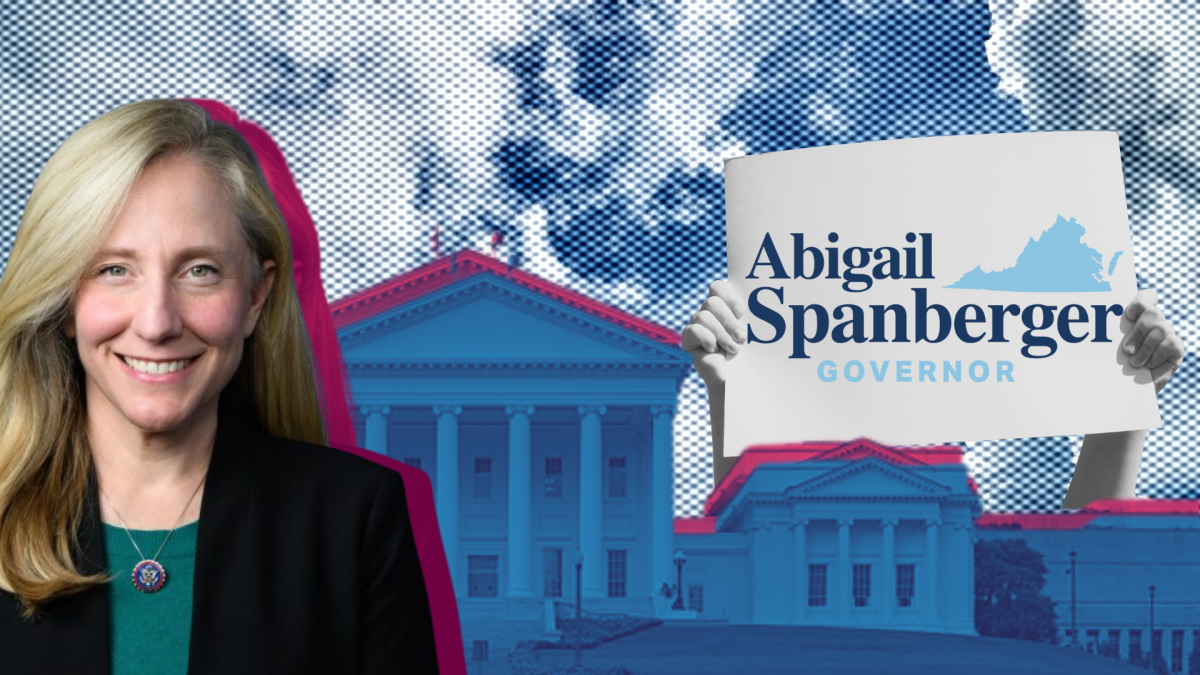
Democrat Abigail Spanberger won the Virginia Gubernatorial election on November 4, with her victory being called almost immediately after the polls closed. Spanberger’s victory delivered a potent repudiation of President Trump’s policies after a campaign laser-focused on attacking them. The former CIA officer and three-term Congresswoman, who entered politics in the 2018 Democratic wave, defeated her Republican opponent, Lieutenant Governor Winsome Earle-Sears, in a race that drew national attention as an early test of voter sentiment toward the Trump administration. At 46, Spanberger will be Virginia’s first female governor, following a streak of 65 men who have served in that office since Virginia became part of the US in 1788. Spanberger replaces popular outgoing Republican Governor Glenn Youngkin, who won in 2021 with 50.6% of the vote to Democrat Terry McAuliffe’s 48.7% but cannot seek consecutive re-election.
Governor-elect Abigail Spanberger, a pragmatic centrist who has bucked her party on occasion, voting against Nancy Pelosi for House speaker in 2019 and criticizing President Joe Biden as too progressive in 2021, cultivated a maverick image that helped her outrun a battered Democratic brand. Spanberger’s theme of “affordability” addressed rising costs for housing, utilities, pharmaceuticals and economic uncertainty from Trump’s tariffs and federal layoffs, while she harnessed anger over cuts to the federal workforce that disproportionately hit Virginia, home to around 320,000 federal workers and hundreds of thousands of contractors. On the campaign trail, she argued that federal layoffs, cutbacks by President Donald Trump’s Department of Government Efficiency (DOGE), tariffs and the federal shutdown amounted to an attack on the state’s economy, pitching herself as a way for voters to push back. “We need a governor who will recognize the hardship of this moment, advocate for Virginians, and make clear that not only are we watching people be challenged in their livelihoods and in their businesses and in communities, but Virginia’s economy is under attack,” she said during a late-October bus tour stop. Backed by national Democrats eyeing a 2026 midterm boost, including a campaign appearance by former President Barack Obama and heavy DNC spending, Spanberger raised nearly twice as much money as Winsome Earle-Sears, held double-digit leads in final polls and ran a surgical effort that scared off primary rivals, resisting calls for new ideas in favor of her 2018 playbook of Trump opposition.
At her jubilant election night watch party, where House Speaker Don Scott shouted, “Y’all ready to witness history tonight?“, Abgail Spanberger struck a bipartisan tone in her victory speech, praising Winsome Earle-Sears and pledging to serve all Virginians in a departure from President Donald Trump’s with-me-or-against-me ethos. She touched on the milestone for their three daughters, recounting her husband’s words: “Your mom is going to be the governor of Virginia—I can guarantee you that those words have never been spoken before.” She took one swipe at the administration, declaring, “Virginia’s economy doesn’t work when Washington treats our Virginia workers as expendable. And to those across the Potomac who are attacking our jobs and our economy, I will not stand by silently.” As Congresswoman Jennifer McClellan put it, “Virginians, they see the impacts of what’s happening in Washington in real time and are looking for state leaders who are going to fill in those gaps and address that harm.”
Winsome Earle-Sears, a Jamaican immigrant who became a US Marine and small business owner, portrayed herself as the American dream incarnate and pledged allegiance to President Donald Trump despite his meager late endorsement and minimal help for her cash-strapped campaign. She vowed to extend Glenn Youngkin’s business-friendly policies, accused Abigail Spanberger of supporting Biden-era moves and attacked her on transgender rights, claiming they threatened girls’ safety in school bathrooms and locker rooms. “Love is not having my daughter having to be forced to undress in a locker room with a man. That’s not love,” she said at an October rally. “Love is making sure that our girl children have opportunities in sports and are not forced to play against biological males.”
The race was jolted in its final weeks by the government shutdown, which both sides blamed on the other and shadowed early voting; a Democratic push to redistrict congressional maps for 2026 midterms favoring their candidates amid Trump’s similar efforts elsewhere; and a scandal over text messages from Democratic attorney general candidate Jay Jones, who hypothetically described shooting a Republican lawmaker. Spanberger denounced the messages, but Earle-Sears faulted her for not demanding Jones drop out. Glenn Youngkin prioritized re-electing Republican Attorney General Jason Miyares over bolstering Winsome Earle-Sears, donating only a fraction of his 2023 General Assembly spending to her effort. Despite the uproar, Jones defeated Miyares in the key post, enabling Virginia to join blue-state lawsuits against Trump. Separately, Democrat Ghazala Hashmi won the lieutenant governor race, becoming the first Muslim woman elected to statewide office in America after a low-profile campaign with few appearances and no debate against Republican talk-show host John Reid, though she trailed Spanberger amid her party’s uneven performance elsewhere.
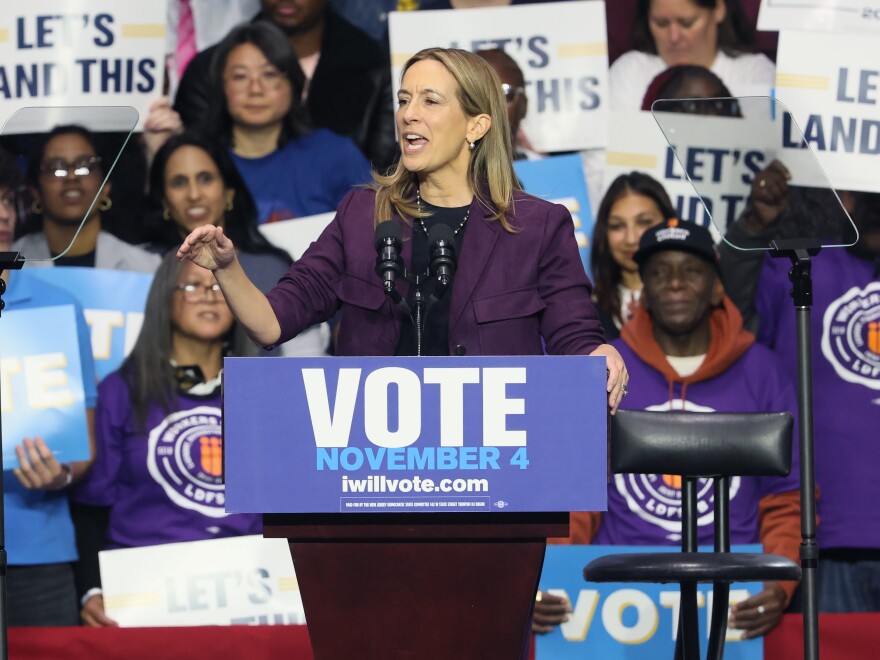
Congresswoman Mikie Sherrill, the Democratic candidate for governor of New Jersey, catapulted to victory on November 4 on the strength of her opposition to President Donald Trump after a hard-fought race against Jack Ciattarelli, a Republican whose energetic campaign could not outrun national politics in a liberal-leaning state. Congresswoman Sherrill, a former Navy helicopter pilot and federal prosecutor, will become New Jersey’s 57th governor and its second female leader.
2. Zohran Mamdani Wins New York City Mayoral Election
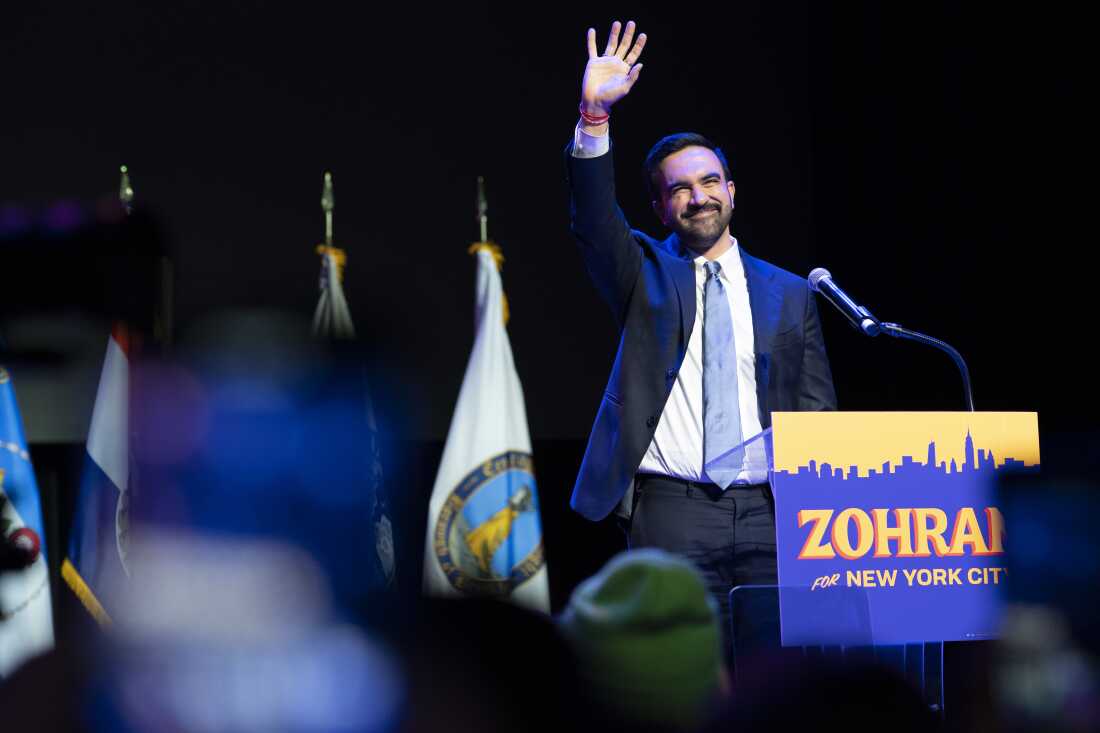
Zohran Mamdani was elected mayor of New York on November 4, capping a stunning ascent for the 34-year-old, Demcoratic Socialist-aligned state lawmaker who promised to transform city government to restore power to the working class and fight back against a hostile Trump administration.
Zohran Mamdani was elected mayor of New York on November 4, capping a stunning ascent for the 34-year-old, Democratic Socialist-aligned state lawmaker who promised to transform city government to restore power to the working class and fight back against a hostile Trump administration. In a victory for the Democratic Party’s progressive wing, Mamdani defeated former Governor Andrew Cuomo and Republican Curtis Sliwa. With his commanding win, Mamdani will etch his place in history as the city’s first Muslim mayor, the first of South Asian heritage, and the first born in Africa. He will also become New York’s youngest mayor in more than a century when he takes office on January 1, 2026. “The conventional wisdom would tell you that I am far from the perfect candidate. I am young, despite my best efforts to grow older. I am Muslim. I am a democratic socialist. And most damning of all, I refuse to apologize for any of this,” Mamdani declared to a roaring crowd at his victory party. He cast his win as a boon for blue-collar workers struggling to get by. “New York, tonight you have delivered a mandate for change,” he said, vowing to “wake up each morning with a singular purpose: To make this city better for you than it was the day before.”
3. California Voters Approve Democratic-drawn Congressional Map as National Redistricting Battle Spreads
California voters have approved a new congressional map drawn by state Democrats on November 4. This gives the party the chance to gain up to five House seats in the 2026 midterm elections and counter Republican redistricting efforts in other states
4. Democrat Abigal Spanberger Wins Virgnia Gubernatorial Election By A Comfortable Margin
Democrat Abigail Spanberger won the Virginia Gubernatorial election on November 4, with her victory being called almost immediately after the polls closed. Spanberger’s victory delivered a potent repudiation of President Trump’s policies after a campaign laser-focused on attacking them.
Democrat Abigail Spanberger won the Virginia Gubernatorial election on November 4, with her victory being called almost immediately after the polls closed. Spanberger’s victory delivered a potent repudiation of President Trump’s policies after a campaign laser-focused on attacking them. The former CIA officer and three-term Congresswoman, who entered politics in the 2018 Democratic wave, defeated her Republican opponent, Lieutenant Governor Winsome Earle-Sears, in a race that drew national attention as an early test of voter sentiment toward the Trump administration. At 46, Spanberger will be Virginia’s first female governor, following a streak of 65 men who have served in that office since Virginia became part of the US in 1788. Spanberger replaces popular outgoing Republican Governor Glenn Youngkin, who won in 2021 with 50.6% of the vote to Democrat Terry McAuliffe’s 48.7% but cannot seek consecutive re-election.
In Texas, the Republicans hope to gain an additional five House seats under new district lines. Republicans in Missouri and North Carolina have passed maps designed to net the party a new seat in each state. A mandatory redraw in Ohio could also benefit Republicans. President Donald Trump has continued to push Republican-led states like Indiana and Kansas to help shore up the party’s narrow House majority. While some Democratic governors and lawmakers are trying to redraw their maps as well, they face additional legal and procedural hurdles that are present in red states because many of them ceded the power to redistrict in recent years to independent or bipartisan commissions.
California Governor Gavin Newsom pushed hard for the Democrats’ redistricting plan, accusing Trump and Republicans of “rigging” the midterm elections with their unusual decision to redraw congressional maps for explicit partisan gain outside the regular decennial cycle linked to the census. The flurry of ads blanketing the state in support of the measure underscored that point. “Donald Trump is out of control, imposing illegal tariffs that hurt our economy and denying disaster aid to California families. Now he’s attempting an unprecedented power grab to steal congressional seats and rig the 2026 election. But we can stop him,” a narrator says in one of the major ads from a group supporting a yes vote on Prop 50. “Prop 50, the Election Rigging Response Act, thwarts Trump’s scheme. Prop 50 levels the playing field in the midterms and gives voters the power to check Trump.” There has been almost $100 million in contributions and ad spending in the race, according to campaign finance reports and data from AdImpact, a political ad tracker.
Declaring victory on November 4, California Governor Gavin Newsom framed the result as part of a strong night for Democrats across the board and a blow to President Donald Trump. “What a night for the Democratic Party, a party that’s in its ascendency, a party that’s on its toes, no longer on its heels. From coast to coast, from sea to shining sea,” Newsom said. “We’re proud here in California to be part of this narrative this evening. We’re proud of the work that the people of California did tonight to send a powerful message to a historic president. Donald Trump is an historic president; he is the most historically unpopular president in modern history.”
While Republicans began saber-rattling and promised to go toe-to-toe with the Democratic efforts, the energy and spending for the campaign to defeat the ballot initiative fizzled down the stretch. The two sides were in rough parity on spending on the airwaves in the first month after the election was announced, $16 million to $17 million on either side. Then the yes side spent $63 million on ads in the final six weeks, compared with less than $16 million from the no side. The intensity of the no side’s spending waned in the final weeks, but it had prominent backers, including former Governor Arnold Schwarzenegger, a Republican. “California voters established an independent commission led by citizens to stop rigged elections. Prop 50 cancels this historic reform, putting the politicians back in charge,” the narrator says in an ad featuring Schwarzenegger calling on voters to cast no votes to “protect” democracy.
California already sends 43 Democrats and nine Republicans to Congress, but multiple nonpartisan analyses of the new maps show that the new lines could allow Democrats to flip as many as five seats by making it harder for Republican Congressmen Doug LaMalfa, Darrell Issa, Ken Calvert, Kevin Kiley, and David Valadao to win re-election. The outcome is far from certain, and most of those Republican lawmakers have won tough races before, but redrawing the lines to add more Democratic voters in their districts will make it tough sledding next fall, especially because the party in power typically faces political headwinds in the midterms.
Zohran Mamdani was elected mayor of New York on November 4, capping a stunning ascent for the 34-year-old, Democratic Socialist-aligned state lawmaker who promised to transform city government to restore power to the working class and fight back against a hostile Trump administration. In a victory for the Democratic Party’s progressive wing, Mamdani defeated former Governor Andrew Cuomo and Republican Curtis Sliwa. With his commanding win, Mamdani will etch his place in history as the city’s first Muslim mayor, the first of South Asian heritage, and the first born in Africa. He will also become New York’s youngest mayor in more than a century when he takes office on January 1, 2026. “The conventional wisdom would tell you that I am far from the perfect candidate. I am young, despite my best efforts to grow older. I am Muslim. I am a democratic socialist. And most damning of all, I refuse to apologize for any of this,” Mamdani declared to a roaring crowd at his victory party. He cast his win as a boon for blue-collar workers struggling to get by. “New York, tonight you have delivered a mandate for change,” he said, vowing to “wake up each morning with a singular purpose: To make this city better for you than it was the day before.”
More than 2 million New Yorkers cast ballots in the contest, the largest turnout in a mayoral race since the 1969 Mayoral Election, which pitted incumbent Liberal Republican John Lindsay against Democrat Mario Procaccino and Conservative Party candidate John Marchi. With roughly 90% of the votes counted, Mamdani held an approximately 9 percentage point lead over Andrew Cuomo. His unlikely rise gives credence to Democrats who have urged the party to embrace more progressive candidates instead of rallying behind centrists in hopes of winning back swing voters who have abandoned the party. He has already faced scrutiny from national Republicans, including President Donald Trump, who have eagerly cast him as a threat and the face the Democratic Party. Trump has repeatedly threatened to cut federal funding to the city and even take it over if Mamdani won.
Zohran Mamdani’s grassroots campaign centered on affordability, and his charisma spoiled former Governor Andrew Cuomo’s attempted political comeback. The former governor, who resigned four years ago following allegations of sexual harassment that he continues to deny, was dogged by his past throughout the race and was criticized for running a negative campaign. Mamdani will also have to deal with President Donald Trump, who not only threatened retribution against the city but also suggested he might try to arrest and deport Mamdani if he won. Mamdani was born in Uganda, where he spent his early childhood, but was raised in New York City and became a US citizen in 2018. In his speech, Mamdani addressed Trump head on. “New York will remain a city of immigrants, a city built by immigrants, powered by immigrants and as of tonight, led by an immigrant,” he said, adding that, “If anyone can show a nation betrayed by Donald Trump how to defeat him, it is the city that gave rise to him.” President Trump appeared to acknowledge Mamdani’s challenges, posting “…AND SO IT BEGINS!” on his Truth Social site.
Zohran Mamdani began his campaign as a relatively obscure state lawmaker, little known even within New York City. Going into the Democratic primary, Andrew Cuomo was the presumed favorite, with near-universal name recognition and deep political connections. Cuomo’s chances were buoyed further when incumbent Mayor Eric Adams bowed out of the primary while dealing with the fallout of his now-dismissed federal corruption case. But as the race progressed, Mamdani’s natural charm, catchy social media videos, and populist economic platform energized voters in the notoriously expensive city. He also began drawing outside attention as his name recognition grew. Mamdani trounced Cuomo in the primary by about 13 points.
Andrew Cuomo then relaunched his campaign as an independent candidate for the general election, vowing to hit the streets with a more energetic approach. However, much of his campaign continued to focus on attacking opponents. In the race’s final stretch, he claimed Zohran Mamdani’s election would make Jews feel unsafe. Meanwhile, supporters packed Mamdani’s rallies, and he held whimsical events, including a scavenger hunt and a community soccer tournament. Cuomo also juxtaposed his deep experience in government with Mamdani’s less than five years in the state Legislature. But the former governor also faced his own political baggage, as his opponents dredged up the sexual harassment allegations that led to his resignation, as well as his decisions during the early days of the COVID-19 pandemic.
Republican nominee Curtis Sliwa, the creator of the Guardian Angels crime patrol group, also had his moments, mostly in the form of funny quips on the debate stage, but had difficulty gaining traction as a Republican in an overwhelmingly Democratic city. He conceded the race about a half hour after the polls closed, wishing Zohran Mamdani “good luck because if he does well, we do well.” But he also issued a warning: “If you try to implement socialism, if you try to render our police weak and impotent, if you forsake the people’s public safety, we will become the mayor-elect and his supporters’ worst enemies.”
Congresswoman Mikie Sherrill, the Democratic candidate for governor of New Jersey, catapulted to victory on November 4 on the strength of her opposition to President Dona;d Trump after a hard-fought race against Jack Ciattarelli, a Republican whose energetic campaign could not outrun national politics in a liberal-leaning state. Congresswoman Sherrill, a former Navy helicopter pilot and federal prosecutor, will become New Jersey’s 57th governor and its second female leader. She was leading Ciattarelli, a former state lawmaker running his third race for governor, by a resounding 13 points with more than 95 percent of the vote counted, according to a tally by The Associated Press.
“Good government doesn’t just manage problems, it solves them,” Governor-elect Mikie Sherrill told supporters gathered in East Brunswick for a victory party. “I know not everyone voted for me,” she added, “but I’m working for everyone — every single one of you.” She said Jack Ciattarelli called her soon after the results were announced, and she recognized him for “stepping up.” Ciattarelli, in a brief concession speech, told his supporters that “life is not always fair.” “Nobody is more disappointed than I am in the result,” he said. “It is my hope that Mikie Sherrill has heard us, in terms of what needs to be done to make New Jersey that place where everybody wants to be to achieve their dreams again.” The race was largely defined by President Donald Trump, who made surprising inroads last November in New Jersey and who had endorsed Jack Ciattarelli. But in a state where Democrats outnumber Republicans by roughly 850,000 voters, the alliance always carried risk.
Senator Cory Booker predicted that Mike Sherrill’s win would ripple far beyond New Jersey. “The whole nation will see,” said Booker, the state’s senior senator, “that we can’t stop the momentum.” Governor-elect Sherrill will now have to at least coexist with the president, who has shown a willingness to punish his foes. That was an argument President Donald Trump raised in the final weeks of the campaign, in a telephone rally he held for Jack Ciattarelli. “He’s got a friend in the White House,” the President said during the call, “where she certainly doesn’t.”
Governor-elect Mikie Sherrill has pledged to freeze the state’s high electricity costs by declaring a state of emergency on her first day in office in January. She plans to get cellphones out of classrooms and hire more mental health counselors for schools. Using data gathered through a new “social media addiction observatory,” she has said, her administration will take on digital platforms that use algorithms to lure in children and teenagers.
In the 2021 campaign, Jack Ciattarelli lost by three points to Governor Phil Murphy, a Democrat barred by term limits from running for re-election. He tried hard during this race to capitalize on the stunning gains President Donald Trump made in Black and Latino communities, campaigning aggressively in churches and at cultural events. Ciattarelli develped a reputation as a moderate Republican during his time on the Somerset County board of Freeholders (2007-2011) and in the New Jersey General Assembly (2012-2018), and until this campaign he had kept President Trump at arm’s length. But after the president’s stronger-than-expected showing last year in some of New Jersey’s most diverse communities, Ciattarelli pivoted, embracing the president and some of his policies, even giving Trump an “A” grade in the final debate.
Jack Ciattarelli’a platform was focused heavily on pocketbook issues like taxes and energy costs. But Ciattarelli also leaned into issues popular with the far-right flank of the party, including publicly funded school vouchers, opposition to transgender rights, vaccine skepticism and the deportation of migrants. On the stump and in ads, Mikie Sherrill’s campaign regularly reminded voters of Ciattarelli’s cozy relationship with President Donald Trump. Then, last month, President Donald Trump said he was terminating funding for the construction of a $16 billion train tunnel considered vital to the country and to New Jersey’s 200,000 commuters, handing the Sherrill campaign an unexpected gift. “With less than 19 days until this election, the president’s punched him in the face like this. That’s pretty telling,” Sherrill said the next day, highlighting the ephemeral value of Ciattarelli’s partnership with a mercurial president. It also gave her a way to change the subject from a controversy centered on why she had been barred from participating in her 1994 graduation ceremony at the US Naval Academy. She has said that she could not participate because she had failed to “turn in” classmates caught up in a cheating scandal. But polls began to narrow as Ciattarelli publicly challenged that explanation and sought to undermine her credibility, denting a central pillar of her campaign: that nine years in the Navy had prepared her to lead the state.
Polls proved largely inaccurate. Most showed Mikie Sherrill leading throughout the race, but few had her winning by a double-digit margin. Only New Jersey and Virginia hold races for governor the year after a presidential contest, and the results are considered bellwethers heading into next year’s pivotal midterm elections, which will determine party control of Congress. In Virginia, former Congresswoman Abigail Spanberger beat her Republican opponent, Lt. Governor Winsome Earle-Sears, by 15 points; Spanberger will be the first woman to serve as governor of the state.
Ken Martin, the chairman of the Democratic National Committee who came to New Jersey repeatedly during the campaign, said victories in both states represent “the beginning of our Democratic resurgence” and proved that voters are “tired of watching the G.O.P. turn our beloved country into a playground for billionaires.” “Tonight isn’t only a warning sign to Republicans,” he said in a statement, “it’s an affirmation of the vision that Democrats have presented to voters in New Jersey and across the country.”
New Jersey’s race was always seen as far more competitive. And Mikie Sherrill’s campaign had become a cause célèbre for Democrat-aligned national groups, which committed roughly $25 million to help her win. An array of prominent Democratic leaders also traveled to New Jersey to campaign with Sherrill in the final weeks of the race. On November 1, an appearance by former President Barack Obama drew thousands of party faithful to a large gymnasium at a community college in Newark. He energized the crowd by warning, as Sherrill has, about the threat posed by President Donald Trump. “We’ve got a commander in chief who has fired decorated military officers because he thinks they might be more loyal to the Constitution than they are to him,” Obama said. “He’s deployed the National Guard in American cities and claimed to be stopping crime waves that don’t actually exist,” he added. “We’ve got masked ICE agents pulling up in unmarked vans and grabbing people off the streets.” “Don’t boo,” Obama said repeatedly as the crowd roared. “Go vote.”
More than 3.1 million New Jersey voters cast ballots, 500,000 more than in 2021. Jack Ciattarelli’s level of support this year actually exceeded his performance in 2021 by more than 100,000 votes, but he still fell short as far more voters beat a path to the polls. “I’m not retiring to Florida. We fight for another day,” Ciattarelli said to loud cheers. “You’ll find me right here on the streets of Central Jersey, or maybe at one of my favorite places on the beach in Surf City.”
The contest was the most competitive race for governor of New Jersey since 2009, when Chris Christie, a Republican, unseated the incumbent governor, Jon Corzine, a wealthy Democrat. It was also extraordinarily expensive. Mikie Sherrill and Jack Ciattarelli won their party’s nominations after spirited primaries. The state’s Election Law Enforcement Commission reported last week that spending by the two candidates and groups supporting their candidacies had already exceeded $82 million. In winning, Sherrill bucked a six-decade historical trend. Not since 1961 had either party held onto the governor’s office for three consecutive terms.
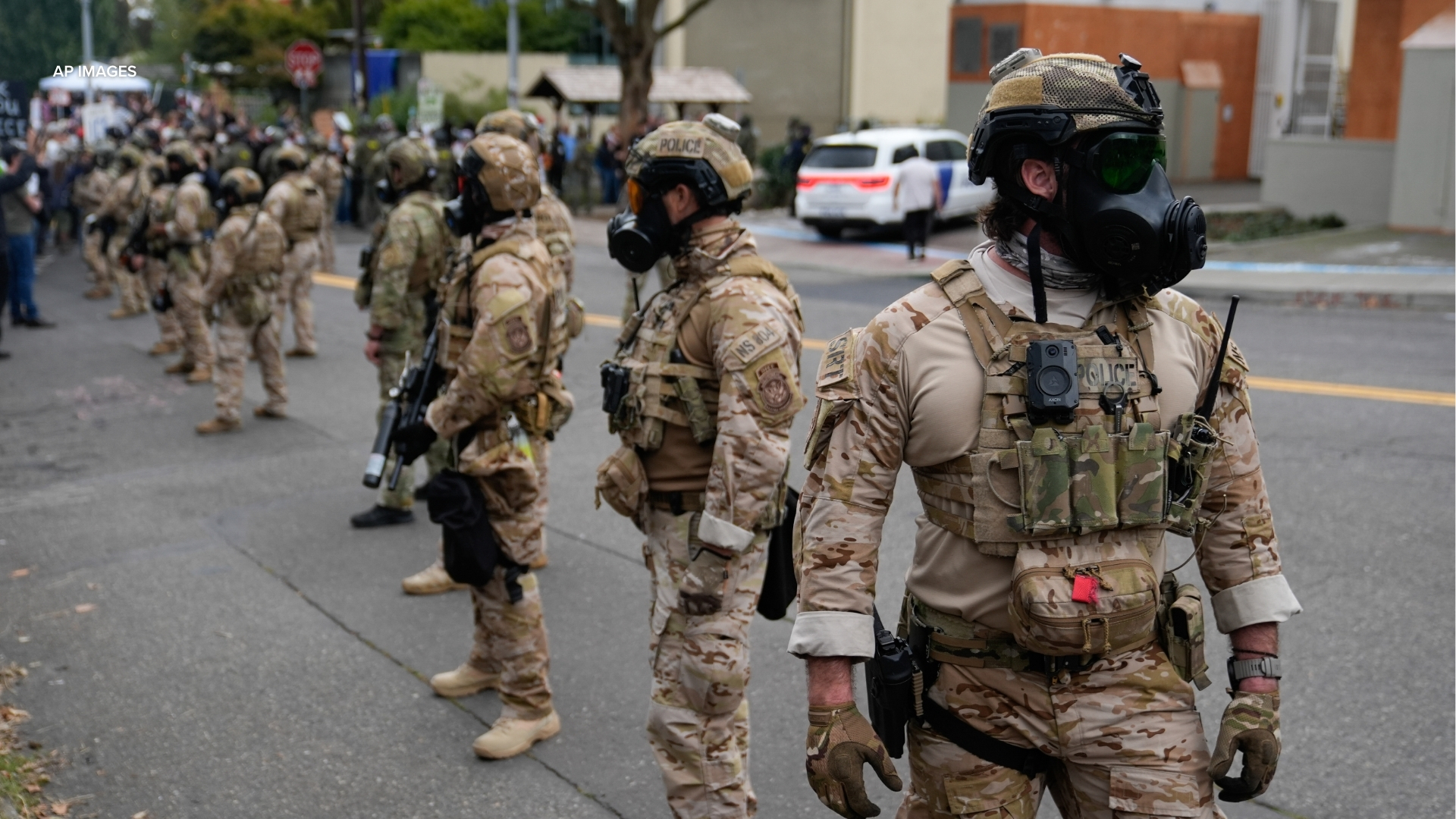
A federal judge in Oregon has halted the Trump administration’s efforts to deploy federalized National Guard members from California and other states to Portland, Oregon. In a rare late Sunday night virtual hearing on October 5, 2025, US District Judge Karin Immergut, a Trump appointee, granted a temporary restraining order requested by the state of California to prevent the deployment of up to 300 California National Guard members to Portland. This ruling followed Immergut’s decision the previous day to block President Donald Trump’s attempt to deploy Oregon National Guard troops in the city.
California Governor Gavin Newsom announced plans to sue the Trump administration after it deployed federalized National Guard troops—called into service by the president—to Oregon. In a statement, Newsom condemned the move, saying, “This is a breathtaking abuse of the law and power. The Trump Administration is unapologetically attacking the rule of law itself and putting into action their dangerous words—ignoring court orders and treating judges, even those appointed by the President himself, as political opponents.”
California Attorney General Rob Bonta praised Immergut’s ruling, suggesting the administration’s attempt to deploy California troops was a direct response to the judge’s earlier order blocking the federalization of Oregon’s National Guard. “The Trump Administration’s flagrant disregard for the courts was on full display when it sought to circumvent Judge Immergut’s order by redeploying troops from Los Angeles to Portland,” Bonta said. “This disrespect for the rule of law cannot stand—and I’m glad the court agreed.”
Oregon Governor Tina Kotek, a Democrat, confirmed that some California National Guard troops arrived in Oregon on the night of October 4, with more expected on OCtober 6. She strongly opposed the deployment, stating, “The facts haven’t changed. There is no need for military intervention in Oregon. There is no insurrection in Portland. No threat to national security. Oregon is our home, not a military target. Oregonians exercising their freedom of speech against unlawful actions by the Trump Administration should do so peacefully.”
In an op-ed published Sunday in The Oregonian, Portland Police Chief Bob Day addressed the situation, noting that “national portrayals” of Portland overstated the city’s issues. “There is no ignoring that we are facing an extraordinary time in our city’s history, with the deployment of both federal law enforcement and the Oregon National Guard,” Day wrote. He emphasized that Portland police employ a “layered approach” to managing public order, avoiding tactics like tactical gear lineups that could escalate crowd behavior.
On the same day, Defense Secretary Pete Hegseth announced in a memo that up to 400 Texas National Guard members would be federalized for deployment to Chicago and Portland for up to 60 days, with the possibility of an extension. The memo, included in a court filing by the Oregon attorney general’s office, cited President Trump’s determination on October 4, 2025, that “violent incidents, as well as the credible threat of continued violence,” were impeding federal law enforcement in Illinois, Oregon, and other locations.
Texas Governor Greg Abbott, a Republican, supported the deployment, stating on X, “I fully authorized the President to call up 400 members of the Texas National Guard to ensure safety for federal officials. You can either fully enforce protection for federal employees or get out of the way and let Texas Guard do it. No Guard can match the training, skill, and expertise of the Texas National Guard.”
I fully authorized the President to call up 400 members of the Texas National Guard to ensure safety for federal officials.
You can either fully enforce protection for federal employees or get out of the way and let Texas Guard do it.
Illinois Governor JB Pritzker, a Democrat, condemned the move, calling it “Trump’s Invasion.” He noted that no federal officials had coordinated with him regarding the deployment and criticized the involvement of another state’s military. “It started with federal agents, it will soon include deploying federalized members of the Illinois National Guard against our wishes, and it will now involve sending in another state’s military troops,” Pritzker said. Both Pritzker and Kotek urged Abbott to withdraw his support for the deployment.
The White House defended the deployment, with spokesperson Abigail Jackson stating, “President Trump exercised his lawful authority to protect federal assets and personnel in Portland following violent riots and attacks on law enforcement.” Pentagon spokesman Sean Parnell added that California National Guard members were reassigned from Los Angeles to Portland “to support U.S. Immigration and Customs Enforcement and other federal personnel performing official duties, including the enforcement of federal law, and to protect federal property.”
In response to Immergut’s ruling blocking the activation of 200 Oregon National Guard troops until at least October 18, the Trump administration filed a motion with the 9th US Circuit Court of Appeals, arguing that the judge “impermissibly second-guessed” Trump’s military judgments. The motion cited a nearly 200-year-old Supreme Court precedent, asserting that such decisions are the president’s prerogative, not that of a governor or federal court.
Judge Immergut’s rulings underscored a “longstanding and foundational tradition of resistance to government overreach, especially in the form of military intrusion into civil affairs.” Oregon’s Governor Kotek reiterated, “There is no insurrection in Portland. No threat to national security. No fires, no bombs, no fatalities due to civil unrest. The only threat we face is to our democracy—and it is being led by President Donald Trump.”
The controversy extends beyond Portland. Last month, a federal judge in Los Angeles ruled that the deployment of National Guard troops and Marines was illegal, and officials in Washington, D.C., also sued to block similar deployments. Trump has threatened to deploy troops and federal law enforcement to other cities, including Baltimore and New Orleans, escalating tensions with Democratic governors and mayors.
Pritzker, in a CNN interview on Sunday, criticized the federal presence in Chicago, stating, “They are the ones that are making it a war zone. They need to get out of Chicago if they’re not going to focus on the worst of the worst, which is what the president said they were going to do.” He and other Democratic leaders have also condemned Trump’s suggestion to senior military officials that “dangerous cities” be used as “training grounds” for the National Guard.
The deployment of federalized National Guard troops has sparked widespread debate about the balance between federal authority and state autonomy, as well as the appropriate use of military forces in domestic civil matters. As legal battles continue, the situation remains a flashpoint in the ongoing clash between the Trump administration and Democratic state leaders.
The Trump administration on October 2 terminated $7.6 billion in grants funding 223 clean energy projects across 16 states, all of which supported former Vice President Kamala Harris in the 2024 presidential election. The decision, announced by the Energy Department, follows a review deeming the projects misaligned with national energy needs or economically unviable. The cuts, affecting initiatives like battery plants, hydrogen technology, electric grid upgrades, and carbon-capture efforts, have sparked accusations of political retaliation amid an ongoing government shutdown.
The Energy Department’s review targeted funding from the Office of Clean Energy Demonstrations, Office of Energy Efficiency and Renewable Energy, and other bureaus. While specific project details were not disclosed, the cancellations include up to $1.2 billion for California’s hydrogen hub, the Alliance for Renewable Clean Hydrogen Energy Systems (ARCHES), and $1 billion for a Pacific Northwest hydrogen project. Notably, hydrogen projects in Texas, West Virginia, Ohio, and Pennsylvania were spared. The 16 affected states are California, Colorado, Connecticut, Delaware, Hawaii, Illinois, Maryland, Massachusetts, Minnesota, New Hampshire, New Jersey, New Mexico, New York, Oregon, Vermont, and Washington. Each of these states voted for Harris in 2024, and their US Senators opposed a Republican short-term funding bill to avert the government shutdown.
White House Budget Director Russell Vought announced the cuts on social media, framing them as eliminating funding for the “Left’s climate agenda.” President Donald Trump, in an interview with One America News, suggested the cuts target Democratic priorities, stating, “I’m allowed to cut things that never should have been approved in the first place.” The administration has also rescinded $13 billion in clean energy funding from the 2022 climate law, citing unspent allocations.
Democrats and environmental groups have condemned the move. California Governor Gavin Newsom highlighted that ARCHES had secured $10 billion in private investment and supported over 200,000 jobs, calling the cut a threat to economic growth. Senator Alex Padilla (D-CA) labeled the decision “vindictive” and “shortsighted,” arguing it undermines US energy leadership. Senator Patty Murray (D-WA.) accused the administration of using American livelihoods as “pawns in some sort of sick political game.” Environmental organizations echoed these concerns. Jackie Wong of the Natural Resources Defense Council (NRDC) called the cuts a blow to innovative technology and clean energy jobs. Conrad Schneider of the Clean Air Task Force warned that the cancellations weaken U.S. competitiveness in global energy markets.
Energy Secretary Chris Wright defended the cancellations, emphasizing they were business decisions to protect taxpayer dollars and prioritize affordable, reliable energy. He denied political motivations, stating, “These decisions are made on whether it’s a good use of the taxpayer money or not.” Wright noted that projects in both Republican and Democratic states, including hydrogen initiatives in West Virginia, Texas, and Louisiana, are under review, with further cancellations expected. Award recipients have 30 days to appeal.
The cuts align with the Trump administration’s broader rollback of climate programs, including vehicle emission and greenhouse gas regulations. The Energy Department’s review began after President Donald Trump’s 2024 election victory, with over a quarter of the rescinded grants awarded between Election Day and Inauguration Day under the Biden administration. The cancellations are part of a $7 billion hydrogen fuel program initiated by President Joe Biden to combat climate change.
As the government shutdown continues, the debate over these cuts underscores tensions between fiscal priorities and clean energy innovation, with significant implications for jobs, energy costs, and US leadership in emerging technologies.
Here are the main events that occurred in Politics this week:
1. President Donald Trump Attacks UN and Lectures Nations in Address to General Assembly
Despite pushing policies that have stirred controversy among voters, President Donald Trump’s approval rating has remained remarkably resilient, according to a recent survey conducted by The New York Times and Siena University from September 22-27, 2025
Despite pushing policies that have stirred controversy among voters, President Donald Trump’s approval rating has remained remarkably resilient, according to a recent survey conducted by The New York Times and Siena University from September 22-27, 2025. The poll, based on a random sample of 1,313 registered voters with a margin of error of plus or minus 3.2 percentage points, reveals that 43 percent of voters approve of Trump’s job performance, while 54 percent disapprove. These figures are nearly identical to those from April 2025, when 42 percent approved and 54 percent disapproved, suggesting that Trump’s support base has not wavered significantly despite ongoing debates over his administration’s actions.
2. US Labor Market Faces Slowdown Amid Government Shutdown Uncertainty
Private payrolls in the US took a significant hit in September, adding complexity to an already uncertain economic landscape. With the government shutdown halting the release of the Bureau of Labor Statistics’ (BLS) monthly jobs report, policymakers and investors are left grappling for insights into the labor market’s health
Private payrolls in the US took a significant hit in September, adding complexity to an already uncertain economic landscape. With the government shutdown halting the release of the Bureau of Labor Statistics’ (BLS) monthly jobs report, policymakers and investors are left grappling for insights into the labor market’s health. In the absence of official data, attention has turned to alternative sources, such as the private-sector jobs report from payroll processor ADP, released on October 1.
3. UN Sanctions Reimposed on Iran Amid Nuclear Deal Tensions
The United Nations has reinstated comprehensive economic and military sanctions on Iran, a significant development a decade after their initial suspension under the 2015 Joint Comprehensive Plan of Action (JCPOA).
The United Nations has reinstated comprehensive economic and military sanctions on Iran, a significant development a decade after their initial suspension under the 2015 Joint Comprehensive Plan of Action (JCPOA). This decision stems from accusations by the UK, France, and Germany, collectively referred to as the E3, that Iran has engaged in “persistent nuclear escalation” and failed to comply with its international obligations. The E3 invoked the JCPOA’s “snapback” mechanism last month, providing Iran a 30-day period to address concerns regarding its nuclear activities. That deadline lapsed on September 27, prompting the immediate reinstatement of sanctions.
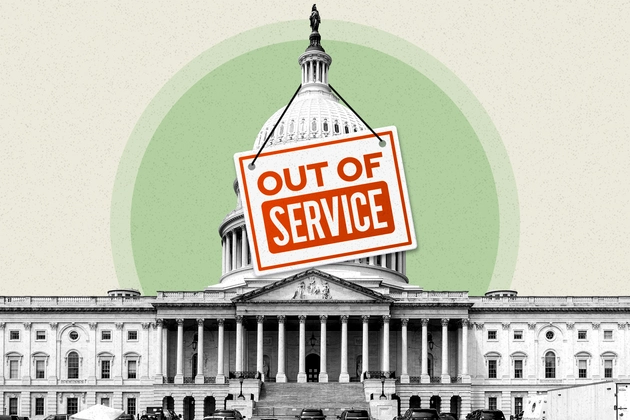
On October 1, the US federal government shut down, marking the first such closure since 2019. The shutdown, triggered by a contentious spending dispute between President Donald Trump and congressional Democrats, has disrupted federal services and furloughed many federal workers.
On October 1, the US federal government shut down, marking the first such closure since 2019. The shutdown, triggered by a contentious spending dispute between President Donald Trump and congressional Democrats, has disrupted federal services and furloughed many federal workers. The current shutdown echoes a 35-day closure in 2018/2019, when President Donald Trump and congressional Democrats clashed over funding for a southern border wall. The central issue behind this most recent government shutdown is the Democrats’ insistence that President Trump agree to extend expiring health care subsidies and reverse Medicaid cuts included in his signature tax cut and domestic policy law passed earlier in 2025. These health care provisions, particularly the Affordable Care Act (ACA) subsidies set to expire by year’s end, are critical to millions of Americans’ access to affordable insurance.
Private payrolls in the US took a significant hit in September, adding complexity to an already uncertain economic landscape. With the government shutdown halting the release of the Bureau of Labor Statistics’ (BLS) monthly jobs report, policymakers and investors are left grappling for insights into the labor market’s health. In the absence of official data, attention has turned to alternative sources, such as the private-sector jobs report from payroll processor ADP, released on October 1.
According to ADP, US private-sector businesses shed 32,000 jobs in September, a stark contrast to economists’ expectations of a 50,000-job gain. The report also revised August’s figures, turning an initial estimate of 54,000 jobs added into a loss of 3,000. ADP’s chief economist, Nela Richardson, attributed much of this downturn to a preliminary “rebenchmarking” of the data, which reduced September’s job count by 43,000 compared to pre-benchmarked figures. “While the numbers changed, the story remains consistent: hiring momentum has slowed throughout 2024,” Richardson told reporters. She noted that the recalibration, aligned with the 2024 Quarterly Census of Employment and Wages (QCEW), revealed a persistent slowdown in hiring, particularly evident in September. The QCEW, which draws from quarterly tax reports submitted by businesses, offers a comprehensive view of employment and wages at state, regional, and county levels. However, its lagged data limits its timeliness, leaving gaps in real-time analysis.
September’s job losses were driven primarily by small businesses, with widespread declines across industries. Professional and business services, as well as leisure and hospitality, saw some of the largest drops. Health care remained a notable exception, continuing to drive consistent employment growth throughout the year. The broader labor market is showing signs of stagnation. The BLS’s August jobs report, the last available before the shutdown, indicated that the economy added just 22,000 jobs, with the unemployment rate climbing to 4.3%—its highest in nearly four years. June’s job gains were also revised downward into negative territory. The BLS’s Job Openings and Labor Turnover Survey, released earlier this week, further underscored the slowdown, with the hiring rate dropping to 3.2% in August, matching its lowest level since 2013, excluding the early pandemic period in 2020.
Despite the lack of a monthly BLS jobs report, economists argue that the Federal Reserve has enough evidence to justify further interest rate cuts at its next meeting. Joe Brusuelas, an economist at RSM US, noted that the labor market’s condition supports a quarter-point rate reduction. He highlighted additional pressures, including policy uncertainty around trade and immigration, as well as long-term demographic challenges limiting labor supply. “The government shutdown and threats of mass firings are not conducive to a positive October payroll outlook,” Brusuelas wrote. US stocks reflected this uncertainty, trending lower amid concerns over the shutdown and remaining subdued after the ADP report’s release.
As the government shutdown persists, the absence of comprehensive data will continue to challenge policymakers and investors alike, making reports like ADP’s a critical, if imperfect, tool for navigating the economic landscape.
On October 1, the US federal government shut down, marking the first such closure since 2019. The shutdown, triggered by a contentious spending dispute between President Donald Trump and congressional Democrats, has disrupted federal services and furloughed many federal workers. The current shutdown echoes a 35-day closure in 2018/2019, when President Donald Trump and congressional Democrats clashed over funding for a southern border wall. The central issue behind this most recent government shutdown is the Democrats’ insistence that President Trump agree to extend expiring health care subsidies and reverse Medicaid cuts included in his signature tax cut and domestic policy law passed earlier in 2025. These health care provisions, particularly the Affordable Care Act (ACA) subsidies set to expire by year’s end, are critical to millions of Americans’ access to affordable insurance.
While most Democrats have united behind Schumer’s strategy, a few broke ranks to support the Republican funding plan, including Senators Catherine Cortez Masto (D-NV), John Fetterman (D-PA) (arguably the Democratic Senator most aligned with the MAGA movement on a majority of public policy issues), and Angus King (I-ME). On the Republican side, Senator Rand Paul (R-KY) was the sole dissenter against his party’s proposal. These defections highlight the complexity of the negotiations, as some lawmakers face pressure from constituents or upcoming re-elections.
Democrats argue that their focus on health care resonates with voters, particularly after backlash from liberal activists in March when some Senate Democrats supported a stopgap funding bill. This time, Democrats are leveraging the health care issue to challenge Trump and Republicans, daring them to reject popular programs like ACA subsidies. Republicans, however, have accused Democrats of holding government funding “hostage” to secure health care concessions. Senate Majority Leader John Thune has expressed willingness to negotiate on extending ACA tax credits separately, but insists that such discussions should occur while the government remains operational.
The shutdown has also amplified partisan rhetoric. On September 29, President Donald Trump met with congressional leaders but later posted an AI-generated video mocking Democratic leaders, including Hakeem Jeffries and Chuck Schumer. The video, which featured offensive caricatures and fabricated quotes, falsely attributed statements to Chuck Schumer claiming Democrats aimed to provide free health care to undocumented immigrants to secure their votes, a debunked conspiracy theory. In response, Jeffries posted a photo of Trump with Jeffrey Epstein, captioning it “This is real” and condemning bigotry. Such exchanges underscore the toxic atmosphere surrounding the shutdown, with both sides using social media to inflame tensions. Republicans have continued to push misleading narratives, including claims that Democrats are prioritizing health care for unauthorized immigrants over government funding, further polarizing the debate.
The immediate consequences of the shutdown include the suspension of non-essential federal services and the furlough of thousands of federal workers. Essential services, such as Social Security payments and national defense operations, will continue, but many agencies will face disruptions, affecting everything from national parks to regulatory oversight.
As the standoff continues, the political fallout will likely shape the narrative heading into the 2026 midterm elections. Both parties are betting on their ability to sway public opinion, with Democrats banking on health care’s broad appeal and Republicans framing Democrats as obstructionists. For now, the American public awaits a resolution while grappling with the real-world impacts of a government in gridlock.
Despite pushing policies that have stirred controversy among voters, President Donald Trump’s approval rating has remained remarkably resilient, according to a recent survey conducted by The New York Times and Siena University from September 22-27, 2025. The poll, based on a random sample of 1,313 registered voters with a margin of error of plus or minus 3.2 percentage points, reveals that 43 percent of voters approve of Trump’s job performance, while 54 percent disapprove. These figures are nearly identical to those from April 2025, when 42 percent approved and 54 percent disapproved, suggesting that Trump’s support base has not wavered significantly despite ongoing debates over his administration’s actions.
The survey highlights that a plurality of voters believe President Donald Trump has overstepped on several key issues, including immigration crackdowns, media relations, and policies targeting higher education. Yet, this disapproval has not translated into a significant erosion of his overall approval rating. This steadfast support, particularly among Republicans, could signal challenges for Democrats as the 2026 midterm elections approach. The poll indicates a closely divided electorate, with 45 percent of voters saying they would support a Republican candidate in congressional elections today, compared to 47 percent favoring Democrats. This narrow gap underscores the competitive political landscape and the potential influence of Trump’s enduring popularity within his party.
However, President Donald Trump faces challenges in other areas of governance. The poll reveals that his management of the federal government, foreign policy, and trade remains deeply unpopular, with voters giving him double-digit negative ratings in these domains. This dissatisfaction reflects broader concerns about the direction of his policies and their impact on the nation’s stability and global standing. As the country braces for a potential government shutdown, made increasingly likely after an unproductive meeting between President Trump and congressional leaders regarding the impending government shutdown, the survey offers insight into public sentiment. Only 27 percent of voters support Democrats shutting down the government to meet their demands, while 65 percent oppose such a move. Even among Democratic voters, congressional Democrats have just 5 percent net support for their funding strategy, indicating a lack of enthusiasm for aggressive tactics.
In the event of a government shutdown, voters are most likely to hold both parties accountable, though Republicans face slightly greater scrutiny. Twenty-six percent of voters said they would likely blame Republicans, compared to 19 percent pointing to Democrats. Independents, a critical voting bloc, were twice as likely to fault Republicans, which could pose challenges for the GOP’s messaging and strategy in the coming months. This blame dynamic underscores the delicate balance both parties must navigate as they approach contentious budget negotiations.
The poll also lays bare the deep polarization gripping the American electorate. For 18 percent of Democrats, President Donald Trump and the Republican Party represent the top issue facing the nation, while 16 percent of Republicans cite Democrats as their primary concern. Among independents, polarization and division ranked as the most pressing issue, reflecting widespread frustration with the state of political discourse. This sentiment is compounded by a pervasive pessimism about the country’s ability to address its challenges, with two-thirds of voters expressing doubt that the US political system can effectively tackle national problems due to entrenched divisions.
As the 2026 midterms loom, President Donald Trump’s resilience in the face of policy controversies and polarized public opinion could serve as a warning for Democrats. His ability to maintain steady approval ratings, particularly among Republicans, and his growing credit for economic improvements suggest that the Republicans may have a strong foundation to build upon. Meanwhile, Democrats face the challenge of unifying their base and appealing to independents in a climate of deep political division. The coming months, particularly with the specter of a government shutdown, will likely test both parties’ ability to navigate these fault lines and shape the narrative ahead of the elections.
The United Nations has reinstated comprehensive economic and military sanctions on Iran, a significant development a decade after their initial suspension under the 2015 Joint Comprehensive Plan of Action (JCPOA). This decision stems from accusations by the UK, France, and Germany, collectively referred to as the E3, that Iran has engaged in “persistent nuclear escalation” and failed to comply with its international obligations. The E3 invoked the JCPOA’s “snapback” mechanism last month, providing Iran a 30-day period to address concerns regarding its nuclear activities. That deadline lapsed on September 27, prompting the immediate reinstatement of sanctions.
The JCPOA, a landmark agreement signed by Iran, the E3, the US, Russia, and China, was designed to restrict Iran’s nuclear capabilities, limiting its nuclear installations, enriched uranium stockpiles, and research activities—to ensure its nuclear program remains exclusively peaceful. In exchange, Iran was granted significant sanctions relief to bolster its economy. However, the agreement began unraveling in 2018 when President Donald Trump unilaterally withdrew from the deal, labeling it fundamentally flawed and reimposing stringent unilateral sanctions on Iran. In response, Iran accelerated its nuclear program, enriching uranium to 60% purity, a level alarmingly close to weapons-grade, and amassing a 408kg stockpile of highly enriched uranium, according to Western intelligence estimates.
Tensions reached a new peak in June when Israel, briefly supported by the US, conducted airstrikes targeting across Iran during the so-called “12 Day War”. The strikes aimed to disrupt Iran’s nuclear advancements, penalize its support for regional proxy groups, and collapse the Iranian government, and ultimately install Reza Pahlavi into power as a puppet momarch. While the attacks caused considerable damage to Iran’s infrasturcture and resulted in countless civilian deaths, Western diplomats and Iranian officials offer conflicting assessments of their impact on Iran’s nuclear program. Iran condemned the strikes as a fundamental violation of the JCPOA’s framework, declaring international support for the agreement “obsolete.” In retaliation, Iran temporarily suspended inspections by the International Atomic Energy Agency (IAEA), a critical obligation under the JCPOA. Although the IAEA confirmed that inspections have partially resumed, the E3 cited Iran’s earlier refusal to grant full access to nuclear sites and its failure to provide a transparent report on its uranium stockpile as key justifications for activating the snapback mechanism.
Iranian President Masoud Pezeshkian denounced the reimposed sanctions as “unfair, unjust, and illegal,” firmly asserting that Iran has no intention of pursuing nuclear weapons. Iran’s foreign ministry argued that the E3’s actions carry no legal weight for UN member states and called on nations to reject the sanctions outright. Iran’s military leadership issued a stern warning, promising a “decisive response” should Israel use the sanctions as a pretext for further aggression. While Pezeshkian moderated earlier threats to withdraw from the Non-Proliferation Treaty (NPT), he cautioned that sustained sanctions and attacks on nuclear facilities could derail future diplomatic efforts. He also dismissed a US proposal to exchange Iran’s enriched uranium stockpile for a temporary three-month sanctions exemption, rhetorically questioning, “Why would we enter such a trap, with a noose tightening around our neck every month?”
The E3 expressed regret over the necessity of sanctions but emphasized that the decision does not foreclose diplomatic avenues. In a joint statement, they urged Iran to avoid further escalatory actions, noting that last-minute talks on the sidelines of the UN General Assembly yielded no meaningful progress. The E3 demanded that Iran fully resume cooperation with the IAEA, provide clarity on its uranium stockpile, and engage in direct negotiations with the US. Secretary of State Marco Rubio reinforced this stance, stating, “President Trump has consistently emphasized that diplomacy remains viable—a comprehensive deal is the best path forward for the Iranian people and global stability.” However, Iran’s Supreme Leader Ayatollah Ali Khamenei rejected negotiations under the current circumstances, arguing that engaging now would signal “surrender” and “disgrace” for Iran.
Western powers and the IAEA remain deeply skeptical of Iran’s assertions that its nuclear program is purely peaceful. Israel hailed the reimposed sanctions as a “major development” in curbing Iran’s nuclear ambitions, urging the international community to employ “every available tool” to prevent Iran from achieving nuclear power status. Conversely, Iran accuses the E3 and the US of failing to honor their JCPOA commitments, particularly regarding promised sanctions relief, and holds them responsible for escalating the crisis. The newly reinstated UN sanctions, which include stringent restrictions on uranium enrichment and ballistic missile technology, compound Iran’s economic woes, already strained by severe US sanctions that have largely isolated it from global financial systems.
The reimposition of UN sanctions represents a pivotal moment in the ongoing standoff between Western powers and Iran, with both sides firmly entrenched in their positions. While European allies hold out hope for renewed negotiations to de-escalate tensions, the prospects for reviving the JCPOA remain fraught with uncertainty, casting a shadow over future diplomatic efforts.
The announcements, made just before Rosh Hashanah, signal a response to mounting public and political pressure, particularly in the UK, where Prime Minister Keir Starmer faced calls from his Labour Party and widespread pro-Palestinian demonstrations. Starmer had pledged in July to recognize Palestine unless Israel agreed to a ceasefire with Hamas, committed to a two-state solution, and ruled out annexing the West Bank, conditions Israel did not meet. Instead, Israel intensified its military operations in Gaza and launched attacks in Doha, Qatar, complicating ceasefire talks. The decision follows the October 7, 2023, Hamas attacks on Israel, which killed approximately 1,200 people and displaced tens of thousands. Israel’s subsequent military campaign in Gaza has resulted in over 65,000 Palestinian deaths, according to Gaza health officials, fueling global outrage and prompting this diplomatic shift.
Israeli Prime Minister Benjamin Netanyahu swiftly condemned the recognitions, calling them a “reward for terror” and vowing that a Palestinian state “will not happen.” The US, aligned with Israel, blocked a UN Security Council resolution for a Gaza ceasefire, citing insufficient condemnation of Hamas. Despite this, over 140 countries now recognize Palestinian statehood, and the Palestinian Authority holds nonmember observer status at the UN since 2012. Analysts, such as Yossi Mekelberg from Chatham House, argue that while symbolic, these recognitions may not immediately alter Israel’s policies without further actions like sanctions or restricted arms sales. However, the move elevates Palestine’s status globally, framing the conflict as one state occupying another, a perspective echoed by Palestinian human rights lawyer Diana Buttu.
The recognition of Palestine by the UK recognition carries particular weight due to its historical role in the region. The 1917 Balfour Declaration supported a Jewish homeland in the British Mandate territories, and laws from that period still underpin Israel’s detention policies. Diana Buttu, a Palestinian-Canadian lawyer and former spokesperson for the Palestinian Liberation Organization (PLO) described the UK’s recognition as “powerful” but insufficient given Gaza’s devastation. The Palestinian mission in London plans to mark the occasion with a flag-raising ceremony, symbolizing its new status as an embassy. Hamas welcomed the recognitions but urged “practical measures” to halt Israel’s actions in Gaza and prevent West Bank annexation. UK Prime Minsiter Kier Starmer, rejecting claims that the move rewards Hamas, emphasized that a two-state solution opposes the group’s ideology and condemned it as a terrorist organization unfit for governance.
While these recognitions do not grant Palestine full UN membership, due to likely US vetoes in the Security Council, they signal a growing international consensus. For Palestinians, the move clarifies their sovereignty but underscores the urgent need for concrete steps to address Gaza’s humanitarian crisis and advance a sustainable resolution.
Here are the main events that occurred in Politics this week:
1. President Donald Trump Attacks UN and Lectures Nations in Address to General Assembly
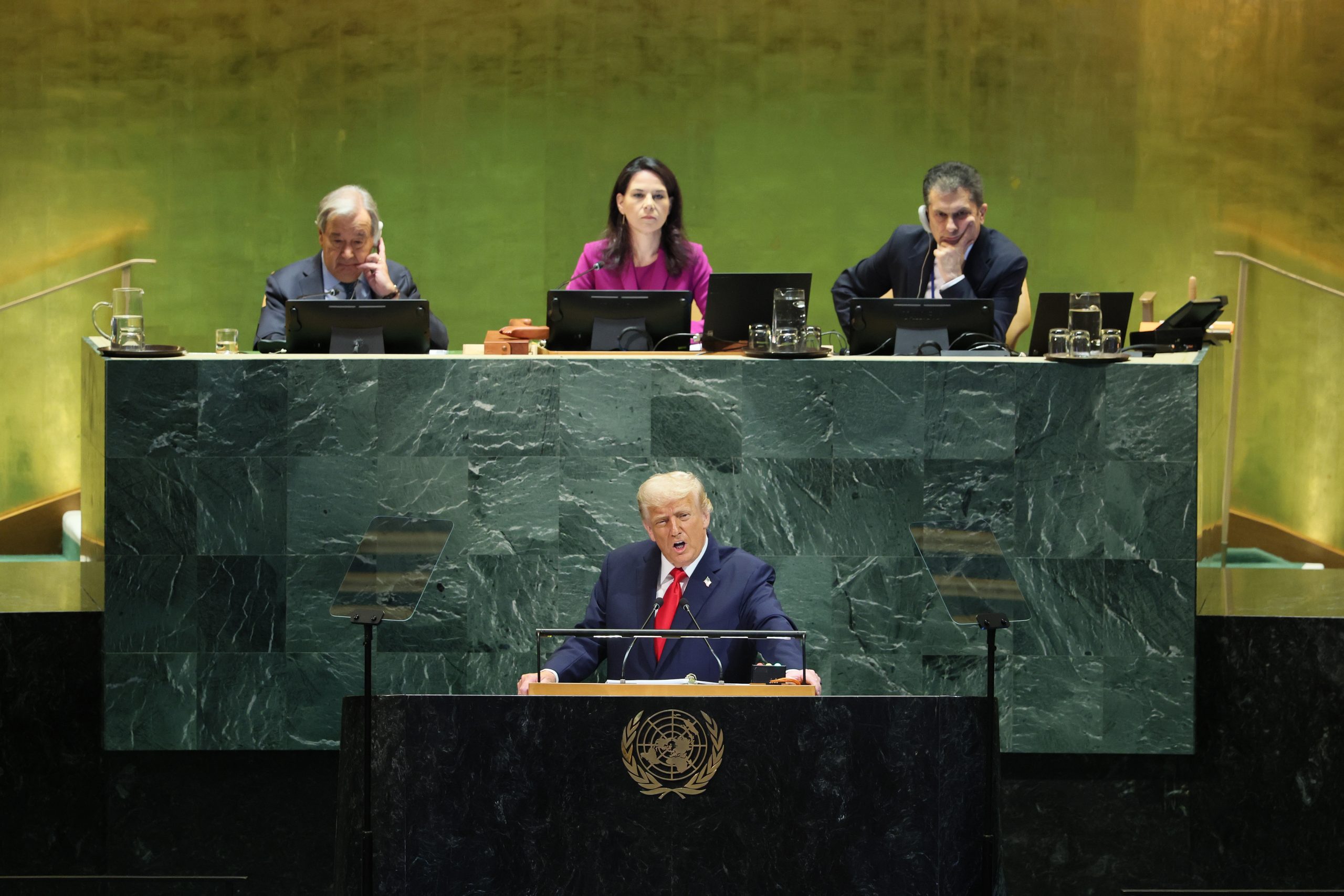
On September 23, President Donald Trump delivered a nearly hour-long address to the UN General Assembly, blending sharp criticism of the global body with self-congratulation for his administration’s achievements.
On September 23, President Donald Trump delivered a nearly hour-long address to the UN General Assembly, blending sharp criticism of the global body with self-congratulation for his administration’s achievements. In a speech that oscillated between grievance and optimism, President Trump touted his “America First” agenda, warned European nations of economic and cultural ruin, and positioned himself as a global peacemaker while questioning the UN’s effectiveness.
2. The UK, Canada, Australia, and Portugal Recognize Palestinian Statehood
On September 21, 2025, the UK, Canada, Australia, and Portugal formally recognized Palestine as a sovereign state, marking a significant shift in their long-standing diplomatic positions.
3. Supreme Court to Review Presidential Authority Over Independent Agencies
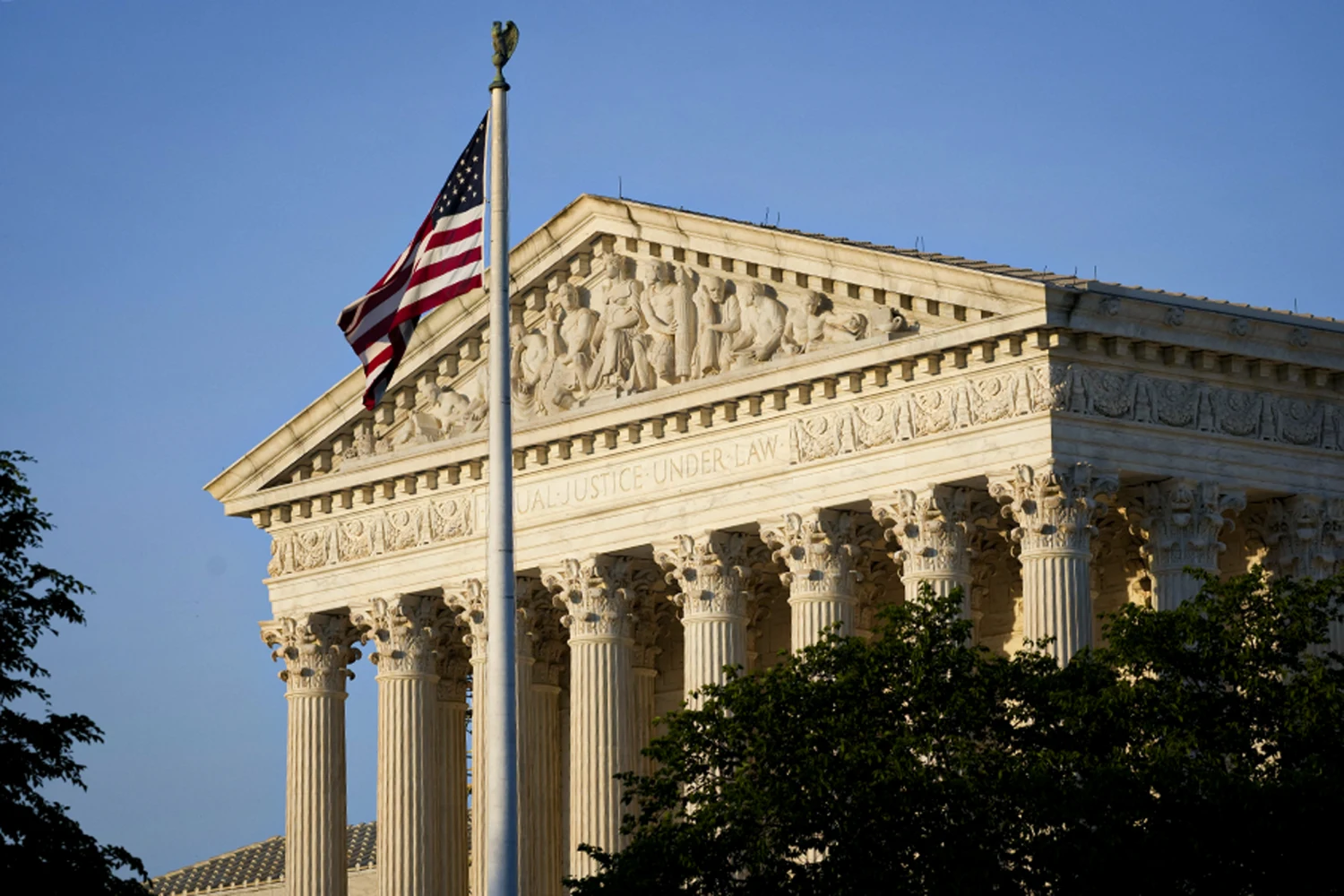
On September 22, 2025, the US Supreme Court announced it would consider a significant expansion of President Donald Trump’s power over independent federal agencies, potentially overturning a nearly century-old precedent that limits when presidents can remove agency board members.
4. President Donald Trump Moves to Designate Antifa as a Major Terrorist Organization
On September 22, President Donald Trump signed an executive order designating the decentralized anti-fascist movement known as Antifa a domestic terrorist organization.
On September 23, President Donald Trump delivered a nearly hour-long address to the UN General Assembly, blending sharp criticism of the global body with self-congratulation for his administration’s achievements. In a speech that oscillated between grievance and optimism, President Trump touted his “America First” agenda, warned European nations of economic and cultural ruin, and positioned himself as a global peacemaker while questioning the UN’s effectiveness.
President Donald Trump opened his speech by calling the UN a “feckless institution” filled with “empty words” that fail to resolve global conflicts. He questioned the organization’s purpose, stating, “The U.N. has such tremendous potential. I’ve always said it. It has such tremendous, tremendous potential. But it’s not even coming close to living up to that potential.” His remarks underscored a return to an unapologetically nationalist stance, a departure from the more internationalist approach of his predecessor, President Joe Biden. Despite his criticisms, Trump later met with UN Secretary-General Antonio Guterres, assuring him that the US remains “100%” supportive of the organization. “I may disagree with it sometimes, but I am so behind it because the potential for peace at this institution is great,” Trump said, striking a conciliatory tone after his earlier rebuke.
President Donald Trump used the global stage to issue stark warnings to European nations, arguing that their migration policies and commitment to green energy initiatives were leading to economic and cultural devastation. He described these policies as a “double-tailed monster” that “destroys everything in its wake.” “I’m telling you that if you don’t get away from the ‘green energy’ scam, your country is going to fail,” Trump declared. “If you don’t stop people that you’ve never seen before that you have nothing in common with, your country is going to fail.” He contrasted these policies with his administration’s approach, which has prioritized expanded oil and gas drilling and aggressive crackdowns on illegal immigration in the United States. Trump expressed sympathy for Europe, saying, “I love the people of Europe, and I hate to see it being devastated by energy and immigration.” His remarks were a clear call for other nations to adopt similar policies to those of his administration.
In a significant development, President Donald Trump addressed Russia’s ongoing war in Ukraine, revealing a shift in his stance. After meeting with Ukrainian President Volodymyr Zelenskyy, Trump announced his belief that Ukraine, with support from the European Union and NATO, could reclaim all territory lost to Russia. “I think Ukraine, with the support of the European Union, is in a position to fight and WIN all of Ukraine back in its original form,” Trump wrote in a post following his speech. “With time, patience, and the financial support of Europe and, in particular, NATO, the original Borders from where this War started, is very much an option.” This marks a departure from his 2024 campaign rhetoric, where he often suggested the US had limited interest in the conflict’s outcome and promised a swift resolution. Trump also took a swipe at Russia, calling it a “paper tiger” and noting that the war, now in its third year, “should have taken a Real Military Power less than a week to win.” He threatened Moscow with “a very strong round of powerful tariffs” if Russian President Vladimir Putin does not negotiate an end to the conflict.
President Donald Trump also addressed the growing international push for Palestinian statehood, a movement spotlighted during the UN General Assembly’s discussions on a two-state solution. France recently joined other nations in recognizing Palestinian statehood, a move Trump and Israel strongly oppose. “The rewards would be too great for Hamas terrorists,” Trump argued, referencing the October 7 attacks. “This would be a reward for these horrible atrocities.” He also participated in a group meeting with leaders from Qatar, Saudi Arabia, Indonesia, Turkey, Pakistan, Egypt, the United Arab Emirates, and Jordan to discuss ending the Gaza war, calling it his “most important meeting” and expressing a desire to resolve a conflict that “should have probably never started.”
Early in his speech, President Donald Trump deviated from his prepared remarks to poke fun at logistical issues at UN headquarters, including a malfunctioning escalator and a faulty teleprompter. “These are the two things I got from the United Nations: a bad escalator and a bad teleprompter,” he quipped, drawing laughter from delegates. UN spokesperson Stephane Dujarric later explained that the escalator issue may have been caused by a videographer from the US delegation triggering a safety mechanism, while a UN official noted that the Trump Administration was responsible for operating the teleprompter.
President Donald Trump reiterated his ambition to win a Nobel Peace Prize, claiming his administration has “ended seven wars” since his return to office. “Everyone says that I should get the Nobel Prize — but for me, the real prize will be the sons and daughters who live to grow up because millions of people are no longer being killed in endless wars,” he said. He cited efforts to mediate conflicts between Israel and Iran, India and Pakistan, and Egypt and Sudan, though experts note that his impact on these resolutions is not as straightforward as he claims. Trump expressed frustration that the UN had not taken a more active role, stating, “It’s too bad that I had to do these things instead of the United Nations doing them.”
President Donald Trump’s address was a vivid reminder of his polarizing leadership style, blending boasts of domestic and foreign policy successes with dire warnings to other nations. His unapologetic “America First” posture, coupled with sharp critiques of global institutions and policies, underscored his intent to reshape the international order. As he navigates his second term, Trump’s vision for global leadership continues to spark both admiration and alarm among world leaders.
The case centers on a challenge to Humphrey’s Executor v. United States (1935), a landmark Supreme Court ruling that established protections for commissioners of independent agencies. In that decision, the Court unanimously held that President Franklin D. Roosevelt could not fire an FTC commissioner without cause, such as misconduct or neglect of duty. This ruling paved the way for the creation of powerful independent agencies tasked with regulating critical areas like consumer protection, labor relations, and federal employment disputes. These agencies were designed to operate with a degree of autonomy, insulated from direct presidential control to ensure decisions were based on expertise rather than political pressures.
However, the Humphrey’s Executor decision has long been a point of contention for conservative legal scholars who argue that independent agencies should be more accountable to the president, as the head of the executive branch. The Justice Department, representing President Donald Trump, contends that the president should have the authority to remove agency board members at will to effectively carry out his agenda. Solicitor General D. John Sauer argued, “The President and the government suffer irreparable harm when courts transfer even some of that executive power to officers beyond the President’s control.” Sauer further noted that courts lack the authority to reinstate fired officials, only to award back pay.
In a 6-3 decision, the Supreme Court permitted President Donald Trump to fire Rebecca Slaughter, a Democratic FTC commissioner, while the broader case challenging Humphrey’s Executor proceeds. This ruling follows a series of similar decisions allowing the president to remove board members from three other independent agencies, including Gwynne Wilcox of the NLRB and Cathy Harris of the MSPB. The Court’s conservative majority did not provide detailed reasoning for allowing Slaughter’s firing, as is typical for decisions on the emergency docket. Justice Elena Kagan, joined by Justices Sonia Sotomayor and Ketanji Brown Jackson, dissented, arguing that Congress explicitly prohibited such presidential removals. “Yet the majority, stay order by stay order, has handed full control of all those agencies to the President,” Kagan wrote. The dissenters expressed concern that eroding the independence of these agencies could lead to regulatory decisions driven by politics rather than expertise.
The upcoming case, set for arguments in December 2025, will determine whether the Court overturns or narrows Humphrey’s Executor. A decision to grant the president broader authority to fire agency board members could fundamentally alter the structure of independent agencies. These bodies, including the FTC, NLRB, and MSPB, play critical roles in enforcing consumer protections, investigating unfair labor practices, overseeing union elections, and resolving federal employment disputes. Opponents of expanding presidential power, including Slaughter’s legal team, argue that allowing the president to remove congressionally confirmed board members at will risks politicizing regulatory decisions. They assert that such a change would undermine the expertise-driven mission of these agencies. “If the President is to be given new powers Congress has expressly and repeatedly refused to give him, that decision should come from the people’s elected representatives,” Slaughter’s attorneys stated. The Justice Department, however, argues that the president’s ability to execute his agenda is hindered when agency officials operate beyond his control. This tension between presidential authority and agency independence lies at the heart of the case.
The Supreme Court’s willingness to hear this case before it has fully worked through lower courts signals its urgency and potential impact. Additionally, Wilcox and Harris, the fired NLRB and MSPB board members, have asked the Court to consider their cases alongside Slaughter’s, highlighting the broader implications for multiple agencies. The Court has also suggested that the president’s removal power may face limits at certain agencies, such as the Federal Reserve. This issue is likely to be tested in a separate case involving fired Fed Governor Lisa Cook, which could further clarify the boundaries of presidential authority.
As the Supreme Court prepares to hear arguments in December, the outcome of this case could redefine the relationship between the executive branch and independent federal agencies. A ruling in favor of expanded presidential power could usher in an era of greater executive control over regulatory bodies, potentially affecting how laws are enforced in areas like consumer protection, labor rights, and federal employment. Conversely, upholding Humphrey’s Executor would preserve the autonomy of these agencies, ensuring their decisions remain grounded in expertise rather than political influence. For now, the Court’s recent decisions signal a conservative majority inclined to reconsider long-standing precedents, setting the stage for a pivotal legal battle with significant consequences for the structure of the federal government.
In a post on X, President Donald Trump stated, “I am pleased to inform our many U.S.A. Patriots that I am designating ANTIFA, A SICK, DANGEROUS, RADICAL LEFT DISASTER, AS A MAJOR TERRORIST ORGANIZATION.” He further emphasized that he would push for thorough investigations into those funding Antifa, ensuring compliance with the highest legal standards.
🚨 "I am pleased to inform our many U.S.A. Patriots that I am designating ANTIFA, A SICK, DANGEROUS, RADICAL LEFT DISASTER, AS A MAJOR TERRORIST ORGANIZATION…" – President Donald J. Trump pic.twitter.com/irLHCkrX1n
White House Press Secretary Karoline Leavitt described the order as one of the administration’s first major steps in fulfilling President Donald Trump’s campaign promises to confront left-leaning political entities. Speaking at a briefing earlier that day, Leavitt railed against Democrats and Trump’s political opponents, stating, “Many Democrats in elective office have now been totally captured by a radical fringe of the far left who want to dehumanize every person they disagree with.” She pointed to Democratic lawmakers who voted against a resolution honoring conservative activist Charlie Kirk, whose recent assassination has intensified the administration’s rhetoric. “We must continue to call this wickedness out,” Leavitt added. “It’s the only way that our nation can heal.”
The announcement follows President Donald Trump’s vow last week to label Antifa a terrorist group, coming in the wake of Charlie Kirk’s killing. In a post on his Truth Social platform, President Trump wrote: “I am pleased to inform our many U.S.A. Patriots that I am designating ANTIFA, A SICK, DANGEROUS, RADICAL LEFT DISASTER, AS A MAJOR TERRORIST ORGANIZATION. I will also be strongly recommending that those funding ANTIFA be thoroughly investigated in accordance with the highest legal standards and practices!”
Press Secretary Karoline Leavitt emphasized that the focus would extend beyond Antifa to its financial backers, noting, “We will be most importantly looking at who is funding Antifa and who is funding these other violent left-wing groups.” She cited evidence from the Kirk investigation, including bullets engraved with anti-fascist messages like “Hey Fascist! Catch!” She also referenced a series of alleged Antifa-linked incidents, including assailants shooting and assaulting law enforcement in Texas and Oregon in July, bringing a pipe bomb to a pro-Trump event in 2022, and threatening to shoot police and Trump supporters outside the Florida State Capitol in 2021. “We have seen a rise in violence perpetuated by Antifa, radical people across this country who subscribe to this group,” Leavitt said.
The term “Antifa,” short for anti-fascist, originates from the German word “antifaschistisch,” referencing 1930s resistance groups that opposed Nazi ideology. It traces its roots to European movements that fought Italian dictator Benito Mussolini during World War II and white supremacist skinhead groups during the Cold War. In the US, Antifa has existed for decades but gained prominence after Donald Trump’s 2016 election and the 2017 Charlottesville rally, where far-right violence galvanized anti-fascist activists.
Unlike structured far-right groups like the Proud Boys or Oath Keepers, which have clear leaders, hierarchies, and membership, Antifa is a loose, leaderless network of individuals and small cells leaning toward the far left, often including anarchists, communists, and hardline socialists. Its members broadly share anti-government, anti-capitalist, pro-LGBTQ+, and pro-immigration views. Activists often organize organically online and offline, without a national command structure, membership lists, or defined funding sources. This decentralization makes it challenging for authorities to target “leaders” or financial networks, as local groups operate independently.
Critics, including President Donald Trump and Republicans, frequently use “Antifa” as a catch-all label for a wide array of liberal and left-wing groups they oppose, blurring lines between ideology and action. The administration’s push raises concerns that it could stretch executive authority to suppress large-scale left-wing dissent. President Trump has already suggested charging members of the activist group Code Pink, who protested him during a recent Washington, D.C., restaurant visit, with crimes, signaling a pattern of aggressive targeting. Trump first promised to designate Antifa a terrorist organization during his first term in 2020, but never followed through. The current effort aligns with his declaration that “radical left political violence has hurt too many innocent people and taken too many lives.” Authorities have described Kirk’s accused killer, Tyler Robinson, as holding a “leftist ideology,” though no direct link to Antifa has been established, and the motive remains unclear.
What distinguishes Antifa from mainstream left-wing activism, according to critics, is some activists’ readiness to employ violence—often framed as self-defense against far-right threats. Participants frequently appear in public wearing dark clothing and face coverings, and online videos capture them wielding clubs, shields, sticks, and pepper spray at rallies. Notable incidents include a 2017 clash in Berkeley, California, where around 100 masked Antifa-linked activists attacked right-wing protesters, leading to multiple arrests. During the 2020 unrest following George Floyd’s killing, self-identified Antifa activist Michael Reinoehl fatally shot a member of the far-right Patriot Prayer group in Portland before being killed by police.
The executive order invokes powers typically reserved for foreign terrorist organizations (FTOs), which allow the US to ban members, deport individuals, seize assets, and prosecute material supporters. However, domestic groups like Antifa do not fit the FTO criteria, which require the entity to be foreign-based. The order specifies implementation within existing laws, directing agencies to pursue “any and all illegal operations” without broadly criminalizing anti-fascist ideology, a move that would violate the First Amendment. Legal experts anticipate swift constitutional challenges, given Antifa’s lack of a centralized structure. Prosecuting individuals for “material support” to domestic groups lacks the clear legal framework available for foreign ones, potentially limiting the order’s reach.
As the administration moves forward, the designation’s practical impact remains uncertain. It fulfills a long-standing Trump pledge but underscores deepening partisan divides, especially in the shadow of Charlie Kirk’s death, where his widow, Erika Kirk, urged fighting hate with love, clashing with President Donald Trump’s assertion at the funeral that he “hates” his political opponents. Karoline Leavitt defended the president, saying, “The president is authentically himself.” Whether this authenticity translates to effective policy or fuels further unrest is a question that will define the coming months.
Here are the main events that occurred in Politics this week:
1. Conservative Political Activist Charlie Kirk Assassinated In Utah Campus Shooting
On September 10, Charlie Kirk, a prominent conservative activist and founder of Turning Point USA, was fatally shot while speaking at Utah Valley University in Orem, Utah
On September 10, Charlie Kirk, a prominent conservative activist and founder of Turning Point USA, was fatally shot while speaking at Utah Valley University in Orem, Utah. The 31-year-old, known for his influential role in mobilizing young conservative voters and his close ties to President Donald Trump, was addressing students as part of Turning Point USA’s college campus tour when the attack occurred. Authorities have described the incident as a targeted political assassination, prompting widespread condemnation and calls for an end to political violence in the United States.
2. President Donald Trump Announces Midterm Convention to Rally Support for Republicans Ahead of 2026 Elections
On September 16, President Donald Trump took to TruthSocial to announce a Republican “Midterm Convention” aimed at energizing the party ahead of the 2026 midterm elections.
On September 16, President Donald Trump took to TruthSocial to announce a Republican “Midterm Convention” aimed at energizing the party ahead of the 2026 midterm elections. The event, with its time and place yet to be determined, promises to be a significant and exciting gathering for the Republicans. President Trump wrote, “The Republicans are going to do a Midterm Convention in order to show the great things we have done since the Presidential Election of 2024. Stay tuned, it will be quite the Event, and very exciting!”
3. In A Major Defeat For Opponents of Gerrymandering, the Missouri State Legislature Approves Congressional Map To Give Republicans an Additional Congressional Seat Ahead Of 2026 Midterm Elections
Missouri lawmakers have approved a new congressional voting map for the 2026 midterm elections, responding to former President Donald Trump’s call to secure a Republican majority in Congress
Missouri lawmakers have approved a new congressional voting map for the 2026 midterm elections, responding to former President Donald Trump’s call to secure a Republican majority in Congress. The state Senate passed the redistricting plan with a 21-11 vote, aiming to flip a Democratic-held seat to Republican control. The map now awaits the signature of Republican Governor Mike Kehoe, who introduced the plan last month, describing it as a “Missouri First” map that aligns with the state’s conservative values.
4. Democratic Support Grows for Zohran Mamdani in NYC Mayoral Race
Zohran Mamdani, the Democratic nominee for mayor of New York City, is gaining significant endorsements from party leaders as concerns mount over President Donald Trump’s attempts to influence the race
Zohran Mamdani, the Democratic nominee for mayor of New York City, is gaining significant endorsements from party leaders as concerns mount over President Donald Trump’s attempts to influence the race. Mamdani, a state assemblyman and democratic socialist, secured the Democratic primary victory in June 2025, defeating former Governor Andrew Cuomo, who is now running as an independent.
5. New Jersey Gubernatorial Race Heats Up as Jack Ciattarelli Closes Gap on Mikie Sherrill
The race for New Jersey’s next governor has tightened dramatically, with Republican Jack Ciattarelli now trailing Congresswoman Mikie Sherrill by a mere two points, according to a recent poll conducted by National Research Inc. from September 8 to 10, 2025
The race for New Jersey’s next governor has tightened dramatically, with Republican Jack Ciattarelli now trailing Congresswoman Mikie Sherrill by a mere two points, according to a recent poll conducted by National Research Inc. from September 8 to 10, 2025. The survey, which included 600 likely voters and carries a margin of error of plus or minus 4 percent, shows Sherrill leading Ciattarelli 47 to 45 percent, signaling a statistical dead heat as the November 4 election approaches. This development underscores the high stakes of the contest, as New Jersey, alongside Virginia, is one of only two states electing a governor this year, making it a critical barometer for national political trends.
On September 16, President Donald Trump took to TruthSocial to announce a Republican “Midterm Convention” aimed at energizing the party ahead of the 2026 midterm elections. The event, with its time and place yet to be determined, promises to be a significant and exciting gathering for the Republicans. President Trump wrote, “The Republicans are going to do a Midterm Convention in order to show the great things we have done since the Presidential Election of 2024. Stay tuned, it will be quite the Event, and very exciting!”
This announcement builds on an idea President Donald Trump first floated last month, when he suggested the Republican Party hold a national convention to highlight the party’s achievements and momentum. “The Republican Party is doing really well,” President Trump stated at the time. “Millions of people have joined us in our quest to MAKE AMERICA GREAT AGAIN. We won every aspect of the Presidential Election and, based on the great success we are having, are poised to WIN BIG IN THE MIDTERMS.” Trump also praised the Republican Party’s fundraising efforts and his administration’s work to undo policies from the Biden era.
In response to President Donald Trump’s announcement, the DNC took a jab, saying, “Imitation is the sincerest form of flattery.” The spokesperson reiterated their plans, noting, “To showcase our tremendous candidates running up and down the ballot and harness the amazing grassroots energy we’re already seeing, several options are on the table for next year, including hosting a midterm convention. The sincerest form of flattery is imitation, and we’re amused the President is following our lead. As both parties gear up for the 2026 midterms, these proposed conventions signal an intensified effort to rally their bases and set the stage for a highly competitive election cycle. With the Republican Party aiming to capitalize on its 2024 momentum and the Democrats pushing back against its policies, the political landscape is heating up.
Zohran Mamdani, the Democratic nominee for mayor of New York City, is gaining significant endorsements from party leaders as concerns mount over President Donald Trump’s attempts to influence the race. Mamdani, a state assemblyman and democratic socialist, secured the Democratic primary victory in June 2025, defeating former Governor Andrew Cuomo, who is now running as an independent.
Prominent Democrats, including Congressman Jamie Raskin of Maryland and Congressman Pat Ryan of New York, have formally endorsed Zohran Mamdani. Congressman Raskin, a leading figure in countering President Donald Trump’s influence, praised Mamdani as a “significant and inspiring leader” with a “Rooseveltian” vision, comparing him to former President Franklin D. Roosevelt for his commitment to the working and middle classes. Ryan, motivated by his opposition to former New York Governor and Mayoral Candidate Andrew Cuomo, described Mamdani as a candidate “for the people,” contrasting him with Cuomo’s self-serving record. Even moderates within the Democratic party such as former Chicago Mayor Rahm Emanuel and New York Congressman Ritchie Torres have expressed support. Emanuel, after meeting Mamdani, noted his preparedness to govern effectively, while Torres called him “impressively knowledgeable and substantive.” Left-leaning Democrats, including Senators Bernie Sanders and Elizabeth Warren, and members of Congress such as Alexandria Ocasio-Cortez, Pramila Jayapa, and Jerrold Nadler, have also backed Mamdani, citing his focus on cost-of-living issues.
Despite Zohran Mamdani’s primary win, some top New York Democrats, including House Minority Leader Hakeem Jeffries, Senate Minority Leader Chuck Schumer, Senator Kirsten Gillibrand, and Governor Kathy Hochul, have not yet endorsed him. Schumer met with Mamdani recently but declined to commit, while Jeffries indicated he would soon clarify his stance. Hochul emphasized the need for pragmatic governance, reflecting her “staunch capitalist” perspective, given New York City’s role as a global financial hub.
President Donald Trump’s efforts to tilt the race toward Andrew Cuomo, including offering positions to Mayor Eric Adams and Republican candidate Curtis Sliwa to drop out, have galvanized Democrats. Party members across the ideological spectrum are urging unity to counter Trump’s influence. Congressman Jamie Raskin stressed the importance of Democratic solidarity, saying, “Democrats must stand together to defend not only our party but our constitution and our country.” Congresswoman Alexandria Ocasio-Cortez echoed this, emphasizing the party’s responsibility to support its nominees post-primary.
Some moderate Democrats, like Conresswoman Laura Gillen and Conressman Tom Suozzi from Long Island, worry that Zorhran Mamdani’s progressive stance could harm the party in the 2026 midterms by fueling Republican narratives painting Democrats as socialists. However, Mamdani’s strong lead in recent polls, particularly among young voters, suggests his appeal could energize the Democratic base. A New York Times/Siena University poll showed him commanding the race, a critical factor as Democrats seek to regain ground lost to Donald Trump in 2024.
Since his nomination, Zohran Mamdani has engaged in extensive outreach, meeting with figures like former President Barack Obama and Rahm Emanuel to discuss governance and policy priorities. His ability to connect with both moderates and progressives has impressed many, with Emanuel noting his readiness to “hit the ground running” and Torres praising his intellectual rigor.
As the mayoral race enters its final stretch, Zohran Mamdani’s campaign is gaining momentum, but the lack of endorsements from key New York Democrats remains a challenge. Meanwhile, Republicans, including Florida Governor Ron DeSantis, are using Mamdani’s candidacy to attack Democrats nationwide. Despite this, supporters like Congressman Jamie Raskin remain steadfast, advocating for party unity: “When progressives beat moderates in the primary, we want the moderates to support the progressives in the general election.”
The race for New Jersey’s next governor has tightened dramatically, with Republican Jack Ciattarelli now trailing Congresswoman Mikie Sherrill by a mere two points, according to a recent poll conducted by National Research Inc. from September 8 to 10, 2025. The survey, which included 600 likely voters and carries a margin of error of plus or minus 4 percent, shows Sherrill leading Ciattarelli 47 to 45 percent, signaling a statistical dead heat as the November 4 election approaches. This development underscores the high stakes of the contest, as New Jersey, alongside Virginia, is one of only two states electing a governor this year, making it a critical barometer for national political trends.
New Jersey has long been a Democratic stronghold, with incumbent Governor Phil Murphy nearing the end of his second term. However, the latest poll reveals a growing sense of unease among voters, with 57 percent of likely voters expressing the belief that the state is on the wrong track. Among these dissatisfied voters, a striking 78 percent attribute their concerns to Murphy’s policies, which they argue have made New Jersey more expensive and less safe. Only 14 percent point to President Donald Trump as a source of their discontent. This pessimism, described by the poll as the most severe to date, could pose a significant challenge for Democrats as they navigate the final weeks of the campaign.
Jack Ciattarelli, a former state assemblyman, has gained traction among key demographic groups, including unaffiliated voters, working-class and middle-class voters, and those who participated in the 2021 gubernatorial election, which he narrowly lost to Phil Murphy. His appeal to these swing groups has contributed to the tightening race, marking a shift from earlier polls. For instance, a Quantus Insights poll conducted from September 2 to 4 showed Sherrill leading by a wider margin of 47 to 37 percent, with a margin of error of 4.3 percent and 95 percent confidence. Another survey by Tipp/League of American Workers, conducted from August 25 to 28, had Sherrill ahead by seven points, highlighting the rapid momentum Ciattarelli has gained in recent weeks.
The significance of this race extends beyond New Jersey’s borders. As one of only two gubernatorial elections in 2025, it offers a rare glimpse into voter sentiment in an off-year election, which typically sees lower turnout and less enthusiasm compared to midterm or presidential election cycles. A Ciattarelli victory could signal challenges for Democrats heading into the 2026 midterms, particularly if voter dissatisfaction with Democratic leadership persists. Political observers note that while presidential policies and party performance often shape midterm outcomes, New Jersey’s off-cycle election may serve as an outlier, driven more by local concerns than national trends.
Commentators have weighed in on the dynamics of the race. Peter Lumaj, a former Republican US Senate candidate, said that Jack Ciattarelli’s strong polling is unsurprising to political strategists. He pointed to shifting voter registration trends, a narrowing Democratic advantage, and a robust GOP campaign capitalizing on frustration with the current administration. Lumaj also highlighted the influence of Donald Trump and historical voting patterns as factors bolstering Ciattarelli’s chances. Conversely, former New Jersey Republican Governor Christine Todd Whitman, who endorsed Mikie Sherrill, emphasized the Democratic candidate’s independence and readiness to lead. Whitman, who served two terms as governor, expressed concern about Ciattarelli’s alignment with Trump, stating that his reluctance to diverge from the President’s positions does not serve New Jersey’s needs. She praised Sherrill’s experience as a former Navy helicopter pilot and her track record in Congress, describing her as an independent voice accountable only to the people of New Jersey.
With less than 60 days until the election, both candidates face a compressed timeline to make their case to voters. Mikie Sherrill, leveraging her military background and congressional experience, is positioning herself as a steady and independent leader capable of addressing the state’s challenges from day one. Jack Ciattarelli, meanwhile, is capitalizing on voter frustration with rising costs and safety concerns, appealing to a broad coalition of swing voters who may determine the outcome. As the campaign enters its final stretch, the race remains too close to call, promising an intense and closely watched battle for the governor’s mansion.
Missouri lawmakers have approved a new congressional voting map for the 2026 midterm elections, responding to former President Donald Trump’s call to secure a Republican majority in Congress. The state Senate passed the redistricting plan with a 21-11 vote, aiming to flip a Democratic-held seat to Republican control. The map now awaits the signature of Republican Governor Mike Kehoe, who introduced the plan last month, describing it as a “Missouri First” map that aligns with the state’s conservative values.
Typically, states redraw congressional districts early in the decade following the national census, which determines the allocation of House seats. However, Missouri’s move comes mid-decade, driven by Trump’s push for Republicans to create more winnable districts. Missouri Republicans argue that the new map, which creates seven Republican-leaning seats and one strongly Democratic district, reflects the state’s political landscape, where Republicans dominate statewide and legislative elections. Currently, Missouri’s congressional delegation consists of six Republicans and two Democrats.
Republican state Senator Rick Brattin, representing the Kansas City suburbs, defended the plan, stating, “The question is, are we actually representing the constituency of Missouri with our congressional delegation? A seven-to-one map does that. Democrats in the state legislature fiercely opposed the changes but could do little to stop or slow their passage because Republicans hold supermajorities in both chambers. Democratic state Senator Stephen Webber argued during floor debate on September 12 that Republicans were surrendering their independence and bending to Trump’s will. “We’re no longer the ‘Show Me State,’” he said, referring the state’s motto. “We’re the ‘Yes, sir state.’” Democratic state Senator Barbara Washington of Kansas City called the map a “blatant political attack.” “This erases the voice of our community,” she said, her voice rising with emotion. “Carving up Kansas City and silencing our constituents is terrible.”
On September 10, thousands of activists protested at the state capitol, vowing to collect the 106,000 signatures needed within 90 days to put the measure to a statewide referendum. By September 12, two lawsuits had already been filed to challenge the plan, signaling a contentious legal battle ahead.
Missouri is not alone in redrawing its maps. President Donald Trump has urged Republican-led states, including Texas, Indiana, and Florida, to adopt district plans that favor Republican candidates. Texas approved a similar plan last month to secure five additional Republican-leaning seats. In response, Democratic-led states like California have proposed maps to bolster Democratic representation, with California’s plan awaiting voter approval on November 4, 2025. Illinois and Maryland are also considering redistricting to favor Democrats.
As Missouri’s new map heads to Governor Kehoe’s desk, its fate remains uncertain. Legal challenges and a potential referendum could delay or block its implementation. Meanwhile, the national push for redistricting continues, with both parties vying to reshape congressional districts to their advantage ahead of the 2026 midterms. The outcome of these efforts could significantly influence the balance of power in the US House.
On September 10, Charlie Kirk, a prominent conservative activist and founder of Turning Point USA, was fatally shot while speaking at Utah Valley University in Orem, Utah. The 31-year-old, known for his influential role in mobilizing young conservative voters and his close ties to President Donald Trump, was addressing students as part of Turning Point USA’s college campus tour when the attack occurred. Authorities have described the incident as a targeted political assassination, prompting widespread condemnation and calls for an end to political violence in the United States.
A rising star in the conservative movement in the US, Charlie Kirk founded Turning Point USA at the age of 18 in 2012, transforming it into a powerhouse of grassroots Republican activism. The organization has amassed millions of followers and played a pivotal role in mobilizing young voters during Trump’s presidential campaigns. Kirk’s events were known for fostering open dialogue between political ideologies, with Vice President JD Vance noting on X that, “If you actually watch Charlie’s events—as opposed to the fake summaries—they are one of the few places with open and honest dialogue between left and right. He would answer any question and talk to everyone.”
Charlie Kirk’s influence extended beyond his organization, as he became one of the most prominent pro-Trump voices in conservative media. His ability to engage young audiences and his unapologetic advocacy for conservative values made him a polarizing yet impactful figure in American politics.
The attack took place during Turning Point USA’s first event of a planned college tour. A single shot was fired, fatally wounding Charlie Kirk and prompting Utah Valley University to lock down its campus and cancel classes. Images from the scene, captured by Tess Crowley of The Deseret News, show law enforcement taping off the area as stunned attendees reacted to the tragedy. Utah Governor Spencer Cox confirmed that Kirk was the intended target, stating, “I want to be very clear that this is a political assassination.” Cox, who spoke with President Trump following the incident, vowed to work with federal and state law enforcement to bring the perpetrator to justice. “Abby and I are heartbroken,” Cox wrote on X. “We are praying for Charlie’s wife, daughter, and son.”
I am being briefed by law enforcement following the violence directed at Charlie Kirk during his visit to Utah Valley University today. We will continue to share updates.
Those responsible will be held fully accountable. Violence has no place in our public life.
FBI Director Kash Patel reported that a person detained as a suspect was later released, and no one else is currently in custody. Authorities have yet to identify a suspect or confirm a motive for the shooting, leaving many questions unanswered.
The assassination drew swift reactions from leaders across the political spectrum, with many condemning the act as a stark reminder of the dangers of political violence. President Donald Trump, in a video statement, described Kirk as “the best of America” and blamed “the radical left” for the attack, arguing that inflammatory rhetoric comparing conservatives to “Nazis and the world’s worst mass murderers” incited the violence. “This kind of rhetoric is directly responsible for the terrorism that we’re seeing in our country today, and it must stop right now,” President Trump said. He vowed to investigate those contributing to political violence, including organizations that “fund it and support it,” and ordered flags lowered to half-staff through September 14 in Kirk’s honor.
In a September 12 interview on Fox & Friends, President Donald Trump expanded on his claims, suggesting that “radical left lunatics” were primarily responsible for the nation’s political violence. He dismissed suggestions of extremism on the right, stating, “The radicals on the right oftentimes are radical because they don’t want to see crime. The radicals on the left are the problem, and they’re vicious and they’re horrible and they’re politically savvy.” Trump also called for investigations into liberal philanthropist George Soros and his family, accusing them of “agitation.”
Vice President JD Vance offered a prayer for Kirk, writing on X, “Eternal rest grant unto him, O Lord.” He praised Kirk’s commitment to civil discourse, emphasizing the inclusive nature of his campus events.
Former presidents also weighed in, universally condemning the violence. Former President Joe Biden wrote on X, “There is no place in our country for this kind of violence. It must end now. Jill and I are praying for Charlie Kirk’s family and loved ones.” Former President Barack Obama echoed this sentiment, stating, “We don’t yet know what motivated the person who shot and killed Charlie Kirk, but this kind of despicable violence has no place in our democracy. Michelle and I will be praying for Charlie’s family tonight, especially his wife Erika and their two young children.”
Former President George W. Bush called for an end to “violence and vitriol” in public discourse, noting, “Members of other political parties are not our enemies; they are our fellow citizens.” Former President Bill Clinton expressed sadness and anger, urging introspection and renewed efforts for peaceful debate. Even before Kirk’s death was confirmed, Democratic leaders like House Minority Leader Hakeem Jeffries, Senate Minority Leader Chuck Schumer, and California Governor Gavin Newsom condemned the attack. Newsom, who had interviewed Kirk for his podcast earlier this year, called the shooting “disgusting, vile, and reprehensible.”
Charlie Kirk’s assassination is the latest in a disturbing series of violent incidents targeting political figures in the US. Earlier incidents include the assassination of Minnesota Democratic state representative Melissa Hortman and her husband, as well as the severe wounding of Democratic state senator John Hoffman and his wife in a separate attack. Authorities reported that the suspect in those cases had compiled a list of largely Democratic lawmakers and abortion rights advocates as potential targets.
These incidents have heightened concerns about the state of political discourse in America. President Trump’s response has drawn scrutiny, particularly his decision to pardon nearly all individuals convicted of federal crimes related to the January 6, 2021, Capitol riot, including those who committed violence against police officers. Critics argue that this move undermines efforts to address political violence impartially.
Turning Point USA released a statement mourning Kirk’s death, describing him as a visionary leader whose loss is deeply felt. “May he be received into the merciful arms of our loving Savior, who suffered and died for Charlie,” the statement read. “We ask that everyone keep his family and loved ones in your prayers. We ask that you please respect their privacy and dignity at this time.”
As investigations continue, Kirk’s death has sparked a broader conversation about the state of political rhetoric and its consequences. While President Donald Trump and his allies point to inflammatory language from the left as a catalyst, others argue that vilification across the political spectrum fuels division and violence. The assassination serves as a grim reminder of the need for civility and mutual respect in public discourse.
The nation now mourns a figure who, regardless of political affiliation, sought to engage young Americans in the democratic process. As leaders from both parties call for an end to violence, the hope is that Kirk’s death will inspire a renewed commitment to dialogue over division.
President Donald Trump has repeatedly argued that mail-in voting undermines election integrity. He claimed, without evidence, “Mail-in ballots are corrupt,” citing unverified anecdotes of individuals receiving multiple ballots in states like California. President Trump has long maintained that mail-in voting enables tampering and multiple voting, despite lacking evidence to support widespread fraud. However, election experts have consistently refuted these claims. Debra Cleaver, founder of VoteAmerica, emphasized the security of mail-in ballots, noting that barcodes on outgoing and return envelopes ensure ballots are tracked and counted accurately. Following the 2020 election, Christopher Krebs, then-director of the Cybersecurity and Infrastructure Security Agency, declared it “the most secure in American history.” Audits and investigations, including those by Republican officials, found no evidence of significant fraud in the 2020 election.
President Donald Trump’s proposed executive order faces significant legal hurdles. He argued in a social media post that states are mere “agents” of the federal government in elections and must follow presidential directives. However, Article I, Section 4 of the US Constitution explicitly grants states the authority to regulate elections, with Congress holding the power to alter such regulations. Legal scholars note that the President lacks the constitutional authority to unilaterally ban mail-in voting, rendering the proposed executive order legally questionable.
Election experts warn that eliminating mail-in voting could disrupt electoral processes. David Becker, executive director of the Center for Election Innovation & Research, called the idea “incredibly bad,” arguing it would create chaos, especially with midterm elections just 15 months away. He noted that mail-in voting, used since the Civil War, enhances accessibility and security when properly implemented.
The White House, through spokesperson Harrison Fields, defended President Donald Trump’s stance, claiming that Democratic policies like “unfettered mail-in voting” have eroded trust in elections. Fields emphasized Trump’s goal to “secure America’s elections” through measures like voter ID requirements and stricter voting laws in states like California and New York.
President Donald Trump’s push to ban mail-in voting has sparked renewed debate over election security and accessibility. While he frames it as a safeguard against fraud, critics argue it could disenfranchise voters who rely on mail ballots due to disability, military service, or other constraints. The legal and practical challenges of implementing such a ban underscore the complexities of reforming election systems in a polarized political landscape. As the 2026 midterms approach, the debate over mail-in voting is likely to intensify, with significant implications for voter turnout and trust in democratic institutions.
California Democrats have unveiled a bold proposal for a new congressional map that could secure up to five additional seats for their party in the House of Representatives. This move, spearheaded by Governor Gavin Newsom, is a strategic response to Republican redistricting efforts in states like Texas, intensifying the national battle for House control ahead of the 2026 midterm elections. The proposal has sparked heated debate, with critics arguing it undermines the state’s independent redistricting process, while supporters claim it’s a necessary countermeasure to maintain political balance. The proposed map targets five Republican-held districts, making them more favorable to Democrats. The affected representatives, Kevin Kiley, Doug LaMalfa, David Valadao, Darrell Issa, and Ken Calvert, now face significantly bluer constituencies. Democrats currently hold 43 of California’s 52 congressional seats, and this redistricting effort aims to solidify their dominance further.
Governor Newsom has framed the plan as a direct response to Texas Republicans’ redistricting, which is expected to add up to five Republican seats. He argues that California must “fight fire with fire” to counter what he describes as aggressive gerrymandering in red states. To ensure public input, Newsom has proposed a special election on November 4, 2025, allowing California voters to decide on the new map, bypassing the state’s independent Citizens Redistricting Commission. “We have the opportunity to de facto end the Trump presidency in less than 18 months. That’s what’s at stake,” Newsom said at a recent press conference, emphasizing the potential for a Democratic-controlled House to check Republican influence. The state legislature is set to vote on the proposal on August 21, 2025. If approved, the new districts would apply to the 2026, 2028, and 2030 elections, with the Citizens Redistricting Commission resuming its authority after the 2030 census.
The proposal has drawn sharp criticism from Republicans and advocates for transparent governance. Republican Representative Kevin Kiley has been vocal in his opposition, introducing federal legislation to ban mid-decade redistricting and accusing Newsom of undermining California’s independent redistricting process. “This is a moment for every Californian and every American of decency, regardless of party affiliation, to speak out against the abject corruption that our governor is attempting,” Kiley declared on the House floor. Good government groups echo these concerns, arguing that bypassing the Citizens Redistricting Commission, established by voters in 2008 and expanded in 2010 to include congressional districts, erodes transparency and public trust. Jeanne Raya, a former Democratic member of the commission, warned that the lack of openness in Newsom’s plan could disenfranchise voters. “Somebody’s going to be drawing maps, whether behind a real door or a virtual door,” Raya said. “There will not be that transparency that is written into the independent commission’s work, and voters will suffer for that. California Governor Gavin Newsom defended the proposal as a transparent process, emphasizing that voters will have the final say through the special election, a step not taken in Texas, where Republican-drawn maps face no such public vote. He also noted that California’s plan includes a trigger clause, meaning it would only take effect if Texas or other red states proceed with their redistricting efforts.
California’s redistricting proposal highlights the escalating partisan battle over congressional representation. While Governor Gavin Newsom argues it is a necessary defense against Republican tactics, critics warn it risks further politicizing a process meant to be impartial. The outcome of the November 4 special election, if approved by the legislature, will determine whether California adopts this contentious new map, and could set a precedent for how states navigate redistricting in this polarized era. As the debate unfolds, all eyes are on California and Texas, where these dueling strategies could reshape the US House for years to come.
In 1942, economist Joseph Schumpeter introduced the concept of creative destruction in his seminal work, Capitalism, Socialism, and Democracy. He described it as the process by which innovations such as new technologies, products, or methods, disrupt and ultimately dismantle established economic structures to pave the way for novel systems and opportunities. This relentless cycle of renewal is not merely a feature of capitalism but its very engine, driving progress through the destruction of the old to make room for the new. Beyond economics, creative destruction serves as a powerful lens for understanding transformation in art, culture, and society, acting as a bridge between the analytical rigor of economics and the expressive freedom of creative disciplines.
The transition from horse-drawn carriages to automobiles exemplifies creative destruction because the innovative technology of cars disrupted and largely eliminated the established carriage industry, displacing related jobs and infrastructure while creating new markets, industries, and opportunities for economic growth.
Schumpeter argued that capitalism thrives on innovation, but this comes at a cost. Established industries, firms, and practices often become obsolete as entrepreneurs introduce groundbreaking ideas. The rise of the automobile, for instance, decimated the horse-drawn carriage industry, while digital streaming platforms have largely supplanted traditional media like DVDs and broadcast television. This process is not gentle, as it disrupts livelihoods, renders skills obsolete, and reshapes markets. Yet, Schumpeter saw it as essential for economic vitality, as it fosters efficiency, growth, and adaptation.
The shift from Neoclassical art to Impressionism exemplifies creative destruction as Impressionist artists like Monet and Renoir rejected the rigid, idealized forms of Neoclassicism, disrupting traditional artistic conventions with innovative techniques like loose brushwork and vibrant colors, thus creating new avenues for expression while rendering older styles less dominant.
The parallels between economic and artistic innovation are striking. In art, creative destruction manifests as the rejection of established norms, styles, or mediums in favor of bold experimentation. Consider the transition from Romanticism to Impressionism in the 19th century. Artists like Claude Monet and Pierre-Auguste Renoir broke with the rigid conventions of academic painting, embracing loose brushwork and vibrant color palettes to capture fleeting moments of light and life. This shift shocked the art world, rendering traditional techniques less relevant while opening new avenues for expression.
Similarly, the 20th century saw movements like Dadaism and Abstract Expressionism dismantle prevailing aesthetic frameworks. Marcel Duchamp’s Fountain (1917), a readymade urinal presented as art, challenged the very definition of artistic value, forcing a reevaluation of creativity itself. These disruptions, while initially controversial, expanded the boundaries of art, inspiring future generations to explore uncharted territory.
The concept of creative destruction serves as a bridge between economics and art, illuminating their shared reliance on reinvention. In both domains, progress demands a willingness to let go of the familiar. Just as entrepreneurs disrupt markets with innovative business models, artists challenge cultural norms with provocative works. This shared dynamic invites reflection on broader societal phenomena, such as reinvention, disruption, and even gentrification.
Gentrification can be viewed through the lens of creative destruction, as it revitalizes areas and creates new opportunities, but at times comes at the cost of cultural erasure.
Gentrification, for example, can be viewed through the lens of creative destruction. As urban neighborhoods evolve, new businesses, residents, and cultural trends displace longstanding communities and traditions. While this process can revitalize areas, it often comes at the cost of cultural erasure or displacement, raising ethical questions about who benefits from such transformations. Similarly, in technology, the rise of artificial intelligence disrupts traditional labor markets but also creates opportunities for new industries and creative pursuits.
Creative destruction reminds us that progress is not linear or painless. It requires courage to dismantle the old, whether it be an obsolete industry or a revered artistic tradition. Yet, this destruction is not an end but a beginning, a catalyst for innovation that drives societies forward. By embracing the discomfort of change, we unlock the potential for reinvention, ensuring that both economies and cultures remain dynamic and resilient.
In conclusion, Schumpeter’s concept of creative destruction transcends economics, offering a framework to understand transformation across disciplines. Its resonance in art underscores the universal need for disruption as a precursor to creation. As we navigate an era of rapid technological and cultural change, creative destruction challenges us to balance the costs of disruption with the promise of renewal, fostering a deeper appreciation for the cycles that shape our world.
In economics, externalities are costs or benefits that affect parties who did not choose to incur them. A factory polluting a river, for example, imposes costs on downstream communities, including health issues, contaminated water, and dead ecosystems, while the factory reaps profits without bearing the full burden. This concept, though rooted in economics, reverberates far beyond, offering a lens to examine exploitation, ethical failures in the art world, and the unaccountable sprawl of global supply chains.
A factory polluting the air in pursuit of a profit is an example of a negative externality, as it results in a producer offloading harm onto others.
Externalities occur when the price of a good or service does not reflect its true social cost or benefit. Negative externalities such as pollution, arise when producers offload harm onto others. Positive externalities occur when benefits spill over, often unintentionally. For example, a homeowner who maintains a vibrant community garden not only enjoys their own harvest but also enhances property values and fosters social bonds for neighbors, who reap these benefits without contributing to the garden’s upkeep. The issue lies in accountability: those creating the externality often face no consequences, leaving society to clean up the mess.
An example of an externality would be a coal plant. A coal plant generates cheap energy but spews carbon, worsening climate change. The plant’s owners profit, while the global public pays the price in floods, heatwaves, and displacement. The market, left unchecked, incentivizes this imbalance. Economists propose solutions such as carbon taxes or cap-and-trade systems to internalize these costs, but implementation lags, especially across borders.
The production of consumer products such as smartphones often amplifies externalities.
Global supply chains amplify externalities by diffusing responsibility. For example, a smartphone’s production spans continents: cobalt mined in Congo, assembled in China, sold in the US. Each step generates externalities, child labor, toxic waste, carbon emissions, yet no single entity is held accountable. The consumer enjoys a sleek device, unaware of the social and environmental toll embedded in its supply chain.
International trade agreements often prioritize profit over people. Developing nations, desperate for economic growth, become dumping grounds for externalities. Factories in Bangladesh or Vietnam produce cheap goods for Western markets, but lax regulations mean workers face unsafe conditions, and rivers turn toxic. The harm is outsourced, invisible to the end consumer. Globalization’s promise of efficiency masks a darker truth: it thrives on exploiting those least equipped to resist.
The art world, often seen as a bastion of creativity, is not immune to externalities. Consider the ethics of art production. Large-scale installations may rely on materials sourced through exploitative labor or environmentally destructive practices. Artists and galleries rarely account for these costs, yet their work is celebrated in pristine white cubes. The harm, deforestation, and displaced communities remain out of sight.
The art world is increasingly confronting the concept of negative externalities. .
Patronage also breeds externalities. Wealthy collectors or institutions fund art to burnish their image, but their money may come from industries tied to social or environmental damage. The art world becomes complicit, laundering reputations while ignoring the broader impact. A museum funded by an oil magnate might showcase “radical” art, but the contradiction festers: the institution profits while externalizing the cost of its patron’s legacy.
Externalities expose a core flaw in institutions, that they are often built to prioritize self-preservation over systemic responsibility. Governments, corporations, and cultural bodies often deflect blame, leaving marginalized groups to bear the brunt. For instance, urban development projects gentrify neighborhoods, displacing low-income residents while developers profit. The social cost, fractured communities, lost cultural heritage, is externalized, unaddressed by those who caused it.
Institutional criticism, a practice rooted in questioning power structures, can challenge this. Artists like Hans Haacke have used their work to expose how institutions evade accountability, from corporate sponsorships to political influence. By shining a light on externalities, such a critique forces us to question who pays the price for progress, and why they are left holding the bill.
Policies such as carbon taxes can help address externalities, but there is much resistance to such policies by entrenched interests.
Addressing externalities requires systemic change. Policy tools like carbon taxes or labor regulations can help, but they face resistance from entrenched interests. On a cultural level, society might need to rethink value, not just in markets but in art, ethics, and global systems. Consumers can demand transparency in supply chains. Artists can interrogate their materials and patrons. Institutions can prioritize accountability over optics.
The concept of externalities is not just economic; it is a moral framework. It asks us to see the hidden costs society has normalized and to demand a world where harm is not offloaded onto the voiceless. Until we confront these unseen burdens, exploitation will persist, cloaked in the guise of progress.
In many countries, a striking economic divide persists which is known as the dual economy. This phenomenon describes the coexistence of two distinct economic sectors within a single nation: an advanced, modern sector integrated with global markets, and a subsistence sector characterized by informal, low-productivity activities. The dual economy can be thought of as two parallel worlds, operating side by side yet rarely intersecting, each with its own rules, opportunities, and challenges.
Within the concept of the dual economy, the advanced sector of the economy is usually centered around an urban area that is technologically sophisticated and globally connected.
The advanced sector is typically the face of progress: urban, technologically sophisticated, and globally connected. It encompasses industries including tech, finance, and manufacturing, where workers enjoy higher wages, formal employment, and access to global supply chains. The advanced sector drives innovation, attracts investment, and fuels economic growth.
Cities such as Buenos Aires are characterized by having both an advanced economic sector and a subservient sector existing side by side.
The duality creates a layered reality. A city like New York or London might boast gleaming financial districts while nearby slums house workers scraping by in the informal economy. These are not just economic divides but social and cultural ones, shaping distinct lifestyles, opportunities, and even worldviews.
This divide inspires powerful narratives. Artists and writers often explore themes of exclusion, who gets to participate in the “modern” world? The informal sector’s invisibility resonates in stories of marginalized voices, while the idea of parallel worlds invites speculative takes on alternate realities coexisting in one space.
Advanced sectors of the economy, such as Artificial Intelligence (AI) often benefit from government policies and public investment, while the subservience sector is left to fend for itself. This dynamic perpetuates inequality.
The dual economy is not just a quirk; it is a structural challenge. The advanced sector often benefits from government policies, infrastructure, and global trade, while the subsistence sector is left to fend for itself. This perpetuates inequality, as those in the informal economy lack access to education, healthcare, or capital to transition to higher-productivity work. Bridging this gap requires targeted policies: microfinance, skill development, and infrastructure investment can help integrate the subsistence sector into the broader economy.
Yet, the dual economy also highlights resilience. Informal workers, often excluded from formal systems, demonstrate remarkable adaptability, creating livelihoods against the odds. Their stories deserve to be told, not just as tales of struggle but as testaments to human ingenuity.
The dual economy is more than an economic framework, it is a reflection of stratified, parallel worlds within a single society. It challenges us to see the invisible, to question who benefits from progress, and to imagine ways to bridge the divide. Whether through policy, art, or storytelling, exploring this concept invites us to confront the layered realities of our world and envision a more inclusive future.
Path dependency is a concept that illuminates how decisions made in the past, sometimes seemingly inconsequential at the time, cast long shadows over the present and future. It suggests that the trajectory of systems, whether in policy, culture, technology, or art, is not merely a product of current conditions but is deeply tethered to historical choices, which create inertia that can both guide and constrain future possibilities. Unlike a simple cause-and-effect model, path dependency emphasizes the compounding effects of early decisions, where initial conditions set a course that becomes increasingly difficult to deviate from, even when alternatives might be more efficient or desirable. This framework offers a nuanced lens through which to explore how legacy and inertia shape modern trajectories, particularly in the context of diaspora artists who grapple with redefining cultural identities while navigating the weight of historical narratives.
The QWERTY keyboard layout’s continued dominance, despite the existence of the more efficient Dvorak keyboard layout, is the classic example of path dependence in economics and technology.
At its core, path dependency illustrates how systems evolve through a series of choices that lock in certain outcomes. In economics, the classic example is the QWERTY keyboard, designed in the 1870s to prevent typewriter jams by slowing typists down. Despite the advent of more efficient layouts like Dvorak, QWERTY’s early adoption by typewriter manufacturers, its standardization across industries, and the collective investment in learning it created a self-reinforcing cycle that entrenched its dominance. Switching to a new layout would require retraining millions and retooling production, making the cost of change prohibitive. This phenomenon, where historical choices create sticky systems, extends far beyond technology, influencing how societies, policies, and cultural identities evolve.
In American foreign policy in the Middle East, path dependence reveals how decisions made decades ago continue to shape contemporary challenges. The post-World War II strategy of the US to secure oil interests and counter Soviet influence led to alliances with authoritarian regimes, such as Saudi Arabia, and interventions like the 1953 CIA-orchestrated coup in Iran. These choices established a pattern of prioritizing geopolitical stability over democratic ideals, creating a legacy of mistrust and anti-American sentiment in the region. The 2003 invasion of Iraq, for instance, can be seen as a continuation of this path, building on earlier interventions that normalized military presence and regime change as tools of influence. Each decision reinforced a trajectory where the US became entangled in complex regional dynamics, making it difficult to pivot toward diplomacy or disengagement without risking established interests. The inertia of these policies constrains modern options, as new administrations inherit alliances, enmities, and expectations shaped by decades of prior commitments.
Retronyms, words created to distinguish an original concept from newer variations, reflect path dependency by showing how historical developments shape language,
Wider culture is also profoundly shaped by path dependency, often through the lens of retronyms, terms coined to distinguish older forms from newer iterations. Retronyms emerge when historical shifts force us to redefine what was once taken for granted. For example, the term “acoustic guitar” became necessary only after the invention of the electric guitar, just as “landline phone” emerged with the rise of mobile phones. These linguistic artifacts highlight how technological or cultural innovations can retroactively reshape our understanding of the past. In the context of path dependency, retronyms underscore how historical developments lock in certain cultural frameworks, making it challenging to revisit or reimagine earlier forms without the baggage of their successors. The term “traditional art,” for instance, gained prominence as digital and conceptual art forms proliferated, framing older practices as static or nostalgic, even when they remain vibrant and evolving.
Artists from the African diaspora, at times, may draw on ancestral traditions such as oral storytelling or textile patterns, which were shaped by centuries of resistance to colonialism and slavery.
The dynamic of path dependency is particularly poignant for diaspora artists, whose work often grapples with the tension between inherited cultural legacies and the need to forge new identities in contemporary contexts. Historical migrations, whether forced or voluntary, create path-dependent cultural narratives that artists must navigate. For example, artists from the African diaspora may draw on ancestral traditions such as oral storytelling or textile patterns, which were shaped by centuries of resistance to colonialism and slavery. These traditions, while rich, carry the weight of historical trauma, and their integration into modern art can be constrained by expectations from both their communities and the broader art world. The inertia of these cultural paths, where certain symbols, motifs, or narratives become codified as “authentic,” can limit creative freedom, as artists risk being pigeonholeed or misunderstood when they deviate from expected forms.
Yinka Shonibare’s vibrant, thought-provoking works, often featuring “Dutch Wax” fabric, challenge path dependency by reimagining historical narratives through a postcolonial lens. His sculptures, paintings, and installations disrupt conventional Eurocentric stories, blending African and Western cultural elements to highlight hybrid identities and question rigid historical trajectories. By doing so, Shonibare reframes how people perceive cultural interdependence, urging a reevaluation of fixed historical and societal paths.
Diaspora artists also demonstrate the potential to subvert path dependence by reclaiming and redefining their narratives. Consider the work of artists such as Yinka Shonibare, whose use of Dutch wax fabric, often mistaken as quintessentially African but a product of colonial trade routes, challenges assumptions about authenticity and cultural purity. By engaging with the historical paths that shaped these materials, Shonibare reimagines their meaning, turning a symbol of colonial exchange into a commentary on hybridity and globalization. Similarly, contemporary Indigenous artists like Kent Monkman use traditional forms like beadwork or painting alongside subversive, campy aesthetics to confront colonial legacies, breaking free from the path-dependent expectation that Indigenous art must adhere to romanticized notions of pre-colonial purity. These artists illustrate how path dependence can be both a constraint and a creative springboard, as they navigate the inertia of historical narratives while carving out new trajectories.
The promotion of Windows operating systems and programs optimized for Windows exemplifies path dependency, as Microsoft’s early dominance in personal computing created a self-reinforcing cycle. Widespread adoption led to more software development for Windows, locking in users and developers to its ecosystem. This entrenched compatibility and familiarity, making it challenging for alternative systems to gain traction, illustrating how initial choices shape long-term technological trajectories.
Technology offers another lens for understanding path dependence, where early standards shape entire industries. The dominance of Microsoft Windows in personal computing, for example, stems from decisions in the 1980s to license the operating system widely, creating a feedback loop where software developers prioritized Windows-compatible programs, which in turn attracted more users. This ecosystem became so entrenched that even superior alternatives struggled to gain traction. The legacy of these technological choices extends to cultural practices, as seen in the art world’s shift toward digital platforms. The rise of NFTs, for example, builds on the path-dependent infrastructure of blockchain technology, which prioritizes decentralization and market-driven valuation. While this has democratized access for some artists, it also constrains others who lack the resources or inclination to engage with digital markets, highlighting how technological paths can both enable and exclude.
The Western historical art canon, epitomized by Renaissance art, reflects path dependency by prioritizing linear perspective and naturalistic representation, choices that have long shaped artistic standards. This focus marginalizes non-Western and non-linear art forms, such as Aboriginal dot painting or Islamic calligraphy, which emphasize symbolic abstraction and cultural storytelling, reinforcing a Eurocentric narrative that sidelines diverse artistic traditions.
In art, path dependency manifests in the canonization of certain styles or movements, which can overshadow alternative voices. The Western art historical canon, for instance, privileges Renaissance perspective and modernist abstraction, paths established through centuries of patronage and institutional support. These choices marginalize non-Western or non-linear art forms, such as Aboriginal dot painting or Islamic calligraphy, which follow distinct historical trajectories. Diaspora artists often find themselves navigating this tension, balancing the expectations of global art markets with the desire to honor their cultural roots. The inertia of the canon can make it difficult for these artists to gain recognition without conforming to established norms. Yet, their work also challenges the canon by introducing hybrid forms that defy traditional categorization.
The concept of path dependence also resonates with the broader theme of legacy in contemporary society. Historical decisions, whether in policy, culture, or art, create frameworks that are difficult to escape, yet they also provide the raw material for reinvention. Diaspora artists, in particular, embody this duality, as they inherit cultural identities shaped by migration, colonialism, and adaptation while forging new paths in globalized contexts. Their work highlights the challenges of reimagining cultural identities when history exerts such a powerful pull. By engaging with retronyms, whether linguistic or conceptual, these artists reveal how the past is never truly fixed but is constantly redefined by the present.
Path dependency offers a powerful framework for understanding how historical choices shape modern trajectories while also illuminating the possibilities for change. It reminds us that the present is not a blank slate but a tapestry woven from countless prior decisions, each thread reinforcing or challenging the ones before it. For diaspora artists, this lens underscores the complexity of their task: to honor the legacy of their histories while breaking free from the constraints of inertia, redefining their narratives in a world that is both bound by the past and open to reinvention.
In addition to my hobby of record collecting, I am also an avid coin collector. I generally focus on American, Canadian, Mexican, and British coinage from the 19th and 20th centuries. My favorite types of American coins to collect are proof coins, early commemorative half dollars, and American coins of unusual denomination or type. This is a discussion of the history of the coin collecting hobby.
The first coins ever made are believed to be Lydian staters, minted in the Kingdom of Lydia (modern-day Turkey) during the 6th Century BCE. These coins were made of electrum, a naturally occurring alloy of gold and silver, and featured a lion’s head on one side. The Lydian staters are considered the first coins because they were officially issued by a government body and served as a model for later coinage.
Coin collecting, formally known as numismatics, has roots that stretch back to the dawn of formal human civilization. Coins were first created in the ancient world as a practical tool for trade, but from the very beginning, they carried more than monetary value. Their artistry, the authority of the ruler whose image they bore, and the historical events they commemorated made them attractive to collectors long before the concept of a “hobby” existed in the modern sense. Over the centuries, what began as a pastime for the elite became an organized pursuit shared by scholars, historians, and eventually millions of everyday people.
The generation of numismatists active during the Renaissance generally focused on collecting ancient Roman coins as objects of study, treating them as tangible records of a forgotten history.
The earliest known coin collectors were rulers and aristocrats in antiquity. Roman emperors such as Augustus and Hadrian are believed to have assembled cabinets of coins depicting earlier emperors and historic events, both to honor Rome’s heritage and to display their own refinement. Coins in the ancient world often circulated far from their place of origin, and finding a coin from a distant land could spark fascination. In the Middle Ages, coin collecting became less common outside of royal treasuries, but the Renaissance brought a revival of interest in classical antiquity. The Italian poet and scholar Petrarch, often credited as the first Renaissance-era numismatist, collected ancient Roman coins not as curios but as objects of study, treating them as tangible records of history. By the 16th and 17th centuries, collecting coins had become a scholarly pursuit among European nobility, with elaborate cabinets designed to display prized specimens.
The Industrial Revolution fundamentally changed the scope of numismatics. Advances in minting technology produced sharper and more uniform coins, while the growth of a prosperous middle class meant the pastime was no longer restricted to kings and scholars. By the mid-19th century, organized numismatic societies were forming in Europe and North America. Auction houses began selling entire collections, dealers emerged in major cities, and price lists and catalogues gave collectors a way to gauge the market. The study of coins evolved into a recognized academic discipline, with numismatists cataloging not just coins but also their metallurgy, iconography, and minting history.
When the large cent in 1857 was discontinued in fsvor of smaller-sized cents, the first coin collecting boom in the US began in earnest. Nostalgia took over for many who wanted to remember the coins they grew up with. The idea of collecting by date originated at this time, as many people sought to find as many different dates as possible before large cents disappeared from circulation. The idea of rarity began to present itself, as some dates were especially hard to find. This prompted some to offer the rarer dates at a premium to those who could not find them. Private sales were made, but no recognized pricing or standards were in place yet
In the US, coin collecting developed alongside the country’s own coinage. Early federal issues like the 1793 Chain Cent, with its distinctive link design, and the Flowing Hair silver dollars of the 1790s were recognized even at the time as unusual pieces worthy of saving. Still, for much of the 19th century, collecting was the domain of wealthy hobbyists and scholars. A major turning point came in 1857 when the US Mint discontinued the large cent and replaced it with a smaller-sized cent that is still in circulation today and will continue to be produced until the end of 2025. The sudden disappearance of the older coins from circulation spurred interest among the public, who began saving examples. This episode introduced many ordinary Americans to the idea that coins could be preserved for their historical and monetary significance.
Proof coins such as this 1957 Proof Ben Franklin half dollar are struck from specially polished dies and planchets that create sharp details and mirror-like surfaces.
Also important to the hobby’s development was the production of proof coins by the US Mint. Proof coins, struck with specially polished dies and planchets to create sharp details and mirror-like surfaces, began to be minted on a limited scale starting in 1817. These coins were originally produced primarily for collectors and were not intended for circulation. However, production of proofs ceased in 1916 and was suspended for about two decades. The US Mint resumed proof coinage in 1936, coinciding with a growing enthusiasm for collecting. Except for 1943-1949 and 1965-1967, proof coinage has been made by the US Mint continuously over the past 89 years. Proof sets quickly became prized among collectors for their exceptional quality and rarity compared to regular circulation coins. Over time, annual proof issues became a cornerstone of the hobby, offering collectors a way to acquire pristine examples of each year’s coinage. The introduction of proof coins helped broaden collecting beyond simply searching through pocket change, fostering a market for specially struck, limited-edition coins that remain popular today.
The founding of the American Numismatic Association (ANA) in 1891 helped knit together collectors across the country, offering exhibitions, publications, and a network for buying, selling, and trading. In the decades that followed, US coin collecting steadily gained popularity, but it was the 1930s that truly marked the hobby’s first great boom. The Great Depression paradoxically fueled interest: while many Americans struggled financially, the idea of finding a rare date or mintmark in everyday change, and perhaps selling it at a profit, was appealing. By 1934, the hobby had entered a banner period. That year saw a marked increase in organized coin shows, numismatic literature, and active trading, as well as growing public awareness of certain collectible issues.
During the 1930s coin-collecting boom, a major focus of collector interests was the series of commemorative half dollars produced by the US Mint beginning in 1892.
At the center of this 1930s excitement were the so-called “classic” commemorative half dollars, a series struck between 1892 and 1954 to honor historic events, figures, and anniversaries. In the mid-1930s, the US Mint began issuing a flood of new commemorative designs, often multiple per year, sometimes with variations in mintmarks or dates that encouraged collectors to buy every version. These coins were sold at premiums above face value, marketed aggressively by promoters, and produced in relatively small numbers to heighten perceived scarcity. Between 1934 and 1936, prices for certain issues soared as new collectors entered the market, believing the coins to be sure-fire investments. This was, in effect, the first major speculative bubble in US numismatics.
The commemorative half dollar boom, however, was short-lived. By 1936, the novelty had worn off, and the sheer number of different issues began to overwhelm even enthusiastic buyers. Many collectors resented the increasingly blatant profiteering by promoters. Between 1936 and 1941, prices for these coins plummeted, leaving many who had bought at the peak with pieces worth a fraction of their purchase price. This crash left a cautionary lesson that still resonates in the hobby: manufactured rarity and market hype can be risky foundations for collecting.
The introduction of inexpensive cardboard coin holders in the mid-1930s made coin collecting accessible to millions of people and resulted in the hobby growing.
Despite the collapse of the commemorative half market, coin collecting retained its mass appeal. The introduction of inexpensive cardboard coin boards by Whitman Publishing and other companies in the mid-1930s made it possible for anyone to organize and display a complete series. Families spent evenings poring over pocket change, searching for missing dates or rare varieties. After World War II, postwar prosperity and leisure time encouraged more serious collecting, and key date US silver dollars, particularly Morgan dollars and Peace dollars long held in Treasury vaults, were released to the public in the 1950s and early 1960s, sparking another collecting surge.
During the early 1960s rus on certian low-mintage coins, the price of coins such as the 1950-D Jefferson nickel spiked to record levels, then collapsed once it became clear that it and other lower mintage coins were not as scarce in unirculated condition as claimed.
The early 1960s also saw a speculative rush on certain low-mintage coins, most famously the 1950-D Jefferson nickel, which dealers and investors promoted as a future rarity. Prices spiked but collapsed once it became clear that the coins were not as scarce in uncirculated condition as advertised. Then, in 1965, a pivotal change occurred when rising silver prices led the US government to remove silver from circulating dimes and quarters and reduce the silver content of the half dollar from 90 percent to 40 percent (silver in the half dollar was subsequently eliminated in 1971). Almost immediately, the public began hoarding pre-1965 silver coins (following the concept of Gresham’s law), and they gradually disappeared from circulation over the next decade and a half. After the Hunt Brothers, two Texas oil billionaires, attempted to corner the silver market in 1979–1980, driving silver to record highs, virtually no silver coins remained in everyday commerce.
The 1970s also brought another wave of popular collecting through the Bicentennial coinage program. Special reverse designs for the quarter, half dollar, and dollar coins commemorated America’s 200th birthday and were released in huge quantities, generating excitement among both casual and serious collectors. The 1980s saw the return of commemorative half dollars and dollars, along with the launch of the American Gold and Silver Eagle bullion coins, which attracted a blend of hobbyists and precious metals investors.
Modern circulating commemorative coin series, including the American Innovation dollar series, remain popular with coin collectors and have increased awareness of the coin hobby to a wider audience.
The 1990s and early 2000s ushered in one of the largest collecting booms in US history with the 50 State Quarters Program, launched in 1999. Millions of Americans who had never collected coins before began saving quarters featuring each state’s design. Banks were swamped by customers requesting rolls of quarters just to search for the newest releases. Although later commemorative programs, such as the America the Beautiful quarters, Presidential dollars, and the American Innovation dollar series, maintained some momentum, none matched the cultural impact of the state quarters era.
The formation of coin grading companies in the mid-1980s, such as PCGS, NGC, and ANACS helped to standardize quality assessment, reduced the prevalence of counterfeit coins, and resulted in greater confidence in higher valued coin transactions.
Today, coin collecting in the US is both a cultural pastime and a multi-billion-dollar industry. The market spans everything from modern circulation finds to legendary rarities like the 1913 Liberty Head nickel or the 1804 Draped Bust dollar, which can sell for millions at auction. The introduction of professional grading services in the mid-1980s helped standardize quality assessment, reduce fraud, and bring greater confidence to high-value transactions. The rise of online platforms has made it easier for collectors to connect with dealers and one another, creating a global marketplace for US coins.
What keeps coin collecting alive, even in an age of digital payments, is its tactile link to history. A coin is a small, enduring artifact of a particular time and place. Whether it is a circulated copper cent from the Civil War, a commemorative half dollar from the 1930s, or a modern bullion coin, each piece carries a story of artistry, economics, and human hands. The combination of history, beauty, and the thrill of discovery has sustained the American coin collecting tradition for generations, and all signs suggest it will continue to do so well into the future.
The ways in which the West perceives and represents the Middle East and other non-Western regions have long influenced political decisions, cultural attitudes, and international relations. These representations often go beyond simple misunderstandings or stereotypes; they form complex, deeply rooted narratives that shape policies and justify actions on the global stage. Understanding these narratives, and how they have evolved, is essential to unpacking the persistent power dynamics between the West and the so-called “Orient.”
What is Orientalism and Neo-Orientalism
Orientalism refers to the historically entrenched framework through which the West has constructed an image of the East as exotic, backward, and fundamentally different, often to justify colonial domination. Neo-Orientalism is a contemporary evolution of this discourse, adapting traditional stereotypes to modern geopolitical contexts, particularly through media, politics, and diaspora voices, to sustain influence and legitimize intervention in the region.
Orientalism and Neo-Orientalism: From Colonial Gaze to Contemporary Narratives
The intertwined concepts of Orientalism and Neo-Orientalism are not just academic abstractions; they are frameworks that have shaped how the West sees, talks about, and interacts with the Middle East, North Africa, and broader “Eastern” societies for centuries.
Edward Said’s seminal 1978 book Orientalism brought the ideas behind the concept of Orientalism to the forefront of scholarly discourse on how the West views the Middle East and other non-Western regions of the world.
Orientalism, a 1978 book written by the renowned Palestinian-American political activist and literary critic Edward Said, fundamentally changed the conversation about cultural representation. He argued that the West’s depictions of the “Orient” were never neutral, but part of a system of domination in which knowledge production served political and military power.
In Orientalism, Said said that “the Orient was almost a European invention, and had been since antiquity a place of romance, exotic beings, haunting memories and landscapes, remarkable experiences. The Orient has helped to define Europe (or the West) as its contrasting image, idea, personality, experience.” This “invention,” according to Said, was not just a matter of stereotypes; it was a form of political technology. By defining the East as mysterious, decadent, irrational, or dangerous, the West justified colonization, intervention, and control, according to Said.
Orientalism: The Original Framework
The European fascination with “the Orient” stretches back centuries, with early expressions found in medieval Crusader chronicles, travelogues, and Renaissance trade accounts. However, it was during the 18th and 19th centuries, the height of European imperial expansion, that Orientalism evolved into a fully institutionalized framework. This transformation occurred across multiple arenas: academia produced scholarly studies and translations that framed Eastern cultures as objects of knowledge, museums collected and displayed artifacts that emphasized the exotic and timeless nature of the East, literature romanticized and mystified Eastern peoples and places, and political discourse used these portrayals to legitimize colonial and imperial ambitions.
At the heart of Orientalism was a set of enduring characteristics that shaped Western perceptions of Eastern societies in reductive and essentialist ways. One such trait was timelessness—the notion that Eastern societies were frozen in a static past, resistant to change or modernization. Unlike the West, which was cast as dynamic and progressive, the Orient was portrayed as trapped in antiquity, as if centuries of social, political, and economic development had passed it by. This assumption erased the complexity and evolution of these societies, rendering them objects to be dominated rather than partners in global exchange.
This painting exemplifies 18th and 19th-century Orientalism, depicting the Middle East through a Western lens filled with culturally specific markers like harems, minarets, bustling bazaars, and intricate decorative arts. Such imagery reinforced exoticized and often stereotyped views of the region, shaping Western perceptions with a mix of fascination and otherness.
Closely related was exoticism, the fascination with culturally specific markers such as harems, minarets, bazaars, and ornate decorative arts. These images served a dual purpose: they evoked beauty and mystery that captivated Western audiences, yet simultaneously suggested irrationality, sensuality, and otherness. This framing rendered Eastern peoples as fundamentally different, alien, and sometimes dangerous, fueling fantasies and fears alike.
Another cornerstone was despotism. Orientalist discourse frequently reduced political life in Eastern societies to the absolute rule of tyrannical leaders over passive, submissive populations. This simplification erased the presence of complex governance systems, resistance movements, intellectual debates, and vibrant civil societies that existed historically and contemporaneously. By portraying Eastern polities as inherently despotic, Orientalism justified Western intervention as a civilizing mission necessary to bring order and progress.
Finally, Orientalism constructed a clear moral hierarchy in which the West occupied the position of modernity, rationality, and democracy, while the East was depicted as pre-modern, emotional, and authoritarian. This hierarchy not only naturalized Western superiority but also delegitimized Eastern knowledge, values, and political systems. It created a dichotomy that made Western domination appear benevolent and inevitable, reinforcing the structures of colonial power.
Together, these characteristics created a pervasive worldview that shaped cultural attitudes, scholarship, and policy for generations. They provided the ideological underpinnings for colonial rule and continue to influence how the West perceives the Middle East and other non-Western regions to this day.
Neo-Orientalism: Updating the Script for the 21st Century
In the decades after formal colonialism’s decline, Western powers found new ways to sustain influence in the Middle East. Neo-Orientalism is not simply “modern Orientalism,” it is a recalibration for the era of
counterterrorism, globalization, and human rights discourse.
The core shifts from Orientalism to Neo-Orientalism include moving from colonies to client states that the west no longer rules directly, but maintains influence through military bases, arms sales, aid packages, sanctions, and covert operations
The core shifts from Orientalism to Neo-Orientalism include moving from colonies to client states that the West no longer rules directly, but maintains influence through military bases, arms sales, aid packages, sanctions, and covert operations. The focus also shifted from exotic to pathological. For example, 19th-century Orientalism romanticized the East’s “sensuality,” while Neo-Orientalism focuses on dysfunction in the region, such as terrorism, civil war, and religious extremism. Additionally, Neo-Orientalism is shaped not only by Western scholars but also by journalists, think-tank analysts, and members of Middle Eastern diasporas who speak to Western audiences in ways that can align with state priorities.
The Role of Middle Eastern Diaspora Groups In Neo-Orientalist Discourse
Diaspora politics also plays a significant role in Neo-Orientalist discourse. Many exiled activists fight for democracy, human rights, and dignity in their homelands. But their positioning in Western societies, especially those closely tied to US foreign policy, means their advocacy is often co-opted into Neo-Orientalist narratives.
The National Iranian American Council (NIAC) is an example of a Middle Eastern diaspora organization at the forefront of challenging neo-Orientalist narratives about Iran. However, it is frequently criticized by more conservative members of the Iranian diaspora, some of whom perpetuate the very neo-Orientalist ideals NIAC seeks to dismantle.
Among Iranian diaspora groups, the National Iranian American Council (NIAC) advocates diplomacy over war between the US and Iran, pushing back against the reduction of Iran to a monolithic “rogue state.” Its founder, Trita Parsi, has warned against “the dangerous simplicity of a caricatured Iran” in US media. However, NIAC is often targeted by more hardline factions in the Iranian diaspora who lobby for maximum pressure policies, sanctions, and even military action, positions that frequently rely on Neo-Orientalist portrayals of Iran as a theocratic government incapable of reform without forced regime change. Some Iranian exile figures, particularly in satellite TV outlets like Iran International, adopt highly simplified narratives that present the Iranian state as an irredeemable regime and dismiss all nuance around the humanitarian impact of Western sanctions. While they often speak from personal grievance, their language sometimes echoes the pathologizing tone of Western security discourse.
Organizations such as the Jewish Voice for Peace also work to challenge the dominant Neo-Orientalist discourse regarding the Israeli-Palestinian confict.
The Role of Media in Perpetuating Neo-Orientalist Ideas
Media coverage of recent Middle East conflicts reveals how Neo-Orientalist narratives continue to shape perceptions and public discourse, often simplifying complex political realities into cultural stereotypes that serve strategic interests.
The coverage by Western media of the ongoing Israeli actions in Gaza generally portrays the Palestinian people as the instigastor of the conflict and minimizes the human cost of the confict on the Palestinian people.
Western media often framed the 2020s escalation in the Israel–Gaza conflict as a humanitarian crisis caused largely by Hamas’ intransigence, with Israel portrayed as a reluctant actor forced into action. The decades-long siege of Gaza, asymmetry of firepower, and structural conditions imposed by occupation were minimized or omitted. The Orientalist roots are clear: Palestinians were depicted either as irrational aggressors or as passive dependents on Western aid, but rarely as political agents with their own strategies and visions for liberation.
In the 12-Day Iran–Israel conflict, US and European outlets frequently described Iran’s actions as the product of religious extremism and ideological hatred. Israeli military strikes, by contrast, were framed as “surgical” and “defensive.” The impact of the war on Iranian civilians received limited coverage compared to narratives about “crippling” Iran’s military infrastructure. This selective moral framing echoes the old Orientalist assumption that Eastern actors are driven by passion and zealotry, while Western allies act with reason and restraint.
In both cases, the pattern is clear: political disputes are reframed as cultural deficiencies, and local voices that challenge this framing are marginalized.
Neo-Orientalist Narratives and Western Policy
Over the past two decades, Neo-Orientalist frameworks have deeply influenced policymaking and public justification for interventions in Iran, Palestine, Iraq, and Afghanistan. These narratives, repeated in government statements, congressional hearings, and official reports, have helped legitimize military actions, economic sanctions, and political isolation.
Regarding Iran, US President George W. Bush famously labeled Iran as part of an “Axis of Evil” in 2002, framing it as a rogue state bent on nuclear weapons development and sponsoring terrorism. This rhetoric echoed Neo-Orientalist tropes of Iran as an irrational, fanatical theocracy. This framing justified the 2006–2015 sanctions regime, covert cyber operations such as Stuxnet, and continued military posturing in the Persian Gulf. The European Union largely followed the lead of the US, incorporating similar language in parliamentary debates and European Union policy papers that emphasized Iran’s “destabilizing” role and “repressive” government. Such discourse ignored Iran’s legitimate security concerns, its role in regional diplomacy, and domestic reformist movements. The Neo-Orientalist caricature made dialogue appear naïve and dangerous.
In Iraq and Afghanistan, post-9/11, the US and the UK framed Afghanistan as a lawless, Taliban-controlled “tribal” backwater harboring terrorists. Iraq was portrayed as a dictatorship hiding weapons of mass destruction and oppressing its people with brutal tribal and sectarian divisions. These portrayals drew directly on Orientalist ideas of stagnant, irrational Eastern societies.
Neo-Orientalist discorse often frames the Israeli-Palestinian conflict through a security lens that centers on the Israeli perspective, often portraying Palestinian resistance as terrorism as opposed to a legitimate polticial struggle.
Regarding Palestine, the US and the European Union have frequently framed the Israeli-Palestinian conflict through a security lens that centers Israeli perspectives, portraying Palestinian resistance primarily as terrorism rather than legitimate political struggle. Such framing delegitimizes Palestinian political aspirations and underplays the effects of occupation and settlement expansion. This perspective also aligns with Neo-Orientalist depictions of Palestinians as irrationally violent, while Israeli policies are often portrayed as defensive. European Union foreign policy statements have echoed these concerns but often emphasize a “two-state solution” without critically addressing power imbalances or structural violence.
Orientalism and its neo-form are not simply about representation; they influence war, diplomacy, immigration policy, and public empathy. A public conditioned to see Iran as a theocracy incapable of reform or Gaza as a chaotic warzone will be more likely to support sanctions, arms sales, or military interventions.
Recognizing the mechanics of these narratives allows us to ask deeper questions: who gets to speak for a country or a people? Which voices are amplified, and which are ignored? How does “expertise” get constructed in ways that serve existing power structures?
The persistence of Orientalism, whether in the romanticized paintings made in 19th Century Europe or in contemporary op-eds calling to “save” Muslim women from their culture, shows that the gaze has evolved, not disappeared. The challenge is to disrupt this gaze, to insist on seeing the East not as a mirror for Western self-image, but as a collection of diverse societies with their own histories, agency, and futures.
Here are the main events that occurred in Politics this week:
1. Mike Johnson Narrowly Re-Elected House Speaker
On January 3, 2025, Congressman Mike Johnson narrowly secured reelection as House Speaker on the first ballot, overcoming resistance from hard-right Republican holdouts.
On January 3, 2025, Congressman Mike Johnson narrowly secured reelection as House Speaker on the first ballot, overcoming resistance from hard-right Republican holdouts. The tense proceedings marked a turbulent beginning to the new Congress, as a small faction of Republicans declined to vote for Johnson or backed other candidates. His struggles reflected the challenges of leading a fractured party, even with President-elect Donald Trump’s support. Trump, who will return to the White House with Republican control of both the House and Senate, personally called dissenting lawmakers to secure Johnson’s victory. The final tally stood at 218-215, highlighting Johnson’s slim margin of support.
2. President Biden Celebrates Judicial Milestone, Outpacing Trump’s First-Term Total Of Appointed Federal Judges
On January 2, 2025, President Joe Biden highlighted the confirmation of 235 federal judges during his presidency, a landmark achievement that narrowly surpassed the 234 lifetime judicial appointments made under President-elect Donald Trump in his first term.
On January 2, 2025, President Joe Biden highlighted the confirmation of 235 federal judges during his presidency, a landmark achievement that narrowly surpassed the 234 lifetime judicial appointments made under President-elect Donald Trump in his first term. Among Biden’s confirmations was one Supreme Court justice, marking the culmination of a determined effort by Democrats to shape the judiciary in the final months of his term.
3. Congress Certifies President-elect Trump’s 2024 Victory in Peaceful Transition
On January 6, 2025, a joint session of Congress certified President-elect Donald Trump’s victory in the 2024 election, fulfilling a vital democratic tradition that was violently disrupted four years ago.
On January 6, 2025, a joint session of Congress certified President-elect Donald Trump’s victory in the 2024 election, fulfilling a vital democratic tradition that was violently disrupted four years ago. This time, there was no sign of unrest, though security at the Capitol was heightened. Unlike President-elect Trump in 2020, Vice President Kamala Harris did not dispute her loss in the November election, and Democrats refrained from raising any objections during the certification of Electoral College votes.
4. Iran’s Execution Rate Surges In 2024: UN Reports Record Numbers
Iran reportedly executed at least 901 people in 2024, the highest total recorded in nine years and a 6% increase from the 853 executions in 2023, according to the UN human rights chief, Volker Türk.
Iran reportedly executed at least 901 people in 2024, the highest total recorded in nine years and a 6% increase from the 853 executions in 2023, according to the UN human rights chief, Volker Türk. The alarming rise includes about 40 executions in a single week in December, sparking fresh concerns over the country’s escalating use of the death penalty. “It is deeply disturbing that yet again we see an increase in the number of people subjected to the death penalty in Iran year-on-year,” Türk said, calling for a moratorium on executions with a view to eventual abolition.
Iran reportedly executed at least 901 people in 2024, the highest total recorded in nine years and a 6% increase from the 853 executions in 2023, according to the UN human rights chief, Volker Türk. The alarming rise includes about 40 executions in a single week in December, sparking fresh concerns over the country’s escalating use of the death penalty. “It is deeply disturbing that yet again we see an increase in the number of people subjected to the death penalty in Iran year-on-year,” Türk said, calling for a moratorium on executions with a view to eventual abolition.
Most of the executions were related to drug offences, though dissidents and individuals connected to the 2022 protests were also targeted. The protests, which erupted following the death of Mahsa Amini, a young Kurdish woman detained for not wearing a “proper” hijab, have had a lasting impact on Iranian society. Ethnic and religious minorities have been disproportionately affected by the government’s crackdown, with more than half of those executed in 2024 belonging to minority groups, including 183 Kurds, according to a report from Hengaw, a Kurdish human rights organization.
The execution of women surged to record levels, with at least 31 women put to death, the highest since Iran Human Rights (IHR) began monitoring the death penalty 17 years ago. Among them was Leila Ghaemi, executed after reportedly killing her husband, whom she found raping her daughter. Another victim, Parvin Mousavi, was executed after unknowingly transporting 5kg of morphine while attempting to support her family. Activists argue that such cases fail to meet the “most serious crimes” standard required for capital punishment under international law.
Juvenile offenders were also among those executed, with the Human Rights Activists News Agency (HRANA) documenting the deaths of five individuals who were under 18 at the time of their alleged crimes. This practice is in direct violation of international law, which prohibits the use of capital punishment for juvenile offenders. The execution of minors and vulnerable groups has intensified calls for accountability and reforms within Iran’s judicial system.
The UN’s fact-finding mission on Iran has noted that the government’s use of the death penalty is part of a broader strategy to instill fear and suppress dissent. “The death penalty is incompatible with the fundamental right to life and raises the unacceptable risk of executing innocent people,” Türk warned, emphasizing that it should never be used for conduct protected under international human rights law. Amnesty International reported that Iran accounted for 74% of all recorded executions worldwide in 2023, a figure that excludes China, where execution data remains classified but is believed to number in the thousands.
As international scrutiny grows, the Iranian regime faces mounting pressure to address its alarming use of the death penalty. Activists and human rights organizations continue to call for greater transparency, fair trials, and adherence to international standards. The execution surge in 2024 underscores the urgent need for reforms to protect vulnerable populations and uphold the fundamental right to life.
On January 6, 2025, a joint session of Congress certified President-elect Donald Trump’s victory in the 2024 election, fulfilling a vital democratic tradition that was violently disrupted four years ago. This time, there was no sign of unrest, though security at the Capitol was heightened. Unlike President-elect Trump in 2020, Vice President Kamala Harris did not dispute her loss in the November election, and Democrats refrained from raising any objections during the certification of Electoral College votes.
Vice President Harris presided over the certification process with dignity, even as it confirmed her loss. The session proceeded smoothly, with lawmakers from both parties reading out each state’s electoral votes in alphabetical order and declaring them “regular in form and authentic.” The only noticeable partisan divide came in the applause: Republicans celebrated the states won by Trump, while Democrats cheered for those carried by Harris. The session ended with a standing ovation from Republicans as Trump’s majority was announced.
Earlier in the day, Vice President Harris described her role as “a sacred obligation,” emphasizing her commitment to the Constitution and democracy. She told reporters in the Rotunda that the key takeaway was that “Democracy must be upheld by the people.” Aides described the peaceful transfer of power as one of the most significant acts of her vice presidency. As Harris led senators to the House chamber, she exchanged polite words with House Speaker Mike Johnson, who had played a prominent role in contesting the 2020 election results.
The calm and orderly certification process starkly contrasted to the violent events of January 6, 2021. This year, the Capitol was under heavy lockdown, with tall metal fencing and enhanced security measures designated by the Department of Homeland Security as a “national special security event.” The increased precautions reflected the lessons learned from the 2021 riot, which was tied to the deaths of seven people, including three police officers, after Trump’s false claims of a stolen election incited his supporters to storm the Capitol.
In the days leading up to the certification, President Joe Biden stressed the importance of a smooth transition of power while urging Americans to remember the events of January 6, 2021. Writing in The Washington Post, Biden accused Trump and his supporters of attempting “to rewrite — even erase — the history of that day.” Despite Trump’s campaign promises to pardon individuals convicted for their actions during the 2021 riot, Democrats refrained from challenging the election results, prioritizing constitutional norms over partisan conflict.
Senate Minority Leader Chuck Schumer underscored the importance of upholding democratic principles and warned Trump against pardoning those responsible for the January 6 violence. “It would be a dangerous endorsement of political violence,” Schumer said. “It is wrong, it is reckless, and would be an insult to the memory of those who died in connection to that day.” With the peaceful certification complete, the nation moves forward under Trump’s leadership, but the shadow of January 6 remains a potent reminder of the fragility of democracy.
On January 3, 2025, Congressman Mike Johnson narrowly secured reelection as House Speaker on the first ballot, overcoming resistance from hard-right Republican holdouts. The tense proceedings marked a turbulent beginning to the new Congress, as a small faction of Republicans declined to vote for Johnson or backed other candidates. His struggles reflected the challenges of leading a fractured party, even with President-elect Donald Trump’s support. Trump, who will return to the White House with Republican control of both the House and Senate, personally called dissenting lawmakers to secure Johnson’s victory. The final tally stood at 218-215, highlighting Johnson’s slim margin of support.
In his first speech as Speaker, Johnson promised to “reject business as usual” and pledged to reduce the size of government drastically. However, his weak grip on leadership poses risks for Trump’s ambitious agenda, which includes significant tax cuts and mass deportations. The narrow vote underscored Johnson’s precarious position, even with backing from Trump, who posted on social media, “Mike will be a Great Speaker, and our Country will be the beneficiary.”
The Speaker’s election, traditionally a ceremonial moment, has become a high-stakes event, reflecting deep divisions within the Republican Party. Vice President Kamala Harris swore in senators, including newly elected party leaders such as John Thune as Republican Majority Leader and Chuck Schumer as Democratic Minority Leader. Meanwhile, Johnson faced a potential crisis, as his failure to secure the Speaker role could have disrupted Congress’s certification of Trump’s 2024 election victory. Johnson’s efforts, including late-night meetings and New Year’s Day at Mar-a-Lago with Trump, ultimately paid off when holdouts Ralph Norman and Keith Self switched their votes after Trump’s intervention.
Johnson’s narrow victory brings to mind the contentious election of Kevin McCarthy as Speaker in 2023, which took 15 rounds of voting. McCarthy was later ousted by his party, highlighting the perils of Republican leadership. Johnson’s slim majority, reduced further by recent Republican seat losses and Congressman Matt Gaetz’s resignation, leaves him reliant on nearly every Republican vote to advance party priorities. Opposition from within his party, such as Freedom Caucus member Congressman Chip Roy, underscores ongoing tensions. “Something MUST change,” Roy posted before eventually supporting Johnson.
To secure the Speaker role, Johnson reportedly made concessions to centrist and hard-right Republicans. A new House rule requires at least nine majority members to approve any resolution to oust the Speaker, increasing the threshold lowered under McCarthy. Freedom Caucus members, who helped deliver Johnson’s votes, demanded immigration reforms, federal spending cuts, and bans on congressional stock trading. Johnson now faces political hazing from colleagues who hold significant leverage, a reminder of his precarious position as a last-ditch choice for Speaker after other candidates failed.
The opening of the new Congress also featured historic milestones. In the Senate, Lisa Blunt Rochester of Delaware and Angela Alsobrooks of Maryland became the first two Black women to serve simultaneously, donning suffragette white for their swearing-in. Sen.-elect Andy Kim of New Jersey made history as the first Korean American in the chamber. Meanwhile, Sarah McBride became the first openly transgender member of Congress in the House, reflecting growing diversity in American politics.
The stakes are high as Republicans take control of Congress alongside Trump’s return to the presidency. Mike Johnson’s role as Speaker places him at the center of efforts to advance Trump’s ambitious 100-day agenda. He likened himself to a quarterback executing the President-elect’s political plays, but his slim majority and internal party divisions may complicate his ability to deliver. The Speaker’s election sets the tone for what promises to be a tumultuous legislative session, with Republicans seeking to capitalize on their unified government while navigating significant internal discord.
On January 2, 2025, President Joe Biden highlighted the confirmation of 235 federal judges during his presidency, a landmark achievement that narrowly surpassed the 234 lifetime judicial appointments made under President-elect Donald Trump in his first term. Among Biden’s confirmations was one Supreme Court justice, marking the culmination of a determined effort by Democrats to shape the judiciary in the final months of his term.
In his remarks, President Biden framed the milestone as a safeguard for democracy and a counterbalance to recent judicial decisions, including the Supreme Court’s overturning of Roe v. Wade. “Together, these judges are going to hear cases on issues, ruling on everything from whether Americans can cast their ballot, literally how they can cast their ballot, when it will be counted, to whether workers can unionize and make a living wage for their families,” Biden said. He also highlighted environmental priorities, adding, “whether their children can breathe clean air and drink clean water.”
Flanked by Senate Majority Leader Chuck Schumer and Senate Judiciary Committee Chair Dick Durbin, Biden reflected on the intense push to confirm his nominees. He praised their shared commitment to diversifying the federal bench, with two-thirds of his appointees being women or people of color. “When I ran for president, I made a promise that I’d have a bench that looks like America and taps into the full talents of this nation,” Biden said. “And I’m proud we’ve kept our commitment.”
Despite the celebratory tone, Biden acknowledged challenges faced during his term, as federal courts blocked several key policy initiatives, including student debt relief programs, immigration reforms, and stricter air pollution regulations. Most recently, a federal appeals court struck down his administration’s net neutrality rules, a signature tech policy. The president’s remarks underscored how the judiciary has become a battleground for polarizing policy disputes, further eroding public confidence in judicial impartiality.
This erosion of trust has been exacerbated by “judge shopping,” where lawsuits are filed in districts perceived to favor particular causes. Polls show public faith in the neutrality of US courts has plummeted, a concern echoed by Chief Justice John Roberts in his year-end report, which also addressed the rise in threats against federal judges. Meanwhile, President-elect Trump, who campaigned on criticisms of the legal system, frequently attacked judges who ruled against him, fueling partisan perceptions of the judiciary.
The urgency to confirm President Joe Biden’s judicial nominees stemmed from a desire to avoid leaving vacancies for Republicans to fill under the incoming administration. The Democratic push mirrored a similar scenario in 2017 when Trump inherited over 100 vacancies after Republicans blocked President Obama’s appointments. Biden’s confirmations now represent over a quarter of the federal bench, setting a new standard for diversity and ensuring a lasting legacy as he concludes his term.
Happy New Year! Here are the main events that occurred in Politics this week:
1. Republican-Run States See Opportunity To Push Extreme Policies Under Trump
Republican state lawmakers and conservative leaders around the United States see Donald Trump’s re-election as a mandate that will help them enact right-wing policies in Republican-run states across the US.
Republican state lawmakers and conservative leaders around the United States see Donald Trump’s re-election as a mandate that will help them enact right-wing policies in Republican-run states across the US. The policies include steep tax cuts, environmental legislation, religion in schools, and legislation concerning transgender medical care and education, among other hot-button social issues. Next year, Republicans will have trifecta control, meaning both legislative bodies and the governorship in a state, in 23 states, while Democrats will only control the three entities in 15 states. The other states have a divided government.
2. Former President Jimmy Carter Dies At The Age Of 100
Jimmy Carter, the 39th president of the United States, died on December 29, 2024, at the age of 100. Though he served only one term in office, he went on to a distinguished second act of humanitarian work, and he lived long enough to become the oldest former president in U.S. history.
Jimmy Carter, the 39th president of the United States, died on December 29, 2024, at the age of 100. Though he served only one term in office, he went on to a distinguished second act of humanitarian work, and he lived long enough to become the oldest former president in U.S. history. Carter “died peacefully Sunday, Dec. 29, at his home in Plains, Georgia, surrounded by his family,” the Carter Center announced in a statement.
3. Russia Rejects President-elect Donald Trump’s Peace Proposal To End Russia-Ukraine War
Russia is dissatisfied with the reported peace deal proposals on Ukraine from U.S. President-elect Donald Trump’s team, Russian Foreign Minister Sergey Lavrov said on December 29, according to state-owned TASS.
Russia is dissatisfied with the reported peace deal proposals on Ukraine from U.S. President-elect Donald Trump’s team, Russian Foreign Minister Sergey Lavrov said on December 29, according to state-owned TASS. Earlier reports from the Wall Street Journal indicated that Trump’s team is considering a plan to delay Ukraine’s NATO membership by at least 20 years in exchange for continued Western arms supplies and the deployment of European peacekeepers to monitor a ceasefire. Lavrov said the proposal, as outlined in leaks and Trump’s December 12 Time interview, suggests “freezing hostilities along the current line of contact and transferring the responsibility of confronting Russia to Europe.” “We are certainly not satisfied with the proposals sounding on behalf of representatives of the president-elect’s team,” Lavrov said, specifically rejecting the idea of introducing European peacekeepers in Ukraine.
4. Biden Administration Sanctions Russia, Iran Over Interference In The 2024 Presidential Election
The Biden Administration announced on December 31, 2024 that it is leveling sanctions on entities in Iran and Russia over attempted election interference.
The Biden Administration announced on December 31, 2024 that it is leveling sanctions on entities in Iran and Russia over attempted election interference. The Treasury Department said the entities, a subordinate organization of Iran’s Islamic Revolutionary Guard Corps and a Moscow-based affiliate of Russia’s military intelligence agency, the GRU, attempted to interfere in the 2024 elections.
5. President-elect Donald Trump Endorses Mike Johnson To Continue As House Speaker
President-elect Donald J. Trump endorsed House Speaker Mike Johnson for another term in his post on December 30, moving to shore up the fortunes of a leader whose fate he threw into question this month when he sank a bipartisan spending deal Speaker Johnson had struck to avert a government shutdown.
President-elect Donald J. Trump endorsed House Speaker Mike Johnson for another term in his post on December 30, moving to shore up the fortunes of a leader whose fate he threw into question this month when he sank a bipartisan spending deal Speaker Johnson had struck to avert a government shutdown. The announcement from Trump on his website, Truth Social, ended days of private discussions by the president-elect and his allies about whether to try to save Johnson or find another candidate, as some conservatives have been agitating for. It followed a concerted, monthslong effort by Johnson to ingratiate himself with the president-elect in hopes of winning his backing and averting another messy fight for the speakership at the start of the 119th Congress on Friday.
Jimmy Carter, the 39th president of the United States, died on December 29, 2024, at the age of 100. Though he served only one term in office, he went on to a distinguished second act of humanitarian work, and he lived long enough to become the oldest former president in U.S. history. Carter “died peacefully Sunday, Dec. 29, at his home in Plains, Georgia, surrounded by his family,” the Carter Center announced in a statement.
“My father was a hero, not only to me but to everyone who believes in peace, human rights, and unselfish love,” said Chip Carter, the former president’s son, in a statement provided by the Carter Center. “My brothers, sister, and I shared him with the rest of the world through these common beliefs. The world is our family because of the way he brought people together, and we thank you for honoring his memory by continuing to live these shared beliefs.” There will be public observances in Atlanta and Washington, D.C., followed by a private interment in Plains, Georgia, the Carter Center said.
In a proclamation Sunday night, President Joe Biden declared January 9 a national day of mourning for Carter and ordered that flags at federal facilities be flown as half-staff for 30 days. President Biden said former President Jimmy Carter was “a man of character, courage, and compassion, whose lifetime of service defined him as one of the most influential statesmen in our history. He embodied the very best of America: A humble servant of God and the people. A heroic champion of global peace and human rights, and an honorable leader whose moral clarity and hopeful vision lifted our Nation and changed our world.” In televised remarks Sunday evening, Biden said Carter “lived a life measured not by words, but by his deeds.” “We would all do well to be a little more like Jimmy Carter,” the president said.
Former President Jimmy Carter’s death over the weekend elicited responses from several other prominent figures, including two statements from President-elect Donald Trump. rump commented on the passing of President Carter in two Truth Social posts. “I just heard of the news about the passing of President Jimmy Carter. Those of us who have been fortunate to have served as President understand this is a very exclusive club, and only we can relate to the enormous responsibility of leading the Greatest Nation in History,” Trump’s initial Truth Social post said. “The challenges Jimmy faced as President came at a pivotal time for our country and he did everything in his power to improve the lives of all Americans. For that, we all owe him a debt of gratitude.” Trump’s post also said he and his wife, Melania, are “thinking warmly of the Carter Family and their loved ones during this difficult time.” “We urge everyone to keep them in their hearts and prayers,” the 45th president’s post said.
An hour after President-elect Donald Trump’s initial statement, he shared another post on Truth Social saying, “President Jimmy Carter is dead at 100 years of age. While I strongly disagreed with him philosophically and politically, I also realized that he truly loved and respected our Country, and all it stands for.” “He worked hard to make America a better place, and for that I give him my highest respect. He was a truly good man and, of course, will be greatly missed,” his post continued. “He was also very consequential, far more than most Presidents, after he left the Oval Office. Warmest condolences from Melania and I to his wonderful family!”
Former President Jimmy Carter had been receiving hospice care at his home for nearly two years following a series of short hospital stays. The Carter Center said in February 2023 that he had “decided to spend his remaining time at home with his family and receive hospice care instead of additional medical intervention.” Carter remained active well into his 90s, continuing his work with Habitat for Humanity and the Carter Center and teaching Sunday school at his church in Plains, Georgia, even as his health began to falter. “He really never forgot where he came from and that’s why he went back to Plains,” Stuart E. Eizenstat, Carter’s chief White House domestic policy adviser, said in an interview.
Both in and out of office, Former President Jimmy Carter built a legacy as a tireless champion for peace and humanitarian causes. He brokered the landmark Camp David Accords in 1978, establishing a framework for peace in the Middle East, and he was awarded the Nobel Peace Prize in 2002 for his decades of work in advancing international peace, democracy, and human rights. “I think that he won a Nobel Peace Prize, which represents for him all of the work he did at stopping civil wars around the world, of monitoring free and fair elections, combatting river blindness, guinea worm disease, tuberculosis, leprosy, you name it,” said presidential historian Douglas Brinkley. “It’s interesting, Carter as ex-president wanted to destroy a disease. He wasn’t somebody who was going into cancer research and finding new ways and more improved technology. He just wanted to wipe it out.”
While Former President Jimmy Carter had his share of accomplishments as president, his time in the White House, from 1977 to 1981, was tumultuous. His one term in office included the US energy shortage and the Iran hostage crisis. Carter rose on the national stage after Watergate, at a time when voters were looking for a change in politics. “They didn’t want Ed Muskie or Hubert Humphrey or Scoop Jackson or George Wallace,” Douglas Brinkley said. “They were tired of those people that had been in the national spotlight for so long. So, he came at America as a fresh new face.”
Jimmy Carter was born on Oct. 1, 1924, in Plains. The son of a peanut farmer, he loved books and his Baptist faith. At the US Naval Academy, he studied nuclear science and graduated with distinction in 1946. That same year, he married a young woman named Rosalynn Smith, a marriage that would last for more than seven decades. They celebrated their 77th anniversary on July 7, 2023, the longest-married presidential couple in American history. She died months later, on November 19, 2023, at age 96. Carter completed submarine training and served in the Navy for seven years before moving home to Georgia in 1953 to run the family peanut farm. He and Rosalynn raised four children while his career focus shifted from farming to politics. After eight years in state offices, Carter, a Democrat, was elected governor of Georgia in 1970. It was clear he was a new kind of Southern leader, one who emphasized racial equality and traditional values, at a time when the nation was in need of stability.
In 1976, Jimmy Carter defeated President Gerald Ford to become the 39th president of the United States. The Carters conveyed that they were of the people when they marched in the open air on the inaugural parade route. “His greatest asset as a candidate was his outsider status,” Brinkley said. “And his greatest failing as a president was the fact that he remained an outsider, when you must be an insider in Washington if you’re going to be an effective president.” Carter struggled to cultivate relationships in Washington and feuded openly with Democratic leaders in Congress. As oil prices and inflation soared, his popularity sank.
Despite this, there were some major accomplishments under the Carter Administration. President Jimmy Carter created the Departments of Energy and Education. He established formal diplomatic ties with China and returned control of the Panama Canal to the Panamanians. Perhaps his greatest achievement was a historic peace treaty between Israel and Egypt, known as the Camp David Accords. “Let history record that deep and ancient antagonism can be settled without bloodshed and without a staggering waste of precious lives,” Carter said at the signing of the peace treaty on March 26, 1979.
Arguably the defining moment of the Carter Administration that sealed its fate in many ways was the Iranian Revolution of 1978-79 and its aftermath. Mohammad Reza Pahlavi, the Shah of Iran, had been a reliable US ally since the 1953 Iranian coup d’état. During the years after the coup, the US lavished aid on Iran (most of which was sent to Iran during the Johnson andNixon Administrations, while Iran served as a dependable source of oil exports. In turn, the US turned a blind eye to many of the human rights abuses committed by the Pahlavi regime such as restrictions on the press, the arrest and torture of political opponents (up to 3,700 political prisoners in 1975, the peak year of political repression under the Pahlavi government), limits on political freedom, and the execution of up to 100 political prisoners.
President Jimmy Carter, Secretary of State Cyrus Vance, and National Security Advisor Zbigniew Brzezinski viewed Iran as a key Cold War ally, not only for the oil it produced but also because of its influence in OPEC and its strategic position between the Soviet Union and the Persian Gulf. Despite his criticism of the human rights violations carried out by the Pahlavi government, Carter visited Iran in late 1977 and authorized the sale of US fighter aircraft. A month later in January 1978, rioting broke out in several cities, and it soon spread across the country. Poor economic conditions, the unpopularity of Pahlavi’s “White Revolution”, and an Islamic revival all led to increasing anger among Iranians, many of whom also despised the United States for its support of the Pahlavi regime and its role in the 1953 coup.
By the summer of 1978, the Iranian Revolution had broken out against Shah Mohammed Reza Pahlavi’s rule and his overthrow seemed inevitable. Secretary of State Cyrus Vance argued that the Shah should institute a series of reforms to appease the voices of discontent, while National Security Advisor Zbigniew Brzezinski argued in favor of a crackdown on dissent. The mixed messages that the Shah received from Vance and Brzezinski contributed to his confusion and indecision. The Shah went into exile in January 1979, leaving a caretaker government in control. A popular religious figure, Ayatollah Ruhollah Khomeini, returned from exile in February 1979 to popular acclaim, thus proclaiming Iran as an Islamic Republic. As the unrest continued, President Jimmy Carter allowed Pahlavi into the United States for medical treatment. Carter and Vance were both initially reluctant to admit Pahlavi due to concerns about the reaction in Iran, but Iranian leaders assured them that it would not cause an issue. In November 1979, shortly after Pahlavi was allowed to enter the US, a group of Iranians stormed the US embassy in Tehran and took 52 American captives, beginning the Iran hostage crisis.
The crisis quickly became the subject of international and domestic attention, and President Jimmy Carter vowed to secure the release of the hostages. He refused the Iranian demand for the return of Pahlavi in exchange for the release of the hostages. His approval ratings rose as Americans rallied around his response, but the crisis became increasingly problematic for his administration as it continued. In an attempt to rescue the hostages, Carter launched Operation Eagle Claw in April 1980. The operation was a total disaster, and it ended in the death of eight American soldiers. The failure of the operation strengthened Ayatollah Khomenei’s position in Iran and badly damaged Carter’s domestic standing. The crisis dominated Carter’s reelection campaign, while the economy continued to struggle and inflation topped 18%. In the final days of his administration, the president and his team negotiated freedom for the hostages. They were released on Ronald Reagan’s Inauguration Day.
In the years after leaving the White House, the Carters established The Carter Center in Atlanta, with a mission to work toward advancing peace and global health. “We can choose to alleviate suffering. We can choose to work together for peace. We can make these changes — and we must,” Jimmy Carter said in 2002 as he formally accepted the Nobel Peace Prize for his decades of humanitarian work. He and Rosalynn built houses with Habitat for Humanity, dedicating their efforts to the group for more than 30 years, and he penned more than 20 books.
Jimmy Carter sparked controversy with his 2006 book “Palestine: Peace Not Apartheid,” in which he characterized Israel’s treatment of Palestinians as oppression. He later issued an open apology to the Jewish community, saying that suggestions for improvement should not stigmatize Israel.
Jimmy Carter announced in August 2015 that he had been diagnosed with cancer, a form of melanoma that had spread to his liver and his brain. Though he curtailed his activities with The Carter Center, he continued to fundraise for the organization and also continued teaching Sunday school classes in Plains, a tradition he started in his teens. Carter was treated with a new immunotherapy drug and made a remarkable recovery, sharing the news six months later that an MRI showed no signs of cancer. In May 2019, he suffered another health setback, falling and breaking his hip. He went home from the hospital to recover and was soon back to teaching his Sunday school class. Carter suffered two more falls in October 2019 and was hospitalized for a fractured pelvis. A month later, he was admitted to a hospital in Atlanta for a surgical procedure to relieve pressure on his brain. The Carter Center said in May 2023 that Rosalynn had been diagnosed with dementia; she continued to live at home with her husband until her death that November.
During his many years after the White House, Jimmy Carter planted seeds of peace, and sometimes seeds of controversy. But as one of the most active former presidents in history, many believe he defined the role for those who would follow.
Russia is dissatisfied with the reported peace deal proposals on Ukraine from U.S. President-elect Donald Trump’s team, Russian Foreign Minister Sergey Lavrov said on December 29, according to state-owned TASS. Earlier reports from the Wall Street Journal indicated that Trump’s team is considering a plan to delay Ukraine’s NATO membership by at least 20 years in exchange for continued Western arms supplies and the deployment of European peacekeepers to monitor a ceasefire. Lavrov said the proposal, as outlined in leaks and Trump’s December 12 Time interview, suggests “freezing hostilities along the current line of contact and transferring the responsibility of confronting Russia to Europe.” “We are certainly not satisfied with the proposals sounding on behalf of representatives of the president-elect’s team,” Lavrov said, specifically rejecting the idea of introducing European peacekeepers in Ukraine.
Reports suggest that President-elect Donald Trump discussed these ideas during a December 7, 2024 meeting in Paris with Ukrainian President Volodymyr Zelensky and French President Emmanuel Macron. Trump reportedly emphasized Europe’s need to take the lead in deterring Russian aggression. Russian Foreign Minister Sergey Lavrov noted that Moscow has received no official signals from Washington regarding these proposals, adding that policy remains under the Biden administration until Trump’s inauguration on January 20. Lavrov expressed Russia’s “willingness to engage” with the new U.S. administration, provided Washington takes the “first move” to restore dialogue severed after the start of Russia’s invasion.
Russian President Vladimir Putin said on December 26 that Russia aims to “end the conflict” in 2025 while reiterating hopes for a front-line success. Following Putin’s comments, Sergey Lavrov ridiculed the possibility of a ceasefire, adding that “a ceasefire is a road to nowhere. Putin expressed openness to dialogue with Trump but maintained Russia’s firm demands, including no territorial concessions and a rejection of Ukraine’s NATO membership.
Russia’s rejection of Trump’s peace proposals is significant because it means that the incoming administration will have to revamp its strategy when it comes to negotiating peace between Kyiv and Moscow. As both sides have now rejected parts of the president-elect’s proposal, in order to facilitate negotiations, Trump will have to come up with an entirely new strategy.
President-elect Donald Trump has previously said on numerous occasions that he would end the war in Ukraine “within 24 hours” and his advisers have reportedly been coming up with a peace plan that would involve freezing all conflict at the front lines and creating a demilitarized zone. Keith Kellogg, the president-elect’s nominee to serve as special envoy to Ukraine and Russia, has said that the nearly three-year war between the two countries will be “resolved in the next few months.” During his recent interview with Time magazine Trump said that he will not abandon Kyiv and that he believes the war would not have broken out if he was president. Russia had previously said that it was “ready to study Trump’s proposals on Ukraine” but specified that “studying” did not mean “agreeing.”
The Biden Administration announced on December 31, 2024 that it is leveling sanctions on entities in Iran and Russia over attempted election interference. The Treasury Department said the entities, a subordinate organization of Iran’s Islamic Revolutionary Guard Corps and a Moscow-based affiliate of Russia’s military intelligence agency, the GRU, attempted to interfere in the 2024 elections.
“As affiliates of the IRGC and GRU, these actors aimed to stoke socio-political tensions and influence the U.S. electorate during the 2024 U.S. election,” said the Treasury Department in a news release. “The Governments of Iran and Russia have targeted our election processes and institutions and sought to divide the American people through targeted disinformation campaigns,” Acting Under Secretary of the Treasury for Terrorism and Financial Intelligence Bradley T. Smith said in the statement. “The United States will remain vigilant against adversaries who would undermine our democracy,” Smith added.
A spokesperson for Iran’s mission to the United Nations in New York said that Iran has denied interfering in US elections “on multiple occasions,” citing past statements that denied the allegations and calling them “devoid of any credibility and legitimacy,” “fundamentally unfounded” and “wholly inadmissible.” “Our reaction remains the same,” said Ali Karimi Magham, a mission spokesperson. Russia’s Embassy in Washington, D.C., denied the US allegations in a statement, saying “we respect the will of the American people.”
The Treasury sanctions announcement on December 31 said that the named Cognitive Design Production Center, acting on behalf of Iran’s Islamic Revolutionary Guard Corps, planned operations “since at least 2023 … to incite socio-political tensions among the U.S. electorate.” The Treasury also said the Moscow-based Center for Geopolitical Expertise, “at the direction of, and with financial support from, the GRU,” directed and subsidized “the creation and publication of deepfakes and circulated disinformation about candidates in the U.S. 2024 general election.” That included disinformation that was “designed to imitate legitimate news outlets to create false corroboration between the stories, as well as to obfuscate their Russian origin,” the department’s release said.
US intelligence officials said in September that propagandists in Russia, Iran and China were using artificial intelligence in efforts to deceive Americans and interfere in the 2024 presidential election. Though none of the entities sanctioned by the Treasure Department are affiliated with China, the department said in a separate letter Monday that its computers had been hacked in a state-sponsored Chinese operation in “a major incident.” China denied that allegation.
President-elect Donald J. Trump endorsed House Speaker Mike Johnson for another term in his post on December 30, moving to shore up the fortunes of a leader whose fate he threw into question this month when he sank a bipartisan spending deal Speaker Johnson had struck to avert a government shutdown. The announcement from Trump on his website, Truth Social, ended days of private discussions by the president-elect and his allies about whether to try to save Johnson or find another candidate, as some conservatives have been agitating for. It followed a concerted, monthslong effort by Johnson to ingratiate himself with the president-elect in hopes of winning his backing and averting another messy fight for the speakership at the start of the 119th Congress on Friday.
It is still not clear whether President-elect Donald Trump’s stamp of approval would guarantee Congressman Mike Johnson, a Louisiana Republican, a smooth road to re-election, given the antipathy he has drawn from some right-wing lawmakers who have recently shown their willingness to buck Trump. Given the very narrow margin of the incoming House majority, the loss of just a few votes could stymie Johnson. One Republican lawmaker, Congressman Thomas Massie of Kentucky, has already pledged to oppose him, and others have said their support is not a certainty.
The House is set to choose a speaker as the new Congress convenes, just three days before President-elect Donald Trump’s Electoral College victory is scheduled to be certified by a joint session of Congress. House Speaker Mike Johnson must cobble together a majority in the 435-member chamber to keep his job, a feat that his predecessor Kevin McCarthy struggled to accomplish even though he, too, had Trump’s endorsement at the time. Failure to have a speaker in place by January 6 could delay the certification process and focus attention on the deep divisions within the narrow House Republican majority. It also could slow what Trump and Republican leaders had hoped would be a rapid start to legislative business in the new Congress to begin enacting the president-elect’s ambitious agenda.
“The American people need IMMEDIATE relief from all of the destructive policies of the last Administration. Speaker Mike Johnson is a good, hard working, religious man,” President-elect Donald Trump wrote in a discursive post that praised himself and his campaign, attacked Democrats, and mocked the Reverend Al Sharpton, with whom he has a long and contentious history. Trump said Johnson would “do the right thing, and we will continue to WIN. Mike has my Complete & Total Endorsement. MAGA!!! A person close to Trump, speaking on the condition of anonymity, said the fact that House Republicans had defied the president-elect on the debt limit demand helped Trump realize that some members of the House posed challenges, but that Johnson was not one of them.
Before making his endorsement on December 30, President-elect Donald Trump had privately told people that House Speaker Mike Johnson had asked for his support, but that he was not sure he was going to back him. Trump and his advisers also told associates, though, that they did not see who else could get the 218 votes required to become speaker. No Republican has emerged to challenge him so far, though several have publicly vented their dissatisfaction with his performance and complained that Johnson did not keep them informed about his spending proposal.
After President-elect Donald Trump’s announcement, Congressman Jim Jordan, the Ohio Republican who would be a potential alternative candidate, said on social media that he agreed with Trump’s endorsement as a way to move quickly on the Republican agenda. “Time to do what we said we would do.” Jordan wrote on social media.
On the other hand, Congresswoman Victoria Spartz, Republican of Indiana, said on Fox News before President-elect Trump’s endorsement that she was uncommitted on supporting Mike Johnson for the speakership. She reiterated that view later in a social media post. “I understand why President Trump is endorsing Speaker Johnson as he did Speaker Ryan, which is definitely important,” Spartz wrote. “However, we still need to get assurances that @SpeakerJohnson won’t sell us out to the swamp.”
After winning the House majority in 2022, Republicans got off to a rough start in 2023, taking 15 ballots and four days to elect Kevin McCarthy as speaker, only to see him deposed 10 months later. That led to Mike Johnson’s surprise election after others on McCarthy’s leadership team were rejected on the House floor. A similar scenario in the new Congress would be an embarrassing spectacle for Republicans who will control the White House and both chambers of Congress.
In private, President-elect Donald Trump has fumed about the fact that Mike Johnson failed during the end-of-session negotiations this month to deliver on his late demand that a year-end spending package also contain a suspension of the debt ceiling, which would have spared him from having to address with the federal borrowing limit when he takes office. Trump had made that demand after he and his ally, Elon Musk torpedoed the original catchall spending deal Johnson had cut with Democrats. Musk also endorsed Johnson keeping his job on Monday.
President-elect Donald Trump has complained about a broad fiscal deal negotiated by House Speaker Kevin McCarthy and President Biden in May 2023, which increased the debt ceiling for two years while freezing and capping some government spending. He has also complained that Mike Johnson has failed to find a way to spare him a debt ceiling dilemma early in his next term, given that many Republicans refuse to support raising the limit no matter who is in the White House.
The Republican resistance to suspending the debt limit showed that despite President-elect Donald Trump’s demands, dozens of the most conservative House Republicans were willing to oppose him and risk the backlash when it comes to a central issue for them. Thomas Massie was among those who balked at the debt limit request, and he renewed his opposition to Mike Johnson after the president-elect’s endorsement. “I respect and support President Trump, but his endorsement of Mike Johnson is going to work out about as well as his endorsement of Speaker Paul Ryan,” Massie wrote on social media, referring to the former speaker who ended up at odds with Trump. “We’ve seen Johnson partner with the democrats to send money to Ukraine, authorize spying on Americans, and blow the budget.” Johnson did rely on Democratic votes multiple times to push through spending bills to avoid government shutdowns and keep aid flowing to Ukraine. The latter position won him Democratic backing when Massie sought unsuccessfully to topple Johnson in May. But Democrats, who were outraged that Johnson abandoned the spending deal he had struck with them this month, have made it clear they would not rescue him a second time.
Mike Johnson said he was “honored and humbled” by the incoming president’s backing. “Together, we will quickly deliver on your America First agenda and usher in the new golden age of America,” Johnson wrote on social media as he reposted Trump’s endorsement. “The American people demand and deserve that we waste no time. Let’s get to work!”
Republican state lawmakers and conservative leaders around the United States see Donald Trump’s re-election as a mandate that will help them enact right-wing policies in Republican-run states across the US. The policies include steep tax cuts, environmental legislation, religion in schools, and legislation concerning transgender medical care and education, among other hot-button social issues. Next year, Republicans will have trifecta control, meaning both legislative bodies and the governorship in a state, in 23 states, while Democrats will only control the three entities in 15 states. The other states have divided government.
While federal and state control could allow Republicans to advance their top priorities, leaders of progressive groups point to other election outcomes, such as some red states supporting abortion rights, as evidence that even if people voted for Trump, that does not necessarily mean they support what opponents describe as extreme proposals. And they remain optimistic that they will prevail against such measures in court. “We are in a moment right now where the incoming administration” won “by distancing themselves from these very policies that it now seems that they are seeking to accelerate”, said Skye Perryman, president of Democracy Forward, a liberal legal group that includes more than 800 lawyers and has filed legal challenges to Republican regulations and administrative actions. Perryman added: “We are laser-focused on protecting the American people and on ensuring that people in this country have the tools to make their voices heard.”
Top priorities among Republican state lawmakers appear to concern curriculum and school choice, meaning allowing parents to use public money to send their children to private schools, which can be religious or more socially conservative than public schools. According to Education Week, twenty-eight states have at least one school choice program, such as education savings accounts, which provide public per-pupil funds to families with children who do not attend public schools. President-elect Donal Trump’s platform stated that he wanted “to protect the God-given right of every parent to be the steward of their children’s education” and when nominating Linda McMahon to serve as education secretary, he stated that she would “fight tirelessly to expand ‘Choice’ to every state in America”.
Since Trump’s election, Republicans in states such as Ohio have also introduced legislation labeled as a “Parent’s Bill of Rights” that would mandate that public school officials notify parents of a student’s mental, emotional or physical health, including “any request by a student to identify as a gender that does not align with the student’s biological sex”. Critics of such legislation have described it as “an endangerment to all LGBTQ+ youth”. Earlier this month, there were 129 pending anti-LGBTQ+ state bills, including proposals to prohibit doctors from prescribing to minors puberty-blocking drugs or gender reassignment surgery, according to the ACLU. Tiffany Justice, co-founder of Moms for Liberty, a rightwing advocacy group, said that the Department of Education under Trump would help states “stop gender ideology being taught in our nation’s schools”.
President-elect Donald Trump has also promised to eliminate the Biden administration’s efforts to address the climate crisis. The Montana state senator Tom McGillvray said he hoped Trump would mitigate or rescind recent federal environmental regulations. “We don’t need Washington to tell us how to manage our environment,” said McGillvray. Still, the courts could provide a way for people to combat Trump administration policies. The Montana Supreme Court upheld a ruling last month that stated that 16 young plaintiffs had a “constitutional right to a clean and healthful environment” and invalidated a law that barred regulators from considering the effects of greenhouse gas emissions when permitting fossil fuel projects.
Democracy Forward plans to use the courts to “challenge policies that are harmful and in instances where the incoming administration may be inclined to ignore the law”, said Skye Perryman. And even though Trump captured the popular vote and electoral college, voters in three states, including Montana, supported the Republican-passed ballot measures to protect abortion rights. According to polls, a majority of people also oppose Project 2025, a policy playbook from the Heritage Foundation, a conservative think tank. During the election, Trump distanced himself from the plan, which calls for withholding federal funding from states that share data on abortion that occurred within their borders and for dismantling the Department of Education, among a long list of other ideas. But Trump has since appointed people connected to Project 2025, including Tom Homan to serve as “border czar” and Brendan Carr to serve as chair of the Federal Communications Commission. “Some of the same architects behind the extreme federal policies also work at the state level,” said Perryman. “We are obviously monitoring the bills that are being filed in various sessions and ensuring that people at the state and local level can make their voices heard, including through using the courts.”
Happy 2024! Here are the main events that occurred in Politics this week:
1. President Biden Condemns Trump as Dire Threat to Democracy in a Blistering Speech
President Joe Biden on January 5 delivered a ferocious condemnation of former President Donald Trump, his likely 2024 opponent, warning in searing language that the former President had directed an insurrection and would aim to undo the nation’s bedrock democracy if he returned to power.
President Joe Biden on January 5 delivered a ferocious condemnation of former President Donald Trump, his likely 2024 opponent, warning in searing language that the former President had directed an insurrection and would aim to undo the nation’s bedrock democracy if he returned to power. On the eve of the third anniversary of the January 6, 2021, attack on the Capitol by former President Trump’s supporters, President Biden framed the coming election as a choice between a candidate devoted to upholding America’s centuries-old ideals and a chaos agent willing to discard them for his benefit. “There’s no confusion about who Trump is or what he intends to do,” Biden warned in a speech at a community college not far from Valley Forge in Pennsylvania, where George Washington commanded troops during the Revolutionary War. Exhorting supporters to prepare to vote this fall, he said: “We all know who Donald Trump is. The question is: Who are we?”
2. Biden Administration Sues Texas Over State’s Controversial Immigration Law
The Biden administration on January 3 filed a lawsuit against Texas over its controversial immigration law that gives local law enforcement in Texas the authority to arrest migrants, arguing the state “cannot run its own immigration system.”
The Biden administration on January 3 filed a lawsuit against Texas over its controversial immigration law that gives local law enforcement in Texas the authority to arrest migrants, arguing the state “cannot run its own immigration system.” The move comes after the Justice Department threatened last week to sue Texas if it did not back down from the measure. It marks the second legal action against the state this week, as President Joe Biden and Texas Governor Greg Abbott spar over the handling of the US-Mexico border. In December, Abbott, a Trump-aligned Republican, signed into law Senate Bill 4, which also gives judges the ability to issue orders to remove people from the United States. The White House has slammed the law – which is slated to take effect in March – as “incredibly extreme.”
3. Former President Donald Trump Appeals Colorado ‘Insurrection Clause’ Ruling to Supreme Court
Former President Donald Trump asked the Supreme Court on January 3 to allow him to stay on the presidential primary ballot in Colorado, saying a state ruling banning him was unconstitutional, unfair, and based on a January 6 insurrection that his appeal said did not happen. The court filing, dominated by technical and procedural challenges to the Colorado Supreme Court ruling last month, does not ask the high court to weigh in on whether the former president indeed participated in an insurrection. The state’s highest court concluded that Trump indeed engaged in the January 6 insurrection effort and thus was banned from running under an obscure, Civil War-era clause in the Constitution’s 14th Amendment banning such a person from holding office.
At least 95 people were killed and scores injured on January 3 in two blasts that struck the central Iranian city of Kerman, where thousands of mourners had gathered to commemorate Qasem Soleimani on the fourth anniversary of his assassination in a US drone strike in Iraq in 2020.
At least 95 people were killed and scores injured on January 3 in two blasts that struck the central Iranian city of Kerman, where thousands of mourners had gathered to commemorate Qasem Soleimani on the fourth anniversary of his assassination in a US drone strike in Iraq in 2020. Bahram Eynollahi, Iran’s health minister, was quoted by Iran’s official Islamic Republic News Agency (IRNA) as saying 95 people were killed and 211 were injured. An earlier toll provided by officials, of 103 killed, was lowered because names were repeated on a list of victims, he said. The deputy governor of Kerman, the slain general’s hometown, said the incident was a “terrorist attack,” according to IRNA. The explosions occurred about a half-mile from Soleimani’s burial place, on the road to the graveyard, and roughly 20 minutes apart, the agency reported. Before the blasts, the state-run live broadcast had shown tens of thousands of mourners filling the street, moving calmly in a procession. After the attack, it broadcast video of people running frantically and men wearing emergency medical technician uniforms surging into the crowd. There was no immediate claim of responsibility.
President Joe Biden on January 5 delivered a ferocious condemnation of former President Donald Trump, his likely 2024 opponent, warning in searing language that the former President had directed an insurrection and would aim to undo the nation’s bedrock democracy if he returned to power. On the eve of the third anniversary of the January 6, 2021, attack on the Capitol by former President Trump’s supporters, President Biden framed the coming election as a choice between a candidate devoted to upholding America’s centuries-old ideals and a chaos agent willing to discard them for his benefit. “There’s no confusion about who Trump is or what he intends to do,” Biden warned in a speech at a community college not far from Valley Forge in Pennsylvania, where George Washington commanded troops during the Revolutionary War. Exhorting supporters to prepare to vote this fall, he said: “We all know who Donald Trump is. The question is: Who are we?”
In an intensely personal address that at one point nearly led President Joe Biden to curse former President Donald Trump by name, the President compared his rival to foreign autocrats who rule by fiat and lies. He said former President Trump had failed the basic test of American leaders, to trust the people to choose their elected officials and abide by their decisions. “We must be clear,” Biden said. “Democracy is on the ballot. Your freedom is on the ballot.”
President Joe Biden’s harshness on his rival illustrated what his campaign believes to be the stakes of the 2024 election and his perilous political standing. Confronted with low approval ratings, bad head-to-head polling against former President Donald Trump, worries about his age, and lingering unease with the economy, President Biden is turning increasingly to the figure who has proved to be Democrats’ single best motivator. Former President Donald Trump, speaking at a campaign rally in Iowa soon after President Joe Biden’s appearance, quickly lashed back, calling the president’s comments “pathetic fearmongering” and accusing him of “abusing George Washington’s legacy.”
President Joe Biden’s remarks carried echoes of the 2020 campaign when he presented himself as the caretaker of “the soul of America” against a Trump presidency that he and Democratic supporters argued was on the verge of causing permanent damage to the country. The 31-minute speech was President Biden’s first public campaign event since he announced in April 2023 that he would seek re-election and was, in tone and content, arguably his most forceful public denunciation of former President Donald Trump since the two men became political rivals in 2019.
President Joe Biden’s appearance, meant as a kickoff to help define the 2024 campaign, was an early effort to revive the politically sprawling anti-Trump coalition that propelled Democrats to key victories in recent elections. Mr. Biden’s task now is to persuade those voters to view the 2024 contest as the same kind of national emergency that they sensed in 2018, 2020, and 2022. He began with an extensive recounting of former President Donald Trump’s actions before, during, and after the January 6 attack. The country, President Biden said, cannot afford to allow Trump and his supporters to present a whitewashed version of that day and spread falsehoods about the violent outcome of their effort to undo the 2020 election results. Upholding the nation’s democracy, Biden said, is “the central cause of my presidency.”
President Joe Biden made no mention of the 91 felony charges the former president faces in four jurisdictions, sticking to a vow to steer clear of his rival’s legal problems and focusing squarely on Trump’s actions rather than any potential criminal consequences for them. “Trump exhausted every legal avenue available to overturn the 2020 election. The legal path took him back to the truth, that I won the election and he was a loser,” Biden said. “He had one act left, one desperate act available to him, the violence of January 6.”
For a president who has faced intense scrutiny over his vigor in public appearances, the speech was a deftly delivered, focused argument about this year’s stakes. It was President Joe Biden’s latest attempt to build his political identity around the ideas of restoring national unity and upholding fairness, democracy, and collective patriotism. He has come back to those themes many times, during his brief push for voting rights legislation in early 2022, then as the midterm elections approached, and most recently in September, during a speech in Arizona honoring former Senator John McCain.
In the speech, President Joe Biden sought to frame former President Donald Trump as the leader of a cult of personality, and his Republican allies as sycophants. The president mentioned the recent $148 million judgment against Rudolph W. Giuliani for his lies about Georgia election workers, as well as the $787.5 million that Fox News was ordered to pay to settle a defamation case about its role in spreading election lies. Biden lamented that Fox News hosts and Republican officials who condemned Trump’s January 6 behavior in the moment had since changed their tune and repeated his falsehoods. “Politics, fear, and money all intervened, and now these MAGA voices who know the truth about Jan. 6 have abandoned democracy,” Biden said.
What remains unclear is how much President Joe Biden’s democracy pitch will resonate with voters who remain nervous about an improving economy, and wary of re-electing an 81-year-old who is already the oldest president in US history. Even some who have expressed deep fears about Trump’s authoritarian impulses are skeptical that the subject will be a winning message in 2024. “As a Biden campaign theme, I think the threat to democracy pitch is a bust,” 2012 Republican Presidential nominee, prominent Trump critic, and Utah Senator Mitt Romney, wrote in a text message to a New York Times reporter. “January 6 will be four years old by the election. People have processed it, one way or another. Biden needs fresh material, a new attack, rather than kicking a dead political horse.”
President Joe Biden threaded his speech with warnings that former President Donald Trump and Republicans would threaten not only democracy but also major Democratic priorities, abortion rights, voting rights, and economic and environmental justice. Ian Bassin, the executive director of Protect Democracy, a nonprofit dedicated to combating authoritarianism, said he had stressed to Biden’s aides that the president needed to connect democracy to voters’ personal experiences on other issues, in the same way Trump repeats to his supporters that prosecutions of him are persecutions of them. “Democracy is not just a way of structuring elections for order in our government,” Mr. Bassin said. “It’s a set of values about the kind of communities we want to live in and the way that we want to live as neighbors.”
President Joe Biden warned in his speech that former President Donald Trump was not being shy about what he would do in a second term. “Trump’s assault on democracy isn’t just part of his past. It’s what he’s promising for the future,” President Biden said. “He’s not hiding the ball.” Biden then recounted, in exacting detail, how a Trump campaign rally last year began with a choir of rioters who stormed the Capitol on January 6 singing the national anthem while a video of the damage played on a big screen. Trump had watched with approval. The scene, Biden suggested, would be the nation’s fate if Trump and his allies returned to power. “This is like something out of a fairy tale,” Biden said. “A bad fairy tale.”
The Biden administration on January 3 filed a lawsuit against Texas over its controversial immigration law that gives local law enforcement in Texas the authority to arrest migrants, arguing the state “cannot run its own immigration system.” The move comes after the Justice Department threatened last week to sue Texas if it did not back down from the measure. It marks the second legal action against the state this week, as President Joe Biden and Texas Governor Greg Abbott spar over the handling of the US-Mexico border. In December, Abbott, a Trump-aligned Republican, signed into law Senate Bill 4, which also gives judges the ability to issue orders to remove people from the United States. The White House has slammed the law – which is slated to take effect in March – as “incredibly extreme.”
In its lawsuit, the Justice Department argued that the measure undercuts the federal government’s “exclusive authority” to enforce immigration law. “Its efforts, through SB 4, intrude on the federal government’s exclusive authority to regulate the entry and removal of noncitizens, frustrate the United States’ immigration operations and proceedings, and interfere with U.S. foreign relations. SB 4 is invalid and must be enjoined,” the complaint, filed in the US District Court for the Western District of Texas, states.
The Justice Department requested that the measure be blocked. “SB 4 is clearly unconstitutional,” Associate Attorney General Vanita Gupta said in a statement. “Under the Supremacy Clause of the Constitution and longstanding Supreme Court precedent, states cannot adopt immigration laws that interfere with the framework enacted by Congress. The Justice Department will continue to fulfill its responsibility to uphold the Constitution and enforce federal law.”
Earlier this week, the Biden administration asked the Supreme Court to allow it to remove razor wire at the US-Mexico border that was installed by Texas. The dispute is over whether the Border Patrol has the legal authority to cut concertina wire on the banks of the Rio Grande.
The state of Texas sued last year to stop the wire cutting, saying it illegally destroys state property and undermines security to assist migrants in crossing the border. A federal appeals court ordered Border Patrol agents to stop the practice while court proceedings play out, and the Justice Department has now filed an emergency application, asking the Supreme Court to overturn that decision.
Former President Donald Trump asked the Supreme Court on January 3 to allow him to stay on the presidential primary ballot in Colorado, saying a state ruling banning him was unconstitutional, unfair, and based on a January 6 insurrection that his appeal said did not happen. The court filing, dominated by technical and procedural challenges to the Colorado Supreme Court ruling last month, does not ask the high court to weigh in on whether the former president indeed participated in an insurrection. The state’s highest court concluded that Trump indeed engaged in the January 6 insurrection effort and thus was banned from running under an obscure, Civil War-era clause in the Constitution’s 14th Amendment banning such a person from holding office.
Former President Donald Trump’s appeal, which experts expect the high court to consider, instead argues that the Colorado court had no business getting involved in the matter at all and that keeping Trump off the ballot would deprive voters of their right in a democracy to choose their leaders. The decision is “a ruling that, if allowed to stand, will mark the first time in the history of the US that the judiciary has prevented voters from casting ballots for the leading major-party presidential candidate,” said the court papers filed late Wednesday afternoon, two days before a deadline to appeal or get booted off the Colorado Republican Party primary ballot.
The Colorado court ruled in favor of six Republican and independent voters who said the “insurrection clause of the 14th Amendment to the Constitution makes Trump ineligible to hold office and thus, not qualified to be on the ballot. That clause, originally directed at Confederates, says no one can hold office who has previously taken an oath to support the Constitution but then engaged in an insurrection or provided help to enemies of the US.
Former President Donald Trump’s team, in their legal brief, argued that Congress gets to decide a candidate’s eligibility to serve as president. And while the appeal was specific to the Colorado case, it tacitly invited the high court to offer a ruling that applied nationwide. “It would be beyond absurdity” for the ballot question to be determined by 51 separate state and District of Columbia jurisdictions rather than federal courts, the brief said. “The election of the President of the United States is a national matter, with national implications, that arises solely under the federal Constitution and does not implicate the inherent or retained authority of the states.”
The brief said former President Donald Trump was never an “officer” of the US and that the oath he took as president was different than those taken by other public servants, meaning he was not subject to the ban on insurrectionists. Further, the court papers said, the clause merely says such an individual cannot serve – not that he or she can’t run for office. The term “insurrection” is unclear, the brief said, and anyway, his lawyers said, Trump did not engage in “insurrection.” “Trump never told his supporters to enter the Capitol, either in his speech at the Ellipse or in any of his statements or communications before or during the events at the Capitol,” the appeal said. “To the contrary, his only explicit instructions called for protesting “peacefully and patriotically” to “support our Capitol Police and Law Enforcement,” to “[s]tay peaceful” and to “remain peaceful.”
Jena Griswold, Colorado’s Democratic secretary of state, urged the high court to settle the matter. “Donald Trump just filed an appeal to the US Supreme Court to consider whether he is eligible to appear on Colorado’s Presidential Primary ballot. I urge the Court to consider this case as quickly as possible,” Griswold wrote on social media.
The appeal is virtually certain to be heard by a Supreme Court whose reputation as an unbiased arbiter has suffered immensely in recent years. Questions about ethical transgressions, along with the stunning 2022 reversal of the 1973 Roe v. Wade decision guaranteeing abortion rights, have turned the court, in the eyes of many Americans, into another partisan entity. The Trump case puts the court in an extremely uncomfortable position: No matter how it may rule, and no matter the legal arguments used to justify it, the decision is likely to cause a backlash from some political segments in deeply divided America. The high court was the target of criticism after its 2000 ruling that effectively made George W. Bush president. And while the justices may not want to enter that political fray again, competing decisions on the insurrection clause likely means the Supreme Court will have no choice but to get involved.
At least 95 people were killed and scores injured on January 3 in two blasts that struck the central Iranian city of Kerman, where thousands of mourners had gathered to commemorate Qasem Soleimani on the fourth anniversary of his assassination in a US drone strike in Iraq in 2020. Bahram Eynollahi, Iran’s health minister, was quoted by Iran’s official Islamic Republic News Agency (IRNA) as saying 95 people were killed and 211 were injured. An earlier toll provided by officials, of 103 killed, was lowered because names were repeated on a list of victims, he said. The deputy governor of Kerman, the slain general’s hometown, said the incident was a “terrorist attack,” according to IRNA. The explosions occurred about a half-mile from Soleimani’s burial place, on the road to the graveyard, and roughly 20 minutes apart, the agency reported. Before the blasts, the state-run live broadcast had shown tens of thousands of mourners filling the street, moving calmly in a procession. After the attack, it broadcast video of people running frantically and men wearing emergency medical technician uniforms surging into the crowd. There was no immediate claim of responsibility.
Iran has faced numerous attacks in the past, including from separatist groups, the US and Israel, and Sunni extremists. A 2017 attack in Tehran claimed by the Islamic State terrorist group targeted the parliament building and the mausoleum of the leader of the nation’s Islamic revolution, killing at least 12 people. Israel, Iran’s main regional rival, has callously assassinated 6 nuclear scientists in Iran between 2010 and 2020 and attacked nuclear facilities. This most recent attack is the deadliest terrorist attack in Iran since the Cinema Rex fire in August of 1978. The Cinema Rex fire, carried out by SAVAK, the secret police of the former Shah of Iran, Mohammed Reza Pahlavi, resulted in the deaths of 470 people and served as a rallying cry in support of the 1978-79 Iranian Revolution that resulted in the overthrow of the Shah’s regime.
A senior Biden administration official, who spoke to reporters on the condition of anonymity under ground rules established by the Biden administration, suggested that the bombing in Iran was the work of an insurgent group such as the Islamic State. “Based on the [modus operandi] it does look like a terrorist attack and the type of thing we’ve seen ISIS do in the past,” the official said, using an acronym for the Islamic State. “And as far as we’re aware that’s kind of, I think, our going assumption at the moment.”
Iranian leaders vowed retaliation against “enemies” but did not accuse anyone directly for the attack. “The evil, criminal enemies of the Iranian nation have once again created a tragedy and martyred a large number of our dear people in Kerman,” Iran’s supreme leader, Ayatollah Ali Khamenei, said in a statement. “This tragedy will be met with a strong response.” In a televised speech, Iranian President Ebrahim Raisi referred frequently to the US and Israel as he condemned the “heinous” killings but also refrained from explicitly blaming anyone for the blasts. “The criminals who have the blood of the innocent people on their hands, they can’t even tolerate his burial site,” he said. The state news agency reported that Raisi had postponed a planned trip to Turkey on January 4 because of the attacks.
Qasem Soleimani headed the Quds Force, an expeditionary unit of the Islamic Revolutionary Guard Corps (IRGC). In that role, he oversaw a network of Iranian-supported proxy groups across the Middle East that helped project Iran’s military and political power in places such as Lebanon, Iraq, Syria, and Yemen. Soleimani joined the IRGC in 1979 following the Iranian Revolution. Reportedly, his training was minimal, but he advanced rapidly and developed a reputation as one of the greatest military tacticians in modern history. Soleimani became commander of the Quds Force in 1988 and formulated Iran’s military interventions in the Syrian Civil War, the war against ISIS, and operations in support of Shi’a sociopolitical groups throughout the Middle East. Due to his active role in the Iranian armed forces and fierce defense of both Iranian territorial integrity and the ideals of the Iranian Revolution, Soleimani became a universally respected figure within Iran and an icon of the cause of anti-imperialism worldwide
Qasem Soleimani was killed on January 3, 2020, by a US drone that struck a two-car convoy carrying Soleimani on an access road near Baghdad International Airport. The assassination marked a high point in tensions between Iran and the Trump administration, which pursued a “maximum pressure” policy against Iran that included the US withdrawal from a landmark nuclear deal and Iran’s subsequent increase in its nuclear activities. Days after Soleimani was killed, Iran launched a missile attack on a US-occupied base in Iraq that wounded 110 US troops.
The terror bombings in Iran on January 3 came during another period of rising regional tensions stemming from the war in Gaza. Iranian-backed militant groups in Yemen, Iraq, and Lebanon have staged almost daily attacks in retaliation for Israel’s military offensive, with many of the attacks targeting its principal ally, the US.
Here are the main events that occurred in Politics this week
1.Iran Executes First Protestor Linked To Ongoing Revolution
Iran has executed a man for allegedly injuring a paramilitary officer in the first known execution linked to the revolution that has swept the country since September, state media reported on December 8.
Iran has executed a man for allegedly injuring a paramilitary officer in the first known execution linked to the revolution that has swept the country since September, state media reported on December 8. Mizan Online, a news agency affiliated with Iran’s judiciary, and the semi-official Tasmin news agency both named the protester as Mohsen Shekari. He was reportedly convicted of “waging war against god” for allegedly stabbing a member of the Basij paramilitary force at a protest in Tehran on September 23. Shekari was sentenced to death on October 23, and executed by hanging on December 8, according to Mizan Online. It was the first execution connected to the protests to be publicly reported by state media.
2. UN Removes Iran From Women’s Rights Commission Due To Human Rights Violations
The United Nations voted to oust Iran from the Commission on the Status of Women because it “continuously undermines and increasingly suppresses the human rights of women and girls,’’ according to the resolution adopted on December 14.
The United Nations voted to oust Iran from the Commission on the Status of Women because it “continuously undermines and increasingly suppresses the human rights of women and girls,’’ according to the resolution adopted on December 14. A majority of the 54 members of the U.N.’s Economic and Social Council (ECOSOC) voted on a US-drafted resolution to expel Iran from the Commission on the Status of Women for the remaining of its 2022-2026 elected term. A total of 29 countries elected to the Council voted in favor of expelling Iran. “There are few obviously right and wrong answers in diplomacy,” Linda Thomas-Greenfield, the US Ambassador to the United Nations, said ahead of the vote. “But today – today – we have an opportunity to do something that is clearly the right thing to do.”
3. Senator Krysten Sinema Switches Parties From Democrat To Independent, Dealing A Major Blow To Demcoratic Senate Control
Arizona Senator Kyrsten Sinema is changing her party affiliation to independent, delivering a jolt to Democrats’ narrow majority and Washington along with it.
Arizona Senator Kyrsten Sinema is changing her party affiliation to independent, delivering a jolt to Democrats’ narrow majority and Washington along with it. In a 45-minute interview, the first-term senator said that she will not caucus with Republicans and suggested that she intends to vote the same way she has for four years in the Senate. “Nothing will change about my values or my behavior,” Senator Sinema said. Provided that Sinema sticks to that vow, Democrats will still have a workable Senate majority in the next Congress, though it will not exactly be the neat and tidy 51 seats they assumed. The Democrats expected to also have the votes to control Senate committees. And Sinema’s move means that Senator Joe Manchin (D-WV), a pivotal swing vote in the 50-50 chamber the past two years, will hold onto some but not all of his outsized influence in the Democratic caucus.
The US is poised to approve sending its most advanced ground-based air defense system to Ukraine, responding to the country’s urgent request to help defend against an onslaught of Russian missile and drone attacks, two US officials said on December 13.
The US is poised to approve sending its most advanced ground-based air defense system to Ukraine, responding to the country’s urgent request to help defend against an onslaught of Russian missile and drone attacks, two US officials said on December 13. Defense Secretary Lloyd Austin could approve a directive as early as this week to transfer one Patriot battery already overseas to Ukraine, the officials said, speaking on the condition of anonymity to discuss internal deliberations. Final approval would then rest with President Joe Biden.
The United Nations voted to oust Iran from the Commission on the Status of Women because it “continuously undermines and increasingly suppresses the human rights of women and girls,’’ according to the resolution adopted on December 14. A majority of the 54 members of the U.N.’s Economic and Social Council (ECOSOC) voted on a US-drafted resolution to expel Iran from the Commission on the Status of Women for the remaining of its 2022-2026 elected term. A total of 29 countries elected to the Council voted in favor of expelling Iran. “There are few obviously right and wrong answers in diplomacy,” Linda Thomas-Greenfield, the US Ambassador to the United Nations, said ahead of the vote. “But today – today – we have an opportunity to do something that is clearly the right thing to do.”
Protests erupted in Iran in September following the death of Mahsa Amini at the hands of Iran’s morality police. Iran carried out its first execution related to the protests on December 8, and many more protesters currently face the death penalty in the country, according to Amnesty International. Because of these heinous human rights abuses, as well as the record of the Iranian government in the realm of human rights since 1979, having Iran as a member of the Commission tarnished the image of the UN body. “If [Iran is] allowed to continue in their role, we believe that it seriously erodes the Commission’s credibility,” Bob Rae, Canada’s ambassador to the United Nations, said before the vote.
Civil society organizations welcomed the UN body’s decision, and some would like to see more action coming out from the UN on Iran. “ The Iranian Diaspora Collective (IDC) calls on the U.N. and other world leaders to continue their solidarity with Iranian women and girls and consider all options, including a forceful, joint response, freezing of assets, cancelling visas of senior members of the government, and downgrading diplomatic relations with the Islamic Republic,” Mandy Ansari, Moj Mahdara and Roya Rastegar, co-founders of the IDC, a nonpartisan organization, said in a statement. “The removal of Iran from the UN Commission on the Status of Women is a welcome step toward holding the Iranian leadership accountable for its long history of discrimination and cruelty towards women and girls,” Louis Charbonneau, UN director at Human Rights Watch said. “But today’s justified action by U.N. member countries is a far cry from real accountability for those responsible for the security forces’ lethal violence against protesters after the death of Mahsa Amini.”
While a majority of countries voted in favor of the resolution, 16 countries abstained, including Mexico, Thailand and Botswana, and some others voted against the resolution. “Tragically, the UN as an organization created for multilateralism is hosted by a country that strives for exclusivity, supremacy, unilateralism, international bullying and intimidation, as part of its foreign policy agenda,” Zahra Ershadi, Iran’s deputy permanent representative to the United Nations, said following the vote, referring to the United States.
Russia voted against the resolution and called the vote a political move by Washington. “The United States with a group of its loyal perpetrators have decided once again to pressure their political opponent trying to discredit them.” The Russian Federation delayed the proceedings of the meeting in the morning by asking for a legal opinion on “whether or not such a vote is in accordance with the procedures of the United Nations specifically the procedures.” Iran circulated a letter ahead of the vote, signed by 17 other countries and Palestine ahead of the vote. The letter called the ECOSOC vote “an unwelcome precedent that will ultimately prevent other Member States with different cultures, customs and traditions, who are also interested in serving in the subsidiary bodies of ECOSOC.”
While countries like Iran and Russia were expected to vote against the resolution, many other unexpected countries were also uneasy with how the resolution came about, according to Richard Gowan, UN expert at the International Crisis Group. “I’ve heard a lot of disquiet and a lot of discomfort from diplomatic contacts about the whole process,” he said. “But the reality was that once the U.S. had put this proposal out there, U.S. allies in particular really had no choice but to go along with it.” He added that the most recent hanging of two protesters gave the resolution additional momentum.
Mexico, a country that has recently adopted a feminist foreign policy, decided to abstain on the resolution. “We believe that it’s better to have Iran inside the CSW than not,” Alicia Buenrostro Massieu, Mexico’s deputy ambassador, said before the meeting, “we believe that [expelling Iran] wouldn’t change the situation or the reality of women on the ground.” China also criticized the vote, saying: “Removing CSW membership of a member state that has been democratically elected into CSW by ECOSOC sets a very dangerous precedent.” Nigeria also voted against the resolution.“We cannot support the blackmail, the politicization of issues at the United Nations,” Nigeria’s representative at the meeting said.
The mosr recent ECOSOC decision is not the first time UN member states vote to remove a country over human rights abuses. More recently, the General Assembly suspended Russia from the Human Rights Council following its invasion of Ukraine and reported human rights violations in the country. While it is not the first time such a decision was made in the Human Rights Council, Gowan says its is a first for the Commission on the Status of Women, leading some diplomats are concerned the two removals could lead to a domino effect. “People are drawing the dots,” Gowan said about how some countries may be concerned about these two votes setting a precedent for other expulsions, “but at the same time I don’t think the U.S. has a list of countries that it wants to kick out of other U.N. bodies. I’ve been really struck for a lot of diplomats from countries with no particular reason to worry they’re going to be targets, have been saying that they do worry that this is the sort of exclusionary multilateralism.”
The US is poised to approve sending its most advanced ground-based air defense system to Ukraine, responding to the country’s urgent request to help defend against an onslaught of Russian missile and drone attacks, two US officials said on December 13. Defense Secretary Lloyd Austin could approve a directive as early as this week to transfer one Patriot battery already overseas to Ukraine, the officials said, speaking on the condition of anonymity to discuss internal deliberations. Final approval would then rest with President Joe Biden.
White House, Pentagon and State Department officials declined to comment on details of the transfer of a Patriot battery, which, if approved, would amount to one of the most sophisticated weapons the United States has provided Ukraine. The Patriot system can knock down Russia’s ballistic missiles, unlike other systems the West has provided, and can hit targets much farther away. “We have been very clear that the United States will continue to prioritize sending air defense systems to Ukraine to help our Ukrainian partners defend themselves from the brutal Russian aggression that we’ve seen for the better part of a year now,” Ned Price, a State Department spokesman, told reporters. Many questions remain about the potential transfer, which was reported earlier by CNN, including how long it would take to train Ukrainian soldiers on the system, presumably in Germany, and where the Patriots would be deployed inside Ukraine.
The US had previously resisted providing the Ukrainians Patriot batteries, of which it has relatively few and which require sophisticated training. But Ukrainian officials have intensified their pleas for air defenses from the US and other Western allies as Russia has conducted relentless attacks on power plants, heating systems and other energy infrastructure. The attacks, using missiles and Iranian-made drones, have left Ukrainians vulnerable and in the dark just as the coldest time of the year is beginning. Over the weekend, Russian drone strikes on the southern Ukrainian port city of Odesa plunged more than 1.5 million people in the region into darkness. President Volodymyr Zelensky of Ukraine said the strikes by Russia, part of a nationwide assault on Ukraine’s energy grid, had left the region in a “very difficult” situation, warning that it would take days, not hours, to restore power to civilians.
The decision to send the Patriot system would be a powerful sign of the US’ deepening military commitment to Ukraine. The Pentagon’s active-duty Patriot units frequently deploy for missions around the world, and experts say the United States does not have the kind of deep stockpiles of Patriot missiles available for transfer that it did with munitions like artillery shells and rockets. Capable of being configured in a number of ways, a Patriot battery typically consists of one or more launchers, radars, and vehicles for command and control of air defense operations.
The US previously provided Ukraine with two shorter-range air defense weapons called National Advanced Surface-to-Air Missile System, or NASAMS, which arrived in November. The US Department of Defense is spending $1.2 billion for six more NASAMS to be built and delivered to Kyiv in the coming years. But NASAMS can strike targets only about a third as far as the Patriot system. The US military has deployed Patriot batteries in numerous conflicts since the early 1990s. In perhaps the weapons’ most recent combat use, US Army soldiers at Al Dhafra Air Base in the United Arab Emirates fired “multiple” Patriot interceptors at missiles headed toward the base in January, according to U.S. Central Command.
Arizona Senator Kyrsten Sinema is changing her party affiliation to independent, delivering a jolt to Democrats’ narrow majority and Washington along with it. In a 45-minute interview, the first-term senator said that she will not caucus with Republicans and suggested that she intends to vote the same way she has for four years in the Senate. “Nothing will change about my values or my behavior,” Senator Sinema said. Provided that Sinema sticks to that vow, Democrats will still have a workable Senate majority in the next Congress, though it will not exactly be the neat and tidy 51 seats they assumed. The Democrats expected to also have the votes to control Senate committees. And Sinema’s move means that Senator Joe Manchin (D-WV), a pivotal swing vote in the 50-50 chamber the past two years, will hold onto some but not all of his outsized influence in the Democratic caucus.
Senator Krysten Sinema would not address whether she will run for reelection in 2024, and informed Senate Majority Leader Chuck Schumer of her decision. “I don’t anticipate that anything will change about the Senate structure,” Sinema said, adding that some of the exact mechanics of how her switch affects the chamber is “a question for Chuck Schumer … I intend to show up to work, do the same work that I always do. I just intend to show up to work as an independent.” She said her closely held decision to leave the Democratic Party reflects that she’s “never really fit into a box of any political party,” a description she said also applies to her fiercely independent state and millions of unaffiliated voters across the country.
Senator Krysten Sinema has a well-established iconoclastic reputation. She competes in Ironman triathlons, moonlighted at a Napa Valley winery and often hangs out on the Republican side of the aisle during floor votes. The 46-year-old said her party switch is a logical next step in a political career built on working almost as closely with Republicans as she does with Democrats. That approach helped her play a pivotal role in bipartisan deals on infrastructure, gun safety and same-sex marriage during the current 50-50 Senate. It’s also infuriated some Democrats, particularly her resistance to higher tax rates and attempts to weaken the filibuster. Her move will buck up her Republican allies and is certain to embolden her Democratic critics, at home and on the Hill. Sinema said that “criticism from outside entities doesn’t really matter to me” and she’ll go for a “hard run” after her announcement becomes public, “because that’s mostly what I do Friday mornings.”
Even before her party switch, Senator Krysten Sinema faced rumblings of a primary challenge in 2024 from Congressman Ruben Galleg. Becoming an independent will avoid a head-to-head primary against Gallego or another progressive, should she seek reelection. A theoretical general-election campaign could be chaotic if both Democrats and Republicans field candidates against her. Senator Sinema asserted she has a different goal in mind: fully separating herself from a party that has never never really been a fit, despite the Democratic Party’s support in her hard-fought 2018 race. Sinema wouldn’t entertain discussions of pursuing a second Senate term: “It’s fair to say that I’m not talking about it right now.” “I keep my eye focused on what I’m doing right now. And registering as an independent is what I believe is right for my state. It’s right for me. I think it’s right for the country,” she said, adding that “politics and elections will come later.”
It has been a decade since the last Senate party switch, when former Pennsylvania Senator Arlen Specter left the Republicans to become a Democrat, and even longer since former Senator Joe Lieberman switched from Democrat to independent. Senator Krysten Sinema said she is not directly lobbying anyone to join her in leaving either the Democratic Caucus or Republican Conference, saying that she’d like the Senate to foster “an environment where people feel comfortable and confident saying and doing what they believe.” What that means practically is continuing to work among the Senate’s loose group of bipartisan dealmakers, some of whom are retiring this year. She has already connected with Senator-elect Katie Britt (R-AL) about working together. She insisted that she will not deviate from her past approach to confirming Democratic presidential appointees, whom she scrutinizes but generally supports, and said she expects to keep her committee assignments through the Democrats (she currently holds two subcommittee chairmanships). Nor, she said, will anything change about her ideology, which is more socially liberal than most Republicans on matters like abortion and more fiscally conservative than most Democrats.
Senator Kryten Sinema voted to convict former President Donald Trump in two impeachment trials, opposed Trump-backed Supreme Court Justice Amy Coney Barrett and supported Supreme Court Justice Ketanji Brown Jackson, tapped by President Joe Biden. She also supported two Democratic party-line bills this Congress, one on coronavirus aid and the other devoted to climate, prescription drugs and taxes. She said she maintains good relationships with Biden and the Senate majority leader as well as Minority Leader Mitch McConnell, who invited her to give a closely watched speech on bipartisanship in his home state several months ago.
Iran has executed a man for allegedly injuring a paramilitary officer in the first known execution linked to revolution that have swept the country since September, state media reported on December 8. Mizan Online, a news agency affiliated with Iran’s judiciary, and the semi-official Tasmin news agency both named the protester as Mohsen Shekari. He was reportedly convicted of “waging war against god” for allegedly stabbing a member of the Basij paramilitary force at a protest in Tehran on September 23. Shekari was sentenced to death on October 23, and executed by hanging on December 8, according to Mizan Online. It was the first execution connected to the protests to be publicly reported by state media.
Iran Human Rights, a non-profit rights organization that has members inside and outside the country, has called for a strong international response to the execution. “His execution must be met with the strongest possible terms and international reactions. Otherwise, we will be facing daily executions of protesters who are protesting for their fundamental human rights,” the group’s director Mahmood Amiry-Moghaddam said in a statement. Amiry-Moghaddam said that Shekari was executed without any due process or access to a lawyer of his choice in a “show trial” by the Revolutionary Court.
Several European governments strongly criticized Iran for the execution. German Foreign Minister Annalena Baerbock said in a tweet that Shekari “was tried and executed in a perfidious rushed trial for disagreeing with the regime.” “The Iranian regime’s inhumanity knows no bounds,” she said. “But the threat of execution will not suffocate people’s desire for freedom.” French foreign ministry spokeswoman Anne-Claire Legendre said France condemned the execution in the “strongest terms” and “reiterated its strongest commitment to the right to peaceful protest.” She said the demands by the protesters are “legitimate and must be heard.” British Foreign Secretary James Cleverly said he was “outraged by the tragic news of the first execution of a protestor in Iran,” while the foreign ministry of the Czech Republic, which currently holds the rotating presidency of the European Union, described the news as “appalling,” and said “the Iranian regime uses outrageously disproportionate penalties to instill terror in its population.”
Several Iranians have been sentenced to death by execution during the nationwide protests, which were sparked by the death of 22-year-old Mahsa Amini after she was apprehended by the state’s morality police for allegedly not wearing her hijab properly. Her death touched a nerve in the Islamic Republic, with prominent public figures coming out in support of the movement, including top Iranian actor Taraneh Alidoosti. The protests have since coalesced around a range of grievances with the authoritarian regime.
According to Amnesty International, as of November, Iranian authorities are seeking the death penalty for at least 21 people in connection with the protests. Approximately 500 people at least have been killed in the unrest since September, according to Norway-based Iran Human Rights organization. Since the demonstrations began, authorities have unleashed a deadly crackdown, with reports of forced detentions and physical abuse being used to target the country’s Kurdish minority group. Meanwhile, Iran’s Supreme Leader (dictator)Ayatollah Ali Khamenei has praised the Basij, a wing of Iran’s Revolutionary Guard, for its role in the crackdown, describing the protest movement as “rioters” and “thugs” backed by foreign forces.
The former Iranian former president Mohammad Khatami has urged the current government to be more lenient with protesters, amid ongoing nationwide demonstrations representing the biggest challenge to the Islamic Republic in decades. Khatami, who previously served as Iranian President from 1997-2005 and was aligned with the reformist wing of the Iranian government said the government must listen to the demonstrators before it is too late, in a message ahead of Students’ Day, which marks the anniversary of the murder of three university students in 1953 by Iranian police under Shah Mohammad Reza Pahlavi’s regime. “I advise the officials to appreciate this presence and instead of dealing with it inappropriately, take a softer approach and listen to them and with their help, recognize the wrong aspects of governance before it is too late for them to move towards good governance,” said Khatami, regarding the government’s handling of the protests.
The Iranian Revolutionary movement were sparked by the death of a 22-year-old Kurdish Iranian woman in September. Mahsa Amini died after she was arrested by the morality police for allegedly not wearing her hijab properly. Authorities have since unleashed a deadly crackdown on demonstrators, with over 500 people at a minimum having been killed in the unrest, according to the organization Iran Human Rights.
Former President Mohammed Khatami said the principles of freedom and security do not have to be mutually exclusive. “Just as freedom is an urgent need and an important demand, security is also important for the country.” “It should not be allowed that freedom and security to be placed against each other, and as a result, freedom is trampled under the pretext of maintaining security, or security, which is a condition for the establishment of order and good order in society, is ignored in the name of freedom,” Khatami explained. The former leader also emphasized that it is important to pay “attention to the rightful demands of the society.” Khatami appeared to place blame on Iran’s government a few weeks ago when he tweeted that “bitter events” in Iran were being caused by the “faulty and incorrect mechanism and method of governance.”
Khatami also called the phrase “Zan (woman), Zendegi (life), Azadi (freedom),” a beautiful message “that shows the movement towards a better future.” The phrase “Woman, Life, Freedom” is a chant taken from the Kurdish slogan Jin Jiyan Azadi and has been echoed throughout the demonstrations as a call for greater freedoms for women in Iran.
Other Iranian public figures have also recently called on the government to take action to listen and protect protesters. Prominent Iranian Sunni cleric Molavi Abdolhamid Ismaeelzahi invoked the country’s judiciary to investigate and prosecute individuals abusing women in prisons. A CNN investigation revealed the abuse endured by female prisoners in Iran’s notorious detention facilities, with survivors and eyewitnesses who left the country speaking out about the sexual assault they suffered. In a tweet on December 7, Ismaeelzahi said, “news about the sexual assault of female prisoners with the intention of humiliating, suppressing and forcing them for confessions have been reported in the media, and some prisoners’ accounts confirm this.” “If proven, the biggest corrupters on earth are the perpetrators of these crimes,” he said, referring to a charge given to some protesters who were sentenced to death. “It is necessary for the judiciary to prosecute these people and punish them severely.”
Here are the main events that occurred in Politics this week:
1. Raphael Warnock Wins Re-election In Runoff Race, Officially Closing Out 2022 Election Season
Senator Raphael Warnock has won reelection in Georgia, the Associated Press reports, giving the Democrats a 51-49 majority in the US Senate.
Senator Raphael Warnock has won reelection in Georgia, the Associated Press reports, giving the Democrats a 51-49 majority in the US Senate. Senator Warnock defeated first-time candidate Herschel Walker, whose campaign was beset by allegations that he paid two women to have abortions. Senator Warnock finished ahead of Walker in the election on November 8, but fell short of the majority needed to avoid a runoff. Former President Barack Obama, who had campaigned for Warnock earlier in the race, returned to Georgia during the runoff to urge voters to come back to the polls.
2. Protesters Detail Mass Sexual Abuse In Iranian Prisons By Regime
Women in Iran detained for protesting against the ruling regime are suffering sexual violence carried out by agents of the Islamic Revolutionary Guard Corps’ (IRGC) intelligence agency, as reported on December 1.
Women in Iran detained for protesting against the ruling regime are suffering sexual violence carried out by agents of the Islamic Revolutionary Guard Corps’ (IRGC) intelligence agency, as reported on December 1. One woman from the city of Bukan in West Azerbaijan province had told her fellow prison detainees she had been raped while being interrogated by members of the Islamic Revolutionary Guard Corps’ (IRGC) intelligence agency, the outlet IranWire reported. The 22-year-old was transferred to a hospital because of her mental and physical condition but upon release, committed suicide, according to the outlet.
3. Iranian Regime Insiders Begin To Turn Against Government Due To Response To Protests
The former Iranian former president Mohammad Khatami has urged the current government to be more lenient with protesters, amid ongoing nationwide demonstrations representing the biggest challenge to the Islamic Republic in decades.
The former Iranian former president Mohammad Khatami has urged the current government to be more lenient with protesters, amid ongoing nationwide demonstrations representing the biggest challenge to the Islamic Republic in decades. Khatami, who previously served as Iranian President from 1997-2005 and was aligned with the reformist wing of the Iranian government said the government must listen to the demonstrators before it is too late, in a message ahead of Students’ Day, which marks the anniversary of the murder of three university students in 1953 by Iranian police under Shah Mohammad Reza Pahlavi’s regime. “I advise the officials to appreciate this presence and instead of dealing with it inappropriately, take a softer approach and listen to them and with their help, recognize the wrong aspects of governance before it is too late for them to move towards good governance,” said Khatami, regarding the government’s handling of the protests.
4. US Economy Adds Over 250,00 New Jobs In November As Inflation Begins To Slow
The US Economy added 263,000 jobs in November, defying aggressive action from the Federal Reserve to cool the economy and bring down decades-high inflation.
The US Economy added 263,000 jobs in November, defying aggressive action from the Federal Reserve to cool the economy and bring down decades-high inflation. The unemployment rate held steady at 3.7%, according to the Labor Department, which released the latest monthly jobs snapshot on December 2. Economists surveyed by Refinitiv had expected the pace of hiring to slow to a gain of only 200,000 jobs in November and the unemployment rate to stay flat at 3.7%. Some of the largest monthly job gains were in the leisure and hospitality sector, as well as health care. The hot jobs report also showed an unexpected spike in average hourly earnings, another knock against the Fed’s efforts to rein in inflation by cooling demand. Officials at the central bank have expressed concern about rising wages keeping inflation elevated.
Senator Raphael Warnock has won reelection in Georgia, the Associated Press reports, giving the Democrats a 51-49 majority in the US Senate. Senator Warnock defeated first-time candidate Herschel Walker, whose campaign was beset by allegations that he paid two women to have abortions. Senator Warnock finished ahead of Walker in the election on November 8, but fell short of the majority needed to avoid a runoff. Former President Barack Obama, who had campaigned for Warnock earlier in the race, returned to Georgia during the runoff to urge voters to come back to the polls.
Though Democrats were already guaranteed to hold onto control of the Senate, the extra seat gives them some breathing room and should make it easier to pass appointments out of Senate committees. The outcome also reinforces a disappointing year for Republicans, who had hoped for a “red wave” that would give them control of both houses of Congress. The Republicans did take control of the House of Representatives by a very narrow margin. Georgia, until recently a solidly red state, is now set to be represented by two Democrats in the Senate for at least four more years. Senator Raphael Warnock first won his seat during a special runoff election in early 2021, defeating the previous incumbent Kelly Loeffler by just under 100,000 votes. He won alongside Democrat Jon Ossoff, who defeated incumbent Republican David Perdue, giving Democrats the 50 votes needed to hold the majority, with Vice President Kamala Harris casting tie-breaking votes.
Herschel Walker, a former NFL running back who played college football for the Georgia Bulldogs NCAA team, endorsed former President Donald Trump during both of his presidential campaigns in 2016 and 2020 and spoke on Trump’s behalf at the 2020 Republican National Convention. Trump encouraged Walker to run for Senate in 2021, but Walker needed to re-establish residency in Georgia, as he was previously a Texas resident. In August 2021, Walker announced his intention to run for Warnock’s Senate seat. Walker’s campaign has been defined by controversy, often making comments that were later reported as false by media outlets, such as his involvement working with law enforcement. In early October, Walker fired his campaign political director Taylor Crowe over suspicions that Crowe was leaking unfavorable information about Walker to the media.
The US Economy added 263,000 jobs in November, defying aggressive action from the Federal Reserve to cool the economy and bring down decades-high inflation. The unemployment rateheld steady at 3.7%, according to the Labor Department, which released the latest monthly jobs snapshot on December 2. Economists surveyed by Refinitiv had expected the pace of hiring to slow to a gain of only 200,000 jobs in November and the unemployment rate to stay flat at 3.7%. Some of the largest monthly job gains were in the leisure and hospitality sector, as well as health care. The hot jobs report also showed an unexpected spike in average hourly earnings, another knock against the Fed’s efforts to rein in inflation by cooling demand. Officials at the central bank have expressed concern about rising wages keeping inflation elevated.
In November, average hourly earnings increased 0.6% from the month before and 5.1% year over year. Economists were expecting those rates of increases to slow from October, where they increased by a revised 0.5% month-over-month and 4.9% year-over-year. “The November employment report delivers a holiday season package of good news for American workers, including a strong increase in wages,” said Mark Hamrick, Bankrate senior economist, in a statement. “In keeping with the classic divide sometimes seen between Main Street and Wall Street, the report tells the Federal Reserve it has more work to do in its battle against inflation.”
The picture of the labor market is becoming more mixed, reflecting a number of forces at play, said Sophia Koropeckyj, managing director at Moody’s Analytics. “First, the tight labor market has definitely limited holiday hiring, but employers are also hiring more cautiously given the uncertainty about the strength of consumer spending,” she wrote in a note Friday. “In addition, employers may be more cautious in order to support margins amid rising labor and material costs. Some interest-rate sensitive industries have also been pulling back. It should be noted that pulling back does not necessarily mean laying off workers. It can mean more cautious hiring. This explains in part the low number layoffs and low unemployment rate.”
The November jobs report report also contained significant revisions: September was revised down by 46,000 to 269,000 jobs, and October was revised up by 23,000 jobs to 284,000. Considering those updates, November’s monthly gain, which remains considerably above pre-pandemic monthly averages, is now the lowest total jobs added since April 2021. Still, that might not bring much solace to the Fed, which has raised its benchmark lending rate by 3.75 percentage points this year in hopes of cooling off demand and bringing down white-hot inflation. While some areas of the economy show the effects of the Fed’s actions, home sales have fallen and inflation rates are starting to slow, the labor market has remained robust in its efforts to continue to recover jobs lost during the pandemic and adjust to continued strong consumer spending, especially in services.
The November employment report marks the very last jobs report before the Fed’s next meeting on December 13-14, when officials are expected to raise rates by half a percentage point, slightly lower than in the four previous meetings. And the hot jobs report is unlikely to shift the Fed away from thatintention to moderate its pace of increases, said Angelo Kourkafas, investment strategist at Edward Jones. “But what it does is it potentially dashes some of the hopes that the Fed will be cutting rates any time soon,” he told CNN Business. “We’re not there yet.”
Women in Iran detained for protesting against the ruling regime are suffering sexual violence carried out by agents of the Islamic Revolutionary Guard Corps’ (IRGC) intelligence agency, as reported on December 1. One woman from the city of Bukan in West Azerbaijan province had told her fellow prison detainees she had been raped while being interrogated by members of the Islamic Revolutionary Guard Corps’ (IRGC) intelligence agency, the outlet IranWire reported. The 22-year-old was transferred to a hospital because of her mental and physical condition but upon release, committed suicide, according to the outlet.
Fatemeh Davand, a political activist now in Turkey, had once been detained at the jail in question, Urmia prison, and left Iran in 2021. She told IranWire that women had told her they had witnessed and suffered sexual violence while in detention since the protests began. “At least eight young women, including a 17-year-old girl, said that they were raped by IRGC intelligence forces during their preliminary interrogation before entering the prison,” Davand told IranWire, a collaborative news website run by professional Iranian journalists in the diaspora and citizen journalists inside Iran.
The death in custody of 22-year-old Kurdish-Iranian woman Mahsa Amini on September 16, three days after her arrest for allegedly improperly wearing a hijab, has spurred an outpouring of anger against the regime of Supreme Leader Ayatollah Ali Khamenei, who has ruled Iran as a burtal autocrat since 1989. Protests against the treatment of women have morphed into a full scale revolt against the Iranian regime. However, the unrest has been met with brute force by the IRGC which answers to Khamenei, as well its Basij militia of volunteers. IranWire has identified 577 of the arrested women, some of whom have been released on bail. Fatemeh Davand said that before being sent to Urmia prison, many faced abuse by IRGC agents, including rape at temporary detention centers.
In November, CNN first reported that unspeakable sexually violent tactics were being used to suppress, demoralize and blackmail protesters, many of whom are kidnapped, disappearing into a network of prisons and secret jails. “There were girls who were sexually assaulted and then transferred to other cities,” one Kurdish-Iranian woman told the network, “they are scared to talk about these things.” Some of rapes were filmed and used to blackmail protesters into silence, utilizing the stigma attached to victims of sexual violence, according to CNN. The network said that many cases of sexual violence it reviewed since the protests started came from the west of the country, where large areas are predominantly Kurdish.
Hana Yazdanpana, spokesperson for the Kurdistan Freedom Party (PAK), a nationalist and separatist militant group of Kurds in Iran, said that women arrested in the Kurdish cities of Sanandaj and Saqqez were frequently sexually assaulted. “We hear about such cases on a daily basis,” she told Newsweek. “However, due to the lack of enough information and the victims’ fear, we cannot proceed on investigations. “After they are raped and freed, they are threatened in many ways. Threatened that if they mention it, next time it will be worse,” she said.
Here are the main events that occurred in Politics this week:
1. Senator Leader Mitch McConnel Re-elected Senate Republican Leader Despite Disappointing Midterm Election Performance By Republicans
Mitch McConnell of Kentucky on November 16 overwhelmingly won re-election as his party’s Senate leader, holding off Senator Rick Scott of Florida in the first challenge Senator McConnell has faced since assuming the post in 2007.
Mitch McConnell of Kentucky on November 16 overwhelmingly won re-election as his party’s Senate leader, holding off Senator Rick Scott of Florida in the first challenge Senator McConnell has faced since assuming the post in 2007. Despite a disappointing election performance that left them demoralized and still mired in the minority, Senate Republicans stuck with their longtime leader, opting for an experienced hand rather than a change at the top that could add to the post-election turmoil engulfing their party. “I think the most important thing we can do is get these differences behind us,” said Senator John Cornyn, Republican of Texas and a leading McConnell ally.
2. Nancy Pelois Steps Down As House Democratic Leader
House Speaker Nancy Pelosi said on November 17 that she will not seek a leadership position in the new Congress, ending a historic run as the first woman with the gavel and making way for a new generation to steer the party after Democrats lost control of the House to Republicans in the midterm elections.
House Speaker Nancy Pelosi said on November 17 that she will not seek a leadership position in the new Congress, ending a historic run as the first woman with the gavel and making way for a new generation to steer the party after Democrats lost control of the House to Republicans in the midterm elections. In a spirited speech on the House floor, Pelosi announced that she will step aside after leading Democrats for nearly 20 years and in the aftermath of the brutal attack on her husband, Paul, last month in their San Francisco home, and after having done “the people’s work.” The California Democrat, a pivotal figure in US history and perhaps the most powerful speaker in modern times, said she would remain in Congress as the representative from San Francisco, a position she has held for 35 years, when the new Congress convenes in January. “I will not seek reelection to Democratic leadership in the next Congress,” she said. “For me, the hour has come for a new generation to lead the Democratic caucus that I so deeply respect.” Now, she said, “we must move boldly into the future.”
3. Iran Intensifies Violent Crackdown Against Anti-Government Protestors
Iran’s clerical rulers have stepped up suppression of persistent anti-government protests in the country’s Kurdish region, deploying troops and killing at least four demonstrators on November 20, social media posts and rights groups said.
Iran’s clerical rulers have stepped up suppression of persistent anti-government protests in the country’s Kurdish region, deploying troops and killing at least four demonstrators on November 20, social media posts and rights groups said. Nationwide protests, sparked by the death of 22-year-old Iranian Kurdish woman Mahsa Amini in September in the custody of morality police, have been at their most intense in the areas where the majority of Iran’s 10 million Kurds live. Videos on social media, showed a convoy of military vehicles with heavily armed troops, purportedly in the western city of Mahabad, located in Iranian Kurdistan. The sounds of heavy weaponry could be heard in several other videos. The Norway-based human rights group Hengaw said military helicopters carried members of the widely feared Islamic Revolutionary Guard Corps (IRGC) to quell the protests in the Sunni-dominated Kurdish city of Mahabad.
Iran’s clerical rulers have stepped up suppression of persistent anti-government protests in the country’s Kurdish region, deploying troops and killing at least four demonstrators on November 20, social media posts and rights groups said. Nationwide protests, sparked by the death of 22-year-old Iranian Kurdish woman Mahsa Amini in September in the custody of morality police, have been at their most intense in the areas where the majority of Iran’s 10 million Kurds live. Videos on social media, showed a convoy of military vehicles with heavily armed troops, purportedly in the western city of Mahabad, located in Iranian Kurdistan. The sounds of heavy weaponry could be heard in several other videos. The Norway-based human rights group Hengaw said military helicopters carried members of the widely feared Islamic Revolutionary Guard Corps (IRGC) to quell the protests in the Sunni-dominated Kurdish city of Mahabad.
In a statement, carried by state media and other pro-regime mouthpieces, the IRGC confirmed “strengthening” their forces in the northwestern Kurdish region to confront “terrorist separatist groups” in the area. “The security of the people is our red line … and dealing decisively with terrorists is our mandate,” the statement said. Iranian authorities, who have blamed Amini’s death on pre-existing medical conditions, have often baselessly claimed that the unrest has been fomented by countries Iran perceives to be its rivals, and often accuse armed separatists of perpetrating violence. Prominent Sunni cleric Molavi Abdolhamid, a powerful dissenting voice in the Shi’ite-ruled Islamic Republic, called on security forces to refrain from shooting at people in Mahabad. “Disturbing news is emerging from the Kurdish areas, especially from Mahabad … pressure and crackdown will lead to further dissatisfaction,” Abdolhamid tweeted.
Hengaw said at least four protesters were killed in the Kurdish area. The widely-followed activist account 1500Tasvir said a 16-year-old student and a school teacher were killed in the Kurdish city of Javanrud. Iran’s state media said calm had been restored in the area. But activists and Hengaw said on Twitter that “the resistance” continued in several Kurdish cities. “In (the Kurdish city of) Marivan repressive forces have opened fire at people,” Hengaw said.
The uprising has turned into a popular revolt by furious Iranians from all layers of society, posing one of the boldest challenges to the clerical leaders since the 1979 Islamic revolution that swept them to power. Ehsan Hajsafi, a footballer who normally plays in Athens, became on November 20 the first member of Iran’s national team to speak out from the World Cup in Doha in apparent support of the protests at home. Other players have kept silent, and some activists have called for protests against the team.
Overall, the revolt in Iran have stretched into a third month despite violent state clampdown and death sentences issued for at least 15,000 protestors. HRANA said 410 protesters had been killed in the unrest as of November 19, including 58 minors. Some 54 members of the security forces were also killed, it said, adding that more than 17,251 people have been arrested. Authorities have not provided an estimate of any wider death count. Videos posted on social media showed Iranians in several other cities kept up protests, from Tehran to the northwestern city of Tabriz, calling for the toppling of the Islamic Republic and chanting “Death to (Supreme Leader Ayatollah Ali) Khamenei“.
2. Nancy Pelois Steps Down As House Democratic Leader
House Speaker Nancy Pelosi said on November 17 that she will not seek a leadership position in the new Congress, ending a historic run as the first woman with the gavel and making way for a new generation to steer the party after Democrats lost control of the House to Republicans in the midterm elections. In a spirited speech on the House floor, Pelosi announced that she will step aside after leading Democrats for nearly 20 years and in the aftermath of the brutal attack on her husband, Paul, last month in their San Francisco home, and after having done “the people’s work.” The California Democrat, a pivotal figure in US history and perhaps the most powerful speaker in modern times, said she would remain in Congress as the representative from San Francisco, a position she has held for 35 years, when the new Congress convenes in January. “I will not seek reelection to Democratic leadership in the next Congress,” she said. “For me, the hour has come for a new generation to lead the Democratic caucus that I so deeply respect.” Now, she said, “we must move boldly into the future.”
President Joe Biden, who had encouraged Nancy Pelosi to stay on as Democratic leader, spoke with Pelosi in the morning and congratulated her on her historic tenure as speaker of the House. “History will note she is the most consequential Speaker of the House of Representatives in our history,” President Biden said in a statement, noting her ability to win unity from her caucus and her “absolute dignity.” It is an unusual choice for a party leader to stay on after withdrawing from congressional leadership, but not without precedent and Pelosi has long defied convention in pursuing power in Washington. In an interview with reporters after her announcement, Pelosi said she will not endorse anyone in the race to succeed her and she will not sit on any committees as a rank-and-file lawmaker. She said the attack on her husband “made me think again about staying.” But in the end, after the election, she decided to step down. “I quite frankly, personally, have been ready to leave for a while,” she said. “Because there are things I want to do. I like to dance, I like to sing. There’s a life out there, right?”
During her remarks on the House floor, House Speaker Nancy Pelosi recapped her career, from seeing the Capitol the first time as a young girl with her father, a former congressman and mayor, to serving as speaker alongside US presidents, noting three of the four, but not mentioning Donald Trump. “Every day I am in awe of the majestic miracle that is American democracy,” she said. At one point, she compared the better-than-expected showing for Democrats in the midterms, the first national election after the January 6, 2021 attack on the Capitol, as “proof through the night that our flag was still there,” drawing cheers from colleagues.
Nancy Pelosi was twice elected to the speakership and has led Democrats through consequential moments, including the passage of the Affordable Care Act with President Barack Obama and the impeachments of President Donald Trump. Pelosi’s decision paves the way for House Democratic leadership elections next month when Democrats reorganize as the minority party for the new Congress. Pelosi’s leadership team, with Majority Leader Steny Hoyer of Maryland and Democratic Whip James Clyburn of South Carolina, has long moved as a triumvirate. All now in their 80s, the three House Democratic leaders have faced restless colleagues eager for them to step aside and allow a new generation to take charge. Hoyer said after Pelosi’s remarks that “it is the time for a new generation of leaders” and that he will also step down from leadership but stay in Congress. Clyburn, the highest-ranking Black American in Congress, has said he expects to stay in Congress next year and hopes to remain at the leadership table. Democratic Congressmembers Hakeem Jeffries of New York, Katherine Clark of Massachusetts, and Pete Aguilar of California have similarly moved as a trio, all working toward becoming the next generation of leaders. Jeffries could make history in the future if Democrats regain control, and he enters the race to become the nation’s first African American speaker of the House.
First elected in 1986, Nancy Pelosi was among a dozen Democratic women in Congress. She was long ridiculed by Republicans as a San Francisco liberal while steadily rising as a skilled legislator and fundraising powerhouse. Her own Democratic colleagues have intermittently appreciated but also feared her powerful brand of leadership. Pelosi first became speaker in 2007, saying she had cracked the “marble ceiling,” after Democrats swept to power in the 2006 midterm elections in a backlash to then-President George W. Bush and the wars in Iraq and Afghanistan.
Mitch McConnell of Kentucky on November 16 overwhelmingly won re-election as his party’s Senate leader, holding off Senator Rick Scott of Florida in the first challenge Senator McConnell has faced since assuming the post in 2007. Despite a disappointing election performance that left them demoralized and still mired in the minority, Senate Republicans stuck with their longtime leader, opting for an experienced hand rather than a change at the top that could add to the post-election turmoil engulfing their party. “I think the most important thing we can do is get these differences behind us,” said Senator John Cornyn, Republican of Texas and a leading McConnell ally.
The leadership bid by Senator Rick Scott was always a long shot, particularly since he had served as the chairman of the National Republican Senatorial Committee, the party campaign arm that was tasked with winning back the Senate majority, and came up short. Many of his colleagues saw him as more responsible for the election defeat than Senate Minority Leader Mitch McConnell. But critics of Senator McConnell, who was re-elected leader on a vote of 37 to 10, with one abstention, said they saw it as a worthwhile demonstration of unrest in the ranks. “We had a double-digit vote against the current leader, and that’s never happened in the time I’ve been here,” said Senator Ted Cruz, Republican of Texas, who opposed McConnell and attempted to delay the leadership selection until after a December 6 Georgia runoff election, a bid that was soundly rejected by his colleagues.
Senate Minority Leader Mitch McConnell said he was not offended by the challenge and some of his supporters relished the showdown as a chance for the Kentucky Republican to give a concrete demonstration of his strong standing within his conference. “We had a good opportunity to discuss the differences, people had an opportunity to listen to both candidates, and I’m pretty proud of 37 to 10,” Senator McConnell said after the vote. The vote at the end of a meeting behind closed doors that stretched for more than three hours, as Republican senators sat at desks in the Old Senate Chamber, a semicircular room adorned with marble columns and an ornate central table hung with crimson fabric, to hash out their differences. The room is a traditional spot for leadership elections.
Republicans in both the House and Senate are reeling from their poor performance in midterm elections in which they expected to post significant gains based on a sour public mood, inflation, and historical trends. But Senate Democrats held their majority and could still expand it, while Republicans managed to squeak into the majority in the House. Party leaders in both chambers are facing an internal backlash, exposing divides that could persist as they confront Democrats over the next two years.
Senator Rick Scott and his allies said that Senate Minority Leader Mitch McConnell represented the status quo and that a new approach was necessary if Republicans were to regroup and triumph in 2024. They criticized Senator McConnell for cooperating too much with Democrats, allowing them to notch legislative victories this year that boosted their campaigns. “Clearly, the Republican Party’s got to do something different if we ever want to be a majority party,” said Senator Josh Hawley (R-MO). “I put it to them, you know, what would they see to do differently, and what do they think the approach ought to be. But most Senate Republicans regarded Senator McConnell as a much better bet for a rebound than Senator Scott. “I have a lot of admiration for his vision and look forward to carrying forward with that,” said Senator Shelley Moore Capito of West Virginia, who was elected as the fifth-ranking Republican, becoming one of two women in the party leadership, alongside Senator Joni Ernst of Iowa, who won the fourth-ranking spot.
The leadership challenge was conducted by secret ballot, but those who indicated they voted against Senator Mitch McConnell included Senators Rick Scott, Ted Cruz, Josh Hawley, Mike Braun, and Lindsey Graham of South Carolina. “I think Rick Scott accomplished his point,” said Senator Kevin Cramer (R-ND). “And that is that several members are frustrated and have been for some time that they want to see a more inclusive process. They don’t want to see so many back-room deals.” Senator McConnell acknowledged the sentiment and said senators were reminded in their private meeting that any five Republican senators could call a party meeting to hash out an issue “We acquainted our members with the tools they have if they have an idea they want to promote,” McConnell said. “I think that will be used more often. I certainly welcome it.” Senator Scott, for his part, hinted that he would not hesitate to continue voicing dissent even in the wake of his loss. “I’m going to continue to fight for what I believe,” Scott said.
Even though Republicans fell short of expectations on November 8, Senate Minority Leader Mitch McConnell and his leadership team emphasized that the Senate, and the nation as a whole, remains narrowly divided and that the Republicans in the Senate could still have significant influence with a Republican House. “It is still a 50-50 country,” said Senator McConnell. “They’ve given us a 50-50 government again. I think what the public is going to be looking at is whether or not this narrowly divided Congress can accomplish anything that does them any good in terms of their lives.” McConnell said he urged the Biden administration and Senate Democrats to try to “find some things between the 40-yard lines that we can agree on, and do them.”
When the next Congress convenes in January, Senate Minority Leader Mitch McConnell will set the record for serving the longest in a Senate leadership role, surpassing Mike Mansfield, Democrat of Montana, who spent 16 years as majority leader in the 1960s and 1970s. The impending record has prompted speculation that Senator McConnell could step aside after he hits that milestone, though he dismissed that idea. “I’m not going anywhere,” he told reporters
Here are the main events that occurred in Politics this week:
1. Defying The Odds, The Democrats Keep Control of The US Senate
Democrats kept control of the Senate in the midterm elections, repelling Republican efforts to retake the chamber and making it harder for them to thwart President Joe Biden’s agenda
Democrats kept control of the Senate in the midterm elections, repelling Republican efforts to retake the chamber and making it harder for them to thwart President Joe Biden’s agenda. The House of Representatives elections, on the other hand, resulted in a very narrow Republican majority. Senator Catherine Cortez Masto’s shock victory in Nevada gave Democrats the 50 seats they needed to keep the Senate. Her win reflects the surprising strength of Democrats across the US this election year. Seeking reelection in an economically challenged state that has some of the highest gas prices in the nation, Cortez Masto was considered the Senate’s most vulnerable member, adding to the frustration of Republicans who were confident she could be defeated.
“We got a lot done and we’ll do a lot more for the American people,” Senate Majority Leader Chuck Schumer (D-NY) said in response to the results. “The American people rejected — soundly rejected — the anti-democratic, authoritarian, nasty and divisive direction the MAGA Republicans wanted to take our country.” With the results in Nevada now decided, Georgia is the only state where both parties are still competing for a Senate seat. Democratic incumbent Senator Raphael Warnock faces Republican challenger Herschel Walker in a December 6 runoff. Alaska’s Senate race has advanced to ranked-choice voting, though the seat will stay in Republican hands.
2. Republicans Gain Control Of The House Of Representatives
The Republican Party have won back control of the House of Representatives, giving the creating a toehold to check President Joe Biden and Congressional Democrats despite a disappointing midterm election.
The Republican Party have won back control of the House of Representatives, giving the creating a toehold to check President Joe Biden and Congressional Democrats despite a disappointing midterm election. Republicans are on track for one of the smallest Congressional majorities since the 2000 House of Representatives elections despite pre-election predictions that a red wave was coming. Instead, it took more than a week of vote-counting after Election Day for it to be clear the party had won the majority. And that majority could be difficult to manage for a Republican speaker next year. The decisive call came in a California race, with Congressman Mike Garcia being declared the winner in his reelection bid in the state’s 27th District over Democratic challenger Christy Smith. Redistricting in states like Florida, Tennessee, Texas, and Kentucky, open-seat victories and a surprisingly strong showing in New York State carried the Republicans back to power. But President Joe Biden’s middling approval ratings and a lackluster economy largely failed to propel Republican candidates over battle-tested Democratic members and a wider majority. In the end, only six Democratic incumbents fell.
3. Democrats Hold Key Gubernatorial Races, Increase Gound In State Government
Dispelling predictions of a red wave, Democrats seized complete control of the legislatures in Michigan and Minnesota, and held on to governorships in Michigan, Pennsylvania, and Wisconsin, maintaining a bulwark against Republican-dominated legislatures in the latter two states.
Dispelling predictions of a red wave, Democrats seized complete control of the legislatures in Michigan and Minnesota, and held on to governorships in Michigan, Pennsylvania, and Wisconsin, maintaining a bulwark against Republican-dominated legislatures in the latter two states. Democrats also won historic victories in Maryland, where voters elected Wes Moore as the state’s first Black governor, and Massachusetts, where they chose Maura Healey as the state’s first openly gay governor. With those two victories, Democrats increased the number of states where they control the governor’s office and both legislative chambers to 18. Republicans had unified control of 23 states heading into yesterday’s election. “Tonight, I want to say something to every little girl and every LGBTQ person out there.
4. Former President Donald Trump Announces 2024 Presidential Bid
Former President Donald Trump, aiming to become only the second commander-in-chief ever elected to two nonconsecutive terms, announced on November 15 night that he will seek the Republican presidential nomination in 2024.
Former President Donald Trump, aiming to become only the second commander-in-chief ever elected to two nonconsecutive terms, announced on November 15 night that he will seek the Republican presidential nomination in 2024. “In order to make America great and glorious again, I am tonight announcing my candidacy for president of the United States,” Trump told a crowd gathered at Mar-a-Lago, his waterfront estate in Florida, where his campaign will be headquartered. Surrounded by allies, advisers, and conservative influencers, Trump delivered a relatively subdued speech, rife with spurious and exaggerated claims about his four years in office.
Despite a historically divisive presidency and his own role in inciting an attack on the US Capitol on January 6, 2021, President Donald Trump aimed to evoke nostalgia for his time in office, frequently contrasting his first-term accomplishments with the Biden administration’s policies and the current economic climate. Many of those perceived accomplishments, from strict immigration actions to corporate tax cuts and religious freedom initiatives, remain deeply polarizing to this day. As Trump spoke to a roomful of Republicans who expect him to face primary challengers in the coming months, he also claimed the party cannot afford to nominate “a politician or conventional candidate” if it wants to win back the White House. “This will not be my campaign, this will be our campaign all together,” Trump said.
5. Iran Protests Heat Up, With General Strikes Planned Amid Continued Government Crackdown
Protests swelled in cities across Iran on November 15 following a day of general strikes marking the anniversary of one of the deadliest uprisings in the country’s history.
Protests swelled in cities across Iran on November 15 following a day of general strikes marking the anniversary of one of the deadliest uprisings in the country’s history. Sources on the ground in Iran showed protests in multiple districts across the capital, Tehran, and in other cities like Shiraz, Esfahan, Hamedan, Bushehr, Bukan, Rasht, Qom, Mashhad, and Sanandaj. Sparked by the death in police custody of 22-year-old Kurdish-Iranian woman Mahsa Amini, the protests are now in their ninth week and represent one of the strongest public rebukes against the Islamic Republic and its leadership since the 1979 revolution. The Kurdish rights group Hengaw Human Rights Organization said two men had been killed by security forces during protests in the Kurdish town of Kamyaran in western Iran on November 14.
Footage showed security forces such as the IRGC and the Basij responding with overwhelming and brutal force against the protestors that violates all the established norms regarding human rights. One video taken from the platform of a Tehran metro station, showed commuters screaming and trying to run as they were being fired on by security forces. A barrage of shots could be heard even as trains were leaving and approaching the platform. Another video from Shiraz showed someone being shot at close range by an armed and uniformed security officer.
Protests swelled in cities across Iran on November 15 following a day of general strikes marking the anniversary of one of the deadliest uprisings in the country’s history. Sources on the ground in Iran showed protests in multiple districts across the capital, Tehran, and in other cities like Shiraz, Esfahan, Hamedan, Bushehr, Bukan, Rasht, Qom, Mashhad, and Sanandaj. Sparked by the death in police custody of 22-year-old Kurdish-Iranian woman Mahsa Amini, the protests are now in their ninth week and represent one of the strongest public rebukes against the Islamic Republic and its leadership since the 1979 revolution. The Kurdish rights group Hengaw Human Rights Organization said two men had been killed by security forces during protests in the Kurdish town of Kamyaran in western Iran on November 14.
Footage showed security forces such as the IRGC and the Basij responding with overwhelming and brutal force against the protestors that violates all the established norms regarding human rights. One video taken from the platform of a Tehran metro station, showed commuters screaming and trying to run as they were being fired on by security forces. A barrage of shots could be heard even as trains were leaving and approaching the platform. Another video from Shiraz showed someone being shot at close range by an armed and uniformed security officer.
The latest actions in Iran come after nationwide calls for three days of strikes and protests to mark the three-year anniversary of the deadly protests that were sparked by fuel prices. Earlier on November 15, thousands of businesses shuttered, students rallied and some industry workers went on strike, according to social media videos, to commemorate those killed in the November 2019 protests. The 2019 Iranian protests (known as Bloody Aban in Farsi) started in response to the human rights abuses carried out by the Iranian government since 1979, as well as government crackdowns on the Iranian democracy movement. The 2019 protests ultimately resulted in the deaths of 1,500-3,000 protestors and the arrest of over 7,000. Despite the human rights abuses the Iranian government has carried out against its people, the international community has generally ignored the issues of human rights in Iran and has bowed to pressure by the Iranian government to ignore such pressing issues.
In the latest series of protests in Iran, at least 400 people have been killed by security forces and nearly 16,000 have been arrested. Additionally, the Iranian government has utilized the most inhumane and brutal tactics regarding the protestors. Despite the brutality of the Iranian government and lack of prior success in efforts against the regime, the Iranian people remain united in their efforts to remove the government from power and implement positive political change. As such, the ongoing protests in Iran represent the most serious effort to bring about an end to the current Iranian government in nearly 40 years and a massive step forward by the Iranian democratic movement.
The response by the Iranian government to the protests has also encouraged international organizations to begin taking action in support of the Iranian people. London-based rights group Amnesty International said it was investigating the death sentences issued to the protestors by the Iranian government and called on the United Nations to take urgent action. The violent tactics by the Iranian government have also led the European Union (traditionally friendly with the Iranian government) to announce fresh sanctions on Iran’s police and military.
Most of the protests in Iran over the past few days protests erupted after dark. In Tehran, videos showed gatherings and rallies in Enghelab Square, in the heart of the capital, Gisha, Tehran Pars, Ekbatan Town, Sadeghiye and the affluent Shahrak-e Gharb district. People are heard shouting “death to the dictator” or singing “freedom, freedom, freedom” in many of the clips. Young people were also shown forming a human chain in the southern port city of Bandar Abbas and protesters also gathered in Bushehr. Footage showed many people coming out in their cars and honking car horns in solidarity, creating gridlock on some of Tehran’s busiest main streets.
Former PresidentDonald Trump, aiming to become only the second commander-in-chief ever elected to two nonconsecutive terms, announced on November 15 night that he will seek the Republican presidential nomination in 2024. “In order to make America great and glorious again, I am tonight announcing my candidacy for president of the United States,” Trump told a crowd gathered at Mar-a-Lago, his waterfront estate in Florida, where his campaign will be headquartered. Surrounded by allies, advisers, and conservative influencers, Trump delivered a relatively subdued speech, rife with spurious and exaggerated claims about his four years in office.
Despite a historically divisive presidency and his own role in inciting an attack on the US Capitol on January 6, 2021, President Donald Trump aimed to evoke nostalgia for his time in office, frequently contrasting his first-term accomplishments with the Biden administration’s policies and the current economic climate. Many of those perceived accomplishments, from strict immigration actions to corporate tax cuts and religious freedom initiatives, remain deeply polarizing to this day. As Trump spoke to a roomful of Republicans who expect him to face primary challengers in the coming months, he also claimed the party cannot afford to nominate “a politician or conventional candidate” if it wants to win back the White House. “This will not be my campaign, this will be our campaign all together,” Trump said.
Donald Trump’s long-awaited campaign comes as he tries to reclaim the spotlight following the Republican parties underwhelming midterm elections performance – including the losses of several Trump-endorsed election deniers – and the subsequent blame game that has unfolded since Election Day. Republicans failed to gain a Senate majority, came up short in their efforts to fill several statewide seats, and have yet to secure a House majority, with only 215 races called in their favor so far out of the 218 needed, developments that have forced Trump and other party leaders into a defensive posture as they face reproval from within their ranks.
To the delight of aides and allies who have long advised him to mount a forward-looking campaign, Donald Trump spent only a fraction of his remarks repeating his lies about the 2020 election. Though he advocated for the use of paper ballots and likened America’s election system to that of “third world countries,” Trump also tried at times to broaden his grievances, lamenting the “massive corruption” and “entrenched interests” that in his view have consumed Washington. Many of Trump’s top advisers have expressed concern that his fixation on promoting conspiracies about the last presidential election would make it harder for him to win a national election in 2024. Throughout the hour-long speech, Trump made clear that he wants his campaign to be seen by Republicans as a sacrificial undertaking. “Anyone who truly seeks to take on this rigged and corrupt system will be faced with a storm of fire that only a few could understand,” he said at one point, describing the legal and emotional toll his presidency and post-presidential period has taken on his family members.
On the heels of last week’s midterm elections, Donald Trump has been blamed for elevating flawed candidates who spent too much time parroting his claims about election fraud, alienating key voters and ultimately leading to their defeats. He attempted to counter that criticism, noting that Republicans appear poised to retake the House majority and touting at least one Trump-endorsed candidate, Kevin Kiley of California. At one point, Trump appeared to blame his party’s midterm performance on voters not yet realizing “the total effect of the suffering” after two years of Democratic control in Washington. “I have no doubt that by 2024, it will sadly be much worse and they will see clearly what has happened and is happening to our country – and the voting will be much different,” he claimed.
Donald Trump is betting that his first-out-of-the-gate strategy will fend off potential primary rivals and give him an early advantage with deep-pocketed donors, aides say. He is widely expected to be challenged by both conservative and moderate Republicans, though the calculus of some presidential hopefuls could change now that he is running. Others, like his former Vice President, Mike Pence, may proceed anyway.
Donald Trump’s third presidential bid also coincides with a period of heightened legal peril as Justice Department officials investigating him and his associates revisit the prospect of indictments in their Trump-related probes. The former President is currently being investigated for his activities before and during the January 6, 2021, attack on the US Capitol and his retention of classified documents at his Mar-a-Lago estate after he left office. While Trump is counting on an easy path to the GOP nomination with his sustained support among the party’s base, his announcement is likely to dash the hopes of party leaders who have longed for fresh talent. In particular, top Republicans have been paying close attention to the next moves of Florida Governor Ron DeSantis, who won his reelection contest with a 19-point margin of victory and considerable support from minority and independent voters. Some Republican leaders may try to scuttle Trump’s campaign by elevating or encouraging alternative candidates, including DeSantis, who has been quietly laying the groundwork for a possible White House bid of his own.
Of course, any effort to inhibit Trump’s path to the nomination is likely to prove difficult. Despite his myriad legal entanglements and the stain of January 6, the twice-impeached 45th president remains immensely popular among most Republican voters and boasts a deep connection with his core backers that could prove difficult for other GOP hopefuls to replicate or weaken. Even leading conservatives who disliked Trump’s pugnacious politics and heterodox policies stuck with him as president because he helped solidify the rightward shift of the US Supreme Court with his nominations – one of the most far-reaching aspects of his legacy, which resulted in the conservative court majority’s deeply polarizing June decision to end federal abortion rights. In fact, while Trump ended his first term with the lowest approval rating of any president, Republicans viewed him favorably, according to a May NBC News poll. That alone could give Trump a significant edge over primary opponents whom voters are still familiarizing themselves with.
Among those potential competitors is Mike Pence, who would likely benefit from high name recognition due to his role as vice president. Pence, who has been preparing for a possible White House run in 2024, is sure to face an uphill battle courting Trump’s most loyal supporters, many of whom soured on the former vice president after he declined to overstep his congressional authority and block certification of now-President Joe Biden’s 2020 victory. Trump could also find himself pitted against DeSantis, who has risen to hero status among cultural conservatives and who is widely considered a more polished version of Trump. Even some of the former president’s advisers have voiced similar observations to CNN, noting that DeSantis also made inroads with major Republican donors during his quest for reelection and built a mountain of goodwill with GOP leaders by campaigning for federal and statewide Republican candidates in the middle of his own race.
Beyond his potential rivals, Donald Trump has another roadblock in his path as the House select committee continues to investigate his role in January 6, 2021, and Justice Department officials weigh whether to issue criminal charges. The committee, which subpoenaed him for testimony and documents in October and which Trump is now battling in court, held public hearings throughout the summer and early fall featuring depositions from those in Trump’s inner circle at the White House, including members of his family, that detailed his public and private efforts to overturn the 2020 presidential election results through a sustained pressure campaign on numerous local, state and federal officials, and on his own vice president.
From the moment Donald Trump left Washington, defeated and disgraced, in January 2021, he began plotting a return to power, devoting the bulk of his time to building a political operation intended for this moment. With assistance from numerous former aides and advisers, he continued the aggressive fundraising tactics that had become a marker of his 2020 campaign, amassing a colossal war chest ahead of the 2022 midterm elections, and worked diligently to elect steadfast allies in both Congress and state legislatures across the country. Through it all, Trump continued to falsely insist that the 2020 election was stolen from him, indulging in far-flung conspiracy theories about voter fraud and pressuring Republican leaders across the party’s election apparatus to endorse changes that would curtail voting rights. rump’s aides were pleased earlier this fall when his public appearances and rally speeches gradually became more focused on rising crime, immigration and economic woes, key themes throughout the midterm cycle and issues they hope will enable him to draw a compelling contrast with Biden as he begins this next chapter.
Despite his campaigning, there is no guarantee that Donald Trump will glide easily to a nonconsecutive second term. Not only does history offer just one example of such a feat (defeated in 1888 after his first term, President Grover Cleveland was elected again in 1892), no previously impeached president has ever run again for office. Trump was first impeached in 2019 on charges of abuse of power and obstruction of justice, and then again in 2021 for inciting the riot at the US Capitol. Though he was acquitted by the Senate both times, 10 House Republicans broke with their party the second time around to join Democrats in a vote to impeach him. Seven Republican senators voted to convict him at his Senate trial. Trump has also been the subject of a bevy of lawsuits and investigations, including a New York state investigation and a separate Manhattan district attorney criminal probe into his company’s finances, a Georgia county probe into his efforts to overturn Biden’s election win in the state, and separate Justice Department probes into his campaign’s scheme to put forth fake electors in battleground states and his decision to bring classified materials with him to Mar-a-Lago upon leaving office.
The Republican Party has won back control of the House of Representatives, giving the creating a toehold to check President Joe Biden and Congressional Democrats despite a disappointing midterm election. Republicans are on track for one of the smallest Congressional majorities since the 2000 House of Representatives elections despite pre-election predictions that a red wave was coming. Instead, it took more than a week of vote-counting after Election Day for it to be clear the party had won the majority. And that majority could be difficult to manage for a Republican speaker next year. The decisive call came in a California race, with Congressman Mike Garcia being declared the winner in his reelection bid in the state’s 27th District over Democratic challenger Christy Smith. Redistricting in states like Florida, Tennessee, Texas, and Kentucky, open-seat victories and a surprisingly strong showing in New York State carried the Republicans back to power. But President Joe Biden’s middling approval ratings and a lackluster economy largely failed to propel Republican candidates over battle-tested Democratic members and a wider majority. In the end, only six Democratic incumbents fell.
In a statement on November 16 night, President Joe Biden congratulated House Minority Leader Kevin McCarthy, who is in line to be the next speaker, on the Republican victory: “I congratulate Leader McCarthy on Republicans winning the House majority, and am ready to work with House Republicans to deliver results for working families.” For his part, House Speaker-elect McCarthy talked about using the Republicans new power to contain the Biden administration. “Think for one moment. It is official,” he told Fox News’ Sean Hannity. “One party Democrat rule in Washington is finished. We have fired Nancy Pelosi.”
Democrats held out hope of keeping the House for part of the summer and fall, as voters vented fury at the Republican Party over the end of Roe v. Wade. But while the issue of abortion gave Democrats a boost with voters and helped even up what had been developing as a Republican year, it was not enough to halt the Republican parties gains entirely. Republicans needed to net only five seats to take control of the House. The party notched early victories on election night in Florida, where strong performances at the top of the ticket by Governor Ron DeSantis and Senator Marco Rubio, coupled with a new, aggressively gerrymandered congressional map, helped the Republicans add several seats.
Despite these early wins by the Republicans, the strength shown by the Florida Republicans did not translate over to many of the most competitive districts across the country. A number of endangered Democratic incumbents survived, including Congressmembers like Abigail Spanberger of Virginia, Angie Craig of Minnesota and Chris Pappas of New Hampshire, and the party captured open toss-up seats in states including Ohio, North Carolina and Pennsylvania. Still, Republicans notched a banner victory over DCCC chairman Sean Patrick Maloney in upstate New York, one of several pickups in the state. Republican Marc Molinaro won a seat that included much of the turf he lost in a summer special election. And all of Long Island turned red as Republicans George Santos and Anthony D’Esposito captured open blue-leaning seats.
Additionally, the Republicans managed to flip seats in Virginia, where Jen Kiggans unseated Rep. Elaine Luria; Arizona where Eli Crane defeated Congressman Tom O’Halleran; New Jersey, where Tom Kean Jr. beat Congressman Tom Malinowski; and Iowa where Zach Nunn bested Congresswoman Cindy Axne. Republicans also picked up open seats in Arizona, Michigan, New York, Oregon, Texas and Wisconsin. But most of those districts were seats that Democrats walked away from, thinking they had no shot in keeping them in 2022. Several of them ended up being among the closest contests. In Michigan, Republican John James, a highly touted recruit, beat an underfunded Democrat by less than 1 point. In Arizona, Republican Juan Ciscomani had a much closer than expected contest with Democrat Kirsten Engel. Both contests saw little to no outside spending by Democratic groups.
Democrats fought back in some places, not only limiting their losses but flipping Republican-held districts in Michigan and Washington State, two places where Republicans who voted to impeach Donald Trump lost in primaries. Democrats were able to beat the eventual far-right nominees in the general elections. Democratic candidates also felled Congressman Steve Chabot (R-OH) and Congresswoman Yvette Herrell (R-NM) in seats that got bluer thanks to redistricting.
The Democratic Party kept control of the Senate in the midterm elections, repelling Republican efforts to retake the chamber and making it harder for them to thwart President Joe Biden’s agenda. The House of Representatives elections, on the other hand, resulted in a very narrow Republican majority. Senator Catherine Cortez Masto’s shock victory in Nevada gave Democrats the 50 seats they needed to keep the Senate. Her win reflects the surprising strength of Democrats across the US this election year. Seeking reelection in an economically challenged state that has some of the highest gas prices in the nation, Cortez Masto was considered the Senate’s most vulnerable member, adding to the frustration of Republicans who were confident she could be defeated.
“We got a lot done and we’ll do a lot more for the American people,” Senate Majority Leader Chuck Schumer (D-NY) said in response to the results. “The American people rejected — soundly rejected — the anti-democratic, authoritarian, nasty and divisive direction the MAGA Republicans wanted to take our country.” With the results in Nevada now decided, Georgia is the only state where both parties are still competing for a Senate seat. Democratic incumbent Senator Raphael Warnock faces Republican challenger Herschel Walker in a December 6 runoff. Alaska’s Senate race has advanced to ranked-choice voting, though the seat will stay in Republican hands.
Democratic control of the Senate ensures a smoother process for President Joe Biden’s Cabinet appointments and judicial picks, including those for potential Supreme Court openings. The party will also keep control over committees and have the power to conduct investigations or oversight of the Biden administration, and will be able to reject legislation sent over by the House of Representatives. In Phnom Penh, Cambodia, for the summit of the Association of Southeast Asian Nations, President Biden said of the election results: “I feel good. I’m looking forward to the next couple of years.” He said winning the 51st seat from the Georgia runoff would be important and allow Democrats to boost their standing on Senate committees. “It’s just simply better,” Biden said. “The bigger the number, the better.”
The fight for Senate control hinged on a handful of deeply contested seats. Both parties spent tens of millions of dollars in Pennsylvania, Arizona, New Hampshire, Washington, Connecticut, Colorado, Nevada, and Georgia, the top battlegrounds where Democrats had hoped that Republicans’ decision to nominate untested candidates, many backed by former President Donald Trump, would help them defy national headwinds. Democrats scored a big win in Pennsylvania, where Lt. Governor ohn Fetterman defeated celebrity heart surgeon Dr. Mehmet Oz, who was endorsed by Trump, to pick up a seat currently held by a Republican. Arizona Senator Mark Kelly won reelection by about 5 percentage points against Trump-supporting Republican Blake Masters.
Heading into the midterm election, Republicans focused relentlessly on the economy, a top concern for many voters amid stubborn inflation and high gas and food prices. The Republicans also hit Democrats on crime, a message that sometimes overstated the threat but nonetheless tapped into anxiety, particularly among the suburban voters who turned away from the party in 2018 and 2020. And they highlighted illegal border crossings, accusing Biden and other Democrats of failing to protect the country. But Democrats were buoyed by voters angry about the Supreme Court’s June decision overturning the constitutional right to an abortion. They also portrayed Republicans as too extreme and a threat to democracy, following January 6, 2021, insurrection at the US Capitol and Trump’s false claims, repeated by many Republican candidates, that the 2020 election was stolen from him.
Senate Majority Leader Chuck Schumer said Democratic candidates’ promises to defend abortion rights resonated with voters. He said the election results made him feel good about the country and its commitment to democracy. “We knew that the negativity, the nastiness, the condoning of Donald Trump’s big lie — and saying that the elections were rigged when there’s no proof of that at all — would hurt Republicans, not help them,” Schumer said. “But too many of them, and their candidates, fell into those traps.” Referring to Trump’s “Make America Great Again” slogan, Schumer said voters had rejected “extremist MAGA Republicans.”
Dispelling predictions of a red wave, Democratsseized complete control of the legislatures in Michigan and Minnesota, and held on to governorships in Michigan, Pennsylvania and Wisconsin, maintaining a bulwark against Republican-dominated legislatures in the latter two states. Democrats also won historic victories in Maryland, where voters elected Wes Moore as the state’s first Black governor, and Massachusetts, where they chose Maura Healey as the state’s first openly gay governor. With those two victories, Democrats increased the number of states where they control the governor’s office and both legislative chambers to 18. Republicans had unified control of 23 states heading into yesterday’s election. “Tonight, I want to say something to every little girl and every LGBTQ person out there. I hope tonight shows you that you can be whatever, whoever, you want to be,” Healey said in her victory speech.
In closely watched governor’s races in Florida and Texas, high-profile Republican incumbents cruised to reelection. Both Florida Governor Ron DeSantis and Texas Governor Greg Abbott have been outspoken opponents of President Joe Biden and have been mentioned as potential presidential candidates. DeSantis called his reelection “a win for the ages” and described Florida as “a refuge of sanity when the world went mad,” referring to his resistance to pandemic-related closures and safety measures. “We made promises to the people of Florida, and we have delivered on those promises,” DeSantis said. In Arizona’s closely fought gubernatorial race, which has attracted national attention, Democrat Katie Hobbs held a slim lead over Republican Kari Lake, who has amplified former President Donald Trump’s lies about the 2020 election.
Abortion rights supporters also had reason to celebrate. In California, Michigan and Vermont, voters approved measures to enshrine abortion rights in their state constitutions. In Kentucky, a proposed constitutional amendment to eliminate the right to an abortion appeared headed for defeat. And in Montana, voters were poised to defeat a legislatively proposed referendum that would require medical professionals to provide care to infants born alive after an induced labor, cesarean section or attempted abortion. Physicians in the state and the American College of Obstetricians and Gynecologists opposed the measure. Ballot measures to legalize recreational marijuana use had mixed results. Voters in Maryland and Missouri approved them, but legalization measures in Arkansas, North Dakota and South Dakota failed.
Michigan, a closely divided battleground state in recent elections, was an especially bright spot for Democrats. Despite talk of a tightening race in the weeks before the election, Democratic Governor Gretchen Whitmer won a second term by a comfortable margin over Republican challenger Tudor Dixon. Democrats gained a majority in the Michigan House for the first time since 2016 and won the Senate for the first time since 1983. And Democrats won in closely watched races for attorney general and secretary of state, defeating Trump-endorsed candidates who have questioned the results of the 2020 election. Governor Whitmer, who has vowed to “fight like hell” for abortion rights, and other Michigan Democrats may have been boosted by the presence of the abortion rights amendment on the ballot. According to exit polls, nearly half of Michigan voters cited abortion as their top issue, compared with about 30% who pointed to inflation.
Here are the main events that occurred in Politics this week:
1. Iranian “Parliament” Urges Judiciary To Sentence Protesters To Death
A group of 227 members of the Iranian parliament (Majles) has called on the Judiciary to issue death sentences for people arrested during the ongoing anti-government protests.
A group of 227 members of the Iranian parliament (Majles) has called on the Judiciary to issue death sentences for people arrested during the ongoing anti-government protests. A few token Iranian “reformists” and members of the ultra-conservative branch of the Iranian Principlist political alliance make up the majority of the parliament, which was chosen in a non-competitive, sham vote in February of 2020. The demonstrators were referred to as “mohareb” in a declaration that was read aloud in the parliament on November 6. This Arabic word literally translates to “warrior,” but in Islamic law, or sharia, it signifies “enemy of God,” which is punishable by death. Additionally, they compared the demonstrators to ISIS fighters who “destroy people’s lives and property.” For taking part in the demonstrations, thousands of individuals have already been accused by the Iranian government of “moharebeh,” “corruption on earth,” “assembly and cooperation against national security,” and “confrontation with the Islamic Republic.”
2. President Joe Biden, Former President Donald Trump Rally On Safe Turf On Election Eve
President Joe Biden is staying away from the toughest races on Election Day eve, opting to campaign in safe Democratic territory before what’s expected to be a difficult night for his party.
President Joe Biden is staying away from the toughest races on Election Day eve, opting to campaign in safe Democratic territory before what’s expected to be a difficult night for his party. Mired in low approval ratings, President Biden will spend election eve in Columbia, Maryland, stumping for the state’s likely first Black governor, Wes Moore. Throughout the weekend, Biden hit the road for candidates in California, Illinois, and New York, a trio of deep-blue states where some races, particularly the New York governor’s race, narrowed significantly in recent weeks. Biden’s not the only one playing on what should be friendly turf as voting nears. First lady Jill Biden is in Northern Virginia, campaigning with Congresswoman Jennifer Wexton (D-VA) in a congressional district the President won by nearly 20 points in 2020. Meanwhile, former President Donald Trump is scheduled to rally alongside Republican J.D. Vance on election eve in Dayton, Ohio, a deep-red state where Democrat Tim Ryan has forced a tighter contest for the open Senate seat.
3. Voters Give President Joe Biden, Democrats, Historically Low Approvals Ahead of Midterm Election
Voters’ approval of President Joe Biden remains deep in negative territory and 70 percent of voters say the country is on the wrong track, both results that bode ill for Democrats as Election Day approaches.
Voters’ approval of President Joe Biden remains deep in negative territory and 70 percent of voters say the country is on the wrong track, both results that bode ill for Democrats as Election Day approaches. Fifty-five percent of registered voters said they disapprove of the job Biden is doing as president, and just 42 percent said they approve in the last POLITICO-Morning Consult poll conducted in advance of the midterm election.
Voters often treat midterm elections as a referendum on the president and his party, which suggests that support for Democrats is on the wane, and many polling averages indicate that voters are more inclined to vote for Republicans as a result. The POLITICO-Morning Consult poll is an outlier on this question, showing support for Democratic congressional candidates at 48 percent, five points above support for Republican candidates. The poll continued to show economic issues at top of mind for voters, with 78 percent saying both the economy and inflation will play a “major role” in how they cast their ballots. By contrast, 61 percent of voters said crime would play a major role in their voting decisions this year and 57 percent said the same about abortion access.
4. US Job Growth Declines, Inflation Surges In October
The strong US labor market is showing signs of cooling, with the Labor Department reporting on November 4 a slower pace of hiring and higher unemployment.
The strong US labor market is showing signs of cooling, with the Labor Department reporting on November 4 a slower pace of hiring and higher unemployment. While the closely watched October jobs report was strong by historical standards, it suggests a series of rate hikes by the Federal Reserve meant to cool the economy has, as yet, had only a limited impact on employers’ desire to hire more workers. The report shows employers added 261,000 jobs in October and the unemployment rate rose to 3.7% from 3.5% in September, a lower monthly jobs gain than the revised September number of 315,000, though it is above the 200,000 forecast from economists surveyed by Refinitiv.
October marks the smallest monthly jobs gain for the US economy since December 2020. But it is also a solid gain by historical standards. The economy added an average of 183,000 jobs a month over the course of the decade before the pandemic. “Today’s stronger than expected report illustrates the difficult task that still lies ahead for the Fed wrestling a resilient labor market and sticky inflation,” said Mike Loewengart, head of model portfolio construction for Morgan Stanley Global Investment Office. “While the number may be disappointing for investors hoping for a dovish Fed sooner rather than later, keep in mind it was the lowest reading in nearly two years.”
Voters’ approval of President Joe Bidenremains deep in negative territory and 70 percent of voters say the country is on the wrong track, both results that bode ill for Democrats as Election Day approaches. Fifty-five percent of registered voters said they disapprove of the job Biden is doing as president, and just 42 percent said they approve in the last POLITICO-Morning Consult poll conducted in advance of the midterm election.
Voters often treat midterm elections as a referendum on the president and his party, which suggests that support for Democrats is on the wane, and many polling averages indicate that voters are more inclined to vote for Republicans as a result. The POLITICO-Morning Consult poll is an outlier on this question, showing support for Democratic congressional candidates at 48 percent, five points above support for Republican candidates. The poll continued to show economic issues at top of mind for voters, with 78 percent saying both the economy and inflation will play a “major role” in how they cast their ballots. By contrast, 61 percent of voters said crime would play a major role in their voting decisions this year and 57 percent said the same about abortion access.
Concerns about political violence appear to be increasing among the electorate, with more than two-thirds of voters telling pollsters they believe political violence has increased in the last year. A majority said they believe politicians, social media and the news media are to blame. A full 80 percent of Americans said they were concerned about political violence in the US, a fear that is shared across gender, age, race, and political ideologies. Eighty-seven percent of Democrats reported concerns about political violence, which is defined as an act of violence to achieve a political end, followed by 76 percent of Republicans and independents, respectively. While most voters said they do not believe the risk of political violence is increasing in their own states or local communities, 65 percent responded that they believe it has increased nationally. That majority includes more than 60 percent of Democrats, Republicans, and independents.
The poll was conducted about one week after an assault on the husband of House Speaker Nancy Pelosi by an armed intruder, and most voters in the poll said they believed that the attack was an act of political violence. Sixty-three percent of respondents said they considered the attack either definitely or probably an act of political violence, while 21 percent said it definitely or probably was not a political attack. There was a strong partisan divide between voters who considered the attack to be political in nature and those who do not: Sixty percent of Democrats said it was political while only 23 percent of Republicans agreed. Independents were closer to Republicans on this question, with 36 percent considering it an act of political violence.
Eighty-three percent of voters place the blame for political violence on the perpetrators themselves, but three-quarters of voters found fault with social media platforms, which have also faced scrutiny from members of Congress for their roles in helping people organize violent attacks and promote violent ideas. Sixty-nine percent also blamed the news media, including 76 percent of Republicans and 64 percent of Democrats. And 55 percent of voters found television hosts and political commentators responsible for political violence, with blame falling equally on conservative and liberal TV personalities. Former President Donald Trump was also found responsible for increased political violence by 57 percent of voters. Eighty-two percent of people who voted for Biden in 2020 blamed Trump as did 31 percent of his own 2020 voters.
President Joe Biden is staying away from the toughest races on Election Day eve, opting to campaign in safe Democratic territory before what’s expected to be a difficult night for his party. Mired in low approval ratings, President Biden will spend election eve in Columbia, Maryland, stumping for the state’s likely first Black governor, Wes Moore. Throughout the weekend, Biden hit the road for candidates in California, Illinois, and New York, a trio of deep-blue states where some races, particularly the New York governor’s race, narrowed significantly in recent weeks. Biden’s not the only one playing on what should be friendly turf as voting nears. First lady Jill Biden is in Northern Virginia, campaigning with Congresswoman Jennifer Wexton (D-VA) in a congressional district the President won by nearly 20 points in 2020. Meanwhile, former President Donald Trump is scheduled to rally alongside Republican J.D. Vance on election eve in Dayton, Ohio, a deep-red state where Democrat Tim Ryan has forced a tighter contest for the open Senate seat.
The late campaign swings underscore how the midterm elections could dramatically reshape the makeup of Congress and statehouses across the country. Democrats are on defense in blue-leaning House seats while Republicans are eyeing supermajority control in statehouses, like in North Carolina and Wisconsin. House Republicans need to net only five House seats to flip the chamber, while an evenly divided, 50-50 Senate means the Republicans need to turn a single seat to take over. Public polling shows margin-of-error races throughout the country, particularly in the Senate, as operatives in both parties anxiously watch how swing voters may break on election day. In recent weeks, Republicans have narrowed or surpassed Democratic candidates in a handful of races, from Georgia to Arizona to New York.
President Joe Biden, along with former President Barack Obama, rallied in Pennsylvania on November 5 for one of the highest-profile races: the contest between Democrat John Fetterman and Republican Mehmet Oz. The president has centered much of his final campaign schedule on rallying against election deniers, including in that rally, when he told voters: “We need to reaffirm the values that have long defined us.” “We are good people,” Biden continued. “I know this.”
President Joe Biden’s focus on defending democracy comes as Americans vote for the first time since the insurrection on January 6, and as a number of election-denying candidates seem poised to win office on election day. But many voters, according to public and private polling, consistently cite economic concerns, like the soaring cost of living, as the top issue that will determine their vote. That’s prompted an early round of recriminations from inside the Democratic Party about its messaging, as operatives and candidates alike brace for a difficult night. One of Biden’s pollsters, John Anzalone, told The Wall Street Journal, for whom his firm conducts polling, that Republicans appear on track to make gains with not only Latino voters but with African American voters. Democrats have also run heavily on the issue of abortion rights, following the Supreme Court overturning Roe v. Wade. And the party is hopeful that a wave of new female voters could help them have a better night than expected.
Early voting totals already show high levels of interest in the 2022 midterms, as Americans cast more ballots ahead of Election Day this year than they did ahead of the 2018 midterms, according to data collected by the United States Elections Project. But those numbers are often not reliable predictors for how an election may go and could merely be a sign that voters are more comfortable with in-person early voting or mail balloting, vote casting that became even more popular during the coronavirus pandemic. Despite the early vote numbers, election officials across the country are warning Americans that results in some states may still be slow, which could cause delays in calling races. Some states, like Pennsylvania, are not allowed, by law, to count mail-in ballots until after Election Day is over, slowing the counting process like it did in 2020. Others, like North Carolina, are processed quickly because the state’s early and absentee ballots are processed as soon as they are received.
A group of 227 members of the Iranian parliament (Majles) has called on the Judiciary to issue death sentences for people arrested during the ongoing anti-government protests. A few token Iranian “reformists” and members of the ultra-conservative branch of the Iranian Principlist political alliance make up the majority of the parliament, which was chosen in a non-competitive, sham vote in February of 2020. The demonstrators were referred to as “mohareb” in a declaration that was read aloud in the parliament on November 6. This Arabic word literally translates to “warrior,” but in Islamic law, or sharia, it signifies “enemy of God,” which is punishable by death. Additionally, they compared the demonstrators to ISIS fighters who “destroy people’s lives and property.” For taking part in the demonstrations, thousands of individuals have already been accused by the Iranian government of “moharebeh,” “corruption on earth,” “assembly and cooperation against national security,” and “confrontation with the Islamic Republic.”
The Iranian parliament baselessly alleged that “the US and other foes” are instigating violence, organizing demonstrations, and supplying financial assistance and firearms to hijack the protests while referring to the current wave of popular protests as “riots.” In addition, they claimed that “thugs and mobs” had killed dozens of people and compromised national security. Reiterating the official narrative of the Islamic Republic, the parliamentarians said that because “victories of the Islamic Republic” had been achieved in Iraq, Syria, Palestine, Lebanon, and Yemen, the “riots” were a response to “enemies of the Islamic Republic” having been vanquished in those countries. The ultra-conservative legislators also requested that the court pursue legal action against “the politicians who incited the riots” without naming any specific people or organizations.
Speaker of the House Mohammad Bagher Ghalibaf claimed earlier in the session that the key players in the country’s discontent are the CIA, Mossad, and their allies. Hardliner parliamentary member Mohammad Esmail Kowsari, who is also a senior Islamic Revolutionary Guard Corps (IRGC) officer, impliedly threatened late in October that the government will handle the current demonstrations differently going forward.
While protests continue across Iran, the Islamic Republic’s Judiciary has also announced that it has indicted over 1,000 people who were arrested during the demonstrations. Authorities have been claiming that “separatists” and “instigators” are behind the efforts to overthrow the government and break Iran into areas controlled by ethnic groups, a claim routinely denied by Iranians on streets and social media. The claim that protests are instigated by foreign enemies was first made by Supreme Leader Ali Khamenei and loyal officials now repeat his conspiracy theory.
President Ebrahim Raisi on October 25 accused “enemies of the Islamic Republic” of fomenting the protests, echoing what Khamenei said a day earlier. Parliament Speaker Mohammad-Bagher Ghalibaf in turn vowed that parliament would take action to change the ways of the morality police in a bid to calm the protesters. “Death sentences against people for exercising their right to freedom of expression, after the killings of peaceful protesters, abductions and gunning down children, and other atrocities, indicate a government that is out of control and willing to quash protests at any cost,” said a statement by Center for Human Rights in Iran. The Norway-based human rights organization also expressed concern regarding the fate of the detained protesters saying, “dozens of them have been charged with the security-related charges of “moharebeh” and “corruption on earth” which carry the death penalty.” The Islamic Republic’s history and current evidence indicate that they intend to use the death penalty as a tool of political repression to intimidate their opposition.
Since the death in custody of Mahsa Amini, a 22-year-old Iranian of Kurdish descent who had been detained on September 13 for violating the Islamic dress code and died three days later from severe head trauma, Iran has been rocked by protests. Mahsa was accused of violating the Islamic dress code. Public indignation after a crackdown that resulted in the deaths of additional young men, women, and children expanded protests. Seven weeks later, the demonstrations are still going strong.
The strong US labor market is showing signs of cooling, with the Labor Department reporting on November 4 a slower pace of Job Growth and higher unemployment. While the closely watched October jobs report was strong by historical standards, it suggests a series of rate hikes by the Federal Reserve meant to cool the economy has, as yet, had only a limited impact on employers’ desire to hire more workers. The report shows employers added 261,000 jobs in October and the unemployment rate rose to 3.7% from 3.5% in September, a lower monthly jobs gain than the revised September number of 315,000, though it is above the 200,000 forecast from economists surveyed by Refinitiv.
October marks the smallest monthly jobs gain for the US economy since December 2020. But it is also a solid gain by historical standards. The economy added an average of 183,000 jobs a month over the course of the decade before the pandemic. “Today’s stronger than expected report illustrates the difficult task that still lies ahead for the Fed wrestling a resilient labor market and sticky inflation,” said Mike Loewengart, head of model portfolio construction for Morgan Stanley Global Investment Office. “While the number may be disappointing for investors hoping for a dovish Fed sooner rather than later, keep in mind it was the lowest reading in nearly two years.”
Economists had expected a smaller rise in the unemployment rate, to only 3.6%. The unemployment rate is calculated using a separate survey of households rather than the employer survey used to count workers on the job. The higher-than-expected unemployment rate is also still low by historical standards, as September’s 3.5% reading matched a half-century low.
Federal Reserve Chairman Jerome Powell has warned that the economy may need to shed jobs as part of the central bank’s battle to tamp down the pace of economic growth as a way of combating higher prices.The continued strength in the labor market could leave the door open for the Fed to continue to hike rates at its upcoming meetings. Several economists said they think the Federal Reserve could slow the pace of rate hikes to a half-percentage point, rather than the three-quarters of a point increases it has been approving at recent meetings. “The bottom line here is that the labor market is softening, but has not yet reached the point where the data are screaming at the Fed to stop tightening,” said Ian Shepherdson, chief economist for Pantheon Macroeconomics. “But if these trends continue, as we expect, markets will start to push the Fed, and especially Chair Powell, to rethink the idea of continued hikes next year.”
The jobs report was praised as good news by Labor Secretary Marty Walsh. “Obviously, 261,000 jobs is great,” he told CNN in an interview after the jobs report was released. However, he noted that while total employment is now above where it was before the pandemic, there are still some sectors, such as leisure and hospitality and public schools, where employment is not yet back to pre-pandemic levels. But he acknowledged that even with the strong labor market, high prices, not jobs, are on the minds of most Americans. “No matter how many jobs that I can get in front of this camera and tell you how we’ve added and how great they are, people are still feeling the struggle at the kitchen table,” he said. The Biden administration is working to address rising prices with its Inflation Reduction Act, he added.
In addition to employment totals, one other key metric the Fed focuses on is wage growth, since higher wages can create inflationary pressure by putting more money in the hands of consumers and driving up demand for goods and services. The October jobs report showed a slowdown in wage gains, with the average weekly wage paid by businesses up just 3.8% from the 4.1% annual gain in September, and well off the gains of 5% or more seen earlier this year and during many months of 2021. Even when wage growth was at 5%, that did not keep up with the pace of price increases being paid by consumers, which stood at an average of 8.2% in the most recent Consumer Price Index. The slower pace of wage increases in this report indicates that it will be even harder for American consumers to pay higher prices.
Here are the main events that occurred in Politics this week
1. New York, New Jersey, & Several Other States Rollback Mask Mandates, Other COVID Mandates as Omicron Surge Recedes
Governor Kathy Hochul will drop New York’s stringent indoor mask mandate on February 9, ending a requirement that businesses ask customers for proof of full vaccination or require mask-wearing at all times, and marking a turning point in the state’s Coronavirus response, according to three people briefed on her decision.
Governor Kathy Hochul will drop New York’s stringent indoor mask mandate on February 9, ending a requirement that businesses ask customers for proof of full vaccination or require mask-wearing at all times, and marking a turning point in the state’s Coronavirus response, according to three people briefed on her decision. The decision will eliminate a rule that prompted legal and interpersonal clashes over mask-wearing, especially in conservative parts of New York. It was set to expire on February 10 and would have required renewing. Governor Hochul is expected to let the mask mandate lapse just as a crushing winter surge in coronavirus cases is finally receding. But it was as yet unclear whether the Governor would renew or drop a separate mask mandate in New York schools that expires in two weeks.
2. House of Representatives Passes Bill to Avert Temporary Government Shutdown
The US House of Representatives on February 8 approved legislation to fund federal government agencies through March 11 and avoid a chaotic shutdown of many of the government’s operations when existing money expires at midnight on February 18.
The US House of Representatives on February 8 approved legislation to fund federal government agencies through March 11 and avoid a chaotic shutdown of many of the government’s operations when existing money expires at midnight on February 18. The House voted 272-162 to approve the stop-gap measure that will give Democratic and Republican negotiators in the House and Senate an additional three weeks to work out a deal on a full-year funding bill. The temporary measure, the third since the start of the fiscal year that began on October 1 now goes to the Senate, where Majority Leader Chuck Schumer has promised prompt action.
3. January Jobs Report Indicates Improving Economic Outlook Despite Omicron
Job growth rose far more than expected in January despite surging Omicron cases that seemingly sent millions of workers to the sidelines, the Labor Department reported February 4.
Job growth rose far more than expected in January despite surging Omicron cases that seemingly sent millions of workers to the sidelines, the Labor Department reported February 4. Nonfarm payrolls surged by 467,000 for the month, while the unemployment rate edged higher to 4%, according to the Bureau of Labor Statistics. The Dow Jones estimate was for payroll growth of 150,000 and a 3.9% unemployment rate. The stunning gain came a week after the Biden Administration warned that the numbers could be low due to the pandemic. COVID cases, however, have plunged nationally in recent weeks, with the seven-day moving average down more than 50% since peaking in mid-January, according to the CDC. Most economists had expected January’s number to be tepid due to the virus, though they were looking for stronger gains ahead.
4. Supreme Court Upholds Alabama Challenge To Voting Rights Act
The Supreme Court, in a 5-4 decision, allowed a congressional map drawn by Alabama Republicans to remain in place on February 7, freezing a lower court ruling that said the map likely violates the Voting Rights Act by diluting the political power of African American voters.
The Supreme Court, in a 5-4 decision, allowed a congressional map drawn by Alabama Republicans to remain in place on February 7, freezing a lower court ruling that said the map likely violates the Voting Rights Act by diluting the political power of African American voters. The lower court had ordered a new map to be drawn, which could have led to Democrats gaining another seat in the House in the fall. Chief Justice John Roberts joined the three liberal justices in dissent. The justices also said they would hear arguments over the map, adding another potentially explosive issue, concerning the scope of a key provision of the Voting Rights Act, to the court’s docket.
The Supreme Court, in a 5-4 decision, allowed a congressional map drawn by Alabama Republicans to remain in place on February 7, freezing a lower court ruling that said the map likely violates the Voting Rights Act by diluting the political power of African American voters. The lower court had ordered a new map to be drawn, which could have led to Democrats gaining another seat in the House in the fall. Chief Justice John Roberts joined the three liberal justices in dissent. The justices also said they would hear arguments over the map, adding another potentially explosive issue, concerning the scope of a key provision of the Voting Rights Act, to the court’s docket.
The court’s order, the first dealing with the 2022 elections, means that the map will be used for the state’s upcoming primary, and likely be in place for the entire election cycle, while the legal challenge plays out.
The order pauses an opinion by a panel of three judges that held that the Alabama map likely violates Section 2 of the Voting Rights Act because it only includes one district where Black voters have the opportunity to elect a candidate of their choice. Justice Brett Kavanaugh, writing for himself and fellow conservative Justice Samuel Alito, said the court acted in order to maintain the status quo while the justices consider the issue. Kavanaugh said the court’s order “does not make or signal any change” to voting rights law.
Chief Justice Roberts, who again found himself siding with the court’s three liberals, said that while he agreed the court should take up the issue for next term to “resolve the wide-ranging uncertainties” in the case, he would have allowed the district court opinion to stand while the appeals process played out. The Supreme Court will hear the full case next fall.
“The District Court properly applied existing law in an extensive opinion with no apparent errors for our correction,” Roberts wrote.
Justice Elena Kagan, writing for her liberal colleagues Stephen Breyer and Sonia Sotomayor, wrote a much more strongly worded dissent. Kagan said the majority had gone “badly wrong” in granting Alabama’s request to freeze the lower court opinion and the court’s decision “forces Black Alabamians to suffer what under the law is clear vote dilution.” She said the decision will undermine a key section of the Voting Rights Act. She also said the court should not issue such an impactful order on its emergency docket (which critics refer to as its “shadow docket”) without full briefing and oral argument. “Today’s decision is one more in a disconcertingly long line of cases in which this Court uses its shadow docket to signal or make changes in the law, without anything approaching full briefing and argument,” Kagan said. She said the court’s action “does a disservice” to Black Alabamians who “have had their electoral power diminished — in violation of a law this court once knew to buttress all of American democracy.”
Alabama’s congressional redistricting plan was challenged under Section 2 of the Voting Rights Act, a VRA provision that has been a crucial tool for voting rights advocates after the Supreme Court gutted another section of the law that required certain states to get federal approval for its maps.
The lower court panel, which included two judges appointed by former President Donald Trump, said that Alabama was required to draw a second district where Blacks made up a majority of voters or close to it. Their decision pointed to Supreme Court precedent for how VRA redistricting cases should be handled. Before the Supreme Court’s ruling, US Rep. Mo Brooks complained to Alabama.com that “skin pigmentation” should not factor into the congressional redistricting process. “These liberal activist judges have tried to segregate us based on race, I find that abominable, in order to elect people in certain parts of the state based on race, which I also think is abominable. We’ve got to put the skin pigmentation issue behind us,” the Alabama Republican told the outlet Saturday, remarking later on “the concept that Blacks can only be elected in Black districts, and Whites should have districts of their own in which they get elected. I believe that is racist and I oppose it.”
Alabama, in seeking the Supreme Court’s intervention, had argued that race had been improperly used in the proceedings to determine whether Alabama was obligated under the law to draw a second minority-majority district. Alabama, in its arguments to the court, is asking the Supreme Court to “cut back significantly on the scope of Section (Two of) the Voting Rights Act in redistricting cases,” Rick Hasen, an election law expert, wrote in an analysis of the case last week. “A cutback could have major negative implications for African-American and other racial minority representation in Congress, in state legislatures, and in local bodies across the country, making it harder to require jurisdictions to draw districts where minority voters can elect representatives of their choice,” Hasen, a law professor at University of California-Irvine, wrote on the election law blog.
The US House of Representatives on February 8 approved legislation to fund federal government agencies through March 11 and avoid a chaotic shutdown of many of the government’s operations when existing money expires at midnight on February 18. The House voted 272-162 to approve the stop-gap measure that will give Democratic and Republican negotiators in the House and Senate an additional three weeks to work out a deal on a full-year funding bill. The temporary measure, the third since the start of the fiscal year that began on October 1 now goes to the Senate, where Majority Leader Chuck Schumer has promised prompt action.
Negotiators have been struggling for weeks to agree on the so-called “omnibus” spending bill to finance the federal government’s wide-ranging activities through September 30, the end of the current fiscal year. During House debate, Appropriations Chair Rosa DeLauro (D-CT) noted that the “omnibus is the only way to unlock” the full $1 trillion in spending on infrastructure projects authorized by Congress late last year. The measure would also beef up spending on defense and veterans programs, along with environmental, education, and other domestic initiatives. Senate Majority Leader Chuck Schumer also expressed confidence that a full-year funding bill would be set in place by March 11. Meanwhile, Senator Richard Shelby, the senior Republican on the Senate Appropriations Committee, told reporters negotiators were nearing a deal on top-line spending for such a bill. That figure might hover around $1.5 trillion. Republicans were insisting the money be equally divided between defense and non-defense programs, while Democrats who control Congress fashioned bills providing slightly more money on the non-defense side of the ledger.
Once the framework of a bill is sketched out through an overall spending level, negotiators are expected to dive into resolving disagreements over specific line-items, such as environmental programs and border security, while also settling perennial battles over policies related to divisive issues such as abortion and Internal Revenue Service activities. “With these basic things, a bipartisan deal should be achievable,” Senate Republican Leader Mitch McConnell said in a speech on the Senate floor.
Governor Kathy Hochul will drop New York’s stringent indoor mask mandate on February 9, ending a requirement that businesses ask customers for proof of full vaccination or require mask-wearing at all times, and marking a turning point in the state’s Coronavirus response, according to three people briefed on her decision. The decision will eliminate a rule that prompted legal and interpersonal clashes over mask-wearing, especially in conservative parts of New York. It was set to expire on February 10 and would have required renewing. Governor Hochul is expected to let the mask mandate lapse just as a crushing winter surge in coronavirus cases is finally receding. But it was as yet unclear whether the Governor would renew or drop a separate mask mandate in New York schools that expires in two weeks.
Still, the easing of New York’s pandemic restrictions on businesses comes as Democratic-led states from New Jersey to California have announced similar moves this week, in a loosely coordinated effort that is the result of months of public-health planning, back-channel discussions, and political focus groups that began in the weeks after the November election. The moves highlight how even local officials who installed sweeping safety measures early in the pandemic are now considering shifting to an endemic response to COVID. “This is not a declaration of victory as much as an acknowledgment that we can responsibly live with this thing,” said New Jersey Democratic Governor Phil Muphy, who imposed some of the countries strictest COVID-related mandates in the earliest days of the pandemic. Under Governor Murphy’s new policies, which will come into effect on March 7, students and school employees in the state will no longer be required to wear masks.
Shortly after the New Jersey announcement on February 7, the Democratic Governors of California, Connecticut, Delaware, and Oregon separately said they would also end some mask mandates. Connecticut will permit students and staff members to stop wearing masks in schools by no later than Feb. 28 and Delaware will end mask mandates in schools by March 31. Oregon and California announced the end to mask mandates at indoor public spaces. Governor Gavin Newsom of California wrote on Twitter on February 7 that cases had dropped, hospitalizations had stabilized, and the state’s indoor mask mandate for vaccinated people would expire on February 15. Governor Kate Brown of Oregon on Twitter said on Monday that the state would “lift mask requirements no later than March 31.” The moves to eliminate mask mandates in these states come as the number of reported cases has dipped to its lowest level since the highly contagious Omicron variant touched off a wave of cases in December.
NEW: CA’s case rate has decreased by 65% since our Omicron peak. Our hospitalizations have stabilized across the state.
Our statewide indoor mask requirement will expire on 2/15.
Unvaccinated people will still need to wear masks indoors.
As of February 8, the daily average of new cases in the United States dropped to around 240,000, the lowest that figure has been since late December. Though the daily average of hospitalizations has steadily declined since its peak on January 20, the daily average of deaths linked to the virus has hovered at nearly 2,600 since January 27. The rollbacks also highlight the patchwork nature of health protocols that have yet to be synchronized from county to county within many states, let alone between states, since the pandemic began in early 2020. New Mexico and Illinois have statewide mask mandates for schools and many indoor settings. Idaho, Louisiana, and Mississippi recommend indoor mask-wearing, and Republican-led states like Texas and Florida have banned mandates. Whether to mandate mask-wearing in schools is up to local officials in most states. The mask rollbacks announced on February 7 appear to undercut messaging coming from federal officials.
Asked on February 7 about the lifting of mask mandates in New Jersey, Jen Psaki, the White House press secretary, pointed to federal guidance from the Centers for Disease Control and Prevention that says masks can reduce transmission of coronavirus. “Our responsibility as the federal government is to rely on the data and the science that is being analyzed by our public health experts,” Psaki said at a news conference.
Job growth rose far more than expected in January despite surging Omicron cases that seemingly sent millions of workers to the sidelines, the Labor Department reported February 4. Nonfarm payrolls surged by 467,000 for the month, while the unemployment rate edged higher to 4%, according to the Bureau of Labor Statistics. The Dow Jones estimate was for payroll growth of 150,000 and a 3.9% unemployment rate. The stunning gain came a week after the Biden Administration warned that the numbers could be low due to the pandemic. COVID cases, however, have plunged nationally in recent weeks, with the seven-day moving average down more than 50% since peaking in mid-January, according to the CDC. Most economists had expected January’s number to be tepid due to the virus, though they were looking for stronger gains ahead.
Along with the big upside surprise for January, massive revisions sent previous months considerably higher. December, which initially was reported as a gain of 199,000, went up to 510,000. November surged to 647,000 from the previously reported 249,000. For the two months alone, the initial counts were revised up by 709,000. The revisions came as part of the annual adjustments from the BLS that saw sizeable changes for many of the months in 2021. Those changes brought the 2021 total to 6.665 million, the biggest single-year gain in US history since 1983. “The benchmark revisions helped the numbers a bit just because it moved out some of the seasonal factors that have been at work. But overall the job market is strong, particularly in the face of omicron,” said Kathy Jones, chief fixed-income strategist at Charles Schwab. “It’s hard to find a weak spot in this report.”
For January, the biggest employment gains came in leisure and hospitality, which saw 151,000 hires, 108,000 of which came from bars and restaurants. Professional and business services contributed 86,000, while retail was up 61,000. Earnings also rose sharply, accelerating 0.7%, good for a 12-month gain of 5.7% and providing confirmation that inflation continues to gather strength. That yearly move was the biggest gain since May 2020 when wage numbers were distorted by the pandemic. The rate of wage gains, however, still lags inflation, which was running around 7% in December as gauged by the consumer price index. The labor force participation rate rose to 62.2%, a 0.3 percentage point gain, taking the rate, which is closely watched by Fed officials, to its highest level since March 2020 and within 1.2 percentage points of where it was pre-pandemic. The labor force participation rate for women rose to 57%.
“These data make it clear that the labor market ahead of Omicron was much stronger than previously believed, and it’s very tempting to argue that the [January] data mean that all danger of an Omicron hit has passed,” wrote Ian Shepherdson, chief economist at Pantheon Macroeconomics. ” We’re a bit more cautious than that, not least because the near-real-time data fell through most of [January] and have only just begun to recover.” The job gains brought employment back to about 1.7 million below where it was in February 2020, a month before the pandemic declaration.
Here are the main events that occurred in Politics this week:
1. President Joe Biden Announces Deployment of 3,000 US Troops To Europe As Tensions Between Ukraine & Russia Increase
President Biden has approved the deployment of roughly 3,000 additional American troops to Europe “in the coming days”, NBC News and The Wall Street Journal confirmed on February 2.
President Biden has approved the deployment of roughly 3,000 additional American troops to Europe “in the coming days“, NBC News and The Wall Street Journal confirmed on February 2. It is “the first major movement of US forces in Russia’s military standoff with Ukraine,” intended to shore up the defense of European allies, the Journal writes. According to a senior administration official, 2,000 soldiers from the US will join troops already in Poland and Germany, while 1,000 troops in Europe will move to join US troops currently in Romania, as reported by NBC News. The deployment was confirmed by Pentagon spokesperson John Kirby, who assured the moves are not permanent and that forces are not going to fight in Ukraine; rather, they are going to bolster NATO allies.
2. US Economic Growth Surged In 2021, Reaching Highest Level Since 1984
The US economy grew 5.7 percent last year, the biggest increase since 1984, according to a January 27 Commerce Department report.
The US economy grew 5.7 percent last year, the biggest increase since 1984, according to a January 27 Commerce Department report. That said, however, the growth “wasn’t a straight line,” notes Mark Zandi, chief economist at Moody’s Analytics. “The economy remains tethered to the pandemic.” For example, though gross domestic product expanded at a whopping 6.9 percent annual rate in the final three months of 2021, it “recently lost momentum” explains The Wall Street Journal, “with business activity undermined by pandemic-induced shortages of supplies and workers.” Still, as a whole, “2021 marked the strongest economic rebound in decades.”
3. Supreme Court Justice Stephen Breyer Announces Retirement After 27 Years On The Court
Justice Stephen Breyer will step down from the Supreme Court at the end of the current term, according to people familiar with his thinking.
Justice Stephen Breyer will step down from the Supreme Court at the end of the current term, according to people familiar with his thinking. President Joe Biden and Breyer are scheduled to appear together at the White House on January 26 as the Supreme Court justice is set to announce his retirement, a source familiar with the matter confirmed to NBC News. Justice Breyer is one of the three remaining liberal justices, and his decision to retire after more than 27 years on the court allows Biden to appoint a successor who could serve for decades and, in the short term, maintain the current 6-3 split between conservative and liberal justices.
President Biden has approved the deployment of roughly 3,000 additional American troops to Europe “in the coming days“, NBC News and The Wall Street Journal confirmed on February 2. It is “the first major movement of US forces in Russia’s military standoff with Ukraine,” intended to shore up the defense of European allies, the Journal writes. According to a senior administration official, 2,000 soldiers from the US will join troops already in Poland and Germany, while 1,000 troops in Europe will move to join US troops currently in Romania, as reported by NBC News. The deployment was confirmed by Pentagon spokesperson John Kirby, who assured the moves are not permanent and that forces are not going to fight in Ukraine; rather, they are going to bolster NATO allies.
On January 28, President Joe Biden said he planned to move US troops to Eastern Europe and NATO countries “in the near term.” This latest decision arrives after Russian President Vladimir Putin on February 1 accused the US and its allies of ignoring Russia’s demands in the standoff. The move also follows word from Pentagon leaders claiming Putin “had deployed the necessary troops and military hardware to conduct an invasion of Ukraine.” Previously, Biden had said he would only deploy troops if Russia did actually invade, but he seems to have changed his opinion as the situation continues to unfold, adds Axios.
“Its important that we send a strong signal to Mr. Putin and the world that NATO matters,” Pentagon spokesperson John Kirby told reporters at a press conference. We are making it clear that we are going to be prepared to defend [our] NATO allies if it comes to that.” In Russia, a senior official said the US movements will complicate the crisis. “The unfounded destructive steps will only fuel military tensions and narrow the field for political decisions,” Deputy Foreign Minister Alexander Grushko said in remarks carried by the Interfax news agency. Ukraine’s Foreign Minister Dmytro Kuleba again played down fears of a Russian attack in a call with reporters but said that if Russia makes moves that could signal an imminent invasion Ukraine would react as necessary.
The US economy grew 5.7 percent last year, the biggest increase since 1984, according to a January 27 Commerce Department report. That said, however, the growth “wasn’t a straight line,” notes Mark Zandi, chief economist at Moody’s Analytics. “The economy remains tethered to the pandemic.” For example, though gross domestic product expanded at a whopping 6.9 percent annual rate in the final three months of 2021, it “recently lost momentum” explains The Wall Street Journal, “with business activity undermined by pandemic-induced shortages of supplies and workers.” Still, as a whole, “2021 marked the strongest economic rebound in decades.”
American Businesses initially boomed during the vaccine rollout last spring and early summer, as protected Americans began to once again travel and dine out. That surge slowed, however, once the Delta variant arrived, notes NPR, and Omicron reared its ugly head not too long after. “Q4 started with a bang and ended with a whimper,” Zandi told NPR. “October was a fantastic month for the economy — consumer spending, investment — everything was kind of firing on all cylinders. And then by December, Omicron came on the scene quickly and did a lot of damage.” Even with its strength, last year’s economic growth fell short of economists’ hopes, proving COVID has still held the recovery back, note NPR and the Journal. “There were just too many people who didn’t get vaccinated,” Zandi added. “It’s admirable how well the economy did perform, despite the fact that vaccines didn’t exactly solve the problem.”
Positively, however, though consumer spending slowed in the first half of January, it did not decline drastically, suggesting Americans “aren’t too spooked and should keep output growing.” To that end, even with Omicron’s drag, economists believe “activity should normalize as the variant fades and spring approaches,”
Justice Stephen Breyer will step down from the Supreme Court at the end of the current term, according to people familiar with his thinking. President Joe Biden and Breyer are scheduled to appear together at the White House on January 26 as the Supreme Court justice is set to announce his retirement, a source familiar with the matter confirmed to NBC News. Justice Breyer is one of the three remaining liberal justices, and his decision to retire after more than 27 years on the court allows Biden to appoint a successor who could serve for decades and, in the short term, maintain the current 6-3 split between conservative and liberal justices.
At 83, Justice Stephen Breyer is currently the court’s oldest member. Liberal activists have urged him for months to retire while Democrats hold both the White House and the Senate, a position that could change after the midterm elections in November. They contended that Justice Ruth Bader Ginsburg stayed too long despite her history of health problems and should have stepped down during the Obama administration. Ginsburg’s death from cancer at 87 allowed then-President Donald Trump to appoint her successor, Amy Coney Barrett, moving the court further to the right. An appointment by President Joe Biden could keep Breyer’s seat on the liberal side of the court for years or decades to come.
Erwin Chemerinsky, dean of the University of California Berkeley School of Law, urged Justice Stephen Breyer to retire in a Washington Post op-ed article in May, writing that there are times “when the stewards of our system must put the good of an institution they love, and of the country, they love, above their own interests. They have to recognize that no one, not even a brilliant justice, is irreplaceable and that the risks presented by remaining are more than hypothetical.” President Joe Biden promised on the campaign trail to nominate a Black woman to the court. In the wake of Breyer’s announcement, there was an outpouring of statements calling for him to follow through. The progressive group Demand Justice hired a truck last year to drive around Washington with the sign: “Breyer Retire. It’s time for a Black woman Supreme Court justice.” Among likely contenders are U.S. Circuit Judge Ketanji Brown Jackson of the Court of Appeals for the District of Columbia, a former Breyer law clerk; and Leondra Kruger, a justice on California’s Supreme Court.
Jackson, formerly a district court judge in Washington, was nominated by Biden to the U.S. Circuit Court and was confirmed by the Senate in mid-June on a 53-44 vote, including three Republicans. She succeeded Merrick Garland, who left the appeals court to become Biden’s attorney general.
Senator Patty Murray (D-WA), was among those who issued a statement soon after the news of Breyer’s impending retirement, calling on Biden to uphold his pledge to nominate a Black woman as the next justice. “The court should reflect the diversity of our country, and it is unacceptable that we have never in our nation’s history had a Black woman sit on the Supreme Court of the United States — I want to change that,” she said.
Senate Majority Whip Dick Durbin (D-IL) echoed those sentiments in a tweet, saying Biden has the opportunity to bring “diversity, experience, and an evenhanded approach to the administration of justice.”
Senate Majority Leader Chuck Schumer (D-NY) said President Joe Biden’s nominee will “receive a prompt hearing in the Senate Judiciary Committee, and will be considered and confirmed by the full United States Senate with all deliberate speed.” “America owes Justice Breyer an enormous debt of gratitude,” Schumer added. Republican Senator Lindsey Graham of South Carolina, who voted for Justices Sonia Sotomayor and Elena Kagan, said if Democrats “hang together,” as he expects, they will have the power to replace Breyer without one Republican vote. “Elections have consequences, and that is most evident when it comes to fulfilling vacancies on the Supreme Court,” Graham said in a statement.
Appointed by President Bill Clinton, Justice Stephen Breyer came to the Supreme Court in 1994 and became one of the court’s moderate-to-liberal members, though he often said it was misleading to label justices with such terms. Breyer believed that interpreting the Constitution should be based on practical considerations, changing with the times. That put him at odds with conservative justices who said the court must be guided by the original intent of the founders. “The reason that I do that is because law in general, I think, grows out of communities of people who have some problems they want to solve,” he said in an interview. Breyer wrote the court’s opinion striking down a state law that banned some late-term abortions in 2000 and dissented seven years later, when the Supreme Court upheld a similar federal law passed by Congress. He supported affirmative action and other civil rights measures. And in a widely noted dissent in 2015, he said the death penalty in America had become so arbitrary that it was probably unconstitutional.
Here are the main events that occurred in Politics this week:
1. CDC: Omicron Cornavirus Variant Less Severe Compared To Earlier Variants
Federal health officials reported on January 25 that the Omicron COVID variant caused less severe illness in hospitalized patients than earlier virus lineages.
Federal health officials reported on January 25 that the Omicron COVID variant caused less severe illness in hospitalized patients than earlier virus lineages, even though its explosive transmissibility has caused far more infections and led to more than 2,200 deaths a day on average, one of the highest tolls since early last year. Researchers at the Centers for Disease Control and Prevention said that people hospitalized with the omicron variant had shorter stays and less frequent admission to intensive care compared with those hospitalized with other coronavirus variants.
2. Atlanta Prosecutor Begins Investigation Into Former President Donald Trump’s Election Interference Efforts
The Atlanta area prosecutor weighing whether former President Donald Trump and others committed crimes by trying to pressure Georgia election officials has been granted a special purpose grand jury to aid in her investigation.
The Atlanta area prosecutor weighing whether former President Donald Trump and others committed crimes by trying to pressure Georgia election officials has been granted a special purpose grand jury to aid in her investigation. Fulton County Superior Court judges on January 24 approved the request made last week by Fulton County District Attorney Fani Willis and said she will be allowed to seat a special grand jury on May 2, the Atlanta Journal-Constitution reported. The special grand jury can continue for a period “not to exceed 12 months,” Christopher Brasher, chief judge of Fulton County Superior Court, wrote in an order. “The special purpose grand jury shall be authorized to investigate any and all facts and circumstances relating directly or indirectly to alleged violations of the laws of the State of Georgia, as set forth in the request of the District Attorney referenced hereinabove,” he added. “The special purpose grand jury … may make recommendations concerning criminal prosecution as it shall see fit.”
3. Supreme Court Clears Way For Release Of Trump Presidential Records To January 6 House Select Committee
The Supreme Court cleared the way on January 26 for the release of presidential records from the Trump White House to a congressional committee investigating the January 6, 2021, attack on the US Capitol.
The Supreme Courtcleared the way on January 26 for the release of presidential records from the Trump White House to a congressional committee investigating the January 6, 2021, attack on the US Capitol. The court’s order means that more than 700 documents will be transferred to Congress that could shed light on the events leading up to the insurrection when hundreds of rioters converged on the Capitol attempting to stop certification of the 2020 presidential election results. Only Justice Clarence Thomas said publicly that he would have granted former President Donald Trump’s request to block the document handover from the National Archives to the House select committee. No other justices made an objection public. The Biden White House supports releasing the records to the committee, after determining the disclosure is in the nation’s best interest and declining to assert executive privilege.
4. President Joe Biden Discusses First Year Record, Agenda For 2022 In First News Conference In 10 Months
President Joe Biden escalated his partisan rhetoric on January 19 during his first news conference in 10 months, laying the blame for his stalled agenda at the feet of Republicans and suggesting on the eve of his first anniversary that he has been surprised by their intransigence.
President Joe Biden escalated his partisan rhetoric on January 19 during his first news conference in 10 months, laying the blame for his stalled agenda at the feet of Republicans and suggesting on the eve of his first anniversary that he has been surprised by their intransigence. “I honest to God don’t know what they’re for,” Biden said at one point during his nearly two-hour exchange with reporters. “What is their agenda?” He said the Republican Party is thoroughly cowed by former president Donald Trump. “Did you ever think that one man out of office could intimidate an entire party where they’re unwilling to take any vote?” Biden asked.
The Supreme Courtcleared the way on January 26 for the release of presidential records from the Trump White House to a congressional committee investigating the January 6, 2021, attack on the US Capitol. The court’s order means that more than 700 documents will be transferred to Congress that could shed light on the events leading up to the insurrection when hundreds of rioters converged on the Capitol attempting to stop certification of the 2020 presidential election results. Only Justice Clarence Thomas said publicly that he would have granted former President Donald Trump’s request to block the document handover from the National Archives to the House select committee. No other justices made an objection public. The Biden White House supports releasing the records to the committee, after determining the disclosure is in the nation’s best interest and declining to assert executive privilege.
“The Supreme Court’s action tonight is a victory for the rule of law and American democracy,” Congressman Bennie Thompson, a Mississippi Democrat, and Congresswoman Liz Cheney, a Wyoming Republican, who are chair and vice-chair of the panel, said in a joint statement on January 26. “The Select Committee has already begun to receive records that the former President had hoped to keep hidden and we look forward to additional productions regarding this important information.”
The select committee is seeking more than 700 pages of disputed documents as it explores Trump’s role in trying to overturn the 2020 presidential election. That includes his appearance at a January 6 rally in which he directed followers to go to the US Capitol where lawmakers were set to certify the election results and “fight” for their county. The documents include activity logs, schedules, speech notes and three pages of handwritten notes from then-White House chief of staff Mark Meadows, paperwork that could reveal goings-on inside the West Wing as Trump supporters gathered in Washington and then overran the Capitol, disrupting the certification of the 2020 vote. Former President Donald Trump is also seeking to keep secret a draft proclamation honoring two police officers who died in the siege and memos and other documents about supposed election fraud and efforts to overturn Trump’s loss of the presidency, the National Archives has said in court documents.
White House spokesman Mike Gwin said in a statement after the ruling that former President Donald Trump’s “actions represented a unique and existential threat to our democracy, and President Biden has been clear that these events require a full investigation to ensure that what we saw on January 6th can never happen again. Today’s ruling by the Supreme Court is an important step forward in that process, and in ensuring accountability for an unprecedented assault on our democracy and the rule of law.”
The move effectively moots former President Donald Trump’s pending appeal in the case that centered on keeping the documents secret. Lawyers for Trump say the documents are sensitive and privileged records. “The disagreement between an incumbent President and his predecessor from a rival political party is both novel and highlights the importance of executive privilege and the ability of Presidents and their advisers to reliably make and receive full and frank advice, without concern that communications will be publicly released to meet a political objective,” Trump’s lawyer, Jesse R. Binnall told the justices. On the other hand, the Biden administration argued that withholding the records based on executive privilege is not in the interest of the United States. Solicitor General Elizabeth Prelogar said that in light of the “extraordinary events” of January 6, President Joe Biden had decided that that an assertion of executive privilege is “not justified.”
A federal appeals court ruled against former President Donald Trump, holding that he “has provided no basis for this court to override President Biden’s judgment and the agreement and accommodations worked out between the Political Branches over these documents.” The court noted that the events “marked the most significant assault on the Capitol since the War of 1812,” but agreed to freeze its ruling until the Supreme Court acted. “Under any of the tests advocated by former President Trump, the profound interests in disclosure advanced by President Biden and the January 6th Committee far exceed his generalized concerns for Executive Branch confidentiality,” the panel of the US Court of Appeals for the DC Circuit wrote.
On January 26, the Supreme Court cited part of that sentence. “Because the Court of Appeals concluded that President Trump’s claims would have failed even if he were the incumbent, his status as a former President necessarily made no difference to the court’s decision,” the Supreme Court said. “Tonight’s ruling is a major setback for former President Trump in his efforts to block the National Archives from turning over documents to the January 6 Committee,” said Steve Vladeck, CNN Supreme Court analyst and professor at the University of Texas School of Law. “Although the justices did not rule on whether the court of appeals correctly rejected his suit, by not blocking the handing over now, the justices have allowed that ruling to be the final word.
Federal health officials reported on January 25 that the Omicron COVID variant caused less severe illness in hospitalized patients than earlier virus lineages, even though its explosive transmissibility has caused far more infections and led to more than 2,200 deaths a day on average, one of the highest tolls since early last year. Researchers at the Centers for Disease Control and Prevention said that people hospitalized with the omicron variant had shorter stays and less frequent admission to intensive care compared with those hospitalized withother coronavirus variants.
Despite record infections and hospitalizations caused by Omicron, the percentage of hospitalized patients with severe illness is lower compared with those in earlier pandemic waves.That lower disease severity is partly the result of immune protection from higher vaccination coverage among those 5 and older, booster use, and previous infection,as well as the potential lower virulence of the virus itself, according to the report. Other studies have suggested that the variant is less able to penetrate deep into the lungs. That pattern notwithstanding, the virus spreads from person to person with frightening speed, resulting in significant numbers of hospitalizations and deaths. On January 25, the seven-day average of daily deaths in the United States was 2,230, the highest since late February 2021.
“People with underlying conditions, people with advanced age, people who are unvaccinated, can have a severe form of covid-19, following infection from omicron,” World Health Organization epidemiologist Maria Van Kerkhove said this week. “People are still being hospitalized with this variant, as well as dying.” The strain on health systems stemming from the large numbers of infectionsunderscores the importance of hospital surge capacity and the ability to adequately staff healthcare systems, the report said.
The CDC report’s findings are consistent with recent studies from health systems in California and Texas, as well as from South Africa, England, and Scotland. One of the studies, a preliminary report by Kaiser Permanente that has not yet been peer-reviewed, looked at nearly 70,000 covid-19 cases in Southern California from November 30 to January 1. It found that rates of hospitalization, admission to intensive care units, use of mechanical ventilation, and death were all substantially lower in patients infected with omicron compared with the delta variant. Hospital stays were also shorter.
“What sets this report apart is that it focuses on the overall impact of the three waves on the health system, more than on ‘severity,’” Andrew T. Pavia, a professor of pediatrics and infectious diseases at the University of Utah, said in an email on January 25. He did not take part in the study. “The omicron wave has been bad news with the largest societal and health care impact, but for infected individuals, particularly those who are vaccinated, the decreased overall severity is good news,” Pavia said.
The data reinforces the importance of being up to date with vaccinations, including booster shots. Recent data from hospitals has shown that a booster shot is critical to preventing severe outcomes during the omicron surge. In a CDC study released last week, researchers showed that a third dose of either the Pfizer-BioNTech or Moderna shots reduces the chance of hospitalization by 90 percent compared with unvaccinated people, and reduces the chance of a trip to the emergency room or urgent-care center by 82 percent.
The Atlanta area prosecutor weighing whether former President Donald Trump and others committed crimes by trying to pressure Georgia election officials has been granted a special purpose grand jury to aid in her investigation. Fulton County Superior Court judges on January 24 approved the request made last week by Fulton County District Attorney Fani Willis and said she will be allowed to seat a special grand jury on May 2, the Atlanta Journal-Constitution reported. The special grand jury can continue for a period “not to exceed 12 months,” Christopher Brasher, chief judge of Fulton County Superior Court, wrote in an order. “The special purpose grand jury shall be authorized to investigate any and all facts and circumstances relating directly or indirectly to alleged violations of the laws of the State of Georgia, as set forth in the request of the District Attorney referenced hereinabove,” he added. “The special purpose grand jury … may make recommendations concerning criminal prosecution as it shall see fit.”
Fulton County District Attorney Fani Willis launched the criminal investigation in February of 2021. At the time, a Trump spokesman dismissed the probe, calling it “the Democrats’ latest attempt to score political points by continuing their witch hunt against President Trump.” In a letter last week, Willis, a Democrat, told the chief judge of Fulton County Superior Court the move was needed because a “significant number of witnesses and prospective witnesses have refused to cooperate with the investigation absent a subpoena requiring their testimony.” Willis cited Georgia Secretary of State Brad Raffensperger (R) as an example. Willis has previously confirmed that part of her investigation centers on the January 2, 2021, phone call between Trump and Raffensperger in which Trump asked Raffensperger to “find” enough votes to overturn Joe Biden’s win in the state’s presidential election.
Former President Donald Trump last week defended his call with Raffensperger, saying in a statement, “I didn’t say anything wrong in the call” and repeating his false claims of widespread voter fraud. Trump has baselessly alleged that the 2020 presidential election was stolen from him and focused much of his attention after the election on Georgia, where Biden became the first Democrat to win the state since 1992. At one point during his call with Raffensperger, Trump told him, “All I want to do is this. I just want to find 11,780 votes, which is one more than we have. Because we won the state.”
In an interview earlier this month with the Associated Press, Fani Willis said that her team was making solid progress in its investigation. “I believe in 2022 a decision will be made in that case,” she said. “I certainly think that in the first half of the year that decisions will be made.” In her letter, Willis called Brad Raffensperger “an essential witness to the investigation” and said he “has indicated that he will not participate in an interview or otherwise offer evidence until he is presented with a subpoena.” Willis pointed to comments Raffensperger made during an October interview with Chuck Todd, host of NBC’s “Meet the Press.”
“If she wants to interview me, there’s a process for that, and I will gladly participate in that because I want to make sure that I follow the law, follow the Constitution,” Raffensperger told Todd. “And when you get a grand jury summons, you respond to it.”
Since the 2020 election, Georgia has become a hot spot in the battle over voting rights. After the state’s Republican-led legislature passed sweeping new voting restrictions last year, several companies spoke out against the new law and Major League Baseball pulled its 2021 All-Star Game out of Atlanta. Earlier this month, President Joe Biden traveled to Atlanta to deliver a major speech that called for changing Senate filibuster rules to pass federal voting rights legislation. The party’s efforts to do so failed after two Senate Democrats, Joe Manchin of West Virginia and Kyrsten Sinema of Arizona joined with Republicans to reject changes to the filibuster.
Here are the main events that occurred in Politics this week:
1. In A Major Defeat For The Democratic Party, Voting Rights Legislation Narrowly Fails In Senate
Voting legislation that the Democratic Party and civil rights leaders say is vital to protecting democracy collapsed late on January 19 when two senators refused to join their party in changing Senate rules to overcome a Republican filibuster after a raw, emotional debate.
Voting legislation that the Democratic Party and civil rights leaders say is vital to protecting democracy collapsed late on January 19 when two senators refused to join their party in changing Senate rules to overcome a Republican filibuster after a raw, emotional debate. The outcome was a stinging defeat for President Joe Biden and his party, coming at the tumultuous close to his first year in office. Despite a day of piercing debate and speeches that often carried echoes of an earlier era when the Senate filibuster was deployed by opponents of civil rights legislation, Democrats could not persuade holdout senators Kyrsten Sinema of Arizona and Joe Manchin of West Virginia to change the Senate procedures on this one bill and allow a simple majority to advance it. “I am profoundly disappointed,” Biden said in a statement after the vote. However, the president said he is “not deterred” and vowed to “explore every measure and use every tool at our disposal to stand up for democracy.”
2. Omicron Surge Spurs New Coronavirus Relief Push In Congress
Hotels, fitness clubs, tour bus companies, and minor league baseball clubs are part of a long line of businesses seeking billions of dollars in new COVID relief aid in response to the Omicron variant surge, if they can overcome opposition from many Republicans who say Congress has already given enough.
Hotels, fitness clubs, tour bus companies, and minor league baseball clubs are part of a long line of businesses seeking billions of dollars in new COVID relief aid in response to the Omicron variant surge, if they can overcome opposition from many Republicans who say Congress has already given enough. Lobbyists for the businesses say their campaign has taken on new urgency as the Omicron variant sweeps across the country, forcing many companies to scale back or shut down operations as employees call in sick and customers cancel orders and reservations. A few Republican lawmakers support more relief funding for targeted industries, but most are generally opposed to spending more funds to help struggling businesses. These opponents say that the government has already provided sufficient relief, including more than $900 billion through the Paycheck Protection Program, and that more government spending will fuel inflation and budget deficits. “The U.S. government has no money to give anyone,“ said Senator Rand Paul (R-KY). ”In the past two years, Congress piled on several trillion dollars to our already substantial deficit. This unprecedented accumulation of debt is causing today’s inflation and will continue to wreak havoc in the future.”
3. Gallup Poll: Republican Party Overtakes Democratic Party In Party Identification For The First Time Since 1991
According to data from the Gallup polling organization, the percentage of Americans identifying as members of the Republican Party reached its highest level since 1991.
On average, Americans’ political party preferences in 2021 looked similar to prior years, with slightly more US adults identifying as Democrats or leaning Democratic (46%) than identified as Republicans or leaning Republican (43%) overall. However, the general stability for the full-year average obscures a dramatic shift over the course of 2021, from a nine-percentage-point Democratic advantage in the first quarter to a rare five-point Republican edge in the fourth quarter, the largest advantage for the Republican Party since 1991.
4. Inflation Rate In US Hits Highest Level Since 1982
The US Inflation rate hit its fastest pace in nearly four decades last year as pandemic-related supply and demand imbalances, along with stimulus intended to shore up the economy, pushed prices up at a 7% annual rate.
The US Inflation rate hit its fastest pace in nearly four decades last year as pandemic-related supply and demand imbalances, along with stimulus intended to shore up the economy, pushed prices up at a 7% annual rate. The Labor Department said on January 12 that the consumer-price index, which measures what consumers pay for goods and services, rose 7% in December from the same month a year earlier, up from 6.8% in November. That was the fastest since 1982 and marked the third straight month in which inflation exceeded 6%. The so-called core price index, which excludes the often-volatile categories of food and energy, climbed 5.5% in December from a year earlier. That was a bigger increase than November’s 4.9% rise, and the highest rate since 1991. On a monthly basis, the CPI increased a seasonally adjusted 0.5% in December from the preceding month, decelerating from October and November.
President Joe Biden escalated his partisan rhetoric on January 19 during his first news conference in 10 months, laying the blame for his stalled agenda at the feet of Republicans and suggesting on the eve of his first anniversary that he has been surprised by their intransigence. “I honest to God don’t know what they’re for,” Biden said at one point during his nearly two-hour exchange with reporters. “What is their agenda?” He said the Republican Party is thoroughly cowed by former president Donald Trump. “Did you ever think that one man out of office could intimidate an entire party where they’re unwilling to take any vote?” Biden asked.
The shift intensified a harsher tone that President Joe Biden has taken this year toward Republicans, starting with an address commemorating the January 6 Capitol assault and continuing in Georgia last week with a blistering address suggesting that those who do not support the current voting rights bills will be remembered in history alongside such notorious racists as Jefferson Davis, the leader of the Confederacy. The sharp critique represents a major shift from Biden’s message during the presidential campaign when he said that Republicans would have an “epiphany” and that partisan gridlock would ease if he took office. And it signals a shift from an inaugural year focused on congressional action to a hard-fought election year with control of Congress at stake.
President Joe Biden also offered unvarnished thoughts about Russia’s intentions toward Ukraine, suggesting that President Vladimir Putin would probably invade the country. He suggested the US response would be different if Moscow launches a “minor incursion” vs. a massive ground invasion, causing a furor that quickly prompted the White House to clarify that he was distinguishing a military and non-military assault. The President also made news by confirming rumors that he plans to break up his roughly $2 trillion social welfare and climate legislation, called the Build Back Better package, into smaller bills.
The roughly two-hour exchange was much longer than expected or typical for a presidential news conference, and President Joe Biden called on far more reporters than he usually does. He joked about staying there for hours and even suggested that the journalists keep their questions short so he could answer more of them. Biden gave the news conference in a moment when his polls are falling and he faces a nation that is exhausted by a lingering pandemic and economic uncertainty.
A recent Gallup poll showed that just 40 percent of Americans approve of the job that President Joe Biden is doing, while 56 percent disapproved. That’s the lowest rating for any recent president at their one-year mark, aside from Trump, whose rating was a few points lower. He noted several times that the country is not where he had hoped and expected it to be. When asked if he’s done a good job unifying Americans he gave a nuanced answer. “The answer is, based on some of the stuff we’ve got done, I’d say yes,” Biden said. “But it’s not nearly unified as it should be. Biden telegraphed that he will spend more time traveling the country and talking to voters and less time embroiled in prolonged negotiations with Congress. “The public doesn’t want me to be the president-senator,” said Biden, who spent 36 years in the Senate before becoming Barack Obama’s vice president. “They want me to be the president and let senators be senators.”
The President’s January 19 news conference took on greater significance than usual because it came on the eve of the anniversary of his first full year in office and also a moment when many of Joe Biden’s plans face turbulence. In what appeared to be a carefully calculated message, he repeatedly excoriated Republicans, accusing them of having no goal except opposing him, no leader except Trump, and no agenda at all. “I did not anticipate that there would be such a stalwart effort to make sure that the most important thing was to make sure Biden didn’t get anything done,” he said. “What are Republicans for? What are they for? Name me one thing they are for.”
Voting legislation that the Democratic Party and civil rights leaders say is vital to protecting democracy collapsed late on January 19 when two senators refused to join their party in changing Senate rules to overcome a Republican filibuster after a raw, emotional debate. The outcome was a stinging defeat for President Joe Biden and his party, coming at the tumultuous close to his first year in office. Despite a day of piercing debate and speeches that often carried echoes of an earlier era when the Senate filibuster was deployed by opponents of civil rights legislation, Democrats could not persuade holdout senators Kyrsten Sinema of Arizona and Joe Manchin of West Virginia to change the Senate procedures on this one bill and allow a simple majority to advance it. “I am profoundly disappointed,” Biden said in a statement after the vote. However, the president said he is “not deterred” and vowed to “explore every measure and use every tool at our disposal to stand up for democracy.”
Voting rights advocates are warning that Republican-led states nationwide are passing laws making it more difficult for African Americans and others to vote by consolidating polling locations, requiring certain types of identification and ordering other changes. Vice President Kamala Harris briefly presided over the Senate, able to break a tie in the 50-50 Senate if needed, but she left before the final vote. The rules change was rejected 52-48, with Manchin and Sinema joining the Republicans in opposition. The nighttime voting brought an end, for now, to legislation that has been a top Democratic priority since the party took control of Congress and the White House. “This is a moral moment,” said Senator Raphael Warnock (D-GA).
The Democrats’ bill, the Freedom to Vote: John R. Lewis Act, would make Election Day a national holiday, ensure access to early voting and mail-in ballots, which have become especially popular during the COVID-19 pandemic, and enable the Justice Department to intervene in states with a history of voter interference, among other changes. It has passed the House. Both Senators Joe Manchin and Krysten Sinema say they support the legislation, but Democrats fell far short of the 60 votes needed to push the bill over the Republican filibuster. It failed to advance 51-49 on a largely party-line vote. Senate Majority Leader Chuck Schumer (D-NY) cast a procedural vote against so the bill could be considered later. Next, Schumer put forward a rules change for a “talking filibuster” on this one bill. It would require senators to stand at their desks and exhaust the debate before holding a simple majority vote, rather than the current practice that simply allows senators to privately signal their objections. But that, too, failed because Manchin and Sinema were unwilling to change the Senate rules a party-line vote by Democrats alone.
Senate Minority Leader Mitch McConnell, who led his party in doing away with the filibuster’s 60-vote threshold for Supreme Court nominees during Donald Trump’s presidency, warned against changing the rules again. McConnell derided the “fake hysteria” from Democrats over the states’ new voting laws and called the pending bill a federal takeover of election systems. He admonished Democrats in a fiery speech and said doing away with filibuster rules would “break the Senate.”
Senator Joe Manchin drew a roomful of senators for his own speech, upstaging the president’s news conference and defending the filibuster. He said changing to a majority-rule Senate would only add to the “dysfunction that is tearing this nation apart.” Several members of the Congressional Black Caucus walked across the Capitol for the proceedings. “We want this Senate to act today in a favorable way. But if it don’t, we ain’t giving up,” said Congressman Jim Clyburn (D-SC), the highest-ranking Black member of Congress. Senator Manchin did open the door to a more tailored package of voting law changes, including the Electoral Count Act, which was tested during the January 6, 2021 insurrection at the Capitol. He said senators from both parties are working on that and it could draw Republican support.
Senator Lisa Murkowski (R-AK said a bipartisan coalition should work on legislation to ensure voter access, particularly in far-flung areas like her state, and to shore up Americans’ faith in democracy. “We don’t need, we do not need a repeat of 2020 when by all accounts our last president, having lost the election, sought to change the results,” said Murkowski. She said the Senate debate had declined to a troubling state: “You’re either a racist or a hypocrite. Really, really? Is that where we are?” At one point, senators broke out in applause after a spirited debate between Senator Susan Collins (R-ME), one of the longer serving Senators, and the relative newcomer Senator Jon Ossoff (D-GA), over the history of the Voting Rights Act.
Dsspite the defeat of the voting rights bill, Senate Majority Leader Chuck Schumer contended the fight is not over and he ridiculed Republican claims that the new election laws in the states will not end up hurting voter access and turnout, comparing it to Trump’s “big lie” about the 2020 presidential election. Democrats decided to press ahead despite the potential for high-stakes defeat as President Joe Biden is marking his first year in office with his priorities stalling out in the face of solid Republican opposition and the Democrats’ inability to unite around their own goals. They wanted to force senators on the record, even their own party’s holdouts, to show voters where they stand. Once reluctant himself to change Senate rules, Biden has stepped up his pressure on senators to do just that. But the push from the White House, including Biden’s blistering speech last week in Atlanta comparing opponents to segregationists, is seen as too late.
On average, Americans’ political party preferences in 2021 looked similar to prior years, with slightly more US adults identifying as Democrats or leaning Democratic (46%) than identified as Republicans or leaning Republican (43%) overall. However, the general stability for the full-year average obscures a dramatic shift over the course of 2021, from a nine-percentage-point Democratic advantage in the first quarter to a rare five-point Republican edge in the fourth quarter, the largest advantage for the Republican Party since 1991.
In the first quarter of 2021, 49% of U.S. adults identified as Democrats or leaned Democratic, while 40% identified as Republicans or leaned Republican. In the second quarter, 49% were Democrats or Democratic leaners, and 43% were Republicans and Republican leaners. In the third quarter, 45% were Democrats and Democratic leaners, and were 44% Republicans and Republican leaners. In the fourth quarter, 42% were Democrats and Democratic leaners, and 47% were Republicans and Republican leaners.
Generally speaking, Gallup and other polling organizations ask all American voters it interviews whether they identify politically as a Republican, a Democrat, or an independent. Independents are then asked whether they lean more toward the Republican or Democratic Party. The combined percentage of party identifiers and leaners gives a measure of the relative strength of the two parties politically. Both the nine-point Democratic advantage in the first quarter and the five-point Republican edge in the fourth quarter are among the largest Gallup has measured for each party in any quarter since it began regularly measuring party identification and leaning in 1991.
The Democratic lead in the first quarter was the largest for the party since the fourth quarter of 2012, when Democrats also had a nine-point advantage. The Republican Party has held as much as a five-point advantage in a total of only four quarters since 1991. The Republicans last held a five-point advantage in party identification and leaning in early 1995, after winning control of the House of Representatives for the first time since 1952. Republicans had a larger advantage only in the first quarter of 1991, after the U.S. victory in the Persian Gulf War led by then-President George H.W. Bush.
Shifting party preferences in 2021 are likely tied to changes in popularity of the two men who served as president during the year. Republican Donald Trump finished out his single term in January, after being defeated in the 2020 election, with a 34% job approval rating, the lowest of his term. His popularity fell more than 10 points from Election Day 2020 as the country’s Coronavirus infections and deaths reached then-record highs, he refused to acknowledge the result of the election, and his supporters rioted at the US Capitol on January 6, 2021, in an attempt to prevent Congress from counting the 2020 Electoral College votes.
Democrat Joe Biden enjoyed relatively high ratings after taking office on Jan.uary 20, and his approval stayed high through the early summer as Coronavirus infections dramatically decreased after millions of Americans got vaccinated against the disease. A summer surge of infections tied to the delta variant of the coronavirus made it clear the pandemic was not over in the US, and Biden’s approval ratings began to sag. Later, the chaotic US withdrawal from Afghanistan caused Biden’s ratings to fall further, into the low 40s. His ratings remain low as the US battles rising inflation and yet another surge of COVID-19 infections, tied to the omicron variant of the virus.
With former President Donald Trump’s approval rating at a low point and President Joe Biden relatively popular in the first quarter, 49% of Americans identified as Democrats or leaned Democratic, compared with 40% who were Republicans or Republican leaners. In the second quarter, Democratic affiliation stayed high, while Republican affiliation began to recover, increasing to 43%. The third quarter saw a drastic decline in Democratic identification and leaning, from 49% to 45%, as President Biden’s ratings began to falter, while there was no meaningful change in Republican affiliation. In the fourth quarter, party support flipped as Republicans made gains, from 44% to 47%, and Democratic affiliation fell from 45% to 42%. These fourth-quarter shifts coincided with strong GOP performances in 2021 elections, including a Republican victory in the Virginia gubernatorial election and a near-upset of the Democratic incumbent governor in New Jersey. Biden won both states by double digits in the 2020 election.
Gallup began regularly measuring party leaning in 1991, and in most years, significantly more Americans have identified as Democrats or as independents who lean Democratic than as Republicans or Republican leaners. The major exception was in early 1991, when Republicans held a 48% to 44% advantage in party identification and leaning. From 2001 through 2003 and in 2010 and 2011, the parties had roughly equal levels of support.
Overall in 2021, an average of 29% of Americans identified as Democrats, 27% as Republicans, and 42% as independents. Roughly equal proportions of independents leaned to the Democratic Party (17%) and to the Republican Party (16%). The percentage of independent identifiers is up from 39% in 2020, but similar to the 41% measured in 2019. Gallup has often seen a decrease in independents in a presidential election year and an increase in the year after. The broader trend toward an increasing share of political independents has been clear over the past decade, with more Americans viewing themselves as independents than did so in the late 1980s through 2000s. At least four in 10 Americans have considered themselves independents in all years since 2011, except for the 2016 and 2020 presidential election years. Before 2011, independent identification had never reached 40%.
Overall, the Gallup public opinion survey results show that 2021 was an eventful one in politics, after a similarly eventful 2020 that also saw major shifts in party preferences. In early 2021, Democratic strength reached levels not seen in nearly a decade. By the third quarter, those Democratic gains evaporated as Biden’s job approval declined. The political winds continued to become more favorable to Republicans in the fourth quarter, giving the Republicans an advantage over Democrats larger than any they had achieved in more than 25 years. As such, the data shows that the Republican Party may soon become the dominant political party in the US for the first time since the early 1930s.
Hotels, fitness clubs, tour bus companies, and minor league baseball clubs are part of a long line of businesses seeking billions of dollars in new COVID relief aid in response to the Omicron variant surge, if they can overcome opposition from many Republicans who say Congress has already given enough. Lobbyists for the businesses say their campaign has taken on new urgency as the Omicron variant sweeps across the country, forcing many companies to scale back or shut down operations as employees call in sick and customers cancel orders and reservations. A few Republican lawmakers support more relief funding for targeted industries, but most are generally opposed to spending more funds to help struggling businesses. These opponents say that the government has already provided sufficient relief, including more than $900 billion through the Paycheck Protection Program, and that more government spending will fuel inflation and budget deficits. “The U.S. government has no money to give anyone,“ said Senator Rand Paul (R-KY). ”In the past two years, Congress piled on several trillion dollars to our already substantial deficit. This unprecedented accumulation of debt is causing today’s inflation and will continue to wreak havoc in the future.”
Lobbyists for those seeking aid, which also includes restaurants and Broadway stage productions, contend that their clients were left out of previous relief efforts or didn’t get nearly enough to cover losses. Industry lobbyists are targeting legislation being crafted by Senator Ben Cardin (D-MD), the chairman of the Senate Small Business Committee, who had found an ally in Sen. Roger Wicker (R-MS) for a bill that would deliver roughly $60 billion in grants from the Small Business Administration.
Efforts to provide COVID relief assistance appear to have support in the House. Nearly 100 Democratic and Republican lawmakers signed a letter in December calling for help for businesses. Prospects are sketchier in the Senate. Under modern Senate procedures, most legislation needs 60 votes for approval. Democrats and their allies control 50 votes, so Senator Ben Cardin is seeking to sweeten the stimulus bill with provisions that can draw the support of 10 Republicans. He has the support of roughly a half-dozen Republicans so far.
Lobbyists for various industries are angling to add their COVID relief proposals to a large appropriations bill that Congress must approve by mid-February to fund the government for the current fiscal year. But that too could prove tricky. Most Republican lawmakers say they are not eager for more government spending, though that could change if the Omicron surge further disrupts the economy and forces business closures and layoffs.
The US Inflation rate hit its fastest pace in nearly four decades last year as pandemic-related supply and demand imbalances, along with stimulus intended to shore up the economy, pushed prices up at a 7% annual rate. The Labor Department said on January 12 that the consumer-price index, which measures what consumers pay for goods and services, rose 7% in December from the same month a year earlier, up from 6.8% in November. That was the fastest since 1982 and marked the third straight month in which inflation exceeded 6%. The so-called core price index, which excludes the often-volatile categories of food and energy, climbed 5.5% in December from a year earlier. That was a bigger increase than November’s 4.9% rise, and the highest rate since 1991. On a monthly basis, the CPI increased a seasonally adjusted 0.5% in December from the preceding month, decelerating from October and November.
The last time consumer prices clocked in at such an annual increase was in June 1982, but the circumstances were very different from today. While inflation right now is rising, back then it was falling after peaking at 14.8% in 1980, when Jimmy Carter was still president and the Iranian revolution had pushed up oil prices. By then, newly installed Federal Reserve Chairman Paul Volcker had set out to crush inflation by raising interest rates dramatically, causing a brief recession in 1980. As rates reached 19% in 1981, a much deeper recession began that lasted into 1982. By the summer of 1982, both inflation and interest rates were falling sharply.
Today, the Coronavirus pandemic has caused supply-chain disruptions, and a shortage of goods and materials, particularly autos, coupled with strong demand from consumers flush with the benefits of government stimulus are behind the inflation surge. Prices for autos, furniture, and other durable goods continue to drive much of the inflationary surge, fueled by largely pandemic-related imbalances of supply and demand that most economists expect to fade as COVID’s impact on economic activity eases. Prices of used cars and trucks soared 37.3% in December from a year earlier, while living room, kitchen and dining room furniture jumped 17.3%.
Economists and the Federal Reserve expect inflation to ease this year as supply bottlenecks clear and demand normalizes, but the Omicron variant has renewed uncertainty about the economic outlook as the pandemic continues. Constance Hunter, chief economist at KPMG, expects the booming demand for goods to reverse in the first half of 2022, easing overall price pressure. “I do think we’ll get back to some semblance of normal as people run through their savings and, hopefully, as we move past Omicron,” she said. Fed Chairman Jerome Powell in congressional testimony said he was optimistic supply-chain issues would ease this year and help bring inflation down. However, he also noted that the smaller U.S. labor force “can be an issue going forward for inflation, probably more so than these supply-chain issues,” Powell said.
The December inflation data suggest a mixed initial impact of the Omicron variant, which is posing a new threat to the economy as the pandemic enters its third year. Prices for airline fares and, in particular, hotels accelerated in December, though those for recreation services fell. Prices for in-person services generally slumped during previous surges in COVID infections. Gains in energy prices—which had been driven by pandemic-related disruptions as well as by weather and geopolitical factors—showed signs of flagging, with gasoline prices falling 0.5% in December from November. However, food inflation remains elevated, rising 0.5% in December from November, a slightly slower pace than the prior month.
The US economy created far fewer jobs than expected in November, in a sign that hiring started to slow even ahead of the new coronavirus Omicron variant threat, the Labor Department reported on December 3. Nonfarm payrolls increased by just 210,000 for the month, though the unemployment rate fell sharply to 4.2% from 4.6%, even though the labor force participation rate increased for the month to 61.8%, its highest level since March 2020. The Dow Jones estimate was for 573,000 new jobs and a jobless level of 4.5% for an economy beset by a chronic labor shortage. A more encompassing measure of unemployment that includes discouraged workers and those holding part-time jobs for economic reasons dropped even more, tumbling to 7.8% from 8.3%. The household survey painted a brighter picture, with an addition of 1.1 million jobs as the labor force increased by 594,000.
“This report is a tale of two surveys,” said Nick Bunker, economic research director at jobs placement site Indeed. “The household survey shows accelerating employment gains, workers returning to the labor force, and low levels of involuntary part-time work. The payroll survey shows a significant deceleration in job growth, particularly in COVID-affected sectors.” “The underlying momentum of the labor market is still strong, but this month shows more uncertainty than expected,” he added. Leisure and hospitality, which includes bars, restaurants, hotels, and similar businesses, saw a gain of just 23,000 after being a leading job creator for much of the recovery. Though the sector has regained nearly 7 million of the jobs lost at the depths of the pandemic, it remains about 1.3 million below its February 2020 level, with an unemployment rate stuck at 7.5%.
Following the disappointment, markets initially shrugged off the numbers but then turned negative after the open. Initial jobs tallies this year have seen substantial revisions, with months showing low counts initially often bumped higher. The October and September estimates were moved up a combined 82,000 in the report. Sectors showing the biggest gains in November included professional and business services (90,000), transportation and warehousing (50,000), and construction (31,000). Even with the holiday shopping season approaching, retail saw a decline of 20,000. The government lost 25,000 jobs. Worker wages climbed for the month, rising 0.26% in November and 4.8% from a year ago. Both numbers were slightly below estimates.
Policymakers have been watching the employment figures closely to gauge how close the economy is to a full recovery from the depths of the pandemic. The US suffered its shortest but steepest recession in the early days of the coronavirus pandemic in March and April of 2020 and has been on a progressive but volatile path since. Federal Reserve officials put a new wrinkle into the picture this week when they indicated that the measures they instituted to support growth could be coming to an end sooner than expected. In congressional testimony earlier in the week, Fed Chairman Jerome Powell said he expects the central bank’s policy committee to discuss at its meeting this month stepping up the level at which it is tapering its monthly bond purchases. Powell said he sees the unwinding to conclude “a few months” sooner than expected, a move that would open the possibility for interest rate hikes.
“The disappointing 210,000 gain in non-farm payrolls in November suggests the labor market recovery was faltering even before the potential impact of the new Omicron variant, possibly as a result of the rising infection rates in the Northeast and Midwest,” wrote Andrew Hunter, senior US economist at Capital Economics. “Nevertheless, the Fed will still push ahead with its plans to accelerate the pace of its QE taper at this month’s FOMC meeting.” St. Louis Fed President James Bullard commented on the jobs numbers upon their release, saying the economy as measured by GDP has recovered fully and can operate with less policy stimulus, particularly considering the pace at which inflation is running. “These considerations suggest, on balance, that the Federal Open Market Committee should remove monetary policy accommodation,” Bullard said.
1. Republican Party Cements Control Over Competitive States Through Gerrymandering Going Into 2022 Elections
The Republican Party is locking in newly gerrymandered maps for the legislatures in four battleground states that are set to secure the party’s control in the statehouse chambers over the next decade, fortifying the Republicans against even the most sweeping potential Democratic wave elections.
The Republican Party is locking in newly gerrymandered maps for the legislatures in four battleground states that are set to secure the party’s control in the statehouse chambers over the next decade, fortifying the Republicans against even the most sweeping potential Democratic wave elections. In Texas, North Carolina, Ohio, and Georgia, Republican state lawmakers have either created supermajorities capable of overriding a governor’s veto or whittled down competitive districts so significantly that Republicans’ advantage is virtually impenetrable, leaving voters in narrowly divided states powerless to change the leadership of their legislatures.
2. Negotiations Resume Between Iran, Major World Powers To Revive 2015 Nuclear Agreement
Negotiators in Vienna resumed talks on November 29 over reviving Iran’s 2015 nuclear deal with world powers, with the US taking part at arm’s length as in previous rounds since the Trump administration pulled out of the accord three years ago.
Negotiators in Vienna resumed talks on November 29 over reviving Iran’s 2015 nuclear deal with world powers, with the US taking part at arm’s length as in previous rounds since the Trump administration pulled out of the accord three years ago. Hopes of quick progress were muted after a hard-line new government in Iran led to a more than five-month hiatus in negotiations. But the European Union official chairing the talks sounded an upbeat note after the first meeting concluded. “I feel positive that we can be doing important things for the next weeks,” EU diplomat Enrique Mora told reporters. All participants showed a willingness to listen to the positions and “sensibilities” of the new Iranian delegation, Mora said. At the same time, Iran’s team made clear it wanted to engage in “serious work” to bring the accord back to life, he said.
3. Voter Enthusiasm For Democratic Party Sharply Declines Ahead of 2022 Midterm Elections
Democrats across the party are raising alarms about sinking support among some of their most loyal voters, warning the Biden Administration and congressional leadership that they are falling short on campaign promises and leaving their base unsatisfied and unmotivated ahead of next year’s midterm elections.
Democrats across the party are raising alarms about sinking support among some of their most loyal voters, warning the Biden Administration and congressional leadership that they are falling short on campaign promises and leaving their base unsatisfied and unmotivated ahead of next year’s midterm elections. President Joe Biden has achieved some major victories, signing a bipartisan $1 trillion infrastructure bill and moving a nearly $2 trillion social policy and climate change bill through the House. But some in the Democratic Party are warning that many of the voters who put them in control of the federal government last year may see little incentive to return to the polls in the midterms, reigniting a debate over electoral strategy that has been raging within the party since 2016. As the administration focuses on those two bills, a long list of other party priorities, expanding voting rights, enacting criminal justice reform, enshrining abortion rights, raising the federal minimum wage to $15, fixing a broken immigration system, have languished or died in Congress.
4. President Joe Biden Announces New US Coronavirus Strategy Regarding Omicron Variant
President Joe Biden on November 29 said the new Omicron coronavirus variant is “a cause for concern, not a cause for panic,” as federal health officials brace for the first cases of the new variant to be detected in the US.
President Joe Biden on November 29 said the new Omicron coronavirus variant is “a cause for concern, not a cause for panic,” as federal health officials brace for the first cases of the new variant to be detected in the US. “Sooner or later we’re going to see cases of this new variant here in the United States. We’ll have to face this new threat just as we face those who have come before it,” Biden said, speaking from the White House. The President noted scientists and officials are learning more every day about the new variant. He said the new travel restrictions his administration put in place, which went into effect on November 29 and restricted travel from several countries in Southern Africa, gives the US more time to respond. Biden said on December 2 he would put forward a “detailed strategy outlining how we’re going to fight Covid this winter. Not with shutdowns or lockdowns, but with more widespread vaccinations, boosters, testing and more.”
President Joe Biden on November 29 said the new Omicron coronavirus variant is “a cause for concern, not a cause for panic,” as federal health officials brace for the first cases of the new variant to be detected in the US. “Sooner or later we’re going to see cases of this new variant here in the United States. We’ll have to face this new threat just as we face those who have come before it,” Biden said, speaking from the White House. The President noted scientists and officials are learning more every day about the new variant. He said the new travel restrictions his administration put in place, which went into effect on November 29 and restricted travel from several countries in Southern Africa, gives the US more time to respond. Biden said on December 2 he would put forward a “detailed strategy outlining how we’re going to fight Covid this winter. Not with shutdowns or lockdowns, but with more widespread vaccinations, boosters, testing and more.”
President Joe Biden told reporters lockdowns to prevent the spread of the virus were off the table “for now.” “If people are vaccinated and wear their mask, there’s no need for lockdown,” Biden said. The President again urged Americans to get vaccinated and get their booster shots, saying it is the best protection against this new variant, as well as any other variants. “We have the best vaccine in the world, the best medicines, the best scientists, and we’re learning more every single day. And we’ll fight this variant with scientific and knowledgeable actions and speed — not chaos and confusion,” Biden said. He continued: “We have more tools today to fight the variant than we’ve ever had before, from vaccines to boosters to vaccines for children, 5 years and older and much more.”
President Joe Biden was joined during his speech by Vice President Kamala Harris and his chief medical adviser, Dr. Anthony Fauci.Officials briefed Biden for approximately 45 minutes on November 28 on the new variant and again early on November 29, with a heavy dose of caution about what is still unknown. Health officials say there are likely far more cases worldwide than is currently known. President Biden praised South African scientists for their transparency and quick work in identifying and reporting the new variant. “This kind of transparency is to be encouraged and applauded because it increases our ability to respond quickly to any new threats, and that’s exactly what we did,” Biden said, adding that he does not believe the travel restrictions would make other countries less likely to report new variants. The President said: “We needed time to give people an opportunity to say get that vaccination now before it, it’s going to move around the world. I think it’s almost inevitable that there will be at some point that strain here in the United States, but I don’t think anyone is going to be reluctant to report.”
President Joe Biden’s team told him it will likely take one to two weeks to know more about the variant, including whether antibodies handle it effectively. The US Centers for Disease Control and Prevention is currently sequencing coronavirus genomes and working closely with state health officials, two steps that will be critical to figuring out if the variant is already in the US. Biden said to beat the pandemic, the world needs to be vaccinated and said the US has shipped more than 275 million coronavirus vaccines to 110 countries. “Now we need the rest of the world to step us as well,” Biden said. Anthony Fauci said that scientists will be able to make a determination soon on whether the Omicron variant is resistant to current coronavirus vaccines. It is also too soon to tell whether Omicron causes a more severe disease. Fauci said he does not think there is any possibility that Omicron could completely evade any protection from the vaccine, but that it may diminish the level of protection. If there is a diminution of protection, Fauci and other health officials said getting a coronavirus vaccine booster shot could help enhance protection since boosters enlarge the capacity of the body to recognize all kinds of mutations on coronavirus variants.
President Joe Biden announced on November 26 the US would restrict travel from South Africa and seven other countries starting on November 29 because of the new variant. The Biden administration is now restricting travel from South Africa, Botswana, Zimbabwe, Namibia, Lesotho, Eswatini, Mozambique, and Malawi. The President was acting on advice from Anthony Fauci and the CDC. The Omicron variant has already been detected on five continents, North America, Australia, Africa, Europe, Asia, and the travel restrictions are already generating push back, with South Africa’s Ministry of International Relations and Cooperation saying they are “akin to punishing” South Africa. The Omicron variant was the quickest to be labeled a “variant of concern” by the World Health Organization because of its seemingly fast spread in South Africa and its many troubling mutations. WHO designates coronavirus variants as either variants of concern, meaning they look dangerous enough to bear close scrutiny and continual updates, or as variants of interest, or variants under monitoring. Only five currently meet the definition for variants of concern: Alpha, Beta, Gamma, Delta, and Omicron.
Democrats across the party are raising alarms about sinking support among some of their most loyal voters, warning the Biden Administration and congressional leadership that they are falling short on campaign promises and leaving their base unsatisfied and unmotivated ahead of next year’s midterm elections. President Joe Biden has achieved some major victories, signing a bipartisan $1 trillion infrastructure bill and moving a nearly $2 trillion social policy and climate change bill through the House. But some in the Democratic Party are warning that many of the voters who put them in control of the federal government last year may see little incentive to return to the polls in the midterms, reigniting a debate over electoral strategy that has been raging within the party since 2016. As the administration focuses on those two bills, a long list of other party priorities, expanding voting rights, enacting criminal justice reform, enshrining abortion rights, raising the federal minimum wage to $15, fixing a broken immigration system, have languished or died in Congress.
Interviews with Democratic lawmakers, activists, and officials in Washington and in key battleground states show a party deeply concerned about retaining its own supporters. Even as strategists and vulnerable incumbents from battleground districts worry about swing voters, others argue that the erosion of crucial segments of the party’s coalition could pose more of a threat in midterm elections that are widely believed to be stacked against it. President Joe Biden’s approval ratings have taken a sharp fall among some of his core constituencies, showing double-digit declines among Black, Latino, female and young voters. Those drops have led to increased tension between the White House and progressives at a time of heightened political anxiety after Democrats were caught off-guard by the intensity of the backlash against them in elections earlier this month. President Biden’s plummeting national approval ratings have also raised concerns about whether he would, or should, run for re-election in 2024.
Not all of the blame is being placed squarely on the shoulders of President Joe Biden; a large percentage of frustration is with the Democratic Party itself. “It’s frustrating to see the Democrats spend all of this time fighting against themselves and to give a perception to the country, which the Republicans are seizing on, that the Democrats can’t govern,” said Bishop Reginald T. Jackson, who leads the A.M.E. churches across Georgia. “And some of us are tired of them getting pushed around, because when they get pushed around, African Americans get shoved.” Congresswoman Alexandria Ocasio-Cortez of New York, a leading House progressive, warned that the party is at risk of “breaking trust” with vital constituencies, including young people and people of color. “There’s all this focus on ‘Democrats deliver, Democrats deliver,’ but are they delivering on the things that people are asking for the most right now?” she said in an interview. “In communities like mine, the issues that people are loudest and feel most passionately about are the ones that the party is speaking to the least.” Congresswoman Ocasio-Cortez and other Democrats acknowledge that a significant part of the challenge facing their party is structural: With slim congressional majorities, the party cannot pass anything unless the entire caucus agrees. That empowers moderate Democrats like Senator Joe Manchin of West Virginia to block some of the biggest promises to their supporters, including a broad voting rights bill.
A more aggressive approach may not lead to the eventual passage of an immigration or voting rights law, but it would signal to Democrats that President Joe Biden is fighting for them, said Faiz Shakir, a close adviser to Senator Bernie Sanders of Vermont. Shakir and others worry that the focus on the two significant pieces of legislation, infrastructure and the spending bill, will not be enough to energize supporters skeptical of the federal government’s ability to improve their lives. “I’m a supporter of Biden, a supporter of the agenda, and I’m frustrated and upset with him to allow this to go in the direction it has,” said Shakir, who managed Sanders’s presidential run in 2020. “It looks like we have President Manchin instead of President Biden in this debate.” He added: “It’s made the president look weak.”
The divide over how much attention to devote to staunch Democratic constituencies versus moderate swing voters taps into a political debate that’s long roiled the party: Is it more important to energize the base or to persuade swing voters? And can Democrats do both things at once? White House advisers argue that winning swing voters, particularly the suburban independents who play an outsize role in battleground districts, is what will keep Democrats in power, or at least curb the scale of their midterm losses. They see the drop among core groups of Democrats as reflective of a challenging political moment, rising inflation, the continued pandemic, uncertainty about schools, rather than unhappiness with the administration’s priorities. “It’s November of 2021, not September of 2022,” John Anzalone, President Joe Biden’s pollster, said. “If we pass Build Back Better, we have a great message going into the midterms, when the bell rings on Labor Day, about what we’ve done for people.” Even pared back from the $3.5 trillion plan that President Biden originally sought, the legislation that passed the House earlier this month offers proposals transforming child care, elder care, prescription drugs, and financial aid for college, as well as making the largest investment ever to slow climate change. But some of the most popular policies will not be felt by voters until long after the midterm elections, nor will the impact of many of the infrastructure projects.
Already, Democrats face a challenging education effort with voters. According to a survey conducted by Global Strategy Group, a Democratic polling firm, only about a third of white battleground voters think that either infrastructure or the broader spending bill will help them personally. Among white Democratic battleground voters, support for the bills is only 72 percent. Congressman James Clyburn, the high-ranking House Democrat from South Carolina and a close ally of President Joe Biden, said the way the bills were negotiated and reported in the media had voters in his district asking him about money that was cut from initiatives rather than the sweeping benefits. “People stopped me on the streets saying we cut money from our H.B.C.U.s,” Congressman Clyburn said, pointing out that more funding for historically Black colleges and universities will be added in the coming years of the administration. “So while everybody keeps blaming the Democrats, Democrats, Democrats, it’s the Senate rules that are archaic, and stop us from passing these bills.” Clyburn and other lawmakers say they struggle to explain the vacillations of congressional wrangling to their voters, who expected that by electing Democrats to the majority they would be able to pass their agenda. “
Already, the national environment looks difficult for Democrats, who may lose seats in redistricting and face the historical trend of a president’s party losing seats during his first term in office. Tomás Robles, the co-chair of Lucha, a Latino civil rights group based in Phoenix that is widely credited with helping Democrats win the state in 2020, said people were “disillusioned and unmotivated” by what they had seen in the first 10 months of Democratic governance. “When you’re not passing bold progressive policies, you have to be able to show something,” Robles said. “President Biden gets the most blame because he’s the most visible, but it’s the party as a whole that has failed its voters.”
In Georgia, inaction on voting rights has fueled a steepening decline of enthusiasm for President Joe Biden among African American voters. The New Georgia Project, a progressive civil rights group, conducted a study last month of African American voters in Georgia and found that 66 percent approved of the job President Biden was doing, and 51 percent thought that his administration was working to address the concerns of the Black community. In 2020, Biden won more than 90 percent of Black voters in Georgia. Congresswoman Cori Bush, a progressive whose district includes large parts of St. Louis, said the social safety net and climate provisions included in the bill that passed the House could not be pared down any further. And, she added, the White House has to follow through on other provisions if Democrats want to excite African American voters, perhaps the party’s most loyal constituency, ahead of the midterm elections. “Do I believe Black community members will be happy to see these investments? Absolutely. Will they feel like this has changed their lives in some ways? Yes,” Congresswoman Bush said. “But will this be enough to excite? When you’re excited, that means that you feel like something else is coming. You have hope that more is happening. So what’s next?”
Negotiators in Vienna resumed talks on November 29 over reviving Iran’s 2015 nuclear deal with world powers, with the US taking part at arm’s length as in previous rounds since the Trump administration pulled out of the accord three years ago. Hopes of quick progress were muted after a hard-line new government in Iran led to a more than five-month hiatus in negotiations. But the European Union official chairing the talks sounded an upbeat note after the first meeting concluded. “I feel positive that we can be doing important things for the next weeks,” EU diplomat Enrique Mora told reporters. All participants showed a willingness to listen to the positions and “sensibilities” of the new Iranian delegation, Mora said. At the same time, Iran’s team made clear it wanted to engage in “serious work” to bring the accord back to life, he said.
The remaining signatories to the nuclear deal formally known as the Joint Comprehensive Plan of Action, Iran, Russia, China, France, Germany, and Britain, convened at the Palais Coburg, a luxury hotel where the agreement was signed six years ago. A US delegation headed by the Biden administration’s special envoy for Iran, Robert Malley, stayed at a nearby hotel where it was being briefed on the talks by diplomats from the other countries. President Joe Biden has signaled he wants to rejoin the talks. The last round, aimed at bringing Iran back into compliance with the agreement and paving the way for the US to rejoin, was held in June. “There is a sense of urgency in putting an end to the suffering of the Iranian people,” said Mora, referring to the crippling sanctions the U.S. re-imposed on Iran when it quit the accord. “And there is a sense of urgency in putting the Iranian nuclear program under the transparent monitoring of the international community,” he said. “What has been the norm over the first six rounds will be again the practice in this seventh round,” Mora added. “Nothing new on working methods.”
The US left the deal under then-President Donald Trump’s failed “maximum pressure” campaign against Iran in 2018. The nuclear deal saw Iran limit its enrichment of uranium in exchange for the lifting of economic sanctions. Since the deal’s collapse, Iran now enriches small amounts of uranium up to 60% purity, a short step from weapons-grade levels of 90%. Iran also spins advanced centrifuges barred by the accord, and its uranium stockpile now far exceeds the accord’s limits. Iran maintains its atomic program is peaceful. However, US intelligence agencies and international inspectors say Iran had an organized nuclear weapons program up until 2003. Nonproliferation experts fear the brinkmanship could push Tehran toward even more extreme measures to try to force the West to lift sanctions. Making matters more difficult, United Nations nuclear inspectors remain unable to fully monitor Iran’s program after Tehran limited their access. A trip to Iran last week by the head of the International Atomic Energy Agency, Rafael Grossi, failed to make any progress on that issue.
Russia’s top representative, Mikhail Ulyanov, said he held “useful” informal consultations with officials from Iran and China on Sunday. That meeting, he said, was aimed at “better understanding … the updated negotiating position of Tehran.“ He tweeted a picture of a meeting he described as a preparatory session with members before Iran joined the discussions. A delegation appointed by new Iranian President Ebrahim Raisi is joining the negotiations for the first time. Iran has made maximalist demands, including calls for the US to unfreeze $10 billion in assets as an initial goodwill gesture, a tough line that might be an opening gambit. Ali Bagheri, an Iranian nuclear negotiator, told Iranian state television that the Islamic republic “has entered the talks with serious willpower and strong preparation.” However, he cautioned that “we cannot anticipate a timeframe on the length of these talks now.”
Iranian Foreign Ministry spokesman Saeed Khatibzadeh suggested that the US could “receive a ticket for returning to the room” of the nuclear talks if it agrees to “the real lifting of sanctions.” He also criticized a recent opinion piece written by the foreign ministers of Britain and Israel, who pledged to “work night and day to prevent the Iranian regime from ever becoming a nuclear power.” Israeli Prime Minister Naftali Bennett, in a video address delivered to nations negotiating in Vienna, warned that he saw Iran trying to “end sanctions in exchange for almost nothing.” “Iran deserves no rewards, no bargain deals, and no sanctions relief in return for their brutality,” Bennett said in the video that he later posted to Twitter. “I call upon our allies around the world: Do not give in to Iran’s nuclear blackmail.”
The Republican Party is locking in newly gerrymandered maps for the legislatures in four battleground states that are set to secure the party’s control in the statehouse chambers over the next decade, fortifying the Republicans against even the most sweeping potential Democratic wave elections. In Texas, North Carolina, Ohio, and Georgia, Republican state lawmakers have either created supermajorities capable of overriding a governor’s veto or whittled down competitive districts so significantly that Republicans’ advantage is virtually impenetrable, leaving voters in narrowly divided states powerless to change the leadership of their legislatures.
Although much of the attention on this year’s redistricting process has focused on gerrymandered congressional maps, the new maps being drafted in state legislatures have been just as distorted. And statehouses have taken on towering importance: With the federal government gridlocked, these legislatures now serve as the country’s policy laboratory, crafting bills on abortion, guns, voting restrictions, and other issues that shape the national political debate. “This is not your founding fathers’ gerrymander,” said Chris Lamar, a senior legal counsel at the Campaign Legal Center who focuses on redistricting. “This is something more intense and durable and permanent.”
This redistricting cycle, the first one in a decade, builds on a political trend that accelerated in 2011 when Republicans in swing states including Pennsylvania, Wisconsin, and Michigan drew highly gerrymandered state legislative maps. Since those maps were enacted, Republicans have held both houses of state government in all three states for the entire decade. They never lost control of a single chamber, even as Democrats won some of the states’ races for president, governor, and Senate. All three of those Northern states are likely to see some shift back toward parity this year, with a new independent commission drawing Michigan’s maps, a state legislative commission drawing maps in Pennsylvania, and a Democratic governor in Wisconsin likely to force the process to be completed by the courts.
Gerrymandering is a tool used by both parties in swing states as well as less competitive ones. Democrats in deep-blue states like Illinois are moving to increase their advantage in legislatures, and Republicans in deep-red states like Utah and Idaho are doing the same. But in politically contested states where Republicans hold full control, legislators are carefully expanding Republican electoral chances. They are armed with sharper technology, weakened federal voting statutes, and the knowledge that legal challenges to their maps may not be resolved in time for the next elections. Texas, North Carolina, and Ohio have signed into law new maps with a significant Republican advantage. Georgia is moving quickly to join them. Republicans say that the growth of such heavily skewed legislatures is both the result of the party’s electoral victories and of where voters choose to live.
As Democratic voters have crowded into cities and commuter suburbs, and voters in rural and exurban areas have grown increasingly Republican, Republican mapmakers say that they risk running afoul of other redistricting criteria if they split up those densely populated Democratic areas across multiple state legislative districts. “What you see is reflective of the more even distribution of Republican and right-leaning voters across wider geographic areas,” said Adam Kincaid, the director of the National Republican Redistricting Trust. Trying to draw more competitive legislative districts, he said, would result in “just a lot of squiggly lines.” He pointed to maps in Wisconsin that were proposed by a commission created by Governor Tony Evers, a Democrat. Under those designs, Republicans would still have a majority in both state legislative chambers, though with significantly smaller margins. “They’re limited by geography,” Kincaid said. “There’s only so many things you can do to spread that many voters across a wide area.”
Democrats note that Republicans are still cracking apart liberal communities, especially in suburbs near Akron and Cleveland in Ohio and in predominantly Black counties in northern and central North Carolina, in a way that hurts the Democrats and cuts against a geographical argument. “They are carving up Democratic voters where they can’t pack them,” said Garrett Arwa, the director of campaigns at the National Democratic Redistricting Committee. He argued that Democratic map proposals “all put forth better and fairer maps that I would say are far from a Rorschach test.”
Democrats have fewer opportunities to unilaterally draw state legislative maps, particularly in battleground states. Of the 14 states where the margin of the 2020 presidential race was fewer than 10 percentage points, Democrats are able to draw state legislative maps in just one: Nevada. Republicans control the redistricting process in six of those 14 states. But when Democrats have had an opening, they have also enacted significant gerrymanders at the state legislative level. In Nevada, Democrats are close to finalizing a map that would give them supermajorities in both chambers of the Legislature, despite President Biden’s winning just 51 percent of the state’s vote last year. The same holds true in deeply blue states. In Illinois, newly drawn State Senate maps would give Republicans roughly 23 percent of seats in the chamber, even though former President Donald Trump won more than 40 percent of voters in the state in 2020.
Republicans have taken two approaches to ensure durable majorities in state legislatures. The tactics in Texas and Georgia are more subtle, while Republicans in Ohio and North Carolina have taken more brazen steps. In Texas and Georgia, the party has largely eliminated competitive districts and made both Republican and Democratic seats safer, a move that tends to ward off criticism from at least some incumbents in the minority party. “Out of the 150 seats in the Texas House, only six of them are within seven points or closer,” said Sam Wang, the director of the Princeton Redistricting Project. Republicans now hold a 20-seat advantage in the chamber, 85 to 65, and the new maps will give the party roughly two more seats. So while the Republican lawmakers did not try to draw an aggressive supermajority, “what they really did a good job of there is getting rid of competition and getting a reasonably safe majority for themselves,” Wang said.
In Georgia, where redistricting is ongoing, early maps follow a trend line similar to that of Texas, as Republicans try to eliminate competitive districts. With the current gerrymandered maps in place, Democrats in the state legislature would have needed to win more than 55.7 percent of the vote to flip the Georgia House in 2020, according to the Princeton Gerrymandering Project. The new maps proposed in Georgia maintain that 55 percent threshold, according to Princeton. Republicans in Ohio have taken more risks than their counterparts in other states, keeping some districts more competitive in an effort to increase the party’s majorities. In Ohio and North Carolina, however, Republicans are taking a forceful tack. By keeping some districts moderately competitive, they are taking more risks in an attempt to create significant majorities or supermajorities, and in doing so, they are often flouting laws or court decisions.
Here are the main events that occurred in Politics this week:
1. Biden Administration Announces Plan To Invest Billions In Expanded Coronavirus Vaccine Manufacturing
The Biden Administration is planning to invest billions of dollars to expand US manufacturing capabilities of coronavirus vaccines to increase the supply of doses for poorer nations and better prepare the country for future pandemics.
2.House of Representatives January 6 Select Committee Subpoenas Far-Right Leaders & Groups
The House of Representatives Select Committee investigating the Capitol attack issued subpoenas on November 23 to the leaders of the far-right Proud Boys and Oath Keepers militia, directly focusing for the first time on the instigators of the violence at the January 6 Insurrection.
The House of Representatives Select Committee investigating the Capitol attack issued subpoenas on November 23 to the leaders of the far-right Proud Boys and Oath Keepers militia, directly focusing for the first time on the instigators of the violence at the January 6 Insurrection. The subpoenas demanding documents and testimony targeted both the leaders of the paramilitary groups on the day of the Capitol attack that sought to stop the certification of President-elect Joe Biden’s election win, as well as the organizations behind the groups. House investigators in total issued five subpoenas to Proud Boys International LLC and its chairman, Henry “Enrqiue” Tarrio, the Oath Keepers group and its president, Stewart Rhodes, as well as Robert Patrick Lewis, the chairman of the 1st Amendment Praetorian militia.
President Joe Biden said on November 23 that the administration will tap the Strategic Petroleum Reserve as part of a global effort by energy-consuming nations to calm 2021′s rapid rise in fuel prices.
President Joe Biden said on November 23 that the administration will tap the Strategic Petroleum Reserve as part of a global effort by energy-consuming nations to calm 2021′s rapid rise in fuel prices. The coordinated release between the US, India, China, Japan, Republic of Korea, and the United Kingdom is the first such move of its kind. The US will release 50 million barrels from the SPR. Of that total, 32 million barrels will be exchanged over the next several months, while 18 million barrels will be an acceleration of a previously authorized sale. US oil dipped 1.9% to a session low of $75.30 per barrel following the announcement, before recovering those losses and moving into positive territory. The contract last traded 2.5% higher at $78.67 per barrel. International benchmark Brent crude stood at $82.31 per barrel, for a gain of 3.2%.
4. Biden Administration Seeks To Reinstate Workplace Coronavirus Vaccine Requirement
The Biden administration asked a federal appeals court on November 23 to lift a court-ordered stay on a sweeping workplace coronavirus vaccine rule to avoid serious harm to public health, or to allow a masking-and-testing requirement.
The Biden administration asked a federal appeals court on November 23 to lift a court-ordered stay on a sweeping workplace coronavirus vaccine rule to avoid serious harm to public health, or to allow a masking-and-testing requirement. Delaying the rule by the Occupational Safety and Health Administration (OSHA) that requires employees to be vaccinated or tested weekly would lead to thousands of hospitalizations and deaths, the administration said in a filing with the 6th US Circuit Court of Appeals. The White House asked for the rule to be reinstated immediately, but the court set a briefing schedule that runs through December 10.
The Biden administration asked a federal appeals court on November 23 to lift a court-ordered stay on a sweeping workplace coronavirus vaccine rule to avoid serious harm to public health, or to allow a masking-and-testing requirement. Delaying the rule by the Occupational Safety and Health Administration (OSHA) that requires employees to be vaccinated or tested weekly would lead to thousands of hospitalizations and deaths, the administration said in a filing with the 6th US Circuit Court of Appeals. The White House asked for the rule to be reinstated immediately, but the court set a briefing schedule that runs through December 10.
President Joe Biden has issued several rules aimed at encouraging vaccinations, although OSHA’s November 5 standard is the most far-reaching. The OSHA rule requires businesses with at least 100 employees, covering tens of millions of American workers, to comply by January 4. Although 82% of US adults have gotten at least one vaccine dose, requiring shots against the coronavirus has become a divisive political issue over trade-offs between civil liberty and public health. The rule was challenged by Republican-led states, businesses, and trade groups, and it was quickly blocked by the 5th US Circuit Court of Appeals in New Orleans, which called it “staggeringly overbroad” and a “one-size-fits-all sledgehammer.”
President Joe Biden said on November 23 that the administration will tap the Strategic Petroleum Reserve as part of a global effort by energy-consuming nations to calm 2021′s rapid rise in fuel prices. The coordinated release between the US, India, China, Japan, Republic of Korea, and the United Kingdom is the first such move of its kind. The US will release 50 million barrels from the SPR. Of that total, 32 million barrels will be exchanged over the next several months, while 18 million barrels will be an acceleration of a previously authorized sale. US oil dipped 1.9% to a session low of $75.30 per barrel following the announcement, before recovering those losses and moving into positive territory. The contract last traded 2.5% higher at $78.67 per barrel. International benchmark Brent crude stood at $82.31 per barrel, for a gain of 3.2%.
The announcement follows the Biden Administration saying for months that it was looking into the tools at its disposal as West Texas Intermediate crude futures surged to a seven-year high, above $85. Prices at the pump have followed the ascent and are hovering around their highest level in seven years. The national average for a gallon of gas stood at $3.409 on Monday, according to AAA, up from $2.11 one year ago. Crude prices make up between 50% and 60% of what consumers pay to fill up their tanks, AAA said. “The President stands ready to take additional action, if needed, and is prepared to use his full authorities working in coordination with the rest of the world to maintain adequate supply as we exit the pandemic,” the White House said in a statement.
As of November 19, the SPR held 604.5 million barrels spread across four sites, according to the Department of Energy. It takes 13 days after a presidential announcement for the oil to hit the market, the department said. In total, the SPR, which was founded in 1975 after the oil embargo, can hold 727 million barrels. The SPR can be tapped in three ways: a full drawdown to counter a “severe energy interruption,” a limited drawdown of up to 30 million barrels, or a drawdown for an exchange or test sale, according to the DOE. “This is a well-timed move to try and lower oil prices,” John Kilduff, partner at Again Capital, said after the announcement. “This added supply should help to bridge the production shortfall ahead of winter, especially if we get confirmation of meaningful supply, as well, from several of the major Asian consuming nations.”
In August, the Biden administration called on OPEC and its oil-producing allies to boost output in the face of rising energy prices. But the group decided to maintain its previously agreed-upon schedule of raising production by 400,000 barrels per month. In April 2020, the group made the unprecedented decision to remove nearly 10 million barrels per day from the market as the pandemic sapped demand for petroleum products. Other producers, including the US, also curbed production as oil prices plunged to never-before-seen lows. Since then, demand has rebounded while producers have been slow to return oil to the market, which has pushed crude to multiyear highs. “Today marks an official emergence of an ‘anti-OPEC+’, a group of top oil-consuming countries that are taking the supply-side dynamics into their own hands in the unconventional and unprecedented release of strategic petroleum reserves to create artificial looseness in the oil market and deliver a negative blow to oil prices,” said Louise Dickson, senior oil markets analyst at Rystad Energy.