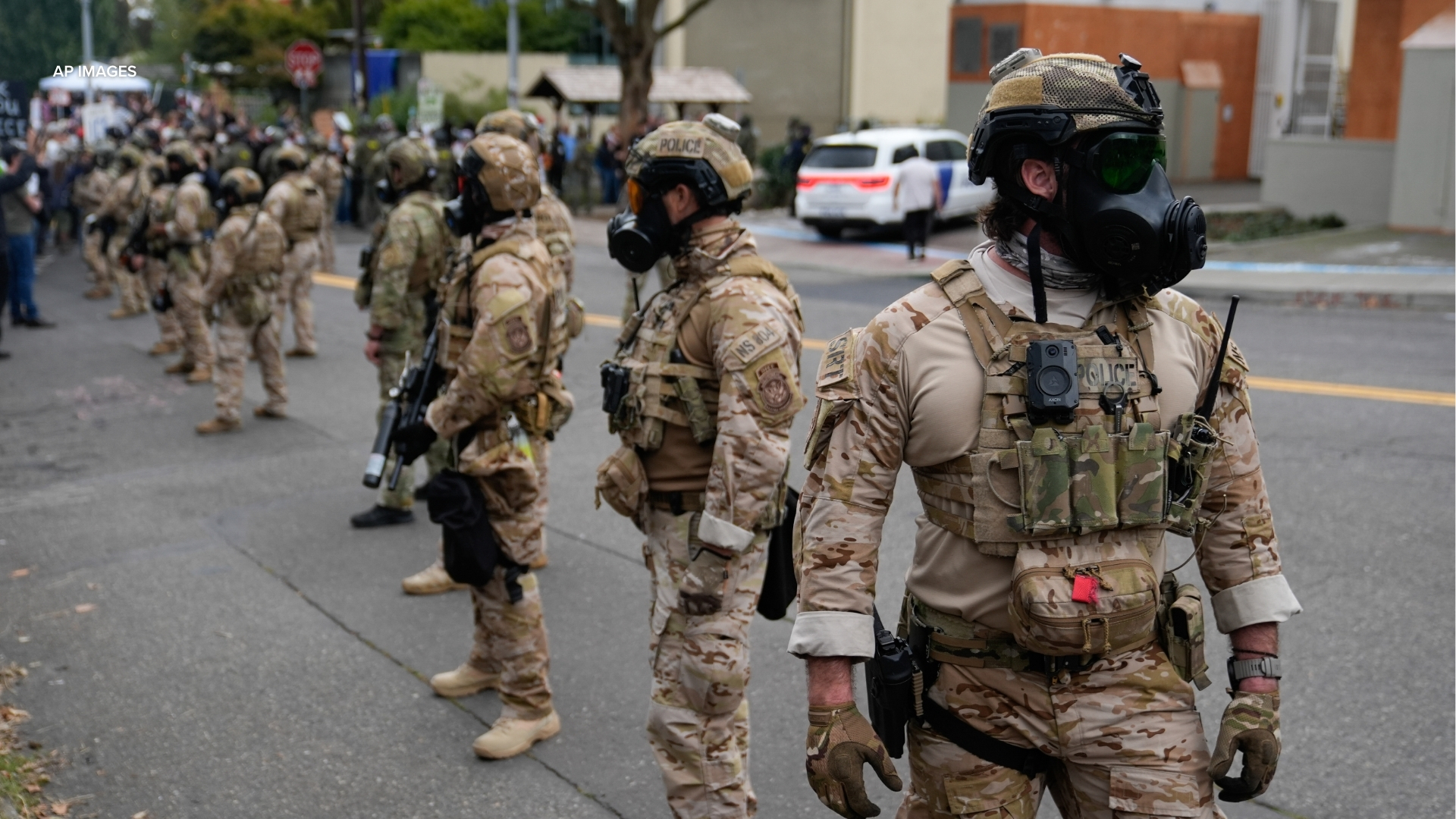
A federal judge in Oregon has halted the Trump administration’s efforts to deploy federalized National Guard members from California and other states to Portland, Oregon. In a rare late Sunday night virtual hearing on October 5, 2025, US District Judge Karin Immergut, a Trump appointee, granted a temporary restraining order requested by the state of California to prevent the deployment of up to 300 California National Guard members to Portland. This ruling followed Immergut’s decision the previous day to block President Donald Trump’s attempt to deploy Oregon National Guard troops in the city.
California Governor Gavin Newsom announced plans to sue the Trump administration after it deployed federalized National Guard troops—called into service by the president—to Oregon. In a statement, Newsom condemned the move, saying, “This is a breathtaking abuse of the law and power. The Trump Administration is unapologetically attacking the rule of law itself and putting into action their dangerous words—ignoring court orders and treating judges, even those appointed by the President himself, as political opponents.”
California Attorney General Rob Bonta praised Immergut’s ruling, suggesting the administration’s attempt to deploy California troops was a direct response to the judge’s earlier order blocking the federalization of Oregon’s National Guard. “The Trump Administration’s flagrant disregard for the courts was on full display when it sought to circumvent Judge Immergut’s order by redeploying troops from Los Angeles to Portland,” Bonta said. “This disrespect for the rule of law cannot stand—and I’m glad the court agreed.”
Oregon Governor Tina Kotek, a Democrat, confirmed that some California National Guard troops arrived in Oregon on the night of October 4, with more expected on OCtober 6. She strongly opposed the deployment, stating, “The facts haven’t changed. There is no need for military intervention in Oregon. There is no insurrection in Portland. No threat to national security. Oregon is our home, not a military target. Oregonians exercising their freedom of speech against unlawful actions by the Trump Administration should do so peacefully.”
In an op-ed published Sunday in The Oregonian, Portland Police Chief Bob Day addressed the situation, noting that “national portrayals” of Portland overstated the city’s issues. “There is no ignoring that we are facing an extraordinary time in our city’s history, with the deployment of both federal law enforcement and the Oregon National Guard,” Day wrote. He emphasized that Portland police employ a “layered approach” to managing public order, avoiding tactics like tactical gear lineups that could escalate crowd behavior.
On the same day, Defense Secretary Pete Hegseth announced in a memo that up to 400 Texas National Guard members would be federalized for deployment to Chicago and Portland for up to 60 days, with the possibility of an extension. The memo, included in a court filing by the Oregon attorney general’s office, cited President Trump’s determination on October 4, 2025, that “violent incidents, as well as the credible threat of continued violence,” were impeding federal law enforcement in Illinois, Oregon, and other locations.
Texas Governor Greg Abbott, a Republican, supported the deployment, stating on X, “I fully authorized the President to call up 400 members of the Texas National Guard to ensure safety for federal officials. You can either fully enforce protection for federal employees or get out of the way and let Texas Guard do it. No Guard can match the training, skill, and expertise of the Texas National Guard.”
I fully authorized the President to call up 400 members of the Texas National Guard to ensure safety for federal officials.
You can either fully enforce protection for federal employees or get out of the way and let Texas Guard do it.
Illinois Governor JB Pritzker, a Democrat, condemned the move, calling it “Trump’s Invasion.” He noted that no federal officials had coordinated with him regarding the deployment and criticized the involvement of another state’s military. “It started with federal agents, it will soon include deploying federalized members of the Illinois National Guard against our wishes, and it will now involve sending in another state’s military troops,” Pritzker said. Both Pritzker and Kotek urged Abbott to withdraw his support for the deployment.
The White House defended the deployment, with spokesperson Abigail Jackson stating, “President Trump exercised his lawful authority to protect federal assets and personnel in Portland following violent riots and attacks on law enforcement.” Pentagon spokesman Sean Parnell added that California National Guard members were reassigned from Los Angeles to Portland “to support U.S. Immigration and Customs Enforcement and other federal personnel performing official duties, including the enforcement of federal law, and to protect federal property.”
In response to Immergut’s ruling blocking the activation of 200 Oregon National Guard troops until at least October 18, the Trump administration filed a motion with the 9th US Circuit Court of Appeals, arguing that the judge “impermissibly second-guessed” Trump’s military judgments. The motion cited a nearly 200-year-old Supreme Court precedent, asserting that such decisions are the president’s prerogative, not that of a governor or federal court.
Judge Immergut’s rulings underscored a “longstanding and foundational tradition of resistance to government overreach, especially in the form of military intrusion into civil affairs.” Oregon’s Governor Kotek reiterated, “There is no insurrection in Portland. No threat to national security. No fires, no bombs, no fatalities due to civil unrest. The only threat we face is to our democracy—and it is being led by President Donald Trump.”
The controversy extends beyond Portland. Last month, a federal judge in Los Angeles ruled that the deployment of National Guard troops and Marines was illegal, and officials in Washington, D.C., also sued to block similar deployments. Trump has threatened to deploy troops and federal law enforcement to other cities, including Baltimore and New Orleans, escalating tensions with Democratic governors and mayors.
Pritzker, in a CNN interview on Sunday, criticized the federal presence in Chicago, stating, “They are the ones that are making it a war zone. They need to get out of Chicago if they’re not going to focus on the worst of the worst, which is what the president said they were going to do.” He and other Democratic leaders have also condemned Trump’s suggestion to senior military officials that “dangerous cities” be used as “training grounds” for the National Guard.
The deployment of federalized National Guard troops has sparked widespread debate about the balance between federal authority and state autonomy, as well as the appropriate use of military forces in domestic civil matters. As legal battles continue, the situation remains a flashpoint in the ongoing clash between the Trump administration and Democratic state leaders.
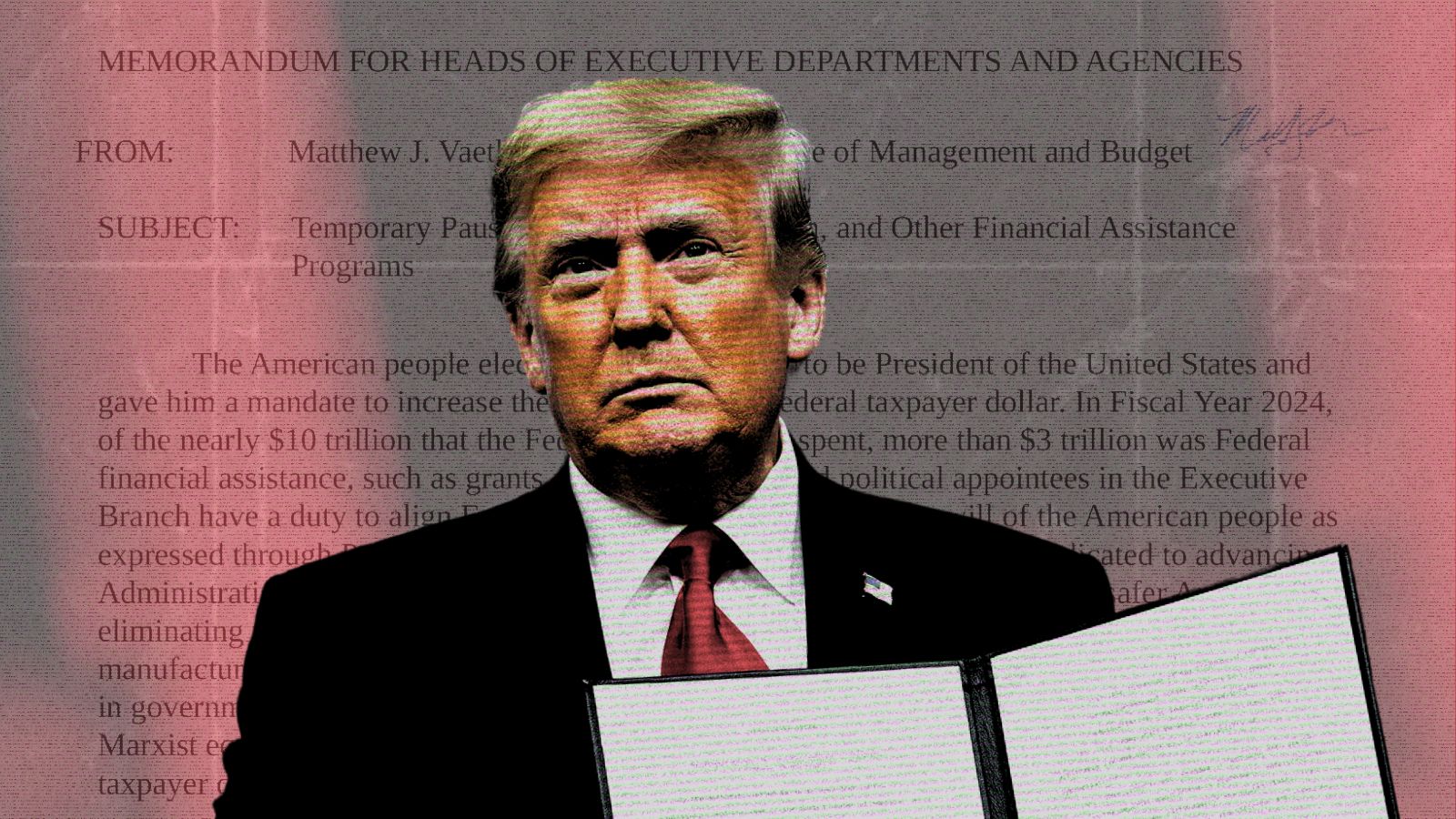
The Trump administration on October 2 terminated $7.6 billion in grants funding 223 clean energy projects across 16 states, all of which supported former Vice President Kamala Harris in the 2024 presidential election. The decision, announced by the Energy Department, follows a review deeming the projects misaligned with national energy needs or economically unviable. The cuts, affecting initiatives like battery plants, hydrogen technology, electric grid upgrades, and carbon-capture efforts, have sparked accusations of political retaliation amid an ongoing government shutdown.
The Energy Department’s review targeted funding from the Office of Clean Energy Demonstrations, Office of Energy Efficiency and Renewable Energy, and other bureaus. While specific project details were not disclosed, the cancellations include up to $1.2 billion for California’s hydrogen hub, the Alliance for Renewable Clean Hydrogen Energy Systems (ARCHES), and $1 billion for a Pacific Northwest hydrogen project. Notably, hydrogen projects in Texas, West Virginia, Ohio, and Pennsylvania were spared. The 16 affected states are California, Colorado, Connecticut, Delaware, Hawaii, Illinois, Maryland, Massachusetts, Minnesota, New Hampshire, New Jersey, New Mexico, New York, Oregon, Vermont, and Washington. Each of these states voted for Harris in 2024, and their US Senators opposed a Republican short-term funding bill to avert the government shutdown.
White House Budget Director Russell Vought announced the cuts on social media, framing them as eliminating funding for the “Left’s climate agenda.” President Donald Trump, in an interview with One America News, suggested the cuts target Democratic priorities, stating, “I’m allowed to cut things that never should have been approved in the first place.” The administration has also rescinded $13 billion in clean energy funding from the 2022 climate law, citing unspent allocations.
Democrats and environmental groups have condemned the move. California Governor Gavin Newsom highlighted that ARCHES had secured $10 billion in private investment and supported over 200,000 jobs, calling the cut a threat to economic growth. Senator Alex Padilla (D-CA) labeled the decision “vindictive” and “shortsighted,” arguing it undermines US energy leadership. Senator Patty Murray (D-WA.) accused the administration of using American livelihoods as “pawns in some sort of sick political game.” Environmental organizations echoed these concerns. Jackie Wong of the Natural Resources Defense Council (NRDC) called the cuts a blow to innovative technology and clean energy jobs. Conrad Schneider of the Clean Air Task Force warned that the cancellations weaken U.S. competitiveness in global energy markets.
Energy Secretary Chris Wright defended the cancellations, emphasizing they were business decisions to protect taxpayer dollars and prioritize affordable, reliable energy. He denied political motivations, stating, “These decisions are made on whether it’s a good use of the taxpayer money or not.” Wright noted that projects in both Republican and Democratic states, including hydrogen initiatives in West Virginia, Texas, and Louisiana, are under review, with further cancellations expected. Award recipients have 30 days to appeal.
The cuts align with the Trump administration’s broader rollback of climate programs, including vehicle emission and greenhouse gas regulations. The Energy Department’s review began after President Donald Trump’s 2024 election victory, with over a quarter of the rescinded grants awarded between Election Day and Inauguration Day under the Biden administration. The cancellations are part of a $7 billion hydrogen fuel program initiated by President Joe Biden to combat climate change.
As the government shutdown continues, the debate over these cuts underscores tensions between fiscal priorities and clean energy innovation, with significant implications for jobs, energy costs, and US leadership in emerging technologies.
On October 1, the US federal government shut down, marking the first such closure since 2019. The shutdown, triggered by a contentious spending dispute between President Donald Trump and congressional Democrats, has disrupted federal services and furloughed many federal workers. The current shutdown echoes a 35-day closure in 2018/2019, when President Donald Trump and congressional Democrats clashed over funding for a southern border wall. The central issue behind this most recent government shutdown is the Democrats’ insistence that President Trump agree to extend expiring health care subsidies and reverse Medicaid cuts included in his signature tax cut and domestic policy law passed earlier in 2025. These health care provisions, particularly the Affordable Care Act (ACA) subsidies set to expire by year’s end, are critical to millions of Americans’ access to affordable insurance.
While most Democrats have united behind Schumer’s strategy, a few broke ranks to support the Republican funding plan, including Senators Catherine Cortez Masto (D-NV), John Fetterman (D-PA) (arguably the Democratic Senator most aligned with the MAGA movement on a majority of public policy issues), and Angus King (I-ME). On the Republican side, Senator Rand Paul (R-KY) was the sole dissenter against his party’s proposal. These defections highlight the complexity of the negotiations, as some lawmakers face pressure from constituents or upcoming re-elections.
Democrats argue that their focus on health care resonates with voters, particularly after backlash from liberal activists in March when some Senate Democrats supported a stopgap funding bill. This time, Democrats are leveraging the health care issue to challenge Trump and Republicans, daring them to reject popular programs like ACA subsidies. Republicans, however, have accused Democrats of holding government funding “hostage” to secure health care concessions. Senate Majority Leader John Thune has expressed willingness to negotiate on extending ACA tax credits separately, but insists that such discussions should occur while the government remains operational.
The shutdown has also amplified partisan rhetoric. On September 29, President Donald Trump met with congressional leaders but later posted an AI-generated video mocking Democratic leaders, including Hakeem Jeffries and Chuck Schumer. The video, which featured offensive caricatures and fabricated quotes, falsely attributed statements to Chuck Schumer claiming Democrats aimed to provide free health care to undocumented immigrants to secure their votes, a debunked conspiracy theory. In response, Jeffries posted a photo of Trump with Jeffrey Epstein, captioning it “This is real” and condemning bigotry. Such exchanges underscore the toxic atmosphere surrounding the shutdown, with both sides using social media to inflame tensions. Republicans have continued to push misleading narratives, including claims that Democrats are prioritizing health care for unauthorized immigrants over government funding, further polarizing the debate.
The immediate consequences of the shutdown include the suspension of non-essential federal services and the furlough of thousands of federal workers. Essential services, such as Social Security payments and national defense operations, will continue, but many agencies will face disruptions, affecting everything from national parks to regulatory oversight.
As the standoff continues, the political fallout will likely shape the narrative heading into the 2026 midterm elections. Both parties are betting on their ability to sway public opinion, with Democrats banking on health care’s broad appeal and Republicans framing Democrats as obstructionists. For now, the American public awaits a resolution while grappling with the real-world impacts of a government in gridlock.
Here are the main events that occurred in Politics this week:
1. President Donald Trump Attacks UN and Lectures Nations in Address to General Assembly
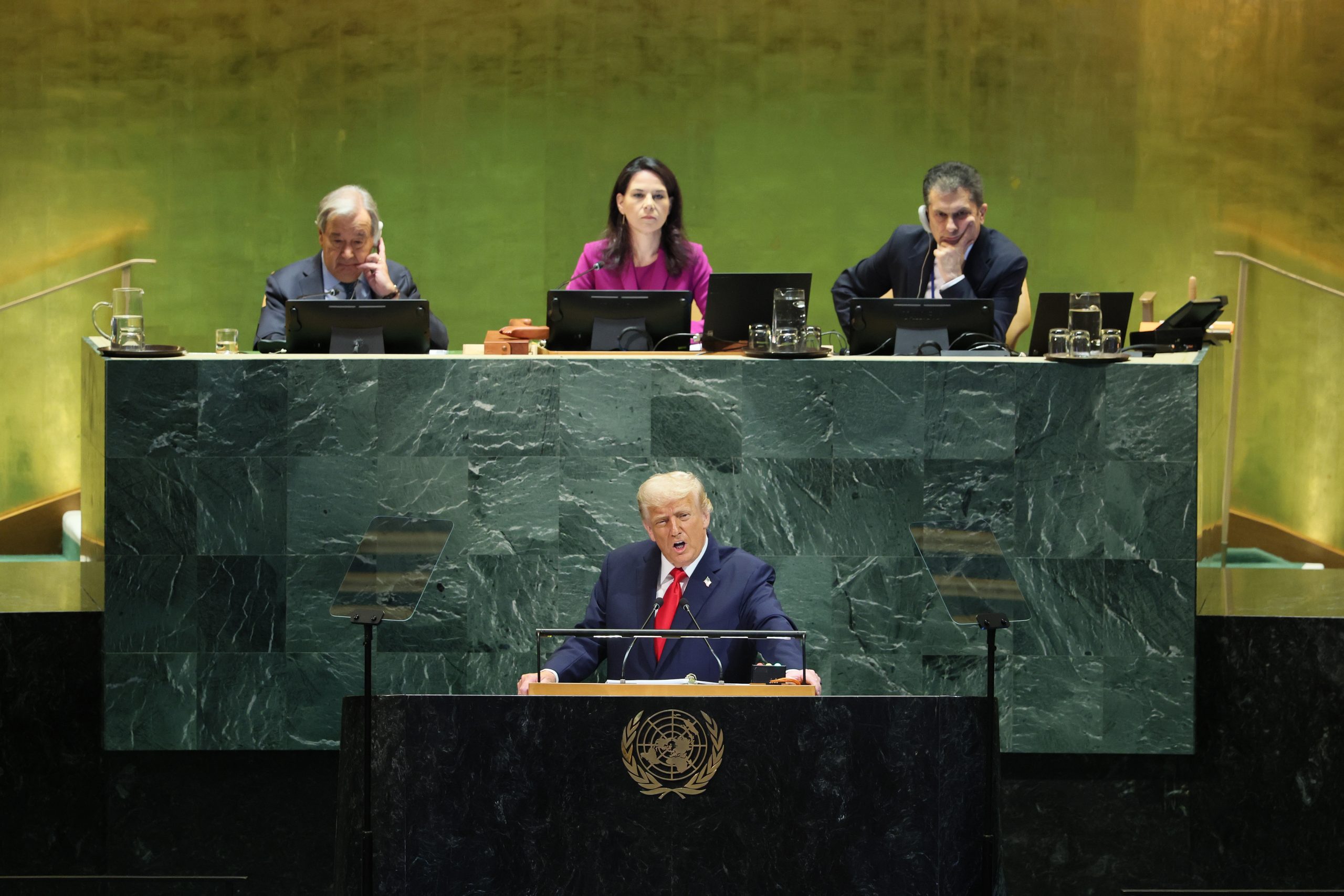
On September 23, President Donald Trump delivered a nearly hour-long address to the UN General Assembly, blending sharp criticism of the global body with self-congratulation for his administration’s achievements.
On September 23, President Donald Trump delivered a nearly hour-long address to the UN General Assembly, blending sharp criticism of the global body with self-congratulation for his administration’s achievements. In a speech that oscillated between grievance and optimism, President Trump touted his “America First” agenda, warned European nations of economic and cultural ruin, and positioned himself as a global peacemaker while questioning the UN’s effectiveness.
2. The UK, Canada, Australia, and Portugal Recognize Palestinian Statehood
On September 21, 2025, the UK, Canada, Australia, and Portugal formally recognized Palestine as a sovereign state, marking a significant shift in their long-standing diplomatic positions.
3. Supreme Court to Review Presidential Authority Over Independent Agencies
On September 22, 2025, the US Supreme Court announced it would consider a significant expansion of President Donald Trump’s power over independent federal agencies, potentially overturning a nearly century-old precedent that limits when presidents can remove agency board members.
4. President Donald Trump Moves to Designate Antifa as a Major Terrorist Organization
On September 22, President Donald Trump signed an executive order designating the decentralized anti-fascist movement known as Antifa a domestic terrorist organization.
On September 23, President Donald Trump delivered a nearly hour-long address to the UN General Assembly, blending sharp criticism of the global body with self-congratulation for his administration’s achievements. In a speech that oscillated between grievance and optimism, President Trump touted his “America First” agenda, warned European nations of economic and cultural ruin, and positioned himself as a global peacemaker while questioning the UN’s effectiveness.
President Donald Trump opened his speech by calling the UN a “feckless institution” filled with “empty words” that fail to resolve global conflicts. He questioned the organization’s purpose, stating, “The U.N. has such tremendous potential. I’ve always said it. It has such tremendous, tremendous potential. But it’s not even coming close to living up to that potential.” His remarks underscored a return to an unapologetically nationalist stance, a departure from the more internationalist approach of his predecessor, President Joe Biden. Despite his criticisms, Trump later met with UN Secretary-General Antonio Guterres, assuring him that the US remains “100%” supportive of the organization. “I may disagree with it sometimes, but I am so behind it because the potential for peace at this institution is great,” Trump said, striking a conciliatory tone after his earlier rebuke.
President Donald Trump used the global stage to issue stark warnings to European nations, arguing that their migration policies and commitment to green energy initiatives were leading to economic and cultural devastation. He described these policies as a “double-tailed monster” that “destroys everything in its wake.” “I’m telling you that if you don’t get away from the ‘green energy’ scam, your country is going to fail,” Trump declared. “If you don’t stop people that you’ve never seen before that you have nothing in common with, your country is going to fail.” He contrasted these policies with his administration’s approach, which has prioritized expanded oil and gas drilling and aggressive crackdowns on illegal immigration in the United States. Trump expressed sympathy for Europe, saying, “I love the people of Europe, and I hate to see it being devastated by energy and immigration.” His remarks were a clear call for other nations to adopt similar policies to those of his administration.
In a significant development, President Donald Trump addressed Russia’s ongoing war in Ukraine, revealing a shift in his stance. After meeting with Ukrainian President Volodymyr Zelenskyy, Trump announced his belief that Ukraine, with support from the European Union and NATO, could reclaim all territory lost to Russia. “I think Ukraine, with the support of the European Union, is in a position to fight and WIN all of Ukraine back in its original form,” Trump wrote in a post following his speech. “With time, patience, and the financial support of Europe and, in particular, NATO, the original Borders from where this War started, is very much an option.” This marks a departure from his 2024 campaign rhetoric, where he often suggested the US had limited interest in the conflict’s outcome and promised a swift resolution. Trump also took a swipe at Russia, calling it a “paper tiger” and noting that the war, now in its third year, “should have taken a Real Military Power less than a week to win.” He threatened Moscow with “a very strong round of powerful tariffs” if Russian President Vladimir Putin does not negotiate an end to the conflict.
President Donald Trump also addressed the growing international push for Palestinian statehood, a movement spotlighted during the UN General Assembly’s discussions on a two-state solution. France recently joined other nations in recognizing Palestinian statehood, a move Trump and Israel strongly oppose. “The rewards would be too great for Hamas terrorists,” Trump argued, referencing the October 7 attacks. “This would be a reward for these horrible atrocities.” He also participated in a group meeting with leaders from Qatar, Saudi Arabia, Indonesia, Turkey, Pakistan, Egypt, the United Arab Emirates, and Jordan to discuss ending the Gaza war, calling it his “most important meeting” and expressing a desire to resolve a conflict that “should have probably never started.”
Early in his speech, President Donald Trump deviated from his prepared remarks to poke fun at logistical issues at UN headquarters, including a malfunctioning escalator and a faulty teleprompter. “These are the two things I got from the United Nations: a bad escalator and a bad teleprompter,” he quipped, drawing laughter from delegates. UN spokesperson Stephane Dujarric later explained that the escalator issue may have been caused by a videographer from the US delegation triggering a safety mechanism, while a UN official noted that the Trump Administration was responsible for operating the teleprompter.
President Donald Trump reiterated his ambition to win a Nobel Peace Prize, claiming his administration has “ended seven wars” since his return to office. “Everyone says that I should get the Nobel Prize — but for me, the real prize will be the sons and daughters who live to grow up because millions of people are no longer being killed in endless wars,” he said. He cited efforts to mediate conflicts between Israel and Iran, India and Pakistan, and Egypt and Sudan, though experts note that his impact on these resolutions is not as straightforward as he claims. Trump expressed frustration that the UN had not taken a more active role, stating, “It’s too bad that I had to do these things instead of the United Nations doing them.”
President Donald Trump’s address was a vivid reminder of his polarizing leadership style, blending boasts of domestic and foreign policy successes with dire warnings to other nations. His unapologetic “America First” posture, coupled with sharp critiques of global institutions and policies, underscored his intent to reshape the international order. As he navigates his second term, Trump’s vision for global leadership continues to spark both admiration and alarm among world leaders.
The case centers on a challenge to Humphrey’s Executor v. United States (1935), a landmark Supreme Court ruling that established protections for commissioners of independent agencies. In that decision, the Court unanimously held that President Franklin D. Roosevelt could not fire an FTC commissioner without cause, such as misconduct or neglect of duty. This ruling paved the way for the creation of powerful independent agencies tasked with regulating critical areas like consumer protection, labor relations, and federal employment disputes. These agencies were designed to operate with a degree of autonomy, insulated from direct presidential control to ensure decisions were based on expertise rather than political pressures.
However, the Humphrey’s Executor decision has long been a point of contention for conservative legal scholars who argue that independent agencies should be more accountable to the president, as the head of the executive branch. The Justice Department, representing President Donald Trump, contends that the president should have the authority to remove agency board members at will to effectively carry out his agenda. Solicitor General D. John Sauer argued, “The President and the government suffer irreparable harm when courts transfer even some of that executive power to officers beyond the President’s control.” Sauer further noted that courts lack the authority to reinstate fired officials, only to award back pay.
In a 6-3 decision, the Supreme Court permitted President Donald Trump to fire Rebecca Slaughter, a Democratic FTC commissioner, while the broader case challenging Humphrey’s Executor proceeds. This ruling follows a series of similar decisions allowing the president to remove board members from three other independent agencies, including Gwynne Wilcox of the NLRB and Cathy Harris of the MSPB. The Court’s conservative majority did not provide detailed reasoning for allowing Slaughter’s firing, as is typical for decisions on the emergency docket. Justice Elena Kagan, joined by Justices Sonia Sotomayor and Ketanji Brown Jackson, dissented, arguing that Congress explicitly prohibited such presidential removals. “Yet the majority, stay order by stay order, has handed full control of all those agencies to the President,” Kagan wrote. The dissenters expressed concern that eroding the independence of these agencies could lead to regulatory decisions driven by politics rather than expertise.
The upcoming case, set for arguments in December 2025, will determine whether the Court overturns or narrows Humphrey’s Executor. A decision to grant the president broader authority to fire agency board members could fundamentally alter the structure of independent agencies. These bodies, including the FTC, NLRB, and MSPB, play critical roles in enforcing consumer protections, investigating unfair labor practices, overseeing union elections, and resolving federal employment disputes. Opponents of expanding presidential power, including Slaughter’s legal team, argue that allowing the president to remove congressionally confirmed board members at will risks politicizing regulatory decisions. They assert that such a change would undermine the expertise-driven mission of these agencies. “If the President is to be given new powers Congress has expressly and repeatedly refused to give him, that decision should come from the people’s elected representatives,” Slaughter’s attorneys stated. The Justice Department, however, argues that the president’s ability to execute his agenda is hindered when agency officials operate beyond his control. This tension between presidential authority and agency independence lies at the heart of the case.
The Supreme Court’s willingness to hear this case before it has fully worked through lower courts signals its urgency and potential impact. Additionally, Wilcox and Harris, the fired NLRB and MSPB board members, have asked the Court to consider their cases alongside Slaughter’s, highlighting the broader implications for multiple agencies. The Court has also suggested that the president’s removal power may face limits at certain agencies, such as the Federal Reserve. This issue is likely to be tested in a separate case involving fired Fed Governor Lisa Cook, which could further clarify the boundaries of presidential authority.
As the Supreme Court prepares to hear arguments in December, the outcome of this case could redefine the relationship between the executive branch and independent federal agencies. A ruling in favor of expanded presidential power could usher in an era of greater executive control over regulatory bodies, potentially affecting how laws are enforced in areas like consumer protection, labor rights, and federal employment. Conversely, upholding Humphrey’s Executor would preserve the autonomy of these agencies, ensuring their decisions remain grounded in expertise rather than political influence. For now, the Court’s recent decisions signal a conservative majority inclined to reconsider long-standing precedents, setting the stage for a pivotal legal battle with significant consequences for the structure of the federal government.
In a post on X, President Donald Trump stated, “I am pleased to inform our many U.S.A. Patriots that I am designating ANTIFA, A SICK, DANGEROUS, RADICAL LEFT DISASTER, AS A MAJOR TERRORIST ORGANIZATION.” He further emphasized that he would push for thorough investigations into those funding Antifa, ensuring compliance with the highest legal standards.
🚨 "I am pleased to inform our many U.S.A. Patriots that I am designating ANTIFA, A SICK, DANGEROUS, RADICAL LEFT DISASTER, AS A MAJOR TERRORIST ORGANIZATION…" – President Donald J. Trump pic.twitter.com/irLHCkrX1n
White House Press Secretary Karoline Leavitt described the order as one of the administration’s first major steps in fulfilling President Donald Trump’s campaign promises to confront left-leaning political entities. Speaking at a briefing earlier that day, Leavitt railed against Democrats and Trump’s political opponents, stating, “Many Democrats in elective office have now been totally captured by a radical fringe of the far left who want to dehumanize every person they disagree with.” She pointed to Democratic lawmakers who voted against a resolution honoring conservative activist Charlie Kirk, whose recent assassination has intensified the administration’s rhetoric. “We must continue to call this wickedness out,” Leavitt added. “It’s the only way that our nation can heal.”
The announcement follows President Donald Trump’s vow last week to label Antifa a terrorist group, coming in the wake of Charlie Kirk’s killing. In a post on his Truth Social platform, President Trump wrote: “I am pleased to inform our many U.S.A. Patriots that I am designating ANTIFA, A SICK, DANGEROUS, RADICAL LEFT DISASTER, AS A MAJOR TERRORIST ORGANIZATION. I will also be strongly recommending that those funding ANTIFA be thoroughly investigated in accordance with the highest legal standards and practices!”
Press Secretary Karoline Leavitt emphasized that the focus would extend beyond Antifa to its financial backers, noting, “We will be most importantly looking at who is funding Antifa and who is funding these other violent left-wing groups.” She cited evidence from the Kirk investigation, including bullets engraved with anti-fascist messages like “Hey Fascist! Catch!” She also referenced a series of alleged Antifa-linked incidents, including assailants shooting and assaulting law enforcement in Texas and Oregon in July, bringing a pipe bomb to a pro-Trump event in 2022, and threatening to shoot police and Trump supporters outside the Florida State Capitol in 2021. “We have seen a rise in violence perpetuated by Antifa, radical people across this country who subscribe to this group,” Leavitt said.
The term “Antifa,” short for anti-fascist, originates from the German word “antifaschistisch,” referencing 1930s resistance groups that opposed Nazi ideology. It traces its roots to European movements that fought Italian dictator Benito Mussolini during World War II and white supremacist skinhead groups during the Cold War. In the US, Antifa has existed for decades but gained prominence after Donald Trump’s 2016 election and the 2017 Charlottesville rally, where far-right violence galvanized anti-fascist activists.
Unlike structured far-right groups like the Proud Boys or Oath Keepers, which have clear leaders, hierarchies, and membership, Antifa is a loose, leaderless network of individuals and small cells leaning toward the far left, often including anarchists, communists, and hardline socialists. Its members broadly share anti-government, anti-capitalist, pro-LGBTQ+, and pro-immigration views. Activists often organize organically online and offline, without a national command structure, membership lists, or defined funding sources. This decentralization makes it challenging for authorities to target “leaders” or financial networks, as local groups operate independently.
Critics, including President Donald Trump and Republicans, frequently use “Antifa” as a catch-all label for a wide array of liberal and left-wing groups they oppose, blurring lines between ideology and action. The administration’s push raises concerns that it could stretch executive authority to suppress large-scale left-wing dissent. President Trump has already suggested charging members of the activist group Code Pink, who protested him during a recent Washington, D.C., restaurant visit, with crimes, signaling a pattern of aggressive targeting. Trump first promised to designate Antifa a terrorist organization during his first term in 2020, but never followed through. The current effort aligns with his declaration that “radical left political violence has hurt too many innocent people and taken too many lives.” Authorities have described Kirk’s accused killer, Tyler Robinson, as holding a “leftist ideology,” though no direct link to Antifa has been established, and the motive remains unclear.
What distinguishes Antifa from mainstream left-wing activism, according to critics, is some activists’ readiness to employ violence—often framed as self-defense against far-right threats. Participants frequently appear in public wearing dark clothing and face coverings, and online videos capture them wielding clubs, shields, sticks, and pepper spray at rallies. Notable incidents include a 2017 clash in Berkeley, California, where around 100 masked Antifa-linked activists attacked right-wing protesters, leading to multiple arrests. During the 2020 unrest following George Floyd’s killing, self-identified Antifa activist Michael Reinoehl fatally shot a member of the far-right Patriot Prayer group in Portland before being killed by police.
The executive order invokes powers typically reserved for foreign terrorist organizations (FTOs), which allow the US to ban members, deport individuals, seize assets, and prosecute material supporters. However, domestic groups like Antifa do not fit the FTO criteria, which require the entity to be foreign-based. The order specifies implementation within existing laws, directing agencies to pursue “any and all illegal operations” without broadly criminalizing anti-fascist ideology, a move that would violate the First Amendment. Legal experts anticipate swift constitutional challenges, given Antifa’s lack of a centralized structure. Prosecuting individuals for “material support” to domestic groups lacks the clear legal framework available for foreign ones, potentially limiting the order’s reach.
As the administration moves forward, the designation’s practical impact remains uncertain. It fulfills a long-standing Trump pledge but underscores deepening partisan divides, especially in the shadow of Charlie Kirk’s death, where his widow, Erika Kirk, urged fighting hate with love, clashing with President Donald Trump’s assertion at the funeral that he “hates” his political opponents. Karoline Leavitt defended the president, saying, “The president is authentically himself.” Whether this authenticity translates to effective policy or fuels further unrest is a question that will define the coming months.
President Donald Trump has repeatedly argued that mail-in voting undermines election integrity. He claimed, without evidence, “Mail-in ballots are corrupt,” citing unverified anecdotes of individuals receiving multiple ballots in states like California. President Trump has long maintained that mail-in voting enables tampering and multiple voting, despite lacking evidence to support widespread fraud. However, election experts have consistently refuted these claims. Debra Cleaver, founder of VoteAmerica, emphasized the security of mail-in ballots, noting that barcodes on outgoing and return envelopes ensure ballots are tracked and counted accurately. Following the 2020 election, Christopher Krebs, then-director of the Cybersecurity and Infrastructure Security Agency, declared it “the most secure in American history.” Audits and investigations, including those by Republican officials, found no evidence of significant fraud in the 2020 election.
President Donald Trump’s proposed executive order faces significant legal hurdles. He argued in a social media post that states are mere “agents” of the federal government in elections and must follow presidential directives. However, Article I, Section 4 of the US Constitution explicitly grants states the authority to regulate elections, with Congress holding the power to alter such regulations. Legal scholars note that the President lacks the constitutional authority to unilaterally ban mail-in voting, rendering the proposed executive order legally questionable.
Election experts warn that eliminating mail-in voting could disrupt electoral processes. David Becker, executive director of the Center for Election Innovation & Research, called the idea “incredibly bad,” arguing it would create chaos, especially with midterm elections just 15 months away. He noted that mail-in voting, used since the Civil War, enhances accessibility and security when properly implemented.
The White House, through spokesperson Harrison Fields, defended President Donald Trump’s stance, claiming that Democratic policies like “unfettered mail-in voting” have eroded trust in elections. Fields emphasized Trump’s goal to “secure America’s elections” through measures like voter ID requirements and stricter voting laws in states like California and New York.
President Donald Trump’s push to ban mail-in voting has sparked renewed debate over election security and accessibility. While he frames it as a safeguard against fraud, critics argue it could disenfranchise voters who rely on mail ballots due to disability, military service, or other constraints. The legal and practical challenges of implementing such a ban underscore the complexities of reforming election systems in a polarized political landscape. As the 2026 midterms approach, the debate over mail-in voting is likely to intensify, with significant implications for voter turnout and trust in democratic institutions.
On January 6, 2025, a joint session of Congress certified President-elect Donald Trump’s victory in the 2024 election, fulfilling a vital democratic tradition that was violently disrupted four years ago. This time, there was no sign of unrest, though security at the Capitol was heightened. Unlike President-elect Trump in 2020, Vice President Kamala Harris did not dispute her loss in the November election, and Democrats refrained from raising any objections during the certification of Electoral College votes.
Vice President Harris presided over the certification process with dignity, even as it confirmed her loss. The session proceeded smoothly, with lawmakers from both parties reading out each state’s electoral votes in alphabetical order and declaring them “regular in form and authentic.” The only noticeable partisan divide came in the applause: Republicans celebrated the states won by Trump, while Democrats cheered for those carried by Harris. The session ended with a standing ovation from Republicans as Trump’s majority was announced.
Earlier in the day, Vice President Harris described her role as “a sacred obligation,” emphasizing her commitment to the Constitution and democracy. She told reporters in the Rotunda that the key takeaway was that “Democracy must be upheld by the people.” Aides described the peaceful transfer of power as one of the most significant acts of her vice presidency. As Harris led senators to the House chamber, she exchanged polite words with House Speaker Mike Johnson, who had played a prominent role in contesting the 2020 election results.
The calm and orderly certification process starkly contrasted to the violent events of January 6, 2021. This year, the Capitol was under heavy lockdown, with tall metal fencing and enhanced security measures designated by the Department of Homeland Security as a “national special security event.” The increased precautions reflected the lessons learned from the 2021 riot, which was tied to the deaths of seven people, including three police officers, after Trump’s false claims of a stolen election incited his supporters to storm the Capitol.
In the days leading up to the certification, President Joe Biden stressed the importance of a smooth transition of power while urging Americans to remember the events of January 6, 2021. Writing in The Washington Post, Biden accused Trump and his supporters of attempting “to rewrite — even erase — the history of that day.” Despite Trump’s campaign promises to pardon individuals convicted for their actions during the 2021 riot, Democrats refrained from challenging the election results, prioritizing constitutional norms over partisan conflict.
Senate Minority Leader Chuck Schumer underscored the importance of upholding democratic principles and warned Trump against pardoning those responsible for the January 6 violence. “It would be a dangerous endorsement of political violence,” Schumer said. “It is wrong, it is reckless, and would be an insult to the memory of those who died in connection to that day.” With the peaceful certification complete, the nation moves forward under Trump’s leadership, but the shadow of January 6 remains a potent reminder of the fragility of democracy.
President Joe Biden on January 5 delivered a ferocious condemnation of former President Donald Trump, his likely 2024 opponent, warning in searing language that the former President had directed an insurrection and would aim to undo the nation’s bedrock democracy if he returned to power. On the eve of the third anniversary of the January 6, 2021, attack on the Capitol by former President Trump’s supporters, President Biden framed the coming election as a choice between a candidate devoted to upholding America’s centuries-old ideals and a chaos agent willing to discard them for his benefit. “There’s no confusion about who Trump is or what he intends to do,” Biden warned in a speech at a community college not far from Valley Forge in Pennsylvania, where George Washington commanded troops during the Revolutionary War. Exhorting supporters to prepare to vote this fall, he said: “We all know who Donald Trump is. The question is: Who are we?”
In an intensely personal address that at one point nearly led President Joe Biden to curse former President Donald Trump by name, the President compared his rival to foreign autocrats who rule by fiat and lies. He said former President Trump had failed the basic test of American leaders, to trust the people to choose their elected officials and abide by their decisions. “We must be clear,” Biden said. “Democracy is on the ballot. Your freedom is on the ballot.”
President Joe Biden’s harshness on his rival illustrated what his campaign believes to be the stakes of the 2024 election and his perilous political standing. Confronted with low approval ratings, bad head-to-head polling against former President Donald Trump, worries about his age, and lingering unease with the economy, President Biden is turning increasingly to the figure who has proved to be Democrats’ single best motivator. Former President Donald Trump, speaking at a campaign rally in Iowa soon after President Joe Biden’s appearance, quickly lashed back, calling the president’s comments “pathetic fearmongering” and accusing him of “abusing George Washington’s legacy.”
President Joe Biden’s remarks carried echoes of the 2020 campaign when he presented himself as the caretaker of “the soul of America” against a Trump presidency that he and Democratic supporters argued was on the verge of causing permanent damage to the country. The 31-minute speech was President Biden’s first public campaign event since he announced in April 2023 that he would seek re-election and was, in tone and content, arguably his most forceful public denunciation of former President Donald Trump since the two men became political rivals in 2019.
President Joe Biden’s appearance, meant as a kickoff to help define the 2024 campaign, was an early effort to revive the politically sprawling anti-Trump coalition that propelled Democrats to key victories in recent elections. Mr. Biden’s task now is to persuade those voters to view the 2024 contest as the same kind of national emergency that they sensed in 2018, 2020, and 2022. He began with an extensive recounting of former President Donald Trump’s actions before, during, and after the January 6 attack. The country, President Biden said, cannot afford to allow Trump and his supporters to present a whitewashed version of that day and spread falsehoods about the violent outcome of their effort to undo the 2020 election results. Upholding the nation’s democracy, Biden said, is “the central cause of my presidency.”
President Joe Biden made no mention of the 91 felony charges the former president faces in four jurisdictions, sticking to a vow to steer clear of his rival’s legal problems and focusing squarely on Trump’s actions rather than any potential criminal consequences for them. “Trump exhausted every legal avenue available to overturn the 2020 election. The legal path took him back to the truth, that I won the election and he was a loser,” Biden said. “He had one act left, one desperate act available to him, the violence of January 6.”
For a president who has faced intense scrutiny over his vigor in public appearances, the speech was a deftly delivered, focused argument about this year’s stakes. It was President Joe Biden’s latest attempt to build his political identity around the ideas of restoring national unity and upholding fairness, democracy, and collective patriotism. He has come back to those themes many times, during his brief push for voting rights legislation in early 2022, then as the midterm elections approached, and most recently in September, during a speech in Arizona honoring former Senator John McCain.
In the speech, President Joe Biden sought to frame former President Donald Trump as the leader of a cult of personality, and his Republican allies as sycophants. The president mentioned the recent $148 million judgment against Rudolph W. Giuliani for his lies about Georgia election workers, as well as the $787.5 million that Fox News was ordered to pay to settle a defamation case about its role in spreading election lies. Biden lamented that Fox News hosts and Republican officials who condemned Trump’s January 6 behavior in the moment had since changed their tune and repeated his falsehoods. “Politics, fear, and money all intervened, and now these MAGA voices who know the truth about Jan. 6 have abandoned democracy,” Biden said.
What remains unclear is how much President Joe Biden’s democracy pitch will resonate with voters who remain nervous about an improving economy, and wary of re-electing an 81-year-old who is already the oldest president in US history. Even some who have expressed deep fears about Trump’s authoritarian impulses are skeptical that the subject will be a winning message in 2024. “As a Biden campaign theme, I think the threat to democracy pitch is a bust,” 2012 Republican Presidential nominee, prominent Trump critic, and Utah Senator Mitt Romney, wrote in a text message to a New York Times reporter. “January 6 will be four years old by the election. People have processed it, one way or another. Biden needs fresh material, a new attack, rather than kicking a dead political horse.”
President Joe Biden threaded his speech with warnings that former President Donald Trump and Republicans would threaten not only democracy but also major Democratic priorities, abortion rights, voting rights, and economic and environmental justice. Ian Bassin, the executive director of Protect Democracy, a nonprofit dedicated to combating authoritarianism, said he had stressed to Biden’s aides that the president needed to connect democracy to voters’ personal experiences on other issues, in the same way Trump repeats to his supporters that prosecutions of him are persecutions of them. “Democracy is not just a way of structuring elections for order in our government,” Mr. Bassin said. “It’s a set of values about the kind of communities we want to live in and the way that we want to live as neighbors.”
President Joe Biden warned in his speech that former President Donald Trump was not being shy about what he would do in a second term. “Trump’s assault on democracy isn’t just part of his past. It’s what he’s promising for the future,” President Biden said. “He’s not hiding the ball.” Biden then recounted, in exacting detail, how a Trump campaign rally last year began with a choir of rioters who stormed the Capitol on January 6 singing the national anthem while a video of the damage played on a big screen. Trump had watched with approval. The scene, Biden suggested, would be the nation’s fate if Trump and his allies returned to power. “This is like something out of a fairy tale,” Biden said. “A bad fairy tale.”
A federal appeals court on November 11 granted a short-term delay in the January 6 select committee’s access to former President Donald Trump’s White House records. A three-judge panel of the US Court of Appeals for the DC Circuit, including President Joe Biden’s first and only appointee to that court, Ketanji Brown Jackson, will instead hear arguments in the matter on November 30. The delay is a minor setback for the House January 6 Committee, which had prevailed in US District Court against Trump’s legal effort to block access to his records altogether. The National Archives, which house Trump’s records, had been preparing to deliver the first batch of requested files to the committee.
The first batch of documents that was slated for release on November 12 is relatively small, as former President Donald Trump contested just 70 pages. But subsequent tranches identified by the Archives include hundreds of pages that were slated for release on November 26. Those will now likely be delayed, as well. The records include call logs, visitor records and documents culled from the files of top Trump aides like chief of staff Mark Meadows. The committee has repeatedly emphasized the urgency of accessing Trump’s records as it explores the former president’s effort to overturn the 2020 election results, including the January 6 assault on the Capitol that disrupted the electoral vote count and sent lawmakers fleeing in fear.
Despite claims of urgency, the January 6 House Select Committee did not object to former President Donald Trump’s request for a temporary injunction while the appeals court considers the broader issues. The Justice Department also took no position on the temporary stay. The composition of the appeals court panel is likely to hearten House investigators. The order issued on November 11 indicates that, in addition to Jackson, the panel includes Judges Patricia Millett and Robert Wilkins, who were appointed by former President Barack Obama to the court. The court’s order emphasized that the move to freeze the status quo, for the time being, should not be seen as reflecting what the court will end up deciding about Trump’s attempt to block disclosure of files from his former White House. “The purpose of this administrative injunction is to protect the court’s jurisdiction to address appellant’s claims of executive privilege and should not be construed in any way as a ruling on the merits,” the order said.
Despite the slowdown, the case is still moving at breakneck speed through typically slow-moving federal courts. Former President Donald Trump filed suit in mid-October to block the January 6 committee’s access to his records. A District Court judge, Tanya Chutkan, rejected Trump’s efforts, dismissing the notion that a former president could overrule the sitting president on matters of executive privilege. Trump quickly appealed the decision and asked the appeals court to delay the effect of Chutkan’s ruling until fuller arguments could be heard. The appeals court’s decision to set a two-week briefing schedule keeps the case moving on a fast track. Trump is due to file his written brief in the case on November 16, with a reply by the National Archives and the House on November 22. Trump will have an additional reply on November 26 before oral arguments the following week. If Trump loses in the three-judge panel, he has the option to appeal to the full appeals court or the Supreme Court.
In a February 28 speech to close out the Conservative Political Action Conference, former President Donald Trumpteased his political future and repeated the lie that he won the 2020 election.“I stand before you today to declare that the incredible journey we began together four years ago is far from over,” the former president said in his first speech since leaving the White House. “We are gathered this afternoon to talk about the future — the future of our movement, the future of our party, and the future of our beloved country.” The former president began his roughly 90-minute address by asking the crowd: “Do you miss me?” before reviving false claims that he had beaten President Joe Biden in November, lies that inspired the deadlypro-Trump riot at the Capitol on January 6. “Actually, as you know they just lost the White House,” Trump said of Democrats. “Who knows, I may even decide to beat them for a third time,” he added, stopping precise of declaring his 2024 plans.
Former President Donald Trump later launched into multiple tirades about mail-in voting, voter ID laws and the Supreme Court ruling rejecting his election challenges. “This election was rigged,” Trump said, prompting the crowd to chant, “You won! you won!” “They didn’t have the guts or the courage to make the right decision,” he added of the high court. Prior to Trump’s address, he won CPAC’s presidential straw poll with the support of 55 percent of the more than 1,000 conference attendees asked about who they support for the GOP’s 2024 bid. That he won with just over half of the vote, though, is notable given the event was jokingly referred to as “TPAC” and supporters were spotted bowing in front of a gold-hued statue in his likeness. While 95 percent said they wanted the Republican Party to advance Trump’s agenda, just 68 percent said they wanted to see Trump himself run again.
Former President Donald Trump said that he is “not starting a new party,” but put fellow Republicans who have crossed him on notice, name-dropping each of the 17 Republicans who voted to impeach or convict him for his role in the January attack. “Get rid of them all,” he said of those members, including Congresswoman Liz Cheney Wyoming and Senator Mitt Romney of Utah. Trump later took aim at Senate Minority Leader Mitch McConnell, of Kentucky, who criticized Trump over his actions around the riot. “The Republican Party is united,” he said. “The only division is between a handful of Washington, D.C., establishment political hacks and everybody else all over the country.”
President Joe Biden was also in the former president’s rhetorical crosshairs, with Donald Trump criticizing his successor on immigration, China, and school reopenings. The White House director of rapid response, Michael Gwin, said in a statement: “The only thing that seems to be able to unite the Republican Party is their opposition to giving Americans $1,400 checks, to getting schools the money they need to reopen safely, to keeping cops, firefighters, and teachers on the job, and to speeding up vaccinations.” “While the GOP casts about for a path forward,” Gwin said, “President Biden is going to remain laser-focused on crushing the virus, re-opening schools, and getting Americans back to work.”
Former President Donald Trump suffered a major setback on February 22 in his long quest to conceal details of his finances as the US Supreme Court paved the way for a New York City prosecutor to obtain the former president’s tax returns and other records as part of an accelerating criminal investigation. The justices without comment rebuffed Trump’s request to put on hold an October 7 lower court ruling directing Trump’s longtime accounting firm, Mazars USA, to comply with a subpoena to turn over the materials to a grand jury convened by Manhattan District Attorney Cyrus Vance, a Democrat. “The work continues,” Vance said in a statement issued after the court’s action. Trump issued a statement describing Vance’s investigation as part of “the greatest political witch hunt in the history of our country,” accusing New York Democrats of expending their energy on taking down a political opponent instead of tackling violent crimes. “That’s fascism, not justice – and that is exactly what they are trying to do with respect to me, except that the people of our Country won’t stand for it,” Trump added.
The Supreme Court’s action does not require former President Donald Trump to do anything. The records involved in the dispute were requested from a third-party, Mazars, not Trump himself. Manhattan District Attorney Cyrus Vance previously told Trump’s lawyers his office would be free to immediately enforce the subpoena if the justices rejected Trump’s request. A Mazars spokesman said the company “remains committed to fulfilling all of our professional and legal obligations.” Unlike all other recent U.S. presidents, Trump refused to make his tax returns public. The data could provide details on his wealth and the activities of his family real-estate company, the Trump Organization. The Supreme Court’s action, which followed Vance’s hiring this month of a prominent lawyer with deep experience in white-collar and organized-crime cases, could boost the district attorney’s investigation into the Trump Organization following a flurry of recent subpoenas.
The Supreme Court, whose 6-3 conservative majority includes three Trump appointees, had already ruled once in the subpoena dispute, last July rejecting former President Donald Trump’s broad argument that he was immune from criminal probes as a sitting president. Trump, who left office on January 20 after losing the Presidential election to Democrat Joe Biden, continues to face an array of legal issues concerning personal and business conduct. Manhattan District Attorney Cyrus Vance subpoenaed Mazars in 2019 seeking Trump’s corporate and personal tax returns from 2011 to 2018. Trump’s lawyers sued to block the subpoena, arguing that a sitting president has absolute immunity from state criminal investigations. The Supreme Court in July rejected those arguments but said Trump could raise other subpoena objections. Trump’s lawyers then told lower courts the subpoena was overly broad and amounted to political harassment.
Manhattan District Attorney Cyrus Vance’s investigation initially focused on hush money paid by former President Donald Trump’s former lawyer and fixer Michael Cohen before the 2016 election to adult-film actress Stormy Daniels and former Playboy model Karen McDougal. The two women said they had sexual encounters with Trump, which he denied. In recent court filings, Vance suggested the probe is now broader and could focus on potential bank, tax and insurance fraud, as well as falsification of business records. “The Supreme Court has now proclaimed that no one is above the law. Trump will, for the first time, have to take responsibility for his own dirty deeds,” Cohen said in a statement.
On February 13, the US Senate voted to acquit former President Donald Trump on a charge of incitement of insurrection despite significant Republican support for conviction, bringing an end to the fourth impeachment trial in US history and the second for Trump. As opposed to the lack of Republican support in Trump’s first impeachment trial, seven Republicans voted to convict Trump for allegedly inciting the deadly Jan. 6 riot at the Capitol, when a mob of pro-Trump supporters tried to disrupt the electoral vote count formalizing Joe Biden’s election win before a joint session of Congress. That is by far the most bipartisan support for conviction in impeachment history. The final vote was 57 to 43, 10 short of the 67 votes needed to secure a conviction. Republican Senators Richard Burr of North Carolina, Susan Collins of Maine, Bill Cassidy of Louisiana, Lisa Murkowski of Alaska, Mitt Romney of Utah, Ben Sasse of Nebraska, and Pat Toomey of Pennsylvania all voted guilty. The vote means the Senate cannot bar Trump from holding future federal offices.
Moments after the vote concluded, former President Donald Trump issued a statement praising his legal team and thanking the senators and other members of Congress “who stood proudly for the Constitution we all revere and for the sacred legal principles at the heart of our country.” “This has been yet another phase of the greatest witch hunt in the history of our Country. No president has ever gone through anything like it,” Trump said. Despite the acquittal, President Joe Biden said in a statement that the “substance of the charge” against Trump is “not in dispute.” “Even those opposed to the conviction, like Senate Minority Leader McConnell, believe Donald Trump was guilty of a ‘disgraceful dereliction of duty’ and ‘practically and morally responsible for provoking’ the violence unleashed on the Capitol,” Biden’s statement read in part. President Biden added that “this sad chapter in our history has reminded us that democracy is fragile. That it must always be defended. That we must be ever vigilant. That violence and extremism has no place in America. And that each of us has a duty and responsibility as Americans, and especially as leaders, to defend the truth and to defeat the lies.”
Senate Majority Leader Chuck Schumer (D-NY), called the impeachment vote “the largest and most bipartisan vote in any impeachment trial in history,” but noted it was not enough to secure a conviction. The trial “was about choosing country over Donald Trump, and 43 Republican members chose Trump. They chose Trump. It should be a weight on their conscience today, and it shall be a weight on their conscience in the future,” he said in a speech on the Senate floor. House Speaker Nancy Pelosi mocked the Republicans who voted to acquit, most of whom cited his status as a “former” president as the reason for their vote. She called them “a cowardly group of Republicans” who “were afraid to defend their job, respect the institution in which they serve.”
With control of the Senate split 50-50, the House managers always had an uphill battle when it came to convincing enough Republicans to cross party lines and convict a former president who is still very popular with a large part of the Republican base. In his closing argument, House manager Joe Neguse (D-CO) argued that “The stakes could not be higher. Because the cold, hard truth is that what happened on January 6 can happen again. I fear, like many of you do, that the violence we saw on that terrible day may be just the beginning.” Lead impeachment manager Jamie Raskin (D-MD) urged the Senators to think of the future. “Senators, this trial, in the final analysis, is not about Donald Trump. The country and the world know who Donald Trump is. This trial is about who we are, who we are,” Raskin said. Former President Donald Trump’s lawyer Michael van der Veen, meanwhile, insisted his client did nothing wrong and maintained he was the victim of vengeful Democrats and biased news media. He called the impeachment proceedings a “charade from beginning to end.” While he often seemed angry during his presentation, van der Veen was delighted by the acquittal. Reporters saw him fist bump a fellow member of Trump’s legal team afterward and exclaim, “We’re going to Disney World!”
The impeachment managers’ task became more difficult when Senate Minority Leader Mitch McConnell announced in an email to his colleagues that he would vote to acquit since former President Donald Trump was already out of office.”While a close call, I am persuaded that impeachments are a tool primarily of removal and we therefore lack jurisdiction,” the influential Kentucky Republican wrote in the email, which was obtained by NBC News. McConnell, who rebuffed Democratic efforts to start the trial while Trump was still in office, had condemned Trump’s conduct after the riot and said he’d keep an open mind about voting to convict, something he’d ruled out entirely during Trump’s first impeachment trial last year. After voting to acquit, McConnell blasted Trump for his “disgraceful dereliction of duty” and squarely laid the blame for the riot at Trump’s door in what amounted to an endorsement of many of the arguments laid out by House impeachment managers. “There’s no question — none — that President Trump is practically and morally responsible for provoking the events of the day,” McConnell said in a speech on the Senate floor. McConnell had suggested in the email earlier in the day that Trump could still face other penalties.
Two of the Republican Senators who voted to convict, Richard Burr and Pat Toomey, are not running for re-election and are set to retire in 2022. Mitt Romney, the lone Republican Senator to cross party lines and vote to convict Trump in his first impeachment trial, is not up for re-election until 2024, while Senators Ben Sasse, Bill Cassidy, and Susan Collins were all re-elected to six-year terms in November. Senator Lisa Murkowski, who Trump had already vowed to campaign against, is up for re-election in 2022 and is expected to face a tough race against former Alaska governor and 2008 Republican Vice Presidential nominee Sarah Palin. Pat Toomey, whose state of Pennsylvania was at the center of several of Trump’s false election conspiracy claims, said, “As a result of President Trump’s actions, for the first time in American history, the transfer of presidential power was not peaceful.” “Unfortunately, his behavior after the election betrayed the confidence millions of us placed in him. His betrayal of the Constitution and his oath of office required conviction,” Toomey said. Senator Cassidy gave a simple explanation for his vote in a 10-second video statement he posted on Twitter. “Our Constitution and our country is more important than any one person. I voted to convict President Trump because he is guilty,” he said.
Opening arguments in the trial began on February 10, with House managers blaming the riot on former President Donald Trump’s months-long campaign to cast doubt on the 2020 election, and his repeated assertions that the only way he would lose was if the election was “stolen.” They focused on his fiery speech on the morning of the January 6 riot, where he urged his supporters to “fight like hell,” and his refusal to take action after they did. Trump declined a request from managers to testify at the trial, and refused to even submit a statement for it, facts Congressman Jamie Raskin urged Senators to keep in mind. “I ask any of you, if you were charged with inciting violent insurrection against our country, and you’re falsely accused, would you come and testify? I know I would,” Raskin said.
“The Republican Party as I knew it no longer exists. I’d call it the cult of Trump,” said Jimmy Gurulé, who was Undersecretary of the Treasury for Terrorism and Financial Intelligence in the Bush administration. Kristopher Purcell, who worked in the Bush White House’s communications office for six years, said roughly 60 to 70 former Bush officials have decided to leave the party or are cutting ties with it, from conversations he has been having. “The number is growing every day,” Purcell said.
More than half of the Republicans in Congress, eight senators and 139 House representatives, voted to block certification of the election just hours after the Capitol siege. Most Republican Senators have also indicated they would not support the impeachment of former President Donald Trump, making it almost certain that the former president will not be convicted in his Senate trial. Trump was impeached on January 13 by the Democratic-led House of Representatives on charges of “incitement of insurrection,” the only president to be impeached twice. The unwillingness by party leaders to disavow Trump was the final straw for some former Republican officials. “If it continues to be the party of Trump, many of us are not going back,” Rosario Marin, a former Treasurer of the US under Bush, told Reuters. “Unless the Senate convicts him, and rids themselves of the Trump cancer, many of us will not be going back to vote for Republican leaders.”
Pro-Donald Trump rioters overwhelmed the Capitol Police and stormed Congress on January 6, interrupting the certification of Joe Biden’s Electoral College win and throwing the US Capitol into a spiral of chaos and violence. Shortly after 2:30 p.m., lawmakers, staff, and reporters were forced to shelter in place, and several House office buildings were evacuated due to potential bomb threats. Vice President Mike Pence was pulled from the Senate chamber. But the situation quickly spun out of control. Protesters breached the Capitol, entering the Senate chamber and streaming through Statuary Hall. They broke windows, and one man sat in the very seat Pence had been sitting in just a few minutes before, while another was in Speaker Nancy Pelosi’s office. Lawmakers, reporters, and staffers sheltered throughout the building as pro-Trump rioters banged on doors and shouted. House Speaker Nancy Pelosi (D-CA), House Minority Leader Kevin McCarthy (R-CA), Senate Majority Leader Mitch McConnell (R-KY) and Senate Minority Leader Chuck Schumer (D-NY) were quickly whisked away to undisclosed locations as the violent protesters broke through the Capitol, busting through secure doors, shattering windows and even scaling scaffolding outside of Senate leadership offices. One person was injured when they fell more than 30 feet from the scaffolding. By mid-afternoon, the National Guard was called up to help suppress the unrest, nearly two hours after the first reports of a breach.
What unfolded at the Capitol was the culmination of months of President Donald Trump’s tweets and statements pushing his allies to overturn the results of the 2020 election based on baseless claims of fraud. Lawmakers, helpless amid the chaos, tweeted urgently at the president to call off his supporters and described, in real-time, the violence and destruction they were witnesses to. Some immediately called President Trump’s conduct impeachable, while others, Republicans and Democrats alike, described it as a “coup” attempt and an insurrection. Senator Ben Sasse (R-NE), a Trump critic, described the violence as “the inevitable and ugly outcome of the President’s addiction to constantly stoking division.” Utah Senator and 2012 Republican Presidential nominee Mitt Romney, who also frequently calls out Trump, directly blamed the President, saying, “What happened here today was an insurrection, incited by the United States President.” “There’s no question the president formed the mob, the president incited the mob, the president addressed the mob. He lit the flame,” said Congresswoman Liz Cheney (R-WY).
Shortly after both chambers were evacuated, President Donald Trump tweeted: “I am asking for everyone at the U.S. Capitol to remain peaceful.” But he did not tell the demonstrators to leave the Capitol. He followed that with a recorded message, saying, “You have to go home now. We have to have peace, we have to have law and order,” President Trump said while still falsely insisting the election was “stolen from us.” President-elect Joe Biden also called on the rioters to stop, saying “This is not dissent. It’s disorder. It’s chaos. It borders on sedition. And it must end now.” The security was in starkcontrastto Trump’s impeachment trial or even Black Lives Matter protests last year, when police presence was more pronounced and restrictive. Before rioters were cleared from the complex, House Speaker Nancy Pelosi and Senate Minority Leader Schumer called forthem to exit the Capitol. “We are calling on President Trump to demand that all protestors leave the U.S. Capitol and Capitol Grounds immediately,” Schumer and Pelosi said.
At 5:30 p.m., three hours after rioters breached the Capitol, the sergeant at arms informed members that the building was finally again secure. Minutes before a 6 p.m. curfew began, an announcement was made warning that anyone who did not leave would be arrested. Shortly before 6 p.m., Senators reconvened behind closed doors to process President-elect Joe Biden’s win and House leaders also vowed to continue their work. Inside the House chamber, the atmosphere was frantic. Capitol Police were warning people they may need to go behind their seats. The House floor quickly turned into chaos. Some top lawmakers, including Majority Leader Steny Hoyer and Whip Jim Clyburn, were pulled from the chamber. Minutes later, police rushed members from the floor to be evacuated. Police and floor staff handed out protective hoods as police warned that tear gas had been dispersed outside the chamber. The House evacuation effort was interrupted, however, and roughly two dozen members and reporters huddled in upper gallery, crouching behind seats, as multiple armed officers barricaded the main chamber door. Loud banging noises could be heard, as members exchanged prayers and made calls to loved ones. As the last group of members and staff was escorted from the chamber, multiple protesters appeared to be restrained by police on the House floor.
Lawmakers and staff had already been on high alert as crowds of Trump allies descended upon the Capitol and local DC officials braced for violence. Then around 1 p.m., offices in both the Cannon and Madison buildings were urgently instructed to leave and move to another building. In some hallways, Capitol Police officers ran door-to-door, instructing staff to leave, according to several of those evacuated. The lockdowns and evacuation orders fueled further anxiety inside the Capitol, as staff were told to stay away from windows and doors. Staff in some office buildings were also instructed to take “escape hoods,” reserved for some kind of chemical attack in the building, and head to the tunnels in Longworth. “All of the members of Congress are just texting each other and trying to make sure that everyone is safe,” said Congresswoman Elissa Slotkin on MSNBC as the chaos was unfolding. “I understand as you just reported that in the chamber they’re now trying to don some gas masks. I dug one out of my storage. We’re sheltering in place. I’m glad to see that the president is now putting out a message that this has gone way too far.”
President Donald Trump and the Republican Party jointly raised $210 million in August, a robust sum but one dwarfed by the record $364.5 million raised by Democrats and their nominee, Joe Biden. Trump’s campaign released its figure on September 9, several days later than usual, and nearly a week after the Biden campaign unveiled its total, the highest for any one month during a presidential campaign. The President’s reelection team said it brought in more money during its party’s convention than the Democrats did in theirs, and officials insisted they “will have all the resources we need” ahead of November. “Both campaigns are raising massive amounts of money but have very different priorities about how to spend it,” said Trump campaign manager Bill Stepien. “In addition to advertising, President Trump’s campaign has invested heavily in a muscular field operation and ground game that will turn out our voters, while the Biden campaign is waging almost exclusively an air war. We like our strategy better.” The noticeable fundraising gap between the two candidates was certain to further rattle Republicans already nervous about Biden’s advantage over Trump in some battleground states that could decide the election. And whispers about a financial disadvantage led President Trump himself this week to suggest he may put some of his own fortunes into the race.
Joe Biden’s August total spoke to the enthusiasm among Democrats to oust Trump from office. The flood of new contributions came from grass-roots supporters as well as deep-pocketed donors, and should alleviate any lingering concern over whether Democrats will be able to inundate the airwaves in key states. The Trump campaign, however, faces questions about how it has managed to lose a massive financial advantage. Announcing for reelection the day of his inauguration in 2017, which allowed him to begin raising money right away, President Donald Trump built an enormous war chest early on that advisers believed put him at a big advantage over the eventual Democratic nominee.
President Donald Trump’s reelection effort, including the Republican National Committee, has spent more than $800 million so far, while Joe Biden and the Democrats have spent about $414 million through July, according to campaign spending reports. But President Trump’s team has also gone dark on the airwaves for stretches as the general election has heated up, raising questions as to whether it was short on cash. Trump campaign officials have kicked off a review of expenditures, including those authorized by former campaign manager Brad Parscale, who was demoted this summer. Some of his decisions have raised eyebrows, including a $100 million blitz earlier this year before voters were largely paying attention, though that plan was defended by Trump in a Twitter post. Parscale also had a car and driver, unusual perks for a campaign manager, and his spending was the subject of an ad campaign by the Lincoln Project, a group of current and former Republicans looking to defeat Trump. The ad imagined a glitzy Parscale lifestyle full of luxury cars and a tony condo in Florida. The ad infuriated Trump, who has long been sensitive to the perception that others are enriching themselves on his name. And many in the campaign, who largely liked Parscale, grumbled that he rarely showed in the suburban Virginia campaign headquarters, instead frequently calling in from his home in Fort Lauderdale.
Some of the Trump campaign’s expenditures clearly were designed with the President in mind, including a series of cable buys solely in Washington, a Democratic stronghold yet a TV market personally viewed by President Donald Trump, a voracious consumer of television news. Moreover, the campaign dropped millions on a swaggering World Series ad as well as two on Super Bowl game day intended to match former Democratic candidate Michael Bloomberg’s $10 million spending that day that totaled more than Trump’s combined advertising in Wisconsin, Michigan, Iowa and Minnesota.
Trump campaign manager Brad Parscale had been a favorite of Jared Kushner, President Donald Trump’s son-in-law, who is perceived to be the de facto campaign manager. But Kushner soured on Parscale since the debacle of President Trump’s intended comeback rally in Tulsa, Oklahoma, this summer and the President has complained to advisers that the campaign squandered its massive fundraising advantage, according to two campaign officials not authorized to speak publicly about private conversations. But even Parscale’s internal critics give him credit for helping the Trump campaign construct an unparalleled Republican operation to attract small donors online. Parscale, who did not respond to a request for comment, directed a major investment in digital ads and list-building that appears to have largely paid for itself. Stepien, who replaced Parscale as campaign manager in July, says he is “carefully managing the budget.” He also says the team’s advertising will be “nimble,” and include a TV spree in early-voting states as well as an urban radio campaign in Minnesota, Wisconsin, Michigan, North Carolina, Georgia, and Florida that will contrast Trump’s record for African-American voters with Joe Biden. The increased focus on African-American voters has become a key strategy for President Donald Trump, who may win the highest percentage of African-American votes for a Republican candidate since Richard Nixon in 1972.
“We have much more money than we had last time going into the last two months. But if we needed any more, I’d put it up,” President Donald Trump said on September 8, vowing to open his wallet. “If I have to, I would.” Campaign officials, however, privately acknowledge that it is unlikely President Trump will spend much of his own money, something he resisted doing during the general election four years ago. Perhaps in an effort to bury disappointing news, the campaign released its numbers just a short time after the release of explosive excerpts from Bob Woodward’s book in which Trump acknowledges knowingly downplaying the severity of the coronavirus pandemic to the American public. In August, as the President’s campaign held a busy calendar of events, he upped his fundraising haul from $72 million in July. Biden’s campaign raised $49 million in July, and Democratic officials attributed the eye-popping amount raised in August to antipathy toward Trump, the selection of California Senator Kamala Harris as his running mate, and a convention that showcased the nominee’s empathy.
President Donald Trump has ordered the Office of Budget Management to look into cutting federal funding to cities where he says “weak mayors” are allowing “anarchists” to “harm people, burn buildings, and ruin lives and businesses.” The official memo sent by President Trump to the OBM chief and Attorney General William Barr on September 2 accuses Democratic state leaders and mayors in cities including Portland, Seattle, and New York of allowing “persistent and outrageous acts of violence and destruction.” Trump has portrayed people attending the wave of protests across the nation, demanding social justice and fair treatment of minorities by law enforcement, as “thugs” and criminals as he campaigns for re-election on a tough “law and order” platform. On September 2, Trump said his administration would “do everything in its power to prevent weak mayors and lawless cities from taking Federal dollars while they let anarchists harm people, burn buildings, and ruin lives and businesses. We’re putting them on notice today.” “My Administration will not allow Federal tax dollars to fund cities that allow themselves to deteriorate into lawless zones,” he said in the memo to the OMB.
The President has squared off with local and state leaders for months, even using federal security forces in American cities to quell protests, on some occasions against the wishes of those leaders. President Donald Trump insists the unrest that was sparked by the police killing of George Floyd in Minnesota and fueled by a series of subsequent incidents of police violence involving African-American men is the result, not of systemic racism in the US, but of Democratic officials failing to execute their duties. Many Democratic leaders, including presidential nominee Joe Biden, argue that the President’s tough stance and refusal to acknowledge any systemic problem in law enforcement has only served to increase the angst on American streets.
Leaders in President Donald Trump’s homestate of New York issued some of the sharpest rebukes over his threat to cut federal funding. “As much as Donald Trump wants New York City to drop dead, we will never let this stand. This has nothing to do with ‘law and order’. This is a racist campaign stunt out of the Oval Office to attack millions of people of color,” said Bill Neidhardt, spokesman for New York City Mayor Bill de Blasio, on Twitter. New York Governor Andrew Cuomo was even more pointed, telling journalists that the President’s rhetoric would so enrage New Yorkers, that he “better have an army if he thinks he’s gonna walk down the street in New York.” “He can’t come back to New York. He can’t,” Cuomo said. “Forget bodyguards, he better have an army if he thinks he’s gonna walk down the street in New York.” The governor said Trump was unwelcome as New York and its residents, “knows him for the joke that he is. The people who know him best, like him least.” The governor called Trump’s memo “an illegal stunt” in a Twitter post. “He is not a king. He cannot ‘defund’ NYC,” wrote Cuomo.
As much as Donald Trump wants New York City to drop dead, we will never let this stand.
This has nothing to do with "law and order". This is a racist campaign stunt out of the Oval Office to attack millions of people of color. https://t.co/w7tzJxc8wW
President Donald Trump said in the memo that Attorney General William Barr should report back within 14 days identifying any “anarchist jurisdictions” where officials “have refused to undertake reasonable measures” to stop violence or property destruction. He gives OMB acting director Russ Vought 30 days to direct “heads of agencies on restricting eligibility of or otherwise disfavoring, to the maximum extent permitted by law, anarchist jurisdictions in the receipt of federal grants.” It is not the first time Trump has tried to deprive US cities of federal funds for enacting policies he dislikes. There are still court battles playing out over the White House’s efforts to withhold crime fighting funds from cities and states that declare themselves “sanctuaries” for migrants and refuse to hand information over to federal authorities in a bid to protect individuals from deportation or prosecution.
US Secretary of State Mike Pompeo praised President Donald Trump’s foreign policy record in a Republican National Convention speech on August 25 that Democrats criticized as a breach of protocol and perhaps the law. Speaking in a recorded video from a Jerusalem rooftop during an official trip, Pompeo, a Trump appointee widely believed to harbor presidential aspirations, said the president had exposed the “predatory aggression” of the Chinese Communist Party while defeating Islamic State militants and lowering the threat from North Korea.
Even before Secretary of State Mike Pompeo spoke, critics pounced, saying Pompeo had broken with decades of protocol in using his appointed office for partisan purposes. The chairman of a Democratic-led US House of Representatives subcommittee announced an investigation into whether Pompeo’s appearance broke federal law and regulations. “The Trump administration and Secretary Pompeo have shown a gross disregard not only of basic ethics, but also a blatant willingness to violate federal law for political gain,” Joaquin Castro, head of the House Foreign Affairs Committee’s oversight subcommittee, said in a statement. In a letter to Deputy Secretary of State Stephen Biegun, Castro said Pompeo’s appearance was “highly unusual and likely unprecedented,” and “may also be illegal.” A State Department official told a pool reporter traveling with Secretary of State Mike Pompeo that the secretary was appearing in his personal capacity and no State Department personnel or resources were involved.
John Bellinger, the top State Department lawyer under former Republican Secretary of State Condoleezza Rice, said the agency had long barred senior political appointees from partisan activity, including attending party conventions, even if they might be permitted under the 1939 Hatch Act limiting the political activities of federal employees. Secretary of State Mike Pompeo’s address also appeared to violate his instructions restating the department’s prohibition on political activities, which applies to official and private time, sent to personnel in a July 24 cable reviewed by Reuters. In his letter to Biegun, Congressman Joaquin Castro wrote that it was “readily apparent” from documents in his panel’s possession that Pompeo’s appearance may violate the Hatch Act, federal regulations implementing that law and federal rules.
At his Bedminster, New Jersey golf resort on August 10, President Donald Trumpsigned four executive actions to provide economic relief amid the coronavirus pandemic. The actions amount to a stopgap measure, after failing to secure an agreement with Congress. The three memorandums and one executive order called for extending some enhanced unemployment benefits, taking steps to stop evictions, continuing the suspension of student loan repayments, and deferring payroll taxes. President Trump promised that funds would be “rapidly distributed” to Americans in need, although it remains unclear whether the president has the authority to do certain steps unilaterally, without congressional approval. In any case, legal challenges are expected, which could delay any disbursement of funds.
In one memorandum, President Donald Trump authorized the federal government to pay $300 per week for people on unemployment. States would be asked to pay an additional $100, for a total of $400 weekly for unemployed workers. “If they don’t, they don’t. That’s up to them,” President Trump said when asked what happens if governors don’t have the funds available. “The states have money. It’s sitting there.” The previous enhanced unemployment benefits, which added $600 a week to standard state unemployment benefits, expired at the end of July. The text of the memorandum calls for up to $44 billion of federal funds for the benefits to come from the Department of Homeland Security’s Disaster Relief Fund. The White House said states could use funding from the March Coronavirus relief package, the CARES Act, to fund their portion of the benefits. Given the current number of Americans unemployed, those disaster funds would likely last only a handful of weeks.
In an executive order calling to minimize evictions, President Donald Trump directed various federal agencies to make funds available for temporary financial assistance to renters and homeowners facing financial hardship caused by the Coronavirus. “It’s not their fault that this virus came into our country,” he said of renters and homeowners. “It’s China’s fault.” That order also directs the Department of Health and Human Services and the Centers for Disease Control and Prevention to consider whether measures to temporarily halt residential evictions for failure to pay rent “are reasonably necessary to prevent the further spread of COVID-19” from one state to another. A federal moratorium on evictions expired on July 24, allowing landlords to begin issuing 30-day notices to vacate their properties. It is estimated that the temporary ban on evictions covered more than 12 million renters, preventing them from being pushed out of their homes even if they could not pay rent.
President Donald Trump also extended relief for student loan borrowers. Student loan interest rates were cut to zero earlier this year, and students could suspend payments through September. President Trump directed the secretary of education to extend the relief through the end of the year and said an additional extension is likely. And a fourth action defers payroll tax collection for workers earning less than $100,000 a year, beginning September 1. “This will mean bigger paychecks [for a time] for working families, as we race to produce a vaccine and eradicate the China virus once and for all,” Trump told reporters. Trump said the “payroll tax holiday” would last through the end of the year but could be made permanent if he is reelected. The connection to November’s election wasn’t subtle. “If I’m victorious on Nov. 3, I plan to forgive these taxes and make permanent cuts to the payroll tax. I’m going to make them all permanent,” Trump said, then turning to jab congressional Democrats and his opponent, former Vice President Joe Biden. “So they will have the option of raising everybody’s taxes and taking this away. But if I win, I may extend and terminate. In other words, I will extend it beyond the end of the year and terminate the tax. And so, we’ll see what happens.”
Both congressional Democrats and Republicans alike opposed this payroll tax proposal when President Donald Trump was trying to get them to include it in the coronavirus relief package. Payroll taxes fund Medicare and Social Security, and this deferral won’t do anything to help the millions of Americans currently unemployed. Trump is likely doing this through the same mechanism that allowed taxpayers to put off filing their taxes until July 15 this year, says Andrew Rudalevige, a professor at Bowdoin College who specializes in presidential executive actions. “The Treasury secretary is authorized to delay the deadline for any action required under tax law up to one year,” said Rudalevige, in the case of a federally declared disaster, and all states are currently operating under one because of the pandemic. “So payroll tax payments could under this provision be delayed. But not forgiven — those taxes are still owed.” There are already significant concerns about the long-term solvency of the popular social safety net programs. Reducing payroll taxes would hasten those problems.
President Donald Trump’s actions come after weeks of talks between Republicans and Democrats on Capitol Hill over the next round coronavirus relief. As of August 8, they were still far from reaching an agreement. Democratic Senate Minority Leader Chuck Schumer and House Speaker Nancy Pelosi responded to President Trump’s executive actions on August 9, calling them “unworkable, weak and narrow policy announcements.” In a statement, they called for Republicans to return to negotiations.
The Trump campaign filed a lawsuit on August 3 against the state of Nevada over its plan to send absentee ballots to all active voters this November in a major expansion of mail-in voting in the battleground state. “The RNC has a vital interest in protecting the ability of Republican voters to cast, and Republican candidates to receive, effective votes in Nevada elections and elsewhere,” the lawsuit, filed by the Trump campaign, the Republican National Committee and the Nevada Republican Party, said. As the coronavirus pandemic continues to spread throughout the country, some states have looked to expand mail-in voting options ahead of November’s election. President Donald Trump, however, has falsely claimed that expanded mail-in voting will lead to fraud in the election.
The Democratic-controlled Nevada state legislature passed a sweeping election bill along party lines over the weekend, and Governor Steve Sisolak, a Democrat, signed the legislation on August 2. Sisolak said in a tweet, “I signed AB 4, which ensures protections for Nevadans to vote safely at the November election during the pandemic. During this global pandemic, I made a commitment that we’d do all we can to allow Nevadans to safely cast a ballot in the upcoming November election.” The legislation will allow election officials to send absentee ballots to every “active registered voter” in the state. It will also extend the deadline for when mail-in ballots can be counted after Election Day, so mailed-in ballots can still be counted if they arrive one week after November 3. The legislation will also ease some restrictions for who can legally handle and submit other people’s ballots, a move that Republicans claimed could lead to voter fraud.
Nevada State Democratic Party Chair William McCurdy called the lawsuit a “sham.” “As states fill the void of Trump’s leadership and begin to step up to the challenge of protecting both voters’ health and their constitutional right to vote, Trump and Republicans are throwing a fit. That is because Trump does not want to hear from the people, he knows what they will say,” he said in a statement. President Donald Trump previously criticized Nevada’s plan to expand mail-in voting and threatened a lawsuit. “In an illegal late-night coup, Nevada’s clubhouse Governor made it impossible for Republicans to win the state,” Trump tweeted. “Post Office could never handle the Traffic of Mail-In Votes without preparation. Using Covid to steal the state. See you in Court!” In addition to Nevada, eight other jurisdictions will mail ballots to all voters in November. Hawaii, Colorado, Oregon, Utah, and Washington state had this plan all along. Vermont, California, and the District of Columbia switched to this method this year because of the Coronavirus pandemic.
In an illegal late night coup, Nevada’s clubhouse Governor made it impossible for Republicans to win the state. Post Office could never handle the Traffic of Mail-In Votes without preparation. Using Covid to steal the state. See you in Court! https://t.co/cNSPINgCY7
President Donald Trump signed a memorandum on July 21 instructing the US Census Bureau to exclude undocumented immigrants from the population totals that determine how many seats in Congress each state gets. It is an unprecedented move that seems to be an attempt to preserve white political power. The American Civil Liberties Union said immediately that it would sue and the action is likely to be met with a flood of legal challenges. The Trump administration appears to be on shaky legal ground, as the US constitution requires seats in Congress to be apportioned based on the “whole number of persons” counted in each state during each decennial census. The constitution vests Congress with power over the census, though Congress has since designated some of that authority to the executive. Republicans in recent years have been pushing to exclude non-citizens and other people ineligible to vote from the tally used to draw electoral districts. In 2015, Thomas Hofeller, a top Republican redistricting expert, explicitly wrote that such a change “would be advantageous to Republicans and non-Hispanic whites”. The White House memo, titled “Excluding Illegal Aliens From the Apportionment Base Following the 2020 Census,” argues that the term “person” in the constitution really means “inhabitant” and that the president has the discretion to define what that means. The memo also argues that allowing undocumented people to count rewards states with high numbers of undocumented people.
“My administration will not support giving congressional representation to aliens who enter or remain in the country unlawfully, because doing so would create perverse incentives and undermine our system of government,” President Donald Trump said in a statement. “Just as we do not give political power to people who are here temporarily, we should not give political power to people who should not be here at all.” Nancy Pelosi, the House speaker, said the House of Representatives would “vigorously contest” the order. “By seeking to exclude undocumented immigrants from being counted in the 2020 census, the president is violating the constitution and the rule of law,” Pelosi said in a statement.
The Trump adminitration’s interpretation is likely to be strongly challenged in court. Experts have said that the idea of illegal immigration did not exist when the constitution was written. Immigration early in America was relatively “free and open”. US Customs and Immigration Services says on its website the federal government began to regulate it in the 19th century. “If those are the best arguments they have, they’re dead in the water,” said Thomas Wolf, a lawyer at the Brennan Center for Justice who works on census issues. “There’s no way to get around the fundamental command of the constitution, on the plain text of the constitution, to count everyone.” The legal rationale for the memo is so specious, Wolf said the motivation behind the memo might not be to enact it. He speculated the Trump administration may be trying to create uncertainty or confusion among immigrants already wary of responding to the census.
President Donald Trump announced a plan on July 22 to send federal agents to the Democratic-run cities of Chicago and Albuquerque to crack down on violent crime in an escalation of his “law and order” theme heading into the final months before the presidential election. President Trump joined at a White House event by Attorney General William Barr, unveiled an expansion of the “Operation Legend” program to more cities in a further effort by federal officials to tackle violence. “Today I’m announcing a surge of federal law enforcement into American communities plagued by violent crime,” said Trump, who has accused Democratic mayors and governors of tolerating crime waves. “This bloodshed must end; this bloodshed will end,” he said. The program involves deploying federal law enforcement agents to assist local police in combating what the Justice Department has described as a “surge” of violent crime.
Attorney General William Barr sought to differentiate the initiative from the use of federal agents from the Department of Homeland Security (DHS) to quell unrest in Portland, where local authorities have complained about the federal involvement. Barr said the law enforcement personnel from a variety of agencies will serve as “street” agents and investigators who will be working to “solve murders and take down violent gangs.” “This is different than the operations and tactical teams we use to defend against riots and mob violence,” Barr said. “We will continue to confront mob violence. But the operations we are discussing today are very different – they are classic crime fighting.” President Donald Trump hopes his “law and order” push will resonate with his political base as he trails Democrat Joe Biden in opinion polls ahead of the Presidential election. But the initiative risks inflaming tensions running high in many cities in the wake of the death in police custody of George Floyd, an African-American.
Operation Legend involves federal agents from the FBI, US Marshals Service, and other agencies partnering with local law enforcement. Chicago mayor Lori Lightfoot said it was not unusual for federal law enforcement to work alongside local partners, but urged Chicagoans to watch for any sign that federal agents, especially DHS officers, were stepping “out of line.” “We don’t need federal troops, we don’t need unnamed, secret federal agents,” said Lightfoot, in reference to tactics used by federal personnel in Portland. President Donald Trump has emphasized a robust policing and military approach to the protests across the US about racial inequality after George Floyd’s death in Minneapolis. The White House has sought to focus on city crime even as Trump’s approval numbers plummet in response to his handling of the coronavirus pandemic. “We are waiting for the mayor (Lightfoot), respectfully, and other mayors and governors to call us. We are ready, willing and able to go in there with great force,” President Trump told reporters later on July 22.
President Donald Trump on July 14 signed legislation and an executive order that he said will hold China accountable for its oppressive actions against the people of Hong Kong, then quickly shifted his speech in the Rose Garden into a campaign rally-style broadside against Democratic rival Joe Biden. The legislation and order are part of the Trump administration’s offensive against China for what he calls unfair treatment by the rising Asian superpower, which hid details about the human-to-human transition of the Coronavirus. The almost daily administration broadsides against China come as Trump is defending his response to the virus, despite a surge in Coronavirus cases, in the US and as he works to portray Joe Biden, the presumptive Democratic nominee, as weak on China. “So Joe Biden and President Obama freely allowed China to pillage our factories, plunder our communities and steal our most precious secrets,” Trump said, adding, “I’ve stopped it largely.” Trump added: “As vice president, Biden was a leading advocate of the Paris Climate accord, which was unbelievably expensive to our country. It would have crushed American manufacturers while allowing China to pollute the atmosphere with impunity, yet one more gift from Biden to the Chinese Communist Party.”
During his address, President Donald Trump Trump did not limit his criticism of Joe Biden to China. He delivered broadside after broadside against Biden on issues from energy to the economy, education, to immigration. Aides have pushed the president to go more negative on Biden, whom President Trump has largely spared from attacks, save for the “Sleepy Joe” nickname. Trump has gone after Biden far less aggressively than he did against his 2016 opponent, Hillary Clinton. Trump, once more, talked up his own tough approach to Beijing, though he spent the early weeks of the pandemic praising Chinese President Xi Jinping, in hopes of securing a new trade deal. But since the two nations signed phase one of the trade deal, the talks have stalled with virtually no hope of restarting before the November election.
The legislation President Donald Trump signed into law targets police units that have cracked down on Hong Kong protesters as well as Chinese Communist Party officials responsible for imposing a new, strict national security law widely seen as chipping away at Hong Kong’s autonomy. The mandatory sanctions are also required to be imposed on banks that conduct business with the officials. Lawmakers from both parties have urged President Trump to take strong action in response to China’s new national security law that erodes the “one country, two systems” framework under which the UK handed Hong Kong over to China in 1997. Hong Kong is considered a special administrative region within China and has its own governing and economic systems. “This law gives my administration powerful new tools to hold responsible the individuals and the entities involved in extinguishing Hong Kong’s freedom,” Trump said. “Their freedom has been taken away. Their rights have been taken away, and with it goes Hong Kong in my opinion because it will no longer be able to compete with free markets. A lot of people will be leaving Hong Kong, I suspect.”
The Supreme Court ruled on July 8 that the Trump administration may allow employers and universities to opt-out of the Affordable Care Act requirement to provide contraceptive care because of religious or moral objections. The issue has been at the heart of an intense legal battle for nine years, first with the Obama administration sparring with religious organizations who said offering contraceptive care to their employees violated their beliefs, and then with the Trump administration broadening an exemption, angering women’s groups, health organizations, and Democratic-led states. July 8th’s decision greatly expands the ability of employers to claim the exception, and the government estimates that between 70,000 and 126,000 women could lose access to cost-free birth control as a result.
The contraceptive case involves a long-running dispute over the Affordable Care Act (colloquial known as “Obamacare“), and a requirement that employers provide cost-free birth control for female employees. The law itself does not specify the rules, leaving it to federal agencies to determine how contraceptives fit into the mandate for cost-free “preventive care and screenings.” The Obama administration required contraceptives and had narrower exceptions for churches and other houses of worship. It created a system of “accommodations,” or workarounds, for religiously affiliated organizations such as hospitals and universities. Those accommodations would provide contraceptive care but avoid having the objecting organizations directly cover the cost. The Trump administration moved in 2018 to expand the types of organizations that could opt-out to include religious groups and non-religious employers with moral and religious objections. Under the rules, the employers able to opt-out include essentially all nongovernmental workplaces, from small businesses to Fortune 500 companies. And the employer has the choice of whether to permit the workaround.
The US Court of Appeals for the 3rd Circuit had put the Trump administration exemptions on hold and said the agencies did not have the broad authority to grant them. Justice Clarence Thomas, who wrote the majority opinion, said that was wrong. “We hold that the [administration] had the authority to provide exemptions from the regulatory contraceptive requirements for employers with religious and conscientious objections,” wrote Thomas, who was joined by Chief Justice John Roberts and Justices Samuel Alito, Neil Gorsuch, and Brett Kavanaugh. Thomas reasoned that if an administration’s agencies have “virtually unbridled discretion to decide what counts as preventive care and screenings, he said, they must also have “the ability to identify and create exemptions” from those guidelines. Justices Elena Kagan and Stephen Breyer agreed with the court’s conservatives that the administration had the right to create an exemption, but they said lower courts should examine whether the administration’s rules were “consistent with reasoned judgment.” Justice Ruth Bader Ginsburg issued a blistering dissent, in which she said her colleagues had gone too far to appease religious conservatives. Until now, “this Court has taken a balanced approach, one that does not allow the religious beliefs of some to overwhelm the rights and interests of others who do not share those beliefs,” Ginsburg wrote in a brief joined by Justice Sonia Sotomayor. “Today, for the first time, the Court casts totally aside countervailing rights and interests in its zeal to secure religious rights to the nth degree.” Ginsburg said Congress meant to provide “gainfully employed women comprehensive, seamless, no-cost insurance coverage for preventive care protective of their health and wellbeing.” The court’s action, she wrote, “leaves women workers to fend for themselves, to seek contraceptive coverage from sources other than their employer’s insurer, and, absent another available source of funding, to pay for contraceptive services out of their own pockets.”
The US has formally notified the United Nations that it is withdrawing from the World Health Organization, following through on an announcement President Donald Trump made in late May. The move, however, would not be effective until July 6, 2021, officials said, leaving open the possibility that, should President Trump lose reelection, a Joe Biden administration could reverse the decision. The former vice president promptly indicated he would do so. “Americans are safer when America is engaged in strengthening global health. On my first day as President, I will rejoin the WHO and restore our leadership on the world stage,” Biden announced on Twitter.
Americans are safer when America is engaged in strengthening global health. On my first day as President, I will rejoin the @WHO and restore our leadership on the world stage. https://t.co/8uazVIgPZB
The withdrawal of the US would plunge global health governance into the unknown, creating questions about the economic viability of the WHO, the future of the polio eradication program, the system for reporting dangerous infectious disease outbreaks, and myriad other programs that are as pertinent to the health of Americans as they are to people from countries around the world, such as efforts to combat the spread of antibiotic-resistant bacteria. Spokesman Tarik Jasarevic said the Geneva-based agency had been informed the official notice had been filed, but had no further information. But Jeremy Konyndyk, a fellow at the Center for Global Development, called the move “reckless and entirely unjustified.” “The disastrous state of the outbreak in the United States is not the result of following WHO guidance but rather is the result of ignoring the agency’s increasingly urgent warnings from late January onward,” he said in a statement. “Had the U.S. followed WHO’s advice on early preparedness, aggressive testing, contact tracing, and other response measures, we would be in a far better place today than we are.”
The US is the WHO’s largest funder, contributing $426 million a year in the 2018-2019 budget period. The US currently owes the WHO $203 million for 2020 and previous years. The notice of withdrawal, signed by Secretary of State Mike Pompeo, made no mention of funds the country owes to the WHO and the State Department did not immediately reply to a question on whether the United States will pay the outstanding dues. The UN also appeared uncertain of the US intent. “The Secretary-General … is in the process of verifying with the World Health Organization whether all the conditions for such withdrawal are met,” Stephane Dujarric, a spokesman for Secretary-General António Guterres, said in an email. The Trump Administration has said it will work with other partners to achieve its global health goals. But experts have warned the country will lose influence internationally and its efforts may lose momentum, as other countries come to view the U.S. as an unreliable partner. “There will be no incentive to take U.S. needs into account,” said Jimmy Kolker, a longtime U.S. diplomat and former assistant secretary for global affairs at the Department of Health and Human Services in the Obama administration. “It will be much harder than some might assume to find alternate channels for us to engage in global health activities,” Kolker warned. “Our investment will no longer leverage others’ and experts in other countries will have to diversify their partnerships away from the CDC, the NIH or USAID, as these may not be sustainable. Once deals are struck and arrangements made without U.S. involvement, it will be an uphill struggle to retrofit them if the U.S. has an interest in getting involved and decides (as we inevitably will) to halt our withdrawal or rejoin.”
President Donald Trump has moved to blame the WHO for the Coronavirus pandemic, insisting that had it been more aggressive with China in January the outbreak might have been averted. While analysts have acknowledged the agency’s lavish praise of China’s handling of the outbreak may have struck the wrong note, they also noted the WHO does not have the power to force a country to let inspectors visit to assess the situation on the ground, something President Trump insisted the agency should have done. Critics of the administration’s handling of the Coronavirus pandemic also note that in January and February, when the WHO was vociferously urging countries to prepare for the spread of the virus, President Trump himself was praising China’s handling of the outbreak and predicting the virus would stop spreading on its own. Even members of his own party have questioned the move and the timing of it, coming as the WHO leads the global response to Coronavirus, the worst health threat in a century. “Certainly, there needs to be a good, hard look at mistakes the World Health Organization might have made in connection with coronavirus, but the time to do that is after the crisis has been dealt with, not in the middle of it,” Senator Lamar Alexander (R-TN) said after Trump’s announcement. “Withdrawing U.S. membership could, among other things, interfere with clinical trials that are essential to the development of vaccines, which citizens of the United States, as well as others in the world, need.”
Here are the main events that occurred in Politics this week:
1.Supreme Court Blocks President Trump’s Efforts To Eliminate DACA Program
The Supreme Court this week detemrined that President Donald Trump’s 2017 plan to overturn the 2012 Deferred Action for Childhood Arrivals program is unconstitutional.
In a major rebuke to President Donald Trump, the US Supreme Court has blocked the Trump administration’s plan to dismantle a program implemented by President Barack Obama in 2012 that has protected 700,000 so-called DREAMers from deportation. The vote was 5-4, with Chief Justice John Roberts writing the opinion. Under the Obama-era program, qualified individuals brought to the US as children were given temporary legal status if they graduated from high school or were honorably discharged from the military, and if they passed a background check. Just months after taking office, President Trump moved to revoke the program, only to be blocked by lower courts, and now the Supreme Court. Roberts’ opinion for the court was a narrow but powerful rejection of the way the Trump administration went about trying to abolish the program known as Deferred Action for Childhood Arrivals, or DACA. “We do not decide whether DACA or its rescission are sound policies,” Roberts wrote. “The wisdom of those decisions is none of our concern. Here we address only whether the Administration complied with the procedural requirements in the law that insist on ‘a reasoned explanation for its action.’ “
2. President Donald Trump Announces Year-Long Suspension of Emplyoment-Based Immigration Visas
President Donald Trump this week signed an executive order suspending employment-based immigration visas for the rest of the year amid the growing Coronavirus pandemic.
President Donald Trump on June 22 issued a proclamation suspending some employment-based visas, including H-1B visas for highly skilled workers, through the end of the year as the US struggles to weather the widening coronavirus pandemic. The Trump administration is touting the move as a way to protect American jobs amid the highest unemployment rate since 1939, but the decision has been panned by a broad range of companies who say they cannot access the labor they need in the US and who warn that the move could lead them to move operations abroad. The order is part of a broad effort by the Trump administration to severely limit immigration into the US during the pandemic. It suspends H-1B visas for highly skilled workers, most H-2B visas for non-agricultural guest workers, many J-1 visas for exchange visitors like teachers, interns, au pairs and camp counselors, and L-1 visas used by companies to transfer foreign workers to locations in the US, officials told reporters on June 22. Food supply chain workers are exempt, as are workers whom the government deems essential to the fight against coronavirus The order will also extend Trump’s April 2020 edict barring green cards for family members of US citizens.
The Senate this week failed to pass a police reform package due to divisions between both parties over the issue of qualified immunity for police officers.
A Republican-sponsored bill meant to rein in police misconduct in the aftermath of George Floyd’s death in Minneapolis failed in the US Senate on June 24, leaving congressional efforts to address racial inequities in American policing at an impasse. Democrats, denouncing the measure as irrevocably flawed, defeated a Republican push to move to final debate by a vote of 55-45, short of the 60 votes needed, a month after Floyd’s death in police custody set off weeks of worldwide protests against police brutality. The legislative fight over reform now moves to the House of Representatives, which plans to vote on a more sweeping Democratic bill on June 25. Senate Minority Leader Chuck Schumer and other Senate Democrats said they believed the June 24 vote makes it more likely that Senate Majority Leader Mitch McConnell, the chamber’s top Republican, will agree to negotiations on a stronger bipartisan measure. McConnell said he would schedule another vote if there was enough progress on closing Republican-Democratic differences. President Donald Trump said he would not accept Democratic reforms and suggested the issue could end in stalemate. “If nothing happens with it, it’s one of those things. We have different philosophies,” he told reporters.
4. Amid A Worsening Coronavirus Pandemic In US, President Donald Trump Announces Plan To Eliminate Federal Funding Of Coronavirus Testing Sites
Amid A Worsening Coronavirus Pandemic In US, President Donald Trump Announces Plan To Eliminate Federal Funding Of Coronavirus Testing Sites
As Coronavirus cases continue to spike across the US, the nation on June 24 saw its largest daily increase in confirmed new infections since the pandemic began, the Trump administration is reportedly planning to cut off federal funding for 13 coronavirus testing sites in five states at the end of the month, a move that is in keeping with the President’s vow to slow screenings for the virus. As reported by Politico on June 24, the federal government is ending its support for 13 drive-thru coronavirus testing sites on June 30, urging states to take over their operations, even as cases spike in several parts of the country. Seven of the sites set to lose federal funding and support are located in Texas, which has seen new Coronavirus cases and hospitalizations skyrocket during the reopening process, a spike that Texas Governor Greg Abbott (one of President Donald Trump’s strongest supporters at the state level) predicted last month in a private call that leaked to reporters. Texas was one of six states that saw a record increase in new infections on Wednesday. The other testing sites that will lose federal support next week are located in Colorado, Pennsylvania, Illinois, and New Jersey.
President Donald Trump on June 22 issued a proclamation suspending some employment-based visas, including H-1B visas for highly skilled workers, through the end of the year as the US struggles to weather the widening coronavirus pandemic. The Trump administration is touting the move as a way to protect American jobs amid the highest unemployment rate since 1939, but the decision has been panned by a broad range of companies who say they cannot access the labor they need in the US and who warn that the move could lead them to move operations abroad. The order is part of a broad effort by the Trump administration to severely limit immigration into the US during the pandemic. It suspends H-1B visas for highly skilled workers, most H-2B visas for non-agricultural guest workers, many J-1 visas for exchange visitors like teachers, interns, au pairs and camp counselors, and L-1 visas used by companies to transfer foreign workers to locations in the US, officials told reporters on June 22. Food supply chain workers are exempt, as are workers whom the government deems essential to the fight against coronavirus The order will also extend Trump’s April 2020 edict barring green cards for family members of US citizens.
An administration official estimated that the restrictions as a whole would prevent some 525,000 people from entering the US through the end of the year, though immigration analysts say they expect the number to be around half that figure. The ban will still be in place on October 1, the start of the government’s new fiscal year, when H-1B visas are typically issued. “American workers compete against foreign nationals for jobs in every sector of our economy, including against millions of aliens who enter the United States to perform temporary work,” President Donald Trump’s proclamation says. “Under ordinary circumstances, properly administered temporary worker programs can provide benefits to the economy. But under the extraordinary circumstances of the economic contraction resulting from the COVID-19 outbreak, certain nonimmigrant visa programs authorizing such employment pose an unusual threat to the employment of American workers.”
Immigration analysts and advocates have criticized the Trump administration for what they see as an effort to use the pandemic as cover to enact a number of restrictive immigration measures the administration has long wished to implement. Immigration hard-liners have pressured the administration for months to act to limit the number of foreign workers allowed into the US. The decision to temporarily suspend worker visas has even divided Congressional Republicans. In a May 27 letter addressed to President Trump, nine Republican senators, including close Trump ally Senator Lindsay Graham of South Carolina, urged the president to reconsider limits on temporary foreign workers, saying that the move would hurt American businesses. “Guest workers are needed to boost American business, not take American jobs,” the letter read. But earlier in May, four Republican Senators wrote to President Donald Trump asking him to do the opposite and instead suspend temporary worker visas amid the pandemic.
In a major rebuke to President Donald Trump, the US Supreme Court has blocked the Trump administration’s plan to dismantle a program implemented by President Barack Obama in 2012 that has protected 700,000 so-called DREAMers from deportation. The vote was 5-4, with Chief Justice John Roberts writing the opinion. Under the Obama-era program, qualified individuals brought to the US as children were given temporary legal status if they graduated from high school or were honorably discharged from the military, and if they passed a background check. Just months after taking office, President Trump moved to revoke the program, only to be blocked by lower courts, and now the Supreme Court. Roberts’ opinion for the court was a narrow but powerful rejection of the way the Trump administration went about trying to abolish the program known as Deferred Action for Childhood Arrivals, or DACA. “We do not decide whether DACA or its rescission are sound policies,” Roberts wrote. “The wisdom of those decisions is none of our concern. Here we address only whether the Administration complied with the procedural requirements in the law that insist on ‘a reasoned explanation for its action.’ “
In 2017, then-Attorney General Jeff Sessions simply declared DACA illegal and unconstitutional. “Such an open-ended circumvention of immigration laws was an unconstitutional exercise of authority by the executive branch,” he said at the time. Sessions argued that the program should be rescinded because he said it was unlawful from the start. But, as Chief Justice John Roberts observed, the Attorney General offered no detailed justifications for canceling DACA. Nor did the acting secretary of Homeland Security at the time, Elaine Duke, who put out a memo announcing the rescission of DACA that relied entirely on Sessions’ opinion that the program was unlawful. As Roberts noted, Duke’s memo did not address the fact that thousands of young people had come to rely on the program, emerging from the shadows to enroll in degree programs, embark on careers, start businesses, buy homes and even marry and have 200,000 children of their own who are US citizens, not to mention that DACA recipients pay $60 billion in taxes each year. None of these concerns are “dispositive,” Roberts said, but they have to be addressed. The fact that they were not addressed made the decision to rescind DACA “arbitrary and capricious,” he wrote. And none of the justifications the administration offered after the fact sufficed either, including a memo issued by then-Secretary of Homeland Security Kirstjen Nielsen. That memo, said Roberts, was essentially too little, too late. An agency must defend its action based on the reasons it gave at the time it acted, he said, instead of when the case is already in court.
Chief Justice John Roberts also made clear that an administration can rescind a program like DACA, and indeed immigration experts do not disagree with that conclusion. The problem for the administration was that it never wanted to take responsibility for abolishing DACA and instead sought to blame the Obama administration for what it called an “illegal and unconstitutional” program. The Chief Justice did not address that issue. Instead, says immigration law professor Lucas Guttentag, the justices in the majority seemed to be saying, “Why should the court be the bad guy” when the administration “won’t take responsibility” for rescinding DACA by explaining clearly what the policy justifications for the revocation are? Joining the Roberts opinion were the court’s four liberal justices, Ruth Bader Ginsburg, Stephen Breyer, Sonia Sotomayor, and Elena Kagan. Sotomayor wrote separately in a concurrence to say that while she agreed that rescinding DACA violated the law for the procedural reasons outlined by the Chief Justice, she would have allowed the litigants to return to the lower courts and make the case that rescinding DACA also amounted to unconstitutional discrimination. Justice Clarence Thomas wrote the principal dissent, accusing Roberts of writing a political rather than a legal opinion. Joining him were Justices Neil Gorsuch and Samuel Alito, with separate dissents also filed by Alito and Justice Brett Kavanaugh.
In a Twitter post, President Donald Trump blasted the decision as one of the “horrible & politically charged decisions coming out of the Supreme Court.” President Trump also asked the question of if “Do you get the impression that the Supreme Court doesn’t like me?” Former Vice President Joe Biden, the presumptive Democratic nominee, on the other hand, celebrated the decision, saying in a statement, “The Supreme Court’s ruling today is a victory made possible by the courage and resilience of hundreds of thousands of DACA recipients who bravely stood up and refused to be ignored.” In an interview with NPR, Ken Cuccinelli, the Trump administration senior official who oversees immigration and citizenship at the Department of Homeland Security, said President Trump is considering his options. “I do expect you will see some action out of the administration,” he said, adding: “He is not a man who sits on his hands.”
These horrible & politically charged decisions coming out of the Supreme Court are shotgun blasts into the face of people that are proud to call themselves Republicans or Conservatives. We need more Justices or we will lose our 2nd. Amendment & everything else. Vote Trump 2020!
While the decision gives DACA and its hundreds of thousands of recipients a lifeline, the issue is far from settled. The court decided that the way President Donald Trump went about canceling DACA was illegal, but all the justices seemed to agree that the president does have the authority to cancel the program if done properly. As for the immediate future of DACA, the consensus among immigration experts is that there is not enough time for President Donald Trump to try again to abolish the program before January. Cornell Law School professor Stephen Yale-Loehr, the author of a 21-volume treatise on immigration law, says, “It’s not remotely possible before the election. But if [Trump] is reelected, he almost certainly will try again” to cancel DACA. For now, though, more individuals eligible for DACA status may be able to apply. Marisol Orihuela, co-director of the Worker & Immigrant Rights Advocacy Clinic at Yale Law School, notes that the administration has refused to accept new applications since 2017. But she thinks that will change now. “Our understanding is that the program is restored to what it was in 2012 when it went into effect,” she says. Guttentag, who teaches immigration law at Yale and Stanford University, says if President Trump is not reelected, a new administration could repair “much of the damage” that he says has been inflicted on immigrants during the Trump administration. But, he adds that the immigration system is “completely shattered” and needs “fundamental reform.”
Democratic Presidential candidateJoe Biden has opened up a 13-point lead over President Donald Trump, the widest margin this year, according to the latest Reuters/Ipsos poll as Americans grow more critical of President Trump over the Coronavirus pandemic and protests against police brutality. In the June 10-16 poll, 48% of registered voters said they would back Biden, the presumptive Democratic nominee, in the Presidential election, while 35% said they would support Trump. Biden’s advantage is the biggest recorded by the Reuters/Ipsos poll since Democrats began their state nominating contests this year to pick their party’s nominee to challenge Trump in November. A similar CNN poll from earlier this month showed Biden with a 14-point lead over Trump among registered voters. The Reuters/Ipsos poll also showed that 57% of adults disapproved of Trump’s performance in office, while just 38% approved, marking Trump’s lowest approval rating since November of 2019 when Congress was conducting its impeachment inquiry into the Republican President. In a clear warning sign for Trump, his own support base appears to be eroding. Republicans’ net approval of Trump is down 13 points from March to June, declining every month in that span.
The shift in opinion comes as Americans are whipsawed by the Coronavirus pandemic, the ensuing economic collapse, and the outpouring of anger and frustration following numerous deadly confrontations between police and African-Americans, including the death last month of George Floyd while in Minneapolis police custody. President Donald Trump, who dismissed the threat of the Coronavirus early on, sparred with state governors as they tried to slow its spread and has pushed authorities to allow businesses to reopen despite warnings from health experts about increasing risks of transmission. More than 116,000 people in the US have died from the virus and more than 2 million people have been infected, by far the most in the world. Some states that have reopened such as Florida, Arizona, and Texas are seeing a jump in cases. Altogether, 55% of Americans said they disapproved of Trump’s handling of the Coronavirus, while 40% approved, which is the lowest net approval for the President on the subject since Reuters/Ipsos started tracking the question in early March.
President Donald Trump also has been criticized for the way he has responded to the protests that were sparked by George Floyd’s killing. While nearly two-thirds of respondents sympathized with the protesters, according to the poll, Trump has openly flirted with deploying the military to “dominate” them. Earlier this month, police in Washington DC forcibly removed peaceful protesters so that Trump could pose for photographs in front of a church near the White House. As businesses shuttered across the country because of coronavirus lockdowns, Americans have increasingly turned their focus to the economy and jobs as a top concern. In that area, President Trump still has the upper hand over Joe Biden. 43% of registered voters said they thought President Trump would be a better steward of the economy than Biden, while 38% said Biden would be better.
Federal civil rights law protects gay, lesbian and transgender workers, the Supreme Court ruled on June 14. The landmark ruling will extend protections to millions of workers nationwide and is a defeat for the Trump administration, which argued that Title VII of the Civil Rights Act of 1964 that bars discrimination based on sex did not extend to claims of gender identity and sexual orientation. The 6-3 opinion was written by Justice Neil Gorsuch, President Donald Trump’s first Supreme Court nominee, and joined by Chief Justice John Roberts and the court’s four liberal justices. “An employer who fires an individual for being homosexual or transgender fires that person for traits or actions it would not have questioned in members of a different sex. Sex plays a necessary and undisguisable role in the decision, exactly what Title VII forbids,” Gorsuch wrote. “There is simply no escaping the role intent plays here: Just as sex is necessarily a but-for cause when an employer discriminates against homosexual or transgender employees, an employer who discriminates on these grounds inescapably intends to rely on sex in its decisionmaking,” the opinion read.
Speaking at a press conference, President Donald Trump called the decision “very powerful” and acknowledged it was surprising to some. “They’ve ruled and we live with the decision,” Trump said. “We live with the decision of the Supreme Court.” Presumptive Democratic Presidential nominee Joe Biden called the ruling “a momentous step forward for our country.” “The Supreme Court has confirmed the simple but profoundly American idea that every human being should be treated with respect and dignity. That everyone should be able to live openly, proudly, as their true selves without fear,” Biden said. Justice Samuel Alito, one of the court’s conservatives, wrote in his dissent that “even if discrimination based on sexual orientation or gender identity could be squeezed into some arcane understanding of sex discrimination, the context in which Title VII was enacted would tell us that this is not what the statute’s terms were understood to mean at that time.” Meanwhile, Justice Brett Kavanaugh, President Donald Trump’s second Supreme court appointee, acknowledged the social and political progress achieved by members of the LGBTQ community, but nonetheless dissented. “They have advanced powerful policy arguments and can take pride in today’s result. Under the Constitution’s separation of powers, however, I believe that it was Congress’s role, not this Court’s, to amend Title VII. I therefore must respectfully dissent from the Court’s judgment,” Kavanaugh wrote.
A number of LGBTQ groups celebrated the court’s ruling, including the Human Rights Campaign, whose president, Alphonso David, said in a tweet that the decision is a “landmark victory for #LGBTQ equality.” Sarah Kate Ellis, the president of the LGBTQ advocacy group GLAAD, said in a statement that the decision “is a step towards affirming the dignity of transgender people, and all LGBTQ people.” But the ruling was also sharply criticized by the conservative Judicial Crisis Network, whose president issued a blistering statement about Justice Neil Gorsuch, who replaced the late Justice Antonin Scalia. “Justice Scalia would be disappointed that his successor has bungled textualism so badly today, for the sake of appealing to college campuses and editorial boards,” said Carrie Severino, a former clerk of Justice Clarence Thomas. “This was not judging, this was legislating — a brute force attack on our constitutional system.” Gorsuch grounded his opinion in the plain text of the law. He acknowledged that when the law was passed, Congress may not have been thinking of gay, lesbian and transgender rights. The conservative justice said Congress might not have “anticipated their work would lead to this particular result,” but, he said, the “express terms of the statute give us one answer.” “Only the written word is the law, and all persons are entitled to its benefit,” he wrote in the ruling.
Huge news: #SCOTUS affirms that sexual orientation and gender identity discrimination are prohibited under Title VII of the Civil Rights Act. This is a landmark victory for #LGBTQ equality.
The court’s ruling was on separate cases: one concerning whether the law encompasses claims of sexual orientation brought by Gerald Bostock, and the estate of Donald Zarda, and the other concerning a transgender woman, Aimee Stephens, whose challenge marked the first time the court heard arguments regarding the civil rights of a transgender individual. Stephens, who died in May, mustered the courage back in 2013 to tell her co-workers about something that she had struggled with her entire life: her gender identity. Not long after, she was fired as the director of a funeral home. Stephens’ former boss, Thomas Rost, testified in the lower court that she was fired because she was “no longer going to represent himself as a man.” A lower court ruled in her favor, holding it is “analytically impossible to fire an employee based on that employee’s status as a transgender person without being motivated, at least in part, by the employee’s sex.” Aimee Stephens’ wife, Donna Stephens, also welcomed the court’s ruling, saying in a statement that Aimee was “a leader who fought against discrimination against transgender people.” “I am grateful for this victory to honor the legacy of Aimee, and to ensure people are treated fairly regardless of their sexual orientation or gender identity,” Donna Stephens said.
The Republican Party’s nominating convention has also been impacted by the pandemic, with current public health rules preventing President Donald Trump from delivering his acceptance speech before a full house of delegates and supporters in Charlotte, North Carolina as initially planned. On June 8, a separate campaign adviser said the President and the Republican National Committee were leaning toward moving Trump’s speech to Jacksonville, Florida, where they expect to be allowed to gather in larger numbers. Florida Governor Ron DeSantis, one of President Trump’s strongest supporters, has endorsed the idea of having the Republican convention in his home state despite the rapid increase in Coronavirus cases in Florida over the past few weeks.
President Donald Trump is under pressure to reverse his tumbling prospects for re-election and is counting on a rebound in the US economy, which was rocked by the global pandemic. He also is grappling with mass protests that erupted after African-American George Floyd died in police custody. A number of public opinion polls show Joe Biden with a substantial lead over President Trump nationally and in some of the battleground states where the election will be decided. Trump’s political advisers, however, see active Republican enthusiasm for his candidacy based on a record of victories by the 64 party candidates he has endorsed in special elections since the 2018 midterms.
Here are the main events that occurred in Politics this week:
1.President Trump Threatens To Deploy Military In Response To Protests Against Police Brutality, Systemic Racism in the US
To the surprise of few, President Donald Trump this week threatened to use the military to crack down on the ongoing series of protests in the US against police brutality and systemic racism.
As the nation prepared for another series of violent protests sparked by the police killing of George Floyd, President Donald Trump on June 1 threatened to deploy the military if states and cities failed to quell the demonstrations. “I am mobilizing all federal and local resources, civilian and military, to protect the rights of law-abiding Americans,” President Trump said during a hastily arranged address at the White House. “Today I have strongly recommended to every governor to deploy the National Guard in sufficient numbers that we dominate the streets. Mayors and governors must establish an overwhelming presence until the violence is quelled,” Trump said. “If a city or state refuses to take the actions necessary to defend the life and property of their residents, then I will deploy the United States military and quickly solve the problem for them,” said the president. Trump stopped short of invoking the Insurrection Act, an archaic law from 1807 that would allow Trump to deploy active-duty U.S. troops to respond to protests in cities across the country. “During his address, Trump said he was taking “swift and decisive action to protect our great capital, Washington DC,” adding, “What happened in this city last night was a total disgrace.” “As we speak, I am dispatching thousands and thousands of heavily armed soldiers, military personnel and law enforcement officers to stop the rioting, looting, vandalism, assaults, and the wanton destruction of property.”
2. Senate Republicans Block Measure Condemning President Trump’s Response To Anti-Racism Protesters
Senate Majority Leader Mitch McConnell this week block a measure condemning President Trump’s response to anti-racism protesters
Senate Majority Leader Mitch McConnell (R-KY) blocked a resolution proposed by Senate Democrats that would have censured President Trump’s response to protesters in Washington, D.C., on June 1, when federal law enforcement officers forcefully removed demonstrators from a park across from the White House. Senate Minority Leader Chuck Schumer (D-NY), introduced the resolution on June 2, saying on the Senate floor that the removal of the protesters was “appalling” and “an abuse of presidential power.” Schumer attempted to pass the measure by unanimous consent, which does not require a vote by the whole Senate but can be blocked by any member. McConnell objected, accusing Democrats of pulling a political stunt in the middle of the crisis sparked by the death of George Floyd, who died after a Minneapolis police officer pinned his knee to his neck.
3. Presumptive Democratic Nominee Joe Biden Denounces President Trump For His Response To US Protests Over Racism & Police Brutality
In powerful remarks earlier this week, presumptive Democratic nominee Joe Biden denounced President Trump for his racial policies and called for an end to police brutality and institutional racism in the US.
Presumptive Democratic Presidential nominee Joe Biden on June 2 blasted President Donald Trump’s response to US protests over racism and police misconduct, vowing to try to heal the country’s racial divide and not “fan the flames of hate.” Speaking in Philadelphia, a city rocked by sometimes violent demonstrations in recent days, the former Vice President sought to draw a vivid contrast between himself and President Trump, whom he will face in the general election. Biden, who served eight years as Vice President under Barack Obama, the first African-American US President, cast himself as the candidate who best understands the longstanding pain and grief in the country’s African-American communities. He said the killing of George Floyd, the African-American man who died at the hands of Minneapolis police last week, was a “wake-up call” for the nation that must force it to address the stain of systemic racism.“We can’t leave this moment thinking we can once again turn away and do nothing,” Biden said. “We can’t.” He accused Trump of turning the nation into “a battlefield riven by old resentments and fresh fears.” “Is this who we want to be?” he asked. “Is this what we want to pass on to our children and grandchildren? Fear, anger, finger-pointing, rather than the pursuit of happiness? Incompetence and anxiety, self-absorption, selfishness?” Biden pledged he would “not traffic in fear or division.”
4. Trump Administration Announces Intentions To Declare Antifa A Terrorist Organization
President Donald Trump this week announced that his administration is considering the left-wing group Antifa a terrorist organization.
President Donald Trump tweeted on May 31 that the US will designate Antifa as a terrorist organization, even though the US government has no existing legal authority to label a wholly domestic group in the manner it currently designates foreign terrorist organizations. Current and former government officials say it would be unconstitutional for the US government to proscribe First Amendment-protected activity inside the US based on its ideology. US law allows terrorist designations for foreign groups since belonging to those groups does not enjoy the same protections. Antifa (short for anti-fascists), describes a broad group of people whose political beliefs lean toward the left-wing of the political spectrum, but do not conform with the Democratic Party platform. Antifa positions can be hard to define, but many members support anti-imperialist viewpoints and policies and protest the amassing of wealth by corporations and elites. Some employ radical or militant tactics to get out their messages. An additional problem with Trump’s is that groups who identify as Antifa are amorphous and lack a centralized leadership structure, though some local activists are highly organized, according to federal law enforcement officials. That has made it difficult for US law enforcement to deal with violence from members of groups that label themselves as Antifa.
The United States of America will be designating ANTIFA as a Terrorist Organization.
President Donald Trumptweeted on May 31 that the US will designate Antifa as a terrorist organization, even though the US government has no existing legal authority to label a wholly domestic group in the manner it currently designates foreign terrorist organizations. Current and former government officials say it would be unconstitutional for the US government to proscribe First Amendment-protected activity inside the US based on its ideology. US law allows terrorist designations for foreign groups since belonging to those groups does not enjoy the same protections. Antifa (short for anti-fascists), describes a broad group of people whose political beliefs lean toward the left-wing of the political spectrum, but do not conform with the Democratic Party platform. Antifa positions can be hard to define, but many members support anti-imperialist viewpoints and policies and protest the amassing of wealth by corporations and elites. Some employ radical or militant tactics to get out their messages. An additional problem with Trump’s is that groups who identify as Antifa are amorphous and lack a centralized leadership structure,though some local activists are highly organized, according to federal law enforcement officials. That has made it difficult for US law enforcement to deal with violence from members of groups that label themselves as Antifa.
The United States of America will be designating ANTIFA as a Terrorist Organization.
President Donald Trump’s call to declare Antifa a terrorist designation comes as Attorney General William Barr and other administration officials have pointed to far-left groups as responsible for many of the violent protests across the country. Federal law enforcement officials stated they are aware of outside groups who are behind some of the property destruction and violence, using the cover of the legitimate protests in Minneapolis and elsewhere. Those domestic extremist groups include anarchists, white supremacists and far-left extremists, some of whom have overlapping affiliations. An announcement by the Justice Department on May 31 to use Joint Terrorism Task Forces around the country to investigate some of the violence in major cities singles out leftist Antifa activity, though US law enforcement officials say there are groups from both the extremist left and right involved in the riots and attacks on police.
President Donald Trump’s and Attorney General William Barr’s focus on left-leaning groups also stands in contrast with repeated warnings in recent years from US law enforcement that the rise of white supremacist groups has become the biggest domestic terrorism challenge. Christopher Wray, the FBI director, has raised concerns about the increase of white supremacist activity driving the domestic terror threat, in some cases surpassing that from foreign terrorist groups. In response to the President’s tweet, ACLU National Security Project Director Hina Shamsi said there is “no legal authority for designating a domestic group” as a terrorist organization. “As this tweet demonstrates, terrorism is an inherently political label, easily abused and misused. There is no legal authority for designating a domestic group. Any such designation would raise significant due process and First Amendment concerns.” The Justice Department has studied the issue of creating a domestic terrorism law to apply to people involved in violence and who belong to domestic extremist groups, but the constitutional issues have been a hurdle to that effort. Despite threats by the President to designate various groups as terrorists, the closest the Trump administration has come is, in recent weeks, the State Department’s designation of a white supremacist group called Russian Imperial Movement, which is a foreign group but has some domestic US supporters, as a specially designated global terrorist group.
Presumptive Democratic Presidential nominee Joe Biden on June 2 blasted President Donald Trump’s response to US protests over racism and police misconduct, vowing to try to heal the country’s racial divide and not “fan the flames of hate.” Speaking in Philadelphia, a city rocked by sometimes violent demonstrations in recent days, the former Vice President sought to draw a vivid contrast between himself and President Trump, whom he will face in the general election. Biden, who served eight years as Vice President under Barack Obama, the first African-American US President, cast himself as the candidate who best understands the longstanding pain and grief in the country’s African-American communities. He said the killing of George Floyd, the African-American man who died at the hands of Minneapolis police last week, was a “wake-up call” for the nation that must force it to address the stain of systemic racism.“We can’t leave this moment thinking we can once again turn away and do nothing,” Biden said. “We can’t.” He accused Trump of turning the nation into “a battlefield riven by old resentments and fresh fears.” “Is this who we want to be?” he asked. “Is this what we want to pass on to our children and grandchildren? Fear, anger, finger-pointing, rather than the pursuit of happiness? Incompetence and anxiety, self-absorption, selfishness?” Biden pledged he would “not traffic in fear or division.”
Joe Biden’s speech on June 2 at Philadelphia’s City Hall marked the first time he has left his home state of Delaware to campaign in person since mid-March when the outbreak of the Coronavirus forced him to halt in-person campaigning indefinitely. While Biden had made public appearances in Delaware in recent days and convened a virtual conference of big-city mayors on June 1, his most recent speech suggested he may soon begin to again move about the country as states slowly re-open. Biden formally launched his White House bid in Philadelphia last year, and it is also where his campaign headquarters, currently empty because of the pandemic, is located. The city was also the birthplace of the US Constitution, which Biden cited in his speech as support of the right to peacefully protest. “Our freedom to speak is the cherished knowledge that lives inside every American,” he said.
As the nation prepared for another series of violent protests sparked by the police killing of George Floyd, President Donald Trump on June 1 threatened to deploy the military if states and cities failed to quell the demonstrations. “I am mobilizing all federal and local resources, civilian and military, to protect the rights of law-abiding Americans,” President Trump said during a hastily arranged address at the White House. “Today I have strongly recommended to every governor to deploy the National Guard in sufficient numbers that we dominate the streets. Mayors and governors must establish an overwhelming presence until the violence is quelled,” Trump said. “If a city or state refuses to take the actions necessary to defend the life and property of their residents, then I will deploy the United States military and quickly solve the problem for them,” said the president. Trump stopped short of invoking the Insurrection Act, an archaic law from 1807 that would allow Trump to deploy active-duty U.S. troops to respond to protests in cities across the country. “During his address, Trump said he was taking “swift and decisive action to protect our great capital, Washington DC,” adding, “What happened in this city last night was a total disgrace.” “As we speak, I am dispatching thousands and thousands of heavily armed soldiers, military personnel and law enforcement officers to stop the rioting, looting, vandalism, assaults, and the wanton destruction of property.”
As President Donald Trump spoke, riot police and military police outside the White House were using tear gas to clear protesters out of Lafayette Square, a public square in front of the president’s residence. Following his remarks, President Trump left the White House and walked through the square, and it appeared strongly as though the riot police had forcibly cleared the square for the sole purpose of clearing a path for the President. Once he reached the far side of the square, Trump raised a bible in front of St. John’s Church, which had been set on fire by protesters the night before. The President did not try to talk to any of the protesters, however, leaving little doubt as to where his sympathies lay.
President Donald Trump’s address followed a weekend where he threatened the protesters gathered outside the gates of the White House with the promise of “vicious dogs” and “ominous weapons.” During a teleconference with governors on June 1, President Trump berated them for not using harsher tactics to quell the protests that have lit up dozens of American cities since last week, when George Floyd, an unarmed African-American man, was killed by Minneapolis police. “You have to dominate if you don’t dominate you’re wasting your time. They’re going to run over you. You’re going to look like a bunch of jerks. You have to dominate,” the President told governors. Trump pressured the governors to mobilize more National Guard units, called for 10-year prison sentences for violent protesters, and effectively blamed the governors themselves for the racial unrest in their states. “The only time [violent protests are] successful is when you’re weak. And most of you are weak,” Trump can be heard saying on the audio recording. Trump also told the governors he was putting the nation’s highest-ranking military officer “in charge.” “General Milley is here who’s head of Joint Chiefs of Staff, a fighter, a warrior, and a lot of victories and no losses. And he hates to see the way it’s being handled in the various states. And I’ve just put him in charge,” Trump told the governors.
As of June 1, 23 states and the District of Columbia have mobilized more than 17,000 National Guard personnel in support of state and local authorities. More than 45,000 members of the National Guard are already supporting Coronavirus response efforts at their governors’ direction. Inside the White House, there was little consensus over what President Donald Trump should do next. Some aides advised the president to deliver a formal address to the nation, urging calm and unity. Other advisers recommended that Trump take the opposite tack, and escalate the federal response, up to and including Trump invoking the 1807 Insurrection Act to order federal troops into Washington D.C. Proponents of involving the Insurrection Act to quell the protests (the most notable of which being Republican Senator Tom Cotton of Arkansas) have pointed to the fact that Presidents Dwight Eisenhower, John F. KennedyLyndon Johnson, and George H.W. Bush invoked the Act in response to racial disturbances during their Presidencies. On the other hand, opponents of such measures argue that they will do little more than to inflame the racial tensions that have steadily increased since President Trump took office and may set negative precedence that may encourage future Presidents to utilize the military to crack down on their political opponents.
To those who claim the military has no role in stopping anarchists and other criminals from tearing apart our cities: read a book.
The military has intervened to maintain public order since the Whiskey Rebellion. Here are a few recent examples.
On May 30, President Donald Trump had attempted to empathize with protesters and with George Floyd’s family during remarks he delivered at a SpaceX launch in Florida.“I understand the pain that people are feeling,” Trump said. “We support the right of peaceful protesters, and we hear their pleas. But what we are now seeing on the streets of our cities has nothing to do with justice or with peace. “The memory of George Floyd is being dishonored by rioters, looters, and anarchists. The violence and vandalism is being led by Antifa and other radical left-wing groups who are terrorizing the innocent, destroying jobs, hurting businesses, and burning down buildings.” But even in his scripted sympathy, Trump politicized the protests to a great extent by blaming “radical left-wing groups” as the main culprits behind the civil disturbances.
Former Vice President Joe Biden’s lead over President Donald Trump has fallen by three points over the last week, according to new polling data. The latest survey by Reuters and Ipsos found that Biden led Trump by six points among registered voters, with 45% backing him and 39% favoring Trump. The former Vice President also had a four-point lead among Independent voters. A third of the group (33%) said they would back Biden, while 29% said the same of Trump. When the same poll was published last week, the presumptive Democratic nominee had a nine-point lead on the president, with 47% of polled voters saying they would back Biden as only 38% opted for Trump. The former Vice President also had a stronger eight-point lead among Independent voters polled last week.
Despite the fact that he lost some ground compared to last week, former Vice President Joe Biden is polling well in the twelve battleground states in the 2020 campaign. For example Joe Biden is polling well ahead of President Donald Trump in Pennsylvania, Michigan, New Hampshire, Maine, Minnesota, Wisconsin, Florida, North Carolina, and Arizona. Additionally, Biden is polling narrowly ahead of Trump in the battleground states of Texas, Georgia, and Utah. Assuming that his lead continues to remain, is likely that former Vice President Joe Biden will win the 2020 election with a substantial electoral college margin and solid popular vote margin.
In their latest survey on the 2020 election, Ipsos pollsters also found that President Donald Trump’s Coronavirus approval rating remained steady this week as the US death toll in the growing Coronavirus pandemic topped 100,000 on May 27. 41% of polled US adults said they approved of the President’s handling of the COVID-19 pandemic, down by just a single point on last week. 53% told Ipsos they disapproved of Trump’s handling of the outbreak, giving the commander-in-chief a net disapproval rating of 12%. When the same poll was conducted the week before, the President’s net coronavirus disapproval rating was at 10%. President Trump’s rating on healthcare reform will make harder reading for the President and his team, with just 38% of polled Americans approving of his handling of the issue and 52% disapproving. However, the President recorded net approval ratings on the economy and employment, despite almost 40 million Americans filing initial jobless claims since March.
Here are the main events that occurred in Politics this week:
1.House of Representatives Approves Fourth Coronavirus Stimulus Bill Amid Deepening Of Pandemic In US
Amid a worsening Coronavirus outbreak in the US, the House of Representatives this week approved a $3 trillion stimulus packaged aimed at proving the American people relief.
On May 15, the House of Representatives passed a $3 trillion tax cut and spending bill aimed at addressing the devastating economic fallout from the coronavirus outbreak by directing huge sums of money into all corners of the economy. The Trump Administration and Senate Republicans have decried the measure’s design and said they will cast it aside, leaving uncertain what steps policymakers might take as the economy continues to face severe strains. The sweeping legislation, dubbed the “Heroes Act, passed 208-199. Fourteen Democrats defected and opposed the bill, reflecting concerns voiced both by moderates and liberals in the House Democratic caucus about the bill’s content and the leadership-driven process that brought it to the floor. The bill won support from just one Republican, Congressman Peter King of New York, generally regarded as a relatively moderate Republican. House Speaker Nancy Pelosi (D-CA) pushed forward despite the divisions in her caucus and Republican opposition, arguing that the legislation will put down a marker for Democrats’ priorities and set the stage for negotiations on the next bipartisan relief bill. Americans “are suffering so much, in so many ways. We want to lessen their pain,” Pelosi said during the House floor debate. “Not to act now is not only irresponsible in a humanitarian way, it is irresponsible because it’s only going to cost more, more in terms of lives, livelihood, cost to the budget, cost to our democracy.”
2. Iranian Parliament Approves Sweeping Anti-Israel Bill
The Iranian Parliament approved a sweeping anti-Israel bill this week amid increasing tensions between both countries in recent weeks.
The Iranian parliament approved a bill on May 18 including a list of measures against Israel, such as the establishment of an Iranian consulate or embassy in Jerusalem to Palestine, boycott measures, and bans on contact and agreements between Iran and Israel. The bill, featuring 14 articles, passed with 43 votes in favor and no votes against, according to the Iranian IRNA news agency. The bill will be brought before the National Security and Foreign Policy Committee so that the parliament can vote on the law at the beginning of next week.
3. According To Recent Study, The Coronavirus Lockdowns Worldwide Have Caused A 17% Decrease In Global Carbon Emissions
A study published in the Nature Climate Change journal shows that the ongoing Coronavirus lockdown throughout the world have resulted in a sustained decrease in global carbon emissions.
The coronavirus pandemic has forced countries around the world to enact strict lockdowns, seal borders and scale back economic activities. Now, an analysis published May 19 finds that these measures contributed to an estimated 17 percent decline in daily global carbon dioxide emissions compared to daily global averages from 2019. It is a worldwide drop that scientists say could be the largest in recorded history. At the height of coronavirus confinements in early April, daily carbon dioxide emissions around the world decreased by roughly 18.7 million tons compared to average daily emissions last year, falling to levels that were last observed in 2006, according to the new study, published in the journal Nature Climate Change.
4. Federal Judge OKs Lawsuit Alleging That President Trump, Trump Family Collaborated In Fraudulent Marketing Schemes.
A federal judge this week approved a lawsuit against President Donald Trump and his family alleging that they collaborated in a fraudulent marketing scheme to prey on Trump Organization inestors.
A federal judge on May 18 allowed a federal lawsuit accusing President Donald Trump, his three eldest children and his company of collaborating with a fraudulent marketing scheme to prey on investors to proceed. The lawsuit, originally filed in October 2018 and amended a few months later, alleges that in exchange for “secret” payments, Trump and three of his adult children used his former reality TV show “The Celebrity Apprentice” and other promotional events as vehicles to boost ACN Opportunity, a telecommunications marketing company linked to a nonprofit that used Trump’s brand to appeal to teens. The lawsuit also accuses the Trumps of having profited off the poor and vulnerable, as people looking “to enrich themselves by systematically defrauding economically marginalized people looking to invest in their educations, start their own small business, and pursue the American dream.” “Weighing the two ‘most critical’ factors — likelihood of success on the merits and irreparable harm — against each other, any prejudice that Defendants and ACN may suffer from proceeding with the litigation during the pendency of the appeal does not outweigh the strong likelihood that Defendants and ACN will not succeed on appeal,” US District Court Judge Lorna Schofield wrote in her opinion.
A federal judge on May 18 allowed a federal lawsuit accusing President Donald Trump, his three eldest children and his company of collaborating with a fraudulent marketing scheme to prey on investors to proceed. The lawsuit, originally filed in October 2018 and amended a few months later, alleges that in exchange for “secret” payments, Trump and three of his adult children used his former reality TV show “The Celebrity Apprentice” and other promotional events as vehicles to boost ACN Opportunity, a telecommunications marketing company linked to a nonprofit that used Trump’s brand to appeal to teens. The lawsuit also accuses the Trumps of having profited off the poor and vulnerable, as people looking “to enrich themselves by systematically defrauding economically marginalized people looking to invest in their educations, start their own small business, and pursue the American dream.” “Weighing the two ‘most critical’ factors — likelihood of success on the merits and irreparable harm — against each other, any prejudice that Defendants and ACN may suffer from proceeding with the litigation during the pendency of the appeal does not outweigh the strong likelihood that Defendants and ACN will not succeed on appeal,” US District Court Judge Lorna Schofield wrote in her opinion.
In response to the new allegations regarding fraudulent marketing schemes, President Donald Trump and his children intent to bring the ruling to an appeals court. A lawyer for the Trumps, Joanna Hendon, said “We intend to promptly move the 2nd Circuit for a stay pending appeal.” Four anonymous plaintiffs brought the suit, including what court papers describe as a hospice caregiver, a self-employed man who was once homeless and a food delivery driver. The Trumps “deliberately misled” consumers about the likely success of their investments, the suit claims, and engaged in “a pattern of racketeering activity.” According to CNN suit is being funded by the nonprofit Tesseract Research Center, which has ties to Democratic candidates.
On May 15, the House of Representatives passed a $3 trillion tax cut and spending bill aimed at addressing the devastating economic fallout from the growing Coronavirus outbreak by directing huge sums of money into all corners of the economy. The Trump Administration and Senate Republicans have decried the measure’s design and said they will cast it aside, leaving uncertain what steps policymakers might take as the economy continues to face severe strains. The sweeping legislation, dubbed the “Heroes Act, passed 208-199. Fourteen Democrats defected and opposed the bill, reflecting concerns voiced both by moderates and liberals in the House Democratic caucus about the bill’s content and the leadership-driven process that brought it to the floor. The bill won support from just one Republican, Congressman Peter King of New York, generally regarded as a relatively moderate Republican. House Speaker Nancy Pelosi (D-CA) pushed forward despite the divisions in her caucus and Republican opposition, arguing that the legislation will put down a marker for Democrats’ priorities and set the stage for negotiations on the next bipartisan relief bill. Americans “are suffering so much, in so many ways. We want to lessen their pain,” Pelosi said during the House floor debate. “Not to act now is not only irresponsible in a humanitarian way, it is irresponsible because it’s only going to cost more, more in terms of lives, livelihood, cost to the budget, cost to our democracy.”
As Washington scrambled to deal with the growing impact of the coronavirus pandemic earlier this year, the Trump administration, state governments, local officials, and businesses took steps to send many Americans home as a way to try to contain the contagion. This led to a mass wave of layoffs that began more than two months ago and has continued every week since, particularly as Americans have sharply pulled back spending. Congress has passed four bipartisan coronavirus relief bills that have already cost around $3 trillion to try to blunt the economic fallout. While Republicans and Trump administration officials agree that more action will be necessary at some point, many say it’s time to pause and see how the programs already funded are working before devoting even more federal funds to the crisis as deficits balloon. “The president has said he would talk about state and local aid, but it cannot become a pretext for bailing out blue states that have gotten themselves into financial trouble, so while he’s open to discussing it he has no immediate plans to move forward,” White House press secretary Kayleigh McEnany said, adding, “The Pelosi bill has been entirely unacceptable.”
In a reflection of clashing priorities that might make it difficult to come to an agreement on additional relief legislation, White House National Economic Council Director Larry Kudlow floated slashing the 21 percent corporate tax rate in half for companies that return operations to the United States from overseas, a dramatic change that drew immediate opposition from Democrats. President Donald Trump has also called for a payroll tax cut and new legal liability protections for businesses in any future legislation, policies that have already been rejected by Democrats, and, in the case of the payroll tax cut, some Republicans as well. President Trump himself is pushing for the economy to reopen as quickly as possible and said recently that he’s in “no rush” to sign off on additional spending.
Here are the main events that occurred in Politics this week
1.US Unemployment Rate Hits Highest Level In 80 Years
The Labor Department announced this week that the unemployment rate in the US has hit its highest level since 1939 amid measures to limit the spread of the Coronavirus.
As the Coronavirus spread accelerated in March, President Donald Trump and a number of state and local leaders put forth restrictions that led businesses to suddenly shut down and shed millions of workers. Many businesses and households also canceled all travel plans. Analysts warn it could take as long as five years to return to the 3.5% unemployment rate the nation recorded in February, in part because it is unclear what the post-pandemic economy will look like, even if scientists make progress on a vaccine. President Trump, though, claimed in a Fox News interview that there would be a quick rebound. “Those jobs will all be back, and they’ll be back very soon,” Trump said. Former Vice President Joe Biden, Trump’s expected opponent in November’s presidential election, said that the jobs report illustrated “an economic disaster” that was “made worse” in part by a slow and uneven response to the crisis earlier this year.
The stark employment data could create even more urgency for a number of governors who are debating when to reopen parts of their state economies. Many are weighing the health risks and the economic toll, a harrowing choice, analysts say. Some hope that reopening quickly will get people back to work, but it will be difficult with many businesses operating at partial capacity and parents wrestling with child-care challenges. The sudden economic contraction has already forced millions of Americans to turn to food banks, seek government aid for the first time,or stop paying rent and other bills. As they go without paychecks for weeks, some have also lost health insurance and even put their homes up for sale. There is a growing concern that the damage will be permanent as people fall out of the middle class and young people struggle to launch careers. “The impact on women and youth is particularly shocking and disproportionate,” said Lisa Cook, a professor at Michigan State University and former economic adviser to President Barack Obama. “Those who grew up during the Great Depression were hesitant to spend for the rest of their lives.”
Job losses began in the hospitality sector, which shed 7.7 million jobs in April, but other industries were also heavily affected. Retail lost 2.1 million jobs, and manufacturing shed 1.3 million jobs. White-collar and government jobs that typically prove resilient during downturns were also slashed, with companies shedding 2.1 million jobs and state and local governments losing nearly a million. More state and local government jobs could be cut in the coming weeks as officials deal with severe budget shortfalls. April’s unemployment rate was horrific by any standard, yet economists say it underestimates the extent of the pain. The Labor Department said the unemployment rate would have been about 20 percent if workers who said they were absent from work for “other reasons” had been classified as unemployed or furloughed. The official figure also does not count millions of workers who left the labor force entirely and the 5 million who were forced to scale back to part time.
There is a growing consensus that the economy is not going to bounce back quickly, as President Donald Trump wants, even as more businesses reopen this month. Many restaurants, gyms, and other businesses will be able to operate only at limited capacities, and customers, fearful of venturing out, are proving to be slow to return. And many businesses will not survive. All of this means the economy is going to need far fewer workers for months, or possibly years, to come. “It’s not like turning a light switch and everything goes back to where it was in February,” Loretta Mester, president of the Federal Reserve Bank of Cleveland, said in an interview. “We depopulated everything quickly. Repopulating it will take a lot longer.” Mester said the best cure for the economy at this point is probably more virus testing, monitoring, and investment in a COVID-19 treatment. Without those measures, people are unlikely to go out and spend again, even if stores and restaurants reopen. “There’s still a lot of uncertainty about the second half of the year,” Mester said. “Consumer confidence has been really, really bad since mid-March.”
2. 2020 Election Polling: Joe Biden Leads Donald Trump Nationwide
2020 Election polling released this week shows former Vice President Joe Biden with a clear lead over President Donald Trump.
Presumptive Democratic nominee Joe Biden‘s lead over President Donald Trump now stands at five points, but Trump has an edge in the critical battleground states that could decide the electoral college, according to a new CNN poll. In the new poll, 51% of registered voters nationwide back Biden, while 46% say they prefer Trump, while in the battlegrounds, 52% favor Trump and 45% Biden. Partisans are deeply entrenched in their corners, with 95% of Democrats behind Biden and the same share of Republicans behind Trump. The two are close among independents (50% back Trump, 46% Biden, not a large enough difference to be considered a lead), but Biden’s edge currently rests on the larger share of voters who identify as Democrats. The former Vice President continues to hold healthy leads among women (55% Biden to 41% Trump) and African-Americans (69% Biden to 26% Trump). The two run more closely among men (50% Trump to 46% Biden) and Trump holds a clear edge among whites (55% Trump to 43% Biden). Surprisingly, the poll suggests Biden outpaces Trump among voters over age 45 by a 6-point margin, while the two are near even among those under age 45 (49% Biden to 46% Trump).
Though other recent polling has shown some signs of concern for Joe Biden among younger voters and strength among older ones, few have pegged the race as this close among younger voters. The results suggest that younger voters in the battleground states are tilted in favor of President Donald Trump, a stark change from the last CNN poll in which battleground voters were analyzed in March, even as other demographic groups shifted to a smaller degree. Given the small sample size in that subset of voters, it is difficult to determine with certainty whether the movement is significant or a fluke of random sampling. Nationally, Biden holds a lead over Trump among voters age 65 and older, a group that has been tilted Republican in recent presidential elections.
President Donald Trump’s biggest advantage over Joe Biden in the poll comes on his handling of the economy. Most voters, 54%, say they trust the President to better handle the nation’s economy, while 42% say they prefer Biden. An earlier release from the same CNN poll found the public’s ratings of the economy at their worst level since 2013, as a growing share said the economic damage wrought by the coronavirus outbreak could be permanent. But Biden does have the advantage as more trusted to handle the response to the coronavirus outbreak (51% Biden to 45% Trump) and health care (54% Biden to 42% Trump). Voters divide over which of the two has the stamina and sharpness to be President (49% say Trump, 46% Biden), a frequent attack Donald Trump levels against the former Vice President. But Biden outpaces Trump across five other tested attributes. His advantage is the largest on which candidate would unite the country and not divide it (55% say Biden would, 38% Trump), followed by being honest and trustworthy (53% choose Biden, 38% Trump). Biden is seen as caring more about people like you (54% Biden vs. 42% Trump), better able to manage the government effectively (52% Biden to 45% Trump) and more trusted in a crisis (51% Biden to 45% Trump).
The recent CNN polling shows that a majority of Americans say they have an unfavorable view of President Donald Trump (55%) while fewer feel negative about Joe Biden (46%). Among the 14% of registered voters who say they have a negative impression of both Trump and Biden, the former Vice President is the clear favorite in the presidential race: 71% say they would vote for Biden, 19% for Trump. Congressman Justin Amash (I-MI), who announced he is exploring a run for the presidency on the Libertarian ticket, is unknown to 80% of Americans and is viewed more unfavorably (13%) than favorably (8%). As Biden’s campaign moves closer to the selection of a Vice Presidential running mate, 38% of Democratic voters say choosing a candidate who brings racial and ethnic diversity to the Democratic ticket is one of the top two traits they would like to see in Biden’s choice, 34% name executive experience as a top-two trait, 32% say bringing ideological balance to the ticket is one of their top two criteria, and 31% say representing the future of the Democratic Party is that important. Proven appeal to swing voters and the legislative experience was a top tier concern for about a quarter of voters.
3. House Democrats Unveil $3 Trillion Coronavirus Relief Package
Amid Republican opposition, House Speaker Nancy Pelosi announced a $3 trillion Coronavirus relief package this week.
House Democrats on May 12 unveiled a $3 trillion Coronavirus relief measure, an ambitious package with aid for struggling states and another round of direct payments to Americans that Republicans instantly dismissed as an exorbitantly priced and overreaching response to the Coronavirus crisis. The proposal, which spanned 1,815 pages, would add a fifth installment to an already sweeping assistance effort from the federal government, although its cost totaled more than the four previous measures combined. And unlike those packages, which were the product of intense bipartisan negotiations among lawmakers and administration officials who agreed generally on the need for rapid and robust action, the House bill represents an opening gambit in what is likely to be a bracing fight over what is needed to counter the public health and economic tolls of the pandemic. The new proposal includes nearly $1 trillion for state, local and tribal governments and territories, an extension of unemployment benefits, and another round of $1,200 direct payments to American families. The measure would also provide a $25 billion bailout for the Postal Service, which the beleaguered agency has called a critical lifeline, but President Trump has opposed, and $3.6 billion to bolster election security.
“There are those who said, ‘Let’s just pause,’ ” said House Speaker Nancy Pelosi, invoking a word used by Senate Majority Leader Mitch McConnell (R-KY), who has said lawmakers should “push the pause button” on further coronavirus aid. “The families who are suffering know that hunger doesn’t take a pause. The rent doesn’t take a pause. The bills don’t take a pause. The hardship of losing a job or tragically losing a loved one doesn’t take a pause.” Senate Republicans immediately rejected the measure. But the House will return to session on May 15 to approve it, Democratic leaders said, along with historic changes to the chamber’s rules that will allow lawmakers for the first time to vote without being physically present in the Capitol.
The measure from House Democrats underscored the gulf between the two parties over how to respond to the coronavirus crisis. Economists and policy experts warn that the government’s relief efforts to date, as unparalleled and far-reaching as they have been, have barely sustained individuals and companies affected by the pandemic, and that abandoning them could result in a deep and protracted recession. But Republicans and the White House have begun to argue that a new round of relief should wait, and Senate Majority Leder Mitch McConnell has said any such aid must be paired with a measure to give companies sweeping protections from a wide range of potential lawsuits as they try to reopen during the pandemic. President Donald Trump and White House officials have also indicated they want any further economic aid legislation to contain tax cuts, although they have yet to agree on which ones to pursue. Democrats are headed in the other direction, as Nancy Pelosi suggested in a letter this week in which she encouraged her colleagues to “think big” about additional federal aid.
Even before Democrats presented their proposal on May 12, top Senate Republicans were voicing vehement opposition, urging restraint in doling out another substantial round of taxpayer dollars as the federal government and banks scramble to distribute the funds from the $2.2 trillion stimulus law enacted in March. And with the US recording its largest monthly deficit in history last month, some Republicans have begun to balk at the prospect of another multitrillion-dollar package, calling for more limited relief. Some Republicans, however, are exploring the possibility of broadening the terms of the stimulus law as an alternative to doling out more funds, but still supporting state and local governments. A small group of Republican senators met with President Donald Trump and top administration officials to discuss giving more flexibility in spending previously allocated funds. Senator John Kennedy (R-LA), a close congressional ally of President Donald Trump, said in a statement that he had requested the meeting to discuss his proposal, which would eliminate guardrails set on the $150 billion in the stimulus law, but prohibit the use of the aid for shoring up pension programs. “This is not something designed to deal with reality, but designed to deal with aspirations,” Senate Majority Leader Mitch McConnell said of the Democrats’ proposal, adding that he would begin discussions with them once Republicans and the White House agreed on how to proceed. “We’re going to insist on doing narrowly targeted legislation
In the legislation unveiled on May 12, Democrats included provisions intended to provide more protections for essential workers. The bill would also provide for $75 billion in mortgage relief and $100 billion for rental assistance. It would substantially expand eligibility and increase the value of some tax credits targeted to the poorest Americans, like the earned-income tax credit. The bill would temporarily suspend a limit on the deduction of state and local taxes from federal income taxes, a move that would disproportionately benefit high-income taxpayers in high-tax areas, and which Democrats have pushed for since the limit was imposed by President Donald Trump’s signature 2017 tax overhaul. The bill also proposes rolling back a widely-criticized tax break for the wealthy included in the stimulus package. That provision permits married couples making at least $500,000 a year to use losses in their business to wipe out their tax bills from gains in the stock market.
Some of the most liberal members of the Democratic caucus, however, balked at the proposal, arguing that it fell short of what was needed to salvage the American economy and support vulnerable populations. The Congressional Progressive Caucus urged its members to officially inform party leaders that they were undecided on the measure, effectively threatening to block it. They also called for the vote to be delayed by a week, and for a meeting of all Democrats to discuss the legislation. “In no circumstance are we ready to vote on this on Friday,” Congresswoman Pramila Jayapal (D-WA), the co-chairwoman of the Congressional Progressive Caucus, said in an interview that “We need a full caucus conversation, an open dialogue, and we need to figure out how to address the crisis with a solution that matches its scale.” Congresswoman Jayapal has called for the federal government to guarantee business payrolls, extend emergency health coverage for the uninsured and tie relief funding for states to requirements that they follow guidelines from health experts as they begin to reopen. She said she grew frustrated when House Speaker Nancy Pelosi informed Democrats on a conference call that a payroll guarantee program would not be included in the proposal.
4. In A Major Defeat For Civil Liberty Advocates, Senate Rejects Proposal Limiting Federal Law Enforcement Officials From Obtaining Internet Search History Data Without A Warrant
The Senate this week rejected a proposal by Senator Ron Wyden (D-OR) to limit federal law enforcement officials from obtaining internet search history data without a warrant.
The Senate came one vote short on May 12 of approving a proposal to prevent federal law enforcement from obtaining internet browsing information or search history without seeking a warrant. The bipartisan amendment won a solid majority of the Senate but just shy of the 60 votes needed for adoption. The 59-37 vote to allow such warrantless searches split both parties, with Republicans and Democrats voting for and against. The amendment’s authors, Democratic Senator Ron Wyden of Oregon and Republican Senator Steve Daines of Montana, have long opposed the expansion and renewal of surveillance laws that the government uses to track and fight terrorists. They say the laws can infringe on people’s rights. “Should law-abiding Americans have to worry about their government looking over their shoulders from the moment they wake up in the morning and turn on their computers to when they go to bed at night?” Wyden asked. “I believe the answer is no. But that’s exactly what the government has the power to do without our amendment.”
The amendment vote came as the Senate considered the renewal of three surveillance provisions that expired in March before Congress left due to the Coronavirus pandemic. The legislation is a bipartisan, House-passed compromise that has the backing of President Donald Trump, Attorney General William Barr, and House Speaker Nancy Pelosi. It would renew the authorities and impose new restrictions to try and appease civil liberties advocates. Senate Majority Leader Mitch McConnell (R-KY), encouraged senators to vote against Wyden and Daines’ amendment, saying the legislation was already a “delicate balance.” He warned changing it could mean the underlying provisions won’t be renewed. “We cannot let the perfect become the enemy of the good when key authorities are currently sitting expired and unusable,” McConnell said on the Senate floor before the vote. The House passed the compromise legislation shortly before the chamber left town two months ago, but McConnell could not find enough support to approve the measure in the Senate, and instead passed a simple extension of the surveillance laws. The close outcome on the Wyden and Daines amendment indicates that a majority of the Senate would like to see the House legislation changed to better protect civil liberties.
Julian Sanchez, a senior fellow at the Cato Institute, a Libertarian think tank, said it was striking that the amendment failed by only one vote and said the vote total would have been “inconceivable” five years ago. “It suggests a sea change in attitudes” following revelations in problems with how the FBI has used its secret surveillance powers, Sanchez said. “It goes to the sort of collapse in trust in the intelligence community to deploy these authorities in a restrained way.” The Senate did adopt an amendment by Republican Senator Mike Lee of Utah and Democratic Senator Patrick Leahy of Vermont that would boost third-party oversight to protect individuals in some surveillance cases. If the Senate passes the legislation with that amendment intact, the bill would then have to go back to the House for approval instead of to the president’s desk for signature. A third amendment by Kentucky Senator Rand Paul, a Republican who is a longtime skeptic of surveillance programs, is expected to be considered before a final vote. Paul’s amendment would require the government to go to a traditional federal court, instead of the secretive Foreign Intelligence Surveillance Court, to get a warrant to eavesdrop on an American.
Here are the main events that occurred in Politics this week:
1. President Donald Trump Announces 2021 Fiscal Year Budget
President Donald Trump unveiled his proposed $4.8 trillion budget for the fiscal year 2021 this week.
On January 10, President Donald Trump proposed a $4.8 trillion election-year budget that would slash major domestic and safety net programs, setting up a stark contrast with President Trump’s rivals as voting gets underway in the Democratic presidential primary. The budget would cut Medicaid and the Children’s Health Insurance Program and also wring savings from Medicare despite Trump’s repeated promises to safeguard Medicare and Social Security. It aims domestic spending with cuts that are sure to be rejected by Congress, including slashing the Environmental Protection Agency budget by 26.5% over the next year and cutting the budget of the Health and Human Services department by 9%. HHS includes the National Institutes of Health and the Centers for Disease Control and Prevention, which will see a budget cut even as the coronavirus spreads, although officials said funding aimed at combating the coronavirus would be protected.
The budget is a proposal to Congress, and lawmakers have mostly rejected President Donald Trump’s proposed cuts in the past. Still, the budget plan sets up the Trump administration’s policy priorities heading into the November elections and is likely to draw scrutiny. It would target the Education Department is for a nearly 8% cut, the Interior Department would be cut 13.4%, and Housing and Urban Development would be cut 15.2%. The State Department and US Agency for International Development would be cut by 22%. The proposed cuts stand in contrast to proposals by major Democratic candidates to expand environmental, education and health care spending, setting up a clash between President Trump and his 2020 rivals over their major campaign priorities. Not all agencies would face cuts, however. Trump proposes to increase spending for the Department of Homeland Security while keeping military spending at roughly the same level as in last year’s budget. The NASA budget would also increase by 12% as Trump has said he wants the agency to prepare for space travel to Mars. Even with all the proposed spending cuts, the budget would fail to eliminate the federal deficit over the next 15 years, only if the economy grows at an unprecedented, sustained 3% clip through 2025, levels the administration has failed to achieve for even one year so far.
During President Donald Trump’s first year in office, his advisers said their budget plan would eliminate the deficit by around 2028. This new trend shows how little progress the White House is making in dealing with ballooning government debt, something Republican party leaders had made a top goal during the Obama administration. Trump’s first budget projected the deficit in 2021 would be $456 billion. Instead, it is projected to be more than double that amount. Trump has shown little interest in dealing with the deficit and debt, though some Republican leaders say it remains a priority. The $4.8 trillion budget for 2021 would represent a $700 billion surge over levels from 2018. White House officials have blamed congressional Democrats for inaction on the federal deficit. However, Trump has agreed to increase spending throughout the government because it was the condition on which Democrats accepted a higher military budget. “Trying to balance the budget in 10 years is very difficult, so having a longer time horizon makes a lot of sense,” said Marc Goldwein, a senior vice president at the Committee for a Responsible Federal Budget, which advocates reducing the deficit. “Fifteen years is still very aggressive.”
President Donald Trump’s budget aims to cut spending on safety-net programs such as Medicaid and food stamps, cutting food stamp spending by $181 billion over a decade. It proposes to squeeze hundreds of billions of dollars from Medicare over a decade through cost-saving proposals such as reforming medical liability and modifying payments to hospitals for uncompensated care. The budget cuts Medicaid spending by about $920 billion over 10 years, a change Democrats and administration critics warn would lead to reductions in benefits and the number of people on the health care program. A senior administration official defended the cut, noting it reflects a decrease in the rate at which Medicaid spending would grow rather than a reduction from current spending levels. The official said the administration would save money on Medicaid spending through new work requirements and recouping payments incorrectly spent by the federal government. Liberal economists rejected that argument. “This is a budget that would cause many millions of people to lose health care coverage. That is unambiguous,” said Aviva Aron-Dine, a former Obama official and vice president at the Center on Budget and Policy Priorities, a left-leaning think-tank.
Democrats such as Congressman John Yarmuth (D-KY), chairman of the House Budget Committee, said early reports indicate the budget includes “destructive changes … while extending [Trump’s] tax cuts for millionaires and wealthy corporations.” During the last year that President Barack Obama was in office, the deficit was less than $600 billion, but it has grown significantly since then. The 2017 tax cuts and new domestic spending approved by bipartisan majorities in Congress have widened this gap markedly. However, the Trump administration’s new budget summary contains the line: “All administration policies will pay for themselves, including extending tax cut provisions expiring in 2025.” Without action by Congress and the administration, tax cuts for families and individuals would expire at the end of 2025. Budget experts have projected that extending those tax cuts would reduce revenue by roughly $1 trillion.
2. Federal Judge Dismisses Lawsuit Against Trump Administration For Its Failure To Preserve Records Of The President’s Meetings With Foreign Leaders
A federal judge this week dismissed a potential lawsuit against the Trump Administration for its failure to preserve adequate records of the President’s meetings anc calls with foreign leaders.
A federal judge on February 10 dismissed a lawsuit brought by historians and watchdog groups to compel the White House to preserve records of President Trump’s calls and meetings with foreign leaders, saying that Congress would have to change presidential archiving laws to allow the courts to do so. Federal courts have ruled that the Presidential Records Act is one of the rare statutes that judges cannot review and that another law, the Federal Records Act, does not specify exactly how agency heads should preserve records, US District Judge Amy Berman Jackson said in a 22-page opinion. “The Court is bound by Circuit precedent to find that it lacks authority to oversee the President’s day-to-day compliance with the statutory provisions involved in this case,” Jackson wrote of the US Court of the Appeals for the District of Columbia Circuit. However, the judge added pointedly, “This opinion will not address, and should not be interpreted to endorse, the challenged practices; nor does it include any finding that the Executive Office is in compliance with its obligations.” Jackson said that though those who brought the lawsuit allege Congress expressed “grave concerns” about the practices at issue, it is Congress that has the power to “revisit its decision to accord the executive such unfettered control or to clarify its intentions.”
The lawsuit was filed against the Trump Administration for its record-keeping policies was in May of 2019 by three organizations, government watchdog group Citizens for Responsibility and Ethics in Washington (CREW), the National Security Archive at George Washington University, and the Society for Historians of American Foreign Relations (SHAFR). The groups alleged that the White House was failing to create and save records as required of Trump’s meetings and communications with foreign leaders, including Russian President Vladimir Putin and North Korean leader Kim Jong Un. The lawsuit preceded Congress’s impeachment inquiry into the White House, which ended last week in a Senate acquittal, that was triggered by a July 25 phone call in which Trump asked his Ukrainian counterpart to investigate unsubstantiated corruption allegations against former vice president Joe Biden, a leading Democratic presidential candidate, and his son Hunter Biden. The groups suing had asked unsuccessfully for an emergency ruling, citing allegations that the episode exposed record-keeping practices “specifically designed to conceal the president’s abuse of his power,” CREW said in a statement. The groups sought a court order to ensure records are not destroyed, misfiled or never created. In a statement, CREW spokesman Jordan Libowitz said the watchdog was “disappointed to see today’s ruling” but is reviewing an appeal.
Thomas Blanton, director of the National Security Archive at George Washington University said it would “certainly appeal.” “Congress assumed presidents would want to save their records. Even [Richard M. Nixon] saved the tapes,” Blanton said, referring to Oval Office audio recordings that helped expose the Watergate scandal. Lawmakers also must decide whether they will give archiving laws “teeth,” making them enforceable and subject to congressional oversight, he said. The Justice Department had moved to dismiss the lawsuit, saying appeals courts have precluded courts from weighing in on presidents’ compliance with the archiving law. Without conceding their arguments for dismissal, department lawyers in October of 2019 promised the court that the White House would not destroy records of Trump’s calls and meetings with foreign leaders while the lawsuit was pending. Justice Department lawyers also said the government had “instructed relevant personnel to preserve the information” sought. They include records of communications with foreign leaders, record-keeping policies and practices, White House or agency investigations into such matters and efforts to return, “claw back” or “lock down” such records.
3. Joe Biden Plummets, Bernie Sanders & Michael Bloomberg Surge In Democratic Primary Polling
Recent polling released this week shows Bernie Sanders and Michael Bloomberg surging ahead of the New Hampshire Democratic Primary on February 11.
Former Vice President Joe Biden has plummeted in a new national poll out on February 10 that also shows Bernie Sanders with a clear lead among Democratic voters heading into the February 11 New Hampshire primary. The new Quinnipiac University poll, conducted after Sanders’ strong showing in the Iowa caucuses a week ago, has the Vermont senator boasting the support of 25% of Democratic voters, making an 8-point lead over Biden and a 4-point increase over the last national survey taken before the caucuses. Biden dropped 9 points to 17% after his dismal performance in Iowa, followed close behind by former New York Mayor Mike Bloomberg, who rose 7 points to 15%, and Senator Elizabeth Warren, who dropped 1 point to 14%. While former South Bend Mayor Pete Buttigieg got a 4-point bump after appearing to narrowly edge Sanders out for first place in the Iowa state delegate count, results which Buttigieg and Sanders are both challenging, Buttigieg came in at fifth place nationally in the Quinnipiac poll, with 10% of the vote. Senator Amy Klobuchar rounds out the top six with 4%, a drop of 3 points, while no other candidate broke 2% in the poll.
The Quinnipiac survey is the latest yet to show a still-fluid race in the Democratic primary but continues a trend in which both Bernie Sanders and Michael Bloomberg are on the rise, while Joe Biden, once considered the prohibitive frontrunner, is losing standing. Sanders looks likely to continue gaining momentum, heading into Tuesday’s primary as the candidate to beat in New Hampshire. Bloomberg’s steady rise, meanwhile, comes as he has continued to pour hundreds of millions of dollars into advertising nationally. He has also shirked the critical spotlight of the debate stage thus far and has been banking on mixed results for his rivals out of the first four early-voting states before the Super Tuesday contests he’s staked his candidacy on.
The February 10 poll finds the former Vice President with his lowest national numbers yet in a poll, but his weakened stance nationally is likely not the only cause for concern for the Biden campaign. The survey also shows that Michael Bloomberg is successfully eating into Joe Biden’s popularity among black voters, a key Democratic voting bloc that had been considered the Vice President’s firewall should he falter in New Hampshire. While Biden is still holding onto his lead among black voters, according to the poll, his support has plummeted from 49% before the caucuses to 27%. Bloomberg, meanwhile, has rocketed into second place among black voters, with 22% support compared to 7% late last month. The poll also brings Bloomberg one step closer toward qualifying for the next Democratic primary debate, which is on February 19 in Nevada. He needs to hit at least 10% in two more polls by February 18 to qualify. So far, Biden, Buttigieg, Klobuchar, Sanders, and Warren have qualified for the debate.
4. US Economy Adds 225,000 Jobs In January In A Surprising Sign Of Continued Economic Strength
The American economy in January added 225,000 jobs, signaling continued economic growth heading into the first quarter of the year.
The US economy added 225,000 jobs in January, a surprising sign of continued strength for the economy. The unemployment rate ticked up slightly to 3.6%, mostly due to more people rejoining the labor force. The jobless rate remains near a 50-year low. The areas of strongest job growth came in construction and health care, as well as transportation and warehousing, according to the Bureau of Labor Statistics. Retail and manufacturing were the two areas with the most significant job losses. “I can say that it pretty much blew estimates out of the water,” said Beth Ann Bovino, the chief economist at S&P Global. “It’s just a really nice report. I’d also say that the recession fears of last year seem to be a thing of the past when you look at this report.”
President Donald Trump is staking his reelection campaign in part on the strength of the economy, touting the job creation under his administration repeatedly during the State of the Union address. But analysts have urged caution, pointing to other economic measures. Relatively modest wage growth, around 3%, remains a puzzle for economists who say it has not grown as expected given the increasingly tight labor market. Business investment has fallen for three straight quarters. And problems at Boeing as well as fears about the coronavirus have raised fears about more economic headwinds on the horizon. “It’s a powerful antidote, in many ways, with respect to what’s been happening in Washington,” said Mark Hamrick, an economic analyst at Bankrate. “In many ways, we’ve seen a political environment that is violently ill, and yet the economy appears to be very robust. … A year or so ago we were thinking we could be on the precipice of a recession. The reality is that the expansion looks good for some time to come for the future.”
5. President Donald Trump’s Approval Rating Hits Highest Level Yet In His Presidency
In the aftermath of his acquittal, President Donald Trump’s approval rating hits the highest level yet seen in his Presidency.
President Donald Trump’s job approval rating has risen to 49%, his highest in Gallup polling since he took office in 2017. The new poll finds 50% of Americans disapproving of President Trump, leaving just 1% expressing no opinion. The average percentage not having an opinion on Trump has been 5% throughout his presidency. Trump’s approval rating has risen because of higher ratings among both Republicans and independents. His 94% approval rating among Republicans is up six percentage points from early January and is three points higher than his previous best among his fellow partisans. The 42% approval rating among independents is up five points and ties three other polls as his best among that group. Democratic approval is 7%, down slightly from 10%. The 87-point gap between Republican and Democratic approval in the current poll is the largest Gallup has measured in any Gallup poll to date, surpassing the prior record, held by Trump and Barack Obama, by one point.
As President Donald Trump’s job approval rating has improved, so has the image of the Republican Party. 51% of Americans view the Republican Party favorably, up from 43% in September of 2019. It is the first time Republican favorability has exceeded 50% since 2005. Meanwhile, 45% of Americans have a positive opinion of the Democratic Party, a slight dip from 48% in September of last year. Additionally, the poll finds 48% of Americans identifying as Republicans or leaning toward that party, compared with 44% Democratic identification or leaning. Recent Gallup polls had shown a fairly even partisan distribution after the Democratic Party held advantages for much of 2019.
Whether the rise in Trump’s approval rating and the Republican Party’s image is being driven by a backlash against impeachment, the strong economy or other factors may become clearer in the near future. If it is mostly impeachment-based, his approval rating may revert quickly back to pre-impeachment levels, as it did for Clinton. Within two months of his acquittal in February 1999, Clinton’s approval rating returned to where it was before he was impeached, as did the Democratic Party’s advantage in party identification and leaning. If Trump’s higher approval rating is being driven by Americans giving him credit for improvements in the economy, his support may increase over the course of the year, as it did for Ronald Reagan in 1984, Bill Clinton in 1996 and Barack Obama in 2012. All of those recent presidents held office during periods of sustained economic improvement and were re-elected with job approval ratings of better than 50%.
Ever since he first announced his candidacy for the Republican nomination in June of 2015, US President Donald Trump has given the world a new term: Trumpism. Though Trumpism is linked to the person Donald Trump himself, its roots run much deeper and share similarities with political ideologies ranging from Neo-conservatism to populism, to Christofascism. Here are the main characteristics of President Donald Trump’s political ideology:
1. Populism
Right-wing populism is one of the major components of President Donald Trump’s political ideology
Trumpism appeals to a large group of anti-intellectual, conspiracy-minded, and alienated malcontents, the same type of voter that backed third-party Presidential candidates Ross Perot and George Wallace as well as Senator Joseph McCarthy (R-WI) during the “Red Scare.” Trumpism embodies a particular kind of populism composed of overt patriotism, and economic nationalism, along with a vague commitment to the middle class and an aggressive foreign policy.
Like all forms of populism, Trumpism relies on the rhetoric of resentment but is thin on specifics. To the thorny issue of race and police brutality, President Donald Trump responds to the chant “Black Lives Matter” by saying “All Lives Matter,” an easy applause line on the campaign trail. Unrestrained by any ideological limitations, President Trump is also able to defend some form of universal healthcare. “Because the insurance companies are making a fortune because they have control of the politicians,” Trump was quoted as saying on the campaign trail. Additionally, President Trump has repeatedly cited President Andrew Jackson during his time in office and claimed that a majority of his policies are inspired by the ones carried out by Jackson. Attacks by the mainstream media, his political opponents, and traditional conservatives only serve the narrative that Trumpism threatens the established power structure, further framing Trump as the savior of the disenfranchised.
2. Xenophobia
Aggressive xenophobia is another hallmark of President Donald Trump’s political agenda
Following in the same tradition, Trumpism first emerged as part of the birther movement. While already debunked in the mainstream, Donald Trump’s 2011 public and calculated demand that then-President Barack Obama release his full birth certificate, kept him in the media spotlight for well over a year and helped him to develop an initial base of support. Most notably, Public Policy Polling released a national survey that showed 61 percent of Trump supporters still identified as birthers as late as 2016. Under the banner of “Mak[ing] America Great Again,” this same conspiratorial fear of foreigners explains the broad approval for President Donald Trump’s impractical, illogical, and callous pledges to build a wall along the Mexican border and deport all illegal immigrants and to ban Muslim immigration to the US.
Although President Donald Trump often lacks the will to push his xenophobic, unrealistic proposals due to the current Congressional makeup, there has been a dramatic increase in the number of hate crimes over the past few years. For example, statistics show that US counties that hosted rallies for President Trump have seen a 226 percent increase in hate crimes since 2016. Additionally, President Trump’s racist rhetoric and acceptance of support from white supremacists such as Richard Spencer and David Duke have directly contributed to events including the 2017 Charlottesville massacre, the October 2018 Pittsburgh Synagogue shooting, and most recently, the March 2019 New Zealand Mosque Shooting. In all three of these incidents, the perpetrators have cited the rhetoric and policies of President Trump as the underlying factors that motivated them in carrying out their crimes.
3. Militarism
Aggressive, unrestrained militarism plays a major role in President Donald Trump’s political ideology.
Another hallmark of Trumpism is an emphasis on the military and unrestrained, unilateral interventionism. Despite President Donald Trump’s proclamations on the campaign trail in 2016 that the US will be reducing its role in policing the world, the US military footprint has increased at an alarming rate during his Presidency. On the 2016 US presidential campaign trail, then-candidate Trump promised a return to the era of American isolationism, pledging to put “America first,” and end costly foreign wars. Trump attacked his rival Republican candidates from the left, and blamed the party’s previous president, George W. Bush, for adding trillions to the national debt in the pursuit of remaking the Middle East in America’s image. “The world must know we do [not] go abroad in search of enemies,” Trump thundered in what was billed as his signature foreign policy speech in April of 2016. In taking direct aim at Bush, war hawks, and neo-conservatives, Trump blamed their “foolishness and arrogance” for throwing “the region into chaos.”
The Trump Administration’s embrace of the military is as much, if not more, about creating an ethos than making new policy. President Donald Trump frequently hails “his” generals, fixates on the projection of muscular, unilateral American power on the world stage, and has sneered at the supposedly equivocating diplomacy of his predecessor. This is all an extension of the ultra-nationalist politics of his key advisers, ideologues who see the world in stark, terrifying, and straightforward terms. For example, cabinet members such as former Defense Secretary James Mattis, Secretary of State Mike Pompeo, and National Security Advisor John Bolton are major followers of Neo-conservative ideology and have repeatedly sought to frame American foreign policy as an “us-vs-them” type of situation. According to President Trump and his advisors, the entire world is against the US and the only way to address that perceived imbalance of power is to implement an aggressive interventionist foreign policy.
The aggressive militarism promoted by the Trump Administration was a major part of the geopolitics of the early 20th Century, when nationalist powers (including the US, UK, Germany, France, and Japan), unchecked by the systems built after World War II, embarked on arms races and entered into devastating, cataclysmic conflict. Observers now see a return to the politics of that era, when a period of “liberal” free trade and proto-globalization gave way to destabilizing struggle and the collapse of empires. “Trump’s sense of abuse and humiliation is potent,” writes Stephen Wertheim of Columbia University. “‘The world is laughing at us,’ [Trump] endlessly repeats. It’s a cry more common to revolutionary states and movements than to the world’s sole superpower. Imperial Japan and Nazi Germany did not conquer territory for the thrill of it; their leaders acted out of perceived desperation, believing that they were losing a ruthless competition for power and status.”
4. Hyperpartisanism
The partisan rhetoric of President Donald Trump has noticeably increased the divide between both political parties in recent years.
President Donald Trump has encouraged this increase in partisanship dramatically. For example, Trump has repeatedly targeted his political opponents (both Democrats as well as Republicans who disagree with his vision) in his public comments, calling for them to be arrested (for imaginary crimes), investigated, and voted out of office just due to their party identification. Additionally, during his campaign for President in 2016, Trump stated that he would refuse to concede to Hillary Clinton if she defeated him and called upon his supporters to take up arms and protest against the Democrats he lost the election. This partisan rhetoric has continued to this day. For example, President Trump often calls the Democratic Party the “enemy of the people” and refuses to even work with them on legislation that enjoys strong bipartisan support.
5. Direct & Personal Discourse With The American People
As opposed to previous President, President Donald Trump has sought to develop a personal, direct relationsip with the American people to pass controverial legislation.
Trumpism is unique in that it focuses on direct communication between the President and the American people. This shift in the relationship between the President and the American people first began with the launch of public Radio broadcasting in 1920 and public TV broadcasting in 1939 and expanded with the rise of online political blogs and social media outlets in recent years. President Donald Trump has made effective use of social media from the moment he launched his Presidential campaign and has used it to directly appeal to the American people to support his proposed legislation and controversial opinions on a whole host of political issues. Although this personalized and direct discourse between President Trump and the American people has served to increase individual involvement in the political process, it has also resulted in an increasing level of political branding.
The new relationship between the President and the American people promoted by Trumpism has resulted in President Donald Trump relying less on Congress and more on his own public approval to put forward his agenda. This has resulted in a weaker relationship between the executive and legislative branches and causes less legislation to be passed efficiently. Because Congress is less willing to work with the President, the President has to rely more on executive action. This situation has played out numerous times over the course of the Trump Presidency. For example, Congress has been reluctant to pass a vast majority of President Donald Trump’s legislative program and the few pieces of legislation were passed by narrow margins at best. Due to this protracted impasse, President Trump has utilized more executive actions than any other President in recent memory and sought to justify these acts through direct and personal appeals to the American people through social media sources such as Twitter.
Here are the main events that occurred in Politics this week: 1. Brett Kavanaugh Supreme Court Confirmation Hearings Begin
Amid much protest, the long-awaited Supreme Court confirmation hearings for Brett Kavanaugh began this week.
The Senate confirmation hearing of President Donald Trump’s choice to be the next judge on the US supreme court, the ultra-conservative Brett Kavanaugh, began on September 4, amid much protest by Senate Democrats and activists. In his opening speech, Kavanaugh recounted his relationship with former Justice Kenedy, noting that he clerked for him in 1993 shortly after graduating law school, and announced that “Supreme Court judges must interpret the Constitution as written, informed by history and tradition and precedent,” reflecting is strict constructionist judicial outlook. Despite his support for a more conservative judicial outlook, Kavanaugh also noted that “the Supreme Court must never be viewed as a partisan institution” and that political opinions should not be the main things that inform a judge’s opinion.
Despite the neutral tone of Brett Kavanaugh’s opening statement, the hearings regarding his confirmation soon heated up. Leading Democratic members of the Senate Judiciary Committee expressed much concern regarding historically secretive and opaque vetting process and the lack of oversight regarding the release of documents related to Judge Kavanaugh’s time working for the Bush Administration. Senators Kamala Harris (D-CA), Diane Feinstein (D-CA), and Cory Booker (D-NJ) led the calls for delay of the confirmation hearings until the documents related to Kavanaugh’s background were released to the public. Senator Charles Grassley (R-IA), the chairman of the Senate Judiciary Committee, denounced the actions on the part of the Democrats, arguing that they are a direct violation of long-standing Senate procedures. In addition to protests within the Senate, close to 300 individuals were arrested for protesting against Judge Kavanaugh’s nomination.
Despite much concern regarding his record and fear that his nomination will overturn much progressive reform that has been implemented over the past century, Brett Kavanaugh’s confirmation hearings went somewhat smoothly and he was cleared for a full Senate vote to be held on October 1. Based on the make-up of the Senate, it will be likely that Judge Kavanaugh will be confirmed with between 54-57 Senate votes, with Republicans Susan Collins, Lisa Murkowski, and Rand Paul being the only Republicans who might oppose his confirmation and several vulnerable Senate Democrats (Joe Manchin, Claire McCaskill, Joe Donnely, Jon Tester, Bill Nelson, Heidi Heitkamp, and Sherrod Brown) potentially voting in favor of his confirmation.
2. Syrian Military Begins Assault on Idlib, the Last Rebel-Held Enclave In The Country
The Syrian government (backed by Russian, Iranian and Hezbollah forces), launched an assault on Idlib, the last rebel-held stronghold in Syria this week.
On September 8, the Syrian Government began a major assault on Idlib, the last substantial area in the county under the control of the anti-Assad “Free Syrian Army.” The assault began with a joint Syrian/Iranian/Russian airstrike on the center of the city, which is to be followed up by a ground invasion with forces from all three countries. The city of Idlib has been under control of anti-Asad rebels since early 2015 and a successful recapture of the city by pro-Assad forces may result in the conclusion of the Syrian Civil War. Thus far, an estimated 5,000 individuals have fled the city to areas in the Northern part of Syria. The airstrikes came two days after Russia, Iran, and Turkey held a summit to discuss the fate of Idlib. A call at the summit for a ceasefire in Idlib, made by Turkish President Recep Tayyip Erdogan, was rejected by Russian President Vladimir Putin and Iranian President Hassan Rouhani, who maintain the province is inhabited by western-supported terrorists who threaten to destabilize the Middle East.
Overall, the international reaction to the Syrian airstrikes in Idlib have been mixed. US President Donald Trump denounced the bombings and is reportedly considering intervening in Syria to remove Assad from power. Additionally, Turkish President Recep Tayyip Erdoğan said Turkey would neither watch from the sidelines nor participate in such a game “if the world turns a blind eye to the killing of tens of thousands of innocent people [in Syria]” in a Twitter message posted in Turkish, English, Arabic, and Russian. Despite much criticism of the assaults by opponents of Syrian President Bashar al-Assad, Russian President Vladimir Putin argued that the airstrikes were justified, correctly noting that many of the anti-Assad rebels subscribe to the ideology of Wahhabism and represent a major threat to both the Christians and Shi’a Muslims of Syria (two groups that comprise nearly 15% of Syria’s total population). The Russian government has also announced that it may consider attacking US military personnel who are working to train and arm the last remaining Syrian rebel groups.
Turkey has been trying to stop the bloodshed in Syria since the crisis broke out. Without discrimination, we rushed to the help of our Syrian brothers and sisters. Today, as in the past, we do not any of our Syrian brothers or sisters to suffer – even from a nosebleed.
3. New York Times Publishes Anonymous Op-Ed By Trump Administration Official
The New York Times this week published an anonymous Op-Ed discussing the chaos going on within the Trump Administration
An unnamed senior Trump administration official assailed President Donald Trump’s “amorality” and reckless decision-making in a New York Times op-ed published on September 5, and said that they are part of a “resistance” working to prevent President Trump from implementing the most destructive aspects of his agenda. “The dilemma — which (Trump) does not fully grasp — is that many of the senior officials in his administration are working diligently from within to frustrate parts of his agenda and his worst inclinations,” the article reads. “I would know. I am one of them.” The New York Times said disclosing the name of the official, who is known to the publication, would jeopardize the official’s job, and that publishing the piece anonymously was the only way to deliver an essential perspective to its readers. The op-ed came on the heels of reports based on a damning book about Trump’s presidency by journalist Bob Woodward and amplified the sense that top advisers to the President have serious concerns about his conduct in office and leadership abilities.
President Donald Trump quickly lashed out against the article immediately after its publication, dismissing it as “really a disgrace” and “gutless” and assailing the author and The New York Times for publishing the anonymous opinion piece. He then pivoted to his accomplishments, claiming that “nobody has done what this administration has done regarding getting things passed and getting things through.” President Trump later Tweeted a sharp and unsubstantiated attack on the New York Times, questioning if the author of the op-ed exists. If the author does exist, the organization should publicly identify the individual, Trump said.
Does the so-called “Senior Administration Official” really exist, or is it just the Failing New York Times with another phony source? If the GUTLESS anonymous person does indeed exist, the Times must, for National Security purposes, turn him/her over to government at once!
The op-ed offers a firsthand account that corroborates key themes of Bob Woodward’s book in that that some of the President’s top advisers have a dim view of the commander in chief and are quietly working to thwart Trump’s most reckless and impulsive decisions from becoming a reality. The author writes the resistance inside the Trump administration is not the same “resistance” of the left against the President and said they “want the administration to succeed … But we believe our first duty is to this country, and the president continues to act in a manner that is detrimental to the health of our republic. That is why many Trump appointees have vowed to do what we can to preserve our democratic institutions while thwarting Mr. Trump’s more misguided impulses until he is out of office.” The result, the official writes, has been a “two-track presidency” in which Trump’s own worldview — uttered both in public and private — diverges from some key actions taken by the administration, like those involving additional sanctions against Russia.
The official also alleges there were “early whispers within” Trump’s Cabinet of invoking the 25th Amendment, which would require a majority of Cabinet officials to declare to Congress they believe the President is “unable to discharge the powers and duties of his office.” Explaining the “resistance” effort, the senior administration official offers a damning portrait of Trump’s character and leadership ability. The author argues the “root of the problem is the President’s amorality” and assails Trump’s “reckless decisions,” “erratic behavior” and what the official describes as the President’s “impetuous, adversarial, petty and ineffective” leadership style.
Trump administration officials, struggling to mount a defense to Woodward’s tell-all book, were stunned when the op-ed was published Wednesday afternoon, left guessing and quietly pointing fingers at other officials as they tried to figure out who wrote it, even texting reporters reasonable guesses. Secretary of State Mike Pompeo slammed the New York Times for publishing the op-ed, saying “they should not well have chosen to take a disgruntled, deceptive, bad actor’s word for anything and put it in their newspaper,” and called it “sad” that the senior administration official made a choice to write the op-ed. Additionally, Vice President Pence (who was rumored to have written the op-ed) was quick to denounce it and stated that he played no role in its publication. Overall, the release of such a document shows that the Trump Administration is in serious trouble politically and that there are severe divisions amongst its members.
4. Trump Administration Meets With Venezuela Generals To Discuss Possible Coup Against President Maduro
The Trump Administration secretly met with several Venezuelan dissidents this week to plan out a coup against Venezuela President Nicholas Maduro.
On September 9, it was reported that the Trump administration held secret meetings with Venezuelan military officials to discuss a potential coup against President Nicolas Maduro. Since Maduro came to power in 2013, Venezuela has suffered from hyperinflation, a decimated economy, a food and drug shortage, and a growing refugee crisis. According to the report, there were plans for a coup in May of this year. However, when US officials declined to cooperate, plans for Maduro’s overthrow fell apart. The report comes just a month after two explosive-laden drones blew up near Maduro in an apparent assassination attempt. Jorge Arreaza, the Venezuelan Foreign Minister, denounced efforts to overthrow his government. “We denounce in front of the international community, the plans for intervention and the support of military plots against Venezuela by the United States government,” he said in a Twitter post.
Denunciamos ante el mundo los planes de intervención y apoyo a conspiraciones militares del gobierno de los Estados Unidos contra Venezuela. En los propios medios estadounidenses salen a la luz nuevas y groseras evidencias: https://t.co/1vvuusfgrb
The relationship between Venezuela and the US has steadily declined over the past 20 years due to the fact that the ruling United Socialist Party of Venezuela is highly critical of US foreign policy throughout the world, correctly noting that it has only served to further enrich the economic and military elites within the US at the expense of the poor and oppressed throughout thw world. The already mediocre relationship between both countries declined even further since President Donald Trump assumed office last year. Along with Iran, Venezuela has been one of the countries that President Trump has repeatedly threatened military action against. For example, President Trump said in August of 2017 that “the people are suffering and they are dying. We have many options for Venezuela including a possible military option if necessary.” The Trump Administration has thus far not responded to the report directly, but did say that it supported dialogue with Venezuelans who “demonstrate a desire for democracy.”
Here are the main events that occurred in Politicsthis week:
1. President Donald Trump Signs Immigration Executive Order Meant to Curtail the Separation of Migrant Children from Parents
On June 20, President Donald Trump on signed an executive order designed to keep together immigrant families who have been detained at the U.S.-Mexico border, while also retaining his administration’s so-called “zero-tolerance” immigration policy. “I didn’t like the sight or the feeling of families being separated,” President Trump said from the Oval Office, but at “the same time, we are keeping a very powerful border, but continue to be zero tolerance.” Trump’s executive order would keep most families together under the Department of Homeland Security, except in cases where an adult may pose a threat to a child. “You’re going to have a lot of happy people,” Trump further said as he signed the order. While the order could possibly work to quell the furor over the controversial practice of separating families at the border, it marks a stunning reversal for President Donald Trump, who has prided himself as being a hardline opponent of illegal immigration.
Vice President Mike Pence, who also appeared with Trump at the signing, said that the order would enable families to stay together in the immediate future, but added that it was still up to Congress to come up with a permanent solution, presumably as part of a larger immigration package. The executive order by President Donald Trump is certain to encounter legal challenges, much like President Obama’s 2014 immigration executive order. Some advocates will argue that children staying in detention centers violates the 1997 decision known as the Flores agreement. Although the Executive Order mandates that Attorney General Jeff Sessions request a US district court to modify the agreement, Trump acknowledged he could be headed for a fight. “There may be some litigation,” he conceded.
The separations at the border began earlier this year when Attorney General Jeff Sessions mandated that all people caught crossing into the US illegally be referred for criminal prosecution. Under that policy, adults were sent to jail under the auspices of the Department of Homeland Security, while children have been held in facilities run by the Office of Refugee Resettlement. Since the policy was implemented, over 2,000 children have been separated, according to government figures. The backlash, spurred by images of children crying, audio documenting the separation, and personal accounts from those experiencing it, was swift and intense and came from both sides of the aisle, as well as from international organizations and figures. Until June 19, the Trump Administration had been vociferously defending his immigration policy. President Trump insisted on June 18, that illegal immigrants were “infesting” the country, and asserted that the only other option was to release all the undocumented immigrants detained at the border. However, Trump insisted that his executive order was not a sign of his backing down. “The border’s just as tough,” he told reporters. “They can come in through ports of entry if they want. That’s a whole different story. And that’s coming in through a process, and the process is what we want.”
2. The US Withdraws from UN Human Rights Council, Alledging Anti-Israeli Bias
The Trump administration withdrew from the United Nations Human Rights Council on June 19 in protest of what it perceives as an entrenched bias against Israel and a willingness to allow notorious human rights abusers as members. UN Ambassador Nikki Haley, who has sought major changes on the council throughout her tenure, issued a blistering critique of the panel, saying it had grown more callous over the past year and become a “protector of human rights abusers and a cesspool of political bias.” She cited the admission of Congo as a member even as mass graves were being discovered there, and the failure to address human rights abuses in Venezuela and Iran. “I want to make it crystal clear that this step is not a retreat from our human rights commitments,” she said during a joint appearance with Secretary of State Mike Pompeo at the department. “On the contrary. We take this step because our commitment does not allow us to remain a part of a hypocritical and self-serving organization that makes a mockery of human rights.” Haley went further to accuse governments with mediocre human rights records of seeking seats on the council to avoid scrutiny and then resisting proposals for reform. “When we made it clear we would strongly pursue council reform, these countries came out of the woodwork to oppose it,” Haley said. “Russia, China, Cuba, and Egypt all attempted to undermine our reform efforts this past year.”
The decision to leave the 47-nation body was more definitive than the lesser option of staying on as a nonvoting observer. It represents another retreat by the Trump administration from international groups and agreements whose policies it deems as out of sync with American interests on trade, defense, climate change and, human rights. Additionally, the decision leaves the council without the US playing a key role in promoting human rights around the world. “By withdrawing from the council, we lose our leverage and allow the council’s bad actors to follow their worst impulses unchecked — including running roughshod over Israel,” said Congressman Eliot Engel (D-NY), the top Democrat on the House committee that oversees the State Department. “However, this administration’s approach when it sees a problem is to take the United States off the field,” he added. “That undermines our standing in the world and allows our adversaries to fill the void.”
The US is midway through a three-year term on the council, which is intended to denounce and investigate human rights abuses. A U.S. departure deprives Israel of its chief defender at a forum where Israel’s human rights record UN human rights chief slammed the Trump Administration’s policy of separating migrant parents from their children after they enter the United States at the Mexican border, calling it “unconscionable” and akin to child abuse.
3. Latest Efforts to Hold Talks on Ending Sudan Civil War Fail
The most recent efforts to negotiate an end to South Sudan’s Civil War ended in failure this week as both sides refused to meet face-to-face.
The latest attempt at ending South Sudan’s five-year civil war failed on June 22, when President Salva Kiir rejected working again with rival Riek Machar after their first face-to-face meeting in almost two years. “This is simply because we have had enough of him,” government spokesman Michael Makuei said. The rivals met this week in neighboring Ethiopia at its prime minister’s invitation, shaking hands and being coaxed into an awkward embrace as they held direct talks. They shook hands again as regional heads of state and met to discuss the civil war in the world’s youngest nation. But it soon became clear that while South Sudan’s government was open to having the opposition in the vice president’s role, it would not accept Machar’s return to that post. Machar fled the country after new fighting broke out in the city of Juba in July 2016, ending a brief attempt at peace in which he returned to his role as Kiir’s deputy.
Opposition spokesman Lam Paul Gabriel said “there was nothing agreed upon in the talks” but that the face-to-face meeting with South Sudan’s president was useful “because we are able to see violence in Salva’s eyes.” Gabriel also accused the East African regional bloc of favoring South Sudan’s government and putting its own interests ahead of “genuine peace,” adding: “This is completely disappointing.” The warring sides are to meet again on June 25 in Kenya. Machar will attend the Khartoum meeting, Makuei said. “We believe that peace is going to come in the coming one month or so,” South Sudan’s Cabinet affairs minister, Martin Elia Lomoro, told reporters even as observers expressed skepticism.
South Sudan’s civil war, which started just two years after the country won independence from Sudan, has continued despite multiple attempts at peace deals. Tens of thousands of people have died and millions have fled to create Africa’s largest refugee crisis since the 1994 Rwandan genocide. Millions of others still in the country are near famine, while the warring sides have been blamed for obstructing or slowing the delivery of desperately needed aid.
The latest attempt at a cease-fire in December was violated within hours. Both sides have been accused of widespread abuses such as gang rapes against civilians, including along ethnic lines. A number of South Sudan officials have been accused by human rights groups of profiting from the conflict and blocking the path to peace, and the US has threatened to withdraw aid to the country. Early this month the UN Security Council adopted a United States-sponsored resolution that threatens an arms embargo on South Sudan and sanctions six people, including the country’s defense chief, if fighting doesn’t stop and a political agreement is not reached. The resolution asks Secretary-General Antonio Guterres to report to the council on that by June 30.
4. Canadian Parliament Approves Bill Legalizing Marijuana
The Canadian government passed legislation allowing the recreational use of marijuana this week, become the second country in the world to do so.
On June 19, the Canadian parliament voted to legalize the recreational use of cannabis, making Canada the first G7 country to legalize marijuana. The law regulates its cultivation, sets limits on possession and prohibits marketing that would encourage consumption. When the law comes into effect, Canada will be the second country in the world, after Uruguay, to make it legal to puff marijuana for pleasure. Bill Blair, a Liberal Party member of the Canadian Parliament, stated that if the bill is passed this week, marijuana could be legal by September, lining up with a late-summer schedule proposed by Prime Minister Justin Trudeau last month.
Concerns expressed about the bill by members of Parliament include how to keep marijuana away from children and how to address organized crime and traffic deaths related to marijuana use. The current bill restricts marijuana production, possession and sale to those over the age of 18. Canadian Senator Peter Harder acknowledged his colleagues’ reservations about the bill’s specifics in a statement on June 18. “Given the exceptional amount of work that went into the Senate’s study of this bill, I understand that some of these outcomes are frustrating for some,” he said. “I know that some of these frustrations are rooted in deeply held policy views and personal values and that much disagreement will not end with our vote on this message, whatever its result.”
This video by CaspianReport discusses President Donald Trump’s decision to unilaterally withdraw from the Iranian nuclear agreement. On May 8, President Donald Trump pulled the plug on the Iranian nuclear agreement, saying that the Iranian government has failed to live up to its obligations and violated the spirit of the accord. Yet since no tangible evidence that was presented, the unilateral decision places the US in violation of the treaty and subject to international scorn. Despite the decision, much remains to be seen regarding what steps both Iran and the US will take next.
In July 2015, an agreement was concluded with Iran, China, France, Italy, Germany, Russia, the United Kingdom, the United States and the European Union, which is known as the Joint Comprehensive Plan of Action (JCPOA). It provided that Iran’s nuclear activities would be limited, in exchange for a reduction in some of the US sanctions implemented against the country in 1979, 1984, 1987, 1995, 2006, and 2010. According to the JCPOA, the President of the United States would certify that Iran would adhere to the terms of the agreement every ninety days.
Ever since he announced his candidacy for President in early 2015, Donald Trump made the renegotiation of the JCPOA one of his main campaign promises, stating at a campaign rally that “this deal, if I win, will be a totally different deal. This will be a totally different deal. Ripping up is always tough.” Trump described the Iran deal as “the worst deal ever,” and argued that its implementation will lead to “a nuclear holocaust” and the destruction of Israel and Saudi Arabia. Under the Trump administration, the State Department did certify that Iran was compliant with the agreements terms in both March and July of 2017. On October 14, 2017, President Trump announced that the United States would not make the certification provided for under U.S. domestic law, on the basis that the suspension of sanctions was not “proportionate and appropriate,” but stopped short of terminating the deal.
Despite withdrawing from the agreement, the Trump Administration announced that it would be willing to renegotiate a “tougher, more comprehensive deal” with Iran. President Donald Trump proposed that any new agreement with Iran would include indefinite restrictions on Iran’s nuclear program (the original agreement only lasted 15 years and became noticeably less strong after the first 10 years), as well as restrictions on Iran’s ballistic missile program. Additionally, the Trump Administration stated that a new agreement would also limit Iran’s foreign policy plans. In response to Iran agreeing to these new provisions, the Trump Administration would remove all sanctions against the Iranian government, restart diplomatic ties, and work to modernize the Iranian economy.
Overall, the withdrawal was praised by most members of the Republican Party, supporters of the neo-conservative movement, and countries such as Saudi Arabia and Israel. Others in the US, including the former President Barack Obama and former Vice President Joe Biden criticized the decision by the Trump administration, while various countries that had been signatories including the UK, France, Italy, Germany, China, and Russia condemned the decision in the strongest terms. Additionally, Iranian Supreme Leader Ayatollah Ali Khameini denounced the Trump Administrations actions, saying that such actions on the part of the US government are more proof that the Iranian people can never trust the US. Moreover, Iranian Foreign Minister Mohammed Javad Zarif stated that his country is “taking all necessary steps in preparation for Iran to pursue industrial-scale enrichment without any restrictions, using the results of the latest research and development of Iran’s brave nuclear scientists.”
The withdraw of the US from the JCPOA places both the US, its allies, and the wider Middle East on an uncertain course. It is likely that the renewal of sanctions and international isolation will do little to change the policies of the Iranian government, as the sanctions have bolstered the power of the Islamic Revolutionary Guard Corps (IRGC) by weakening the Iranian private sector. Additionally, it is argued that the sanctions will only serve to strengthen the conservative movement within the country. The strengthening of the conservative movement in Iran will make political reform less likely and result in increased political repression against the Iranian people by the government. Most notably, the demise of the JCPOA makes a joint US/Israeli/Saudi military strike against Iran much more likely. Such a scenario may spark a major international conflict and destabilize the Middle East for generations to come.
Here are the main events that occurred in Politicsthis week:
1. US, UK, and France Bomb Syria Over Chemical Weapons Attack
The US and several of its European allies launched airstrikes in Syria in response to allegations of chemical weapons use by the Assad government.
The US and several of its allies launched airstrikes on April 13 against several Syrian military targets in response to a supposed chemical attack near Damascus ordered last week by Syrian President Bashar al-Assad that killed nearly 40 people. The UK and France joined the US in the strikes in an action that was meant to show Western resolve in the face of what the Trump Administration called persistent violations of international law by the Assad Regime since the start of the Syrian Civil War in 2011. “These are not the actions of a man, they are crimes of a monster instead,” President Trump said of Assad’s presumed chemical attack in an oval office address.
The operations carried out by the US, UK, and France in Syria were somewhat limited than originally anticipated. The main target in the operation was the Barzah Research and Development Center, a scientific research center located outside of Damascus. The facility was hit with 76 missiles, utterly destroying the facility and setting back the Syrian chemical weapons program back at least several years according to Secretary of Defense James Mattis. The other two targets were part of the Him Shinshar chemical weapons complex, located outside the city of Homs. The strikes completely destroyed the facility and the installations chemical weapons bunker was irreparably damaged. Overall, most military strategists and commentators feel that the operations in Syria were successful and achieved their goals in weakening the Assad Regime.
The international reaction to the US strike in Syria was mixed overall. Several US allies in the Middle East such as Saudi Arabia and Israel applauded the strike and pledged to expand their support for regime change in Syria. On the other hand, Russia, Iran, China, as well as several militia active in the Middle East such as Hezbollah, Hamas, and the Houthi Movement forcefully condemned the strikes. Russian President Vladimir Putin said that the strikes were a violation of international law and viewed them as a direct threat to Russian interests in the Middle East. Additionally, the Russian government warned of “dire consequences” for the US, sparking fears of an open conflict between the US and Russia.
2. House Speaker Paul Ryan Announced Retirement, Indicating Tough Road for Republican Party in Midterm Elections
House Speaker Paul Ryan announced his retirement this week, signaling a tough battle ahead for the Republicans in the 2018 midterm elections.
On April 11, House Speaker Paul Ryan (R-WI) stunned the political world, as well as the Republican Party leadership, by announcing that he will not run for re-election for a tenth term in Congress and will step down as House Speaker after the midterm elections. In delivering the news to the press, Ryan said that among his proudest moments in Congress, the passage of the Tax Cuts and Jobs Act (the “Trump Tax Cuts”) and the efforts to repeal the Affordable Care Act (“Obamacare”), are the ones that stand out the most. The retirement of Ryan from Congress creates an opening for the Republican Congressional leadership. House Majority Leader Kevin McCarthy (R-CA) is likely to run for House Republican Leader but is expected to experience a strong challenge from Majority Whip Steve Scalise (R-LA), a known supporter of white supremacist activist and Trump supporter David Duke.
Even though Paul Ryan framed his retirement from Congress as a personal decision related to his family, the retirement creates another open House seat for the GOP to defend in a midterm election that is expected to be difficult for the Republican Party. Additionally, Ryan’s retirement serves as a vote of non-confidence for the Republican Party going into the midterm elections. Even though Ryan’s seat was previously considered to be “safe Republican as long as he was running for re-election, the seat is now considered to be one of many likely Democratic pick-ups in the midterm election. Randy Bryce and Cathy Myers are the two Democratic candidates who have announced their interest in the seat, whereas white nationalist activist Paul Nehlen is the most likely Republican nominee for the seat. Most polling shows Randy Bryce leading the Democratic primary and that the general election at this point is his to lose.
3. President Trump promises GOP lawmaker to Protect the Rights of States That Have Already Legalized Marijuana Usage
President Donald Trump announced his approval for efforts to protect the rights of states that have already legalized marijuana, shifting away from his “law-and-order” image.
President Donald Trump has promised to support legislation protecting the marijuana industry in states that have legalized the drug, a move that could lift a threat to the industry made by Attorney General Jeff Sessions back in January. Senator Cory Gardner (R-CO), a strong supporter of efforts at the state level to legalize marijuana, said on April 13 that Trump made the pledge to him in a conversation two days earlier. This action marked the latest flip by President Trump on the issue of marijuana legalization. Trump pledged on the campaign trail to respect the rights of states and localities that legalized marijuana, but hinted as President that he would support expanding the death penalty to cover individuals who both deal marijuana as well as use the substance. White House Press Secretary Sarah Huckabee Sanders said Gardner’s account was accurate and the president supported states’ rights in the matter.
Senator Cory Gardner has been pushing to reverse a decision made by Attorney General Jeff Sessions in January that removed prohibitions that kept federal prosecutors from pursuing cases against people who were following pot laws in states such as Colorado that have legalized the drug. “President Trump has assured me that he will support a federalism-based legislative solution to fix this states’ rights issue once and for all,” Gahttps://twitter.com/RonWyden/status/984903124904284160rdner said in a statement to the press. Additionally, Gardner pledged to introduce bipartisan legislation keeping the federal government from interfering in state marijuana markets.
The reaction to the change in the Trump Administration’s marijuana policy has been met with much public support by even some of the President’s most persistent critics. “We may now be seeing the light at the end of the tunnel,” said Mason Tvert, who spearheaded the 2012 proposal legalizing marijuana in Colorado. “This is one more step toward ending the irrational policy of marijuana prohibition, not only in Colorado but throughout the country.” Additionally, former House Speaker John Boehner announced that he was switching his position on marijuana legalization in response to the change in policy by the Trump Administration and would now lobby on behalf of the legal marijuana industry. On the other hand, several other supporters of legalization were wary given the president’s record of reversing positions and pledges of legislative support. “This cannot be another episode of realDonaldTrump telling somebody whatever they want to hear, only to change directions later on,” wrote Senator Ron Wyden (D-OR) in a twitter post.
A major consideration within American politics is the eligibility requirements of the President, in particular, the question of the “natural born” citizenship requirement. The Constitution does not specifically mention what it means to be a natural born citizen, which has raised numerous questions among Constitutional experts and Presidential historians as to what exactly makes someone a natural born citizen. In recent weeks, there has emerged several issues regarding Ted Cruz’s eligibility to the Presidency because he was born in Canada to a Cuban father and American mother. Cruz has argued that there are no Constitutional barriers that prevent him from running for President. On the other hand, rival candidates for the Republican nomination such as Donald Trump have claimed that Cruz is not a natural born citizen as is, therefore, ineligible to serve as President under the Constitutional guidelines. Despite the allegations to the contrary, it can be argued that Ted Cruz is a natural born US citizen and qualified to run for President.
The Constitution directly addresses the qualifications necessary for someone to serve as President in Article II, Section 1, Clause 5. In addition to being a resident of the United States for a minimum of 14 years and being at least 35 years old, the Constitution mentions that the Presidency is to be filled by a natural born citizen of the United States. The definition of what exactly makes someone a natural born citizen is not specifically addressed in the Constitution and was not addressed before the passage of the Naturalization Act of 1790. The purpose of the Naturalization Act was to put forward the rules of granting citizenship would occur and clarify any remaining questions regarding United States citizenship not previously addressed. Furthermore, the Naturalization Act stated that any foreign-born child who had one parent with American citizenship would automatically be a US citizen so long as the parent met certain requirements of prior US residency.
Ted Cruz was born in Canada to a mother with American citizenship and a Cuban father who initially came to the United States for schooling on a student visa. Cruz’s father would eventually earn Canadian citizenship and ultimately US citizenship. At the time of his birth, both Cruz’s parents had lived in Canada for several years for work-related reasons. Despite the fact that Cruz was born abroad and had one parent who was not an American citizenship, it can be argued that he is a natural born citizen of the United States due his mother’s citizenship. As previously stated, the Naturalization Act asserts that any foreign-born children with one parent with American citizenship are considered an American citizen, assuming that the parent in question had resided in the United States for at least 14 years.
Ted Cruz at Political Rally
Furthermore, past legal precedence can be used to argue that Ted Cruz is a natural born American citizen despite his birthplace. For example, the Supreme Court case Tuan Anh Nguyen v. INS determined that an American citizen who was living abroad and expecting a child could either re-enter the United States to have the child born or either stay abroad and have the child born there. In either case, the court determined that the child would still be considered an American citizen.
Additionally, the United States Court of Appeals for the Ninth Circuit determined that one may become a natural bon citizen of the United States through either being born abroad to at least one citizen parent or by being born in the United States in the case of United States v. Carlos Jesus Marguet-Pillado.
In addition to the questions raised about Ted Cruz’s eligibility and citizenship status, there was also debate over the citizenship status of John McCain, the 2008 Republican nominee. McCain was born in 1936 to American citizens stationed at a military base in the Panama Canal Zone. Cases questioning McCain’s eligibility were rejected due to a lack of legal standing. Despite the lack of legal standing for many of the allegations, one federal court recognized that McCain would indeed classify as a citizen at birth and thus a natural born citizen because he was born outside the limits of the United States to parents who met the requirements for citizenship.
In conclusion, the definition over what constitutes a natural born citizen of the United States has influenced the Presidential selection process and raised numerous questions about the citizenship status of several Presidential candidates. The vague meaning of the term has prevented a consensus over what exactly the term means. The issue has been brought up recently regarding the Presidential qualifications of Republican Presidential candidate Ted Cruz. Despite the fact that Ted Cruz is not a native born United States citizen, it can be argued that he is indeed a natural born citizen under the Naturalization Act of 1790. Additionally, past legal precedence in a number of cases further argue in favor of Ted Cruz’s position that he is a natural born citizen of the United States.