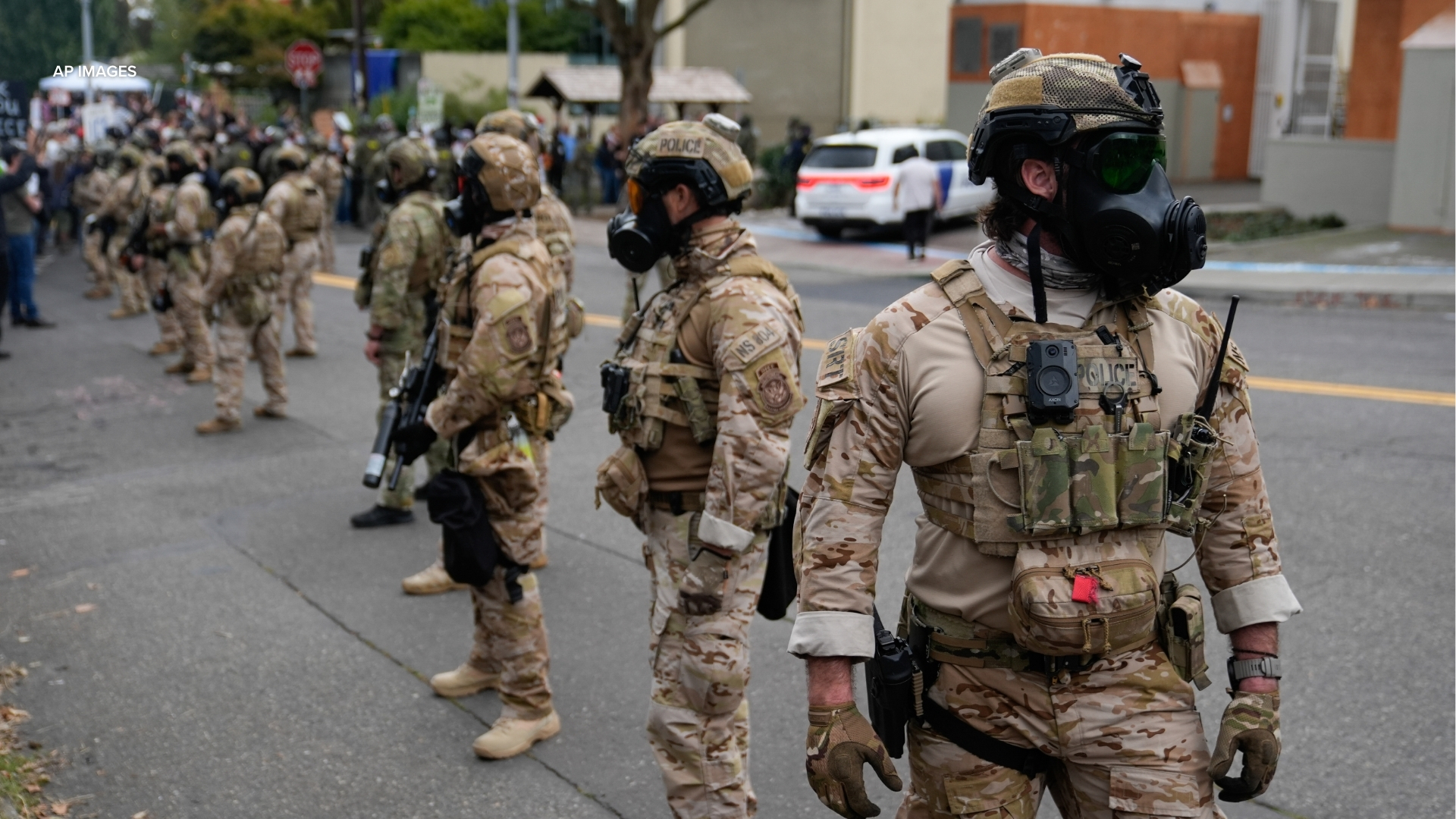
A federal judge in Oregon has halted the Trump administration’s efforts to deploy federalized National Guard members from California and other states to Portland, Oregon. In a rare late Sunday night virtual hearing on October 5, 2025, US District Judge Karin Immergut, a Trump appointee, granted a temporary restraining order requested by the state of California to prevent the deployment of up to 300 California National Guard members to Portland. This ruling followed Immergut’s decision the previous day to block President Donald Trump’s attempt to deploy Oregon National Guard troops in the city.
California Governor Gavin Newsom announced plans to sue the Trump administration after it deployed federalized National Guard troops—called into service by the president—to Oregon. In a statement, Newsom condemned the move, saying, “This is a breathtaking abuse of the law and power. The Trump Administration is unapologetically attacking the rule of law itself and putting into action their dangerous words—ignoring court orders and treating judges, even those appointed by the President himself, as political opponents.”
California Attorney General Rob Bonta praised Immergut’s ruling, suggesting the administration’s attempt to deploy California troops was a direct response to the judge’s earlier order blocking the federalization of Oregon’s National Guard. “The Trump Administration’s flagrant disregard for the courts was on full display when it sought to circumvent Judge Immergut’s order by redeploying troops from Los Angeles to Portland,” Bonta said. “This disrespect for the rule of law cannot stand—and I’m glad the court agreed.”
Oregon Governor Tina Kotek, a Democrat, confirmed that some California National Guard troops arrived in Oregon on the night of October 4, with more expected on OCtober 6. She strongly opposed the deployment, stating, “The facts haven’t changed. There is no need for military intervention in Oregon. There is no insurrection in Portland. No threat to national security. Oregon is our home, not a military target. Oregonians exercising their freedom of speech against unlawful actions by the Trump Administration should do so peacefully.”
In an op-ed published Sunday in The Oregonian, Portland Police Chief Bob Day addressed the situation, noting that “national portrayals” of Portland overstated the city’s issues. “There is no ignoring that we are facing an extraordinary time in our city’s history, with the deployment of both federal law enforcement and the Oregon National Guard,” Day wrote. He emphasized that Portland police employ a “layered approach” to managing public order, avoiding tactics like tactical gear lineups that could escalate crowd behavior.
On the same day, Defense Secretary Pete Hegseth announced in a memo that up to 400 Texas National Guard members would be federalized for deployment to Chicago and Portland for up to 60 days, with the possibility of an extension. The memo, included in a court filing by the Oregon attorney general’s office, cited President Trump’s determination on October 4, 2025, that “violent incidents, as well as the credible threat of continued violence,” were impeding federal law enforcement in Illinois, Oregon, and other locations.
Texas Governor Greg Abbott, a Republican, supported the deployment, stating on X, “I fully authorized the President to call up 400 members of the Texas National Guard to ensure safety for federal officials. You can either fully enforce protection for federal employees or get out of the way and let Texas Guard do it. No Guard can match the training, skill, and expertise of the Texas National Guard.”
I fully authorized the President to call up 400 members of the Texas National Guard to ensure safety for federal officials.
You can either fully enforce protection for federal employees or get out of the way and let Texas Guard do it.
Illinois Governor JB Pritzker, a Democrat, condemned the move, calling it “Trump’s Invasion.” He noted that no federal officials had coordinated with him regarding the deployment and criticized the involvement of another state’s military. “It started with federal agents, it will soon include deploying federalized members of the Illinois National Guard against our wishes, and it will now involve sending in another state’s military troops,” Pritzker said. Both Pritzker and Kotek urged Abbott to withdraw his support for the deployment.
The White House defended the deployment, with spokesperson Abigail Jackson stating, “President Trump exercised his lawful authority to protect federal assets and personnel in Portland following violent riots and attacks on law enforcement.” Pentagon spokesman Sean Parnell added that California National Guard members were reassigned from Los Angeles to Portland “to support U.S. Immigration and Customs Enforcement and other federal personnel performing official duties, including the enforcement of federal law, and to protect federal property.”
In response to Immergut’s ruling blocking the activation of 200 Oregon National Guard troops until at least October 18, the Trump administration filed a motion with the 9th US Circuit Court of Appeals, arguing that the judge “impermissibly second-guessed” Trump’s military judgments. The motion cited a nearly 200-year-old Supreme Court precedent, asserting that such decisions are the president’s prerogative, not that of a governor or federal court.
Judge Immergut’s rulings underscored a “longstanding and foundational tradition of resistance to government overreach, especially in the form of military intrusion into civil affairs.” Oregon’s Governor Kotek reiterated, “There is no insurrection in Portland. No threat to national security. No fires, no bombs, no fatalities due to civil unrest. The only threat we face is to our democracy—and it is being led by President Donald Trump.”
The controversy extends beyond Portland. Last month, a federal judge in Los Angeles ruled that the deployment of National Guard troops and Marines was illegal, and officials in Washington, D.C., also sued to block similar deployments. Trump has threatened to deploy troops and federal law enforcement to other cities, including Baltimore and New Orleans, escalating tensions with Democratic governors and mayors.
Pritzker, in a CNN interview on Sunday, criticized the federal presence in Chicago, stating, “They are the ones that are making it a war zone. They need to get out of Chicago if they’re not going to focus on the worst of the worst, which is what the president said they were going to do.” He and other Democratic leaders have also condemned Trump’s suggestion to senior military officials that “dangerous cities” be used as “training grounds” for the National Guard.
The deployment of federalized National Guard troops has sparked widespread debate about the balance between federal authority and state autonomy, as well as the appropriate use of military forces in domestic civil matters. As legal battles continue, the situation remains a flashpoint in the ongoing clash between the Trump administration and Democratic state leaders.
The case centers on a challenge to Humphrey’s Executor v. United States (1935), a landmark Supreme Court ruling that established protections for commissioners of independent agencies. In that decision, the Court unanimously held that President Franklin D. Roosevelt could not fire an FTC commissioner without cause, such as misconduct or neglect of duty. This ruling paved the way for the creation of powerful independent agencies tasked with regulating critical areas like consumer protection, labor relations, and federal employment disputes. These agencies were designed to operate with a degree of autonomy, insulated from direct presidential control to ensure decisions were based on expertise rather than political pressures.
However, the Humphrey’s Executor decision has long been a point of contention for conservative legal scholars who argue that independent agencies should be more accountable to the president, as the head of the executive branch. The Justice Department, representing President Donald Trump, contends that the president should have the authority to remove agency board members at will to effectively carry out his agenda. Solicitor General D. John Sauer argued, “The President and the government suffer irreparable harm when courts transfer even some of that executive power to officers beyond the President’s control.” Sauer further noted that courts lack the authority to reinstate fired officials, only to award back pay.
In a 6-3 decision, the Supreme Court permitted President Donald Trump to fire Rebecca Slaughter, a Democratic FTC commissioner, while the broader case challenging Humphrey’s Executor proceeds. This ruling follows a series of similar decisions allowing the president to remove board members from three other independent agencies, including Gwynne Wilcox of the NLRB and Cathy Harris of the MSPB. The Court’s conservative majority did not provide detailed reasoning for allowing Slaughter’s firing, as is typical for decisions on the emergency docket. Justice Elena Kagan, joined by Justices Sonia Sotomayor and Ketanji Brown Jackson, dissented, arguing that Congress explicitly prohibited such presidential removals. “Yet the majority, stay order by stay order, has handed full control of all those agencies to the President,” Kagan wrote. The dissenters expressed concern that eroding the independence of these agencies could lead to regulatory decisions driven by politics rather than expertise.
The upcoming case, set for arguments in December 2025, will determine whether the Court overturns or narrows Humphrey’s Executor. A decision to grant the president broader authority to fire agency board members could fundamentally alter the structure of independent agencies. These bodies, including the FTC, NLRB, and MSPB, play critical roles in enforcing consumer protections, investigating unfair labor practices, overseeing union elections, and resolving federal employment disputes. Opponents of expanding presidential power, including Slaughter’s legal team, argue that allowing the president to remove congressionally confirmed board members at will risks politicizing regulatory decisions. They assert that such a change would undermine the expertise-driven mission of these agencies. “If the President is to be given new powers Congress has expressly and repeatedly refused to give him, that decision should come from the people’s elected representatives,” Slaughter’s attorneys stated. The Justice Department, however, argues that the president’s ability to execute his agenda is hindered when agency officials operate beyond his control. This tension between presidential authority and agency independence lies at the heart of the case.
The Supreme Court’s willingness to hear this case before it has fully worked through lower courts signals its urgency and potential impact. Additionally, Wilcox and Harris, the fired NLRB and MSPB board members, have asked the Court to consider their cases alongside Slaughter’s, highlighting the broader implications for multiple agencies. The Court has also suggested that the president’s removal power may face limits at certain agencies, such as the Federal Reserve. This issue is likely to be tested in a separate case involving fired Fed Governor Lisa Cook, which could further clarify the boundaries of presidential authority.
As the Supreme Court prepares to hear arguments in December, the outcome of this case could redefine the relationship between the executive branch and independent federal agencies. A ruling in favor of expanded presidential power could usher in an era of greater executive control over regulatory bodies, potentially affecting how laws are enforced in areas like consumer protection, labor rights, and federal employment. Conversely, upholding Humphrey’s Executor would preserve the autonomy of these agencies, ensuring their decisions remain grounded in expertise rather than political influence. For now, the Court’s recent decisions signal a conservative majority inclined to reconsider long-standing precedents, setting the stage for a pivotal legal battle with significant consequences for the structure of the federal government.
On January 2, 2025, President Joe Biden highlighted the confirmation of 235 federal judges during his presidency, a landmark achievement that narrowly surpassed the 234 lifetime judicial appointments made under President-elect Donald Trump in his first term. Among Biden’s confirmations was one Supreme Court justice, marking the culmination of a determined effort by Democrats to shape the judiciary in the final months of his term.
In his remarks, President Biden framed the milestone as a safeguard for democracy and a counterbalance to recent judicial decisions, including the Supreme Court’s overturning of Roe v. Wade. “Together, these judges are going to hear cases on issues, ruling on everything from whether Americans can cast their ballot, literally how they can cast their ballot, when it will be counted, to whether workers can unionize and make a living wage for their families,” Biden said. He also highlighted environmental priorities, adding, “whether their children can breathe clean air and drink clean water.”
Flanked by Senate Majority Leader Chuck Schumer and Senate Judiciary Committee Chair Dick Durbin, Biden reflected on the intense push to confirm his nominees. He praised their shared commitment to diversifying the federal bench, with two-thirds of his appointees being women or people of color. “When I ran for president, I made a promise that I’d have a bench that looks like America and taps into the full talents of this nation,” Biden said. “And I’m proud we’ve kept our commitment.”
Despite the celebratory tone, Biden acknowledged challenges faced during his term, as federal courts blocked several key policy initiatives, including student debt relief programs, immigration reforms, and stricter air pollution regulations. Most recently, a federal appeals court struck down his administration’s net neutrality rules, a signature tech policy. The president’s remarks underscored how the judiciary has become a battleground for polarizing policy disputes, further eroding public confidence in judicial impartiality.
This erosion of trust has been exacerbated by “judge shopping,” where lawsuits are filed in districts perceived to favor particular causes. Polls show public faith in the neutrality of US courts has plummeted, a concern echoed by Chief Justice John Roberts in his year-end report, which also addressed the rise in threats against federal judges. Meanwhile, President-elect Trump, who campaigned on criticisms of the legal system, frequently attacked judges who ruled against him, fueling partisan perceptions of the judiciary.
The urgency to confirm President Joe Biden’s judicial nominees stemmed from a desire to avoid leaving vacancies for Republicans to fill under the incoming administration. The Democratic push mirrored a similar scenario in 2017 when Trump inherited over 100 vacancies after Republicans blocked President Obama’s appointments. Biden’s confirmations now represent over a quarter of the federal bench, setting a new standard for diversity and ensuring a lasting legacy as he concludes his term.
The Biden administration on January 3 filed a lawsuit against Texas over its controversial immigration law that gives local law enforcement in Texas the authority to arrest migrants, arguing the state “cannot run its own immigration system.” The move comes after the Justice Department threatened last week to sue Texas if it did not back down from the measure. It marks the second legal action against the state this week, as President Joe Biden and Texas Governor Greg Abbott spar over the handling of the US-Mexico border. In December, Abbott, a Trump-aligned Republican, signed into law Senate Bill 4, which also gives judges the ability to issue orders to remove people from the United States. The White House has slammed the law – which is slated to take effect in March – as “incredibly extreme.”
In its lawsuit, the Justice Department argued that the measure undercuts the federal government’s “exclusive authority” to enforce immigration law. “Its efforts, through SB 4, intrude on the federal government’s exclusive authority to regulate the entry and removal of noncitizens, frustrate the United States’ immigration operations and proceedings, and interfere with U.S. foreign relations. SB 4 is invalid and must be enjoined,” the complaint, filed in the US District Court for the Western District of Texas, states.
The Justice Department requested that the measure be blocked. “SB 4 is clearly unconstitutional,” Associate Attorney General Vanita Gupta said in a statement. “Under the Supremacy Clause of the Constitution and longstanding Supreme Court precedent, states cannot adopt immigration laws that interfere with the framework enacted by Congress. The Justice Department will continue to fulfill its responsibility to uphold the Constitution and enforce federal law.”
Earlier this week, the Biden administration asked the Supreme Court to allow it to remove razor wire at the US-Mexico border that was installed by Texas. The dispute is over whether the Border Patrol has the legal authority to cut concertina wire on the banks of the Rio Grande.
The state of Texas sued last year to stop the wire cutting, saying it illegally destroys state property and undermines security to assist migrants in crossing the border. A federal appeals court ordered Border Patrol agents to stop the practice while court proceedings play out, and the Justice Department has now filed an emergency application, asking the Supreme Court to overturn that decision.
Former President Donald Trump asked the Supreme Court on January 3 to allow him to stay on the presidential primary ballot in Colorado, saying a state ruling banning him was unconstitutional, unfair, and based on a January 6 insurrection that his appeal said did not happen. The court filing, dominated by technical and procedural challenges to the Colorado Supreme Court ruling last month, does not ask the high court to weigh in on whether the former president indeed participated in an insurrection. The state’s highest court concluded that Trump indeed engaged in the January 6 insurrection effort and thus was banned from running under an obscure, Civil War-era clause in the Constitution’s 14th Amendment banning such a person from holding office.
Former President Donald Trump’s appeal, which experts expect the high court to consider, instead argues that the Colorado court had no business getting involved in the matter at all and that keeping Trump off the ballot would deprive voters of their right in a democracy to choose their leaders. The decision is “a ruling that, if allowed to stand, will mark the first time in the history of the US that the judiciary has prevented voters from casting ballots for the leading major-party presidential candidate,” said the court papers filed late Wednesday afternoon, two days before a deadline to appeal or get booted off the Colorado Republican Party primary ballot.
The Colorado court ruled in favor of six Republican and independent voters who said the “insurrection clause of the 14th Amendment to the Constitution makes Trump ineligible to hold office and thus, not qualified to be on the ballot. That clause, originally directed at Confederates, says no one can hold office who has previously taken an oath to support the Constitution but then engaged in an insurrection or provided help to enemies of the US.
Former President Donald Trump’s team, in their legal brief, argued that Congress gets to decide a candidate’s eligibility to serve as president. And while the appeal was specific to the Colorado case, it tacitly invited the high court to offer a ruling that applied nationwide. “It would be beyond absurdity” for the ballot question to be determined by 51 separate state and District of Columbia jurisdictions rather than federal courts, the brief said. “The election of the President of the United States is a national matter, with national implications, that arises solely under the federal Constitution and does not implicate the inherent or retained authority of the states.”
The brief said former President Donald Trump was never an “officer” of the US and that the oath he took as president was different than those taken by other public servants, meaning he was not subject to the ban on insurrectionists. Further, the court papers said, the clause merely says such an individual cannot serve – not that he or she can’t run for office. The term “insurrection” is unclear, the brief said, and anyway, his lawyers said, Trump did not engage in “insurrection.” “Trump never told his supporters to enter the Capitol, either in his speech at the Ellipse or in any of his statements or communications before or during the events at the Capitol,” the appeal said. “To the contrary, his only explicit instructions called for protesting “peacefully and patriotically” to “support our Capitol Police and Law Enforcement,” to “[s]tay peaceful” and to “remain peaceful.”
Jena Griswold, Colorado’s Democratic secretary of state, urged the high court to settle the matter. “Donald Trump just filed an appeal to the US Supreme Court to consider whether he is eligible to appear on Colorado’s Presidential Primary ballot. I urge the Court to consider this case as quickly as possible,” Griswold wrote on social media.
The appeal is virtually certain to be heard by a Supreme Court whose reputation as an unbiased arbiter has suffered immensely in recent years. Questions about ethical transgressions, along with the stunning 2022 reversal of the 1973 Roe v. Wade decision guaranteeing abortion rights, have turned the court, in the eyes of many Americans, into another partisan entity. The Trump case puts the court in an extremely uncomfortable position: No matter how it may rule, and no matter the legal arguments used to justify it, the decision is likely to cause a backlash from some political segments in deeply divided America. The high court was the target of criticism after its 2000 ruling that effectively made George W. Bush president. And while the justices may not want to enter that political fray again, competing decisions on the insurrection clause likely means the Supreme Court will have no choice but to get involved.
Iran has executed a man for allegedly injuring a paramilitary officer in the first known execution linked to revolution that have swept the country since September, state media reported on December 8. Mizan Online, a news agency affiliated with Iran’s judiciary, and the semi-official Tasmin news agency both named the protester as Mohsen Shekari. He was reportedly convicted of “waging war against god” for allegedly stabbing a member of the Basij paramilitary force at a protest in Tehran on September 23. Shekari was sentenced to death on October 23, and executed by hanging on December 8, according to Mizan Online. It was the first execution connected to the protests to be publicly reported by state media.
Iran Human Rights, a non-profit rights organization that has members inside and outside the country, has called for a strong international response to the execution. “His execution must be met with the strongest possible terms and international reactions. Otherwise, we will be facing daily executions of protesters who are protesting for their fundamental human rights,” the group’s director Mahmood Amiry-Moghaddam said in a statement. Amiry-Moghaddam said that Shekari was executed without any due process or access to a lawyer of his choice in a “show trial” by the Revolutionary Court.
Several European governments strongly criticized Iran for the execution. German Foreign Minister Annalena Baerbock said in a tweet that Shekari “was tried and executed in a perfidious rushed trial for disagreeing with the regime.” “The Iranian regime’s inhumanity knows no bounds,” she said. “But the threat of execution will not suffocate people’s desire for freedom.” French foreign ministry spokeswoman Anne-Claire Legendre said France condemned the execution in the “strongest terms” and “reiterated its strongest commitment to the right to peaceful protest.” She said the demands by the protesters are “legitimate and must be heard.” British Foreign Secretary James Cleverly said he was “outraged by the tragic news of the first execution of a protestor in Iran,” while the foreign ministry of the Czech Republic, which currently holds the rotating presidency of the European Union, described the news as “appalling,” and said “the Iranian regime uses outrageously disproportionate penalties to instill terror in its population.”
Several Iranians have been sentenced to death by execution during the nationwide protests, which were sparked by the death of 22-year-old Mahsa Amini after she was apprehended by the state’s morality police for allegedly not wearing her hijab properly. Her death touched a nerve in the Islamic Republic, with prominent public figures coming out in support of the movement, including top Iranian actor Taraneh Alidoosti. The protests have since coalesced around a range of grievances with the authoritarian regime.
According to Amnesty International, as of November, Iranian authorities are seeking the death penalty for at least 21 people in connection with the protests. Approximately 500 people at least have been killed in the unrest since September, according to Norway-based Iran Human Rights organization. Since the demonstrations began, authorities have unleashed a deadly crackdown, with reports of forced detentions and physical abuse being used to target the country’s Kurdish minority group. Meanwhile, Iran’s Supreme Leader (dictator)Ayatollah Ali Khamenei has praised the Basij, a wing of Iran’s Revolutionary Guard, for its role in the crackdown, describing the protest movement as “rioters” and “thugs” backed by foreign forces.
A group of 227 members of the Iranian parliament (Majles) has called on the Judiciary to issue death sentences for people arrested during the ongoing anti-government protests. A few token Iranian “reformists” and members of the ultra-conservative branch of the Iranian Principlist political alliance make up the majority of the parliament, which was chosen in a non-competitive, sham vote in February of 2020. The demonstrators were referred to as “mohareb” in a declaration that was read aloud in the parliament on November 6. This Arabic word literally translates to “warrior,” but in Islamic law, or sharia, it signifies “enemy of God,” which is punishable by death. Additionally, they compared the demonstrators to ISIS fighters who “destroy people’s lives and property.” For taking part in the demonstrations, thousands of individuals have already been accused by the Iranian government of “moharebeh,” “corruption on earth,” “assembly and cooperation against national security,” and “confrontation with the Islamic Republic.”
The Iranian parliament baselessly alleged that “the US and other foes” are instigating violence, organizing demonstrations, and supplying financial assistance and firearms to hijack the protests while referring to the current wave of popular protests as “riots.” In addition, they claimed that “thugs and mobs” had killed dozens of people and compromised national security. Reiterating the official narrative of the Islamic Republic, the parliamentarians said that because “victories of the Islamic Republic” had been achieved in Iraq, Syria, Palestine, Lebanon, and Yemen, the “riots” were a response to “enemies of the Islamic Republic” having been vanquished in those countries. The ultra-conservative legislators also requested that the court pursue legal action against “the politicians who incited the riots” without naming any specific people or organizations.
Speaker of the House Mohammad Bagher Ghalibaf claimed earlier in the session that the key players in the country’s discontent are the CIA, Mossad, and their allies. Hardliner parliamentary member Mohammad Esmail Kowsari, who is also a senior Islamic Revolutionary Guard Corps (IRGC) officer, impliedly threatened late in October that the government will handle the current demonstrations differently going forward.
While protests continue across Iran, the Islamic Republic’s Judiciary has also announced that it has indicted over 1,000 people who were arrested during the demonstrations. Authorities have been claiming that “separatists” and “instigators” are behind the efforts to overthrow the government and break Iran into areas controlled by ethnic groups, a claim routinely denied by Iranians on streets and social media. The claim that protests are instigated by foreign enemies was first made by Supreme Leader Ali Khamenei and loyal officials now repeat his conspiracy theory.
President Ebrahim Raisi on October 25 accused “enemies of the Islamic Republic” of fomenting the protests, echoing what Khamenei said a day earlier. Parliament Speaker Mohammad-Bagher Ghalibaf in turn vowed that parliament would take action to change the ways of the morality police in a bid to calm the protesters. “Death sentences against people for exercising their right to freedom of expression, after the killings of peaceful protesters, abductions and gunning down children, and other atrocities, indicate a government that is out of control and willing to quash protests at any cost,” said a statement by Center for Human Rights in Iran. The Norway-based human rights organization also expressed concern regarding the fate of the detained protesters saying, “dozens of them have been charged with the security-related charges of “moharebeh” and “corruption on earth” which carry the death penalty.” The Islamic Republic’s history and current evidence indicate that they intend to use the death penalty as a tool of political repression to intimidate their opposition.
Since the death in custody of Mahsa Amini, a 22-year-old Iranian of Kurdish descent who had been detained on September 13 for violating the Islamic dress code and died three days later from severe head trauma, Iran has been rocked by protests. Mahsa was accused of violating the Islamic dress code. Public indignation after a crackdown that resulted in the deaths of additional young men, women, and children expanded protests. Seven weeks later, the demonstrations are still going strong.
The Supreme Court, in a 5-4 decision, allowed a congressional map drawn by Alabama Republicans to remain in place on February 7, freezing a lower court ruling that said the map likely violates the Voting Rights Act by diluting the political power of African American voters. The lower court had ordered a new map to be drawn, which could have led to Democrats gaining another seat in the House in the fall. Chief Justice John Roberts joined the three liberal justices in dissent. The justices also said they would hear arguments over the map, adding another potentially explosive issue, concerning the scope of a key provision of the Voting Rights Act, to the court’s docket.
The court’s order, the first dealing with the 2022 elections, means that the map will be used for the state’s upcoming primary, and likely be in place for the entire election cycle, while the legal challenge plays out.
The order pauses an opinion by a panel of three judges that held that the Alabama map likely violates Section 2 of the Voting Rights Act because it only includes one district where Black voters have the opportunity to elect a candidate of their choice. Justice Brett Kavanaugh, writing for himself and fellow conservative Justice Samuel Alito, said the court acted in order to maintain the status quo while the justices consider the issue. Kavanaugh said the court’s order “does not make or signal any change” to voting rights law.
Chief Justice Roberts, who again found himself siding with the court’s three liberals, said that while he agreed the court should take up the issue for next term to “resolve the wide-ranging uncertainties” in the case, he would have allowed the district court opinion to stand while the appeals process played out. The Supreme Court will hear the full case next fall.
“The District Court properly applied existing law in an extensive opinion with no apparent errors for our correction,” Roberts wrote.
Justice Elena Kagan, writing for her liberal colleagues Stephen Breyer and Sonia Sotomayor, wrote a much more strongly worded dissent. Kagan said the majority had gone “badly wrong” in granting Alabama’s request to freeze the lower court opinion and the court’s decision “forces Black Alabamians to suffer what under the law is clear vote dilution.” She said the decision will undermine a key section of the Voting Rights Act. She also said the court should not issue such an impactful order on its emergency docket (which critics refer to as its “shadow docket”) without full briefing and oral argument. “Today’s decision is one more in a disconcertingly long line of cases in which this Court uses its shadow docket to signal or make changes in the law, without anything approaching full briefing and argument,” Kagan said. She said the court’s action “does a disservice” to Black Alabamians who “have had their electoral power diminished — in violation of a law this court once knew to buttress all of American democracy.”
Alabama’s congressional redistricting plan was challenged under Section 2 of the Voting Rights Act, a VRA provision that has been a crucial tool for voting rights advocates after the Supreme Court gutted another section of the law that required certain states to get federal approval for its maps.
The lower court panel, which included two judges appointed by former President Donald Trump, said that Alabama was required to draw a second district where Blacks made up a majority of voters or close to it. Their decision pointed to Supreme Court precedent for how VRA redistricting cases should be handled. Before the Supreme Court’s ruling, US Rep. Mo Brooks complained to Alabama.com that “skin pigmentation” should not factor into the congressional redistricting process. “These liberal activist judges have tried to segregate us based on race, I find that abominable, in order to elect people in certain parts of the state based on race, which I also think is abominable. We’ve got to put the skin pigmentation issue behind us,” the Alabama Republican told the outlet Saturday, remarking later on “the concept that Blacks can only be elected in Black districts, and Whites should have districts of their own in which they get elected. I believe that is racist and I oppose it.”
Alabama, in seeking the Supreme Court’s intervention, had argued that race had been improperly used in the proceedings to determine whether Alabama was obligated under the law to draw a second minority-majority district. Alabama, in its arguments to the court, is asking the Supreme Court to “cut back significantly on the scope of Section (Two of) the Voting Rights Act in redistricting cases,” Rick Hasen, an election law expert, wrote in an analysis of the case last week. “A cutback could have major negative implications for African-American and other racial minority representation in Congress, in state legislatures, and in local bodies across the country, making it harder to require jurisdictions to draw districts where minority voters can elect representatives of their choice,” Hasen, a law professor at University of California-Irvine, wrote on the election law blog.
Justice Stephen Breyer will step down from the Supreme Court at the end of the current term, according to people familiar with his thinking. President Joe Biden and Breyer are scheduled to appear together at the White House on January 26 as the Supreme Court justice is set to announce his retirement, a source familiar with the matter confirmed to NBC News. Justice Breyer is one of the three remaining liberal justices, and his decision to retire after more than 27 years on the court allows Biden to appoint a successor who could serve for decades and, in the short term, maintain the current 6-3 split between conservative and liberal justices.
At 83, Justice Stephen Breyer is currently the court’s oldest member. Liberal activists have urged him for months to retire while Democrats hold both the White House and the Senate, a position that could change after the midterm elections in November. They contended that Justice Ruth Bader Ginsburg stayed too long despite her history of health problems and should have stepped down during the Obama administration. Ginsburg’s death from cancer at 87 allowed then-President Donald Trump to appoint her successor, Amy Coney Barrett, moving the court further to the right. An appointment by President Joe Biden could keep Breyer’s seat on the liberal side of the court for years or decades to come.
Erwin Chemerinsky, dean of the University of California Berkeley School of Law, urged Justice Stephen Breyer to retire in a Washington Post op-ed article in May, writing that there are times “when the stewards of our system must put the good of an institution they love, and of the country, they love, above their own interests. They have to recognize that no one, not even a brilliant justice, is irreplaceable and that the risks presented by remaining are more than hypothetical.” President Joe Biden promised on the campaign trail to nominate a Black woman to the court. In the wake of Breyer’s announcement, there was an outpouring of statements calling for him to follow through. The progressive group Demand Justice hired a truck last year to drive around Washington with the sign: “Breyer Retire. It’s time for a Black woman Supreme Court justice.” Among likely contenders are U.S. Circuit Judge Ketanji Brown Jackson of the Court of Appeals for the District of Columbia, a former Breyer law clerk; and Leondra Kruger, a justice on California’s Supreme Court.
Jackson, formerly a district court judge in Washington, was nominated by Biden to the U.S. Circuit Court and was confirmed by the Senate in mid-June on a 53-44 vote, including three Republicans. She succeeded Merrick Garland, who left the appeals court to become Biden’s attorney general.
Senator Patty Murray (D-WA), was among those who issued a statement soon after the news of Breyer’s impending retirement, calling on Biden to uphold his pledge to nominate a Black woman as the next justice. “The court should reflect the diversity of our country, and it is unacceptable that we have never in our nation’s history had a Black woman sit on the Supreme Court of the United States — I want to change that,” she said.
Senate Majority Whip Dick Durbin (D-IL) echoed those sentiments in a tweet, saying Biden has the opportunity to bring “diversity, experience, and an evenhanded approach to the administration of justice.”
Senate Majority Leader Chuck Schumer (D-NY) said President Joe Biden’s nominee will “receive a prompt hearing in the Senate Judiciary Committee, and will be considered and confirmed by the full United States Senate with all deliberate speed.” “America owes Justice Breyer an enormous debt of gratitude,” Schumer added. Republican Senator Lindsey Graham of South Carolina, who voted for Justices Sonia Sotomayor and Elena Kagan, said if Democrats “hang together,” as he expects, they will have the power to replace Breyer without one Republican vote. “Elections have consequences, and that is most evident when it comes to fulfilling vacancies on the Supreme Court,” Graham said in a statement.
Appointed by President Bill Clinton, Justice Stephen Breyer came to the Supreme Court in 1994 and became one of the court’s moderate-to-liberal members, though he often said it was misleading to label justices with such terms. Breyer believed that interpreting the Constitution should be based on practical considerations, changing with the times. That put him at odds with conservative justices who said the court must be guided by the original intent of the founders. “The reason that I do that is because law in general, I think, grows out of communities of people who have some problems they want to solve,” he said in an interview. Breyer wrote the court’s opinion striking down a state law that banned some late-term abortions in 2000 and dissented seven years later, when the Supreme Court upheld a similar federal law passed by Congress. He supported affirmative action and other civil rights measures. And in a widely noted dissent in 2015, he said the death penalty in America had become so arbitrary that it was probably unconstitutional.
The Supreme Courtcleared the way on January 26 for the release of presidential records from the Trump White House to a congressional committee investigating the January 6, 2021, attack on the US Capitol. The court’s order means that more than 700 documents will be transferred to Congress that could shed light on the events leading up to the insurrection when hundreds of rioters converged on the Capitol attempting to stop certification of the 2020 presidential election results. Only Justice Clarence Thomas said publicly that he would have granted former President Donald Trump’s request to block the document handover from the National Archives to the House select committee. No other justices made an objection public. The Biden White House supports releasing the records to the committee, after determining the disclosure is in the nation’s best interest and declining to assert executive privilege.
“The Supreme Court’s action tonight is a victory for the rule of law and American democracy,” Congressman Bennie Thompson, a Mississippi Democrat, and Congresswoman Liz Cheney, a Wyoming Republican, who are chair and vice-chair of the panel, said in a joint statement on January 26. “The Select Committee has already begun to receive records that the former President had hoped to keep hidden and we look forward to additional productions regarding this important information.”
The select committee is seeking more than 700 pages of disputed documents as it explores Trump’s role in trying to overturn the 2020 presidential election. That includes his appearance at a January 6 rally in which he directed followers to go to the US Capitol where lawmakers were set to certify the election results and “fight” for their county. The documents include activity logs, schedules, speech notes and three pages of handwritten notes from then-White House chief of staff Mark Meadows, paperwork that could reveal goings-on inside the West Wing as Trump supporters gathered in Washington and then overran the Capitol, disrupting the certification of the 2020 vote. Former President Donald Trump is also seeking to keep secret a draft proclamation honoring two police officers who died in the siege and memos and other documents about supposed election fraud and efforts to overturn Trump’s loss of the presidency, the National Archives has said in court documents.
White House spokesman Mike Gwin said in a statement after the ruling that former President Donald Trump’s “actions represented a unique and existential threat to our democracy, and President Biden has been clear that these events require a full investigation to ensure that what we saw on January 6th can never happen again. Today’s ruling by the Supreme Court is an important step forward in that process, and in ensuring accountability for an unprecedented assault on our democracy and the rule of law.”
The move effectively moots former President Donald Trump’s pending appeal in the case that centered on keeping the documents secret. Lawyers for Trump say the documents are sensitive and privileged records. “The disagreement between an incumbent President and his predecessor from a rival political party is both novel and highlights the importance of executive privilege and the ability of Presidents and their advisers to reliably make and receive full and frank advice, without concern that communications will be publicly released to meet a political objective,” Trump’s lawyer, Jesse R. Binnall told the justices. On the other hand, the Biden administration argued that withholding the records based on executive privilege is not in the interest of the United States. Solicitor General Elizabeth Prelogar said that in light of the “extraordinary events” of January 6, President Joe Biden had decided that that an assertion of executive privilege is “not justified.”
A federal appeals court ruled against former President Donald Trump, holding that he “has provided no basis for this court to override President Biden’s judgment and the agreement and accommodations worked out between the Political Branches over these documents.” The court noted that the events “marked the most significant assault on the Capitol since the War of 1812,” but agreed to freeze its ruling until the Supreme Court acted. “Under any of the tests advocated by former President Trump, the profound interests in disclosure advanced by President Biden and the January 6th Committee far exceed his generalized concerns for Executive Branch confidentiality,” the panel of the US Court of Appeals for the DC Circuit wrote.
On January 26, the Supreme Court cited part of that sentence. “Because the Court of Appeals concluded that President Trump’s claims would have failed even if he were the incumbent, his status as a former President necessarily made no difference to the court’s decision,” the Supreme Court said. “Tonight’s ruling is a major setback for former President Trump in his efforts to block the National Archives from turning over documents to the January 6 Committee,” said Steve Vladeck, CNN Supreme Court analyst and professor at the University of Texas School of Law. “Although the justices did not rule on whether the court of appeals correctly rejected his suit, by not blocking the handing over now, the justices have allowed that ruling to be the final word.
The Atlanta area prosecutor weighing whether former President Donald Trump and others committed crimes by trying to pressure Georgia election officials has been granted a special purpose grand jury to aid in her investigation. Fulton County Superior Court judges on January 24 approved the request made last week by Fulton County District Attorney Fani Willis and said she will be allowed to seat a special grand jury on May 2, the Atlanta Journal-Constitution reported. The special grand jury can continue for a period “not to exceed 12 months,” Christopher Brasher, chief judge of Fulton County Superior Court, wrote in an order. “The special purpose grand jury shall be authorized to investigate any and all facts and circumstances relating directly or indirectly to alleged violations of the laws of the State of Georgia, as set forth in the request of the District Attorney referenced hereinabove,” he added. “The special purpose grand jury … may make recommendations concerning criminal prosecution as it shall see fit.”
Fulton County District Attorney Fani Willis launched the criminal investigation in February of 2021. At the time, a Trump spokesman dismissed the probe, calling it “the Democrats’ latest attempt to score political points by continuing their witch hunt against President Trump.” In a letter last week, Willis, a Democrat, told the chief judge of Fulton County Superior Court the move was needed because a “significant number of witnesses and prospective witnesses have refused to cooperate with the investigation absent a subpoena requiring their testimony.” Willis cited Georgia Secretary of State Brad Raffensperger (R) as an example. Willis has previously confirmed that part of her investigation centers on the January 2, 2021, phone call between Trump and Raffensperger in which Trump asked Raffensperger to “find” enough votes to overturn Joe Biden’s win in the state’s presidential election.
Former President Donald Trump last week defended his call with Raffensperger, saying in a statement, “I didn’t say anything wrong in the call” and repeating his false claims of widespread voter fraud. Trump has baselessly alleged that the 2020 presidential election was stolen from him and focused much of his attention after the election on Georgia, where Biden became the first Democrat to win the state since 1992. At one point during his call with Raffensperger, Trump told him, “All I want to do is this. I just want to find 11,780 votes, which is one more than we have. Because we won the state.”
In an interview earlier this month with the Associated Press, Fani Willis said that her team was making solid progress in its investigation. “I believe in 2022 a decision will be made in that case,” she said. “I certainly think that in the first half of the year that decisions will be made.” In her letter, Willis called Brad Raffensperger “an essential witness to the investigation” and said he “has indicated that he will not participate in an interview or otherwise offer evidence until he is presented with a subpoena.” Willis pointed to comments Raffensperger made during an October interview with Chuck Todd, host of NBC’s “Meet the Press.”
“If she wants to interview me, there’s a process for that, and I will gladly participate in that because I want to make sure that I follow the law, follow the Constitution,” Raffensperger told Todd. “And when you get a grand jury summons, you respond to it.”
Since the 2020 election, Georgia has become a hot spot in the battle over voting rights. After the state’s Republican-led legislature passed sweeping new voting restrictions last year, several companies spoke out against the new law and Major League Baseball pulled its 2021 All-Star Game out of Atlanta. Earlier this month, President Joe Biden traveled to Atlanta to deliver a major speech that called for changing Senate filibuster rules to pass federal voting rights legislation. The party’s efforts to do so failed after two Senate Democrats, Joe Manchin of West Virginia and Kyrsten Sinema of Arizona joined with Republicans to reject changes to the filibuster.
The Republican Party is locking in newly gerrymandered maps for the legislatures in four battleground states that are set to secure the party’s control in the statehouse chambers over the next decade, fortifying the Republicans against even the most sweeping potential Democratic wave elections. In Texas, North Carolina, Ohio, and Georgia, Republican state lawmakers have either created supermajorities capable of overriding a governor’s veto or whittled down competitive districts so significantly that Republicans’ advantage is virtually impenetrable, leaving voters in narrowly divided states powerless to change the leadership of their legislatures.
Although much of the attention on this year’s redistricting process has focused on gerrymandered congressional maps, the new maps being drafted in state legislatures have been just as distorted. And statehouses have taken on towering importance: With the federal government gridlocked, these legislatures now serve as the country’s policy laboratory, crafting bills on abortion, guns, voting restrictions, and other issues that shape the national political debate. “This is not your founding fathers’ gerrymander,” said Chris Lamar, a senior legal counsel at the Campaign Legal Center who focuses on redistricting. “This is something more intense and durable and permanent.”
This redistricting cycle, the first one in a decade, builds on a political trend that accelerated in 2011 when Republicans in swing states including Pennsylvania, Wisconsin, and Michigan drew highly gerrymandered state legislative maps. Since those maps were enacted, Republicans have held both houses of state government in all three states for the entire decade. They never lost control of a single chamber, even as Democrats won some of the states’ races for president, governor, and Senate. All three of those Northern states are likely to see some shift back toward parity this year, with a new independent commission drawing Michigan’s maps, a state legislative commission drawing maps in Pennsylvania, and a Democratic governor in Wisconsin likely to force the process to be completed by the courts.
Gerrymandering is a tool used by both parties in swing states as well as less competitive ones. Democrats in deep-blue states like Illinois are moving to increase their advantage in legislatures, and Republicans in deep-red states like Utah and Idaho are doing the same. But in politically contested states where Republicans hold full control, legislators are carefully expanding Republican electoral chances. They are armed with sharper technology, weakened federal voting statutes, and the knowledge that legal challenges to their maps may not be resolved in time for the next elections. Texas, North Carolina, and Ohio have signed into law new maps with a significant Republican advantage. Georgia is moving quickly to join them. Republicans say that the growth of such heavily skewed legislatures is both the result of the party’s electoral victories and of where voters choose to live.
As Democratic voters have crowded into cities and commuter suburbs, and voters in rural and exurban areas have grown increasingly Republican, Republican mapmakers say that they risk running afoul of other redistricting criteria if they split up those densely populated Democratic areas across multiple state legislative districts. “What you see is reflective of the more even distribution of Republican and right-leaning voters across wider geographic areas,” said Adam Kincaid, the director of the National Republican Redistricting Trust. Trying to draw more competitive legislative districts, he said, would result in “just a lot of squiggly lines.” He pointed to maps in Wisconsin that were proposed by a commission created by Governor Tony Evers, a Democrat. Under those designs, Republicans would still have a majority in both state legislative chambers, though with significantly smaller margins. “They’re limited by geography,” Kincaid said. “There’s only so many things you can do to spread that many voters across a wide area.”
Democrats note that Republicans are still cracking apart liberal communities, especially in suburbs near Akron and Cleveland in Ohio and in predominantly Black counties in northern and central North Carolina, in a way that hurts the Democrats and cuts against a geographical argument. “They are carving up Democratic voters where they can’t pack them,” said Garrett Arwa, the director of campaigns at the National Democratic Redistricting Committee. He argued that Democratic map proposals “all put forth better and fairer maps that I would say are far from a Rorschach test.”
Democrats have fewer opportunities to unilaterally draw state legislative maps, particularly in battleground states. Of the 14 states where the margin of the 2020 presidential race was fewer than 10 percentage points, Democrats are able to draw state legislative maps in just one: Nevada. Republicans control the redistricting process in six of those 14 states. But when Democrats have had an opening, they have also enacted significant gerrymanders at the state legislative level. In Nevada, Democrats are close to finalizing a map that would give them supermajorities in both chambers of the Legislature, despite President Biden’s winning just 51 percent of the state’s vote last year. The same holds true in deeply blue states. In Illinois, newly drawn State Senate maps would give Republicans roughly 23 percent of seats in the chamber, even though former President Donald Trump won more than 40 percent of voters in the state in 2020.
Republicans have taken two approaches to ensure durable majorities in state legislatures. The tactics in Texas and Georgia are more subtle, while Republicans in Ohio and North Carolina have taken more brazen steps. In Texas and Georgia, the party has largely eliminated competitive districts and made both Republican and Democratic seats safer, a move that tends to ward off criticism from at least some incumbents in the minority party. “Out of the 150 seats in the Texas House, only six of them are within seven points or closer,” said Sam Wang, the director of the Princeton Redistricting Project. Republicans now hold a 20-seat advantage in the chamber, 85 to 65, and the new maps will give the party roughly two more seats. So while the Republican lawmakers did not try to draw an aggressive supermajority, “what they really did a good job of there is getting rid of competition and getting a reasonably safe majority for themselves,” Wang said.
In Georgia, where redistricting is ongoing, early maps follow a trend line similar to that of Texas, as Republicans try to eliminate competitive districts. With the current gerrymandered maps in place, Democrats in the state legislature would have needed to win more than 55.7 percent of the vote to flip the Georgia House in 2020, according to the Princeton Gerrymandering Project. The new maps proposed in Georgia maintain that 55 percent threshold, according to Princeton. Republicans in Ohio have taken more risks than their counterparts in other states, keeping some districts more competitive in an effort to increase the party’s majorities. In Ohio and North Carolina, however, Republicans are taking a forceful tack. By keeping some districts moderately competitive, they are taking more risks in an attempt to create significant majorities or supermajorities, and in doing so, they are often flouting laws or court decisions.
A federal appeals court on November 11 granted a short-term delay in the January 6 select committee’s access to former President Donald Trump’s White House records. A three-judge panel of the US Court of Appeals for the DC Circuit, including President Joe Biden’s first and only appointee to that court, Ketanji Brown Jackson, will instead hear arguments in the matter on November 30. The delay is a minor setback for the House January 6 Committee, which had prevailed in US District Court against Trump’s legal effort to block access to his records altogether. The National Archives, which house Trump’s records, had been preparing to deliver the first batch of requested files to the committee.
The first batch of documents that was slated for release on November 12 is relatively small, as former President Donald Trump contested just 70 pages. But subsequent tranches identified by the Archives include hundreds of pages that were slated for release on November 26. Those will now likely be delayed, as well. The records include call logs, visitor records and documents culled from the files of top Trump aides like chief of staff Mark Meadows. The committee has repeatedly emphasized the urgency of accessing Trump’s records as it explores the former president’s effort to overturn the 2020 election results, including the January 6 assault on the Capitol that disrupted the electoral vote count and sent lawmakers fleeing in fear.
Despite claims of urgency, the January 6 House Select Committee did not object to former President Donald Trump’s request for a temporary injunction while the appeals court considers the broader issues. The Justice Department also took no position on the temporary stay. The composition of the appeals court panel is likely to hearten House investigators. The order issued on November 11 indicates that, in addition to Jackson, the panel includes Judges Patricia Millett and Robert Wilkins, who were appointed by former President Barack Obama to the court. The court’s order emphasized that the move to freeze the status quo, for the time being, should not be seen as reflecting what the court will end up deciding about Trump’s attempt to block disclosure of files from his former White House. “The purpose of this administrative injunction is to protect the court’s jurisdiction to address appellant’s claims of executive privilege and should not be construed in any way as a ruling on the merits,” the order said.
Despite the slowdown, the case is still moving at breakneck speed through typically slow-moving federal courts. Former President Donald Trump filed suit in mid-October to block the January 6 committee’s access to his records. A District Court judge, Tanya Chutkan, rejected Trump’s efforts, dismissing the notion that a former president could overrule the sitting president on matters of executive privilege. Trump quickly appealed the decision and asked the appeals court to delay the effect of Chutkan’s ruling until fuller arguments could be heard. The appeals court’s decision to set a two-week briefing schedule keeps the case moving on a fast track. Trump is due to file his written brief in the case on November 16, with a reply by the National Archives and the House on November 22. Trump will have an additional reply on November 26 before oral arguments the following week. If Trump loses in the three-judge panel, he has the option to appeal to the full appeals court or the Supreme Court.
A federal appeals court temporarily blocked President Joe Biden’s Covid vaccine and testing requirements for private businesses on November 6, just a day after they had officially gone into effect. The Republican attorneys general of Texas, South Carolina, Louisiana, Mississippi, and Utah, as well as several private companies, filed petitions on November 5 challenging the mandate in the US Fifth Circuit Court of Appeals. The court on November 6 ordered the vaccine and testing requirements halted pending review “because the petitions give cause to believe there are grave statutory and constitutional issues with the Mandate.” The three judges who issued the order, Stuart Kyle Duncan, Kurt Damian Englehardt, and Edith Hollan Jones, were appointed by former Presidents Donald Trump and Ronald Reagan.
The Labor Department’s top lawyer, Seema Nanda, said the Biden Administration is “fully prepared to defend this standard in court.” The Occupational Safety and Health Administration, which polices workplace safety for the Labor Department, developed the vaccine and testing requirements under emergency authority that allows the agency to shortcut the process to issue workplace safety standards, which normally take years. “The Occupational Safety and Health Act explicitly gives OSHA the authority to act quickly in an emergency where the agency finds that workers are subjected to a grave danger and a new standard is necessary to protect them,” Nanda said in a statement after the Republican attorneys general and companies filed their challenge.
Under the mandates, companies with 100 or more employees must ensure their staff has received the shots necessary for full vaccination by January 4. After that date, unvaccinated employees must submit weekly negative COVID-19 tests to enter the workplace. Unvaccinated workers must start wearing masks indoors at their workplaces starting December 5. Seema Nanda said the mandate “preempts any state or local requirements that ban or limit an employer’s authority to require vaccination, face-covering, or testing.” Texas Governor Greg Abbott banned vaccine mandates in his state through an executive order last month.
Texas Attorney General Ken Paxton, in a statement, called the vaccine mandate “a breathtaking abuse of federal power,” arguing that it is “flatly unconstitutional.” Paxton said the mandate goes beyond the “limited power and specific responsibilities” of OSHA. In their petition to halt the mandates, several companies that operate in Texas challenged OSHA’s authority to issue emergency workplace safety standards, arguing that it is an unconstitutional delegation of legislative authority to the executive branch. OSHA’s emergency authority was established by Congress. The companies Burnett Specialists, Choice Staffing, and Staff Force also argued that the requirements put them in the position of either violating federal regulations or Texas state law. They also said the mandates would result in irreparable harm, including fines for possible non-compliance as well as the loss of employees to smaller companies who are not covered by the mandates.
The US Supreme Court on February 22 brought a formal end to eight lingering disputes pursued by former President Donald Trump and his allies related to the Presidential election including a Republican challenge to the extension of Pennsylvania’s deadline to receive mail-in ballots. The justices turned away appeals by the Republican Party of Pennsylvania and Republican members of the state legislature of a ruling by Pennsylvania’s top court ordering officials to count mail-in ballots that were postmarked by Election Day and received up to three days later. Three of the nine-member court’s six conservative justices, Clarence Thomas, Samuel Alito, and Neil Gorsuch, dissented from the decision not to hear the Pennsylvania case.
Former President Donald Trump made false claims that the Presidential election was stolen from him through widespread voting fraud and irregularities. From the day after the Presidential election until the middle of December, Trump’s legal team filed some 40 election-related lawsuits challenging the results in seven states (Pennsylvania, Wisconsin, Michigan, Georgia, Arizona, Nevada, and New Mexico). The Supreme Court ruled these disputes as invalid on December 11 in 1 7-2 decision, with even Trump’s own Supreme Court appointees ruling against him.
The case brought by Pennsylvania Republicans concerned 9,428 ballots out of 6.9 million cast in the state. The Supreme Court previously rejected a Republican request to block the lower court ruling allowing the ballots to be counted. In his dissent, Justice Clarence Thomas said the Supreme Court should resolve whether non-legislators, including elections officials and courts, have any power to set election rules. Thomas said it was fortunate that the state high court’s ruling did not involve enough ballots to affect the election’s outcome.
Former President Donald Trump suffered a major setback on February 22 in his long quest to conceal details of his finances as the US Supreme Court paved the way for a New York City prosecutor to obtain the former president’s tax returns and other records as part of an accelerating criminal investigation. The justices without comment rebuffed Trump’s request to put on hold an October 7 lower court ruling directing Trump’s longtime accounting firm, Mazars USA, to comply with a subpoena to turn over the materials to a grand jury convened by Manhattan District Attorney Cyrus Vance, a Democrat. “The work continues,” Vance said in a statement issued after the court’s action. Trump issued a statement describing Vance’s investigation as part of “the greatest political witch hunt in the history of our country,” accusing New York Democrats of expending their energy on taking down a political opponent instead of tackling violent crimes. “That’s fascism, not justice – and that is exactly what they are trying to do with respect to me, except that the people of our Country won’t stand for it,” Trump added.
The Supreme Court’s action does not require former President Donald Trump to do anything. The records involved in the dispute were requested from a third-party, Mazars, not Trump himself. Manhattan District Attorney Cyrus Vance previously told Trump’s lawyers his office would be free to immediately enforce the subpoena if the justices rejected Trump’s request. A Mazars spokesman said the company “remains committed to fulfilling all of our professional and legal obligations.” Unlike all other recent U.S. presidents, Trump refused to make his tax returns public. The data could provide details on his wealth and the activities of his family real-estate company, the Trump Organization. The Supreme Court’s action, which followed Vance’s hiring this month of a prominent lawyer with deep experience in white-collar and organized-crime cases, could boost the district attorney’s investigation into the Trump Organization following a flurry of recent subpoenas.
The Supreme Court, whose 6-3 conservative majority includes three Trump appointees, had already ruled once in the subpoena dispute, last July rejecting former President Donald Trump’s broad argument that he was immune from criminal probes as a sitting president. Trump, who left office on January 20 after losing the Presidential election to Democrat Joe Biden, continues to face an array of legal issues concerning personal and business conduct. Manhattan District Attorney Cyrus Vance subpoenaed Mazars in 2019 seeking Trump’s corporate and personal tax returns from 2011 to 2018. Trump’s lawyers sued to block the subpoena, arguing that a sitting president has absolute immunity from state criminal investigations. The Supreme Court in July rejected those arguments but said Trump could raise other subpoena objections. Trump’s lawyers then told lower courts the subpoena was overly broad and amounted to political harassment.
Manhattan District Attorney Cyrus Vance’s investigation initially focused on hush money paid by former President Donald Trump’s former lawyer and fixer Michael Cohen before the 2016 election to adult-film actress Stormy Daniels and former Playboy model Karen McDougal. The two women said they had sexual encounters with Trump, which he denied. In recent court filings, Vance suggested the probe is now broader and could focus on potential bank, tax and insurance fraud, as well as falsification of business records. “The Supreme Court has now proclaimed that no one is above the law. Trump will, for the first time, have to take responsibility for his own dirty deeds,” Cohen said in a statement.
President Joe Biden’s aides have launched a formal review of the US military prison at Guantanamo Bay in Cuba, reviving the Obama-era goal of closing the controversial facility with the aim of doing so before he leaves office, the White House said on February 12. Aides involved in internal discussions are considering an executive action to be signed by President Biden in coming weeks or months, two people familiar with the matter told Reuters, signaling a new effort to remove what human rights advocates have called a stain on America’s global image. Asked whether President Biden would shut the high-security prison located at the Guantanamo Naval Station by the time his presidency ends, White House spokeswoman Jen Psaki told reporters: “That certainly is our goal and our intention.” But such an initiative is unlikely to bring down the curtain anytime soon on the offshore facility, due largely to the steep political and legal obstacles that also frustrated efforts by his ex-boss, former President Barack Obama, to close it.
Set up to house foreign suspects following the 9/11 attacks on New York and Washington, the prison came to symbolize the excesses of the US “war on terror” because of harsh interrogation methods that critics say amounted to torture. “We are undertaking an NSC process to assess the current state of play that the Biden administration has inherited from the previous administration, in line with our broader goal of closing Guantanamo,” National Security Council spokeswoman Emily Horne told Reuters, which was the first to report that the review was underway. “The NSC will work closely with the Departments of Defense, State, and Justice to make progress toward closing the GTMO facility, and also in close consultation with Congress,” she added.
The immediate impact of a new approach could be to reinstate, in some form, former President Barack Obama’s Guantanamo closure policy, which was reversed by former President Donald Trump as soon as he took office in 2017. Trump kept the prison open during his four years in the White House. Now, 40 prisoners remain, most held for nearly two decades without being charged or tried. President Joe Biden’s campaign said during the 2020 race that he continued to support closing the detention center but did not say how he would do it. It is also unclear how specific Biden’s coming executive action might be about his plans for the prison, which holds suspects in the 9/11 attacks among its detainee population. “This is an encouraging and much welcome development,” said Scott Roehm, Washington director of advocacy group The Center for Victims of Torture. “The process needs to move quickly.”
Opened under former President George W. Bush in 2002, Guantanamo Bay’s population grew to a peak of about 800 inmates in 2006 before it started to shrink. Former President Barack Obama whittled down the number further, but his effort to close the prison was mainly stymied by Republican opposition in Congress. The federal government is still barred by law from transferring any inmates to prisons on the US mainland. Even with his own Democratic party now controlling Congress, their majorities are so slim that President Joe Biden would face a tough challenge securing legislative changes because some vulnerable Democratic Senators might also oppose them.
In his statement, President Donald Trump said any new refugees this year should be placed by the US State Department in parts of the country open to hosting them. “Newly admitted refugees should be placed, to the maximum extent possible, in States and localities that have clearly expressed their willingness to receive refugees” and “resettled in communities that are eager and equipped to support their successful integration into American society and the labor force,” Trump said. Critics say that President Trump has abandoned a longstanding US role as a safe haven for persecuted people and that cutting refugee admissions undermines other foreign policy goals. Trump’s Democratic rival and former Vice President Joe Biden has pledged to raise refugee admissions to 125,000 a year if he defeats Trump, although advocates have said the program could take years to recover.
Tens of thousands of refugees have applications in the pipeline for the US, even as increased vetting by the Trump administration and the novel coronavirus have slowed arrivals for the 2020 fiscal year, which had an 18,000 quota. President Donald Trump’s 2021 plan allocates 5,000 slots for refugees facing religious persecution, 4,000 for refugees from Iraq who helped the US, and 1,000 for refugees from El Salvador, Guatemala, and Honduras, leaving 5,000 for others. It bans refugees from Somalia, Syria, and Yemen except in “special humanitarian concerns,” citing the risk of terrorism.
President Donald Trump’s Supreme Court nominee, Amy Coney Barrett, said on October 14 it was an “open question” whether President Donald Trump could pardon himself and added that the top US judicial body “can’t control” whether a president obeys its decisions. She also sought to allay Democratic fears that she would be an automatic vote to strike down the Obamacare healthcare law in a case due to be argued November 10, promising an “open mind.” Barrett wrapped up about eight hours of questioning on the third day of her four-day Senate Judiciary Committee confirmation hearing. The committee will hear on October 15 from witnesses both for and against her confirmation, but Barrett herself will not be present.
President Donald Trump has said he has the “absolute power” to pardon himself, part of his executive clemency authority. Asked by Democratic Senator Patrick Leahy whether a president could pardon himself for a crime, Amy Coney Barrett said the “question has never been litigated. “While saying that “no one is above the law,” Barrett twice declined to answer directly when Leahy asked whether a president who refuses to comply with a court order is a threat to the US constitutional system of checks and balances within the three branches of government. “The Supreme Court can’t control whether or not the president obeys,” Barrett said. Supreme Court rulings, Barrett said, have the “force of law,” but the court lacks enforcement power and relies on other government branches.
Amy Coney Barrett could be on the high court for arguments in a challenge by Trump and Republican-led states to the 2010 law formally called the Affordable Care Act that has helped millions of Americans obtain medical coverage and includes protections for people with pre-existing conditions. Responding to Democratic suggestions that she would vote to strike down Obamacare in its entirety if one part is deemed unlawful, Barrett said if a statute can be saved, a judge has to do so. Barrett added that she would approach any ACA case “with an open mind.” Barrett has criticized previous Supreme Court rulings upholding Obamacare. Senator Kamala Harris, who is Democratic presidential candidate Joe Biden’s running mate, said that the proceedings “lack legitimacy in the eyes of the people of our country” because they want the winner of the election to decide who fills the court’s vacancy. “Americans right now are suffering from a deadly pandemic and we are also suffering from a historic economic crisis,” Harris said. “The Senate should be working day and night to provide economic relief to families and not rushing a Supreme Court confirmation.”
Amy Coney Barrett would be the fifth woman ever to serve on the court. As a conservative Roman Catholic, Barrett personally opposes abortion. “This is history being made folks,” said Republican Senator Lindsey Graham, chairman of the panel. “This is the first time in American history that we’ve nominated a woman who is unashamedly pro-life and embraces her faith without apology, and she’s going to the court.” Barrett would not say if the landmark 1965 Griswold v. Connecticut ruling that protects the right of married couples to use contraceptives without government restrictions was decided correctly, but said it was “very unlikely” to be imperiled. Some conservatives, including Barrett’s mentor, the late Justice Antonin Scalia, have criticized the ruling, which recognized a constitutional right to privacy and paved the way for the 1973 Roe v. Wade ruling that legalized abortion nationwide as well as decisions recognizing LGBT rights.
Democratic Senator Cory Booker raised concerns to Amy Coney Barrett about racial issues, noting that Black Americans are disproportionately affected by criminal sentencing and voting access restrictions. “In my private life, I abhor racial discrimination and obviously for both personal reasons and professional reasons, I want to ensure that there’s equal justice for all,” added Barrett, who has two adopted children from Haiti among her seven children.
Amy Coney Barrett’s confirmation would give the court a 6-3 conservative majority. Republicans have a 53-47 Senate majority, making Barrett’s confirmation a virtual certainty. Republicans are preparing for a committee vote next week and a final Senate confirmation vote before the end of October. Even though Barret holds some judicial views that do not fully align with the author of this site, she is highly qualified and would make a great choice for the Supreme Court provided that she does not become a rubber stamp for President Donald Trump’s agenda and side with him in any potential election-related disputes regarding the 2020 election. Additionally, she has the potential to make history as the first female Cheif Justice of the Supreme Court if the opportunity to elevate her to that position arises in a future Republican administration.
The US Supreme Court on October 13 turned away South Carolina’s bid to cut off public funding to Planned Parenthood, the latest case involving a conservative state seeking to deprive the women’s healthcare and abortion provider of government money. The justices declined to hear South Carolina’s appeal of a lower court ruling that prevented the state from blocking funding under the Medicaid program to Planned Parenthood South Atlantic, the organization’s regional affiliate. Planned Parenthood South Atlantic operates clinics in Charleston and Columbia, South Carolina, where it provides physical exams, cancer, and other health screenings, as well as abortions. Each year the clinics serve hundreds of patients who receive Medicaid, a government health insurance program for low-income Americans.
Numerous Republican-governed states have pursued direct and indirect restrictions involving abortion. Planned Parenthood often is targeted by anti-abortion activists. Planned Parenthood is the largest single provider of abortions in the US and also receives millions of dollars in public funding for other healthcare services. Planned Parenthood and Medicaid patient Julie Edwards sued the state’s Department of Health and Human Services in 2018 after officials ended the organization’s participation in the state Medicaid program. The state took the action after Governor Henry McMaster, a Republican, issued executive orders declaring that any abortion provider would be unqualified to provide family planning services and cutting off state funding to them. The state’s action forced Planned Parenthood to turn away Medicaid patients seeking healthcare services, according to a court filing. South Carolina already did not provide Medicaid reimbursements for abortion except in cases of rape, incest, or if the mother’s life was in danger, as required by federal law.
The Richmond, Virginia-based 4th US Circuit Court of Appeals blocked the state’s decision in 2019, saying that by ending Planned Parenthood’s Medicaid agreement for reasons unrelated to professional competency, the state violated Edwards’ right under the federal Medicaid Act to receive medical assistance from any institution that is “qualified to perform the service.” In appealing to the Supreme Court, the state’s health department said Medicaid recipients do not have a right to challenge a state’s determination that a specific provider is not qualified to provide certain medical services. The Supreme Court in 2018 rejected similar appeals by Louisiana and Kansas seeking to terminate Planned Parenthood’s Medicaid funding. At that time, three conservative justices, Clarence Thomas, Samuel Alito, and Neil Gorsuch, said the court should have heard the states’ appeals.
President Donald Trump announced September 26 that he will nominate federal appeals court Judge Amy Coney Barrett to the Supreme Court, a choice that would lock a conservative majority on the high court and that could help turn out Republican voters in the election less than six weeks away. Judge Barrett would fill the vacancy left by the death of Justice Ruth Bader Ginsburg, preserving the court’s gender balance of three women and six men while potentially tipping its ideological balance for decades. President Trump introduced Barrett in a Rose Garden ceremony attended by conservative activists, a reminder that shifting the Supreme Court to the ideological right has been a decades-long focus for Republicans.
“Amy Coney Barrett will decide cases based on the text of the Constitution as written,” President Donald Trump said, as the nominee stood beside him. “As Amy has said, being a judge takes courage. You are not there to decide cases as you may prefer. You are there to do your duty and to follow the law, wherever it may take you.” President Trump and Judge Barrett praised Ginsburg as a trailblazer, and Barrett said she would do the job of a justice “mindful of who came before me.” Their views and backgrounds could not be more different, however, as the deeply conservative Barrett made clear with a tribute to the late Antonin Scalia, the conservative jurist for whom she was a law clerk and who she said was her legal role model. “I have no illusions that the road ahead of me will be easy, either for the short term or the long haul. I never imagined that I would find myself in this position, but now that I am, I assure you that I will meet the challenge with both humility and courage,” Barrett said, adding that she looked forward to meeting with senators.
Judge Amy Coney Barrett is expected to be confirmed swiftly by the Republican-majority Senate and could be seated before the Presidential election, the resolution of which President Donald Trump has predicted could end up before the Supreme Court. Democrats, with little chance of derailing the nomination, say they are being steamrolled. Some in the party are refusing to meet with Barrett, while liberal activists are pushing Democratic lawmakers for more drastic moves such as boycotting the confirmation hearings. Senate Republicans were preparing to accelerate the confirmation process as soon as the announcement was made, with Senate Majority Leader Mitch McConnell (R-KY) planning to meet with Barrett on September 29, according to an aide. Senate Judiciary Committee Chairman Lindsey Graham (R-SC) confirmed in an interview with Fox News that the hearings for Barrett will begin October 12 with opening statements, with questions set to take place on October 13 and 14. There will be testimony from outside witnesses at some point, he said, and the committee process will begin October 15, meaning a panel vote on Barrett’s nomination could come as early as October 22 under Judiciary rules. “I expect they’re going to throw the kitchen sink at us,” Senate Majority Whip John Barrasso (R-WY), said in an interview. But he said he was confident Barrett would be confirmed before the election “if everything moves along smoothly.”
The prospect of conservative judges and a shift on the high court helped President Donald Trump, with few ideological lodestars, win over skeptical Republicans in 2016, and he has been unapologetic about using this surprise vacancy to further his chances for reelection. “Fill that seat” has been a featured chant at President Donald Trump’s political rallies over the past week, and his campaign is raising money with messages to supporters that tout the president’s Supreme Court pick. Republicans also started selling a T-shirt Saturday that appropriated Ginsburg’s pop-culture-inspired nickname, “Notorious RBG.” The shirts say “Notorious ACB.”
During the White House announcement, the election was not mentioned, nor was abortion, the issue on which many senators of both parties are likely to base their vote on Amy Coney Barrett. Democratic presidential nominee Joe Biden issued a statement on the nomination that focused on the Coronavirus and the Affordable Care Act’s future, which is back before the high court in the term that begins October 5. “She has a written track record of disagreeing with the U.S. Supreme Court’s decision upholding the Affordable Care Act” in 2012, Biden said, noting that Barrett had also criticized Chief Justice John Roberts for his deciding vote in that case.
The 16 days from Amy Barrett’s nomination to the start of her confirmation hearings would be the shortest in recent memory. Since 1990, it has taken an average of 50 days from a Supreme Court pick’s nomination to the start of his or her confirmation hearings, significantly shortcutting the time available for Senators to examine Barrett’s record, read through her writings, and to prepare questions for the hearings. Republican leaders are aiming for a final confirmation vote just days before Election Day, a goal they say is feasible in part because Barrett’s record and background were already scrutinized during her bitter 2017 confirmation to the federal bench. Democrats cited Senate Majority Leader Mitch McConnell’s 2016 refusal to hold hearings for President Barack Obama’s last Supreme Court nominee, Judge Merrick Garland, on the theory that voters in that year’s presidential election should have their say first. Senator McConnell has since reversed his opinion to say that Trump’s confirmation pick should go forward before the election.
Amy Coney Barrett is already well known to Republican senators, many of whom had hoped Trump would pick her for the next vacancy. When President Donald Trump said he would consider only women to fill Ginsburg’s seat, Barrett became the automatic favorite. President Trump said he considered five women, but Barrett is the only one he is known to have interviewed in person. Senate Majority Leader Mitch McConnell made known to Trump his preference for Barrett, since his ranks were the most familiar with her. Although her writings on precedent and personal antiabortion views could be a significant obstacle for Senators Susan Collins (R-ME) and Lisa Murkowski (R-AK), who support access to abortion, both have said they do not support holding a confirmation vote before the election anyway. That cleared the way for Trump and McConnell to push through the most conservative candidate possible. As he departed the White House for a Saturday night rally in Pennsylvania, Trump told reporters he did not discuss abortion with Barrett during their interview. “I never discussed that with Amy” and the court itself is “going to have to make that decision,” he said. At the rally, he said that “most important of all she will defend your God-given rights and freedoms.” People behind Trump wore MAGA hats and MAGA masks and held signs saying “Fill That Seat” and “Peaceful Protester.”
Democratic presidential candidate Joe Biden urged Senate Republicans on September 21 not to vote on any candidate nominated to the US Supreme Court as the November election nears, calling President Donald Trump’s plan an “exercise of raw political power.” Biden said that if he wins the Presidential election, he should have the chance to nominate the next Supreme Court justice. The former Vice President rejected the idea of releasing the names of potential nominees, saying that doing so, as President Trump did, could improperly influence those candidates’ decisions in their current court roles as well as subject them to “unrelenting political attacks.” He reiterated his pledge to nominate an African-American woman to the court, which would be a historic first, if he has the opportunity.
Earlier on September 21, Senator Lisa Murkowski of Alaska said she did not support Trump’s plan to move fast on filling the seat, becoming the second of the 53 Republicans in the 100-seat chamber to object publicly following Ruth Bader Ginsburg’s death. On September 20, Republican Senator Susan Collins of Maine said the presidential election winner should pick the nominee. She is locked in a tight re-election battle and is currently polling behind her Democratic challenger Sara Gideon. On the other hand, Lisa Murkowski’s Senate term does not end until 2022, though she is expected to face a tough primary election fight against 2008 Republican Vice Presidential nominee and former Alaska Governor Sarah Palin. Senator Lamar Alexander of Tennessee, another moderate Republican, said in a statement he did not object to a vote, adding: “No one should be surprised that a Republican Senate majority would vote on a Republican president’s Supreme Court nomination, even during a presidential election year.”
Democrats noted that in 2016 Republican Senate Majority Leader Mitch McConnell blocked a vote on a Democratic appointee on the grounds that the vacancy should be filled by the next president. Senate Democratic leader Chuck Schumer did not rule out that his party might move in the future to end the filibuster, a procedural tactic under which the support of 60 members is required to move to a vote on legislation if the Republicans went ahead with the nomination. “We first have to win the majority. … But if we win the majority, everything is on the table,” he said. A majority of Americans, some 62% including many Republicans, told a Reuters/Ipsos poll that they thought the winner of the November election should get to nominate a justice to fill the vacancy. Justice Antonin Scalia, a close friend of Ginsburg’s, died in February 2016, but McConnell blocked a vote on Democratic President Barack Obama’s Supreme Court nominee, Merrick Garland.
Justice Ruth Bader Ginsburg’s death upended the November election campaign, energizing both President Donald Trump’s conservative base, eager to see the court overturn the 1973 Roe v. Wade decision that legalized abortion nationwide, and presenting new complications in the battle for control of the US Senate. “I will be putting forth a nominee next week. It will be a woman,” President Trump said at a campaign rally in Fayetteville, North Carolina, where supporters chanted: “Fill that seat.” Trump and Senate Majority Leader McConnell have time to schedule a vote. While elections are on November 3, a new Congress will not be sworn in until January 3, with the winner of the presidential contest inaugurated on January 20.
Republican Senator John Barrasso, the second-highest-ranking Senate Republican and a strong ally of President Donald Trump on nearly every policy issue brushed off Democratic complaints in a September 22 interview. “Let’s be very clear – if the shoe were on the other foot and the Democrats had the White House and the Senate, they would right now be trying to confirm another member of the Supreme Court,” Barrasso said. Democrat Hillary Clinton, whom President Trump defeated in the 2016 election, called that view “indefensible.” “What’s happening in our country is incredibly dangerous,” said Clinton, whose husband, former President Bill Clinton, nominated Ginsburg to the court in 1993. “Our institutions are being basically undermined by the lust for power.”
The US Justice Department on September 21 threatened to revoke federal funding for New York City, Seattle, and Portland, saying the three cities were allowing Anarchy and violence on their streets. “We cannot allow federal tax dollars to be wasted when the safety of the citizenry hangs in the balance,” Attorney General William Barr said in a statement. In a joint statement, New York City Mayor Bill de Blasio, Portland Mayor Ted Wheeler, and Seattle Mayor Jenny Durkan accused the Trump administration of playing politics and said withholding federal funds would be illegal. “This is thoroughly political and unconstitutional. The president is playing cheap political games with congressionally directed funds. Our cities are bringing communities together; our cities are pushing forward after fighting back a pandemic and facing the worst financial crisis since the Great Depression, all despite recklessness and partisanship from the White House,” they said.
The September 22 threat by Attorney General William Barr to revoke federal funds was the government’s latest escalation in its quest to curb the protests. It comes after President Donald Trump earlier this month issued a memo laying out criteria to consider when reviewing funding for states and cities that are “permitting anarchy, violence, and destruction in American cities.” The criteria include things such as whether a city forbids the police from intervening or if it defunds its police force. In all three cities, the Justice Department said, the leadership has rejected efforts to allow federal law enforcement officials to intervene and restore order, among other things. In a press briefing earlier on September 21, New York City Corporation Counsel Jim Johnson promised a court battle if the Trump administration proceeds to cut off the funds. “The president does not have the authority to change the will of Congress,” he said. “The designation of ‘anarchy’ doesn’t even pass the common sense test. If need be we can send, in addition to our legal filings, a dictionary. Because what we have in New York is not anarchy.”
A US Appeals Court on September 14 sided with President Donald Trump over his administration’s decision to end humanitarian protections for hundreds of thousands of immigrants, many of whom have lived in the US for decades. In a 2-1 ruling, a panel of three judges in the California-based 9thCircuit Court of Appeals reversed a lower court decision that had blocked President Trump’s move to phase out so-called Temporary Protected Status (TPS) for people from El Salvador, Haiti, Nicaragua, and Sudan. The ruling is expected to affect the status of people from Honduras and Nepal, who filed a separate lawsuit that was suspended last year pending the outcome of the broader case. The appeals court ruling means that those immigrants will be required to find another way to remain in the US legally or depart after a wind-down period at least until early 2021. Judge Consuelo Callahan, an appointee of former President George W. Bush, wrote in a 54-page opinion that the Trump administration decisions to phase out the protections were not reviewable and, therefore, should not have been blocked. Judge Callahan also rejected a claim by plaintiffs that President Trump’s past criticism of non-white, non-European immigrants influenced the TPS decisions. “While we do not condone the offensive and disparaging nature of the president’s remarks, we find it instructive that these statements occurred primarily in contexts removed from and unrelated to TPS policy or decisions,” she wrote.
An attorney with the American Civil Liberties Union of Southern California, which represents plaintiffs in the lawsuit, said that they planned to seek another “en banc” review of the matter by 11 of the appeals court’s judges. The attorney, Ahilan Arulanantham, called the decision “deeply flawed” during a call with reporters, and said the case eventually could be appealed to the US Supreme Court, depending on the outcome of the request for a broader appeals court review. The termination of TPS for Haitians is also subject to separate litigation in the 2nd US Circuit Court of Appeals in New York. The appeals court heard arguments in that case in June but has not yet ruled.
President Donald Trump has made his tough immigration stance a hallmark of his presidency and the 2020 re-election campaign against Democratic challenger Joe Biden. TPS allows foreigners whose home countries experience a natural disaster, armed conflict, or other extraordinary events to remain in the US and apply for work permits. The status must be renewed periodically by the Secretary of Homeland Security, who can extend it for six- to 18-month intervals. The Trump administration has argued that most countries in the program have recovered from the related disasters or conflicts, while the status has been renewed for years beyond its need.
President Donald Trump signed a memorandum on July 21 instructing the US Census Bureau to exclude undocumented immigrants from the population totals that determine how many seats in Congress each state gets. It is an unprecedented move that seems to be an attempt to preserve white political power. The American Civil Liberties Union said immediately that it would sue and the action is likely to be met with a flood of legal challenges. The Trump administration appears to be on shaky legal ground, as the US constitution requires seats in Congress to be apportioned based on the “whole number of persons” counted in each state during each decennial census. The constitution vests Congress with power over the census, though Congress has since designated some of that authority to the executive. Republicans in recent years have been pushing to exclude non-citizens and other people ineligible to vote from the tally used to draw electoral districts. In 2015, Thomas Hofeller, a top Republican redistricting expert, explicitly wrote that such a change “would be advantageous to Republicans and non-Hispanic whites”. The White House memo, titled “Excluding Illegal Aliens From the Apportionment Base Following the 2020 Census,” argues that the term “person” in the constitution really means “inhabitant” and that the president has the discretion to define what that means. The memo also argues that allowing undocumented people to count rewards states with high numbers of undocumented people.
“My administration will not support giving congressional representation to aliens who enter or remain in the country unlawfully, because doing so would create perverse incentives and undermine our system of government,” President Donald Trump said in a statement. “Just as we do not give political power to people who are here temporarily, we should not give political power to people who should not be here at all.” Nancy Pelosi, the House speaker, said the House of Representatives would “vigorously contest” the order. “By seeking to exclude undocumented immigrants from being counted in the 2020 census, the president is violating the constitution and the rule of law,” Pelosi said in a statement.
The Trump adminitration’s interpretation is likely to be strongly challenged in court. Experts have said that the idea of illegal immigration did not exist when the constitution was written. Immigration early in America was relatively “free and open”. US Customs and Immigration Services says on its website the federal government began to regulate it in the 19th century. “If those are the best arguments they have, they’re dead in the water,” said Thomas Wolf, a lawyer at the Brennan Center for Justice who works on census issues. “There’s no way to get around the fundamental command of the constitution, on the plain text of the constitution, to count everyone.” The legal rationale for the memo is so specious, Wolf said the motivation behind the memo might not be to enact it. He speculated the Trump administration may be trying to create uncertainty or confusion among immigrants already wary of responding to the census.
President Donald Trump announced a plan on July 22 to send federal agents to the Democratic-run cities of Chicago and Albuquerque to crack down on violent crime in an escalation of his “law and order” theme heading into the final months before the presidential election. President Trump joined at a White House event by Attorney General William Barr, unveiled an expansion of the “Operation Legend” program to more cities in a further effort by federal officials to tackle violence. “Today I’m announcing a surge of federal law enforcement into American communities plagued by violent crime,” said Trump, who has accused Democratic mayors and governors of tolerating crime waves. “This bloodshed must end; this bloodshed will end,” he said. The program involves deploying federal law enforcement agents to assist local police in combating what the Justice Department has described as a “surge” of violent crime.
Attorney General William Barr sought to differentiate the initiative from the use of federal agents from the Department of Homeland Security (DHS) to quell unrest in Portland, where local authorities have complained about the federal involvement. Barr said the law enforcement personnel from a variety of agencies will serve as “street” agents and investigators who will be working to “solve murders and take down violent gangs.” “This is different than the operations and tactical teams we use to defend against riots and mob violence,” Barr said. “We will continue to confront mob violence. But the operations we are discussing today are very different – they are classic crime fighting.” President Donald Trump hopes his “law and order” push will resonate with his political base as he trails Democrat Joe Biden in opinion polls ahead of the Presidential election. But the initiative risks inflaming tensions running high in many cities in the wake of the death in police custody of George Floyd, an African-American.
Operation Legend involves federal agents from the FBI, US Marshals Service, and other agencies partnering with local law enforcement. Chicago mayor Lori Lightfoot said it was not unusual for federal law enforcement to work alongside local partners, but urged Chicagoans to watch for any sign that federal agents, especially DHS officers, were stepping “out of line.” “We don’t need federal troops, we don’t need unnamed, secret federal agents,” said Lightfoot, in reference to tactics used by federal personnel in Portland. President Donald Trump has emphasized a robust policing and military approach to the protests across the US about racial inequality after George Floyd’s death in Minneapolis. The White House has sought to focus on city crime even as Trump’s approval numbers plummet in response to his handling of the coronavirus pandemic. “We are waiting for the mayor (Lightfoot), respectfully, and other mayors and governors to call us. We are ready, willing and able to go in there with great force,” President Trump told reporters later on July 22.
President Donald Trumpannounced regulatory changes to the National Environmental Policy Act on July 15, a change that will speed up approval of federal projects such as mines, highways, water infrastructure, and gas pipelines, effectively weakening what’s considered to be a landmark conservation law. President Trump announced the implementation of the newly revised regulations in Georgia at the UPS Hapeville Airport Hub, which is set to benefit from the expedited review of a highway expansion project that will allow the hub’s operations to be more efficient. Trump claimed that “mountains and mountains of red tape” slowed the approval and development of infrastructure projects, but added that “all of that ends today.” “Today’s action completely modernizes the environmental review process under the National Environmental Policy Act of 1969. We are cutting the federal permitting timeline … for a major project from up to 20 years or more … down to two years or less,” Trump said, later adding that at “the same time, we’ll maintain America’s gold standard environmental protections.”
President Donald Trump announced his administration’s plans to rewrite the NEPA regulations in January, saying at the time that the existing regulations “(led to) endless delays, waste money, keep projects from breaking ground and deny jobs to our nation’s incredible workers. The administration claims the change will speed up the process for getting environmental reviews approved that are required for major infrastructure projects. “You spend three, four, five years on the environmental review before you ever break ground. That’s a problem,” Environmental Protection Agency administrator Andrew Wheeler said in an interview with Gray TV. Environmental advocacy groups view the policy change as another example of the Trump administration dismantling important conservation safety guards that protect the environment and public health from pollution. The change “drastically curtails environmental reviews for thousands of federal agency projects nationwide, a move that will weaken safeguards for air, water, wildlife, and public lands,” the Center for Biological Diversity, an advocacy group, said in a statement responding to the decision.
NEPA, signed into law in 1970 by President Richard Nixon, is considered one of the foundational environmental laws formed at the beginning of the modern environmental movement. Rolling back this policy “may be the single biggest giveaway to polluters in the past 40 years,” according to Brett Hartl, Center for Biological Diversity government affairs director. “The Trump administration is turning back the clock to when rivers caught fire, our air was unbreathable, and our most beloved wildlife was spiraling toward extinction. The foundational law of the modern environmental movement has been turned into a rubber stamp to enrich for-profit corporations, and we doubt the courts will stand for that,” Hartl said in a statement. Environmental advocacy groups such as the National Resource Defense Council Inc. and the Sierra Club believe that the change will harm minority communities more than others. “NEPA gives a voice to communities whose health and safety would be threatened by destructive projects, and it is despicable that the Trump administration is seeking to silence them,” Sierra Club executive director Michael Brune said in a statement. “As the country faces a global pandemic and grapples with persistent racial injustice, the last thing communities need is an attack on this bedrock environmental and civil rights law.” In contrast, Mike Sommers, the President and CEO of the American Petroleum Institute, which represents America’s oil and natural gas industry, said in a statement that the regulatory changes are “essential to US energy leadership and environmental progress, providing more certainty to jumpstart not only the modernized pipeline infrastructure we need to deliver cleaner fuels but highways, bridges and renewable energy.”
Iran has issued an arrest warrant for US President Donald Trump over the drone strike that killed a top Iranian general in January, as reported by Fars News Agency on June 30. President Trump is one of 36 people Iran has issued arrest warrants for in relation to the death of Qasem Soleimani, commander of the Islamic Revolution Guard Corps (IRGC), according to Fars, but the Tehran attorney general Ali Alqasi Mehr said President Trump was at the top of the list. Mehr claimed Trump would be prosecuted as soon as his term as President ends, Fars reported. Iran also said it had asked Interpol to issue a Red Notice for these 36 individuals, semi-official state news agency ISNA reported, though it was unlikely that Interpol would grant the request. In a statement to CNN, Interpol said it “would not consider requests of this nature.” It explained that it was not in accordance with its rules and constitution, which states “it is strictly forbidden for the organization to undertake any intervention or activities of a political, military, religious or racial character.”
US Special Representative for Iran Brian Hook called the move a “political stunt” during a joint press conference with the Saudi Arabian Minister of State for Foreign Affairs Adel al-Jubeir on June 30. “It’s propaganda that we’re used to,” Hook said. “This has nothing to do with national security, international peace or promoting stability, so we see it for what it is — it’s a propaganda stunt that no one takes seriously and makes the Iranians look foolish,” he added.
Qasem Soleimani was killed in a US drone strike at Baghdad International Airport in January along with five others, including Abu Mahdi al-Muhandis, the deputy head of the Iran-backed Iraqi Popular Mobilization Forces (PMF). The strike, condemned by Iran and its allies as an “assassination,” raised the specter of further regional destabilization. A spokesman for Iran’s judiciary, Gholam-Hossein Esmaili, announced in early June that an Iranian citizen had been sentenced to death for allegedly working for foreign intelligence agencies. Esmaili claimed that Seyed Mahmoud Mousavi Majd disclosed the whereabouts of Soleimani to US intelligence officials. The Pentagon blamed Soleimani for the deaths of hundreds of Americans and US allies in the months leading up to his killing. “General Soleimani was actively developing plans to attack American diplomats and service members in Iraq and throughout the region,” the Pentagon said at the time, calling the strike “decisive defensive” action aimed at deterring future Iranian attacks.
In a major rebuke to President Donald Trump, the US Supreme Court has blocked the Trump administration’s plan to dismantle a program implemented by President Barack Obama in 2012 that has protected 700,000 so-called DREAMers from deportation. The vote was 5-4, with Chief Justice John Roberts writing the opinion. Under the Obama-era program, qualified individuals brought to the US as children were given temporary legal status if they graduated from high school or were honorably discharged from the military, and if they passed a background check. Just months after taking office, President Trump moved to revoke the program, only to be blocked by lower courts, and now the Supreme Court. Roberts’ opinion for the court was a narrow but powerful rejection of the way the Trump administration went about trying to abolish the program known as Deferred Action for Childhood Arrivals, or DACA. “We do not decide whether DACA or its rescission are sound policies,” Roberts wrote. “The wisdom of those decisions is none of our concern. Here we address only whether the Administration complied with the procedural requirements in the law that insist on ‘a reasoned explanation for its action.’ “
In 2017, then-Attorney General Jeff Sessions simply declared DACA illegal and unconstitutional. “Such an open-ended circumvention of immigration laws was an unconstitutional exercise of authority by the executive branch,” he said at the time. Sessions argued that the program should be rescinded because he said it was unlawful from the start. But, as Chief Justice John Roberts observed, the Attorney General offered no detailed justifications for canceling DACA. Nor did the acting secretary of Homeland Security at the time, Elaine Duke, who put out a memo announcing the rescission of DACA that relied entirely on Sessions’ opinion that the program was unlawful. As Roberts noted, Duke’s memo did not address the fact that thousands of young people had come to rely on the program, emerging from the shadows to enroll in degree programs, embark on careers, start businesses, buy homes and even marry and have 200,000 children of their own who are US citizens, not to mention that DACA recipients pay $60 billion in taxes each year. None of these concerns are “dispositive,” Roberts said, but they have to be addressed. The fact that they were not addressed made the decision to rescind DACA “arbitrary and capricious,” he wrote. And none of the justifications the administration offered after the fact sufficed either, including a memo issued by then-Secretary of Homeland Security Kirstjen Nielsen. That memo, said Roberts, was essentially too little, too late. An agency must defend its action based on the reasons it gave at the time it acted, he said, instead of when the case is already in court.
Chief Justice John Roberts also made clear that an administration can rescind a program like DACA, and indeed immigration experts do not disagree with that conclusion. The problem for the administration was that it never wanted to take responsibility for abolishing DACA and instead sought to blame the Obama administration for what it called an “illegal and unconstitutional” program. The Chief Justice did not address that issue. Instead, says immigration law professor Lucas Guttentag, the justices in the majority seemed to be saying, “Why should the court be the bad guy” when the administration “won’t take responsibility” for rescinding DACA by explaining clearly what the policy justifications for the revocation are? Joining the Roberts opinion were the court’s four liberal justices, Ruth Bader Ginsburg, Stephen Breyer, Sonia Sotomayor, and Elena Kagan. Sotomayor wrote separately in a concurrence to say that while she agreed that rescinding DACA violated the law for the procedural reasons outlined by the Chief Justice, she would have allowed the litigants to return to the lower courts and make the case that rescinding DACA also amounted to unconstitutional discrimination. Justice Clarence Thomas wrote the principal dissent, accusing Roberts of writing a political rather than a legal opinion. Joining him were Justices Neil Gorsuch and Samuel Alito, with separate dissents also filed by Alito and Justice Brett Kavanaugh.
In a Twitter post, President Donald Trump blasted the decision as one of the “horrible & politically charged decisions coming out of the Supreme Court.” President Trump also asked the question of if “Do you get the impression that the Supreme Court doesn’t like me?” Former Vice President Joe Biden, the presumptive Democratic nominee, on the other hand, celebrated the decision, saying in a statement, “The Supreme Court’s ruling today is a victory made possible by the courage and resilience of hundreds of thousands of DACA recipients who bravely stood up and refused to be ignored.” In an interview with NPR, Ken Cuccinelli, the Trump administration senior official who oversees immigration and citizenship at the Department of Homeland Security, said President Trump is considering his options. “I do expect you will see some action out of the administration,” he said, adding: “He is not a man who sits on his hands.”
These horrible & politically charged decisions coming out of the Supreme Court are shotgun blasts into the face of people that are proud to call themselves Republicans or Conservatives. We need more Justices or we will lose our 2nd. Amendment & everything else. Vote Trump 2020!
While the decision gives DACA and its hundreds of thousands of recipients a lifeline, the issue is far from settled. The court decided that the way President Donald Trump went about canceling DACA was illegal, but all the justices seemed to agree that the president does have the authority to cancel the program if done properly. As for the immediate future of DACA, the consensus among immigration experts is that there is not enough time for President Donald Trump to try again to abolish the program before January. Cornell Law School professor Stephen Yale-Loehr, the author of a 21-volume treatise on immigration law, says, “It’s not remotely possible before the election. But if [Trump] is reelected, he almost certainly will try again” to cancel DACA. For now, though, more individuals eligible for DACA status may be able to apply. Marisol Orihuela, co-director of the Worker & Immigrant Rights Advocacy Clinic at Yale Law School, notes that the administration has refused to accept new applications since 2017. But she thinks that will change now. “Our understanding is that the program is restored to what it was in 2012 when it went into effect,” she says. Guttentag, who teaches immigration law at Yale and Stanford University, says if President Trump is not reelected, a new administration could repair “much of the damage” that he says has been inflicted on immigrants during the Trump administration. But, he adds that the immigration system is “completely shattered” and needs “fundamental reform.”
Federal civil rights law protects gay, lesbian and transgender workers, the Supreme Court ruled on June 14. The landmark ruling will extend protections to millions of workers nationwide and is a defeat for the Trump administration, which argued that Title VII of the Civil Rights Act of 1964 that bars discrimination based on sex did not extend to claims of gender identity and sexual orientation. The 6-3 opinion was written by Justice Neil Gorsuch, President Donald Trump’s first Supreme Court nominee, and joined by Chief Justice John Roberts and the court’s four liberal justices. “An employer who fires an individual for being homosexual or transgender fires that person for traits or actions it would not have questioned in members of a different sex. Sex plays a necessary and undisguisable role in the decision, exactly what Title VII forbids,” Gorsuch wrote. “There is simply no escaping the role intent plays here: Just as sex is necessarily a but-for cause when an employer discriminates against homosexual or transgender employees, an employer who discriminates on these grounds inescapably intends to rely on sex in its decisionmaking,” the opinion read.
Speaking at a press conference, President Donald Trump called the decision “very powerful” and acknowledged it was surprising to some. “They’ve ruled and we live with the decision,” Trump said. “We live with the decision of the Supreme Court.” Presumptive Democratic Presidential nominee Joe Biden called the ruling “a momentous step forward for our country.” “The Supreme Court has confirmed the simple but profoundly American idea that every human being should be treated with respect and dignity. That everyone should be able to live openly, proudly, as their true selves without fear,” Biden said. Justice Samuel Alito, one of the court’s conservatives, wrote in his dissent that “even if discrimination based on sexual orientation or gender identity could be squeezed into some arcane understanding of sex discrimination, the context in which Title VII was enacted would tell us that this is not what the statute’s terms were understood to mean at that time.” Meanwhile, Justice Brett Kavanaugh, President Donald Trump’s second Supreme court appointee, acknowledged the social and political progress achieved by members of the LGBTQ community, but nonetheless dissented. “They have advanced powerful policy arguments and can take pride in today’s result. Under the Constitution’s separation of powers, however, I believe that it was Congress’s role, not this Court’s, to amend Title VII. I therefore must respectfully dissent from the Court’s judgment,” Kavanaugh wrote.
A number of LGBTQ groups celebrated the court’s ruling, including the Human Rights Campaign, whose president, Alphonso David, said in a tweet that the decision is a “landmark victory for #LGBTQ equality.” Sarah Kate Ellis, the president of the LGBTQ advocacy group GLAAD, said in a statement that the decision “is a step towards affirming the dignity of transgender people, and all LGBTQ people.” But the ruling was also sharply criticized by the conservative Judicial Crisis Network, whose president issued a blistering statement about Justice Neil Gorsuch, who replaced the late Justice Antonin Scalia. “Justice Scalia would be disappointed that his successor has bungled textualism so badly today, for the sake of appealing to college campuses and editorial boards,” said Carrie Severino, a former clerk of Justice Clarence Thomas. “This was not judging, this was legislating — a brute force attack on our constitutional system.” Gorsuch grounded his opinion in the plain text of the law. He acknowledged that when the law was passed, Congress may not have been thinking of gay, lesbian and transgender rights. The conservative justice said Congress might not have “anticipated their work would lead to this particular result,” but, he said, the “express terms of the statute give us one answer.” “Only the written word is the law, and all persons are entitled to its benefit,” he wrote in the ruling.
Huge news: #SCOTUS affirms that sexual orientation and gender identity discrimination are prohibited under Title VII of the Civil Rights Act. This is a landmark victory for #LGBTQ equality.
The court’s ruling was on separate cases: one concerning whether the law encompasses claims of sexual orientation brought by Gerald Bostock, and the estate of Donald Zarda, and the other concerning a transgender woman, Aimee Stephens, whose challenge marked the first time the court heard arguments regarding the civil rights of a transgender individual. Stephens, who died in May, mustered the courage back in 2013 to tell her co-workers about something that she had struggled with her entire life: her gender identity. Not long after, she was fired as the director of a funeral home. Stephens’ former boss, Thomas Rost, testified in the lower court that she was fired because she was “no longer going to represent himself as a man.” A lower court ruled in her favor, holding it is “analytically impossible to fire an employee based on that employee’s status as a transgender person without being motivated, at least in part, by the employee’s sex.” Aimee Stephens’ wife, Donna Stephens, also welcomed the court’s ruling, saying in a statement that Aimee was “a leader who fought against discrimination against transgender people.” “I am grateful for this victory to honor the legacy of Aimee, and to ensure people are treated fairly regardless of their sexual orientation or gender identity,” Donna Stephens said.
State-backed hackers from China have targeted staffers working on the US presidential campaign of Democrat Joe Biden, a senior Google security official said on June 4. The same official said Iranian hackers had recently targeted email accounts belonging to Republican President Donald Trump’s campaign staff. The announcement, made on Twitter by the head of Google’s Threat Analysis Group, Shane Huntley, is the latest indication of the digital spying routinely aimed at top politicians. Huntley said there was “no sign of compromise” of either campaign. Iranian attempts to break into Trump campaign officials’ emails have been documented before. Last year, Microsoft announced that a group often nicknamed Charming Kitten had tried to break into email accounts belonging to an unnamed US presidential campaign, which sources identified as Trump’s. Google declined to offer details beyond Huntley’s tweets, but the unusually public attribution is a sign of how sensitive Americans have become to digital espionage efforts aimed at political campaigns. “We sent the targeted users our standard government-backed attack warning and we referred this information to federal law enforcement,” a Google representative said.
Hacking to interfere in elections has become a concern for governments, especially since US intelligence agencies concluded that Russia ran a hacking and propaganda operation to disrupt the American democratic process in 2016 to help then-candidate Donald Trump become president. Among the targets was digital infrastructure used by the 2016 Democratic presidential candidate Hillary Clinton’s campaign. The Russian government has denied any meddling. Attempts by foreign adversaries to break into presidential campaigns are commonplace but the unusually public attribution offered by Google is a sign of how sensitive Americans have become to digital espionage efforts aimed at candidates. “We are aware of reports from Google that a foreign actor has made unsuccessful attempts to access the personal email accounts of campaign staff,” a Biden campaign spokesman said. “We have known from the beginning of our campaign that we would be subject to such attacks and we are prepared for them.” The Trump campaign, the Chinese Embassy in Washington, and the Iranian mission to the United Nations in New York did not immediately respond to requests for comment.
Charming Kitten, the group identified by Google as being responsible for the targeting of the Trump campaign, has also recently hit the headlines over other exploits, including the targeting of the pharmaceutical company Gilead Sciences Inc. Earlier this year, Reuters tied the group to attempts to impersonate high-profile media figures and journalists. John Hultquist, senior director of intelligence analysis with US cybersecurity firm FireEye Inc., described the two hacking groups as “espionage actors” and said they were likely attempting to collect intelligence rather than steal material to leak online.
The Minneapolis city council has pledged to disband the city’s police department and replace it with a new system of public safety, a historic move that comes as calls to defund law enforcement are sweeping the US. Speaking at a community rally on June 7, a veto-proof majority of council members declared their intent to “dismantle” and “abolish” the embattled police agency responsible for George Floyd’s death, and build an alternative model of community-led safety. The decision is a direct response to the massive protests that have taken over American cities in the last two weeks, and is a major victory for abolitionist activists who have long fought to disband police and prisons. “In Minneapolis and in cities across the US, it is clear that our system of policing is not keeping our communities safe,” said Lisa Bender, the Minneapolis city council president, at the event. “Our efforts at incremental reform have failed, period. Our commitment is to do what’s necessary to keep every single member of our community safe and to tell the truth: that the Minneapolis police are not doing that. Our commitment is to end policing as we know it and to recreate systems of public safety that actually keep us safe.” Nine council members announced their support and represent a supermajority on the 12-person council, meaning the mayor, who earlier this weekend opposed disbanding the department, cannot override them.
The formal effort to abolish a major-city police department in America and replace it with a different model of safety would have been almost unthinkable even weeks ago and is a testament to the impact of the protests that began with George Floyd’s death on May 25. “This is a moment that’s going to go down in history as a landmark in the police and prison abolition movement,” said Tony Williams, a member of MPD150, a Minneapolis group whose literature on building a “police-free future” has been widely shared during the protests. “There’s a groundswell of support for this. People are grounded in the history of policing in a way that has never happened before. It’s visible that police are not able to create safety for communities.” The council members are expected to face opposition from law enforcement officials and the police union, though activists emphasize that the veto-proof majority has the authority to move forward regardless of opposition. President Donald Trump tweeted his opposition to the Minneapolis move on June 8, stating “LAW & ORDER, NOT DEFUND AND ABOLISH THE POLICE. The Radical Left Democrats have gone Crazy!”
LAW & ORDER, NOT DEFUND AND ABOLISH THE POLICE. The Radical Left Democrats have gone Crazy!
While the effort in Minneapolis is the most radical, a number of other US mayors and local leaders have reversed their positions on police funding. The mayor of Los Angeles said he would look to cut as much as $150 million from the police this week, just days after he pushed forward a city budget that was increasing it by 7%. Following days of protests and widespread accounts of police misconduct in New York City, Mayor Bill de Blasio said on June 7 that some funding would be moved from the police to “youth initiatives and social services”. Some council members and others, however, have been pushing for a $1 billion divestment from the New York Police Department. “The details will be worked out in the budget process in the weeks ahead, but I want people to understand that we are committed to shifting resources to ensure that the focus is on our young people,” Mayor De Blasio said. “And I also will affirm while doing that, we will only do it in a way that we are certain continues to ensure that this city will be safe.” De Blasio also announced that enforcement of regulations involving street vendors – many of whom are persons of color and, or immigrants, should not be handled by police. “Civilian agencies can work on proper enforcement and that’s what we’ll do going forward,” he said.
For years, police abolitionist groups have advocated for governments to take money away from police and prisons and reinvesting the funds in other services. The basic principle is that government budgets and “public safety” spending should prioritize housing, employment, community health, education and other vital programs, instead of police officers. Advocates for defunding argue that recent police reform efforts have been unsuccessful, noting that de-escalation training, body cameras, and other moves have not stopped racist brutality and killings. Amid the current protests, abolitionist groups have put forward concrete steps toward dismantling police and prisons, arguing that defunding police is the first move and that cities need to remove police from schools, repeal laws that “criminalize survival” such as anti-homelessness policies, provide safe housing for people and more. Colleges, public school systems, museums, and other institutions have also increasingly announced plans to divest from the police.
As the nation prepared for another series of violent protests sparked by the police killing of George Floyd, President Donald Trump on June 1 threatened to deploy the military if states and cities failed to quell the demonstrations. “I am mobilizing all federal and local resources, civilian and military, to protect the rights of law-abiding Americans,” President Trump said during a hastily arranged address at the White House. “Today I have strongly recommended to every governor to deploy the National Guard in sufficient numbers that we dominate the streets. Mayors and governors must establish an overwhelming presence until the violence is quelled,” Trump said. “If a city or state refuses to take the actions necessary to defend the life and property of their residents, then I will deploy the United States military and quickly solve the problem for them,” said the president. Trump stopped short of invoking the Insurrection Act, an archaic law from 1807 that would allow Trump to deploy active-duty U.S. troops to respond to protests in cities across the country. “During his address, Trump said he was taking “swift and decisive action to protect our great capital, Washington DC,” adding, “What happened in this city last night was a total disgrace.” “As we speak, I am dispatching thousands and thousands of heavily armed soldiers, military personnel and law enforcement officers to stop the rioting, looting, vandalism, assaults, and the wanton destruction of property.”
As President Donald Trump spoke, riot police and military police outside the White House were using tear gas to clear protesters out of Lafayette Square, a public square in front of the president’s residence. Following his remarks, President Trump left the White House and walked through the square, and it appeared strongly as though the riot police had forcibly cleared the square for the sole purpose of clearing a path for the President. Once he reached the far side of the square, Trump raised a bible in front of St. John’s Church, which had been set on fire by protesters the night before. The President did not try to talk to any of the protesters, however, leaving little doubt as to where his sympathies lay.
President Donald Trump’s address followed a weekend where he threatened the protesters gathered outside the gates of the White House with the promise of “vicious dogs” and “ominous weapons.” During a teleconference with governors on June 1, President Trump berated them for not using harsher tactics to quell the protests that have lit up dozens of American cities since last week, when George Floyd, an unarmed African-American man, was killed by Minneapolis police. “You have to dominate if you don’t dominate you’re wasting your time. They’re going to run over you. You’re going to look like a bunch of jerks. You have to dominate,” the President told governors. Trump pressured the governors to mobilize more National Guard units, called for 10-year prison sentences for violent protesters, and effectively blamed the governors themselves for the racial unrest in their states. “The only time [violent protests are] successful is when you’re weak. And most of you are weak,” Trump can be heard saying on the audio recording. Trump also told the governors he was putting the nation’s highest-ranking military officer “in charge.” “General Milley is here who’s head of Joint Chiefs of Staff, a fighter, a warrior, and a lot of victories and no losses. And he hates to see the way it’s being handled in the various states. And I’ve just put him in charge,” Trump told the governors.
As of June 1, 23 states and the District of Columbia have mobilized more than 17,000 National Guard personnel in support of state and local authorities. More than 45,000 members of the National Guard are already supporting Coronavirus response efforts at their governors’ direction. Inside the White House, there was little consensus over what President Donald Trump should do next. Some aides advised the president to deliver a formal address to the nation, urging calm and unity. Other advisers recommended that Trump take the opposite tack, and escalate the federal response, up to and including Trump invoking the 1807 Insurrection Act to order federal troops into Washington D.C. Proponents of involving the Insurrection Act to quell the protests (the most notable of which being Republican Senator Tom Cotton of Arkansas) have pointed to the fact that Presidents Dwight Eisenhower, John F. KennedyLyndon Johnson, and George H.W. Bush invoked the Act in response to racial disturbances during their Presidencies. On the other hand, opponents of such measures argue that they will do little more than to inflame the racial tensions that have steadily increased since President Trump took office and may set negative precedence that may encourage future Presidents to utilize the military to crack down on their political opponents.
To those who claim the military has no role in stopping anarchists and other criminals from tearing apart our cities: read a book.
The military has intervened to maintain public order since the Whiskey Rebellion. Here are a few recent examples.
On May 30, President Donald Trump had attempted to empathize with protesters and with George Floyd’s family during remarks he delivered at a SpaceX launch in Florida.“I understand the pain that people are feeling,” Trump said. “We support the right of peaceful protesters, and we hear their pleas. But what we are now seeing on the streets of our cities has nothing to do with justice or with peace. “The memory of George Floyd is being dishonored by rioters, looters, and anarchists. The violence and vandalism is being led by Antifa and other radical left-wing groups who are terrorizing the innocent, destroying jobs, hurting businesses, and burning down buildings.” But even in his scripted sympathy, Trump politicized the protests to a great extent by blaming “radical left-wing groups” as the main culprits behind the civil disturbances.
A federal judge on May 18 allowed a federal lawsuit accusing President Donald Trump, his three eldest children and his company of collaborating with a fraudulent marketing scheme to prey on investors to proceed. The lawsuit, originally filed in October 2018 and amended a few months later, alleges that in exchange for “secret” payments, Trump and three of his adult children used his former reality TV show “The Celebrity Apprentice” and other promotional events as vehicles to boost ACN Opportunity, a telecommunications marketing company linked to a nonprofit that used Trump’s brand to appeal to teens. The lawsuit also accuses the Trumps of having profited off the poor and vulnerable, as people looking “to enrich themselves by systematically defrauding economically marginalized people looking to invest in their educations, start their own small business, and pursue the American dream.” “Weighing the two ‘most critical’ factors — likelihood of success on the merits and irreparable harm — against each other, any prejudice that Defendants and ACN may suffer from proceeding with the litigation during the pendency of the appeal does not outweigh the strong likelihood that Defendants and ACN will not succeed on appeal,” US District Court Judge Lorna Schofield wrote in her opinion.
In response to the new allegations regarding fraudulent marketing schemes, President Donald Trump and his children intent to bring the ruling to an appeals court. A lawyer for the Trumps, Joanna Hendon, said “We intend to promptly move the 2nd Circuit for a stay pending appeal.” Four anonymous plaintiffs brought the suit, including what court papers describe as a hospice caregiver, a self-employed man who was once homeless and a food delivery driver. The Trumps “deliberately misled” consumers about the likely success of their investments, the suit claims, and engaged in “a pattern of racketeering activity.” According to CNN suit is being funded by the nonprofit Tesseract Research Center, which has ties to Democratic candidates.
President Donald Trump’s Defense Team Begins Their Opening Arguments
President Donald Trump’s impeachment defense team began their opening arguments this week as the impeachment trial got underway in the Senate.
President Donald Trump’s lawyers began their opening arguments in the impeachment trial on January 25, accusing Democrats of asking senators to “tear up” the ballots of the upcoming election while having “no evidence” to support the president’s removal from office. White House counsel Pat Cipollone indicated to senators that the initial arguments would seek to directly rebut the evidence presented by Democratic impeachment managers the previous three days. He also sought to portray the consequences of impeaching Trump in grave terms. “They’re asking you not only to overturn the results of the last election but, as I’ve said before, they’re asking you to remove President Trump from the ballot in an election that’s occurring in approximately nine months,” Cipollone said. “I don’t think they spent one minute of their 24 hours talking to you about the consequences of that for our country.” President Trump’s defense team has 24 hours over three days to make its arguments. While Democrats used nearly the full time allotted for their opening arguments this week, Cipollone said he did not expect the defense to do the same and that their presentations would be “efficient.”
Pat Cipollone, his deputies Michael Purpura and Patrick Philbin, and President Donald Trump’s personal attorney Jay Sekulow handled the speaking roles on January 25. They came armed with video clips of selected testimony to undercut specific arguments presented by House managers, seeking to paint the case against Trump as flimsy and based on cherry-picked evidence. “I am not going to continue to go over and over and over again the evidence that they did not put before you because we would be here for a lot longer than 24 hours,” Sekulow said. Trump’s team made the rough transcript of his July 25 call with Ukrainian President Volodymyr Zelensky a central part of its early arguments. House impeachment managers similarly relied on the transcript in building their case, turning the five-page document into a Rorschach test for those trying to determine the President’s fate. Cipollone claimed that Democrats misrepresented the call, including by ignoring portions that showed Trump talking about burden-sharing and corruption.
The lawyers also zeroed in on storylines that will satisfy President Donald Trump. They raised questions about the credibility of the anonymous whistleblower who raised concerns about the Ukraine call, attacked lead impeachment manager House Intelligence Committee Chairman Adam Schiff (D-CA), and painted the President as a victim of the agents who investigated his campaign’s contacts with Russia. The attorneys quickly showed a clip of Schiff reading a parody account of the call, claiming it was “fake,” an early indication they would focus on criticizing Democrats in an effort to drive home their claim that the impeachment inquiry was motivated by partisan interests. The use of the clip is likely to satisfy Trump. The president spent the days after Schiff made the comments calling for the congressman’s resignation and suggesting he committed treason. Even months after the September hearing, Trump continues to bring up Schiff’s comments in interviews when railing against the impeachment proceedings.
A significant point of debate
within the American legal system is what type of jurisprudence approach will
bring about a fair and just interpretation of the law. This debate over the
proper legal approaches has led to many controversial and closely divided
Supreme Court decisions in the US and continues to polarize the current
justices in terms of ideological views. Two Supreme Court members who had
conflicting views regarding what they feel is the ideal legal approach for the
US are Stephen Breyer and the Antonin Scalia. Justice Breyer is generally
aligned with the liberal faction of the Court, whereas Justice Scalia was
largely considered to be the ideological voice of the conservative side of the
Court. To further explain their differences in legal approach, Justice Scalia
and Justice Breyer participated in a forum sponsored by the Federalist
Society and the American Constitutional Society in 2006 in which
they discussed their respective approaches to legal decision-making.
The first part of the discussion centered on the views of both Stephen Breyer and Antonin Scalia regarding what they feel is the ideal role of a judge. Justice Breyer stated that the proper task of a Supreme Court member is to not only apply the law but also to recognize that the main purpose of the law is to bring about justice. The concept of justice, according to Justice Breyer, is an inherent human desire and that applying the law in a way to maximize the pursuit of justice is the primary goal of all judges. Additionally, Justice Breyer also stated that judges do not seek to achieve justice through simply looking for the better result in each case, but through applying the law in every case, as individuals believe that is the most effective way to bring about justice under the law.
Justice Stephen Breyer then went on
to discuss some of the challenges that the Supreme Court faces when deciding on
specific legal issues. Justice Breyer pointed out that while the Supreme Court
rules unanimously on a sizeable percentage of cases, the cases that have led to
divisions on the Supreme Court were the ones that deal with statutory or
constitutional language that is open to interpretation. In cases dealing with
statutes and constitutional language that is open to interpretation, Justice
Breyer tends to rule in such a way that maximizes the rights of liberty and
justice under the law. Justice Breyer dealt with this issue in a case dealing
with the due process rights of an individual who claimed to have been wrongly
convicted of murder. When discussing the case, Justice Breyer stated that
because of the statute in question having vague language, he ruled in a way
that would serve to keep open the door to the rights of due process for
individuals who may have been wrongly convicted of a crime.
In contrast to Justice Stephen
Breyer, Justice Antonin Scalia expressed a contrary view regarding the question
of what the proper role of a judge is when determining a case. As opposed to
viewing the role of a judge as to provide for justice and equality under the
law, Justice Scalia feels that the ideal role of a judge is to interpret the
law as fairly and closely to the original intent of the author of the law as
possible. Additionally, Justice Scalia also stated that an ideal judge would
not let their judgment influence their decision regarding a particular case.
Scalia holds this belief because following such an approach would potentially
lead to unconstitutional and inconsistent results that would serve to prevent a
fair interpretation of the law.
Justice Antonin Scalia, noting that
this approach is not without its flaws, pointed to an example of a case in
which he had to rule on in a certain way which produced a result contrary to
his personal opinion due to his belief that the primary role of a judge is to
interpret the law. The case in question dealt with the adoption provision in
the Indian Child Welfare Act. According to Scalia, the main issue
in the case was whether or not a Native American child had to return to his
tribe if the tribe council said so despite living with a foster family for
several years. Justice Scalia ruled in favor of the tribal council, citing the
statutory language. Although Justice Scalia believed that the child’s parents
should have decided if their child were to remain with them, he ruled based on
the fact that the original intent of the statute required that a member of a
Native American tribe could not be adopted by anyone outside of a tribe without
the explicit permission of the tribal council.
Justices Stephen Breyer and Antonin
Scalia next discussed what they feel are the proper tools used by judges to
interpret legislative texts, in particular, the effectiveness of looking at the
overall purpose of the statute, and the consequences that a relevant to the
statute at issue. Justice Breyer expressed support for using the purpose and
consequence approaches in legal analysis for several reasons. The main reason
why Justice Breyer supports utilizing both tools is that he feels that they are
likely to keep a judge in touch with the legislature in statutory cases, which,
is in turn, in touch with the American people and their desire for both
justices under the law and the democratic rule of law. Addressing the question
of whether focusing on the purpose and consequence of a statute or piece of
legislation will make a judicial decision more subjective, Justice Breyer
stated that a judge can write down their legal reasoning and fully explain to
the reader in their court opinion the steps that led to their decision in a
case.
In contrast to Justice Stephen
Breyer, Justice Antonin Scalia expressed a different view regarding looking at
statutory and constitutional cases under the purpose and consequence lens. The
main problem with looking at the purpose and consequences in statutory and
constitutional cases, according to Justice Scalia, is that they invite
subjective judgment on the part of a judge. Justice Scalia stated that to
decide the purpose of a statute, it depends on what level of generality a judge
looks at it. Scalia further argued that considering the purpose of a statute
leads to the question of whether the limitations of the statute should be
applied and if the limitations are a part of the inherent nature of the
statute. According to Justice Scalia, any limitations are a part of the inherent
nature of the statute. To consider the purpose of a statute, according to
Justice Scalia, both asks the question and assumes that limitations in a
statute were not intended because they would limit the purpose of the statute.
Regarding the question of whether a
judge should consider the consequences of a statute or law, Justice Antonin
Scalia feels that a full consideration of the consequences will serve to reduce
the objectivity of the judiciary. When it comes to considering consequences,
Justice Scalia feels there is an open question as to how a judge determines what
exactly makes a legal consequence good or bad in nature. This situation,
according to Justice Scalia, could lead to a situation where a judge who likes
the consequences of a particular rule of law will interpret a case one way, and
a judge who does not like the consequences will interpret the case in another,
completely different way. Following this logic, Justice Scalia believes this
approach will lend itself to subjectivity, which in his mind, is not the proper
role of a judge.
Justices Stephen Breyer and Antonin
Scalia next addressed the question of whether they believe in the idea that the
judges should change their interpretation of the US Constitution over time as
society changes. Justice Scalia expressed reluctance to endorse the idea of a
“living constitution.” Justice Scalia pointed out that the issue with
the idea is not related to figuring out how the Constitution applies to
contemporary society, but with taking preexisting realities present during the
time in which the Constitution was initially written and attempting to alter
the original intent of the Framers to reflect contemporary society. Justice
Scalia cites to contemporary policy and judicial debates regarding topics such
as abortion rights, the death penalty, and same-sex marriage. Justice Scalia
mentions that all three of these concepts existed at the time the Constitution
was adopted and that no person believed at the time that they should have been
explicitly referenced in the Constitution. Justice Scalia states that people
now believe that either allowing or not allowing these things is not in accord
with the Constitution. Because these three social issues are not explicitly
referenced in the Constitution, Scalia feels that the onus of responsibility to
alter the Constitution to either allow or disallow them lays on the part of the
American people as opposed to unelected judges. Giving the American people the
responsibility to put forward changes in the Constitution, according to Scalia,
also serves as a check on unrestrained judicial power and further promotes
democracy and a republican form of government.
In contrast to Justice Antonin
Scalia, Justice Stephen Breyer expressed a degree of support for the notion of
a “living constitution.” The main part of Justice Breyer’s argument
is that because the nature and context of American society at the time the
Constitution was written was dramatically different from today, the only way to
accurately apply the Constitution today is to adapt it based on changing
societal circumstances. As an example to illustrate how society changed since
the ratification of the Constitution, Justice Breyer cites the Commerce Clause
and the First Amendment. For example, at the time the Constitution was written,
Framers could not have envisioned societal changes such as the advent of mass
communication tools, advances in transportation methods, and the rise in
globalization and how these advances would have impacted future interpretations
of the Commerce Clause and the First Amendment. Despite the fact that the
Framers could not have envisioned the societal changes when writing these
provisions, Justice Breyer believes that there is an innate value written into
these constitutional provisions that remains relevant to contemporary legal
issues.
Another discussion between Justices
Antonin Scalia and Stephen Breyer centered around their views regarding the use
of the historical approach in constitutional interpretation. Justice Breyer
generally expressed a mixed opinion regarding the historical approach. While
the historical approach, according to Justice Breyer, does not take into
account individual changes in values since the US Constitution was written, it
can sometimes be useful in helping judges settling a complex case with little
modern precedent. Justice Breyer also stated that the historical approach was
useful in informing his decision in a case dealing with the question of whether
a school voucher program violated the Establishment Clause because the voucher
program allowed parents to send their children to religious schools. Justice
Scalia similarly agreed that the historical approach has its share of merits in
enabling judges to determine case. For example, Justice Scalia stated that many
current judges tend to ignore the original meaning of the Constitution and
statutes. This lack of understanding the original meaning of the Constitution
and statues, according to Justice Scalia, leads to inaccurate opinions not in
accord with the original intent of the Constitution.
When the question was raised if
either of the Justices considered themselves to be “activist judges,” both
Antonin Scalia and Stephen Breyer agreed that the term was useless in
determining how a judge rules on certain legal issues. Justices Breyer and
Scalia stated that the term activist judge is used as an insult describing
someone who is substituting their own opinion for what the Constitution
requires and takes away from the role of a judge to apply different results to
a Constitutional issue in order to get the result that is most in accord with
the main goals of the American legal system. Additionally, Justice Breyer
mentions that many cases that were seen as “activist” during the time in which
they were decided are now considered to be the correct application of the law.
As an example, Justice Breyer cites the Brown v. Board of Education decision
as a case originally considered to be activist in nature, but is now considered
to be the correct application of the Equal Protection Clause
Regarding the need to decide cases
in a narrow, unanimous manner, Justice Antonin Scalia rejected this approach,
citing his belief that narrow decisions have become somewhat commonplace since
the appointment of John Roberts as Chief Justice. Justice Scalia expressed
opposition to this approach because it would lead to less firm opinions that
could potentially be overturned by future cases. Additionally, Justice Scalia
stated that these narrow opinions would be of little use to the legal
profession in the future. Justice Stephen Breyer expressed agreement with
Justice Scalia, stating that judges want to have unanimous opinions for the
sake of having the Court appear to be in agreement. The only exception to this
rule, according to Justice Breyer, would be in cases dealing with technological
issues. According to Justice Breyer, a broader decision regarding a technological
issue could make some rule of law that could potentially become either obstacle
to one party in a case, or ultimately be beneficial to the other party of a
case. This scenario, Justice Breyer states, would go against the belief that
the main purpose of the law is to promote the equal distribution of
justice.
The legal theory most in alignment
with Justice Antonin Scalia’s views is Originalism. Originalism is a legal
approach in which a judge interprets the Constitution in line with what it
meant at the time of its drafting. There are several benefits to this approach
to legal reasoning, according to proponents. The first reason is that
Originalists believe that disregarding the reasoning behind the Framers writing
specific Constitutional provisions would call into question the reasoning
behind their drafting the Constitution. Proponents of Originalism also argue
that by scrutinizing of the intent of the Framers, judges can deduce
“constitutional truths” that they can apply to cases, which serves to produce
neutral positions of law and eliminates value-laden decisions, and that the
application of Originalist theory in judicial decisions fosters stability of
law in an increasingly changing society (Epstein and Walker, 24-26).
Justice Antonin Scalia can be
considered a proponent of Originalist legal theory for several reasons. The
aspect of Justice Scalia’s the judicial philosophy that is aligned with the
notion of Originalism is the fact that he interprets the words of any statute
or constitutional provision that is in question and interprets them based on
what they would have meant at the time the Constitution was originally written.
Additionally, Justice Scalia also feels that by focusing on the reasoning why
the Framers put certain provisions in the Constitution or federal statues, a
judge cannot objectively determine the applicable rule of law in a particular
case and will ultimately come to a legal conclusion that is not in accord with
the original intent of the Framers of the Constitution.
In contrast to the theory of
Originalism, the legal approach that Justice Stephen Breyer follows is
Pragmatism. In its simplest form, Pragmatism is the belief that the Supreme Court
does not always have to feel bound to follow past precedents. Some of the
reasons why a court may not appear to be bound by previous rulings are due to
changed circumstances that make the prior rule of law inconsistent, a ruling
that was made in error, or changes in the interpretation of Constitutional
provisions or statute at other court levels. Additionally, Pragmatic legal
theory may require judges to select constitutional interpretations that have
the most ideal consequences based on the legal issue in play in the case they
are working with (Epstein and Walker, 31).
Justice Stephen Breyer can be
characterized as a proponent of legal Pragmatism. The main reason why Justice
Breyer can be identified with legal Pragmatism is that in his decisions on numerous
legal issues, he tends to focus on the question of what application of the law
will result in the most ideal consequences in the case and promote the
essential values of the American legal system. Additionally, Justice Breyer
follows the belief that because society changes over time, prior legal
precedent may not be applicable in the present day and may serve as a hindrance
to fulfilling the goals of the American legal system. This belief is in accord
with the idea promoted by Pragmatism that courts should not be bound by
inconsistent rulings that came about due to societal changes.
In conclusion, the issues of constitutional and statutory interpretation continue to remain a much-debated issue among legal scholars and judges alike. Two Supreme Court members with divergent views on these issues were Stephen Breyer and Antonin Scalia. Justice Breyer generally aligned with the theory of legal Pragmatism, whereas Justice Scalia identified as an Originalist. Their different views on legal philosophy led to numerous closely divided decisions and have defined the American legal system for many years to come. Despite holding different philosophical views, Justices Scalia and Breyer both believed that the historical approach in determining case outcomes is beneficial in certain respects. Additionally, Justice Breyer and Justice Scalia concluded that broad Supreme Court decisions are beneficial because they result in firmer opinions on legal issues and that the application of their respective approaches would serve to promote democracy and safeguard the American system of government from abuses of power by either branch of government. Moreover, both Justice Scalia and Breyer expressed confidence in the American legal system and that the ideas of justice, equality, and fairness under the law will continue to endure.
President Donald Trump was impeached by the U.S. House of Representatives on December 18, becoming only the third American President to be formally charged under the Constitution’s ultimate remedy for high crimes and misdemeanors. The historic vote split along party lines, much the way it has divided the nation, over a charge that the 45th president abused the power of his office by enlisting a foreign government to investigate a political rival ahead of the 2020 election. The House then approved a second charge, that he obstructed Congress in its investigation. The Articles of Impeachment, the political equivalent of an indictment, now go to the Senate for trial. If President Trump is acquitted by the Republican-led chamber, as expected, he still would have to run for reelection carrying the enduring stain of impeachment on his purposely disruptive presidency. “The president is impeached,” House Speaker Nancy Pelosi declared after the vote. She called it “great day for the Constitution of the United States, a sad one for America that the president’s reckless activities necessitated us having to introduce articles of impeachment.”
President Donald Trump, who began December 18 by tweeting his anger at the proceedings, pumped his fist before an evening campaign rally in Battle Creek, Michigan, boasting of “tremendous support” in the Republican Party. “By the way,” he told the crowd, “it doesn’t feel like I’m being impeached.” The mood in the House chamber shifted throughout the day as the lawmakers pushed toward the vote. Democrats spun lofty speeches, framing impeachment as what many said was their duty to protect the Constitution and uphold the nation’s system of checks and balances. Republicans mocked and jeered the proceedings, as they stood by their party’s leader, who has frequently tested the bounds of civic norms. The start of Trump’s Michigan rally was delayed as the voting was underway in Washington but once he took the stage he boasted of accomplishments and complained bitterly about his foes for two hours, defiant rather than contrite. He called Pelosi names and warned the impeachment would be politically disastrous for Democrats.
No Republicans voted for impeachment, and Democrats had only slight defections on their side, with Jeff Van Drew (D-NJ), Collin Peterson (D-MN), Jared Golden (D-ME), and Tulsi Gabbard (D-HI) being the only Democrats who voted against impeachment. While Democrats had the majority in the House to impeach Trump, a vote of two-thirds is necessary for conviction in the Republican-controlled Senate. The trial is expected to begin in January of 2020, but House Speaker Pelosi was noncommittal about sending the House articles over, leaving the start date uncertain. Senate leaders are expecting to negotiate details of the trial, but Democrats are criticizing Senate Majority Leader Mitch McConnell for saying he will not be an impartial juror and already knows the outcome.
The House impeachment resolution laid out in stark terms the articles of impeachment against Trump stemming from his July 2019 phone call when he asked the Ukrainian president for a “favor,” to announce he was investigating Democrats including potential 2020 rival Joe Biden. At the time, Ukrainian President Zelenskiy, new to politics and government, was seeking a coveted White House visit to show backing from the U.S. as he confronted a hostile Russia at his border. He was also counting on $391 million in military aid already approved by Congress. The White House delayed the funds, but Trump eventually released the money once Congress intervened. Narrow in scope but broad in its charges, the impeachment resolution said President Donald Trump “betrayed the nation by abusing his high office to enlist a foreign power in corrupting democratic elections,” and then obstructing Congress’ oversight like “no president” in American history. “President Trump, by such conduct, has demonstrated that he will remain a threat to national security and the Constitution if allowed to remain in office,” it said.
Republicans argued that Democrats were impeaching President Donald Trump because they cannot defeat him in 2020. “They want to take away my vote and throw it in the trash,” said Congressman Chris Stewart (R-UT). But Democrats warned the country cannot wait for the next election to decide whether President Trump should remain in office because he has shown a pattern of behavior, particularly toward Russia, and will try to corrupt US elections again. “The president and his men plot on,” said Congressman Adam Schiff (D-CA), the chairman of the Intelligence Committee that led the inquiry. “The danger persists. The risk is real.”
Thus far, it is likely that the Senate will vote to acquit President Donald Trump. Whereas some Republican Senators including Mitt Romney (R-UT), Ben Sasse (R-NE), Susan Collins (R-ME), and Lisa Murkowski (R-AK), are moving in the direction to vote to impeach President Trump, arch-conservative Democratic Senator Joe Manchin of West Virginia is reluctant at best to support the Senate’s impeachment efforts. Based on this factor, the Senate will likely vote to acquit Trump assuming that Republican defections are kept at a minimum
President Donald Trump has indicated that he is considering pardons for several American military members accused or convicted of war crimes, including high-profile cases of murder, attempted murder, and desecration of a corpse, according to two US officials. The officials said that the Trump administration had made expedited requests this week for paperwork needed to pardon the troops on or around Memorial Day. One request is for Special Operations Chief Edward Gallagher of the Navy SEALs, who is scheduled to stand trial in the coming weeks on charges of shooting unarmed civilians and killing an enemy captive with a knife while deployed in Iraq. The officials, who spoke on condition of anonymity because they were not authorized to speak publicly, said they had not seen a complete list, and did not know if other service members were included in the request for pardon paperwork.
The White House sent requests on May 17 to the Justice Department’s Office of the Pardon Attorney, which alerted the military branches, according to one senior military official. Pardon files include background information and details on criminal charges, and in many cases include letters describing how the person in question has made amends. The official said while assembling pardon files typically takes months, the Justice Department stressed that all data would have to be complete before Memorial Day weekend because President Donald Trump planned to pardon the men then.
President Donald Trump has often bypassed traditional channels in granting pardons and wielded his power freely, sometimes in politically charged cases that resonate with him, such as the conviction of the former Arizona sheriff Joe Arpaio. Earlier this month, Trump pardoned former Army First Lieutenant Michael Behenna, who had been convicted of killing an Iraqi civilian during an interrogation in 2008. While the requests for pardon files are a strong sign of the President’s plans, Trump has been known to change his mind and it is not clear what the impetus was for the requests. But most of the troops who are positioned for a pardon have been championed by conservative lawmakers and media organizations, such as Fox News, which have portrayed them as being unfairly punished for trying to do their job. Many have pushed for Trump to intervene. The White House declined to comment. Pardoning several accused and convicted war criminals at once, including some who have not yet gone to trial, has not been done in recent history, legal experts said. Some worried that it could erode the legitimacy of military law and undercut good order and discipline in the ranks.
The Supreme Court returned to the subject of partisan gerrymandering on March 26, appearing divided along ideological lines as it considered for a second time in two years whether drawing election maps to help the party in power ever violates the Constitution. Justice Brett Kavanaugh, the court’s newest member and the one who may possess the decisive vote, expressed uneasiness about the practice. “Extreme partisan gerrymandering is a real problem for our democracy,” he said. “I’m not going to dispute that.” He added, though, that recent developments around the nation, including state ballot initiatives establishing independent redistricting commissions, proposed legislation in Congress and State Supreme Court rulings, may take action from the US Supreme Court less necessary. “Have we really reached the moment, even though it would be a big lift for this court to get involved, where the other actors can’t do it?” he asked.
Justice Brett Kavanaugh was an exceptionally active participant in March 26’s arguments, asking probing questions of both sides and displaying particularly detailed familiarity with the geography and voting districts of Maryland, his home state. But his record as an appeals court judge provides few hints about how he will approach the issue. The other justices seemed largely split along the usual lines, with the more conservative ones wary of announcing constitutional limits on partisan gerrymandering and the more liberal ones prepared to try. There was certainly no consensus on how to fashion a legal standard that would separate acceptable partisanship from the kind that is unconstitutional. Justice Stephen Breyer proposed a numerical test, but it did not seem to gain traction with his colleagues. Justice Neil Gorsuch, on hearing one lawyer’s proposed standard, said it amounted to “I know it when I see it.”
Last year’s cases, from Wisconsin and Maryland, raised the possibility that the court might decide, for the first time, that some election maps were so warped by politics that they crossed a constitutional line. Challengers had pinned their hopes on Justice Anthony Kennedy, who had expressed ambivalence on the subject, but he and his colleagues appeared unable to identify a workable constitutional test. The justices instead sidestepped the central questions in the two cases. When Justice Kavanaugh replaced Justice Kennedy, many election lawyers said the prospects of a decision limiting partisan gerrymandering dropped sharply. Justice Kavanaugh’s questioning on March 26 complicated that assessment.
The North Carolina case, Rucho v. Common Cause, No. 18-422, was an appeal from a decision in August by a three-judge panel of a Federal District Court in North Carolina. The ruling found that Republican legislators there had violated the Constitution by drawing the districts to hurt the electoral chances of Democratic candidates. The Maryland case, Lamone v. Benisek, No. 18-726, was brought by Republican voters who said Democratic state lawmakers had in 2011 redrawn a district to retaliate against citizens who supported its longtime incumbent, Congressman Roscoe Bartlett, a Republican. That retaliation, the plaintiffs said, violated the First Amendment by diluting their voting power.
Overall, the striking down of the tactic of partisan gerrymandering by the Supreme Court would have significant results going forward and would help to equalize the American political system. For example, gerrymandering is the primary factor that prevented the Democrats from regaining control of Congressional seats in competitive states and reduced their chances to have a substantial House majority. Additionally, gerrymandering has prevented the Republican Party from remaining competitive in states that lean towards the Democratic Party. If gerrymandering is overturned, it is hoped that the American political system will stabilize and the hyper-partisan rhetoric on both sides of the aisle will subside.
What Does The Release of the Mueller Report Mean For The Trump Presidency
The two-year long investigation led by Robert Mueller found no evidence that President Donald Trump or any of his aides coordinated with the Russian government’s 2016 election interference, according to a summary of the special counsel’s key findings made public on March 24. Mueller, who spent nearly two years investigating Russia’s effort to sabotage the 2016 Presidential Election, found no conspiracy “despite multiple offers from Russian-affiliated individuals to assist the Trump campaign,” Barr wrote in a letter to lawmakers. Mueller’s team drew no conclusions about whether President Trump illegally obstructed justice, Barr said, so he made his own decision. The Attorney General and his deputy, Rod Rosenstein, determined that the special counsel’s investigators had insufficient evidence to establish that the president committed that offense. Attorney General Barr cautioned, however, that Mueller’s report states that “while this report does not conclude that the president committed a crime, it also does not exonerate him” on the obstruction of justice issue.
The release of the findings was a significant political victory for President Donald Trump and lifted a cloud that has hung over his Presidency since before he took the oath of office. It is also likely to alter discussion in Congress about the fate of the Trump presidency, as some Democrats had pledged to wait until the special counsel finished his work before deciding whether to initiate impeachment proceedings. President Trump and his supporters trumpeted the news almost immediately, even as they mischaracterized the special counsel’s findings. “It was a complete and total exoneration,” Trump told reporters in Florida before boarding Air Force One. “It’s a shame that our country had to go through this. To be honest, it’s a shame that your president has had to go through this.” Trump added, “This was an illegal takedown that failed.”
The Fake News Media has lost tremendous credibility with its corrupt coverage of the illegal Democrat Witch Hunt of your all time favorite duly elected President, me! T.V. ratings of CNN & MSNBC tanked last night after seeing the Mueller Report statement. @FoxNews up BIG!
Attorney General William Barr’s letter was the culmination of a tense two days since Robert Mueller delivered his report to the Justice Department. Barr spent the weekend poring over the special counsel’s work, as President Donald Trump strategized with lawyers and political aides. Hours later, Barr delivered his letter describing the special counsel’s findings to Congress. Barr’s letter said that his “goal and intent” was to release as much of the Mueller report as possible, but warned that some of the reports were based on grand jury material that “by law cannot be made public.” Barr planned at a later date to send lawmakers the detailed summary of Mueller’s full report that the attorney general is required under law to deliver to Capitol Hill. Despite the comprehensive nature of the report on the Mueller investigation, many Congressional Democrats expressed concern regarding its findings. For example, shortly after the release of the Mueller findings, Congressman Jerrold Nadler (D-NY), the chairman of the House Judiciary Committee, said in a Twitter post that he planned to call Barr to testify about what he said were “very concerning discrepancies and final decision making at the Justice Department.”
There must be full transparency in what Special Counsel Mueller uncovered to not exonerate the President from wrongdoing. DOJ owes the public more than just a brief synopsis and decision not to go any further in their work.
It can be argued that the release of the Mueller report is beneficial for President Donald Trump going into the 2020 Election.
Overall, the findings of the Mueller report will have a significant impact on American politics going forward. The biggest takeaway from the report is that there is no tangible evidence explicitly connecting President Donald Trump to Russian efforts to sway the 2016 Presidential Election in his favor. The lack of evidence in this area weakens the efforts to impeach President Trump. While there is ample evidence that Trump committed serious financial crimes prior to his Presidency and was involved in White Supremacist hate groups such as the KKK since at least the 1970s, the US Consitution makes it difficult at best to indict a sitting President. The only area that Trump can potentially be indicted on is his attempt to cover up his affair with Stormy Daniels and violate campaign finance laws by doing so, though there is little will on the part of Congress to pursue these charges.
Additionally, it can be argued that the partial exoneration of President Donald Trump will have a positive effect on his poll numbers going into 2020. For example, President Trump’s approval rating has hovered between 42-48% over the past few months. Many observers note that the President’s approval ratings remained in this range due to the ongoing Mueller investigation. With the Mueller investigation behind him, it is likely that Trump’s approval ratings will increase over the coming months assuming that the economy remains strong and no major foreign policy issues will emerge. These higher approval ratings may linger into 2020 and might be enough to (unfortunately) carry Trump to a second term in office.
House Speaker Nancy Pelosi Rules Out Impeaching President Trump
House Speaker Nancy Pelosi annouced this week that she would not support the impeachment of President Donald Trump, arguing that such a position will divide the country and directly play into the hands of the President
That thinking among Democrats has shifted in part because of the possibility that Mueller’s report will not be decisive and because his investigation is more narrowly focused. Instead, House Democrats are pursuing their own broad, high-profile investigations that will keep the focus on Trump’s business dealings and relationship with Russia, exerting congressional oversight without having to broach the subject of Impeachment. Oversight and Reform Committee Chairman Elijah Cummings (D-MD), one of the lawmakers leading those investigations, said he agrees with Pelosi and Congress needs “to do our homework.” Congressman Cummings said impeachment “has to be a bipartisan effort, and right now it’s not there.” “I get the impression this matter will only be resolved at the polls,” Cummings said.
House Speaker Nancy Pelosi set a high bar for the impeachment of President Donald Trump, saying he is “just not worth it” even as some on her own party clamor to start proceedings. Pelosi said in an interview with The Washington Post on March 11 that she would not be in favor of impeaching Trump. “Unless there’s something so compelling and overwhelming and bipartisan, I don’t think we should go down that path, because it divides the country,” Pelosi said. While she has made similar comments before, Pelosi is making clear to her caucus and to voters that Democrats will not move forward quickly with trying to remove Trump from office. And it is a departure from her previous comments that Democrats are waiting on special counsel Robert Mueller to lay out findings from his Russia investigation before considering impeachment.
Some new freshman Democrats who hail from solidly liberal districts have not shied away from the subject of impeaching President Trump. For example, Congresswoman Rashida Tlaib (D-MI) used a vulgarity in calling for Trump’s impeachment the day she was sworn in. Billionaire activist Tom Steyer, who is bankrolling a campaign pushing for Trump’s impeachment, shot back at Pelosi on Monday: “Speaker Pelosi thinks ‘he’s just not worth it?’ Well, is defending our legal system ‘worth it?’ Is holding the president accountable for his crimes and cover-ups ‘worth it?’ Is doing what’s right ‘worth it?’ Or shall America stop fighting for our principles and do what’s politically convenient.” Other lawmakers who have called for impeachment looked at Pelosi’s comments more practically. Congresman Brad Sherman (D-CA), who filed articles of impeachment against Trump on the first day of the new Congress in January, acknowledged that there is not yet public support for impeachment, but noted that Pelosi “didn’t say ‘I am against it if the public is clamoring for it.’”
Republicans alternately praised Pelosi and were skeptical. White House Press Secretary Sarah Sanders said “I agree” in response to Pelosi’s words. Sanders added of impeachment, “I don’t think it should have ever been on the table.” House Minority Leader Kevin McCarthy (R-CA) said it was a “smart thing for her to say,” but Congressman Doug Collins (R-GA), the top Republican on the Judiciary Committee, said he does not think it’s “going to fly” with some of Pelosi’s members. “I do believe what Speaker Pelosi understands is that what they want to do is going to require far more than what they have now, so I think they are hedging their bet on it,” Collins said. Freshman Democrats who are from more moderate districts and will have to win re-election again in two years have been fully supportive of Pelosi’s caution. “When we have something that’s very concrete, and we have something that is compelling enough to get a strong majority of Americans, then we’ll do it,” said Congresswoman Katie Hill (D-CA). “But if it’s going to be a political disaster for us, then we’re not going to do it.”
On February 27, 2019, Michael Cohen, who acted as President Donald Trump’s attorney from 2006 to 2018, appeared before the House Oversight Committee for questioning regarding the President’s alleged crimes. Although his testimony did not point to any direct evidence of President Trump directly colluding with the Russian government to influence the results of the 2016 Presidential Election or the 2018 Midterm Elections, Cohen’s testimony painted a scathing picture of the Trump Administration overall. Through his testimony, Cohen alleged that Trump approved a hush money payment to Stormy Daniels in 2017, had knowledge of the 2016 WikiLeaks email dump in advance, and wanted Congress to receive misleading testimony about his close ties to Russia. Cohen expressed remorse for his actions and his loyalty to Trump during a blockbuster hearing before the House Oversight Committee that lasted more than seven hours.
In the hearing, Michael Cohen described President Trump as an “intoxicating” presence. “It seems unbelievable that I was so mesmerized by Donald Trump that I was willing to do things for him that I knew were wrong.”I regret the day I said ‘yes’ to Mr. Trump. I regret all the help and support I gave him along the way,” said Cohen in a 20-page opening statement. “I am not protecting Mr. Trump anymore.” In his closing remarks, Cohen addressed the President head-on, ticking off items on a lengthy list of criticism of Trump’s behavior in office, ranging from his weather-based decision to skip a ceremony honoring veterans to his attacks on law enforcement, the media, and others. “You don’t use the power of your bully pulpit to destroy the credibility of those who speak out against you. You don’t separate families from one another or demonize those looking to America for a better life. You don’t slander people based on the god they pray to, and you don’t cuddle up to our adversaries at the expense of our allies,” he said. “And finally, you don’t shut down the government before Christmas and New Year’s to appease your base. This behavior is churlish, it denigrates the office of the president, and it’s un-American, and it’s not you.” Cohen also used the hearings to make new claims that contradicted Trump’s previous statements regarding his ties to Russia, though he said that he knew of no direct evidence that Trump or his Presidential campaign colluded with Russian President Vladimir Putin.
Michael Cohen also provided the committee with a series of documents, including letters he authored threatening Trump’s high school, college and the College Board from releasing his grades and SAT scores, according to Cohen’s prepared opening statement. Cohen also presented a pair of reimbursement checks he received for the $130,000 hush payment he made to porn star Stormy Daniels weeks before the 2016 presidential election to keep her quiet about her allegation of a 2006 affair with Trump, an affair Trump says did not happen. Cohen’s documentation and testimony said Congressman Elijah Cummings (D-MD), “raises grave questions about the legality of President Trump’s conduct and the truthfulness of his statements while he was president.”
Over the course of the hearings, Democrats sought to ask Michael Cohen substantive questions and generally respected his time, whereas the Republican members on the committee largely sought to discredit and delegitimize Cohen’s testimony, with one lawmaker describing him as a “pathological liar” due to his previous false statements to Congress. Congressmen Jim Jordan (R-OH) and Mark Meadows (R-NC), two of President Donald Trump’s strongest Congressional allies, claimed that the Democrats are merely using Michael Cohen to “try to remove the president from office because Tom Steyer told them to.” Additionally, Congressman Meadows correctly pointed out during the hearing that Cohen acted in violation of Federal Rules of Civil Procedure (FRCP) 26(b)(3) (which governs Attorney-Client Privilege) by recording his conversations with President Trump and revealing confidential information that was discussed with the President. Moreover, President Trump predictably responded to the hearings by stating that Cohen “lied a lot” and stated that the hearings were “fake” and a partisan tool used by the Democrats.
Michael Cohen was one of many lawyers who represented me (unfortunately). He had other clients also. He was just disbarred by the State Supreme Court for lying & fraud. He did bad things unrelated to Trump. He is lying in order to reduce his prison time. Using Crooked’s lawyer!
Despite the fact that nothing entirely substantive was revealed during Cohen’s questioning, the information that was revealed indicated a pattern of deceit and misinformation on the part of President Trump. While there is yet to be found any compellint evidence tying the Trump campaign to the Russian government’s effort to alter the results of the 2016 Presidential Election and the 2018 Midterm elections, it is likely that President Trump is complicit in some form of a cover-up of his associate’s wrongdoings. This revelation may ultimately result in the end of the Trump Presidency.
A Copyright is a form of legal protection automatically provided to the authors of “original works of authorship,” including literary, dramatic, musical, and artistic works. The US Constitution authorizes Congress to “promote the Progress of Science and the useful Arts, by securing for limited Times to Authors and Inventors the exclusive Right to their respective Writings and Discoveries.” The federal copyright law arises from the portions of this clause concerning “authors” and “writings.” Thus, copyright law exists to serve a specified utilitarian goal: to promote the progress of science and the useful arts. Copyright protection serves this goal by giving authors an incentive to create works that will benefit the public.
The copyright owner has a right to exclude. For example, they may prevent other persons from reproducing, distributing performing, or publically displaying their work without their permission. Additionally, they may transfer their copyright to others and effectively destroy it by abandoning it.
Many different types of works are protected by US copyright law including:
Literary works
Music and lyrics
Dramatic works and music
Pantomimes and choreographic works
Photographs, graphics, paintings, and sculptural works
Motion pictures and other audiovisual works
Video games and computer software
Audio recordings
Architectural work
Despite the fact that many different types of creative works are copyrightable under existing federal law, several other creative works such as ideas are also not copyrightable. Only tangible forms of expression (e.g., a book, play, drawing, film, or photo, etc.) are copyrightable. Once you express your idea in a fixed form as a digital painting, recorded song, or even scribbled on a napkin, it is automatically copyrighted if it is an original work of authorship. Unfixed works that have not been recorded in a tangible, fixed form (e.g., a song you made up and sang in the shower), works in the public domain, titles, names, short phrases, and slogans; familiar symbols or designs; numbers, ideas and facts, processes and systems (e.g., the Dewey decimal system), and federal government works (e.g., the tax code) are not copyrightable under US law.
The author/creator, their heirs assuming that the creator is dead, creators of a joint work, and anyone to whom the author/creator has given or assigned his or her copyright (e.g., an employer if the copyrighted work is created under a “work made for hire” agreement, a publisher or record company if the copyrighted work is given in exchange for a publishing or recording contract) are copyright owners under the law.
With regards to recorded music, if a person writes a song and records it, that person is the creator and owns the copyright. But professionally produced music can have many copyright owners. For example, the copyright to a particular sound recording may be owned by the songwriter, the performer, the producer, a record label (i.e. the RCA-Victor, Columbia, Supraphon, Esta, etc.), a publisher, or a combination thereof. The 1976 Copyright Act extended the basic term for new works to the author’s life plus 50 years, whereas the 1998 Copyright Term Extension Act (CTEA) extended the terms of all existing and future copyrights by an additional 20 years.
Generally speaking, any work published in the US prior to 1923 is now in the public domain, though recorded music going back to 1889 (the year in which Edison Records, then known as the North American Phonograph Co., released the first pre-recorded music on wax cylinder records) is now copyrighted due to the Music Modernization Act of 2018. Though all American music recordings going back to 1889 are potentially copyrightable under the Music Modernization Act, other works such as movies, comic books, etc. are not and the clock will start ticking again in 2020 when works made after 1924 will start trickling into the public domain.
After a year of relative calm, the ongoing territorial disputes between Russia and Ukraine heated up late this week. On November 25, the Ukrainian navy said that Russian authorities closed off the Kerch Strait amid a confrontation with Ukrainian naval vessels. Earlier this year, the Russian government opened a 19-kilometer bridge across the strait, creating a road linking Russia’s Krasnodar region with the Crimean peninsula, which was annexed by Russia from Ukraine in 2014. In a statement released shortly after the incident, the Ukrainian ministry of defense said traffic through the strait had been blocked by a tanker anchored near the Kerch Strait bridge. Russian state news agency TASS, quoting Alexei Volkov, the general director of the Crimean seaports, said traffic through the strait had been closed for security purposes.
The incident came amid a confrontation at sea between Ukrainian and Russian vessels. According to the Ukrainian navy, the naval vessels Berdyansk, Nikopol and Yani Kapu were carrying out a planned transfer from the port of Odessa to the port of Mariupol on the Azov Sea. Both countries offered differing accounts of what followed. The Russian Federal Security Service’s Border Service in Crimea reported that three Ukrainian warships had illegally entered Russia’s territorial waters, and were carrying out dangerous maneuvers, TASS stated. The Ukrainian navy said Russian border patrol vessels “carried out openly aggressive action” against the Ukrainian ships, resulting in damage to one Ukrainian ship, a navy tugboat.
Overall, the current disputes between Russia and Ukraine show that the ongoing conflict between both countries is far from settled despite a decline in tensions over the past few months. The current territorial disputes between Russia and Ukraine can be traced back to early 2014 when the Obama Administration authorized the CIA to carry out a coup against the pro-Russian Ukrainian government led by Viktor Yanukovych. In response, Russian President Vladimir Putin ordered the Russian military to invade the Crimean region of Ukraine (which is home to a large Russian-speaking population) and annex the territory. Ever since the Russian annexation of Crimea, Ukraine has been embroiled in an endless conflict with Russia that has evolved into a proxy war between Russia and the US and its NATO allies. This recent incident shows that the localized conflict between Russia and Ukraine has the potential to turn into a major global conflict.
According to a New York Times article published on November 20, President Donald Trump told the White House counsel in the spring that he wanted to order the Justice Department to prosecute two of his political opponents: his 2016 challenger, Hillary Clinton, and the former FBI director James Comey. Donald McGahn, a Justice Department lawyer, rebuffed the President, saying that he had no authority to order prosecution. McGahn noted that while he could request an investigation, that could prompt accusations of abuse of power. To underscore his point, McGahn had White House lawyers write a memo for President Trump warning that if he asked law enforcement to investigate his rivals, he could face a range of consequences, including possible impeachment.
A White House spokesman declined to comment on the allegations, stating that they are false and without any factual basis. A spokeswoman for the FBI declined to comment on the president’s criticism of Wray, whom he appointed last year after firing James Comey. “Mr. McGahn will not comment on his legal advice to the president,” said McGahn’s lawyer, William A. Burck. “Like any client, the president is entitled to confidentiality. McGahn would point out, though, that the President never, to his knowledge, ordered that anyone prosecute Hillary Clinton or James Comey.”
It is not clear which accusations President Donald Trump wanted prosecutors to pursue. He has accused Former FBI director James Comey, without evidence, of illegally having classified information shared with The New York Times in a memo that Comey wrote about his interactions with the President. The document contained no classified information. President Trump’s lawyers also privately asked the Justice Department last year to investigate Comey for mishandling sensitive government information and for his role in the Clinton email investigation.
In his conversation with McGahn, President Trump asked what stopped him from ordering the Justice Department to investigate James Comey and Hillary Clinton. He did have the authority to ask the Justice Department to investigate, McGahn said but warned that making such a request could create a series of problems. McGahn promised to write a memo outlining the President’s authorities in terms of investigating political opponents. In the days that followed, lawyers in the White House Counsel’s Office wrote a several-page document in which they strongly cautioned President Trump against asking the Justice Department to investigate anyone. The lawyers laid out a series of consequences. For starters, Justice Department lawyers could refuse to follow Trump’s orders even before an investigation began, setting off another political firestorm. If charges were brought, judges could dismiss them. And Congress, they added, could investigate the President’s role in a prosecution and begin impeachment proceedings. Ultimately, the lawyers warned, President Trump could be voted out of office if voters believed he had abused his power.
This video by PressTV presents a review of President Donald Trump’s first full year in office. One year has passed since Donald Trump has been elected US President. Since then, the world has seen a US President unlike any other. One that is aggressive, impulsive, uninterested in politics, and egotistical. Despite coming into office with a grand series of promises to change American politics for the better, the case can be made that the policies pursued by the Trump Administration have changed American politics for the worst. Trump has thus far failed to realize any of his campaign promises, fanned the conspiracy flames regarding his relationship with Russia, contradicted and insulted his staff, and made enemies of allies throughout the world. Additionally, President Trump has attacked the governmental institutions he oversees, threatened to use his powers to ruin the lives of his political opponents, waged war against members of his own party, and engaged in race-baiting, sexism, ableism, and religious bigotry when pursuing his destructive agenda.
One such area in which President Donald Trump left his mark during his first year was his immigration executive order banning (mostly Shi’a Muslim) immigrants, travelers, and refugees from seven majority-Muslim countries (Syria, Iran, Iraq, Yemen, Sudan, Somalia, and Libya). This action ignited a firestorm of protest and revealed the bigoted, white supremacist agenda underlying the Trump Administration’s policies. President Trump also rattled the nuclear-saber more than any other President in US history with his incitement of North Korea, going as far to threaten the North Korean government with “fire and fury.” Many politicians on both sides of the aisle worry that Trump has misused the moral authority surrounding the office of the Presidency through such statements and actions.
President Donald Trump claimed during his first year in office that he has the unilateral authority to order the Justice Department to open or close investigations into his political opponents. Such rhetoric threatens to set a negative precedent in future Administrations that goes directly against the principles of separation of power spelled out in the US Constitution. President Trump’s outreach to autocratic regimes such as Saudi Arabia and Israel further characterized his first year in office. By backing the Saudi Crown Prince Mohammad bin Salman, President Trump has given the green light for Saudi Arabia to escalate its three-year-long intervention in Yemen, which has resulted in the deaths of thousands of innocent people and has encouraged hatred towards Shi’a Muslims throughout the world. Additionally, President Trump’s choice to recognize Jerusalem (“al-Quds” in Arabic) as the capital of Israel has encouraged the Israeli regime to expand its crusade against the Palestinian people.
President Donald Trump also left a negative mark within the realm of international politics and has adopted a firm, neoconservative view regarding the role of the US in the world. President Trump has repeatedly denounced the Iranian nuclear deal, calling it the “worst deal ever negotiated” despite the fact that it was upheld by numerous organizations, most notably the United Nations and International Atomic Energy Agency (IAEA). Additionally, President Trump has proposed a hardliner stance towards Iran, calling it a “terrorist nation” and calling for US military action to remove the current Iranian government from power. These actions on the part of the President have led to many European leaders such as German Chancellor Angela Merkel and French President Emmanuel Macron to rethink their reliance on US political and diplomatic leadership on the world stage.
In terms of domestic policy, President Donald Trump generally has had an abysmal first year in office. Trump failed to follow through on repealing The Patient Protection Affordable Care Act (“Obamacare”) despite the fact that his party controls both houses of Congress, and has relied on Executive Orders more often than any other first-year President in US history. The only true legislative achievements of President Trump’s first year in office are his nomination of Neil Gorsuch to the Supreme Court and the passage of the Tax Cuts and Jobs Act of 2017. Many critics argue that the presence of Neil Gorsuch on the Supreme Court will move the Judicial branch far to the right and have a profound (and what many view as a negative) impact on decisions such as drug policy, women’s rights, abortion, gay rights, and electoral reform. Additionally, nearly all economic organizations point out that the Tax Cuts and Jobs Act is a clear giveaway to the wealthiest 1% and only serve to further the widening income gap between the wealthy and the poor.
News Break folks, the newest fashions are in. Walking on poor people is the new style. In China, Ivanka Trump’s factory has been sighted for labor violations in a country with little labor laws. If you like poor people to suffer, expensive shoes and human misery, this brand is for you!
The shoes if you like stomping on poor people
http://www.zappos.com/p/ivanka-trump-liah-4-medium-pink-satin/product/8874792/color/53362?ef_id=V3XHhwAAAQ9QyjQo:20170623043121:s
A key area of interest among political scientists is the promotion of human rights and democracy at the international level. Over the past century, many countries in all regions throughout the world sought to create domestic democratic political systems with mixed results. In these cases, some countries transitioned towards democracy, while on the contrary, others slipped further towards authoritarianism. Some of the factors inhibiting the establishment of democratic governments and improve the protection of human rights worldwide include the role of the military, cultural and historical factors, and religious factors. Additionally, the structure of international institutions such as the United Nations often makes it difficult to effectively promote human rights and efforts at democratization at the international level. This paper seeks to explore the overall record of the UN in fostering democratic political reforms and human rights protections at the international arena and offers some suggestions regarding the future of these efforts.
The UN has sought to improve the global protection of human rights and encourage the spread of democratic governments at the international level since its inception. Even though the UN Charter does not specifically address the issue of democracy on the global scale, the opening lines of the charter show that there is a direct link between the will of the people to the member-states and the legitimacy of the organization. Additionally, the UN Charter directly mentions human rights and states that the promotion of these rights is a major aspect of international policy. Democracy and human rights were also addressed through the Universal Declaration of Human Rights, adopted unanimously by the UN General Assembly in 1948.
The UN further promoted the idea of political reform and human rights protection in the International Covenant on Civil and Political Rights (ICCPR). Adopted on December 15, 1966, the ICCPR puts forward the legal basis for the promotion of democracy under the international legal mechanism. The ICCPR enshrines freedom of expression, freedom of assembly, freedom of association, the right to vote and take part in public affairs, and universal suffrage as essential aspects of any international efforts to promote democracy. In addition to many different conventions and charters focusing on human rights and democracy, several committees within the UN focus on the effective promotion of human rights and democracy at the international level. These committees include the UN Human Rights Committee, United Nations Development Programme (UNDP), the United Nations Democracy Fund (UNDEF), and the Office of the High Commissioner for Human Rights (OHCHR), among many others.
One of the main successes of the UN is its election-monitoring procedures.
The UN has had some success in promoting democracy and human rights. An example of the UN furthering democracy is its monitoring of elections. Starting in the 1980s, the UN strengthened its election monitoring processes. The primary factor contributing to this change was the end of the Cold War, which resulted in an increase in democratization worldwide. This increase in democratization necessitated the need for the international community to monitor elections within newly-democratic states to make sure that they were in accord with international standards.
One failure of the UN regarding human rights was its inability to adequately address the genocides in Bosnia and Rwanda during the 1990s. During the Rwandan genocide, the UN did little to prevent human rights abuses taking place within the country. The lack of political will among the members of the peacekeeping operations within the country and the lack of a vital national security interest in the country by the Security Council members prevented an effective response to the crisis. Additionally, the UN failed to address the ongoing human rights violations stemming from the Syrian Civil War. Like the response by the UN to the Rwandan genocide, the failure to address the human rights issues surrounding the Syrian conflict are attributed to political deadlock within the UN Security Council and the lack of will to address these issues head-on. These incidents show that much of the international community was reluctant at times to intervene to prevent human rights abuse.
Permanent members of the UN Security Council such as the US, Russia, and China often veto resolutions that ultimately improve human rights protections and promote democracy.
There are several factors that reduce the effectiveness of the promotion of democracy and the protection and upholding of human rights by the UN. One such reason is related to the structure of the UN Security Council. The UN Security Council has five permanent members and ten non-permanent members who serve two-year terms. The five permanent members have veto power over all resolutions passed by the Security Council. In recent years, members of the council such as Russia and China have vetoed several resolutions related to the Syrian Civil War. Additionally, the US used veto power over resolutions condemning the continued building of illegal Israeli settlements in the Palestinian territories.
Another factor that hampers the promotion of human rights and democracy by the UN is the overall structure of the UN committee system. The structure of the UN committees allows countries with poor human rights records and undemocratic political systems to potentially serve on committees dealing with human rights. For example, China, Cuba, and Saudi Arabia were elected to sit on the UN Human Rights Committee despite being guilty of human rights abuses and having nondemocratic governments.
Reform of the UN Security Council is one way to improve the human rights record of the UN.
The record of the UN in promoting democratic reform at the international level and protecting human rights illustrates the need for lasting reforms within the UN. The central area of improvement is related to the structure of the UN Security Council. One such reform proposal is to limit the right of veto to national security issues. By restricting veto authority to matters related to national security concerns, the security council will be forced to put aside their political objections to human rights resolutions. Another reform proposal is to require the five permanent members of the security council to consult with other nations to get an agreement before using their veto power on resolutions. The official language of the UN charter hampers any efforts to implement changes to the UN Security Council. For example, Article 108 of the UN Charter states that the Five Permanent Security Council members have veto power over any proposed amendments to the UN Charter.
Another proposal to improve the protection of human rights by the UN is to implement a grading scale for countries on various human rights issues to encourage improvements and progress. This approach will allow for a mare targeted approach to human rights violations while at the same time making sure that any changes are implemented in a way that is monitored easily by the international community. The UN should provide increased levels of support and development aid to countries that have improved their overall human rights record.
Tunisia is an example of a country that can be a model for this proposal. For example, Tunisia typically ranked near the bottom regarding human rights before the ousting of its President, Zine El Abidine Ben Ali, in 2011. After Ali’s removal from power, Tunisia made a series of improvements regarding human rights and political freedom and today ranks as one of the Middle Eastern nations with the highest level of political freedom. By implementing this proposal, the UN can allow for permanent changes in human rights policy to be implemented.
Restricting committee membership to countries with adequate human rights records is a plausible, yet discriminatory, measure to improve the UN’s human rights record.
The structure of elections to UN committees dealing with human rights is an additional area in which reform is necessary. A possible solution in this area is to restrict elections to the human rights related committees to countries that have met the international requirements for human rights protection. One possible benefit from this proposal is that it will improve the effectiveness of the committees dealing with human rights and motivate countries to improve their human rights records. A problem with this proposal is that it is undemocratic in nature and prevents equal representation at the international level, thus going against the original intent of the UN as a fair and impartial body for international dispute settling.
Afghanistan, the United States, the Soviet Union, And Illegitimacy PS 401: Seminar in Political Science
Fall 2016
Marco Palladino
(Work In Progress citations not cited properly due to format of blog- can submit original copy if needed(word doc)
Abstract
Intervention in a failed state is not an effective counterterrorism tool when it is reliant on military power to prop up a perceived illegitimate government. Additionally, foreign hegemonic forces are often viewed as invaders even if that does not represent the underlying goal of the intervention. This study will focus on the policies implemented by the US and the Soviet Union over the courses of their interventions in Afghanistan, which is at the forefront of America’s failed counter-terrorism campaign in the Middle East and North Africa. Afghanistan has a history of being invaded and pushing invaders out. For example, Greece, Great Britain, and the Soviet Union all invaded Afghanistan at various points in time, but their efforts ultimately ended in a resounding defeat. All these unsuccessful invasion help give Afghanistan the nickname of “The Graveyard of Empires.” This paper seeks to explore what are the likely results of an intervention by foreign hegemonic forces in a failed state to install and maintain an illegitimate government. The methods measured include casualty rates, economic indices, military spending on intervention by hegemonic power and results of such interventions, and various social indices. Examining the long-term effects of war and insurgency will be critical to determine the effectiveness of foreign intervention against terrorism.
Introduction
The ongoing “War on Terrorism” has been a major foreign policy challenge over the past decade and a half.
A major foreign policy issue in recent years has been the ongoing War on Terror, which is an international effort to destroy groups, organizations, and affiliates that are a threat to the United States or its Allies. The War on Terror began as a response to the 9/11 Attacks by North Atlantic Treaty Organization (NATO), which includes the United States, France, United Kingdom and Germany. Even though NATO was set up as a military and political alliance during the Cold War era, its focus has shifted towards intervention in numerous failed states and has conducted many aerial bombings in attempting to combat “terrorism” and to implement governmental change.
According to the Global Political Forum, a failed state is “a government that can no longer provide basic functions such as education, security, or governance, usually due to fractious violence or extreme poverty”. Using United Nations data on casualty rates, stability, corruption, and social well-being will determine if the country is moving forward or backward. Military spending will also factor in the results if the amount of money invested was spent wisely and has had a noticeable positive effect on national progression. Is there a lack of diplomacy or willingness to negotiate that could be reducing possible results?
This paper will examine the effects of foreign intervention by hegemonic forces and their role in exacerbating the problems in “failed states” such as Afghanistan. The hypothesis is that a heavy reliance on military intervention in a country to prop up a perceived illegitimate government will have largely negative results. This paper will also look at the robust strategic patterns of the United States and the lack of ensuing results through military intervention in failed states in addition to general campaigns in Afghanistan and their correspondence to the objective of the reduction of terrorism and increasing stability in the nation-state. This paper focuses on Afghanistan, which has been considered the epicenter for global terrorism and had large-scale intervention by foreign hegemonic forces. The result of the intervention in many states has been largely negative for the population in question. The cases study will look at Afghanistan as a whole and the large-scale military intervention by NATO in the last few year’s outcomes. The case study will look at spending habits and how they factor into the successful elevation of suffering and counter-terrorism in a failed state. The final area will be how diplomacy factors into resolving a crisis in a failed state.
Originally part of Iran, Afghanistan received its independence in 1709 after a successful revolt against the Iranian government, then under the leadership of Shah Sultan Husayn, a member of the Safavid dynasty which ruled Iran from 1502-1722. Over the ensuing centuries, Afghanistan was characterized by conflicts with European powers such as Great Britain and the Russian Empire. By 1919, Amanullah Khan was finally able to remove British influence from Afghanistan and began to pursue an independent foreign policy. Over the next few decades, Afghanistan was led by Mohammed Zahir Shah, who ascended to the throne in 1933. Mohammed Zahir Shah shares some similarities with Shah Mohammed Reza Pahlavi of neighboring Iran in that he sought to increase economic modernization and secularism within Afghanistan. Additionally, Mohammed Zahir Shah was generally a far less repressive leader than Pahlavi and allowed a much higher level of political freedom overall in Afghanistan than in Iran.
Beginning in 1955, the Soviet Union provided large amounts of military training and materials to Afghanistan that gradually increased over the next two decades. For example, 1 out of every 3 members of the Afghan military was trained on Soviet soil by the early 1970s. The major political event to note during Mohammed Zahir Shah’s rule was the creation of the People’s Democratic Party of Afghanistan (PDPA) in 1965. The PDPA ultimately split into two factions, the Khaliqis led by Noor Taraki, and Parachamists led by Babrak Karmal. The Khaliqis has a base of support in rural areas and among the Pasthuns. The Parachamists primarily had support from urban areas and were the reformist political faction within Afghanistan. In 1973, Prime Minister Mohammed Daoud peacefully overthrew Mohammed Zahir Shah. The Khalq faction never fully recognized Daoud’s leadership, viewing his overthrow of the King as a plot to gain power.
On April 28, 1978, Afghani soldiers supportive of the Khalq faction killed Mohammed Daoud and his family in his presidential palace, thus allowing Noor Taraki to become Prime Minister and Babrak Karmal to become Deputy Prime Minister. The Carter Administration viewed the overthrow of Daoud as a communist takeover. Internal Afghan politics complicated the US and Soviet influence during this period. Hafizullah Amin, an ally of Taraki received word that Karmal was planning a Paracham plot to overthrow the Taraki regime. Amin executed many Parchasmists to reinforce his power. The overthrow damaged the communist revolution that was attempting to spread across the country. The communist governance was now by the winter of 1978 met with armed insurgency across the country. Amin and Taraki signed a treaty allowing direct Soviet military assistance against any insurgency threatening the regime.
In mid-1979, the Soviets began to sends advisers to Bagram Air Base outside Kabul. In response, the Carter Administration started supplying non-lethal aid to Afghan Mujahideen, a Sunni Islamic insurgent group. Amin believed the Soviet intervention was designed to strengthen Taraki at his expense. As a result, Amin ordered the death of Taraki in October of 1979, earning the ire of the Soviets. Additionally, Islamic fighters were defeating the Afghan army and the Soviets were forced to either lose their foothold in Afghanistan. As such, the Soviets invades Afghanistan on December 26, 1979, and initially sent in motorized divisions and Special Forces. The Soviets killed Amin and installed Barak Karmal as head of Afghanistan. President Carter subsequently stepped up aid to the insurgents and announced his own doctrine to protect Middle Eastern oil supplies from encroaching communism. Washington wanted to make the Soviet occupation as painful and as brief as possible. The Soviet war in Afghanistan ended up lasting 10 years and millions of lives lost. The Soviets spent $50 billion dollars and lost 15,000 men in addition to a strong uprising emerging in Afghanistan, this igniting a civil war.
After the Soviets left in 1989, Afghanistan was destabilized and was characterized by various political groups vying for power. The Taliban, an Islamic fundamentalist group, ultimately took power by 1992. The Taliban would later allow Osama bin Laden to establish training bases in Afghanistan beginning in 1996. Their rationale behind this decision was to make Afghanistan an outpost for Wahabbi Islam and to ultimately attack Iran, which is majority Shi’a and strongly opposed to radical Islamic ideologies.
Afghanistan would subsequently suffer from major social, political, economic, and governmental problems following the 2001 invasion by the United States. The result of the invasion would be the exacerbation of all the problems in Afghanistan from food shortages to increased levels of violence precipitating the region and more complex problems arising. Before the invasion, millions of people were on the edge of starvation and many aid groups had to leave before the invasion because it wasn’t safe. The number of civilian casualties in Afghanistan is increasing every year. A United Nations Assistance in Afghanistan report states ” During the time covered by this report, 157,987 Afghans were displaced because of the war. This brings the estimated total number of conflict-induced displacement Afghans to 1.2 million.” All this is indicative of 40 years of intervention by NATO in a conflict-prone area increasing casualties and failing to solve the problem through the use of diplomacy.
Methodology
The paper will use various variables relating to the state of Afghanistan, either progressing further into or out of a “failed state” that help demonstrate government legitimacy. The United State’s relation to that progression or regression will be key in the country. Such variables like civilian deaths per year (graphs/charts, including deaths from violence), drug production levels (estimated # of tons), internal/external displaced populations (note population displacement is hard to calculate and numbers often conservative, Afghans are the 2nd largest refugee population in the world).
The fiscal problems facing the Afghan government include a small GDP and a heavy reliance on foreign money from the United States. Looking at insurgent attacks over the last decade will help paint a picture of future violence. The goal of the gathering of these statistics is to map out where the future of Afghanistan is headed and to provide an overview of the growing problems in the country. In relation to these problems, the United States & Soviet Union’s role in the country may be positive or negative. What has been the effectiveness of the United States at legitimizing through solving these problems? Examining basic areas of spending patterns will support understanding on if investments proved worthwhile long-term (10-15 year period).
There are some limitations to this analysis, however. One such issue is the measurement of insurgent members in Afghanistan. Finding this data is difficult due to the fact that many attacks are unreported because the government of Afghanistan does not have effective record-keeping procedures. As such, the level of casualties is used to help blanket insurgent levels. Looking at micro use-spending habits could also prove difficult to uncover and total spending habits also may be hard to figure out, as a result of how certain projects are classified. Examples could include, weapons programs being tested, use of special forces, the cost of technology, soldiers with PTSD or other medical issues that encompass US Spending in Afghanistan. The numbers keep growing and examining simpler terms would provide a better overview of the situation rather than smaller difficult programs to map out the impacts. Determining the number of munitions dropped by the US in Afghanistan alone is an impossible task for the research to dive into because there is a lot of shock and awe tactics (where large sums of bombs are dropped quickly). The cultural, linguistic, and religious variables that affect Afghanistan will not be included. A 14-week schedule makes an analysis of a wide variety of data difficult at best. The motivation behind the methodology is to look at simpler variables to construct a conceptualization and overview of Afghanistan at present as well as its future. The research is by no means to suggest solid claim of Afghanistan future but merely a roadmap in the direction in which the country is heading.
Literature Review
Carl Von Clausewitz was one of the earliest philosophers who studied the notion of warfare.
The philosophy of war has a long and arduous history ranging from the Ancient Greeks to the modern members of Congress that make military decisions. The literature review will focus on contemporary theorists in the philosophy of war. One of the earliest theorists was Carl Von Clausewitz, a 19th Century Prussian general, and military theorist. Primarily influenced by the Napoleonic Wars and Frederick the Great, Clausewitz focused on the moral and political aspects of war and said that “War is the continuation of politics by other means.” According to Clausewitz, the US war in Afghanistan would be considered an unideal and unjust war due to the fact that the US has been indiscriminate in harming civilians and other non-military targets.
On the other hand, John Keegan has the opposite perspective and is referred to in political science as the anti-Clausewitz. His perspective is that modern wars like Vietnam were not immoral and instead fought the wrong way. Essentially, Keegan is saying that it is not the crusade that was wrong but the way the crusade was carried out. According to Keegan, the War in Afghanistan would be perfectly moral and flawed only due to the fact that the US did not entirely commit itself to fight the war successfully. Keegan would suggest that the US should dramatically expand its presence in Afghanistan and not hold back in its efforts to prosecute the war to a successful conclusion.
it is not the crusade that was wrong but the way the crusade was carried out
Neorealism is another well-known theory in international relations.
Kenneth N. Waltz, Patrick James, and David Fiammenghi are proponents of neorealism. The neorealist theory states that international politics is defined by anarchy, and by the distribution of capabilities. As such, there exists no formal central authority and that every sovereign state is formally equal in this system. The states, in turn, act according to the logic of self-help, meaning they seek their own interest and will not subordinate their interest to the interests of other states. Additionally, the security dilemma in realism states that a situation in which actions by a state intended to intensify its security, such as increasing its military infrastructure or building alliances, can lead other states to respond with similar measures, producing increased tensions that create conflict, even when neither side desires it.
Charles L. Gaster is a proponent of the concept of the security dilemma and illustrated the political consequences of military strategies within individual countries. Gaster stated that “The first focused on military capabilities and implicitly assumed that the basic goals of the Soviet Union were fixed; its central concern was to determine what military capabilities the United States required to deter or defeat the Soviet Union. The second component focused on what I term political consequences the effect of U.S. policy on the basic goals of the Soviet Union and on Soviet views of U.S. resolve. Sharp disagreements about political consequences played an important role in dividing the American cold war debate over military policy.”
Another theory in realism is the prisoners’ dilemma. As described by Robert Jervis and R. Harrison Wagner in a January 1978 World Politics journal article, the prisoners’ dilemma shows why two completely rational individuals might not cooperate, even if it appears to be in their best interests to do so. An example could be the dynamic between Iran and Russia on one hand, and the US on the other hand regarding the Syrian Civil War.
Defensive Realism is the theory that aggressive expansion as promoted by offensive neorealists upsets the tendency of states to follow to the balance of power theory, thus decreasing the primary goals of the state, namely ensuring their security. Kenneth N. Waltz considered the founder of defensive realism as a theory, explains his perspective on international relations after the cold war by stating that the “one condition for success is that the game is played under the shadow of the future. Because states coexist in a self-help system, they may, however, have to concern themselves not with maximizing collective gain but with lessening, preserving, or widening the gap in welfare and strength between themselves and others. The contours of the future’s shadow look different in hierarchic and anarchic systems ”
Offensive Realism holds the anarchic nature of the international system responsible for aggressive state behavior in international politics. John Mearsheimer is one of the first who explored this theory in his 2001 book “The Tragedy of Great Power Politics.” Offensive Realism depicts powerful states as power-maximizing information control entities, that force others to fight while they are on the sidelines, overbalancing strategies in their ultimate aim to dominate the international system. Contributing theorists include Glen H. Snyder, Eric J. Labs, Fareed Zakaria, Colin Elman, Randall L. Schweller. Steven E. Lobell writes, “According to offensive realism, security in the international system is scarce. Driven by the anarchical nature of the international system, such theorists contend that states seek to maximize their security through maximizing their relative power by expansionist foreign policies, taking advantage of opportunities to gain more power, and weakening potential challengers. The state’s ultimate goal is hegemony. How a state will go about expansion will vary from nation to nation (due to geography, military tradition, etc.)—offensive realism does not predict the same security strategy for every state. ”
Is there an offensive-defensive theory of realism? According to Sean M. Lynn-Jones, “Offensive-defense theory argue that there is an offense-defense balance that determines the relative efficacy of offensive and defensive security strategies. Variations in the offensive-defensive balance, the theory suggests, affects the patterns of intentional politics.”
The Neo-Classical realist perspective is closer to the defensive realistic perspective, the actions of a state in the international system can be explained by systemic variables, the distribution of power capabilities among states, as well as cognitive variables, such as the perception of systemic pressures, other states’ intentions, or threats and domestic variables such as state institutions, elites, and social actors within society, affecting the power and freedom of action of the decision-makers in foreign policy. While holding true to the neorealist concept of balance of power, neoclassical realism further adds that states’ mistrust and inability to perceive one another accurately, or state leaders’ inability to mobilize state power and public support can result in an under expansion or under balancing behavior leading to imbalances within the international system, the rise and fall of great powers, and war.
Gideon Rose states that “Neoclassical Realism argues that the scope and ambition of a country’s foreign policy are driven first and foremost by the country’s relative material power. Yet it contends that the impact of power capabilities on foreign policy is indirect and complex because systemic pressures must be translated through intervening unit-level variables such as decision-makers’ perceptions and state structure.”
Noam Chomsky is a critic of the idea of American Exceptionalism.
Relative material power brings the discussion to the United States with its exceptional power over other nations. American Exceptionalism is the idea that American is unique and superior to other nations, Marilyn B. Young, a Harvard scholar on American Foreign Relations, says “There’s an arrogance born of power”. In here view America has become very deceptive in how a leader in government talk about, how the military reacts to war and the lack of transparency in some areas. Noam Chomsky depicts the United States as a country which goal of its foreign policy is to create more open societies where the United States can expand control of politics and the market.
In contrast, Neo-Conservatives think that the military is there for the United States to use it. Essentially we have the power so we need to use it to push our way into practice by force. Senior officials in the Bush Administration such as Vice President Dick Cheney and Secretary of Defense Donald Rumsfeld are prominent followers of this ideology which is an extension of American Exceptionalism. Former UN Ambassador Jeane Kirkpatrick is another neoconservative who criticized the foreign policy of Jimmy Carter, who endorsed de-escalation of the Cold War.
Another component of neoconservatism is the Bush Doctrine, which holds the idea of a preemptive attack on perceived enemies of the US. William Kristol, a supporter of the Bush Doctrine, wrote in 2002 that the “world is a mess. And, I think, it’s very much to Bush’s credit that he’s gotten serious about dealing with it. … The danger is not that we’re going to do too much. The danger is that we’re going to do too little. ” Neo-Conservatives hold true the idea of policing the world as a way to ensure political peace and stability and would argue that intervention in Afghanistan by the US is an appropriate step for this goal.
Current Problems Facing Afghanistan
The decade-long Soviet intervention in Afghanistan left 15,000 Soviet military personnel and nearly a million Afghani civilians dead. The war was a proxy for the United States against the Soviets in which the United States used “our gold and their blood” (referring to Afghani civilians). During the war, the CIA encouraged Islamic extremists to join in the war to defend Islam against an invasion by the “godless Communists.”. Much of the weapons in Afghanistan today were paid for by either the United States or the Soviet Union and left there an estimated total of 45 billion dollars in arms/ammunition. The mass amounts of weapons would aid the conflict of the civil war that plagued Afghanistan from 1989 to 1996. The Taliban came to power in the ruins of the civil war and ruled Afghanistan as an Islamic state based largely on the ideology of Wahhabism. Bin Laden would later find refuge there where he helped the government fight off the Soviets in the 1980s and was largely viewed as an honorable man within Afghanistan due to the fact that he successfully repelled a foreign imperialist invader who sought to install an illegitimate government into power.
The United States invaded Afghanistan on October 7th, 2001 in retaliation for the 9/11 attacks. The Taliban government did not provide any material support or personnel (mostly Saudi Nationals) for the attacks on 9/11, though they allowed Osama Bin Laden to have a safe haven. The Taliban refused to release Bin Laden to the United States and said they would give him to a neutral 3rd party. The United States rejected their offer. The Taliban also asked for evidence and the US declined their request. According to the UN and aids groups, prior to the invasion, it was thought there would be a mass famine where millions would starve because of Afghanistan’s dependence on foreign food. After the United States bombed Afghanistan for 2 months, the Taliban government ultimately surrendered in December of 2001. The United States would install a government that Afghani civilians view as illegitimate, corrupt, and weak. Displacement of the population is one of the biggest problems in Afghanistan and the Middle East from war and conflict.
Afghanistan has one of the worst population displacements problems in the world. Afghans make up the 2nd largest refugee population in the world and it is estimated that 3.7 million Afghans have been displaced by the conflict in the last decade or so. That is a daunting number no government or institution can handle alone to manage. One million are estimated to have fled to Iran, another 1.5 million into Pakistan. From a 2014 report, 700,000 are expected to be displaced in Afghanistan itself. Every year the numbers get worse and worse, more death and more casualties beating the last year. There is a variety of reason for this but many civilians die in either ground engagements or through IEDs that are leftover or part of the current war. The surge under President Obama, which was the deployment of 30,000 additional troops to Afghanistan, did not make Afghanistan safer and their withdrawal has not reduced the casualties rates. Killing members of Taliban have only created more instability and turned various areas of the country into a devastated war zone. In this climate, these policies undermine government legitimacy constantly because the government cannot provide basic necessities. Additionally, this policy has the government of Afghanistan largely taking orders from NATO and the US, which have large cultural differences and questionable understanding of the country. For example, Afghanistan is predominantly Muslim (~85-93% Sunni and ~7-15% Shi’a) and the main languages spoken are various dialects of Farsi (an Iranian-based language which is not widely taught in the West).
Heroin usage and production is a major problem facing Afghanistan, as it produces 80-90% of the world’s supply of Heroin. The Taliban profits nearly a billion dollars a year from the trade, namely by exporting opioids to other countries. It is estimated that there are around 1.6 million drug users in Afghan cities and another 3 million in the countryside. Unfortunately, the opium production has helped fuel severe problems with addiction to opium which has worsened the situation in Afghanistan. In 2001, The Taliban government issued a fatwa forbidding heroin use, which essentially put a stop to the problems of its use in Afghanistan. The US invasion that same year and the subsequent installation of Hamid Karzai as the Afghan President saw the prior ban go away and thus opium production skyrocket starting in 2002.
The US invasion had multiple coalitions of groups such as the Northern Alliance in Northern Afghanistan and the Puston Warlords in the South-East who also played a major role in the trafficking in Heroin which would result in it’s come back largely in Afghanistan. The whole story isn’t told there, “The drug trade accounted for most of its tax revenues, almost all its export income, and much of its employment. In this context, opium eradication proved to be an act of economic suicide that brought an already weakened society to the brink of collapse. Indeed, a 2001 U.N. survey found that the ban had “resulted in a severe loss of income for an estimated 3.3 million people,” 15% of the population, including 80,000 farmers, 480,000 laborers, and their millions of dependents”. As such, banning opium, which was largely pushed by Westerners, was a severe miscalculation on the part of the Taliban-led government. Ideally, it would have been smarter to have a transition period meant to phase out opium production and allow those whose livelihood depends on its production to developing alternative sources of income.After the invasion in 2001, the Taliban went back to selling heroin to fund the insurgency but there are other segments that sell and control opium distribution.
Prior to the Soviet-Afghan war (1979-1989), opium production in Afghanistan and Pakistan was directed to small regional markets. There was no local production of heroin. The CIA helped design the Afghan Narcotics economy to fund the Taliban and launder money during the War against the Soviets in Afghanistan. Currently, the problems of heroin fuel the insurgency and corrupt the government while increasing drug usage both inside and outside the country. The US would later spend 7.6 billion to eradicate opium in Afghanistan and in every measurable way they have failed. Instead, it helps fuel the insurgency by upsetting locals and fueled government corruption. Again undermining the legitimacy of the government while pushing cultivation practices that they have helped start in the first place. That 7.6 billion wasted in opium eradication is just the tip of the iceberg with unsustainable spending patterns.
The financial problems facing the Afghan government, such as a small GDP and reliance on foreign money from the United States and others present serious problems. The reliance of foreign money make long-term success difficult and, if foreign money is withdrawn from the economy, the government would collapse. Corruption is also a major problem in Afghanistan. Many hands are taking money out of the government coffers for personal gain. The corruption isn’t something that is only on the local level but stretches all the way to the top. It’s difficult to measure the level of corruption but there are key findings to support the idea that the Afghan government has serious corruption problems which undermine the government as an institution and waste precious money needed to support the Afghan people. In 2012, nearly half of Afghan citizens paid a bribe while requesting a public service and the total cost of bribes paid to public officials amounted to $3.9 billion US dollars. This corresponds to an increase of 40 percent between 2009 and 2012. So the government abuses its position which increases the cost for the people who pay taxes and then pay again to get something done. A snapshot of Afghan culture is that bribery is embedded in social practices, with patronage and bribery being an acceptable part of Afghan culture. These practices of bribery are also in other regions without government.
Non-governmental groups like village associations and the Taliban have patronage systems. Bribery usually occurring in government to change police or judicial results or provide governmental services faster. The bribes can undermine government institutions which are flooded with money. Examples of government corruption can be to keep a family or relative from going to jail by paying the judge or police off. An instance of corruption is the people put in power, namely family relatives, for example, the director of Education was put in power because of his relatives but could not read or write.
These problems are worsened by the uncertainty of how long the US will stay and fight. If one thinks they’re leaving next week or not here to stay then obviously you’re going to abuse the money that comes in. You have elections where they have large accusations of voter fraud and reinforcement of the idea that Afghanistan looks like a “tin-pot dictatorship”. It costs somewhere around $12 billion dollars a year to train Afghan security forces and neither the US nor the Afghan government can sustain that figure. So in no way is the situation an economically manageable one, especially with record numbers of security forces being killed and high levels of desertions. “Between October 2013 and September 2014, more than 1,300 Afghan army troops were killed in action and 6,200 were wounded”. Senior US Officers have called that “unsustainable”. Desertion is a problem but there are poor numbers on this so it’s just important to mention it as a problem. The Taliban have been killing more and more people in the security forces and expanding their territory.
Growing insurgency problem across the countries level of violence grows worse.US Policy may appear to be helping reinforce insurgency numbers. The basic premise of counter-insurgency strategy is you’re only as good as the government you represent. The government that represents Afghanistan lacks legitimacy with Afghan people and it can’t even hold the Taliban at bay. While the US in for example in 2011, was killing 360 insurgent leaders in a 90 day period using Special Forces, there were more attacks against coalition forces and no reduction in overall violence. Basically, it goes back to the old adage of “if you hit me, I hit you.” Abdul Hakim Mujahidin, the Taliban Envoy to the UN from 1998 to 2001 said” They consider that the continuance of the war in this country is not for the benefit of their people. But in practice, they are using their military against the Taliban. They are forcing the Taliban to respond militarily”. Osama Bin Laden was not part of the Taliban but Al Qaeda and his objective were to drive the US into Afghanistan to shatter will at home and push US and Allies to get out of the Islamic world. The war in Afghanistan is now the longest war in US history and the US government has still been unable to ensure Al Qaeda’s come back into Afghanistan. Some reports show drone strikes are counterproductive and other say they are. It’s hard to tell productive ones from unproductive ones when they target high-ranking leaders but when they kill innocent civilians or low-level combatants they can help fuel an insurgency.
What has the US Invested For Afghanistan’s Success? The United States is spending too much money on Afghanistan, so much so that the numbers are often unknown or hard to pin down. Many different sources provide different estimates for costs on different things, but to figure out the total and cost year by year is simply too long of a process. For instances, some institution will say the cost of Iraq X and others Y. From Pew, it was shown that the US is spending around $16-17 billion dollars a year on counter-terrorism. What exactly does that cover? Again hard to pin down what exactly all these funds are being spent on. You also have heightened violence which is going to require more mobilization of the military to things like Veterans health which are extremely costly. These costs are often stuck with other wars. Here are some estimates on the spent money in key areas, reconstruction, $110 billion dollars, the largest portion of that is $60 billion being spent on training Afghan security forces.But this may not be accurate because many costs are left out of such reports so it’s better to give a bulk total of 4 to 6 trillion on the costs then try to micro-manage every cost exactly into the bill. Again this is unsustainable spending and if the US pulls out tomorrow and loses everything much of that investment could prove worthless, which is why many are reluctant to do so.
At the same times it getting harder for members of Congress to justify trillions of dollars spent for a deteriorating situation. The government gives aid to Pakistan and sometimes that aid is used to train the Taliban and other groups while fighting against Al Qaeda. Pakistan has received military aid from the US since 1948. Since 2001, the US has given Pakistan roughly $2 billion per year in military and assistance some of which has been used to support insurgent groups.This aid has gone up and down and appears to have no effect on reduction of violence in Afghanistan or Pakistan. These failures undermine the US influence in Muslim countries and appear to not give the Afghan government more legitimacy. Instead, it is akin to throwing money down a drain and hoping that something sticks.
American Exceptionalism
American Exceptionalism is the idea that America is unique, just and always on the side of good. The idea of American Exceptionalism date back to the founders, but has become largely ingrained in American Society and Politics in the 21st century following World War II. The American Military is a manifestation of this Exceptionalism and when it does something with the use of force it is always to protect our Democratic system and protect our national interests. An example of this is the perception of the Iraq where US citizens perceived the invasion of Iraq to be freeing the people of Iraq and keeping the world safe for democracy. The truth tends to be different from the perception by the American public. There is the problem of Amnesia, where people forget what the US had done wrong like people will say the government did that in the past or not remember it at all.
People also preach the perceived values of the US even if their false and the idea the US has the right to break the rules to enforce the appropriate world order. This type of clouded perception of US intervention has helped lead to two costly wars, namely, Iraq and Afghanistan. The Idea that the US was on the side of right when it invaded allowed it to label others as the bad guys versus the good guys which is one of the biggest reason for the strategic blunder. The biggest mistake the Bush Administration admits too is not differentiating the Taliban from Al Qaeda. That mistake has helped continue years of bloodshed which looks like a result of that clouded perception by the US mindset and no victory coming closer. Again this idea of American Exceptionalism is a weakness Osama Bin Laden used to push the US to invade Afghanistan and undermine its legitimacy has a hegemonic power.
The United States repeated and made the same mistakes the Soviets did in Afghanistan such as invading the country and installing/propping up an illegitimate government. There is also a large disillusion that the problems could be solved in a few months where it would appear they cannot t be solved in 16 years. Both the Bush Administration and the Soviet Union thought they would have victory in Afghanistan relatively quickly, but long-term insurgency never seemed to be defeated completely. They would kill tens of thousands and there would be a battle the next day. There was also this feeling that once the Soviets got in, the fight was about “National Prestige”(Vietnam Syndrome)(much like American Exceptionalism). If they left they would shame their country, so the Soviets stayed for 10 years and then got kicked out. There was a very large disconnect between the Afghan culture, language and the invaders (US/Soviet). There continues to be a problem that stems very much from Afghanistan, Jihad to protect Islam whether or not it’s true it is an idea that has spread. There was the idea that both the Soviet Union and the US had about creating stability even though their actions did the opposite (referencing actions of Soviets in the 1980s vs the US today). In Afghanistan, they were almost always high casualties largely taken by poor farmers who felt they were defending their country or pro-government forces caught between tribal disputes. There is still consistent aid and travel by the Taliban in and out of Pakistan. There is also the problems of people deserting the Afghan army which the hegemony supports. Both countries become involved in a war they thought they won in weeks but ended up turning into something like the Sopranos where everyone is killing everyone and the hegemony is caught in the middle.
Possible Options To Increase The Legitimacy Of The Government Of Afghanistan *Gain control of opium production and put it under some form of governmental control. The government needs the money and many of them are already involved in the opium trade it’s a legal barrier of just legitimizing it to gain more secure control of the country. It always puts a lot of people to work and helps many people to make a living, after Afghan is more built up its possible to move it away from there after large improvements are made.
* Make peace with large portions of the Taliban and allow them to govern more legitimately (in the eyes in the Afghan people). This policy is difficult to implement and will require much work, negotiation, and large term forward-thinking on the part of policymakers in the US.
*Reduce bombing campaigns to be more strategic and at all costs reduce refugee populations
* Figure a way to build large housing developments in a cost-effective manner and again working with the Taliban to make a safer country long term. These policies would help alleviate problems of population displacement and allow the people of Afghanistan to live in safety.
*Work heavily with Iran, Russia, Pakistan, and other neighboring countries to improve stability within the Middle East. Some of the ways include increased military cooperation, political planning, and population management. Another solution is to partition Afghanistan between Iran and Pakistan. Iran would gain the primarily Shi’a Western regions of Afghanistan, whereas Pakistan would get the Sunni-dominated regions in Eastern Afghanistan. The key to this proposal is to implement it democratically through an UN-sponsored referendum. If this step is not done democratically, it can further embolden insurgents and make the already difficult situation in Afghanistan much worse.
*Governance should be looked at a provincial level rather than a Federal state (small self-governing provinces). Tribalism playing a role here.
*There needs to be a transition from a strategy of killing Taliban and Al Qaeda Leaders to legitimizing Afghan government, as key counter-insurgency means.
*Increase and incorporate region cultural understand, natural, economic and political problems as the heart of counter-insurgency.
What does Trump mean for the future of Afghanistan? President Donald Trump has made many negative and inaccurate statements about Islam, which does not do any good to help the image of the legitimacy of the Afghan government. Trump is appointing neoconservatives which are generally more hawkish than Neo-liberals such as President Obama or Bill Clinton. A more hawkish approach would be to increasing militarizing the situation by increasing bomb campaigns which will likely worsen the situation. Trump’s view of the conflict with terrorism as an ideologically struggle against where the enemy is 110% evil echoes the same problems the Bush Administration pushed where they failed (even Obama), a reasonable understanding of the situation is crucial to success. Trump seems to display a profoundly ignorant understanding of the conflict.
Trump has also spoken in favor of a hardened US policy towards Iran for the nuclear reason, which is largely rooted in ignorance and misunderstandings of the sorts. If a war was launched against Iran, it would ensure that Al Qaeda and other terrorist groups become stronger than ever. Iran borders Afghanistan and conflict in the area would make both countries less safe. Trump’s dislike for NATO could mean the United States occupies Afghanistan alone and increases the requirements for more troop deployments. Trump embodies the idea of American Exceptionalism in a negative way. Trump’s position on Russia was formerly stable, but his advisers pushed him away from that stance into a more confrontational one due to the issue of Syria. Trump has already reneged on many campaign promises so it’s hard to tell what the policy will be but he has surrounded himself with the people who lead the country into Iraq.
Conclusion
The United States and NATO need to refocus on why they are in Afghanistan and the plans for the future. If they plan to continue fighting heavily in Afghanistan they need a new long-term strategy. The United States needs to increase accountability with aid and better keep track of resources in order to maximize efficiency. Increasingly high casualties taken by civilians and security forces undermine government legitimacy. A record number of refugees destabilize the region where countries like Iran, Pakistan, and others taken in millions of refugees. The new administration coming in needs to make sure it uses forces to find a political solution and not to defeat the insurgency because ultimately Afghanistan will be solved by a political solution whether it be dividing Afghanistan up or other solutions like negotiating heavily with the Taliban. If the government wants to become more legitimate curbing corruption is a major hill to climb as well as developing a proper narcotics strategy that makes sure the Afghan people are put first. Poor results have been shown to develop with high levels of violence, high population displacement, high corruption, and war. Perhaps it’s impossible given the problems to remove the label from Afghanistan of Failed State under the next administration.
Citations
Abramowitz, Morton, James Holmes, Seth J. Frantzman, and Ashton B. Carter. “How American Exceptionalism Dooms U.S. Foreign Policy.” The National Interest. The National Interest, 22 Oct. 2012. Web. 12 Dec. 2016.
“Afghan Refugees.” Afghan Refugees | Costs of War. Watson Institute, Apr. 2015. Web. 5 Dec. 2016.
“Afghanistan: Record Level of Civilian Casualties Sustained in First Half of 2016 — UN Report.” UNAMA. United Nations, 25 July 2016. Web. 5 Dec. 2016.
Afghanistan War Documentary. Dir. Andrew Mackay. Perf. David Cameron. Afghanistan: The Lessons of War. BBC, 2016. Web. 5 Dec. 2016.
Atal, Nishant. “More Harm Than Good?” World Report. US News, 25 Nov. 2015. Web. 5 Dec. 2016.
Chomsky, Noam. “The War In Afghanistan.” The War In Afghanistan. Z Magazine, 1 Feb. 2002. Web. 5 Dec. 2016.
Chossudovsky, Michel. “The Spoils of War: Afghanistan’s Multibillion Dollar Heroin Trade.” Global Research, Jan. 2015. Web. 5 Dec. 2016.
DeSilver, Drew. “U.S. Spends over $16 Billion Annually on Counter-terrorism.” Pew Research. Pew Research Center, 11 Sept. 2013. Web. 4 Dec. 2016.
Dharapak, Charles. “The Man Who Keeps Tabs On U.S. Money Spent In Afghanistan.” NPR. NPR, 15 May 2015. Web. 5 Dec. 2016.
France-Presse, Agence. “US Afghan Army Suffers Heavy Combat Losses.” Defense News. Defence News, 3 Mar. 2015. Web. 5 Dec. 2016.
Gall, Carlotta. “An Afghan Secret Revealed Brings End of an Era.” The New York Times. The New York Times, 31 Jan. 2009. Web. 5 Dec. 2016.
Jolly, David. “Afghanistan Had Record Civilian Casualties in 2015, U.N. Says.” The New York Times. The New York Times, 14 Feb. 2016. Web. 5 Dec. 2016.
Lodin, Azizullah, Jean-Luc Lemahieu, and Sandeep Chawla. “Corruption in Afghanistan:Recent Trends.” Islamic Republic of Afghanistan High Offi Ce of Oversight and Anti-Corruption (2012): 1-40. 2012. Web. 5 Dec. 2016.
McCoy, Alfred. “Tomgram: Alfred McCoy, Washington’s Twenty-First-Century Opium Wars (February 21, 2016).” Academia.edu – Share Research. Academia, Feb. 2016. Web. 5 Dec. 2016.
Micallef, Joseph V. “How the Taliban Gets Its Cash.” The Huffington Post. TheHuffingtonPost.com, 14 Nov. 2015. Web. 5 Dec. 2016.
“Milestones: 1977–1980 – Office of the Historian.” U.S. Department of State. U.S. Department of State, n.d. Web. 5 Dec. 2016.
Pamela Constable. “Heroin Addiction Spreads with Alarming Speed across Afghanistan.” The Washington Post. WP Company, 8 Jan. 2015. Web. 5 Dec. 2016.
Pike, John. “Military.” Peace Operations in an Insurgency Environment. Global Research, 1997. Web. 5 Dec. 2016.
Pike, John. “Military.” The Soviet Invasion of Afghanistan- 1979-1989. GlobalSecurity.org, 2016. Web. 12 Dec. 2016.
Roy, Arundhati. “‘Brutality Smeared in Peanut Butter’” The Guardian. Guardian News and Media, 22 Oct. 2001. Web. 5 Dec. 2016.
Scahill, Jeremy. The Assassination Complex: Inside the Government’s Secret Drone Warfare Program. New York: Simon & Schuster, 2016. Print.
Simon, Roger. “Down the Opium Rathole.” Down the Opium Rathole. Politico, 29 Oct. 2014. Web. 5 Dec. 2016.
Soviet War in Afghanistan 1979-1989. Perf. Http://transcripts.cnn.com/TRANSCRIPTS/0201/01/cp.03.html. Afghanistan. CNN, 23 Nov. 2014. Web. 5 Dec. 2016.
Thompson, Mark. “The True Cost of the Afghanistan War May Surprise You.” Time. Time, 1 Jan. 2015. Web. 5 Dec. 2016.
“‘US Drone Attacks Are Counter Productive and Terrorise Civilians’” The Telegraph. Telegraph Media Group, Sept. 2012. Web. 5 Dec. 2016.
Literature Review Citations
“Assessing the Bush Doctrine”, in “The war behind closed doors.” Frontline, PBS. 20 February 2003.
Mores, Bill, and Marilyn B. Young. “Marilyn B. Young on the War in Iraq BillMoyers.com.” BillMoyerscom. May 11, 2007. Accessed October 18, 2016.
Glaser, Charles L. “Political Consequences of Military Strategy: Expanding and Refining the Spiral and Deterrence Models.” World Politics 44, no. 4 (1992): 497-538.
Gideon Rose, “Neoclassical Realism and Theories of Foreign Policy,” World
Politics 51, no. 1 (October 1998), pp. 144–77.
Jervis, Robert. “Cooperation Under Security the Dilemma.” World Politics 30.2 (1978): 167-214. Social Sciences UCLA. Social Sciences Division UCLA, 1978. Web. 5 Dec. 2016
“Lawrence AS Theory.” Lawrence AS Theory. Accessed October 18, 2016. https://lawrencemediatheory.wordpress.com/2016/09/.
LOBELL, Steven E. “War is Politics: Offensive Realism, Domestic Politics, and Security Strategies.” Security Studies 12.2 (2002): 1-30. 2002. Web. 17 Oct. 2016. Sean M. Lynn-Jones, “Offensive-Defense Theory and Its Critics.” Security Studies 4 (Summer 1995): 660-91
Waltz, Kenneth N. “Structural Realism after the Cold War.” International Security 25, no. 1 (Summer 2000): 5-41.
Photo: “Non-Violence”, Carl-Fredrik Reuterswärd, 1988, United Nations
The short answer to the question is “maybe,” the shorter answer is “fuck no.” Why do I say that? Well, let’s look at the record. How did the US respond to the “attack” by Assad (unverified by UN/independent)? Well, they shot missiles because that will teach them a lesson not to commit war crimes. So the US Government (Trump Administration) launched 60 cruises missiles roughly (59) the result of such was destruction to fighter aircraft and actually the destruction of some villages accidentally hit. So you respond to the killing of innocent people by killing more people so the government will stop killing innocent people even though in the process you killed innocent people. Do you see the hypocrisy? Furthermore, the attack is a violation of international law (not that I support laws) and violation of the Nuremberg principles. I do not recognize the right of one Nation to use force against another in anything other than a purely defensive matter, meaning directly attack or invasion on sovereign soil (embassies don’t count). Why does the United States get involved in “conflicts” that present no direct threat to the United States?
There are plenty of reasons that answer that question but let’s focus on a few of them. Is the United States a nation that cares about the loss of human life or the wants to reduce it to a sheer minimum? Short Answer No, real answer once in a while. What is the easiest way to end the Syria Proxy war? Cut off arms to both sides, have they done this?(NO), Well Obama had a chance to do such in 2012- it didn’t work out because they thought Assad would fall quickly like Libya (Failed State). So if we look large in the Middle East (MENA) has the United State done everything to minimize deaths? Well, there is a major famine in Yemen (minor in other places as well but mostly Yemen) then we see the US is not only cutting aid to humanitarian assistance worldwide but also helping create the famine with the aid of Saudi blockade of the country(Yemen Imports 90% of its food). It should be noted the Houthi rebels are also causing starvation of own people on a smaller scale- just increasing desperation of the conflict.
Costs
Can the United States save millions of lives in the next year by changing its budget? In the United States alone 45,000 people die every year from lack of health insurance(medical treatment). By creating a single-payer health care system you can likely saved most of those people while also distributing better quality care to large portions of the populations- preventive care and direct care. Reasons for the US not switching? Money would be lost by large corporations, health insurance companies, doctors salaries might decrease and loan companies that give people loans(borrowed money) would make less cash. So we see the monetization of the need to make a profit and keep embedded systems in power(political/economic/social). How many people starve to death every day? Wide variation on that answer but one estimate is a person every 4 seconds. That’s 21,000 a day. The Tomahawk Missiles cost about a million dollars each(500,000 for production solo but at a link below it explained why that’s not so simple{WebArchive}). How many people could 60 million dollars feed? That’s a research topic and I don’t have the answer for you here but here’s a link that describes what money can be put toward and you can do the math on your own.
“Compared to the cost of living in the United States, the cost of eradicating hunger is minimal. For example, it costs just $10 USD to feed a boy in Kenya’s refugee camps for 3 weeks – this is less than the cost of lipstick in Manhattan.(1) It costs only $50 USD to feed a school-aged girl for an entire year in many developing nations.(2) It costs only 20 cents to feed one child a nutrient-rich serving of Plumpy’Sup®, a nutritional food supplement.(3) In 2003, the FAO estimated that an additional $24 billion in public funding each year would be needed to reach the goal of halving global hunger by 2015 (with inflation, the figure becomes $36 billion in 2008 dollars
Almost two weeks ago, President Donald Trump issued an executive order banning immigration from seven majority-Muslim countries (Iran, Iraq, Syria, Libya, Yemen, Sudan, and Somalia), arguing that a ban on immigration from these countries will improve national security and reduce the potential for terrorist attacks. President Trump’s executive action has sparked a major controversy in the US and has raised numerous questions. Overall, it can be argued that President Trump’s executive order is morally reprehensible and goes against nearly every value the US stands for. Here is a list of the reasons why Trump’s executive order is unethical, inhumane, and an example of public policy at its worst.
1. The action itself is unconstitutional and discriminatory
The executive order is a violation of the Establishment Clause of the US Constitution, which states that Congress or the Executive Branch will not put forward any laws “respecting an establishment of religion.” Additionally, the Supreme Court also declared in the case of Epperson v. Arkansas (1968) that the federal government may not “aid or oppose any religion” through the policies that it seeks to implement. President Trump’s executive order clearly favors Christianity over Islam, as it states that the US will continue to take in Christian refugees from Muslim-majority countries as opposed to aiding Muslim refugees in Muslim-majority countries who face religious persecution.
The executive order also creates a negative precedent that may be used to justify future violations of civil rights and civil liberties of both Muslim-Americans and Americans who hold dual-citizenship from Muslim-majority countries. As such, one can conclude that the executive order by President Trump is a blatant violation of the US constitution and is a violation of civil rights and civil liberties.
2. None of the countries affected by the executive order were involved in past terrorist attacks on US soil.
In order to justify the actions, President Trump claimed that the countries included on the list were directly involved with the 9/11 Attacks and in numerous other terrorist activities in the US. In actuality, Trump’s statement is entirely false. For example, the 9/11 hijackers were from Saudi Arabia, Lebanon, Egypt and the United Arab Emirates (countries that are not included in Trump’s executive order). Additionally, according to a report by the think tank New America, no individual from any of the seven countries committed any violent attacks on American soil. Additionally, the report further states that most terrorist attacks are not carried out by refugees, but instead by people who are already American citizens who became radicalized due to a multitude of factors such as continued economic inequalities, religious bigotry, and racism.
3. All of the countries on the list are victims of aggressive US foreign policy
Another common theme shared by all seven of the countries included in President Trump’s executive order is that they have been victims of aggressive US foreign policy over the years. Here’s a list of the countries and the actions by the US in each one:
• The US has followed an aggressive policy towards Iran since 1953, when the CIA participated in a Coup that removed the democratically-elected Prime Minister Mohammed Mossadegh from power and gave Mohammed Reza Pahlavi, the Shah of Iran, increased political powers in relation to the elected government of Iran. Over the next 25 years, the Shah ruled Iran as a brutal autocrat with full US-support, torturing and executing thousands of political opponents, attempting to force secularism and Western values on the Iranian people, and personally profiting off the selling of Iranian natural resources.
• The US and its allies such as Israel, Saudi Arabia, and the Gulf States have played a major role in the escalation of the Civil War in Syria since 2011 by supporting rebel groups in opposition to Syrian President Bashar al-Assad, placing crippling sanctions against Syria, and by attempting to isolate the Assad government and turn international opinion away from it. Because of the policies of the US, the Syrian Civil War has steadily escalated, resulting in the deaths of hundreds of thousands and the displacement of at least 10 million Syrian civilians. Additionally, the increased intervention by the US and its allies in Syria directly contributed to the rise of extremist groups such as ISIS and threatens to spark a conflict between the US-led coalition and the main allies of Syria such as Russia, Iran, China, and Hezbollah (a Lebanese political party that is primarily supported by the Shi’a Muslims of Lebanon and the Maronite Catholic Church).
•The US intervention in Libya in 2011 to remove Muammar Qaddafi from power has destabilized the country and has essentially turned it into a “failed state.” As a result of the US-led intervention, some 30,000 Libyan civilians were killed and the country is now beset with a continual civil war and is a breeding ground for extremist groups.
• The US has played a major role in support of the Saudi-led intervention in the Civil War in Yemen (which began in 2015 with the overthrow of the pro-Saudi Yemeni government) and their efforts to fight against the Houthis, a Shi’a group that is opposed to the Yemeni government (which has ruthlessly suppressed the Shi’a community in Yemen). The Saudi government has primarily targeted civilian areas and is considered by many to be guilty of committing war crimes against the people of Yemen. The US has supplied Saudi Arabia with military aid and has participated in numerous drone strikes in the country. As a result of the actions by Saudi Arabia and the US, close to 10,000 Yemeni civilians have been killed and the entire country is at risk of undergoing a severe famine.
•The US-led invasion of Iraq (which occurred after a dozen years of crippling sanctions against Iraq) resulted in the deaths of close to 500,000 people and permanently destabilized the country. Additionally, the actions of the US contributed to Iraq becoming a major stronghold for extremist groups such as ISIS and Al-Qaeda and created a precedent for future US-led intervention in the country.
•The US has been involved in covert actions in Somalia since the start of the War on Terror 15 years ago. Since 2003, the US has launched some 20 raids and 21 drone strikes into Somalia in order to take out suspected terrorists. In 2016 alone, the US launched 13 strikes into Somalia, killing 215 people. Since their initial launch, the raids by the US into Somalia killed over 400 people and did little to restore stability to a country that has long been characterized as unstable.
•President Bill Clinton placed crippling sanctions against Sudan in 1997 due to their alleged connection to terrorist organizations such as Al-Qaeda. In reality, the US-implemented sanctions against Sudan ended up negatively impacting ordinary people by denying them access to healthcare and negatively impacted the already-weak economy of Sudan. Additionally, the US blew up the Al-Shifa pharmaceutical plant (which manufactured over half of the country’s pharmaceutical products) in 1998. Although the attack was supposedly aimed at Osama bin Laden’s terrorist network and Al-Qaeda, no such link has ever been proven.
4. The executive order goes against all of the core values of the US
The US has historically prided itself on a reputation as a nation that takes in people in need and gives them the opportunity to have a better life free from fear and oppression. On the other hand, President Trump’s executive order goes against these values. As the well-known Iranian-American religious scholar Reza Aslan (who himself is an immigrant who came to the US in the early 1980s) noted, supporters of the executive order such as House Speaker Paul Ryan are hypocritical by not accepting immigrants and people in need because their ancestors came to the US for the very same reason that the refugees from war-torn regions and the immigrants from Muslim-Majority countries are coming to the US.
A major consideration within American politics is the eligibility requirements of the President, in particular, the question of the “natural born” citizenship requirement. The Constitution does not specifically mention what it means to be a natural born citizen, which has raised numerous questions among Constitutional experts and Presidential historians as to what exactly makes someone a natural born citizen. In recent weeks, there has emerged several issues regarding Ted Cruz’s eligibility to the Presidency because he was born in Canada to a Cuban father and American mother. Cruz has argued that there are no Constitutional barriers that prevent him from running for President. On the other hand, rival candidates for the Republican nomination such as Donald Trump have claimed that Cruz is not a natural born citizen as is, therefore, ineligible to serve as President under the Constitutional guidelines. Despite the allegations to the contrary, it can be argued that Ted Cruz is a natural born US citizen and qualified to run for President.
The Constitution directly addresses the qualifications necessary for someone to serve as President in Article II, Section 1, Clause 5. In addition to being a resident of the United States for a minimum of 14 years and being at least 35 years old, the Constitution mentions that the Presidency is to be filled by a natural born citizen of the United States. The definition of what exactly makes someone a natural born citizen is not specifically addressed in the Constitution and was not addressed before the passage of the Naturalization Act of 1790. The purpose of the Naturalization Act was to put forward the rules of granting citizenship would occur and clarify any remaining questions regarding United States citizenship not previously addressed. Furthermore, the Naturalization Act stated that any foreign-born child who had one parent with American citizenship would automatically be a US citizen so long as the parent met certain requirements of prior US residency.
Ted Cruz was born in Canada to a mother with American citizenship and a Cuban father who initially came to the United States for schooling on a student visa. Cruz’s father would eventually earn Canadian citizenship and ultimately US citizenship. At the time of his birth, both Cruz’s parents had lived in Canada for several years for work-related reasons. Despite the fact that Cruz was born abroad and had one parent who was not an American citizenship, it can be argued that he is a natural born citizen of the United States due his mother’s citizenship. As previously stated, the Naturalization Act asserts that any foreign-born children with one parent with American citizenship are considered an American citizen, assuming that the parent in question had resided in the United States for at least 14 years.
Ted Cruz at Political Rally
Furthermore, past legal precedence can be used to argue that Ted Cruz is a natural born American citizen despite his birthplace. For example, the Supreme Court case Tuan Anh Nguyen v. INS determined that an American citizen who was living abroad and expecting a child could either re-enter the United States to have the child born or either stay abroad and have the child born there. In either case, the court determined that the child would still be considered an American citizen.
Additionally, the United States Court of Appeals for the Ninth Circuit determined that one may become a natural bon citizen of the United States through either being born abroad to at least one citizen parent or by being born in the United States in the case of United States v. Carlos Jesus Marguet-Pillado.
In addition to the questions raised about Ted Cruz’s eligibility and citizenship status, there was also debate over the citizenship status of John McCain, the 2008 Republican nominee. McCain was born in 1936 to American citizens stationed at a military base in the Panama Canal Zone. Cases questioning McCain’s eligibility were rejected due to a lack of legal standing. Despite the lack of legal standing for many of the allegations, one federal court recognized that McCain would indeed classify as a citizen at birth and thus a natural born citizen because he was born outside the limits of the United States to parents who met the requirements for citizenship.
In conclusion, the definition over what constitutes a natural born citizen of the United States has influenced the Presidential selection process and raised numerous questions about the citizenship status of several Presidential candidates. The vague meaning of the term has prevented a consensus over what exactly the term means. The issue has been brought up recently regarding the Presidential qualifications of Republican Presidential candidate Ted Cruz. Despite the fact that Ted Cruz is not a native born United States citizen, it can be argued that he is indeed a natural born citizen under the Naturalization Act of 1790. Additionally, past legal precedence in a number of cases further argue in favor of Ted Cruz’s position that he is a natural born citizen of the United States.
During the debate over the ratification of the Constitution in the late 1780s, a series of essays known as the Federalist Papers were written. Primarily written by Alexander Hamilton, John Jay, and James Madison, the purpose of the Federalist Papers was to promote the ratification of the Constitution and expressed the underlying principles of the new American government. In addition to discussing numerous issues relating to the American national government, the Federalist Papers also examined the roles and responsibilities of the Presidency. One example of a Federalist Paper that discusses a critical issue regarding the Presidency is Federalist No. 68, which goes over the methods of electing both the President and the Vice President, and the roles of both the House of Representatives and the Senate in the event of an electoral tie.
In Federalist No. 68, Alexander Hamilton continues his discussion of the executive branch, specifically the subject of what is the most efficient way to elect the President. In his argument, Hamilton states that a system based on the Electoral College is the proper way to select the President for several reasons. One such reason as to why Hamilton backed the electoral college system is because it would give individuals the right to have a say in who was to be elected President while at the same time maintaining the stability of the American political system. Hamilton argues that the direct election of the President could result in a corrupt leader taking power without the will or the people, or ultimately the downfall of the American national government. Hamilton further explains that the Electoral College would consist of capable people free of any bias resulting from the fact that they do not hold political office and are unaffiliated with electors from any other state. As a result of such factors, Hamilton believes that the Electoral College process would afford a “moral certainty” that the office of the Presidency is filled by highly qualified and trustworthy individual.
Federalist No. 68 goes on to describe the procedures to select the electors and what is to occur in the event of a tie in the Electoral College. Hamilton mentions that the people in each state will choose who will serve as the electors, equal to the number of Senators and Representatives of such state in the national government. Their votes, as Hamilton describes, are to be transmitted to the federal government and the person with the highest number of votes is to be the winner of the Presidency. In the event of a tie, the House of Representatives is to select out of the candidates with the five highest number of votes, the one who is the most qualified in their eyes. Hamilton goes further and references several specific guidelines that the electors must follow. The guidelines mentioned by Hamilton are meant to prevent any bias in the selection of the Presidency and are intended to encourage everyday individuals to gain a level of involvement in the electoral process in the respective states.
Alexander Hamilton also discusses the methods for the election of the Vice President in Federalist No. 68. The selection of the Vice President its to occur in a similar manner to the President, but instead, the Senate has the authority to vote in the case of a tie in the electoral vote as opposed to the House of Representatives. Hamilton is highly critical towards the idea that the Senate should elect the Vice President and goes over two arguments against that particular point. The first argument is that if the Vice President is elected by the Senate, they would be beholden to that particular body. As a result, the Vice President’s vote in the case of a tie in the Senate may be influenced by the opinions of other senators. The second argument is that the Vice President assuming the office of the Presidency without being selected by the Electoral College may raise questions about their legitimacy as a leader. Considering such factors, Hamilton expresses opposition to the idea that the Senate should play the primary role in electing the Vice President.
Overall, Alexander Hamilton makes several valid arguments for the Electoral College in Federalist No. 68. The strongest argument that he makes is the fact that it allows for impartiality and reduces the chances of a corrupt or unqualified individual from becoming President. Furthermore, the electoral college system may encourage an increased level of citizen participation in politics and foster a higher level of political knowledge. On the contrary, it can also be argued that the Electoral College is unnecessary in the contemporary political environment because it compels Presidential candidates to focus primarily on campaigning in the states with the highest number of electoral votes. Additionally, it can be argued that the direct election of the President through popular vote is more in accord with longstanding democratic principles and will give people an increased say in who will govern them.
In Conclusion, the issues surrounding the election of both the President and the Vice President are explored by Alexander Hamilton in Federalist No. 68. The system that Hamilton advocates for is the Electoral College. Throughout Federalist No. 68, Hamilton makes a compelling argument for the Electoral College. With a Presidential election process based on the Electoral College, Hamilton argues that the selection of the President will occur in a way that preserves the stability of the American political system and that the office of the Presidency will be held by a highly qualified person free of any corruption. Furthermore, Hamilton also explores the procedure is which Presidential electors are appointed and the election process of the Vice President in Federalist No. 68 as well.
Source:
Hamilton, Alexander. “Federalist No.68.” The Library of Congress. The Library of Congress, n.d. Web. 23 Jan. 2016.
One of the major foreign policy issues facing the world over the past few years is the Syrian Civil War and the formation of groups such as ISIS as a result of the instabilities created due to the conflict. In spite of the urgency of ending the conflict and combating the rise of organizations such as ISIS, there has been little effort on the world stage to come up with an adequate plan to do so. A major reason the international community has yet to come up with a plan to fight ISIS and end the Syrian Civil War is due to different visions between world powers over the best way to do so. The U.S. argues that the ultimate goal of any intervention in Syria would be that Syrian President Bashar al-Assad would peacefully step down from power. In contrast, Russia is a close ally of Assad and their only military outpost in the Middle East is in Syria. Russia believes that any regime change in Syria would lead to increased instability in the Middle East and threaten their military presence in the region.
In recent weeks, Russian President Vladimir Putin has stepped up Russian presence in Syria and has begun a military build-up in the country. U.S. diplomats have cautioned Russia against such a move, arguing that it would lead to even greater instability and violence in Syria. Additionally, the U.S. fears that a potential confrontation may emerge between U.S.-backed coalition members and Russian forces in Syria if Russia continues expanding its military presence in the region. Despite the differences in opinion between the U.S. and Russia, Putin has come up with several proposals to combat ISIS, put an end to the Syrian Civil War and restore a greater sense of stability to the Middle East.
Vladimir Putin’s plan includes several components. The first part is that the U.S. and its allies coordinate their actions against ISIS with the Russian, Iraqi, Iranian and Syrian armies. Through the coordination of their actions, Putin hopes that any conflict between coalition members can be reduced and that a consensus to stop the spread of ISIS can emerge on the international level. Also, Russia also stated that their plan would put in place measures that would gradually transition political power away from Assad. Putin has also stated that if the U.S. and its allies reject his offer, he would be prepared to take military actions against ISIS in Syria unilaterally. Putin is hoping that the U.S. will accept his plan on the basis of it being the only realistic way to bring an end to the Syrian Civil War and contribute greater stability to the Middle East.
The reaction to Putin’s proposal has been mixed. For example, UN Ambassador Samantha Powers has stated that the U.S. would be unwilling to join in a coalition with the Syrian army because of Syrian Bashar al-Assad’s human rights record and alleged actions over the course of the war. Also, U.S. officials question Putin’s motives and feel that his plan is not comprehensive enough to be successful. Despite their reluctance to side with Russia, the Obama Administration did announce that it would be willing to engage in talks with Russia over the issue in the coming weeks. Additionally, Russian Foreign Minister Sergei Lavrov stated that the U.S. has become more receptive to Russia’s position and that it moderated two parts of its Syrian policy, that Assad must step down from power and that it will not negotiate with his government.
The proposed course of action by Russia regarding the Syrian Civil War could involve resorting to several components of international law. For example, Russia could present its case before the UN Security Council. After reviewing the case, the Security Council may call on the parties involved in the Syrian Civil War to settle their disputes via peaceful means. Furthermore, Russia can receive the authority to strike ISIS forces within Syria if it is given permission by the Syrian government to do so. If Russia acts without Syria’s permission, they would be in violation of Article 2 Paragraph 4 of the UN Charter, which prohibits the use of force against another country in terms other than that of self-defense. On the other hand, Russia could use the argument that their actions against ISIS are purely self-defense. At that point, Russia’s actions would be in accord with Article 51 of the UN Charter, which states that any member nations has a right to self-defense until the Security Council has taken measures to maintain international peace and security.
In conclusion, the Syrian Civil War has been a key issue facing the international community over the past few years and has destabilized the Middle East. The rise of ISIS is a major problem that has arose out of the instability brought on by the Syrian Civil War. Russia has devised a plan including several components that would potentially end the war and stop ISIS and is seeking support from the U.S. and its allies for its actions. If the U.S. rejects their offer, Russia is prepared to act unilaterally in Syria. The Russian plan for the Syrian Civil War can be implemented through existing channels of international law. Only time will tell if the plan can gain support on the international stage and successfully put an end to the Syrian conflict
The issue of immigration reform in the United States has ignited a series of political debates over the last few years and has increased the partisan divide between both political parties. In the debate over illegal immigration, some argue that the proper solution is to enhance border security and to provide a program that establishes a pathway to citizenship for undocumented immigrants. On the other hand, others argue that illegal immigration negatively impacts taxpayers, tarnish the public perception of immigrants, and jeopardizes the safety of law enforcement officials and citizens along the US-Mexican border. Additionally, opponents of comprehensive immigration reform argue that in effect, any reform would “reward lawbreakers” at the expense of immigrants who come to the United States through legal means. The issue of immigration reform has also resulted in several different proposals at the Congressional level by members of both political parties.
To address a number of issues surrounding illegal immigration, President Obama issued a series of executive orders in November 2014 meant to protect some 5 million undocumented immigrants from deportation and allow for a percentage of undocumented immigrants to apply for citizenship under the Deferred Action for Childhood Arrivals (DACA) program. The response to President Obama’s executive actions has been mixed, with Democrats almost universally in favor and Republicans nearly unanimous in their opposition. In addition, the sweeping nature of the executive orders has led some to argue that President Obama’s actions are unconstitutional and represent an instance of executive overreach. In response to the allegations of the order’s unconstitutionality, several states have signed on to a federal lawsuit challenging the Obama Administration. Overall, it can be argued that President Obama’s actions are unconstitutional and represent an abuse of executive power.
The main point of contention against the Obama Administration’s executive actions on immigration is that they go against the principle of separation of power and usurp legislative authority regarding the implementation of immigration laws. The historical precedence regarding immigration law is that Congress has the authority to regulate immigration and legislate any laws surrounding it. Article 1, Section 8 of the US Constitution goes on to entrust the legislative branch to “establish a uniform role of naturalization.” Such language confirms the fact that Congress is to have the primary power in establishing laws that determine how noncitizens are to become citizens of the United States. The idea of Congress having the power to regulate immigration has been upheld by the Supreme Court cases in many cases such as Henderson v. Mayor of New York and Arizona v. United States.
Additionally, President Obama using an executive order to influence existing law may set a precedent for future Presidents to use executive authority to address matters explicitly reserved for other branches of government.
Additionally, opponents of President Obama’s immigration executive order argue that his decision to not enforce existing immigration law is a violation of his Constitutional powers. Article 2, Section 3 of the Constitution requires the President to “take Care that the Laws be faithfully executed.” Such guidelines mean that the President cannot nullify or not enforce laws that they do not agree with. An example of a law passed by Congress that President Obama has chosen not to support through his executive order is the Illegal Immigration Reform and Immigration Responsibility Act of 1996 (IIRAIRA). The purpose of the Act was to improve border security by increasing the powers and responsibilities of agencies charged with monitoring visa applications. Additionally, the law gave federal agents increased latitude with deporting undocumented immigrants. Considering such factors, it can be argued that President Obama is acting outside of his Constitutionally defined powers by issuing the executive orders regarding immigration.
In conclusion, the debate over immigration reform has emerged as an important political topic over the past few years and has served to highlight the partisan divisions between both the Republican and Democratic parties. Numerous solutions were proposed to address the issue, but the stark divisions between both sides have thus far prevented any substantial reform from emerging. The executive orders issued by President Obama has added to the debate over illegal immigration and has raised numerous questions about the powers of the executive branch. It can be argued that President Obama’s executive order are in violation of the principles of separation of power and are in violation of the President Constitutional powers, in particular, their obligation to uphold and execute all laws. Only time will tell if the issue of immigration reform will become settled law and whether or not President Obama’s executive actions will be deemed Constitutional or not.
In his most recent Foreign Affairs article “Why Iran Should Get the Bomb,” political scientist Kenneth Waltz explores the background behind the debate over the Iranian nuclear program. Since 2002, a major discussion has emerged at the international level regarding the Iranian nuclear program and the true nature behind it. Many countries such as the US, Israel and the UK have argued that Iran is seeking to develop nuclear weapons, whereas the Iranian government has denied such claims and instead argues that its nuclear program is for peaceful purposes. Additionally, the issue has resulted in increased tensions between Iran, the US, and Israel and serves as a roadblock preventing the normalization of ties between all three countries. In contrast to other political commentators and policy-makers, Waltz argues that that Iran possessing nuclear weapons would restore stability and correct the imbalance of power in the Middle East.
Waltz feels that the Iranian nuclear program crisis could end in three possible outcomes. The first outcome is that Iran gives up its nuclear ambitions in the face of increased international sanctions and diplomacy. The next possibility is that Iran develops breakout capability (the ability to develop a nuclear weapon quickly), but stops short of testing a nuclear weapon. The third scenario is that Iran goes ahead and tests a nuclear weapon. Even though the US and Israel are strongly opposed to the last outcome, historical precedent shows that when a new state develops nuclear weapons, imbalances of power are reduced and regional stability typically emerges.
Waltz argues that Iran is seeking to develop their own nuclear weapons in response to Israel’s nuclear weapon monopoly. For example, Israel has been a nuclear-armed state at least since the late 1970s and is one of 4 nuclear-armed states that is not a signatory to the Nuclear Non-Proliferation Treaty. Israel’s possession of nuclear weapons has served to increase instability within the Middle East, in addition to its hostile relations with its neighbors and support by the US. As opposed to using nuclear weapons offensively against the US or Israel, Waltz states that Iran is seeking nuclear weapons for its own purposes of national security and to correct the imbalance of power within the region.
Waltz also mentions that another concern among Western leaders is that other countries would follow suit in developing nuclear weapons if Iran tests one, but history shows that there has been a slowdown in nuclear proliferation over the past few decades. Waltz further states that if both Iran and Israel are nuclear-armed states, they will deter each other and the chance of a major war between both will be less likely to occur. In conclusion, Waltz believes that the U.S. and its allies should give up their concerns about Iran developing nuclear weapons and take comfort in the regional stability that may emerge as a result. The arguments that waltz makes throughout the article present an entirely different picture regarding the Iranian nuclear program and offer an alternative view on the factors behind it.
There are some moments in life that are the result of hard work and determination. One such moment in my life was getting the opportunity to attend the New Jersey Boys State program during the early summer of 2011. There was never a more important and prestigious program that I was able to attend before it. It was the culmination of many long and arduous years of hard work and determination that finally paid off towards my favor. Most importantly, attending Boys State helped me reach the conclusion that the political and law fields are where I want to seek a career for myself after college graduation.
The Boys State Programs is run by the American Legion and is a hands-on mock government program that is meant to educate each participant about how the political process works. Roughly 900 delegates are selected from towns all across New Jersey and meet for a week at Rider University. The delegates are then divided up into 16 cities which make up several counties. The residents in each city elect their representatives and pass laws relating to the problems facing the city. The delegates also elect state officials such as the governor, lieutenant governor, and two senators. Throughout the week, there are many other activities for the delegates to take part in such as sports, band practice and seminars relating to several careers.
I was utterly surprised when I was selected. My history teacher and my guidance counselor felt that I was an excellent candidate for Boys State due to my strong academic performance and strong interest in history and politics. My parents were thrilled at my selection and felt I deserved it due to the fact that my academic performance had improved markedly so during my time in High School. Upon hearing the news about me being selected, my family began preparing for me to attend it as soon as possible with the utmost speed.
Despite my initial excitement towards attending, I had a feeling of anxiety towards the idea of having to stay away from home for a week at an unfamiliar place. When I attended the orientation for Boys State, I was surprised to see that several of my classmates were attending it as well. Seeing them helped assuage me from some of my anxiety towards attending the program. Despite the fact that I felt less anxious about staying away from home, the prospects regarding meeting new people still made me feel relatively uneasy. The day that I embarked on my journey to Rider University approached fast and I felt ready to go. I met up with my counselor and fellow delegates at the local American Legion post and then proceeded with them on a bus to the university.
While I was on the bus traveling to Rider University, I began to hear an extremely loud and persistent thud coming from the motor of the bus. It sounded almost like a knocking sound when listened to closely. At first, I thought the noise was nothing major and just a minor annoyance, but it did not stop and instead grew louder and louder as the trip progressed. My fellow delegates and I began to fear that the bus was going to break down in the middle of the road. Ultimately, the bus driver pulled over to check out what damage had occurred. Upon his further inspection, it appeared that the motor of the bus was seized and could not run. The bus breaking down could not have come at a worse time, as it was hot enough outside to boil water along the road and we had to be at the campus within the next hour. My anxiety level increased dramatically and I feared the worse. After the dramatic breakdown of the bus, a more reliable one was swiftly brought in and we made it to the campus in a short amount of time.
When we were divided up into our respective cities, my anxiety began to drop, as I found out that I shared several interests with my fellow delegates. One person had a huge interest in politics and history just like me while another person was also interested in record collecting like me. Another delegate from my city even started a yhatzee club in his school and taught me and several other people how to play it. In addition, many of my fellow delegates came from diverse backgrounds all throughout the state. I then realized that there were people that shared the same interests as me and that it is not that hard getting to know new people who come from much more diverse and varied backgrounds than the ones I am accustomed to from my previous experiences.
The dorm room that I was assigned was clean and orderly for the most part, but the furniture in it, especially the bed that I had to sleep on, was dilapidated and worn down from decades of use. In addition, the food that was served to us was second-rate in quality, especially the food served to us for breakfast and dinner. After getting settled in our dorms and having our first meal there, our cities counselor called us into a meeting to discuss how the political aspects of Boys State worked. After the meeting, our city had its first election for the mayor of it. I decided to run for mayor along with four other people. I tried to run an energetic campaign that focused on the needs of my city and how to find practical and forward-thinking solutions for the issues that it faced. Despite my persistent efforts, I lost the election, but received the second largest amount of votes out of all the candidates. I ultimately was appointed as the city public works administrator by the person who won the mayoral election. Although I lost the election, I gained a great insight into how to run a campaign and how local politics works.
There were several current political leaders that spoke to us at the seminars. The first person that spoke to us was Congressman Leonard Lance, who spoke in well-expressed terms about his experiences attending Boys State nearly 40 years earlier. Moreover, former Bush Administration Press Secretary Ari Fleischer spoke at a later assembly about what path to take when getting started in politics. The most noteworthy person to speak to us was Governor Chris Christie, who had a question and answer period in which any delegate could as him a question. I was unable to ask him anything due to the fact that several hundred delegates formed a line to talk to him. Although I was not able to ask him a question, seeing Governor Christie was inspiring to me because I knew that he came from a relatively average background and was able to succeed in politics.
Another fun experience at Boys State occurred on the second day. After we had lunch, our counselor divided up our city into two teams for a dodge ball game. The game quickly became very intense and exciting, although several participants were resistant to playing it at first. The game got very intense at time, but luckily no one walked away with any serious wounds once it ended. After the epic game was over, we learned that the team that won it would get an award for it at the graduation ceremony. My team won it, so I was thrilled to get the award at the graduation ceremony.
On the last day of Boys State, a picnic was held for all the delegates and their families before the main graduation ceremony from the program. When my parents came to the picnic, they were very proud that I was able to attend such a program and noticed that I had grown as a person during my short time there. At the graduation assembly, current U.S. Senator Robert Menendez spoke to the delegates about his experiences attending Boys State and how it changed him as a person. During the graduation ceremony, I felt a sense of deep pride and cheerfulness in what I was able to accomplish.
After I had packed up my bags, I felt a feeling of sadness as I left my city and my delegates. I had grown as a person and met many new and diverse people that I could build a lasting friendship with. I also had a feeling of satisfaction knowing that I was able to take part in such a great and educational program. Most importantly, I realized that a career in politics is what I might want to pursue in the future.