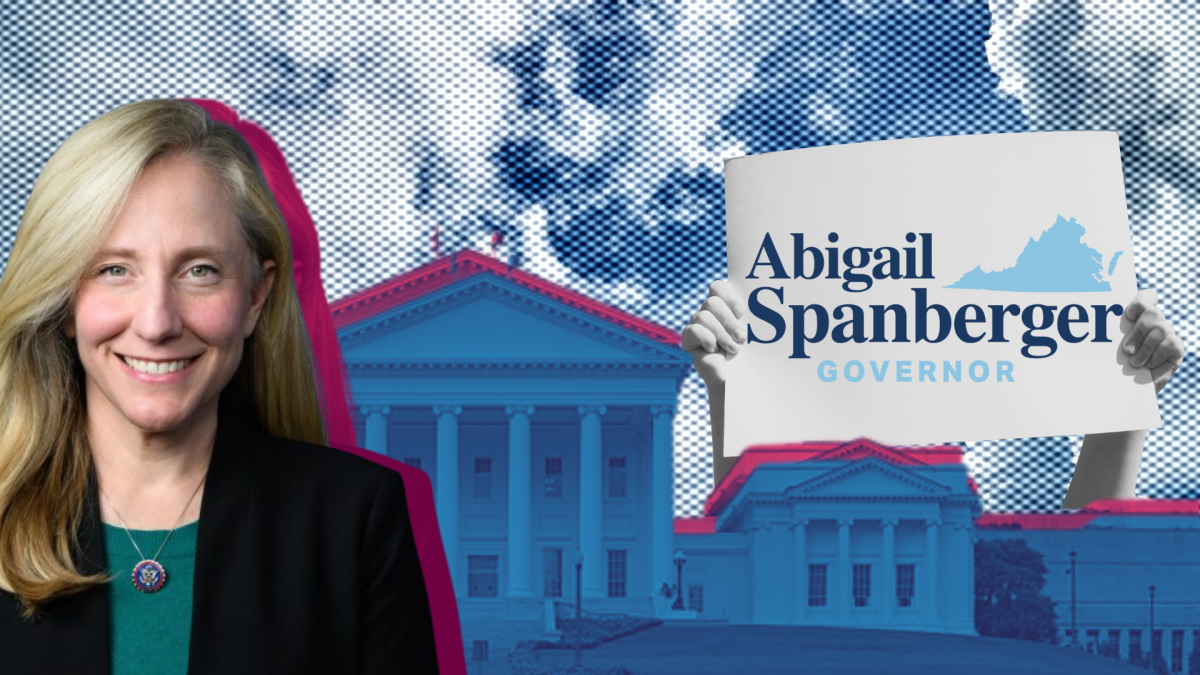
Democrat Abigail Spanberger won the Virginia Gubernatorial election on November 4, with her victory being called almost immediately after the polls closed. Spanberger’s victory delivered a potent repudiation of President Trump’s policies after a campaign laser-focused on attacking them. The former CIA officer and three-term Congresswoman, who entered politics in the 2018 Democratic wave, defeated her Republican opponent, Lieutenant Governor Winsome Earle-Sears, in a race that drew national attention as an early test of voter sentiment toward the Trump administration. At 46, Spanberger will be Virginia’s first female governor, following a streak of 65 men who have served in that office since Virginia became part of the US in 1788. Spanberger replaces popular outgoing Republican Governor Glenn Youngkin, who won in 2021 with 50.6% of the vote to Democrat Terry McAuliffe’s 48.7% but cannot seek consecutive re-election.
Governor-elect Abigail Spanberger, a pragmatic centrist who has bucked her party on occasion, voting against Nancy Pelosi for House speaker in 2019 and criticizing President Joe Biden as too progressive in 2021, cultivated a maverick image that helped her outrun a battered Democratic brand. Spanberger’s theme of “affordability” addressed rising costs for housing, utilities, pharmaceuticals and economic uncertainty from Trump’s tariffs and federal layoffs, while she harnessed anger over cuts to the federal workforce that disproportionately hit Virginia, home to around 320,000 federal workers and hundreds of thousands of contractors. On the campaign trail, she argued that federal layoffs, cutbacks by President Donald Trump’s Department of Government Efficiency (DOGE), tariffs and the federal shutdown amounted to an attack on the state’s economy, pitching herself as a way for voters to push back. “We need a governor who will recognize the hardship of this moment, advocate for Virginians, and make clear that not only are we watching people be challenged in their livelihoods and in their businesses and in communities, but Virginia’s economy is under attack,” she said during a late-October bus tour stop. Backed by national Democrats eyeing a 2026 midterm boost, including a campaign appearance by former President Barack Obama and heavy DNC spending, Spanberger raised nearly twice as much money as Winsome Earle-Sears, held double-digit leads in final polls and ran a surgical effort that scared off primary rivals, resisting calls for new ideas in favor of her 2018 playbook of Trump opposition.
At her jubilant election night watch party, where House Speaker Don Scott shouted, “Y’all ready to witness history tonight?“, Abgail Spanberger struck a bipartisan tone in her victory speech, praising Winsome Earle-Sears and pledging to serve all Virginians in a departure from President Donald Trump’s with-me-or-against-me ethos. She touched on the milestone for their three daughters, recounting her husband’s words: “Your mom is going to be the governor of Virginia—I can guarantee you that those words have never been spoken before.” She took one swipe at the administration, declaring, “Virginia’s economy doesn’t work when Washington treats our Virginia workers as expendable. And to those across the Potomac who are attacking our jobs and our economy, I will not stand by silently.” As Congresswoman Jennifer McClellan put it, “Virginians, they see the impacts of what’s happening in Washington in real time and are looking for state leaders who are going to fill in those gaps and address that harm.”
Winsome Earle-Sears, a Jamaican immigrant who became a US Marine and small business owner, portrayed herself as the American dream incarnate and pledged allegiance to President Donald Trump despite his meager late endorsement and minimal help for her cash-strapped campaign. She vowed to extend Glenn Youngkin’s business-friendly policies, accused Abigail Spanberger of supporting Biden-era moves and attacked her on transgender rights, claiming they threatened girls’ safety in school bathrooms and locker rooms. “Love is not having my daughter having to be forced to undress in a locker room with a man. That’s not love,” she said at an October rally. “Love is making sure that our girl children have opportunities in sports and are not forced to play against biological males.”
The race was jolted in its final weeks by the government shutdown, which both sides blamed on the other and shadowed early voting; a Democratic push to redistrict congressional maps for 2026 midterms favoring their candidates amid Trump’s similar efforts elsewhere; and a scandal over text messages from Democratic attorney general candidate Jay Jones, who hypothetically described shooting a Republican lawmaker. Spanberger denounced the messages, but Earle-Sears faulted her for not demanding Jones drop out. Glenn Youngkin prioritized re-electing Republican Attorney General Jason Miyares over bolstering Winsome Earle-Sears, donating only a fraction of his 2023 General Assembly spending to her effort. Despite the uproar, Jones defeated Miyares in the key post, enabling Virginia to join blue-state lawsuits against Trump. Separately, Democrat Ghazala Hashmi won the lieutenant governor race, becoming the first Muslim woman elected to statewide office in America after a low-profile campaign with few appearances and no debate against Republican talk-show host John Reid, though she trailed Spanberger amid her party’s uneven performance elsewhere.
In Texas, the Republicans hope to gain an additional five House seats under new district lines. Republicans in Missouri and North Carolina have passed maps designed to net the party a new seat in each state. A mandatory redraw in Ohio could also benefit Republicans. President Donald Trump has continued to push Republican-led states like Indiana and Kansas to help shore up the party’s narrow House majority. While some Democratic governors and lawmakers are trying to redraw their maps as well, they face additional legal and procedural hurdles that are present in red states because many of them ceded the power to redistrict in recent years to independent or bipartisan commissions.
California Governor Gavin Newsom pushed hard for the Democrats’ redistricting plan, accusing Trump and Republicans of “rigging” the midterm elections with their unusual decision to redraw congressional maps for explicit partisan gain outside the regular decennial cycle linked to the census. The flurry of ads blanketing the state in support of the measure underscored that point. “Donald Trump is out of control, imposing illegal tariffs that hurt our economy and denying disaster aid to California families. Now he’s attempting an unprecedented power grab to steal congressional seats and rig the 2026 election. But we can stop him,” a narrator says in one of the major ads from a group supporting a yes vote on Prop 50. “Prop 50, the Election Rigging Response Act, thwarts Trump’s scheme. Prop 50 levels the playing field in the midterms and gives voters the power to check Trump.” There has been almost $100 million in contributions and ad spending in the race, according to campaign finance reports and data from AdImpact, a political ad tracker.
Declaring victory on November 4, California Governor Gavin Newsom framed the result as part of a strong night for Democrats across the board and a blow to President Donald Trump. “What a night for the Democratic Party, a party that’s in its ascendency, a party that’s on its toes, no longer on its heels. From coast to coast, from sea to shining sea,” Newsom said. “We’re proud here in California to be part of this narrative this evening. We’re proud of the work that the people of California did tonight to send a powerful message to a historic president. Donald Trump is an historic president; he is the most historically unpopular president in modern history.”
While Republicans began saber-rattling and promised to go toe-to-toe with the Democratic efforts, the energy and spending for the campaign to defeat the ballot initiative fizzled down the stretch. The two sides were in rough parity on spending on the airwaves in the first month after the election was announced, $16 million to $17 million on either side. Then the yes side spent $63 million on ads in the final six weeks, compared with less than $16 million from the no side. The intensity of the no side’s spending waned in the final weeks, but it had prominent backers, including former Governor Arnold Schwarzenegger, a Republican. “California voters established an independent commission led by citizens to stop rigged elections. Prop 50 cancels this historic reform, putting the politicians back in charge,” the narrator says in an ad featuring Schwarzenegger calling on voters to cast no votes to “protect” democracy.
California already sends 43 Democrats and nine Republicans to Congress, but multiple nonpartisan analyses of the new maps show that the new lines could allow Democrats to flip as many as five seats by making it harder for Republican Congressmen Doug LaMalfa, Darrell Issa, Ken Calvert, Kevin Kiley, and David Valadao to win re-election. The outcome is far from certain, and most of those Republican lawmakers have won tough races before, but redrawing the lines to add more Democratic voters in their districts will make it tough sledding next fall, especially because the party in power typically faces political headwinds in the midterms.
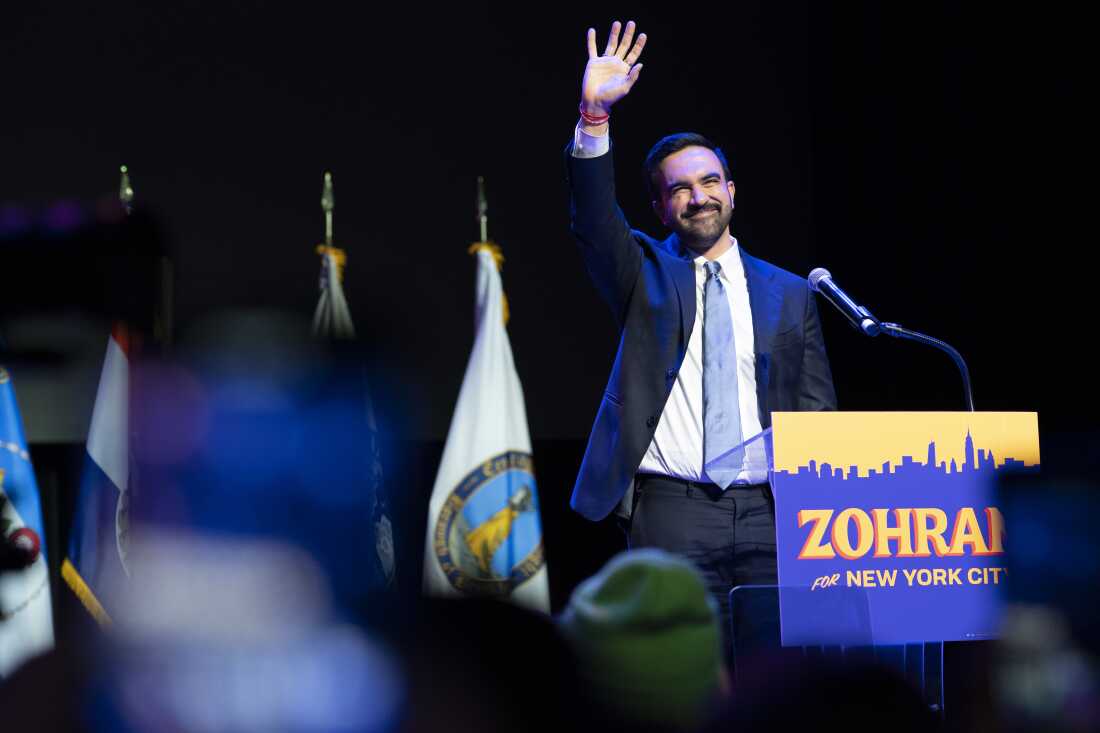
Zohran Mamdani was elected mayor of New York on November 4, capping a stunning ascent for the 34-year-old, Democratic Socialist-aligned state lawmaker who promised to transform city government to restore power to the working class and fight back against a hostile Trump administration. In a victory for the Democratic Party’s progressive wing, Mamdani defeated former Governor Andrew Cuomo and Republican Curtis Sliwa. With his commanding win, Mamdani will etch his place in history as the city’s first Muslim mayor, the first of South Asian heritage, and the first born in Africa. He will also become New York’s youngest mayor in more than a century when he takes office on January 1, 2026. “The conventional wisdom would tell you that I am far from the perfect candidate. I am young, despite my best efforts to grow older. I am Muslim. I am a democratic socialist. And most damning of all, I refuse to apologize for any of this,” Mamdani declared to a roaring crowd at his victory party. He cast his win as a boon for blue-collar workers struggling to get by. “New York, tonight you have delivered a mandate for change,” he said, vowing to “wake up each morning with a singular purpose: To make this city better for you than it was the day before.”
More than 2 million New Yorkers cast ballots in the contest, the largest turnout in a mayoral race since the 1969 Mayoral Election, which pitted incumbent Liberal Republican John Lindsay against Democrat Mario Procaccino and Conservative Party candidate John Marchi. With roughly 90% of the votes counted, Mamdani held an approximately 9 percentage point lead over Andrew Cuomo. His unlikely rise gives credence to Democrats who have urged the party to embrace more progressive candidates instead of rallying behind centrists in hopes of winning back swing voters who have abandoned the party. He has already faced scrutiny from national Republicans, including President Donald Trump, who have eagerly cast him as a threat and the face the Democratic Party. Trump has repeatedly threatened to cut federal funding to the city and even take it over if Mamdani won.
Zohran Mamdani’s grassroots campaign centered on affordability, and his charisma spoiled former Governor Andrew Cuomo’s attempted political comeback. The former governor, who resigned four years ago following allegations of sexual harassment that he continues to deny, was dogged by his past throughout the race and was criticized for running a negative campaign. Mamdani will also have to deal with President Donald Trump, who not only threatened retribution against the city but also suggested he might try to arrest and deport Mamdani if he won. Mamdani was born in Uganda, where he spent his early childhood, but was raised in New York City and became a US citizen in 2018. In his speech, Mamdani addressed Trump head on. “New York will remain a city of immigrants, a city built by immigrants, powered by immigrants and as of tonight, led by an immigrant,” he said, adding that, “If anyone can show a nation betrayed by Donald Trump how to defeat him, it is the city that gave rise to him.” President Trump appeared to acknowledge Mamdani’s challenges, posting “…AND SO IT BEGINS!” on his Truth Social site.
Zohran Mamdani began his campaign as a relatively obscure state lawmaker, little known even within New York City. Going into the Democratic primary, Andrew Cuomo was the presumed favorite, with near-universal name recognition and deep political connections. Cuomo’s chances were buoyed further when incumbent Mayor Eric Adams bowed out of the primary while dealing with the fallout of his now-dismissed federal corruption case. But as the race progressed, Mamdani’s natural charm, catchy social media videos, and populist economic platform energized voters in the notoriously expensive city. He also began drawing outside attention as his name recognition grew. Mamdani trounced Cuomo in the primary by about 13 points.
Andrew Cuomo then relaunched his campaign as an independent candidate for the general election, vowing to hit the streets with a more energetic approach. However, much of his campaign continued to focus on attacking opponents. In the race’s final stretch, he claimed Zohran Mamdani’s election would make Jews feel unsafe. Meanwhile, supporters packed Mamdani’s rallies, and he held whimsical events, including a scavenger hunt and a community soccer tournament. Cuomo also juxtaposed his deep experience in government with Mamdani’s less than five years in the state Legislature. But the former governor also faced his own political baggage, as his opponents dredged up the sexual harassment allegations that led to his resignation, as well as his decisions during the early days of the COVID-19 pandemic.
Republican nominee Curtis Sliwa, the creator of the Guardian Angels crime patrol group, also had his moments, mostly in the form of funny quips on the debate stage, but had difficulty gaining traction as a Republican in an overwhelmingly Democratic city. He conceded the race about a half hour after the polls closed, wishing Zohran Mamdani “good luck because if he does well, we do well.” But he also issued a warning: “If you try to implement socialism, if you try to render our police weak and impotent, if you forsake the people’s public safety, we will become the mayor-elect and his supporters’ worst enemies.”
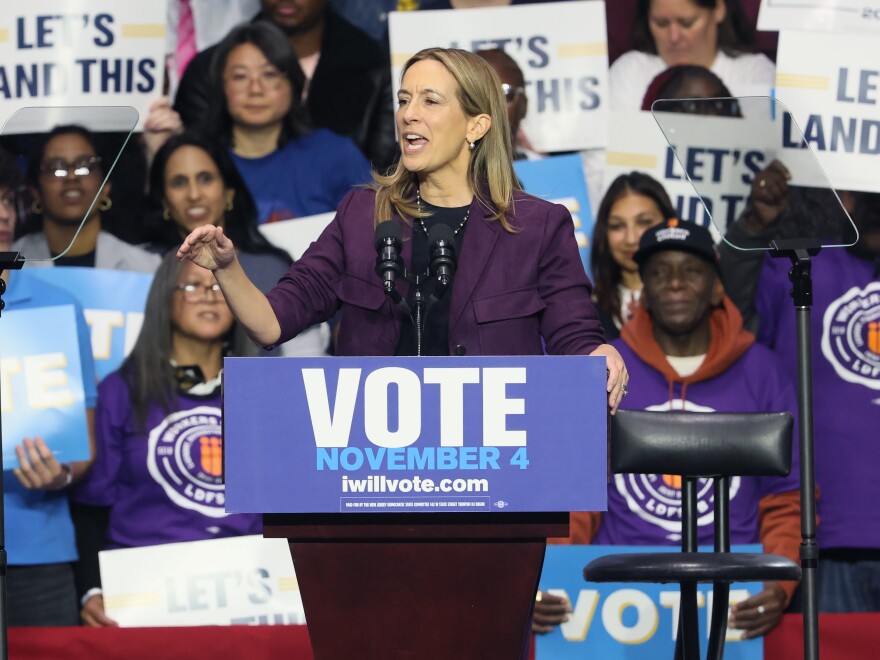
Congresswoman Mikie Sherrill, the Democratic candidate for governor of New Jersey, catapulted to victory on November 4 on the strength of her opposition to President Dona;d Trump after a hard-fought race against Jack Ciattarelli, a Republican whose energetic campaign could not outrun national politics in a liberal-leaning state. Congresswoman Sherrill, a former Navy helicopter pilot and federal prosecutor, will become New Jersey’s 57th governor and its second female leader. She was leading Ciattarelli, a former state lawmaker running his third race for governor, by a resounding 13 points with more than 95 percent of the vote counted, according to a tally by The Associated Press.
“Good government doesn’t just manage problems, it solves them,” Governor-elect Mikie Sherrill told supporters gathered in East Brunswick for a victory party. “I know not everyone voted for me,” she added, “but I’m working for everyone — every single one of you.” She said Jack Ciattarelli called her soon after the results were announced, and she recognized him for “stepping up.” Ciattarelli, in a brief concession speech, told his supporters that “life is not always fair.” “Nobody is more disappointed than I am in the result,” he said. “It is my hope that Mikie Sherrill has heard us, in terms of what needs to be done to make New Jersey that place where everybody wants to be to achieve their dreams again.” The race was largely defined by President Donald Trump, who made surprising inroads last November in New Jersey and who had endorsed Jack Ciattarelli. But in a state where Democrats outnumber Republicans by roughly 850,000 voters, the alliance always carried risk.
Senator Cory Booker predicted that Mike Sherrill’s win would ripple far beyond New Jersey. “The whole nation will see,” said Booker, the state’s senior senator, “that we can’t stop the momentum.” Governor-elect Sherrill will now have to at least coexist with the president, who has shown a willingness to punish his foes. That was an argument President Donald Trump raised in the final weeks of the campaign, in a telephone rally he held for Jack Ciattarelli. “He’s got a friend in the White House,” the President said during the call, “where she certainly doesn’t.”
Governor-elect Mikie Sherrill has pledged to freeze the state’s high electricity costs by declaring a state of emergency on her first day in office in January. She plans to get cellphones out of classrooms and hire more mental health counselors for schools. Using data gathered through a new “social media addiction observatory,” she has said, her administration will take on digital platforms that use algorithms to lure in children and teenagers.
In the 2021 campaign, Jack Ciattarelli lost by three points to Governor Phil Murphy, a Democrat barred by term limits from running for re-election. He tried hard during this race to capitalize on the stunning gains President Donald Trump made in Black and Latino communities, campaigning aggressively in churches and at cultural events. Ciattarelli develped a reputation as a moderate Republican during his time on the Somerset County board of Freeholders (2007-2011) and in the New Jersey General Assembly (2012-2018), and until this campaign he had kept President Trump at arm’s length. But after the president’s stronger-than-expected showing last year in some of New Jersey’s most diverse communities, Ciattarelli pivoted, embracing the president and some of his policies, even giving Trump an “A” grade in the final debate.
Jack Ciattarelli’a platform was focused heavily on pocketbook issues like taxes and energy costs. But Ciattarelli also leaned into issues popular with the far-right flank of the party, including publicly funded school vouchers, opposition to transgender rights, vaccine skepticism and the deportation of migrants. On the stump and in ads, Mikie Sherrill’s campaign regularly reminded voters of Ciattarelli’s cozy relationship with President Donald Trump. Then, last month, President Donald Trump said he was terminating funding for the construction of a $16 billion train tunnel considered vital to the country and to New Jersey’s 200,000 commuters, handing the Sherrill campaign an unexpected gift. “With less than 19 days until this election, the president’s punched him in the face like this. That’s pretty telling,” Sherrill said the next day, highlighting the ephemeral value of Ciattarelli’s partnership with a mercurial president. It also gave her a way to change the subject from a controversy centered on why she had been barred from participating in her 1994 graduation ceremony at the US Naval Academy. She has said that she could not participate because she had failed to “turn in” classmates caught up in a cheating scandal. But polls began to narrow as Ciattarelli publicly challenged that explanation and sought to undermine her credibility, denting a central pillar of her campaign: that nine years in the Navy had prepared her to lead the state.
Polls proved largely inaccurate. Most showed Mikie Sherrill leading throughout the race, but few had her winning by a double-digit margin. Only New Jersey and Virginia hold races for governor the year after a presidential contest, and the results are considered bellwethers heading into next year’s pivotal midterm elections, which will determine party control of Congress. In Virginia, former Congresswoman Abigail Spanberger beat her Republican opponent, Lt. Governor Winsome Earle-Sears, by 15 points; Spanberger will be the first woman to serve as governor of the state.
Ken Martin, the chairman of the Democratic National Committee who came to New Jersey repeatedly during the campaign, said victories in both states represent “the beginning of our Democratic resurgence” and proved that voters are “tired of watching the G.O.P. turn our beloved country into a playground for billionaires.” “Tonight isn’t only a warning sign to Republicans,” he said in a statement, “it’s an affirmation of the vision that Democrats have presented to voters in New Jersey and across the country.”
New Jersey’s race was always seen as far more competitive. And Mikie Sherrill’s campaign had become a cause célèbre for Democrat-aligned national groups, which committed roughly $25 million to help her win. An array of prominent Democratic leaders also traveled to New Jersey to campaign with Sherrill in the final weeks of the race. On November 1, an appearance by former President Barack Obama drew thousands of party faithful to a large gymnasium at a community college in Newark. He energized the crowd by warning, as Sherrill has, about the threat posed by President Donald Trump. “We’ve got a commander in chief who has fired decorated military officers because he thinks they might be more loyal to the Constitution than they are to him,” Obama said. “He’s deployed the National Guard in American cities and claimed to be stopping crime waves that don’t actually exist,” he added. “We’ve got masked ICE agents pulling up in unmarked vans and grabbing people off the streets.” “Don’t boo,” Obama said repeatedly as the crowd roared. “Go vote.”
More than 3.1 million New Jersey voters cast ballots, 500,000 more than in 2021. Jack Ciattarelli’s level of support this year actually exceeded his performance in 2021 by more than 100,000 votes, but he still fell short as far more voters beat a path to the polls. “I’m not retiring to Florida. We fight for another day,” Ciattarelli said to loud cheers. “You’ll find me right here on the streets of Central Jersey, or maybe at one of my favorite places on the beach in Surf City.”
The contest was the most competitive race for governor of New Jersey since 2009, when Chris Christie, a Republican, unseated the incumbent governor, Jon Corzine, a wealthy Democrat. It was also extraordinarily expensive. Mikie Sherrill and Jack Ciattarelli won their party’s nominations after spirited primaries. The state’s Election Law Enforcement Commission reported last week that spending by the two candidates and groups supporting their candidacies had already exceeded $82 million. In winning, Sherrill bucked a six-decade historical trend. Not since 1961 had either party held onto the governor’s office for three consecutive terms.
On September 16, President Donald Trump took to TruthSocial to announce a Republican “Midterm Convention” aimed at energizing the party ahead of the 2026 midterm elections. The event, with its time and place yet to be determined, promises to be a significant and exciting gathering for the Republicans. President Trump wrote, “The Republicans are going to do a Midterm Convention in order to show the great things we have done since the Presidential Election of 2024. Stay tuned, it will be quite the Event, and very exciting!”
This announcement builds on an idea President Donald Trump first floated last month, when he suggested the Republican Party hold a national convention to highlight the party’s achievements and momentum. “The Republican Party is doing really well,” President Trump stated at the time. “Millions of people have joined us in our quest to MAKE AMERICA GREAT AGAIN. We won every aspect of the Presidential Election and, based on the great success we are having, are poised to WIN BIG IN THE MIDTERMS.” Trump also praised the Republican Party’s fundraising efforts and his administration’s work to undo policies from the Biden era.
In response to President Donald Trump’s announcement, the DNC took a jab, saying, “Imitation is the sincerest form of flattery.” The spokesperson reiterated their plans, noting, “To showcase our tremendous candidates running up and down the ballot and harness the amazing grassroots energy we’re already seeing, several options are on the table for next year, including hosting a midterm convention. The sincerest form of flattery is imitation, and we’re amused the President is following our lead. As both parties gear up for the 2026 midterms, these proposed conventions signal an intensified effort to rally their bases and set the stage for a highly competitive election cycle. With the Republican Party aiming to capitalize on its 2024 momentum and the Democrats pushing back against its policies, the political landscape is heating up.
Zohran Mamdani, the Democratic nominee for mayor of New York City, is gaining significant endorsements from party leaders as concerns mount over President Donald Trump’s attempts to influence the race. Mamdani, a state assemblyman and democratic socialist, secured the Democratic primary victory in June 2025, defeating former Governor Andrew Cuomo, who is now running as an independent.
Prominent Democrats, including Congressman Jamie Raskin of Maryland and Congressman Pat Ryan of New York, have formally endorsed Zohran Mamdani. Congressman Raskin, a leading figure in countering President Donald Trump’s influence, praised Mamdani as a “significant and inspiring leader” with a “Rooseveltian” vision, comparing him to former President Franklin D. Roosevelt for his commitment to the working and middle classes. Ryan, motivated by his opposition to former New York Governor and Mayoral Candidate Andrew Cuomo, described Mamdani as a candidate “for the people,” contrasting him with Cuomo’s self-serving record. Even moderates within the Democratic party such as former Chicago Mayor Rahm Emanuel and New York Congressman Ritchie Torres have expressed support. Emanuel, after meeting Mamdani, noted his preparedness to govern effectively, while Torres called him “impressively knowledgeable and substantive.” Left-leaning Democrats, including Senators Bernie Sanders and Elizabeth Warren, and members of Congress such as Alexandria Ocasio-Cortez, Pramila Jayapa, and Jerrold Nadler, have also backed Mamdani, citing his focus on cost-of-living issues.
Despite Zohran Mamdani’s primary win, some top New York Democrats, including House Minority Leader Hakeem Jeffries, Senate Minority Leader Chuck Schumer, Senator Kirsten Gillibrand, and Governor Kathy Hochul, have not yet endorsed him. Schumer met with Mamdani recently but declined to commit, while Jeffries indicated he would soon clarify his stance. Hochul emphasized the need for pragmatic governance, reflecting her “staunch capitalist” perspective, given New York City’s role as a global financial hub.
President Donald Trump’s efforts to tilt the race toward Andrew Cuomo, including offering positions to Mayor Eric Adams and Republican candidate Curtis Sliwa to drop out, have galvanized Democrats. Party members across the ideological spectrum are urging unity to counter Trump’s influence. Congressman Jamie Raskin stressed the importance of Democratic solidarity, saying, “Democrats must stand together to defend not only our party but our constitution and our country.” Congresswoman Alexandria Ocasio-Cortez echoed this, emphasizing the party’s responsibility to support its nominees post-primary.
Some moderate Democrats, like Conresswoman Laura Gillen and Conressman Tom Suozzi from Long Island, worry that Zorhran Mamdani’s progressive stance could harm the party in the 2026 midterms by fueling Republican narratives painting Democrats as socialists. However, Mamdani’s strong lead in recent polls, particularly among young voters, suggests his appeal could energize the Democratic base. A New York Times/Siena University poll showed him commanding the race, a critical factor as Democrats seek to regain ground lost to Donald Trump in 2024.
Since his nomination, Zohran Mamdani has engaged in extensive outreach, meeting with figures like former President Barack Obama and Rahm Emanuel to discuss governance and policy priorities. His ability to connect with both moderates and progressives has impressed many, with Emanuel noting his readiness to “hit the ground running” and Torres praising his intellectual rigor.
As the mayoral race enters its final stretch, Zohran Mamdani’s campaign is gaining momentum, but the lack of endorsements from key New York Democrats remains a challenge. Meanwhile, Republicans, including Florida Governor Ron DeSantis, are using Mamdani’s candidacy to attack Democrats nationwide. Despite this, supporters like Congressman Jamie Raskin remain steadfast, advocating for party unity: “When progressives beat moderates in the primary, we want the moderates to support the progressives in the general election.”
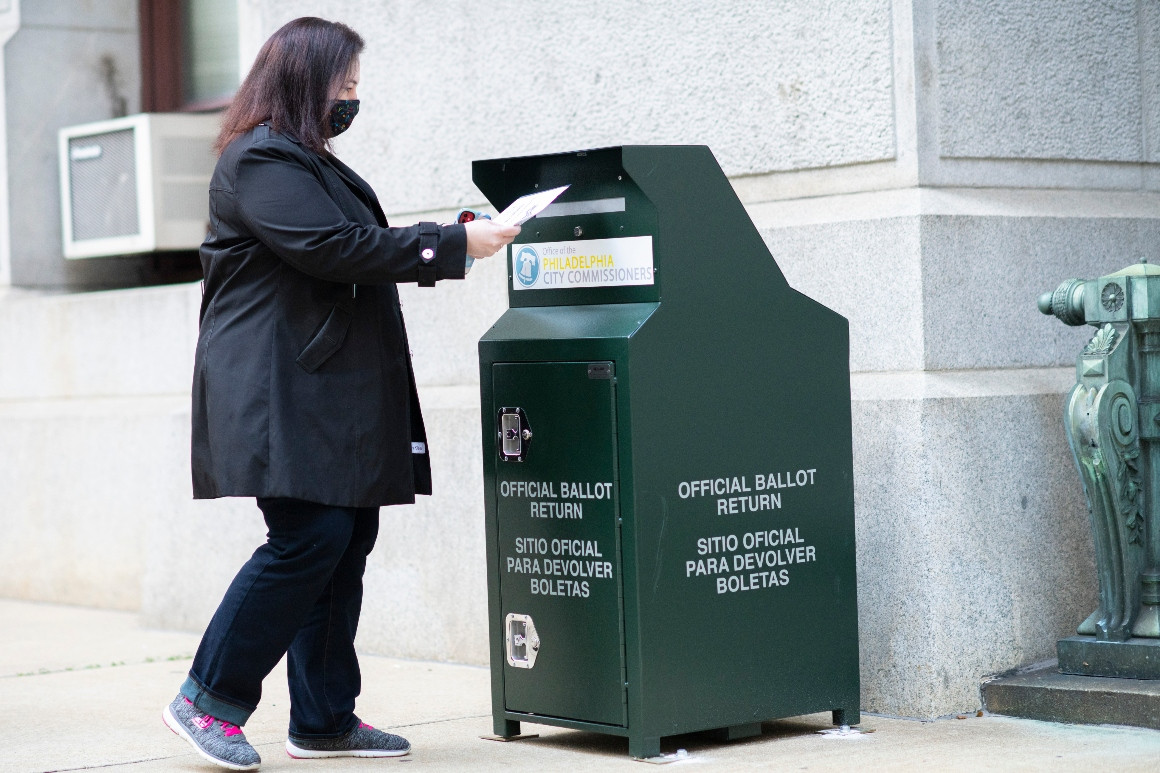
President Donald Trump has repeatedly argued that mail-in voting undermines election integrity. He claimed, without evidence, “Mail-in ballots are corrupt,” citing unverified anecdotes of individuals receiving multiple ballots in states like California. President Trump has long maintained that mail-in voting enables tampering and multiple voting, despite lacking evidence to support widespread fraud. However, election experts have consistently refuted these claims. Debra Cleaver, founder of VoteAmerica, emphasized the security of mail-in ballots, noting that barcodes on outgoing and return envelopes ensure ballots are tracked and counted accurately. Following the 2020 election, Christopher Krebs, then-director of the Cybersecurity and Infrastructure Security Agency, declared it “the most secure in American history.” Audits and investigations, including those by Republican officials, found no evidence of significant fraud in the 2020 election.
President Donald Trump’s proposed executive order faces significant legal hurdles. He argued in a social media post that states are mere “agents” of the federal government in elections and must follow presidential directives. However, Article I, Section 4 of the US Constitution explicitly grants states the authority to regulate elections, with Congress holding the power to alter such regulations. Legal scholars note that the President lacks the constitutional authority to unilaterally ban mail-in voting, rendering the proposed executive order legally questionable.
Election experts warn that eliminating mail-in voting could disrupt electoral processes. David Becker, executive director of the Center for Election Innovation & Research, called the idea “incredibly bad,” arguing it would create chaos, especially with midterm elections just 15 months away. He noted that mail-in voting, used since the Civil War, enhances accessibility and security when properly implemented.
The White House, through spokesperson Harrison Fields, defended President Donald Trump’s stance, claiming that Democratic policies like “unfettered mail-in voting” have eroded trust in elections. Fields emphasized Trump’s goal to “secure America’s elections” through measures like voter ID requirements and stricter voting laws in states like California and New York.
President Donald Trump’s push to ban mail-in voting has sparked renewed debate over election security and accessibility. While he frames it as a safeguard against fraud, critics argue it could disenfranchise voters who rely on mail ballots due to disability, military service, or other constraints. The legal and practical challenges of implementing such a ban underscore the complexities of reforming election systems in a polarized political landscape. As the 2026 midterms approach, the debate over mail-in voting is likely to intensify, with significant implications for voter turnout and trust in democratic institutions.
President Joe Biden on January 5 delivered a ferocious condemnation of former President Donald Trump, his likely 2024 opponent, warning in searing language that the former President had directed an insurrection and would aim to undo the nation’s bedrock democracy if he returned to power. On the eve of the third anniversary of the January 6, 2021, attack on the Capitol by former President Trump’s supporters, President Biden framed the coming election as a choice between a candidate devoted to upholding America’s centuries-old ideals and a chaos agent willing to discard them for his benefit. “There’s no confusion about who Trump is or what he intends to do,” Biden warned in a speech at a community college not far from Valley Forge in Pennsylvania, where George Washington commanded troops during the Revolutionary War. Exhorting supporters to prepare to vote this fall, he said: “We all know who Donald Trump is. The question is: Who are we?”
In an intensely personal address that at one point nearly led President Joe Biden to curse former President Donald Trump by name, the President compared his rival to foreign autocrats who rule by fiat and lies. He said former President Trump had failed the basic test of American leaders, to trust the people to choose their elected officials and abide by their decisions. “We must be clear,” Biden said. “Democracy is on the ballot. Your freedom is on the ballot.”
President Joe Biden’s harshness on his rival illustrated what his campaign believes to be the stakes of the 2024 election and his perilous political standing. Confronted with low approval ratings, bad head-to-head polling against former President Donald Trump, worries about his age, and lingering unease with the economy, President Biden is turning increasingly to the figure who has proved to be Democrats’ single best motivator. Former President Donald Trump, speaking at a campaign rally in Iowa soon after President Joe Biden’s appearance, quickly lashed back, calling the president’s comments “pathetic fearmongering” and accusing him of “abusing George Washington’s legacy.”
President Joe Biden’s remarks carried echoes of the 2020 campaign when he presented himself as the caretaker of “the soul of America” against a Trump presidency that he and Democratic supporters argued was on the verge of causing permanent damage to the country. The 31-minute speech was President Biden’s first public campaign event since he announced in April 2023 that he would seek re-election and was, in tone and content, arguably his most forceful public denunciation of former President Donald Trump since the two men became political rivals in 2019.
President Joe Biden’s appearance, meant as a kickoff to help define the 2024 campaign, was an early effort to revive the politically sprawling anti-Trump coalition that propelled Democrats to key victories in recent elections. Mr. Biden’s task now is to persuade those voters to view the 2024 contest as the same kind of national emergency that they sensed in 2018, 2020, and 2022. He began with an extensive recounting of former President Donald Trump’s actions before, during, and after the January 6 attack. The country, President Biden said, cannot afford to allow Trump and his supporters to present a whitewashed version of that day and spread falsehoods about the violent outcome of their effort to undo the 2020 election results. Upholding the nation’s democracy, Biden said, is “the central cause of my presidency.”
President Joe Biden made no mention of the 91 felony charges the former president faces in four jurisdictions, sticking to a vow to steer clear of his rival’s legal problems and focusing squarely on Trump’s actions rather than any potential criminal consequences for them. “Trump exhausted every legal avenue available to overturn the 2020 election. The legal path took him back to the truth, that I won the election and he was a loser,” Biden said. “He had one act left, one desperate act available to him, the violence of January 6.”
For a president who has faced intense scrutiny over his vigor in public appearances, the speech was a deftly delivered, focused argument about this year’s stakes. It was President Joe Biden’s latest attempt to build his political identity around the ideas of restoring national unity and upholding fairness, democracy, and collective patriotism. He has come back to those themes many times, during his brief push for voting rights legislation in early 2022, then as the midterm elections approached, and most recently in September, during a speech in Arizona honoring former Senator John McCain.
In the speech, President Joe Biden sought to frame former President Donald Trump as the leader of a cult of personality, and his Republican allies as sycophants. The president mentioned the recent $148 million judgment against Rudolph W. Giuliani for his lies about Georgia election workers, as well as the $787.5 million that Fox News was ordered to pay to settle a defamation case about its role in spreading election lies. Biden lamented that Fox News hosts and Republican officials who condemned Trump’s January 6 behavior in the moment had since changed their tune and repeated his falsehoods. “Politics, fear, and money all intervened, and now these MAGA voices who know the truth about Jan. 6 have abandoned democracy,” Biden said.
What remains unclear is how much President Joe Biden’s democracy pitch will resonate with voters who remain nervous about an improving economy, and wary of re-electing an 81-year-old who is already the oldest president in US history. Even some who have expressed deep fears about Trump’s authoritarian impulses are skeptical that the subject will be a winning message in 2024. “As a Biden campaign theme, I think the threat to democracy pitch is a bust,” 2012 Republican Presidential nominee, prominent Trump critic, and Utah Senator Mitt Romney, wrote in a text message to a New York Times reporter. “January 6 will be four years old by the election. People have processed it, one way or another. Biden needs fresh material, a new attack, rather than kicking a dead political horse.”
President Joe Biden threaded his speech with warnings that former President Donald Trump and Republicans would threaten not only democracy but also major Democratic priorities, abortion rights, voting rights, and economic and environmental justice. Ian Bassin, the executive director of Protect Democracy, a nonprofit dedicated to combating authoritarianism, said he had stressed to Biden’s aides that the president needed to connect democracy to voters’ personal experiences on other issues, in the same way Trump repeats to his supporters that prosecutions of him are persecutions of them. “Democracy is not just a way of structuring elections for order in our government,” Mr. Bassin said. “It’s a set of values about the kind of communities we want to live in and the way that we want to live as neighbors.”
President Joe Biden warned in his speech that former President Donald Trump was not being shy about what he would do in a second term. “Trump’s assault on democracy isn’t just part of his past. It’s what he’s promising for the future,” President Biden said. “He’s not hiding the ball.” Biden then recounted, in exacting detail, how a Trump campaign rally last year began with a choir of rioters who stormed the Capitol on January 6 singing the national anthem while a video of the damage played on a big screen. Trump had watched with approval. The scene, Biden suggested, would be the nation’s fate if Trump and his allies returned to power. “This is like something out of a fairy tale,” Biden said. “A bad fairy tale.”
Senator Raphael Warnock has won reelection in Georgia, the Associated Press reports, giving the Democrats a 51-49 majority in the US Senate. Senator Warnock defeated first-time candidate Herschel Walker, whose campaign was beset by allegations that he paid two women to have abortions. Senator Warnock finished ahead of Walker in the election on November 8, but fell short of the majority needed to avoid a runoff. Former President Barack Obama, who had campaigned for Warnock earlier in the race, returned to Georgia during the runoff to urge voters to come back to the polls.
Though Democrats were already guaranteed to hold onto control of the Senate, the extra seat gives them some breathing room and should make it easier to pass appointments out of Senate committees. The outcome also reinforces a disappointing year for Republicans, who had hoped for a “red wave” that would give them control of both houses of Congress. The Republicans did take control of the House of Representatives by a very narrow margin. Georgia, until recently a solidly red state, is now set to be represented by two Democrats in the Senate for at least four more years. Senator Raphael Warnock first won his seat during a special runoff election in early 2021, defeating the previous incumbent Kelly Loeffler by just under 100,000 votes. He won alongside Democrat Jon Ossoff, who defeated incumbent Republican David Perdue, giving Democrats the 50 votes needed to hold the majority, with Vice President Kamala Harris casting tie-breaking votes.
Herschel Walker, a former NFL running back who played college football for the Georgia Bulldogs NCAA team, endorsed former President Donald Trump during both of his presidential campaigns in 2016 and 2020 and spoke on Trump’s behalf at the 2020 Republican National Convention. Trump encouraged Walker to run for Senate in 2021, but Walker needed to re-establish residency in Georgia, as he was previously a Texas resident. In August 2021, Walker announced his intention to run for Warnock’s Senate seat. Walker’s campaign has been defined by controversy, often making comments that were later reported as false by media outlets, such as his involvement working with law enforcement. In early October, Walker fired his campaign political director Taylor Crowe over suspicions that Crowe was leaking unfavorable information about Walker to the media.
Dispelling predictions of a red wave, Democratsseized complete control of the legislatures in Michigan and Minnesota, and held on to governorships in Michigan, Pennsylvania and Wisconsin, maintaining a bulwark against Republican-dominated legislatures in the latter two states. Democrats also won historic victories in Maryland, where voters elected Wes Moore as the state’s first Black governor, and Massachusetts, where they chose Maura Healey as the state’s first openly gay governor. With those two victories, Democrats increased the number of states where they control the governor’s office and both legislative chambers to 18. Republicans had unified control of 23 states heading into yesterday’s election. “Tonight, I want to say something to every little girl and every LGBTQ person out there. I hope tonight shows you that you can be whatever, whoever, you want to be,” Healey said in her victory speech.
In closely watched governor’s races in Florida and Texas, high-profile Republican incumbents cruised to reelection. Both Florida Governor Ron DeSantis and Texas Governor Greg Abbott have been outspoken opponents of President Joe Biden and have been mentioned as potential presidential candidates. DeSantis called his reelection “a win for the ages” and described Florida as “a refuge of sanity when the world went mad,” referring to his resistance to pandemic-related closures and safety measures. “We made promises to the people of Florida, and we have delivered on those promises,” DeSantis said. In Arizona’s closely fought gubernatorial race, which has attracted national attention, Democrat Katie Hobbs held a slim lead over Republican Kari Lake, who has amplified former President Donald Trump’s lies about the 2020 election.
Abortion rights supporters also had reason to celebrate. In California, Michigan and Vermont, voters approved measures to enshrine abortion rights in their state constitutions. In Kentucky, a proposed constitutional amendment to eliminate the right to an abortion appeared headed for defeat. And in Montana, voters were poised to defeat a legislatively proposed referendum that would require medical professionals to provide care to infants born alive after an induced labor, cesarean section or attempted abortion. Physicians in the state and the American College of Obstetricians and Gynecologists opposed the measure. Ballot measures to legalize recreational marijuana use had mixed results. Voters in Maryland and Missouri approved them, but legalization measures in Arkansas, North Dakota and South Dakota failed.
Michigan, a closely divided battleground state in recent elections, was an especially bright spot for Democrats. Despite talk of a tightening race in the weeks before the election, Democratic Governor Gretchen Whitmer won a second term by a comfortable margin over Republican challenger Tudor Dixon. Democrats gained a majority in the Michigan House for the first time since 2016 and won the Senate for the first time since 1983. And Democrats won in closely watched races for attorney general and secretary of state, defeating Trump-endorsed candidates who have questioned the results of the 2020 election. Governor Whitmer, who has vowed to “fight like hell” for abortion rights, and other Michigan Democrats may have been boosted by the presence of the abortion rights amendment on the ballot. According to exit polls, nearly half of Michigan voters cited abortion as their top issue, compared with about 30% who pointed to inflation.
President Joe Biden is staying away from the toughest races on Election Day eve, opting to campaign in safe Democratic territory before what’s expected to be a difficult night for his party. Mired in low approval ratings, President Biden will spend election eve in Columbia, Maryland, stumping for the state’s likely first Black governor, Wes Moore. Throughout the weekend, Biden hit the road for candidates in California, Illinois, and New York, a trio of deep-blue states where some races, particularly the New York governor’s race, narrowed significantly in recent weeks. Biden’s not the only one playing on what should be friendly turf as voting nears. First lady Jill Biden is in Northern Virginia, campaigning with Congresswoman Jennifer Wexton (D-VA) in a congressional district the President won by nearly 20 points in 2020. Meanwhile, former President Donald Trump is scheduled to rally alongside Republican J.D. Vance on election eve in Dayton, Ohio, a deep-red state where Democrat Tim Ryan has forced a tighter contest for the open Senate seat.
The late campaign swings underscore how the midterm elections could dramatically reshape the makeup of Congress and statehouses across the country. Democrats are on defense in blue-leaning House seats while Republicans are eyeing supermajority control in statehouses, like in North Carolina and Wisconsin. House Republicans need to net only five House seats to flip the chamber, while an evenly divided, 50-50 Senate means the Republicans need to turn a single seat to take over. Public polling shows margin-of-error races throughout the country, particularly in the Senate, as operatives in both parties anxiously watch how swing voters may break on election day. In recent weeks, Republicans have narrowed or surpassed Democratic candidates in a handful of races, from Georgia to Arizona to New York.
President Joe Biden, along with former President Barack Obama, rallied in Pennsylvania on November 5 for one of the highest-profile races: the contest between Democrat John Fetterman and Republican Mehmet Oz. The president has centered much of his final campaign schedule on rallying against election deniers, including in that rally, when he told voters: “We need to reaffirm the values that have long defined us.” “We are good people,” Biden continued. “I know this.”
President Joe Biden’s focus on defending democracy comes as Americans vote for the first time since the insurrection on January 6, and as a number of election-denying candidates seem poised to win office on election day. But many voters, according to public and private polling, consistently cite economic concerns, like the soaring cost of living, as the top issue that will determine their vote. That’s prompted an early round of recriminations from inside the Democratic Party about its messaging, as operatives and candidates alike brace for a difficult night. One of Biden’s pollsters, John Anzalone, told The Wall Street Journal, for whom his firm conducts polling, that Republicans appear on track to make gains with not only Latino voters but with African American voters. Democrats have also run heavily on the issue of abortion rights, following the Supreme Court overturning Roe v. Wade. And the party is hopeful that a wave of new female voters could help them have a better night than expected.
Early voting totals already show high levels of interest in the 2022 midterms, as Americans cast more ballots ahead of Election Day this year than they did ahead of the 2018 midterms, according to data collected by the United States Elections Project. But those numbers are often not reliable predictors for how an election may go and could merely be a sign that voters are more comfortable with in-person early voting or mail balloting, vote casting that became even more popular during the coronavirus pandemic. Despite the early vote numbers, election officials across the country are warning Americans that results in some states may still be slow, which could cause delays in calling races. Some states, like Pennsylvania, are not allowed, by law, to count mail-in ballots until after Election Day is over, slowing the counting process like it did in 2020. Others, like North Carolina, are processed quickly because the state’s early and absentee ballots are processed as soon as they are received.
The Republican Party is locking in newly gerrymandered maps for the legislatures in four battleground states that are set to secure the party’s control in the statehouse chambers over the next decade, fortifying the Republicans against even the most sweeping potential Democratic wave elections. In Texas, North Carolina, Ohio, and Georgia, Republican state lawmakers have either created supermajorities capable of overriding a governor’s veto or whittled down competitive districts so significantly that Republicans’ advantage is virtually impenetrable, leaving voters in narrowly divided states powerless to change the leadership of their legislatures.
Although much of the attention on this year’s redistricting process has focused on gerrymandered congressional maps, the new maps being drafted in state legislatures have been just as distorted. And statehouses have taken on towering importance: With the federal government gridlocked, these legislatures now serve as the country’s policy laboratory, crafting bills on abortion, guns, voting restrictions, and other issues that shape the national political debate. “This is not your founding fathers’ gerrymander,” said Chris Lamar, a senior legal counsel at the Campaign Legal Center who focuses on redistricting. “This is something more intense and durable and permanent.”
This redistricting cycle, the first one in a decade, builds on a political trend that accelerated in 2011 when Republicans in swing states including Pennsylvania, Wisconsin, and Michigan drew highly gerrymandered state legislative maps. Since those maps were enacted, Republicans have held both houses of state government in all three states for the entire decade. They never lost control of a single chamber, even as Democrats won some of the states’ races for president, governor, and Senate. All three of those Northern states are likely to see some shift back toward parity this year, with a new independent commission drawing Michigan’s maps, a state legislative commission drawing maps in Pennsylvania, and a Democratic governor in Wisconsin likely to force the process to be completed by the courts.
Gerrymandering is a tool used by both parties in swing states as well as less competitive ones. Democrats in deep-blue states like Illinois are moving to increase their advantage in legislatures, and Republicans in deep-red states like Utah and Idaho are doing the same. But in politically contested states where Republicans hold full control, legislators are carefully expanding Republican electoral chances. They are armed with sharper technology, weakened federal voting statutes, and the knowledge that legal challenges to their maps may not be resolved in time for the next elections. Texas, North Carolina, and Ohio have signed into law new maps with a significant Republican advantage. Georgia is moving quickly to join them. Republicans say that the growth of such heavily skewed legislatures is both the result of the party’s electoral victories and of where voters choose to live.
As Democratic voters have crowded into cities and commuter suburbs, and voters in rural and exurban areas have grown increasingly Republican, Republican mapmakers say that they risk running afoul of other redistricting criteria if they split up those densely populated Democratic areas across multiple state legislative districts. “What you see is reflective of the more even distribution of Republican and right-leaning voters across wider geographic areas,” said Adam Kincaid, the director of the National Republican Redistricting Trust. Trying to draw more competitive legislative districts, he said, would result in “just a lot of squiggly lines.” He pointed to maps in Wisconsin that were proposed by a commission created by Governor Tony Evers, a Democrat. Under those designs, Republicans would still have a majority in both state legislative chambers, though with significantly smaller margins. “They’re limited by geography,” Kincaid said. “There’s only so many things you can do to spread that many voters across a wide area.”
Democrats note that Republicans are still cracking apart liberal communities, especially in suburbs near Akron and Cleveland in Ohio and in predominantly Black counties in northern and central North Carolina, in a way that hurts the Democrats and cuts against a geographical argument. “They are carving up Democratic voters where they can’t pack them,” said Garrett Arwa, the director of campaigns at the National Democratic Redistricting Committee. He argued that Democratic map proposals “all put forth better and fairer maps that I would say are far from a Rorschach test.”
Democrats have fewer opportunities to unilaterally draw state legislative maps, particularly in battleground states. Of the 14 states where the margin of the 2020 presidential race was fewer than 10 percentage points, Democrats are able to draw state legislative maps in just one: Nevada. Republicans control the redistricting process in six of those 14 states. But when Democrats have had an opening, they have also enacted significant gerrymanders at the state legislative level. In Nevada, Democrats are close to finalizing a map that would give them supermajorities in both chambers of the Legislature, despite President Biden’s winning just 51 percent of the state’s vote last year. The same holds true in deeply blue states. In Illinois, newly drawn State Senate maps would give Republicans roughly 23 percent of seats in the chamber, even though former President Donald Trump won more than 40 percent of voters in the state in 2020.
Republicans have taken two approaches to ensure durable majorities in state legislatures. The tactics in Texas and Georgia are more subtle, while Republicans in Ohio and North Carolina have taken more brazen steps. In Texas and Georgia, the party has largely eliminated competitive districts and made both Republican and Democratic seats safer, a move that tends to ward off criticism from at least some incumbents in the minority party. “Out of the 150 seats in the Texas House, only six of them are within seven points or closer,” said Sam Wang, the director of the Princeton Redistricting Project. Republicans now hold a 20-seat advantage in the chamber, 85 to 65, and the new maps will give the party roughly two more seats. So while the Republican lawmakers did not try to draw an aggressive supermajority, “what they really did a good job of there is getting rid of competition and getting a reasonably safe majority for themselves,” Wang said.
In Georgia, where redistricting is ongoing, early maps follow a trend line similar to that of Texas, as Republicans try to eliminate competitive districts. With the current gerrymandered maps in place, Democrats in the state legislature would have needed to win more than 55.7 percent of the vote to flip the Georgia House in 2020, according to the Princeton Gerrymandering Project. The new maps proposed in Georgia maintain that 55 percent threshold, according to Princeton. Republicans in Ohio have taken more risks than their counterparts in other states, keeping some districts more competitive in an effort to increase the party’s majorities. In Ohio and North Carolina, however, Republicans are taking a forceful tack. By keeping some districts moderately competitive, they are taking more risks in an attempt to create significant majorities or supermajorities, and in doing so, they are often flouting laws or court decisions.
The US Supreme Court on February 22 brought a formal end to eight lingering disputes pursued by former President Donald Trump and his allies related to the Presidential election including a Republican challenge to the extension of Pennsylvania’s deadline to receive mail-in ballots. The justices turned away appeals by the Republican Party of Pennsylvania and Republican members of the state legislature of a ruling by Pennsylvania’s top court ordering officials to count mail-in ballots that were postmarked by Election Day and received up to three days later. Three of the nine-member court’s six conservative justices, Clarence Thomas, Samuel Alito, and Neil Gorsuch, dissented from the decision not to hear the Pennsylvania case.
Former President Donald Trump made false claims that the Presidential election was stolen from him through widespread voting fraud and irregularities. From the day after the Presidential election until the middle of December, Trump’s legal team filed some 40 election-related lawsuits challenging the results in seven states (Pennsylvania, Wisconsin, Michigan, Georgia, Arizona, Nevada, and New Mexico). The Supreme Court ruled these disputes as invalid on December 11 in 1 7-2 decision, with even Trump’s own Supreme Court appointees ruling against him.
The case brought by Pennsylvania Republicans concerned 9,428 ballots out of 6.9 million cast in the state. The Supreme Court previously rejected a Republican request to block the lower court ruling allowing the ballots to be counted. In his dissent, Justice Clarence Thomas said the Supreme Court should resolve whether non-legislators, including elections officials and courts, have any power to set election rules. Thomas said it was fortunate that the state high court’s ruling did not involve enough ballots to affect the election’s outcome.
This week’s elections were expected to mark the formal finale to the tempestuous 2020 election season, although the Democrats’ resounding success was overshadowed by chaos and violence in Washington, where angry Trump supporters stormed the US Capitol to stop Congress from certifying Biden’s victory. January 6’s unprecedented siege drew fierce criticism of President Donald Trump’s leadership from within his own party, and combined with the Republican defeat in Georgia, marked one of the darkest days of his divisive Presidency. Still, the Democrats’ twin victories in Georgia represented a striking shift in the state’s politics as the swelling number of diverse, college-educated voters flex their power in the heart of the Deep South. They also cemented the transformation of Georgia, once a solidly Republican state, into one of the nation’s premier battlegrounds for the foreseeable future.
In an emotional address on January 6, Senator-elect Raphael Warnock vowed to work for all Georgians whether they voted for him or not, citing his personal experience with the American dream. His mother, he said, used to pick “somebody else’s cotton” as a teenager. “The other day, because this is America, the 82-year-old hands that used to pick somebody else’s cotton picked her youngest son to be a United States senator,” he said. “Tonight, we proved with hope, hard work and the people by our side, anything is possible.” Kelly Loeffler, who remains a senator until the election results are finalized, returned to Washington to join a small group of senators planning to challenge Congress’ vote to certify Joe Biden’s victory. She did not get a chance to vocalize her objection before the violent protesters stormed the Capitol. Georgia’s other runoff election pitted Senator David Perdue, a 71-year-old former business executive who held his Senate seat until his term expired Sunday, against Jon Ossoff, a former congressional aide and journalist. “This campaign has been about health and jobs and justice for the people of this state, for all the people of this state,” Ossoff said in a speech broadcast on social media. “Whether you were for me, or against me, I’ll be for you in the U.S. Senate. I will serve all the people of the state.”
President Donald Trump’s false claims of voter fraud cast a dark shadow over the runoff elections, which were held only because no candidate hit the 50% threshold in the general election. He raised the prospect of voter fraud as votes were being cast and likened the Republicans who run Georgia’s election system to “chickens with their heads cut off” during a rally in Washington. Gabriel Sterling, a top official with the Georgia secretary of state’s office and a Republican, said there was “no evidence of any irregularities.” “The biggest thing we’ve seen is from the president’s fertile mind of finding fraud where none exists,” he said.
Both contests tested whether the political coalition that fueled Biden’s November victory was an anti-Trump anomaly or part of a new electoral landscape. To win in the Georgia runoff elections, and in the future, Democrats needed strong African American support. AP VoteCast, a survey of more than 3,700 voters in the Georgia runoffs, found that Black voters made up roughly 30% of the electorate, and almost all of them, 94%, backed Ossoff and Warnock. The Democrats also relied on the backing of younger voters, people earning less than $50,000 annually and newcomers to the state. The Republican coalition backing Loeffler and Perdue was the mirror opposite: white, older, wealthier and longtime Georgia residents. The coalition closely resembles the one that narrowly handed Georgia’s Electoral College votes to Biden in November, making him the first Democratic presidential candidate to win the state in almost three decades. President Donald Trump’s claims about voter fraud in the 2020 election, while meritless, resonated with Republican voters in Georgia. About 7 in 10 agreed with his false assertion that Biden was not the legitimately elected president, AP VoteCast found.
Publicly and privately, some Republicans acknowledged that President Donald Trump’s monthslong push to undermine the integrity of the nation’s electoral system may have contributed to the Republican Party’s losses in Georgia. “It turns out that telling the voters that the election was rigged is not a great way to turn out your voters,” said Utah Senator and 2012 Republican nominee Mitt Romney, a frequent Trump critic. Even with Trump’s claims, voters in both parties were drawn to the polls because of the high stakes. AP VoteCast found that 6 in 10 Georgia voters say Senate party control was the most important factor in their vote. Turnout exceeded both sides’ expectations. Ultimately, more people cast ballots in the runoffs than voted in Georgia’s 2016 presidential election.
Elections to the US Senate will be held November 3, 2020, with 33 of the 100 seats in the Senate being contested in regular elections and two seats being contested in special elections. The winners will serve six-year terms from January 3, 2021, to January 3, 2027. Counting the special elections, Republicans have 21 seats up for re-election, whereas Democrats have 12 seats up for re-election. There are also two spatial elections: Republicans can afford to have a net loss of three or four seats to still remain in the majority, whereas the Democrats need to have a net gain of 4-5 seats to gain a majority in the Senate depending on which party wins the Presidency. Three of the Republican seats are open as a result of retirements in Wyoming, Tennessee, and Kansas, whereas one Democratic seat is open due to the retirement of Democratic Senator Tom Udall of New Mexico. The current polling shows many competitive races that can go either way. As such, current control of the Senate remains a tossup, with a slight edge to the Republicans.
Here is a complete list of the Senate seats up in 2020 and an analysis of the likely results of each race:
Alabama:
One-term Democrat Doug Jones is running for election to a full term and faces an uphill battle against Trump-aligned Republican Tommy Tuberville
Incumbent Democrat Doug Jones was elected in a special election in 2017, narrowly defeating Republican nominee Roy Moore, who was weakened due to allegations of sexual misconduct against minors as well as numerous controversial statements on policy issues. Jones is running for his first full term as a Senator. Former Auburn University football head coach Tommy Tuberville defeated former senator and attorney general Jeff Sessions in a July 14 runoff to secure the Republican nomination. Sessions occupied the seat until early 2017 when he resigned to become attorney general in the Trump administration.
Despite the fact that Doug Jones is the first Alabama Democrat elected to a statewide office since 2006, most polling tends to paint a dim picture of his re-election bid. Alabama is one of the most conservative states in the entire country and Jones’s 2017 win was mostly attributed to the fact that Roy Moore was a weak candidate. As such, it has been long expected that the seat will flip back to the Republicans as Jones faces much stronger opposition from Tommy Tuberville. Despite some competitive polling, Tuberville has led Jones by an average of 12% in nearly all polls. As such, Alabama is a likely pickup for the Republicans.
Alaska
One term Republican Dan Sullivan is running for re-election and faces a potentially competitive race against Independent Democrat Al Gross
Republican Dan Sullivan was elected in 2014, defeating incumbent Democrat Mark Begich. He is running for a second term. Potential Democratic candidates included Begich, who was the Democratic nominee for governor of Alaska in 2018, and Anchorage mayor Ethan Berkowitz, who was the Democratic nominee for governor of Alaska in 2010. One Democrat, Edgar Blatchford, filed to run by the June 1 filing deadline. On July 2, 2019, Al Gross an orthopedic surgeon and fisherman, declared his candidacy as an Independent. In a joint primary for the Alaska Democratic Party, Alaska Libertarian Party and Alaskan Independence Party, he won the nomination as an independent supported by the Democratic Party.
Overall, the Alaska Senate race is considered one of the more competitive Senate races this election cycle. Dan Sullivan thus far has only led by about 3-5% against Al Gross, though there still remains a high number of undecided votes. The election was impacted by the revelation of recordings related to the controversial Pebble Mine project, which could adversely impact the ecosystem of Bristol Bay. Though Dan Sullivan has publicly opposed the mining project, corporate executives of the Pebble Limited Partnership indicated that he would quietly support the project after the election, if he is re-elected, in secret recordings that were made public. Moreover, Al Gross’ status as a doctor may resonate with Alaskans who are impacted by the Coronavirus pandemic. As such, the Alaska Senate race is considered a lean Republican race, with the potential for Al Gross to win in an upset.
Arizona:
Appointed Republican Martha McSally is widely expected to lose her race to earn a full Senate term.
Republican senator John McCain (who is largely considered one of the greatest Senators in US history) was elected to a sixth term in 2016 but died in office in August 2018 from a brain tumor. Republican governor Doug Ducey appointed former senator Jon Kyl to fill the seat temporarily. After Kyl stepped down at the end of the year, Ducey appointed outgoing Congresswoman Martha McSally to replace him. McSally is running in the 2020 special election to fill the remaining two years of the term. Retired astronaut Mark Kelly won the Democratic nomination.
Once a solidly Republican state from the early 1950s until the 2000s, Arizona has trended heavily towards the Democrats in recent years. Incumbent Republican Martha McSally was appointed to the late John McCain’s seat two months after losing the 2018 Arizona U.S. Senate election to Democrat Kyrsten Sinema. Her Democratic opponent, astronaut Mark Kelly (who is married to former Congresswoman Gabrielle Giffords), has raised significantly more money and generally leads her by 5-15 points in the polling. McSally is also suffering from low approval ratings due to her strong allegiance to Trump, who is unpopular in Arizona despite winning the state by 3.5% in 2016. A s such, the Arizona Senate race is expected to be won by Mark Kelly by ~5%.
Arkansas
First term Neo-conservative aligned Republican Tom Cotton is expected to face an easy re-election considering that the Demcoratic party did not even field a candidate.
Neo-conservative-aligned Republican Tom Cotton was first elected in 2014 after serving two years in the House of Representatives, defeating incumbent Democratic senator Mark Pryor by a 17% margin. Cotton is seeking a second term. Joshua Mahony, a nonprofit executive and 2018 Democratic nominee for Congress in Arkansas’s 3rd congressional district, filed to run for the Democratic nomination, but dropped out just after the filing deadline. No other Democrats filed within the filing deadline. Progressive activist Dan Whitfield ran as an independent but suspended his campaign on October 1, 2020, after failing to qualify for the ballot. Christian missionary Ricky Dale Harrington Jr. is running as the Libertarian nominee and is thus Tom Cotton’s only opponent due to the lack of any other major candidates in the race.
Overall, the Arkansas Senate race is generally viewed as safe for Tom Cotton, who is likely to win by anywhere by a 11-55% margin. A stronger Democratic candidate such as former Arkansas governor Mike Beebe or former congressman Mike Ross might have made this race competitive, though Arkansas has trended heavily Republican over the past 10 years due to the Democratic party’s leftward drift on social issues, as well as the increasingly populist message of the Republican party. What is interesting about this election is that despite being the Libertarian candidate, Harrington will likely win the few remaining Democratic counties in Arkansas, which will make for an interesting election results map.
Colorado
First term Republican Cory Garder faces a formidable opponent in former Colorado Governor John Hickenlooper and is expected to lose his re-election bid by a comfortable margin.
Republican Cory Gardner was elected in 2014 after serving four years in the House of Representatives, narrowly defeating one-term Democrat Mark Udall. Gardner is seeking a second term.
Former Colorado governor John Hickenlooper is the Democratic nominee and generally leads Gardner by 10-20 points in the polls, with many pundits already considering him a favorite to win. Gardner is Colorado’s only Republican statewide officeholder, and the once competitive state has trended increasingly Democratic since Gardner’s narrow win in 2014. Gardner also has low approval ratings due to his strong allegiance to President Donald Trump, who lost Colorado in 2016 to Hillary Clinton by 4.9%. Hickenlooper has raised significantly more money than Gardner, as well. As such, the Colorado Senate election is widely considered to be a comfortable pick up for the Democratic party.
Delaware:
Democrat Chris Coons is expected to win a third Senate term against QAnon supported Republican Lauren Witzke.
Democrat Chris Coons was reelected in 2014; he first took office after winning a 2010 special election, which occurred after longtime Senator Joe Biden resigned to become Vice President. He faced a primary challenge from technology executive Jessica Scarane. Conservative activist and QAnon supporter Lauren Witzke is the Republican nominee, having defeated attorney Jim DeMartino in the Republican Senate primary on September 15, 2020. Witzke’s campaign has mostly focused on her support for labor unions and opposition to gun control.
Overall, the Delaware Senate race is considered to be a safe hold for the Democratic party. No Republican has won a statewide office in Delaware since 2008, and the state is largely considered to be safe for the Democratic party in terms of the Presidential race due to the presence of native son Joe Biden as the Democratic nominee. As such, Chris Coons is expected to win re-election with at least 35% of the vote.
Georgia (Regular Election)
First term Republican David Perdue is facing a tough re-election bid against Democrat Jon Ossoff.
Republican David Perdue was elected in 2014. He is seeking a second term. Former Columbus mayor Teresa Tomlinson and 2018 lieutenant governor nominee Sarah Riggs Amico lost the Democratic nomination to former congressional candidateJon Ossoff, a documentary film producer and investigative journalist. (Other potential Democratic candidates who did not run included former state senator Jason Carter and state representative Scott Holcomb) Ossoff will face Perdue in November.
Overall, the Georgia Regular Election is largely considered to be one of the more competitive Senate elections and a potential pick up opportunity for the Democratic party. Georgia is largely considered a pivotal swing state (that Joe Biden has a decent chance in carrying) and Jon Ossoff has thus far run a positive, issue-oriented campaign. The trends in favor of the Democratic party, couple with Ossoff’s strong campaign, have resulted in David Perdue losing by an average of 3% in recent polling, thus pointing to a victory by Ossoff. Assuming that neither candidate reaches 50%, Georgia law requires a run-off election. The Georgia run-off elections generally favor the Republican party (as was evident in 2008 and 2014), so if the election goes to a run-off, then Perdue is likely to be favored
Georgia (Special Election):
Democrat Raphael Warnock is running a strong campaign for the Georgia special election and stands a chance at winning assuming that the race does not go to a run-off.
Three-term Senator Johnny Isakson announced that he would resign from the Senate at the end of 2019, citing health concerns. A “jungle primary” will be held November 3, 2020; a candidate earning a majority of votes cast will win, but if no candidate wins a majority, a runoff election between the top two finishers will be held January 5, 2021. The winner of the special election will serve until the expiration of Isakson’s term on January 3, 2023. Georgia governor Brian Kemp appointed Republican Kelly Loeffler to replace Isakson until an election could be held; Loeffler took office on January 6, 2020, and will compete in the November 2020 election. Other Republicans running for the seat include Wayne Johnson, former chief operating officer of the Office of Federal Student Aid, and four-term Congressman (and staunch Trump ally)Doug Collins
Unlike the regular election, the special election is being conducted as a jungle primary: all candidates are listed on the same ballot regardless of party affiliation, and if no candidate gets more than 50% of the vote, the top two will advance to a runoff on January 5, 2021. Doug Collins remains close to Kelly Loeffler in the polls due to allegations of insider trading against Loeffler. Democrats running for the seat include Raphael Warnock, Matt Lieberman, Ed Tarver, and Richard Dien Winfield. Prominent national Democrats and the Democratic National Senatorial Committee have endorsed Warnock.
Much like Jon Ossoff, Raphael Warnock has run a very strong campaign and has opened up a substantial polling lead over both Kelly Loeffler and Doug Collins. Despite his polling lead, Warnock has not yet hit the 50% mark required to avoid a run-off election. As such, while Warnock is likely to lead in the initial election, the Georgia Special election is likely to be headed to a run-off, in which either Kelly Loeffler or Doug Collins would be slightly favored to narrowly win.
Idaho:
Republican Jim Risch should likely experience a relatively easy re-election bid in one of the most Republican states in the country.
Two-term Republican Jim Risch was easily reelected in 2014. On August 13, 2019, he announced that he would seek a third term. Former gubernatorial nominee and former Coeur d’Alene Tribal Councilwoman Paulette Jordan won the Democratic nomination in a primary against retired policeman Jim Vandermaas.
Overall, Idaho is a safe hold for the Republican party. Idaho is one of the most Republican states in the entire country and no Democrat has been in office as a Senator from Idaho since Frank Church (one of the greatest Senators in modern history) lost re-election in 1980. Additionally, Jim Risch is a relatively non-controversial incumbant, with his only notable positions being his strong support for Saudi Arabia and Israel. As such, Risch will likely win re-election by a least a 25% margin.
Iowa:
Republican Joni Ernst is experiencing a difficult re-election fight due to her strong support for President Donald Trump, advocacy for trade policies that adversely impact Iowa’s farmers.
Republican Joni Ernst was elected in 2014 after serving four years in the Iowa Senate. She is seeking a second term. Theresa Greenfield won the Democratic nomination, defeating former vice-admiral Michael T. Franken, attorney Kimberly Graham, and businessman Eddie Mauro in the primary.
Joni Ernst’s popularity has dropped in the polls, allegedly due to support for President Donald Trump’s trade tariffs that have impacted Iowa farmers. But Democrats have had a hard time winning statewide in Iowa in recent years, narrowly losing the governor’s election in 2018. Trump won the state by 9 points in 2016 after Barack Obama carried it in both 2008 and 2012. Democrats do hold three of Iowa’s four congressional seats, picking up two of them in 2018. Ernst and Greenfield, a first-time candidate, are polling neck-and-neck in the general election, but Greenfield lacks name recognition, despite raising more money than Ernst. As such, Joni Ernst is likely to narrowly win re-election, although an upset victory by Theresa Greenfield is possible
Kansas:
Republican Roger Marshall is expected to win his first Senate term by a relatively close margin.
Four-term Republican Pat Roberts is retiring and will not run for reelection. Former Kansas Secretary of State Kris Kobach, state Turnpike Authority chairman (and former Kansas City Chief defensive end) Dave Lindstrom, Congressman Roger Marshall, plumber/businessman Bob Hamilton, Kansas Board of Education member Steve Roberts, state senate president Susan Wagle, and Republican socialist Brian Matlock all announced their candidacies. Wagle later withdrew. Congressman Marshall won the primary election on August 4, having defeated Kobach by a 14% margin.
Among Democrats, former Republican turned Democratic state senator Barbara Bollier ran and faced Robert Tillman, nominee for Kansas’s 4th congressional district in 2012 and candidate in 2016 and 2017. Former US attorney Barry Grissom, mayor of Manhattan Usha Reddi, and former congresswoman Nancy Boyda announced runs but withdrew before the primary. Former governor Kathleen Sebelius declined to run.
Senate Majority Leader Mitch McConnell is expected to win his re-election bid by a landslide margin.
Incumbent Republican Senator Mitch McConnell, who has been Senate Majority Leader since 2015 and senator from Kentucky since 1984, is running for reelection to a seventh term. He faces the Democratic nominee, US Marine fighter pilot Amy McGrath, and Libertarian Brad Barron.
Overall, Mitch McConnell is heavily favored to win re-election by perhaps his largest margin of victory of his Senate career. Amy McGrath has thus far run a very weak Senate campaign that has pulled resources away from other more competitive Senate races. Additionally, Donald Trump’s strong popularity in Kentucky is expected to help Mitch McConnell immensely in his re-election bid. As such, the Kentucky Senate election represents a lost opportunity for the Democratic party. Assuming that a stronger candidate such as former Kentucky Governor Steve Beshear, former Kentucky House of Representatives minority leader Rocky Adkins, or Kentucky House of Representatives member Charles Booker received the Senate nomination, this seat would have been a potential pick-up opportunity for the Democrats.
Louisiana:
First term Republican Bill Cassidy is expected to easily win re-election in heavily Republican Louisiana.
Republican Bill Cassidy was elected in 2014 after serving six years in the United States House of Representatives, defeating three-term Democrat Mary Landrieu. He is running for reelection. Multiple Democratic candidates are running, but the Democratic Senatorial Campaign Committee has endorsed Shreveport mayor Adrian Perkins. Similarly to the Georgia Special election, a Louisiana primary (a form of jungle primary) will be held November 3; if no candidate wins a majority of the vote in the primary, a runoff election will be held.
Thus far, Bill Cassidy seems to be heavily favored to win re-election. Over the past 10 years, Louisiana has trended heavily towards the Republican party and is expected to be won by Donald Trump by ~25%. These factors tend to point to a strong victory by Bill Cassidy in the run-off election.
Maine:
Despite facing a strong challenge from Maine’s state House Speaker Sara Gideon, four term Republican incumbent Susan Collins is expected to narrowly win re-election
Four-term Republican Susan Collins was reelected by a wide margin in 2014. She is seeking a fifth term in office Democrats running included state House speaker Sara Gideon, attorney Bre Kidman, and activist and 2018 gubernatorial candidate Betsy Sweet. Gideon won the nomination.
Susan Collins is a formidable incumbent who defeated her last serious challenger, in the democratic wave year of 2008, by a resounding 20 point margin. However, Collins has taken some tough votes recently, and there is some indication that things are genuinely competitive this time. However, Collins is an entrenched incumbent and should be able to win, albeit by a very narrow margin.
Massachusetts:
Democrat Ed Markey is expected to win re-election easily in one of the most solidly Democratic states in the entire country.
Democrat Ed Markey was reelected in 2014, after first winning a 2013 special election to replace longtime incumbent John Kerry, who resigned to become Secretary of State. He is running for a second term. Joe Kennedy III, four-term Congressman for Massachusetts’s Fourth District and grandson of former senator and US attorney general Robert Kennedy, unsuccessfully challenged Markey for the Democratic nomination. Noted conspiracy theorist Shiva Ayyadurai, an independent candidate for Senate in 2018, unsuccessfully ran against attorney Kevin O’Connor for the Republican nomination. On August 24, 2020, perennial candidate Vermin Supreme launched a write-in campaign for the Libertarian nomination but received too few votes to qualify for the general election ballot.
Ed Markey is expected to win re-election by a landslide margin this year. Since the late 1920s, Massachusetts has been a heavily Democratic state and has not elected a Republican to a full Senate term since Edward Brooke in 1972. Additionally, Massachusetts is expected to be one of Joe Biden’s best states in the Presidential election. As such, Ed Markey is heavily favored to win a second full Senate term without too much difficulty.
Michigan:
Republican John James is expected to narrowly defeat Democrat Gary Peters in the Michigan Senate election.
Democrat Gary Peters was elected in 2014 after serving six years in the House of Representatives. He is seeking a second term. 2018 Senate nominee John James won the Republican nomination. He faced token opposition for the Republican nomination from perennial candidate Bob Carr.
Overall, Michigan represents a pick-up opportunity for the Republican party. Despite his strong support for Donald Trump, John James has run a very strong campaign and has promoted a positive, inclusive message. In contrast, Gary Peters has thus far run a lackluster campaign and is expected to run significantly behind Joe Biden. As such, John James is likely to narrowly win the Michigan Senate election.
Minnesota:
Democrat Tina Smith is generally viewed as the favorite to win re-election, though an upset victory by Republican Jason Lewis remains a possibility.
Incumbent Democrat Tina Smith was appointed to the Senate to replace Al Franken in 2018 after serving as lieutenant governor and won a special election later in 2018 to serve the remainder of Franken’s term. On August 11, she won the Democratic nomination to serve a full term. Former Congressman Jason Lewis is the Republican nominee, having defeated minor candidates Cynthia Gail, John Berman, Bob Carney, and James Reibestein in the primary election.
Overall, the Minnesota Senate election can be described as a race leaning towards the Democrats. While Jason Lewis polled somewhat strongly early on in the race, Tina smith has narrowed the gap and is leading as of right now by a 7-13% margin. As such, the Minnesota Senate race is expected to remain in Democratic hands, although an upset by Jason Lewis cannot be entirely ruled out.
Mississippi:
Controversial Republican incumbent Cindy Hyde-Smith is expected to win re-election by at least a 20% margin over Democrat Mike Espy
After seven-term Republican senator Thad Cochran resigned in April 2018, Republican Governor Phil Bryant appointed state agriculture commissioner Cindy Hyde-Smith to succeed him until a special election could be held later in the year. Hyde-Smith won the November 2018 special election to fill the remainder of Cochran’s term, which ends in January 2021. Hyde-Smith is running for a full term. She was unopposed in the Republican primary. Former Clinton Agriculture Secretary and 2018 Senate candidate Mike Espy won the Democratic primary with 93.1% of the vote. Libertarian candidate Jimmy Edwards also made the general election ballot.
Despite her strong support for Donald Trump and white supremacist views, Cindy Hyde-Smith is expected to easily win re-election. Mississippi has been a solidly Republican state since the 1980s and has not elected a Democrat to any Senate seat since 1982. While Mike Espy is expected to do better than previous Democratic Senate nominees in Mississippi, Donald Trump’s coattails are expected to enable Cindy Hyde-Smith to win re-election by a 15-20% margin.
Montana:
First term Republican Steve Daines is locked in a competitive race with Montana governor Steve Bullock.
Republican Steve Daines was elected in 2014 after serving two years in the House of Representatives He is seeking a second term. Daines was opposed (prior to his nomination) in the Republican primary by hardware store manager Daniel Larson and former Democratic speaker of the Montana House of Representatives John Driscoll, who changed parties in 2020. Incumbent governor Steve Bullock won the Democratic nomination, defeating nuclear engineer and Navy veteran John Mues. Libertarian and Green party candidates were set to appear on the general election ballot, but the Libertarians refused to nominate a replacement after their nominee withdrew and the Greens’ nominee was disqualified.
Once seen as likely to remain in Republican hands, Daines’s seat is now competitive due to Bullock’s last-minute entry. Daines leads Bullock by single digits in the most recent polling, while Bullock raised more money than Daines. But Montana is expected to be safely Republican in the presidential election, meaning that Bullock is relying on Montana’s history of ticket-splitting, as he did in 2016 when he was re-elected to a second gubernatorial term by 4 points despite Trump winning the state by 20 points. Montana also reelected Jon Tester, a Democrat, to the Senate in 2018, by 4 points. As such, the Montana Senate race is largely viewed as a toss-up race with a slight edge to Steve Bullock.
Nebraska:
Trump critic Ben Sasses is expected to win re-election over his Democratic challenger Chris Janicek, who has been weakened by sexual assault allegations.
Anti-Trump Republican Ben Sasse was elected to the Senate in 2014 after serving as the president of Midland University. He is seeking a second term. Sasse defeated businessman and former Lancaster County Republican Party chair Matt Innis in the Republican primary with 75.2% of the vote. Businessman and 2018 Senate candidate Chris Janicek won the Democratic primary with 30.7% of the vote, defeating six other candidates. Libertarian candidate Gene Siadek will also appear on the general election ballot.
After the primary election, the Nebraska Democratic party withdrew its support from Janicek when allegations that he sexually harassed a campaign staffer emerged. Janicek refused to leave the race despite the state party endorsing his former primary opponent, which led former Democratic Congressman Brad Ashford to announce a write-in campaign on August 23, 2020. After Janicek vowed to remain in the race anyway, Ashford then withdrew on August 27, citing a lack of the time and resources necessary to run a Senate campaign. The state Democratic Party subsequently threw its support behind long-time Nebraska activist Preston Love, Jr., who declared a write-in candidacy for the seat. Due to his relatively moderate positions, as well as the poor candidate quality of Chris Janicek, Ben Ssse is expected to easily win re-election by at least a 30% margin.
New Hampshire:
Despite New Hampshire being a toss-up state at the Presidential level, two term Democrat Jeanne Shaheen is expected to easily win re-election over her Republican rival.
Two-term Democrat Jeanne Shaheen was narrowly reelected in 2014. She is seeking a third term. Former brigadier general Donald C. Bolduc, perennial candidate Andy Martin, and attorney Corky Messner ran for the Republican nomination. Messner won the nomination on September 8. Libertarian Justin O’Donnell will appear on the general election ballot.
While New Hampshire is a toss-up state in the Presidential election and has a reputation as one of the more conservative states in New England, Jeanne Shaheen is heavily favored against Corky Messner. The main reason why Shaheen is heavily favored is due to the weak campaign Messner has thus far run. Assuming that a stronger Republican candidate such as New Hampshire Governor Chris Sununu, New Hampshire State Representative Al Baldasaro, former Senator Kelly Ayotte, or former Massachusetts Senator Scott Brown (who now resides in New Hampshire) opted to run, this Senate race would have been far more competitive. Based on these factors, Jeanne Shaheen is expected to win re-election by at least a 25% margin.
New Jersey:
Democrat Cory Booker is running for a second full term and is expected to be re-elected by a strong margin.
Democrat Cory Booker was reelected in 2014; he first took office by winning a 2013 special election after serving as Newark Mayor since 2006. Booker sought the Democratic Presidential nomination in 2020 and polled strongly at first. Although the state allows him to simultaneously run for both president and the Senate, Booker suspended his presidential campaign on January 13, 2020, and confirmed his intention to seek a second Senate term Republican candidates included engineer Hirsh Singh, 2018 Independent Senate candidate Tricia Flanagan, 2018 independent Senate candidate Natalie Lynn Rivera, and Eugene Anagnos. The party ultimately nominated pharmacist, Georgetown University law professor, and attorney Rik Mehta. Green Party candidate Madelyn Hoffman and two independent candidates will also appear on the general election ballot.
Overall, Cory Booker is heavily favored to win re-election. While New Jersey experienced close Senate races in 1988, 1994, 2000, 2006, and 2018, no Republican has served as a Senator from the state since appointed Senator Nicholas Brady left office in December of 1982. Additionally, Rik Mehta has thus far run a lackluster campaign. Assuming that the New Jersey Republican party instead nominated 2018 Senate candidate Bob Hugin, state assembly member Jack Ciattarelli, Congressman Chris Smith, or state senator Thomas Kean Jr., this race would have been slightly more competitive. Based on these factors, Cory Booker is expected to cruise to re-election
New Mexico:
In the race to succeed retiring Democrat Tom Udall, Congressman Ben Ray Luján is the clear favorite to win.
Two-term Democrat Tom Udall is the only incumbent Democratic Senator retiring in 2020. Congressman Ben Ray Luján was unopposed for the Democratic nomination. Among Republicans, former Interior Department official Gavin Clarkson and executive director for the New Mexico Alliance for Life Elisa Martinez ran. They lost in the primary to former KRQE chief meteorologist Mark Ronchetti. Libertarian Bob Walsh will appear on the general election ballot.
As of right now, Ben Ray Luján is heavily favored in the Senate election. New Mexico is a heavily Democratic state, having last voting in a Republican Senator in 2002. Additionally, New Mexico is expected to go to Joe Biden by at least 15% These factors, combined with Mark Ronchetti’s poor quality campaign, will result in Ben Ray Luján winning the election by at least 10%.
North Carolina:
Despite allegations of sexual misconduct, Democrat Cal Cunningham is the slight favorite in the North Carolina Senate election.
Republican Thom Tillis was elected in 2014 after serving eight years in the North Carolina House of Representatives, narrowly defeating one-term Democrat Kay Hagan. He faced a primary challenge from three different candidates. State senator Erica D. Smith, Mecklenburg County Commissioner Trevor Fuller, and former state senator Cal Cunningham ran for the Democratic nomination. On March 3, 2020, Tillis and Cunningham won their parties’ primaries. The Libertarian Party and the Constitution Party have candidates on the general election ballot.
Thom Tillis has grown unpopular among both centrist and conservative Republicans due to his inconsistent support of Trump. He also suffers from low name recognition, and North Carolina is trending towards the Democratic party. The Tillis campaign experienced a slight resurgence in early October, when several sexual misconduct allegations were levied against Cal Cunningham. Despite these allegations, the Cunningham campaign actually gained a few percentage points in the polls. As such Thom Tillis is not currently favored to win re-election and is expected to underperform Donald Trump in North Carolina by 1%.
Oklahoma:
In one of the most conservative states in the entire country, Republican Jim Inhofe is the clear favorite to win re-election.
Four-term Republican Jim Inhofe was easily reelected in 2014. He is seeking a fifth term. J.J. Stitt, a farmer and gun shop owner, Neil Mavis, a former Libertarian Party candidate, and John Tompkins unsuccessfully challenged Inhofe for the Republican nomination. Democrats in the race included attorney Abby Broyles, perennial candidate Sheila Bilyeu, 2018 5th congressional district candidate Elysabeth Britt, and R.O. Joe Cassity Jr. Broyles won the nomination. Libertarian candidate Robert Murphy and two Independents will also appear on the general election ballot.
Oklahoma is one of the most solidly Republican states and is expected to give Donald Trump over 70% of the vote in favor of his re-election. Additionally, no Democrat has won a Senate race there since David Boren’s landslide re-election in 1990. Based on these factors, James Inhofe is expected to win re-election easily, perhaps by a 30% margin.
Oregon:
Democrat Jeff Merkely is expected to win re-election by a wide margin over his QAnon-backed Republican opponent.
Two-term Democrat Jeff Merkley was reelected by a comfortable margin in 2014. Merkley, who was considered a possible 2020 presidential candidate, is instead seeking a third Senate term and was unopposed in the Democratic primary. 2014 US Senate and 2018 US House candidate Jo Rae Perkins is the Republican nominee, defeating three other candidates with 49.29% of the vote. She is a supporter of QAnon. Ibrahim Taher will also be on the general election ballot, representing the Pacific Green Party and the Oregon Progressive Party. Gary Dye will represent the Libertarian Party.
Overall Jeff Merkely is expected to easily win re-election. Oregon is a heavily Democrattic state and has not elected a Republican to the Senate since 2002. Additionally, Jo Rae Perkin’s strong support for QAnon is expected to be a major campaign issue. As such, Jeff Merkely is expected to win re-election by at least a 20% margin.
Rhode Island:
Even though Rhode Island has slightly trended Republican in recent years, Democrat Jack Reed should expect an easy re-election against weak opponents.
Four-term Democrat Jack Reed was easily reelected in 2014. He is seeking a fifth term and was unopposed in the Democratic primary. Investment consultant Allen Waters was unopposed for the Republican nomination. One independent candidate filed for the election.
Trump aligned Republican Lindsey Graham is expereincing a stronger than expected re-election challenge in Democrat Jamie Harrison
Three-term Republican Lindsey Graham was reelected in 2014 and is seeking a fourth term. He defeated three opponents in the June 9 Republican primary. After his primary opponents dropped out, former South Carolina Democratic Party chairman Jaime Harrison was unopposed for the Democratic nomination. Bill Bledsoe won the Constitution Party nomination. On October 1, 2020, Bledsoe dropped out of the race and endorsed Graham, but he will remain on the ballot as required by state law.
Despite the significant Republican lean of the state as a whole, polls indicate that the Senate election is competitive, with summer polling ranging from a tie to a modest advantage for Graham. Graham’s popularity has declined as a result of his close embrace of Trump, reversing his outspoken criticism of Trump in the 2016 campaign. As such, the South Carolina Senate race is one of the more competitive races this cycle and will likely be won by Graham by a margin of less than 5%.
South Daokta:
One term Republican Mike Rounds is the clear favorite to win re-election in South Dakota.
Republican Mike Rounds was elected in 2014 after serving two terms as governor of South Dakota. He faced a primary challenge from state representative Scyller Borglum. Former South Dakota state representative Dan Ahlers was unopposed in the Democratic primary.
Mike Rounds is expected to win an easy re-election. South Dakota is a heavily Republican state, with the last Democratic Senate victory occurring in 2008. Additionally, Donald Trump handily won South Dakota in 2016 and is expected to win the state by a 20% margin this year. As such, Mike Rounds will win a strong re-election victory against Dan Ahlers.
Tennessee:
Republican Bill Haggerty is the clear favorite to win the Tennessee Senate election this year.
Three-term Republican Lamar Alexander was reelected in 2014. He announced in December 2018 that he would not seek a fourth term. Assisted by an endorsement from Trump, former ambassador to Japan Bill Hagerty won the Republican nomination. Orthopedic surgeon Manny Sethi also ran for the nomination, as did 13 other Republicans. James Mackler, an Iraq War veteran, and Nashville attorney, ran for the Democratic nomination with support from the Democratic Senatorial Campaign Committee but was upset in the primary by environmental activist Marquita Bradshaw of Memphis.
Overall, the Tennessee Senate election is expected to be an easy victory for Bill Haggerty. Tennessee as a whole has trended heavily Republican over the past 10 years and is expected to give Donald Trump one of his largest victories out of any state. Additionally, Republican dominance at all levels of government in the state has decimated the Democratic bench. As such, Bill Haggerty is expected to win with at least 30% of the vote.
Texas:
Even though Texas will likely vote Democratic at the Presidential level, three term Republican John Cornyn is the clear favorite due to ticket splitting in the Dallas, Houston, and Fort Worth suburbs.
Three-term Republican John Cornyn was reelected in 2014 by a wide margin and is seeking a fourth term. He defeated four other candidates in the Republican primary with 76.04% of the vote. Democrats MJ Hegar, an Air Force combat veteran who was the 2018 Democratic nominee for Texas’s 31st congressional district, and state senator Royce West were the top two vote-getters in a field of 13 candidates in the Democratic primary and advanced to a primary runoff election on July 14 to decide the nomination. Hegar prevailed.
While Joe Biden has a strong chance to become the first Democrat since Jimmy Carter in 1976 to win Texas at the Presidential level, John Cornyn is heavily favored to win re-election. MJ Hegar has been heavily outspent and only started to outraise John Cornyn in recent weeks. Additionally, there is reported to be a good deal of ticket-splitting in the Dallas, Houston, and Fort Worth suburbs that should help John Cornyn. Based on these factors, John Cornyn is likely to win re-election with at least 5% even if Joe Biden carries Texas at the Presidential level.
Virginia:
Two term Democrat Mark Warner is the clear favorite to win re-election in Virginia.
Two-term Democrat Mark Warner was reelected by a very narrow margin in 2014 after winning easily in 2008. He is seeking a third term and was unopposed in the Democratic primary. Republicans nominated professor and Army veteran Daniel Gade. The primary also included teacher Alissa Baldwin and Army veteran and intelligence officer Thomas Speciale.
The Virginia Senate race is expected to be easily won by Mark Warner. While Daniel Gade has run a relatively decent campaign, Virginia has trended heavily towards the Democratic party since 2006. Additionally, Donald Trump is deeply unpopular in the state and is expected to lose by at least 10%. As such, Mark Warner is expected to win re-election, though Daniel Gade may overperform Donald Trump slightly.
West Virginia:
Republican Shelly Moore Capito is the clear favorite to win re-election in one of the most Republican states in the US.
Republican Shelley Moore Capito was easily elected after serving 14 years in the House of Representatives. She was unsuccessfully challenged in the Republican primary by farmer Larry Butcher and Allen Whitt, president of the West Virginia Family Policy Council. Environmental activist Paula Jean Swearengin, a candidate for US Senate in 2018, won the Democratic primary, beating former mayor of South Charleston Richie Robb and former state senator Richard Ojeda, a nominee for the House of Representatives in West Virginia’s 3rd congressional district in and briefly a 2020 presidential candidate. Libertarian candidate David Moran will also appear on the general election ballot.
Overall, the West Virginia Senate race is expected to be a safe hold for Shelly Moore Capito. West Virginia is arguably one of the most Republican states in the entire country and voted for Donald Trump by a 42% margin in 2016. Additionally, the Democratic party has a weak bench at best in the state. Due to these factors, Shelly Moore Capito should expect an easy re-election.
Wyoming:
Former Congresswoman Cynthia Lummis should expect an easy election victory in heavily Republican Wyoming
Four-term Republican Mike Enzi was reelected in 2014, and announced in May 2019 that he will retire. Announced Republican candidates included former Congresswoman and eventual nominee Cynthia Lummis and eight others. Merav Ben-David, the Chair of the Department of Zoology and Physiology at the University of Wyoming went on to defeat community activist Yana Ludwig, think-tank executive Nathan Wendt, community activist James DeBrine and perennial candidates Rex Wilde and Kenneth R. Casner for the Democratic nomination.
Overall, the Wyoming Senate race is expected to be a safe victory for Cynthia Lummis. Like West Virginia, Wyoming voted for Donald Trump by over 40% in 2016 and no Democrat was elected in a Senate race in Wyoming since Gale McGee in 1970. As such, Wyoming is widely expected to be a safe Republican hold.
Less than a week before Election Day, Joe Biden is tantalizingly close to a prize that has eluded generations of Democratic presidential candidates: Texas. Public opinion polls show Biden and Republican President Donald Trump tied in the state. They also suggest the former vice president is leading among those helping to set its staggering early vote totals. As of October 27, nearly 8 million Texans had cast ballots, approaching 90% of the entire 2016 vote, a higher percentage than any state in the country, according to the US Elections Project at the University of Florida. Trump appears to have the edge with voters planning to cast ballots on November 3, according to polls, which also show him improving his standing among Hispanics in Texas, a huge constituency, mirroring modest gains he has made with that demographic nationally since 2016. Texans do not register by party, which makes it difficult to say with certainty who is leading in early voting. A Biden win in Texas, which has not voted for a Democratic nominee for president since Jimmy Carter narrowly won the state in 1976, would end any chance of Trump’s re-election. Since 1976, the only elections years when the Democrats came close in Texas were 1992 and 1996.
The Democrat’s campaign has been cautious not to lose its focus on the battleground states, however. Four years ago, Hillary Clinton was criticized for miscalculating by spending time in Republican states late in the campaign only to lose seemingly solid Democratic states to Donald Trump. “We’ve been really focused on our top six states,” said Jenn Ridder, the Biden campaign’s national states director, referring to Pennsylvania, Michigan, Wisconsin, Arizona, Florida, and North Carolina. “But in these last 10 days, if we can do a little bit to put (other states) over the edge, we’re going to take that opportunity.” Joe Biden’s running mate, Senator Kamala Harris, will visit Texas on October 30, and billionaire Michael Bloomberg plans to spend $15 million in Texas and Ohio in a last-minute bid to flip both Republican-leaning states. The campaign’s reluctance to go all-in has frustrated some Texas Democrats, including Julian Castro and Beto O’Rourke, who both ran for their party’s 2020 presidential nomination. “They’ve invested close to zero dollars in the state of Texas, and they’re doing this well,” O’Rourke told reporters last week. “Imagine if they invested some real dollars.”
Texas added a week of early voting to ease crowds on Election Day in the middle of the Coronavirus pandemic. Harris County, which includes Houston and has become a Democratic stronghold in recent years, has already seen more than 1.1 million votes. But early voting is surging in all corners of the state, including Republican areas like Denton County, near Dallas, as well as Democratic centers like San Antonio’s Bexar County. Both counties have already surpassed their total votes cast in 2016. Mark Jones, a political science professor at Rice University, conducted a poll from October 13-20 with the University of Houston that showed Joe Biden leading among those who had already voted by a 59% to 39% margin. But Trump led by a similar amount among those who planned to vote on November 3. “Democrats are clearly dominating the early turnout,” Jones said. “The pivotal issue for Republicans is whether they can get their voters to turn out on Election Day.”
Besides the early vote, there are signs that Texas’ shift toward the Democratic Party is not a mirage. Donald Trump and Joe Biden have been close in the state polls all year, and Democratic and Republican candidates are fiercely contesting dozens of congressional and state legislative races. As in other parts of the country, President Donald Trump has seen his poll numbers erode in Texas’ rapidly diversifying suburbs. That could have calamitous effects on down-ballot Republicans. According to James Henson, director of the Texas Politics Project at the University of Texas, Biden has made gains among independent voters, who make up roughly 10% of the state’s electorate. An October poll conducted by Henson’s organization found Biden outperforming Trump among independents, 45% to 37%. In 2016, Clinton lost the same group by nearly 30 percentage points. Democrats also point to more than 3 million newly registered voters in the state, many of whom moved to Texas from predominantly Democratic states.
Rebecca Acuna, Joe Biden’s Texas campaign director, noted that the early voters include close to a million people who have never voted in a presidential election, many younger and more diverse voters who likely lean Democratic. “We have every reason to believe that Texas is a tossup,” Acuna said. Citing its own internal analysis, the Trump campaign asserted the president is ahead by hundreds of thousands of votes among early ballots. Trump won Texas by a nine-point margin in 2016. In recent days, Trump has tried to hurt Biden with the state’s dominant oil and gas industry by playing up comments he made at last week’s debate about the need to transition eventually from fossil fuels to renewable energy sources. “Texas voters recognize Biden’s radical anti-energy agenda will destroy the state’s economy,” Trump campaign spokeswoman Samantha Cotten said.
Early Voting counts show a record level of civic participation before Election Day. The tens of millions of ballots already cast show highly enthusiastic voters are making sure their votes are counted amid a pandemic. Democrats hope this energy leads to a decisive victory in the Presidential election. Registered Democrats are outvoting Republicans by a large margin in states that provide partisan breakdowns of early ballots. Republicans, however, are more likely to tell pollsters they intend to vote in person, and the Republican party is counting on an overwhelming share of the Election Day vote going to President Donald Trump. Voting before Election Day has been expanded this year because of the coronavirus pandemic, an option that more than 60 percent of registered voters want, according to a Washington Post-University of Maryland poll in September.
More voters than ever before can vote by mail this election. While the concept of voting by mail can be traced back to the Civil War and some Western states have long conducted their elections by mail, others, such as New Hampshire, allow all voters to cast ballots by mail for the first time. Several key states, such as Wisconsin, Arizona, and Iowa, greatly expanded mail-in voting, bringing to 12 the number of states that now mail absentee applications to everyone registered. By the end of September, requests for absentee ballots had already surpassed 2016 levels in nearly every state. In 10 states, all voters are being sent a mail-in ballot automatically. Voters are also taking advantage of in-person early voting, with a record-breaking number showing up on the first day of early voting in some states. This is Virginia’s first election with early voting, a change made after Democrats assumed control of the state House and Senate last fall. A handful of states expanded early voting in response to the pandemic, including Texas, where Republican Governor Greg Abbott extended it by a week. The critical question for Democrats is whether these 2020 early ballots are additional voters or just people who would have voted on Election Day anyway.
For states where early ballots can be matched against a voter file, roughly 1 in 5 votes have come from someone who did not cast a ballot four years ago in the same state. These new voters, who may have moved to a new state, turned 18, or just sat out the last presidential election, will probably play a pivotal role in choosing the next president. Even with so many ballots already cast, it is not definitive that unprecedented early voting will translate into voter turnout to exceed the historically high number of votes cast in 2016: 139 million. It is possible that when the dust settles after November 3, the number of Americans who voted will be similar to numbers in previous presidential elections, though they used different methods. One thing is clear through: Despite weeks of campaigning and news still to come, the election is well underway. A large share of Americans have not just made up their minds; they have sealed in their vote.
The Supreme Court turned down an appeal from Pennsylvania’s Republican leaders on October 19 and left in place a ruling that says late-arriving mail ballots will be counted as long as they were mailed by election day. The justices were split 4-4, with four conservatives on one side, and Chief Justice John Roberts joining liberals on the other. Both of President Donald Trump’s appointees, Neil Gorsuch and Brett Kavanaugh, sided with the Pennsylvania Republican party and felt that it was justified for the Supreme Court to hear their argument. The decision has the effect of upholding a state supreme court ruling that allowed for counting mail ballots that arrive up to three days after November 3 as long as they are postmarked or mailed by election day. Pennsylvania is a battleground state, crucial to both President Donald Trump and former Vice President Joe Biden. Election officials anticipate the outcome there may turn on the nearly 3 million ballots that are likely to be sent by mail. The October 19 decision is a victory for Democrats and voting rights advocates. They feared postal delays could result in mail ballots arriving after election day. Justices Clarence Thomas, Samuel Alito, Neil Gorsuch, and Brett Kavanaugh said they would have granted the appeals filed by Republican leaders in the state legislature and the Pennsylvania Republican Party, which said mail ballots should not be counted unless they arrived by election day. It takes a majority to issue such an order, and with the death of Justice Ruth Bader Ginsburg last month, the court now has just eight justices.
Last year, the Pennsylvania legislature agreed to allow all of its registered voters to cast a ballot by mail but also said these ballots must arrive by election day if they are to be counted. But the county election boards struggled in June when the pandemic prompted more than 1 million in Pennsylvania to switch to a mail-in ballot. With the November election looming, the state supreme court agreed in September to rule on several disputes that arose from competing lawsuits. By a 4-3 vote, the state justices agreed to “adopt” the recommendation of Secretary of State Kathy Boockvar and extend the deadline for three days to allow for counting mail ballots that were posted by election day but arrived by November 6. The state judges cited a warning from a US Postal Service lawyer who said there was a “significant risk” that ballots mailed at the end of October would not arrive in a county office by November 3. They also noted that late-arriving ballots from overseas military personnel are counted so long as they are postmarked by election day.
The state ruling was not a total victory for voting rights advocates, however. The state high court upheld a strict rule against counting a mail ballot that does not arrive inside a secured safety envelope. Republican leaders of the state legislature and the Republican Party of Pennsylvania filed separate emergency appeals with the Supreme Court, urging the justices to overrule the state high court on the issue of the late-arriving mail ballots. They said the extended deadline would invite fraud. “This is an open invitation to voters to cast their ballots after election day, thereby injecting chaos and the potential for gamesmanship into what was an orderly and secure schedule of a clear, bright-line deadline,” they wrote in Scarnati vs. Pennsylvania Democratic Party. The two sides presented sharply different views of the law. Pennsylvania’s attorney general argued the state supreme court had ruled on a matter of state election law, which he said should be off-limits to the US justices in Washington. The state Republican leaders insisted that the national election day is set in federal law, and the Constitution gives the state legislature, not its courts, the authority to set the rules for a presidential election.
Overall, the Supreme Court ruling on Pennsylvania’s ballot-counting procedures represents an ominous sign regarding post-election legal challenges by President Donald Trump’s campaign. While Chief Justice John Roberts, regarded as a moderate conservative, sided with the court’s three more liberal members, both of President Trump’s appointees, Neil Gorsuch and Brett Kavanaugh, argued that it was justified to strike down Pennsylvania’s mail-in ballot procedures. This seems to show that they will be likely to side with Trump in any election disputes. Coupled with Justice Amy Coney Barrett’s expected support for post-election challenges, it is likely that the Supreme Court may hand Donald Trump a second term even in the case of an overwhelming victory by Joe Biden.
Here are the main events that occurred in Politics this week:
1.President Donald Trump Nominates Amy Coney Barret To The Supreme Court
President Donald Trump announced September 26 that he will nominate federal appeals court Judge Amy Coney Barrett to the Supreme Court, a choice that would lock a conservative majority on the high court and that could help turn out Republican voters in the election less than six weeks away.
President Donald Trump announced September 26 that he will nominate federal appeals court Judge Amy Coney Barrett to the Supreme Court, a choice that would lock a conservative majority on the high court and that could help turn out Republican voters in the election less than six weeks away. Judge Barrett would fill the vacancy left by the death of Justice Ruth Bader Ginsburg, preserving the court’s gender balance of three women and six men while potentially tipping its ideological balance for decades. President Trump introduced Barrett in a Rose Garden ceremony attended by conservative activists, a reminder that shifting the Supreme Court to the ideological right has been a decades-long focus for Republicans.
2. President Donald Trump Announces Economic Empowerment Plan For African Americans
President Donald Trump unveiled a plan to win over the African American vote on September 25, less than two months before Election Day, primarily expanding upon the existing economic-related initiatives the President established in his first term.
President Donald Trump unveiled a plan to win over the African American vote on September 25, less than two months before Election Day, primarily expanding upon the existing economic-related initiatives the President established in his first term. The proposals include prosecuting the Ku Klux Klan and Antifa as terrorist organizations, making Juneteenth a federal holiday, and bolstering Black economic prosperity. During an Atlanta event announcing what was deemed the Black Economic Empowerment “Platinum Plan,” Trump sought to draw contrasts between his plan for the African American community and Joe Biden’s proposals, arguing that the former vice president “inflicted” damage on the Black community over the last 47 years he’s spent working in Washington. Trump garnered just 8% of the African American electorate in 2016, and an average of recent 2020 polls shows Biden leading Trump with African American voters by an 83% to 8%, or 75-point, margin. “They only care about power for themselves, whatever that means. My opponent is offering Black Americans nothing but the same old, tired, empty slogans,” President Donald Trump argued.
3. 2020 Election: US Intelligence Reports Warn Of Extremist Threat Around Election
US security officials warn that violent domestic extremists pose a threat to the presidential election next month, amid what one official called a “witch’s brew” of rising political tensions, civil unrest, and foreign disinformation campaigns.
US security officials warn that violent domestic extremists pose a threat to the presidential election next month, amid what one official called a “witch’s brew” of rising political tensions, civil unrest, and foreign disinformation campaigns. A joint FBI and US Department of Homeland Security (DHS) memo issued on September 29 says that domestic extremists’ threats to election-related targets will likely increase in the run-up to the Presidential election. Those warnings so far have primarily remained internal. But New Jersey’s homeland security office took the unusual step of publicly highlighting the threat in a little-noticed report on its website last week. “You have this witch’s brew that hasn’t happened in America’s history. And if it has, it’s been decades if not centuries,” said Jared Maples, director of the New Jersey Office of Homeland Security and Preparedness, which published the threat assessment.
4. 2020 Election: President Donald Trump Gives Unhinged Performance At First Presidential Debate
President Donald Trump decided on September 29 to bring his chaotic and confrontational style directly to the debate stage at his first face-off with Democrat Joe Biden, seemingly unconcerned that his approach has alienated many independent and moderate voters. Despite his confidence in this approach, President Trump’s performance is likely to be remembered as one of the worst debate performances of any politician in recent memory.
President Donald Trump decided on September 29 to bring his chaotic and confrontational style directly to the debate stage at his first face-off with Democrat Joe Biden, seemingly unconcerned that his approach has alienated many independent and moderate voters. Despite his confidence in this approach, President Trump’s performance is likely to be remembered as one of the worst debate performances of any politician in recent memory. Trump’s frequent interruptions and personal barbs during the roughly 90-minute showdown were the personifications of his re-election strategy, which has mainly focused on exciting a core group of die-hard supporters who revel in his willingness to insult and shock while giving no ground. And he at times flustered Biden, who Trump has for months attempted to paint as senile, with unrelenting attacks on his family and policies. But Biden never looked out-of-touch, and he did match Trump attack for attack, calling the President a “clown,” a “racist” and “the worst president America’s ever had.”
US officials charged with protecting the 2020 election said on August 26 they have “no information or intelligence” that foreign countries, including Russia, Iran, and China, are attempting to undermine any part of the mail-in voting process, contradicting President Donald Trump, who has repeatedly pushed false claims that foreign adversaries are targeting mail ballots as part of a “rigged” presidential race. Specifically, a senior intelligence official discounted the possibility of foreign actors mass producing fake ballots to interfere in the November elections, again breaking with Trump who has continued to insist that mail-in voting poses a significant threat to election security. “We have no information or intelligence that any nation-state threat actor is engaging in activity … to undermine any part of the mail-in vote or ballots,” the official told reporters. However, senior officials declined to discuss Russia’s efforts to seize upon the President’s attempts to sow mistrust and doubt about the mail in voting process.
While the intelligence community and other relevant agencies have made a concerted effort to release information related to election security threats in recent weeks, they have been reluctant to address questions about the President’s actions or whether Russia, specifically, is tailoring its messaging based on Trump’s comments. Still, the comments from senior US intelligence officials highlight just how isolated President Donald Trump is with his rhetoric about election security and voting misconduct. His conspiratorial claims about widespread fraud and “rigged elections” have now been rejected by top US officials from his own administration, state officials from both parties, and nonpartisan voting experts. It is also the latest example of how President Trump is routinely out-of-step with the views of the US intelligence community regarding issues of national importance, including Russian meddling in the 2016 election and the assassination of Saudi journalist Jamal Khashoggi.
Trump campaign officials and the White House have repeatedly declined to comment when asked why the President continues to promote lies related to mail-in voting despite being told by election security officials that there is no intelligence or information to back up his claims. In an email to CNN hours after the briefing, Trump campaign spokesperson Thea McDonald declined to address why the President’s theories about voting were publicly rejected by top US intelligence officials. She instead offered an ominous and misleading warning about potential election shenanigans by Democrats. “The intelligence community is right to keep a close eye on this issue, as Democrats attempt to flood the zone with tens of millions of unrequested mailed ballots that will undoubtedly throw our election system into chaos,” McDonald said, omitting that unrequested absentee ballots are mailed out in only nine states and ballots go only to registered voters.
Here are the main events that occurred in Politics this week:
1.President Trump Threatens To Deploy Military In Response To Protests Against Police Brutality, Systemic Racism in the US
To the surprise of few, President Donald Trump this week threatened to use the military to crack down on the ongoing series of protests in the US against police brutality and systemic racism.
As the nation prepared for another series of violent protests sparked by the police killing of George Floyd, President Donald Trump on June 1 threatened to deploy the military if states and cities failed to quell the demonstrations. “I am mobilizing all federal and local resources, civilian and military, to protect the rights of law-abiding Americans,” President Trump said during a hastily arranged address at the White House. “Today I have strongly recommended to every governor to deploy the National Guard in sufficient numbers that we dominate the streets. Mayors and governors must establish an overwhelming presence until the violence is quelled,” Trump said. “If a city or state refuses to take the actions necessary to defend the life and property of their residents, then I will deploy the United States military and quickly solve the problem for them,” said the president. Trump stopped short of invoking the Insurrection Act, an archaic law from 1807 that would allow Trump to deploy active-duty U.S. troops to respond to protests in cities across the country. “During his address, Trump said he was taking “swift and decisive action to protect our great capital, Washington DC,” adding, “What happened in this city last night was a total disgrace.” “As we speak, I am dispatching thousands and thousands of heavily armed soldiers, military personnel and law enforcement officers to stop the rioting, looting, vandalism, assaults, and the wanton destruction of property.”
2. Senate Republicans Block Measure Condemning President Trump’s Response To Anti-Racism Protesters
Senate Majority Leader Mitch McConnell this week block a measure condemning President Trump’s response to anti-racism protesters
Senate Majority Leader Mitch McConnell (R-KY) blocked a resolution proposed by Senate Democrats that would have censured President Trump’s response to protesters in Washington, D.C., on June 1, when federal law enforcement officers forcefully removed demonstrators from a park across from the White House. Senate Minority Leader Chuck Schumer (D-NY), introduced the resolution on June 2, saying on the Senate floor that the removal of the protesters was “appalling” and “an abuse of presidential power.” Schumer attempted to pass the measure by unanimous consent, which does not require a vote by the whole Senate but can be blocked by any member. McConnell objected, accusing Democrats of pulling a political stunt in the middle of the crisis sparked by the death of George Floyd, who died after a Minneapolis police officer pinned his knee to his neck.
3. Presumptive Democratic Nominee Joe Biden Denounces President Trump For His Response To US Protests Over Racism & Police Brutality
In powerful remarks earlier this week, presumptive Democratic nominee Joe Biden denounced President Trump for his racial policies and called for an end to police brutality and institutional racism in the US.
Presumptive Democratic Presidential nominee Joe Biden on June 2 blasted President Donald Trump’s response to US protests over racism and police misconduct, vowing to try to heal the country’s racial divide and not “fan the flames of hate.” Speaking in Philadelphia, a city rocked by sometimes violent demonstrations in recent days, the former Vice President sought to draw a vivid contrast between himself and President Trump, whom he will face in the general election. Biden, who served eight years as Vice President under Barack Obama, the first African-American US President, cast himself as the candidate who best understands the longstanding pain and grief in the country’s African-American communities. He said the killing of George Floyd, the African-American man who died at the hands of Minneapolis police last week, was a “wake-up call” for the nation that must force it to address the stain of systemic racism.“We can’t leave this moment thinking we can once again turn away and do nothing,” Biden said. “We can’t.” He accused Trump of turning the nation into “a battlefield riven by old resentments and fresh fears.” “Is this who we want to be?” he asked. “Is this what we want to pass on to our children and grandchildren? Fear, anger, finger-pointing, rather than the pursuit of happiness? Incompetence and anxiety, self-absorption, selfishness?” Biden pledged he would “not traffic in fear or division.”
4. Trump Administration Announces Intentions To Declare Antifa A Terrorist Organization
President Donald Trump this week announced that his administration is considering the left-wing group Antifa a terrorist organization.
President Donald Trump tweeted on May 31 that the US will designate Antifa as a terrorist organization, even though the US government has no existing legal authority to label a wholly domestic group in the manner it currently designates foreign terrorist organizations. Current and former government officials say it would be unconstitutional for the US government to proscribe First Amendment-protected activity inside the US based on its ideology. US law allows terrorist designations for foreign groups since belonging to those groups does not enjoy the same protections. Antifa (short for anti-fascists), describes a broad group of people whose political beliefs lean toward the left-wing of the political spectrum, but do not conform with the Democratic Party platform. Antifa positions can be hard to define, but many members support anti-imperialist viewpoints and policies and protest the amassing of wealth by corporations and elites. Some employ radical or militant tactics to get out their messages. An additional problem with Trump’s is that groups who identify as Antifa are amorphous and lack a centralized leadership structure, though some local activists are highly organized, according to federal law enforcement officials. That has made it difficult for US law enforcement to deal with violence from members of groups that label themselves as Antifa.
The United States of America will be designating ANTIFA as a Terrorist Organization.
Bernie Sanders rebounded late in the evening in delegate-rich Western states: He was quickly declared the winner in Colorado and Utah after polls closed there, and he also claimed the largest delegate lode of the primary race, California. Sanders also easily carried his home state of Vermont. Yet Joe Biden’s sweep of states across the South and the Midwest showed he had the makings of a formidable coalition that could propel him through the primaries. As he did in South Carolina, Biden rolled to victory in several states with the support of large majorities of African-Americans. And he also performed well with a demographic that was crucial to the party’s success in the 2018 midterm elections: college-educated white voters. “We were told, well, when you got to Super Tuesday, it’d be over,” a triumphant Biden said at a celebration in Los Angeles. “Well, it may be over for the other guy!” After a trying stretch in February, even Biden appeared surprised at the extent of his success. “I’m here to report we are very much alive!’’ he said. “And make no mistake about it, this campaign will send Donald Trump packing.”
For his part, Bernie Sanders continued to show strength with the voters who have made up his political base: Latinos, liberals and those under age 40. But he struggled to expand his appeal with older voters and African-Americans. The results also called into question Sanders’s decision to spend valuable time over the past week campaigning in both Minnesota and Massachusetts, two states where he had hoped to embarrass rivals on their home turf. The gambit proved badly flawed, as it was Joe Biden who pulled off upset wins in both states, with the help of a last-minute endorsement from Senator Amy Klobuchar that upended the race in Minnesota.
2. President Donald Trump Announces Support For Economic Stimulus Package To Assist Business, Individuals Hurt By Coronavirus
Amid increasing criticism over his response to the Coronavirus outbreak and handling of the slowing economy, President Donald Trump announced his support for an economic stimulus package this week.
President Donald Trump’s decision to push for a stimulus package represented a departure for the administration, which has insisted that the fundamentals of the economy are solid and that the coronavirus would cause only a short-term blip in growth. But the coronavirus threat continues to rattle financial markets. American stocks collapsed on March 9, with the Dow Jones industrial average plummeting by more than 2,000 points for its worst day since 2008 after a free fall in oil prices and a growing number of coronavirus cases. Total coronavirus cases around the globe surpassed 111,000, with confirmed US cases exceeding 600. The worldwide death toll approached 4,000 and rose to 26 in the US
On March 6, President Donald Trump signed an $8.3 billion package of emergency funding to help treat and slow the spread of the virus. The package includes funding for research and development of vaccines as well as money for prevention, preparedness, and response. Treasury Secretary Steven Mnuchin, who appeared alongside President Trump at the news conference, said the US has “the most resilient economy in the world.” But, “there are parts of the economy that are going to be impacted, especially workers that need to be at home, hard-working people who are at home under quarantine and are taking care of their family,” he said. “We’ll be working on a program to address that.”
At the congressional level Senator Chuck Grassley (R-IA), the chairman of the Senate Finance Committee and a strong ally of President Donald Trump, also has begun exploring the possibility of a stimulus package. “While we continue to assess the economic impacts, Senator Grassley is exploring the possibility of targeted tax relief measures that could provide a timely and effective response to the coronavirus,” said Grassley’s spokesman, Michael Zona. “Several options within the committee’s jurisdiction are being considered as we learn more about the effects on specific industries and the overall economy.” Some economists are recommending broader steps Congress can take in the short term to aid those immediately affected by the virus, such as defraying the health care costs of those infected and reducing the Social Security payroll tax for all workers.
3. The US Begins Withdrawing Troops From Afghanistan
The US military began withdrawing from Afghanistan this week after signing a tentative peace agreement with the Taliban two weeks ago.
US troops have started to leave Afghanistan for the initial troop withdrawal required in the US-Taliban agreement, a spokesman for US Forces in Afghanistan announced on March 9, amid political chaos in the country that threatens the deal. The US will cut the number of forces in the country to 8,600, according to a statement by US Forces Afghanistan spokesman Colonel Sonny Leggett. “In accordance with the US-Islamic Republic of Afghanistan Joint Declaration and the US-Taliban Agreement, US Forces Afghanistan (USFOR-A) has begun its conditions-based reduction of forces to 8,600 over 135 days,” Leggett said in the statement quoted by. “USFOR-A maintains all the military means and authorities to accomplish our objectives -including conducting counterterrorism operations against al-Qaeda and ISIS-K and providing support to the Afghan National Defense and Security Forces,” he added. “USFOR-A is on track to meet directed force levels while retaining the necessary capabilities. The pullout came as Afghanistan’s rival leaders were each sworn in as president in separate ceremonies on March 9, creating a complication for the US as it figures out how to move forward on the agreement, signed late last month, and end the 18-year war. The sharpening dispute between President Ashraf Ghani, who was declared the winner of last September’s election, and his rival Abdullah Abdullah, who charged fraud in the vote along with the elections complaints commission, threatens to wreck the next key steps and even risks devolving into new violence.
The US has not tied the withdrawal to political stability in Afghanistan or any specific outcome from the all-Afghan peace talks. Instead, it depends on the Taliban meeting its commitment to preventing “any group or individual, including al-Qaeda, from using the soil of Afghanistan to threaten the security of the US and its allies.” Under the peace agreement, the US troop withdrawal had to begin within 10 days after the deal was signed on February 29. Defense Secretary Mark Esper said on March 2 that he had already approved the start of the withdrawal, which would then be coordinated by military commanders in Afghanistan. The US official said that the troops leaving now had been scheduled to depart, but they will not be replaced. Esper has said General Scott Miller, the US commander in Afghanistan, will pause the withdrawal and assess conditions once the troop level goes down to 8,600. The long-term plan is for the US to remove all troops within 14 months if security conditions are met. The agreement with the Taliban followed a seven-day “reduction in violence” period that, from the Trump administration’s viewpoint, was meant to test the Taliban’s seriousness about moving towards a final peace agreement.
4. U.N. Announces Sharp Increase In Iran’s Uranium Stockpile In Violation Of The JCPOA
The UN this week announced that Iran has dramatically increased its uranium production in the wake of the Trump Administration’s decision to abandon the JCPOA and reimpose sanctions on the Iranian economy.
Iran is dramatically ramping up production of enriched uranium in the wake of the Trump administration’s decision to abandon the 2015 nuclear deal, the International Atomic Energy Agency confirmed on March 4 while also criticizing the Iranian government for blocking access to possible nuclear-related sites. Inspectors from the IAEA reported a near-tripling of Iran’s stockpile of low-enriched uranium just since November of 2019, with total holdings more than three times the 300-kilogram limit set by the nuclear accord. Iran also substantially increased the number of machines it is using to enrich uranium, the agency said, allowing it to make more of the nuclear fuel faster. The confidential report provided to member states is the first since Iran announced it would no longer adhere to any of the nuclear pact’s restrictions on uranium fuel production, in a protest of the Trump administration’s decision to walk away from the deal. Iran has declined to formally pull out of the agreement, known as the Joint Comprehensive Plan of Action, in which it had to sharply curtail its nuclear activities and submit to intrusive inspections in exchange for relief from economic sanctions.
Inspectors confirmed that Iran now possesses more than 1,020 kilograms of low-enriched uranium, up from 372 kilograms in the fall, although the IAEA found no evidence that Iran is taking specific steps toward nuclear weapons production. Independent analysts said the bigger stockpile and faster enrichment rate has substantially decreased Iran’s theoretical “breakout” time, the span needed for acquiring enough weapons-grade material for a single nuclear bomb. When the Iranian nuclear was fully implemented in 2015, US officials said that Iran would need about a year to reach the “breakout” point if it chose to make a bomb. Based on the new figures, one Iran analyst calculated that the window has been reduced to about 3½ months. Iran’s enriched uranium soared to “levels not expected just a few weeks ago,” said the analyst, David Albright, president of the Institute for Science and International Security, a Washington nonprofit specializing in nuclear weapons research.
The IAEA reports are certain to rekindle debate over President Donald Trump’s decision to walk away from the accord, which the Trump administration says failed to address long-term concerns over Iran’s nuclear intentions. Critics of the deal pointed to Iran’s lack of cooperation with IAEA inspectors as evidence that Iran cannot be trusted. “The problem is not breakout at known facilities; it is sneakout at clandestine facilities through advanced centrifuges permitted by JCPOA,” Mark Dubowitz, chief executive of the Foundation for Defense of Democracies, said in a Twitter posting, using the acronym for the nuclear deal. Other experts said the report highlighted the administration’s folly in torpedoing a deal that was demonstrably working, without having a viable alternative plan for keeping Iran’s nuclear activities in check. “The bottom line: Iran is closer to being able to build a bomb now than under JCPOA and the previous administration, and we are less capable of addressing that danger,” said Jon Wolfsthal, the senior director for arms control on the Obama White House’s National Security Council, in an email.
The Iranian conservatives will dominate the country’s new parliament following an election marked by the lowest voter turnout in decades, according to state media. Two days after the polls closed, the interior ministry results published on February 23 by state media said conservative candidates had secured at least 219 seats in the 290-strong parliament, also known as the Majlis. With 11 seats set to be contested in the second round in April, the new parliament will also comprise of at least 20 reformists and 35 independents. Five seats are guaranteed for the country’s religious minorities: Zoroastrians, Jews, Assyrians, Chaldean Christians, and Armenian Christians. In the Iranian capital Tehran, conservatives won all 30 seats, with former mayor and commander of the elite Islamic Revolutionary Guard Corps, Mohammad Bagher Ghalibaf, topping the list. Before the election, Ghalibaf’s conservative bloc formed a joint list with the ultra-conservative Paydari Front. The Front is led by Morteza Agha Tehrani, a conservative politician who tends to advocate the principles that led to Iran’s 1979 revolution while Ghalibaf has a reputation of being an ambitious technocrat.
According to the Ministry of Interior, voter turnout across the country was ~42%, the lowest since the initial Iranian Parliamentary Elections held in 1980. In previous parliamentary elections, the nationwide turnout exceeded 60%. In Tehran, the turnout stood at just 25%, down from previous votes when it averaged 50%. On February 24, Iran’s Supreme Leader Ayatollah Ali Khamenei said the country’s enemies had tried to “discourage” people from voting by exaggerating the threat of a new coronavirus but added that participation had been good. The disease has so far claimed the lives of at least eight people in Iran, while more than 40 cases have been confirmed in the country. According to Fouad Izadi, a professor at the faculty of world studies at Tehran University, the low turnout reflected the public’s dissatisfaction with the reformist and moderate bloc, which is associated with President Hassan Rouhani. “For the most part, a good portion of Rouhani’s supporters did not show again because they did not wish to vote for him nor for the opposition,” Izadi said.
In 2016, voters had given the reformist political coalition a parliamentary majority of 126 on the back of a landmark deal negotiated the previous year between Iran and world powers that offered Iran relief from global sanctions in exchange for curbs on its nuclear program. The bloc, which also promised greater freedoms and international engagement, had also taken all of the 30 seats in Tehran. But a sense of disillusionment appeared to set in among its supporters in 2018 after the US withdrew from the nuclear deal – formally known as the Joint Comprehensive Plan of Action (JCPOA), and reimposed sanctions against Iran. The financial measures put the Iranian economy into a tailspin, with inflation reaching 33.5% and growth declining by at least 6 percent. “Many people were not very satisfied with their [reformist parliamentarians’] economic policies and their investment in JCPOA rather than in domestic [issues] and development from within,” Zohreh Kharazmi, an assistant professor of American studies at Tehran University said.
Compounding the bloc’s woes, including anger over the poor state of the economy and perceived mismanagement, Iran’s constitutional watchdog in January disqualified thousands of reformists and moderate candidates from running in the vote. Public anger meanwhile soared last month after the military shot down a Ukrainian airliner, killing all 176 people, mostly Iranians, at a time of heightened tensions with the US following its killing of top Iranian military commander Qassem Soleimani in Iraq’s capital, Baghdad, on January 3. “Given that the US imposed more and more sanctions [and] assassinated Iranian General Qassem Soleimani … [a vote in support of the reformists] would have sent a wrong signal that Iranians were bowing down to [US] pressures,” said Zeinab Ghasemi Tari, also an assistant professor of American Studies at Tehran University.
Iran’s Parliament is responsible for passing legislation, approving the annual budget and ratifying international agreements and treaties. All legislation passed by the Majlis is then approved by the Guardian Council and the president. The parliament has a limited say in foreign affairs, although it has played a crucial role in some of the country’s pivotal moments, including in 2015 when it approved the now-unravelling nuclear deal. With a presidential election scheduled for 2021, Iranian political commentator Mohammad Hashemi said the new parliament is “likely to mean tougher years [ahead] for Rouhani“. “[It] comprises of parliamentarians who have mostly taken blatant positions against 2015 nuclear deal, who would further seek to constrain Rouhani and his foreign minister, [Mohammad] Javad Zarif,” he added. For Izadi, the results are a harbinger to policies comparable with those of former conservative President Mahmoud Ahmadinejad, who took a hardline approach to relations with the West during his 2005-2013 tenure. “The parliament will question the idea of a rapprochement with the West and tend to be more conservative and populist in its outlook on social and economic issues,” Izadi argued.
In an early Iowa Democratic caucus vote count, Senator Bernie Sander held a slight popular-vote lead, while former South Bend, Indiana Mayor Pete Buttigieg led in a measure of state delegates. With 62 percent of precincts counted, Sanders earned 26 percent of the popular vote; Buttigieg hit 25. By both measures, Sen. Elizabeth Warren (D-MA) was in third place with 20 percent of the vote, and former Vice President Joe Biden placed fourth at 13 percent. The results were released nearly a day after the caucuses were held, thanks to widespread reporting issues. The Iowa Democratic Party blamed inconsistencies in reporting for the delay. A New York Times analysis of the data, however, said that the results were “riddled with inconsistencies. Technical glitches in an app used to report caucus data delayed results typically released the night of the Iowa presidential caucuses, which took place on February 3. Candidates started to move on to New Hampshire on February 4 ahead of its February 11 primary, but not before they put a positive spin on the Hawkeye State outcome in the absence of official numbers.
Iowa Democratic Party spokeswoman Mandy McClure said this week that the party would “continue to release the results as we can.” The first set of data from more than half of the precincts came at about 5 p.m. on February 4, followed by more results just before midnight. New chunks of numbers came throughout the day on February 5. Adding to confusion and frustration, Iowa Democrats had to update one batch of data after acknowledging they needed to make a “minor correction.” The figures the party initially released showed Buttigieg jumping barely ahead of Sanders in one of its three data sets, reallocated preference. But Sanders once again had an edge in that category when the numbers were reissued. Just before the party released its first batch of data, its chairman, Troy Price, apologized for the botched reporting process. He called it “unacceptable.” Price said Iowa Democrats would undertake a “thorough, transparent and independent examination of what occurred.” Price said the party faced “multiple reporting challenges” including a “coding error” in the app used at caucus sites. He noted that Iowa Democrats have taken their time out of an “abundance of caution” to make sure the data is accurate. Price said the party has a paper trail to verify electronically reported data.
Multiple Democratic campaigns criticized the delay in releasing results. The chaos fueled more calls from observers to do away with caucuses or Iowa’s first-in-the-nation status. In the absence of results, campaigns announced internal tallies, which can skew toward their candidates. The data suggested some combination of Sanders, Buttigieg and Warren were competing at the top of the caucus field. Buttigieg declared victory early on February 5, the only candidate to do so before the state party released any data. Speaking in New Hampshire after Iowa Democrats released results, he said a campaign that “some said should have no business even making this attempt has taken its place at the front of this race.” Speaking before results were released, Sanders said “we’re not declaring victory.” After the Iowa results started to come out, he said to reporters in New Hampshire, “I’m very proud to tell you that last night in Iowa we received more votes on the first and second round than any other candidate.” “For some reason in Iowa, they’re having a little bit of trouble counting votes,” he continued. “But I am confident that here in New Hampshire I know you’ll be able to count those votes on election night.”
"And I'm very proud to tell you that last night in Iowa we received more votes on the first and second round than any other candidate. That is with 62% of the vote in, for some reason in Iowa they're having a little bit of trouble counting votes…https://t.co/TTnpXt0kl8pic.twitter.com/xOCGlVyp4M
Muhammadu Buhari was elected to a second term as Nigeria’s President this week.
On February 25, Nigerian election officials declared that Muhammadu Buhari had won a second term as president of Africa’s most populous country, where voters rejected a corruption-stained candidate in favor of a leader who promised to continue a campaign to eliminate graft. Not long after the polls closed, election officials found it apparent that Buhari had defeated the leading candidate, Atiku Abubakar, by a wide margin in an election that was marred by violence. In his post-election statement, President Buhari said he planned to keep working to improve security and the economy, and to fight corruption. He asked supporters “not to gloat or humiliate the opposition. Victory is enough reward for your efforts.”
In response to the results, Atiku Abubakar released a statement calling the results a “sham election” and saying that he would contest the outcome in court. He cited what he called a “statistical impossibility” of the results in some states, where turnout was high despite the fact that life there has been upended by war, as well as anomalies in states that are opposition strongholds. Referring to violence in some states in the south where, he said, soldiers had fired on civilians, Abubakar added, “The militarization of the electoral process is a disservice to our democracy and a throwback to the jackboot era of military dictatorship.” Local civil society groups had also ticked off lists of irregularities during the voting. At one point Abubakar demanded a halt to the counting.
Consequently, I hereby reject the result of the February 23, 2019 sham election and will be challenging it in court.
Nigeria’s Presidential election was in many ways a referendum on honesty, as voters once again embraced a candidate who declared to reduce the rampant levels of corruption that gave Nigeria a mediocre reputation in the past. Additionally, the election served as a referendum on the policies of President Buhari. Despite some questionable policies and poor poll numbers, Buhari was able to secure a second term due to a lower than expected turnout and lack of enthusiasm on the part of Abubakar supporters. Another factor that influence turnout was the fact that election officials decided to delay the vote by a week just hours before polls were to have opened. Numerous registered voters had made long journeys to their home districts to vote because Nigeria has no absentee balloting system. When officials postponed the election, many people gave up and returned home.
Elections to the US Senate will be held November 6, 2018, with 33 of the 100 seats in the Senate being contested in regular elections and two seats being contested in special elections. The winners will serve six-year terms from January 3, 2019, to January 3, 2025. Currently, Democrats have 26 seats up for election, including the seats of two independents who caucus with them. Republicans have only nine seats up for election. Republicans can only afford to have a net loss of one Senate seat and still have a working majority of 50 Senators and Republican Vice President Mike Pence, who is able to cast a tie-breaking vote in accordance with Article One of the US Constitution. Three of the Republican seats are open as a result of retirements in Tennessee, Utah, and Arizona. Democrats are defending ten seats in states won by Donald Trump in the 2016 presidential election, while Republicans are only defending one seat in a state won by Hillary Clinton in 2016. According to FiveThirtyEight, Democrats face the most unfavorable Senate map in 2018 that any party has ever faced in any election (even more so than in the 1980 Senate elections). The current polling shows many competitive races that the Republicans have a slight edge in. As such, it is entirely possible that the Republicans will defy the usual midterm election trend and have a net gain of several Senate seats.
Here is a complete list of the Senate seats up in 2018 and an analysis of the likely results of each race:
Congresswomen Marth McSally and Krysten Sinema are locked in a close Senate race in Arizona
Arizona:
One-term Republican Jeff Flake, a Libertarian-aligned Republican and major critic of President Donald Trump, was narrowly elected with ~49% of the vote in 2012. Flake has declared he will retire at the end of his only Senate term due to his dissatisfaction with the direction that the Republican party is going in and the fact that many Republican senators have thus far lacked the backbone to stand up to the destructive aspects of President Trump’s agenda. On the Republican side, Congresswoman Martha McSally won the Republican nomination in a close three-way primary on August 28, 2018, against Joe Arpaio and Kelli Ward (two candidates aligned with both President Donald Trump and the Tea Party movement). The Democrats have settled on Congresswoman Kyrsten Sinema, who easily secured the Democratic nomination. Even though previously polling showed Congresswoman Sinema in the lead with between 47 and 51% of the vote, Congresswoman McSally has picked up some momentum over the past week and is now leading by roughly 3-6%. As such, the Arizona Senate race is now considered to be leaning towards the Republican party and will likely remain close until the very end.
Longtime Democratic Senator Diane Feinstein is widely-expected to win re-election.
California:
Four-term Democrat Dianne Feinstein, first elected in a 1992 Special election and re-elected by large margins in 1994, 2000, 2006, and 2012, is running for a fifth (and likely final) term in the Senate. Feinstein secured top spot in Calfornia’s June 5 Jungle Primary and will face off against fellow Democrat and California State Senate President Kevin de León, who is running as a somewhat conservative Democrat. Based on the fact that Calfornia is one of the most Democratic states in the country and has not elected a Republican to the Senate since 1988, it is likely that Dian Feinstein will win re-election with at least 60% of the vote.
Freshmen Senator Chris Murphy is running for a second term.
Connecticut:
One-term Democrat Chris Murphy, an impassioned advocate for expanded gun control measures and strong supporter of Robert Mueller’s investigations into the crimes committed by the Trump campaign during the 2016 campaign, is running for his second term. Murphy was first elected to the Senate with ~55% of the vote in 2012, matching President Barack Obama’s winning margin in Connecticut in that year’s Presidential election. On the Republican side, businessman Matthew Corey won his parties nomination pretty much unopposed. Based on current polling, Chris Murphy will likely win re-election with between 54-59% of the vote.
Three-term incumbent Democrat Tom Carper is expected to win re-election by a landslide margin.
Delaware:
Three-term Democrat Tom Carper won re-election with 66% of the vote in 2012. He announced he was running for re-election during an interview on MSNBC on July 24, 2017. He defeated Dover community activist Kerri Evelyn Harris for the Democratic nomination. Sussex County Councilman Robert Arlett won the Republican nomination. Polling shows Tom Carper ahead with roughly 60% of the vote, making Delaware one of the safest Democratic Senate seats this election cycle.
Incumbent Democrat Bill Nelson and his Republican challenger, popular Florida governor Rick Scott, are facing off against each other in a tight Senate race.
Florida:
Three-term Democrat Bill Nelson was re-elected with 55% of the vote in 2012. He is seeking re-election to a fourth term in office. On the Republican side, Florida Governor Rick Scott won the Republican nomination. First elected in 2010 and re-elected in 2014, Scott’s term as Governor of Florida is set to end by January 2019, due to term limits. Edward Janowski is running as an independent candidate in the election as well. Current polling shows Rick Scott ahead by anywhere between 3-6% and as having a much higher level of name recognition than Bill Nelson. As such, Florida is likely one of the Senate seats that the Republican party will pick up this election cycle.
One-term Democrat Mazie Hirono is running for a second term.
Hawaii:
One-term Democrat Mazie Hirono was elected with 63% of the vote in 2012 and is running for re-election. Ron Curtis was selected by the Hawaii Republican party as the nominee for the Senate. Mazie Hirono is well ahead in the polls and looks likely to win re-election in a state that has not elected a Republican to the Senate since 1970.
One-term Democrat Joe Donnelly is running for a second term.
Indiana:
One-term Democrat Joe Donnelly was elected with ~50% of the vote in 2012 and is running for re-election. State Representative Mike Braun won the May 8 Republican primary, defeating Congressman Luke Messer and Todd Riorka by a close margin. Most polling shows a close race but is it is likely that President Donald Trump’s strong approval rating in Indiana, as well as Joe Donnelly’s opposition to Judge Brett Kavanaugh and liberal positions on social issues in a generally conservative state, will be enough to carry Mike Braun over the top on election day.
Independent Senator Angus King is running for a second term.
Maine:
One-term Independent Senator Angus King was elected in a three-way race with ~53% of the vote in 2012 and is running for re-election. King has caucused with the Democratic Party since taking office in 2013, but he has left open the possibility of caucusing with the Republican Party in the future. State Senator Eric Brakey ran unopposed for the Republican nomination, whereas Public school teacher and founder of UClass Zak Ringelstein ran unopposed for the Democratic nomination. The election will be conducted with ranked choice voting, as opposed to “First-past-the-post voting”, after Maine voters passed a citizen referendum approving the change in 2016 and a June 2018 referendum sustaining the change. Despite the fact that President Donald Trump is relatively popular in Maine, Angus King will likely win re-election with approximately 40-45% of the vote due to his strong popularity with independent voters and some Democrats.
Moderate Democratic incumbent Ben Carin is running for a third term to the Senate.
Maryland:
Two-term Democrat Ben Cardin was re-elected with 56% of the vote in 2012. He won the Democratic primary unopposed. Tony Campbell won the Republican nomination in a four-way race. Other candidates include Libertarian Arvin Vohra and Independent Neal Simon. Based on current polling, Ben Carin should easily win re-election with over 60% of the vote due to the declining popularity of President Donald Trump in Maryland and his own popularity and reputation as a moderate Democrat.
Elizabeth Warren is likely to win a second Senate term by a strong margin against her Republican opponent.
Massachusetts:
One-term Democrat Elizabeth Warren was elected with 54% of the vote in 2012 and is running for a second term. State Representative Geoff Diehl won the Republican nomination in a three-way race. Current polling shows Elizabeth Warren well ahead and winning anywhere between 65-75% of the vote, making Massachusetts a Senate seat that is safe for the Democrats.
Democrat Debbie Stabenow is favored to win a fourth Senate term.
Michigan:
Three-term Democrat Debbie Stabenow was re-elected with 59% of the vote in 2012. She was renominated without Democratic opposition. On the Republican side, businessman John James was nominated. Independent candidate Marcia Squier is also running. Even though President Donald Trump narrowly won Michigan in the 2016 election and still remains somewhat popular in the state, John James thus far has run a lackluster campaign and will likely lose by a high single-low or double-digit margin.
Two-term Democrat Amy Klobuchar is running for a third Senate term.
Minnesota:
Two-term Democrat Amy Klobuchar was re-elected with 65% of the vote in 2012. She is running for a third term. State Representative Jim Newberger was nominated by the Republican party. Even though Minnesota is trending towards the Republican party at the national level (and will likely vote for President Donald Trump for re-election in 2020), Amy Klobuchar is a popular incumbent and will likely win by a 15-20% margin.
Appointed Democrat Tina Smith is running in a special election for former Senator Al Franken’s seat.
Minnesota (Special) Election:
Two-term Democrat Al Franken announced that he would resign in December 2017, following allegations of sexual harassment. Mark Dayton, Governor of Minnesota, appointed Lt. Gov. Tina Smith on January 2, 2018, as an interim Senator until the November 2018 election. She defeated primary challenger Richard Painter in the Democratic primary held on August 14. Incumbent Tina Smith is running against Republican Karin Housley in the general election for a full term ending January 3, 2021. Much like with the case of Klobuchar, Tina Smith is a popular incumbent and will win by a 10-15% margin.
Two-term Republican Roger Wicker is running for a third term to the US Senate
Mississippi:
One-term Republican Roger Wicker won re-election with 57% of the vote in 2012. He was appointed in 2007 and won a special election in 2008 to serve the remainder of former Senate Majority Leader Trent Lott’s term. He is running for re-election to a third term. David Baria won the Democratic nomination in a run-off on June 26. Roger Wicker is currently ahead in the polls and will likely be re-elected with at least 60% of the vote.
Appointed Republican Cindy Hyde-Smith is running in a special election.
Mississippi (Special) Election:
Seven-term Republican Thad Cochran, who won re-election with ~60% of the vote in 2014, announced that he would resign April 1, 2018, due to health reasons. Phil Bryant, Governor of Mississippi, announced on March 21, 2018, that he would appoint Mississippi Agriculture Commissioner Cindy Hyde-Smith to fill the vacancy. She will be running in the special election. Former US Secretary of Agriculture and Congressman Mike Espy is the Democratic nominee. Tea Party Republican Chris McDaniel is also running. Based on current polling, the Mississippi Senate race will likely go to a run-off due to the fact that no candidate is polling with 50% or more of the vote. Based on the fact that run-off elections in the South usually result in low turnout amongst Democratic voters, it is likely that Cindy Hyde-Smith will prevail with ~52-53% of the vote to serve the remainder of the Senate term.
Two-term Democrat Claire McCaskill is one of the more vulnerable Senate Democrats this election cycle.
Missouri:
Two-term Democrat Claire McCaskill was re-elected with ~55% of the vote in 2012. She was renominated for a third term after defeating several weak challengers. Missouri Attorney General Josh Hawley won the Republican nomination, defeating Libertarian Republican Austin Peterson and Alt-Right candidate Courtland Stykes. Current polling shows a relatively tight race, with both McCaskill and Hawley leading at various point in the race. Based on Missouri’s strong Republican lean (it voted for President Donald Trump by over 20% in 2016), as well as the fact that Claire McCaskill holds social views far out of the mainstream of most Missouri voters, it is likely that Josh Hawley will defeat her by a 3-6% margin.
Democrat Jon Tester is running for re-election in a state that is becoming increasingly unfriendly to the Democratic party.
Montana:
Two-term Democrat Jon Tester was re-elected with 49% of the vote in 2012. He won the Democratic nomination in the June 5 primary with no opposition. State Auditor Matthew Rosendale won the Republican nomination in the June 5 primary. State Senator Albert Olszewski, former judge Russell Fagg, and Troy Downing also ran for the Republican nomination. Polling shows a very tight race between Tester and Rosendale, with both candidates statistically tied. The Montana Senate race will likely come down to the wire on election day and as such, there are no clear indications as of yet who will merge victorious.
Republican Deb Fischer is likely to win re-election in a state that hasn’t voted for a Democratic Senator since 2006.
Nebraska:
One-term Republican Deb Fischer was elected with 58% of the vote in 2012. She ran for and won the Republican nomination in the May 15 primary. Lincoln Councilwoman Jane Raybould ran for and won the Democratic nomination in the May 15 primary. Other Democrats who ran include Frank Svoboda, Chris Janicek, and Larry Marvin, who was a candidate in 2008, 2012, and 2014. Based on Nebraska’s strong Republican lean (it has not voted for a Democratic Presidential nominee since 1964), Deb Fischer will easily win re-election with over 65% of the vote.
Republican Dean Heller faces an uphill battle against Democrat Jackey Rosen.
Nevada:
Incumbent Republican Dean Heller is the Republican nominee. He was appointed to the seat in 2011 and then elected with 46% of the vote in 2012. Heller considered running for governor but chose to seek re-election. Nevada is the only state in the midterm elections that has an incumbent Republican Senator in a state that Hillary Clinton won in 2016. Representative Jacky Rosen is the Democratic nominee. Based on the fact that Dean Heller won his first term by a very narrow margin in a state that has consistently trended Democratic since 2008, he will likely lose re-election by anywhere between 1-5%
Democrat Bob Menendez faces an unexpectedly strong challenge by Republican Bob Hugin in New Jersey.
New Jersey:
Republican Bob Hugin was nominated to face two-term Democrat Bob Menendez, who was re-elected with 59% of the vote in 2012. Menendez was originally appointed to the seat in January 2006 by then-New Jersey Governor Jon Corzine. He is running for a third term. New Jersey represents one of several pick-up opportunities for the Republicans in 2018, as Bob Menendez is not a particularly strong candidate and is still perceived as a corrupt politician despite the fact that he was cleared of all criminal charges in a widely-publicized trial last year. Additionally, President Donald Trump remains somewhat popular in parts of New Jersey such as Monmouth, Ocean, Salem, and Cape May counties, all areas that have high populations and high voter turnout in midterm elections. Current polling shows Hugin leading anywhere by 1-5%. As such, New Jersey is likely to flip Republican this election cycle
Despite running a strong campaign,2012 and 2016 Libertarian Presidential nominee Gary Johnson is unlikely to defeat popular Democratic incumbent Martin Heinrich.
New Mexico:
One-term Democrat Martin Heinrich was elected with 51% of the vote in 2012. He is running for re-election. Mick Rich won the Republican nomination unopposed. Aubrey Dunn Jr., New Mexico Commissioner of Public Lands and otherwise the first Libertarian to ever hold statewide elected office in history, announced his run for the seat but stepped aside in August to allow former Governor of New Mexico, Gary Johnson’s candidacy. Current polling shows Martin Heinrich ahead with ~55% of the vote in this heavily Democratic state, and Libertarian Gary Johnson in second place. Based on his strong polling numbers, Martin Heinrich will likely win re-election without too much difficulty.
Democratic incumbent and possible 2020 Presidential candidate Kirsten Gillibrand is likely to win re-election with at least 70% of the vote.
New York:
Up for re-election is One-term Democrat Kirsten Gillibrand, who was elected with 72% of the vote in 2012. She had previously been appointed to the seat by then-New York Governor David Patterson in 2009 to fill the seat held by Hillary Clinton prior to her appointment as Secretary of State in the Obama Administration and won a special election for the remainder of the term in 2010. Private equity executive Chele Chiavacci Farley has been nominated for the Senate by both the Republican and Conservative Parties, which often runs fusion candidates in New York. Kirsten Gillibrand is currently leading Chele Chiavacci Farely by 32% in the most recent poll of the race and is likely to cruise to re-election by an overwhelming margin
Despite leading in the polls earlier this year, Democrat Heidi Heitkamp is now expected to lose re-election to the Senate.
North Dakota:
One-term Democrat Heidi Heitkamp was elected with 50% of the vote in 2012. She won the Democratic nomination unopposed. Congressman Kevin Cramer won the Republican nomination in the June 12 primary, defeating several minor candidates. Even though Heidi Heitkamp was previously thought to have a strong chance to be elected to a second term due to the fact that North Dakota has a recent history of voting for Democratic candidates at the Congressional level, Congressman Cramer has closed the gap in recent weeks and is leading by anywhere between 6-12% The main factors explaining Congressman Cramer’s newfound lead is the fact that Heitkamp was vocal in her opposition to Judge Brett Kavanaugh, as well as the fact that President Donald Trump remains extremely popular in North Dakota. Based on these factors, North Dakota is widely expected to be a Republican gain.
Populist Democrat Sherrod Brown is likely to defy the trends of his state and win re-election by a comfortable margin.
Ohio:
Two-term Democrat Sherrod Brown was re-elected with 51% of the vote in 2012. He is running and was unopposed in the Democratic primary. Congressman Jim Renacci ran for and won the Republican nomination in the May 8 primary. Other Republicans who ran include investment banker Michael Gibbons, businesswoman Melissa Ackison, Dan Kiley, and Don Elijah Eckhart. Even though Ohio is rapidly trending towards the Republican party, as well as the fact that President Donald Trump has a relatively high (54%) approval rating in the state overall, Congressman Renacci has consistently been behind in the polls by anywhere from 4-18% depending on the pollster. As such, Senator Brown will likely defy the trends of his state and win re-election.
Democrat Bob Casey is running for a third Senate term.
Pennsylvania:
Two-term Democrat Bob Casey Jr. was re-elected with 54% of the vote in 2012. He is running and won the Democratic primary unopposed. Congressman Lou Barletta ran for and won the Republican nomination in the May 15 primary. Even though Pennsylvania is trending towards the Republican party due to an aging population and declining population in cities such as Philadelphia and Pittsburgh, Bob Casey is likely to win re-election by a 10% margin. The main reasons why Bob Casey is likely to win a third Senate term is because Congressman Barletta has thus far run a lackluster campaign, as well as the fact that Bob Casey is a relatively moderate Democrat regarding social issues and has solely focused his campaign on economic issues pertinent to Pennsylvania voters.
Democrat Sheldon Whitehouse is running for a third term and faces little legitimate opposition from the Republicans.
Rhode Island:
Two-term Democrat Sheldon Whitehouse was re-elected with 64% of the vote in 2012. He is running for a third term. Former Rhode Island Supreme Court Associate Justice Robert Flanders is the Republican nominee. Even though President Donald Trump performed relatively decent for a Republican in Rhode Island, as well as the fact that the Republicans are likely to win the Rhode Island gubernatorial election this year, Sheldon Whitehouse has led by commanding margins in all pre-election polls and looks likely to win a third Senate term.
Congresswoman Marsha Blackburn has narrowed the gap considerably against former Tennessee governor Phil Bredesen in recent weeks and looks likely to hold the Tennessee Senate seat for the Republicans.
Tennessee:
Two-term Republican Bob Corker was re-elected with 65% of the vote in 2012. announced his intentions to run for re-election as early as 2016 but changed his mind and announced his intent to retire in September of 2017. Generally a “moderate Republican” in terms of his political views, Senator Corker stated that the main reason he decided to retire is due to his opposition to many of the policies of President Donald Trump and the fact that the Republican party is shifting away from its past values of traditional conservatism to a platform aligned with the far-right. Ultra-conservative Congresswoman Marsha Blackburn easily won the Republican nomination, whereas former governor (2003-2011), whereas former Tennessee governor (2003-11) Phil Bredesen won the Democratic nomination.
Even though polls earlier in the year have shown former Governor Bredesen leading by as much as 10%, the race has considerably tightened in recent weeks, with Congresswoman Blackburn now holding a 14% lead in the polls. Several factors have resulted in the Tennessee Senate race becoming less competitive. One such factor is the fact that Tennessee has rapidly trended towards the Republican party since 2010 due to the defeat or retirement of many of the more conservative Democrats who dominated in the Applacian and Ozarks regions of the country, the increasingly socially liberal positions of the Democratic party as a whole, and changes in the demographics of the state. Additionally, President Donald Trump won Tennessee by a resounding margin in 2016 (and is likely to improve on his already large victory margin when he runs for re-election in 2020) and has campaigned heavily for Congresswoman Blackburn in recent weeks. As such, it is likely that the Republicans will hold the Tennessee Senate seat by anywhere from a 10-15% margin.
Congressman Beto O’Rourke has a good chance to defeat Republican Ted Cruz due to his positive, issue-focused campaign, as well as the fact that Texas is trending towards the Democratic party.
Texas:
One-term Republican Ted Cruz was elected with ~55% of the vote in 2012, slightly underperforming Republican nominee Mitt Romney in Texas. Ted Cruz overwhelmingly won the Republican primary on March 6, 2018, defeating TV producer Bruce Jacobson, Houston energy attorney Stefano de Stefano, former mayor of La Marque Geraldine Sam, Mary Miller, and Thomas Dillingham. On the Democratic side, Congressman Beto O’Rourke won the Democratic nomination on March 6, 2018, by a large margin.
Texas represents a surprisingly strong pick-up opportunity for the Democratic party. The main reason why the Texas Senate race is competitive is that Texas is rapidly trending towards the Democratic party. Historically, Texas was one of the first Southern states to trend towards the Republicans during the 1950s and as recently as 2004, voted Republican by an almost 25% margin. In recent years, however, Texas has swung towards the Democratic party, with Hillary Clinton only losing by a 7-8% margin in 2016. Additionally, Ted Cruz is one of the most unpopular Senators currently in office due to his aggressive, partisan tactics, as well as a volatile personality. On the other hand, Congressman O’Rourke has run a positive, issue-focused campaign and represents a fresh face for a rapidly changing electorate in a traditionally conservative state. As such, Congressman O’Rourke is likely to narrowly win the Texas Senate race this year.
2012 Republican Presidential nominee Mitt Romney is running for Senate in Utah and is likely to win by a large margin.
Utah:
Seven-term Republican Orrin Hatch was re-elected with 65% of the vote in 2012. Hatch is the President pro tempore of the United States Senate, as well as the second-most-senior Senator. Before the 2012 election, Hatch said that he would retire at the end of his seventh term if he was re-elected. Hatch initially announced his re-election campaign on March 9, 2017, but later announced his plans to retire on January 2, 2018. Former 2012 Republican presidential nominee Mitt Romney is running for the seat. Professor James Singer was running for the Democratic nomination, but he dropped out and endorsed Salt Lake County Councilwoman Jenny Wilson, who made her Senate bid official on July 17, 2017. Even though the Democratic party felt that the Utah Senate race had the potential to become competitive due to President Donald Trump’s unpopularity in the state, Mitt Romney has thus far run a very strong campaign and attempted to frame himself as a “Never Trump” Republican who is unafraid of breaking away from the President on certain issues. As such, the Utah Senate race should end up in a strong Republican victory.
2016 Democratic primary candidate Bernie Sanders is expected to win a third term with at least 75% of the vote.
Vermont:
Two-term Independent Senator Bernie Sanders was re-elected with 71% of the vote in 2012. Sanders, one of two independent members of Congress, has caucused with the Democratic Party since taking office in 2007. In November 2015, Sanders announced his plans to run as a Democrat, rather than an Independent, in all future elections. He won the nomination easily. The Vermont Republican party nominated Lawrence Zupan, an obscure candidate that does not even have a legitimate campaign website. Based on his strong popularity and extremely weak opponent, Bernie Sanders is expected by be re-elected with anywhere between 75-80% of the vote.
2016 Democratic Vice-Presidential nominee Tim Kaine is heavily favored to win a second term.
Virginia:
One-term Democratic Senator and Hillary Clinton’s running-mate in 2016 Tim Kaine was elected with 53% of the vote in 2012. He was re-nominated unopposed. Prince William County Supervisor and prominent “Alt-Right” political leader Corey Stewart is the Republican nominee. Matt Waters is the Libertarian nominee. Based on the fact that Virginia is a state that has been trending towards the Democratic party at a high rate since at least 2004, as well as the fact that President Donald Trump is highly unpopular in the Virginia overall (his disapproval rating in the state is a whopping 73%), Tim Kaine is likely to win re-election with anywhere between 55-60% of the vote.
Three-term Democrat Maria Cantwell is expected to win a fourth term in a heavily Democratic state.
Washington:
Three-term Democrat Maria Cantwell was re-elected with 61% of the vote in 2012. She is running for a fourth term. Much like California, Washington holds non-partisan blanket primaries, in which the top two finishers advance to the general election regardless of party. Cantwell and former state Republican Party chair Susan Hutchison are facing each other in November. Based on current polling, Maria Cantwell is widely expected to cruise to re-election by at least 16%.
Conservative Democrat (and Trump supporter) Joe Manchin is expected to narrowly win a second full Senate term against relatively weak opposition.
West Virginia:
One-term conservative Democrat Joe Manchin was elected with 61% of the vote in 2012. He originally won the seat in a 2010 special election. Manchin is running for re-election and won the May 8 Democratic primary. Environmental activist Paula Jean Swearengin also ran for the Democratic nomination. West Virginia Attorney General Patrick Morrisey received the Republican nomination in the May 8 primary. Congressman Evan Jenkins, coal miner Bo Copley, Jack Newbrough, Don Blankenship, and Tom Willis ran for the Republican nomination. Even though West Virginia was President Donald Trump’s second-best state in the 2016 Presidential Election and is overwhelming Republican in terms of voting, Patrick Morrisey has been struggling in the polls, with Senator Manchin leading him by anywhere from 4-8%. As such, West Virginia is likely a lost cause of the Republicans this election cycle. Despite the fact that Joe Manchin is favored to win re-election, there is a possibility that he will end us switching over to the Republican party due to his support for much of President Donald Trump’s agenda, as well as differences with the Democratic party leadership on issues such as abortion, LGBT rights, gun control, and environmental policy.
Democrat Tammy Baldwin is favored to win a second term to the US Senate.
Wisconsin:
One-term Democrat Tammy Baldwin was elected with 51% of the vote in 2012. She is running for a second term. State Senator Leah Vukmir and businessman and member of Wisconsin Board of Veterans Affairs Kevin Nicholson ran for the Republican nomination, with Vukmir proceeding to win. Even though President Donald Trump won Wisconsin in 2016 and is poised to do so again in 2020, Leah Vukmir has thus far run an extremely poor campaign. As such, Senator Baldwin will likely win re-election by at least 20%.
Republican John Barrasso is expected to easily win a second Senate term in one of the countries most Republican states.
Wyoming:
One-term Republican John Barrasso was elected with 76% of the vote in 2012. Barrasso was appointed to the seat in 2007 and won a special election in 2008. He is running for a second full term. 59-year-old Gary Trauner, a Jackson Hole businessman and Congressional candidate in 2006 and 2008, is the Democratic nominee. Considering that Wyoming was President Donald Trump’s best state in 2016, as well as the fact that the last time a Democrat won a statewide election in Wyoming was in 2006, Senator Barrasso will likely win re-election with at least 70% of the vote.
Here are the main events that occurred in Politicsthis week:
1. Florida School Shooting Leave 17 Dead, 15 Wounded
A school shooting in a Florida high school on February 14 resulted in the deaths of 17 individuals and renewed public debate over the issue of gun control.
On February 14, a mass shooting occurred at Marjory Stoneman Douglas High School in Parkland, Florida. 17 people were killed and 15 were wounded, making it one of the deadliest school massacres since Columbine some 19 years earlier. The shooting was carried out by Nikolas Jacob Cruz, a 19-year old high school senior with a known past of threatening his fellow students, posting hate content on his social media accounts, and bragging about killing animals. Additionally, Cruz holds extremist views and advocated the killing of African-Americans, Hispanic-Americans, Muslim-Americans, and the LGBT community. These abhorrent views made Cruz a target for FBI investigation as early as September of 2016.
Politicians on both sides of the political aisle have condemned the shooting and reached out to the victims. In a Twitter post, President Donald Trump offered his prayers and condolences to the victims and their families, stating that, “no child, teacher or anyone else should ever feel unsafe in an American school.” Additionally, President Trump ordered the flags to be flown at half-staff for the entire US and paid a visit to the victims’ hospital. Florida Governor Rick Scott similarly expressed strong support for the victims and went as far as to claim that FBI Director Christopher Wray should resign in wake of the shooting, noting that the FBI had the ability to intervene to prevent the massacre from happening.
My prayers and condolences to the families of the victims of the terrible Florida shooting. No child, teacher or anyone else should ever feel unsafe in an American school.
The shooting has also renewed public debate over the issue of gun control. For example, student survivors organized the group Never Again MSD to demand legislative action to prevent similar shootings from occurring again and to call out US lawmakers (mostly Republicans, but a few Democrats as well) who have received campaign contributions from the National Rifle Association (NRA). Additionally, The Alliance for Securing Democracy noted that Russian “sock” (fake) accounts used Twitter over the past few days to inflame tensions by posting loaded comments that support or oppose gun control to divide the American people and by claiming that the shooting was a false flag operation which the US government will exploit to expand gun control efforts.
2. 13 Russian Citizens Indicted in Mueller Investigation On Charges Related To Meddling In The 2016 Presidential Elections
The Trump-Russia investigation took an interesting turn this week with the arrest of several Russian nationals on the charges of election meddling.
On February 16, the special counsel probing interference in the last presidential election charged 13 Russian nationals and three Russian groups with violating criminal laws with the intent of meddling “with U.S. elections and political processes.” The 37-page indictment, signed by Robert Mueller, depicts an elaborate scheme in which the Russians accused came to the US with the deliberate intention of undermining the American political and electoral process, including the 2016 presidential election. Deputy Attorney General Rod Rosenstein said that the Russians charged called their work “information warfare against the United States” with the goal of spreading distrust of candidates and the political system in general. Additionally, many of the accused Russians “communicated with unwitting individuals associated with the Trump campaign” without revealing their association with Russia. The new indictment comes amid a wide-ranging probe by the special counsel into Russian meddling in the US election and is also the first set of charges by Mueller for 2016 presidential election interference.
President Donald Trump was quick to denounce the allegations, claiming that the Russians “started their anti-US campaign in 2014” nearly one full year before the Trump campaign launched and that the “results of the election were not impacted. The Trump campaign did nothing wrong – no collusion!” in a Twitter rant post. Despite the President’s blanket denial and dismissal of the allegations, the recent indictments reveal that Russia’s meddling in the 2016 Election is far from a hoax and underscores the vulnerabilities facing the American political system. Moreover, the recent developments in the case have raised the chances of President Trump’s impeachment to perhaps its highest level yet.
3. Israeli Military Bombs 12 Iranian & Syrian Military Sites, Raising Possibility of War
The Israeli Air Force bombed several Iranian and Syrian-military installations on February 10, threatening to further expand the Syrian Civil War.
On February 10, the Israeli Air Force carried out extensive airstrikes inside Syria, targeting air defense batteries, army bases, and several Iranian military positions.The Israeli military said it launched the large-scale attack after one of its F-16 fighter jets crashed under Syrian anti-aircraft fire. Israeli Prime Minister Benjamin Netanyahu and Israeli military officials described the initial incursion as an Iranian “attack” and said it was Israel’s right and duty to respond. The Israeli army said the Iranian drone did not cross into Israel by accident and was on a mission but declined to give further details or comment on whether the drone was armed.
The US government responded to the attack with their typical support for the Israeli position. Secretary of State Rex Tillerson reaffirmed in a phone call with Netanyahu on Saturday that the US is backing Israel 100% of the time. Additionally, Undersecretary of State for Public Diplomacy and Public Affairs Steven Goldstein stated that “Israel has the right to defend itself” using whatever means possible. The Iranian government was quick to criticize the attack. Iranian Foreign Ministry spokesperson Bahran Qasemi condemned the attack forcefully and said that the Syrian government had the right to defend itself by shooting down the Israeli jet. The Syrian government described the airstrikes as “new Israeli aggression” and stated that any other incursions by Israel would be met with “serious and fierce” retaliation. The Russian government also condemned the strikes, stating that Israel’s actions threatened the Russian military advisors currently stationed in Syria and are, in effect, a violation of all recognized principles of international law. The actions on the part of the Israeli government, as with nearly all other actions that it has taken during the Syrian Civil War, threaten to spark a war in the Middle East that will engulf the major world powers and permanently destabilize the region.