The US and China jolted the United Nations climate summit here with a surprise announcement on November 10, pledging the two countries would work together to slow global warming during this decade and ensure that the Glasgow talks result in meaningful progress. The world’s two biggest greenhouse gas emitters said they would take “enhanced climate actions” tomeet the central goals of the 2015 Paris climate accord, limiting warming to “well below” 2 degrees Celsius (3.6 Fahrenheit) beyond preindustrial levels, and if possible, not to exceed 1.5 degrees Celsius. Still, the declaration was short on firm deadlines or specific commitments, and parts of it restated policies both nations had outlined in a statement in April of 2021. To try to keep those temperature limits “within reach,” Chinese and American leaders agreed to jointly “raise ambition in the 2020s”and said they would boost clean energy, combat deforestation and curb emissions of methane, a potent greenhouse gas.
The US and China, plus other major emitters such as the European Union, have come under fire in recent days for not yet delivering on some of the lofty rhetoric their leaders showcased last week. But many leaders have demonstrated a willingness during COP26 to go further than they have before, as shown by a new draft of the agreement conference president Alok Sharma released barely 12 hours before the US-China declaration came out. The draft, which Sharma said he hoped would be signed by the end of the week, proposed a breakthrough not seen in three decades of U.N. climate negotiations: an explicit acknowledgment that nations must phase out coal-burning faster and stop subsidizing fossil fuels. “It’s fossil fuels that cause climate change,” said Mohamed Adow, director of the Kenya-based think tank Power Shift Africa. “Explicitly mentioning it gets on the path to addressing it.”
Many nations have come under scrutiny at the summit, but few have faced closer examination than the US and China. Speaking before US Climate Change Envoy and former Secretary of State John Kerry at an unannounced news conference, Chinese special climate envoy Xie Zhenhua said that as superpowers, the two countries have a special obligation to work together on keeping the world a peaceful and sustainable place. “We need to think big and be responsible,” Xie said, adding, “We both see that the challenge of climate change is an existential and severe one.” He acknowledged that “both sides recognize there is a gap between the current efforts and the Paris agreement goals.”
Both envoys on November 10 said the joint declaration was a product of nearly three dozen negotiating sessions over the year. While many of those meetings were virtual, US and Chinese diplomats also had face-to-face talks in China, London, and during the Glasgow summit. The declaration also marked a payoff for the men who announced it. John Kerry has spent this year pursuing extensive personal diplomacy, and he has broken with other Biden aides to advocate robust engagement with China on climate issues. Meanwhile, Xie, a veteran Chinese climate negotiator who led his delegation at previous talks in Copenhagen and Paris, came out of retirement to manage China’s climate diplomacy in the run-up to the high-profile talks in Glasgow.
The news drew various reactions, from outright praise to skepticism over whether the agreement would lead to new and concrete action. “Tackling the climate crisis requires international cooperation and solidarity, and this is an important step in the right direction,” UN Secretary-General António Guterres tweeted. “This is a challenge which transcends politics,” tweeted the EU’s top climate envoy, Frans Timmermans. “Bilateral cooperation between the two biggest global emitters should boost negotiations at #COP26.” Manish Bapna, president of the Natural Resources Defense Council, agreed that having the US and China on the same page on climate change trumps having them at odds. But, he added in a statement, if the world is to meet the goals it set six years ago in Paris, “we urgently need to see commitments to cooperate translate into bolder climate targets and credible delivery.”
China and the US, which together account for about 40 percent of the world’s emissions, are central to any international accord on climate change. The two nations have joined forces before with outsize influence, most notably when President Barack Obama and Chinese President Xi Jinping forged a similar partnership a year before the Paris climate accord, helping to make that landmark pact a reality.
Acting US Homeland Security Secretary Chad Wolf told a former top aide to stop providing assessments of the threat of Russian interference in the 2020 Election and to play down US white supremacist activity, according to a whistleblower complaint released on September 9. Brian Murphy, a former Homeland Security deputy undersecretary for intelligence, said in the complaint that Wolf told him in mid-May to begin reporting instead on political interference threats posed by China and Iran and to highlight the involvement of left-wing groups in domestic disorder. The instruction had come to Wolf from White House national security adviser Robert O’Brien, Murphy cited Wolf as saying. The White House and Department of Homeland Security denied the claims. “Ambassador O’Brien has never sought to dictate the Intelligence Community’s focus on threats to the integrity of our elections or on any other topic; any contrary suggestion by a disgruntled former employee, who he has never met or heard of, is false and defamatory,” said White House spokeswoman Sarah Matthews. Homeland Security spokesman Alexei Woltornist added: “We flatly deny that there is any truth to the merits of Mr. Murphy’s claim.”
US intelligence assessments that a Russian influence operation aimed at swaying the 2016 election in then-Republican nominee Donald Trump’s favor has overshadowed much of his presidency with a series of investigations being dismissed by Trump as a hoax. President Trump has expressed admiration for Russian President Vladimir Putin, whose government denied election meddling. US officials say Russia, China, and Iran have been working to influence the 2020 election between Trump and his Democratic challenger Joe Biden. Brian Murphy’s complaint said he declined to comply with Chad Wolf’s order because doing so “would put the country in substantial and specific danger.” On a second occasion in July, Murphy said Wolf told him an intelligence notification on Russian disinformation efforts should be “held” because “it made the president look bad.” Murphy said that he “objected, stating that it was improper to hold a vetted intelligence product for reasons for political embarrassment. In response, Wolf took steps to exclude Murphy from relevant future meetings on the subject,” according to the complaint.
Brian Murphy filed the complaint on September 8 with the DHS Office of Inspector General. It was released on September by the intelligence committee of the Democratic-controlled US House of Representatives. The complaint outlined other allegations of misconduct by Trump administration officials. Murphy said he was instructed by senior DHS officials to ensure that intelligence assessments he produced for former Homeland Security Secretary Kirsten Nielsen supported administration claims that large numbers of suspected terrorists were entering the country from Mexico. Murphy said he declined to censor or manipulate the intelligence, believing this would be “improper administration of an intelligence program,” and that he warned one of the officials that doing so would constitute a felony. Officials said they would hold back one homeland threat assessment, according to Murphy, following expressions of “concerns” by Wolf and Ken Cuccinelli, a top DHS official, about how it would “reflect upon President Trump.” Brian Murphy further said that two sections of the threat assessment particularly concerned the officials: one on white supremacist extremists and the other on Russian influence. Cuccinelli, Murphy said, told him to modify the section on white supremacists “in a manner that made the threat appear less severe, as well as include information on the prominence of violent ‘left-wing’ groups.” Murphy said he refused to make the requested changes, and advised Cuccinelli that doing so would amount to censorship of intelligence information.
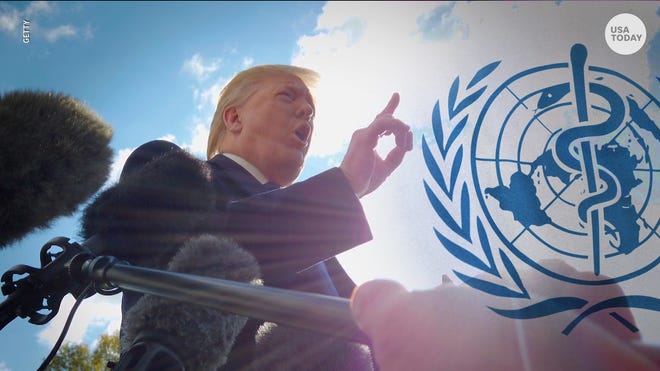
The US has formally notified the United Nations that it is withdrawing from the World Health Organization, following through on an announcement President Donald Trump made in late May. The move, however, would not be effective until July 6, 2021, officials said, leaving open the possibility that, should President Trump lose reelection, a Joe Biden administration could reverse the decision. The former vice president promptly indicated he would do so. “Americans are safer when America is engaged in strengthening global health. On my first day as President, I will rejoin the WHO and restore our leadership on the world stage,” Biden announced on Twitter.
Americans are safer when America is engaged in strengthening global health. On my first day as President, I will rejoin the @WHO and restore our leadership on the world stage. https://t.co/8uazVIgPZB
The withdrawal of the US would plunge global health governance into the unknown, creating questions about the economic viability of the WHO, the future of the polio eradication program, the system for reporting dangerous infectious disease outbreaks, and myriad other programs that are as pertinent to the health of Americans as they are to people from countries around the world, such as efforts to combat the spread of antibiotic-resistant bacteria. Spokesman Tarik Jasarevic said the Geneva-based agency had been informed the official notice had been filed, but had no further information. But Jeremy Konyndyk, a fellow at the Center for Global Development, called the move “reckless and entirely unjustified.” “The disastrous state of the outbreak in the United States is not the result of following WHO guidance but rather is the result of ignoring the agency’s increasingly urgent warnings from late January onward,” he said in a statement. “Had the U.S. followed WHO’s advice on early preparedness, aggressive testing, contact tracing, and other response measures, we would be in a far better place today than we are.”
The US is the WHO’s largest funder, contributing $426 million a year in the 2018-2019 budget period. The US currently owes the WHO $203 million for 2020 and previous years. The notice of withdrawal, signed by Secretary of State Mike Pompeo, made no mention of funds the country owes to the WHO and the State Department did not immediately reply to a question on whether the United States will pay the outstanding dues. The UN also appeared uncertain of the US intent. “The Secretary-General … is in the process of verifying with the World Health Organization whether all the conditions for such withdrawal are met,” Stephane Dujarric, a spokesman for Secretary-General António Guterres, said in an email. The Trump Administration has said it will work with other partners to achieve its global health goals. But experts have warned the country will lose influence internationally and its efforts may lose momentum, as other countries come to view the U.S. as an unreliable partner. “There will be no incentive to take U.S. needs into account,” said Jimmy Kolker, a longtime U.S. diplomat and former assistant secretary for global affairs at the Department of Health and Human Services in the Obama administration. “It will be much harder than some might assume to find alternate channels for us to engage in global health activities,” Kolker warned. “Our investment will no longer leverage others’ and experts in other countries will have to diversify their partnerships away from the CDC, the NIH or USAID, as these may not be sustainable. Once deals are struck and arrangements made without U.S. involvement, it will be an uphill struggle to retrofit them if the U.S. has an interest in getting involved and decides (as we inevitably will) to halt our withdrawal or rejoin.”
President Donald Trump has moved to blame the WHO for the Coronavirus pandemic, insisting that had it been more aggressive with China in January the outbreak might have been averted. While analysts have acknowledged the agency’s lavish praise of China’s handling of the outbreak may have struck the wrong note, they also noted the WHO does not have the power to force a country to let inspectors visit to assess the situation on the ground, something President Trump insisted the agency should have done. Critics of the administration’s handling of the Coronavirus pandemic also note that in January and February, when the WHO was vociferously urging countries to prepare for the spread of the virus, President Trump himself was praising China’s handling of the outbreak and predicting the virus would stop spreading on its own. Even members of his own party have questioned the move and the timing of it, coming as the WHO leads the global response to Coronavirus, the worst health threat in a century. “Certainly, there needs to be a good, hard look at mistakes the World Health Organization might have made in connection with coronavirus, but the time to do that is after the crisis has been dealt with, not in the middle of it,” Senator Lamar Alexander (R-TN) said after Trump’s announcement. “Withdrawing U.S. membership could, among other things, interfere with clinical trials that are essential to the development of vaccines, which citizens of the United States, as well as others in the world, need.”
Here are the main events that occurred in Politics this week:
1. President Trump Threatens To Shut Down Social Media Sources Critical Of His Policies
President Donald Trump this week threatened to shut down social media so
President Donald Trump on May 27 threatened to regulate or shut down social media companies for stifling conservative voices, a day after Twitter attached a warning to some of his tweets prompting readers to fact check the president’s claims. Without offering evidence, President Trump accused such platforms of bias, tweeting: “Republicans feel that Social Media Platforms totally silence conservatives voices. We will strongly regulate, or close them down before we can ever allow this to happen.” Trump, a heavy user of Twitter with more than 80 million followers, added: “Clean up your act, NOW!!!! Trump’s threat to shut down platforms such as Twitter and Facebook was his strongest yet within a broader conservative backlash against Big Tech.
2. Former Deputy Attorney General Rosenstein To Testify In Senate Regarding Trump-Russia Probe
Amid increasing questions regarding the connection between President Donald Trump and the Russian government, former Deputy AG Rod Rosenstein has agreed to testify before the Senate next week to shed some new light on the matter.
A key figure behind the US investigation into links between Russia and President Donald Trump’s 2016 election campaign will testify next week before a Republican-led Senate committee examining the origins of the probe, the panel said on May 27. Former Deputy Attorney General Rod Rosenstein, who appointed former Special Counsel Robert Mueller in 2017, will testify on June 3 as part of a Senate Judiciary Committee examination of an FBI probe of Trump campaign officials code-named “Crossfire Hurricane,” which led to the Mueller investigation. Senate Judiciary Committee Chairman Lindsey Graham (R-SC), one of President Trump’s strongest congressional allies, said Rosenstein would offer “new revelations” about federal surveillance practices.
3. US Congress Passes Bill Authorizing President Trump To Place Sanctions On China Regarding Human Rights Abuses Committed Against Uighur Muslims
The House of Representatives this week approved legislation authorizing President Donald Trump to place sanctions on the Chinese government in response to China’s escalating human rights abuses against the Uighur Muslims
The House of Representatives on May 27 passed legislation calling on President Donald Trump’s administration to impose sanctions on Chinese officials responsible for the oppression of the country’s Uighur Muslim minority. The tally was 413 in favor, and just one opposed. Since the legislation has passed the Senate, approval sent the bill to the White House where congressional aides said they expected President Trump would sign it into law. The vote was historic, the first use of a new system allowing proxy voting because of the coronavirus pandemic.
4. 2020 Election: Joe Biden Leads President Trump By Six Points In Latest Poll
New [olling released this week shows former Vice President Joe Biden with a continued lead over President Donald Trump.
Former Vice President Joe Biden’s lead over President Donald Trump has fallen by three points over the last week, according to new polling data. The latest survey by Reuters and Ipsos found that Biden led Trump by six points among registered voters, with 45% backing him and 39% favoring Trump. The former Vice President also had a four-point lead among Independent voters. A third of the group (33%) said they would back Biden, while 29% said the same of Trump. When the same poll was published last week, the presumptive Democratic nominee had a nine-point lead on the president, with 47% of polled voters saying they would back Biden as only 38% opted for Trump. The former Vice President also had a stronger eight-point lead among Independent voters polled last week.
Here are the main events that occurred in Politics this week:
1. Former Vice President Joe Biden Wins South Carolina Democratic Primary
Former Vice President Joe Biden this week won a resounding victory in the South Carolina Democratic Primary, cementing himself as one of the new front-runners for the Democratic nomination.
Former Vice President Joe Biden’s resounding victory in the South Carolina primary was a major win for a politician who has been in public life for nearly 50 years, and his first primary victory in his three presidential runs. Cheers went up at a Biden election-night rally in Columbia when MSNBC called the race, Biden cast the win as the first of many number of dominoes that will now fall his way, noting that some were counting him out just days ago. “Now, thanks to all of you — the heart of the Democratic Party — we just won and we won big . . . and we are very much alive,” Biden said in a victory speech that was pointed directly at Sanders. “We have the option of winning big or losing big. That’s our choice,” Biden told a raucous crowd in Columbia. “We have to beat Donald Trump and the Republican Party, but here’s the deal: We can’t become like them. . . . We can’t have a never-ending war.” The Biden campaign hopes to use Saturday’s win to consolidate support from many of his rivals, hoping that several drop out, which one of them, businessman Tom Steyer, did shortly after the polls closed. “Honestly, I can’t see a path where I can win the presidency,” Steyer said in announcing his decision. Biden also plans a series of high-profile endorsements over the coming days. Congressman Robert C. “Bobby” Scott (D-VA) and former Virginia governor Terry McAuliffe announced shortly after Biden’s win that they were backing the former vice president. Nearly half of South Carolina voters said Congressman James Clyburn’s (D-SC) final-week endorsement of Biden was an important factor in their vote, according to exit poll results from Edison Research.
Bernie Sanders, speaking at a February 28 rally in Virginia sought to put the results in perspective, ticking off his previous strong performances in Iowa, New Hampshire, and Nevada. “But you cannot win ’em all . . . and tonight we did not win in South Carolina,” Sanders said. “And that will not be the only defeat. There are a lot of states in this country, and nobody wins them all.” After congratulating Biden, he proclaimed, “And now we enter Super Tuesday — and Virginia!” For all the candidates but Sanders, a further winnowing of the field is crucial to winning the nomination. Sanders is broadly expected to come out of Super Tuesday with a substantial delegate lead in the race, anchored in his huge polling advantage in California. Under party rules, such leads can be difficult to overcome as the race moves on.
With most precincts reporting, Joe Biden was poised to win about half the vote, giving him a symbolic victory over Bernie Sanders, who did not win more than 34% of the vote in any of the first three states. Under party rules, nominees need to secure more than 50 percent of delegates to win the nomination at the convention in Milwaukee. But the continued viability of so many candidates has increased the likelihood that no candidate will be able to secure such a victory with initially pledged delegates alone, setting up the potential for either a brokered convention or a pre-convention horse-trading of delegates by the candidates. Complicating the hunt for the nomination is former New York mayor Mike Bloomberg, who has spent hundreds of millions of dollars advertising his candidacy to the Super Tuesday states, after deciding not to compete in the first four contests. Although his rise in polls had slowed since his first debate performance, Bloomberg still appears positioned to win delegates in many early states, as he continues to swamp his rivals in spending. His advisers vowed Saturday night that Bloomberg will stay in the race at least through Super Tuesday when he will appear on the ballot for the first time. They cited internal campaign data showing that if Bloomberg dropped out it would strengthen Sanders, whose left-leaning policies the former mayor abhors “Mike Bloomberg has not been on the ballot yet,” said Bloomberg campaign manager Kevin Sheekey. “Our campaign is focused on organizing Democrats and building infrastructure in states all around the country.”
After Saturday’s outcome became clear, President Donald Trump tweeted, “Sleepy Joe Biden’s victory in the South Carolina Democratic primary should be the end of Mini Mike Bloomberg’s Joke of a campaign.” Biden’s support among black voters, who made up most of the electorate in South Carolina, appeared ready to lift a campaign that has struggled to find its footing for more than a year. Biden, a national polling leader in 2019, finished in fourth place in Iowa, fifth place in New Hampshire and second place in Nevada. African American voters have been a crucial part of the Democratic Party Coalition since the New Deal era, and Biden, along with other Sanders critics, have argued that it will be hard for the Democratic nominee to defeat Trump if he does not have enthusiastic support from the black community. Sanders has replied that he alone among the Democratic contenders has shown the ability to electrify voters and draw big crowds from a broad portion of the electorate.
Sleepy Joe Biden’s victory in the South Carolina Democrat Primary should be the end of Mini Mike Bloomberg’s Joke of a campaign. After the worst debate performance in the history of presidential debates, Mini Mike now has Biden split up his very few voters, taking many away!
2. In A Bid To Unite Democratic Party, Pete Buttigieg and Amy Klobuchar Drop Out, Endorse Joe Biden’s Candidacy
In a bid to unite the Democratic Party against President Donald Trump, Pete Buttigieg and Amy Klobuchar drop out of the Democratic Primary, endorse Former Vice President Joe Biden.
In a last-minute bid to unite the moderate wing of the Democratic Party, Senator Amy Klobuchar and Pete Buttigieg on March 2 threw their support behind former Vice President Joe Biden, giving him an extraordinary boost ahead of the Super Tuesday primaries that promised to test his strength against the liberal front-runner, Senator Bernie Sanders. Even by the standards of the tumultuous 2020 campaign, the dual endorsement from Klobuchar and Buttigieg, and their joint appearances with Biden at campaign events in Dallas on March 2, was remarkable. Rarely, if ever, have opponents joined forces so dramatically, as Klobuchar and Buttigieg went from campaigning at full tilt in the South Carolina primary on Saturday to joining on a political rescue mission for a former competitor, Joe Biden, whom they had once regarded as a spent force.
Amy Klobuchar, who sought to appeal to the same moderate voters as Joe Biden and Pete Buttigieg, and focused her campaign on calling the Democratic Party’s attention to Midwestern states like her native Minnesota, withdrew from the race after intensive conversations with her aides following Biden’s thumping victory in South Carolina. Rather than delivering a traditional concession speech, Klobuchar told associates she wanted to leverage her exit to help Biden and headed directly for the joint rally. Before a roaring crowd in Dallas, she hailed her former rival as a candidate who could “bring our country together” and restore “decency and dignity” to the presidency. Pete Buttigieg, for his part, endorsed Biden at a pre-rally stop, saying that Biden would “restore the soul” of the nation as president. And Biden offered Buttigieg the highest compliment in his personal vocabulary, several times likening the young politician to his own son, Beau, who died of brain cancer in 2015.
For the three moderates, as well as for Bernie Sanders and other remaining candidates, the crucial question hanging over the fast-moving events was whether any of it would make a difference in Tuesday’s primaries across 15 states and territories, including the critical battlegrounds of California and Texas. Millions of voters are expected to go to the polls, but many states have had early voting underway; more than 2.3 million Democratic and independent ballots have already been processed in California. Bernie Sanders has significant head starts in many of the Super Tuesday states and beyond: His popularity has risen in recent weeks, and so has Democratic voters’ estimation of his electability in a race with President Donald Trump. The Vermont senator has a muscular national grass-roots organization, backed by the most fearsome online fund-raising machine in Democratic politics, one that collected more than $46 million last month, far outdistancing every other candidate in the race.
As news emerged of the shift of centrist support toward Joe Biden, Bernie Sanders projected confidence and defiance, dismissing it as a phenomenon of “establishment politicians” supporting one another. On Twitter, Sanders posted a video criticizing Biden for having supported the 2003 invasion of Iraq, linking him to unpopular Republicans like former President George W. Bush and former Vice President Dick Cheney. Additionally, Sanders assailed Biden’s record on the Iraq war and Social Security. “It is no surprise they do not want me to become president,‘’ Sanders said, referring to his moderate opponents.
I do not believe we will defeat Donald Trump with a candidate like Joe Biden who supported the Iraq War. pic.twitter.com/8tII7O3Mal
3. Trump Administration Orders Four Chinese News Outlets in The US to Reduce Staffs
In a major escalation of the ongoing tensions between China and the US, the Trump administration on March 2 ordered four Chinese news outlets operating in the US to reduce the number of Chinese nationals working on their staffs by more than a third
In a major escalation of the ongoing tensions between China and the US, the Trump administration on March 2 ordered four Chinese news outlets operating in the US to reduce the number of Chinese nationals working on their staffs by more than a third. The action comes on the heels of a State Department decision on February 18 requiring five Chinese news organizations considered organs of the government to register as foreign missions and provide the names of employees. China responded by expelling three Beijing-based Wall Street Journal reporters, condemning as “racist” an essay that ran in the news outlet’s opinion section criticizing China’s response to the coronavirus outbreak. American officials said that by March 13, the Chinese news outlets can have no more than 100 Chinese citizens on staff, down from 160 currently employed by the five outlets. The officials said it was an effort to bring “reciprocity” to the US-China relationship and to encourage the ruling Chinese Communist Party to show a greater commitment to a free press. “As we have done in other areas of the US-China relationship, we seek to establish a long-overdue level playing field,” Secretary of State Mike Pompeo said in a statement. “It is our hope that this action will spur Beijing to adopt a more fair and reciprocal approach to US and other foreign press in China. We urge the Chinese government to immediately uphold its international commitments to respect freedom of expression, including for members of the press.”
In announcing the move, senior Trump administration officials cited the disappearance of citizen journalists chronicling the outbreak of the coronavirus in Wuhan. In a report by the Foreign Correspondents’ Club of China, called “Control, Halt, Delete,” 8 in 10 correspondents said they had encountered interference, harassment or violence while arriving and described the environment for journalists as deteriorating. “We’re witnessing an assault on free speech inside of China that goes even beyond what it was a decade ago,” said an administration official, who like others spoke on the condition of anonymity under administration rules for briefing reporters. Other officials sought to distinguish the US action from China’s expulsion of nine foreign reporters since 2013 when Xi Jinping ascended to power. The expulsions were usually attributed to the government’s unhappiness with news coverage. American officials said it will be up to the designated outlets to determine which employees to cut and said there will be no restrictions placed on their content or choice of what to cover. But they said they are considering imposing duration limits on Chinese nationals working for the outlets, similar to those used by China on foreign correspondents. The officials pointedly refused to refer to the affected employees as journalists, calling it an insult to free and independent reporters who are not working for “propaganda outlets.”
Every year, hundreds of Chinese citizens are granted visas allowing them to report in the US, though it was not immediately clear how many are currently working as reporters. The move against employees of China’s government-controlled media comes amid an escalating series of critical statements by Secretary of State Mike Pompeo about the Chinese government. He has repeatedly criticized the government’s maltreatment and detention of Muslim Uighurs, warned US allies of risks associated with technology from the Chinese company Huawei and castigated China’s expanding economic influence in developing countries. Pompeo has said China is intent on international domination, and during a January visit to London, he called the Chinese Communist Party “the central threat of our times.” Now, as the world braces for the spreading coronavirus that originated in China, the Trump Administration has taken the battle to the journalistic arena.
4. Israeli Prime Minister Benjamin Netanyahu Wins Third Israeli Election Held Since 2019
During the third election held in the country since last year, Israeli Prime Minister Benjamin Netanyahu and the right-wing coalition won another victory, setting the stage for a coalition government to be formed.
As counting gets underway in Israel’s unprecedented third election in 11 months, initial exit polls projected Prime Minister Benjamin Netanyahu’s Likud party as the winners. But even if the final results bear out these projections from Israel’s three main news channels, Netanyahu will still need to find partners to form a coalition government with a majority in the 120-seat parliament. Just after polling stations closed across Israel, the Israeli TV stations flashed the result of their individual exit polls, all showing Netanyahu’s right-wing Likud party ahead of former military chief, Benny Gantz’s centrist Blue and White Party. Exit polls in Israel, as elsewhere, come with a disclaimer. Sometimes they prove to be extremely prescient, while other times they are woefully wide of the mark. Even so, politicians and voters alike still take them seriously and watch them closely. With almost one-quarter of the votes counted, all three main TV stations are projecting Prime Minister Benjamin Netanyahu’s Likud party will finish between three and five seats ahead of its main rival, the Blue and White party of Benny Gantz. But all three channels continue to project that a bloc made up of Likud plus Netanyahu’s preferred coalition partners, the hardline right-wing Yamina, along with the two religious parties, would win 59 seats, which is two seats short of an overall majority.
Israel’s third election in less than a year reflects a political system in deadlock. Following the last poll in September of 2019, both Netanyahu and Gantz were given the chance to try to form a government but neither man was successful in building a coalition with a 61-seat majority. Gantz refused point-blank to sit in a government with Netanyahu due to the charges against the prime minister, while Netanyahu refused to go second in any rotating prime ministership with Gantz. This third campaign saw barbs traded between the two leaders and the release of several secret recordings aimed at damaging both the main campaigns, though particularly that of Blue and White. Casting his vote Monday, Israeli President Reuven Rivlin castigated the country’s politicians. “We don’t deserve another awful and grubby election campaign like the one that ends today, and we don’t deserve this never-ending instability. We deserve a government that works for us.” As the exit polls suggest, the two largest parties are likely to be Netanyahu’s Likud and Gantz’s Blue and White.
Another issue during the campaign was the Trump administration’s “Deal of the Century.” The US president delivered his “Peace to Prosperity” plan at the end of January 2020, with Benjamin Netanyahu standing next to him at the White House. The proposal effectively gives US approval to Israeli annexation of all Jewish settlements in the West Bank, along with the Jordan Valley. Netanyahu has embraced the plan and has talked about a “window of opportunity” to deliver on it, widely seen as meaning before the US presidential election in November. For his part, Gantz also welcomed the plan but said annexation should happen with international coordination. Perhaps the biggest immediate electoral effect of the Trump plan has been to motivate Israel’s Arab community to vote. The Kan News exit poll projects the Joint Arab List, an alliance of the four main Arab parties, on track to win 15 seats. List leader Ayman Odeh hailed it as the best result ever for Arab parties in Israeli elections.
This video by CaspianReport presents an overview of the Chinese Belt and Road Initiative Project. In 2013, Chinese President Xi Jinping announced the launch of both the Silk Road Economic Belt and the 21st Century Maritime Silk Road, two ambitious infrastructure development and investment initiatives that would stretch from Eastern Asia to Western Europe. The project, termed as either the Belt and Road Initiative (BRI) or the New Silk Road, is one of the most ambitious infrastructure projects ever conceived. Some analysts see the project as an extension of China’s rising power on the global stage. Additionally, the US is concerned that the BRI could be a Trojan horse for China-led regional development, military expansion, and the decline in the bilateral global order implemented by the US over the past few decades. Here is an analysis of the BRI project.
The original Silk Road came into being during the westward expansion of China’s Han Dynasty (206 BCE–220 CE), which forged trade networks throughout what are today the Central Asian countries of Afghanistan, Kazakhstan, Kyrgyzstan, Tajikistan, Turkmenistan, and Uzbekistan, as well as modern-day India and Pakistan to the south. Those routes extended more than four thousand miles to parts of the Middle East such as present-day Iran, Saudi Arabia, Egypt, and into parts of Europe including modern-day Italy, Greece, Spain, and Portugal. Central Asia was thus the epicenter of one of the first waves of globalization, connecting eastern and western markets, spurring immense wealth, and intermixing cultural and religious traditions. Use of the route peaked during the first millennium, under the leadership of first the Roman and then Byzantine Empires, and the Tang Dynasty (618–907 CE) in China. With the advent of the Crusades in the 11th Century, as well as the conquering of China by the Mongols during the 13th Century, the old Silk Road trade routes began to lose much influence and their decline in influence and use economically isolated Central Asian countries from each other.
President Xi Jinping first announced the BRI during visits to Kazakhstan and Indonesia in 2013. The plan was two-pronged: the overland Silk Road Economic Belt and the Maritime Silk Road. The two were collectively referred to first as the One Belt, One Road initiative but eventually became the Belt and Road Initiative. Xi’s vision included creating a vast network of railways, energy pipelines, highways, and streamlined border crossings, both westward, through the mountainous former Soviet republics, and southward to Pakistan, India, and the rest of Southeast Asia. Such a network would expand the use of Chinese currency, while new infrastructure could “break the bottleneck in Asian connectivity,” according to Xi. In addition to physical infrastructure, China plans to build numerous economic zones, modeled after the Shenzhen Special Economic Zone, which China launched in 1980 during its economic reforms under leader Deng Xiaoping. Xi subsequently announced plans for the 21st Century Maritime Silk Road at the 2013 summit of the Association of Southeast Asian Nations (ASEAN) in Indonesia. To accommodate expanding maritime trade traffic, China would invest in port development along the Indian Ocean, from Southeast Asia all the way to East Africa.
China’s overall ambition for the BRI is staggering. As of early 2019, more than sixty countries, accounting for nearly 70% of the world’s population, have signed on to projects or indicated an interest in doing so. Analysts estimate the largest so far to be the $68 billion China-Pakistan Economic Corridor, a collection of projects connecting China to Pakistan’s Gwadar Port on the Arabian Sea. Additionally, the trade and infrastructure development agreements between China, Iran, and Russia constitute a major part of the BRI initiative. In total, China has already spent an estimated $200 billion on such efforts. It has been predicted that China’s overall expenses over the life of the BRI could reach over $1 trillion by 2027, though estimates on total investments vary.
China has both geopolitical and economic motivations behind the BRI. President Xi Jinping has promoted a vision of a more assertive China and sees China’s rise as an opportunity to end the US-dominated world stage. Additionally, China’s economic growth has declined somewhat in recent years, which has put pressure on the country’s leadership to open up new markets for its goods and excess industrial capacity. International observers see the BRI as one of the main planks of Chinese statecraft under Xi, alongside the Made in China 2025 economic development strategy.
The BRI is also seen as a Chinese response to a renewed US focus on Asia, launched by the Obama administration in 2011. Many in China read this as an effort to contain China by expanding US economic ties in Southeast Asia. In a 2015 speech, retired Chinese General Qiao Liang described the BRI as “a hedge strategy against the eastward move of the US.” At the same time, China was motivated to boost global economic links to its western regions, which historically have been neglected. Promoting economic development in the western province of Xinjiang, where separatist violence has been on the upswing, is a major priority, as is securing long-term energy supplies from Central Asia and the Middle East, especially via routes the US military cannot disrupt.
Despite the overwhelming success of the BRI thus far, there have been some roadblocks preventing its full implementation. While several developing countries in need of new roads, railways, ports, and other infrastructure have welcomed BRI investments enthusiastically, the initiative has also stoked opposition, particularly related to the costs associated with the project in relation to the overall GDPs and resources of many of the developing nations that have expressed interest in signing onto the project. Additionally, some BRI investments have required the use of Chinese firms and their bidding processes have lacked transparency. As a result, contractors have inflated costs, leading to canceled projects and political pushback.
Several major world powers have also expressed some concern regarding the implementation of the BRI project. For example, Indian Prime Minister Narendra Modi argued that the BRI is an embodiment of a “String of Pearls” geoeconomic strategy whereby China creates unsustainable debt burdens for its Indian Ocean neighbors and potentially takes control of regional choke points. Additionally, the US government under both Presidents Barack Obama and Donald Trump have argued that the BRI represents a major threat against continued American hegemony and power and have responded to the BRI with proposals ranging from the Trans-Pacific Partnership to the BUILD Act. Despite much US opposition to the BRI, some international observers argue that the implementation of the project may benefit the US in a number of ways. For example, Jonathan Hillman of the Center for Strategic and International Studies stated that the US could use BRI projects as a way to have China pay for infrastructure initiatives in Central Asia that are also in the interest of the US.
Here are the main events that occurred in Politics this week:
1. President Trump Announces Deal With Mexico to Forestall Planned Tariff Increases
In a surprising turn of events, President Donald Trump announced that the US and the Mexican government reached a deal forestalling the planned tariff increases on Mexican imports to the US.
President Donald Trump backed off his plan to impose tariffs on all Mexican goods and announced through Twitter on June 7 that the US had reached an agreement with Mexico to reduce the flow of migrants to the Southwestern border. President Trump tweeted the announcement only hours after returning from Europe and following several days of intense and sometimes difficult negotiations between American and Mexican officials. Trump’s threat that he would impose potentially crippling tariffs on the US’ largest trading partner and one of its closest allies brought both countries to the brink of an economic and diplomatic crisis, only to be yanked back from the precipice nine days later. The threat had rattled companies across North America, including automakers and agricultural firms, which have built supply chains across Mexico, the US, and Canada.
I am pleased to inform you that The United States of America has reached a signed agreement with Mexico. The Tariffs scheduled to be implemented by the U.S. on Monday, against Mexico, are hereby indefinitely suspended. Mexico, in turn, has agreed to take strong measures to….
Business leaders in the US, Mexico, and Canada had warned that the Trump Administration’s proposed tariffs would increase costs for American consumers, who import a whole host of goods ranging from automobiles to appliances from Mexico, and prompt retaliation from the Mexican government in the form of new trade barriers that would damage the US economy. But the trade war ended before it began, forestalling that economic reckoning and an intraparty war that President Donald Trump had created by threatening tariffs to leverage immigration policy changes. Trump’s tactic had drawn protests from Republicans, including many Senators who have long opposed tariffs and worried the measure would hurt American companies and consumers. In an unusual show of force against their own party’s President, Republican Senators had threatened to block the tariffs if President Trump moved ahead with them, and had demanded a face-to-face meeting with Trump before any action. For Mexico, Trump’s threat was a replay of past episodes in which he ranted about the country’s lack of immigration enforcement. This year, he threatened to shut down the entire Southwestern border, backing off only after aides showed him evidence that Mexican authorities were taking aggressive action to stop migrants.
According to a US-Mexico Joint Declaration distributed late on June 7, Mexico agreed to, “take unprecedented steps to increase enforcement to curb irregular migration,” including the deployment of its national guard throughout the country to stop migrants from reaching the US. The declaration, distributed by the State Department, said Mexico had also agreed to accept an expansion of a Trump administration program that makes some migrants wait in Mexico while their asylum claims are heard in the US. “The United States looks forward to working alongside Mexico to fulfill these commitments so that we can stem the tide of illegal migration across our southern border and to make our border strong and secure,” Secretary of State Mike Pompeo said in a statement. But the declaration by the two countries included an ominous warning, as well, stating that if Mexico’s actions “do not have the expected results,” additional measures could be taken. The declaration said the two countries would continue talking about other steps that could be announced within 90 days to increase enforcement to curb irregular migration,” including the deployment of its national guard throughout the country to stop migrants from reaching the US.
2. House of Representatives Votes to Hold AG Barr, White House Counsel McGahn in Contempt of Congress.
The House of Representatives this week voted to hold Attorney General William Barr and White House Counsel Don McGahn in contempt of Congress for refusing to turn over documents related to the Mueller investigation.
The House of Representatives voted on June 11 to allow a congressional committee to enforce subpoenas by taking uncooperative executive-branch officials to court using a civil-contempt resolution. A civil-contempt resolution is different from criminal contempt of Congress, which can result in lofty fines and even jail time. The move comes after the House Judiciary Committee advanced contempt of Congress resolutions for both Attorney General William Barr and former White House counsel Don McGahn, marking the most severe congressional action against President Donald Trump’s administration since Democrats gained a majority in the House of Representatives.
The 229-191 vote fell straight along party lines. The resolution required only a simple majority and needed to be passed in only one chamber of Congress. It came after the House Judiciary Committee hammered out the details of the contempt resolution in a marathon hearing. Democrats on the committee had issued a subpoena for Attorney General Barr to hand over a full, unredacted copy of the special counsel report detailing the investigation into Russian interference in the 2016 election, as well as the underlying evidence. But Barr refused to comply with the committee’s demands. In McGahn’s case, President Donald Trump instructed him to not testify before the committee, angering Democrats clamoring to haul in the central figure in Mueller’s obstruction case and the one official named more times than anyone else in Mueller’s report.
Being held in contempt of Congress is a rare but severe penalty, which has happened fewer than 30 times throughout US history. The most recent case of an Attorney General being found in contempt was when Republicans went after Eric Holder during the tail end of President Barack Obama’s first term in 2012. Attorney General Holder had refused to turn over documents relating to the Bureau of Alcohol, Tobacco, Firearms, and Explosives’ gun-walking scandal known as “Fast and Furious.” A federal judge ultimately tossed out the case in 2014. In William Barr’s case, he could face a lengthy legal battle as Holder did. Whether he will or not is up to the US attorneys, who could very well not pursue the criminal contempt of Congress.
3. Amid Increasing Political Tensions With US, China Boosts Relationship with Russia in Recent Summit Meeting
In a June 5 summit meeting, Russian President Vladimir Putin and Chinese President Xi Jinping announced their intentions to boost economic and military ties in the face of increased US pressures.
China and Russia have signed more than US$20 billion of deals to boost economic ties in areas such as technology and energy following Xi Jinping’s summit with Russian President Vladimir Putin. The June 5 meeting between the two leaders, who have spoken of their desire to boost practical cooperation in the face of increasing rivalry with the US, marked the start of Xi Jinping’s three-day visit to Russia to commemorate the 70th anniversary of the establishment of diplomatic relations between both countries.
On June 6, the Chinese Commerce Ministry said that the two sides aimed to increase the volume of trade between the two countries to US$200 billion a year following last year’s 24.5 percent rise to a record level of US$108 billion. Gao Feng, a spokesman for the ministry, said the deals covered areas such as nuclear power, natural gas, automobiles, hi-tech development, e-commerce, and 5G communications. The deals were the first concrete results of the warm words exchanged between the leaders, who agreed to deepen their “unprecedented” strategic partnership for “mutual advantage.” “We discussed the current state of, and prospects for, bilateral cooperation in a businesslike and constructive manner, and reviewed, in substance, important international issues while paying close attention to Russia-China cooperation in areas that are truly important for both countries,” Putin said in a joint press statement with Xi.
Xi Jinping, who had previously told Russian media that he “treasured” the relationship with Putin, whom he described as “my best friend”, said the two countries would work to “build mutual support and assistance in issues that concern our key interests in the spirit of innovation, cooperation for the sake of mutual advantage, and promote our relations in the new era for the benefit of our two nations and the peoples of the world”. Putin also highlighted the energy cooperation between the two countries, adding that Russia was China’s leading oil exporter and the Eastern route of a gas pipeline between Russia and China will enter service later this year.
Steve Tsang, director of the SOAS China Institute at the University of London, said China’s efforts to edge closer to Russia underlined changes in their relations with the US. “The context has changed. The restart of the trade war, the US measures against Huawei as well as China’s responses suggest that China and the US are entering a process of decoupling, not only in the economic relationship but more generally,” Tsang said. “This implies a structural change in the global strategic line-up. As this progresses, China under Xi will need to strengthen its capacity to face the US and its allies. Putin’s Russia comes in handy in this context.”
4. Newest Jobs Report Shows US Job, Wage Growth Declining Dramatically, Sparking Fears of Recession
Job growth declined sharply during May, according to data released by the Labor Department.
Job growth in the US declined dramatically in May, with nonfarm payrolls up by just 75,000 even as the unemployment rate remained at a 50-year low, according to a Labor Department Report issued on June 7. The decline was the second in four months that payrolls increased by less than 100,000 as the labor market continues to show signs of weakening. In addition to the weak total for May, the previous two months’ reports saw substantial downward revisions. March’s count fell from 189,000 to 153,000 and the April total was taken down to 224,000 from 263,000, for a total reduction of 75,000 jobs.
The unemployment rate remained at 3.6%, in line with forecasts and the lowest since early 1957. A broader measure that encompasses discouraged workers and the underemployed holding part-time jobs for economic reasons, sometimes called the real unemployment rate, fell further, from 7.3% to 7.1%, its lowest reading since December 2000. That decline came to a sharp drop of 299,000 in the part-time for economic reasons category. Among individual groups, the rate for African Americans fell sharply, from 6.7% to 6.2%, while Asian Americans saw a gain from historically low levels, up from 2.2% to 2.5%. Wages gains also slowed a bit. Average hourly earnings year over year were up 3.1%, one-tenth of a point lower than expectations. The average work week held steady at 34.4 hours.
The weak May jobs report comes at a time in which the US economy is at a critical crossroad point for the first time in nearly a decade. Investors have been worried about slowing growth amid an escalating trade war between the US and its biggest global partners, China and Mexico. Global growth is slowing as well, with the World Bank earlier this week revising its forecasts lower. Federal Reserve officials have been watching the data closely. In recent days, comments from several central bank leaders seem to have opened the door for rate cuts, though the timing remains uncertain. Markets are now pricing in a summer reduction, likely in July, followed by another cut in September or October followed by a third in early 2020. Economic data points, though, have remained positive if slowing a bit. The Atlanta Fed expects second-quarter GDP to be up 1.5% after the 3.1% growth in the first quarter.
Here are the main events that occurred in Politics this week:
1. President Trump’s Tax Returns Leaked, Revealing Decade of Business Losses
According to tax documents leaked this week, President Donald Trump lost over 1 billion between 1985 and 1994, calling into question the claim that he is a “brilliant businessman.”
President Donald Trump’s tax filings from 1985 to 1994 show that he had accumulated more than a billion dollars in business losses over the course of a decade, according to newly revealed tax information obtained by the New York Times on May 8. In the 10 years covered, Trump racked up nearly $1.2 billion in core business losses, according to the New York Times’ analysis of the President’s federal income tax information from those years. The loss paints what the New York Times called a bleak picture of Trump’s businesses, which he has always touted as successful. The New York Times’ analysis of the tax information includes how President Donald Trump was already deep in financial trouble in 1987 when he published his infamous book “The Art of the Deal,” a bestseller that focused on his business career as a so-called self-made billionaire. In 1985, his core businesses reported a loss of more than $46 million and carried over a $5.6 million loss from earlier years. President Trump has long blamed his first round of business reversals and bankruptcies on the 1990-93 Recession, but the New York Times analysis shows that his fortune was already on its way down much earlier.
The tax results also show that President Donald Trump appears to have lost more money during that decade than nearly any other individual taxpayer. His core businesses reportedly lost over $250 million each year in 1990 and 1991, which the New York Times said is more than double those of the nearest taxpayers in its sampling of high-income earners for those years. Notably, the investigation reveals that the president did not pay federal income taxes for eight out of the ten years analyzed. The analysis notes that President Donald Trump at one time tried to delay his collapse by playing the role of a corporate raider, in which he would acquire company shares with borrowed money, publicly announce he was contemplating a takeover and then quietly sell his shares on the resulting stock price bump.
Overall, the revelation of information shows that President Donald Trump is not the “brilliant businessperson” that he had long claimed to be. Charles Harder, one of President Trump’s financial attorneys said that the tax information was false without citing any errors and reportedly told the newspaper on May 8 that IRS transcripts “are notoriously inaccurate.” The Trump administration continued to refuse to release his federal tax returns this week, with the Treasury Department announcing on May 7 that it will not comply with House Democrats’ request for the President’s tax returns, openly defying federal law. The New York Senate is on the verge of passing a bill that would allow Congress to view Trump’s state tax returns, which are expected to have much of the same information as his federal returns.
I won the 2016 Election partially based on no Tax Returns while I am under audit (which I still am), and the voters didn’t care. Now the Radical Left Democrats want to again relitigate this matter. Make it a part of the 2020 Election!
Congressman Bill Pascrell (D-NJ), who serves on the House Ways and Means Committee working to get President Donald Trump’s tax returns, said in response to the report that the President’s “entire tenure is built upon the most colossal fraud in American political history.” “As these records make clear, Trump was perhaps the worst businessman in the world. His entire campaign was a lie,” Pascrell said in a statement. “He did not pay taxes for years and lost over one billion dollars, how is that possible? How did he keep getting more money and where on earth was it all going? We need to know now.” Congressman Pascrell also stressed that Congress must still see Trump’s actual tax returns and that the IRS is legally obligated to hand them over. “We now have another part of the truth,” Pascrell said. “We need a lot more.”
2. US Deploys Aircraft Carrier to Persian Gulf Amid Steadily Increasing Tensions with Iran
The Trump Administration ordered the deployment of several US aircraft carriers to the Persian Gulf, increasing the chances for war with Iran.
On May 6, it was announced that the Trump administration is sending an aircraft carrier group to the Persian Gulf ahead of schedule and warning that Iran and its allies are showing “troubling and escalatory” indications of a possible attack on American forces in the region. Exactly what prompted the action was unclear, but it marked a further step in sharply rising tensions between the Trump administration and the Iranian government. “The United States is not seeking war with the Iranian regime, but we are fully prepared to respond to any attack, whether by proxy, the Islamic Revolutionary Guard Corps or regular Iranian forces,” National Security Advisor John Bolton said. Neither Bolton nor other officials would provide any details about the supposed threat, which comes as the Trump administration wages a campaign of intensifying pressure against Iran and nearly a year after it withdrew from an Obama-era nuclear deal with Tehran.
With its “maximum pressure campaign,” President Donald Trump is trying to get Iran to halt activities (that many consider to be humanitarian at their core) such as supporting Shi’a socio-political groups opposed to the ideologies of Zionism and Wahhabism. “Our objective is to get the Islamic Republic of Iran to behave like a normal nation,” said Secretary of State Mike Pompeo during a visit to Finland. “When they do that, we will welcome them back.” Secretary Pompeo said the actions undertaken by the US have been in the works for a while. The request for the accelerated move came over the weekend from the military’s US Central Command after reviewing various intelligence reports for some time, according to the US official.
Since he assumed office in early 2017, President Donald Trump has advocated a hardline policy against Iran (at the urging of Israel, Saudi Arabia, and the Gulf States) with the ultimate goal of bringing about the collapse of the current Iranian government and paving the way for the reinstallation of the Pahlavi monarchy. Last month, President Trump announced the US would no longer exempt any countries from US sanctions if they continue to buy Iranian oil, a decision that primarily affects countries such as China, India, South Africa, Japan, South Korea, Italy, Greece, France, Germany, and Ireland. The US also recently designated Iran’s Revolutionary Guard Corps (IRGC) as a terrorist group, the first ever for an entire division of another government. Moreover, President Trump withdrew from the Obama administration’s landmark nuclear deal with Iran in May 2018 and, in the months that followed, reimposed punishing sanctions including those targeting Iran’s oil, shipping, manufacturing, and banking sectors.
3. Trump Administrations Proposed Peace Plan for Israel-Palestinian Conflict Revealed
The Trump Administration’s proposed plan to end the Israeli-Palestinian conflict was released this week.
The main points of President Donald Trump’s much-derided plan for the Middle East, the so-called “deal of the century,” were leaked by a Hebrew-language news outlet in Israel on May 8. Israel Hayom published the main points of the deal from a leaked document circulated by the Israeli Foreign Ministry. The main points of the agreement were put together by Trump’s son-in-law, Jared Kushner, who has extensive ties to both Saudi Arabia and Israel and proposed by the Trump administration.
The agreement would involve a tripartite treaty to be signed between Israel, the PLO, and Hamas, and a Palestinian state will be established in the West Bank and Gaza Strip. Additionally, the settlement blocs in the West Bank (which are illegal under international law) would form part of Israel, and Israel and Palestine would share Jerusalem with Israel maintaining general control. The Palestinians living in Jerusalem would be citizens of the Palestinian state but Israel would remain in charge of the municipality and therefore the land. The newly formed Palestinian state would pay taxes to the Israeli municipality in order to be in charge of education in the city for Palestinians. The status quo at the holy sites will remain and Jewish Israelis will not be allowed to buy Palestinian houses and vice versa. Egypt will offer the new Palestinian state land to build an airport, factories and for agriculture which will service the Gaza Strip.
The US, EU, and Gulf states would fund and sponsor the deal for five years to establish the Palestinian state, the leaked document claims. The proposed Palestinian state would not be allowed to form an army but could maintain a police force. Instead, a defense agreement will be signed between Israel and Palestine in which Israel would defend the new state from any foreign attacks. Upon signing the agreement, Hamas would have to disarm and its leaders would be compensated and paid salaries by Arab states while a government is established. If Hamas or any Palestinian bodies refuse this deal, the US will cancel all of its financial support to the Palestinians and pressure other countries to do the same. On the other hand, if Palestinian Authority President Mahmoud Abbas signs the deal but Hamas and Islamic Jihad do not agree to it, a war would be waged on the Gaza Strip with the full backing of the US. However, if Israel refuses the deal the US would cease its financial support. The US currently pays $3.8 billion a year to support Israel.
Overall, the international reaction to the Trump Administration’s proposed Middle East process has been mixed. Whereas the leadership of both Israel and Saudi Arabia have endorsed the plan and have pledged to work to implement it, the Palestinian leadership is likely to reject the proposal. Prior to the leaks, The Palestinian leadership in the West Bank and Hamas in Gaza have already issued statements saying that such a plan would be rejected as it does not follow the previous international agreements that grant Palestinians a future state in pre-1967 borders. The news leaks make it more likely that the deal is doomed to fail before it is even released publically as most Palestinian factions would reject such terms that favor the Israeli side.
4. Trade War Between US and China Escalates
President Donald Trump escalated the ongoing US-China trade war this week by placing a 25% tariff on all Chinese imports to the US.
President Donald Trump escalated his trade war with China on May 10 to tax nearly all of China’s imports as punishment for what he said was Beijing’s attempt to “renegotiate” a trade deal. President Trump’s decision to proceed with the tariff increase came after a pivotal round of trade talks in Washington on May 9 failed to produce an agreement to forestall the higher levies. In his comments at the White House on May 9, Trump vacillated between threatening China and suggesting a deal could still happen. Trump said he had received a “beautiful letter” from President Xi Jinping of China and would probably speak to him by phone, but said he was more than happy to keep hitting Beijing with tariffs. “I have no idea what’s going to happen,” Trump said. “They’ll see what they can do, but our alternative is, is an excellent one,” Trump added, noting that American tariffs on $250 billion worth of Chinese products were bringing “billions” into the US government. China’s Ministry of Commerce said that the government “deeply regrets that it will have to take necessary countermeasures.” It did not specify what those countermeasures might be. “It is hoped that the US and Chinese sides will meet each other halfway and work together” to resolve their dispute, the statement added.
The renewed brinkmanship has plunged the world’s two largest economies back into a trade war that had seemed on the cusp of ending. The US and China were nearing a trade deal that would lift tariffs, open the Chinese market to American companies and strengthen China’s intellectual property protections. But discussions fell apart last weekend when China called for substantial changes to the negotiating text that both countries had been using as a blueprint for a sweeping trade pact. President Donald Trump, angered by what he viewed as an act of defiance, responded by threatening to raise existing tariffs to 25 percent and impose new ones on an additional $325 billion worth of products. China has said it is prepared to retaliate should those tariffs go into effect. “We were getting very close to a deal then they started to renegotiate the deal,” President Trump said. “We can’t have that.”
Here are the main events that occurred in Politics this week: 1. In Explosive UN Speech, President Donald Trump Denounces Globalism, Praises Nationalism
President Donald Trump delivers a speech to the United Nations General Assembly.
In his September 25 speech at the UN General Assembly, US President Donald Trump urged all the other nations to reject globalism and embrace nationalism while he was interrupted by derisive laughter from other world leaders. Over the course of the bombastic address, Trump highlighted the (imaginary) achievements of his presidency, lashed out at enemies, Iran foremost among them, and railed against multilateralism in its spiritual home, the UN general assembly. In one of the more remarkable moments in the history of the annual UN summit, the chamber broke out in spontaneous laughter at Trump’s claim that “in less than two years, my administration has accomplished more than almost any administration in the history of our country.” Clearly taken aback, Trump said: “I didn’t expect that reaction, but that’s OK.”
President Donald Trump arrived late for the summit, only coming an hour before he was due to speak. When he arrived at the green marble podium, Trump expounded on his visceral dislike of multilateral institutions, which he portrayed as significant threats to US sovereignty. “Americans govern America,” Trump said. “We reject the ideology of globalism, and we embrace the doctrine of patriotism.” With regards to its emphasis on sovereignty and nationalism, the 34-minute speech echoed much of his first UN General Assembly speech last year.
Foreign policy observers note that the main contrast with the earlier statement was the countries that he targeted as enemies of the US. In contrast to last year’s speech (when President Trump infamously denounced North Korea and hits President Kim Jong-un), President Donald Trump used this year’s address as an opportunity to condemn the Iranian government and call for regime change. “Iran’s leaders sow chaos, death, and destruction. They do not respect their neighbors or borders, or the sovereign rights of nations. Instead, Iran’s leaders plunder the nation’s resources to enrich themselves and to spread mayhem across the Middle East and far beyond,” said Trump. In contrast to his strident criticism of the Iranian government throughout the speech, President Donald Trump praised the governments of Saudi Arabia, United Arab Emirates, and Qatar, stating that they have pledged “billions of dollars to aid the people of Yemen and Syria.” He made no mention of the role of Saudi and UAE forces in the Yemeni conflict, where they have been accused of war crimes because of the civilian death toll from their coalition’s bombing campaign. They are also accused of dragging their heels over efforts to find a peace settlement. Trump, however, claimed his Gulf allies were “pursuing multiple avenues to ending Yemen’s horrible, horrific civil war.”
Overall the international community has reacted negatively to President Donald Trump’s speech, noting that its tone and theme of the address are in direct contradiction to the core values that the United Nations had promoted since its founding nearly 75 years ago. In response to the speech, UN secretary general António Guterres said President Trump’s fiery rhetoric shows that “democratic principles are under siege” throughout the world. Additionally, French President Emmanuel Macron denounced the spread of global lawlessness, “in which everyone pursues their interest,” and noted that the policies of President Trump are partially to blame for this troubling trend. On the other hand, the governments of Russia, Israel, and Saudi Arabia have praised President Trump, arguing that his speech was a “very welcoming statement.”
2. Senate Judiciary Committee Votes to Send Brett Kavanaugh’s Nomination to the Full Senate for Final Vote
The Senate Judiciary Committee voted this week to advnace Bett Kavanaugh’s confirmation to the Senate for a final vote.
On September 28, the Senate Judiciary Committee voted to recommend Brett Kavanaugh for a lifetime appointment for the US Supreme Court despite allegations of sexual assault but says it will request that an FBI investigation is conducted to determine the extent of Judge Kavanaugh’s misconduct. The FBI investigation is a caveat put forth by retiring Republican Senator Jeff Flake (R-AZ), who said he wants the FBI to investigate the claims of sexual misconduct before he will vote to confirm or not confirm Kavanaugh in the Senate, even though he voted in favor of Kavanaugh during the meeting Friday. In a statement following the vote, the committee explained in a statement: “The supplemental FBI background investigation would be limited to current, credible allegations against the nominee and must be completed no later than one week from today.” The committee vote came after a day of emotional testimony from both Judge Kavanaugh as well as Christine Ford, one of the women accusing him of sexual misconduct. During the hearings, Judge Kavanaugh was criticized for his poor performance, erratic behavior, an inability to answer even the most simple questions. These actions have led some critics to conclude that Judge Kavanaugh is not fit for the Supreme Court even if the investigation clears him of any serious wrong-doing.
Senator Jeff Flake was the deciding vote and did not commit to either side until early in the morning of September 28. In a written statement, Flake said: “I left the hearing yesterday with as much doubt as I had certainty.” “What I do know is that our system of justice affords a presumption of innocence to the accused, absent corroborating evidence.” But before the vote was expected to take place at 1:30 p.m., senators met behind closed doors. They reconvened around 2 p.m. Flake said he asked to delay the vote before the full Senate by one week to allow an FBI investigation. That is when Flake explained he needed more information before he could promise to vote for Kavanaugh in the Senate.
The Judiciary committee vote was on party lines; 11 Republicans voted in favor of recommending Kavanaugh, 10 Democrats voted against. Majority leader Mitch McConnell will now call for a vote in the Senate to confirm him. The Republicans control the Senate with a narrow 51-49 majority, but as the midterms are approaching, it may not stay that way for long (estimates show that the Republicans will likely have a net gain of three seats, giving them a 54-46 majority, at the same time as they lose control of the House of Representatives). Three senators have not taken firm positions on Kavanaugh: Susan Collins (R-ME), Lisa Murkowski (R-AK), and Joe Manchin (D-WV). Commenting on the vote, President Donald Trump said he did not yet pick an alternative if the Senate doesn’t confirm Kavanaugh. He also said he would not interfere in the process. “I’m going to let the Senate handle that. They’ll make their decisions,” Trump told reporters at the White House Friday afternoon. Based on the fact that the Senate Judiciary Committee gave him a preliminary endorsement, as well as the fact that his testimony seemed to at least partially persuade the three undecided Senators, it is likely that Brett Kavanaugh will be confirmed by a 52-48 margin. Despite his confirmation, Brett Kavanaugh will likely develop a reputation as a mediocre and ethically-challenged Supreme Court Justice appointed by one of the worst Presidents in US history.
3. US, Mexico, and Canada Agree To New Trade Agreement
The US, Mexico, and Canada agreed on a new trade deal this week meant to replace the 25-year-old NAFTA agreement.
On September 30, the United States, Canada, and Mexico reached an agreement to update the North American Free Trade Agreement, the 1994 pact that governs more than $1.2 trillion worth of trade among the three nations, after nearly one year of tense negotiations. The new deal (known as the United States-Mexico Canada Free Trade Agreement) will not go into effect right away. Most of the key provisions do not commence until 2020 because leaders from the three countries have to sign it and then Congress and the legislatures in Canada and Mexico have to approve it, a process that is expected to take months.
Overall, the treaty itself includes many new provisions governing trade between all three countries. One such area of change is in the automotive production industry. To qualify for zero tariffs beginning in 2020, a car or truck made in any of the three countries must have 75 percent of its components manufactured in Canada, Mexico or the United States, a substantial boost from the current 62.5 percent requirement. Additionally, a new rule in the agreement stipulates that a significant percentage of the work done on the car must be completed by workers earning at least $16 an hour. While many economists think these new rules will help some North American workers, they also warn that both new and used car prices may rise and that some small cars may no longer be made in North America because they would be too expensive under the new requirements. There are also concerns that automakers might not make as many cars in North America to export to China and elsewhere overseas because costs would be higher in the USMCA region than making the vehicles in Asia.
In addition to the changes regarding the automotive industries in all three countries, the treaty includes several other provisions. The agreement stipulates that Canada must open up to US dairy products, potentially benefitting American dairy farmers (a reliably Republican group that will credit President Trump for boosting their economic fortunes), increased environmental and labor rights, increased intellectual property protection, and an improved dispute resolution process. Moreover, the new treaty gives American pharmaceutical corporations and increased market share in both Canada and Mexico.
Overall, the leadership of all three countries praised the new trade agreement as a positive step and an example of constructive dialogue between different countries. In a Twitter post, President Trump praised the agreement as a “great deal for all three countries” that goes a “long way to solving the many deficiencies and mistakes in NAFTA.” Despite much praise for the agreement, some observers argue that it does not address the underlying issues of worker exploitation and environmental degradation. Additionally, it is also claimed that the main purpose of the new trade agreement is to improve President Trump’s already strong popularity in the industrial Midwest and ultimately will have a negative impact on the US economy.
Late last night, our deadline, we reached a wonderful new Trade Deal with Canada, to be added into the deal already reached with Mexico. The new name will be The United States Mexico Canada Agreement, or USMCA. It is a great deal for all three countries, solves the many……
4. China Postpones Military Talks with US Over Sanctions
China cancelled its annual military talks with the US this week due to new US sanctions.
China has postponed joint military talks with the United States in protest against Washington’s move to impose sanctions on the Chinese military for buying Russian fighter jets and surface-to-air missile systems. The Defense Ministry said in a statement on September 29 that it had recalled Navy Chief Commander Shen Jinlong from a visit to the US and postponed talks between Chinese and US military officials in Beijing planned for next week. The statement added that China’s military reserved the right to take further countermeasures against the latest US-imposed sanctions, without giving further details. Earlier in the day, China’s Foreign Ministry had summoned US Ambassador to Beijing Terry Branstad and “lodged solemn representations over US sanctions against (the) Chinese military.”
The US State Department imposed the sanctions on September 27 on the Equipment Development Department (EED), a branch of the Chinese military responsible for weapons procurement, for engaging in “significant transactions” with Russia’s major weapons exporter Rosoboronexport. The sanctions are aimed at blocking the EED and its director, Li Shangfu, from the possibility of applying for export licenses and participating in the US financial system. According to the US State Department, the sanctions on Beijing are linked to its decision to purchase 10 Russian SU-35 fighter jets in 2017 as well as S-400 surface-to-air missile system-related equipment in 2018.
Defense Ministry spokesman Wu Qian said that China’s decision to buy fighter jets and missile systems from Russia was a typical act of cooperation between two sovereign countries and Washington had “no right to interfere.” The ministry spokesman also warned that the United States would face “consequences” if it did not immediately revoke the bans. The Trump Administration views China’s purchases from Russia as a breach of a sweeping US sanctions bill enacted in 2017 titled Countering America’s Adversaries Through Sanctions Act, or CAATSA.
The S-400 system, whose full name is the Triumph Mobile Multiple Anti-Aircraft Missile System (AAMS), is an advanced Russian missile system designed to detect, track, and destroy planes, drones, or missiles as far as 402 kilometers away. The defense system is capable of downing US F-35 stealth fighters. China became the first international buyer of Russia’s S-400 Triumph in 2015 as part of a 3-billion-dollar deal and received the first batch of the missile systems in April. China will reportedly receive a total of two S-400 regiments, and the second regimental set is expected to be delivered by the end of 2018.
Here are the main events that occurred in Politics this week: 1. Myanmar Government Accused By UN of committing Genocide Against Rohingya Muslims
The government of Myanmar has been accused of committing genocide against the Rohingya Muslims according to a UN Report issued this week
Myanmar’s military government has been accused of genocide against the Rohingya Muslims (who belong to the Hanafi sect of Sunni Islam) in a damning UN report released on Agust 29 that alleged that the Myanmar military was responsible for war crimes and crimes against humanity against minorities across the country. The UN report said it found conclusive evidence that the actions of the country’s armed forces, known as the Tatmadaw, “undoubtedly amounted to the gravest crimes under international law” in Rakhine as well as in Kachin and Shan, states also beset by internal conflicts.
The UN investigators were denied access to Myanmar by the government but interviewed 875 observers who had fled the country. They found that the military was “killing indiscriminately, gang-raping women, assaulting children and burning entire villages” in Rakhine, home to the Muslim Rohingya, and in Shan and Kachin. The Tatmadaw also carried out murders, imprisonments, enforced disappearances, torture, rapes and used sexual slavery and other forms of sexual violence, persecution, and enslavement, all of which constitute crimes against humanity. “The fact-finding mission’s powerful report and clear recommendations demonstrate the obvious need for concrete steps to advance criminal justice for atrocious crimes, instead of more hollow condemnations and expressions of concern,” said Brad Adams, Asia director at Human Rights Watch. “This report should eliminate any doubt about the urgency of investigating those responsible for mass atrocities.”
“The Fact-Finding Mission’s powerful report & clear recommendations demonstrate the obvious need for concrete steps to advance criminal justice for atrocious crimes, instead of more hollow condemnations & expressions of concern” about #Myanmar at #UN@hrwhttps://t.co/wJMQsiu90I
Several countries have thus far condemned the ongoing human rights abuses in Myanmar. The US government announced that it had imposed economic sanctions on Myanmar security forces for what American officials said was their role in “ethnic cleansing” against Rohingya Muslims and “widespread human rights abuses” against other ethnic minority groups. Additionally, the government of Turkey has similarly condemned the actions of the government of Myanmar and has reportedly urged the Organization of Islamic Cooperation (OIC) to take appropriate steps to end the violence within the country. On the other hand, China, one of the strongest allies of the Myanmar military government, has called for a political solution to resolve the Rohingya issue, saying “unilateral accusations and pressure” will not work. Additionally, China criticized the US and its allies of hypocrisy regarding their stance on the plight of the Rohingya Muslims, noting that the US is also involved in efforts to suppress the rights of the Shi’a Muslims of Yemen through their support of the Saudi-led war in Yemen.
2. Federal Court Strikes Down North Carolina Congressional Map
A Federal Court decision this week has struck down North Carolina’s gerrymandered Congressional map, arguing that its existence is a violation of the 14th Amendment.
On August 27, a federal court struck down North Carolina’s congressional map Monday, calling it an unconstitutional partisan gerrymander and throwing the state’s House elections into uncertainty just ten weeks before Election Day. It is unusual for courts to throw out a political map so close to an election, but district court judges wrote that the situation in North Carolina “presents unusual circumstances.” A three-judge panel issued the decision, noting that Republican state legislators had violated the First Amendment and the equal-protection clause of the Fourteenth Amendment when they drew congressional lines that favored their party in 2011. Currently, ten of the state’s 13 House districts are held by Republicans, even though North Carolina is a swing state at the national level. Circuit Court Judge James Wynn wrote the majority opinion, and District Court Judge William Britt concurred. Former President Barack Obama appointed Wynn and Britt was appointed by former President Jimmy Carter in 1980. District Court Judge William Osteen Jr., a George W. Bush appointee, partially dissented in the decision.y
The timing of the decision has left the North Carolina state legislature scrambling to come up with a revised election map. The court has given the North Carolina state legislature a chance to draw up a “constitutionally compliant” election map by September 17, less than three weeks away. On top of that, North Carolina has already held its 2018 congressional primaries. The court raised the option of candidates running in general election districts that were different than the ones in which their primaries were held. But the judges also floated the possibility that the state could instead hold primaries on Nov. 6, Election Day, and then hold special general election contests at a later date to be determined. “You don’t know the districts you’re running, and you don’t know when you’re having an election, so that’s my definition of chaos,” said Carter Wrenn, a Republican consultant in the state.
https://youtu.be/CkAerrIz-48
The decision also comes on the heels of a competitive election season in North Carolina, with several districts already in play for the Democrats. The DCCC has identified Democrats Dan McCready and Kathy Manning as top battleground candidates, and both of them have raised more money than their Republican opponents. McCready is set to face Republican Mark Harris in the 9th District outside Charlotte, while Manning is running against Republican Ted Budd in the 13th District. Meanwhile, Congressman George Holding’s campaign recently told supporters that he trailed Democrat Linda Coleman in a poll of North Carolina’s 2nd District. Additionally, the midterm election contests in North Carolina also may serve as a referendum on the performance of President Donald Trump, who barely won North Carolina in 2016 and currently has a low approval rating in the state.
3. UN Releases Report Accusing The Governments of Saudi Arabia and the United Arab Emirates of Committing War Crimes In Yemen
The UN released a report this week accusing the government of Saudi Arabia of committing war crimes in Yemen over the course of the four-year-long Yemen Civil War.
Individuals at the highest level from Saudi Arabia, the United Arab Emirates, and the Sunni-led government of Yemen have committed violations of international law in Yemen that may amount to war crimes, UN experts have said in a report issued on August 28. The UN report discusses abuses including rape, torture, disappearances and “deprivation of the right to life” during the almost four-year Yemeni conflict, in which the Shi’a Houthi rebels and their allies are fighting against a Saudi-led coalition that backs the Sunni-led government of President Abd Rabbu Mansour Hadi. In a particularly damning section of the report, UN noted the Saudi-led coalition routinely failed to consult its own “no-strike list” of more than 30,000 sites in Yemen, including refugee camps and hospitals. They also said the Saudi air force had failed to cooperate with them about its targeting process. “Despite the severity of the situation we continue to see a complete disregard for the people in Yemen,” said Charles Garraway, one of the authors of the report and a former legal officer to the British army.
The 41-page report, based on visits to many parts of Yemen, said coalition airstrikes had caused most of the documented civilian casualties, with residential areas, marketplaces, funerals, weddings, detention centers, religious sites and medical facilities hit. “There is little evidence of any attempt by parties to the conflict to minimize civilian casualties,” the group’s chair, Kamel Jendoubi, said in a statement. “I call on them to prioritize human dignity in this forgotten conflict.”
The release of the report has sparked mixed reactions. James Mattis, the US Secretary of Defense, announced that the US would continue its steadfast support for Saudi Arabia in the conflict and that the US has seen “no callous disregard for human life” in the conflict. The government of Saudi Arabia similarly condemned the report, claiming that it has numerous inaccuracies and has mischaracterized the Saudi role in the conflict. Additionally, the United Arab Emirates foreign affairs minister, Anwar Gargash, said the report merited a response, but that the region needed to be preserved from “Iranian encroachment.” On the other hand, the Iranian government has pledged to step up their efforts to defend the Shi’a Muslims of Yemen from Saudi attacks and has urged the international community to put a stop to the War in Yemen and allow the Houthis to play a major role in the post-war settlement in Yemen.
4. Florida, Arizona Primaries Set Up Fierce Fall Midterm Election Showdowns
The results of the Florida and Arizona Gubernatorial and Senate Primaries have set up a fierce battle for control of Congress in the 2018 Midterm elections,
On August 28, primaries in the states of Florida, Arizona, and Oklahoma were held, setting up a fierce fight for the fall midterm elections. In Florida, Tallahassee mayor and Bernie Sanders supporter Andrew Gillum won the Democratic primary by a relatively close margin. Assuming that he is victorious in November, Gillum would be Florida’s first African-American governor. On the Republican side, Congressman Ron DeSantis, a strong supporter of President Donald Trump, pulled an upset victory in the Republican primary and credited the Presidents support for him as the primary factor behind his victory, saying that with one supportive tweet, the president “put me on the map.” On the other hand, Gillum thanked supporters who embraced “our plan for a state that makes room for all of us, not just the well-heeled and the well-connected, but all of us.”
Congressman Ron DeSantis, a top student at Yale and Harvard Law School, is running for Governor of the Great State of Florida. Ron is strong on Borders, tough on Crime & big on Cutting Taxes – Loves our Military & our Vets. He will be a Great Governor & has my full Endorsement!
In addition to the Florida Gubernatorial primary results, the Florida Senate Primary was held. On the Democratic side, Senator Bill Nelson was renominated with minimal opposition, whereas Governor Rick Scott easily won the Republican Primary. The Florida Senate race is currently one of the most hotly-contested ones of the election cycle and is one of the few potential bright spots in what is likely to be a bloodbath for the Republicans across the country. Currently, Rick Scott is leading longtime Senator Bill Nelson in the polls, due to his high popularity and broad name recognition across the state. Additionally, many Democrats are worried that Nelson is not a strong enough candidate and that Scott will massively outspend him.
In Arizona, Congresswoman Martha McSally fended off a pair of conservative challengers to win the Republican Senate primary to fill the seat vacated by retiring Senator Jeff Flake, a prominent “Never Trump‘ Republican known for his Libertarian positions on many policy issues. The Arizona primary was shadowed by the death of John McCain, a towering figure who represented Arizona in Congress since 1982. Even though John McCain has received praise from both Democrats and Republicans this week, the three Republican candidates running to replace his retiring seat-mate Flake, including establishment favorite McSally, aligned themselves more with President Trump than the longtime senator.
The results of both primaries show that Florida and Arizona continue both closely watched states, featuring growing minority populations that have bolstered Democratic candidates and Republican electorates that have become older and more conservative. The fall face-offs could well signal how both states will vote in the 2020 presidential election.
Here are the main events that occurred in Politics this week:
1. US Re-imposes Sanctions On Iran Three Months After Withdraw From Nuclear Agreement
President Donald Trump signed an executive order this week reimposing and tightening US sanctions against Iran.
On August 7, President Donald Trump announced that he would be reimposing sanctions on Iran that had been lifted as a part of the 2015 nuclear deal. The May decision to withdraw from the Iran deal officially dubbed the Joint Comprehensive Plan of Action (JCPOA), gave a 90-day wind-down period for some business activities, and a 120-day wind-down period for others. Some sanctions were reimposed on August 8, whereas others will be reimposed on November 5. In a Twitter message posted shortly before his appearance at a campaign rally in Ohio, President Trump stated that the Iran sanctions have officially been cast. “These are the most biting sanctions ever imposed, and in November they ratchet up to yet another level. Anyone doing business with Iran will NOT be doing business with the United States. I am asking for WORLD PEACE, nothing less!,” stated the President in a Twitter post.
The Iran sanctions have officially been cast. These are the most biting sanctions ever imposed, and in November they ratchet up to yet another level. Anyone doing business with Iran will NOT be doing business with the United States. I am asking for WORLD PEACE, nothing less!
According to the text of the executive order, the reimposed sanctions are meant to advance the goal of applying financial pressure on the Iranian government in pursuit of a comprehensive and lasting solution to a number of politics that the US, Israel, and Saudi Arabia claim (without any factual backing) are contributing to the destabilization of the Middle East. “The president has been very clear,” said US State Department spokesperson Heather Nauert in a statement to the press. “None of this needs to happen. He will meet with the Iranian leadership at any time to discuss a real comprehensive deal that will contain their regional ambitions, will end their malign behavior, and deny them any path to a nuclear weapon,” Nauert further stated.
https://youtu.be/ghGjwtQTphQ
The sanctions that go back into effect immediate impact any purchase of US bank notes by Iran’s government, Iran’s trade in precious metals like gold, graphite, aluminum, steel, coal and software in industrial processes, Iran’s automotive sector, transactions related to the Iranian rial, and Iran’s issuing of sovereign debt, according to the White House. The sanctions that will be reimposed in November include those on Iran’s port operators and energy, shipping and shipbuilding sectors, any of Iran’s petroleum-related transactions, and foreign financial institutions with the Central Bank of Iran. Additionally, Secretary of State Mike Pompeo has stated that the Trump administration is “not looking to grant waivers” to companies or governments who want to continue to receive Iranian oil imports, but is “glad to discuss and look at requests on a case-by-case basis.”
The international reaction to the new sanctions against Iran has generally been negative. Even though Israel and Saudi Arabia praised the decision on the part of the Trump administration (claiming that it would result in the collapse of the Iranian government and pave the way for Reza Pahlavi to come to power in Iran), many other countries such as the UK, France, Russia, China, Italy, and Germany condemned the decision, arguing that new sanctions are morally wrong and that any efforts to topple the Iranian government are counterproductive at best. Additionally, the Iranian government denounced the new sanctions and has vowed a “proportional reaction.” “The main goal of America in approving these sanctions against Iran is to destroy the nuclear deal and we will show a very intelligent reaction to this action,” said Deputy Foreign Minister Abbas Araqchi.
2. Saudi Arabia Recalls Ambassador To Canada Over Human Rights Concerns Raised On The Part Of The Canadian Government
The relationship between Saudi Arabia and Canada declined this week due to criticism of the Saudi human rights record on the part of the Canadian government.
On August 6, Saudi Arabia announced that it was expelling the Canadian ambassador and had recalled its envoy while freezing all new trade, in protest of Prime Minister Justin Trudeau’s calls for the release of jailed activists. The Saudi government gave the Canadian ambassador 24 hours to leave the country, in an abrupt rupture of relations over what it slammed as “interference” in its internal affairs. The move, which underscores a newly aggressive foreign policy led by Crown Prince Mohammed bin Salman, comes after Canada demanded the immediate release of human rights campaigners swept up in a recent crackdown. “The Canadian position is an overt and blatant interference in the internal affairs of the Kingdom of Saudi Arabia,” the Saudi foreign ministry tweeted. The ministry also announced, “the freezing of all new trade and investment transactions with Canada while retaining its right to take further action.”
The dispute between both countries began last week with a series of tweets by Canadian Foreign Minister Chrystia Freeland stating that the Canadia government was “gravely concerned” over a new wave of arrests of women and human rights campaigners in the kingdom, including award-winning gender rights activist Samar Badawi. Badawi was arrested along with fellow campaigner Nassima al-Sadah, the latest victims of what Human Rights Watch called an “unprecedented government crackdown on the women’s rights movement”. The arrests come weeks after more than a dozen women’s rights campaigners were detained and accused of undermining national security and collaborating with enemies of the state. The Saudi foreign ministry voiced anger over the Canadian statement. “Using the phrase ‘immediately release’ in the Canadian statement is very unfortunate, reprehensible, and unacceptable in relations between States,” the ministry tweeted.
Very alarmed to learn that Samar Badawi, Raif Badawi’s sister, has been imprisoned in Saudi Arabia. Canada stands together with the Badawi family in this difficult time, and we continue to strongly call for the release of both Raif and Samar Badawi.
The ongoing rupture in the relationship between Saudi Arabia and Canada reinforces the new foreign policies that have been implemented by Mohammed bin Salman since he assumed the role of Crown Prince last year. Even though Salman has introduced a series of progressive reforms (much like what Shah Mohammed Reza Pahlavi of Iran did through his misguided “White Revolution” series of reforms in 1962-63), he has pursued an aggressive foreign policy, cracking down harshly on dissent both at home and abroad. Additionally, the outsized reaction to the tweet underscores how Saudi Arabia is taking a much harsher stance against what it perceives as Western interference in its internal affairs on issues like human rights, perhaps emboldened by the US willingness under Donald Trump to de-emphasize rights issues when it comes to its allies. Saudi Arabia and the US have been enjoying an exceptionally close relationship, as both Saudi Crown Prince Mohammed bin Salman and Trump share similar concerns about Iran, as well as support for Israel. By contrast, Trump and Trudeau locked horns during the G7 summit in June in an unusually public manner.
3. Post Election Violence Continues In Zimbabwe
Post-election violence continued in Zimbabwe this week, rocking the struggling, conflict-torn country.
After holding elections on July 30, Zimbabwe has again descended into violence. At least six people were killed on the streets of the capital two days after the vote. Since then human-rights groups have recorded more than 150 alleged cases of abuse against opposition supporters (including that of the husband and wife above), most seemingly at the hands of soldiers. The true figure is almost certainly many times higher. Hundreds of MDC members have fled their homes, including Tendai Biti, one of the bloc’s senior figures, whose claim for asylum in Zambia was rejected on August 8.
Since taking power via a coup last November, President Emmerson Mnangagwa has sought to convince the world that Zimbabwe is “open for business” following nearly four decades of rule by Robert Mugabe. The culmination of this plan was meant to be a convincing victory in the election, which even if neither free nor fair, would be orderly enough to win him the blessing of foreign governments. They would then encourage creditors to lend the country much-needed foreign currency. Instead, the exact opposite scenario is taking place. Instead of convincing western investors that the country is entering into a new period of stability, the recent post-election violence shows that Zimbabwe has a long way to go before its political situation will be stabilized.
The reaction to the election violence in Zimbabwe at the international level has been negative. In response to the post-election violence, President Donald Trump signed into law legislation expanding the already-stringent sanctions that the US has had in place against Zimbabwe since 2001. Some of the conditions put forward in the legislation include the establishment of an independent electoral commission, the banning of military involvement in politics, and allowing the Zimbabwean diaspora to vote in elections from abroad.
4. Trump Administration Announces Plan To Establish “Space Force” Branch of US Military
The Trump Administration announced that it would be creating a “Space Force” branch of the US military, with the stated goal of better preparing the US military to deal with cosmic threats.
In a speech on August 9, Vice President Mike Pence announced that President Donald Trump has authorized plans to create a new branch of the US military dedicated to fighting warfare in space. The United States Space Force, as proposed by President Trump, would be a new branch of the military by 2020, on par with the army, navy, air force, marines and coast guard. An independent branch cannot be created until Congress approves it, but the Administration can take several steps on its own to prepare for the launch of a new force, the first since the air force was formed shortly after World War II. Officials plan to create a Space Operations Force, an “elite group of warfighters specializing in the domain of space” drawn from various branches of the military, in the style of existing special operations forces, Pence said.
The main rationale for creating the SpaceForce, according to the Trump Administration, is the need to counter galactic threats from US rivals such as Russia and China. In recent years, both Russia and China have been developing weapons that can be used to track and destroy communications satellites used by the US military and civilians alike. The estimated cost for the initial establishment of the Space Force would be approximately $8 Billion over a five-year period and is expected to cost at least several Billion more to get the branch up and running.
Overall, the reaction to the proposed Space Force has been somewhat mixed, with many pointing to the apparent lack of need for such a branch.“Maybe, just maybe, we should make sure our people are not dying because they lack health insurance before we start spending billions to militarize outer space,” stated Senator Bernie Sanders (I/D-VT) in a Twitter post. Additionally, former NASA astronaut Mark Kelly said Trump’s plan for a new military space branch is “redundant” and “wasteful.” Despite much opposition to the new proposal, Congressmen Mike Rodgers (R-AL) and Jim Cooper (D-TN), both endorsed the plan, stating that “we have been warning for years of the need to protect our space assets and to develop more capable space systems.”
Maybe, just maybe, we should make sure our people are not dying because they lack health insurance before we start spending billions to militarize outer space. #SpaceForce
Here are the main events that occurred in Politicsthis week:
1. US, UK, and France Bomb Syria Over Chemical Weapons Attack
The US and several of its European allies launched airstrikes in Syria in response to allegations of chemical weapons use by the Assad government.
The US and several of its allies launched airstrikes on April 13 against several Syrian military targets in response to a supposed chemical attack near Damascus ordered last week by Syrian President Bashar al-Assad that killed nearly 40 people. The UK and France joined the US in the strikes in an action that was meant to show Western resolve in the face of what the Trump Administration called persistent violations of international law by the Assad Regime since the start of the Syrian Civil War in 2011. “These are not the actions of a man, they are crimes of a monster instead,” President Trump said of Assad’s presumed chemical attack in an oval office address.
The operations carried out by the US, UK, and France in Syria were somewhat limited than originally anticipated. The main target in the operation was the Barzah Research and Development Center, a scientific research center located outside of Damascus. The facility was hit with 76 missiles, utterly destroying the facility and setting back the Syrian chemical weapons program back at least several years according to Secretary of Defense James Mattis. The other two targets were part of the Him Shinshar chemical weapons complex, located outside the city of Homs. The strikes completely destroyed the facility and the installations chemical weapons bunker was irreparably damaged. Overall, most military strategists and commentators feel that the operations in Syria were successful and achieved their goals in weakening the Assad Regime.
The international reaction to the US strike in Syria was mixed overall. Several US allies in the Middle East such as Saudi Arabia and Israel applauded the strike and pledged to expand their support for regime change in Syria. On the other hand, Russia, Iran, China, as well as several militia active in the Middle East such as Hezbollah, Hamas, and the Houthi Movement forcefully condemned the strikes. Russian President Vladimir Putin said that the strikes were a violation of international law and viewed them as a direct threat to Russian interests in the Middle East. Additionally, the Russian government warned of “dire consequences” for the US, sparking fears of an open conflict between the US and Russia.
2. House Speaker Paul Ryan Announced Retirement, Indicating Tough Road for Republican Party in Midterm Elections
House Speaker Paul Ryan announced his retirement this week, signaling a tough battle ahead for the Republicans in the 2018 midterm elections.
On April 11, House Speaker Paul Ryan (R-WI) stunned the political world, as well as the Republican Party leadership, by announcing that he will not run for re-election for a tenth term in Congress and will step down as House Speaker after the midterm elections. In delivering the news to the press, Ryan said that among his proudest moments in Congress, the passage of the Tax Cuts and Jobs Act (the “Trump Tax Cuts”) and the efforts to repeal the Affordable Care Act (“Obamacare”), are the ones that stand out the most. The retirement of Ryan from Congress creates an opening for the Republican Congressional leadership. House Majority Leader Kevin McCarthy (R-CA) is likely to run for House Republican Leader but is expected to experience a strong challenge from Majority Whip Steve Scalise (R-LA), a known supporter of white supremacist activist and Trump supporter David Duke.
Even though Paul Ryan framed his retirement from Congress as a personal decision related to his family, the retirement creates another open House seat for the GOP to defend in a midterm election that is expected to be difficult for the Republican Party. Additionally, Ryan’s retirement serves as a vote of non-confidence for the Republican Party going into the midterm elections. Even though Ryan’s seat was previously considered to be “safe Republican as long as he was running for re-election, the seat is now considered to be one of many likely Democratic pick-ups in the midterm election. Randy Bryce and Cathy Myers are the two Democratic candidates who have announced their interest in the seat, whereas white nationalist activist Paul Nehlen is the most likely Republican nominee for the seat. Most polling shows Randy Bryce leading the Democratic primary and that the general election at this point is his to lose.
3. President Trump promises GOP lawmaker to Protect the Rights of States That Have Already Legalized Marijuana Usage
President Donald Trump announced his approval for efforts to protect the rights of states that have already legalized marijuana, shifting away from his “law-and-order” image.
President Donald Trump has promised to support legislation protecting the marijuana industry in states that have legalized the drug, a move that could lift a threat to the industry made by Attorney General Jeff Sessions back in January. Senator Cory Gardner (R-CO), a strong supporter of efforts at the state level to legalize marijuana, said on April 13 that Trump made the pledge to him in a conversation two days earlier. This action marked the latest flip by President Trump on the issue of marijuana legalization. Trump pledged on the campaign trail to respect the rights of states and localities that legalized marijuana, but hinted as President that he would support expanding the death penalty to cover individuals who both deal marijuana as well as use the substance. White House Press Secretary Sarah Huckabee Sanders said Gardner’s account was accurate and the president supported states’ rights in the matter.
Senator Cory Gardner has been pushing to reverse a decision made by Attorney General Jeff Sessions in January that removed prohibitions that kept federal prosecutors from pursuing cases against people who were following pot laws in states such as Colorado that have legalized the drug. “President Trump has assured me that he will support a federalism-based legislative solution to fix this states’ rights issue once and for all,” Gahttps://twitter.com/RonWyden/status/984903124904284160rdner said in a statement to the press. Additionally, Gardner pledged to introduce bipartisan legislation keeping the federal government from interfering in state marijuana markets.
The reaction to the change in the Trump Administration’s marijuana policy has been met with much public support by even some of the President’s most persistent critics. “We may now be seeing the light at the end of the tunnel,” said Mason Tvert, who spearheaded the 2012 proposal legalizing marijuana in Colorado. “This is one more step toward ending the irrational policy of marijuana prohibition, not only in Colorado but throughout the country.” Additionally, former House Speaker John Boehner announced that he was switching his position on marijuana legalization in response to the change in policy by the Trump Administration and would now lobby on behalf of the legal marijuana industry. On the other hand, several other supporters of legalization were wary given the president’s record of reversing positions and pledges of legislative support. “This cannot be another episode of realDonaldTrump telling somebody whatever they want to hear, only to change directions later on,” wrote Senator Ron Wyden (D-OR) in a twitter post.
In the Foreign Affairs article “Restoring America’s Strength,” US Senator Marco Rubio puts forward his vision for U.S. foreign policy assuming that he is elected president in 2016. Rubio argues that as the world has become more connected over the past few decades, American leadership has grown critical to maintaining world order and protecting the interests of the American people. Rubio feels that President Obama refused to recognize that fact and instead his policies resulted in American interests becoming less secure and threatened throughout the world. In contrast, Rubio puts forward a foreign policy that involves restoring American strength, promoting the spread of economic prosperity and defending freedom and human rights.
Marco Rubio states that the most important part of his foreign policy is the restitution of American strength, based on the idea that the world is safest when America is strongest. In addition, another major component of Rubio’s foreign policy plan is the importance of protecting open international trade. Due to an increasingly globalized world, millions of people have jobs dependent on foreign trade. Thus, their prosperity is dependent on keeping international trade open and free from threats. Another component of Rubio’s foreign policy proposal is the need for the U.S. to speak out against human rights violations and defend the cause of freedom throughout the world. Overall, Rubio feels that the recent departure from those principles caused chaos and discord throughout the world and that it is necessary to reassert those principles through an active U.S. foreign policy.
In international politics, a major theory is Realism. Realists argue that the primary goal of states is survival and the need to act within their self-interest, that political decisions are more important that morality and that international politics is driven by an endless struggle for power and influence. Several important figures in Realist thought were Thucydides, Machiavelli, and Hobbes. The assertions that Marco Rubio makes in “Restoring America’s Strength” both reject and support Realist principles. One example of Marco Rubio rejecting Realist theory occurs when he speaks about President Obama ignoring human rights abuses committed by China when negotiating economic issues. A proponent of Realist theory would argue that morality is subservient to political decisions and that it is in the best interest of the U.S. to not question China’s position on human rights issues.
Another example of Marco Rubio rejecting realist theory occurs when he discusses Russia’s policy in Ukraine and China’s aggression the Pacific. Rubio argues that a central reason for Russia and China’s actions in Ukraine and the Pacific is a decline in U.S. global stature during the Obama Administration. In contrast, a Realist would argue that the main reasons why Russia intervened in Ukraine and why China is asserting its influence in the Pacific is due to both countries self-interest. On the other hand, Rubio embraces a concept from Realism when he remarks that Russia, Iran, and China are challenging the U.S. on the world stage. A Realist would argue that they are doing so because they sense that the U.S. is in a weaker position on the world stage and that they have a chance to expand their power and influence.
In conclusion, Marco Rubio discusses out his potential foreign policy agenda in “Restoring America’s Strength.” The main foreign policy planks that Rubio brings up consist of three components that he argues will make America stronger and more respected on the world stage, improve human rights and spread the cause of freedom and protect international trade from any major threats. The main points that Rubio brings up both reject and embrace the main assumptions of Realist thought