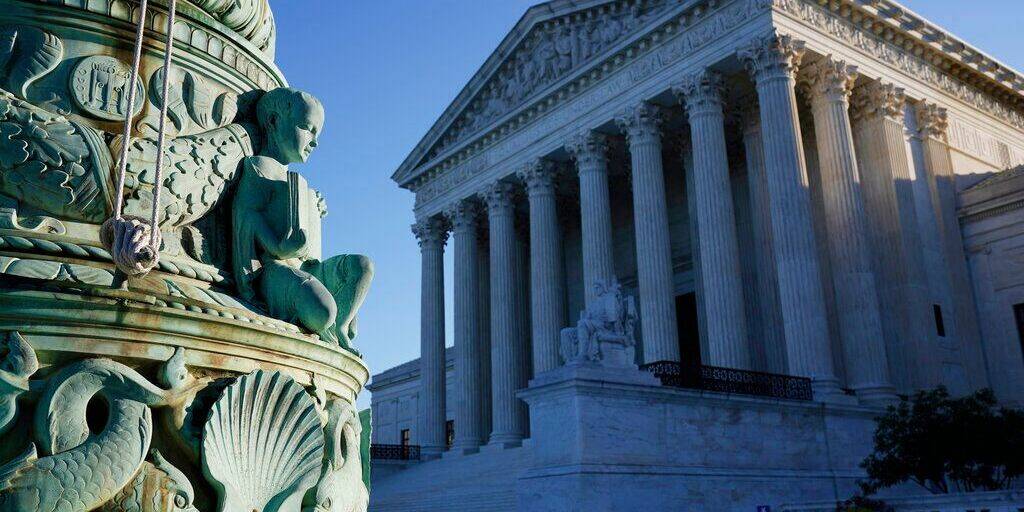
Former President Donald Trump asked the Supreme Court on January 3 to allow him to stay on the presidential primary ballot in Colorado, saying a state ruling banning him was unconstitutional, unfair, and based on a January 6 insurrection that his appeal said did not happen. The court filing, dominated by technical and procedural challenges to the Colorado Supreme Court ruling last month, does not ask the high court to weigh in on whether the former president indeed participated in an insurrection. The state’s highest court concluded that Trump indeed engaged in the January 6 insurrection effort and thus was banned from running under an obscure, Civil War-era clause in the Constitution’s 14th Amendment banning such a person from holding office.
Former President Donald Trump’s appeal, which experts expect the high court to consider, instead argues that the Colorado court had no business getting involved in the matter at all and that keeping Trump off the ballot would deprive voters of their right in a democracy to choose their leaders. The decision is “a ruling that, if allowed to stand, will mark the first time in the history of the US that the judiciary has prevented voters from casting ballots for the leading major-party presidential candidate,” said the court papers filed late Wednesday afternoon, two days before a deadline to appeal or get booted off the Colorado Republican Party primary ballot.
The Colorado court ruled in favor of six Republican and independent voters who said the “insurrection clause of the 14th Amendment to the Constitution makes Trump ineligible to hold office and thus, not qualified to be on the ballot. That clause, originally directed at Confederates, says no one can hold office who has previously taken an oath to support the Constitution but then engaged in an insurrection or provided help to enemies of the US.
Former President Donald Trump’s team, in their legal brief, argued that Congress gets to decide a candidate’s eligibility to serve as president. And while the appeal was specific to the Colorado case, it tacitly invited the high court to offer a ruling that applied nationwide. “It would be beyond absurdity” for the ballot question to be determined by 51 separate state and District of Columbia jurisdictions rather than federal courts, the brief said. “The election of the President of the United States is a national matter, with national implications, that arises solely under the federal Constitution and does not implicate the inherent or retained authority of the states.”
The brief said former President Donald Trump was never an “officer” of the US and that the oath he took as president was different than those taken by other public servants, meaning he was not subject to the ban on insurrectionists. Further, the court papers said, the clause merely says such an individual cannot serve – not that he or she can’t run for office. The term “insurrection” is unclear, the brief said, and anyway, his lawyers said, Trump did not engage in “insurrection.” “Trump never told his supporters to enter the Capitol, either in his speech at the Ellipse or in any of his statements or communications before or during the events at the Capitol,” the appeal said. “To the contrary, his only explicit instructions called for protesting “peacefully and patriotically” to “support our Capitol Police and Law Enforcement,” to “[s]tay peaceful” and to “remain peaceful.”
Jena Griswold, Colorado’s Democratic secretary of state, urged the high court to settle the matter. “Donald Trump just filed an appeal to the US Supreme Court to consider whether he is eligible to appear on Colorado’s Presidential Primary ballot. I urge the Court to consider this case as quickly as possible,” Griswold wrote on social media.
The appeal is virtually certain to be heard by a Supreme Court whose reputation as an unbiased arbiter has suffered immensely in recent years. Questions about ethical transgressions, along with the stunning 2022 reversal of the 1973 Roe v. Wade decision guaranteeing abortion rights, have turned the court, in the eyes of many Americans, into another partisan entity. The Trump case puts the court in an extremely uncomfortable position: No matter how it may rule, and no matter the legal arguments used to justify it, the decision is likely to cause a backlash from some political segments in deeply divided America. The high court was the target of criticism after its 2000 ruling that effectively made George W. Bush president. And while the justices may not want to enter that political fray again, competing decisions on the insurrection clause likely means the Supreme Court will have no choice but to get involved.
Justice Stephen Breyer will step down from the Supreme Court at the end of the current term, according to people familiar with his thinking. President Joe Biden and Breyer are scheduled to appear together at the White House on January 26 as the Supreme Court justice is set to announce his retirement, a source familiar with the matter confirmed to NBC News. Justice Breyer is one of the three remaining liberal justices, and his decision to retire after more than 27 years on the court allows Biden to appoint a successor who could serve for decades and, in the short term, maintain the current 6-3 split between conservative and liberal justices.
At 83, Justice Stephen Breyer is currently the court’s oldest member. Liberal activists have urged him for months to retire while Democrats hold both the White House and the Senate, a position that could change after the midterm elections in November. They contended that Justice Ruth Bader Ginsburg stayed too long despite her history of health problems and should have stepped down during the Obama administration. Ginsburg’s death from cancer at 87 allowed then-President Donald Trump to appoint her successor, Amy Coney Barrett, moving the court further to the right. An appointment by President Joe Biden could keep Breyer’s seat on the liberal side of the court for years or decades to come.
Erwin Chemerinsky, dean of the University of California Berkeley School of Law, urged Justice Stephen Breyer to retire in a Washington Post op-ed article in May, writing that there are times “when the stewards of our system must put the good of an institution they love, and of the country, they love, above their own interests. They have to recognize that no one, not even a brilliant justice, is irreplaceable and that the risks presented by remaining are more than hypothetical.” President Joe Biden promised on the campaign trail to nominate a Black woman to the court. In the wake of Breyer’s announcement, there was an outpouring of statements calling for him to follow through. The progressive group Demand Justice hired a truck last year to drive around Washington with the sign: “Breyer Retire. It’s time for a Black woman Supreme Court justice.” Among likely contenders are U.S. Circuit Judge Ketanji Brown Jackson of the Court of Appeals for the District of Columbia, a former Breyer law clerk; and Leondra Kruger, a justice on California’s Supreme Court.
Jackson, formerly a district court judge in Washington, was nominated by Biden to the U.S. Circuit Court and was confirmed by the Senate in mid-June on a 53-44 vote, including three Republicans. She succeeded Merrick Garland, who left the appeals court to become Biden’s attorney general.
Senator Patty Murray (D-WA), was among those who issued a statement soon after the news of Breyer’s impending retirement, calling on Biden to uphold his pledge to nominate a Black woman as the next justice. “The court should reflect the diversity of our country, and it is unacceptable that we have never in our nation’s history had a Black woman sit on the Supreme Court of the United States — I want to change that,” she said.
Senate Majority Whip Dick Durbin (D-IL) echoed those sentiments in a tweet, saying Biden has the opportunity to bring “diversity, experience, and an evenhanded approach to the administration of justice.”
Senate Majority Leader Chuck Schumer (D-NY) said President Joe Biden’s nominee will “receive a prompt hearing in the Senate Judiciary Committee, and will be considered and confirmed by the full United States Senate with all deliberate speed.” “America owes Justice Breyer an enormous debt of gratitude,” Schumer added. Republican Senator Lindsey Graham of South Carolina, who voted for Justices Sonia Sotomayor and Elena Kagan, said if Democrats “hang together,” as he expects, they will have the power to replace Breyer without one Republican vote. “Elections have consequences, and that is most evident when it comes to fulfilling vacancies on the Supreme Court,” Graham said in a statement.
Appointed by President Bill Clinton, Justice Stephen Breyer came to the Supreme Court in 1994 and became one of the court’s moderate-to-liberal members, though he often said it was misleading to label justices with such terms. Breyer believed that interpreting the Constitution should be based on practical considerations, changing with the times. That put him at odds with conservative justices who said the court must be guided by the original intent of the founders. “The reason that I do that is because law in general, I think, grows out of communities of people who have some problems they want to solve,” he said in an interview. Breyer wrote the court’s opinion striking down a state law that banned some late-term abortions in 2000 and dissented seven years later, when the Supreme Court upheld a similar federal law passed by Congress. He supported affirmative action and other civil rights measures. And in a widely noted dissent in 2015, he said the death penalty in America had become so arbitrary that it was probably unconstitutional.
The US Supreme Court on October 28 dealt setbacks to Republicans by allowing extended deadlines for receiving mail-in ballots in next Tuesday’s election in Pennsylvania and North Carolina, states pivotal to President Donald Trump’s re-election chances. With their new colleague, Amy Coney Barrett immediately recusing herself, the justices’ action means a September 17 ruling by Pennsylvania’s top court allowing mail-in ballots that are postmarked by Election Day and received up to three days later to be counted will remain in place for now. The Supreme Court already had rejected a prior Republican request to block the lower court ruling on October 19. This time, the justices opted not to fast-track their consideration of an appeal of the state court ruling by the Republican Party of Pennsylvania to hear and decide the case before the election. The conservative-majority court on October 28 also rejected a request by Trump’s campaign to block North Carolina’s extension of the deadline for receiving mail-in ballots, in another key battleground legal loss for Republicans.
Associate Justice Samuel Alito, joined by fellow conservatives Clarence Thomas and Neil Gorsuch, said in a written opinion that there is a “strong likelihood” that the Pennsylvania court’s decision violates the US Constitution, and it should be reviewed before the election. But I reluctantly conclude that there is not enough time at this late date to decide the question before the election,” Alito wrote. Pennsylvania Attorney General Josh Shapiro, a Democrat, in a statement urged voters to drop off mail ballots at drop boxes or county election offices in an effort to “stave off further anticipated legal challenges.” The Pennsylvania Supreme Court ruled in favor of the Pennsylvania Democratic Party and various Democratic officials and candidates who had asked for the court to protect voting rights during the Coronavirus pandemic. Democrats in the case also raised concerns about whether the US Postal Service, led by Louis Dejoy, an ally of President Donald Trump, would be able to handle the surge of ballots promptly.
On October 26, the conservative justices were in the majority when the Supreme Court on a 5-3 vote declined to extend mail-in voting deadlines sought by Democrats in Wisconsin. Despite their ruling on the Wisconsin mail-in balloting procedures, the conservative justices indicated they did not see the Pennsylvania matter as closed. They said the case could still be reviewed and decided relatively quickly. Pennsylvania officials have said that ballots arriving after Election Day will be kept separate from the other ballots “so that if the State Supreme Court’s decision is ultimately overturned, a targeted remedy will be available,” Associate Justice Samuel Alito wrote.
President Donald Trump’s fellow Republicans in many states have opposed measures to facilitate voting during the Coronavirus pandemic. The public health crisis has prompted an increase in mail-in ballot requests as voters seek to avoid crowds at polling places. In their earlier decision, the justices, shorthanded after the death of Justice Ruth Bader Ginsburg, were divided 4-4, leaving in place the state court ruling. Chief Justice John Roberts joined the three liberal justices in denying the request.
The US Supreme Court on October 13 turned away South Carolina’s bid to cut off public funding to Planned Parenthood, the latest case involving a conservative state seeking to deprive the women’s healthcare and abortion provider of government money. The justices declined to hear South Carolina’s appeal of a lower court ruling that prevented the state from blocking funding under the Medicaid program to Planned Parenthood South Atlantic, the organization’s regional affiliate. Planned Parenthood South Atlantic operates clinics in Charleston and Columbia, South Carolina, where it provides physical exams, cancer, and other health screenings, as well as abortions. Each year the clinics serve hundreds of patients who receive Medicaid, a government health insurance program for low-income Americans.
Numerous Republican-governed states have pursued direct and indirect restrictions involving abortion. Planned Parenthood often is targeted by anti-abortion activists. Planned Parenthood is the largest single provider of abortions in the US and also receives millions of dollars in public funding for other healthcare services. Planned Parenthood and Medicaid patient Julie Edwards sued the state’s Department of Health and Human Services in 2018 after officials ended the organization’s participation in the state Medicaid program. The state took the action after Governor Henry McMaster, a Republican, issued executive orders declaring that any abortion provider would be unqualified to provide family planning services and cutting off state funding to them. The state’s action forced Planned Parenthood to turn away Medicaid patients seeking healthcare services, according to a court filing. South Carolina already did not provide Medicaid reimbursements for abortion except in cases of rape, incest, or if the mother’s life was in danger, as required by federal law.
The Richmond, Virginia-based 4th US Circuit Court of Appeals blocked the state’s decision in 2019, saying that by ending Planned Parenthood’s Medicaid agreement for reasons unrelated to professional competency, the state violated Edwards’ right under the federal Medicaid Act to receive medical assistance from any institution that is “qualified to perform the service.” In appealing to the Supreme Court, the state’s health department said Medicaid recipients do not have a right to challenge a state’s determination that a specific provider is not qualified to provide certain medical services. The Supreme Court in 2018 rejected similar appeals by Louisiana and Kansas seeking to terminate Planned Parenthood’s Medicaid funding. At that time, three conservative justices, Clarence Thomas, Samuel Alito, and Neil Gorsuch, said the court should have heard the states’ appeals.
President Donald Trump announced September 26 that he will nominate federal appeals court Judge Amy Coney Barrett to the Supreme Court, a choice that would lock a conservative majority on the high court and that could help turn out Republican voters in the election less than six weeks away. Judge Barrett would fill the vacancy left by the death of Justice Ruth Bader Ginsburg, preserving the court’s gender balance of three women and six men while potentially tipping its ideological balance for decades. President Trump introduced Barrett in a Rose Garden ceremony attended by conservative activists, a reminder that shifting the Supreme Court to the ideological right has been a decades-long focus for Republicans.
“Amy Coney Barrett will decide cases based on the text of the Constitution as written,” President Donald Trump said, as the nominee stood beside him. “As Amy has said, being a judge takes courage. You are not there to decide cases as you may prefer. You are there to do your duty and to follow the law, wherever it may take you.” President Trump and Judge Barrett praised Ginsburg as a trailblazer, and Barrett said she would do the job of a justice “mindful of who came before me.” Their views and backgrounds could not be more different, however, as the deeply conservative Barrett made clear with a tribute to the late Antonin Scalia, the conservative jurist for whom she was a law clerk and who she said was her legal role model. “I have no illusions that the road ahead of me will be easy, either for the short term or the long haul. I never imagined that I would find myself in this position, but now that I am, I assure you that I will meet the challenge with both humility and courage,” Barrett said, adding that she looked forward to meeting with senators.
Judge Amy Coney Barrett is expected to be confirmed swiftly by the Republican-majority Senate and could be seated before the Presidential election, the resolution of which President Donald Trump has predicted could end up before the Supreme Court. Democrats, with little chance of derailing the nomination, say they are being steamrolled. Some in the party are refusing to meet with Barrett, while liberal activists are pushing Democratic lawmakers for more drastic moves such as boycotting the confirmation hearings. Senate Republicans were preparing to accelerate the confirmation process as soon as the announcement was made, with Senate Majority Leader Mitch McConnell (R-KY) planning to meet with Barrett on September 29, according to an aide. Senate Judiciary Committee Chairman Lindsey Graham (R-SC) confirmed in an interview with Fox News that the hearings for Barrett will begin October 12 with opening statements, with questions set to take place on October 13 and 14. There will be testimony from outside witnesses at some point, he said, and the committee process will begin October 15, meaning a panel vote on Barrett’s nomination could come as early as October 22 under Judiciary rules. “I expect they’re going to throw the kitchen sink at us,” Senate Majority Whip John Barrasso (R-WY), said in an interview. But he said he was confident Barrett would be confirmed before the election “if everything moves along smoothly.”
The prospect of conservative judges and a shift on the high court helped President Donald Trump, with few ideological lodestars, win over skeptical Republicans in 2016, and he has been unapologetic about using this surprise vacancy to further his chances for reelection. “Fill that seat” has been a featured chant at President Donald Trump’s political rallies over the past week, and his campaign is raising money with messages to supporters that tout the president’s Supreme Court pick. Republicans also started selling a T-shirt Saturday that appropriated Ginsburg’s pop-culture-inspired nickname, “Notorious RBG.” The shirts say “Notorious ACB.”
During the White House announcement, the election was not mentioned, nor was abortion, the issue on which many senators of both parties are likely to base their vote on Amy Coney Barrett. Democratic presidential nominee Joe Biden issued a statement on the nomination that focused on the Coronavirus and the Affordable Care Act’s future, which is back before the high court in the term that begins October 5. “She has a written track record of disagreeing with the U.S. Supreme Court’s decision upholding the Affordable Care Act” in 2012, Biden said, noting that Barrett had also criticized Chief Justice John Roberts for his deciding vote in that case.
The 16 days from Amy Barrett’s nomination to the start of her confirmation hearings would be the shortest in recent memory. Since 1990, it has taken an average of 50 days from a Supreme Court pick’s nomination to the start of his or her confirmation hearings, significantly shortcutting the time available for Senators to examine Barrett’s record, read through her writings, and to prepare questions for the hearings. Republican leaders are aiming for a final confirmation vote just days before Election Day, a goal they say is feasible in part because Barrett’s record and background were already scrutinized during her bitter 2017 confirmation to the federal bench. Democrats cited Senate Majority Leader Mitch McConnell’s 2016 refusal to hold hearings for President Barack Obama’s last Supreme Court nominee, Judge Merrick Garland, on the theory that voters in that year’s presidential election should have their say first. Senator McConnell has since reversed his opinion to say that Trump’s confirmation pick should go forward before the election.
Amy Coney Barrett is already well known to Republican senators, many of whom had hoped Trump would pick her for the next vacancy. When President Donald Trump said he would consider only women to fill Ginsburg’s seat, Barrett became the automatic favorite. President Trump said he considered five women, but Barrett is the only one he is known to have interviewed in person. Senate Majority Leader Mitch McConnell made known to Trump his preference for Barrett, since his ranks were the most familiar with her. Although her writings on precedent and personal antiabortion views could be a significant obstacle for Senators Susan Collins (R-ME) and Lisa Murkowski (R-AK), who support access to abortion, both have said they do not support holding a confirmation vote before the election anyway. That cleared the way for Trump and McConnell to push through the most conservative candidate possible. As he departed the White House for a Saturday night rally in Pennsylvania, Trump told reporters he did not discuss abortion with Barrett during their interview. “I never discussed that with Amy” and the court itself is “going to have to make that decision,” he said. At the rally, he said that “most important of all she will defend your God-given rights and freedoms.” People behind Trump wore MAGA hats and MAGA masks and held signs saying “Fill That Seat” and “Peaceful Protester.”
Here are the main events that occurred in Politics this week:
1. US Economy Adds Record 4.8 Million Jobs In June
According to data released on July 2, the US economy added 4.8 million jobs in the month of June.
The US economy added a record 4.8 million jobs in June, according to federal data released on July 2, but a surge in new Coronavirus infections and a spate of new closings threatens the nascent recovery. Two key federal measurements showed the precarious place the economy finds itself in three and a half months into the pandemic as the country struggles to hire back the more than 20 million workers who lost their jobs in March and April. While companies have continued to reopen, a large number of Americans are finding their jobs are no longer available. The unemployment rate in June was 11.1 percent, the Bureau of Labor Statistics said, down from a peak of 14.7 percent in April but still far above the 3.5 percent level notched in February. And another 1.4 million Americans applied for unemployment insurance for the first time last week and more than 19 million people are still receiving unemployment benefits, stubbornly high levels that show how many people are struggling to find or keep work. The Congressional Budget Office said the Coronavirus pandemic gave such a shock to the labor market that it would not fully recover for more than 10 years.
2. President Donald Trump Withdraws The US From The World Health Organization
President Donald Trump announced this week that the US would be withdrawing from the World Health Organization.
The US has formally notified the United Nations that it is withdrawing from the World Health Organization, following through on an announcement President Donald Trump made in late May. The move, however, would not be effective until July 6, 2021, officials said, leaving open the possibility that, should President Trump lose reelection, a Joe Biden administration could reverse the decision. The former vice president promptly indicated he would do so. “Americans are safer when America is engaged in strengthening global health. On my first day as President, I will rejoin the WHO and restore our leadership on the world stage,” Biden announced on Twitter.
Americans are safer when America is engaged in strengthening global health. On my first day as President, I will rejoin the @WHO and restore our leadership on the world stage. https://t.co/8uazVIgPZB
3. Supreme Court Rules In Favor of Trump Administration On Obamacare Birth Control Mandate
Supreme Court ruled in favor of the Trump Administration this week on its interpretation of the Obamacare birth control mandate.
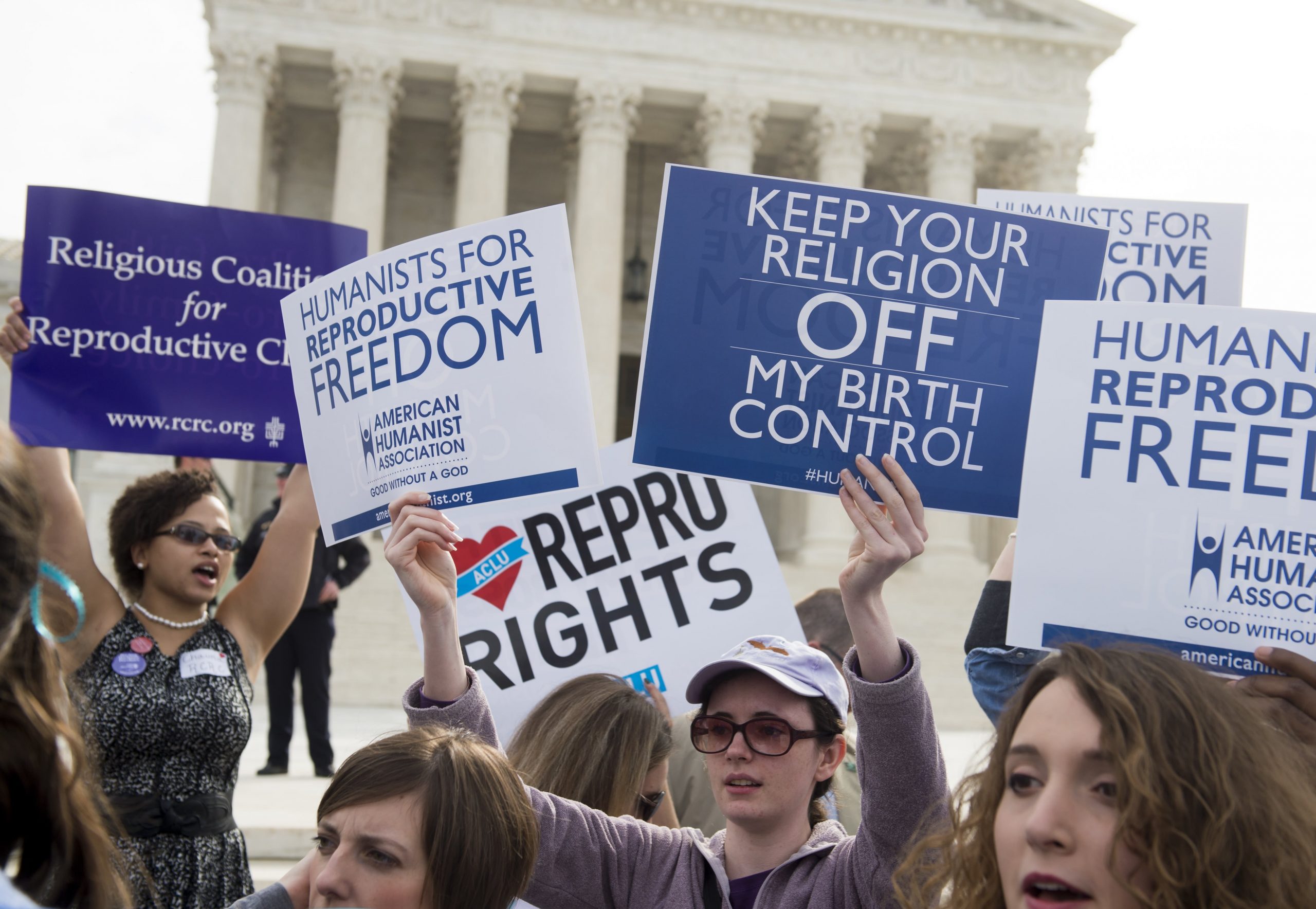
The Supreme Court ruled on July 8 that the Trump administration may allow employers and universities to opt-out of the Affordable Care Act requirement to provide contraceptive care because of religious or moral objections. The issue has been at the heart of an intense legal battle for nine years, first with the Obama administration sparring with religious organizations who said offering contraceptive care to their employees violated their beliefs, and then with the Trump administration broadening an exemption, angering women’s groups, health organizations, and Democratic-led states. July 8th’s decision greatly expands the ability of employers to claim the exception, and the government estimates that between 70,000 and 126,000 women could lose access to cost-free birth control as a result.
4. House of Representatives Passes Landmark $1.5 Trillion Infrastructure Reform Bill
The House or Representatives this week passed a landmark $1.5 trillion infrastructure package.
The House of Representatives on July 1 passed a $1.5 trillion infrastructure bill that would sharply increase spending on roads and transit, push for deep reductions in pollution, direct billions to water projects, affordable housing, broadband and schools, and upgrade hospitals and US Postal Service trucks. House Speaker Nancy Pelosi (D-CA) said Democrats were making good on a promise to rebuild America with “green, resilient, modern and job-creating infrastructure,” adding that the Moving Forward Act “shows that everything in our country is connected, from the education of our children to the technologies of the future to the road map to get there.” The bill is meant, in part, to address the expiration in September of a law authorizing spending on highways, transit, and other transportation programs. Backers, including Transportation Committee Chairman Peter DeFazio (D-OR), said the bill represents an ambitious, years-in-the-making push to buttress and expand aging infrastructure in a sustainable way. The bill’s passage “is proof that finally, there is a majority of us in Congress who won’t accept the status quo and instead are willing to fight for a new vision” that puts “millions of people to work in jobs that cannot be exported, while harnessing American-made materials, ingenuity, and innovation,” DeFazio said.
The Supreme Court ruled on July 8 that the Trump administration may allow employers and universities to opt-out of the Affordable Care Act requirement to provide contraceptive care because of religious or moral objections. The issue has been at the heart of an intense legal battle for nine years, first with the Obama administration sparring with religious organizations who said offering contraceptive care to their employees violated their beliefs, and then with the Trump administration broadening an exemption, angering women’s groups, health organizations, and Democratic-led states. July 8th’s decision greatly expands the ability of employers to claim the exception, and the government estimates that between 70,000 and 126,000 women could lose access to cost-free birth control as a result.
The contraceptive case involves a long-running dispute over the Affordable Care Act (colloquial known as “Obamacare“), and a requirement that employers provide cost-free birth control for female employees. The law itself does not specify the rules, leaving it to federal agencies to determine how contraceptives fit into the mandate for cost-free “preventive care and screenings.” The Obama administration required contraceptives and had narrower exceptions for churches and other houses of worship. It created a system of “accommodations,” or workarounds, for religiously affiliated organizations such as hospitals and universities. Those accommodations would provide contraceptive care but avoid having the objecting organizations directly cover the cost. The Trump administration moved in 2018 to expand the types of organizations that could opt-out to include religious groups and non-religious employers with moral and religious objections. Under the rules, the employers able to opt-out include essentially all nongovernmental workplaces, from small businesses to Fortune 500 companies. And the employer has the choice of whether to permit the workaround.
The US Court of Appeals for the 3rd Circuit had put the Trump administration exemptions on hold and said the agencies did not have the broad authority to grant them. Justice Clarence Thomas, who wrote the majority opinion, said that was wrong. “We hold that the [administration] had the authority to provide exemptions from the regulatory contraceptive requirements for employers with religious and conscientious objections,” wrote Thomas, who was joined by Chief Justice John Roberts and Justices Samuel Alito, Neil Gorsuch, and Brett Kavanaugh. Thomas reasoned that if an administration’s agencies have “virtually unbridled discretion to decide what counts as preventive care and screenings, he said, they must also have “the ability to identify and create exemptions” from those guidelines. Justices Elena Kagan and Stephen Breyer agreed with the court’s conservatives that the administration had the right to create an exemption, but they said lower courts should examine whether the administration’s rules were “consistent with reasoned judgment.” Justice Ruth Bader Ginsburg issued a blistering dissent, in which she said her colleagues had gone too far to appease religious conservatives. Until now, “this Court has taken a balanced approach, one that does not allow the religious beliefs of some to overwhelm the rights and interests of others who do not share those beliefs,” Ginsburg wrote in a brief joined by Justice Sonia Sotomayor. “Today, for the first time, the Court casts totally aside countervailing rights and interests in its zeal to secure religious rights to the nth degree.” Ginsburg said Congress meant to provide “gainfully employed women comprehensive, seamless, no-cost insurance coverage for preventive care protective of their health and wellbeing.” The court’s action, she wrote, “leaves women workers to fend for themselves, to seek contraceptive coverage from sources other than their employer’s insurer, and, absent another available source of funding, to pay for contraceptive services out of their own pockets.”
In a major rebuke to President Donald Trump, the US Supreme Court has blocked the Trump administration’s plan to dismantle a program implemented by President Barack Obama in 2012 that has protected 700,000 so-called DREAMers from deportation. The vote was 5-4, with Chief Justice John Roberts writing the opinion. Under the Obama-era program, qualified individuals brought to the US as children were given temporary legal status if they graduated from high school or were honorably discharged from the military, and if they passed a background check. Just months after taking office, President Trump moved to revoke the program, only to be blocked by lower courts, and now the Supreme Court. Roberts’ opinion for the court was a narrow but powerful rejection of the way the Trump administration went about trying to abolish the program known as Deferred Action for Childhood Arrivals, or DACA. “We do not decide whether DACA or its rescission are sound policies,” Roberts wrote. “The wisdom of those decisions is none of our concern. Here we address only whether the Administration complied with the procedural requirements in the law that insist on ‘a reasoned explanation for its action.’ “
In 2017, then-Attorney General Jeff Sessions simply declared DACA illegal and unconstitutional. “Such an open-ended circumvention of immigration laws was an unconstitutional exercise of authority by the executive branch,” he said at the time. Sessions argued that the program should be rescinded because he said it was unlawful from the start. But, as Chief Justice John Roberts observed, the Attorney General offered no detailed justifications for canceling DACA. Nor did the acting secretary of Homeland Security at the time, Elaine Duke, who put out a memo announcing the rescission of DACA that relied entirely on Sessions’ opinion that the program was unlawful. As Roberts noted, Duke’s memo did not address the fact that thousands of young people had come to rely on the program, emerging from the shadows to enroll in degree programs, embark on careers, start businesses, buy homes and even marry and have 200,000 children of their own who are US citizens, not to mention that DACA recipients pay $60 billion in taxes each year. None of these concerns are “dispositive,” Roberts said, but they have to be addressed. The fact that they were not addressed made the decision to rescind DACA “arbitrary and capricious,” he wrote. And none of the justifications the administration offered after the fact sufficed either, including a memo issued by then-Secretary of Homeland Security Kirstjen Nielsen. That memo, said Roberts, was essentially too little, too late. An agency must defend its action based on the reasons it gave at the time it acted, he said, instead of when the case is already in court.
Chief Justice John Roberts also made clear that an administration can rescind a program like DACA, and indeed immigration experts do not disagree with that conclusion. The problem for the administration was that it never wanted to take responsibility for abolishing DACA and instead sought to blame the Obama administration for what it called an “illegal and unconstitutional” program. The Chief Justice did not address that issue. Instead, says immigration law professor Lucas Guttentag, the justices in the majority seemed to be saying, “Why should the court be the bad guy” when the administration “won’t take responsibility” for rescinding DACA by explaining clearly what the policy justifications for the revocation are? Joining the Roberts opinion were the court’s four liberal justices, Ruth Bader Ginsburg, Stephen Breyer, Sonia Sotomayor, and Elena Kagan. Sotomayor wrote separately in a concurrence to say that while she agreed that rescinding DACA violated the law for the procedural reasons outlined by the Chief Justice, she would have allowed the litigants to return to the lower courts and make the case that rescinding DACA also amounted to unconstitutional discrimination. Justice Clarence Thomas wrote the principal dissent, accusing Roberts of writing a political rather than a legal opinion. Joining him were Justices Neil Gorsuch and Samuel Alito, with separate dissents also filed by Alito and Justice Brett Kavanaugh.
In a Twitter post, President Donald Trump blasted the decision as one of the “horrible & politically charged decisions coming out of the Supreme Court.” President Trump also asked the question of if “Do you get the impression that the Supreme Court doesn’t like me?” Former Vice President Joe Biden, the presumptive Democratic nominee, on the other hand, celebrated the decision, saying in a statement, “The Supreme Court’s ruling today is a victory made possible by the courage and resilience of hundreds of thousands of DACA recipients who bravely stood up and refused to be ignored.” In an interview with NPR, Ken Cuccinelli, the Trump administration senior official who oversees immigration and citizenship at the Department of Homeland Security, said President Trump is considering his options. “I do expect you will see some action out of the administration,” he said, adding: “He is not a man who sits on his hands.”
These horrible & politically charged decisions coming out of the Supreme Court are shotgun blasts into the face of people that are proud to call themselves Republicans or Conservatives. We need more Justices or we will lose our 2nd. Amendment & everything else. Vote Trump 2020!
While the decision gives DACA and its hundreds of thousands of recipients a lifeline, the issue is far from settled. The court decided that the way President Donald Trump went about canceling DACA was illegal, but all the justices seemed to agree that the president does have the authority to cancel the program if done properly. As for the immediate future of DACA, the consensus among immigration experts is that there is not enough time for President Donald Trump to try again to abolish the program before January. Cornell Law School professor Stephen Yale-Loehr, the author of a 21-volume treatise on immigration law, says, “It’s not remotely possible before the election. But if [Trump] is reelected, he almost certainly will try again” to cancel DACA. For now, though, more individuals eligible for DACA status may be able to apply. Marisol Orihuela, co-director of the Worker & Immigrant Rights Advocacy Clinic at Yale Law School, notes that the administration has refused to accept new applications since 2017. But she thinks that will change now. “Our understanding is that the program is restored to what it was in 2012 when it went into effect,” she says. Guttentag, who teaches immigration law at Yale and Stanford University, says if President Trump is not reelected, a new administration could repair “much of the damage” that he says has been inflicted on immigrants during the Trump administration. But, he adds that the immigration system is “completely shattered” and needs “fundamental reform.”
Federal civil rights law protects gay, lesbian and transgender workers, the Supreme Court ruled on June 14. The landmark ruling will extend protections to millions of workers nationwide and is a defeat for the Trump administration, which argued that Title VII of the Civil Rights Act of 1964 that bars discrimination based on sex did not extend to claims of gender identity and sexual orientation. The 6-3 opinion was written by Justice Neil Gorsuch, President Donald Trump’s first Supreme Court nominee, and joined by Chief Justice John Roberts and the court’s four liberal justices. “An employer who fires an individual for being homosexual or transgender fires that person for traits or actions it would not have questioned in members of a different sex. Sex plays a necessary and undisguisable role in the decision, exactly what Title VII forbids,” Gorsuch wrote. “There is simply no escaping the role intent plays here: Just as sex is necessarily a but-for cause when an employer discriminates against homosexual or transgender employees, an employer who discriminates on these grounds inescapably intends to rely on sex in its decisionmaking,” the opinion read.
Speaking at a press conference, President Donald Trump called the decision “very powerful” and acknowledged it was surprising to some. “They’ve ruled and we live with the decision,” Trump said. “We live with the decision of the Supreme Court.” Presumptive Democratic Presidential nominee Joe Biden called the ruling “a momentous step forward for our country.” “The Supreme Court has confirmed the simple but profoundly American idea that every human being should be treated with respect and dignity. That everyone should be able to live openly, proudly, as their true selves without fear,” Biden said. Justice Samuel Alito, one of the court’s conservatives, wrote in his dissent that “even if discrimination based on sexual orientation or gender identity could be squeezed into some arcane understanding of sex discrimination, the context in which Title VII was enacted would tell us that this is not what the statute’s terms were understood to mean at that time.” Meanwhile, Justice Brett Kavanaugh, President Donald Trump’s second Supreme court appointee, acknowledged the social and political progress achieved by members of the LGBTQ community, but nonetheless dissented. “They have advanced powerful policy arguments and can take pride in today’s result. Under the Constitution’s separation of powers, however, I believe that it was Congress’s role, not this Court’s, to amend Title VII. I therefore must respectfully dissent from the Court’s judgment,” Kavanaugh wrote.
A number of LGBTQ groups celebrated the court’s ruling, including the Human Rights Campaign, whose president, Alphonso David, said in a tweet that the decision is a “landmark victory for #LGBTQ equality.” Sarah Kate Ellis, the president of the LGBTQ advocacy group GLAAD, said in a statement that the decision “is a step towards affirming the dignity of transgender people, and all LGBTQ people.” But the ruling was also sharply criticized by the conservative Judicial Crisis Network, whose president issued a blistering statement about Justice Neil Gorsuch, who replaced the late Justice Antonin Scalia. “Justice Scalia would be disappointed that his successor has bungled textualism so badly today, for the sake of appealing to college campuses and editorial boards,” said Carrie Severino, a former clerk of Justice Clarence Thomas. “This was not judging, this was legislating — a brute force attack on our constitutional system.” Gorsuch grounded his opinion in the plain text of the law. He acknowledged that when the law was passed, Congress may not have been thinking of gay, lesbian and transgender rights. The conservative justice said Congress might not have “anticipated their work would lead to this particular result,” but, he said, the “express terms of the statute give us one answer.” “Only the written word is the law, and all persons are entitled to its benefit,” he wrote in the ruling.
Huge news: #SCOTUS affirms that sexual orientation and gender identity discrimination are prohibited under Title VII of the Civil Rights Act. This is a landmark victory for #LGBTQ equality.
The court’s ruling was on separate cases: one concerning whether the law encompasses claims of sexual orientation brought by Gerald Bostock, and the estate of Donald Zarda, and the other concerning a transgender woman, Aimee Stephens, whose challenge marked the first time the court heard arguments regarding the civil rights of a transgender individual. Stephens, who died in May, mustered the courage back in 2013 to tell her co-workers about something that she had struggled with her entire life: her gender identity. Not long after, she was fired as the director of a funeral home. Stephens’ former boss, Thomas Rost, testified in the lower court that she was fired because she was “no longer going to represent himself as a man.” A lower court ruled in her favor, holding it is “analytically impossible to fire an employee based on that employee’s status as a transgender person without being motivated, at least in part, by the employee’s sex.” Aimee Stephens’ wife, Donna Stephens, also welcomed the court’s ruling, saying in a statement that Aimee was “a leader who fought against discrimination against transgender people.” “I am grateful for this victory to honor the legacy of Aimee, and to ensure people are treated fairly regardless of their sexual orientation or gender identity,” Donna Stephens said.
Here are the main political events that occurred throughout the past year. From Trump’s bizarre antics to foreign policy triumphs and tragedy to political scandals at the highest levels of government, 2018 was an exciting and unforgettable year in the realm of Politics.
January
New Infrastructure Bill and a Renewed Nuclear Arms Race
#Infrastructure
President Trump proposed an ambitious infrastructure reform bill meant to help the US regain a competitive advantage when compared to emerging economies throughout the world.
January 2018 got off to an interesting start in terms of political developments. Shortly before his January 30 “State of the Union Address,” President Donald Trump proposed an ambitious $1.5 trillion infrastructure bill with the goal of modernizing the American economy and allowing it to maintain a competitive advantage with rising global powers such as Russia, China, Iran, India, and South Korea. “America is a nation of builders, We built the Empire State Building in just one year. Isn’t it a disgrace that it can now take 10 years just to get a permit approved for a simple road?” said Trump shortly after announcing the proposal. Thus far, Congress has not moved to push forward the proposal, though it is likely that the House of Representatives (which is under Democratic control as of January of 2019) may take action on the proposal sometime next year.
#Nuclearweapons
Defense Secretary Jmaes Mattis announced major changes to the US nuclear policy in a report issued at the end of January.
Much to the dismay of disarmament advocates and activists in the peace movement, the Trump Administration announced an aggressive nuclear weapons strategy at the end of January. The new policy, as announced by Defense Secretary James Mattis, called for the introduction of “low-yield nuclear weapons” on submarine-launched ballistic missiles and the development of nuclear submarine-launched cruise missiles. Despite being called “low-yield” these new weapons could potentially cause as much damage as the nuclear bombs dropped by the US on the Japanese cities of Hiroshima and Nagasaki in 1945. The main point of this change in policy, according to the Trump Administration, is to pressure US rivals such as Russia, China, Iran, and North Korea into giving in to US demands in terms of both their internal and external policies. This policy may also trigger a renewed nuclear arms race and increase the risk of a nuclear war to a level even higher than it was during the peak of the Cold War (1955-1962).
February
School Shootings & New Presidential Historian Rankings
#TragetyInFlorida
A school shooting in a Florida high school on February 14 resulted in the deaths of 17 individuals and renewed public debate over the issue of gun control.
On February 14, a mass shooting occurred at Marjory Stoneman Douglas High School in Parkland, Florida. 17 people were killed and 15 were wounded, making it one of the deadliest school massacres since Columbine some 19 years earlier. The shooting was carried out by Nikolas Jacob Cruz, a 19-year old high school senior with a known past of threatening his fellow students, posting hate content on his social media accounts, and bragging about killing animals. Additionally, Cruz holds extremist views and advocated the killing of African-Americans, Hispanic-Americans, Muslim-Americans, and the LGBT community. Politicians on both sides of the political aisle have condemned the shooting and reached out to the victims. Bith President Donald Trump and Florida Governor Rick Scott immediately expressed strong support for the victims and their families and called for an end to school shootings. The shooting also renewed public debate over the issue of gun control. For example, student survivors organized the group Never Again MSD to demand legislative action to prevent similar shootings from occurring again and to call out US lawmakers (mostly Republicans, but a few Democrats as well) who have received campaign contributions from the National Rifle Association (NRA).
#Bottomranked?
According to the most recent rankings by the American Political Science Association, President Donald Trump now ranks as the worst President in US History.
On February 19, the most recent Presidential historical rankings were released by the American Political Science Association. The new rankings, to the surprise of none, place Donald Trump at the very bottom of the list (below even the infamous James Buchanan). Additionally, the rankings place Barack Obama as the eight greatest President in US history, one place above Ronald Reagan and one spot below Dwight Eisenhower. Despite their low ranking of Trump, the authors of the study do indicate that Trump has plenty of time to improve his ranking considering that he has more than two years left in his first term.
March
Trump Cabinet Shake-ups & Growing Protests in the Gaza Strip
#Tillerson
President Donald Trump dismissed Secretary of State Rex Tillerson amid a declining relationship and a disappointing tenure.
On March 13, President Donald Trump announced that he has fired Secretary of State Rex Tillerson and nominated CIA Director Mike Pompeo to succeed him. Tillerson’s departure followed months of tension between him and Trump. President Trump publicly undercut Secretary Tillerson’s diplomatic initiatives numerous times since he came to office over a year ago. For example, President Trump criticized Tillerson’s positions on Iran, the European Union, NATO, and Russia. For Tillerson’s replacement, President Donald Trump named CIA Director Mike Pompeo and moved up Gina Haspel to the post of CIA director. In a Twitter post, Trump stated that “Mike Pompeo, Director of the CIA, will become our new Secretary of State. He will do a fantastic job! Thank you to Rex Tillerson for his service! Gina Haspel will become the new Director of the CIA, and the first woman so chosen. Congratulations to all!” Despite the optimistic tone of President Trump regarding these changes, they point to an Executive Branch in continual flux and crisis.
#Gaza
Major protests broke out in the Gaza Strip at the end of march due to Israel’s ongoing blockade of the territory.
On March 30, tens of thousands of Palestinians in the Gaza Strip participated in non-violent protests as part of the Great Return March. Palestinian participants soon began walking towards the fence that separates the strip from Israel and were met with live fire from the Israeli military that saw hundreds of people injured and 16 killed. The protests were held to commemorate Land Day and demonstrate for the rights of Palestinian refugees to be resettled in Israel. Israeli Prime Minister Benjamin Netanyahu and Defense Secretary Avigdor Lieberman responded to the protests by claiming that Hamas, which has controlled Gaza since 2007, had sent women and children to the fence as human shields. The Israeli response drew widespread criticism around the world, with UN Secretary-General Antonio Guterres calling for an independent inquiry into Friday’s events. Additionally, several countries in the Middle East condemned the response to the protests by the Israeli government. Perhaps the country that most forcefully condemned the actions of Israel was Iran. In a Twitter post on March 31, Iranian Foreign Minister Mohammed Javad Zarif stated that “On the eve of Passover (of all days), which commemorates God liberating Prophet Moses and his people from tyranny, Zionist tyrants murder peaceful Palestinian protesters – whose land they have stolen – as they march to escape their cruel and inhuman apartheid bondage.” On the other hand, the US blocked a UN Resolution denouncing the Israeli response and placed the blame squarely on the part of the Palestinian protestors.
April
Tensions in Syria & Growing Support for Marijuana Legalization
#Syria #ChemicalWeapons
The US and several of its European allies launched airstrikes in Syria in response to allegations of chemical weapons use by the Assad government.
The US and several of its allies launched airstrikes on April 13 against several Syrian military targets in response to a supposed chemical attack near Damascus ordered last week by Syrian President Bashar al-Assad that killed nearly 40 people. These are not the actions of a man, they are crimes of a monster instead,” President Trump said of Assad’s presumed chemical attack in an oval office address. The operations carried out by the US, UK, and France in Syria were somewhat limited than originally anticipated. The main target in the operation was the Barzah Research and Development Center, a scientific research center located outside of Damascus. The facility was hit with 76 missiles, utterly destroying the facility and setting back the Syrian chemical weapons program back at least several years according to Secretary of Defense James Mattis. The international reaction to the US strike in Syria was mixed overall. Several US allies in the Middle East such as Saudi Arabia and Israel applauded the strike and pledged to expand their support for regime change in Syria. On the other hand, Russia, Iran, China, as well as several socio-political organizations active in the Middle East such as Hezbollah, Hamas, and the Houthi Movement forcefully condemned the strikes.
#MarijuanaLegalization
President Donald Trump announced his approval for efforts to protect the rights of states that have already legalized marijuana, shifting away from his “law-and-order” image.
Previously a strong opponent of Marijuana legalization, President Donald Trump also took an interesting turn regarding this policy issue in April. Senator Cory Gardner (R-CO), a strong supporter of efforts at the state level to legalize marijuana, said on April 13 that President Trump made the pledge to him in a conversation two days earlier. White House Press Secretary Sarah Huckabee Sanders said Gardner’s account was accurate and the president supported states’ rights in the matter. Senator Cory Gardner has been pushing to reverse a decision made by Attorney General Jeff Sessions in January that removed prohibitions that kept federal prosecutors from pursuing cases against people who were following pot laws in states such as Colorado that have legalized the drug. “President Trump has assured me that he will support a federalism-based legislative solution to fix this states’ rights issue once and for all,” Gardner said in a statement to the press. Additionally, Gardner pledged to introduce bipartisan legislation keeping the federal government from interfering in state marijuana markets.
May
US Withdraws from Iranian Nuclear Deal & Renewed Social Conservatism
#JCPOA
President Donald Trump controversially withdrew from the 2015 Iranian Nuclear deal on May 8.
On May 8, President Donald Trump pulled the plug on the Iranian nuclear agreement, saying that the Iranian government has failed to live up to its obligations and violated the spirit of the accord. Yet since no tangible evidence that was presented, the unilateral decision places the US in violation of the treaty and subject to international scorn. Despite withdrawing from the agreement, the Trump Administration announced that it would be willing to renegotiate a “tougher, more comprehensive deal” with Iran. President Donald Trump proposed that any new agreement with Iran would include indefinite restrictions on Iran’s nuclear program (the original agreement only lasted 15 years and became noticeably less strong after the first 10 years), as well as restrictions on Iran’s ballistic missile program. Additionally, the Trump Administration stated that a new agreement would also limit Iran’s foreign policy and their humanitarian efforts to defend both the Shi’a Muslims of Syria, Iraq, Lebanon, Yemen, Afghanistan, and Pakistan, as well as the Palestinian people. In response to Iran agreeing to these new provisions, the Trump Administration would remove all sanctions against the Iranian government, restart diplomatic ties, and work to modernize the Iranian economy.
#Abortion #SocialConservatism
Iowa Governor and staunch Trump ally Kim Reynold signed into law the nations strictest anti-abortion bill on May 4.
On May 4, Iowa Governor Kim Reynolds (a devout Catholic and strong supporter of President Donald Trump) signed a law banning most abortions if a fetal heartbeat can be detected, or at around six weeks of pregnancy, marking the strictest abortion regulation in the nation. The Republican governor signed the legislation in her formal office at the state Capitol as protesters gathered outside chanting, “My body, my choice!” Reynolds acknowledged that the new law would likely face litigation, but said that “This is bigger than just a law, this is about life, and I’m not going to back down.” The ban has propelled Iowa to the front of a push among conservative statehouses jockeying to enact restrictive regulations on the medical procedure. Backers of the legislation hope it could challenge Roe vs. Wade, the landmark 1973 Supreme Court ruling that established women have a right to terminate pregnancies until a fetus is viable. Critics argued the bill would ban abortions before some women even know they are pregnant, which will likely set up Iowa for a legal challenge.
June
Peace Between the US & North Korea?, Scientific Discoveries, & Another Trumpcastrophe
#Trump #KimJonUn #Rocketman
President Donald Trump and North Korean President Kim Jong-un held their historic summit meeting on June 12.
On June 12, US President Donald Trump and North Korean leader Kim Jong-un attended a historic summit meeting in Sentosa, Singapore. This meeting was notable in that it was the first meeting between the leaders of the US and North Korea. In their meeting, both President Trump and Kim -Jong-un signed a joint statement agreeing to security guarantees for North Korea, new peaceful relations, the denuclearization of the Korean Peninsula, recovery of soldiers’ remains, and follow-up negotiations between high-level officials. After nearly seven decades of US aggression towards North Korea and provocative statements on the part of President Trump, this meeting may signal a new chapter in US-North Korea relations and may bring about a just and lasting peace in the Korean Penninsula
#Mars #AncientAliens #NASA
NASA Finds Ancient Organic Material, possibly linked to life, on the Martian surface.
On June 7, the US space agency (NASA) says its Mars exploration vehicle has discovered chemical substances necessary for life. Scientists reported that NASA’s Curiosity Rover found large amounts of organic molecules in a thousands-year-old rock in an area called the Gale Crater. The area on Mars is believed to have once contained a large lake that evaporated due to some unknown cataclysm a millennia ago. The discovery of organic molecules suggests that ancient conditions on Mars may have supported life. Ashwin Vasavada a scientist working on the Curiosity project stated that the chances of being able to find signs of ancient life (perhaps even remnants of a humanoid civilization that existed millions of years ago) with future missions “just went up.” Additionally, Jennifer Eigenbrode (an astrobiologist with NASA’s Goddard Space Flight Center) noted that there is a strong possibility that the organic molecules were, in fact, created by some form of ancient life on the Martian surface. The impact of these findings is significant because it may result in increased funding for space programs such as NASA, as well as higher levels of support for space exploration efforts. Currently, the total budget for NASA represents less than 0.5% of the federal budget and an overwhelming majority of Americans today feel that the federal government spends far too much on space exploration and that the money would be better spent on education, public health, and developing alternative energy sources. The discovery of the potential of life on Mars might create the perception in the eyes of the American people that further space research and exploration is worth it and that the federal government should rethink its priorities to make such efforts a reality
#Trumpism
In his second G7 conference as President, Donald Trump and his erratic policies decrease certainty in the future role of the US in the eyes of European leaders.
In his second G7 Summit since assuming office, President Donald Trump alienated the closest allies of the US at the annual summit of the group in Canada with his aggressive trade declarations and a surprising suggestion that Russia should be readmitted to the exclusive club of major economic powers. After leaving early, President Trump went on Twitter to blow up the agreement forged at the meeting. Trump exited the Quebec resort on June 9 where the group had gathered, leaving other world leaders whipsawed and uncertain about their future relationship with the US, to head to Singapore for a summit with North Korean leader Kim Jong Un on Tuesday. Trump’s actions added to the anxiety of longtime US allies, who are alarmed to see him lashing out against them while he is advocating for Russian President Vladimir Putin and cozying up to North Korea. Most political observers feel that the G7 summit ended in abject failure and only served to highlight the ideological and political divisions between Trump and Western allies and fueled fears that the most successful alliance in history is beginning to erode. “What worries me most, however, is the fact that the rules-based international order is being challenged, quite surprisingly not by the usual suspects but by its main architect and guarantor, the US,” said Donald Tusk, the president of the European Council.
PM Justin Trudeau of Canada acted so meek and mild during our @G7 meetings only to give a news conference after I left saying that, “US Tariffs were kind of insulting” and he “will not be pushed around.” Very dishonest & weak. Our Tariffs are in response to his of 270% on dairy!
A New Supreme Court Justice & the Putin-Trump Bromance Continues
#Kavanaugh #SupremeCourt
President Donald Trump announced his selection of Brett Kavanaugh to the Supreme Court this week.
In a prime-time address on July 9, President Donald Trump nominated Judge Brett M. Kavanaugh of the United States Court of Appeals for the District of Columbia Circuit to fill Justice Anthony M. Kennedy’s seat on the Supreme Court. Presenting Judge Kavanaugh at the White House, President Trump described him as “one of the finest and sharpest legal minds in our time,” and stated that he is a jurist who would set aside his political views and apply the Constitution “as written.” Kavanaugh was selected from a list of “25 highly qualified potential nominees” considered by the Trump Administration. The main reasons cited by President Trump for the nomination of Kavanaugh included his “impeccable credentials, unsurpassed qualifications, and a proven commitment to equal justice under the law” with the emphasis that “what matters is not a judge’s political views, but whether they can set aside those views to do what the law and the Constitution require.” In his remarks, Judge Kavanaugh, who once clerked for Justice Kennedy, said he would “keep an open mind in every case.” But he declared that judges “must interpret the law, not make the law.”
#Putin #Trump
President Donald Trump met with Russian President Vladimir Putin in a controversial summit in Finland.
Amid chaos following his bizarre antics at the June G-7 Summit and the ongoing investigations into allegations that the Russian government colluded with his 2016 Presidential campaign, President Donald Trump met with Russian President Vladimir in Helinski, Finland on July 16 in their first-ever summit meeting. The summit marked the first official meeting between the leaders after previous unofficial talks between Trump and Putin at the 2017 G20 conference in Vienna. In addition to meeting with Putin, Trump also met the Finnish President Sauli Niinistö in the Presidential Palace. Some of the topics Trump pledged to discuss with Putin include the ongoing Syrian Civil War, the tensions between Russia and Ukraine, the steadily declining relationship between the US and Iran, and measures to reduce the threat of nuclear war between the US and Russia.
August
Environmental Policy Changes & A Death of Moderate Republicanism
#McCain
Senator and 2008 Republican nominee John McCain died on August 25 after being diagnosed with an incurable form of cancer one year ago.
John McCain, who endured six years as a prisoner of war in Vietnam before becoming the 2008 Republican presidential nominee and serving Arizona for nearly 36 years in Congress, died On August 25 at age 81. Destined to be remembered among the political giants of American history, McCain disclosed in July 2017 that he had been diagnosed with a deadly form of brain cancer called glioblastoma. McCain was a two-time presidential candidate, losing the GOP nomination in 2000 to then-Texas Gov. George W. Bush and the general election in 2008 to Barack Obama. Despite the fact that he generally aligned with Neoconservatives on foreign policy and called for increased US military intervention in the Middle East, John McCain developed a reputation as a moderate Republican overall and as a strong opponent of the Truman Administration. Despite the fact that politicians on both sides of the aisle praised Senator McCain and his accomplishments, President Donald Trump had a muted reaction to McCain’s death, refusing to issue a statement praising McCain’s life and opting to not fly the flag at half-staff (which is the typical custom of the President to do when a member of Congress dies in office) in honor of McCain.
"Some lives are so vivid, it is difficult to imagine them ended. Some voices are so vibrant, it is hard to think of them stilled. John McCain was a man of deep conviction and a patriot of the highest order.” […] Full statement by President George W. Bush https://t.co/FQVYWIUyGLpic.twitter.com/W8LCxJXRLi
— George W. Bush Presidential Center (@TheBushCenter) August 26, 2018
#Environmentalism
President Donald Trump announced his intention to roll-back the “Clean Power Plan,” as well as other Obama-era environmental regulations.
On August 21, the Trump administration revealed a plan to scale back an Obama-era rule designed to cut planet-warming emissions from the nation’s power plants. The proposal from the Environmental Protection Agency will reportedly hand authority to states to create their own rules for coal-fired power plants. That would give states the option to impose looser restrictions that allow utilities to emit more greenhouse gases like carbon dioxide and other pollutants — or to defer taking any action. The measure also stands to relieve pressure on the coal industry, a sector President Donald Trump has vowed to revive. Coal miners have seen their fortunes fade as coal-fired plants retire ahead of schedule, under pressure from cheap natural gas and falling prices for renewable energy projects.
More stringent regulations implemented in 2015 by former President Barack Obama put stress on the coal industry by requiring power plants to undertake expensive upgrades or shut down. President Obama’s signature Clean Power Plan established the first nationwide rules for carbon emissions. It set emissions goals for each state and gave them many options to reduce climate pollution, with the goal of cutting the nation’s emissions by 32 percent below 2005 levels. The new plan from the Trump Administration does not set a hard goal for nationwide emissions reductions, according to reports. It is projected to allow 12 times more greenhouse gas to be emitted over the next decade than under the Clean Power Plan and asks states to focus on requiring coal plants to take steps to run more efficiently. In contrast, the Clean Power Plan allowed states to meet their goals by taking measures that would push coal out of the energy mix, including adding more solar and wind farms or converting coal plants to natural gas facilities. The Trump plan would also give states a chance to forgo creating any new rules by allowing them to explain why they do not need to take action. It is possible that several states (namely Ohio, Kentucky, West Virginia, Tennessee, Missouri, Louisiana, and Arkansas) could pursue that option, given significant opposition to Obama’s plan.
September
A Supreme Court Showdown & More Trumpisms
#Kavanaugh #SupremeCourt
Sexual assault allegations against Supreme Court nominee Brett Kavanaugh were revealed early in September.
What was expected to be a relatively easy confirmation hearing for Brett Kavanaugh took an interesting turn in September with the revelation that Kavanaugh sexually assaulted Christine Blasey Ford, currently a Palo Alto University Psychology professor back when they were in high school in the 1980s. On September 16, Ford went public with her allegation of sexual misconduct on Supreme Court nominee Brett Kavanaugh. Brett Kavanaugh immediately denied the allegations, stating that”he had never done anything like what the accuser describes — to her or to anyone. Because this never happened, I had no idea who was making this accusation until she identified herself yesterday. I am willing to talk to the Senate Judiciary Committee in any way the Committee deems appropriate to refute this false allegation, from 36 years ago, and defend my integrity.” Despite the serious allegations against him, Judge Kavanaugh was ultimately confirmed by the Senate by a close 51-49 vote on September 28, with all Republicans except Lisa Murkowski voting in favor, and all Democrats except the arch-conservative Joe Manchin voting against Kavanaugh.
#Trumped
President Donald Trump delivers a speech to the United Nations General Assembly.
In his September 25 speech at the UN General Assembly, US President Donald Trump urged all the other nations to reject globalism and embrace nationalism while he was interrupted by derisive laughter from other world leaders. Over the course of the bombastic address, Trump highlighted the (imaginary) achievements of his presidency, lashed out at enemies, Iran foremost among them, and railed against multilateralism in its spiritual home, the UN general assembly. In one of the more remarkable moments in the history of the annual UN summit, the chamber broke out in spontaneous laughter at Trump’s claim that “in less than two years, my administration has accomplished more than almost any administration in the history of our country.” Clearly taken aback, Trump said: “I didn’t expect that reaction, but that’s OK.”
Overall the international community has reacted negatively to President Donald Trump’s speech, noting that its tone and theme of the address are in direct contradiction to the core values that the United Nations had promoted since its founding nearly 75 years ago. In response to the speech, UN secretary general António Guterres said President Trump’s fiery rhetoric shows that “democratic principles are under siege” throughout the world. Additionally, French President Emmanuel Macron denounced the spread of global lawlessness, “in which everyone pursues their interest,” and noted that the policies of President Trump are partially to blame for this troubling trend. On the other hand, the governments of Russia, Israel, and Saudi Arabia have praised President Trump, arguing that his speech was a “very welcoming statement.”
October
Political Violence & Turmoil in Saudi Arabia
#Khashoggi
Jamal Khashoggi, a major Saudi dissdent, was assassinated by the Saudi government on Turkish soil on October 2, revealing the brutal face of Saudi Arabia.
On October 2, Jamal Khashoggi, a dissident Saudi Journalist for the Washington Post, was assassinated at the Saudi consulate in Turkey by agents employed by Mohammed bin Salman, the current Crown Prince of Saudi Arabia. Known as a strong critic of the current government of Saudi Arabia, Khashoggi developed a reputation as an opponent of Zionism and the Israeli government, a critic of the ongoing Saudi War in Yemen, and a critic of the oppression of Shi’a Muslims by the Saudi government. These actions made him a prime target to be eliminated by the Saudi government. The international community generally reacted negatively to the assassination of Jamal Khashoggi, although US President Donald Trump and Israeli Prime Minister Benjamin Netanyahu implicitly praised the Saudi government for carrying out his assassination and stated that Khashoggi was a “Muslim Brotherhood operative, a pro-jihad, pro-Iranian, pro–[Tayyip] Erdoğan Jew-hater. A supporter of Iran. Basically, he died as a warrior on the wrong side of the war on terror.” Despite the lack of punishment by the international community for their crime, the assassination of Khashoggi did raise some doubts regarding the human rights record of Saudi Arabia.
#Pittsburgh
A Pittsburgh-area synagogue was the site of one of the worst religiously-motivated mass shootings in US history on October 27.
Armed with an AR-15-style assault rifle and at least three handguns, a man shouting anti-Semitic slurs opened fire inside a Pittsburgh synagogue on October 27, killing at least 11 congregants and wounding four police officers and two others. The public reaction to the Pittsburgh synagogue shooting was one of condemnation. Calling it the “most horrific crime scene” he had seen in 22 years with the FBI, Robert Jones, special agent in charge in Pittsburgh, said the synagogue was in the midst of a “peaceful service” when congregants were gunned down and “brutally murdered by a gunman targeting them simply because of their faith.” “We simply cannot accept this violence as a normal part of American life,” said Pennsylvania governor Tom Wolf in a news conference in Pittsburgh shortly after the incident occurred. “These senseless acts of violence are not who we are as Pennsylvanians and are not who we are as Americans.” Additionally, President Donald Trump similarly condemned the shooting, stating that “It’s a terrible, terrible thing what’s going on with hate in our country and frankly all over the world, and something has to be done.”
November
Midterm Election Shake-up
#CongressionalChanges
The 2018 midterm elections in the US revealed an extremely mixed and divided political picture.
On November 6, the US midterm elections were held and ultimately revealed an increasingly divided American electorate. In the House of Representatives, the Democrats gained nearly 40 seats, narrowly regaining control over that legislative body for the first time since 2010. Additionally, the Democrats also gained control of key governorships in Wisconsin, Illinois, New Mexico, and Michigan. Despite Democratic gains in certain areas of the country, the Republicans expanded their Senate majority by 3 seats, picking up seats in Missouri, North Dakota, Indiana, and Florida as well as by holding onto vulnerable seats such as Texas and Mississippi. These mixed results reveal the fact that the American electorate is divided in their opinions of President Donald Trump and may spell trouble for the President in accomplishing his agenda over the next two years.
#IranSanctions
President Donald Trump reimposed sanctions against Iran on November 5 in response to alleged human rights violations on the part of the Iranian government,
Described as the “biggest series of sanctions ever implemented by the US against another country,” the Trump Administration imposed a series of crushing and punitive sanctions against Iran on November 5. The package of severe economic penalties imposed against Iran by the US is the most significant part of President Trump’s decision last May to abandon the Iranian nuclear agreement of 2015 (JCPOA), which he has described as a “disaster” and a significant security risk for US allies in the Middle East such as Saudi Arabia and Israel. Despite the stringent nature of the sanctions, there are several exceptions that could reduce their effectiveness. For example, Iran’s biggest oil customers India and China are exempt from the sanctions. Despite several gaps, Iran’s shipping, banking, and oil industries could take a significant hit and its already weakened currency could plunge even further due to the sanctions.
The international reaction to the newly imposed sanctions against Iran by the US has been overwhelmingly negative. Despite countries such as Saudi Arabia and Israel enthusiastically supporting the Trump Administration’s policy, other countries such as the UK, France, Germany, Italy, and Russia were quick to condemn the sanctions as “punitive” and as having no justification. Iranian President Hassan Rouhani said that his country would “proudly break” the reimposed sanctions and that Iran was engaged in “an economic war” with the US, and Iran’s foreign minister, Mohammed Javad Zarif, an outspoken critic of President Trump, said the sanctions reinforced what he called the growing isolation of the United States. The outcome of the sanctions against Iran is unclear at this point. While some observers note that the sanctions may result in the Iranian government ultimately collapsing, recent events show that in times of elevated sanctions, the Iranian economy has instead adapted and, in some cases, thrived due to its effective use of Import Substitution Industrialization (ISI) policies. Additionally, the reimposition of US sanctions against Iran raises the specter of war to a level unseen in recent years. For example, the Iranian military tested new missiles as part of its air defense system hours after the sanctions resumed, and announced that it has every right to retaliate against the US in response to the sanctions.
December
Death of a Statesman & Withdraw from Syria & Afghanistan?
#Bush41
Former President George H.W. Bush (1989-93) passed away this week at the age of 94, leaving behind an extensive legacy of public service.
On December 1, former US President George H.W. Bush (1989-93) passed away at his home in Houston, Texas at the age of 94. Largely considered by historians to have been an “average” President along the lines of Rutherford B. Hayes, Benjamin Harrison, and William Howard Taft, Bush assumed office at the end of the Cold War and was arguably one of the most experienced President in US history, having served in Congress between 1966 and 1970 (Bush was one of the few Southern Congressmen who supported the Fair Housing Act of 1968, which banned racial discrimination in the realm of housing), as UN Ambassador and CIA Director during the Nixon and Ford Administrations, and as Vice President under Ronald Reagan (1981-89). Despite his achievements in the foreign policy realm, Bush was perceived to have mishandled the Recession of 1990-93 and came across as aloof to the needs of the American people. Both of these factors resulted in Bush losing re-election in a close three-way race to then-Arkansas Governor Bill Clinton in 1992. Despite his lackluster Presidency, Bush remained active in public life and actively campaigned and supported his son George W. Bush in his successful 2000 and 2004 Presidential bids. In recent years, Bush emerged as a major critic of President Donald Trump, having refused to vote for him in 2016, instead opting to support Hillary Clinton instead.
As with the death of Senator John McCain earlier this year, the life and legacy of President George H.W. Bush was praised by politicians on both sides of the aisle. Additionally, President Donald Trump was roundly criticized for his actions at the state funeral, as he refused to express his condolences to the Bush family and did not acknowledge former President Barack Obama and his 2016 Presidential rival Hillary Clinton. These actions seem to show that President Donald Trump is indeed a narcissist who only cares about himself at the expense of others.
#WithdrawFromSyria&Afghanistan
President Donald Trump surprisingly announced that the US would be withdrawing from Syria and Afghanistan over the next few months.
In a surprising announcement on December 19, President Donald Trump announced that the US would begin withdrawing its troops from Syria and Afghanistan over the next few months, arguing that the US has all but accomplished its goals in both countries. Ironically stating that the US “should not become the policeman of the Middle East,” President Trump announced his plan in a video posted on Twitter. In announcing the withdrawal from both countries, Trump claimed that he was doing so because the US had defeated the Islamic State in Iraq and Syria (ISIS) in Syria, as well as the Taliban in Afghanistan.
Does the USA want to be the Policeman of the Middle East, getting NOTHING but spending precious lives and trillions of dollars protecting others who, in almost all cases, do not appreciate what we are doing? Do we want to be there forever? Time for others to finally fight…..
The reaction to President Donald Trump’s proposed withdrawal of US forces from both countries has been met with much support from even some of the President’s strongest critics. Senator Rand Paul (R-KY), generally an opponent of the Trump Administration’s foreign policy, stated that he was “very proud” of President Trump from making such a move. Additionally, Senators Bernie Sanders (I/D-VT), and Jeff Merkley (D-OR), similarly praised Trump’s decision. Despite much support for his decision, many Republican officeholders and commentators condemned the decision, calling it “premature” and “misguided.” Additionally, Defense Secretary James Mattis similarly opposed the decision and announced his resignation from the Trump cabinet as a result.
Overall, 2018 was a very exciting and eventful year in terms of politics at all levels. From #Trumpscandals to #Foreignpolicychallenges, this year had it all. Here’s to hope that 2019 will be an equally interesting year in terms of political events!
Here are the main events that occurred in Politics this week: 1. Brett Kavanaugh Supreme Court Confirmation Hearings Begin
Amid much protest, the long-awaited Supreme Court confirmation hearings for Brett Kavanaugh began this week.
The Senate confirmation hearing of President Donald Trump’s choice to be the next judge on the US supreme court, the ultra-conservative Brett Kavanaugh, began on September 4, amid much protest by Senate Democrats and activists. In his opening speech, Kavanaugh recounted his relationship with former Justice Kenedy, noting that he clerked for him in 1993 shortly after graduating law school, and announced that “Supreme Court judges must interpret the Constitution as written, informed by history and tradition and precedent,” reflecting is strict constructionist judicial outlook. Despite his support for a more conservative judicial outlook, Kavanaugh also noted that “the Supreme Court must never be viewed as a partisan institution” and that political opinions should not be the main things that inform a judge’s opinion.
Despite the neutral tone of Brett Kavanaugh’s opening statement, the hearings regarding his confirmation soon heated up. Leading Democratic members of the Senate Judiciary Committee expressed much concern regarding historically secretive and opaque vetting process and the lack of oversight regarding the release of documents related to Judge Kavanaugh’s time working for the Bush Administration. Senators Kamala Harris (D-CA), Diane Feinstein (D-CA), and Cory Booker (D-NJ) led the calls for delay of the confirmation hearings until the documents related to Kavanaugh’s background were released to the public. Senator Charles Grassley (R-IA), the chairman of the Senate Judiciary Committee, denounced the actions on the part of the Democrats, arguing that they are a direct violation of long-standing Senate procedures. In addition to protests within the Senate, close to 300 individuals were arrested for protesting against Judge Kavanaugh’s nomination.
Despite much concern regarding his record and fear that his nomination will overturn much progressive reform that has been implemented over the past century, Brett Kavanaugh’s confirmation hearings went somewhat smoothly and he was cleared for a full Senate vote to be held on October 1. Based on the make-up of the Senate, it will be likely that Judge Kavanaugh will be confirmed with between 54-57 Senate votes, with Republicans Susan Collins, Lisa Murkowski, and Rand Paul being the only Republicans who might oppose his confirmation and several vulnerable Senate Democrats (Joe Manchin, Claire McCaskill, Joe Donnely, Jon Tester, Bill Nelson, Heidi Heitkamp, and Sherrod Brown) potentially voting in favor of his confirmation.
2. Syrian Military Begins Assault on Idlib, the Last Rebel-Held Enclave In The Country
The Syrian government (backed by Russian, Iranian and Hezbollah forces), launched an assault on Idlib, the last rebel-held stronghold in Syria this week.
On September 8, the Syrian Government began a major assault on Idlib, the last substantial area in the county under the control of the anti-Assad “Free Syrian Army.” The assault began with a joint Syrian/Iranian/Russian airstrike on the center of the city, which is to be followed up by a ground invasion with forces from all three countries. The city of Idlib has been under control of anti-Asad rebels since early 2015 and a successful recapture of the city by pro-Assad forces may result in the conclusion of the Syrian Civil War. Thus far, an estimated 5,000 individuals have fled the city to areas in the Northern part of Syria. The airstrikes came two days after Russia, Iran, and Turkey held a summit to discuss the fate of Idlib. A call at the summit for a ceasefire in Idlib, made by Turkish President Recep Tayyip Erdogan, was rejected by Russian President Vladimir Putin and Iranian President Hassan Rouhani, who maintain the province is inhabited by western-supported terrorists who threaten to destabilize the Middle East.
Overall, the international reaction to the Syrian airstrikes in Idlib have been mixed. US President Donald Trump denounced the bombings and is reportedly considering intervening in Syria to remove Assad from power. Additionally, Turkish President Recep Tayyip Erdoğan said Turkey would neither watch from the sidelines nor participate in such a game “if the world turns a blind eye to the killing of tens of thousands of innocent people [in Syria]” in a Twitter message posted in Turkish, English, Arabic, and Russian. Despite much criticism of the assaults by opponents of Syrian President Bashar al-Assad, Russian President Vladimir Putin argued that the airstrikes were justified, correctly noting that many of the anti-Assad rebels subscribe to the ideology of Wahhabism and represent a major threat to both the Christians and Shi’a Muslims of Syria (two groups that comprise nearly 15% of Syria’s total population). The Russian government has also announced that it may consider attacking US military personnel who are working to train and arm the last remaining Syrian rebel groups.
Turkey has been trying to stop the bloodshed in Syria since the crisis broke out. Without discrimination, we rushed to the help of our Syrian brothers and sisters. Today, as in the past, we do not any of our Syrian brothers or sisters to suffer – even from a nosebleed.
3. New York Times Publishes Anonymous Op-Ed By Trump Administration Official
The New York Times this week published an anonymous Op-Ed discussing the chaos going on within the Trump Administration
An unnamed senior Trump administration official assailed President Donald Trump’s “amorality” and reckless decision-making in a New York Times op-ed published on September 5, and said that they are part of a “resistance” working to prevent President Trump from implementing the most destructive aspects of his agenda. “The dilemma — which (Trump) does not fully grasp — is that many of the senior officials in his administration are working diligently from within to frustrate parts of his agenda and his worst inclinations,” the article reads. “I would know. I am one of them.” The New York Times said disclosing the name of the official, who is known to the publication, would jeopardize the official’s job, and that publishing the piece anonymously was the only way to deliver an essential perspective to its readers. The op-ed came on the heels of reports based on a damning book about Trump’s presidency by journalist Bob Woodward and amplified the sense that top advisers to the President have serious concerns about his conduct in office and leadership abilities.
President Donald Trump quickly lashed out against the article immediately after its publication, dismissing it as “really a disgrace” and “gutless” and assailing the author and The New York Times for publishing the anonymous opinion piece. He then pivoted to his accomplishments, claiming that “nobody has done what this administration has done regarding getting things passed and getting things through.” President Trump later Tweeted a sharp and unsubstantiated attack on the New York Times, questioning if the author of the op-ed exists. If the author does exist, the organization should publicly identify the individual, Trump said.
Does the so-called “Senior Administration Official” really exist, or is it just the Failing New York Times with another phony source? If the GUTLESS anonymous person does indeed exist, the Times must, for National Security purposes, turn him/her over to government at once!
The op-ed offers a firsthand account that corroborates key themes of Bob Woodward’s book in that that some of the President’s top advisers have a dim view of the commander in chief and are quietly working to thwart Trump’s most reckless and impulsive decisions from becoming a reality. The author writes the resistance inside the Trump administration is not the same “resistance” of the left against the President and said they “want the administration to succeed … But we believe our first duty is to this country, and the president continues to act in a manner that is detrimental to the health of our republic. That is why many Trump appointees have vowed to do what we can to preserve our democratic institutions while thwarting Mr. Trump’s more misguided impulses until he is out of office.” The result, the official writes, has been a “two-track presidency” in which Trump’s own worldview — uttered both in public and private — diverges from some key actions taken by the administration, like those involving additional sanctions against Russia.
The official also alleges there were “early whispers within” Trump’s Cabinet of invoking the 25th Amendment, which would require a majority of Cabinet officials to declare to Congress they believe the President is “unable to discharge the powers and duties of his office.” Explaining the “resistance” effort, the senior administration official offers a damning portrait of Trump’s character and leadership ability. The author argues the “root of the problem is the President’s amorality” and assails Trump’s “reckless decisions,” “erratic behavior” and what the official describes as the President’s “impetuous, adversarial, petty and ineffective” leadership style.
Trump administration officials, struggling to mount a defense to Woodward’s tell-all book, were stunned when the op-ed was published Wednesday afternoon, left guessing and quietly pointing fingers at other officials as they tried to figure out who wrote it, even texting reporters reasonable guesses. Secretary of State Mike Pompeo slammed the New York Times for publishing the op-ed, saying “they should not well have chosen to take a disgruntled, deceptive, bad actor’s word for anything and put it in their newspaper,” and called it “sad” that the senior administration official made a choice to write the op-ed. Additionally, Vice President Pence (who was rumored to have written the op-ed) was quick to denounce it and stated that he played no role in its publication. Overall, the release of such a document shows that the Trump Administration is in serious trouble politically and that there are severe divisions amongst its members.
4. Trump Administration Meets With Venezuela Generals To Discuss Possible Coup Against President Maduro
The Trump Administration secretly met with several Venezuelan dissidents this week to plan out a coup against Venezuela President Nicholas Maduro.
On September 9, it was reported that the Trump administration held secret meetings with Venezuelan military officials to discuss a potential coup against President Nicolas Maduro. Since Maduro came to power in 2013, Venezuela has suffered from hyperinflation, a decimated economy, a food and drug shortage, and a growing refugee crisis. According to the report, there were plans for a coup in May of this year. However, when US officials declined to cooperate, plans for Maduro’s overthrow fell apart. The report comes just a month after two explosive-laden drones blew up near Maduro in an apparent assassination attempt. Jorge Arreaza, the Venezuelan Foreign Minister, denounced efforts to overthrow his government. “We denounce in front of the international community, the plans for intervention and the support of military plots against Venezuela by the United States government,” he said in a Twitter post.
Denunciamos ante el mundo los planes de intervención y apoyo a conspiraciones militares del gobierno de los Estados Unidos contra Venezuela. En los propios medios estadounidenses salen a la luz nuevas y groseras evidencias: https://t.co/1vvuusfgrb
The relationship between Venezuela and the US has steadily declined over the past 20 years due to the fact that the ruling United Socialist Party of Venezuela is highly critical of US foreign policy throughout the world, correctly noting that it has only served to further enrich the economic and military elites within the US at the expense of the poor and oppressed throughout thw world. The already mediocre relationship between both countries declined even further since President Donald Trump assumed office last year. Along with Iran, Venezuela has been one of the countries that President Trump has repeatedly threatened military action against. For example, President Trump said in August of 2017 that “the people are suffering and they are dying. We have many options for Venezuela including a possible military option if necessary.” The Trump Administration has thus far not responded to the report directly, but did say that it supported dialogue with Venezuelans who “demonstrate a desire for democracy.”
Here are the main events that occurred in Politics this week:
1. President Donald Trump Selects Brett Kavanaugh As His Supreme Court Nominee
President Donald Trump announced his selection of Brett Kavanaugh to the Supreme Court this week.
In a prime-time address on July 9, President Donald Trump nominated Judge Brett M. Kavanaugh of the United States Court of Appeals for the District of Columbia Circuit to fill Justice Anthony M. Kennedy’s seat on the Supreme Court. Presenting Judge Kavanaugh at the White House, President Trump described him as “one of the finest and sharpest legal minds in our time,” and stated that he is a jurist who would set aside his political views and apply the Constitution “as written.” Kavanaugh was selected from a list of “25 highly qualified potential nominees” considered by the Trump Administration. The main reasons cited by President Trump for the nomination of Kavanaugh included his “impeccable credentials, unsurpassed qualifications, and a proven commitment to equal justice under the law” with the emphasis that “what matters is not a judge’s political views, but whether they can set aside those views to do what the law and the Constitution require.” In his remarks, Judge Kavanaugh, who once clerked for Justice Kennedy, said he would “keep an open mind in every case.” But he declared that judges “must interpret the law, not make the law.”
In choosing Judge Kavanaugh, President Donald Trump opted for a veteran of Republican politics with close ties to the Bush family. After graduating from Yale Law School in 1990, Kavanaugh worked as a law clerk for Judge Walter Stapleton of the United States Court of Appeals for the Third Circuit shortly before clerking for Supreme Court Justice Anthony Kennedy. After his Supreme Court clerkship, Kavanaugh worked for Ken Starr as an Associate Counsel in the Office of the Independent Counsel;in that capacity, he handled a number of the novel constitutional and legal issues presented during that investigation and was a principal author of the Starr Report to Congress on the Monica Lewinsky-Bill Clinton and Vincent Foster investigation Before joining the Bush Administration in 2003, Judge Kavanaugh worked for the Bush 2000 campaign in Florida.
The reaction to Judge Kavanaugh’s nomination has been split along party lines. Senate Republicans (with the notable exceptions of Lisa Murkowski, Susan Collins, and Rand Paul) have generally expressed strong support for Kavanaugh’s nomination. Senate Majority Leader Mitch McConnell (R-KY) stated that Kavanaugh is “highly regarded throughout the legal community” and intends to hold confirmation hearings before the November midterm elections. Several vulnerable Senate Democrats such as Joe Manchin (D-WV), Joe Donnelly (D-IN), and Heidi Heitkamp (D-ND) have also announced that they might support Kavanaugh. Additionally, several liberal legal scholars such as Akhil Reed Amar and Alan Dershowitz expressed support for Kavanaugh’s nomination.
On the other hand, Many Senate Democrats such as Minority Leader Chuck Schumer (D-NY), Kalama Harris (D-CA), and Kirsten Gillibrand (D-NY) denounced Brett Kavanaugh’s selection and intended on opposing his confirmation. Additionally, social conservative organizations such as the American Family Association and March to Life expressed concerns about Kavanaugh’s views on social issues, stating that he lacked the “backbone” to overturn cases such as Roe V. Wade, Obergefell v. Hodges, and National Federation of Independent Business v. Sebelius
2. President Donald Trump Embarks On European Tour, Antagonizing Allies With Unorthodox Behavior
President Donald Trump embarked on his second European trip this week, frustrating allies with his unorthodox and unpredictable behavior and actions.
On July 8, President Donald Trump embarked on a weeklong European trip that took him through a series of meetings at the annual North Atlantic Treaty Organization gathering, a stop in Great Britain to meet with Prime Minister Theresa May, Queen Elizabeth II and other political leaders, and a visit with Russian President Vladimir Putin in Helenski, Finland. But in typical Trumpian manner, the President blew through all the diplomatic norms of engaging with American allies, instead alienating and puzzling them through his unpredictable actions.
In talks in Belgium with the leaders of the 29-country Atlantic alliance, President Trump escalated his criticism of American allies in Europe, demanding that NATO countries double their military spending targets and saying that Germany was “captive to Russia” because of its energy imports. The president ultimately left reaffirming his support for the alliance but offering vague threats of a potential American withdrawal. President Trump’s remarks sent officials scrambling for answers, triggered ripples of dismay among defense officials and alarmed members of Trump’s own party enough that one worried aloud the President is trying to “tear down” the nearly 70-year long alliance that has helped to unify Europe in the face of threats from countries such as Russia.
The reaction to President Donald Trump’s NATO trip has generally been negative. Senate Foreign Relations Chairman Bob Corker (R-TN), a major critic of President Trump, stated that he is concerned that the President is trying to “tear down” NATO and “punch our friends in the nose.” through his harsh and unpredictable rhetoric. House Speaker Paul Ryan (R-WI), typically a strong supporter of Trump stated that he subscribes “to the view that we should not be criticizing our president while he is overseas, but let me say a couple of things. NATO is indispensable.” NATO Secretary General Jens Stoltenberg and European leaders pushed back against Trump’s blistering attacks on Germany and other partner nations, as they attempted to downplay notions that the alliance may be fracturing. “The strength of NATO is that despite these differences, we have always been able to unite around our core task to protect and defend each other because we understand that we are stronger together than apart,” Stoltenberg told Trump over breakfast.
3. Twelve Russian Intelligence Officers Indicted For Hacking The Clinton Presidential Campaign And The Democratic National Committee
Twelve Russian operatives were indicted in the Russia-Trump probe this week due to their theft of documents related to the Clinton 2016 campaign.
On July 12, the Justice Department indicted 12 Russian intelligence officers in the hacking of the Democratic National Committee, the 2016 Clinton presidential campaign and the Democratic Congressional Campaign Committee. The allegations came in the latest indictment from special counsel Robert Mueller’s investigation into Russian interference in the 2016 Elections and ties to President Donald Trump’s successful campaign. According to the indictment, the officers worked for a military agency known as GRU, which hacked into computers of individuals working on the election with the goal of stealing and releasing documents unfavorable to Hillary Clinton, who advocated a hard line against the Russian government and called for the removal of Vladimir Putin from power.
Starting in June 2016, the intelligence officers released thousands of documents using online pseudonyms, such as “Guccifer 2.0” and “DC Leaks.” They used a network of computers around the world, to conceal their identities. They also broke into the computers of those charged with overseeing elections, including state election officials and secretaries of state (primarily in key states such as Florida, North Carolina, Georgia, Pennsylvania, Michigan, Texas, Arizona, and Wisconsin), as well as companies in charge of election technology and software. In total, the indictment charges 11 spies with conspiracy to commit computer crimes, eight counts of aggravated identity theft, and conspiracy to launder money. Two of the defendants are charged with a separate conspiracy to commit computer crimes. The indictment comes just days before President Donald Trump is set to meet with Russian President Vladimir Putin in Helsinki.
The reaction to the indictments has resulted in a mixed reaction from American political leaders. Senate Minority Leader Chuck Schumer (D-NY) and House Minority Leader Nancy Pelosi (D-CA) have called on President Donald Trump to cancel his meeting with Vladimir Putin in response to the allegations. Additionally, Senators Mark Warner (D-VA) and Tammy Duckworth (D-IL) responded to the indictments by calling on President Trump to expand the already-strong sanctions the US has in place against Russia and work with the international community to remove the Putin regime from power. In its response to the indictments, In an unusual response to the Russian indictments Friday, the Trump Administration issued a statement full of bullet points emphasizing that no Americans were charged and further reiterating that Russia’s supposed election meddling did not impact the actual vote in the 2016 Election and that President Trump was not personally aware of efforts by the Russian government to influence the election in his favor
Here are the main events that occurred in Politics this week:
1. Supreme Court Upholds Trump Executive Order Banning Travel & Immigration To/From Six Muslim Majority Countries
In a close decision, the Supreme Court upheld President Trump’s executive order banning residents from 6 majority-Muslims countries to the US.
On June 26, the Supreme Court upheld President Trump’s ban on travel from several predominantly Muslim countries, delivering Trump a key political victory and an endorsement of his power to control immigration at a time of political upheaval about the treatment of migrants at the Mexican border. In a close 5 to 4 decision, the court said that the President’s power to secure the country’s borders, delegated by Congress over decades of immigration lawmaking, was not undermined by President Trump’s incendiary statements about the dangers he claimed that Muslims (predominantly of the Shi’a sect) pose to the US. Writing for the majority, Chief Justice John Roberts said that Trump had statutory authority to make national security judgments in the realm of immigration. The more liberal members of the court denounced the decision. In her dissent, Justice Sonia Sotomayor said the decision was similar to Korematsu V. United States, a 1944 decision that endorsed the detention of Japanese-Americans during World War II. Sotomayor praised the court for officially overturning Korematsu in its decision on Tuesday, but by upholding the travel ban, Justice Sotomayor said that the court “merely replaces one gravely wrong decision with another.”
President Donald Trump, who has battled court challenges to the travel ban since the start of his administration, hailed the decision to uphold his third version as a “tremendous victory” and promised to continue using his office to defend the country against terrorism, crime and extremism. “This ruling is also a moment of profound vindication following months of hysterical commentary from the media and Democratic politicians who refuse to do what it takes to secure our border and our country,” Trump said in a statement issued by the White House soon after the decision was announced.
Despite the fact that President Donald Trump and many members of the Republican Party strongly endorsed the Supreme Court’s decision, civil liberty groups throughout the country denounced the ruling. Jamal Abdi, the Vice President of Policy at the National Iranian American Council (NIAC), condemned the ruling, arguing that it goes against the principles of the US Constitution and the ideas of tolerance and respect for all individuals regardless of their ethnicity, culture, or religion.“ The Supreme Court has added Trump’s Muslim Ban to the list of American moral failures that future generations will lament. This travesty of justice is a far cry from the Supreme Court that struck down segregation and bans on same-sex marriage. History will view this decision along with other outrageous decisions that upheld and solidified official government-sanctioned discrimination,” said Abdi in a statement. Additionally, Abdi stated that his organization will be at the forefront of all efforts to convince Congress to repeal this discriminatory measure and to prevent such policy from setting a negative precedent for future Presidential decisions.
2. Justice Anthony Kennedy Retires From The Supreme Court
Supreme Court Justice Anthony Kennedy announced his retirement from the nation’s highest court, ending 30 years of service.
On June 27, Supreme Court Justice Anthony Kennedy, a crucial swing vote on the Court as well as a largely liberal Republican, announced that he intends on retiring at the end of July, giving President Donald Trump another chance to fundamentally reshape the highest court in the land. His departure could have major and long-lasting effects on American public policy, particularly on issues such as abortion rights, gay rights, civil rights for non-white Americans, and civil liberties. and gay rights nationwide. Kennedy’s planned retirement announcement immediately raised questions about how long the court would stand by its earlier rulings on the issue of abortion such as Roe V. Wade (1973) and Planned Parenthood V. Casey (1992).
In a statement, Kennedy stated that it was “the greatest honor and privilege to serve our nation in the federal judiciary for 43 years, 30 of those years in the Supreme Court.” He also sent a letter to Trump on Wednesday notifying the president of his decision. “For a member of the legal profession, it is the highest of honors to serve on this Court,” he wrote. “Please permit me by this letter to express my profound gratitude for having had the privilege to seek in each case how best to know, interpret and defend the Constitution and the laws that must always conform to its mandates and promises.”
Despite his past opposition to Justice Kennedy on several issues, President Donald Trump called Kennedy a “great justice” who has displayed “tremendous vision and heart.” in a press conference on June 28. President Trump’s first nominee to the court, Neil Gorsuch, has already had an enormous effect on U.S. policy in narrowly decided rulings this week related to Trump’s ban on travel from certain countries, abortion and labor unions. The president said his next choice would come from a previously released list of 25 candidates, which includes the ultra-conservative Appeals Judges Thomas Hardiman and William Pryor, as well as Senator Mike Lee (R-UT), a respected conservative legal scholar known for his work on civil liberties issues.
The retirement of Justice Kennedy immediately sparked much debate amongst members of Congress and legal scholars alike regarding the future of the nations highest court. Members of the Republican Party feel that Kennedy’s retirement will cement the court’s conservative majority (which has been dominant on the court since the Presidency of Ronald Reagan) and result in conservative decisions on cases ranging from Abortion, Gay Rights, Religious Freedom, and Civil Rights. On the other hand, liberals feel that a shift in a more conservative direction goes directly against the values held by a majority of American people. Senate Majority Leader Mitch McConnell (R-KY) promised a Senate vote on whomever President Trump nominates by the fall. With only one Republican vote needed to derail a nomination, Democrats are hoping they might be able to sway the liberal Republican Senators Lisa Murkowski (R-AL) and Susan Collins (R-ME). On the other hand, several conservative Democratic senators such as Joe Manchin (D-WV) have announced that they would support President Trump’s nominee under certain conditions.
3. Recep Tayyip Erdogan Re-elected As Turkish President
In a resounding referendum on his policies, Turkish President Recep Tayyip Erdogan was re-elected on June 25 in a somewhat controversial race.
On June 24,Turkish President Recep Tayyip Erdogan emerged victorious in a high-stakes election, defeating the most serious challenge to his 15-year political dominance in Turkey and tightening his grip on the nation. In spite of ever-growing opposition to his policies and a steadily declining economy, Erdogan declared himself the winner shortly before official results were confirmed. With nearly 98% of the votes counted, Sadi Guven, chief of Turkey’s Supreme Election Board, said that Erdogan had won an absolute majority, avoiding a runoff against his main challenger Muharrem Ince. State media put Erdogan at 52% of the vote, over 20% more than Ince’s vote total. “The winners of the June 24 elections are Turkey, the Turkish nation, sufferers of our region and all oppressed (people) in the world,” Erdogan said in a victory address in the Turkish capital Ankara.
President Erdogan starts a new five-year term as president with sweeping new powers granted in a narrowly-won referendum last year, denounced by his critics as an attempt to garner increased power and influence. Under the new Turkish governmental system, the office of prime minister is abolished, parliament’s powers reduced, and the president is accorded a wide-ranging executive authority. Turkish Foreign Minister Mevlut Cavusoglu said that the implementation of the constitutional amendments “is important for our stability and economic development.” It’s a new system for us,” he said, adding that it was approved by the Turkish electorate.
The reaction to Erdogan’s election victory was somewhat mixed. Russian President Vladimir Putin congratulated Erdogan on his re-election, stating that “the outcome of the vote fully confirms Erdogan’s great political authority, broad support of the course pursued under his leadership towards solving vital social and economic tasks facing Turkey and enhancing the country’s foreign policy positions.” Additionally, Iranian President Hassan Rouhani similarly endorsed Erdogan’s re-election, expressing hope that the increasingly-strong relations between Iran and Turkey will deepen further. On the other hand, the leadership of the European Union (EU) questioned the results of the election and the changing nature of the Turkish government, stating that changes in governmental structure will reduce Turkey’s chances of joining the EU.
4. The government of Saudi Arabia Lifts Long-Standing Ban on Women Driving
The government of Saudi Arabia ended it’s long-standing ban on women drivers this week.
Much to the shock of numerous international observers, the government of Saudi Arabia lifted its ban on women driving on June 25. The end of the controversial ban brings the ultra-conservative nation in line with the rest of the world and represents the culmination of years of campaigning by rights activists who have sometimes been arrested, imprisoned, and tortured for their efforts. More than 120,000 women applied for the drivers license the day the ban was lifted, according to senior Ministry of Interior and Traffic Directorate officials. “Demand for obtaining driving licenses is very high,” said Maj. Gen. Mansour Al Turki, the official spokesman of the Ministry of Interior.
The change in policy, first announced in September of 2017, liberates many Saudi women from the constraints of needing to hire a male driver to travel even the smallest distances, allowing many to join the workforce, grow their own businesses, and the ability to travel throughout the country unencumbered. The removal of the ban was a key centerpiece of Vision 2030, an ambitious plan to modernize the authoritarian monarchy being spearheaded by Crown Prince Mohammed bin Salman (MbS)
Despite the fact that the plan represents a positive change in Saudi policy, much reform needs to be done to improve the human rights situation in Saudi Arabia. Numerous other restrictions on women’s everyday lives remain in place under the male guardian system, including the right to work, travel abroad, and the freedom to marry without one’s guardian’s permission. Additionally, numerous activists who have fought for the right for women to drive were arrested by the Saudi government last month for their efforts to bring attention to the plight that Saudi women face on a daily basis.