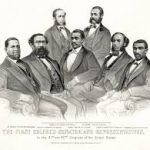
Category: American History

  • House Speaker Nancy Pelosi Announces Efforts To Remove Confederate Symbols From US Capitol

    House Speaker Nancy Pelosi Announces Efforts To Remove Confederate Symbols From US Capitol

    House Speaker Nancy Pelosi renewed a years-long quest to remove the remaining Confederate statues from the US Capitol as calls to erase monuments to the Confederacy increase amid the nation’s reckoning with its racist past. Nancy Pelosi wrote in a letter on June 10 to her colleagues who co-chair the Joint Committee on the Library that Congress should “lead by example.” “The statues in the Capitol should embody our highest ideals as Americans, expressing who we are and who we aspire to be as a nation,” Pelosi wrote. “Monuments to men who advocated cruelty and barbarism to achieve such a plainly racist end are a grotesque affront to these ideals. Their statues pay homage to hate, not heritage. They must be removed.” Pelosi, then the House Minority Leader, led this charge in 2017 after the violent white supremacist marches in Charlottesville that began over plans to remove a statue of Confederate General Robert E. Lee. But Republicans rejected her entreaty, saying it is up to the states to decide the likenesses they want representing them in Washington.

    Each state is allowed to choose two statues to decorate the halls of Congress. There are, according to House Speaker Nancy Pelosi’s letter, 11 Confederate statutes, including Jefferson Davis and Alexander Stephens, the President and Vice President of the Confederate States of America, respectively. Some states have taken it upon themselves to remove statues honoring those who sided with the Confederacy. In 2019, Arkansas replaced two figures from the Civil War with statues of music legend Johnny Cash and civil rights icon Daisy Lee Gatson Bates, though at the time Republican Governor Asa Hutchinson said the reason for the swap was to have a more modern representation of the state. Now, the debate over whether to remove Confederate monuments from public and private spaces has raged anew in the aftermath of George Floyd’s death, which spawned a national reckoning over the history of racism in the US.

    Unlike other attempts to remove Confederate monuments, a societal awareness around issues of systemic racism could lead to more action. This week, institutions including NASCAR and the US Marine Corps banned the use of the Confederate symbols, and there’s increasing pressure to rename military bases that are named for Confederate generals. Congresswoman Zoe Lofgren (D-CA), the vice chairwoman of the Joint Committee on the Library, said in response to House Speaker Nancy Pelosi’s letter that the Confederate statues displayed around the US Capitol should be replaced. “I agree that the Joint Committee and Architect of the Capitol should expediently remove these symbols of cruelty and bigotry from the halls of the Capitol,” Lofgren said. “I stand ready, and call on the Chair of the Joint Committee to swiftly approve the removal of these statues. The Capitol building belongs to the American people and cannot serve as a place of honor for the hatred and racism that tears at the fabric of our nation, the very poison that these statues embody.”

  • “Trump’s Remarks on Andrew Jackson” Article Response

    “Trump’s Remarks on Andrew Jackson” Article Response

    In the Truthout article “Trump’s Remarks on Andrew Jackson Was a Dog Whistle for White Nationalists,” Alexander Reid Ross discusses President Donald Trump’s praise for former US President Andrew Jackson, as well as how the embrace of Jacksonian policies by the Trump Administration has the potential to lead the US down the road toward Fascism. On May 1, 2017, President Donald Trump stated that if “Andrew Jackson been a little bit later, you wouldn’t have had the Civil War,” as well as expressed his admiration for the seventh President of the US. Amid criticism of the factual inaccuracy of Trump’s comment, many have also pointed out that Trump’s praise for Jackson offered proof of how contemporary white nationalist narratives continue to shape the Presidents view of the world.

    A favorite of white nationalist and fascist political groups, Andrew Jackson set up a legacy for the expansion of the US and the slave-owning South and implemented Classically Liberal economic policies that directly contributed to the Depression of 1837-43, which began less than two months after his successor, Martin Van Buren, assumed office. When Van Buren rejected Texas’s admission to the Union to avoid upsetting the balance between slave states and non-slave states, Jackson withdrew his support for Van Buren in favor of James Polk, a slave-holding president whose support for the annexation of Texas strengthened the hand of slaveholding states in the South. The continued expansion of the slave-holding territories in subsequent presidencies would set the stage for the Civil War. In accordance with this broader white nationalist reverence for Jackson, Trump has sought to present himself as a modern-day Andrew Jackson. For example, Trump paid a visit to Jackson’s home and grave and hung several portraits of Jackson in the White House.

    Many of Trump’s actions as President also betray a resonance with the actions of Jackson. Jackson was infamous for his backhanded words regarding the Supreme Court’s decision to defend the Cherokee’s right of place, n used the powers of the executive to contravene the checks and balances of the constitutional system and displace the Native American tribes based in the Southern region of the US. The ensuing “Trail of Tears” that decimated the population of the Cherokee by upward of a third came to mark the policy of “Indian Removal” and Jackson’s presidency. Trump has echoed this sort of unilateral provocation in his own immigration policy proposals and more recently in his May 2, 2017, tweet stating “our country needs a good ‘shutdown’ in September to fix the mess!”

    Another interesting thing to note regarding President Donald Trump’s comments regarding Andrew Jackson is that they came about at a time in which many of his supporters started to declare a “second Civil War” amid confrontations with anti-Fascist protestors that continue to this day. Members of the “Alt-Right” frequently promote the notion of a second Civil War. For example, several Alt-Right organizations have retweeted an article by conservative columnist Dennis Prager that envisions a civil war between the left and the rest of the US over freedom of speech. Trump supporters have been quick to follow the lead of the “alt-right,” suggesting that the second Civil War will occur if the Democratic Party retakes Congress in the 2018 Midterm elections.

    Fascists in the US have long identified Jackson’s legacy with their identity as a defeated and subjugated group. Jackson serves as the driving figure of US history for fascists such as the post-war US organizer Francis Parker Yockey, who identifies Jackson with the beginning of “the great epoch of the history of the practice of government in America.” The battle over the legacy of the Civil War and Andrew Jackson is currently taking place in New Orleans, where Fascist Trump supporter and KKK leader David Duke has taken it upon himself to defend historical monuments to the legacy of the Confederacy, including a statue of Andrew Jackson. Duke’s successful manipulation of populist politics, which earned him a seat in the Louisiana state legislature in the 1990s, has been likened to Trump’s own appeals to the white working class. As such, Jackson’s legacy today represents the fulfillment of many of the most violent fantasies underpinning US independence, particularly the white nationalist fantasy of removing all non-whites from the US. For this reason, as well as on account of Jackson’s unilateral approach to sovereignty, white nationalist Trump booster Jared Taylor has described Trump as a “kindred spirit” of Jackson’s.

    Despite their similarities, the comparison of Trump to Jackson has always been somewhat out of context. While Jackson melded the brash pose of violent militarism with the persona of a backwoods Southern country boy, Trump entered into his role as US President without spending a day in military service. Despite these differences, Trump has appropriated the identity of Jackson, the founder of both the modern political party system as well as the American Conservative movement who earned his reputation as the “Napoleon of the woods” by defeating British forces during the Battle of New Orleans. Andrew Jackson never met Napoleon Bonaparte, but idealized him, and shared much in common with him. Both Jackson and Bonaparte gained the support of the conservative countryside and the business class through militant nationalism. The Jacksonian legacy is one of a jingoism similar to the support by many Bonapartists of the Confederacy in the Civil War, and its xenophobic objectives gained parallels with Bonapartists who supported the radical-right populism of 19th Century French and German politicians. Considering these factors, it is no surprise that Trump has drawn comparisons to Bonaparte from many different news outlets.

    What binds Trump and Jackson runs deeper than a tacit class alliance and something so simple as Trump’s support for Jackson’s policies. It strikes to the core of sovereignty and how it is used. A true sovereign requires not just an “other” that can constitute the political “outside,” but the potential brought about through a suspension of political order itself. The sovereignty desired by the far right would use the specter of the “outsider” as leverage to supersede checks and balances on executive authority and perpetuate its power through aggressive manipulations of nationalist sentiment in the interests of “rebirth” and “national rejuvenation.” As Trump’s most avid far-right supporters move toward creating a violent, autonomous base of power amid what they identify as a “Civil War,” his quest for unchecked sovereignty furthers their unrestrained efforts to liquidate the left in the name of anti-antifascism.

    The author concludes by stating that Trump’s invocation of Jackson evidences Trump’s tacit proximity to fascist narratives both in the US and abroad. At the same time, the President’s own quaint regard for a slavery-supporting perpetrator of genocide who set the stage for the Civil War reveals how deeply white nationalism is engrained within the social and historical fabric of the US and how violently it is defended by its proponents.

    Here is a link to the full article:

    Trump’s Remarks on Andrew Jackson Was a Dog Whistle for White Nationalists

  • Predictions for 2020-2030

    Predictions for 2020-2030

    Many people are asking if the Democrats will take back the House of Representatives in 2018? I suspect they will make significant gains. Upsets in Pennsylvania and elsewhere have shown a weakened Republican party. The Republicans across the state have been slowly eaten by the Tea Party movement and even the Bannon movement where they have been running candidates and working hard to get rid of “moderates”, meaning centrists Democrat types like Bob Mendez (NJ) or others modern neo-liberal Democrats. What the media has been ignoring is “insurgents” candidates across the country that have been chipping away at the Democratic Machine.

    In America, money almost always determines victory in an election, but since the Sanders Movement during the 2016 elections we saw an underfunded candidate nearly take over America’s major political party (the Democratic Party). He created a group OUR Revolution which has affiliates in every state in America. Even Puerto Rico! America politics have just been changed forever and people don’t seem to understand it. Sanders victory would not have been winning the presidency, I don’t think he had the political muscle to get anything significant done, the Democrats hate him, the Republicans would have controlled congress, what could he have really done but slow down the de-funding of government? Another debate for another time. Now he goes around, traveling across the country, talking to the American people while Clinton goes on book tours trying to sell her book. He has built the infrastructure for a new style of American Democracy not seen since the 1960s. He has the largest support among millennial’s, now the largest voting block in America. He has a fairly good history on most issues and being on the right side of history except foreign policy (Sanders is relatively weak on anti-war policy). He should have won the black vote but the churches are so establishment-controlled that he couldn’t break through. The only thing Sanders needs is the backing of religious zealots who are progressive and can destroy the notion that Republicans are the only people who talk to God. Over time I doubt those groups will disappear, you’re looking at a long drawn out civil war on both parties, but worse off for the Democrats. You have a long history of political corruption in some states more than others and you have the truth. Its simple enough to pull up statistics and see that the percentages for big companies donating to Democrats or Republicans can be evenly split.

    The single-payer idea is the only rational policy and then you have the Democrats being unable to support it because their being funded by the same people destroying American healthcare. Over time with reforms, you could see insurgent candidates stay in power and continue to build stronger power bases for more “working class heroes” or Bernie Sanders-esque politicians. Where Ralph Nader failed in 2000, Sanders succeed in 2016, with many of the same issues, just different microphones. A graph I did personally at Monmouth University showed the vast majority of young MU college students under 50,000 support Sanders, even many in the upper income brackets, but as people get poorer because of the global economy and poor policies that increase poverty, will we see the rise of a new party growing inside the old? A party that is Democratic, a party that fails for a few years and then starts to rebirth the Democrat party? I think so, its the right time in America, unless there is a war where many troops are used then we could see the process speed up, as wars often do to these things. The Our Revolution groups have nowhere to go but up, the mainstream parties battling each other and the ‘insurgent’ candidates can really only become more unpopular as they fail to get real policy in place and start to bring in people who traditional aren’t in the process or haven’t been accepted as a decision maker. We see similar politics in the UK with labor changing under Jeremy Corbyn. We are seeing infrastructure for the Sanderist movement grow, where communication and cooperation between different groups are growing. They are running decent candidates, many of which will lose this time, but will be able to run again, and again, and again. The 2020 election is where everything will likely start to break down. Sanders is the Henry Wallace of his time, although this time labor is set for a huge victory, its the speed that is hard to figure out.

    Links
    https://ourrevolution.com/groups/

    History Of The Democratic Party


    https://www.opensecrets.org/industries/lobbying.php?cycle=2018&ind=H03
    https://en.wikipedia.org/wiki/Ralph_Nader_presidential_campaign,_2000

    What the Dan Lipinski-Marie Newman Democratic Primary in Illinois Means

    Polling Shows Running on Progressive Policies Would Work in Swing Districts

  • Soldiers: Desertion, Rebellion, and the Philosophy of the Refusal to Fight

    Soldiers: Desertion, Rebellion, and the Philosophy of the Refusal to Fight

    Throughout human history, war has often been a method for different governments, nation-states, as well as organizations, to control resources. These wars have become bloodier and more collectivized over the last 150 years. What do I mean by collectivized? The entire population is gearing up to destroy another nation and now legitimately the enemy of another “nation.” Carl Von Clausewitz’s theory of “Total War” reshaped warfare starting in the 1800s. Total war is defined as “war that is unrestricted in terms of the weapons used, the territory or combatants involved, or the objectives pursued, especially one in which the laws of war are disregarded.” The concept of “total war” has lead to extreme policies by nations such as strategic bombings, commerce raiding, collective punishment, forced labor for military, targeting of agriculture, Scorched Earth policy, Ethnic Cleansing,  prolonged sieges that starved cities and nations, use of nuclear weapons, chemical warfare, Free Fire Zones and many more. These extreme policies carried out resulted in the idea that soldiers have a “moral duty” to resist, disobey and refuse to join the military of a nation, usually a draft. The paper will examine the actions of Soldiers who refused to fight wars, deserted the military, and in some cases turn on command, during the Vietnam War.

    What was the goal of the Vietnam War carried out largely through the United States?

    The Vietnam War was primarily fought over Vietnamese Independence from the “West” (Britain, France, the United States and other “allies” of the United States). After World War II, the Vietnamese wanted independence from France, because it had largely remained a French colony prior to the war and during the war under the Japanese who further devastated the country. The Vietnamese had fought off the Japanese with US support and had planned a constitution modeled after the US constitution. The country was split by a UN mandate in 1954 which split Vietnam into North and South regions. In 1955, the planned democratic elections were halted in the South over fears they would vote to unify with North Vietnam and that the so-called ‘communist” Ho Chi Minh would win. The US, in turn, installed a puppet dictator, Ngo Dinh Diem, a wealthy business owner, staunchly anti-communist, and a Catholic in charge of a largely Buddhist nation. Diem brutally persecuted Buddhists and become so unpopular that he was assassinated by the CIA in October of 1963 and replaced by his brother. From 1950 to 1975, the US waged a war to control formerly French Indochina via, military aid (up to 90% of French fighting with US dollars until they lost in 1954), also during and after with “military advisors”, constantly increasing until the US openly intervened in Vietnam in 1964, in which it consistently increased troop deployments until 1975, when the war finally came to an end.

    Nearly three million Americans would ultimately serve in Vietnam over the next 20 years (Wardog). Many Americans did not agree or even understand why the US was involved in Vietnam. The US lied about the “Gulf of Tonkin” incident in July of 1964, where a US ship was falsely attacked so President Lyndon B. Johnson could gain more war powers and the result had been a major escalation of the war. The Americans did not find out about this event until nearly ten years later. David Duncan, formerly a Green Beret in Vietnam, was one of the first military trainers in Vietnam. After his tour of duty, he came back and told people the war was a lie. “I was really proud of what I thought I was doing. The problem I had was realizing that what I was doing was not good. I was doing it right but I wasn’t doing right” (Sir!NoSir!). He took a stand openly against the war and resigned from the military. The war took a long time to end, it was pushed with starch anti-communism and what Einstein calls the “measles of mankind”, nationalism.

    Other soldiers such as Dr. Howard Levy refused to perform their military duties to help the war effort. The ideas of personal responsibility made many people not only question the war, hate the war, but also actively try to stop it or refuse to participate in it. Soldiers created underground newspapers in military barracks, ships and cafes across the country to spread the anti-war news. These would often become ban by the military officers and that banning of it would ironically arouse interests by more troops in what was being printed, almost a metaphor in a way for the drug war. Troops on aircraft carriers were literally signing petitions not to go to Vietnam, over 1,200 sailors signed it.

    From April 18 to April 23, 1971, some 900 Vietnam veterans were involved in a massive anti-war rally in Washington, DC. The events included lobbying Congress, “Guerilla Theater” in the streets and keep in mind this was during the 1971 investigation into war crimes, with “150 vets testifying from firsthand experience” (VVAW). This helped the organization Vietnam Veterans Against the War, formed in 1967, became a national organization. The April events were considered one of “the most powerful anti-war demonstration held up to that time”(VVAW). It scared President Richard Nixon so much that he received hourly reports on the demonstration (VVAW). 50 veterans even took over the office of Senator James Buckley (R-NY) after he refused to meet with them. The last day of the demonstration the veterans each individual made a statement against the war and then threw their medals over the White House fence protesting against the war. One Veteran from the demonstration famously stated that “If we have to fight again, it will be to take these steps.”

    The famous May Day Protests in 1971 saw, according to Chief Jerry V. Wilson, some 12,000 to 15,000 protestors block streets, throw “chicken shit” to mock the colonels, block government buildings and marching in protest of the war (Halloran). Most of the protesters were a mix of students and veterans. These people believed that serving the war effort was deeply wrong and that the war would end when soldiers refused to fight the wars. In the 1980s, under the Presidency of Ronald Reagan, much of this history of the anti-war movement was swept under the carpet and myths of the “hippies” who spat on soldiers started.

    Many sailors, pilots, and San Diego residents even joined the anti-war movement. Sailors on the USS Coral Sea, at first signed hundreds of petitions then thousands of them signed it. On Sept. 13, 1971, they wrote a petition to Congress stating that a majority of the sailors do not believe in the Vietnam War and asking that their ship not return to Southeast Asia. Before the petitions could be sent to Congress they were ripped off by the lifers and are now being held by the ship’s executive officer. He said the petition was legal but ignored attempts by the crew to get it back. So the crew ignored the executive officer and started a new petition. Over 300 men signed the first one and were pissed off when it was ripped up (Good Times/Vol. IV No. 29/OCT. 1, 1971). When the ship sailed out the Golden Gate on Monday for a two-week trial run, there were thousands of leaflets with the text of the petition and places for signatures.

    The naval carriers and pilot crews often had little combat casualties and dealt severe damage to the civilians across Laos, Cambodia, and Vietnam, especially when President Richard Nixon started slowly withdrawing troops in 1969, it meant more bombing and higher civilian deaths. Veterans started focusing on actively persuading people that the war was wrong. Saying things like I was there, I did terrible things and we shouldn’t be there, things like that are a lot more persuasive when you can say you fought in that war. Soldiers also did symbolic things like wear black armbands to say they support a protest at home. The Vietnam War is also where you see the “black power” movement start to emerge and groups like the black panthers. Where are legitimate questions asked why are black people fighting for a country that doesn’t provide them with equal rights? Famous athletes like Muhammad Ali refused to fight the war, perhaps modern day Kaepernick could be said as a mini Ali.

    Soon after their return home from Vietnam in 1971, a group of 236 GI’s from the 173rd Airborne Brigade made the following statement: “Throughout our time in the service we’ve seen minority group GI’s discriminated against. In Vietnam, that’s been evidenced by higher casualty rates. Other times it takes the form of slower promotions, higher penalties for rules violations, and the worst job assignments. We feel that the Army fosters racism and has purposely avoided dealing with the day-to-day problems of minority groups”(Boyle).

    To briefly address it I will reference what’s in Richard Boyle article not far below the previous quote,
    “Many white officers and NCO’s made a practice of harassing Black GI’s about their Afros which didn’t conform to “military regulations.” While right-wing soldiers were allowed to fly confederate flags on Martin Luther King’s birthday and could generally count on getting away with making open racial slurs, Black GI’s were given sentences of up to 6 months for giving the clenched fist salute and “dapping” (a brotherly greeting)”(Boyle).

    During the 10 years of the Vietnam War according to figures by the Pentagon, 500,000 deserted (Woolf). A large anti-war movement actively protesting, the Vietcong (a “determined enemy”), a military on collapse, Nixon announced the policy of “Vietnamization” making the Vietnamese takeover the efforts which completely failed and people knew it would fail in the 1970s.

    “By every conceivable indicator, our army that now remains in Vietnam is in a state approaching collapse, with individual units avoiding or having refused combat, murdering their officers and noncommissioned officers, drug-ridden, and dispirited where not near mutinous”(Heinl).
    THE COLLAPSE OF THE ARMED FORCES
    By Col. Robert D. Heinl, Jr.
    North American Newspaper Alliance
    Armed Forces Journal, 7 June 1971

    The US military had become almost self-governing in a way, even outside of its officers. Soldiers refusing to go on missions, people on drugs everywhere, especially heroin, officers being killed for given orders; to put it bluntly it was a circus. Because of the drug addiction and disapproval of the military, there was now an “epidemic of barracks theft”. This theft is even more devastating for moral where you have soldiers unable to trust each other, especially when in combat.

    “Soldier muggings and holdups are on the rise everywhere. Ft. Dix, N.J., has a higher rate of on-post crime than any base on the East Coast. Soldier muggings are reported to average one a night, with a big upsurge every pay-day. Despite 450 MP’s (one for every 55 soldiers stationed there – one of the highest such ratios in the country) no solution appears in sight (Heinl). Armed Forces Journal

    There are more military police than ever and still, the situation cannot be dealt with. The military was in a state of active revolt.

    “Crimes are so intense and violent in the vicinity of an open-gate “honor system” detention facility at Ft. Dix that, according to press reports, units on the base are unwilling to detail armed sentinels to man posts nearby, for fear of assault and robbery”(Heinl). Armed Forces Journal

    So bad that the military can’t even protect a gate so they have to have a bullshit system to protect themselves from looking weak. These issues are some of many that build up an identity of the military at war with itself that can’t maintain itself, in a war it doesn’t want to fight, unrest at home and a country trying to find itself. Toward the end of the war things got so bad a term “fragging” was given to the time when US soldier in Vietnam would attack their commanders for giving those orders to fight or go on missions.
    “Shortly after the costly assault on Hamburger Hill in mid-1969, the GI underground newspaper in Vietnam, “G.I. Says”, publicly offered a $10,000 bounty on Lt. Col. Weldon Honeycutt, the officer who ordered(and led) the attack”(Heinl).

    Several attempts were made on that soldier’s life although he went home alive. But even the brashness to publish something about killing an officer in a newspaper with a bounty shows how bad the situations were. This did affect judgments by leaders, “Another Hamburger Hill is definitely out “said one Major (Heinl). The problem of soldiers refusing to fight is evident throughout the end of the war, notable by two examples, the entire units of 196th Light Infantry Brigade publicly sat down on the battlefield and 1st Air Cavalry Division refused going down a dangerous trail (Heinl). When soldiers actively don’t believe in the “value” of the war serious consequences happen to the nation’s military.

    Briefly, I will talk about the problems of historically armies in World War 1, World War 2, Iraq, Afghanistan 1980s and Modern, while touching back to Vietnam. During WW1, over 240,000 British and Commonwealth soldiers were court-martialed (Hinke). World War II saw 1.7 million US courts-martial, “one-third of all American prosecutions”, and around 21,000 desertions (Hinke). During the Afghan War, 60,000-80,000 ethnic Soviet border troops from the Muslim Central Asian regions deserted (Hinke). 85,000 Afghan national troops also deserted during this period (Hinke).

    2001 to Today
    “Pentagon estimates more than 40,000 troops have deserted from all branches of military service. In 2001 alone, 7,978 deserted” (Hinke).

    All these problems of desertion relate to poor morale, belief in conflict, in some instances pay, the requirements of troops and length of the conflict. These conflicts are all about domination of regions, resources and/or competing for national interests. The Vietnam War adds up to a cumulative discontent with soldiers disbelief in the value of the conflict and actively trying to end the war. This dislike by the US soldiers does not mean that the Vietcong were just in their actions, who often killed, tortured, overtaxed and committed numerous atrocities, but as the song For What it’s Worth says, “Noboy is right if everybody’s wrong”.

    Examine the Vietnam War
    Examine the Opposition to the War in the Military(Army)
    – How they applied refusing to fight philosophy
    -Social Problems of the time (small)
    -US Military on verge of Collapse?

    Presentation
    Present – Stop video at 5:23 mins (https://search.alexanderstreet.com/view/work/bibliographic_entity%7Cvideo_work%7C1786515/sir-no-sir)
    (Ask Questions
    Question 1: What do you think about the idea “if people refuse to fight the wars can’t continue”?
    – Quick Facts:
    More than 21,000 American soldiers were convicted of desertion in World War Two
    Since 2000 estimate of more than 40,000 troops deserted from all branches of the military.
    In 2001 alone, 8,000 deserted the US military.
    More than 5,500 desertions 2003-2004
    Any guesses to how many deserted during the Vietnam War 10 year period? 500,000!
    -Question 2
    Was what they did right for refusing to fight what they perceived as an unjust war?
    -Quick Facts
    How many people if there was a draft implemented tomorrow and require you to show up at your local town hall would do so, to prepare for a military conflict against China and North Korea?

    Images and further Readings

    http://www.gettyimages.com/detail/news-photo/viet-nam-veterans-against-the-war-demonstrate-against-the-news-photo/526094756#viet-nam-veterans-against-the-war-demonstrate-against-the-war-in-picture-id526094756 ( March in DC Arlington Cemetery)

    24 May 1969: Senior US officers say the strategic location of Hill 937 – ‘Hamburger Hill’ https://www.theguardian.com/world/2017/may/24/troops-count-cost-vietnam-hamburger-hill-archive-1969

    http://www.substancenews.net/articles.php?page=6379

    Film

    References
    (2009). From US War Dogs : http://www.uswardogs.org/new_page_18.htm
    Between Hitler and Stalin . (n.d.). From UCRDC: http://www.ucrdc.org/HI-SCORCHED_EARTH_POLICY.html
    Boyle, R. (1973). GI Revolts The Breakdown of the US Army in Vietnam. From Richard Gibson : http://richgibson.com/girevolts.htm
    Col. Robert D. Heinl, J. (1971, June 7). THE COLLAPSE OF THE ARMED FORCES. North American Newspaper Alliance. From https://msuweb.montclair.edu/~furrg/Vietnam/heinl.html
    Col. Robert D. Heinl, J. (1971, June 7). THE COLLAPSE OF THE ARMED FORCES. From Montclair University : https://msuweb.montclair.edu/~furrg/Vietnam/heinl.html
    Drooling on the Vietnam Vets. (2000, May 2). From Slate : http://www.slate.com/articles/news_and_politics/press_box/2000/05/drooling_on_the_vietnam_vets.html
    Halloran, R. (1972). 7,000 Arrested in Capital War Protest; 150 Are Hurt as Clashes Disrupt Traffic. From http://www.nytimes.com/learning/general/onthisday/big/0503.html
    Turse, N. (2017, September 28 ). The Ken Burns Vietnam War Documentary. From The Intercept: https://theintercept.com/2017/09/28/the-ken-burns-vietnam-war-documentary-glosses-over-devastating-civilian-toll/
    United Nations Office of Genocide Prevnetion and The Resposiblity to Protect . (2017). Ethnic Cleansing . From United Nations : http://www.un.org/en/genocideprevention/ethnic-cleansing.html
    VVAW. (1977, Apirl ). Vets’ History: Operation “Dewey Canyon III”. From Vietnam Veterans Against the War: http://www.vvaw.org/veteran/article/?id=1656
    Woolf, C. (2015, March 26). From the Revolution to Bowe Bergdahl, desertion has a long history in the US. From PRI: https://www.pri.org/stories/2015-03-26/revolution-bowe-bergdahl-desertion-has-long-history-us
    Zeiger, D. (Director). (2005 ). Sir!No Sir! [Motion Picture].

    Links if need be
    https://en.oxforddictionaries.com/definition/total_war

    The Ken Burns Vietnam War Documentary Glosses Over Devastating Civilian Toll


    http://www.un.org/en/genocideprevention/ethnic-cleansing.html
    http://www.ucrdc.org/HI-SCORCHED_EARTH_POLICY.html
    http://www.uswardogs.org/new_page_18.htm

    https://search.alexanderstreet.com/view/work/bibliographic_entity%7Cvideo_work%7C1786515/sir-no-sir
    https://msuweb.montclair.edu/~furrg/Vietnam/heinl.html
    http://richgibson.com/girevolts.htm
    https://www.britannica.com/topic/Students-for-a-Democratic-Society
    http://www.foundsf.org/index.php?title=Anti-Vietnam_war
    http://www.slate.com/articles/news_and_politics/press_box/2000/05/drooling_on_the_vietnam_vets.html
    http://www.nytimes.com/learning/general/onthisday/big/0503.html
    https://www.pri.org/stories/2015-03-26/revolution-bowe-bergdahl-desertion-has-long-history-us

  • “10 Minutes: Trump One Year President” Video Response

    “10 Minutes: Trump One Year President” Video Response

    This video by PressTV presents a review of President Donald Trump’s first full year in office. One year has passed since Donald Trump has been elected US President. Since then, the world has seen a US President unlike any other. One that is aggressive, impulsive, uninterested in politics, and egotistical. Despite coming into office with a grand series of promises to change American politics for the better, the case can be made that the policies pursued by the Trump Administration have changed American politics for the worst. Trump has thus far failed to realize any of his campaign promises, fanned the conspiracy flames regarding his relationship with Russia, contradicted and insulted his staff, and made enemies of allies throughout the world. Additionally, President Trump has attacked the governmental institutions he oversees, threatened to use his powers to ruin the lives of his political opponents, waged war against members of his own party, and engaged in race-baiting, sexism, ableism, and religious bigotry when pursuing his destructive agenda.

    One such area in which President Donald Trump left his mark during his first year was his immigration executive order banning (mostly Shi’a Muslim) immigrants, travelers, and refugees from seven majority-Muslim countries (Syria, Iran, Iraq, Yemen, Sudan, Somalia, and Libya). This action ignited a firestorm of protest and revealed the bigoted, white supremacist agenda underlying the Trump Administration’s policies. President Trump also rattled the nuclear-saber more than any other President in US history with his incitement of North Korea, going as far to threaten the North Korean government with “fire and fury.” Many politicians on both sides of the aisle worry that Trump has misused the moral authority surrounding the office of the Presidency through such statements and actions.

    President Donald Trump claimed during his first year in office that he has the unilateral authority to order the Justice Department to open or close investigations into his political opponents. Such rhetoric threatens to set a negative precedent in future Administrations that goes directly against the principles of separation of power spelled out in the US Constitution. President Trump’s outreach to autocratic regimes such as Saudi Arabia and Israel further characterized his first year in office. By backing the Saudi Crown Prince Mohammad bin Salman, President Trump has given the green light for Saudi Arabia to escalate its three-year-long intervention in Yemen, which has resulted in the deaths of thousands of innocent people and has encouraged hatred towards Shi’a Muslims throughout the world.  Additionally, President Trump’s choice to recognize Jerusalem (“al-Quds” in Arabic) as the capital of Israel has encouraged the Israeli regime to expand its crusade against the Palestinian people.

    President Donald Trump also left a negative mark within the realm of international politics and has adopted a firm, neoconservative view regarding the role of the US in the world. President Trump has repeatedly denounced the Iranian nuclear deal, calling it the “worst deal ever negotiated” despite the fact that it was upheld by numerous organizations, most notably the United Nations and International Atomic Energy Agency (IAEA). Additionally, President Trump has proposed a hardliner stance towards Iran, calling it a “terrorist nation” and calling for US military action to remove the current Iranian government from power.  These actions on the part of the President have led to many European leaders such as German Chancellor Angela Merkel and French President Emmanuel Macron to rethink their reliance on US political and diplomatic leadership on the world stage.

    In terms of domestic policy, President Donald Trump generally has had an abysmal first year in office. Trump failed to follow through on repealing The Patient Protection Affordable Care Act (“Obamacare”) despite the fact that his party controls both houses of Congress, and has relied on Executive Orders more often than any other first-year President in US history. The only true legislative achievements of President Trump’s first year in office are his nomination of Neil Gorsuch to the Supreme Court and the passage of the Tax Cuts and Jobs Act of 2017. Many critics argue that the presence of Neil Gorsuch on the Supreme Court will move the Judicial branch far to the right and have a profound (and what many view as a negative) impact on decisions such as drug policy, women’s rights, abortion, gay rights, and electoral reform. Additionally, nearly all economic organizations point out that the Tax Cuts and Jobs Act is a clear giveaway to the wealthiest 1% and only serve to further the widening income gap between the wealthy and the poor.

    Here is the link to the video:

    https://www.youtube.com/watch?v=dKLDqJqcBbI&index=12&list=LL1B7oixItfvf2Uqvx7886Vw&t=28s

  • Seven Must-Know Facts For Planning College Political Events

    Seven Must-Know Facts For Planning College Political Events

    Have you ever tried to organize a college event? Did you get frustrated by issues of planning and attendance?

    College is a stressful environment often characterized by heavy workloads and important deadlines to meet. Planning a successful college event can be most successful by following certain guidelines to maximize your potential. Finals/Midterms times and prior to are the worst time to hold events. Here are some tips to help you set up a successful event:

    1. Early Bird gets the worm
    First-time Political leaning or educational events, in my opinion, are always best to be done in the first 2-3 weeks of school. Before Midterms and before homework starts getting overwhelming.

    2.Time Time Time
    Make sure the event isn’t at a time when most people are in class but perhaps “college hour,” or a time when people want to have some pizza after class.

    3. Who’s Who?
    Figure out who are the Demographic most likely to attend. Figure out how to attract them, like LGBTQ attract them by telling them about the issue and how it’s important in their life. How they should come and will benefit. Then figure out how to attract large segments of the student or other population.

    4. Monopoly MOFO
    Making sure your event has a monopoly over the time/date is important so other events don’t drain from your audience. If a more “liberal” socially- (not economically that word is misused today), then figure out what other events that draw people in that realm may be happening or run by and inform them of your event beforehand to make sure you have a leg up on them. Something as simple as saying “hey come to my event” and “save the date.” Informing the faculty who are “experts” in that field your event is on can help spread the word as well.

    5. Art Bitches
    Make sure you have an attractive flyer to catch someone’s eye to the event. This should also include online postings like on Instagram/Facebook which are drawing more attention these days. A picture is worth a thousand words so keep it relative to the event.

    6. Munchies!
    Having Pizza at the event can go a long way where people who aren’t generally as interested now come to the event and want a piece of that action. So food is a way to lure people just make sure you try to gauge the attendance with food supply otherwise it will take away from an event. Refillable cups is advised along with water to reduce plastic use and make your event more environmentally friendly.

    7. Songs of the time (EXTRA)
    Having a musician play relevant music at the end of the event can lure more people- his or her friends to attend- and ends an element that there will be a musician playing at the end. Try to keep the music almost relevant to the event. For example, if the event discusses healthcare policy, include a song that talks about health care or if the event is about immigration feature a song about immigration. Try to keep the music it a genre you think people will like. Solidarity Singers in NJ are known for political songs and is a good source for political events.

    Early in Semester
    During a right day of week/Time
    Figuring out the target group
    Making sure the target group has only your event to attend
    Posters that are well designed
    Some food at the event
    (Extra)Perhaps music performance at the end or start
    (These are lessons I have learned from my failed events-XOXO )

  • History Of The Democratic Party

    History Of The Democratic Party

    One of the two major political parties in the US is the Democratic Party. With its roots being traced back to the late 18th Century Democratic Party has arguably been the most important party in US history. The Democratic Party dominated US politics at the national level between 1828 and 1860 and again from 1932 to 1968, and a majority of American voters still identify as Democrats today even though the Party has lost ground in many areas of the country over the past 50 years. Here is a brief overview of the history of the Democratic Party.

    Before the Democratic Party

    The Federalist and Democratic-Republican Parties participated in spirited debates regarding the direction of the young country during the late 18th and early 19th Centuries.

    After the U.S. Constitution came into effect in 1789, the voters and elected officials divided into two rival political factions. The first such group was the Federalist Party, which favored a strong and active federal government ruled by a wealthy elite. The second group was the Democratic-Republican Party, which advocated dispersing power more broadly among white male property owners. By the time of the 1824 Presidential Election, the Federalists Party mostly collapsed, leaving the Democratic-Republican Party as the only remaining political party in the US.

    During the 1820s new states entered the union, voting laws were relaxed, and several states passed legislation that provided for the direct election of presidential electors by voters. These changes split the Democratic-Republicans into factions, each of which nominated a candidate in the presidential election of 1824. The party’s congressional caucus chose William H. Crawford of Georgia, but Andrew Jackson and John Quincy Adams, the leaders of the party’s two most significant factions also sought the presidency. House Speaker Henry Clay was nominated by the Kentucky and Tennessee legislatures. Jackson won a majority of the popular and electoral vote, but no candidate received the necessary majority in the electoral college. When the election went to the House of Representatives, Clay threw his support to Adams, who won the House vote and subsequently appointed Clay secretary of state.

    Andrew Jackson is the father of the modern Democratic Party.

    Despite Adams’s victory, differences between the Adams and the Jackson factions persisted. Adams’s supporters, representing Eastern interests and progressive economic and social policies, called themselves the National Republicans. Jackson, whose strength was in the South and West, referred to his followers as Democrats. The Jacksonian branch advocated economic populism, social conservatism, and rural values. Jackson defeated Adams in the 1828 presidential election by a landslide and soon began to implement his right-wing, populist agenda (which was in many ways similar to the modern-day “Tea-Party” movement in the Republican Party and is cited by President Donald Trump as an inspiration for his policies). In 1832 in Baltimore, Maryland, the Democrats nominated Jackson for a second term as President, drafted a party platform, and established a rule that required party presidential and vice presidential nominees to receive the votes of at least two-thirds of the national convention delegates, thus establishing the Convention System, which nominated all Presidential candidates between 1832 and 1976.

    Growth & Decline of the Democratic Party

    From 1828 to 1856 the Democrats won all Presidential elections except 1840 and 1848 and controlled Congress with substantial majorities. As the 1840s and 1850s progressed, the Democratic Party suffered internal strains over the issue of extending slavery to the Western territories. Southern Democrats wanted to allow slavery in all the areas of the country, while Northern Democrats proposed that each territory should decide the question for itself through a public vote. The issue split the Democrats at their 1860 presidential convention, where Southern Democrats nominated Vice President John C. Breckinridge, and Northern Democrats nominated Senator Stephen Douglas. The 1860 election also included John Bell, the nominee of the Constitutional Union Party, and Abraham Lincoln, the Republican candidate. With the Democrats split, Lincoln was elected president with only about 40 percent of the national vote.

    American Presidential elections during the late 19th Century were split based on ethnic, regional, and ideological lines.

    The election of 1860 is regarded by most political observers as the first of the country’s three “critical” elections—contests that produced sharp yet enduring changes in party loyalties across the country. It established the Democratic and Republican parties, which represented the right and left of the political spectrum respectively. In federal elections from the 1870s to the 1890s, the parties were evenly split except in the South, where the Democrats dominated because most whites blamed the Republican Party for both the American Civil War and Reconstruction. The two parties controlled Congress for almost equal periods through the rest of the 19th century, though the Democratic Party held the presidency only during the two terms of Grover Cleveland (1885–89 and 1893–97).

    A Shift Towards Progressivism

    The Democratic Party began to move to the left during the 1896 Presidential Election with the nomination of former Nebraska Congressman William Jennings Bryan. In contrast to prior Democratic nominees, Bryan advocated a progressive platform meant to counter the growing power of economic elites and return some semblance of stability to the common man. Even though Bryan ultimately lost to Republican William McKinley, his nomination resulted in a permanent realignment of both political parties on economic policy. The progressive trend within the Democratic Party continued under President Woodrow Wilson (1913-21). Wilson championed various liberal economic reforms, such as federal banking regulation, child labor laws, the break up of business monopolies, and pure food and drug regulations.

    The peak of the Modern Democratic Party

    President Roosevelt is credited with reviving the Democratic Party during the 1930s and 1940s.

    The stock market crash of 1929 and the subsequent start of the Great Depression was the primary catalyst for the Democratic Party revival of the mid-20th Century. Led by President Franklin D. Roosevelt, the Democrats not only regained the presidency but also replaced the Republicans as the majority party. Through his political skills and his sweeping New Deal social programs, Roosevelt forged a broad coalition including small farmers, some ethnic minorities, organized labor, urban dwellers, liberals, intellectuals, and reformers that enabled the Democratic Party to retain the presidency until 1952 and to control both houses of Congress for most of the period from the 1930s to the mid-1990s. Roosevelt was reelected in 1936, 1940, and 1944 and was the only president to be elected to more than two terms. Upon his death in 1945, Roosevelt was succeeded by Vice President Harry S. Truman, who was narrowly elected in 1948. The only Republican President during this period was Dwight D. Eisenhower, the former Supreme Allied Commander during World War II and a largely liberal Republican.

    Despite having overwhelming control over the American political system, the Democratic Party began to witness divisions regarding the issue of civil rights during the 1930s. Northern Democrats mostly favored federal civil rights reforms, whereas Southern Democrats expressed violent opposition to such proposals. As the 1950s progressed, many Southern Democrats Senators such as future President Lyndon Johnson (TX), Estes Kefauver (TN), Claude Pepper (FL), and Ralph Yarborough (TX) began to embrace the idea of civil rights and sought to push the Democratic Party to take a firm stance in favor of the issue. After the assassination of President John F. Kennedy, President Lyndon Johnson took charge on civil rights and pushed Congress to pass the previously-stalled Civil Rights Act of 1964, the Voting Rights Act of 1965, and the Civil Rights Act of 1968. These efforts led to another realignment in American politics that resulted in the Republican Party gaining ground with Southern Whites and the Democratic Party cementing its support amongst minority voters and liberal voters in the Northeast and West Coast.

    The New Democratic Party

    The Democratic Party under President Bill Clinton moved to the right on economic issues and to the left on social issues.

    By the late 1960s, the extended period of Democratic Party domination was coming to an end. With the party split over issues such as the Vietnam War, civil rights, and the proper role of government, Republican candidate Richard Nixon was able to defeat Vice President Hubert Humphrey and independent segregationist candidate George Wallace by a comfortable margin. Despite retaining control over both houses of Congress until 1994, the Democratic Party lost 6 out of the 9 Presidential elections between 1968 and 2004. To regain support at the Presidential level and capitalize on public dissatisfaction (particularly in the Northeast and West Coast) at the continuing rightward drift of the Republican Party, the Democratic Party started to move towards the political center during the late 1980s and 1990s. Under the leadership of President Bill Clinton (1993-2001), the Democratic Party adopted neo-liberal economic policies such as free trade advocacy, support for targeted tax cuts, and fiscal conservatism. Additionally, the Democratic Party during this period began to move towards the left on social issues such as gay rights, abortion, and the role of religion to gain ground in the mostly secular Northeast and West Coast. Even though these policies endeared the Democratic Party to numerous voting groups, they negatively impacted Democratic chances in the Appalachian and Ozarks regions in the South, parts of the Midwest, and in the Great Plains states.

    Future of the Democratic Party

    In the 2016 Presidential Election, Democratic nominee Hillary Clinton won the popular vote by almost 3 million but ended up losing the electoral vote by a close margin. These results reveal that the Democratic Party is regaining its status as the nations majority party, albeit with an entirely different coalition of voters. Additionally, Clinton performed strongly in several typically-Republican states such as Texas, Utah, Georgia, Arizona, and North Carolina. Perhaps these results indicate a new trend that will allow the Democratic Party to gain control of the Southwest and some of the more cosmopolitan Southern states.

  • History of the Republican Party

    History of the Republican Party

    The Republican Party is one of the two main political parties currently active in the United States. Founded by anti-slavery activists, economic modernizers, and liberal Whigs and Democrats in 1854, the Republicans dominated politics nationally and was the majority political party in the Northeast, Midwest, and Great Plains for most of the period between 1854 and 1932. The Republican party has won 24 of the last 40 U.S. presidential elections, and there has been a total of 19 Republican Presidents between 1860 and 2016, the most from any political party.

    Liberal Republicans & The  Civil War

    The Republican Party was founded in Ripon, Wisconsin in 1854 and soon became the main anti-slavery political party within the US.

    The Republican Party was officially formed in the small town of Ripon, Wisconsin on March 20, 1854, as a coalition of anti-slavery Whigs and Democrats opposed to the Kansas–Nebraska Act, which opened Kansas Territory and Nebraska Territory to slavery and future admission as slave states, thus repealing the 34-year prohibition on slavery in territories north of the Mason–Dixon line. This change was viewed anti-slavery members of Congress as an aggressive, expansionist maneuver by the slave-owning South. In addition to supporting an anti-slavery platform, the Republican Party followed a platform based on economic modernization, a more open interpretation of the constitution, expanded banking, openness to new immigrants, and giving free western land to farmers as a way to discourage the spread of slavery to the Western territories. Most of the support for the new political party came from New England (particularly Vermont, Maine, and parts of Upstate New York),  the Midwest, and certain areas in the Upper South such as Eastern Tennessee, Southeastern Kentucky, and Western Virginia (regions where slavery was non-existent).

    The Republican Party almost immediately made a mark on American politics and soon superseded the Whig Party as the chief opposition party. The first Republican Presidential nominee was John Frémont, a former general during the Mexican-American War and a strong opponent of the spread slavery. In the 1856 Presidential Election, Frémont scored 33% of the vote and came very close to defeating Democratic candidate James Buchanan in the Electoral College. The strong performance of the Republican Party was an impressive feat despite the fact that the party lacked a strong organizational structure and was not on the ballot in all states. The Republican Party built upon their successes by winning control of both House of Congress in the 1858 midterm elections.

    The election of Abraham Lincoln in 1860 and the subsequent start of the Civil War led to the first era of Republican domination of the American political system.

    The election of Abraham Lincoln in 1860 and the subsequent start of the Civil War opened a new era of Republican dominance at the federal level known as the Third-Party System. President Lincoln proved brilliantly successful in uniting the factions of his party to fight for the Union. Most of the remaining Democrats at first were War Democrats and supportive of the Union war effort until late 1862. When in the Fall of 1862 Lincoln added the abolition of slavery as one of the leading war goals, many War Democrats became “Peace Democrats” and thus became more sympathetic to the cause of the Confederacy. The Republicans condemned the peace-oriented Democrats as disloyal and won enough War Democrats to maintain their Congressional majority in 1862. In 1864, the Republicans formed a coalition with many War Democrats (such as Tennessee military governor Andrew Johnson) as the National Union Party which reelected Lincoln in a landslide.

    Nearly all of the state Republican parties accepted the idea of the abolition of slavery except Kentucky. In Congress, the Republicans established legislation to promote rapid modernization, the creation of national banking system, high tariffs, the first income tax, paper money issued without backing (“greenbacks”), a large national debt, homestead laws, federal infrastructure spending (particularly on the railroads and industries), and federal aid for education and agriculture. These legislative efforts added to the perception that the Republican Party was the more liberal of the two main political parties.

    Post Civil-War Republicans

    After the successful conclusion of the Civil War in 1865, the Republican Party leadership was faced with the challenge of Reconstruction. The Republican Party soon became split between the moderates (who favored a lenient approach to Reconstruction) and the Radical Republicans (who demanded aggressive action against slavery and vengeance toward former Confederates). By 1864, a majority of Republicans in Congress were part of the Radical branch of the party. These tensions reached their boiling point after President Lincoln’s assassination in April of 1865. The Radical Republicans at first welcomed President Andrew Johnson (Lincoln’s second Vice President and a Southern Democrat who supported the Union), believing that he would take a hard line in punishing the South and enforce the rights of former slaves. However, Johnson denounced the Radicals and attempted to ally with moderate Republicans and Democrats. The showdown came in the Congressional elections of 1866, in which the Radicals won a sweeping victory and took full control of Reconstruction, passing laws over President Johnson’s veto. President Johnson was impeached by the House of Representatives in 1868 but was acquitted by the Senate by only one vote.

    The Republican Party of the 1870s sought to establish a viable political coalition based on the ideas of racial equality and progressive public policy.

    With the election of Ulysses S. Grant in 1868, the Radicals had control of Congress, the party structure, and the army and sought to build a Republican base in the South using the votes of Freedmen, Scalawags, and Carpetbaggers, supported directly by the US army. Republicans all throughout the South formed clubs called Union Leagues that mobilized the voters, discussed policy issues and fought off white supremacist attacks. President Grant strongly supported radical reconstruction programs in the South, the Fourteenth Amendment and equal civil and voting rights for the freedmen. Despite President Grant’s popularity and devotion to the cause of racial and social equality, his tolerance for corruption led to increased factionalism in the Republican Party. The economic depression of 1873 energized the Democrats at the Congressional level. The Democrats won control of the House of Representatives in 1874 and formed “Redeemer” coalitions which recaptured control of each southern state. Reconstruction came to an end when an electoral commission awarded the contested election of 1876 to Republican Rutherford B. Hayes, who promised through the unofficial Compromise of 1877 to withdraw federal troops from the control of the last three southern states (Mississippi, South Carolina, and Louisiana). The South then became known as the Solid South, giving overwhelming majorities of its electoral votes and Congressional seats to the Democrats for the next century.

    Economic Conservatism

    The Republican Party by and large remained the dominant political party at the Presidential level for the next five decades, with the Democrats only winning the Presidency in 1884, 1892, 1912, and 1916.  Starting in the mid-1890s, both of the political parties began to shift on economic policy due to events such as the 1893-1897 economic depression. During the 1896 Presidential Election, the Democrats nominated former Congressman William Jennings Bryan of Nebraska, whereas the Republicans nominated Governor William McKinley of Ohio. In contrast to previous Democratic nominees, Bryan followed a platform aligned with contemporary liberalism. Some of the main components of Bryan’s platform included increased federal aid to farmers and factory workers, opposition to the gold standard, a federal income tax, opposition to the wealthy elite, and economic populism. In contrast, Republican William McKinley took an entirely opposite position, arguing that the application of classically liberal economic policies, the continuation of the gold standard, and protectionism would lead to widespread prosperity. Ultimately, McKinley defeated Bryan by a comfortable margin, but the political shifts from this election would have ramifications moving forward. Even though the Republican Party moved towards the left-wing of the political spectrum once more under the Presidencies of Theodore Roosevelt and William Howard Taft, the conservative branch would win out by 1920 with the nomination and subsequent election of Warren Harding to the Presidency.

    A Party in Decline & Flux

    Senator Robert Taft of Ohio led the conservative wing of the Republican Party from the late 1930s to the early 1950s and advocated for the party to support fiscally conservative principles.

    The initial era of Republican domination at the Presidential level would come to an end with the start of the Great Depression in 1929. President Hoover attempted to alleviate the widespread suffering caused by the Depression, but his strict adherence to Republican principles precluded him from establishing relief directly from the federal government. Additionally, President Hoover became the first Republican President to openly-endorse white supremacy and supported the removal of blacks from state-level Republican parties, which alienated black support for the Republican Party. The Depression cost Hoover the presidency with the 1932 landslide election of Franklin D. Roosevelt and allowed the Democrats to gain a substantial Congressional majority for the first time since the 1850s. The Roosevelt Administration implemented a legislative program known as the “New Deal,” which expanded the role of the federal government in the economy as a way to alleviate the suffering caused by the economic decline and to prevent another economic decline on the scale of the Great Depression from occurring again. Additionally, President Roosevelt sought to gain the support of voter groups that typically voted Republican such as African-Americans, ethnic minorities, and rural farmers. Roosevelt’s efforts were ultimately successful and led to strong victories for the Democratic Party at the ballot box for the next three decades. During this period, the Democratic Party retained control of Congress for every year except 1946 and 1952 and won the Presidency in all elections except 1952 and 1956, when Dwight Eisenhower, a liberal Republican, defeated a fractured Democratic Party.

    In response to the New Deal and the policies of the national Democratic Party, the Republicans split into two factions. The first wing was the liberal faction, which favored expanding the New Deal social programs, but felt that such programs would be managed better by Republican administrations. Additionally, the liberal faction of the Republican Party firmly favored civil rights legislation and worked closely with Northern Democrats to push forward positive legislative changes in that arena. The other group was the conservative faction, which advocated a return to laissez-faire economics and fiscal conservatism. Even though the conservative faction of the Republican Party also supported civil rights reforms, they started to form alliances with conservative Southern Democrats in the late 1930s as a way to prevent progressive laws from passing. After the 1938 midterm election, the “Conservative Coalition” formed a majority in Congress and prevented successive Democratic administrations from expanding the New Deal and other associated social programs. It can be argued that the “Conservative Coalition” controlled Congress until 1958, when a large group of liberal Democrats was elected to the Senate and House of Representatives.

    The Southern Strategy & The Republican Resurgence

    The political parties began to shift again in the 1960s due to policy changes within the Democratic Party. The main split in the Democratic Party came about due to the struggle for civil rights. Since the late 1930s, the Democratic Party experienced a major split between the liberal and moderate factions, which favored civil rights, and the Southern faction, which was steadfast in its opposition to federal civil rights legislation. These tensions came to a head when Lyndon Johnson became President after John F. Kennedy was assassinated in 1963. Despite being a Southerner, Johnson had a record in support of civil rights since the mid-1950s and felt that civil rights represented a major political opportunity for the Democratic Party. Over the course of his Presidency, major civil rights legislation was passed in 1964, 1965, and 1968 and the Democrats soon became associated with civil rights reform. In response to these changes, the Republican Party began to appeal to white Southerners opposed to the changes to their way of life. These appeals first became apparent in the 1962 Alabama Senate Election between Democrat Lister Hill and Republican James Martin. Despite being a supporter of segregation, Hill was targeted relentlessly by Martin as a covert supporter of federal civil rights legislation. Ultimately Hill won the race, but by only a 1% margin. The Hill-Martin Senate race served as a prelude to the 1964 Presidential Election, in which Republican Barry Goldwater lost in every region of the country except the Deep South due to his opposition to the Civil Rights Act of 1964.

    Modern Republicans look up to President Ronald Reagan (1981-89) as the main political leader to emulate.

    The Republican Party began to see a resurgence at the federal level during the late 1960s that continue to this day. As a result of the aforementioned civil rights reform, the ongoing Vietnam War, and the failure of the Democratic Party leadership to reform the party structure, the Republican Party regained control of the Presidency in 1968 and retained control of this office in each election except 1976, 1992, 1996, 2008, and 2012. On the other hand, the Republican Party did not regain control of the Senate until 1980 and the House of Representatives until 1994. The growth of the Republican Party over the past 50 years can be attributed to the implementation of a conservative platform on both economics and foreign policy as well as the rise of the Christian Right political movement in the late 1970s. The modern Republican Party considers President Ronald Reagan (1981-89) as the political leader to look up to, much like how Democrats view Franklin Roosevelt as their political idol. During his Presidency, Reagan implemented neoliberal economic policies, expressed strong support for socially conservative values, increased defense spending and advocated an internationalist foreign policy that some credit with contributing to the end the Cold War.

    Contemporary Republican Party

    Today, the Republican Party is at its highest level of support since the late 1920s. The Republicans control both House of Congress and have gained total control over historically Democratic areas such as the Appalachian and Ozark regions of the South since 2010 and are increasingly becoming dominant in the industrial Midwest. On the other hand, the Republican Party has lost nearly all of their historic support in the Northeast and West Coast due to their adopting of a socially conservative and xenophobic platform over the past decade.

    In the 2016 Presidential Election, Republican Donald Trump defeated Democrat Hillary Clinton with 304 Electoral Votes but lost the popular vote by 3 million. Trump performed strongly in the Midwest, Appalachia, Ozarks, and some states in the Northeast such as Maine, Rhode Island, and New Hampshire. Additionally, Trump performed very poorly in several typically Republican states such as Texas, Georgia, Arizona, North Carolina, and Utah. Perhaps the 2016 Presidential Election signals a new realignment for both political parties. Future elections may see the Republican Party cementing their gains in the Midwest, Appalachia, and Ozarks, and the Democratic Party continuing to grow in support along both coasts of the US and picking up parts of the cosmopolitan Southern states and the Southwest.

  • The US Nuclear Attack on Japan was Immoral

    The US Nuclear Attack on Japan was Immoral

    “I am a death, destroyer of worlds”

    J. Robert Oppenheimer quoting the Bhagavad Gita

    Traveling back to 1945, an era where World War II had wiped tens of millions off the face of the Earth, resulted in genocide and mass murder on an unimaginable scale, we find the world plunged into darkness for nearly 6 years. By the time the Germans had surrendered, the war with Japan was also coming to an end(May 1945). The atomic bomb was a poker hand play by President Truman to force the Soviet Union into submission on deals across Europe and Asia. By doing so, the US could maintain its hegemony over the entire world and expand its influence into Eastern Europe.

    President Harry Truman himself wrote after the Potsdam conference that “We have discovered the most terrible bomb in the history of the world.” Six out of seven Five Star Generals during World War II were against the use of the devastating weapon on Japan because they knew Japan was going to surrender and that the use of such weapon could not be undone. Here is some direct information discussing why some high ranking military officials were against the use of the atomic bomb:

    In his “third person” autobiography (co-authored with Walter Muir Whitehill) the commander in chief of the U.S. Fleet and Chief of Naval Operations, Ernest J. King, stated The President in giving his approval for these [atomic] attacks appeared to believe that many thousands of American troops would be killed in invading Japan, and in this he was entirely correct; but the dilemma was an unnecessary one, for had we been willing to wait, the effective naval blockade would, in the course of time, have starved the Japanese into submission through lack of oil, rice, medicines, and other essential materials.”

    The use of nuclear weapons did not bring Japan closer to surrender. The Japanese had wanted to reach peace with the Allies as early as March of 1945, but also be able to have their Emperor and Prime Minister have a role in determining military decisions, which was something the Truman administration would not accept.

    General Carl “Tooey” Spaatz, who in July 1945 commanded the U.S. Army Strategic Air Force (USASTAF), recalled in a 1962 interview that he gave “notification that I would not drop an atomic bomb on verbal orders–they had to be written–and this was accomplished.” Spaatz also stated that the dropping of the atomic bomb was “done by a military man under military orders. We’re supposed to carry out orders and not question them.” In a 1965 Air Force oral history interview, Spaatz stressed that the bombing “was purely a political decision, wasn’t a military decision. The military man carries out the order of his political bosses.”

    The bombing of Hiroshima and Nagasaki was not about winning a war, it was about testing a new weapon on an enemy many people believed to be subhuman (the Japanese). The bombings targeted civilians populations like modern terrorist groups such as Al-Qaeda and ISIS killing hundreds of thousands of innocent people. Those left alive from the atomic bombs suffered a cruel death from radiation poisoning and severe burns. Estimates of killed and wounded in Hiroshima (150,000) and Nagasaki (75,000) considered over conservative by the Children of Atomic Bomb project.

    General Douglas MacArthur, the US commander in the Pacific, thought that the use of such bomb was completely unnecessary from a military point of view. General Curtis “Demon” LeMay, a staunch anti-Communist who gained notoriety after being selected as segregationist candidate George Wallace’s running mate in the 1968 Presidential Election said that “Even without the atomic bomb and the Russian entry into the war, Japan would have surrendered within two weeks. The atomic bomb had nothing to do with the end of the war.”

    Douglas MacArthur was an American five-star general and field marshal of the Philippine Army. He was Chief of Staff of the United States Army during the 1930s and played a prominent role in the Pacific theater during World War II.

    In every US history class, we are told the opposite, in that the use of the atomic bomb on Japan saved lives and resulted in a speedy victory against Japan. That statement is unequivocally false. The US didn’t have to invade the Japanese mainland or use the atomic bomb. The United States could have ended the war sooner without unconditional surrender and many people paid the price of politics of the war with their lives. The atomic bomb was a political weapon more so than a military one. The atomic bomb now poses a threat to wiping out the human species, as nuclear weapons have become significantly more powerful with the new Hydrogen Bomb and now numbers in the thousands across the globe. Currently, the US and Russia hold 90% of world stockpiles and the stakes for war between both countries are much higher than they were during the height of the Cold War (roughly between 1955 and 1963) because of US troops on Russian borders and other areas like North Korea.

    The scientist and people who developed the Manhattan project circulated a petition with over a 70 people signing it against the use of such a bomb. The petition stated that“If after this war a situation is allowed to develop in the world which permits rival powers to be in uncontrolled possession of these new means of destruction, the cities of the United States, as well as the cities of other nations, will be in continuous danger of sudden annihilation. All the resources of the United States, moral and material, may have to be mobilized to prevent the advent of such a world situation. Its prevention is at present the solemn responsibility of the United States — singled out by virtue of her lead in the field of atomic power.”  

    The US had a moral responsibility to prevent the use of the weapon and make sure others weren’t pushed to pursue it. The Truman Administration failed to realize the long-term problems of using nuclear weapons. Because he used them the Soviets put tons of time and energy into developing the technology. Truman not considering the advice from the scientist ignored warnings that the rest of the world would catch up, specifically the Soviet Union, which the scientists claimed could lead to a Cold war and destroy human civilization. An accidental mishap could mean triggering a nuclear war, which has come close to happening during the Cuban Missile Crisis of 1962 and a few other times, most notably in 1979, 1983, and 1995. It should be known that these weapons aren’t safe and that mistakes have been before, where atomic weapons have almost been set off. For example, unarmed nuclear weapons were accidental dropped by the US Air Force in South Carolina in 1958 and North Carolina in 1961. Luckily neither incident resulted in the detonation of the bombs. Another time a maintenance worker while fixing things around a nuclear warhead accidental armed it with his tool belt. These are just a few instances of how a weapon endangered the lives of countless people. There are also the nuclear weapons that are missing not to ruffle your feathers.

    A world without nuclear weapons is a safe one and the United Nations just passed a resolution to ban Nuclear Weapons with many European countries and the US abstaining. The resolution goal is to hold a conference in March 2017 to negotiate a “legally binding instrument to prohibit nuclear weapons, leading towards their total elimination”.

    Bullet Points

    • Japan was going to surrender just under terms it felt would allow them to keep their Emperor.
    • Most high-level military Generals were against the use of Atomic weapons.
    • Hundreds of thousands of civilians killed.
    • Bombs had no military or strategic importance.
    • Truman made decision to drop bomb not experts.
    • US leaders failed to understand they would lose nuclear monopoly in the future(20 years later).
    • Scientists who developed the bomb were against its use.
    • UN resolution to ban Nukes on table recently.
    • For those less tech savoy words highlighted in blue if clicked link to sources.

    I recommend watching the video below, it is graphic but shows the horrors of nuclear attack on Japan.

    The symbol originally designed for the British nuclear disarmament movement. The Campaign for Nuclear Disarmament symbol, designed by Gerald Holtom in 1958.

    Some Images
    http://www.english.illinois.edu/maps/poets/g_l/levine/bombing.htm

    Supplemental Materials
    Oliver Stone Untold History of the US (Season 1 Episode 3) Goes into detail on Atomic Weapon Use and why it was Immoral
    Conversations with History: Kenzaburo Oe University of California Television (UCTV): Japanese man who lived through Bombings/Outspoken against nuclear weapons
    http://www.aasc.ucla.edu/cab/200708230009.html
    http://www.colorado.edu/AmStudies/lewis/2010/atomicdec.htm
    http://www.deseretnews.com/top/2605/0/13-times-the-US-almost-destroyed-itself-with-its-own-nuclear-weapons.html

    http://www.icanw.org/campaign-news/un-votes-to-outlaw-nuclear-weapons-in-2017/
    https://artifactsjournal.missouri.edu/2012/03/wwii-propaganda-the-influence-of-racism/

  • Political Communication in President Obama’s 2009 Inaugural Address

    Political Communication in President Obama’s 2009 Inaugural Address

    One of the most significant tools in political communication is the use of public addresses and statements by the President of the United States. In addition to directly informing the public, Presidential addresses set the political agenda and put forward direct appeals to the American people. Throughout American history, Presidential speeches have focused on many different themes based on the mood of the public and the events occurring at both the national and international levels. One example of a particular type of Presidential address is the inaugural address. Since the creation of the office of the Presidency, the primary purpose of the inaugural address was to introduce the President to the American people and frame the underlying goals of the administration. The tones expressed in inaugural addresses have varied from inspirational to passionate, and reflect the overall attitudes of the American people. The use of distinct political communication concepts and theories can be used to analyze Presidential inaugural addresses and highlight their underlying messages.

    One of the more notable Presidential inaugural address is Barack Obama’s 2009 inaugural address. During the 2008 campaign, Obama focused on different rhetorical approaches such as thematic and policy appeals. Thematic appeals are developed by Presidential campaigns in order to explain the broader ideals that a candidate seeks to represent. Some of the thematic appeals used by Obama during the campaign included the need for unity in the face of increasing divisions within American society, the need to overcome both racial and political divides, and the necessity for political change. In addition to the thematic appeals, the Obama campaign focused on several different policy positions including healthcare reform, national security issues, education reform, and the economy. The use of specific thematic appeals and the focus on policy issues highlighted the key theme of change that the Obama campaign sought to promote. In this way, Obama framed his overall message to distinguish it from those of rival candidates such as Hillary Clinton and John McCain. The overall themes of the Obama Presidential campaign were carried over to the inaugural address and served as a way to frame the overall goals that his administration would seek to follow.

    One of the main rhetorical approaches used by Barack Obama in his inaugural address is his use of optimistic language. Projecting an optimistic and positive tone during difficult times is an important communicative tool because it allows the speaker to impart a feeling of confidence and hope to their audience and create the impression that their actions will turn things around for the better. An example of a President presenting an optimistic message in their inaugural address was by Franklin Roosevelt in 1933. In spite of the economic challenges facing America and the feeling of hopelessness felt by many, Roosevelt projected a sense of optimism by stating that the American people had “nothing to fear but fear itself” and by framing his speech in a way that projected the feeling that he understood the challenges and would seek to address them adequately. Much like Roosevelt, Obama attempted to project an optimistic tone in his inaugural address by stating that even though the problems facing the US will not be met easily, they will ultimately be addressed due to the resilience of the American people and due to the change in leadership as a result of his election.

    Another rhetorical approach used in Obama’s 2009 inaugural speech is the call to action to address the economic crisis and to create a new foundation for future growth. Calling for action is important in any Presidential speech because it mobilizes public support for policy proposals and creates a higher level of support at the grassroots level to lead the charge for change. A notable example of a Presidential address that focused on the idea of calling for action to address the issues is John F. Kennedy’s inaugural address in 1961. In this speech, Kennedy stated the American people should, “ask not what your country can do for you; ask what you can do for your country.” Through such language, Kennedy was saying that it is in the best interest of the American people to address the challenges of the 1960s and, by doing so, would create a shared sense of duty to the country. Similarly, Obama stated that the people who claimed that the US lacked the ability to tackle emerging challenges ignored the resolve of the American people and what they can accomplish with unity between them and a common goal.

    Another notable aspect of Barack Obama’s 2009 inaugural address was the fact that he was able to communicate two conflicting messages successfully. For example, Obama spoke of the fact that free market economic policies are a useful tool in creating prosperity and increasing individual freedom, but that it required a watchful eye to prevent its powers from spiraling out of control. Additionally, Obama explained that tough choices are necessary to address the problems at both the national and international level and also expressed optimism that the American people can and would solve such problems. Moreover, the language used by Obama in his speech created the impression that he is the type of leader who is not afraid to suggest that radical actions may be necessary to enact change and settle long-standing issues. It helps also that he is a mainstream and moderate political leader. By communicating two conflicting messages in his inaugural address, Obama is framing his ideas in ways that appeal to both people who supported him and reaching out to people who may be skeptical towards him or his policies. Additionally, by highlighting two contradictory values, Obama is attempting to create the perception that he is a political leader who would look to more pragmatic solutions to address the issues facing America. The idea of pragmatism was also expressed during the Obama campaign, in particular, his pledge to be an inclusive leader who would serve as a representative for all the American people in an uncertain time.

    The Obama inauguration further appeals to traditional values. An important aspect of political communication is the promotion and highlighting of traditional values by political leaders. One of the most important traditional values prevalent in the US is religious faith and religious traditions. Furthermore, the debate over religion is significant within American political discussions. In his inaugural speech, Obama appealed to religious values by thanking God for giving him the opportunity to be President and mentioning that the US is a “nation of Christians and Muslims, Jews and Hindus, and non-believers.” Additionally, Obama stated that religious traditions and diversity serve as a binding force within the US to strengthen American society, not divide it. The idea of religion as a unifying source within society further relates to the underlying campaign theme of Obama that cast himself as a unifying leader.

    Barack Obama’s inaugural address also served as a way to reveal the oratorical qualities of Obama himself. During the speech, Obama utilizes language that can be considered to be formal, yet plain enough for the average person to understand. For example, Obama states the US “is at war against a far-reaching network of violence and hatred. Our economy is badly weakened, a consequence of greed and irresponsibility on the part of some, but also our collective failure to make hard choices and prepare our nation for a new age.” Through such language, Obama is stating clearly the problems facing the US in a way that can easily be understood by the American people. Additionally, Obama uses lofty rhetoric during the inaugural speech as well. An example of more formal and lofty rhetoric in the speech occurs when Obama states that “the words have been spoken during rising tides of prosperity and the still waters of peace. Yet, every so often, the oath is taken amidst gathering clouds and raging storms.” The use of loftier rhetoric requires the listener to think more about the words to connect them to real-life events. Obama’s use of both formal and informal language is efficient because it enables his speech to have a poetic and rhythmic flow at the same time as allowing the average listener to understand the main points of the speech.

    A number of symbolic themes also surrounded Obama’s inaugural address. The central symbolic aspect was that Obama’s inauguration served as a culmination of the ideas promoted by the Civil Rights movement and as a step forward for the American people. Additionally, the overarching theme of Obama’s inauguration was the idea of “a new birth of freedom,” which recognized the 200th anniversary of the birth of Abraham Lincoln. The idea of the “new birth of freedom” served as a symbol in promoting the idea that the struggles faced by African-Americans over the course of American history had finally come full circle. The media further supported this symbolism in Obama’s inauguration by highlighting the past accomplishment of past Civil Rights leaders such as Martin Luther King Jr. Despite the media’s positive to Obama’s inauguration, some argue that the press ignored the continued racial inequalities within the US and attempted to frame Obama’s inauguration as the end to such disparities.

    In conclusion, the Presidential inaugural address serves as a valuable tool in political communication. An analysis of Presidential inaugural addresses allows political scientists to understand better the underlying goals and ideas of the President and the ways in which he communicates such ideas to the American people. Throughout his 2009 inaugural address, Barack Obama touched upon numerous political communication concepts such as the use of an optimistic tone to build confidence in the American people, appealing to traditional values, and calling for action to enact political change. Additionally, the Obama inaugural address promoted the idea that the struggles of the Civil Rights movement finally came full circle within the American political system. The Obama inaugural address further served as a way to introduce the American public to a new President and set the overall tone of the Obama Administration.

  • Crtitque of the Electoral College System

    Crtitque of the Electoral College System

    During the debate over the ratification of the Constitution in the late 1780s, a series of essays known as the Federalist Papers were written. Primarily written by Alexander Hamilton, John Jay, and James Madison, the purpose of the Federalist Papers was to promote the ratification of the Constitution and expressed the underlying principles of the new American government. In addition to discussing numerous issues relating to the American national government, the Federalist Papers also examined the roles and responsibilities of the Presidency. One example of a Federalist Paper that discusses a critical issue regarding the Presidency is Federalist No. 68, which goes over the methods of electing both the President and the Vice President, and the roles of both the House of Representatives and the Senate in the event of an electoral tie.

    In Federalist No. 68, Alexander Hamilton continues his discussion of the executive branch, specifically the subject of what is the most efficient way to elect the President. In his argument, Hamilton states that a system based on the Electoral College is the proper way to select the President for several reasons. One such reason as to why Hamilton backed the electoral college system is because it would give individuals the right to have a say in who was to be elected President while at the same time maintaining the stability of the American political system. Hamilton argues that the direct election of the President could result in a corrupt leader taking power without the will or the people, or ultimately the downfall of the American national government. Hamilton further explains that the Electoral College would consist of capable people free of any bias resulting from the fact that they do not hold political office and are unaffiliated with electors from any other state. As a result of such factors, Hamilton believes that the Electoral College process would afford a “moral certainty” that the office of the Presidency is filled by highly qualified and trustworthy individual.

    Federalist No. 68 goes on to describe the procedures to select the electors and what is to occur in the event of a tie in the Electoral College. Hamilton mentions that the people in each state will choose who will serve as the electors, equal to the number of Senators and Representatives of such state in the national government. Their votes, as Hamilton describes, are to be transmitted to the federal government and the person with the highest number of votes is to be the winner of the Presidency. In the event of a tie, the House of Representatives is to select out of the candidates with the five highest number of votes, the one who is the most qualified in their eyes. Hamilton goes further and references several specific guidelines that the electors must follow. The guidelines mentioned by Hamilton are meant to prevent any bias in the selection of the Presidency and are intended to encourage everyday individuals to gain a level of involvement in the electoral process in the respective states.


    Alexander Hamilton also discusses the methods for the election of the Vice President in Federalist No. 68. The selection of the Vice President its to occur in a similar manner to the President, but instead, the Senate has the authority to vote in the case of a tie in the electoral vote as opposed to the House of Representatives. Hamilton is highly critical towards the idea that the Senate should elect the Vice President and goes over two arguments against that particular point. The first argument is that if the Vice President is elected by the Senate, they would be beholden to that particular body. As a result, the Vice President’s vote in the case of a tie in the Senate may be influenced by the opinions of other senators. The second argument is that the Vice President assuming the office of the Presidency without being selected by the Electoral College may raise questions about their legitimacy as a leader. Considering such factors, Hamilton expresses opposition to the idea that the Senate should play the primary role in electing the Vice President.

    Overall, Alexander Hamilton makes several valid arguments for the Electoral College in Federalist No. 68. The strongest argument that he makes is the fact that it allows for impartiality and reduces the chances of a corrupt or unqualified individual from becoming President. Furthermore, the electoral college system may encourage an increased level of citizen participation in politics and foster a higher level of political knowledge. On the contrary, it can also be argued that the Electoral College is unnecessary in the contemporary political environment because it compels Presidential candidates to focus primarily on campaigning in the states with the highest number of electoral votes. Additionally, it can be argued that the direct election of the President through popular vote is more in accord with longstanding democratic principles and will give people an increased say in who will govern them.

    In Conclusion, the issues surrounding the election of both the President and the Vice President are explored by Alexander Hamilton in Federalist No. 68. The system that Hamilton advocates for is the Electoral College. Throughout Federalist No. 68, Hamilton makes a compelling argument for the Electoral College. With a Presidential election process based on the Electoral College, Hamilton argues that the selection of the President will occur in a way that preserves the stability of the American political system and that the office of the Presidency will be held by a highly qualified person free of any corruption. Furthermore, Hamilton also explores the procedure is which Presidential electors are appointed and the election process of the Vice President in Federalist No. 68 as well.

    Source:
    Hamilton, Alexander. “Federalist No.68.” The Library of Congress. The Library of Congress, n.d. Web. 23 Jan. 2016.

  • “FDR’s Folly” Book Review

    “FDR’s Folly” Book Review

    Throughout the 2003 book FDR’s Folly: How Roosevelt and His New Deal Prolonged the Great Depression, Jim Powell argues that the policies of U.S. President Franklin Roosevelt and the New Deal did little to restore the American economy during the height of the Great Depression and that they only contributed to the stagnant economic situation and high rate of unemployment. In addition, he argues that the New Deal necessitated a heightened level of government intervention in the economy through the establishment of a myriad of regulations in nearly every aspect of economic life. To back up his argument, Powell examines the long-term effects of the New Deal and analyzes President Roosevelt’s policies in order to assert that they had an adverse impact on the economy overall. In the introduction, Powell attempts to clarify what went wrong during the Great Depression, declaring that it would have been “avoidable” with better governmental policies. He determines that “chronic unemployment persisted during the 1930s because of a succession of misguided New Deal policies.”

    Overall, Powell’s assessment of President Roosevelt’s economic policies represents a new interpretation of U.S. economic history. The conventional belief among historians is that the New Deal reforms ultimately saved the U.S. economy from ruin and that the Great Depression was primarily caused by the lack of government regulation in the economy. For example, in the introduction to “The Great Depression: America 1929-1941,” historian Robert McElvaine argues that the Great Depression was caused primarily by the lack of government regulation and oversight in the economy, further stating that the policies of the New Deal ultimately succeeded in their goal to prevent another economic collapse as severe as the Great Depression. Additionally, McElvaine argues that President Roosevelt was too cautious with spending on the New Deal and that increased spending would have made the New Deal programs more efficient. In contrast, Powell argues that the Great Depression was caused in part by changes in monetary policy by the Federal Reserve in 1929 and due to the Federal Reserve’s failure to adequately respond to the subsequent drop in consumer demand. 

    Powell mentions that President Roosevelt harmed the economy by increasing taxes during his term in office. To end the Great Depression and restore economic stability in the U.S., Roosevelt sought to increase government influence over the economy by requiring higher taxes. Initially, Roosevelt pushed for higher excise taxes on products such as tobacco, liquor, and gasoline during his first year in office, and further sought to increase income taxes beginning in his second year. The 1934 Revenue Act impacted higher-income individuals, through raising taxes on all incomes above $9,000 annually. Additionally, the Social Security Act of 1935 introduced the payroll tax, which increased the cost of hiring people and prolonged high unemployment. The implementation of a variety of tax increases by the Roosevelt administration reduced the spending power of both average and wealthy Americans and prolonged the difficult financial situation.

    Powell argues that the New Deal resulted in increased costs for consumers through the enacting of numerous federal regulations. Powell cites the National Industrial Recovery Act (NIRA), which set up the National Recovery Administration (NRA), as an example of a New Deal program that established new economic regulations. The primary goal of the NRA was to bring business, labor and government together to create codes of fair practices and to fix prices to reduce competition from monopolies. The NRA also implemented regulations requiring businesses to reduce output and keep established prices to increase the wages of their employees. In reality, the policies of the NRA increased the cost of consumer goods and did little to cure persistent unemployment. Additionally, the NRA created government-sanctioned cartels between industries through the establishment of uniform codes businesses had to follow. Ultimately, the NRA was struck down as unconstitutional by the Supreme Court in 1935. After the NIRA had been overturned, economists declared that “the NRA on the whole retarded recovery” by increasing regulations on businesses and raising the costs of consumer goods.

    Powell then goes on to explore the economic effects of the public works program established through the New Deal such as the Public Works Administration (PWA), which was established to construct complex and large-scale public works projects such as highways, bridges, and dams. As a result, most PWA projects tended to employ skilled workers as opposed to poorer and unskilled workers affected most by the Great Depression. Much of the money allotted for relief and public works programs were also used to promote favoritism and patronage towards supporters of the Democratic Party and President Roosevelt, thus encouraging corruption at the highest levels of government. For the Democratic Party to attract the loyalty and votes of states such as Nevada and Utah, Powell contends that the Western region benefitted most from the New Deal public works programs even though the area was affected less by the Great Depression than the South and larger urban centers in the Northeast.

    Powell contends that the recovery from the 1937-38 Recession was worsened by the Fair Labor Standards Act, which specified a minimum wage of 25 cents per hour. The implementation of a minimum wage depressed the economy by increasing the cost of hiring new employees and necessitating an increase in wages that many employers could not afford. The minimum wage particularly impacted African American agricultural workers in the South. For example, the Labor Department reported in 1938 that some thirty to fifty thousand workers, primarily southern African Americans, lost their jobs within two weeks of the implementation of the Fair Labor Standards Act. As a result of the economic downturn in 1938, many Americans began to turn against the New Deal, and it increasingly looked like President Roosevelt did not have a clear economic policy.

    Despite the factual basis of Powell’s argument, there are several instances of bias throughout the text. For example, Powell shows bias towards the economic belief that reducing taxes and government spending is the primary factor that leads to economic recovery. Powell exhibits this conviction in the final chapter when he is comparing the recovery from the Great Depression with recoveries from preceding economic downturns. Powell mentions that the reason the U.S. recovered from the 1837 Recession and the 1920 Recession was through reductions in government expenditures and taxes. However, his comparisons may not be entirely valid, as at the time such economic downturns took place, the U.S. economy lacked the 1930s-levels of industrialization and globalization.

    Moreover, Powell at times criticized President Roosevelt in a way that lacks objectivity. For example, Powell compares Roosevelt’s actions regarding economic regulation to the actions of dictators such as Juan Peron and Mao Zedong. Additionally, Powell accuses some of the advisors to President Roosevelt as pushing for socialism through their support of progressive economic policies. Powell then implies that President Roosevelt’s advisors pursued economic policies based purely on a form of idealism that did not take into account the potential negative effects of government intervention in the economy. The chapter titles may also serve as an indicator of Powell’s own bias, as they are worded as questions asking the reader why a particular policy of President Roosevelt and the New Deal negatively impacted the economy.

    To sum it up, Jim Powell argues that the New Deal programs and the economic policy of President Franklin Roosevelt ultimately failed to end the Great Depression and instead worsened the economic situation in the U.S. In order to back up his arguments, Powell cites examples of President Roosevelt’s economic policy such as the low effectiveness of the public works programs, tax policy changes during the 1930s, banking policy, and economic regulatory policy. Overall, Powell makes a compelling case against the New Deal through the factual basis of his opinions, though his own personal bias takes away from the central focus of his arguments at times throughout the text.

  • “The Elusive Republic” Book Review

    “The Elusive Republic” Book Review

    Throughout the 1980 book The Elusive Republic: Political Economy in Jeffersonian America, Drew McCoy attempts to explore the competing economic visions in the U.S. during the aftermath of the Revolutionary War and how different leaders such as Thomas Jefferson, James Madison, and Alexander Hamilton had conflicting ideas regarding what economic system would be the most suitable for the newly independent nation. Hamilton advocated a commercialized economy in which manufacturing was fundamental. On the other hand, Madison and Jefferson felt that an agrarian economy would be best for the U.S. and would ensure its success as a nation. McCoy explores the relationship between political economy and morality and how this definition shifted during early American history. Furthermore, McCoy argues that the economic visions of Thomas Jefferson and James Madison were short-lived and that several factors prevented them from becoming permanent.

    In the first chapter, McCoy discusses the debate during the 18th Century over economics and morality and how they would later influence the founding fathers. By the mid-18th Century, Europe was undergoing a commercial and industrial revolution that led to profound changes in its economic conditions. In addition, the rise of industrialization raised many questions about its effect on society and helped to alter the opinion regarding luxury goods. Since the middle ages, luxury was considered to be a corrupting influence in society and a danger to public welfare. However, the 18th Century marked a transitional period in the perception of luxury goods. As a result of increased materialistic impulses, some began to redefine the meaning of luxury and explore the societal implications of the increased emphasis on luxury goods.

    McCoy describes the reaction to the changes in the economy by philosophers during the 18th Century. A major critic of the new social order was Jean-Jacques Rousseau. Rousseau argued that the commercialization of society would have a harmful effect on society and would promote a multitude of artificial needs and desires in men, to which they would become enslaved. Furthermore, Rousseau felt that the drive for status and wealth would never fully satisfy individuals and that it would increase social inequalities. In contrast, David Hume defended the commercialization of society that came as a result of the industrial revolution. Hume argued that the advancement of commerce, mechanical arts, liberal arts, and fine arts were interdependent on one another. As a result of their interconnection, Hume argued that the advancement of commerce would be beneficial to society by establishing a more refined culture. The differences in opinion regarding the growth of commerce and its effects on society would soon influence the debate in post-Revolutionary America over which type of political economy would develop in the new country.

    McCoy first discusses the economic ideas of Alexander Hamilton, who served as Treasury Secretary under George Washington. The political economy of Hamilton advocated an aggressive expansion of American commercial interests and the development of a strong manufacturing sector with the cooperation of a strong federal government. Hamilton’s economic plan called for a funding of the national debt and the incorporation of the Bank of the United States, which would help the new government establish its credit and encourage the investment of private capital in the development of a commercial sector. Hamilton viewed the development of commercial relations with Great Britain as a way to supply America with the capital and credit that could ignite the economic growth that he envisioned .

    Additionally, Alexander Hamilton felt that a manufacturing economy was a sign of social progress and that the social inequalities resulting from it were inevitable. Proponents of the Hamiltonian system argued that a growing manufacturing sector would also increase individual liberty by giving people more freedom in choosing an occupation. Hamilton’s economic policy was further pushed forward by the Jay Treaty, signed between the U.S. and Great Britain in 1794. In addition to averting a major war between both countries, the Jay treaty opened up limited trade between the U.S. and several of Britain’s colonies. The resulting increase in foreign trade helped to fuel further the commercial revolution and made its eventual spread to the U.S. increasingly inevitable.

    In contrast to Alexander Hamilton, James Madison advocated a political economy that focused on agriculture and the growth of a household goods industry as opposed to rapid commercialization. The main component of Madison’s political economy was westward expansion and national development across space rather than across time. By encouraging a spread across western lands, Madison argued that the U.S. would remain a nation of industrious farmers who could market their surplus crops overseas to purchase manufactured goods from Europe. As a result, America could remain a young and virtuous country and at the same time offer a market for advanced manufactured goods from Europe. Unlike Hamilton, Madison believed that the rise of industrialization in countries such as Great Britain was a sign of moral and societal decay. He concluded that Hamilton’s plan threatened to subvert the principles of republican government and would lead to the “Anglicization” of the American government.

    McCoy then goes on to describe the political and economic aspirations of Thomas Jefferson after his election in 1800. Jefferson described his election as a return to the original values and ideals of America that were overturned and repudiated under Federalist rule. The main aspects of Jefferson’s political economy included his advocacy of western expansion as a way to encourage the continued strength of a primarily agrarian economy; a relatively liberal international commercial order to offer markets for American agricultural surplus; and a reduction in government spending and the national debt. Through such steps, Jefferson sought to evade the social corruption of an increasingly commercialized society and preserve the republican vision of American society. Jefferson’s political economy was enacted through the Louisiana Purchase of 1803. By purchasing the Louisiana territory from France, Jefferson hoped that the addition of new lands would preserve the agriculture-based U.S. economy and add to his notion of a continuously expanding “empire of liberty” across the western hemisphere.

    McCoy main thesis in “The Elusive Republic” is that the political economy advocated by Thomas Jefferson and James Madison ultimately failed and was not realized in the long term. Overall, the basis of his argument is strong and is based on several key factors. The first two factors were the outbreak of the wars resulting from the French Revolution in 1792 and the signing of the Jay Treaty in 1794. Despite the widespread belief that European demand for American exports would decline as a result of the wars, it instead increased dramatically after 1792. McCoy argues that the wars resulting from the French Revolution marked a major turning point in the American economy because it made it profitable for Americans to export goods and materials to Europe. Additionally, the Jay Treaty helped to open the door to increased international trade and cemented America’s economic ties with Great Britain.

    Furthermore, McCoy argues that the Louisiana Purchase augmented the spread of slavery and in turn, undermined the political economy of Jefferson and Madison. Despite the fact that the Louisiana Purchase removed several obstacles to the realization to Jefferson’s republican vision, it also exposed some of the contradictions within his vision. For example, the supporters of Jefferson frequently boasted of the isolation and independence of the U.S., but in reality American republicanism depended on both an open international commercial order and the absence of any competing presence in North America. The U.S., McCoy argues, could isolate itself from foreign influences only if it were to resign itself from international trade and westward expansion (204). In addition, the Louisiana Purchase fueled the spread of slavery as the U.S. expanded westward. The Jeffersonian political economy had hoped by the controlled exploitation of land would reduce the need for slavery and that it would eventually die out. In reality, the demand for slave labor increased dramatically as the agricultural industry expanded westward (252).
    In conclusion, Drew McCoy explores the competing economic visions in early America in The Elusive Republic: Political Economy in Jeffersonian America. The major figures in the debate over political economy in America were Alexander Hamilton, James Madison, and Thomas Jefferson. Ultimately, the political economy of Jefferson and Madison did not come to define the U.S. in the long-term, and several diverse factors prevented it from becoming permanent. Furthermore, McCoy discusses the implications of the shift towards a highly commercialized economy and the changing moral beliefs regarding luxury goods throughout the 18th and early 19th Centuries.

  • ISIS: How and Where they Came From

    ISIS: How and Where they Came From

    One major foreign policy issue facing the world over the past few years is the rise of ISIS (Islamic State of Iraq and Syria). ISIS is an anti-Western militant group whose goal is to establish an independent Islamic state. ISIS currently controls territory in both Iraq and Syria and is seeking to gain more territory throughout the Middle East. In the aftermath of the Iraq war, ISIS has taken advantage of regional instability and publically promoted itself online with graphic videos of threats and violence. The rise and spread of ISIS has further confounded policymakers with regards to their promoting stability in the Middle East. In recent years, there has been much debate at the highest levels of government over ways to combat ISIS and the reasons behind its creation and expansion. As with many other foreign policy issues, the debate over ways to fight ISIS has evoked debate on both sides, with some arguing for a more forceful response and others seeking to stay out of the conflict. The underlying reasons behind the rise of ISIS can be contributed to a number of factors such as the current instability in the Middle East, cultural and religious differences, and intervention in the region by western powers such as the U.S.

    The formation of ISIS can be traced back to 2004, when Abu Musab al-Zarqawi founded Al-Qaeda in Iraq (AQI) in response to the U.S. invasion that toppled Saddam Hussein from power in 2003. AQI played a major role in the Iraqi insurgency that followed. They reacted to the U.S. invasion and occupation of Iraq with a variety of violent acts that resulted in the deaths of civilians and U.S. soldiers alike. Despite the fact that AQI was weakened after the death of al-Zarqawi in a U.S. airstrike in 2006, the organization survived and a faction of AQI separated and began to rebrand itself. Abu Bakr al-Baghdadi took over as head of this organization in 2010, changed its name to the Islamic State (IS) in 2011, and the group grew more violent as U.S. forces began to withdraw from Iraq.

    As the U.S. further withdrew troops from Iraq in 2011, IS began to expand its efforts into Syria to fight against the regime of Bashar al-Assad in the Syrian Civil War. In 2012, IS established the Al-Nusra Front, a satellite organization of IS headed by Abu Muhammad al-Julani, establishing a base for IS outside of Iraq. The expansion of efforts into Syria gave IS an opportunity to expand its ideology into a newer territory. In an attempt to prevent a rift between both organizations, al-Baghdadi unified Al-Nusra Front and IS in 2013. The name of the organization was then changed to the Islamic State of Iraq and Syria (ISIS). However, al-Julani refused to align his group to al-Baghdadi and switched his allegiance to Al-Qaeda leader Ayman al-Zawahiri. As a result of the rivalry between the two groups, Al-Zawahiri announced the unification (between ANF and IS) had been annulled as of June 2014. On January 3, 2014, al-Zawahiri announced he had severed all connections with ISIS. As a result, the disputes between ISIS and the Al-Nusra Front worsened, leading to violent clashes between both groups and further adding to instability in the two countries. As of today ISIS, Al-Nusra Front, and Al-Qaeda all operate in the region.

    One of the major underlying reasons behind ISIS’ rise is the instability of the Middle East. Historically, preexisting disputes in the region have been cultural and religious in nature and have only worsened with the addition of western intervention over the past century. One of the main religious disputes has been between the Sunni and Shia branches of Islam. This dispute causes tension and a desire for dominance in the region between countries such as Saudi Arabia and Iran, the two largest and most stable powers in the region. Saudi Arabia is predominantly Sunni, whereas Iran is primarily Shia. Interestingly enough, Iraq and Afghanistan, two unstable countries, have sizable populations of both Sunni and Shia Muslims. Furthermore, the recent escalation of the Arab-Israeli conflict and debate over nuclear proliferation has stirred tension. In addition, the U.S.-led invasion of Iraq has destabilized the country and made it a prime recruiting ground for ISIS.

    Another reason for ISIS’ creation is the Middle Eastern backlash against western intervention and foreign policy. After the discovery of oil reserves in Saudi Arabia in the 1930s, numerous western powers sought to gain a foothold in the region in order to meet their need for resources. With the increasing demand for oil, the U.S. began to assert its influence by supporting western-backed dictators in countries such as Iran, Saudi Arabia, and Egypt. In addition, the U.S. has intervened on numerous occasions in order to keep these leaders in power in order to preserve its own interests, such as supporting regime change and military action against leaders who reject U.S. goals and interests U.S. policy of intervention in the Middle East is manifested in the Carter Doctrine, which was laid forward by President Jimmy Carter in his 1980 State of the Union Address. The Carter Doctrine stated that the U.S. had the right to intervene in order to defend its interests in the Middle East, in particular, to ensure the access to oil. As a result of the Carter Doctrine, the Middle East became a focal point of U.S. foreign policy, resulting in increased anti-American sentiment throughout the region.

    The most notable example of the U.S. intervening in the Middle East occurred in Iran in 1953 through Operation Ajax. Operation Ajax was the CIA/Mossad backed a coup that removed Iran’s democratically elected Prime Minister Mohammad Mossadegh, giving more power to Shah Mohammad Reza Pahlavi, who ruled Iran as an absolute monarch for the next 26 years, executing an estimated 160,000 political opponents, using secret police forces such as SAVAK to torture and intimidate regime opponents such as leftists and Islamists, and allowing little dissent against his rule. One of the major reasons behind the US/Israeli-backed coup was that Mossadegh sought to nationalize Iran’s oil production and use the profits to improve the lives of ordinary Iranians. This commandeering of its oil reserves did not align with U.S. interests. Operation Ajax is considered to be an important factor behind the 1979 Iranian Revolution and another reason Iran and the U.S. have a strained relationship today. This reaction to U.S. intervention resulted in heightened instability in the country, which allowed for the current Islamic Republic of Iran to take control. Similarly, the volatility derived from U.S. actions in Iraq and the Syrian Civil war has now promoted the recent rise of the similarly-titled “Islamic State” of Iraq and Syria.

    The main ideology of ISIS is based off Wahhabism, a form of Sunni Islam that follows a strict interpretation of the Quran and promotes violence against non-believers. ISIS’ primary goal is to establish an independent Islamic State in the Middle East and expand its influence into other parts of the world. In order to achieve these goals, ISIS uses several brutal methods, such as mass killings, beheadings and systematic cruelty against those who would challenge their actions, both Muslims and non-Muslims alike. In addition, ISIS promotes its goals through videos and social media sources, by which the group seeks to gain more recruits. ISIS justifies its actions through religion, as members feel that they have a moral obligation to kill whoever stands in the way of their establishing an independent Islamic State.

    ISIS has received funding from a variety of different sources. The main source is from oil smuggling on the Turkish border, through which ISIS sells oil from Syrian oil fields that it controls for as little as $25 per barrel. Another source of funding for ISIS comes from wealthy individuals in Gulf countries such as Saudi Arabia, the United Arab Emirates, and Qatar. These donors have long served as sources of funding for ISIS as well as for other violent anti-Western militia groups in the Middle East. Between all of those sources, U.S. officials estimate that ISIS is bringing in close to $1 Million per day in order to fund its operations.

    ISIS also relies on foreign fighters from a number of countries. Some 20,000 foreign nationals are currently fighting for ISIS in Iraq and Syria, with roughly 3,400 from Western countries. In addition, an increasing number of U.S. citizens are seeking to join ISIS. According to Congressman Michael McCaul of the House Homeland Security Committee, the number of U.S. citizens seeking to join ISIS this year is 150, up from only 50 last year. McCaul also stated that 18 Americans have already succeeded in joining ISIS and 18 others who have joined the similar Islamic terrorist groups. One of the members included is Douglas McAuthur McCain, a Californian who was killed in August while fighting alongside ISIS in Syria.

    There are several possible ways in which the international community can defeat ISIS and restore a sense of stability to the Middle East. At this point, a ground invasion of Syria and Iraq by US troops would only make matters worse because it would result in another major war in the Middle East and directly play into the goal that ISIS has of drawing Western powers into the conflict. One such option to fight ISIS would be for the core countries such as the US to change their economic policy towards the Middle East. If the Middle Eastern Countries become economically interdependent on the United States and each other, the beginning of trade would bring an end to the fighting, leading to increased stability. Stability in the region would help to defeat ISIS because ISIS needs the instability of the region to survive. Furthermore, another thing that would go a long way to help encourage more stability in the Middle East would be for the US and other Western powers to acknowledge their past instances of intervention in the Middle East. Doing so would increase the level of trust between them and the governments of many countries in the region and make them more willing to work to defeat extremism and terrorism. Additional options to fight ISIS include working with local governments in the Middle East in order to identify threats, identify funding for ISIS and similar groups and work to increase public understanding with regards to the reasons why ISIS was created and its stated goals and ideology.

    Works Cited:

    Cambanis, Thanassis. “The Carter Doctrine: A Middle East Strategy past Its Prime.” Boston Globe. Boston Globe Media Partners LLC. 14 Oct. 2012. Web. 30 Apr. 2015.

    Dassanayake, Dion. “Islamic State: What Is IS and Why Are They so Violent?” Express. Northern and Shell Media Publications, 13 Feb. 2015. Web. 29 Apr. 2015.

    Dehghan, Saeed Kamali, and Richard Norton-Taylor. “CIA Admits Role in 1953 Iranian Coup.” The Guardian. Guardian News and Media Limited, 19 Aug. 2013. Web. 27 Apr. 2015.

    Dilanian, Ken. “US Intel: IS Militants Drawing Steady Stream of Recruits.” AP News. Associated Press, 11 Feb. 2015. Web. 02 May 2015.

    Ghitis, Frida. “Why ISIS Is so Brutal.” CNN. Cable News Network, 3 Feb. 2015. Web. 30 Apr. 2015.

    “ISIS: Portrait of a Jihadi Terrorist Organization.” The Meir Amit Intelligence and Terrorism Information Center. The Meir Amit Intelligence and Terrorism Information Center, 26 Nov. 2014. Web. 02 May 2015.

    Reynolds, Ben. “Iran Didn’t Create ISIS; We Did.” The Diplomat. The Diplomat, 31 Aug. 2014. Web. 28 Apr. 2015.

    Windrem, Robert. “Who’s Funding ISIS? Wealthy Gulf ‘Angel Investors,’ Officials Say.” NBC News. NBC News, 21 Sept. 2014. Web. 30 Apr. 2015.