
Since the dawn of recorded history, humanity has defined itself by a simple metric: we are the smart ones. From Aristotle defining man as the “rational animal” to René Descartes declaring “I think, therefore I am,” the monopoly humans have had on high-level reasoning was the distinction that separated humanity from the rest of the natural world. But today, that distinction is being breached by algorithms and machines.
As Artificial Intelligence (AI) writes poetry, passes medical board exams, and generates award-winning art, the qualities we once considered uniquely human such as intelligence, creativity, and consciousness, are being routinely replicated by machines. This technological rise forces us to confront a profound philosophical crisis: If machines can replicate what we do, what is left for us? The answer may lie not in holding onto our “superior” intellect, but in redefining humanity through the lens of vulnerability, embodiment, and connection.
The first wall to fall was our confidence in raw calculation. When computing technology was first developed and began outpacing human capacity in terms of knowledge gathering, society collectively shrugged it off as mere mathematics and automation. But modern AI models challenge us on a much deeper level, as they seem to understand the human experience in far deeper ways than the original computers.
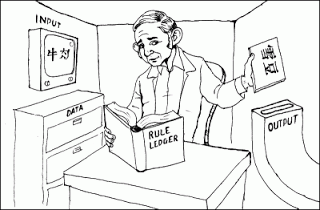
Philosophers argue that this understanding is a highly convincing illusion. In his famous “Chinese Room” thought experiment, philosopher John Searle argued that a computer processing language is like a person locked in a room who has a rulebook for matching Chinese characters. The person can pass out perfect answers through a slot without understanding a single word of Chinese. Similarly, AI possesses syntax, which is the rules of arranging symbols, but completely lacks semantics, which is the actual meaning behind the symbols themselves.
This echoes a prediction made nearly 400 years ago by René Descartes. In his Discourse on Method, Descartes argued that while a machine might be made to utter words, it could never “arrange them differently to reply to the sense of all that is said in its presence.” For Descartes and Searle, true intelligence is not just output; it is the internal spark of understanding, which is a spark AI has yet to ignite.
If intelligence is simply about processing data, surely creativity remains the exclusive domain of the human soul? Yet, generative AI tools now produce hauntingly beautiful paintings and symphonies in seconds.
Here, the distinction becomes more subtle. Ada Lovelace, the 19th-century mathematician often celebrated as the first computer programmer, famously objected that a machine “has no pretensions whatever to originate anything. It can do whatever we know how to order it to perform.” Her point remains relevant today, as AI does not create from inspiration; it creates from statistical probability and recognition of patterns from training.

Cognitive scientist and philosopher Margaret Boden refines this by distinguishing between “exploratory” creativity (exploring a structured space, which AI excels at) and “transformational” creativity (breaking the rules to create entirely new paradigms). While an AI can seamlessly mimic the brushstrokes of Van Gogh, it cannot experience the psychological torment that drove him to paint the stars. It generates art without the “lived experience” that gives art its cultural resonance.
The final and most defensible frontier is consciousness—the subjective quality of “feeling” alive. In his seminal 1979 work Moral Questions, Serbian-American philosopher Thomas Nagel famously asked, “What is it like to be a bat?” He argued that an organism has conscious mental states only if there is something that it is like to be that organism.
Currently, there is absolutely nothing it is “like” to be a server farm. AI may process data about pain, but it does not suffer. This leads to what David Chalmers calls the “Hard Problem” of consciousness: explaining how physical processes in the brain, or a computer chip, give rise to subjective experience. Until AI can feel the sting of mortality or the warmth of joy, it remains what philosophers call a “zombie,” a being that behaves exactly like us but lacks the inner light of experience.

Perhaps the real danger is not that AI becomes human, but that humans begin to treat themselves like machines. The German philosopher Martin Heidegger warned of technology as “enframing” (Gestell), a mindset that turns everything, including nature and humanity, into “standing reserve” (Bestand), or resources to be optimized.
If we define ourselves merely by our data-processing utility, we risk viewing our own lives as technical problems to be solved rather than mysteries to be lived. We become “human resources” in the literal sense, measured only by our efficiency, a game we will inevitably lose to our silicon creations.
AI will not erase what it means to be human; it will force humans to purify the definition. For centuries, we prided ourselves on being “thinking machines.” Now that we have built actual thinking machines, we are free to discover what else we can be.
We are finding that our humanity lies not in our ability to calculate, but in our capacity to care. As philosopher Hubert Dreyfus argued, intelligence is inherently embodied, as it arises from our physical fragility and our stakes in the world. A machine has no mortality to fear, no heart to break, and no hand to hold. In the age of AI, being human may no longer be about being the smartest entity in the room, but about being the only one that can truly feel the weight of existence.
Leave a Reply