Throughout human history, philosophers have attempted to determine the best way to promote intellectual freedom and allow individuals to break free from intellectual oppression and increase their enlightenment levels. In their analysis of these questions, philosophers have developed numerous different theories that have been applied over time. The merits of various philosophical views are debated intensely among scholars, with some ideas accepted, and others ultimately becoming discredited as society changes, and new facts about life are discovered. An example of a philosopher who explored these ideas was Plato, a Greek philosopher who is largely considered one of the founding figures in Western philosophical thought. Plato first explored how philosophy promotes freedom and intellectual curiosity in The Allegory of the Cave, a section in his philosophical treatise The Republic. The Allegory of the Cave illustrates the human situation as a parable about ignorance and learning.
Plato begins his discussion in The Allegory of the Cave by describing the condition of human ignorance as akin to prisoners living in a cave deep underground with the inability to move freely within the cave. The cave is also mentioned as devoid of all forms of visible light. The only form of visible light in the cave is a fire that reflects the shadows from objects and individuals passing by onto the cave walls. Additionally, the echo inherent to the cave results in the sounds of individuals or objects either passing the cave or inside the cave to be reflected. This would result in the prisoners to talk to the shadows even though the shadows are not real. As such, the prisoners’ reality is only the reflection of the shadows and the echoes of their voices and other sounds.
Plato next discusses what might happen when the former prisoner decides to leave the cave for the first time. The fact that the individual has to climb from the bottom part of the cave to higher ground is akin to the fact that the pursuit of knowledge often places an individual at a higher level of consciousness and increases their level of clarity regarding society and the world in general. Once outside of the cave, the former prisoner is also described to have their eyes blinded by the light from the sun. The fact that the sunlight burns the eyes of the former prisoner may also be an illusion to the fact that newfound knowledge at times can be overwhelming for an individual and result in their initial rejection of new knowledge. Once they are at the outside world and accustomed to numerous facets of life, the former prisoner will begin to realize that the reality they experienced in the cave is false.
Plato is correct in saying that educated people are treated as outcasts by other individuals who lack education or the initiative to pursue higher knowledge and wisdom levels. Societal institutions such as the educational system and the media at their core do not value critical thinking and critical analysis. Instead, it emphasizes presenting facts in such a manner that prevents individuals from questioning the nature of reality and the way life works. In turn, these societal institutions reinforce oppression and allow the status quo to continue without a critical examination of its very nature. Through the exposure to new ideas and concepts, a person accustomed to the structure created through societal institutions will soon realize that there is more to life than what they previously understood. By taking their newfound perspectives on life and applying to their thought processes, an individual, in effect, is challenging the status quo and many of the perceptions that numerous individuals hold. As such, they will be considered by society as outcasts and non-conformists due to their questioning the information they have been taught from an early age.
In conclusion, the importance of philosophy is discussed by Plato in The Allegory of the Cave. By explaining the pursuit of knowledge through the perspective of an individual escaping from imprisonment in a dark cave and journeying to the outside world, Plato is promoting the belief that intellectual curiosity and critical thinking is akin to liberating oneself from the chains of societal oppression and earning a newfound level of freedom. Additionally, by stating that the former prisoner will be looked at in a negative light by the remaining prisoners assuming that he travels back to the cave, Plato is pointing to the fact that society itself does not value intellectual curiosity and tends to view individuals who value the traits of knowledge and wisdom as non-conformists who will question the most basic elements of societal fabric.
Two lawmakers introduced a bipartisan measure on August 25 condemning the ring-wing conspiracy theory QAnon a week after President Donald Trump said the theory’s followers “like me very much” and QAnon-linked candidates won Republican congressional primary races across the country. Congressmen Tom Malinowski (D-NJ), and Denver Riggelman (R-VA), said their bill would make it clear the debunked conspiracy theory had no place in the American political mainstream. “Conspiracy theories that falsely blame secret cabals and marginalized groups for the problems of society have long fueled prejudice, violence and terrorism,” Malinowski said. “QAnon and the conspiracy theories it promotes are a danger and a threat that has no place in our country’s politics,” said Riggelman, who lost a Republican primary this year. The measure would condemn QAnon; ask federal law enforcement agencies to remain vigilant against violence provoked by conspiracy theories; and urge Americans to get information from trustworthy sources. The measure must first pass the House Judiciary Committee before it can be considered by the full House of Representatives.
The QAnon conspiracy theory, which the FBI has called a domestic terrorism threat, is based on unfounded claims that there is a “deep state” apparatus run by political elites, business leaders and Hollywood celebrities who are also pedophiles and actively working against President Donald Trump. The measure cites several incidents where QAnon adherents were linked to crimes they claimed were inspired by their beliefs, including the 2018 arrest of a man who plotted to plant a bomb in the Illinois Capitol Rotunda to raise awareness of the conspiracy theory. Political leaders have denounced the conspiracy theories. House Minority Leader Kevin McCarthy said on Fox News last week, “There is no place for QAnon in the Republican Party.” And White House Press Secretary Kayleigh McEnany dismissed the idea last week that the President supported the theory.
Despite the negative overall reaction to the QAnon conspiracy theory, several QAnon-linked candidates have nevertheless won Republican congressional primaries this year. One candidate, Marjorie Taylor Greene, is likely to win the general election in her staunchly Republican district in northwestern Georgia. President Donald Trump called her a “future Republican Star” in a Twitter Post after her primary win, though Press Secretary Kayleigh McEnany told reporters Trump had not “done a deep dive into the statements” of Greene. President Trump said at his press briefing on August 19 that he did not know much about QAnon other than that “they like me very much, which I appreciate.” “These are people that don’t like seeing what’s going on in places like Portland, Chicago and New York and other cities and states,” he told reporters. “I’ve heard these are people that love our country.” When a reporter further explained the theory to Trump, including the belief that Trump is secretly saving the world from a satanic cult of pedophiles and cannibals, Trump responded: “Is that supposed to be a bad thing? If I can help save the world from problems I’m willing to do it, I’m willing to put myself out there.”
Congratulations to future Republican Star Marjorie Taylor Greene on a big Congressional primary win in Georgia against a very tough and smart opponent. Marjorie is strong on everything and never gives up – a real WINNER!
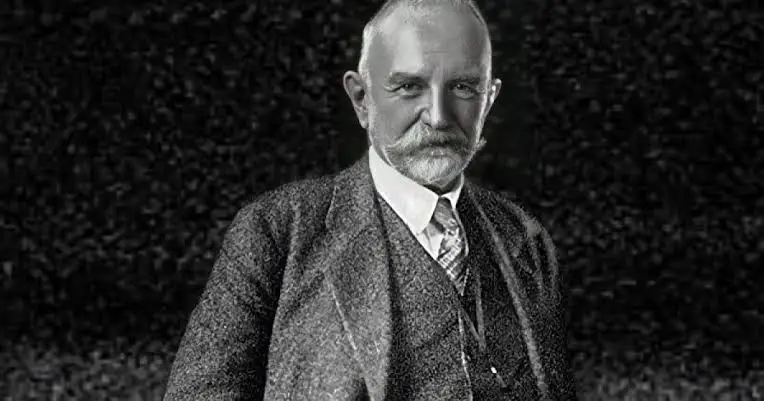
George Herbert Mead (1863-1931) is a major figure in Philosophy and (along with Willam James and John Dewey), is one of the founders of Pragmatism, a philosophical approach based on experimentation. Mead published numerous articles during his lifetime and several of his students produced four books in his name from his unpublished notes and stenographic records of his courses at the University of Chicago. Through his teaching, writing, and posthumous publications, Mead has exercised a significant influence in 20th Century social theory. Mead’s theory of the emergence of mind and self out of the social process of significant communication has become the foundation of the symbolic interactionist school of thought in philosophy.
George Herbert Mead is most well known for his theory of the self, which was presented in the 1934 book Mind, Self, and Society (published posthumously and edited by Charles W. Morris). Mead’s theory of personal identity maintains that the conception a person holds of themselves in their mind emerges from social interaction with others. This concept goes directly against the concept of biological determinism because it holds that an individual’s traits are not present at birth or fully present at the beginning of a social interaction, but are constructed and reconstructed in the process of social experience and activity.
George Herbert Mead believed in interaction based on symbols and hypothesized that we do not know who we are until we interact with other people
The self, according to Mead, is made of two components: the “I” and the “me.” The “me” represents the expectations and attitudes of others (the “generalized other”) organized into a social self. From this point, the individual defines their own behavior with reference to the generalized attitude of the social groups they occupy. When the individual can view himself or herself from the standpoint of the generalized other, self-consciousness in the full sense of the term is attained. From this standpoint, the generalized other (internalized in the “me”) is the major instrument of social control, for it is the mechanism by which the community exercises control over the conduct of its individual members. On the other hand, the “I” is the response to the “me,” or the person’s individuality.
Within Mead’s theory, there are three activities through which the self is developed (language, play, and game). Language allows individuals to take on the “role of the other” and allows people to respond to his or her own gestures in terms of the symbolized attitudes of others. During play, individuals take on the roles of other people and pretend to be those other people in order to express the expectations of significant others. This process of role-playing is key to the generation of self-consciousness and to the general development of the self. In the game, the individual is required to internalize the roles of all others who are involved with him or her in the game and must comprehend the rules of the game.
Mead theorized that human beings begin their understanding of the social world through “play” and “game”. The “play” stage comes first in the child’s development. The child takes different roles they observe in society and play them out to gain an understanding of the different social roles. As a result, the child learns to become both subject and object and begins to become able to build a self. However, this is a limited self because the child can only take the role of distinct and separate others and still lack a more general and organized sense of themselves. In the game stage, a person is required to develop a full sense of self. Whereas in the play stage the child takes on the role of distinct others, in the game stage, the child must take the role of everyone else involved in the game. Furthermore, these roles must have a definite relationship to one another.
In the game stage, some form of social organization begins and defined personalities start to emerge. Individuals begin to become able to function in organized groups and determine what they will do within a specific group. Mead calls this the child’s first encounter with the “generalized other.” The “generalized other” can be thought of as understanding the given activity and the actors’ place within the activity from the perspective of all the others engaged in the activity. Through understanding the “generalized other” the individual understands what kind of behavior is expected and appropriate in different social settings.
It has been argued that social acts (such as games and routine forms of social interaction) enable perspective taking through ‘position exchange’ Assuming that games and routine social acts have differentiated social positions and that these positions create our cognitive perspectives, then it might be that by moving between roles in a game, we come to learn about the perspective of the other. This new interpretation of Mead’s account of taking the perspective of the other has experimental support.
In addition to his contributions in the realm of social philosophy, Mead is well known for his work on the philosophy of science. Mead sought to find the psychological origin of science in the efforts of individuals to attain power over their environment. The notion of a physical object arises out of a manipulatory experience. There is a social relation to inanimate objects, for the organism takes the role of things that it manipulates directly, or that it manipulates indirectly in perception. For example, in taking the resistant role of a solid object, an individual obtains cognition of what makes up nonliving things. Historically, the concept of the physical object arose from an animistic conception of the universe.
Contact experience includes experiences of position, balance, and support, and these are used by the organism when it creates its conceptions of the physical world. Our scientific concepts of space, time, and mass are abstracted from manipulatory experience. Such concepts as that of the electron are also derived from manipulation. In developing a science we construct hypothetical objects in order to assist ourselves in controlling nature. The conception of the present as a distinct unit of experience, rather than as a process of becoming and disappearing, is devised to facilitate exact measurement. In the scientific worldview, immediate experience is replaced by theoretical constructs. The ultimate in experience, however, is the manipulation and contact at the completion of an act.
One of the most influential figures on Western philosophical thought was Immanuel Kant (1724-1804), a German philosopher active during the 18th Century. Kant’s contributions to the fields of metaphysics, epistemology, ethics, and aesthetics (four of the main branches of philosophy) have had a profound impact on almost every philosophical movement that followed him. Throughout his works, Kant argued that
the human mind creates the structure of human experience,
that reason is the source of morality,
that aesthetics arises from a faculty of disinterested judgment,
that space and time are forms of human sensibility,
and that the world as it is “in-itself” is independent of humanity’s concepts of it.
In terms of politics, Kant was one of the earliest proponents of the idea that political peace and stability could be achieved through international cooperation and worldwide democracy and believed that such a situation would be the eventual outcome of universal history.
One of the main areas in which Immanuel Kant left his mark on was in the realm of Deontological Ethics. Derived from the word deon (“duty” in Greek), this ethical theory holds that there is an innate aspect to a given moral rule that makes it either good or bad. Thus, Kantian/Deontological ethical theory is based on established definitions of morality. The main aspect of Kant’s theory was the Categorical Imperative.
Immanuel Kant defined an imperative as any proposition that declares a certain action (or inaction) to be necessary. A hypothetical imperative would compel action in a given circumstance (if I wish to satisfy my thirst, then I must drink something). A categorical imperative would denote an absolute, unconditional requirement that exerts its authority in all circumstances, both required and justified as an end in itself.
He argued that the “highest good” must be both intrinsically good (good “in itself”), and good without qualification (when the addition of that thing never makes a situation ethically worse). He concluded that there is only one thing that is truly good: a goodwill chosen out of a feeling of moral duty. From this concept of duty, Kant derived what he called a categorical imperative, a principle that is intrinsically valid (good in and of itself), and that must be obeyed in all situations and circumstances if our behavior is to observe moral laws. He considered it an unconditional obligation, regardless of our will or desires, and regardless of any consequences which might arise from the action. He also believed that if an action is not done with the motive of duty, then it is without moral value and therefore meaningless.
Act only in such a way that you would want your actions to become a universal law, applicable to everyone in a similar situation.
Act in such a way that you always treat humanity (whether oneself or other), as both the means of an action, but also as an end.
Act as though you were a law-making member (and also the king) of a hypothetical “kingdom of ends”, and therefore only in such a way that would harmonize with such a kingdom if those laws were binding on all others.
The idea of Deontological Ethics as proposed by Immanuel Kant is not without its share of critics, in particular, proponents of Libertarian philosophy, as well as the idea of Utilitarianism are opposed to the theory. The Libertarian philosopher Robert Nozick points out that Deontology forbids some acts that maximize welfare overall. The example used is that of a trolley hurtling towards five innocent and immobile people at the end of a track, where the only way to stop the trolley and save the five is to throw one innocent bystander in front of the trolley. The Principle of Permissible Harm in Deontology rules out deliberately throwing a person in front of the trolley, but the consequence of that is that five innocent bystanders die (which also contravenes the Principle of Permissible Harm).
Proponents of Utilitarianism such as Jeremy Bentham have criticized Deontology on the grounds that it a version of popular morality, and that the objective and unchanging principles that deontologists attribute to natural law or universal reason are really just a matter of subjective opinion. John Stuart Mill argued that deontologists usually fail to specify which principles should take priority when rights and duties conflict, so that Deontology cannot offer complete moral guidance. Mill also criticized Kant’s claims for his Categorical Imperative, arguing that it is really just another way of saying that the ends justify the means, which is essentially a consequentialist argument.
One of the most significant political theorists in recent memory is Noam Chomsky. Noam Chomsky is known for his contributions to linguistics, philosophy, history, and political discourse. Most notably, Chomsky is a proponent of the political ideologies of Anarchism and Anarcho-syndicalism, which are critical of centralized governmental and societal institutions and call for decentralized power structures. Chomsky was influenced by many sources ranging from philosophers such as William Goodwin to political theorists and economists such as Karl Marx. Anarchism and Anarcho-syndicalism are two political theories that are not widely explored by mainstream political theorists and philosophers. Despite the lack of understanding behind both theories, Noam Chomsky continues to have an influence on politics at all levels and is widely considered to be one of the most influential political theorists of the last few decades.
Noam Chomsky was born in Philadelphia on December 7, 1928. Chomsky grew up during the depths of the Great Depression alongside his younger brother David in a middle-class family. During his upbringing, Chomsky witnessed massive worker strikes and substantial political reform pushed forward by the government at all levels. His mother, Elsie Chomsky had been involved in the radical politics of the time and was a noted political activist within their community. Chomsky attended a progressive school and wrote a well-researched paper on the Spanish Civil War at the age of 10. Additionally, Chomsky was influenced politically by his uncle, who owned a newsstand where politics were frequently discussed.
At the age of 16, Chomsky graduated high school and soon enrolled at the University of Pennsylvania, where he excelled in classes in diverse subjects such as linguistics, philosophy, and mathematics. During his time at the University of Pennsylvania, Chomsky read works by figures such as Nathan Fine, Nelson Goodman, and W. V. Quine. These experiences made Chomsky come to the conclusion that human language was innate in every human’s mind and that language is influenced by the environment and evolves accordingly. Chomsky’s master’s thesis The Morphophonemics of Modern Hebrew focused on the evolution of language. Chomsky eventually received his Ph. D from the University of Pennsylvania in 1955 and began teaching at MIT a year later. During this period, Chomsky became known for works such as the Aspects of the Theory of Syntax and several linguistic theories such as “extended standard theory”, “generative” and “transformational” theories.
Noam Chomsky, circa 1967, in an interview discussing The Responsibility of Intellectuals.
By the 1960s, Chomsky began to make his mark as a political activist due to his opposition to US involvement in the Vietnam War and staunch support for the Civil Rights Movement. In his 1967 essay The Responsibility of Intellectuals, Chomsky denounced the aggressive nature of American foreign policy throughout the world and spoke of the need for the intellectual community to come together to challenge the status quo American foreign policy. Additionally, Chomsky is further known for his book Manufacturing Consent, in which he criticizes American Media as biased and siding with US power structures. Chomsky’s criticisms of the American political system are rooted in the fact that the distribution of power within the US is biased in favor of the wealthiest and most powerful individuals. As a result of such factors, Chomsky has made his life’s work to side with the oppressed and focusing on how different factors such as media coverage impact this unequal balance of power. Chomsky is still active in worldwide political discourse and is frequently interviewed on a diverse array of topics, ranging from political theory to linguistics, to philosophy.
Human Nature
The early 20th Century Russian anarchist Peter Kropotkin is one of the main figures who influenced Noam Chomsky’s political philosophy.
Noam Chomsky’s view on human nature is unique in the realm of philosophy. Chomsky believes that humans are innately linked with the natural work. Additionally, Chomsky believes that genes influence any organism, just like bees or geese, and that there are outside factors that enter into any organisms growth and development. Three important factors being the genetic composition, environmental effect, and lastly the way the laws of nature work. Chomsky also notes that there are fundamental roots in human nature and cites the idea of mutual aid. As discussed by the Russian philosopher Peter Kropotkin in the 1902 book Mutual Aid A Factor of Evolution, mutual aid is the voluntary exchange of resources and services for mutual benefit. Chomsky applies this concept to humans to explain why individuals build communities to help each other survive and defend ourselves from outside threats. Chomsky also discusses how many people form their view of human nature from religion and how that can mislead in the fact that we just don’t know have much certainty in human nature. Chomsky believes there must be some kind of framework for mortality and altruism as a base. Chomsky follows and favors the Humboldtian concept of how language forms and how it is a generative process which people use words in an “infinite use of finite means.” This concept views language as more plastic and changing all the time. The change is how we view words and how we interpret our lives with language.
Anarchism and Anarcho-syndicalism?
Pierre-Joseph Proudhon is one of the founders of Anarchist political thought.
Noam Chomsky is known for his views on Anarchism and Anarcho-syndicalism. Anarchism is the idea of being free and separated from a large federal government. The founder of Anarchist political thought is considered to be Pierre-Joseph Proudhon, a 19th-century French political writer, and socialist. Proudhon argued that the real laws of society have nothing to do with authority but rather stem from the nature of society itself. Additionally, he foresaw the eventual dissolution of authority and the emergence of a natural social order.” Proudhon thinks of a society that is organized on an egalitarian basis, with difficult tasks diffused throughout society. This society would also be based on decentralized communities of worker associations and small communities. Decisions and other activities are done in cooperation and common interest rather than laws. Proudhon also rejected Parliamentary systems as ineffective. Another contributor to Anarchist political theory is William Goodwin, an English philosopher active during the late 18th and early 19th centuries. Goodwin argued that governmental authority inherently goes against human nature and that social evils exist solely because people cannot act according to reason. As a solution to this predicament, Goodwin feels that a decentralized society of small communities is far more effective in promoting societal peace and stability.
The Israeli kibbutz system is considered to be a possible societal model according to Noam Chomsky.
Noam Chomsky explored this theme in his book On Anarchism. In the book, Chomsky discusses the concept of the kibbutz, a communal form of living seen in many Jewish communities in Israel, where people are highly interdependent and live communally in small villages. The problems of isolation and huge social stigma if you do something wrong on the kibbutz is terrible. It will destroy you if you stray to much from the community. But in Chomsky’s view, it is not perfect and needs to be worked out. Despite his view that collectivism is in many ways beneficial to society as a whole, Noam Chomsky is critical of Marxist political thought. Although Chomsky views Marxism as enabling individuals to reach the point in which they can solve their problems in an effective manner, he also feels that Marxism is, at times, an authoritarian ideology that directly against the ideas of Anarchism such as opposition to centralized power.
Here is an interesting quote discussion Chomsky’s view on Marxism:
“Actually, I’m not a great ethousists of Marx, but what he one comment he made seems appropriate here. I’m quoting him… but somewhere or other he said: socialism is an effort to try to solves man’s animal problems, and after having solved the animal problems, then we can face the human problems..socialism is an effort to get you to the point where you can face human problems”.
Throughout his writings, Noam Chomsky shows contempt for the modern system of capitalism, viewing it as an imperfect and flawed system, Much like with all systems and societal structures, Chomsky feels that the capitalist system can be improved through experimentation, but that a system based on Anarchism is perhaps the system that should be the goal of society to eventually move towards. William Goodwin, an English Anarchist, makes classical anarchist arguments that authority is against human nature and that social evil exists because people cannot act according to reason which is why a decentralized society of small communities is more natural and more effective. Chomsky belief of working inside the system (liberal reform) and radically changing the system (Marxist), can be confusing and at times hard to understand.
The Economic, The Political and the Social
Noam Chomsky is a self-described Anarcho-Syndicalist and is sympathetic to many of the ideas promoted in Libertarian Socialism. Chomsky wrote On Anarchism which discussed many of his thoughts on Anarchism, as well as the ideas unique to his own political philosophy. Chomsky’s works have been influenced by many different political perspectives, ranging from the more radical perspectives such as Marxism to Libertarianism. Chomsky was highly influenced by Anarchist theorists such as Goodwin and Proudhon. Chomsky does not believe there is a contradiction between pursuing certain reforms such as social welfare programs and single-payer health care systems that expand state power but benefit the public, to long-term implementation of increasingly Democratic institutions over time that gives workers more power until the point of system overthrow. The view held by Chomsky is that power is inherently evil in nature and that the federal government, while holding much power and often being illegitimate in terms of its overall structure, serves the purposes of protecting people from rampant, unregulated capitalism. An example of this philosophy could be the EPA stopping General Motors from poisoning rivers in Michigan, it would be very difficult for average citizens to undertake that. While the federal government structure, a tyranny in itself might be illegitimate, a private tyranny is worse and can only be checked by the power of a strong and active federal government.
In order to illustrate this point, Noam Chomsky uses an interesting metaphor:
“I’m not in favor of people being in cages. On the other hand I think people ought to be in cages if there’s a saber-toothed tiger wandering around outside and if they go out of the cage the saber-toothed tiger will kill them. So sometimes there’s a justification for cages. That doesn’t mean cages are good things. State power is a good example of a necessary cage. There are saber-toothed tigers outside; they are called transnational corporations which are among the most tyrannical totalitarian institutions that human society has devised. And there is a cage, namely the state, which to some extent is under popular control. The cage is protecting people from predatory tyrannies so there is a temporary need to maintain the cage, and even to extend the cage”.
Chomsky points to a broad range of examples for a basic moral philosophy that seems self-evident to people around the world on issues that directly affect them. This is a very bare bones again, not a judgment on human nature as good but having some kind of structure. Something similar to the golden rule appears in many societies and a conceptualization of right and wrong that does not allow for some level of abuse. An example could be small peasant farmers in Guatemala condemning Nestle for buying up their water supply, which results in water shortages and an angry. He would say that is a human reaction to something perceived as an unfair use of resources that belong to the community. Chomsky often points on examples of corporate greed in his works and how people believe it is immoral. A company like Exxon spilling thousands of barrels of oil into the ocean and getting to write it off for taxes and some years not paying taxes, as one of the largest corporations of the world, he would say humans naturally believe something like that is inherently unfair and wrong.
Chomsky has largely favored worker coops and companies like the Mondragon Corporation in Spain which came out of the period of Spanish Civil War in the 1930s. Chomsky views worker coops, or worker councils, workers managing the company and often owning the company equally as a style of capitalism to push as a short-term solution. Gar Alperovitz is considered similar where he has been helping create worker coops in Ohio. Chomsky is not in favor of capitalism nor is he in favor of markets. He often cites the fact that true markets do not exist and that when markets do exist, companies are often heavily subsidized or there is little to no competition. An example of this in the realm of international politics would be third world nations being prevented by larger powers from developing and having to rely on outside powers to subsidize them and provide them only a meager existence. Chomsky is critical of Neo-liberalism and its policies across the globe, noting that these politicians do little more than enrich the power elite at the expense of poor and vulnerable people. Instead, Chomsky favors a model based in part on Contemporary Liberalism because it does far more to help ordinary people throughout the world and helps to equalize the distribution of power and resources.
Here is an example of Noam Chomsky discussing the negative effects of Neo-liberal economic policies after the 2008 economic crisis:
“So, for example, Fed Chairman Alan Greenspan, at the time when he was still “Saint Alan” – hailed by the economics profession as one of the greatest economists of all time (this was before the crash for which he was substantially responsible) – was testifying to Congress in the Clinton years, and he explained the wonders of the great economy that he was supervising. He said a lot of its success was based substantially on what he called “growing worker insecurity”. If working people are insecure, if they’re part of the precariat, living precarious existences, they’re not going to make demands, they’re not going to try to get better wages, they won’t get improved benefits. We can kick ’em out, if we don’t need ’em. And that’s what’s called a “healthy” economy, technically speaking. And he was highly praised for this, greatly admired”.
As noted above, “worker insecurity’ is the main theme in Chomsky’s philosophy, where you cannot always seek perfect solutions you seek better ones than neoliberal policies. Authors like Naomi Klein who wrote The Shock Doctrine emphasizes a similar philosophy of how neoliberalism uses various tools to unfairly rig markets to favor often the rich and powerful people. The book emphasizes how neoliberal policies are used to smash economies and push in policies that normally wouldn’t be put into place through “shock and awe”. She brings up the takeover of charter schools after Hurricane Katrina in New Orleans, where “The Friedmanite American Enterprise Institute enthused that “Katrina accomplished in a day … what Louisiana school reformers couldn’t do after years of trying”, meaning privatize the school systems, which was largely against what the public had previously wanted. Chomsky has seen the transitions from the New Deal to the Clinton years of NAFTA, which he views as very different forms of capitalism requiring different approaches to understand.
Chomsky gives a definition of patriotism that states:
“For those whose instincts are democratic rather than totalitarian, “patriotism” means commitment to the welfare and improvement of the society, its people, its culture. That’s a natural sentiment and one that can be quite positive. It’s one all serious activists share, I presume; otherwise why take the trouble to do what we do? But the kind of “patriotism” fostered by totalitarian societies and military dictatorships, and internalized as second nature by much of intellectual opinion in more free societies, is one of the worst maladies of human history, and will probably do us all in before too long”.
Noam Chomsky views patriotism (depending on the tendency of individuals) as having the potential to do good, often in democratic and local levels, rather than the national level. The view he has of nationalism is highly critical of American foreign policy, which is what he calls jingoistic, especially in the post-9/11 world. Foreign policy should be more measured in Chomsky’s opinion and less focused on the use of force for private gain and instead more on cooperation. Many anarchists and Marxists leaning philosophers have had similar sentiments on war and many were locked up during World War I, the most famous being the 1912 and 1920 Socialist Party Presidential candidate Eugene Debs.
In conclusion, Noam Chomsky is one of the most influential political theorists and philosophers in recent memory and is a leading intellectual force on many different topics. Chomsky is known for promoting the political theories of Anarchism and Anarcho-syndicalism, which are critical of state power and favor a more decentralized power structure based in part on voluntary institutions. Chomsky holds a philosophy that brings truth to power, stands up for the oppressed, and is rooted in diverse intellectual traditions. Noam Chomsky promotes his ideas through numerous writings on topics such as economics, philosophy, American foreign policy, and political theory. Moreover, Chomsky’s political views were shaped in part by events such as the Vietnam War, the Civil Rights Movement, and the rise in Neo-liberal economic policies during the last few decades of the 20th Century. Chomsky’s political philosophy still remains influential to this very day in the realm of Anarcho-syndicalism and will continue to influence future generations of political scientists and activists alike.
Bibliography
Albert, Michael. “Science, Religion & Human Nature – The Chomsky Sessions – (2).” YouTube. February 2010. Accessed March 01, 2018.https://www.youtube.com/watch?v=f02gcRrdK2I.
Chomsky, Noam. “A Conversation with Noam Chomsky on Organizing for a Next System.” TheNextSystem.org. March 24, 2016. Accessed March 01, 2018. https://thenextsystem.org/conversation_with_noam_chomsky.
Chomsky, Noam. Chomsky on Anarchism. New York City, NY: The New Press, 2013.
Chomsky, Noam, and Carlos Peregrín Otero. Language and politics. Edinburgh: AK Press U.K., 2004.
Chomsky, Noam. “Noam Chomsky on Patriotism.” Noam Chomsky on Patriotism. November 11, 2002. Accessed March 01, 2018. http://www.serendipity.li/wot/nc_patrio.htm.
Chomsky, Noam. “Old Wine in New Bottles: A Bitter Taste Noam Chomsky.” Old Wine in New Bottles: A Bitter Taste. June 1996. Accessed March 01, 2018.https://chomsky.info/199606__/.
Chomsky, Noam. “Plutonomy and the Precariat: On the History of the US Economy in Decline.” France Al Jazeera. May 16, 2012. Accessed March 01, 2018. https://www.aljazeera.com/indepth/opinion/2012/05/201251114163762922.html.
Chomsky, Noam. The Responsibility of Intellectuals. New York: The New Press, 2017.
Clark, John P. The Philosophical Anarchism of William Godwin. Princeton: Princeton Legacy Library, 2015.
Clark, John P. “What is Anarchism?” Nomos 19 (1978): 3-28. http://bluehawk.monmouth.edu:2083/stable/24219036.
Edgley, Alison. Social and Political Thought of Noam Chomsky. Hoboken: Taylor and Francis, 2013.
Miller, Martin A., George Woodcock, Arif Dirlik, and Franklin Rosemont. “Anarchism.” Encyclopaedia BritanGeorge nica. December 20, 2017. Accessed March 01, 2018. https://www.britannica.com/topic/anarchism.
Noland, Aaron. “Pierre-Joseph Proudhon: Socialist as Social Scientist.” The American Journal of Economics and Sociology 26, no. 3 (1967): 313-28.http://bluehawk.monmouth.edu:2083/stable/3485528.
Noland, Aaron. “Pierre-Joseph Proudhon: Socialist as Social Scientist.” The American Journal of Economics and Sociology 26, no. 3 (1967): 313-28. http://bluehawk.monmouth.edu:2083/stable/3485528.
O’Neill, Ben. “On “Private Tyrannies” .” Mises Institute. January 22, 2009. Accessed March 01, 2018. https://mises.org/library/private-tyrannies#_ftn12.
Sofroniou, Andrea. International Law, Global Relations, World Powers. S.l., NY: Lulu Com, 2017.
“The Shock Doctrine.” The Shock Doctrine: An Excerpt From the Introduction Naomi Klein. 2008. Accessed March 01, 2018. http://www.naomiklein.org/shock-doctrine/excerpt.
Philosophy (literally meaning “love of wisdom” in Greek) is the study of general and fundamental queries concerning matters such as existence, knowledge, values, reason, mind, and language. The term was coined by Pythagoras of Samos (570–495 BCE), an early Greek philosopher known for his founding of the Pythagoreanism movement. Philosophical methods include questioning, critical thinking, rational argument, and systematic presentation of the evidence to back up any and all arguments. Classic philosophical questions include “is it possible to know anything and to prove it? and “what is most real? Philosophers also devise practical and concrete answers pertaining to questions such as the proper way to live one’s life, the nature and extent of free will, and how to be a moral and virtuous person.
Metaphysics (Study of Existence)
Metaphysics is the branch of philosophy responsible for the study of existence. It is the foundation of a worldview. It answers the question “What is?” It encompasses everything that exists, as well as the nature of existence itself. It says whether the world is real, or merely an illusion. It is a fundamental view of the world around us.
One can argue that Metaphysics is the foundation of philosophy and critical thinking. Without an explanation or an interpretation of the world around us, we would be helpless to deal with reality. We could not feed ourselves, or act to preserve our lives. The degree to which our metaphysical worldview is correct is the degree to which we are able to comprehend the world and act accordingly. Without this firm foundation, all knowledge becomes suspect. Any flaw in our view of reality will make it more difficult to live.
Ethics (Study of Action)
Ethics is the branch of study dealing with what is the proper course of action for a person to take. It answers the question, “What do I do?” It is the study of right and wrong in human endeavors. At a more fundamental level, it is the method by which we categorize our values and pursue them. Do we pursue our own happiness, or do we sacrifice ourselves to a greater cause? Is that foundation of ethics based on the Bible, or on the very nature of man himself, or neither?
Ethics is a requirement for human life. It is our means of deciding a course of action. Without it, our actions would be random and aimless. There would be no way to work towards a goal because there would be no way to pick between a limitless number of goals. Even with an ethical standard, we may be unable to pursue our goals with the possibility of success. To the degree in which a rational ethical standard is taken, we are able to correctly organize our goals and actions to accomplish our most important values. Any flaw in our ethics will reduce our ability to be successful in our endeavors.
Aesthetics (Study of Art)
Aesthetics is the study of art. It includes what art consists of, as well as the purpose behind it. Does art consist of music, literature, and painting? Or does it include a good engineering solution or a beautiful sunset? These are the questions that are asked in Aesthetics. It also studies methods of evaluating art and allows individuals to make judgments of the piece of art in question. Is art in the eye of the beholder? Does anything that appeals to an individual fit under the umbrella of art? Or does it have a specific nature? Does it accomplish a goal?
Aesthetics is important because art in some form or another has existed through most of recorded human history. It is unique to humans because of our unique form of thinking. Its importance is based on this nature, specifically, man’s ability to abstract. Art is a little-understood tool of Man to bring meaning to abstract concepts. Aesthetics is important because it delves into the reason why art has always existed, the burning need of mankind through the ages to see the world in a different, clear way. It further evaluates art by the standard of human life, and whether it accomplishes the job of satisfying man’s intellectual needs, or whether it tends to hurt or make worse those needs.
Epistemology (Study of Knowledge)
Epistemology is the study of our method of acquiring knowledge. It answers the question, “How do we know?” It encompasses the nature of concepts, the construction of concepts, the validity of the senses, logical reasoning, as well as thoughts, ideas, memories, emotions, and all things mental. It is concerned with how our minds are related to reality, and whether these relationships are valid or invalid.
Epistemology is an explanation of how we think. It is required in order to be able to differentiate the true from the false, by determining a proper method of evaluation. It is needed in order to use and obtain knowledge of the world around us. Without epistemology, we could not think. More specifically, we would have no reason to believe our thinking was productive or correct, as opposed to random images flashing before our minds. With an incorrect understanding of epistemology, we would not be able to distinguish truth from error. The consequences are obvious. The degree to which our epistemology is correct is the degree to which we could understand reality and the degree to which we could use that knowledge to promote our lives and goals. Flaws in epistemology will make it harder to accomplish anything.
Logic (Study of Reasoning)
Logic is the study of reasoning or the study of the principles and criteria of valid inference and demonstration. It attempts to distinguish good reasoning from bad reasoning. Logic investigates and classifies the structure of statements and arguments, both through the study of formal systems of inference and through the study of arguments in natural language. It deals only with propositions (declarative sentences) that are capable of being true and false. It is not concerned with the psychological processes connected with thought, or with emotions, images, and the like. It covers core topics such as the study of fallacies and paradoxes, as well as specialized analysis of reasoning using probability and arguments involving causality and argumentation theory.
Any logical argument or statement should contain three of the following things:
consistency (none of the theorems of the system contradict one another);
soundness (the system’s rules of proof will never allow a false inference from a true premise); and
completeness (which means that there are no true sentences in the system that cannot, at least in principle, be proved in the system).
Logic can be divided into Formal Logic, Informal Logic, Symbolic Logic, and Mathematical Logic. Formal Logic is what we think of as traditional logic or philosophical logic, namely the study of inference with purely formal and explicit content Informal Logic is a recent discipline which studies natural language arguments and attempts to develop a logic to assess, analyze and improve ordinary language (every day) reasoning. Symbolic Logic is the study of symbolic abstractions that capture the formal features of logical inference. It deals with the relations of symbols to each other, often using complex mathematical calculus, in an attempt to solve intractable problems that traditional formal logic is not able to address. Mathematical Logic is a type of formal logic that seeks to apply the principles of formal logic into the field of mathematics and mathematical reasoning.
Philosophy itself can also be described as a sort of intellectual activity. As opposed to biology, political science, math, and history, philosophy itself does not consist of theories and information. Instead, philosophers came up with different theories that are the products of their unique perspectives on society and the nature of reality. The main point of understanding these theories is to facilitate students on their philosophical journey and learn to think critically about the world around them.
The study of philosophy and pursuit of knowledge amounts to hard work. The pursuit of knowledge is considered hard work because it involves individuals questioning their long-held beliefs and leading someone into a direction that society generally does not support. Additionally, philosophy also requires individuals to think critically, consistently, and thoughtfully about their fundamental beliefs. Thinking critically about one’s own beliefs may result in an individual taking note of inconsistent thoughts that may be difficult to rationalize. Usually, the difficulties of understanding philosophy can also be made easier by the assistance of a teacher.
The main goal of teaching philosophy is described as that of freedom. Due to the exposure to new ideas and beliefs, philosophy serves to eliminate narrow points of view and expand open-mindedness. Once an individual gains insight into different ideas and viewpoints, they will indeed be able to gain intellectual freedom and liberation from intellectual oppression. Philosophy is finally described as a tool that enables individuals to examine the most basic assumptions about life that they hold. On a daily basis, individuals make assumptions about the world around them and hold onto beliefs that they have held their entire life without even questioning them. However, the study of philosophy allows an individual to examine the assumptions that they held throughout their life. An examination of even the most basic of these assumptions can serve to open up a different perspective on life and allow individuals to understand how life works.
One of the most well-known and influential philosophers of the 20th Century was Bertrand Russell (1872-1970). Bertrand Russell was a British philosopher, logician, essayist and social critic best known for his work in mathematical logic and analytic philosophy. His most influential contributions include his championing of logicism, refining Gottlob Frege’s predicate calculus, a strong defense of neutral monism, and his theories of definite descriptions, logical atomism and logical types. Russell is recognized as one of the main founders of modern analytic philosophy. His works on Type Theory and contributions with A.N. Whitehead on Principia Mathematica reinvigorated the study of logic throughout the twentieth century. Over the course of a long career, Russell made significant contributions to a broad range of topics such as ethics, politics, educational theory, the history of ideas, and the philosophy of religion. Russell was awarded the Order of Merit in 1949 and the Nobel Prize for Literature in 1950. Noted for anti-nuclear protests and for campaigns against western involvement in the Vietnam War, Russell remained a prominent public figure in both the philosophical and peace movements until his death at the age of 98.
In his 1912 book “The Problems of Philosophy,” Bertrand Russell attempts to create a brief and accessible guide to problems found within philosophy. Focusing on problems he believes will lead to constructive discussion, Russell concentrates on knowledge rather than metaphysics and explores philosophical questions from a logical position. Russell begins by asking the reader to consider what knowledge exists that can be known beyond reasonable doubt. His purpose is to produce the realization that radical doubt brings even the most self-evident assumptions in our everyday lives under reconsideration. Russell describes a scene in which he is sitting in a chair at a table on which are papers with writing on them. All of these “facts” are easily called into question. Russell engages in this discussion to find out how knowledge of such things is possible at all.
In order examine the issue in question, Russell concentrates on the table before him. Walking around the table, he notes different colors from different points of view. Russell notes the difference in color throughout the table, the change in color when lighting is removed or adjusted, the alteration of color as one move around the table, or the different color reported by a color-blind person. The same could be done with the claims about a table’s texture. If one asserts the table is smooth, one could look through a microscope and see the hills and valleys in the grain and rough textures caused by variations in the composition of the wood.
For Russell, as one digs down and tests these statements, one becomes aware of the difference between appearance (how things seemed), and reality (how things are discovered to be). As one continues to dig and discredit appearances, the questions arise is there a table at all, and if there is, what sort of object it is. Russell suggests that our common existential assertions about the table are really about sense-data. Our immediate awareness of the data is formed through our senses. While this data is sensed, we might doubt whether there is something, a reality or “matter” behind the data that we sense. While mainstream science during the height of Bertrand Russel’s career viewed matter as “a vast collection of electric charges in violent motion,” Russell treats matter in a more general way, which is anything that is “behind” the sense-data.
For if matter is treated as something opposed to mind that occupies space, there have been several parties that historically have disagreed. For example, the Irish philosopher George Berkely (1685-1753) maintained that the sense-data does stand for some outside reality. Berkely believed this is necessary to explain how we know the outside world. Berkely supposed that if the reality of the table was drastically different from its appearance it could not be known. The ideas responsible for our sensation of sense-datum linger even when we are not present.
Russell observes that in absolute idealism Berkeley’s concept of the all-perceiving mind of God is secularized into the collective mind of the universe. Russell summarizes the general idealist argument for an exclusively mental reality as “‘Whatever can be thought of is an idea in a thinker’s mind; therefore nothing can be thought of except ideas in minds; therefore anything else is inconceivable, and what is inconceivable cannot exist.” Russell rejects this argument but points out that idealism is not so radical about the question between appearance and reality. We can doubt the existence of a non-mental reality outside of appearance, but we might also doubt any sort of reality altogether (matter in the more general sense). Russell’s argument also begs the question of if reality is not the same as appearance, do we have any means of knowing whether there is an independent reality? And if so, are there any means of knowing what that reality is actually like?
Social Contract Theory is a concept that dates back to the Age of Enlightenment that explores the origins of society and the legitimacy of the authority of the state over the individual. Social contract arguments assert that individuals have consented in some form or the other to abandon some of their freedoms and obey to the authority of a ruler in exchange for protection of essential rights such as safety and security. The question of the relation between natural and legal rights is often an aspect of social contract theory. The term takes its name from The Social Contract, a 1762 book by Jean-Jacques Rousseau.
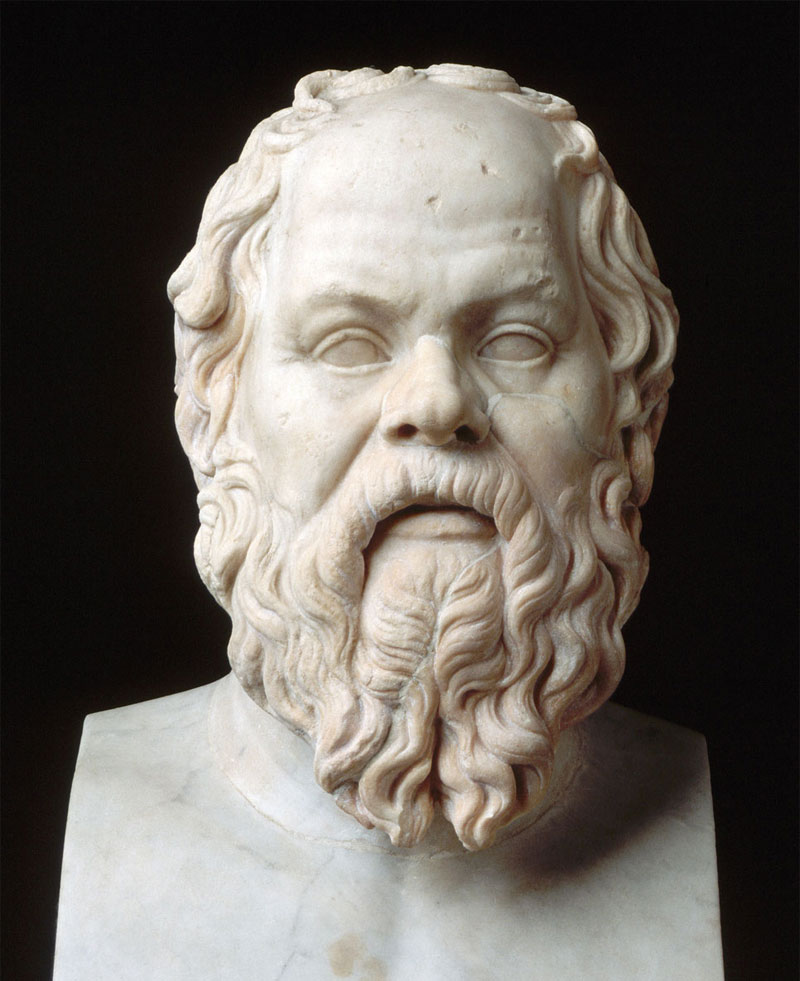
The ancient Greek philosopher Socrates is considered to be the founder of social contract theory.
One of the earliest political theorists that explored the idea of the social contract was Socrates, a Greek philosopher active in the 4th Century BC. In the book, Crito, Socrates makes an argument as to why he must stay in prison and accept the death penalty rather than escape to a different city. He personifies the Laws of Athens and explains that he has acquired an overwhelming obligation to obey the Laws because they have made his entire way of life possible. For example, such laws made it possible for his mother and father to marry, and therefore to give birth to him. Having been born there, the city of Athens (through its laws) required that his father care for and educate him. Socrates’ life and the way in which that life has flourished in Athens are thus dependent upon the existing legal system.
Socrates notes that this relationship between citizens and the Laws of the city is not coerced. Residents can freely choose whether to leave, taking their property with them, or stay. Staying implies an agreement to abide by the Laws and accept the punishments that they administer. And, having made an agreement that is itself just, Socrates asserts that he must keep to this agreement and obey the Laws, in this case, by staying and accepting the death penalty. Importantly, the contract described by Socrates is an implicit one: it is implied by his choice to stay in Athens, even though he is free to leave.
Thomas Hobbes is the founder of modern-day social contract theory and was a defender of the ideas promoted by absolute monarchy systems of government.
Thomas Hobbes
Thomas Hobbes is widely considered to be the founder of modern Social Contract theory. Thomas Hobbes was born in England in 1588. Hobbes’ father was a clergyman in the Anglican church (and a hardened alcoholic) who ultimately abandoned his family within a few short years. Hobbes learned to read and write by age 4 and was fluent in both Greek and Latin by age 6. After studying at Oxford for 5 years, Hobbes gained employment by the Duke of Cavendish as a tutor for their children. Through that capacity, Hobbes was able to meet numerous thinkers of the Enlightenment and his views developed even further in several areas. Additionally, events such as the Thirty Years War (1618-48) helped to shape Hobbes’ worldviews and encouraged him to become a defender of the English monarchy and the ideals promoted by monarchical systems of government. In 1642, Hobbes fled from England as a result of the English Civil War and remained abroad until 1651. Upon returning to England in 1651, Hobbes published Leviathan, his most important work. Leviathan is an eloquent defense of the English monarchy and puts forward the ideas surrounding Social Contract Theory.
Throughout his life, Hobbes believed that the ideal form of government was an absolute monarchy. This belief stemmed from the central tenet of Hobbes’ natural philosophy that human beings are selfish and immoral at their core. According to Hobbes, if humans are put in a state of nature (without any form of government whatsoever), they would be in an eternal state of warfare with one another. In this natural state, Hobbes said, the life of a man was “solitary, poor, nasty, brutish, and short” (a bit ironic considering that Hobbes himself lived to be 91 years old at a time when the average person in England only lived about 35 years if they were lucky).
The government of Iraq under the leadership of Saddam Hussien (in power from 1968 to 2003) is considered to be an embodiment of the Hobbesian social contract theory.
Because of Hobbes’ pessimistic view of human nature, he believed the only form of government strong enough to hold humanity’s cruel whims in check was an absolute monarchy, where a king wields supreme and unchecked power over all of his subjects. While Hobbes believed in social contract theory, he ascribed nearly total power to the monarch and did not believe the people had any right to rebel whatsoever. The Hobbesian view of social contract theory can be applied to several different governments and regimes throughout history such as Iraq under Saddam Hussien, Iran under the Pahlavi monarchy, and many of the governments in power in Latin America between the 1950s and 1980s.
John Locke
John Locke’s notion of the social contract differed from that of Thomas Hobbes in several different respects. Locke believed that individuals in the state of nature would be bound morally (by the Law of Nature) not to harm each other, but without government to defend them against those seeking to injure or enslave them, people would have no security and would live in perpetual fear. Locke argued that individuals would agree to form a state that would provide a “neutral judge,” acting to protect the lives, liberty, and property of those who lived within it.
John Locke based his social contract theory on Hobbes’, but felt that government had a right to protect individual property and the fruits of their citizen’s labor as well.
While Hobbes argued for near-absolute authority, Locke argued for inviolate freedom under law in his Second Treatise of Government. Locke argued that governmental legitimacy comes from the citizens’ delegation to the government of their absolute right to violence (keeping the right of self-defense), along with elements of other rights (such as property rights) as necessary to achieve the goal of security through granting the state a monopoly of violence, whereby the government, as an impartial judge, may use the collective force of the populace to enforce the law, rather than each man acting to enforce the laws (the condition in the state of nature). Some of the countries that follow the Lockian view on social contract theory include the US, the UK, and many of the European countries.
Jean-Jacques Rousseau
Jean-Jacques Rousseau (1712–1778), outlined a different version of social contract theory, as the foundations of political rights based on unlimited popular sovereignty. Rousseau held that liberty was possible where there was direct rule by the people as a whole in lawmaking, where popular sovereignty was inseparable. But he also affirmed that the people often did not know their “real will,” and that an ideal society would not occur until a great leader arose to change the values and customs of the people (likely through the use of organized religion).
Jean Jacques Rousseau also saw that there is a contractual agreement between people and government, but said that the contractual agreement between people and government is about general will and the common good.
Rousseau’s political theory differs in substantial ways from that of Locke and Hobbes. Rousseau’s collectivism is most evident in his development of the “luminous conception” of the general will. Rousseau argues that a citizen cannot pursue their interests by being an egoist but instead subordinate himself to the laws created by the citizenry.
Rousseau’s phrase that man must “be forced to be free” should be understood in this way. Since the indivisible and inalienable popular sovereignty decides what is good for the whole, then if a person lapses back into his ordinary egoism and disobeys the law, he will be forced to listen to what was decided when the people collaborate. As such, the law (since it is created by individuals working together) is not a limitation of personal freedom, but an expression of liberty.
As such, the enforcement of laws is not a restriction on individual liberty: the person, as a citizen, explicitly agreed to be constrained if, as a private individual, he did not respect his own will as formulated in the general will. Because laws represent the restraints of civil freedom, they represent the leap made from humans from the state of nature into civil society. In this sense, the law is a civilizing force and Rousseau believed that the laws that govern the individual helped to mold their character and makes them ideal and model citizens.
Classical Theism is the belief in which God is an absolute and ultimate metaphysical being. Whereas most theists agree that God is all-knowing, all-powerful, and good, some classical theists go further and conceive of God as utterly transcendent, simple, and as having attributes such as immutability, impassibility, and timelessness. The ideas of Classical Theism are associated with philosophers such as Plato, Aristotle, Plotinus, Augustine, St. Anselm, Maimonides, Averroes and Thomas Aquinas.
Because Greek philosophy influences traditional theistic ideas and focus on God in the abstract and metaphysical sense, Classical Theism can be difficult to reconcile with the caring, and compassionate view of God manifested in the religious texts of the main monotheistic religions including the Bible, Torah, and Qur’an
Aristotelian Theology takes a somewhat different viewpoint than Classical Theism. In Metaphysics, Aristotle discusses the meaning of “being as being.” Aristotle holds that “being” refers to the Unmoved Movers, and assigned one of these to each movement in the heavens. Each Unmoved Mover continuously contemplates its contemplation, and everything that fits the second meaning of “being” by having its source of motion in itself, moves because the knowledge of its Mover causes it to emulate this Mover (or should).
Aristotle’s definition of God connects perfection to this being, and as a perfect being can only contemplate upon perfection and not on imperfection, otherwise perfection would not be one of his attributes. God, according to Aristotle, is in a state of “stasis” untouched by change and fault. As such, the “unmoved mover” is dissimilar to the conception of God seen in most religions.
Pantheism is the belief that all reality is identical with divinity and that everything composes an all-encompassing, immanent God. Pantheists do not believe in a distinct personal or anthropomorphic God. Additionally, Pantheists believe in and accept all interpretations of God regardless of religion and view all religions as equal.
Pantheism views all religions as equally valid and that everything that people can observe represents God.
Many traditional and folk religions can be seen as being aligned with the ideas of pantheism and there are elements of pantheism in some forms of Christianity and Hinduism. Pantheism is also popular in some New age religious movements such as Neopaganism and Theosophy.
Within every academic field and in one’s personal life, it is important to recognize when an individual is acting as a Un-Critical Thinker and is giving into societal biases and logical fallacies. Here is a list of the five main hallmarks of an Un-Critical Thinker. The un-virtues listed below are adapted from The Aspiring Thinkers Guide to Critical Thinking, which was written by Linda Paul and Richard Elder in 2009.
1. Innate egocentrism (“It’s true because I believe it”)
Is when an individual continually assumes that what they believe is true even though they have never questioned the basis for many of these beliefs.
2. Innate sociocentrism (“It’s true because we believe it)”
Is when someone assumes that the dominant beliefs in the groups to which they belong to is true even though they have never questioned the basis for many of these beliefs)
3. Innate Wish Fulfillment (“It’s true because I want to believe it”)
Occurs when an individual finds themselves believing, in, for example, accounts of behavior that put them in a positive rather than a negative light even though they have not seriously considered the evidence for the more negative account. They believe what “feels good,” what supports their other beliefs, what does not require them to change my thinking is any significant way, and what does not require them to admit they are wrong)
4. Innate Self-Validation (“It’s true because I have always believed it”)
In which case an individual feels a strong ego-attraction to beliefs that they held for a long time even though they have not seriously considered the evidence for the critique of these traditional beliefs).
5. innate selfishness (“It’s true because it is in my vested interest to believe it”)
When someone finds themselves gravitating to beliefs which if true would justify their gaining a personal advantage and not noticing the evidence or reasoning against such beliefs
I see more courage and dignity in the eyes of those who have not everything, but nothing. I see men who wear many clothes, the finest money can offer and those that wear less. I see more character in the ones with less to wear and more worn on the strapping of their heart. I see a nation staring at itself in the mirror and the images cracks, it is not a pretty picture and yet it is not the only picture that can be. Men can write history which ever way they want, when they want, for who they want, but it is the poor man that will write the future. It is the men who say I demand change, not those who ask for it, a wise former slave who proclaimed himself Fredrick Douglass once wrote, “Power concedes nothing without demand”. I am not here for you to follow me on an endless journey, but to plant the seeds for you to begin your own. Money does not make might, money does not make one’s character and might does not make right. We have growing problems in this world we have been given. We have the tools to solve those problems. We have technology to solve many of those problems yet we resist. The resistance does not shoulder the burden on the backs of the wealthiest or strongest among us, but the weakest. People who are too poor to make sure food isn’t an issue this week, or next week or a year from now. People who are plagued with disease, rising costs, who shoulder the burden our society puts on them. Drugs, violence, food, shelter, these are not the problems of a man in a golden tower. But the problems of a man who is tasked with changing his reality.
We do not seek conflict on our own, but others order us toward that conflict. We do not lust for blood or gold by nature but are commanded to it by a culture of lust. Lust for silver, lust for more goods, things you don’t need, you don’t want and by the time you get it, it breaks down and ends up in the trash next week. Where are the saviors of this world? Are they the men who speak the words of injustice? Or the men who hear and see the injustice and commit themselves to ending it? This speech is not giving you a guide to ruling the world, instead, it says look inward. Be the person you want to admire, be the change you wish to see in the world. Don’t utter words of compassion, offer arms of embrace. Don’t give money to write problems off, act to solve them. IF You die tomorrow or five minutes from now, what will you say at your own funereally? Will you quote Caesar and say “I came, I saw, I conquered”. Or will you be bold solve the ills of the worlds before you die only to realize that in solving those problems you never really died? A man who cures cancer lives on forever. A man who cares for a small boy and makes a positive difference in that one child’s life lives forever. My advice to you is not to go out a fight in some war somewhere or to pick up a pitchfork and or to bath in the ease of common life. My advice is simply, Live Forever.
Within nearly every field of study, it is important to be a fair in one’s thoughts and actions. By being non-judgmental towards the thoughts, actions, and beliefs of others and not giving into hasty generalizations, an individual can become a fair-minded critical thinker and understand the strong and lasting biases within society. The key intellectual virtues listed below are adapted from The Aspiring Thinkers Guide to Critical Thinking, which was written by Linda Paul and Richard Elder in 2009. This book is a key aspect of the study of philosophy and promotes the ideas of thinking critically and not giving into societal biases.
1. Intellectual Integrity
Having a consciousness of the limits of one’s knowledge, including a sensitivity to circumstances in which one’s native egocentrism is likely to function self-deceptively; sensitivity to bias, prejudice, and limitations of one’s viewpoint. Intellectual humility depends on recognizing that one should not claim more than one actually knows. It does not imply spinelessness or submissiveness. It implies the lack of intellectual pretentiousness, boastfulness, or conceit, combined with insight into the logical foundations, or lack of such foundations, of one’s beliefs.
2. Intellectual Independence
Figure out things for yourself. Do not just believe what you are told by others, use intellectual standards such as accuracy, relevance, significance, and fairness to inform your opinions
3. Intellectual Humility
Having a consciousness of the limits of one’s knowledge. Intellectual humility depends on recognizing that one should not claim more than they actually know. It does not imply spinelessness or submissiveness. Instead, it implies the lack of intellectual pretentiousness, boastfulness, or conceit, combined with insight into the logical foundations, or lack of such foundations, of one’s beliefs.
4. Intellectual Courage
Having a consciousness of the need to face and fairly address ideas, beliefs or viewpoints toward which we have strong negative emotions and to which we have not given a serious hearing. This courage is connected with the recognition that ideas considered faulty are, at times, rationally justified. To determine for ourselves which is which, we must not passively and uncritically “accept” what we have “learned.”
5. Intellectual Empathy
Understanding the need to put oneself in the place of others in order to genuinely understand their beliefs, which requires the consciousness of our egocentric tendency to identify truth with our immediate perceptions of long-standing thought or belief. This trait correlates with the ability to reconstruct the viewpoints and reasoning of others and to reason from premises, assumptions, and ideas other than our own. This trait also correlates with the willingness to remember occasions when we were wrong in the past despite an intense conviction that we were right.
6. Intellectual Perseverance
Understanding the need to use intellectual insights and truths in spite of difficulties, obstacles, and frustrations; firm adherence to rational principles despite the irrational opposition of others; a sense of the need to struggle with confusion and unsettled questions over an extended period of time to achieve deeper understanding or insight.
7. Confidence in Reason
Confidence that one’s own higher interests and those of humankind at large will be best served by giving the freest play to reason, by encouraging people to come to their own conclusions by developing their own rational faculties; faith that, with proper encouragement and cultivation, people can learn to think for themselves, to form rational viewpoints, draw reasonable conclusions, think coherently and logically, persuade each other by reason and become reasonable persons, despite the deep-seated obstacles in the native character of the human mind and in society as we know it.
8. Fairmindedness
Having a consciousness of the need to treat all viewpoints alike, without reference to one’s own feelings or vested interests, or the feelings or vested interests of one’s friends, community or nation; implies adherence to intellectual standards without reference to one’s own advantage or the advantage of one’s group.
Ockham’s Razor is a well-known concept within philosophy and logic. It stipulates that in trying to understand something and to determine the solution to a given problem, getting any unnecessary information out of the way is the fastest way to determine the truth or to find out the best explanation.
The originator of the concept was William of Ockham (1285-1349), an English Franciscan friar, philosopher, and theologian. Ockham spent most of his life developing a philosophical concept that reconciled religious belief with demonstratable, generally experienced truth, mainly by separating the two from each other.
Getting any unnecessary information out of the way is the fastest way to determine the truth or to find out the best explanation.
Where earlier philosophers attempted to justify God’s existence with physical proof, Ockham declared religious belief to be incapable of such proof and a matter of faith. He rejected the notions preserved from Classical times of the independent existence of qualities such as truth, hardness, and durability and said these ideas had value only as descriptions of particular objects and were really characteristics of human cognition.
Pascal’s Wager is a philosophical concept developed by French philosopher Blaise Pascal during the mid 17th Century. The argument is rooted in the concept of game theory and its main premise is that one cannot determine the existence of God through reason alone. Because one cannot use reason and inquiry to prove with 100% certainty that God either exists or does not exists, Pascal concludes that the wise thing and individual should do is to live life as if God does exist. By living such a life, an individual has everything to gain and nothing to lose. If a person lives as though God exists, and they turn out to be correct, they have gained infinite reward in the afterlife.
On the other hand, if God does not exist, an individual has lost nothing. If individuals live as though God does not exist and they are wrong, they have only gained punishment and have lost the potential for a peaceful and happy afterlife. As such, if one weighs the options, clearly the rational choice to live as if God exists is the better of the possible choices according to the logic promoted by Pascal.
The Banking Concept in Education is a concept in philosophy originally explored by Brazilian philosopher Paulo Freire in his 1968 book “Pedagogy of the Oppressed.” The “banking” concept of education is a method of teaching and learning where the students simply store the information relayed to them by the teacher. In a “banking” type of environment, a classroom is structured in a way that the primary duty of students is to remember and accurately recall the information provided by the instructor. They are not asked to participate in any other way, and simply absorb the information. In this type of approach, the world is seen as static and unchangeable, and students are simply supposed to fit into it as it is. The prevalence of the banking concept within most educational systems prevents students from developing skills that make themselves fair-minded critical thinkers and continues to promote long-standing biases within society.
The world is seen as static and unchangeable, and students are simply supposed to fit into it as it is.
In contrast to the Banking Concept in Education, Freire proposes the Problem Solving Method in Education. This method is concerned with the task of “presenting reality as it truly is” and not glossing over the truth. Additionally, it holds two-way learning as essential in all education and treats dialogue as a vital part to successful education. The Problem Solving Method in Education allows students to become critical thinkers, emphasizes scholarly inquiry and fosters action upon reality. Most importantly, the Problem Solving Method in education allows students the opportunity to break free of the oppressive, authoritarian nature of the traditional education dynamic.
What gives government right to rule?Is it law? Or is it reason? Perhaps consent? All of these things have elements mixed in the current government(20 year period), some more than others. Every man has a right to prosperity under the most ideal conditions a state can provide. But is the state providing those conditions or allowing them to flourish? The answer is clearly no. The government is largely maintained through simple power dynamics that have recognizable effects on the prosperity of men’s lives. Why will there be more plastic than fish in the ocean by 2050?
Well you have your answer – power and government. Not at the whims of the common man but of the man who holds the green tickets on the ride of injustice. Where do you stand? Well, it is likely you stand more with the common man than the common thief. If you ask why don’t Americans have healthcare, it is not about resources, it’s not about money, it’s about power.
The definition of power is a complex one and will evolve throughout this post. The current power is with the green tickets that allow the government roller-coaster to twist and turn at their will. The 2nd type of power is true power, which is the type of power that is hidden from the common man. The power for men to gather and make decisions en masse and enforce those desires, needs, or what have you on the state. If that power is not answered, if men do not demand justice from the first type of power, then power gives nothing without demand. If left unchecked, then men will remain peasants under feudal rule of gods and kings. It doesn’t take much for a man to realize he is not free when his teeth fall out. Meanwhile, the politician on the stage proclaims “we are for freedom.” Where is his freedom when tooth by tooth his teeth decay, wary of that evil word, that word used to manipulate the masses, the flock. “Freedom,” they say; well freedom they shall never achieve. Because freedom is really the ability to choose, not between red or blue, but between feudalism and freedom, the kind of choice you probably don’t have.
My advice to you is not to support politician via automatic weapons, but to support them via mass mobilization on common issues that all man agree on such as free speech and healthcare, human rights for all, even minorities. You must proclaim your independence and freedom. “But divide ye fall” proclaimed Julius Caesar as he conquered Gaul. As Benjamin Franklin eloquently stated in 1754, “Join or Die.”
One of the most important political theorists in Iran over the past century was Ali Shariati. Shariati was a well-known Iranian intellectual active during the 1960s and 1970s. Shariati developed an entirely new perspective on the history, philosophy, and sociology of Islam based in part on Marxist political thought, and gave highly charged lectures that laid the foundation for the Iranian Revolution of 1978-79, which ignited only 7 months after his death at the age of 43.
Ali Shariati was born in the Iranian city of Mashad on November 23, 1933, to a religious family. His father was a teacher and Islamic scholar. From an early age, Shariati came into contact with individuals from the less privileged economic classes and was exposed to the massive levels of poverty and hardship evident within much of Iran during the 1930s and 1940s. At the same time, he was exposed to Western philosophy and political thought. He attempted to provide solutions for the problems faced by Middle Eastern societies through traditional Islamic principles interwoven with the point of view of modern sociology and philosophies such as Marxism and Socialism.
Ali Shariati became a high-school teacher in 1952 and was an active member of the Islamic Association of Students. In 1953, Shariati became a member of the National Front and received his bachelor’s degree from the University of Mashhad in 1955. In 1957, he was arrested by the Iranian police, along with 16 other members of the National Resistance Movement due to his leading a protest critical of the Pahlavi Regime. Shariati managed to obtain a scholarship for France, where he continued his graduate studies at Sorbonne University and worked towards earning his doctorate in sociology. During this period, Shariati started collaborating with the Algerian National Liberation Front (FLN) in 1959.
In 1961, Ali Shariati founded the Freedom Movement of Iran along with Ebrahim Yazdi, Mostafa Chamran and Sadegh Ghotbzadeh, three individuals who would become the leaders in the first post-revolutionary government of Iran in 1979. Shariat returned to Iran in 1962 and was arrested for taking part in the June 5, 1963, protests against the Iranian government and the rule of Shah Mohammed Reza Pahlavi. He was released after a few weeks, at which point he began teaching at the University of Mashhad. Shariati subsequently moved to Tehran, where he began lecturing at the Hosseiniye Ershad Institute. These lectures proved to be hugely popular among his students and were spread by word of mouth throughout all sectors of Iranian society
Shariati’s continued success again aroused the interest of the government, which arrested him in late 1975. Widespread pressure from the populace and an international outcry eventually led to his release after eighteen months in solitary confinement in June of 1977. Shariati was allowed to leave the country for England and d died three weeks later in a Southampton hospital under mysterious circumstances. It is argued by many that his time in captivity within Iran and torture at the hands of SAVAK contributed to his death.
Ali Shariati developed an entirely novel approach to religious study and interpreted Shi’a Islam under the lens of revolutionary ideologies such as Socialism and Marxism. In particular, Shariati discussed the dual aspects of the Shi’a Islam throughout its history. The pure form of Shi’ism was known as Red Shi’ism, which is the pure form of the religion and focuses on social justice and salvation for the common person. Additionally, Red Shi’ism lacks the rituals and an established clerical hierarchy. In contrast, Black Shi’ism is the less pure form of the religion and is under the domination of several distinct groups such as the monarchy, the clerical establishment, and the Bazzari (the traditional merchant class of Iran), thus being out of touch with the needs of the common person. According to Shariati, Black Shi’ism was established in Iran under the Safavid monarchy during the 16th Century and was embodied by the Pahlavi monarchy.
The idea of Red Shi’ism as promoted by Ali Shariati shares some similarities with Liberation Theology, which was established by the Catholic Church in Latin America during the 1960s in response to massive human rights abuses and continued economic inequalities within the region. Liberation Theology stresses the active involvement of religious organizations in addressing social inequalities and promoting the belief that religion can play an active role in improving societal conditions.
Ali Shariati argued that a moral and proper society would conform to Islamic values. Shariati suggested that the role of government was to guide society in the most moral manner rather than to manage society in the best possible manner. Shariati also believed that the most experienced and knowledgeable members of the clergy were the best suited for guiding society due to their in-depth understanding of the Islamic values system. Due to their knowledge of such traditions and beliefs, Shariati felt that the clergy was uniquely suited to advance the individual towards their greatest potential and to not give into to the hedonistic desires of individuals as evident in much of the Western world.
In contrast to Western philosophers such as John Locke, Alexis de Tocqueville, and John Stuart Mill, Ali Shariati was critical of the idea of liberal democracy, pointing out that the induction of liberal democracy correlates with the plundering of nations for economic reasons. Shariati believed that the idea of liberal democracy is the main enemy of humankind and progress and that the economic structure characteristic of it promotes inequalities and harms the rights of individuals. Shariati does not accept the definition of Democracy based on western explanation and viewed religious government as the best form of democracy. According to Shariati, the religious government is the main right of Muslim citizens in terms of democracy and governmental type because it promotes the highest level of social equality and respects the rights of all citizens regardless of their differences in appearance, status, and social class.
Ali Shariati sought to translate his ideas into the cultural symbols of Shi’a Islam that many Iranian citizens could relate to such as Ashura. Shariati believed that Shi’a’s should not only actively await the return of the Twelfth Imam but should work to hasten his return by fighting for social justice at any cost. Additionally, Shariati believed that people do not have to put away and hide their religious and cultural practices in the fight against imperialism and inequality and that the people could fight such problems the most effectively through the recovering of their cultural and religious identity.
In conclusion, Ali Shariati was one of the most influential Iranian philosophers of the 20th Century. Shariati believed that the application of both Marxism and Islamic principles is the most effective way to address social inequalities and further social justice, and sought to spread his ideas through symbols associated with Shi’a Islam and Iranian culture. Additionally, many of Ali Shariati’s ideas are still influential today and have been used by numerous groups worldwide seeking to create an equal society and move away from the legacies of imperialism and colonialism.
In the 2005 article “Most Abortions Are Morally Legitimate,” Bonnie Steinbock puts forward an argument stating that abortion is in fact morally justified in most cases. Steinbock begins by declaring that her belief on the morality of abortion is based on two considerations which are the moral status of the embryo and the fetus and the burdens imposed on women through pregnancy and childbirth. Steinbock also puts forward the interests view, which limits moral status to people who have interests in their future and restricts the possession of interests to people who are conscious of the world around them. Following the logic presented by the interest view, Steinbock argues that fetuses are not conscious enough to understand their interests and that it is not morally wrong to kill a fetus when there is an adequate reason for doing so. Steinbock further discusses the view on abortion possessed by Don Marquis and argues that it is wrong because it attempts to claim that a fetus is a conscious living being and that it would be immoral to kill an unborn child even though they have no awareness of their interests and the outside world.
Bonnie Steinbock first discusses the moral status of a fetus. Many opponents of legalized abortion tend to argue that abortion is an unethical practice because they view it as the killing of an innocent person. Additionally, abortion opponents do not see any difference between a fetus during the early stages of pregnancy and a newborn child. Following such logic, it could be argued that if it is morally wrong to kill a young child, it would also be morally wrong to kill a fetus through abortion. In contrast, Steinbock asserts that killing a fetus is morally different than killing a newborn baby because fetuses are not sentient beings because they cannot experience pain or pleasure. Steinbock states that being sentient is important because non-sentient beings lack interests of their own. As such, non-sentient beings should not be categorized among those whose interests people are required to consider in their day-to-day actions.
The main point of criticism regarding the interest view, according to Bonnie Steinbock, is that opponents tend to ask why a being must experience or feel anything to have a unique set of interests. Steinbock argues that the main flaw with this approach is that it misconceives the interest view because the interest view can acknowledge that certain non-sentient beings and objects have value and that people have all kinds of reasons to protect and preserve any non-sentiment beings and objects. Additionally, the main difference between sentient and non-sentient beings is that because non-sentient beings have no feelings and cannot be made to suffer, it does not matter what is done to them and in people deciding what they can do, they should not consider their interests because they do not have any. The interest view relates to the morality of abortion because most scientists agree that fetuses in the early gestation phase do not have feelings and understand their interests and are thus non-sentient beings. Considering such factors, Steinbeck concludes that a non-sentient being such as a fetus not deprived of anything by being killed and that abortion is thus not morally wrong.
Bonnie Steinbock then discusses her criticisms against the potentiality principle. Through the potentiality principle, opponents of abortion argue that the potential of a fetus to become a sentient being with a unique set of interests and awareness of its future is enough to ascribe moral status to a fetus and to give it the same rights as any other person. One such flaw with this approach is that it does not follow from the fact that “something is a potential x that should be treated as an actual x.” Additionally, this argument also raises the question that if abortion is morally wrong, then the use of contraceptives such as spermicide is also unethical because it prevents a potential person from being born. Considering that few abortion opponents are willing to accept such a conclusion, Steinbock states that they are often forced to either give up or modify their overall argument.
Bonnie Steinbock criticizes Don Marquis’s argument against abortion by highlighting his objections to the interest view. Marquis holds that his opinion is correct because it can explain why it is morally wrong to kill people who are temporarily unconscious. For example, Marquis asks if it is morally right to kill a non-sentient being, then how come it is wrong to kill a person in a comma considering that the individual is not conscious or sentient. If people appeal to the future conscious state of the individual in a comma, then the same argument can apply to a fetus, which will become conscious and sentient if we allow it to develop. Steinbock argues that two responses can be made to the objection to the interest view proposed by Marquis. The first is that there is a difference between a temporarily unconscious person and a fetus because the person who is unconscious had past experiences and an interest in its future. On the other hand, a fetus does not have past experiences and lacks a stake or awareness in its future. The second response is that people’s interests are not limited to what they take an interest in. According to Steinbock, if the non-conscious fetus is not interested in continuing to live, we could argue that continued existence it not in its best interest considering its personal desires.
The ethical theory that is explored by Bonnie Steinbock is the idea of Kantian ethics. Kantian ethics argues that for a person to qualify for moral consideration, they must be able to use their reasoning skills to derive and understand moral issues. As such, the only people that would qualify for moral consideration under Kantian ethics would be individuals who were developed enough to have basic reasoning skills and a basic understanding of what is morally right or wrong. Steinbock’s position on the morality of abortion aligns with Kantian ethics because she argues that an unborn fetus lacks reasoning power and an awareness of what in fact is ethical. Considering her view that fetuses lack reasoning powers, Steinbock would argue that fetuses do not qualify for moral consideration and that it is not morally incorrect to destroy a fetus through an abortion.
Overall, the argument put forward by Bonne Steinbock in “Most Abortions Are Morally Legitimate” includes several strengths and weaknesses. The main weakness of Steinbock’s argument is that it asserts that a fetus is not a sentient being and thus is not considered a moral agent. The main flaw with this argument is that scientists have yet to reach a full conclusion regarding whether a fetus can feel pain or is conscious of the world around them. If a fetus can, in fact, feel pain, then the argument posed by Steinbock that a fetus is not a living thing would, in turn, be invalid. The main strength of Steinbock’s argument is that she raises the question of the differences between sentient and non-sentient beings. The differences between sentient and non-sentient beings are often ignored by most contemporary philosophers, and many people tend to ignore the distinctions between both categories. By highlighting their differences, Steinbock is seeking to frame the debate regarding the morality of abortion in an entirely different light that is often ignored by recent studies on ethical issues.
In the 1989 essay “Abortion Is Immoral,” Don Marquis argues that abortion is morally wrong. Marquis feels that most contemporary philosophers ignore the issue of the morality of abortion because of their affiliation with secular higher education settings, which makes them believe that the anti-abortion viewpoint is “a conclusion generated by seriously confused philosophical argument.” In contrast to contemporary philosophers, Marquis argues that abortion is unethical and that it is in the same category as killing an innocent adult.
To develop an argument on the unethical nature of abortion, Don Marquis states that we must ask the question of why it is morally wrong to kill someone. Marquis determines that what makes killing wrong is the effect that it has on the victim itself. Marquis argues that loss of one’s life “deprives one of all the experiences, activities, projects, and enjoyments” that they will have in their life, and that would have defined their future. As such, killing an innocent person is wrong in Marquis’ opinion because it prevents a person from following through on the activities and experiences that would have defined their future life and helped to make them stand out as an individual. Te idea that the elimination of a person’s future is what makes killing wrong is illustrated by the fact that killing denies the victim of more than any other crime does.
Don Marquis next asserts that the idea that the loss of a person’s future potential is what makes killing morally wrong gains further support when several its implications are examined. The first two implications are that his theory would support the belief that it would be wrong to kill beings that are members of other species and that the futures of some animals are like the prospects of people and that it is thus immoral to take their lives. The third implication discussed by Marquis is the claim that the loss of one’s future is the “wrong-making feature of one’s being killed does not entail that active euthanasia is wrong.” On the other hand, Marquis asserts that it is the value of a human’s future which makes killing wrong in this theory. The fourth implication is that the account of the wrongness of killing entails that it is immoral and unethical to kill children and infants because “we do presume that they have futures of value.”
Don Marquis mentions that the potential future of a standard unborn child includes a series of experiences that are identical to an ordinary adult or young children. Considering that one can assert that it is immoral to kill a person after birth because it denies a person of their future potential, Marquis states that similar logic can be used to argue that abortion is morally wrong. The structure of Marquis’ anti-abortion argument is defended through a comparison with the case against inflicting pain on animals, which assumes that it is morally wrong to inflict pain on others. Both the argument against abortion and the argument against causing pain to animals begin with a premise regarding what it is wrong to do to another person and the consequences of a wrong action. Additionally, both recognize that the “wrong-making feature of such immoral actions is a property of actions sometimes directed at an individual other than postnatal human beings.” Marquis then argues that if the structure of the argument against the wrongness of inflicting pain on animals is correct, then the argument against abortion would be right as well.
Don Marquis next mentions that abortion can be justified on certain grounds such as if the birth of a child would seriously threaten the life of the expectant mother. Even if abortion would be morally acceptable under a rare case, Marquis argues that they would only be admissible if they were to occur early in the pregnancy. Marquis also looks at the morality of contraception and its relation to the belief that killing denies an individual of their future potential. Even though contraception prevents the actualization of a possible future of value for a person that may potentially be conceived, Marquis argues that contraception is not immoral in practice. Marquis feels that contraception is not immoral because there is no identifiable subject of the loss of their future and value in the case of contraception.
The ethical theory put forward by Don Marquis in “Abortion Is Immoral” is the idea of Utilitarian ethics. Utilitarian ethics stipulates that all pains and pleasures are morally significant and that the most morally right course of action to take is the one that limits suffering and maximizes pleasure for all people in society. Following such logic, Utilitarianism would argue that both sentient or non-sentient beings are subjects of moral consideration and that it is immoral to harm anyone. It can be reasoned that the argument by Marquis is related to Utilitarianism because he argues that abortion increases suffering because it prevents the opportunity for unborn children from realizing their full potential as they develop and mature. Additionally, Marquis also considers unborn children to be full subjects of moral consideration and feels that they are entitled to the same rights as all other people within society.
The argument put forward by Don Marquis in “Abortion Is Immoral” includes several strengths and weaknesses. The main weakness regarding his argument is that it does not consider the belief that fetuses lack the awareness to take an interest in their future. Scientists often debate over whether fetuses have a conscious understanding of their future and the world surrounding them. If fetuses lack an understanding of their future and the world around them, then they do not take an active interest in their future. Assuming that fetuses lack an understanding or interest in their future, one can make the argument that it is not morally wrong to kill them through an abortion. On the other hand, the main strength of Marquis’ argument is that it considers the fact that killing an innocent person is morally wrong because of the effect that it has on themselves. By killing a person, you eliminate any hope that they may have for their future and attempt to dehumanize and devalue people by making them out as mere objects within society.
One of the most influential American philosophers of the 20th Century was John Dewey. Dewey was a proponent of pragmatism and wrote numerous works on ethics, logic, metaphysics, political theory, and epistemology. Additionally, he also lectured on political and social issues and was well known for his studies on economics and education. Dewey’s most famous work was “The Quest for Certainty,” which was first published in 1929. “The Quest for Certainty” explained the idea of pragmatic ethics and sought to apply it to explain many philosophical and moral questions.
In “The Quest for Certainty,” John Dewey argues that the choice between relativism and objectivity is a false dichotomy. Dewey begins his argument by making a comparison between beliefs about values and beliefs about nature. He concludes that ideas about values are in the same position as beliefs about nature were prior to the scientific revolution and notes that there exists a fundamental distrust of the capacity of personal experiences to determine regulatory standards and an appeal to the concept of eternal values to ensure regulation of personal beliefs and actions. As such, Dewey argues that a complete division between the rationalistic and empirical methods has the most significance in the ways both good and bad thoughts are acted upon.
Dewey then looks at the ways in which ethical positions emerge in society. He asserts that morally proper values are neither discovered or occur due to arbitrary reasons. Instead, the development of morally right values is the result of ongoing interactions between individuals and their environments throughout all societies.
John Dewey next puts forward the belief that all judgments regarding values are decisions about the conditions and results of experienced objects and that any judgments about them should serve to regulate the formation of an individual’s desires. affections, and enjoyments. Through this statement, Dewey is saying that all ethical principles are constructed through selected and directed operation inquiry by people and that inquiry is essential in the development of the good. This process also shows that gradualism is essential to human nature and that all scholarly inquiry is subject to revision and inaccurate information. Dewey Also states that most conflicts that are of importance are essentially conflicts between things that have been satisfying or not as opposed to conflicts between the good and the bad.
John Dewey next stresses the need to eliminate the distinction between the material and spiritual world and seeks to do so by using the scientific method. Dewey uses the scientific method for several different reasons. The first two are that it provides the most accurate answers and eliminates previously subjective attitudes about philosophical issues. The final reason is that it would allow all tenants and creeds about good and goods to be treated as legitimate hypotheses. As opposed to being rigidly fixed, they would be treated as intellectual instruments to be tested and confirmed through consequences of acting upon them. The numerous changes that would result from the adoption of the scientific method can be summed up by saying that it would place the means and the method at the same level of importance that was historically only reserved for the ends.
John Dewey concludes by stating that industrial life during the early 20th Century is a legitimate indicator of the existing separation of means and ends within society. The economic life of an individual concerned with that of want is based on that of nature. For example, people have wants they need to have satisfied, but they are only requirements of a good life and not fundamental elements of such a life. On the other hand, the life in which individuals lead is mainly determined by economic circumstances, and thus, Dewey states that we can hardly expect a moral system that ignores economic systems to be other than remote and empty overall. Industrial life is also brutalized by a failure to equate it as the means to how cultural and social values are ultimately realized. Dewey then states that the fact that the economic life takes retribution by asserting that it is the only social reality and using the concept of materialistic determination of societal institutions and conduct in every field is not surprising to most observers.
One of the most influential philosophers in recent history is Thomas Hobbes, who was active in Great Britain during the 17th Century. Hobbes was a proponent of social contract ethics, which is the idea that both an individual’s moral and political obligations are dependent upon a contract or agreement among them to form the society in which they live in. During his life, Hobbes published many different works on subjects ranging from political theory, philosophy, and history. The most famous work written by Thomas Hobbes is “Leviathan,” which was written in 1651 in response to the English Civil War, which resulted in the establishment of a parliamentarian system and the reduction in the power of the monarchy. Even though Hobbes rejected the divine right of kings to rule over their citizens, he argued that a powerful king is needed to rule to prevent any instability or societal disorder.
In the chapter “Of the Natural Condition of Mankind as Concerning their Felicity and Misery,” Thomas Hobbes directs his study to that of human nature. An understanding of human nature will allow people to progress from the state of nature to a stable and civilized society. Hobbes noted that people are continuously moved by what they both dislike and like. As such, people have certain ends on their minds that they are seeking to achieve. Because many people desire the same goals, they are in a continual state of competition and conflict with each other. If the appetites of individuals had limits, the conflict between people would not be as complicated. On the other hand, Hobbes claims that people are never satisfied with any amount of power and are thus always in a power struggle with others. Even though it seems that in such a state of nature the strong would triumph over the weak and some natural equilibrium would be instituted, the nature of power distribution prevents this from occurring. According to Hobbes, individuals are by nature equal in their abilities. From such equality in the state of nature arises a perpetual state of continual conflict. Hobbes then argues that without a common power to mediate any disputes, the state of nature is nothing more than a state of perpetual war and conflict.
Thomas Hobbes then goes over the concept of the Laws of Nature in the chapter “Of the first and second Natural Lawes, and of Contracts.” A law of nature is a given rule that is discovered through pure reason. Such laws assert the concept of self-preservation and reject any acts that are ultimately destructive to human life overall. A law of nature is inherently known by every person because natural mental faculties can understand it. The first law of nature stipulates that every person must attempt to promote and seek peace. The next law of nature is that people must divest themselves of individual rights to escape the state of natural war. The mutual transferring of rights as illustrated in the second law of nature is known as a contract and is the primary foundation of the idea of moral obligations. The third law says that people must be required to keep the contract that they make and that it is not enough to only make such contracts. The third law of nature is the foundation for the concept of justice and fairness in the legal system. Because of the inherent desire for increased power, there always exists incentives to break such a contract. Hobbes also states that additional natural laws must come into effect to preserve the functionality of the third law of nature.
In conclusion, Thomas Hobbes explored the ideas of social contract ethics throughout “Leviathan.” Social contract theory is an entirely different branch of ethical theory that explores the idea that moral and political obligations of an individual are dependent upon a contract or agreement among them to form the society or governmental system in which they live in. The idea of social contract ethics combines both elements from philosophy, political theory, and history to develop an alternative theory to explain the ethical decisions that people make. Additionally, Hobbes examines the ideas of the state of nature and the laws of nature and determines that both concepts serve to influence the overall stability of certain societies and political systems.
In the 1861 essay “What Utilitarianism Is,” John Stuart Mill defines the theory of utilitarianism and addresses the common misconceptions people have regarding it. Utilitarianism is an ethical doctrine that claims that virtue is based on utility and that all human conduct should be directed toward promoting the greatest overall level of happiness of the highest number of individuals in society. Mill observes that people misunderstand the true definition of utilitarianism by interpreting utility as opposition to pleasure. In reality, Mill states that utility is defined as pleasure and the absence of pain and suffering. Mill discusses the idea of the Greatest Happiness Principle, which holds that actions are right if they= promote happiness and wrong if they produce the pain and suffering. Happiness is described as deliberate pleasure and the absence of pain, whereas unhappiness is described as consisting of pain and the lack of comfort. Following such an idea, pleasure and the absence of pain are the only things that are acceptable as ends in themselves and the only things that are inherently good and moral. As such, actions are good when they lead to a high level of general happiness, and bad when they decrease that level of general happiness.
The next criticism that Mill addresses is the claim that it is demeaning to reduce the meaning of life to pleasure. Mill replies that human pleasures are superior to animalistic pleasures and that once people are made aware of their higher level of intellect, they will never be happy to leave their pleasures uncultivated. As such, happiness is considered to be an indicator that humans are utilizing their higher mental capacities. Even though it is the case that some pleasures may be invaluable, it does not mean that all forms of pleasure are not valuable. Instead, it is the case that some forms of pleasure are more intrinsically valuable than others. When making a moral consideration on an act, Mill asserts that utilitarianism takes into account both the size and the quality of the pleasures that result from it. Mills also makes a distinction between high and low pleasures. Pleasure is considered to be high if people would choose it over a different desire even if discomfort accompanies it and also if they would not trade it for a greater amount of any other pleasure. Moreover, Mill contends that people will prefer pleasures that appeal to their higher faculties if they have equal access to all different varieties of pleasures.
Another common misconception about utilitarianism highlighted by Mill stems from the confusion of happiness and contentment. People with higher capabilities are often less content and happy because they have an understanding about the limitations of the world. On the other hand, their pleasure is often of a higher character than that of an animal or an unintelligent person. Additionally, Mill argues that the people who are best qualified to judge the overall quality of a pleasure are people who have had experience in understanding both the higher and lower pleasures. Mill then observes that even if the possession of a noble character and moral lifestyle brought about less happiness to the individual, society would still benefit. The main reason as to why society would still benefit is because the greatest happiness principle considers the total amount of happiness to be noble and morally right, even if less desirable for an individual to still be desirable in society by utilitarian standards.
In conclusion, John Stuart Mill describes the main principles of utilitarianism in the essay “What is Utilitarianism.” According to Mill, Utilitarianism is the ethical principle that stipulates that virtue is entirely based on utility and that the primary goal of society is to should be directed toward promoting the higher level of happiness for the largest number of individuals in society. In his analysis of utilitarian principles, Mill attempts to address some of the common misconceptions that individuals have regarding utilitarianism and makes a distinction between the different types of pleasures in society. Additionally, Mill goes over the common misconceptions that emerge regarding the definitions of happiness and contentment and concludes that both concepts are different and that they are mutually exclusive of each other.
One of the most significant political theories of the 20th Century is Ayn Rands Objectivism. Rand is known for promoting the philosophical idea of objectivism. She defines objectivism as a philosophy that emphasizes personal freedom, individuality, and rational egoism. Her anthology of fiction books describes the political theory of Objectivism through the actions and speeches of the main characters. Her additional non-fiction works continue to explore that political and social philosophy. Rand was influenced by a number of theorists such as Aristotle and writers including Victor Hugo and Edmond Rostand. Objectivism is a controversial political theory and has been criticized by academic philosophers due to its view on the role of government and human nature. On the other hand, the popularity of Rand’s work continues to grow and has an influence on political thought to this very day.
Rand was born as Alissa Rosenbaum in 1905 in St. Petersburg to a middle-class Jewish family. From a young age, she expressed great ambition and an interest in pursuing a career in writing. A singular event that occurred in her early years was the 1917 Russian Revolution, in which the country transitioned almost immediately from a monarchy into a Communist state. She had numerous experiences in Soviet Russia that helped to mold her sociopolitical beliefs. For example, the nationalization of her father’s chemistry shop transitioned her family from relative affluence to poverty. Despite the loss of her family’s assets under the Soviet regime, she was able to attend university and graduate with a degree in history. Changing her name from Alissa Rosenbaum to Ayn Rand, she left the Soviet Union for the United States in 1926 to pursue her dream of becoming a screenwriter. Over the succeeding years, Rand found success first as a screenwriter, and eventually as a playwright and author.
Ayn Rand c. 1930s
An important factor that influenced Rand’s writings over the course of her life was her personal experience in numerous political eras. From monarchy in Russia, to the transition to the Soviet Union, to Great Depression era America, her youth was characterized by many stark contrasts in political and economic systems. Rand’s writings against communism were influenced by what she observed and she wrote numerous works outlining Objectivist theory throughout World War II and the early Cold War era. In response to the Cold War and the threat of Communism spreading worldwide, Rand cautioned against the belief of collectivism in books such as The Fountainhead and Atlas Shrugged. Both The Fountainhead and Atlas Shrugged are fictional works that promote the belief in personal freedom and rationality, and speak out against the spread of Communism and Socialism.
Ayn Rand personally cites Aristotle as one of her primary influences. Aristotle was a Greek logician, philosopher, and scientist as well as one of the founders of western political theory. Rand explains, “it is not the special sciences that teach man to think; it is philosophy that lays down the epistemological criteria of all special sciences.” Just as Ayn Rand believed that science was one of the most important values of society, Aristotle argued that politics is the master science because mankind is a political animal. As Aristotle believed in “biology expressed in the naturalism of politics,” his concept of morality and the world aligned with Rand’s concepts of philosophy and politics being inextricably tied to science. Similarly, Aristotle argued that mankind engaged in politics through all of its actions. Rand believed that each person acts as an individual to create the political society that exists. If each individual acts according to the principles and morals of Objectivism, such as those of rational thought and the execution of free will, sociopolitical order will naturally emerge. Aristotle contends that politics is the study of values, ethics, what is right and wrong, what should be, and what could be.
Despite the fact that Rand cited Aristotle as one of her primary influences, their views on the ideal form of government were dissimilar. For example, Aristotle viewed democracy as flawed because it resulted in competition between social classes and felt that the proper form of government consisted of its leaders governing with the common interest of all its people in mind as opposed to governing based on individual interests. Additionally, Aristotle felt that a key role of the government would be to provide for and promote the public good and explored the idea of the organic theory of the state throughout his works. The organic theory of the state theory stipulates that the power and authority of the state transcends the power of the individual. On the contrary, Rand believed that the role of government would be limited to protecting individual rights and serving as an agent for people’s self-defense. A government that promoted the opposite values, according to Rand, has no justification and is the primary threat to the structure and nature of human society.
One of the major values of Objectivism is a belief in rational egoism. Objectivism believes in the “concept of man as a heroic being, with his own happiness as the moral purpose of his life, with productive achievement as his noblest activity, and reason as his only absolute.” With this, Ayn Rand is saying there is no more important moral goal in Objectivism than that of achieving happiness. Achieving happiness, according to Objectivists, requires rational respect for the facts of reality, including those regarding human nature and our own needs. In order to achieve such goals, Rand argues that people must behave in a way that conforms to “rational egoism,” in which the promotion of one’s self-interest is in accordance with that of reason. Rand further promotes the logic of this theory in The Virtues of Selfishness. Rand argues that selfishness is a proper value to pursue and rejects the idea of altruism, the belief that self-sacrifice is a moral ideal to pursue. Additionally, Rand rejects the idea of “selfless selfishness” of irrationally acting individuals and instead argues that to be ethically selfish entails a commitment to reason rather than to emotionally driven whims and instincts.
In addition, Objectivism promotes a unique view on the nature of reality and views knowledge and reason as important aspects in society. Objectivism holds that “reality exists as an objective absolute—facts are facts, independent of man’s feelings, wishes, hopes or fears.” Rand’s Objectivism begins with three self-evident concepts: existence, consciousness, and identity. All three truths are interconnected and exist simultaneously. Ayn Rand goes on to further explain that anything that is metaphysically given is absolute and cannot be changed. Objectivism holds that all knowledge is reached through reason, the “faculty that identifies and integrates the material provided by man’s senses.” This view of reason in an Objectivist society was further exhibited by the main characters and themes in Rand’s 1957 novel Atlas Shrugged. The work dramatizes the idea that the reasoning mind is the basic source of the values on which human life depends.
Furthermore, Rand supported a belief in secularism through Objectivism and also promoted a distinct purpose of morality. Objectivism is a purely secular ideology that views the role of religion as having a negative influence on reason and capitalism. The purpose of morality under Objectivist thought is to allow people to enjoy their own lives. This belief is further exemplified by John Galt, the embodiment of Objectivism in Rand’s Atlas Shrugged, when he said, “The purpose of morality is to teach you, not to suffer and die, but to enjoy yourself and live.” Rand felt that religion is an “ideology that opposes man’s enjoyment of his life on earth” and thus, in violation of the key principles expressed though Objectivism. Objectivism rejects both mysticism (the idea that knowledge can be acquired through non-rational means) and skepticism (the belief that knowledge is impossible and cannot be acquired by any means). Objectivism also teaches us that a harmony of interests exists among rational individuals, so that no one’s benefit will come at the expense of another’s. As such, a life of mutual respect and benevolent independence is possible through Objectivism.
Objectivism includes several suggestions as to what constitutes a proper society. One such element is the support for individual rights and freedom from coercion. The ethics of Objectivism hold that each person can live and flourish through the free exercise of his or her rational mind. Unless faced with threats of coercion or force, it is essential for people to exercise their own free will. The threat of force makes people accept someone else’s dictates, rather than follow their own judgment. Rand argues that certain societies, such as that of the Soviet Union, and certain ideologies, such as communism, are doomed to failure due to the lack of individual rights and the use of coercion to limit freedoms. Rand further argues that “freedom, in a political context, has only one meaning: the absence of physical coercion” and that societies must secure the principle that no one has the right to use physical force or coercion against any other.
In “Capitalism: An Unknown Ideal,” Rand states, “government is the most dangerous threat to man’s rights: it holds a legal monopoly on the use of physical force against legally disarmed victims.” Objectivism calls for a limited form of government and promotes the belief that an excessive government is a threat to individual freedom. Additionally, Rand argues that the government also has a role in defending its people from foreign enemies, providing a system for arbitration of disputes, and developing a system for enforcement of the law. Objectivism also argues that the main source of government power comes from “the consent of the governed,” which means that the only rights that the government has are delegated to it by the citizens for a specific purpose.
Objectivism considers Capitalism to be a proper political economy. Rand considered capitalism in its purest form to be a social system characterized by individual freedom and diversity. Additionally, she felt that Capitalism was an egalitarian system that treated all people as individuals with no regard to ethnic, religious, or other collective principles enshrined by law. Moreover, Objectivism, like Capitalism, is a social system based on the recognition of individual private property rights. Objectivism expresses the belief that respect for property rights is key in the development of a capitalist economic system and as a way to ensure the upholding of individual rights and economic freedoms. Property rights are important to Objectivists because they ensure that people can keep what they earn. As Objectivism emphasizes production and creation, the property acquired through hard work is the most essential representation of the exercise of free will. Rand states that, “without property rights, there is no way to solve or to avoid a hopeless chaos of clashing views, interests, demands, desires, and whims.”
Not everyone, however, is fully receptive to Rand’s ideas on morality. While she does have a large following, there are numerous critics of her somewhat rigid interpretation of social values. One of the main points of criticism is her influence as a moral and political philosopher. For example, it has been claimed that the ideas expressed by Rand throughout her works are not important in the realm of philosophy and did not constitute and groundbreaking ideas. Furthermore, Rand’s view on ethics is also criticized, in particular, her defense of the morality of selfishness. The view on politics that Rand expressed in Objectivist theory is also criticized by some of ignoring the central role that government often plays in society.
In conclusion, Ayn Rand is one of the most influential political theorists of the 20th Century. Rand is known for developing the philosophy of Objectivism, which promotes the ideals of rational egoism, individual liberty, reason and knowledge, and secular values. Rand has expressed the idea of Objectivism through numerous writings, in fiction and non-fiction alike. Moreover, Rand’s views on sociopolitical issues were influenced by past experiences growing up in Soviet Russia and her early adult years in Depression-era America. Rand’s political philosophy still remains significant to this very day and her works continue to retain mainstream popularity.
Sources:
Ayn Rand , “Introducing Objectivism,” The Objectivist Newsletter Vol. 1 No. 8, August 1962, p. 35
Ayn Rand “Faith and Force: The Destroyers of the Modern World,” in Philosophy, Who Needs It? p. 62.
Bell-Villad, Gene H. “Who Was Ayn Rand?” Salmagundi 141/142 (n.d.): 227-42.
Miller, Fred. “Aristotle’s Political Theory.” Stanford University. 1998. Accessed February 24, 2016.
Biddle, Craig. “Atlas Shrugged and Ayn Rand’s Morality of Egoism.” The Objective Standard 7, no. 2 (Summer 2012).