Here are the main events in Politics that occurred over the past week:
1. Push to Repeal “Obamacare” Resumes in the Senate
Republican Senators Lindsey Graham and Bill Cassidy have recently introduced a bill repealing portions of the Affordable Care Act nearly two months after the most recent repeal effort failed in the Senate.
On September 13, the efforts to repeal The Affordable Care Act (“ObamaCare”) in the Senate resumed after a two-month hiatus. The new repeal effort has thus far been led by Senators Lindsey Graham (R-SC) and Bill Cassidy (R-LA). The overall details of the bill have been somewhat sketchy thus far, but several provisions of the bill have come to light in recent days. The main change would be to turn control over the healthcare exchange market to individual states by setting up block grant that states could use to develop any health-care system it wants. This approach would be beneficial to the states that rejected the Medicaid expansion provision of the ACA. Additionally. the proposal would scrap the individual mandate component of the ACA and place new restrictions on federal funding for women’s health organizations such as Planned Parenthood.
The reaction to the proposal by Senators Graham and Cassidy has been mixed thus far. President Donald Trump and House Speaker Paul Ryan have endorsed the plan and pledge to do all in their power to see that it become law. Additionally, several Republican Senators opposed to the previous efforts to repeal the ACA such as John McCain (R-AZ) and Lisa Murkowski (R-AK) have signaled a willingness to support this most recent effort. On the other hand, the recent repeal effort has been met with universal opposition by members of the Democratic Party, who correctly point out that any changes to the existing healthcare system will negatively impact low and middle-income Americans and worsen income inequality. Moreover, several Republican Senators such as Ted Cruz (R-TX) and Rand Paul (R-KY) spoke out against the plan as well, arguing that it does not go far enough in reducing government involvement in the healthcare system. It can be argued that the Graham-Cassidy healthcare reform proposal might stand a good chance of passing assuming that several of the more moderate Democratic Senators such as Joe Manchin (D-WV), Heidi Heitkamp (D-ND) and Joe Donnelly (D-IN) sign on in support.
2. Tensions With North Korea On The Rise
The ongoing tensions with North Korea expanded this wek with the implementation of expanded sanctions against the isolated country.
The ongoing tensions between the US and North Korea continued to rise this week. On September 14, North Korea flew a ballistic missile over Japan for the second time this month. The missile flew about 3,500 km before splashing down far out into the Pacific Ocean. Much like with the earlier test, the Japanese government condemned the launch and vowed to work closely with its allies such as the US and South Korea to contain the regime and place additional pressures in order to convince it to change its policies. It is widely considered that the recent test was in response to the passage of tough sanctions resolution against North Korea by the UN Security Council on September 11. The new sanctions directly target the North Korean economic sector by banning all textile exports to the country and restricting shipments of oil products to North Korea.
3. Oppression Against Rohingya Muslims Continues
The campaign against the Rohingya Muslims by the Myanmar government continued unabated this week.
The ongoing genocidal campaign against the Rohingya Muslims of Myanmar continued unabated this week. The Rohingya’s are a Muslim sect that practices a form of Sunni Islam and have lived in Rakhine, one of Myanmar’s poorest states, for hundreds of years. Violence against the Rohingya in Myanmar is part of a “longstanding pattern of violations and abuses; systematic and systemic discrimination; and policies of exclusion and marginalization” that have persisted since the early 1960s and has been encouraged in part by the government of Myanmar. For example, the Myanmar government denies the Rohingya citizenship, restricts interfaith marriages between the Rohingya and non-Rohingya residents of the country, and has a strict family planning policy limiting the reproductive rights of Rohingya Muslim women. The most recent incident began with a supposed attack on a Myanmar military base by a group affiliated with the Rohingya community. In response, the Myanmar government launched a major purge against the Rohingya community that has thus far resulted in the deaths of thousands and the displacement of some 400,000.
The international community has reacted with universal condemnation of the recent campaign against the Rohingya Muslims in Myanmar. Several Muslim-majority countries such as Indonesia, Malaysia, Pakistan, and Turkey urged the government of Myanmar to stop the bloodshed and end all discriminatory acts against the Rohingya Muslims. Surprisingly, US President Donald Trump has been silent on the ongoing crisis in Myanmar, which has bolstered the perception that President Trump is indifferent to human rights abuses at the global level.
4. Referendum For The Creation Of An Independent Kurdish State Gains Support
The Kurdish independence movement gained additional support this week with the endorsement of a Kurdish state by Israel.
The proposed referendum for the creation of an independent Kurdish state based on the borders of the Iraqi Kurdistan region picked up some steam on September 13 with the endorsement of the proposal by Israeli Prime Minister Benjamin Netanyahu. The Kurds are a non-Arab ethnic group located in several mountainous areas in the Middle East such as Southwestern Turkey, Northern Iraq, Northwestern Iran, Northern Syria, and parts of Lebanon. The Kurds have historically been a stateless group that has faced much oppression from regional powers, most notably Iraq under Saddam Hussien. In recent years, the Kurdish people gained some degree of autonomy with the creation of an autonomous region in Northern Iraq in 2005. The leadership of Kurdistan hopes to gain recognition as an official nation with a referendum on September 25. Despite the aspirations of the Kurdish people to create their own state, several countries such as the US, Iran, Turkey, and Iraq have come out against the referendum, arguing that any major territorial changes will only serve to upset the balance of power in the Middle East and embolden extremist groups such as ISIS.
Here are the main events in Politics that occurred over the past week:
1. President Trump Ends the DACA Program
President Donald Trump stirred some controversy this week by ending the DACA program.
On September 5, President Donald Trump announced that his Administration would be ending the Deferred Action for Childhood Arrivals (DACA) program. Originally established by the Obama Administration in June of 2012, the DACA program allows some individuals who entered the US illegally as minors to receive a renewable two-year period of deferred action from deportation and eligibility for a work permit. In order to qualify under DACA guidelines, one must have been born prior to June 16, 1981, came to the US before their 16th birthday, have no serious misdemeanors on their record, and must have completed either high school, college, or military service. In a statement after his agencies and attorney general announced the decision, President Donald Trump blamed former President Barack Obama for creating the program through executive authority and urged Congress to come up with a long-term solution that may include passing legislation incorporating many of DACA’s provisions. In the five years since DACA first enacted, nearly 800,000 individuals have enrolled in the program and the Trump Administrations plan makes their future in the US uncertain and opens the door for a more hardline federal policy regarding immigration.
The reaction to President Trump’s decision has been mixed this far. Senator Bernie Sanders (I-VT), condemned the plan, stating that the decision is “one of the ugliest and cruelest decisions ever made by a president in our modern history.” Additionally, House Minority Leader Nancy Pelosi and Senate Minority Leader Chuck Schumer denounced the action and pledged to attach a DACA fix to other bills if Congress will not pass stand-alone legislation making DACA’s provisions permanent. Reactions within President Trump’s own political party have not been universally in favor of the decision as well. For example, House Speaker Paul Ryan and several Senate Republicans such as Orrin Hatch and Jeff Flake felt that the decision on the part of Trump was too rash and reportedly urged the President to reconsider this action in light of their reservations.
2. Congressional Democrats and President Trump Reach Deal on Debt Ceiling Increase and Storm Relief.
President Donald Trump bypassed the leadership in his own political party this week by working with the Democrats on a budget agreement.
On September 6, President Donald Trump bucked his own political party and reached a deal with the Congressional Democratic leadership in support of a plan that would fund Hurricane Harvey aid and raise the debt ceiling until December. Additionally, both items would also be tied to a measure to keep the government open through the end of the year. Ignoring the advice of the Congressional Republican leadership, Trump told the press that he wanted a fair and acceptable solution to both pressing issues and felt that the plan the Democrats put forward was far superior to the Republican plan. The agreement between President Trump and the Democratic Party Congressional leadership is a rare showing of bipartisanship in an increasingly polarized political environment and resulted in the President’s approval rating climbing twelve points to a still abysmal 46%. Additionally, the actions also reveal that the relationship between President Trump and members of his own party is steadily weakening, which may ultimately hamper the President’s ability to effectively set and pass his agenda.
3. Senator Bob Menendez (D-NJ) Faces Federal Corruption Charges in Trial
The long awaited corruption trial for Senator Bob Menendez (D-NJ) began on September 6.
The long awaited trial for NJ Senator Bob Menendez kicked off on September 6 after several years of lingering allegations. The roots of the trial began in 2013 when a federal grand jury in Miami began investigating suspicious connections between Menendez and one of his close friends and major political supporters Dr. Salomon Melgen. The court was especially concerned over Menendez’s advocacy of Melgen’s business interests. After two years of investigation, the Department of Justice indicted both the United States Department of Justice indicted both Menendez and Melgen and charged charging Menendez with bribery, fraud, and making false and misleading statements under oath. According to the Department of Justice, Menendez asked State Department officials to pressure the Dominican Republic into enforcing a port-security contract that would benefit Melgen’s business interests, while at the same time Melgen promised to donate $60,000 to Menendez’s re-election campaign in 2012. Prosecutors also charged that Menendez abused his office to solely benefit Melgen by helping to obtain visas for several of Melgen’s girlfriends and family members.
In response to the allegations, Senator Menendez has declared his innocence and has accused the prosecution of playing politics regarding their allegations. Considering the overwhelming evidence against him, it is likely that Senator Menendez will be convicted for corruption and thus removed from office. If Menendez is removed from office prior to the end of the year, NJ Governor Chris Christie will be tasked with appointing a replacement Senator who would run for a full term in 2018. It is entirely possible that Governor Christie will appoint himself to Menendez’s Senate seat due to the fact that his term will be almost over, though it is unlikely that Christie would win a full term in 2018 considering his high disapproval rating and the national trends going against the Republican Party.
4. Israel Bombs Syrian Military Base
The Israeli bombing of a Syrian military installation threatens to escalate the Syrian Civil War to a dangerous level.
On September 7, the Israeli air force launched an airstrike on a military base in the Syrian city of Masyaf that was previously used to produce advanced missiles and other armaments. The Syrian government announced that the airstrike killed two Syrian soldiers and all but destroyed the facility. The Israeli government has previously been reluctant to intervene directly in the Syrian Civil war, but such actions signal that the Israeli’s are in the planning stages to intervene in the war. The Syrian military and its allies condemned the Israeli strike and stated that there are “serious repercussions of such acts of aggression on the security and stability of the region.” The potential repercussions against the Israeli government for such a strike may also signal a dangerous escalation of the Syrian Civil War and threatens to engulf many outside powers into the conflict and thus spark a major global war.
Here are the main events in Politics that occurred over the past week:
1. Trump Impeachment Talk Begins to Gain Traction in Congress
Congressman Steve Cohen (D-TN) became the third member of Congress to file articles of impeachment against President Donald Trump.
This past week, support for the impeachment of President Donald Trump began to pick up steam amid continuing fallout from the President’s post-Charlottesville remarks and the continuing investigations into the connections between his 2016 campaign and Russian President Vladimir Putin. On August 21, Congressman Steve Cohen (D-TN’s 9th Congressional District) announced that he will be filing articles of impeachment against President Trump. Arguing that “no moral president would ever shy away from outright condemning hate, intolerance, and bigotry and that “no moral president would ever question the values of Americans protesting in opposition of such actions,” Cohen (who himself is Jewish and represents a Congressional district with a sizeable African-American population) correctly argues that President Trump has failed the test of leadership and character and must be impeached and removed from office.
Thus far, Congressman Cohen is the third member of Congress who has filed impeachment articles against President Trump. The other two members were Congressman Al Green (D-TX’s 9th Congressional District) and Brad Sherman (D-CA’s 30th Congressional District). Even though it is unlikely that the House Speaker Paul Ryan will bring any of the impeachment resolutions to the House floor for a vote, they do show that President Trump is becoming increasingly unpopular in the eyes of everyday voters and that he has thus far failed in his duties as President.
2. Trump Restores Military Ban on Transgender Individuals
President Trump was widely criticized this week for placing a ban on transgender people from serving in the military.
On August 25, President Donald Trump ordered the military via executive order not to move forward with an Obama-era plan that would have allowed transgender men and women to serve in the armed forces. The executive order also prohibits the Department of Defense from using its resources to provide medical treatment regimens for transgender people currently serving in the military. President Trump also directed the Department of Defense and Department of Homeland Security to determine how to address transgender individuals currently serving based on military effectiveness and lethality, budgetary constraints, and applicable laws. Furthermore, White House offered no guidance as to how the ban would be implemented, leaving transgender service members wondering about their future in the military.
President Trump’s announcement was met with universal condemnation by members of both parties and civil rights advocates, who feel that Trump’s decision reversed nearly a decade of progress for LGBT rights and went against the findings of numerous studies revealing that allowing transgender individuals to serve in the military has a minimal impact overall. Additionally, critics of the decision feel that it is an example of President Trump playing into his far-right political base as a way to gain higher levels of support in response to the mounting legal and ethical charges that threaten to bring down his Presidency.
3. Russian President Vladimir Putin appoints new Russian ambassador to the US
Anatoly Antonov, a hardliner against the West, was appointed by Russian President Vladimir Putin as the new ambassador to the US.
On August 21, Russian President Vladimir Putin announced that he would be naming Anatoly Antonov as the new ambassador to the US, replacing the embattled Sergey Kislyak, who is at the center of allegations regarding the collusion between President Donald Trump and the Russian government. Antonov has served in the Russian foreign service since 1978 and previously served as Deputy Defense Minister from 2011 to 2016. In his capacity as Deputy Defense Minister, Antonov was personally sanctioned by the European Union following Russia’s military intervention in Ukraine and has also accused NATO of turning Ukraine into a “frontline of confrontation” with Russia.Widely considered to be a hardliner against the West, Antonov takes office at a time in which the relationship between Russia and the US is at a level lower than it was during the peak of the Cold War (1955-1963) and he is regarded by most observers to do little but inflame the escalating tensions between Russia and the US.
4. ‘Strong indications’ Trump Administration Will Not Recertify Iranian Compliance With The Nuclear Deal
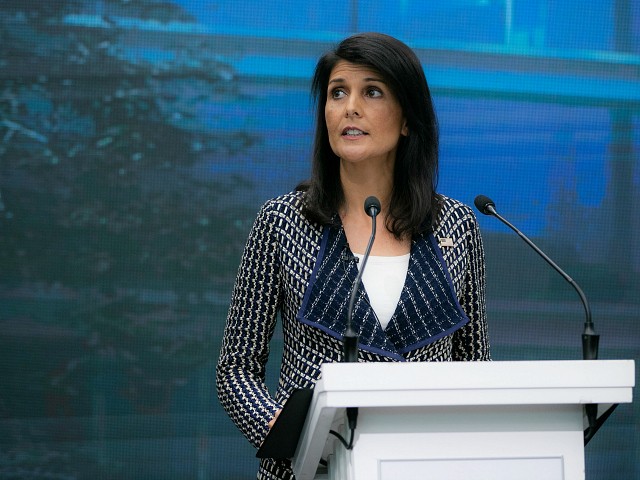
Several members of the Trump Administration such as UN Ambassador Nikk Haley have been pushing the President to not re-certify Iranian compliance in the 2015 nuclear deal.
This past week, several members of the Trump Administration signaled that the President will likely not recertify Iran’s compliance in following the 2015 nuclear agreement. If that happens, some observers believe it risks alienating U.S. allies, as the 2015 nuclear agreement was also signed by Great Britain, France, Germany, Russia, and China. The White House sent Nikki Haley, the UN Ambassador, to Vienna on Augst 23 to meet with officials from the International Atomic Energy Agency. During the visit, Haley “discussed the IAEA’s verification and monitoring of Iran’s nuclear-related commitments.”
The Trump administration has certified Iran’s compliance twice under a law that requires it to notify Congress of Iran’s compliance every three months. The next review period ends on October 1st. President Trump’s action in not certifying Iran’s compliance with the nuclear agreement threatens to put both Iran and the US on the path of a war and to further isolate the US on the international stage.
Here are the main events in Politics that occurred over the past week:
1. NJ Congressional Members Lead Push for Legislative Changes After the Charlottesville Incident
Senator Cory Booker (D-NJ) is at the forefront of efforts to address the legacy of white supremacy in in the aftermath of the Charlottesville incident.
Last weeks Charlottesville incident has encouraged renewed efforts at the Congressional level to address the legacy of white supremacy and to improve the Civil Rights situation within the US. One such effort is spearheaded by Senator Cory Booker (D-NJ), who announced on August 16 that he will introduce legislation ordering the remove all Confederate statues from the Capitol building. Arguing that the “Capitol’s statuary hall should be a place of honor for Patriots — those who have served, sacrificed, or made tremendous contributions to our nation,” Booker feels that it is inappropriate to honor individuals who pursued actions contrary to American values and that memorializing Confederate leaders is a disgrace to the memory of the individuals who lost their lives during the Civil War and in fighting for equal rights for all Americans regardless of race. Despite the overwhelming public support for Senator Booker’s legislative proposal, the bill has little chance to pass due to strong opposition by President Donald Trump and the Congressional Republican leadership.
In addition to Senator Booker’s legislative proposal, Congressman Leonard Lance (R-NJ’s 7th Congressional District) announced that he supports a new version of the Voting Rights Act of 1965. The Supreme Court invalidated key sections of the Act in the 2013 case Shelby County v. Holder, with the majority reasoning that the Justice Department could no longer review and block changes to the voting procedures in several Southern states with a history of discrimination because the statistics and data on which the Voting Rights Act was premised were no longer up to date. The new version of the law would make all states and jurisdictions eligible for coverage formula based on voting violations in the last 15 years and would create more transparency in the event of any changes to polling times, dates, locations and protocols. Even though the updated Voting Rights Act is supported by members of both political parties, the Republican-controlled Congress is opposed to such legislation, arguing that voting policies are to be left to the states and that any federal efforts are in violation of the Tenth Amendment to the Constitution. As such, prospects for any changes in federal voting law remain low.
2. Trump Approval Rating Falls to Record-Low Level
President Donald Trump’s approval rating has fallen to a record-low level over this past week.
Over this past week, President Donald Trump’s overall approval rating fell to a new low in response to his poor response to the Charlottesville incident and continued allegations regarding his connections to Russian President Vladimir Putin. In recent polling by Gallup, President Trump’s approval rating has fallen to only 34%, the lowest ever recorded for a President who has been in office for less than one year. The polling also shows that Trump’s support amongst Republicans has fallen to only 79% and that a majority of Republicans believe that Trump has fallen short on the national stage and that he needs to correct his policies and rhetoric in order to get back on course. Moreover, President Trump’s approval in three key states that helped him win the Presidential Election (Pennsylvania, Wisconsin, and Michigan) has fallen to less than 40%. This news reveals that the Trump Administration is deeply unpopular with the vast majority of the American people and perhaps is an early sign pointing towards a strong victory by the Democratic Party in next years midterm election and ultimately, a victory in the 2020 Presidential Election.
3. President Donald Trump Fires Chief Strategist Steve Bannon
The ouster of chief strategist Steve Bannon may signal the fact that President Trump is looking to turn a new corner in his administration.
On August 18, President Donald Trump fired Steve Bannon, his chief strategist, during a shakeup of his cabinet and top advisors. Bannon was originally hired by Trump last June shortly after the Republican primaries and was a driving force behind the “nationalist” ideology promoted by President Trump both on the campaign trail and in office. The tensions between President Trump and Bannon began last week when Bannon was quoted in an interview contradicting Trump on North Korea and asserting that he was able to make personnel changes at the State Department. These actions angered the President and made Bannon’s ouster inevitable.
Bannon’s exit means that one of the White House’s most controversial staffers would longer be at the center of the Trump Administration and may signal that President Trump is willing to modify his policies. Additionally, it is rumored that Bannon was fired based on the suggestion of Chief of Staff John Kelly who took over as chief of staff looking to instill order in a chaotic White House beset by internal divisions, staff infighting, and numerous controversies.
Here are the main events in Politics that occurred over the past week:
1. Tensions Between North Korea & The US Heat Up
Tensions between the US and North Korea increased over this past week due to soaring rhetoric on the part of President Trump.
Over the past week, tensions between North Korea and the US reached a boiling point and the chance for conflict between both countries is at its highest level since the end of the Korean War almost 65 years ago. The war of words between both countries began when President Donald Trump stated that any threats made by North Korea towards the US and its allies such as South Korea and Japan will be met with “fire, fury, and a massive show of force” and threatened to launch a pre-emptive strike against a country that has been under constant US sanctions and international isolation since the early 1950s. In response, North Korea leader Kim Jong-Un declared that his country would respond to such threats by attacking US territories in the Pacific such as Guam and Hawaii. Critics have argued that such rhetoric on the part of President Trump threatens to spark a large-scale military confrontation in one of the most volatile regions of the world and has the potential to get countries such as Russia and China involved. Additionally, the Trump administration’s overall policy towards North Korea can be considered to be an embodiment of US imperialism, in particular, the goal to have dominion over countries that are opposed to the current US-led global order.
2. The Russia Probe Against President Donald Trump Intensifies
The investigation into possible collusion between the Trump Presidential campaign and Russian President Vladimir Putin took an interesting turn this past week.
This week the investigations into alleged Russian collusion with the Trump campaign took a major turn with the announcement that the FBI raided the home of Paul Manafort, the Trump campaign manager. Manafort is being investigated for possible money laundering and has been targeted as someone who might testify against former colleagues in exchange for plea bargaining and immunity from prosecution. Senator Richard Blumenthal (D-CT) called the raid a “highly significant step” and said it was “typical of the most serious criminal investigations dealing with uncooperative or untrusted potential targets.”
Another possible indicator of collusion between President Donald Trump and Russian President Vladimir Putin was revealed by the President’s reaction to Russia ordering some 775 US diplomats to leave the country. As opposed to criticizing the move, President Trump praised Putin’s actions as beneficial because he said it helps him cut the U.S. government’s payroll. Even though Trump’s comments seemed to be a bit tongue-in-cheek, they point to a common trend in him not criticizing the policies by the Russian government and perhaps point to some form of collusion that helped to get him elected President.
3. Charlottesville Rally & Protests Take a Deadly Turn
Protests against a white nationalist rally in Charlottesville, Virginia turned violent on August 12.
On August 11, a group of several hundred white nationalists, neo-Nazis and Ku Klux Klan launched a rally in the small city of Charlottesville, Virginia. Known as the “Unite the Right rally,” the main purpose of the demonstration was to protest the removal of Confederate memorials from public spaces in Virginia and to come out in support of the policies and political positions of President Donald Trump. Some of the prominent speakers at the rally included Neo-Nazi activist Richard Spencer and former Imperial Wizard of the Ku Klux Klan David Duke, who both endorsed and campaigned for President Donald Trump. In response to the vile and bigoted nature of the rally, a counter-protest emerged led by organizations such as Black Lives Matter, Democratic Socialists of America, and Antifa. The protests became deadly on August 12 when James Alex Fields Jr. rammed his 2010 Dodge Challenger into a crowd of people protesting the rally, killing one and injuring another 19.
The response to the tragedy has overall been strong and forceful. Virginia Governor Terry McCaullife and Charlottesville Mayor Michael Signer directly addressed the participants in the rally and stated that they “are not wanted in this great commonwealth” and that the rhetoric of President Donald Trump is partially responsible for such events. President Donald Trump’s response has been roundly criticized by individuals on all sides of the political spectrum due to the fact that he did not specifically denounce the white nationalists, white supremacists and neo-Nazis attendees and hinted that he felt that the counter-protesters deserved the lions share of the blame.
4. President Donald Trump Continues to Criticize Senate Majority Leader Mitch McConnell
President Donald Trump continued to criticize Senate Majority Leader Mitch McConnell (R-KY) this week due to the failure of the Obamacare repeal.
President Donald Trump continued his ongoing public attacks against Senate Majority Leader Mitch McConnell this week. In particular, Trump has criticized the Senate majority leader for the recent failure by the Republican Party to repeal the Patient Protection Affordable Care Act (“Obamacare”) and replace it with a suitable substitute. Trump responded on Twitter three times following criticism from McConnell that the President had “excessive expectations” of Congress and that “artificial deadlines” hurt the GOP agenda and prevent effective public policy proposals from being successfully implemented. The increased level of criticism on the part of the President to a once-key political ally threatens to stall the agenda of the Trump Administration during a critical point in the legislative calendar year. For example, the increased criticism may make Senate Majority Leader McConnell less willing to move forward on some of the Trump Administrations key policy proposals such as tax reform, infrastructure spending, and the passage of the annual federal budget.
5. Iranian Parliament Softens Drug Death Penalty Laws
The Iranian Parliament passed a bill softening legal punishments related to drug possession and trafficking.
On August 12, the Iranian Parliament (Majiles) passed an amendment to its drug trafficking laws raising the thresholds that can trigger capital punishment. Even though the legislation still needs to be approved by the conservative-dominated Guardian Council, it gained parliamentary approval after several months of debate. According to Amnesty International, Iran is one of the several countries in the world that relies on capital punishment for various crimes and a majority of its executions are political opponents to the Iranian government.
The new law raises the amounts that can trigger the death penalty from 30 grams to two kilos for the production and distribution of chemical substances such as cocaine and heroin. The new law will apply retroactively, thus commuting the sentences for many of the 5,000 inmates currently on death row for drug trafficking and possession. The law also restricts the death penalty to individuals who lead drug-trafficking efforts, exploit minors less than 18 years of age, carry or draw firearms while committing drug-related offenses, or have a previous conviction of the death penalty or a jail sentence of more than 15 years or life in prison.
Afghanistan, the United States, the Soviet Union, And Illegitimacy PS 401: Seminar in Political Science
Fall 2016
Marco Palladino
(Work In Progress citations not cited properly due to format of blog- can submit original copy if needed(word doc)
Abstract
Intervention in a failed state is not an effective counterterrorism tool when it is reliant on military power to prop up a perceived illegitimate government. Additionally, foreign hegemonic forces are often viewed as invaders even if that does not represent the underlying goal of the intervention. This study will focus on the policies implemented by the US and the Soviet Union over the courses of their interventions in Afghanistan, which is at the forefront of America’s failed counter-terrorism campaign in the Middle East and North Africa. Afghanistan has a history of being invaded and pushing invaders out. For example, Greece, Great Britain, and the Soviet Union all invaded Afghanistan at various points in time, but their efforts ultimately ended in a resounding defeat. All these unsuccessful invasion help give Afghanistan the nickname of “The Graveyard of Empires.” This paper seeks to explore what are the likely results of an intervention by foreign hegemonic forces in a failed state to install and maintain an illegitimate government. The methods measured include casualty rates, economic indices, military spending on intervention by hegemonic power and results of such interventions, and various social indices. Examining the long-term effects of war and insurgency will be critical to determine the effectiveness of foreign intervention against terrorism.
Introduction
The ongoing “War on Terrorism” has been a major foreign policy challenge over the past decade and a half.
A major foreign policy issue in recent years has been the ongoing War on Terror, which is an international effort to destroy groups, organizations, and affiliates that are a threat to the United States or its Allies. The War on Terror began as a response to the 9/11 Attacks by North Atlantic Treaty Organization (NATO), which includes the United States, France, United Kingdom and Germany. Even though NATO was set up as a military and political alliance during the Cold War era, its focus has shifted towards intervention in numerous failed states and has conducted many aerial bombings in attempting to combat “terrorism” and to implement governmental change.
According to the Global Political Forum, a failed state is “a government that can no longer provide basic functions such as education, security, or governance, usually due to fractious violence or extreme poverty”. Using United Nations data on casualty rates, stability, corruption, and social well-being will determine if the country is moving forward or backward. Military spending will also factor in the results if the amount of money invested was spent wisely and has had a noticeable positive effect on national progression. Is there a lack of diplomacy or willingness to negotiate that could be reducing possible results?
This paper will examine the effects of foreign intervention by hegemonic forces and their role in exacerbating the problems in “failed states” such as Afghanistan. The hypothesis is that a heavy reliance on military intervention in a country to prop up a perceived illegitimate government will have largely negative results. This paper will also look at the robust strategic patterns of the United States and the lack of ensuing results through military intervention in failed states in addition to general campaigns in Afghanistan and their correspondence to the objective of the reduction of terrorism and increasing stability in the nation-state. This paper focuses on Afghanistan, which has been considered the epicenter for global terrorism and had large-scale intervention by foreign hegemonic forces. The result of the intervention in many states has been largely negative for the population in question. The cases study will look at Afghanistan as a whole and the large-scale military intervention by NATO in the last few year’s outcomes. The case study will look at spending habits and how they factor into the successful elevation of suffering and counter-terrorism in a failed state. The final area will be how diplomacy factors into resolving a crisis in a failed state.
Originally part of Iran, Afghanistan received its independence in 1709 after a successful revolt against the Iranian government, then under the leadership of Shah Sultan Husayn, a member of the Safavid dynasty which ruled Iran from 1502-1722. Over the ensuing centuries, Afghanistan was characterized by conflicts with European powers such as Great Britain and the Russian Empire. By 1919, Amanullah Khan was finally able to remove British influence from Afghanistan and began to pursue an independent foreign policy. Over the next few decades, Afghanistan was led by Mohammed Zahir Shah, who ascended to the throne in 1933. Mohammed Zahir Shah shares some similarities with Shah Mohammed Reza Pahlavi of neighboring Iran in that he sought to increase economic modernization and secularism within Afghanistan. Additionally, Mohammed Zahir Shah was generally a far less repressive leader than Pahlavi and allowed a much higher level of political freedom overall in Afghanistan than in Iran.
Beginning in 1955, the Soviet Union provided large amounts of military training and materials to Afghanistan that gradually increased over the next two decades. For example, 1 out of every 3 members of the Afghan military was trained on Soviet soil by the early 1970s. The major political event to note during Mohammed Zahir Shah’s rule was the creation of the People’s Democratic Party of Afghanistan (PDPA) in 1965. The PDPA ultimately split into two factions, the Khaliqis led by Noor Taraki, and Parachamists led by Babrak Karmal. The Khaliqis has a base of support in rural areas and among the Pasthuns. The Parachamists primarily had support from urban areas and were the reformist political faction within Afghanistan. In 1973, Prime Minister Mohammed Daoud peacefully overthrew Mohammed Zahir Shah. The Khalq faction never fully recognized Daoud’s leadership, viewing his overthrow of the King as a plot to gain power.
On April 28, 1978, Afghani soldiers supportive of the Khalq faction killed Mohammed Daoud and his family in his presidential palace, thus allowing Noor Taraki to become Prime Minister and Babrak Karmal to become Deputy Prime Minister. The Carter Administration viewed the overthrow of Daoud as a communist takeover. Internal Afghan politics complicated the US and Soviet influence during this period. Hafizullah Amin, an ally of Taraki received word that Karmal was planning a Paracham plot to overthrow the Taraki regime. Amin executed many Parchasmists to reinforce his power. The overthrow damaged the communist revolution that was attempting to spread across the country. The communist governance was now by the winter of 1978 met with armed insurgency across the country. Amin and Taraki signed a treaty allowing direct Soviet military assistance against any insurgency threatening the regime.
In mid-1979, the Soviets began to sends advisers to Bagram Air Base outside Kabul. In response, the Carter Administration started supplying non-lethal aid to Afghan Mujahideen, a Sunni Islamic insurgent group. Amin believed the Soviet intervention was designed to strengthen Taraki at his expense. As a result, Amin ordered the death of Taraki in October of 1979, earning the ire of the Soviets. Additionally, Islamic fighters were defeating the Afghan army and the Soviets were forced to either lose their foothold in Afghanistan. As such, the Soviets invades Afghanistan on December 26, 1979, and initially sent in motorized divisions and Special Forces. The Soviets killed Amin and installed Barak Karmal as head of Afghanistan. President Carter subsequently stepped up aid to the insurgents and announced his own doctrine to protect Middle Eastern oil supplies from encroaching communism. Washington wanted to make the Soviet occupation as painful and as brief as possible. The Soviet war in Afghanistan ended up lasting 10 years and millions of lives lost. The Soviets spent $50 billion dollars and lost 15,000 men in addition to a strong uprising emerging in Afghanistan, this igniting a civil war.
After the Soviets left in 1989, Afghanistan was destabilized and was characterized by various political groups vying for power. The Taliban, an Islamic fundamentalist group, ultimately took power by 1992. The Taliban would later allow Osama bin Laden to establish training bases in Afghanistan beginning in 1996. Their rationale behind this decision was to make Afghanistan an outpost for Wahabbi Islam and to ultimately attack Iran, which is majority Shi’a and strongly opposed to radical Islamic ideologies.
Afghanistan would subsequently suffer from major social, political, economic, and governmental problems following the 2001 invasion by the United States. The result of the invasion would be the exacerbation of all the problems in Afghanistan from food shortages to increased levels of violence precipitating the region and more complex problems arising. Before the invasion, millions of people were on the edge of starvation and many aid groups had to leave before the invasion because it wasn’t safe. The number of civilian casualties in Afghanistan is increasing every year. A United Nations Assistance in Afghanistan report states ” During the time covered by this report, 157,987 Afghans were displaced because of the war. This brings the estimated total number of conflict-induced displacement Afghans to 1.2 million.” All this is indicative of 40 years of intervention by NATO in a conflict-prone area increasing casualties and failing to solve the problem through the use of diplomacy.
Methodology
The paper will use various variables relating to the state of Afghanistan, either progressing further into or out of a “failed state” that help demonstrate government legitimacy. The United State’s relation to that progression or regression will be key in the country. Such variables like civilian deaths per year (graphs/charts, including deaths from violence), drug production levels (estimated # of tons), internal/external displaced populations (note population displacement is hard to calculate and numbers often conservative, Afghans are the 2nd largest refugee population in the world).
The fiscal problems facing the Afghan government include a small GDP and a heavy reliance on foreign money from the United States. Looking at insurgent attacks over the last decade will help paint a picture of future violence. The goal of the gathering of these statistics is to map out where the future of Afghanistan is headed and to provide an overview of the growing problems in the country. In relation to these problems, the United States & Soviet Union’s role in the country may be positive or negative. What has been the effectiveness of the United States at legitimizing through solving these problems? Examining basic areas of spending patterns will support understanding on if investments proved worthwhile long-term (10-15 year period).
There are some limitations to this analysis, however. One such issue is the measurement of insurgent members in Afghanistan. Finding this data is difficult due to the fact that many attacks are unreported because the government of Afghanistan does not have effective record-keeping procedures. As such, the level of casualties is used to help blanket insurgent levels. Looking at micro use-spending habits could also prove difficult to uncover and total spending habits also may be hard to figure out, as a result of how certain projects are classified. Examples could include, weapons programs being tested, use of special forces, the cost of technology, soldiers with PTSD or other medical issues that encompass US Spending in Afghanistan. The numbers keep growing and examining simpler terms would provide a better overview of the situation rather than smaller difficult programs to map out the impacts. Determining the number of munitions dropped by the US in Afghanistan alone is an impossible task for the research to dive into because there is a lot of shock and awe tactics (where large sums of bombs are dropped quickly). The cultural, linguistic, and religious variables that affect Afghanistan will not be included. A 14-week schedule makes an analysis of a wide variety of data difficult at best. The motivation behind the methodology is to look at simpler variables to construct a conceptualization and overview of Afghanistan at present as well as its future. The research is by no means to suggest solid claim of Afghanistan future but merely a roadmap in the direction in which the country is heading.
Literature Review
Carl Von Clausewitz was one of the earliest philosophers who studied the notion of warfare.
The philosophy of war has a long and arduous history ranging from the Ancient Greeks to the modern members of Congress that make military decisions. The literature review will focus on contemporary theorists in the philosophy of war. One of the earliest theorists was Carl Von Clausewitz, a 19th Century Prussian general, and military theorist. Primarily influenced by the Napoleonic Wars and Frederick the Great, Clausewitz focused on the moral and political aspects of war and said that “War is the continuation of politics by other means.” According to Clausewitz, the US war in Afghanistan would be considered an unideal and unjust war due to the fact that the US has been indiscriminate in harming civilians and other non-military targets.
On the other hand, John Keegan has the opposite perspective and is referred to in political science as the anti-Clausewitz. His perspective is that modern wars like Vietnam were not immoral and instead fought the wrong way. Essentially, Keegan is saying that it is not the crusade that was wrong but the way the crusade was carried out. According to Keegan, the War in Afghanistan would be perfectly moral and flawed only due to the fact that the US did not entirely commit itself to fight the war successfully. Keegan would suggest that the US should dramatically expand its presence in Afghanistan and not hold back in its efforts to prosecute the war to a successful conclusion.
it is not the crusade that was wrong but the way the crusade was carried out
Neorealism is another well-known theory in international relations.
Kenneth N. Waltz, Patrick James, and David Fiammenghi are proponents of neorealism. The neorealist theory states that international politics is defined by anarchy, and by the distribution of capabilities. As such, there exists no formal central authority and that every sovereign state is formally equal in this system. The states, in turn, act according to the logic of self-help, meaning they seek their own interest and will not subordinate their interest to the interests of other states. Additionally, the security dilemma in realism states that a situation in which actions by a state intended to intensify its security, such as increasing its military infrastructure or building alliances, can lead other states to respond with similar measures, producing increased tensions that create conflict, even when neither side desires it.
Charles L. Gaster is a proponent of the concept of the security dilemma and illustrated the political consequences of military strategies within individual countries. Gaster stated that “The first focused on military capabilities and implicitly assumed that the basic goals of the Soviet Union were fixed; its central concern was to determine what military capabilities the United States required to deter or defeat the Soviet Union. The second component focused on what I term political consequences the effect of U.S. policy on the basic goals of the Soviet Union and on Soviet views of U.S. resolve. Sharp disagreements about political consequences played an important role in dividing the American cold war debate over military policy.”
Another theory in realism is the prisoners’ dilemma. As described by Robert Jervis and R. Harrison Wagner in a January 1978 World Politics journal article, the prisoners’ dilemma shows why two completely rational individuals might not cooperate, even if it appears to be in their best interests to do so. An example could be the dynamic between Iran and Russia on one hand, and the US on the other hand regarding the Syrian Civil War.
Defensive Realism is the theory that aggressive expansion as promoted by offensive neorealists upsets the tendency of states to follow to the balance of power theory, thus decreasing the primary goals of the state, namely ensuring their security. Kenneth N. Waltz considered the founder of defensive realism as a theory, explains his perspective on international relations after the cold war by stating that the “one condition for success is that the game is played under the shadow of the future. Because states coexist in a self-help system, they may, however, have to concern themselves not with maximizing collective gain but with lessening, preserving, or widening the gap in welfare and strength between themselves and others. The contours of the future’s shadow look different in hierarchic and anarchic systems ”
Offensive Realism holds the anarchic nature of the international system responsible for aggressive state behavior in international politics. John Mearsheimer is one of the first who explored this theory in his 2001 book “The Tragedy of Great Power Politics.” Offensive Realism depicts powerful states as power-maximizing information control entities, that force others to fight while they are on the sidelines, overbalancing strategies in their ultimate aim to dominate the international system. Contributing theorists include Glen H. Snyder, Eric J. Labs, Fareed Zakaria, Colin Elman, Randall L. Schweller. Steven E. Lobell writes, “According to offensive realism, security in the international system is scarce. Driven by the anarchical nature of the international system, such theorists contend that states seek to maximize their security through maximizing their relative power by expansionist foreign policies, taking advantage of opportunities to gain more power, and weakening potential challengers. The state’s ultimate goal is hegemony. How a state will go about expansion will vary from nation to nation (due to geography, military tradition, etc.)—offensive realism does not predict the same security strategy for every state. ”
Is there an offensive-defensive theory of realism? According to Sean M. Lynn-Jones, “Offensive-defense theory argue that there is an offense-defense balance that determines the relative efficacy of offensive and defensive security strategies. Variations in the offensive-defensive balance, the theory suggests, affects the patterns of intentional politics.”
The Neo-Classical realist perspective is closer to the defensive realistic perspective, the actions of a state in the international system can be explained by systemic variables, the distribution of power capabilities among states, as well as cognitive variables, such as the perception of systemic pressures, other states’ intentions, or threats and domestic variables such as state institutions, elites, and social actors within society, affecting the power and freedom of action of the decision-makers in foreign policy. While holding true to the neorealist concept of balance of power, neoclassical realism further adds that states’ mistrust and inability to perceive one another accurately, or state leaders’ inability to mobilize state power and public support can result in an under expansion or under balancing behavior leading to imbalances within the international system, the rise and fall of great powers, and war.
Gideon Rose states that “Neoclassical Realism argues that the scope and ambition of a country’s foreign policy are driven first and foremost by the country’s relative material power. Yet it contends that the impact of power capabilities on foreign policy is indirect and complex because systemic pressures must be translated through intervening unit-level variables such as decision-makers’ perceptions and state structure.”
Noam Chomsky is a critic of the idea of American Exceptionalism.
Relative material power brings the discussion to the United States with its exceptional power over other nations. American Exceptionalism is the idea that American is unique and superior to other nations, Marilyn B. Young, a Harvard scholar on American Foreign Relations, says “There’s an arrogance born of power”. In here view America has become very deceptive in how a leader in government talk about, how the military reacts to war and the lack of transparency in some areas. Noam Chomsky depicts the United States as a country which goal of its foreign policy is to create more open societies where the United States can expand control of politics and the market.
In contrast, Neo-Conservatives think that the military is there for the United States to use it. Essentially we have the power so we need to use it to push our way into practice by force. Senior officials in the Bush Administration such as Vice President Dick Cheney and Secretary of Defense Donald Rumsfeld are prominent followers of this ideology which is an extension of American Exceptionalism. Former UN Ambassador Jeane Kirkpatrick is another neoconservative who criticized the foreign policy of Jimmy Carter, who endorsed de-escalation of the Cold War.
Another component of neoconservatism is the Bush Doctrine, which holds the idea of a preemptive attack on perceived enemies of the US. William Kristol, a supporter of the Bush Doctrine, wrote in 2002 that the “world is a mess. And, I think, it’s very much to Bush’s credit that he’s gotten serious about dealing with it. … The danger is not that we’re going to do too much. The danger is that we’re going to do too little. ” Neo-Conservatives hold true the idea of policing the world as a way to ensure political peace and stability and would argue that intervention in Afghanistan by the US is an appropriate step for this goal.
Current Problems Facing Afghanistan
The decade-long Soviet intervention in Afghanistan left 15,000 Soviet military personnel and nearly a million Afghani civilians dead. The war was a proxy for the United States against the Soviets in which the United States used “our gold and their blood” (referring to Afghani civilians). During the war, the CIA encouraged Islamic extremists to join in the war to defend Islam against an invasion by the “godless Communists.”. Much of the weapons in Afghanistan today were paid for by either the United States or the Soviet Union and left there an estimated total of 45 billion dollars in arms/ammunition. The mass amounts of weapons would aid the conflict of the civil war that plagued Afghanistan from 1989 to 1996. The Taliban came to power in the ruins of the civil war and ruled Afghanistan as an Islamic state based largely on the ideology of Wahhabism. Bin Laden would later find refuge there where he helped the government fight off the Soviets in the 1980s and was largely viewed as an honorable man within Afghanistan due to the fact that he successfully repelled a foreign imperialist invader who sought to install an illegitimate government into power.
The United States invaded Afghanistan on October 7th, 2001 in retaliation for the 9/11 attacks. The Taliban government did not provide any material support or personnel (mostly Saudi Nationals) for the attacks on 9/11, though they allowed Osama Bin Laden to have a safe haven. The Taliban refused to release Bin Laden to the United States and said they would give him to a neutral 3rd party. The United States rejected their offer. The Taliban also asked for evidence and the US declined their request. According to the UN and aids groups, prior to the invasion, it was thought there would be a mass famine where millions would starve because of Afghanistan’s dependence on foreign food. After the United States bombed Afghanistan for 2 months, the Taliban government ultimately surrendered in December of 2001. The United States would install a government that Afghani civilians view as illegitimate, corrupt, and weak. Displacement of the population is one of the biggest problems in Afghanistan and the Middle East from war and conflict.
Afghanistan has one of the worst population displacements problems in the world. Afghans make up the 2nd largest refugee population in the world and it is estimated that 3.7 million Afghans have been displaced by the conflict in the last decade or so. That is a daunting number no government or institution can handle alone to manage. One million are estimated to have fled to Iran, another 1.5 million into Pakistan. From a 2014 report, 700,000 are expected to be displaced in Afghanistan itself. Every year the numbers get worse and worse, more death and more casualties beating the last year. There is a variety of reason for this but many civilians die in either ground engagements or through IEDs that are leftover or part of the current war. The surge under President Obama, which was the deployment of 30,000 additional troops to Afghanistan, did not make Afghanistan safer and their withdrawal has not reduced the casualties rates. Killing members of Taliban have only created more instability and turned various areas of the country into a devastated war zone. In this climate, these policies undermine government legitimacy constantly because the government cannot provide basic necessities. Additionally, this policy has the government of Afghanistan largely taking orders from NATO and the US, which have large cultural differences and questionable understanding of the country. For example, Afghanistan is predominantly Muslim (~85-93% Sunni and ~7-15% Shi’a) and the main languages spoken are various dialects of Farsi (an Iranian-based language which is not widely taught in the West).
Heroin usage and production is a major problem facing Afghanistan, as it produces 80-90% of the world’s supply of Heroin. The Taliban profits nearly a billion dollars a year from the trade, namely by exporting opioids to other countries. It is estimated that there are around 1.6 million drug users in Afghan cities and another 3 million in the countryside. Unfortunately, the opium production has helped fuel severe problems with addiction to opium which has worsened the situation in Afghanistan. In 2001, The Taliban government issued a fatwa forbidding heroin use, which essentially put a stop to the problems of its use in Afghanistan. The US invasion that same year and the subsequent installation of Hamid Karzai as the Afghan President saw the prior ban go away and thus opium production skyrocket starting in 2002.
The US invasion had multiple coalitions of groups such as the Northern Alliance in Northern Afghanistan and the Puston Warlords in the South-East who also played a major role in the trafficking in Heroin which would result in it’s come back largely in Afghanistan. The whole story isn’t told there, “The drug trade accounted for most of its tax revenues, almost all its export income, and much of its employment. In this context, opium eradication proved to be an act of economic suicide that brought an already weakened society to the brink of collapse. Indeed, a 2001 U.N. survey found that the ban had “resulted in a severe loss of income for an estimated 3.3 million people,” 15% of the population, including 80,000 farmers, 480,000 laborers, and their millions of dependents”. As such, banning opium, which was largely pushed by Westerners, was a severe miscalculation on the part of the Taliban-led government. Ideally, it would have been smarter to have a transition period meant to phase out opium production and allow those whose livelihood depends on its production to developing alternative sources of income.After the invasion in 2001, the Taliban went back to selling heroin to fund the insurgency but there are other segments that sell and control opium distribution.
Prior to the Soviet-Afghan war (1979-1989), opium production in Afghanistan and Pakistan was directed to small regional markets. There was no local production of heroin. The CIA helped design the Afghan Narcotics economy to fund the Taliban and launder money during the War against the Soviets in Afghanistan. Currently, the problems of heroin fuel the insurgency and corrupt the government while increasing drug usage both inside and outside the country. The US would later spend 7.6 billion to eradicate opium in Afghanistan and in every measurable way they have failed. Instead, it helps fuel the insurgency by upsetting locals and fueled government corruption. Again undermining the legitimacy of the government while pushing cultivation practices that they have helped start in the first place. That 7.6 billion wasted in opium eradication is just the tip of the iceberg with unsustainable spending patterns.
The financial problems facing the Afghan government, such as a small GDP and reliance on foreign money from the United States and others present serious problems. The reliance of foreign money make long-term success difficult and, if foreign money is withdrawn from the economy, the government would collapse. Corruption is also a major problem in Afghanistan. Many hands are taking money out of the government coffers for personal gain. The corruption isn’t something that is only on the local level but stretches all the way to the top. It’s difficult to measure the level of corruption but there are key findings to support the idea that the Afghan government has serious corruption problems which undermine the government as an institution and waste precious money needed to support the Afghan people. In 2012, nearly half of Afghan citizens paid a bribe while requesting a public service and the total cost of bribes paid to public officials amounted to $3.9 billion US dollars. This corresponds to an increase of 40 percent between 2009 and 2012. So the government abuses its position which increases the cost for the people who pay taxes and then pay again to get something done. A snapshot of Afghan culture is that bribery is embedded in social practices, with patronage and bribery being an acceptable part of Afghan culture. These practices of bribery are also in other regions without government.
Non-governmental groups like village associations and the Taliban have patronage systems. Bribery usually occurring in government to change police or judicial results or provide governmental services faster. The bribes can undermine government institutions which are flooded with money. Examples of government corruption can be to keep a family or relative from going to jail by paying the judge or police off. An instance of corruption is the people put in power, namely family relatives, for example, the director of Education was put in power because of his relatives but could not read or write.
These problems are worsened by the uncertainty of how long the US will stay and fight. If one thinks they’re leaving next week or not here to stay then obviously you’re going to abuse the money that comes in. You have elections where they have large accusations of voter fraud and reinforcement of the idea that Afghanistan looks like a “tin-pot dictatorship”. It costs somewhere around $12 billion dollars a year to train Afghan security forces and neither the US nor the Afghan government can sustain that figure. So in no way is the situation an economically manageable one, especially with record numbers of security forces being killed and high levels of desertions. “Between October 2013 and September 2014, more than 1,300 Afghan army troops were killed in action and 6,200 were wounded”. Senior US Officers have called that “unsustainable”. Desertion is a problem but there are poor numbers on this so it’s just important to mention it as a problem. The Taliban have been killing more and more people in the security forces and expanding their territory.
Growing insurgency problem across the countries level of violence grows worse.US Policy may appear to be helping reinforce insurgency numbers. The basic premise of counter-insurgency strategy is you’re only as good as the government you represent. The government that represents Afghanistan lacks legitimacy with Afghan people and it can’t even hold the Taliban at bay. While the US in for example in 2011, was killing 360 insurgent leaders in a 90 day period using Special Forces, there were more attacks against coalition forces and no reduction in overall violence. Basically, it goes back to the old adage of “if you hit me, I hit you.” Abdul Hakim Mujahidin, the Taliban Envoy to the UN from 1998 to 2001 said” They consider that the continuance of the war in this country is not for the benefit of their people. But in practice, they are using their military against the Taliban. They are forcing the Taliban to respond militarily”. Osama Bin Laden was not part of the Taliban but Al Qaeda and his objective were to drive the US into Afghanistan to shatter will at home and push US and Allies to get out of the Islamic world. The war in Afghanistan is now the longest war in US history and the US government has still been unable to ensure Al Qaeda’s come back into Afghanistan. Some reports show drone strikes are counterproductive and other say they are. It’s hard to tell productive ones from unproductive ones when they target high-ranking leaders but when they kill innocent civilians or low-level combatants they can help fuel an insurgency.
What has the US Invested For Afghanistan’s Success? The United States is spending too much money on Afghanistan, so much so that the numbers are often unknown or hard to pin down. Many different sources provide different estimates for costs on different things, but to figure out the total and cost year by year is simply too long of a process. For instances, some institution will say the cost of Iraq X and others Y. From Pew, it was shown that the US is spending around $16-17 billion dollars a year on counter-terrorism. What exactly does that cover? Again hard to pin down what exactly all these funds are being spent on. You also have heightened violence which is going to require more mobilization of the military to things like Veterans health which are extremely costly. These costs are often stuck with other wars. Here are some estimates on the spent money in key areas, reconstruction, $110 billion dollars, the largest portion of that is $60 billion being spent on training Afghan security forces.But this may not be accurate because many costs are left out of such reports so it’s better to give a bulk total of 4 to 6 trillion on the costs then try to micro-manage every cost exactly into the bill. Again this is unsustainable spending and if the US pulls out tomorrow and loses everything much of that investment could prove worthless, which is why many are reluctant to do so.
At the same times it getting harder for members of Congress to justify trillions of dollars spent for a deteriorating situation. The government gives aid to Pakistan and sometimes that aid is used to train the Taliban and other groups while fighting against Al Qaeda. Pakistan has received military aid from the US since 1948. Since 2001, the US has given Pakistan roughly $2 billion per year in military and assistance some of which has been used to support insurgent groups.This aid has gone up and down and appears to have no effect on reduction of violence in Afghanistan or Pakistan. These failures undermine the US influence in Muslim countries and appear to not give the Afghan government more legitimacy. Instead, it is akin to throwing money down a drain and hoping that something sticks.
American Exceptionalism
American Exceptionalism is the idea that America is unique, just and always on the side of good. The idea of American Exceptionalism date back to the founders, but has become largely ingrained in American Society and Politics in the 21st century following World War II. The American Military is a manifestation of this Exceptionalism and when it does something with the use of force it is always to protect our Democratic system and protect our national interests. An example of this is the perception of the Iraq where US citizens perceived the invasion of Iraq to be freeing the people of Iraq and keeping the world safe for democracy. The truth tends to be different from the perception by the American public. There is the problem of Amnesia, where people forget what the US had done wrong like people will say the government did that in the past or not remember it at all.
People also preach the perceived values of the US even if their false and the idea the US has the right to break the rules to enforce the appropriate world order. This type of clouded perception of US intervention has helped lead to two costly wars, namely, Iraq and Afghanistan. The Idea that the US was on the side of right when it invaded allowed it to label others as the bad guys versus the good guys which is one of the biggest reason for the strategic blunder. The biggest mistake the Bush Administration admits too is not differentiating the Taliban from Al Qaeda. That mistake has helped continue years of bloodshed which looks like a result of that clouded perception by the US mindset and no victory coming closer. Again this idea of American Exceptionalism is a weakness Osama Bin Laden used to push the US to invade Afghanistan and undermine its legitimacy has a hegemonic power.
The United States repeated and made the same mistakes the Soviets did in Afghanistan such as invading the country and installing/propping up an illegitimate government. There is also a large disillusion that the problems could be solved in a few months where it would appear they cannot t be solved in 16 years. Both the Bush Administration and the Soviet Union thought they would have victory in Afghanistan relatively quickly, but long-term insurgency never seemed to be defeated completely. They would kill tens of thousands and there would be a battle the next day. There was also this feeling that once the Soviets got in, the fight was about “National Prestige”(Vietnam Syndrome)(much like American Exceptionalism). If they left they would shame their country, so the Soviets stayed for 10 years and then got kicked out. There was a very large disconnect between the Afghan culture, language and the invaders (US/Soviet). There continues to be a problem that stems very much from Afghanistan, Jihad to protect Islam whether or not it’s true it is an idea that has spread. There was the idea that both the Soviet Union and the US had about creating stability even though their actions did the opposite (referencing actions of Soviets in the 1980s vs the US today). In Afghanistan, they were almost always high casualties largely taken by poor farmers who felt they were defending their country or pro-government forces caught between tribal disputes. There is still consistent aid and travel by the Taliban in and out of Pakistan. There is also the problems of people deserting the Afghan army which the hegemony supports. Both countries become involved in a war they thought they won in weeks but ended up turning into something like the Sopranos where everyone is killing everyone and the hegemony is caught in the middle.
Possible Options To Increase The Legitimacy Of The Government Of Afghanistan *Gain control of opium production and put it under some form of governmental control. The government needs the money and many of them are already involved in the opium trade it’s a legal barrier of just legitimizing it to gain more secure control of the country. It always puts a lot of people to work and helps many people to make a living, after Afghan is more built up its possible to move it away from there after large improvements are made.
* Make peace with large portions of the Taliban and allow them to govern more legitimately (in the eyes in the Afghan people). This policy is difficult to implement and will require much work, negotiation, and large term forward-thinking on the part of policymakers in the US.
*Reduce bombing campaigns to be more strategic and at all costs reduce refugee populations
* Figure a way to build large housing developments in a cost-effective manner and again working with the Taliban to make a safer country long term. These policies would help alleviate problems of population displacement and allow the people of Afghanistan to live in safety.
*Work heavily with Iran, Russia, Pakistan, and other neighboring countries to improve stability within the Middle East. Some of the ways include increased military cooperation, political planning, and population management. Another solution is to partition Afghanistan between Iran and Pakistan. Iran would gain the primarily Shi’a Western regions of Afghanistan, whereas Pakistan would get the Sunni-dominated regions in Eastern Afghanistan. The key to this proposal is to implement it democratically through an UN-sponsored referendum. If this step is not done democratically, it can further embolden insurgents and make the already difficult situation in Afghanistan much worse.
*Governance should be looked at a provincial level rather than a Federal state (small self-governing provinces). Tribalism playing a role here.
*There needs to be a transition from a strategy of killing Taliban and Al Qaeda Leaders to legitimizing Afghan government, as key counter-insurgency means.
*Increase and incorporate region cultural understand, natural, economic and political problems as the heart of counter-insurgency.
What does Trump mean for the future of Afghanistan? President Donald Trump has made many negative and inaccurate statements about Islam, which does not do any good to help the image of the legitimacy of the Afghan government. Trump is appointing neoconservatives which are generally more hawkish than Neo-liberals such as President Obama or Bill Clinton. A more hawkish approach would be to increasing militarizing the situation by increasing bomb campaigns which will likely worsen the situation. Trump’s view of the conflict with terrorism as an ideologically struggle against where the enemy is 110% evil echoes the same problems the Bush Administration pushed where they failed (even Obama), a reasonable understanding of the situation is crucial to success. Trump seems to display a profoundly ignorant understanding of the conflict.
Trump has also spoken in favor of a hardened US policy towards Iran for the nuclear reason, which is largely rooted in ignorance and misunderstandings of the sorts. If a war was launched against Iran, it would ensure that Al Qaeda and other terrorist groups become stronger than ever. Iran borders Afghanistan and conflict in the area would make both countries less safe. Trump’s dislike for NATO could mean the United States occupies Afghanistan alone and increases the requirements for more troop deployments. Trump embodies the idea of American Exceptionalism in a negative way. Trump’s position on Russia was formerly stable, but his advisers pushed him away from that stance into a more confrontational one due to the issue of Syria. Trump has already reneged on many campaign promises so it’s hard to tell what the policy will be but he has surrounded himself with the people who lead the country into Iraq.
Conclusion
The United States and NATO need to refocus on why they are in Afghanistan and the plans for the future. If they plan to continue fighting heavily in Afghanistan they need a new long-term strategy. The United States needs to increase accountability with aid and better keep track of resources in order to maximize efficiency. Increasingly high casualties taken by civilians and security forces undermine government legitimacy. A record number of refugees destabilize the region where countries like Iran, Pakistan, and others taken in millions of refugees. The new administration coming in needs to make sure it uses forces to find a political solution and not to defeat the insurgency because ultimately Afghanistan will be solved by a political solution whether it be dividing Afghanistan up or other solutions like negotiating heavily with the Taliban. If the government wants to become more legitimate curbing corruption is a major hill to climb as well as developing a proper narcotics strategy that makes sure the Afghan people are put first. Poor results have been shown to develop with high levels of violence, high population displacement, high corruption, and war. Perhaps it’s impossible given the problems to remove the label from Afghanistan of Failed State under the next administration.
Citations
Abramowitz, Morton, James Holmes, Seth J. Frantzman, and Ashton B. Carter. “How American Exceptionalism Dooms U.S. Foreign Policy.” The National Interest. The National Interest, 22 Oct. 2012. Web. 12 Dec. 2016.
“Afghan Refugees.” Afghan Refugees | Costs of War. Watson Institute, Apr. 2015. Web. 5 Dec. 2016.
“Afghanistan: Record Level of Civilian Casualties Sustained in First Half of 2016 — UN Report.” UNAMA. United Nations, 25 July 2016. Web. 5 Dec. 2016.
Afghanistan War Documentary. Dir. Andrew Mackay. Perf. David Cameron. Afghanistan: The Lessons of War. BBC, 2016. Web. 5 Dec. 2016.
Atal, Nishant. “More Harm Than Good?” World Report. US News, 25 Nov. 2015. Web. 5 Dec. 2016.
Chomsky, Noam. “The War In Afghanistan.” The War In Afghanistan. Z Magazine, 1 Feb. 2002. Web. 5 Dec. 2016.
Chossudovsky, Michel. “The Spoils of War: Afghanistan’s Multibillion Dollar Heroin Trade.” Global Research, Jan. 2015. Web. 5 Dec. 2016.
DeSilver, Drew. “U.S. Spends over $16 Billion Annually on Counter-terrorism.” Pew Research. Pew Research Center, 11 Sept. 2013. Web. 4 Dec. 2016.
Dharapak, Charles. “The Man Who Keeps Tabs On U.S. Money Spent In Afghanistan.” NPR. NPR, 15 May 2015. Web. 5 Dec. 2016.
France-Presse, Agence. “US Afghan Army Suffers Heavy Combat Losses.” Defense News. Defence News, 3 Mar. 2015. Web. 5 Dec. 2016.
Gall, Carlotta. “An Afghan Secret Revealed Brings End of an Era.” The New York Times. The New York Times, 31 Jan. 2009. Web. 5 Dec. 2016.
Jolly, David. “Afghanistan Had Record Civilian Casualties in 2015, U.N. Says.” The New York Times. The New York Times, 14 Feb. 2016. Web. 5 Dec. 2016.
Lodin, Azizullah, Jean-Luc Lemahieu, and Sandeep Chawla. “Corruption in Afghanistan:Recent Trends.” Islamic Republic of Afghanistan High Offi Ce of Oversight and Anti-Corruption (2012): 1-40. 2012. Web. 5 Dec. 2016.
McCoy, Alfred. “Tomgram: Alfred McCoy, Washington’s Twenty-First-Century Opium Wars (February 21, 2016).” Academia.edu – Share Research. Academia, Feb. 2016. Web. 5 Dec. 2016.
Micallef, Joseph V. “How the Taliban Gets Its Cash.” The Huffington Post. TheHuffingtonPost.com, 14 Nov. 2015. Web. 5 Dec. 2016.
“Milestones: 1977–1980 – Office of the Historian.” U.S. Department of State. U.S. Department of State, n.d. Web. 5 Dec. 2016.
Pamela Constable. “Heroin Addiction Spreads with Alarming Speed across Afghanistan.” The Washington Post. WP Company, 8 Jan. 2015. Web. 5 Dec. 2016.
Pike, John. “Military.” Peace Operations in an Insurgency Environment. Global Research, 1997. Web. 5 Dec. 2016.
Pike, John. “Military.” The Soviet Invasion of Afghanistan- 1979-1989. GlobalSecurity.org, 2016. Web. 12 Dec. 2016.
Roy, Arundhati. “‘Brutality Smeared in Peanut Butter’” The Guardian. Guardian News and Media, 22 Oct. 2001. Web. 5 Dec. 2016.
Scahill, Jeremy. The Assassination Complex: Inside the Government’s Secret Drone Warfare Program. New York: Simon & Schuster, 2016. Print.
Simon, Roger. “Down the Opium Rathole.” Down the Opium Rathole. Politico, 29 Oct. 2014. Web. 5 Dec. 2016.
Soviet War in Afghanistan 1979-1989. Perf. Http://transcripts.cnn.com/TRANSCRIPTS/0201/01/cp.03.html. Afghanistan. CNN, 23 Nov. 2014. Web. 5 Dec. 2016.
Thompson, Mark. “The True Cost of the Afghanistan War May Surprise You.” Time. Time, 1 Jan. 2015. Web. 5 Dec. 2016.
“‘US Drone Attacks Are Counter Productive and Terrorise Civilians’” The Telegraph. Telegraph Media Group, Sept. 2012. Web. 5 Dec. 2016.
Literature Review Citations
“Assessing the Bush Doctrine”, in “The war behind closed doors.” Frontline, PBS. 20 February 2003.
Mores, Bill, and Marilyn B. Young. “Marilyn B. Young on the War in Iraq BillMoyers.com.” BillMoyerscom. May 11, 2007. Accessed October 18, 2016.
Glaser, Charles L. “Political Consequences of Military Strategy: Expanding and Refining the Spiral and Deterrence Models.” World Politics 44, no. 4 (1992): 497-538.
Gideon Rose, “Neoclassical Realism and Theories of Foreign Policy,” World
Politics 51, no. 1 (October 1998), pp. 144–77.
Jervis, Robert. “Cooperation Under Security the Dilemma.” World Politics 30.2 (1978): 167-214. Social Sciences UCLA. Social Sciences Division UCLA, 1978. Web. 5 Dec. 2016
“Lawrence AS Theory.” Lawrence AS Theory. Accessed October 18, 2016. https://lawrencemediatheory.wordpress.com/2016/09/.
LOBELL, Steven E. “War is Politics: Offensive Realism, Domestic Politics, and Security Strategies.” Security Studies 12.2 (2002): 1-30. 2002. Web. 17 Oct. 2016. Sean M. Lynn-Jones, “Offensive-Defense Theory and Its Critics.” Security Studies 4 (Summer 1995): 660-91
Waltz, Kenneth N. “Structural Realism after the Cold War.” International Security 25, no. 1 (Summer 2000): 5-41.
Almost two weeks ago, President Donald Trump issued an executive order banning immigration from seven majority-Muslim countries (Iran, Iraq, Syria, Libya, Yemen, Sudan, and Somalia), arguing that a ban on immigration from these countries will improve national security and reduce the potential for terrorist attacks. President Trump’s executive action has sparked a major controversy in the US and has raised numerous questions. Overall, it can be argued that President Trump’s executive order is morally reprehensible and goes against nearly every value the US stands for. Here is a list of the reasons why Trump’s executive order is unethical, inhumane, and an example of public policy at its worst.
1. The action itself is unconstitutional and discriminatory
The executive order is a violation of the Establishment Clause of the US Constitution, which states that Congress or the Executive Branch will not put forward any laws “respecting an establishment of religion.” Additionally, the Supreme Court also declared in the case of Epperson v. Arkansas (1968) that the federal government may not “aid or oppose any religion” through the policies that it seeks to implement. President Trump’s executive order clearly favors Christianity over Islam, as it states that the US will continue to take in Christian refugees from Muslim-majority countries as opposed to aiding Muslim refugees in Muslim-majority countries who face religious persecution.
The executive order also creates a negative precedent that may be used to justify future violations of civil rights and civil liberties of both Muslim-Americans and Americans who hold dual-citizenship from Muslim-majority countries. As such, one can conclude that the executive order by President Trump is a blatant violation of the US constitution and is a violation of civil rights and civil liberties.
2. None of the countries affected by the executive order were involved in past terrorist attacks on US soil.
In order to justify the actions, President Trump claimed that the countries included on the list were directly involved with the 9/11 Attacks and in numerous other terrorist activities in the US. In actuality, Trump’s statement is entirely false. For example, the 9/11 hijackers were from Saudi Arabia, Lebanon, Egypt and the United Arab Emirates (countries that are not included in Trump’s executive order). Additionally, according to a report by the think tank New America, no individual from any of the seven countries committed any violent attacks on American soil. Additionally, the report further states that most terrorist attacks are not carried out by refugees, but instead by people who are already American citizens who became radicalized due to a multitude of factors such as continued economic inequalities, religious bigotry, and racism.
3. All of the countries on the list are victims of aggressive US foreign policy
Another common theme shared by all seven of the countries included in President Trump’s executive order is that they have been victims of aggressive US foreign policy over the years. Here’s a list of the countries and the actions by the US in each one:
• The US has followed an aggressive policy towards Iran since 1953, when the CIA participated in a Coup that removed the democratically-elected Prime Minister Mohammed Mossadegh from power and gave Mohammed Reza Pahlavi, the Shah of Iran, increased political powers in relation to the elected government of Iran. Over the next 25 years, the Shah ruled Iran as a brutal autocrat with full US-support, torturing and executing thousands of political opponents, attempting to force secularism and Western values on the Iranian people, and personally profiting off the selling of Iranian natural resources.
• The US and its allies such as Israel, Saudi Arabia, and the Gulf States have played a major role in the escalation of the Civil War in Syria since 2011 by supporting rebel groups in opposition to Syrian President Bashar al-Assad, placing crippling sanctions against Syria, and by attempting to isolate the Assad government and turn international opinion away from it. Because of the policies of the US, the Syrian Civil War has steadily escalated, resulting in the deaths of hundreds of thousands and the displacement of at least 10 million Syrian civilians. Additionally, the increased intervention by the US and its allies in Syria directly contributed to the rise of extremist groups such as ISIS and threatens to spark a conflict between the US-led coalition and the main allies of Syria such as Russia, Iran, China, and Hezbollah (a Lebanese political party that is primarily supported by the Shi’a Muslims of Lebanon and the Maronite Catholic Church).
•The US intervention in Libya in 2011 to remove Muammar Qaddafi from power has destabilized the country and has essentially turned it into a “failed state.” As a result of the US-led intervention, some 30,000 Libyan civilians were killed and the country is now beset with a continual civil war and is a breeding ground for extremist groups.
• The US has played a major role in support of the Saudi-led intervention in the Civil War in Yemen (which began in 2015 with the overthrow of the pro-Saudi Yemeni government) and their efforts to fight against the Houthis, a Shi’a group that is opposed to the Yemeni government (which has ruthlessly suppressed the Shi’a community in Yemen). The Saudi government has primarily targeted civilian areas and is considered by many to be guilty of committing war crimes against the people of Yemen. The US has supplied Saudi Arabia with military aid and has participated in numerous drone strikes in the country. As a result of the actions by Saudi Arabia and the US, close to 10,000 Yemeni civilians have been killed and the entire country is at risk of undergoing a severe famine.
•The US-led invasion of Iraq (which occurred after a dozen years of crippling sanctions against Iraq) resulted in the deaths of close to 500,000 people and permanently destabilized the country. Additionally, the actions of the US contributed to Iraq becoming a major stronghold for extremist groups such as ISIS and Al-Qaeda and created a precedent for future US-led intervention in the country.
•The US has been involved in covert actions in Somalia since the start of the War on Terror 15 years ago. Since 2003, the US has launched some 20 raids and 21 drone strikes into Somalia in order to take out suspected terrorists. In 2016 alone, the US launched 13 strikes into Somalia, killing 215 people. Since their initial launch, the raids by the US into Somalia killed over 400 people and did little to restore stability to a country that has long been characterized as unstable.
•President Bill Clinton placed crippling sanctions against Sudan in 1997 due to their alleged connection to terrorist organizations such as Al-Qaeda. In reality, the US-implemented sanctions against Sudan ended up negatively impacting ordinary people by denying them access to healthcare and negatively impacted the already-weak economy of Sudan. Additionally, the US blew up the Al-Shifa pharmaceutical plant (which manufactured over half of the country’s pharmaceutical products) in 1998. Although the attack was supposedly aimed at Osama bin Laden’s terrorist network and Al-Qaeda, no such link has ever been proven.
4. The executive order goes against all of the core values of the US
The US has historically prided itself on a reputation as a nation that takes in people in need and gives them the opportunity to have a better life free from fear and oppression. On the other hand, President Trump’s executive order goes against these values. As the well-known Iranian-American religious scholar Reza Aslan (who himself is an immigrant who came to the US in the early 1980s) noted, supporters of the executive order such as House Speaker Paul Ryan are hypocritical by not accepting immigrants and people in need because their ancestors came to the US for the very same reason that the refugees from war-torn regions and the immigrants from Muslim-Majority countries are coming to the US.
A major consideration within American politics is the eligibility requirements of the President, in particular, the question of the “natural born” citizenship requirement. The Constitution does not specifically mention what it means to be a natural born citizen, which has raised numerous questions among Constitutional experts and Presidential historians as to what exactly makes someone a natural born citizen. In recent weeks, there has emerged several issues regarding Ted Cruz’s eligibility to the Presidency because he was born in Canada to a Cuban father and American mother. Cruz has argued that there are no Constitutional barriers that prevent him from running for President. On the other hand, rival candidates for the Republican nomination such as Donald Trump have claimed that Cruz is not a natural born citizen as is, therefore, ineligible to serve as President under the Constitutional guidelines. Despite the allegations to the contrary, it can be argued that Ted Cruz is a natural born US citizen and qualified to run for President.
The Constitution directly addresses the qualifications necessary for someone to serve as President in Article II, Section 1, Clause 5. In addition to being a resident of the United States for a minimum of 14 years and being at least 35 years old, the Constitution mentions that the Presidency is to be filled by a natural born citizen of the United States. The definition of what exactly makes someone a natural born citizen is not specifically addressed in the Constitution and was not addressed before the passage of the Naturalization Act of 1790. The purpose of the Naturalization Act was to put forward the rules of granting citizenship would occur and clarify any remaining questions regarding United States citizenship not previously addressed. Furthermore, the Naturalization Act stated that any foreign-born child who had one parent with American citizenship would automatically be a US citizen so long as the parent met certain requirements of prior US residency.
Ted Cruz was born in Canada to a mother with American citizenship and a Cuban father who initially came to the United States for schooling on a student visa. Cruz’s father would eventually earn Canadian citizenship and ultimately US citizenship. At the time of his birth, both Cruz’s parents had lived in Canada for several years for work-related reasons. Despite the fact that Cruz was born abroad and had one parent who was not an American citizenship, it can be argued that he is a natural born citizen of the United States due his mother’s citizenship. As previously stated, the Naturalization Act asserts that any foreign-born children with one parent with American citizenship are considered an American citizen, assuming that the parent in question had resided in the United States for at least 14 years.
Ted Cruz at Political Rally
Furthermore, past legal precedence can be used to argue that Ted Cruz is a natural born American citizen despite his birthplace. For example, the Supreme Court case Tuan Anh Nguyen v. INS determined that an American citizen who was living abroad and expecting a child could either re-enter the United States to have the child born or either stay abroad and have the child born there. In either case, the court determined that the child would still be considered an American citizen.
Additionally, the United States Court of Appeals for the Ninth Circuit determined that one may become a natural bon citizen of the United States through either being born abroad to at least one citizen parent or by being born in the United States in the case of United States v. Carlos Jesus Marguet-Pillado.
In addition to the questions raised about Ted Cruz’s eligibility and citizenship status, there was also debate over the citizenship status of John McCain, the 2008 Republican nominee. McCain was born in 1936 to American citizens stationed at a military base in the Panama Canal Zone. Cases questioning McCain’s eligibility were rejected due to a lack of legal standing. Despite the lack of legal standing for many of the allegations, one federal court recognized that McCain would indeed classify as a citizen at birth and thus a natural born citizen because he was born outside the limits of the United States to parents who met the requirements for citizenship.
In conclusion, the definition over what constitutes a natural born citizen of the United States has influenced the Presidential selection process and raised numerous questions about the citizenship status of several Presidential candidates. The vague meaning of the term has prevented a consensus over what exactly the term means. The issue has been brought up recently regarding the Presidential qualifications of Republican Presidential candidate Ted Cruz. Despite the fact that Ted Cruz is not a native born United States citizen, it can be argued that he is indeed a natural born citizen under the Naturalization Act of 1790. Additionally, past legal precedence in a number of cases further argue in favor of Ted Cruz’s position that he is a natural born citizen of the United States.
 Republican Senators Lindsey Graham and Bill Cassidy have recently introduced a bill repealing portions of the Affordable Care Act nearly two months after the most recent repeal effort failed in the Senate.
 The ongoing tensions with North Korea expanded this wek with the implementation of expanded sanctions against the isolated country.
 The campaign against the Rohingya Muslims by the Myanmar government continued unabated this week.
 The Kurdish independence movement gained additional support this week with the endorsement of a Kurdish state by Israel.