Tag: nj

  • OurWeek in Politics (11/5-11/11/17)

    Here are the main events in Politics that occurred over the past week:

    1. Democrats Sweep Virginia and New Jersey Gubernatorial Elections

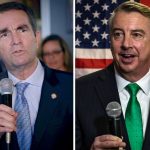
    Democratic candidates Phil Murphy (pictured) and Ralph Northam won smashing victories in their respective gubernatorial elections this week.

    Voters in Virginia and New Jersey gave Democratic gubernatorial candidates large victories on November 8 and sent a clear message of rebuke to President Donald Trump and the Republican Party. In Virginia, Democratic candidate Ralph Northam defeated Republican Ed Gillespie by almost 9% and narrowed Republican control over the House of Delegates. In New Jersey, Democrat Phil Murphy easily defeated Republican Kim Guadagno by a 13% margin to succeed the very unpopular Republican Governor Chris Christie. Additionally, the Democratic Party made huge gains in both the New Jersey State Senate and House of Representatives, earning their largest majorities in both bodies since the 1970s.

    The results of these elections show that the American people are beginning to get fed up with the policies of the Trump Administration and the Republican Party. Perhaps these elections are the first signs of an upcoming wave for the Democratic Party in the 2018 midterm elections. These results also underscore the fact that the Republican Party needs to reform its policies in order to become more viable in both state and federal-level elections. It can be argued that if the Republican leadership does not heed these warnings, their status as one of the two major US political parties may, in fact, be numbered.

    2. Tensions Between Saudi Arabia and Iran Grow

    The long-term rivalry between Iran and Saudi Arabia reached a boiling point this week.

    The lingering tensions between Saudi Arabia and Iran took a dangerous turn this week. On November 6, the Saudi government charged that a missile fired at its territory from Yemen was an “act of war” by Iran, in the sharpest escalation in nearly three decades of mounting hostility between the two regional rivals. Saudi Foreign Minister Adel Jubair further stated that “Iran cannot lob missiles at Saudi cities and towns and expect us not to take steps.” The accusations came a day after a wave of arrests that seemed to consolidate the power of Crown Prince Mohammed bin Salman, who is known for his anti-Iran foreign policy positions, support for Israel and Zionism, and advocacy of Wahhabi Islam.

    Countries such as the US, Israel, and the UK came out in full support of the Saudi response, arguing that Saudi Arabia has the right to defend itself from any and all threats. On the other hand, several of Iran’s closest allies such as Russia and China urged the Saudi government to ratchet down its rhetoric and to solve its disputes with Iran through diplomatic means. This incident also underscores the major risks that an Iran-Saudi Arabia War would have on regional stability, the global economy, and the international community. In the event that a war would break out between both countries, it is likely that Iran would emerge as the clear victor due to their much larger and more technologically advanced military, more diverse economy, more stable political system, and widespread support from countries such as Russia and China.

    3. Republican Senate Candidate Roy Moore Faces Growing Allegations of Sexual Misconduct With Underage Women

    Far-right Republican Senate candidate Roy Moore experienced a high level of controversy this week with the revelation that he may have had inappropriate sexual relations with several underage girls between the late 1970s and early 1990s.

    The controversial Senate candidate Roy Moore (R-AL) faced another stumbling block this week with the revelation of sexual misconduct with at least three women under the age of 18 when he was in his early 30s. One of the women was only 14 years old at the time, two years younger than the age of consent in Alabama. While most of these incidents occurred in the late 1970s, one incident occurred as recently as 1991. At the time of the incidents in the 1970s, Moore was an assistant district attorney and active in local Alabama politics. In response to these allegations, many Republicans such as John McCain and Mitt Romney called for Moore to drop out of the race and numerous Republican Senators such as Ted Cruz, Mitch McConnell, and Cory Gardner withdrew their support. House Speaker Paul Ryan also called for Moore to abandon his campaign. On the other hand, Alabama Republicans have largely defended Moore and still view him as the lesser evil in the race.

    Despite the serious nature of the allegations, Roy Moore has remained defiant and instead doubled down on his far-right message. Moore has declared the allegations as a plot by the Democratic Party to bring down his candidacy and accused those who oppose him as anti-Christian. The long-term effects of the Roy Moore scandal may result in Democratic candidate Doug Jones ultimately winning the seat. A potential victory by Jones would give Alabama is first Democratic Senator in over 20 years and further cut into the Republican Senate majority to the point in which the Democratic Party would have a strong chance of regaining control of that body in the 2018 Midterm elections.

  • OurWeek In Politics (10/14/10/21/17)

    Here are the main events in Politics that occurred over the past week:

    1. NJ Gubernatorial Elections Heats Up In The Final Stretch

    The NJ gubernatorial race entered its final stretch this week with the final debate between both the candidates.

    The ongoing gubernatorial race in New Jersey picked up some steam this past week as both the candidates headed into the final stretch of campaigning. The final New Jersey Gubernatorial debate was held on October 18 and witnessed both candidates taking on each other on pressing issues facing the state such as property taxes, increasing spending on public services such as education, the gas tax, and the overall legacy of Governor Chris Christie. Despite having a commanding lead in most polls, Democratic candidate Phil Murphy performed somewhat poorly in the debate, particularly by not answering the questions fielded to him head on and by repeadely dodging the question of what he would do to reduce the burden of property taxes on the states poorest residents. In contrast, Republican candidate Kim Guadagno came across as the more decisive of the two candidates, by directly answering each question posed to her and by clearly stating her position on the issues. On the other hand, the overall tone of Guadagno during the debate was quite negative and created the perception that she would be unwilling to compromise on the issues. Overall, it can be argued that the overall poor performance of both candidates will result in little change in the polls, which have Phil Murphy leading comfortably.

    2. Billionaire Democratic Donor Urges Local and State Political Leaders to Support Trump Impeachment Efforts

    Tom Steyer, a wealthy Democratic donor and activist has urged political leaders to support articles of impeachment against President Trump.

    Prominent Democratic donor and billionaire environmental activist Tom Steyer this week called on every governor in the United States to tell their constituents where they stand on the question impeaching President Donald Trump. In a letter to donors, Steyer asked state and local leaders to call on federal representatives to support Trump’s removal from office. Thus far, Congressmen Al Green (D-TX), Brad Sherman (D-CA), and Steve Cohen (D-TN) have all came out in support of efforts to impeach President Trump. In the letter, Steyer said that Politicians at all levels of government must speak out about Trump’s lack of fitness for office, and denounced the president’s decision to withdraw from the Paris climate agreement. Additionally, Steyer also accused Trump of violating the constitution by trying to delegitimize the ongoing Russia investigation and failing to disclose his business ties to foreign governments. Even though impeachment proceeding against Trump is unlikely because Republicans control both houses of Congress, Steyer feels that efforts to impeach Trump could become a real issued provided that the Democratic Party regains control of both houses of Congress after the 2018 midterm elections.

    3. Democrats Increasing Worried About The VA Gubernatorial Race

    The national Democratic Party is worried that the Virginia gubernatorial race will ultimately end up in a Republican victory.

    Much like the New Jersey gubernatorial race, the Virginia gubernatorial race entered into its final stretch this week and witnessed political heavyweights from both sides campaigning for their respective candidates. President Donald Trump enthusiastically endorsed Republican candidate and former RNC chairman Ed Gillespie and appeared at several rallies with him in the Southwestern part of the state. On the Democratic side, former President Barack Obama and Bill Clinton campaigned with Ralph Northam and urged Virginian voters to turn out in high enough numbers to regain control of the state legislature and allow for unified Democratic control over the state for the first time in nearly a decade. Despite the strong campaigning on both sides and the initial optimism regarding Democratic chances for the race, it appears that Ed Gillespie has a slight edge going into election day despite the fact that Virginia is a solidly Democratic state at the Presidential level. Some of the factors benefiting Gillespie include the typically lower Democratic turnout in off-year elections, the popularity of President Trump amongst rural voters in Southwestern Virginia, and voter dissatisfaction with the Virginia Democratic Party over their failure to come up with a cohesive message to counter the Trumpist shift of the Republican Party.

    4. Saudi Arabian Government Pledges To Clamp Down On Extremist Interpretations Of Islam

    The government of Saudi Arabia is considered to be the leading sponsor of global terrorism.

    In part of an attempt to reform its image as a state sponsorer of terrorism, the government of Saudi Arabia announced on October 18 that it will begin policing and reexamining the teachings of the Prophet Muhammad to make sure followers of Islam do not use twisted and radical interpretations of Islamic traditions to foment violence and terrorism. While lacking specifics on how this policy would be implemented, the Saudi Arabian Culture and Information Ministry said that it would strive to “eliminate fake and extremist texts and any texts that contradict the teachings of Islam and justify the committing of crimes, murders, and terrorist acts.” These teaching come as a surprise to many observers, who note the fact that the government of Saudi Arabia is the worlds leading sponsorer of terrorism and that it uses the ideology of Wahhabism to promote a puritanical and fundamentalist version of Islam that is entirely opposite to the message originally promoted by the Prophet Muhammad. It argued that this change in policy was pushed for in part by the US and Israeli governments, who want to portray Saudi Arabia as a moderate and progressive country in their efforts to sway Arab allies in support of increased sanctions and outright military intervention against Iran, which is Saudi Arabia’s main regional rival.

  • OurWeek in Politics #1 (7/31-8/5/17)

    OurWeek in Politics #1 (7/31-8/5/17)

    Here are the major events in Politics that occurred over the past week:

    1. Court Revives Bridgegate Records Suit

    The Bridgegate scandal was back in the news this week over how the Christie Administration deliberately hid emails tieing the governor to the scandal. The Bridgegate scandal was back in the news this week over how the Christie Administration deliberately hid emails tieing the governor to the scandal.

    The Bridgegate scandal was back in the news on August 3 regarding how the Christie administration handled emails and records related to the plot to cause traffic problems in Fort Lee in retaliation for its mayor Dawn Zimmer (D) deciding not to endorse Governor Chris Christie for re-election in 2013.

    A state appellate panel reinstated two lawsuits by North Jersey Media Group that alleged the Christie Administration deliberately withheld documents in violation of NJ law. In 2013, the media company sought emails between Chris Christie’s staff members and Port Authority officials after access lanes on the George Washington Bridge were closed. But the administration didn’t provide the emails that were known to exist. The court’s decision means members of Christie’s administration could face additional legal penalties.

    2. Marijuana Legalization Bill Introduced at Federal Level

    Senator Cory Booker (D-NJ) has recently put forward a bill that would legalize and decriminalize marijuana at the federal level. Senator Cory Booker (D-NJ) has recently put forward a bill that would legalize and decriminalize marijuana at the federal level.

    On August 2, Senator Cory Booker (D-NJ) introduced a bill that would legalize Marijuana at the federal level and reverse the decades-long drug war. Booker has pointed out that marijuana laws disproportionately hurt minorities and the poor and that the War on Drugs has replaced slavery and Jim Crow laws as a tool to disenfranchise minorities. Booker hopes to attract support for his proposal from Democrats such as Bernie Sanders and Republicans including Rand Paul, Mike Lee, and Cory Gardner.

    Despite the fact that the bill has much potential and would positively impact American public policy, it stands little chance of coming for a vote due to the fact that the Republican Party controls Congress and because the Trump Administration has expanded the War on Drugs by increasing penalties for drug possession.

    3. Congressman John Delaney becomes the first candidate to challenge Donald Trump in 2020 presidential race

    John Delaney (D-MD) is the first serious candidate to announce that they are running for the Democratic Presidential nomination in 2020. John Delaney (D-MD) is the first serious candidate to announce that they are running for the Democratic Presidential nomination in 2020.

    Congressman John Delaney (D-MD) announced on July 28 that he would be seeking the Democratic Presidential nomination in 2020, becoming the first major candidate to have declared their candidacy. Running as a socially-liberal, yet pro-business candidate, John Delaney stated in a Washington Post interview that his politics was based on “celebrating the power of our free-market economy while insisting that the federal government has a key role in setting goals and standards and standing up and protecting the poor and vulnerable members of society. Additionally, Delaney supports increasing government investments in the technology sector as a way to address the ever-changing global economy and continue to allow the US to remain one of the world’s largest economies.

    Despite the early attention surrounding the candidacy of John Delaney, most political observers feel that he has little chance to win the Democratic nomination and will be quickly upstaged by other prospective Democratic candidates such as Cory Booker, Kamala Harris, Elizabeth Warren, and Bernie Sanders.

    4. The Trump Administration Signs into Law Increased Sanctions on Russia, Iran, and North Korea

    President Donald Trump signed legislation increasing sanction against Russia, North Korea, and Iran this week. President Donald Trump signed legislation increasing sanction against Russia, North Korea, and Iran this week.

    On August 2, President Trump signed into law the Countering America’s Adversaries Through Sanctions Act, which places embargoes on and expands pre-existing sanctions on Russia, Iran, and North Korea for their supposed destabilizing actions and (in Russia’s case) interfering in the 2016 US Elections.

    President Trump applauded the imposition of increased sanctions on North Korea and Iran, saying that both countries are sponsors of terrorism and that “regime change” is necessary for both countries. On the other hand, Trump was critical of the sanctions against Russia, stating that the “legislation is significantly flawed” and that in its haste to pass the legislation, “Congress included a number of clearly unconstitutional provisions.” President Trump’s negative reaction to the sanctions on Russia has led to further questions regarding his involvement in Russian efforts to influence the 2016 Presidential Election. As expected, the leadership of all three of the countries impacted by the bill condemned its passage and have pledged to respond using international legal standards.

  • Analysis of the 2017 New Jersey Gubernatorial Election

    The 2017 New Jersey Gubernatorial Election is set to be held on November 7. Incumbent Republican Governor Chris Christie (who was first elected in 2009 with 49% of the vote and re-elected in 2013 with 60% of the vote) is term-limited and cannot run for a third term. Despite coming into office with an ambitious agenda for political reform, Governor Christie is leaving office with a 15% approval rating and a legacy marked by scandal, continued fiscal decline, and failure to address long-standing structural issues facing the state.

    Here is an overview of the candidates and a preliminary prediction of the election results:

    Lieutenant Governor Kim Guadagno is the Republican candidate for New Jersey governor and has proposed a center-right platform.
    Lieutenant Governor Kim Guadagno is the Republican candidate for New Jersey governor and has proposed a center-right platform.

    Lieutenant Governor Kim Guadagno
    Lieutenant Governor Kim Guadagno is the Republican candidate for governor, having won the June 7th primary with ~47% of the vote. Guadagno was born in Waterloo, Iowa on April 13, 1959, and earned a Law Degree from American University Washington College of Law in 1983. After graduation, Guadagno took a job as a federal law clerk in New York City and developed a reputation as an effective prosecutor in cases involving political corruption. Prior to serving as Lieutenant Governor, Guadagno was Assistant New Jersey Attorney General from 1999 to 2001 and was elected Monmouth County Sherrif in 2007, serving for two years.

    Kim Guadagno has developed several different policy positions that have helped her to stand out as a candidate. Guadagno has pledged to veto any new tax increases and supports placing a cap the school portion of a homeowner’s property tax bill, arguing that such a measure will save a family making New Jersey’s median income of $72,000 an average of $895 annually. Guadagno is opposed to increasing the minimum wage to $15 per hour, arguing that such a policy will harm the economy of the state. Guadagno supports reform to the New Jersey antiquated school funding formula and expanded school choice. Guadagno is opposed to the current House Republican plan to cut Medicaid and has called on lawmakers to find a “more sustainable way to replace the services to some of the neediest Americans.” Additionally, Guadagno is opposed to marijuana legalization (but backs its decriminalization) and supports bringing public health insurance plans in line with the private sector as a way to reduce state expenses.

    Phil Murphy is the Democratic candidate for New Jersey Governor.
    Phil Murphy is the Democratic candidate for New Jersey Governor.

    Former Ambassador Phil Murphy
    Phil Murphy is the Democratic candidate for governor, having won the Democratic primary with 48% of the vote. Murphy was born on August 16, 1957, to a middle-class family in Boston, Massachusetts. Both of his parents were politically active, having campaigned for future President John F. Kennedy in his successful Senate campaigns in 1952 and 1958. Murphy received a Bachelor’s Degree in Finance from Harvard University in 1979 and an MBA from the University of Pennsylvania in 1983. After graduation, Murphy began a 23-year career at Goldman Sachs and established a reputation as an effective deal-maker. After retiring from Goldman Sachs, Murphy served from 2006 to 2009 as the National Finance Chair of the Democratic National Committee and was subsequently appointed Ambassador to Germany by President Barack Obama and served from 2009 to 2013. In 2014, Murphy created New Start New Jersey, a progressive policy think tank. One of the goals of the organization was to help displaced workers back into the workforce and improve the economic climate in New Jersey.

    Phil Murphy has proposed an ambitious agenda for moving New Jersey forward. Murphy supports the creation of a statewide investment bank as a way to improve the New Jersey economy. Such a bank would supply loans to both businesses in the state and college students and would have the effect of limiting Wall Street firms from participating in state financial activities. Murphy supports increasing state investment in infrastructure as a way to both attract workers and promote economic advancements. Murphy is also a major proponent of raising the minimum wage to $15 an hour, mandating earned sick leave, and expanding the Earned Income Tax Credits for New Jersey residents. Murphy has thus far been vague on how to address the state’s troubled pension system but has stated that New Jersey has a need to follow through on its obligations to its workers. Murphy also supports the legalization and decriminalization of marijuana and guaranteed paid sick leave for New Jersey workers.

    The New Jersey Libertairan Party selected Peter Rohrman as its gubernatorial nominee.
    The New Jersey Libertarian Party selected Peter Rohrman as its gubernatorial nominee.

    Peter Rohrman
    Former Marine and candidate for Bergen County Freeholder in 2015 and 2016 Peter Rohrman is the Libertarian nominee for Governor. Rohrman is the grandson of Italian and German immigrants and grew up in a blue-collar family. After a stint in the Marine Corps, Rohrman earned a degree in Computer Science at Rutgers University and was subsequently employed as an operations director for an Internet service provider.

    Peter Rohrman has mostly focused on economic issues during his campaign for Governor. Rohrman supports eliminating the gas tax, sales tax, and state income tax in addition to reducing state spending by as much as 30%. Rohrman favors making the public pensions system voluntary, improving the state’s business climate, and reform to prevailing wage laws. On social issues, Rohrman supports the legalization and decriminalization of marijuana, criminal justice reform, and a loosening of firearms regulations in New Jersey.

    Pastor Seth Kaper-Dale is the Green Party candidate and proposes a progressive platform to the left of Phil Murphy.
    Pastor Seth Kaper-Dale is the Green Party candidate and proposes a progressive platform to the left of Phil Murphy.

    Seth Kaper-Dale
    Pastor Seth Kaper-Dale is the Green Party nominee for governor. Kaper-Dale and his wife Stephanie both graduated from Princeton Theological Seminary in 2001 and soon after became co-pastors at the Reformed Church of Highland Park. Dring his service as a pastor, he and his wife have emerged as progressive voices for social justice and have led efforts to raise awareness regarding issues such as affordable housing and immigration reform, and has worked to end Solitary Confinement and torture in the New Jersey prison system.

    Seth Kaper-Dale supports increasing the state income tax rate as a way to reduce income inequality and favors the implementation of a single-payer Medicare-for-All healthcare system. Kaper-Dale also supports the legalization and decriminalization of marijuana and increased measures preventing police brutality within minority communities. Kaper-Dale is a major backer of reforming the New Jersey criminal justice system, arguing for a ban on Solitary Confinement, reopening the Office of the Public Advocate, and implementing meaningful re-entry services for inmates.

    Overall, the candidates running in the New Jersey gubernatorial election have a variety of different views covering all parts of the political spectrum. Based on current polling, it seems that Phil Murphy will likely win with around 55% of the vote, with 43% going to Lieutenant Governor Kim Guadagno and 2% going to the minor candidates. Even though he is far from a perfect candidate, there are several factors going in Murphy’s favor going into the election. The first is the overall national trend against the Republican Party and President Donald Trump. Currently, President Trump has a 37% approval rating nationally, thus dampening Republican chances in local, state, and national elections (Trump’s low approval rating may even be enough for the Democratic Party to retake both House of Congress, a majority of state governorships, and many state legislatures in the mid-term elections next year). The next factor is the overall economic situation in New Jersey. Even though the unemployment rate in New Jersey is 4.1%, the economic outlook in the state remains bleak and job growth remains stagnant. Because of these factors, it can be argued that Phil Murphy has an edge in the Gubernatorial election barring any drastic improvement of Republican prospects both nationally and statewide.

    Here is a list of polling places in New Jersey and information on how to register to vote:

    https://voter.njsvrs.com/elections/polling-lookup-orig.html

    http://www.state.nj.us/mvc/Licenses/VoterRegistration.htm

  • Legalization of Marijuana in New Jersey: Recent Policy Proposals

    Although Governor Chris Christie (R) is strongly opposed to legalizing Marijuana (arguing that it is a “gateway” drug despite the fact that it has been scientifically proven that Marijuana usage has health benefits) the State Senate has begun discussions on how to regulate the Marijuana industry in New Jersey provided that it is legalized. State Senator Nicholas Scutari (D-Union) has recently sponsored a bill that legalizes marijuana possession and sale by adults 21 and older. Scutari’s bill includes several other provisions such as decriminalizing Marijuana possession of up to 50 grams immediately, creates a Division of Marijuana Enforcement in the state Attorney General’s Office which would create the rules used to govern the legal market of growers and sellers, and imposes a tax on Marijuana sales at 7% for the first year.

    Democratic gubernatorial nominee Phil Murphy is a supporter of efforts to legalize Marijuana in New Jersey.
    Democratic gubernatorial nominee Phil Murphy is a supporter of efforts to legalize Marijuana in New Jersey.

    Thus far, the bill legalizing Marijuana has attracted its share of both supporters and opponents. Organizations supporting the bill include New Jersey United for Marijuana Reform and various civil rights leaders who argue that existing drug enforcement laws are draconian and disproportionately affect minorities and the most vulnerable members of society. Additionally, Democratic Gubernatorial nominee Phil Murphy supports legalization of Marijuana. Opponents to the change in New Jersey drug policy have been relatively silent, though it is expected that most opposition comes from the pharmaceutical industry and drug and alcohol rehabilitation centers. Because of the fact that a majority of New Jersey residents support the legalization of Marijuana, it is expected that the Senate bill will likely be passed and signed into law assuming that the Democratic Party wins this year’s gubernatorial election.