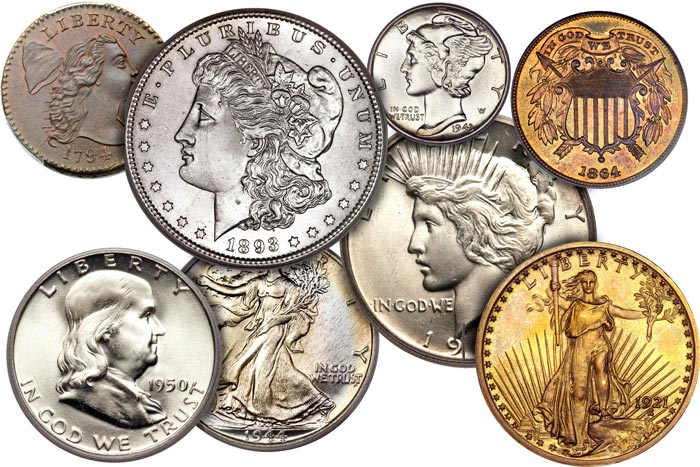
In addition to my hobby of record collecting, I am also an avid coin collector. I generally focus on American, Canadian, Mexican, and British coinage from the 19th and 20th centuries. My favorite types of American coins to collect are proof coins, early commemorative half dollars, and American coins of unusual denomination or type. This is a discussion of the history of the coin collecting hobby.

Coin collecting, formally known as numismatics, has roots that stretch back to the dawn of formal human civilization. Coins were first created in the ancient world as a practical tool for trade, but from the very beginning, they carried more than monetary value. Their artistry, the authority of the ruler whose image they bore, and the historical events they commemorated made them attractive to collectors long before the concept of a “hobby” existed in the modern sense. Over the centuries, what began as a pastime for the elite became an organized pursuit shared by scholars, historians, and eventually millions of everyday people.

The earliest known coin collectors were rulers and aristocrats in antiquity. Roman emperors such as Augustus and Hadrian are believed to have assembled cabinets of coins depicting earlier emperors and historic events, both to honor Rome’s heritage and to display their own refinement. Coins in the ancient world often circulated far from their place of origin, and finding a coin from a distant land could spark fascination. In the Middle Ages, coin collecting became less common outside of royal treasuries, but the Renaissance brought a revival of interest in classical antiquity. The Italian poet and scholar Petrarch, often credited as the first Renaissance-era numismatist, collected ancient Roman coins not as curios but as objects of study, treating them as tangible records of history. By the 16th and 17th centuries, collecting coins had become a scholarly pursuit among European nobility, with elaborate cabinets designed to display prized specimens.
The Industrial Revolution fundamentally changed the scope of numismatics. Advances in minting technology produced sharper and more uniform coins, while the growth of a prosperous middle class meant the pastime was no longer restricted to kings and scholars. By the mid-19th century, organized numismatic societies were forming in Europe and North America. Auction houses began selling entire collections, dealers emerged in major cities, and price lists and catalogues gave collectors a way to gauge the market. The study of coins evolved into a recognized academic discipline, with numismatists cataloging not just coins but also their metallurgy, iconography, and minting history.

In the US, coin collecting developed alongside the country’s own coinage. Early federal issues like the 1793 Chain Cent, with its distinctive link design, and the Flowing Hair silver dollars of the 1790s were recognized even at the time as unusual pieces worthy of saving. Still, for much of the 19th century, collecting was the domain of wealthy hobbyists and scholars. A major turning point came in 1857 when the US Mint discontinued the large cent and replaced it with a smaller-sized cent that is still in circulation today and will continue to be produced until the end of 2025. The sudden disappearance of the older coins from circulation spurred interest among the public, who began saving examples. This episode introduced many ordinary Americans to the idea that coins could be preserved for their historical and monetary significance.

Also important to the hobby’s development was the production of proof coins by the US Mint. Proof coins, struck with specially polished dies and planchets to create sharp details and mirror-like surfaces, began to be minted on a limited scale starting in 1817. These coins were originally produced primarily for collectors and were not intended for circulation. However, production of proofs ceased in 1916 and was suspended for about two decades. The US Mint resumed proof coinage in 1936, coinciding with a growing enthusiasm for collecting. Except for 1943-1949 and 1965-1967, proof coinage has been made by the US Mint continuously over the past 89 years. Proof sets quickly became prized among collectors for their exceptional quality and rarity compared to regular circulation coins. Over time, annual proof issues became a cornerstone of the hobby, offering collectors a way to acquire pristine examples of each year’s coinage. The introduction of proof coins helped broaden collecting beyond simply searching through pocket change, fostering a market for specially struck, limited-edition coins that remain popular today.
The founding of the American Numismatic Association (ANA) in 1891 helped knit together collectors across the country, offering exhibitions, publications, and a network for buying, selling, and trading. In the decades that followed, US coin collecting steadily gained popularity, but it was the 1930s that truly marked the hobby’s first great boom. The Great Depression paradoxically fueled interest: while many Americans struggled financially, the idea of finding a rare date or mintmark in everyday change, and perhaps selling it at a profit, was appealing. By 1934, the hobby had entered a banner period. That year saw a marked increase in organized coin shows, numismatic literature, and active trading, as well as growing public awareness of certain collectible issues.

At the center of this 1930s excitement were the so-called “classic” commemorative half dollars, a series struck between 1892 and 1954 to honor historic events, figures, and anniversaries. In the mid-1930s, the US Mint began issuing a flood of new commemorative designs, often multiple per year, sometimes with variations in mintmarks or dates that encouraged collectors to buy every version. These coins were sold at premiums above face value, marketed aggressively by promoters, and produced in relatively small numbers to heighten perceived scarcity. Between 1934 and 1936, prices for certain issues soared as new collectors entered the market, believing the coins to be sure-fire investments. This was, in effect, the first major speculative bubble in US numismatics.
The commemorative half dollar boom, however, was short-lived. By 1936, the novelty had worn off, and the sheer number of different issues began to overwhelm even enthusiastic buyers. Many collectors resented the increasingly blatant profiteering by promoters. Between 1936 and 1941, prices for these coins plummeted, leaving many who had bought at the peak with pieces worth a fraction of their purchase price. This crash left a cautionary lesson that still resonates in the hobby: manufactured rarity and market hype can be risky foundations for collecting.

Despite the collapse of the commemorative half market, coin collecting retained its mass appeal. The introduction of inexpensive cardboard coin boards by Whitman Publishing and other companies in the mid-1930s made it possible for anyone to organize and display a complete series. Families spent evenings poring over pocket change, searching for missing dates or rare varieties. After World War II, postwar prosperity and leisure time encouraged more serious collecting, and key date US silver dollars, particularly Morgan dollars and Peace dollars long held in Treasury vaults, were released to the public in the 1950s and early 1960s, sparking another collecting surge.

The early 1960s also saw a speculative rush on certain low-mintage coins, most famously the 1950-D Jefferson nickel, which dealers and investors promoted as a future rarity. Prices spiked but collapsed once it became clear that the coins were not as scarce in uncirculated condition as advertised. Then, in 1965, a pivotal change occurred when rising silver prices led the US government to remove silver from circulating dimes and quarters and reduce the silver content of the half dollar from 90 percent to 40 percent (silver in the half dollar was subsequently eliminated in 1971). Almost immediately, the public began hoarding pre-1965 silver coins (following the concept of Gresham’s law), and they gradually disappeared from circulation over the next decade and a half. After the Hunt Brothers, two Texas oil billionaires, attempted to corner the silver market in 1979–1980, driving silver to record highs, virtually no silver coins remained in everyday commerce.
The 1970s also brought another wave of popular collecting through the Bicentennial coinage program. Special reverse designs for the quarter, half dollar, and dollar coins commemorated America’s 200th birthday and were released in huge quantities, generating excitement among both casual and serious collectors. The 1980s saw the return of commemorative half dollars and dollars, along with the launch of the American Gold and Silver Eagle bullion coins, which attracted a blend of hobbyists and precious metals investors.

The 1990s and early 2000s ushered in one of the largest collecting booms in US history with the 50 State Quarters Program, launched in 1999. Millions of Americans who had never collected coins before began saving quarters featuring each state’s design. Banks were swamped by customers requesting rolls of quarters just to search for the newest releases. Although later commemorative programs, such as the America the Beautiful quarters, Presidential dollars, and the American Innovation dollar series, maintained some momentum, none matched the cultural impact of the state quarters era.

Today, coin collecting in the US is both a cultural pastime and a multi-billion-dollar industry. The market spans everything from modern circulation finds to legendary rarities like the 1913 Liberty Head nickel or the 1804 Draped Bust dollar, which can sell for millions at auction. The introduction of professional grading services in the mid-1980s helped standardize quality assessment, reduce fraud, and bring greater confidence to high-value transactions. The rise of online platforms has made it easier for collectors to connect with dealers and one another, creating a global marketplace for US coins.
What keeps coin collecting alive, even in an age of digital payments, is its tactile link to history. A coin is a small, enduring artifact of a particular time and place. Whether it is a circulated copper cent from the Civil War, a commemorative half dollar from the 1930s, or a modern bullion coin, each piece carries a story of artistry, economics, and human hands. The combination of history, beauty, and the thrill of discovery has sustained the American coin collecting tradition for generations, and all signs suggest it will continue to do so well into the future.
Leave a Reply