Saudi Arabia (officially the Kingdom of Saudi Arabia (KSA)) is a Unitary Islamic absolute monarchy located in the Middle East constituting of the bulk of the Arabian Peninsula. Saudi Arabia is bordered by countries such as Jordan, Iraq, Yemen, Kuwait, and Egypt, has an area of approximately 2,150,000 square kilometers, and a population of around 33 million. Saudi Arabia plays a major role in the context of Middle Eastern politics due to its status as the birthplace of Islam and the world’s only remaining absolute monarchy, as well as its relatively strong and diverse economy and alliances with many Western powers.
The history of Saudi Arabia can be traced back to 20,000 BCE when the earliest nomadic tribes settled in the area. Over the ensuing millennia, Saudi Arabia soon became a thriving trade center for Middle Eastern Empires such as the Achaemenid Empire, Byzantine Empire, and Sassanid Empire. Its cities of Mecca and Medina were both thriving trade posts by the end of the 6th Century CE. The history of Saudi Arabia entered into a period of immense change after the birth of Muhammad, the Prophet of Islam, in 570. By the time of his death in 632 CE, Muhammad was able to unite the various tribes of Saudi Arabia under a single religion and also worked to end many of the social injustices prevalent in pre-Islamic Arabic society. Despite Saudi Arabia’s spiritual importance as the home of Mecca and Medina, the territory became less politically important compared to other Islamic empires during this time period. Most of Saudi Arabia once again fell under a traditional tribal rule and the Sharif of Mecca who ruled the holy city between the 10th and early 20th centuries had to defer to the Abbasids, Egyptians, and Ottomans, who each conquered Saudi Arabia at various times over the centuries.
Saudi Arabia’s present-day royal family descends from Mohammad bin Saud, who established the first modern Saudi state near Riyadh in 1744 with a religious leader named Muhammad ibn Abd al-Wahhab, the founder of the strict Wahhabi branch of Sunni Islam observed in Saudi Arabia today. After Ottoman viceroy Mohammed Ali Pasha destroyed this first Saudi state in 1818, a second Saudi state was established in a much smaller area in 1824. In 1891, the Al Saud were exiled by the Al Rashid clan with whom they battled for control of the territory for decades. The Ottoman Empire collapsed after the 1918 Arab Revolt and end of WWI. The House of Saud reclaimed Riyadh from the Al Rashid in 1902 and eventually regained control of most of their former territory by the time King Abdul-Aziz bin Saud established the present-day state of Saudi Arabia in 1932. At the time, Saudi Arabia ranked among the world’s poorest countries, but the nation’s fortunes dramatically changed after vast Persian Gulf oil reserves were discovered just a few years later in 1938.
Mohammed bin Salman is the current Crown Prince of Saudi Arabia and is currently the de facto head of government.
The current constitution of Saudi Arabia (known as the “Basic Law”) was adopted on January 30, 1992, and stipulates that Saudi Arabia is an absolute theocratic monarchy. The law states that the king must comply with Shari’a (Islamic) law and the Qur’an and that the Qur’an and Sunnah are the main sources of law in the country. The current King of Saudi Arabia is Salman bin Abdulaziz Al Saud, who came into power in early 2015. In addition to formal roles, the Saudi King also serves as the country’s Prime Minister. The second most important position in Saudi Arabia is the Crown Prince, who is the designated successor of the King. Currently, the Crown Prince assumes power with the approval of the Allegiance Commission after he is appointed by the King. In addition to his role as the heir apparent to the Saudi royal throne, the Crown Prince sets the overall foreign and domestic policy of Saudi Arabia. The current Crown Prince of Saudi Arabia is Mohammed bin Salman (MbS), who assumed that role in May of 2017.
Saudi Arabia does not have a formal legal system, and all laws in the country are based on Islamic teachings.
Royal decrees are the other main source of law but are referred to as regulations rather than laws because they are subordinate to the Sharia. Royal decrees supplement Sharia in areas such as labor, commercial and corporate law. Additionally, traditional tribal law and custom remain significant. Extra-Shari’a government tribunals usually handle disputes relating to specific royal decrees. Final appeal from both Sharia courts and government tribunals are to the King and all courts and tribunals follow Shari’a rules of evidence and procedure. The Saudi system of justice has been criticized for its “ultra-puritanical judges,” who are often harsh in their sentencing, but also sometimes overly lenient and slow, for example leaving thousands of abandoned women unable to secure a divorce. The system has also been criticized for being arcane, lacking in some of the safeguards of justice, and unable to deal with the modern world.
Overall, Saudi Arabia is considered by the international community to be among the worst violators of human rights and has consistently been criticized for human rights violations by organizations such as Amnesty International, Human rights Watch, FreedomHouse, as well as neighboring countries in the region. Some of the human rights issues that have attracted strong criticism include the disadvantaged position of women, capital punishment for even the most minor crimes, religious discrimination (particularly against the large Shi’a Muslim minority within the country), the lack of religious freedom, and the activities of the religious police. Between 1996 and 2000, Saudi Arabia acceded to four UN human rights conventions and, in 2004, the government approved the establishment of the National Society for Human Rights (NSHR), staffed by government employees, to monitor their implementation. To date, the activities of the NSHR have been limited and doubts remain over its neutrality and independence.
Saudi Arabia has a poor human rights record and has been repeatedly criticized by much of the international community.
Saudi Arabia remains one of the very few countries in the world not to accept the UN’s Universal Declaration of Human Rights. In response to the continuing criticism of its human rights record, the Saudi government points to the special Islamic character of the country and asserts that this justifies a different social and political order. The United States Commission on International Religious Freedom had unsuccessfully urged US President Barack Obama to raise human rights concerns with King Abdullah on his March 2014 visit to the Kingdom especially the imprisonments of Sultan Hamid Marzooq al-Enezi, Saud Falih Awad al-Enezi, and Raif Badawi.
Another point of criticism regarding Saudi Arabia’s human rights record is its “Counter-Radicalization Program” the purpose of which is to “combat the spread and appeal of extremist ideologies among the general populous (sic)” and to “instill the true values of the Islamic faith, such as tolerance and moderation.”This “tolerance and moderation” has been called into question by numerous international observers. In September 2015, Faisal bin Hassan Trad, Saudi Arabia’s ambassador to the UN in Geneva, has been elected Chair of the United Nations Human Rights Council panel that appoints independent experts. In January 2016, Saudi Arabia executed the prominent Shi’aa cleric Sheikh Nimr who had called for pro-democracy demonstrations and for free elections in Saudi Arabia.
The Saudi government is known for repressing its Shi’a minority and denying them equal rights under the law.
In terms of demographics, Saudi Arabia is estimated to be ~99% Muslim. Saudi Arabia is home to Mecca and Medina, two of the three holiest cities in Islam, and major pilgrimage sites for Muslims throughout the world. Approximately 80-85% of Saudi Muslims are Sunni, whereas 15-20% are Shi’a, who primarily reside in the oil-rich Eastern Province of Saudi Arabia. A majority of Saudi Sunni Muslims follow the Wahhabi sect, whereas, most Saudi Shi’a Muslims are members of the Twelver sect. Due to their status as the minority group within Islam, the Shi’a minority of Saudi Arabia has been the target of state-sponsored oppression over the past few decades. For example, Shi’as are routinely denied opportunities in education, employment, access to governmental benefits, and are denied freedom to worship. Additionally, numerous Shi’a religious figures and political activists such as Sheikh Nimr al-Nimr have been executed by the Saudi government based on the allegation that they are spies employed by the Iranian government. In addition, there are an estimated 2 million members (mostly foreign workers) of other religious communities residing in Saudi Arabia. Arabs are the largest ethnic group in Saudi Arabia and Arabic is the official language. Saudi Arabia has a literacy rate of 94.7% and a life expectancy of 75.5 years, comparable to the US and many Western countries.
Saudi Arabia has an oil-based economy with strong government controls over major economic activities. It possesses about 16% of the world’s proven petroleum reserves, ranks as the largest exporter of petroleum, and plays a leading role in OPEC. The petroleum sector accounts for roughly 87% of budget revenues, 42% of GDP, and 90% of export earnings. Currently, Saudi Arabia has a GDP of $1.7 trillion (the largest in the Middle East and 19th largest in the world) and Human Development score of 0.853. The economy of Saudi Arabia is primarily service-based (53.2%) Agriculture and Industry make up 2.6 and 44.2% of the Saudi economy respectively. The unemployment rate in Saudi Arabia is estimated to be ~6 as of 2018 and the country has a GDP per capita of $55,000. The economy of Saudi Arabia is currently in the process of being reformed under the Saudi Vision 2030 plan. The Vision 2030 Plan, introduced by Crown Prince Mohammed bin Salman in 2016, is meant to reduce Saudi Arabia’s dependence on oil, diversify its economy, and develop public service sectors such as health, education, infrastructure, recreation, and tourism. Goals include reinforcing economic and investment activities, increasing non-oil industry trade between countries through goods and consumer products, and increasing government spending on the military. Saudi Arabia’s primary trade partners are the US, China, South Korea, Japan, and Germany.
Saudi Arabia joined the United Nations in 1945 and is a founding member of member of the Arab League, Gulf Cooperation Council, Muslim World League, OPEC, and the Organization of the Islamic Cooperation. Moreover, Saudi Arabia maintains diplomatic relations with a majority of countries and has attempted to frame itself as a voice for stability in the Middle East. Some of Saudi Arabia’s strongest regional allies include Egypt, Morocco, Jordan, Kuwait, the United Arab Emirates, and Bahrain. Additionally, the relationship between Saudi Arabia and Israel has improved since Mohammed bin Salman became Crown Prince in 2017, with both countries expanding their military cooperation (due to their mutual opposition to the Iranian government), developing close economic ties, and beginning to negotiate an agreement establishing formal diplomatic ties. Saudi Arabia is also a major critic of the current Iranian government and has repeatedly called for military intervention against Iran. The poor relationship between Saudi Arabia and Iran can be traced back to factors such as competing visions for the future of the Middle East, different interpretations of Islam on the part of the leadership of both countries, and the fact that Saudi Arabia supported Shah Mohammed Reza Pahlavi during the Iranian Revolution. This rivalry has played a role in numerous conflicts throughout the Middle East, such as the Syrian and Yemeni Civil Wars, the Arab Spring Protests, and the ongoing genocide against Shi’a Muslims in Pakistan, Yemen, and Bahrain.
Saudi Arabia and the US have had a strong political, economic, and military alliance going back to the 1940s.
Outside of the Middle East, Saudi Arabia has close ties with many Western countries. In particular, the US and Saudi Arabia have a strong alliance in nearly every area. The strong relationship between the US and Saudi Arabia can be traced back to the 1930s and expanded drastically after 1970. Foreign policy observers note that the primary reason the US has continued to support Saudi Arabia despite its repressive government and support for terrorism is due to its vast oil reserves and mutual opposition to expanded Iranian and Shi’a influence in the region. Since 2010, the US has sold Saudi Arabia an estimated $400 billion in weapons and other military aid. In addition to the US, Saudi Arabia in recent years has sought to establish a close relationship with China, with a majority of Saudi citizens viewing Chinese influence on the world stage as positive.
In conclusion, Saudi Arabia is one of the most important countries in the Middle East due to its relative stability, a strong economy, and close ties with Western powers. Despite its relative stability, Saudi Arabia continues to remain stagnant in terms of human rights, political freedom, and democratic political institutions. .
The Czech Republic is a unitary parliamentary republic located in Central Europe. It consists of the historical provinces of Bohemia and Moravia along with the southern tip of Silesia, which are often called the “Czech Lands” The Czech Republic is bordered by countries such as Germany, Austria, Poland, and Slovakia, has an area of approximately 78,866 square kilometers, and a population of a little less than 11 million. The Czech Republic plays an important role in the wider context of European politics due to its central location between both Germany and Russia, reputation as one of the most stable and freest countries in Europe, and past struggles for independence from regional powers.
The Czech Republic has a long and rich history and is considered to be one of the first areas in which modern humans settled,
The history of the Czech Republic can be traced back to the Lower Paleolithic era when the earliest modern humans settled in the region. Some of the Paleolithic cultures that settled in the present-day Czech Republic included the Acheulean, Micoquien, Mousterian, and Předmostí. The area was subsequently settled by the Celts in the 5th Century BC and by various Germanic tribes during the 1st Century CE. During the 5th century CE, Slavic tribes from the Vistula basin settled in the region of Bohemia, Moravia, and Silesia. The Czechs founded the kingdom of Bohemia and the Premyslide dynasty, which ruled Bohemia and Moravia from the 10th to the 16th century. One of the Bohemian kings, Charles IV, Holy Roman Emperor, made Prague an imperial capital and a center of Latin scholarship. The Hussite movement founded by Jan Hus (1369–1415) linked the Slavs to the Reformation and revived Czech nationalism, previously under German domination. A Hapsburg, Ferdinand I, ascended the throne in 1526. The Czechs rebelled in 1618, precipitating the Thirty Years’ War (1618–1648). Defeated in 1620, they were ruled for the next 300 years as part of the Austrian empire. Full independence from the Hapsburgs was not achieved until the end of World War I, following the collapse of the Austrian-Hungarian Empire.
The Czech Republic witnessed a high level of political oppression during the periods in which it was occupied by Nazi Germany (1938-45), and the Soviet Union (1948-89).
A union of the Czech lands and Slovakia was proclaimed in Prague on Nov. 14, 1918, and the Czech Republic became one of the two component parts of the newly formed Czechoslovakia. In March 1939, German troops occupied Czechoslovakia, and Czech Bohemia and Moravia became protectorates of Nazi for the duration of World War II. The former government returned in April 1945 when the war ended and the country’s pre-1938 boundaries were restored. When elections were held in 1946, Communists became the dominant political party and gained control of the Czechoslovakian government by 1948. During the period of communist rule, the Czech Republic witnessed atrocities committed by the Communist government and was invaded by the Soviet Union in 1968 in response to its attempts to break away from the Warsaw Pact.
Over four decades of Communist rule ended with the nearly bloodless “velvet revolution” in 1989. Václav Havel, a leading playwright and dissident, was elected president of Czechoslovakia in 1989. Havel, imprisoned twice by the Communist regime and his plays banned, became an international symbol for human rights, democracy, and peaceful dissent. The return of democratic political reform saw a strong Slovak nationalist movement emerge by the end of 1991, which sought independence for Slovakia. When the general elections of June 1992 failed to resolve the continuing coexistence of the two republics within the federation, Czech and Slovak political leaders agreed to separate their states into two fully independent nations. On Jan. 1, 1993, the Czechoslovakian federation was dissolved and two separate independent countries were established—the Czech Republic and Slovakia. The Czech Republic joined NATO in March 1999 and the European Union in 2004.
Miloš Zeman is the current President of the Czech Republic and was first elected in 2013.
The current Czech constitution was adopted on October 19, 1992, and ratified on New Years Day 1993. The constitution stipulates that the Czech Republic is a is a unitary parliamentary republic with three branches of government. The executive branch is headed by the President and the Prime Minister. The president is a formal head of state who has the power to return bills to the parliament, appoint members to the board of the Czech National Bank, nominate constitutional court judges for the Senate’s approval and dissolve the Chamber of Deputies under certain special and unusual circumstances. The president appoints the prime minister, as well as the other members of the cabinet on a proposal by the prime minister. The President serves a five-year term with no more than two consecutive terms and since 2013, is directly elected. The current President of the Czech Republic is Miloš Zeman, who was first elected in 2013 and (narrowly) re-elected in 2018 despite much opposition to his policies (he is considered to be the “Donald Trump” of the Czech Republic).
Andrej Babiš is the current prime minister of the Czech Republic and has been in office since December of 2017.
The Prime Minister of the Czech Republic is considered to be the head of government and holds considerable powers, such as the right to set the agenda for most foreign and domestic policy and choose government ministers. The current Prime Minister of the Czech Republic is Andrej Babiš, a member of the centrist ANO 2011. He has served as Prime Minister since December 6, 2017. The Chamber of Deputies is the lower house of the Czech Parliament and its members are elected to a four-year term by proportional representation, with a 5% election threshold. The Senate members are elected in single-seat constituencies by two-round runoff voting for a six-year term, with one-third elected every even year in the autumn. The first election was in 1996, for differing terms.
The judicial system of the Czech Republic follows the principle of civil law system based on the continental type, rooted in Germanic legal culture. The Czech court system includes district, county and supreme courts and is divided into civil, criminal, and administrative branches. The Constitutional Court consists of 15 constitutional judges and oversees violations of the Constitution by either the legislature or by the government. The Supreme Court is formed of 67 judges and is the court of highest appeal for almost all legal cases heard in the Czech Republic. The Supreme Administrative Court decides on issues of procedural and administrative propriety. It also has jurisdiction over many political matters, such as the formation and closure of political parties, jurisdictional boundaries between government entities, and the eligibility of persons to stand for public office.
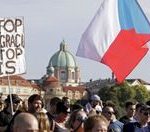
Despite having a strong human rights record, the Czech Republic is currently undergoing protests over the EU refugee resettlement proposals.
The Czech Republic has an overall strong record in the realm of human rights and political freedom and is considered to be a model for the former Soviet-bloc countries. Perhaps in response to abuses committed towards the Czech people during the periods of Nazi Germany and Soviet occupation, the Czech Republic takes an active role in protecting the rights of its citizens and is proud of its human rights record. Despite its overall positive record on human rights, the Czech Republic still faces some criticism by human rights organizations due to its refusal to participate in refugee resettlement programs put forward by the European Union and an increase in hate speech towards migrants from the Middle East. Additionally, governmental corruption has increased under the Presidency of Milos Zeman, thus increasing citizen alienation from the Czech political process.
In terms of demographics, the Czech Republic is estimated to be 10.4% Roman Catholic, 1.1% Protestant, 54% unspecified/other, and 34.5% non-religious. The main ethnic groups in the Czech Republic are Czech (64.3%), Moravian (5%), Slovak (1.4%), other (1.8%), and 27.5% unspecified, and the official languages of the country are Czech (spoken by ~95% of the population) and Slovak (spoken by ~2% of the population). The Czech Republic has a literacy rate of ~99% for both men and women and a life expectancy of 78.8 years (81.9 for women and 75.1 for men), comparable to the US and other European countries.
The Czech Republic has a strong economy characterized by a stable currency, diverse industries, and a low unemployment rate.
The Czech Republic is has a GDP $372 billion (2017 estimate), Human Development Index Score of 0.878 and a GINI Score of 25.9. The economy of the Czech Republic is primarily service-based (59.7%), with industry and agriculture making up 37.8% and 2.5% of total economic output respectively. The unemployment rate of the Czech Republic is estimated to be around 3% as of 2017 and GDP per capita is $35,200. The Czech Republic currently has the lowest unemployment rate in the European Union and its currency is one of the strongest performing currencies of 2017. Despite its strong economic performance in recent years, the Czech economies dependence on exports makes economic growth vulnerable to contractions in external demand.
In the realm of foreign policy, the Czech Republic is an active member of organizations such as the UN, European Union, NATO, and is an observer in the Organization of American States. The Czech Republic has diplomatic ties with a majority of countries and has sought to establish a positive reputation as a mediator in diplomatic disputes currently going on in Europe. Historically, the Czech Republic has had a tense relationship with both Germany and Russia due to the latter two countries attempts to limit Czech sovereignty and gain influence within both Czech domestic and foreign policy. In recent years, the Czech Republic has improved its diplomatic ties with Germany and have developed close economic ties. On the other hand, Czech-Russian relations soured to a point since Vladimir Putin began his third term in 2012. The Czech Republic strongly opposed the Russian-intervention in Ukraine and supports the ongoing EU sanctions against Russia.
In conclusion, the Czech Republic continues to remain one of the more stable countries within the European Union due to its strong economy, democratic society, and positive role in foreign affairs. Geopolitical issues remain minimal within the country and its future outlook remains strong in the face of emerging challenges such as a resurgent Russia, declines in US support for Europe, and the EU refugee crisis.
Iraq (officially known as the Republic of Iraq) is a Federal parliamentary republic located in the central part of the Middle East. Iraq bordered by countries such as Iran, Turkey, Saudi Arabia, Jordan, Kuwait, and Syria, has an area of approximately 438,317 Square Kilometers, and a population of around 40 Million. Iraq plays a major role in Middle Eastern politics due to its unstable nature, strategic location between two of the regions most stable countries, and a history defined by violent authoritarianism and colonialism.
Iraq has a long and rich history going back nearly 2,500 years.
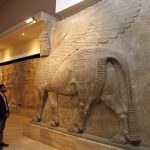
The history of Iraq can be traced back to the 24th Century BCE, with the establishment of the Akkadian Empire in present-day Iraq. The Akkadian Empire lasted until 2150 BCE when it was replaced by the Assyrian Empire, which remained in power until 627 BCE. After the collapse of the Assyrian Empire, the Neo-Babylonian Empire came to power. The rule of the Neo-Babylonian Empire was ultimately short-lived, as the area comprising present-day Iraq was conquered by the Persian (present-day Iran) Shah Cyrus the Great in 539 BCE and soon became an integral part of the Persian Empire for the next few centuries. Iraq was conquered by the Arabs in 634 CE and its city of Baghdad became the capital of the Abbasid Caliphate by the 8th Century CE. Iraq soon became the primary cultural center of the Muslim world during the “Islamic Golden Age.” The Iranians re-established control over Iraq by the 11th Century and Iraq remained as part of present-day Iran until 1831, when the Ottoman Empire gained control over the area after lengthy conflicts with both the Safavid and Qajar Iranian monarchies.
Following the defeat of the Ottoman Empire in World War I, the UK acquired a mandate over Iraq and sought to remake Iraq into an image that would suit their plans for global domination. The British government installed into power a Sunni monarch, Faisal ibn Husayn (despite the fact that Iraq is majority Shi’a) and worked to suppress the nationalist sentiments of groups within Iraq such as the Kurds and Assyrian Christians. These parameters would continue until the 1958 Revolution that established the Republic of Iraq. The UK ultimately granted Iraq independence in 1938, but the country still relied on British support and was considered to be a “vassal state” of the declining British Empire.
Saddam Hussein (who ruled Iraq from 1968 to 2003) had a reputation as a brutal dictator and is widely considered to be one of the worst human rights abuses in recent memory.
The monarchy was overthrown in the Iraqi Revolution of 1958 by Abd al-Karīm Qāsim and Abdul Salam Arif. Saddam Hussein and the Ba’ath Party assumed power after the July 1968 Iraqi Revolution and soon sought to remake Iraq into their own image. Even though Saddam Hussein implemented a series of progressive social programs, improved women’s rights, and nationalized Iraq’s oil production in 1972, he had a reputation as a brutal dictator who allowed little opposition to his rule. For example, Saddam Hussein was known for committing human rights abuses against both the Shi’a Muslims and Kurds of Iraq (ranging from torture to mass executions), allowed only Sunni Muslims into positions of power, and implemented an apartheid system meant to separate Shi’a Muslims from the rest of Iraqi society. After the successful conclusion of the Iranian Revolution in early 1979, Saddam set his sites on Iran, which he felt was in a vulnerable position due to the recent Revolution and purges by the government of Ayatollah Khomeini against former members of the Shah’s military force. Iraq launched a war against Iran in September of 1980 with the goal of overthrowing the Khomeini government from power and annexing the oil-rich province of Khuzestan, which is home to a large population of Iranian Arabs who identify as Sunni Muslim. Despite the fact that Saddam Hussein was backed by countries such as the US, Soviet Union, UK, France, Germany, Japan, and Saudi Arabia, the Iranians were able to hold the border for the course of the war. During the war, Iraq (with US help) developed a chemical weapons program and used these weapons numerous times over the course of the war, on both Iranian soldiers and civilians, as well as the Kurds of Northern Iraq. Ultimately, Iran was able to turn back the Iraqi invasion and won a pyrrhic (costly) victory.
In August 1990, Iraq seized Kuwait in response to a long-standing dispute related to oil production but was expelled by US-led coalition forces during the 1990-91 Gulf War. Following Kuwait’s liberation, the UN Security Council required Iraq to scrap all weapons of mass destruction and long-range missiles and to allow UN verification inspections. Continued Iraqi noncompliance with UN resolutions over a period of 12 years led to the US-led invasion of Iraq in March 2003 and the ouster of Saddam Hussein from power. US forces remained in Iraq until 2011, helping to provide security and to train and mentor Iraqi security forces. In October 2005, Iraqis approved a constitution in a national referendum and, pursuant to this document, elected a 275-member Council of Representatives in December 2005. The Council of Representatives approved most cabinet ministers in May 2006, marking the transition to Iraq’s first constitutional government since the late 1960s. Since 2014, Iraq has been engaged in a military campaign against ISIS to recapture territory lost in the western and northern portion of the country.
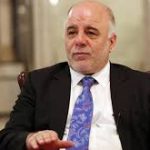
Haider al-Abadi is the current Prime Minister of Iraq and has been in power since 2014.
The current Iraqi constitution was adopted on 15 October 2005. The constitution stipulates that Iraq is a democratic, federal parliamentary Islamic republic. The federal government is composed of three branches, the executive, legislative, and judiciary, as well as numerous independent commissions. Aside from the federal government, there are regions (made of one or more governorates), governorates, and districts within Iraq with jurisdiction over various matters as defined by law. The executive branch of Iraq consists of the Presidency Council and the Council of Ministers. The president is the head of state, protecting the constitution and representing the sovereignty and unity of the state, while the prime minister is the direct executive authority and commander in chief. The president and vice presidents are elected by the Council of Representatives. The prime minister is nominated by the largest bloc in the Council of Representatives. Upon designation, the prime minister names the members of his cabinet, the Council of Ministers, which is then approved by the Council of Representatives. The executive branch serves a four-year term concurrent with that of the Council of Representatives. The current President of Iraq is Fuad Masum, who assumed office on July 24, 2014, and the current Iraqi Prime Minister is Haider al-Abadi, who came to power on September 8, 2014.
The Council of Representatives is the main elected body of Iraq. The Constitution defines the “number of members at a ratio of one representative per 100,000 Iraqi persons representing the entire Iraqi people.” The members are elected for terms of 4 years. The council elects the President of Iraq; approves the appointment of the members of the Federal Court of Cassation, the Chief Public Prosecutor, and the President of Judicial Oversight Commission on proposal by the Higher Juridical Council; and approves the appointment of the Army Chief of Staff, his assistants and those of the rank of division commanders and above, and the director of the intelligence service, on proposal by the Cabinet.
The Iraqi Supreme Court Building.
The judicial system of Iraq consists of three levels, the Supreme Court, the Supreme Iraqi Criminal Tribunal, and the Central Criminal Court. The Supreme Court determines the constitutionality of laws and regulations, acts as a final court of appeals, settles disputes between the federal government and the regions and governorates, municipalities, and local administrations, and settles accusations directed against the President, the Prime Minister and the Ministers. The Supreme Iraqi Criminal Tribunal is a special court established to try Iraqi nationals or residents accused of genocide, crimes against humanity, war crimes or other serious crimes committed during the 35-year rule of Saddam Hussien (1968-2003). The Central Criminal Court is the main criminal court of Iraq and is based on an inquisitorial system and consists of two chambers: an investigative court, and a criminal court. The Iraqi judiciary is supervised by the Higher Judicial Council, which nominates the Chief Justice, Justice of the Judiciary Oversight Commission, and drafts the budget of the judiciary.
Iraq has a mixed record regarding human rights and is widely considered by international observers to be an unstable democracy. Since 2003, Iraq has made some progress in developing a democratic political system for the first time since the late 1960s. Iraq has had seven competitive elections over the past 13 years that resulted in a variety of different political parties coming into power. Additionally, civil society organizations have grown in number since the 2003 US-led invasion that removed Saddam Hussein from power and are viewed as essential aspects of political participation by a majority of the population of Iraq. Despite some progress over the past few years, Iraq continues to remain a highly unstable country in terms of politics. The Iraqi Consitution includes no provisions establishing a system of checks and balances between the branches of government and high levels of political corruption have plagued the Iraqi government in recent years. These problems are further compounded by the lack of strong formal governmental institutions meant to promote political stability. Arbitrary arrests and torture are a common occurrence in Iraq, though the human rights situation has improved overall when compared to when Saddam Hussein was in power. As a result of these challenges, protests have emerged in Iraq in 2011 and 2015 due to the fact that the citizens are increasingly growing tired of weak governmental institutions and the failure of the government to develop credible solutions to the problems facing Iraq such as the rise of extremist groups such as ISIS and the poor economic situation facing the country.
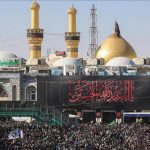
Iraq is home to Karbala, which is the site of the tomb of the grandson of Muhammad and the third Shi’a Imam, Husayn ibn Ali
In terms of demographics, Iraq is estimated to be ~99% Muslim. Approximately 51-65% of Iraqi Muslims are Shi’a, whereas 35-46% are Sunni. Iraq is home to the cities of Karbala and Najaf, which are the holiest sites in Shi’a Islam. Najaf is the site of the tomb of Ali ibn Abi Talib (the first Shi’a Imam), and Karbala is the site of the tomb of the grandson of Muhammad and Shi’a Imam, Husayn ibn Ali. Najaf is also a center of world renown Shi’a seminaries and schools. A majority of Iraqi Christians are ethnic Assyrians and members of the Chaldean Catholic Church, Assyrian Church of the East, and the Eastern Orthodox Church. Despite numbering as high as 16 million as late as 1987, the Iraqi Christian population has declined to 450,000 as of 2013. Some of the factors contributing to the decline of the Iraqi Christian population include the rise of extremist groups such as ISIS and Al-Qaeda, political instability, and lack of economic opportunities. A majority of Iraqi Christians over the past three decades have migrated to countries such as Iran, the US, UK, and Canada to flee oppression and find a better life. Other religious groups in Iraq include Yazidism, Zoroastrianism, Mandaeism, and several indigenous religious groups. A majority of the population of Iraq (~80%) identifies as Arab and Arabic, Kurdish, and Azerbaijani are the official languages of the country. Iraq has a literacy rate of 79.7% (85.7% for men and 73.7% for women).
Iraq has a GDP of $660 billion (2017 estimates), a Human Development Index Score of 0.649 and a GINI Score of 30.9. The economy of Iraq is primarily serviced-based (54.6%) and industry and agriculture make up 40.6% and 4.8% of the economy respectively. The unemployment rate of Iraq is ~16% and the GDP per capita is $17,000. The economy of Iraq continues to remain stagnant due to political instability, lack of foreign investment, and inefficiencies resulting from excessive governmental intervention in the Iraqi economy.
Iraq has recently sought to improve its standing before the international community and develop a role as a constructive regional power.
Iraq has a complex role in terms of international politics. Previously considered a “pariah state” during the rule of Saddam Hussien, Iraq is working to rebuild its reputation in the eyes of the international community. Iraq is a member of a number of international organizations such as the Arab League, the Non-Aligned Movement, the Organization of Islamic Cooperation, the International Criminal Court, and the United Nations and has diplomatic relations with a majority of countries. Historically, Iraq and Iran had a very tense relationship due to the legacy of the Iran-Iraq War, religious differences, and differing visions for their respective roles in the greater Middle East. Since the overthrow of Saddam Hussien however, Iraq and Iran have expanded their diplomatic ties and now consider each other to be allies. Additionally, Iraq is seeking to develop constructive ties with countries such as the US, Russia, Brazil, India, and Jordan. On the other hand, Iraq views Saudi Arabia as its main regional opponent, criticising the Saudi government for their discrimination against Shi’a Muslims and noting that the Saudi government has played a major role in the growth and spread of extremist groups such as ISIS and Al-Qaeda and destructive ideologies such as Wahhabi Islam.
In conclusion, Iraq continues to remain arguably one of the most unstable countries in the Middle East some 15 years after the overthrow of Saddam Hussien and his authoritarian regime. Some of the main issues preventing Iraq to emerge as a strong country include the lack of formal governmental institutions, the continued existence of violent extremist groups, weak economic prospects, and the legacies of authoritarianism and colonialism.
One of the most unstable countries in the Middle East is Lebanon. Officially known as the Lebanese Republic, Lebanon is a parliamentary republic located in the Mediterranean region of the Middle East. Lebanon is bordered by countries such as Greece, Cyprus, Syria, Israel, Jordan, and Iraq, has an area of approximately 10,400 square kilometers and a population of around 4 Million (not counting 1.9 Million refugees mostly from Syria and Palestine). Lebanon plays a significant role in contemporary Middle Eastern politics due to its ongoing territorial disputes with Israel, lack of a strong central government, and the continued influence of neighboring countries such as Syria within its internal and external affairs.
Lebanon was a province of the Ottoman Empire from the early 16th Century all the way up until 1918.
The people of Lebanon (much like the Palestinian people) are descendants of the Canaanites, who first settled in the Meditteranean region of the Middle East around 3000 BCE. Historically, the territory of Lebanon was controlled by foreign powers such as the Phoenicians, the Persians (under the Achaemenid Empire), the Greeks, Romans, the Arabs (under both the Rashidun and Abbasid Caliphates), and the Christian Crusaders during the 12th Century. Most recently, Lebanon was annexed by the Ottoman Sultan Selim I in 1516 and soon became an integral part of the Ottoman Empire, linking the Empire with parts of Southern Europe such as Italy, France, Spain, and Portugal.
Following the defeat of the Ottoman Empire in World War I, France acquired a mandate over the northern portion of the former Ottoman Empire province of Syria. The French named the region Lebanon in 1920 and granted this area independence in 1943. Since 1943, Lebanon has been marked by periods of political turmoil interspersed with prosperity built on its position as a regional center for finance and trade. The Lebanese Civil War (lasting from April of 1975 to November of 1989 and resulting in the deaths of some 120,000 people) was followed by years of social and political instability. Neighboring countries such as Syria have historically influenced Lebanon’s foreign policy and internal policies, and its military occupied Lebanon from 1976 until 2005. The Shi’a Muslim Hezbollah political group and Israel continued attacks and counterattacks against each other after Syria’s withdrawal and fought a brief war in 2006.
The current Lebanese constitution was adopted on May 23, 1926, and most recently amended in October of 1989. The constitution stipulates that Lebanon is a parliamentary democracy that includes confessionalism, in which high-ranking offices are reserved for members of specific religious groups. The President, for example, has to be a Maronite Christian, the Prime Minister a Sunni Muslim, the Speaker of the Parliament a Shi’a Muslim, and the Deputy Prime Minister and the Deputy Speaker of Parliament Greek Orthodox Christians. This system is intended to deter sectarian conflict and attempts to represent fairly the demographic distribution of the 18 recognized religious groups in government. The confessional system is based on 1932 census data, which showed the Maronite Christians as making up nearly 70% of the countries total population. The Government of Lebanon continues to refuse to undertake a new consensus, for fear that a change in the political system would further destabilize the country.
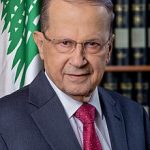
Michel Aoun is the current President of Lebanon and has served in office since October of 2016.
The executive branch of Lebanon is headed by the President and the Prime Minister. The President of Lebanon is elected by Parliament for a six-year term and cannot be reelected again until six years have passed from the end of the first term. The current President of Lebanon is Michel Aoun, who assumed office on October 31, 2016. Aoun is a member of the Free Patriotic Movement, a political party that is aligned with both the Maronite Christians and the Shi’a Muslims of Lebanon. The Prime Minister and Deputy Prime Minister are appointed by the President in consultation with the Parliament. The Prime Minister of Lebanon is Saad Hariri, who has been in power since December 8, 2016. Hariri is a member of the Future Movement, a political party aligned with the Sunni Muslims of Lebanon.
Lebanon’s national legislature is called the Assembly of Representatives (Majlis al-Nuwab in Arabic). Since the elections of 1992, the Parliament has had 128 seats. The term for the legislature was recently extended to five years. The parliament is elected by universal adult suffrage based on a system of majority or “winner-take-all” for the various confessional groups. There has been a recent effort to switch to proportional representation which many argue will provide a more accurate assessment of the size of political groups and allow minorities to have their voices heard. Most deputies do not represent political parties as they are known in the West, and rarely form Western-style groups in the assembly. Political blocs are usually based on confessional and local interests or on personal/family allegiance rather than on political affinities. Lebanon’s judicial system is based on the Napoleonic Code. The Lebanese court system has three levels:
courts of first instance,
courts of appeal, and the
court of cassation.
There also is a system of religious courts having jurisdiction over personal status matters within their own communities.
Hezbollah, a Shi’a Muslim political party & militia group founded by Iran and Syria in 1982, is the most powerful political organization in Lebanon.
Lebanese political institutions often play a secondary role to highly confessionalized, personality-based politics. Powerful families still play a role in mobilizing votes for both local and parliamentary elections. Nonetheless, a lively panoply of domestic political parties, some even predating independence, exists. The largest are all confessional based. The Free Patriotic Movement, The Kataeb Party, the National Bloc, National Liberal Party, Lebanese Forces and the Guardians of the Cedars each have their own base among Christians. Amal and Hezbollah are the main rivals for the organized Shi’a vote, and the PSP (Progressive Socialist Party) is the leading Druze party. While Shi’a and Druze parties command loyalty to their leadership, there is more factional infighting among many of the Christian parties. Sunni parties have not been the standard vehicle for launching political candidates, and tend to focus across Lebanon’s borders on issues that are important to the community at large. Lebanon’s Sunni parties include Hizb ut-Tahrir, Future Movement, Independent Nasserist Organization, the Al-Tawhid, and Ahbash. In addition to the traditional confessional parties, new secular parties have emerged, representing a new trend in Lebanese politics towards secularism. In addition to domestic parties, there are branches of pan-Arab secular parties (Ba’ath parties, socialist, and communist parties) that were active in the 1960s and throughout the period of civil war.
Overall, the political system can be described as a “flawed” and an “unstable” democracy. Even though Lebanon has numerous democratic political isnstitutions, a free press system, and is generally on par with international standards regarding human rights, the government itself remains relatively weak and formal governmental institutions are ineffective at best. The lack of strong political institutions within Lebanon is considered to be one of the lingering effects of the Lebanese Civil War, ongoing Middle East conflicts such as the War against ISIS and the Israel-Palestinian conflict, and the continued influence of foreign powers such as Syria, Iran, Russia, and Israel within Lebanese domestic politics.
Lebanon is home to members of all three of the Abrahamic faiths, as well as several indigenous religious groups.
In terms of religion, Lebanon is estimated to be 55% Muslims, 40% Christian, and 5% other. An overwhelming majority (~75%) of Lebanese Muslims are Shi’a, whereas only 25% are Sunni. Twelvers are the predominant Shi’a group, followed by Alawites and Ismailis. The Shi’a Muslims of Lebanon are largely concentrated in northern and western Beqaa, Southern Lebanon, Southern Beirut, Tripoli, and Akkar. Most Lebanese Sunni Muslims identify with the ideology of Wahhabism, an ultra-conservative sect of Islam that originated in Saudi Arabia during the 18th Century. A majority of Lebanese Christians are members of the Maronite Catholic Church, though a number of Greek Orthodox and Protestant communities exist as well. Other religious groups within Lebanon include the Druze, a small Jewish population, Baha’i, and several indigenous religions unconnected to any of the three Abrahamic faiths. Arabs are the largest ethnic group in Lebanon and Arabic, French, English, and Armenian are the official languages. Lebanon has a 94% literacy rate (the only country in the Middle East with a higher literacy rate is Iran) and an average life expectancy of 78 years, comparable to countries such as the US.
Lebanon has a GDP of around $50 billion and Human Development score of 0.763 as of 2015. The economy of Lebanon is primarily service-based (73.3%) Agriculture and Industry make up 21% and 5.7% of the Lebanese economy respectively. The unemployment rate in Lebanon is estimated to be at least 10% and the country has a GDP per capita of $19,100. The 1975-89 civil war damaged Lebanon’s economic infrastructure, cut national output by half, and derailed Lebanon’s position as the economic hub of the Middle East. Following the civil war, Lebanon rebuilt much of its war-torn physical and financial infrastructure by borrowing heavily, mostly from domestic banks, which saddled the government with a huge debt burden. Spillover from the Syrian conflict, including the influx of more than 1 million Syrian refugees, has increased internal tension and slowed economic growth to the 1-2% range for the past five years.
Lebanon is an active member of international organizations such as the UN, Non-Aligned Movement, and the Organization of Islamic Cooperation.
In terms of international politics, Lebanon is a member of a number of international organizations such as the Arab League, the Non-Aligned Movement, the Organization of Islamic Cooperation, the International Criminal Court, and the United Nations and has diplomatic relations with a majority of countries. Some of the countries that Lebanon has close ties with are Iran, Syria, Russia, Palestine, and Pakistan, Additionally, Lebanon has a stable relationship with many Western countries such as the US, UK, Germany, Italy, and France. Lebanon’s main enemy in the Middle East is Israel. The animosity between Lebanon and Israel can be traced back to the creation of Israel in 1948. Lebanon was an active participant in the 1948, 1967, and 1973 Arab-Israeli Wars and considers the Shebaa farms area in Northern Israel as part of Lebanon. Additionally, Israel intervened in the Lebanese Civil War in 1976 and began an occupation of Southern Lebanon in 1985, which lasted until 2000. During their occupation of Southern Lebanon, the Israeli government committed numerous human rights abuses such as the killing of unarmed civilians, denying the Shi’a Muslims of Southern Lebanon the freedom to practice their faith, and clamped down on numerous rights such as press freedom, political participation, and freedom of expression. These actions only served to further expand the already tense relationship between the Lebanese people and Israel and made any potential reconciliation between both countries next to impossible.
In conclusion, Lebanon continues to be beset with numerous social, political, and economic issues despite having the potential to be one of the most progressive and stable countries in the entire Middle East. The root of most political issues in Lebanon can be traced back to its confessional system of government, which makes representation in government highly unequal and discourages citizen involvement in the political system. A possible solution would be to move towards a system based on proportional representation an to not restrict offices such as the Presidency and the Prime Minister to members of certain religions. Such a system would reduce the strong levels of political tension within Lebanon and allow it to become a beacon of stability in one of the most unstable regions of the world.
The Middle East is the term for a region consisting of countries in Southwest Asia and the Northern part of Africa. The term “Middle East” dates back to the late 19th Century, when it was coined by the British foreign service and soon adopted by the US government. The term was originally used to distinguish the area east of the Balkans and west of India. The origin of the name speaks volumes about the political realities of the 19th Century when the perspective of the British and the US carried much weight in international relations.
The Middle East is a diverse region in terms of both its landscape and culture.
The Middle East is a geographically diverse region in Southwest Asia and part of North Africa stretching from the Mediterranean Sea to the Persian Gulf, bounded by the Caspian Sea in the north and the Sahara Desert in the South. It has a long shared history and a shared religious tradition, being the birthplace of the four major monotheistic religions of Islam, Judaism, Christianity, and Zoroastrianism. The Middle East is also defined as being a central location of trade and cultural transmission between Europe, Africa, and Asia.
Within the larger Middle East, one can also describe sub-regions, such as North Africa and the Levant, which share certain characteristics. The Levant encompasses Syria, Cyprus, Turkey, Iraq, Lebanon, Israel and Palestine, and is considered an important area because of its close historical connection with countries such as Italy, France, Spain, and Portugal. Additionally, the North African region of the Middle East is characterized by a culture mixed with Arab, African, and Southern European traditions as well as a diverse religious landscape (the religion of Judaism is widely considered to have originated in Northern Africa and large communities of Sephardic Jews remain in the region to this present-day).
The exact list of countries that make up the Middle East is often sharply debated by scholars. Almost all scholars would agree that the Middle East includes the countries of Bahrain, Cyprus, Egypt, Iran, Iraq, Israel, Jordan, Kuwait, Lebanon, Oman, Palestine, Qatar, Suadi Arabia, Syria, Turkey, United Arab Emirates, and Yemen. Additionally, many experts also characterize the North African countries of Algeria, Libya, Morocco, Sudan, and Tunisia as part of the Middle East due to a shared culture with the rest of the Middle East. By and large, a majority of people living in the Middle East identify as part of the Arab ethnic group, although diverse ethnic groups such as Persians (residing in Iran, Iraq, Lebanon, Syria, Yemen, Bahrain, and the Gulf States), Kurds (mostly present in Iran, Iraq, Syria, Turkey, and Lebanon), Turks, and many others play a large role in Middle Eastern politics.
The cultures of both Afghanistan and Pakistan were influenced by Middle Eastern countries such as Iran.
The author of this post agrees with the universal consensus regarding the countries that make up the Middle East but also feels that several countries and regions not typically considered to be part of the Middle East should be included as well. The first two countries are Afghanistan and Pakistan. Even though Afghanistan and Pakistan are usually considered to be part of South Asia, they shared numerous cultural and religious similarities with several Middle Eastern countries such as Iran. Afghanistan and Pakistan were integral parts of the Persian Empire prior to the 18th Century and Shi’a Islam is a strong force within both countries (roughly 7-15% of Afghanistan’s population identifies as Shi’a, whereas as many as 20-30% of Pakistani Muslims are Shi’a). Additionally, the main languages of both Afghanistan and Pakistan are rooted in the Iranian-based language Farsi and the region of Baluchistan (located in Southeastern Iran) is split between Iran and Pakistan.
The culture of Southern Italy continued to be influenced by the legacy of the Arab rule of the Abbasid Caliphate.
Another territory that can reasonably be considered part of the Middle East is Southern Italy, which consists of major cities such as Sicily, Palermo, and Sardinia. Southern Italy can be characterized as being part of the Middle East for several factors. The main reason is that Southern Italy was under Arab control from 831 CE (with the establishment of the Emirate of Sicily, which was ruled by the Abbasid Caliphate) to 1091 CE (when it was conquered by Christian crusaders under the command of Roger I of Sicily). Despite the conquest of Southern Italy by the Byzantine Empire, Muslims continued to make up a majority of the population in the territory until the 13th Century. The legacy of Muslim rule continues to influence Southern Italy to the present day, with Arabic and Sicilian language sharing many root words. Additionally, Southern Italy serves a key point linking both the Mediterranean and North African regions of the Middle East to mainland Europe and has a very rich and diverse culture as a result.
Despite being considered part of Europe by most experts, Greek culture was strongly influenced by Middle Eastern countries such as Turkey and Iran.
Greece is another country that makes up the broader Middle East. Despite historically having tensions with major powers in the Middle East such as Iran and Turkey (mostly due to religious and territorial factors), Greek culture shares numerous similarities with the ancient civilizations of the Middle East. Most of the similarities are based on shared mythologies, literature, cultural practices, and traditions. The Greek language also shares several root words with Farsi and Turkish language. Moreover, Greece was a key part of the Ottoman Empire for nearly four centuries and (much like Southern Italy) has established a reputation as a central point linking Europe with the Eastern part of the Middle East.
Some observers include Turkmenistan, Uzbekistan, Tajikistan, Kyrgyzstan, Kazakhstan, Georgia, Armenia, and Azerbaijan as part of the greater Middle East. The main rationale for including these countries is due to the fact that they were all once either part of Iran or the Ottoman Empire. However, the residents of these countries have strong local characteristics that distinguish them from the nations of the Middle East and instead are mostly tied to European countries such as Russia and several Asian countries such as Mongolia.
Arguably one of the most stable countries in the Middle East is Morocco. Officially known as the Kingdom of Morocco, Morocco is a Constitutional monarchy located in the Maghreb region of the Middle East. Morocco is bordered by countries such as Libya, Algeria, Sapin, Portugal, and Italy, has an area of approximately 440,000 square kilometers and a population of around 34 million. Morocco plays a significant role in contemporary Middle Eastern politics due to its relative stability in one of the most violent and unstable regions of the world, its ethnically and culturally-diverse population, and efforts to solve pressing regional issues such as the Israeli-Palestinian conflict.
Morocco has a long and rich history going back several thousand years.
The history of Morocco can be traced back to the establishment of the Berber kingdom of Mauretania in 225 BC, which was the first independent Moroccan state. Mauretania became a client state of the Roman Empire in 33 BC and was annexed directly as a Roman province in 44 CE. The decline of the Roman Empire during the 4th and 5th centuries CE resulted in parts of present-day Morocco being reconquered by the Berber tribes, who sought to establish an independent nation free of foreign domination. The Muslim conquest of the Maghreb during the 7th and 8th centuries CE brought both the religion of Islam and Arabic language to Morocco. The indigenous Berber tribes adopted Islam by the late 7th Century, although they retained their traditional laws and customs. By 788, the first of a series of Moroccan Muslim dynasties came to power. In the 16th century, the Sa’adi monarchy came to power and soon sought to make Morocco a significant regional power. Under the Sa’adi rule, Morocco pushed back repeated incursions by the growing Ottoman Empire and a Portuguese attack at the battle of Ksar el Kebir in 1578.
In 1666, Morocco was reunited with the Alaouite Dynasty, who has been the ruling family of Morocco ever since. During this period, Morocco faced much aggression from Spain and the Ottoman Empire, which were both seeking to expand their borders westward. The Alaouites succeeded in stabilizing their position for the time being and reunified Morocco. In 1860, Spain occupied northern Morocco and ushered in a half-century of rivalry among European powers that saw Morocco’s sovereignty steadily decline. In 1912, the French imposed a protectorate over the country. A protracted independence struggle with France ended successfully in 1956. Sultan Mohammed V subsequently organized the new Moroccan state as a constitutional monarchy and assumed the title of king in 1957.
Mohammed VI is the current King of Morocco.
The current Moroccan constitution was adopted on December 14, 1962, and most recently amended on July 1, 2011. The constitution stipulates that Morocco is a parliamentary constitutional monarchy with three branches of government. The executive branch is headed by both the king and the President of Government. The constitution grants the king extensive powers and states that he is both the secular political leader and the “Commander of the Faithful” due to his status as a direct descendant of the Prophet Mohammed. The king presides over the Council of Ministers, appoints the president following legislative elections, and selects the members of the government upon the suggestions of the president. On the other hand, the primary role of the President is to follow through on public policies and to serve as the elected representative of the Moroccan people. The current King of Morocco is Mohammed VI, who came to power in July of 1999 following the death of his father, King Hassan II. The current President of Morocco is Saadeddine Othmani, who assumed office on April 5, 2017. Othmani is a member of the Justice and Development Party.
The legislative branch of Morocco consists of two branches. The first branch is the Chamber of Advisors, which consist of 120 seats. Its members are indirectly elected by an electoral college consisting of local government councils and serve for a 6-year term. The Chamber of Representatives is the second legislative house in Morocco, which consists of 395 seats. 305 of its members are directly elected in multi-seat constituencies by proportional representation vote and 90 are directly elected in a single nationwide constituency by proportional representation vote. In the national constituency, 60 seats are reserved for women and 30 reserved for those under age 40. All of the members serve for a 5-year term. The most recent elections were held on November 25, 2011, and had a 43% turnout rate. The highest court in Morocco is the Supreme Court, whose judges are appointed by the King. The legal system of Morocco is considered to be a mixture of both civil law and Shari’a law.
Overall, the government of Morocco has a mixed record with regards to human rights and political freedom. Under the rule of King Hassan II, regime opponents were subject to heavy-handed reprisals such as torture, executions, and harassment by governmental authorities. The human rights situation in Morocco began to improve once King Mohammed VI came to power in 1999. Under King Mohammed VI, numerous rights such as freedom of speech, press, and expression have been upheld by the government, a new electoral system was implemented, governmental corruption was tackled, and an Equity and Reconciliation Commission was set up to investigate human rights abuses under the rule of King Hassan II. Many international observers credit these gradual reforms as preventing Morocco from descending into the chaos and instability that has been evident in much of the Middle East over the past two decades. On the other hand, some critics argue that these reforms have done little to fully improve the political situation within Morocco and only serve to strengthen the monarchies hold on power.
The population of Morocco is diverse and consists of members of all three of the Abrahamic Religions.
In terms of religion, Morocco is estimated to be 98.9% Muslim, 0.9% Christian, and 0.2% Jewish. An overwhelming majority (67%) of Moroccan Muslims are Sunni and 30% of Muslims are non-denominational. Approximately 3-8,000 Shi’a Muslims reside in Morocco, most of whom are of Iraqi and Lebanese origin. Morocco is home to approximately 400,000 Christians, giving it one of the largest Christian populations in the region (behind Egypt, Lebanon, Cyprus, Iran, Iraq, and Syria). A majority of Moroccan Christians are members of the Chaldean Catholic church, although a small number of Protestant sects are present as well. Approximately 6-8,000 Jews (mostly Sephardic) reside in Morocco, giving it the third largest Jewish population in the Middle East (behind Israel and Iran). Due to its status as a meeting place of many diverse faiths, Morocco has established a reputation as a pluralistic country that encourages ecumenical dialogue between all religions. Arabs are the largest ethnic group in Morocco and Arabic, Berber, and French are the official languages. Morocco has a 68.5% literacy rate and an average life expectancy of 77 years, comparable to many Western countries such as the US.
Morocco has a GDP of around $281.4 billion and Human Development score of 0.647. The economy of Morocco is primarily service-based (56.8%) Agriculture and Industry make up 13.6 and 29.5% of the Moroccan economy respectively. The unemployment rate in Morocco is estimated to be ~9% as of 2016 and the country has a GDP per capita of $8,200. The economy of Morocco is currently expanding due to the neo-liberal economic policies of King Mohammed VI and expanded investment by countries such as the US, UK, France, and Italy in recent years.
Morocco has close relations with many Middle Eastern countries including Saudi Arabia.
Morocco is an active member of international organizations such as the United Nations, the Arab League, and the Non-Aligned Movement among others. Moreover, Morocco maintains diplomatic relations with a majority of countries and has recently sought to increase its positive role in the international community and become the leading voice for Arab unity. Some of Morocco’s strongest regional allies include Saudi Arabia, Jordan, Egypt, Algeria, and Kuwait. Additionally, Morocco has pursued a moderately pro-Israel foreign policy by forming close economic ties with the Jewish state, pushing for a permanent solution to the Arab-Israeli conflict, and working with moderate voices on both sides of the conflict. Morocco is also critical of the current Iranian government and supports efforts by the Arab states to isolate Iran. The poor relationship between Morocco and Iran can be traced back to the fact that the Moroccan government under King Hassan II strongly backed Shah Mohammed Reza Pahlavi during the Iranian Revolution and granted him asylum after his overthrow. Morocco is also critical of Iran’s regional ambitions and feels that increased Iranian regional influence will result in higher levels of instability that will ultimately weaken governments throughout the region.
Morocco and the US have a strong relationship dating back to the late 18th Century.
Outside of the Middle East, Morocco has pursued close diplomatic and economic ties with many Western powers. In particular, Morocco and the US have a strong economic, political, and military alliance. The relationship between Morocco and the US dates back to the late 1770s when Morocco became the first country to recognize the US and an independent nation. The close cooperation between Morocco and the US has grown in recent years due to events such as the War on Terrorism. The US considers Morocco to be a major non-NATO ally and a beacon of stability in the region. As a reward for the close friendship between both countries, Morocco became one of the few countries in the Middle East to extend visa-free travel to American citizens.
In conclusion, Morocco is one of the most important countries in the Middle East due to its relative stability, a strong economy, close ties with numerous world powers, and diverse population. Continued progress is dependent on steady reform of the Moroccan political and economic system and support from the international community.
One of the most notable countries in the Middle East is Palestine. Officially known as the State of Palestine, Palestine is a Parliamentary Republic located in the Western Middle East. Palestine is bordered by countries such as Israel, Egypt, Jordan, Saudi Arabia, Lebanon, and Syria, has an area of approximately 2,300 square kilometers (split between the West Bank and Gaza Strip) and a population of around 5 million. Palestine plays a significant role in contemporary Middle Eastern politics due to its ongoing border disputes with Israel and efforts to become an independent and legitimate nation.
Palestine Circa 1900.
Palestine has a long and rich heritage going back several thousand years. The Palestinian people are the descendants of the earliest inhabitants of the territory, the Philistines, and the Canaanites, who originally settled in the areas around 3000 BCE, nearly two millennia before the first Jewish settlers arrived in the region. Historically, the Palestinian territory was controlled by numerous foreign powers such as the Iranians (under both the Achaemenid and Sassanid Empires), the Greeks, Romans, Assyrians, and Arabs. Most recently, the Ottoman Empire controlled Palestine from the early 16th Century until the end of World War I. After World War I, Palestine was governed by Great Britain under a Mandate received from the League of Nations in 1920. In 1947, the UN passed a resolution to establish two states within the Palestinian territory and designated a territory including present-day West Bank as part of the proposed Arab state.
During the 1948 Arab-Israeli War, the West Bank was captured by Transjordan (present-day Jordan), and the Gaza Strip was captured by Egypt. Israel gained control of both territories during the 1967 Six Day War. The Palestinian Liberation Organization (PLO) was founded in 1964 with the intention of becoming the sole representative of the Palestinian people. Yasir Arafat (the founder of the political party Fatah in 1958) became the leader of the PLO in 1968 and soon began to seek regional support in favor of the creation of a Palestinian state and in opposition to the occupation of territories rightfully belonging to the Palestinian people by Israel. The PLO was recognized by the Arab League in 1974 as the representative of the Palestinian people. Arafat ultimately declared Palestine as an independent state on November 15, 1988. Israel ultimately transferred control of Palestinian-populated areas of the West Bank and the Gaza Strip to the Palestinian Authority (PA) under a series of agreements negotiated and signed between 1991 and 1999. Yasir Arafat was elected president of the Palestinian Authority in 1996 and served until his death in 2004 and was succeeded by Mahmoud Abbas.
Recent Palestinian politics has been characterized by the divide between Fatah and Hamas.
Recently, there has been a high level of tension within Palestine related to the political divide between Fatah and Hamas, an Islamist political party. Hamas won a majority of seats in the Palestinian Legislative Council in 2006 in elections widely considered to be free and fair by international observers. Despite the formation of a unity government with Fatah, Hamas ultimately took over the Gaza Strip by mid-2007, resulting in a division between the governments in the West Bank and Gaza Strip that continues to this present day. Despite high levels of political instability, Palestine was recognized as a non-member observer state by the UN General Assembly in November of 2012 and was admitted to the International Criminal Court in early 2015.
Mahmoud Abbas is the current President of Palestine and was first elected in 2005.
Palestine is a parliamentary republic operating under a semi-Presidential system. The current constitution of Palestine (the Basic Law) was adopted in 2002 and is modeled in part on the constitutions of various countries in the region such as Turkey, Syria, Lebanon, and Iran. The 2002 Basic Law of Palestine states that Palestinians will not be subject to “any discrimination on the basis of race, sex, color, religion, political convictions or disability.” The law also states that the principles of Shari’a law are the primary source of all legislative proposals. The President of Palestine is directly elected by the Palestinian people in the West Bank, East Jerusalem, and the Gaza Strip. The current President is Mahmoud Abbas, who was elected in 2005. The Prime minister of Palestine is directly appointed by the President and is not required to be a member of the legislature while in office. The current Prime Minister is Rami Hamdallah, who has been in office since 2013. The Palestinian Legislative Council (PLC) is the main legislative body within Palestine. The current Speaker of Parliament is Aziz Duwaik, who has been in office since 2006. Due to the ongoing conflict between Fatah and Hamas, elections for both the President and the Palestinian Legislative Council have been postponed since 2006, though local elections were held in the West Bank in 2016.
Palestine is considered to be a “hybrid regime,” or an “illiberal democracy” with elements characteristic of both authoritarian and democratic governments according to a 2016 “Democracy Index” rating. Some of the major factors that have prevented Palestine from becoming a full-democracy include the lack of strong governmental institutions, continued international isolation, and the ongoing conflict with Israel. Even though the Palestinian government has guaranteed freedom of assembly, press freedom, and freedom of speech, the rights of individuals to demonstrate openly have become increasingly subject to police control and restriction over the past few years due to the ongoing conflicts between Israel and Palestine and Hamas and Fatah. Despite the fact that the 2002 Basic Law mandates respect for other religions such as Christianity and Judaism, Islamic institutions and places of worship tend to receive preferential treatment from the Palestinian government. Additionally, Hamas began to enforce some Islamic standards of dress for women such as mandatory hijab since it came to power in the 2006 election and is alleged by the Israeli government to have established Islamic courts in the Gaza Strip.
Palestine is majority Muslim and Arabs make up the largest ethnic group in the country.
In terms of religion, Palestine is estimated to be between 83-97% Muslim, 3-14% Christian, and 3% other. An overwhelming majority (<95%) of Palestinian Muslims are Sunni and most Palestinian Christians are Greek Orthodox, Maronite, or Roman Catholic. As late as 1900, as much as one-third of the Palestinian population was Christian but declined in recent decades due to the Israeli occupation, the rise of anti-Christian policies by the Israeli government, and the lack of work opportunities. Arabs make up a majority (83%) of the Palestinian population and Arabic, Hebrew, and English are the official languages of the country. Palestine has a 91.9% literacy rate and women have full suffrage in Palestine and made up 47% of registered voters in the 2006 legislative elections.
Palestine has a GDP of $12.6 billion (2015 estimates) and a Human Development Index Score of 0.677 and a GINI Score of 35.5. The economy of Palestinian is primarily service based (81%). Agriculture (5%) and Industry (14%) make up the rest of the Palestinian economy. Unemployment in Palestine is estimated to be around 27% and 25.8% of the population lives below the poverty line. Israeli security measures and ongoing Israeli-Palestinian violence continue to negatively impact economic conditions in the Palestinian territories.
In recent years, Palestine has sought to gain an active role in international affairs.
Palestine is currently a member of a number of international organizations such as the Arab League, the Non-Aligned Movement, the Organization of Islamic Cooperation, the International Criminal Court, and the United Nations and also has diplomatic relations with 136 Nations. Some of the main allies of the Palestinian-led government in the West Bank include Saudi Arabia, Jordan, Egypt, and Morocco. Additionally, the US government under the leadership of former President Barack Obama sought to improve ties with the Palestinian government during his 8 years in office. On the other hand, the Hamas-led government in the Gaza Strip is primarily allied with countries such as Russia, China, Iran, Syria, Lebanon, Turkey, and Yemen and is not recognized as the true Palestinian government by the international community despite the fact that Hamas won a plurality of the vote in the 2006 Palestinian elections and is considered by a majority of Palestinians to be the legitimate government of the territory.
As a country, Palestine continues to face many daunting challenges that threaten its future success. Arguably the main challenge facing the country is its ongoing disputes with Israel and the dual nature of its own government. Within the ongoing peace process, several different solutions have been proposed. The specific solutions range from a one-state, two-state, or even a three-state solution. Each of these proposals has their own set of strengths and weaknesses and have been promoted at various times by the international community. Despite the high level of support for both approaches, it is unlikely that either a one-state or a two-state solution will be viable given the current situation in the region.
It can be argued that a one-state solution is not a viable solution to the Israeli-Palestinian conflict for several reasons. The main reason is that it would result in the wholesale disenfranchisement of the Palestinian people and deny them the right to self-determination. By denying the Palestinian people the right to self-determination, the Israeli government would risk the creation of a civil war and expand the already existing conflicts between the different ethnic groups within the country. Additionally, a one-state solution may permanently alter the overall face of the State of Israel. For example, the high fertility rate among Palestinians coupled with the return of Palestinian refugees would quickly render the Israeli Jewish community an ethnic minority.
It can also be argued that the two-state solution is not viable given the current political realities within Israel. Even though the two-state solution would allow the Palestinian people to develop their own governmental system and full self-determination, the political divisions within the Palestinian territories make the implementation of this proposal unrealistic. For example, the Palestinian territories are split between the West Bank and the Gaza Strip, and both territories are governed by different political factions (the Palestinian Authority in the West Bank, and Hamas in the Gaza Strip). The differences between both political factions regarding policy make a possible unification difficult at best. Additionally, both the West Bank and Gaza Strip are apart from each other geographically, so the logistics for travel between both locations would be difficult to be implemented.
Considering these factors, a three-state solution is the most viable option for the Israeli-Palestinian conflict. Under such an option, Israel would have its borders set to what they were prior to the Six-Day War of 1967 and the West Bank and the Gaza Strip would become two separate Palestinian states. The West Bank would be governed by the Palestinian Authority and Gaza Strip would be governed by Hamas. Additionally, the city of Jerusalem would become a demilitarized zone under the joint administration between representatives from all three states, observers from the United Nations, and leaders from all of the main religious groups within the territory. This approach would reduce the chances of conflict within the region, prevent extremism from spreading, and improve the overall chances for lasting peace in the Middle East.
One of the most notable emerging countries is Nigeria. Officially known as the Federal Republic of Nigeria, Nigeria is a Federal presidential republic located in Western Africa. Nigeria is bordered by countries such as Benin and Cameroon, has an area of approximately 900,000 square kilometers and a population of around 186 million, making it the most populated country in Africa. Nigeria plays a significant role in African economies due to the fact that it is rich in natural resources such as oil and various minerals. Due to its resource wealth, Nigeria has a GDP of around $400 billion, making it the largest economy in Africa and the 11th largest economy in the world. Despite its strong economic potential and relative stability in a region characterized by rampant instability, Nigeria faces several pressing issues that threaten its emergence as a major player in world affairs.
Nigeria gained its independence from Great Britain in 1960 after nearly 50 years of colonial rule.
Niergai has historically been dominated by foreign imperialist powers over the past few centuries, the most notable of which being Great Britain. Britain began to colonize Nigeria in the early 19th Century and officially made Nigeria one of their protectorates in 1914. The British set up administrative and legal structures whilst practicing indirect rule through traditional tribal groups. A series of constitutions after World War II granted Nigeria a greater level of autonomy, and the country ultimately gained independence on October 1, 1960. After gaining independence in 1960, Nigerian politics were marked by rampant instability and authoritarianism until the country transitioned to democracy in the late 1990s. The government of Nigeria continues to face the daunting task of institutionalizing democracy and reforming a petroleum-based economy, whose revenues have been squandered through corruption and mismanagement. In addition, Nigeria continues to experience longstanding ethnic and religious tensions. Although both the 2003 and 2007 presidential elections were marred by significant irregularities and violence, Nigeria is currently experiencing its longest period of civilian rule since independence. The general elections of April 2007 marked the first civilian-to-civilian transfer of power in the country’s history and the elections of 2011 were generally regarded as credible.
Muhammadu Buhari is the current President of Nigeria and was first elected in 2015.
The current constitution of Nigeria was adopted on May 5, 1999, and stipulates that Nigeria is a federal republic modeled after the United States with executive power exercised by the President. The president presides as both head of state and head of the federal government and is elected by popular vote to a maximum of two 4-year terms. The current President of Nigeria is Muhammadu Buhari, a member of the All Progressives Congress political party. Buhari was first elected in March of 2015 and received 53% of the vote in the Presidential election.
The National Assembly is the main legislative body of Nigeria
The National Assembly is the main legislative body of Nigeria and has two chambers; the House of Representatives and the Senate. The House of Representatives is presided over by the Speaker of the House of Representatives and has 360 members who are elected for four-year terms in single-seat constituencies. The Senate is presided over by the President of the Senate. 108 members are elected for four-year terms in 36 three-seat constituencies, which correspond to the country’s 36 states. One member is selected in the single-seat constituency of the federal capital. The current House Speaker of Nigeria is Yakubu Dogara and the current Senate President is Bukola Saraki.Both men have served in their respective roles since 2015 and are members of the All Progressives Congress. The judicial branch consists of the Supreme Court of Nigeria, the Court of Appeals, the High Courts, and other trial courts such as the Magistrates, Customary, and Shari’a courts. The National Judicial Council serves as an independent executive body, insulating the judiciary from the executive arm of government.The Supreme Court of Nigeriais presided over by the Chief Justice of Nigeria and thirteen associate justices, who are appointed by the President of Nigeria on the recommendation of the National Judicial Council. All members of the Supreme Court are subject to confirmation by the Senate.
Nigeria is a relatively diverse country in terms of demographics. Christianity is the largest religion in Nigeria and makes up 56% of the total population. Islam is the second largest religion in Nigeria, with 41% of the population identifying as Muslim. A majority of Nigerian Muslims (90%) identify as Sunni, whereas 10% identify as Shi’a. There are an estimated 250 ethnic groups currently residing in Nigeria that include the Hausa and the Fulani 29%, Yoruba 21%, Igbo (Ibo) 18%, Ijaw 10%, Kanuri 4%, Ibibio 3.5%, Tiv 2.5%. Additionally, English is the official language of Nigeria, though Hausa, Yoruba, Igbo (Ibo), Fulani, and ~500 indigenous languages are spoken as well. Nigeria has a 59% literacy rate (69% for men, 49% for women) and a majority of residents attend school for a period of 8-9 years.
The economy of Nigeria is primarily service based (59.5%) with agriculture and industry making up 21.1% and 19.4% of the countries overall economic output respectively. Some of Nigeria’s main industries include oil production, coal, tin, and columbite mining, rubber and lumber production, textile production, footwear, chemicals, fertilizer, printing, ceramics, and steel. The unemployment rate in Nigeria is estimated to be between 19-23% as of 2016 and 70% of the population lives below the poverty line. Additionally, Nigeria has a Human Development Index score of 0.53 and a GINI Coefficient of 48.8.
Nigeria has historically maintained close ties with countries such as the US.
Nigeria is an active member of international organizations such as the United Nations, African Union, and the Non-Aligned Movement among others. Moreover, Nigeria maintains diplomatic relations with a majority of countries and has recently sought to increase its positive role in the international community and become the leading voice for African unity. Nigeria has maintained favorable ties with major international players such as the US, China, Great Britain, Israel, and many others. Most notably, the relationship between Nigeria and Iran has grown in recent years due to economic factors and shared religious backgrounds between residents in both countries.
Violent extremist organizations such as Boko Haram are a major threat to Nigeria’s long-term stability.
Despite the fact that it has much potential as a country, there are a number of issues that continue to impact Nigeria and prevent its emergence as a major world power. Arguably the main factor is the continued insurgency lead by groups such as Boko Haram, a Wahhabi extremist group based in Northern Nigeria. Boko Haram has primarily targeted Shi’a Muslims and Christians and has fanned the flames of tension between the diverse religious groups within the country. Another issue facing Nigeria has continued political instability and a lack of formal governmental institutions. The lack of strong institutions prevents the Nigerian government from effectively meeting the needs of its people and thus directly contributes to the emergence of extremist groups. A possible way for Nigeria to improve its overall stability and reduce the persistent violent extremism that plagues the country would be to continue to develop close ties with the international community and focus on economic and political reform efforts. By following these steps, Nigeria will be able to at last gain a major role on the world stage and become a model for stability in Africa.
*(This article was originally posted on December 30, 2016, but was updated in response to President Trump’s visits to Saudi Arabia and Israel and the recent Iranian Presidential Election)
Over the past century, many countries in the Middle East have sought to move towards democracy. In these cases, some countries successfully transitioned and many others slipped towards authoritarianism. Some of the factors inhibiting the establishment of democratic governments in the Middle East include the influence of the military, cultural and historical factors, and religious factors. Additionally, the legacies of Western imperialism and the role of outside powers such as the US helped to play a role in both the successes and failures of democratization in the region. Iran is one such country that has experiences with democratic political movements. Despite its experiences with democratic political movements and the fact that the dynamics of the country make it a strong candidate for political change, Iran has yet to become a full democracy.
With a population of close to 80 million and an economy with a GDP nearing $400 billion, Iran has the largest population in the Middle East and the second-biggest economy in the region after Saudi Arabia. Iran plays a major role in the international economy as one of the world’s largest producers of oil. Iran is characterized by a highly effective and centralized governmental structure and has established a reputation as an increasingly important regional power. The Iranian people are bound together by a shared sense of national identity derived from both Shi’a Islam and pre-Islamic heritage that has endured despite governmental changes and the influence of outside powers.
History of Democratic Political Movements in Iran Known as Persia until 1935, Iran (meaning land/place of the Aryan) has been a unified country for the past 2,500 years and resisted colonialism by Western powers. Even though Iran resisted colonialism, countries such as Great Britain and Russia had a strong influence in Iran during the 19th and early 20th Centuries and convinced the Iranian government (then under the rule of Shah Mozaffar ad-Din Qajar) to grant them full access to Iranian natural resources. Such policies angered the Iranian public, who saw their country declining at the hands of a weak government. Additionally, a new social group consisting of the intelligentsia and the middle class exposed to enlightenment political ideals called for a parliamentary system.
This desire for political change culminated with the 1905-1911 Persian Constitutional Revolution, which was a response to the 1904-1905 Iranian economic crisis. The response by Mozaffar ad-Din Shah Qajar triggered a wave of popular unrest throughout the country. Some of the goals of the protesters included the establishment of an elected national assembly (the Majiles), a modern judiciary system, and a constitution. Mozaffar ad-Din Shah Qajar dismissed the protesters, but eventually gave in to the demands due to an ongoing general strike and signed a decree on August 5, 1906, allowing for the holding of national elections for election to the Constituent Assembly.
The Iranian Constitution divided powers between the Majiles and the Shah. The Shah had the power to declare war, sign treaties, appoint cabinet members, and sign any proposed bills into law. The Majiles, in turn, had the authority to propose legislation and had the final say on all laws, trade agreements, concessions, and treaties. Additionally, the Iranian Constitution gave the citizens a bill of rights including freedom of speech, equality under the law, and freedom of assembly. The two dominant political parties in Iran after the Consititutional Revolution were the Moderate Socialists Party and the Democrat Party. The Moderate Socialists Party largely followed a platform aligned with traditional conservatism and gradualism, whereas the Democrat Party was a proponent of the ideology of modern liberalism and secularism.
Despite the initial optimism surrounding the Constitutional Revolution, the political leaders of Iran soon realized that it lacked the full power to reform the country, as well as to develop comprehensive solutions to the problems facing Iran such as the continued influence of the UK and Russia on Iranian politics, societal inequalities in Iran, and events such as the 1917-1919 Iranian famine (which killed an estimated 10 million people). As such, Iran by 1920 was considered a “failed state” with a weak government a political system immobilized by competing visions and rivalries.
Reza Shah Pahlavi placed Iran on a path of economic development during the 1920s and 1930s but also reduced political freedom
The rise of Reza Shah Pahlavi as the Shah of Iran further influenced the struggle for the establishment of democracy in Iran. Two years after leading a coup against the British-back Iranian government, Pahlavi became Prime Minister in 1923. As Prime Minister, Pahlavi sought to modernize Iran and create a strong, centralized government that would ensure political peace and societal stability. By 1925, Pahlavi had enough political support to convince the Majiles to exile Ahmad Shah Qajar and install himself as the next Shah of Iran.
After his coronation in April 1926, Reza Shah Pahlavi continued the radical reforms he had embarked on while prime minister. He broke the power of the tribes, which had been a turbulent element in the nation, disarming and partly settling them. In 1928 he put an end to the one-sided agreements and treaties with foreign powers, abolishing all special privileges. He built the Trans-Iranian Railway and started branch lines toward the principal cities, as well as developing other physical and human infrastructure such as roads, schools, and hospitals. Pahlavi also opened the first univeristy in Iran in 1934. Additionally, Pahlavi abolished the institution of slavery in Iran via the Iranian Slavery Abolition Act of 1929. Pahlavi also expanded women’s rights in Iran and encouraged Iranian women to take an active role in the future of the country. Pahlavi’s modernization policies were directed at the same time toward the democratization of the country and its emancipation from foreign interference.
Despite his aggressive plan for modernization and improving Iranian political institutions, Pahlavi limited democratic political rights. Declaring that “every country has its own ruling system and ours is a one-man system,” Pahlavi placed restrictions on press freedoms, political freedom, and workers’ rights. Additionally, elections to the Majiles under Pahlavi’s rule were far from democratic (as only property-owning men over the age of 21 had the right to vote in Iran at the time) and candidates had to be approved by the interior ministry. Perhaps the least fair election under the rule of Reza Shah Pahlavi was the 1939 Majiles election, which saw not even one opposition figure elected to the Iranian Parliament.
As the 1930s progressed, opposition to Reza Shah Pahlavi’s rule began to increase. In particular, the religious establishment of Iran was critical of the policies implemented by Pahlavi such as restrictions on religious rituals, the unveiling of Iranian women, gender integration in public places, and governmental licensing requirements for members of the Shi’a clergy.
The opposition to Reza Shah Pahlavi by the Shi’a religious establishment culminated in 1935 when a rebellion erupted in the Imam Reza Shrine in Mashhad. Responding to a cleric who denounced the Shah’s “heretical” innovations, corruption and heavy consumer taxes, many bazaaris and villagers took refuge in the shrine, chanting slogans such as “The Shah is a new Yezid.” For four full days local police and army refused to violate the shrine. The standoff was ended when troops from the Iranian military arrived and broke into the shrine, killing 18 people and injuring 300. This event marked the final rupture between the Shi’a clerical establishment and the Shah.
The Anglo-Soviet invasion of Iran in 1941 resulted in the abdication of Reza Shah Pahlavi and the rise of his son, Mohammad Reza Pahlavi, into power as the Shah of Iran. Pahlavi initially turned over much of the political authority to the Majiles and did not get that involved in domestic politics. The relaxing of political restrictions in Iran led to a period of political debate not seen since the Constitutional Revolution. The two political factions that emerged during this period were the Tudeh Party and the National Front. The Tudeh Party was the Iranian communist party and had the support of the working class, student movements, and the intellectuals. The National Front was a loose parliamentary coalition comprised of members of the upper-middle class, professionals, business people, and nationalists. Led by Mohammed Mossadegh, a long-serving member of the Majiles, the National Front sought to establish national sovereignty and diminish foreign control over Iranian society. The message of independence and sovereignty put forward by the National Front resonated deeply resonated with the Iranian people, who long desired independence and the power to determine their futures.
Mohammed Mossadegh sought to establish an independent and democratic Iran during his two years as prime minister but was removed from power by a CIA-backed coup in 1953.
By early 1951, Mohammed Mossadegh had mobilized enough support within the Majiles to become the Iranian prime minister and implemented a plan to nationalize the Anglo-Persian Oil Company. Mossadegh also proposed a series of progressive policy proposals such as an electoral reform law and a proposed replacing the monarchy with a democratic republic. Both the Shah and the British government were strongly opposed to such policy proposals and sought to remove Mossadegh from power. Eventually, the British government convinced the US government to back a coup attempt based on the pretense that Mossadegh was sympathetic to the Soviet Union and that the nationalization of Iranian oil was a threat to American oil interests in the region. The coup, known as Operation Ajax, succeeded in its goal of removing Mossadegh from power and in turn, gave the Shah increased powers in relation to the elected government of Iran and represented a setback in the quest for democracy in Iran.
In the years after the 1953 Coup, Shah Mohammed Reza Pahlavi followed in his fathers footsteps and implemented an aggressive plan to modernize Iranian society and to make Iran a major world power. Under the Shah, the Iranian economy diversified and massive investments were made into physical and human infrastructure.
Iran also pursued a constructive foreign policy under the rule of Shah Mohammed Reza Pahlavi. Over the course of the Shahs rule, Iran developed constructive ties with all members of the international community and developed a reputation as a “non-aligned” nation during the Cold War. Additionally, Iran participated in numerous UN peacekeeping missions from the 1950s-1970s and attempted to mediate ongoing worldwide disputes such as the Cold War rivalry between the US and the Soviet Union, as well as the Arab-Israeli conflict.
Arguably the most impactful aspect of the rule of Shah Mohammed Reza Pahlavi was the “White Revolution,” a series of policy reforms first introduced in 1962. The main goals of the “White Revolution” were to make Iran into a modernized nation and a major global power. Some of the hallmarks of the “White Revolution” were efforts to reduce gender inequality in Iran, the redistribution of wealth from the wealthy landowner class to members of the lower class, the development of Iranian human infrastructure, the nationalization of Iranian national resources, and increased cultural exchange between Iran and other countries under a so-called “Dialogue of Civilizations.”
Despite the economic and social reforms, political development remained stagnant during the rule of Shah Mohammed Reza Pahlavi. The activities of opposition political parties, press freedom, and electoral freedom were limited during the Shah’s rule and any dissent was harshly punished. Much like under his father, elections during Shah Mohammed Reza Pahlavi’s time in power were unfair and rigged. For example, the 1960 Majiles elections were considered to be “extensively and clumsily rigged,” and its results led to so much of an outcry that they were annulled. Additionally, governmental corruption and inequalities in terms of wealth, equality of outcome, and the pace of development emerged as major issues in Iran as the 1960s and 1970s progressed.
Shah Mohammad Reza Pahlavi also created the intelligence organization SAVAK in 1956 with the goal and monitoring groups opposed to his reign such as leftists and islamists. At times, SAVAK targeted members of these groups with arrest, torture, and (at times) execution. Between 1956 and its dissolution in 1978, SAVAK agents killed roughly 368 anti-Shah guerrilla fighters and executed up to 300 political prisoners. These tactics on the part of SAVAK alienated many Iranians from the rule of the Shah and increased support for his overthrow as the 1960s and 1970s progressed.
The Iranian Revolution emerged as a response to the Shah’s policies and lack of democratic institutions in Iran.
.As Shah Mohammed Reza Pahlavi became more secure in his role as the leader of Iran, political and social tensions drastically increased in Iran in the 1960s and 1970s. The opposition movement to the Shah during this period was led by religious leaders such as Ayatollah Ruhollah Khomeini, who criticized the Shah for his corruption, alliance with the US, diplomatic ties with Israel and the lack of democratic political institutions in Iran. In response to these charges, the Shah began to reduce restrictions on political freedom in Iran in 1976, allowing opposition groups to become active, issuing amnesty for political prisoners, and expanding press freedom. These changes resulted in criticism of the Iranian government under the Shah to become more common and convinced many people that governmental change was essential for Iran to become a democracy.
The small scale criticism of the regime of Shah Mohammed Reza Pahlavi began to heat up in the fall of 1977 and Iran eventually entered a revolutionary stage by the beginning of 1978. The Shah generally continued with his policy of liberalization as a way to reduced revolutionary sentiment and refused to authorize the Iranian military to use force against the protestors. These actions further emboldened the protestors and made the overthrow of the Shah inevitable.
Additionally, many of the countries allied to Iran such as the US, UK, France, Germany, and Israel did not offer Shah Mohammed Reza Pahlavi much support in the lead up to his overthrown. The lack of support offered to the Shah perhaps can be attributed to the fact that Iran was beginning to become more independent from the West as the 1970s progressed. Moreover, it has also been alleged that the US, UK, and France may have assisted Iranian opposition groups during the Iranian Revolution as a way to weaken Iran and further destabilize the Middle East.
Ultimately, Shah Mohammed Reza Pahlavi fled Iran in exile in January of 1979 as the protest movement reached its zenith. Before leaving Iran, the Shah appointed Shapour Bakhtiar, a leader of the secular democratic movement as prime minister of Iran. While he attempted to transition Iran to a parliamentary democracy, Bakhtiar eventually surrendered to Ayatollah Khomeini and the Iranian government collapsed in February 11, 1979. Khomeini subsequently declared Iran an Islamic Republic on April 1, 1979 and approved the current Iranian constitution in December of 1979.
In the aftermath of the Revolution, Iranian society was characterized by conflict between various political factions. Some of the political factions who sought power during this period were the People’s Mojahedin of Iran, the Freedom Movement of Iran, and religious conservatives. The key event that allowed the Iranian government under the leadership of Ayatollah Khomeini to consolidate was the nine-year-long Iran-Iraq War, which united the country around the government in the face of an existential threat. Even though the war ended in a stalemate, Iran was considered to have won because it lost no territory and successfully repelled a foreign invader who was backed by major Western powers such as the US, France, the Soviet Union, and the UK. The victory over Iraq further aligned the Iranian people with their government and allowed Khomeini to consolidate his hold on power.
Political Structure of Iran
After the Iranian Revolution and the consolidation of power by the regime of Ayatollah Khomeini, an entirely new governmental structure was set up and Iran was declared to be an Islamic Republic. While Iran previously had a legal system based on secular law, Khomeini introduced a Sharia-based legal system. While the claimed goals of these laws was to make Iranian society a more religious and pious country, such laws have had the opposite effect and have made Islam a symbol of torture and oppression in the eyes of many Iranians. Additionally, the rights of religious minorities in Iran were limited by the Iranian government. In particular, members of the Baha’i faith and Sunni Muslims have had their rights limited by the Iranian government and have been the target of government actions such as arrests, mass executions, and the denial political freedoms.
Additionally, the Iranian economy largely changed as a result of the Islamic Revolution. While largely characterized by global integration during the rule of Shah Mohammed Reza Pahlavi, the Iranian economy post-Revolution is characterized by a reliance on Import-Substitution-Industrialization (ISI) and lack of global integration. These factors have negatively impacted the Iranian economy and resulted in numerous problems such as high poverty, inflation, and corruption among government officials.
Since the Iranian Revolution, the human rights situation in Iran has largely declined when compared to the situation during the rule of Shah Mohammed Reza Pahlavi. Iran overall ranks in the bottom five in terms of human rights and is particularly criticized for its treatment of political prisoners, ethnic minority groups, and gender apartheid policies. For example, it is estimated that the Iranian government has killed roughly 45,000 political prisoners since the Iranian Revolution (with nearly 34,000 alone killed in 1988). Moreover, Iran presently has the highest number of political prisoners in the world and its legal system lacks mechanism meant to prevent unjust arrest and persecution of political opponents.
An in-depth analysis of the Iranian political system was previously done by the author of the site and can be found here: The Political System of Iran
Despite governmental oppression, the Iranian people are highly engaged in politics .
Even though observers characterize the Iranian political system as authoritarian, the political structure of Iran on paper be described as a hybrid system. Iran’s political system includes elements of both authoritarian and democratic political systems. Examples of political organizations within Iran that can be described as authoritarian are the Supreme Leader, the Guardian Council, and the Islamic courts. Democratic political institutions within Iran include the presidency, the Majiles, and the regular court system.
Political activism is commonplace within Iran, with a high level of political mobilization among all elements of the population and a substantial degree of competition between candidates for public office. For example, the most recent Iranian Presidential election had a turnout of ~73%. On the other hand, the Iranian Constitution places strict limits on civil and political liberties and places several limits on individual freedom.
Current Political Issues within Iran
There are currently several different issues facing Iran that play an impact on the future of democratization within Iran and the outcome of such issues be explained through the application of several theories regarding democratization. One of the major issues facing Iran in recent years is the conflict between the reformists and the traditionalist political factions. Reformist political leaders seek to increase the power of democratic institutions, open Iran to the international community, and implement a series of long-lasting structural changes to the Iranian political system. On the other hand, the more traditional groups within the Iranian political system are generally opposed to major reforms and seek to preserve the Iranian political system in its current form. The traditional factions argue that any reforms within Iran will weaken its government and allow nations hostile to Iran to gain a foothold in the country.
The struggle between the reformists and traditionalists within Iran reached its peak during the presidency of Mohammed Khatami (1997-2005).
The struggle between the reformist and conservative elements in Iranian politics reached its peak during the reformist presidency of Mohammed Khatami, which lasted from 1997-2005. Despite control of the Majiles by reformist political parties and widespread support among the Iranian populace, the reform efforts by Khatami were hindered by political institutions such as the Guardian Council, the Judiciary, and even by the Supreme Leader. Additionally, because Khatami was part of the Iranian political establishment, his reforms only focused on the policies put forward by the government, they were not intended to establish a new form of government within Iran.
The dynamic between the hard-liners and the soft-liners within the Iranian government reflects the theory proposed by Adam Przeworski in “Democracy and the Market.” A possible democratic transition in Iran is dependent on any agreement made between the moderates and conservatives within the government. The overall success of such an arrangement is dependent on the resilience of political institutions within Iran and the willingness of the moderate factions in both the pro-democracy and anti-democracy groups to reduce the influence of the radical elements who are opposed to any political compromise. An agreement between both political factions within Iran may also result in an increasing level of political liberalization and the opening of the Iranian political sphere to an increasingly diverse group of people. The higher level of political liberalization may, in turn, may result in the collapse of the current regime and the replacement of it with a more democratic government. Despite its potential successes in forcing a regime transition, political liberalism is not feasible unless everyone has a full and accurate knowledge of everyone’s political preferences and the probability of successful repression by the government.
Support for increasing levels of democracy within Iran is divided, with the youth and the less religious generally more supportive of democratic reforms.
The overall societal attitudes towards democracy also play a factor in determining the likelihood of a democratic transition in Iran. Several studies carried out in Iran between 1975 and 2008 reveal a relatively mixed picture regarding support for democracy within Iran. Both studies showed that democracy support was negatively correlated with religiosity, with the more religious respondents expressing weaker support for democracy. The surveys revealed that education, gender, and age correlated with higher support for democratic reform and that the greater the public dissatisfaction with the government, the greater were the demands for democratization. Such findings reveal that there is a lack of consensus and national unity among the Iranian people regarding the ideal political system for their country.
Modernization theory stipulates that as economic development increases, the level of democracy and political freedom in a country will increase as well. The experiences of Iran over the past few decades show the opposite trend. For example, Iran experienced high levels of industrialization throughout the 1950s through the 1970s that allowed it to emerge as an economic leader of the developing world. Despite the high level of economic development that characterized Iran during this period, the overall level of democracy and political freedom remained stagnant. Additionally, Iran has again witnessed increased levels of economic growth and investment since the partial removal of international sanctions against it over the past year. Despite the removal of sanctions and increasing relations between Iran and the rest of the international community, overall political development within Iran continues to remain stagnant and political change seems unlikely in the near-term.
The Revolutionary Guards is the elite branch of the Iranian military and has had an increasingly influential role in Iranian politics over the past 20 years.
The role of the military in a democratic transition in Iran is also a major factor. The Iranian military is divided into two different factions, the regular military, and the Revolutionary Guards. Whereas the regular military is charged with protecting Iran from any outside threats, the Revolutionary Guard is tasked with preserving the Iranian governmental system from any internal or external threats. The Revolutionary Guards has trained several violent extremist groups active in the Middle East such as Hamas and Hezbollah and has recently been involved in the fight against ISIS in Iraq and Syria. The Revolutionary Guards were involved in suppressing the 2009 protests in response to alleged disputes in the Iranian Presidential election that year. Iranian politicians in both the reformist and moderate political factions are opposed to the increasing role by the Revolutionary Guards in Iranian politics and have repeatedly sought to place limits on the organization’s influence and power. In response, the leadership of the Revolutionary Guards has often threatened to support a coup against the Iranian government if their authority and power are reduced.
Conclusion
Several factors may ultimately influence a proposed democratic transition in Iran. Arguably the strongest factor that would play a role is the relationships between the hardliners and the moderates within the government. In the relationship between both the hardliners and the reformists within the Iranian government shows that there is a minimal chance for Iran to become a democracy through gradual means. As such, it is likely that the best way for Iran to become a full democracy is through a change in the political system of Iran. The likelihood of changing the political system of Iran is dependent on continued activism by the Iranian people and increasing awareness of democratic political ideals.
Officially known as the Kingdom of Belgium, Belgium is a constitutional monarchy located in Western Europe. Belgium is bordered by Germany, France, the Netherlands, and Luxembourg and is approximately 30,500 square kilometers and has a population of around 11 million. Belgium is the seat of the European Union (EU) and the North Atlantic Treaty Organization (NATO). Belgium has had an important position in the United Nations and in contributing to international policy regarding human rights through its seat on the United Nations Human Rights Council.
Philippe is the current King of Belgium. He assumed this role in July of 2013.
Belgium is a federal parliamentary republic under a limited constitutional monarchy. The Belgian Constitution grants numerous civil and political rights to its citizens including equality under the law, non-discrimination of persons, freedom of speech, and freedom of religion. Belgian citizens are subject to the rights guaranteed by the European Convention on Human Rights. The branches of government are the executive, legislative, and judiciary. The head of state is the king, Philippe, who has been in power since July 2013. The role of the monarchy in Belgium is symbolic and ceremonial, as the primary purpose the king has is to designate a political leader after an election. The executive branch is headed by the Prime Minister, who is appointed by the king and comes from the political parties that make up the governing coalition within Belgium. Charles Michel is the current Belgian Prime Minister and has served in office since October of 2014.
The main legislative body is the Federal Parliament, which consists of the Chamber of Representatives and the Senate. Members of the Chamber of Representatives serve for a 5-year term and are directly elected by all Belgian citizens over 18. The Belgian Senate is chosen by the regional parliaments and communities within Belgium. In total, the Belgian Parliament consists of 210 members, including 150 members of the Chamber of Representatives and 60 Senate members. Belgium also has a law that requires compulsory voting. The most recent elections in Belgium were in 2014, which resulted in the victory of a center-ight political coalition led by the New Flemish Alliance. Belgian citizens can vote in elections to the European Parliament, the main legislative body of the European Union. The judicial system of Belgium follows the concept of civil law and consists of several different levels, the highest one being the Constitutional Court. Belgium is also a founding member of the ICJ and accepts its jurisdiction as compulsory.
Belgium is considered by mot observers to be a model liberal democracy.
Belgium plays a significant role within the wider context of European and international politics. Belgium is considered a model liberal democracy in an area increasingly defined by disunity. Belgium promotes the ideas of European unity and openness within the international system. One of the main factors that influenced Belgium’s views on its role in the realm of international politics is due to its past political experiences. For example, Belgium was under German occupation during both World Wars and saw first-hand the effects of the Cold War. Due to its experiences during these periods, Belgium developed the belief that unity among nations and international cooperation is necessary to promote international peace and stability. This view of integration is shown through Belgium’s support of and membership in the European Union and NATO.
The Belgian economy is primarily serviced-based. Some of its leading industries include engineering and the production of cars, transportation equipment, and scientific instruments. The current rate of unemployment of Belgium is around 8.5%. Despite having a debt-to-GDP rate of well over 100%, Belgium has a high GDP per capita and saw its GDP increase by 1.8% in 2016. Belgium has sought to attract foreign investment in its economy. In recent years, the Belgian government has implemented economic reforms meant to make its economy a more attractive source for foreign investment.
Belgium has played a major role within the UN that has included participating in numerous UN peacekeeping operations.
Belgium joined the UN on December 27, 1945. Over the course of its membership, Belgium was involved in many different capacities within the UN. One example of Belgium’s work within the UN is its role as a non-permanent member of the Security Council on five separate occasions. Belgium contributed UN peacekeeping in South Korea, Somalia, Lebanon, Rwanda, and Sudan. The Belgian delegation to the UN took the initiative in several different areas such as disarmament, international disputes, gender equality measures, and human rights. Belgium also plays an active role on subcommittees such as the International Criminal Tribunal for the former Yugoslavia, the Intergovernmental Panel on Climate Change, and the Committee on Economic, Social and Cultural Rights.
Belgium has played an increasing role within the UN through its membership in the UN Human Rights Council. Created in 2006, the UN Human Rights Council superseded the earlier UN Commission on Human Rights. The UN Human Rights Council consists of 47 members who serve three-year terms. Belgium was first elected in 2009 and was re-elected to the Council in 2015.
Belgium strongly supports efforts to prevent and counter violent extremism.
Through its capacity on the human rights committee, Belgium expressed strong support for the Turning Point Strategy put forward by the Center for Strategic and International Studies (CSIS). This strategy highlights the need for cooperation between civil society organizations (CSOs) and governments to strengthen efforts to fight violent extremism and to prevent further human rights abuses from emerging through governmental efforts to counter extremism.
Belgium also supports stronger efforts in promoting firearm regulations at the international level and views firearm regulations as key in protecting human rights at the international level. In its capacity as a member of the UN Human Rights Council, Belgium strongly supported the Programme of Action to Prevent, Combat, and Eradicate the Illicit Trade in Small Arms and Light Weapons in All Its Aspects and recent efforts by the European Parliament to implement stringent firearms regulations.
Belgium has played a key role in raising international attention to the human rights abuses committed against the Rohingya Muslims in Myanmar.
Belgium supports resolutions put forward by the Human Rights Committee addressing the plight of the Rohingya Muslims of Myanmar and continued efforts by the international community to ensure that the government of Myanmar is taking appropriate steps to ensure that the rights of this community are protected and upheld. These efforts illustrate the fact that Belgium has a strong commitment to the cause of human rights and is prepared to work with the international community in all capacities to ensure the rights of numerous groups are protected.
An example of a country with a multi-leveled domestic judiciary system is Poland. Poland is a parliamentary republic and is an active member of numerous international organizations such as the UN, the European Union, and the International Court of Justice. Poland was also a member of the Permanent Court of International Justice, the legal arm of the League of Nations that immediately preceded the creation of ICJ. Though there are no currently available cases in the ICJ, Poland appeared before PCIJ several times to litigate disputes with other nations, as in the case with Lithuania over the Landwarow Kaisiadorys railway line in 1931.
The constitution of Poland was adopted on April 2, 1997. It declares that Poland is a parliamentary republic with three branches of government in a system based on the principles of separation of power and balance between the executive, judicial, and legislative components. The legislature of Poland is bicameral and consists of the Sejm (lower house of Parliament) and the Senate (upper house of Parliament). The executive branch of Poland consists of both the President and the Council of Ministers, and the powers of the judiciary are vested in both the courts and tribunals within Poland. Additionally, Poland is a unitary state divided into 16 provinces. The sources of law in Poland are divided into universally binding legislation such as ratified international agreements and internal law, which binds domestic institutions.
The judicial system of Poland is composed of several levels. The lowest level is the common court system. The common court system within Poland is divided into three branches: regional, appellate, and district courts. Presently, there are 376 common courts in Poland, including 11 courts of appeal, 321 regional courts, and 45 district courts. The Polish president, with the consent of the National Judiciary Council, selects the judges within the common court system. The primary goal of the National Judiciary Council is to safeguard the independence of the court system and evaluate prospective judge candidates. The National Judiciary Council is composed of 25 individuals, each of whom is appointed by: the President, the First President of the Supreme Court, the President of the Supreme Administrative Court, the Minister of Justice, four Parliament members, two Senators, ten judges from the common courts, two Supreme Court justices, a judge of the military tribunal, and two judges from the administrative courts.
Cases regarding administrative law within Poland are under the jurisdiction of the Supreme Administrative Court. According to Article 184 of the Polish Constitution, the primary purpose of the Supreme Administrative Court is to exercise “control over the performance of public administration” and to settle disputes between private citizens and administrative agencies within the Polish government. The head of the Supreme Administrative Court is appointed by the Polish President and serves a six-year term in office. Another aspect of the Polish judicial system is the Constitutional Tribunal, which is set up to settle disputes regarding the constitutionality of actions by state institutions as well as any disputes between the central constitutional organs of Poland. There are currently 15 members of the Constitutional Tribunal, who serve for 9-year terms. The Tribunal of the State is another part of Poland’s judiciary and is set up to investigate any violations by the legislative and executive branches in Poland. The Tribunal of the State consists of 16 members and the President of Poland appoints its chairperson.
Polish Supreme court Building
The highest level within the judiciary of Poland is the Supreme Court. The Polish Supreme Court is considered to be the court of last resort, addressing judgments made by the lower court levels. The First President of the Supreme Court is appointed by the President of Poland for a six-year term and is selected from a list of candidates proposed by the General Assembly of Judges of the Supreme Court. Additional members of the Supreme Court are also appointed by the President and serve for an undefined period. Members of the Supreme Court are recommended via a motion from the National Judiciary Council.
Poland is currently a member of the International Court of Justice, having first accepted compulsory jurisdiction by the court on September 25, 1990. On March 25, 1996, Poland withdrew and simultaneously recognized a new version of their acceptance of the ICJ statute with several reservations. Before its membership to the ICJ, Poland was also a member of the Permanent Court of International Justice (PCIJ), the predecessor to the ICJ, from 1922 to 1946. In its capacity in the PCIJ, Poland appeared before the court a few times to settle several issues, many of which were related to territorial disputes and issues of Polish citizenship. One such case occurred in 1931 in which the PCIJ issued an advisory opinion a dispute between Poland and Lithuania over railway traffic from the Landwarow Kaisiadorys Railway, which linked both countries.
The background behind this dispute between Poland and Lithuania can be traced back to the immediate aftermath of World War I. Before the war, both Poland and Lithuania were part of the Russian Empire, and the Landwarow Kaisiadorys Railway Line represented an important commercial route to Russia’s naval ports within the region. As a result of the war, the states of Poland, Latvia, and Lithuania emerged out of territories from the former Russian Empire. Poland subsequently occupied a region that was directly adjacent to the non-occupied part of Lithuania. Poland then requested transit to the city of Memel, located in Lithuanian territory through the Landwarow Kaisiadorys Railway. Lithuania refused Poland’s request and subsequently shut down the railway route. As the situation escalated, the League of Nations demanded that both countries enter into negotiations to settle their dispute. Ultimately, the talks between both Poland and Lithuania failed, and the League of Nations asked the PCIJ to intervene in the case. Ultimately, the PCIJ ruled that Lithuania was not bound to open the Landwarow Kaisiadorys Railway for traffic under current international engagements.
Poland’s view towards international legal institutions may be shaped by its past experiences. The ruling against Poland in the 1931 railway dispute case may have played a role in the country’s perception of international law, perhaps reducing its opinion of the effectiveness of such organizations. In its declaration accepting the compulsory jurisdiction of the ICJ, Poland expresses several reservations, including over disputes of territory (“Declarations Recognizing the Jurisdiction of the Court as Compulsory”). As it did in the railway case, Poland litigated international disputes with neighboring states such as Germany. Generally, the PCIJ ruled against Poland in many of the cases. Within a few years, Poland was occupied by Germany and lost much of its sovereignty in World War II. When Poland did appeal to the courts prior to World War II, it suffered subsequent injustice from Germany. Therefore, Poland may have wanted to assert its territorial integrity through aforementioned reservations in 1996 to prevent similar conflicts. Poland was more active in international legal cases under the PCIJ as opposed to the ICJ after World War II. Perhaps not receiving justice under the PCIJ has deterred them from participating in international jurisdictions such as the ICJ. For example, the ICJ shows no history of cases involving Poland on its website.
In conclusion, Poland is an example of a nation with a strong, multi-level judiciary and is a member state to numerous international institutions. Furthermore, Poland’s perspective regarding international law and the role of international organizations could be negatively influenced by its past experiences. An understanding of Poland’s past experiences regarding international institutions may offer insight into future perceptions of international law.
Works Cited:
“Declarations Recognizing the Jurisdiction of the Court as Compulsory.” International Court of Justice. International Court of Justice, n.d. Web. 28 Nov. 2015.
“The Judiciary in Poland.” Ministry of Justice of the Republic of Poland. Ministry of Justice of the Republic of Poland, n.d. Web. 28 Nov. 2015.
Rakowski, Piotr, and Robert Rybicki. “The Polish Legal System.” NYU Law. Hauser Global Law School Program, New York University School of Law, Oct. 2005. Web. 28 Nov. 2015.
Railway Traffic Between Lithuania and Poland. Series A/B: Collection of Judgments, Orders and Advisory Opinions. Permanent Court of International Justice. 15 Oct. 1931. International Court of Justice. International Court of Justice, n.d. Web. 27 Nov. 2015.
“The Constitution of the Republic of Poland.” Constitute. Constitute Project. n.d. Web. 26 Nov. 2015
The international legal system depends on adoption by the domestic legal systems of individual states to function effectively. The international legal system is interpreted through diverse ways at the domestic level. The execution of international law at the national level is determined by governmental structure, the constitution, and the division of power in individual states. Many nations explicitly describe how international law will be applied within their legal systems in their fundamental laws, including their constitutions, charters, and basic laws. The two main theories regarding international law application are monism and dualism. Monist theory says that both the international and domestic legal systems are one and the same and that the international legal system takes precedence over the domestic system. On the other hand, proponents of dualism argue that international law should be applied through incorporation into the domestic system and that both the international and internal systems are to be separate.
One example of a state that has interpreted international law and adopted it within its domestic legal system is Greece. The current constitution of Greece was originally adopted in 1975 and amended most recently in 2008. Greece is a parliamentary republic with three branches of government. The three branches of government in Greece are the legislative, executive, and judiciary. The Greek parliament is unicameral and is elected by popular vote, and the total number of members is 300, as determined by law. The executive branch consists of the president, who acts as the head of state, and a prime minister, who serves as the head of government. The judiciary is divided between civil, criminal, and administrative courts that are presided over by the Supreme Judicial Court and the Special Supreme Tribunal. The Greek judicial branch also follows the tradition of civil law as opposed to common law. The background of civil law is based in Roman tradition and is prevalent in Eastern Europe, whereas common law is based in English tradition and is common to Western Europe and the U.S. Greece is subject to the laws of the United Nations and the European Union as an active member of both organizations.
International law is explicitly referenced in the Greek Constitution in several provisions. The first reference to international law occurs in Article 2 Section 2 of the Greek Constitution, in which it states that Greece will adhere to international law. The provision states that “Greece, following the generally accepted rules of international law, seeks consolidation of peace and justice and fostering of friendly relations among Peoples and States (Greek Constitution art. 2 par. 2). In addition, Article 28 Section 2 states that Greece will accept limits on their autonomy as voted by the majority vote of parliament when it states, “Greece shall accept restrictions on the exercise of national sovereignty by laws passed by the absolute majority of the total number of deputies, if this be dictated by important national interests, if human rights and the foundations of the democratic regime be not violated, and if this be effected on the basis of the principle of equality and on condition of reciprocity” (Greek Constitution art. 28 par. 2). The incorporation of such provisions within its constitution illustrates that Greece views international law as a significant characteristic in its own fundamental laws and that international law will take precedence over internal laws.
With regards to the provisions referencing the role of international law within its constitution, Greece is operating under the principles of monist theory as opposed to dualist theory. Monist theory stipulates that international law does not need to be translated into domestic law and that the act of ratifying a treaty incorporates both international law and national law. The provision in the Greek Constitution that supports monist theory is Article 28 Section 1. In Article 28 Section 1, the Constitution mentions that the generally recognized rules of international law will be an aspect of Greek law upon their ratification and will prevail over any contrary constitutional provision. In contrast, dualist theory specifies that international law is not directly applicable domestically and that it must be translated into national legislation before it can be applied nationally.
International law within Greece can be implemented through parliamentary procedures. For any treaty to come into effect, parliament must vote in favor by a 3/5th majority, as stated in Article 28 Section 2. Additionally, if the President opts to act as a representative of the state and personally endorse any “conventions on trade, taxation, economic cooperation and participation in international organizations or unions and all others containing concessions,” as referenced in Article 36 Section 2, all policies must be ratified by the Parliament before being enacted (Greek Constitution art. 3 par. 2). In constitutional law, the powers of judicial administration are granted by the constitution to the state and the state enacts legislation under its judgment to promote the well-being of all citizens. Fundamental law, on the other hand, explicitly states the laws for individual people. Because Greek law is dictated by parliamentary and executive operatives, it can be considered constitutional in nature. For example, Article 1 of the Greek constitution states that “Popular sovereignty is the foundation of government,” and, “All powers derive from the People and exist for the People and the Nation; they shall be exercised as specified by the Constitution” (Greek Constitution art. 1). This is saying that powers of government entities are dictated by the constitution.
In Greece, jurisdiction over issues such as whether rules of international law belong to customary international law and the clarification of international law provisions rests with the Supreme Special Court. According to Article 100 of the Greek Constitution, the Supreme Special Court is comprised of the Presidents of the Supreme Courts, four members of the Court of Cassation, and four members of the Council of State. The selected members of the Court of Cassation and the Council of State serve on the Supreme Special Court for a 2-year term. The Supreme Special Court is not a permanent standing court and only called when a case relating to its special competencies arises. Decisions of the Supreme Special Court are also binding and irrevocable for all the other branches of the judiciary.
Greece has interpreted the meaning of specific sources of international law within its domestic system. A recent example of Greece interpreting international law in its internal system occurred with its implementing of austerity measures as ordered by the European Union to solve the debt crisis the country has been experiencing over the past few years. As a result of the financial crisis of the late 2000s, the Greek economy has declined, and the level of government debt grew to unsustainable levels. As a consequence of the unstable economic conditions within the country, the European Union offered Greece a bailout to stabilize its finances and restore some order in its economy. The bailout came with the conditions that Greece would need to implement austerity measures such as tax increases and cuts in government spending. In response to the bailout provisions and reflecting their view that international conventions in which they are party to represent an essential part of their domestic legal system, Greece had to abide by the bailout conditions and implement a variety of austerity measures through their legislative and executive branches.
Another example of Greece interpreting the meaning of international law occurred through its declaration recognizing the jurisdiction of the International Court of Justice as compulsory with several reservations in 2015. In its statement, Greece stated that it will hold any of the rulings of the court as mandatory with the exception of any dispute relating to military action taken to protect its sovereignty, any dispute concerning State boundaries or sovereignty over its territory and any dispute in respect of which any other party to the dispute has accepted the compulsory jurisdiction of the Court only in relation to or for the purpose of that dispute. Through the determination of such reservations, the Greek government is asserting its perception that the ICJ statute goes against what it views as customary international law.
The future of Greece’s perception of international law depends on several factors. One such factor is related to the ongoing Greek debt crisis. As a result of the economic turmoil within the country and the conditions brought about by austerity measures the country has taken, a potential backlash may emerge against organizations that Greece is a party to such as the European Union. In recent years, an active nationalist movement led by groups such as Golden Dawn also emerged in Greece in response to the issues facing the country and called for less participation in international organizations. In addition, the expressed reservations by Greece against the ICJ statute may serve as an indicator as to how Greece may perceive international law in the future.
In conclusion, the success international legal system is contingent on the adoption by the domestic legal systems of individual states and the interpretation of the international legal system at the national level is diverse and depends on several factors. Greece is one such country that has applied international law within its domestic system in several ways and has also had to interpret specific sources of international law. Through the study of Greece’s application of international law in the domestic law structure, one can determine how the country will interpret and apply international law in the years to come.
In the realm of international relations, law can develop from a number of influences. The sources of international law may either be formal or informal and either written down or based on longstanding customs in individual states. In addition, individual states have a number perspectives on the nature of international law. The Republic of Sierra Leone has had a long history of involvement in international affairs. Sierra Leone is centrally located along the coast of Africa and boasts the third largest natural harbor in the world. In addition, the country is rich in natural resources such as diamonds and titanium. Because of these factors, Sierra Leone has a long history associated with colonialism, government instability, and the smuggling of weapons across its borders. These three factors have developed the perspectives of the people of Sierra Leone and are contributors to the country’s involvement in international law.
A major aspect that helped to shape Sierra Leone’s view on international law is its political history. Sierra Leone was originally set up by British abolitionists as a settlement for repatriated and rescued slaves in 1787 and became a protectorate of Great Britain in 1896. By the mid-20th Century, widespread unrest began to spread throughout the country in response to British rule and demands for independence grew. In 1961, Britain finally gave in and granted Sierra Leone independence. The political history of Sierra Leone over the ensuing decades was characterized by corruption in government; rebellion by extremist groups such as the Revolutionary United Front (RUF); and mismanagement of the country’s resources. The instabilities within Sierra Leone came to a head with the start of a 10-year long civil war commencing in 1991.
UN Peacekeeping Force in Sierra Leone, 1999
As a result of the civil war, the UN sent peacekeeping forces to Sierra Leone in 1999 with the goal to enforce a peace treaty ending the war and to bring rebel leaders accused of war crimes to justice. UN forces remained in Sierra Leone until 2004 and helped to supervise the disarming of rebel groups and the establishment of a system of order in the country. In addition, the UN created a war crimes tribunal within the country in order to try senior leaders from both sides in the civil war. In the years since the UN mission ended, Sierra Leone is continuing to progress and has seen a marked increase in stability. Despite the progress, serious problems still exist, and the long-term legacy of colonialism and British rule continues to influence the country’s view on international law.
The geographical importance of Sierra Leone and its wealth in natural resources shapes its perception of the nature of international law as well. Sierra Leone is located along the Northwestern coast of Africa and is bordered by Guinea and Liberia. Sierra Leone boasts the third largest natural harbor in the world in the city of Freetown, which makes it a potentially attractive venue for international trade. Furthermore, Sierra Leone contains some of the world’s largest reserves of precious metals. Despite the fact that Sierra Leone is rich in precious metals, the country has struggled to maintain control of their export due to past instabilities. For example, much of the diamond and titanium mines in Sierra Leone were at one point under the control of rebel groups such as the RUF. As a result of the control of the precious metal reserves by rebel groups and the lack of a strong central government, a flourishing underground trade of precious metals for weapons emerged. Rebel groups traded diamonds from the mines under their control for weapons from countries such as Liberia, Angola, and the Congo.
An example of an international agreement that Sierra Leone is a party to is the Arms Trade Treaty. The Arms Trade Treaty was adopted by the UN General Assembly on April 2, 2013, and came into effect on December 24, 2014. The main purpose of the Arms Trade Treaty is to regulate the international trade of conventional weapons for the purpose of promoting global peace and the eradication of the illegal trade of weapons. Opposition to the Arms Trade Treaty has mostly come from Iran, North Korea, and Syria, the only three UN member states that voted against the treaty. The Arms Trade Treaty has resulted in some controversy among policy makers in the U.S., who feel that the treaty will impede U.S. foreign policy by making it difficult to supply weapons to important allies such as Israel and Taiwan.
Sierra Leone Supported the UN Arms Trade Treaty and Ratified it in 2014.
Sierra Leone supported the negotiation of the Arms Trade Treaty and ratified it by accession on August 8, 2014. A key reason why Sierra Leone supported the treaty is due to its past experiences regarding the illicit trafficking of weapons. During the period of instability within Sierra Leone, groups such as the RUF traded precious metals and diamonds from the country’s rich mines for illicit weapons. As a result of the illicit arms trade and the smuggling of diamonds, the RUF was able to gain the weapons that it needed to and sustain in its fight against the government. In addition, the trading of illegal weapons further resulted in rampant instability and tumult that the Sierra Leone is still recovering from to this day.
A section of the Arms Trade Treaty that discusses the legal obligations between member nations is Article 6 Section 2. The section states that a state party shall not authorize any transfer of conventional arms as covered under Article 2 Section 1 if it has knowledge at the time of authorization that the arms would be used in the perpetration of genocide, crimes against humanity, breaches of the Geneva Conventions of 1949, attacks directed against civilian, or other war crimes as defined by international contracts which it is a party to. The language in the section codifies existing international law through the concept of jus cogens, which are fundamental principles of international law that are accepted by the international community as a norm by which no derogation is permitted. Some examples of jus cogens include the prohibition of genocide, human rights violations, and war crimes. Through the adoption of such language, Article 6 Section 2 of the Arms Trade Treaty is upholding preexisting forms of customary international law.
The enforcement of the provisions of Article 6 Section 2 of Arms Trade Treaty is dependent on several factors. One such factor is the willingness of states to enforce the provisions of the treaty and the overall strength of the provisions. In addition, its enforcement may be strengthened because the provisions are based in part on customary international law that is considered to be the norm by the global community. The view of the treaty by Sierra Leone may determine its future conduct in international relations as well. By accepting the terms of the treaty, Sierra Leone has shown that it is moving beyond its past instabilities as a nation and is beginning to develop a positive reputation on the world stage.
To sum it up, international law can derive from a number of different sources and its interpretation by individual states varies. Some of the influences on a country’s interpretation include political and economic events, overall geography, and previous interactions with sovereign actors on the international stage. Sierra Leone is one such country that had its views on international law shaped by a number of events, both inside and outside the realm of conventional international law. Through the study of its reaction to sources of international law, one gains insight into how Sierra Leone could react in the future to events in international relations.
Works Cited:
Barcroft, Peter. “PGA Welcomes Ratification of Arms Trade Treaty by the Governments of Dominican Republic and Sierra Leone.” Parliamentarians for Global Action. Parliamentarians for Global Action, 21 Aug. 2014. Web. 09 Oct. 2015.
Delgado, Andrea. “Explainer: What Is the Arms Trade Treaty?” The Conversation. The Conversation US, Inc., 23 Feb. 2015. Web. 10 Oct. 2015.
Goodenough, Patrick. “Unratified by the US, Controversial UN Arms Treaty Enters Into Force.” CNS News. Media Research Center, 23 Dec. 2014. Web. 08 Oct. 2015.
Onishi, Norimitsu. “Africa Diamond Hub Defies Smuggling Rules.” The New York Times. The New York Times, 01 Jan. 2001. Web. 08 Oct. 2015.
“Sierra Leone Profile.” BBC News. BBC, 18 Mar. 2015. Web. 09 Oct. 2015.


 Mohammed bin Salman is the current Crown Prince of Saudi Arabia and is currently the de facto head of government.
 Saudi Arabia does not have a formal legal system, and all laws in the country are based on Islamic teachings.
 Saudi Arabia has a poor human rights record and has been repeatedly criticized by much of the international community.
 The Saudi government is known for repressing its Shi’a minority and denying them equal rights under the law.
 Saudi Arabia and the US have had a strong political, economic, and military alliance going back to the 1940s.