Tag: impeachment

  • Former President Donald Trump Acquitted In Second Impeachment Trial

    Former President Donald Trump Acquitted In Second Impeachment Trial

    On February 13, the US Senate voted to acquit former President Donald Trump on a charge of incitement of insurrection despite significant Republican support for conviction, bringing an end to the fourth impeachment trial in US history and the second for Trump. As opposed to the lack of Republican support in Trump’s first impeachment trial, seven Republicans voted to convict Trump for allegedly inciting the deadly Jan. 6 riot at the Capitol, when a mob of pro-Trump supporters tried to disrupt the electoral vote count formalizing Joe Biden’s election win before a joint session of Congress. That is by far the most bipartisan support for conviction in impeachment history. The final vote was 57 to 43, 10 short of the 67 votes needed to secure a conviction. Republican Senators Richard Burr of North Carolina, Susan Collins of Maine, Bill Cassidy of Louisiana, Lisa Murkowski of Alaska, Mitt Romney of Utah, Ben Sasse of Nebraska, and Pat Toomey of Pennsylvania all voted guilty. The vote means the Senate cannot bar Trump from holding future federal offices.

    Moments after the vote concluded, former President Donald Trump issued a statement praising his legal team and thanking the senators and other members of Congress “who stood proudly for the Constitution we all revere and for the sacred legal principles at the heart of our country.” “This has been yet another phase of the greatest witch hunt in the history of our Country. No president has ever gone through anything like it,” Trump said. Despite the acquittal, President Joe Biden said in a statement that the “substance of the charge” against Trump is “not in dispute.” “Even those opposed to the conviction, like Senate Minority Leader McConnell, believe Donald Trump was guilty of a ‘disgraceful dereliction of duty’ and ‘practically and morally responsible for provoking’ the violence unleashed on the Capitol,” Biden’s statement read in part. President Biden added that “this sad chapter in our history has reminded us that democracy is fragile. That it must always be defended. That we must be ever vigilant. That violence and extremism has no place in America. And that each of us has a duty and responsibility as Americans, and especially as leaders, to defend the truth and to defeat the lies.”

    Senate Majority Leader Chuck Schumer (D-NY), called the impeachment vote “the largest and most bipartisan vote in any impeachment trial in history,” but noted it was not enough to secure a conviction. The trial “was about choosing country over Donald Trump, and 43 Republican members chose Trump. They chose Trump. It should be a weight on their conscience today, and it shall be a weight on their conscience in the future,” he said in a speech on the Senate floor. House Speaker Nancy Pelosi mocked the Republicans who voted to acquit, most of whom cited his status as a “former” president as the reason for their vote. She called them “a cowardly group of Republicans” who “were afraid to defend their job, respect the institution in which they serve.”

    With control of the Senate split 50-50, the House managers always had an uphill battle when it came to convincing enough Republicans to cross party lines and convict a former president who is still very popular with a large part of the Republican base. In his closing argument, House manager Joe Neguse (D-CO) argued that “The stakes could not be higher. Because the cold, hard truth is that what happened on January 6 can happen again. I fear, like many of you do, that the violence we saw on that terrible day may be just the beginning.” Lead impeachment manager Jamie Raskin (D-MD) urged the Senators to think of the future. “Senators, this trial, in the final analysis, is not about Donald Trump. The country and the world know who Donald Trump is. This trial is about who we are, who we are,” Raskin said. Former President Donald Trump’s lawyer Michael van der Veen, meanwhile, insisted his client did nothing wrong and maintained he was the victim of vengeful Democrats and biased news media. He called the impeachment proceedings a “charade from beginning to end.” While he often seemed angry during his presentation, van der Veen was delighted by the acquittal. Reporters saw him fist bump a fellow member of Trump’s legal team afterward and exclaim, “We’re going to Disney World!”

    The impeachment managers’ task became more difficult when Senate Minority Leader Mitch McConnell announced in an email to his colleagues that he would vote to acquit since former President Donald Trump was already out of office.”While a close call, I am persuaded that impeachments are a tool primarily of removal and we therefore lack jurisdiction,” the influential Kentucky Republican wrote in the email, which was obtained by NBC News. McConnell, who rebuffed Democratic efforts to start the trial while Trump was still in office, had condemned Trump’s conduct after the riot and said he’d keep an open mind about voting to convict, something he’d ruled out entirely during Trump’s first impeachment trial last year. After voting to acquit, McConnell blasted Trump for his “disgraceful dereliction of duty” and squarely laid the blame for the riot at Trump’s door in what amounted to an endorsement of many of the arguments laid out by House impeachment managers. “There’s no question — none — that President Trump is practically and morally responsible for provoking the events of the day,” McConnell said in a speech on the Senate floor. McConnell had suggested in the email earlier in the day that Trump could still face other penalties.

    Two of the Republican Senators who voted to convict, Richard Burr and Pat Toomey, are not running for re-election and are set to retire in 2022. Mitt Romney, the lone Republican Senator to cross party lines and vote to convict Trump in his first impeachment trial, is not up for re-election until 2024, while Senators Ben Sasse, Bill Cassidy, and Susan Collins were all re-elected to six-year terms in November. Senator Lisa Murkowski, who Trump had already vowed to campaign against, is up for re-election in 2022 and is expected to face a tough race against former Alaska governor and 2008 Republican Vice Presidential nominee Sarah Palin. Pat Toomey, whose state of Pennsylvania was at the center of several of Trump’s false election conspiracy claims, said, “As a result of President Trump’s actions, for the first time in American history, the transfer of presidential power was not peaceful.” “Unfortunately, his behavior after the election betrayed the confidence millions of us placed in him. His betrayal of the Constitution and his oath of office required conviction,” Toomey said. Senator Cassidy gave a simple explanation for his vote in a 10-second video statement he posted on Twitter. “Our Constitution and our country is more important than any one person. I voted to convict President Trump because he is guilty,” he said.

    https://twitter.com/SenBillCassidy/status/1360697544293183488?ref_src=twsrc%5Etfw%7Ctwcamp%5Etweetembed%7Ctwterm%5E1360697544293183488%7Ctwgr%5E%7Ctwcon%5Es1_&ref_url=https%3A%2F%2Fthehill.com%2Fhomenews%2Fsenate%2F538774-gop-sen-cassidy-i-voted-to-convict-trump-because-he-is-guilty

    Opening arguments in the trial began on February 10, with House managers blaming the riot on former President Donald Trump’s months-long campaign to cast doubt on the 2020 election, and his repeated assertions that the only way he would lose was if the election was “stolen.” They focused on his fiery speech on the morning of the January 6 riot, where he urged his supporters to “fight like hell,” and his refusal to take action after they did. Trump declined a request from managers to testify at the trial, and refused to even submit a statement for it, facts Congressman Jamie Raskin urged Senators to keep in mind. “I ask any of you, if you were charged with inciting violent insurrection against our country, and you’re falsely accused, would you come and testify? I know I would,” Raskin said.

  • Ethics Groups Call For The Impeachment Of Attorney General William Barr

    Ethics Groups Call For The Impeachment Of Attorney General William Barr

    Two private groups focused on US government ethics on October 12 accused Attorney General William Barr of misusing his office to support President Donald Trump’s political goals and called on the House of Representatives to begin impeachment proceedings against him. The University of Pennsylvania’s Center for Ethics and the Rule of Law and Washington-based Citizens for Responsibility and Ethics in Washington said Barr could not be trusted to represent his department’s work accurately and that there were problems with the truthfulness of Barr’s public statements. Justice Department officials did not immediately respond to requests for comment.

    The groups in a 267-page research paper alleged that Attorney General William Barr’s “authoritarian worldview limits the degree to which … (he) regards himself as bound by the rule of law and makes him see himself as entitled to ignore the laws, ethics and historical practices” at the Justice Department. The paper highlighted several Barr actions, including what it described as his intentional mischaracterization of former Special Counsel Robert Mueller’s probe into Russian interference in the 2016 election as well as Barr’s move to assign US Attorney John Durham to conduct his own investigation of the Mueller probe. While President Donald Trump has long bristled at suggesting that foreign interference helped his 2016 upset victory, multiple reviews by US intelligence agencies concluded that Russia acted to undercut his rival Hillary Clinton’s chances in that election.

    The authors of the October 12 reports called on the Democratic-led House of Representatives to begin a formal impeachment inquiry, the first step toward removing Attorney General William Barr from office. Earlier this year, the Republican-controlled Senate acquitted President Donald Trump after a House impeachment proceeding accused him of misusing his office. House officials did not immediately respond to a request for comment. A little more than three weeks remain until the November 3 elections. President Trump is seeking a second term against Democratic challenger, former Vice President Joe Biden, and is currently well behind in the polls.

  • President Donald Trump Reportedly Said He Wanted Justice Department to Prosecute His Political Opponents 

    President Donald Trump Reportedly Said He Wanted Justice Department to Prosecute His Political Opponents 

    According to a New York Times article published on November 20, President Donald Trump told the White House counsel in the spring that he wanted to order the Justice Department to prosecute two of his political opponents: his 2016 challenger, Hillary Clinton, and the former FBI director James Comey. Donald McGahn, a Justice Department lawyer, rebuffed the President, saying that he had no authority to order prosecution. McGahn noted that while he could request an investigation, that could prompt accusations of abuse of power. To underscore his point, McGahn had White House lawyers write a memo for President Trump warning that if he asked law enforcement to investigate his rivals, he could face a range of consequences, including possible impeachment.

    A White House spokesman declined to comment on the allegations, stating that they are false and without any factual basis. A spokeswoman for the FBI declined to comment on the president’s criticism of Wray, whom he appointed last year after firing James Comey. “Mr. McGahn will not comment on his legal advice to the president,” said McGahn’s lawyer, William A. Burck. “Like any client, the president is entitled to confidentiality.  McGahn would point out, though, that the President never, to his knowledge, ordered that anyone prosecute Hillary Clinton or James Comey.”

    It is not clear which accusations President Donald Trump wanted prosecutors to pursue. He has accused Former FBI director James Comey, without evidence, of illegally having classified information shared with The New York Times in a memo that Comey wrote about his interactions with the President. The document contained no classified information. President Trump’s lawyers also privately asked the Justice Department last year to investigate Comey for mishandling sensitive government information and for his role in the Clinton email investigation.

    In his conversation with McGahn, President Trump asked what stopped him from ordering the Justice Department to investigate James Comey and Hillary Clinton. He did have the authority to ask the Justice Department to investigate, McGahn said but warned that making such a request could create a series of problems. McGahn promised to write a memo outlining the President’s authorities in terms of investigating political opponents. In the days that followed, lawyers in the White House Counsel’s Office wrote a several-page document in which they strongly cautioned President Trump against asking the Justice Department to investigate anyone. The lawyers laid out a series of consequences. For starters, Justice Department lawyers could refuse to follow Trump’s orders even before an investigation began, setting off another political firestorm. If charges were brought, judges could dismiss them. And Congress, they added, could investigate the President’s role in a prosecution and begin impeachment proceedings. Ultimately, the lawyers warned, President Trump could be voted out of office if voters believed he had abused his power.

  • OurWeek In Politics (10/14/10/21/17)

    Here are the main events in Politics that occurred over the past week:

    1. NJ Gubernatorial Elections Heats Up In The Final Stretch

    The NJ gubernatorial race entered its final stretch this week with the final debate between both the candidates.

    The ongoing gubernatorial race in New Jersey picked up some steam this past week as both the candidates headed into the final stretch of campaigning. The final New Jersey Gubernatorial debate was held on October 18 and witnessed both candidates taking on each other on pressing issues facing the state such as property taxes, increasing spending on public services such as education, the gas tax, and the overall legacy of Governor Chris Christie. Despite having a commanding lead in most polls, Democratic candidate Phil Murphy performed somewhat poorly in the debate, particularly by not answering the questions fielded to him head on and by repeadely dodging the question of what he would do to reduce the burden of property taxes on the states poorest residents. In contrast, Republican candidate Kim Guadagno came across as the more decisive of the two candidates, by directly answering each question posed to her and by clearly stating her position on the issues. On the other hand, the overall tone of Guadagno during the debate was quite negative and created the perception that she would be unwilling to compromise on the issues. Overall, it can be argued that the overall poor performance of both candidates will result in little change in the polls, which have Phil Murphy leading comfortably.

    2. Billionaire Democratic Donor Urges Local and State Political Leaders to Support Trump Impeachment Efforts

    Tom Steyer, a wealthy Democratic donor and activist has urged political leaders to support articles of impeachment against President Trump.

    Prominent Democratic donor and billionaire environmental activist Tom Steyer this week called on every governor in the United States to tell their constituents where they stand on the question impeaching President Donald Trump. In a letter to donors, Steyer asked state and local leaders to call on federal representatives to support Trump’s removal from office. Thus far, Congressmen Al Green (D-TX), Brad Sherman (D-CA), and Steve Cohen (D-TN) have all came out in support of efforts to impeach President Trump. In the letter, Steyer said that Politicians at all levels of government must speak out about Trump’s lack of fitness for office, and denounced the president’s decision to withdraw from the Paris climate agreement. Additionally, Steyer also accused Trump of violating the constitution by trying to delegitimize the ongoing Russia investigation and failing to disclose his business ties to foreign governments. Even though impeachment proceeding against Trump is unlikely because Republicans control both houses of Congress, Steyer feels that efforts to impeach Trump could become a real issued provided that the Democratic Party regains control of both houses of Congress after the 2018 midterm elections.

    3. Democrats Increasing Worried About The VA Gubernatorial Race

    The national Democratic Party is worried that the Virginia gubernatorial race will ultimately end up in a Republican victory.

    Much like the New Jersey gubernatorial race, the Virginia gubernatorial race entered into its final stretch this week and witnessed political heavyweights from both sides campaigning for their respective candidates. President Donald Trump enthusiastically endorsed Republican candidate and former RNC chairman Ed Gillespie and appeared at several rallies with him in the Southwestern part of the state. On the Democratic side, former President Barack Obama and Bill Clinton campaigned with Ralph Northam and urged Virginian voters to turn out in high enough numbers to regain control of the state legislature and allow for unified Democratic control over the state for the first time in nearly a decade. Despite the strong campaigning on both sides and the initial optimism regarding Democratic chances for the race, it appears that Ed Gillespie has a slight edge going into election day despite the fact that Virginia is a solidly Democratic state at the Presidential level. Some of the factors benefiting Gillespie include the typically lower Democratic turnout in off-year elections, the popularity of President Trump amongst rural voters in Southwestern Virginia, and voter dissatisfaction with the Virginia Democratic Party over their failure to come up with a cohesive message to counter the Trumpist shift of the Republican Party.

    4. Saudi Arabian Government Pledges To Clamp Down On Extremist Interpretations Of Islam

    The government of Saudi Arabia is considered to be the leading sponsor of global terrorism.

    In part of an attempt to reform its image as a state sponsorer of terrorism, the government of Saudi Arabia announced on October 18 that it will begin policing and reexamining the teachings of the Prophet Muhammad to make sure followers of Islam do not use twisted and radical interpretations of Islamic traditions to foment violence and terrorism. While lacking specifics on how this policy would be implemented, the Saudi Arabian Culture and Information Ministry said that it would strive to “eliminate fake and extremist texts and any texts that contradict the teachings of Islam and justify the committing of crimes, murders, and terrorist acts.” These teaching come as a surprise to many observers, who note the fact that the government of Saudi Arabia is the worlds leading sponsorer of terrorism and that it uses the ideology of Wahhabism to promote a puritanical and fundamentalist version of Islam that is entirely opposite to the message originally promoted by the Prophet Muhammad. It argued that this change in policy was pushed for in part by the US and Israeli governments, who want to portray Saudi Arabia as a moderate and progressive country in their efforts to sway Arab allies in support of increased sanctions and outright military intervention against Iran, which is Saudi Arabia’s main regional rival.

  • OurWeek in Politics #4 (8/19-8/26/17)

    OurWeek in Politics #4 (8/19-8/26/17)

    Here are the main events in Politics that occurred over the past week:

    1. Trump Impeachment Talk Begins to Gain Traction in Congress

    Congressman Steve Cohen (D-TN) became the third member of Congress to file articles of impeachment against President Donald Trump. Congressman Steve Cohen (D-TN) became the third member of Congress to file articles of impeachment against President Donald Trump.

    This past week, support for the impeachment of President Donald Trump began to pick up steam amid continuing fallout from the President’s post-Charlottesville remarks and the continuing investigations into the connections between his 2016 campaign and Russian President Vladimir Putin. On August 21, Congressman Steve Cohen (D-TN’s 9th Congressional District) announced that he will be filing articles of impeachment against President Trump. Arguing that “no moral president would ever shy away from outright condemning hate, intolerance, and bigotry and that “no moral president would ever question the values of Americans protesting in opposition of such actions,” Cohen (who himself is Jewish and represents a Congressional district with a sizeable African-American population) correctly argues that President Trump has failed the test of leadership and character and must be impeached and removed from office.

    Thus far, Congressman Cohen is the third member of Congress who has filed impeachment articles against President Trump. The other two members were Congressman Al Green (D-TX’s 9th Congressional District) and Brad Sherman (D-CA’s 30th Congressional District). Even though it is unlikely that the House Speaker Paul Ryan will bring any of the impeachment resolutions to the House floor for a vote, they do show that President Trump is becoming increasingly unpopular in the eyes of everyday voters and that he has thus far failed in his duties as President.

    2. Trump Restores Military Ban on Transgender Individuals

    President Trump was widely criticized this week for placing a ban on transgender people from serving in the military. President Trump was widely criticized this week for placing a ban on transgender people from serving in the military.

    On August 25, President Donald Trump ordered the military via executive order not to move forward with an Obama-era plan that would have allowed transgender men and women to serve in the armed forces. The executive order also prohibits the Department of Defense from using its resources to provide medical treatment regimens for transgender people currently serving in the military. President Trump also directed the Department of Defense and Department of Homeland Security to determine how to address transgender individuals currently serving based on military effectiveness and lethality, budgetary constraints, and applicable laws. Furthermore, White House offered no guidance as to how the ban would be implemented, leaving transgender service members wondering about their future in the military.

    President Trump’s announcement was met with universal condemnation by members of both parties and civil rights advocates, who feel that Trump’s decision reversed nearly a decade of progress for LGBT rights and went against the findings of numerous studies revealing that allowing transgender individuals to serve in the military has a minimal impact overall. Additionally, critics of the decision feel that it is an example of President Trump playing into his far-right political base as a way to gain higher levels of support in response to the mounting legal and ethical charges that threaten to bring down his Presidency.

    3. Russian President Vladimir Putin appoints new Russian ambassador to the US

    Anatoly Antonov, a hardliner against the West, was appointed by Russian President Vladimir Putin as the new ambassador to the US. Anatoly Antonov, a hardliner against the West, was appointed by Russian President Vladimir Putin as the new ambassador to the US.

    On August 21, Russian President Vladimir Putin announced that he would be naming Anatoly Antonov as the new ambassador to the US, replacing the embattled Sergey Kislyak, who is at the center of allegations regarding the collusion between President Donald Trump and the Russian government. Antonov has served in the Russian foreign service since 1978 and previously served as Deputy Defense Minister from 2011 to 2016. In his capacity as Deputy Defense Minister, Antonov was personally sanctioned by the European Union following Russia’s military intervention in Ukraine and has also accused NATO of turning Ukraine into a “frontline of confrontation” with Russia.Widely considered to be a hardliner against the West, Antonov takes office at a time in which the relationship between Russia and the US is at a level lower than it was during the peak of the Cold War (1955-1963) and he is regarded by most observers to do little but inflame the escalating tensions between Russia and the US.

    4.  ‘Strong indications’ Trump Administration Will Not  Recertify Iranian Compliance With The Nuclear Deal

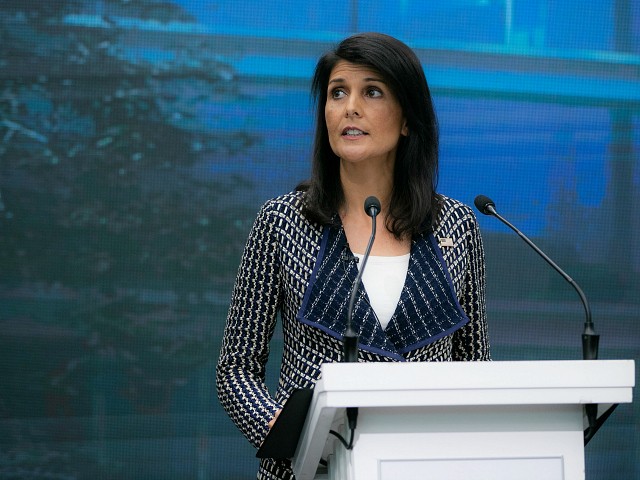
    Several members of the Trump Administration such as UN Ambassador Nikk Haley have been pushing the President to not re-certify Iranian compliance in the 2015 nuclear deal. Several members of the Trump Administration such as UN Ambassador Nikk Haley have been pushing the President to not re-certify Iranian compliance in the 2015 nuclear deal.

    This past week, several members of the Trump Administration signaled that the President will likely not recertify Iran’s compliance in following the 2015 nuclear agreement. If that happens, some observers believe it risks alienating U.S. allies, as the 2015 nuclear agreement was also signed by Great Britain, France, Germany, Russia, and China. The White House sent Nikki Haley, the UN Ambassador, to Vienna on Augst 23 to meet with officials from the International Atomic Energy Agency. During the visit, Haley “discussed the IAEA’s verification and monitoring of Iran’s nuclear-related commitments.”

    The Trump administration has certified Iran’s compliance twice under a law that requires it to notify Congress of Iran’s compliance every three months. The next review period ends on October 1st. President Trump’s action in not certifying Iran’s compliance with the nuclear agreement threatens to put both Iran and the US on the path of a war and to further isolate the US on the international stage.