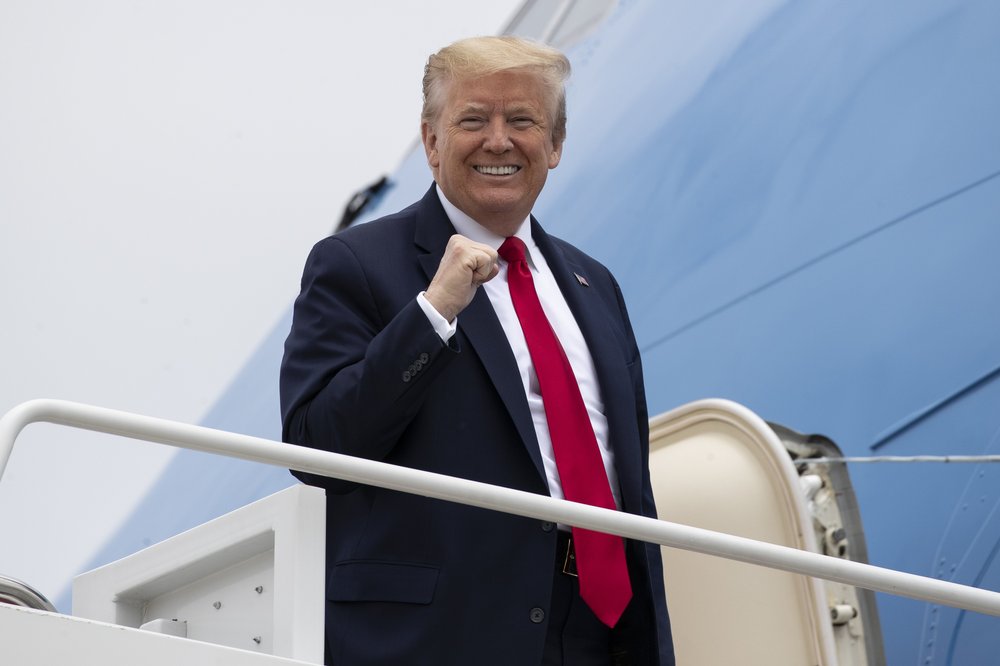
Despite pushing policies that have stirred controversy among voters, President Donald Trump’s approval rating has remained remarkably resilient, according to a recent survey conducted by The New York Times and Siena University from September 22-27, 2025. The poll, based on a random sample of 1,313 registered voters with a margin of error of plus or minus 3.2 percentage points, reveals that 43 percent of voters approve of Trump’s job performance, while 54 percent disapprove. These figures are nearly identical to those from April 2025, when 42 percent approved and 54 percent disapproved, suggesting that Trump’s support base has not wavered significantly despite ongoing debates over his administration’s actions.
The survey highlights that a plurality of voters believe President Donald Trump has overstepped on several key issues, including immigration crackdowns, media relations, and policies targeting higher education. Yet, this disapproval has not translated into a significant erosion of his overall approval rating. This steadfast support, particularly among Republicans, could signal challenges for Democrats as the 2026 midterm elections approach. The poll indicates a closely divided electorate, with 45 percent of voters saying they would support a Republican candidate in congressional elections today, compared to 47 percent favoring Democrats. This narrow gap underscores the competitive political landscape and the potential influence of Trump’s enduring popularity within his party.
However, President Donald Trump faces challenges in other areas of governance. The poll reveals that his management of the federal government, foreign policy, and trade remains deeply unpopular, with voters giving him double-digit negative ratings in these domains. This dissatisfaction reflects broader concerns about the direction of his policies and their impact on the nation’s stability and global standing. As the country braces for a potential government shutdown, made increasingly likely after an unproductive meeting between President Trump and congressional leaders regarding the impending government shutdown, the survey offers insight into public sentiment. Only 27 percent of voters support Democrats shutting down the government to meet their demands, while 65 percent oppose such a move. Even among Democratic voters, congressional Democrats have just 5 percent net support for their funding strategy, indicating a lack of enthusiasm for aggressive tactics.
In the event of a government shutdown, voters are most likely to hold both parties accountable, though Republicans face slightly greater scrutiny. Twenty-six percent of voters said they would likely blame Republicans, compared to 19 percent pointing to Democrats. Independents, a critical voting bloc, were twice as likely to fault Republicans, which could pose challenges for the GOP’s messaging and strategy in the coming months. This blame dynamic underscores the delicate balance both parties must navigate as they approach contentious budget negotiations.
The poll also lays bare the deep polarization gripping the American electorate. For 18 percent of Democrats, President Donald Trump and the Republican Party represent the top issue facing the nation, while 16 percent of Republicans cite Democrats as their primary concern. Among independents, polarization and division ranked as the most pressing issue, reflecting widespread frustration with the state of political discourse. This sentiment is compounded by a pervasive pessimism about the country’s ability to address its challenges, with two-thirds of voters expressing doubt that the US political system can effectively tackle national problems due to entrenched divisions.
As the 2026 midterms loom, President Donald Trump’s resilience in the face of policy controversies and polarized public opinion could serve as a warning for Democrats. His ability to maintain steady approval ratings, particularly among Republicans, and his growing credit for economic improvements suggest that the Republicans may have a strong foundation to build upon. Meanwhile, Democrats face the challenge of unifying their base and appealing to independents in a climate of deep political division. The coming months, particularly with the specter of a government shutdown, will likely test both parties’ ability to navigate these fault lines and shape the narrative ahead of the elections.
On January 3, 2025, Congressman Mike Johnson narrowly secured reelection as House Speaker on the first ballot, overcoming resistance from hard-right Republican holdouts. The tense proceedings marked a turbulent beginning to the new Congress, as a small faction of Republicans declined to vote for Johnson or backed other candidates. His struggles reflected the challenges of leading a fractured party, even with President-elect Donald Trump’s support. Trump, who will return to the White House with Republican control of both the House and Senate, personally called dissenting lawmakers to secure Johnson’s victory. The final tally stood at 218-215, highlighting Johnson’s slim margin of support.
In his first speech as Speaker, Johnson promised to “reject business as usual” and pledged to reduce the size of government drastically. However, his weak grip on leadership poses risks for Trump’s ambitious agenda, which includes significant tax cuts and mass deportations. The narrow vote underscored Johnson’s precarious position, even with backing from Trump, who posted on social media, “Mike will be a Great Speaker, and our Country will be the beneficiary.”
The Speaker’s election, traditionally a ceremonial moment, has become a high-stakes event, reflecting deep divisions within the Republican Party. Vice President Kamala Harris swore in senators, including newly elected party leaders such as John Thune as Republican Majority Leader and Chuck Schumer as Democratic Minority Leader. Meanwhile, Johnson faced a potential crisis, as his failure to secure the Speaker role could have disrupted Congress’s certification of Trump’s 2024 election victory. Johnson’s efforts, including late-night meetings and New Year’s Day at Mar-a-Lago with Trump, ultimately paid off when holdouts Ralph Norman and Keith Self switched their votes after Trump’s intervention.
Johnson’s narrow victory brings to mind the contentious election of Kevin McCarthy as Speaker in 2023, which took 15 rounds of voting. McCarthy was later ousted by his party, highlighting the perils of Republican leadership. Johnson’s slim majority, reduced further by recent Republican seat losses and Congressman Matt Gaetz’s resignation, leaves him reliant on nearly every Republican vote to advance party priorities. Opposition from within his party, such as Freedom Caucus member Congressman Chip Roy, underscores ongoing tensions. “Something MUST change,” Roy posted before eventually supporting Johnson.
To secure the Speaker role, Johnson reportedly made concessions to centrist and hard-right Republicans. A new House rule requires at least nine majority members to approve any resolution to oust the Speaker, increasing the threshold lowered under McCarthy. Freedom Caucus members, who helped deliver Johnson’s votes, demanded immigration reforms, federal spending cuts, and bans on congressional stock trading. Johnson now faces political hazing from colleagues who hold significant leverage, a reminder of his precarious position as a last-ditch choice for Speaker after other candidates failed.
The opening of the new Congress also featured historic milestones. In the Senate, Lisa Blunt Rochester of Delaware and Angela Alsobrooks of Maryland became the first two Black women to serve simultaneously, donning suffragette white for their swearing-in. Sen.-elect Andy Kim of New Jersey made history as the first Korean American in the chamber. Meanwhile, Sarah McBride became the first openly transgender member of Congress in the House, reflecting growing diversity in American politics.
The stakes are high as Republicans take control of Congress alongside Trump’s return to the presidency. Mike Johnson’s role as Speaker places him at the center of efforts to advance Trump’s ambitious 100-day agenda. He likened himself to a quarterback executing the President-elect’s political plays, but his slim majority and internal party divisions may complicate his ability to deliver. The Speaker’s election sets the tone for what promises to be a tumultuous legislative session, with Republicans seeking to capitalize on their unified government while navigating significant internal discord.
Jimmy Carter, the 39th president of the United States, died on December 29, 2024, at the age of 100. Though he served only one term in office, he went on to a distinguished second act of humanitarian work, and he lived long enough to become the oldest former president in U.S. history. Carter “died peacefully Sunday, Dec. 29, at his home in Plains, Georgia, surrounded by his family,” the Carter Center announced in a statement.
“My father was a hero, not only to me but to everyone who believes in peace, human rights, and unselfish love,” said Chip Carter, the former president’s son, in a statement provided by the Carter Center. “My brothers, sister, and I shared him with the rest of the world through these common beliefs. The world is our family because of the way he brought people together, and we thank you for honoring his memory by continuing to live these shared beliefs.” There will be public observances in Atlanta and Washington, D.C., followed by a private interment in Plains, Georgia, the Carter Center said.
In a proclamation Sunday night, President Joe Biden declared January 9 a national day of mourning for Carter and ordered that flags at federal facilities be flown as half-staff for 30 days. President Biden said former President Jimmy Carter was “a man of character, courage, and compassion, whose lifetime of service defined him as one of the most influential statesmen in our history. He embodied the very best of America: A humble servant of God and the people. A heroic champion of global peace and human rights, and an honorable leader whose moral clarity and hopeful vision lifted our Nation and changed our world.” In televised remarks Sunday evening, Biden said Carter “lived a life measured not by words, but by his deeds.” “We would all do well to be a little more like Jimmy Carter,” the president said.
Former President Jimmy Carter’s death over the weekend elicited responses from several other prominent figures, including two statements from President-elect Donald Trump. rump commented on the passing of President Carter in two Truth Social posts. “I just heard of the news about the passing of President Jimmy Carter. Those of us who have been fortunate to have served as President understand this is a very exclusive club, and only we can relate to the enormous responsibility of leading the Greatest Nation in History,” Trump’s initial Truth Social post said. “The challenges Jimmy faced as President came at a pivotal time for our country and he did everything in his power to improve the lives of all Americans. For that, we all owe him a debt of gratitude.” Trump’s post also said he and his wife, Melania, are “thinking warmly of the Carter Family and their loved ones during this difficult time.” “We urge everyone to keep them in their hearts and prayers,” the 45th president’s post said.
An hour after President-elect Donald Trump’s initial statement, he shared another post on Truth Social saying, “President Jimmy Carter is dead at 100 years of age. While I strongly disagreed with him philosophically and politically, I also realized that he truly loved and respected our Country, and all it stands for.” “He worked hard to make America a better place, and for that I give him my highest respect. He was a truly good man and, of course, will be greatly missed,” his post continued. “He was also very consequential, far more than most Presidents, after he left the Oval Office. Warmest condolences from Melania and I to his wonderful family!”
Former President Jimmy Carter had been receiving hospice care at his home for nearly two years following a series of short hospital stays. The Carter Center said in February 2023 that he had “decided to spend his remaining time at home with his family and receive hospice care instead of additional medical intervention.” Carter remained active well into his 90s, continuing his work with Habitat for Humanity and the Carter Center and teaching Sunday school at his church in Plains, Georgia, even as his health began to falter. “He really never forgot where he came from and that’s why he went back to Plains,” Stuart E. Eizenstat, Carter’s chief White House domestic policy adviser, said in an interview.
Both in and out of office, Former President Jimmy Carter built a legacy as a tireless champion for peace and humanitarian causes. He brokered the landmark Camp David Accords in 1978, establishing a framework for peace in the Middle East, and he was awarded the Nobel Peace Prize in 2002 for his decades of work in advancing international peace, democracy, and human rights. “I think that he won a Nobel Peace Prize, which represents for him all of the work he did at stopping civil wars around the world, of monitoring free and fair elections, combatting river blindness, guinea worm disease, tuberculosis, leprosy, you name it,” said presidential historian Douglas Brinkley. “It’s interesting, Carter as ex-president wanted to destroy a disease. He wasn’t somebody who was going into cancer research and finding new ways and more improved technology. He just wanted to wipe it out.”
While Former President Jimmy Carter had his share of accomplishments as president, his time in the White House, from 1977 to 1981, was tumultuous. His one term in office included the US energy shortage and the Iran hostage crisis. Carter rose on the national stage after Watergate, at a time when voters were looking for a change in politics. “They didn’t want Ed Muskie or Hubert Humphrey or Scoop Jackson or George Wallace,” Douglas Brinkley said. “They were tired of those people that had been in the national spotlight for so long. So, he came at America as a fresh new face.”
Jimmy Carter was born on Oct. 1, 1924, in Plains. The son of a peanut farmer, he loved books and his Baptist faith. At the US Naval Academy, he studied nuclear science and graduated with distinction in 1946. That same year, he married a young woman named Rosalynn Smith, a marriage that would last for more than seven decades. They celebrated their 77th anniversary on July 7, 2023, the longest-married presidential couple in American history. She died months later, on November 19, 2023, at age 96. Carter completed submarine training and served in the Navy for seven years before moving home to Georgia in 1953 to run the family peanut farm. He and Rosalynn raised four children while his career focus shifted from farming to politics. After eight years in state offices, Carter, a Democrat, was elected governor of Georgia in 1970. It was clear he was a new kind of Southern leader, one who emphasized racial equality and traditional values, at a time when the nation was in need of stability.
In 1976, Jimmy Carter defeated President Gerald Ford to become the 39th president of the United States. The Carters conveyed that they were of the people when they marched in the open air on the inaugural parade route. “His greatest asset as a candidate was his outsider status,” Brinkley said. “And his greatest failing as a president was the fact that he remained an outsider, when you must be an insider in Washington if you’re going to be an effective president.” Carter struggled to cultivate relationships in Washington and feuded openly with Democratic leaders in Congress. As oil prices and inflation soared, his popularity sank.
Despite this, there were some major accomplishments under the Carter Administration. President Jimmy Carter created the Departments of Energy and Education. He established formal diplomatic ties with China and returned control of the Panama Canal to the Panamanians. Perhaps his greatest achievement was a historic peace treaty between Israel and Egypt, known as the Camp David Accords. “Let history record that deep and ancient antagonism can be settled without bloodshed and without a staggering waste of precious lives,” Carter said at the signing of the peace treaty on March 26, 1979.
Arguably the defining moment of the Carter Administration that sealed its fate in many ways was the Iranian Revolution of 1978-79 and its aftermath. Mohammad Reza Pahlavi, the Shah of Iran, had been a reliable US ally since the 1953 Iranian coup d’état. During the years after the coup, the US lavished aid on Iran (most of which was sent to Iran during the Johnson andNixon Administrations, while Iran served as a dependable source of oil exports. In turn, the US turned a blind eye to many of the human rights abuses committed by the Pahlavi regime such as restrictions on the press, the arrest and torture of political opponents (up to 3,700 political prisoners in 1975, the peak year of political repression under the Pahlavi government), limits on political freedom, and the execution of up to 100 political prisoners.
President Jimmy Carter, Secretary of State Cyrus Vance, and National Security Advisor Zbigniew Brzezinski viewed Iran as a key Cold War ally, not only for the oil it produced but also because of its influence in OPEC and its strategic position between the Soviet Union and the Persian Gulf. Despite his criticism of the human rights violations carried out by the Pahlavi government, Carter visited Iran in late 1977 and authorized the sale of US fighter aircraft. A month later in January 1978, rioting broke out in several cities, and it soon spread across the country. Poor economic conditions, the unpopularity of Pahlavi’s “White Revolution”, and an Islamic revival all led to increasing anger among Iranians, many of whom also despised the United States for its support of the Pahlavi regime and its role in the 1953 coup.
By the summer of 1978, the Iranian Revolution had broken out against Shah Mohammed Reza Pahlavi’s rule and his overthrow seemed inevitable. Secretary of State Cyrus Vance argued that the Shah should institute a series of reforms to appease the voices of discontent, while National Security Advisor Zbigniew Brzezinski argued in favor of a crackdown on dissent. The mixed messages that the Shah received from Vance and Brzezinski contributed to his confusion and indecision. The Shah went into exile in January 1979, leaving a caretaker government in control. A popular religious figure, Ayatollah Ruhollah Khomeini, returned from exile in February 1979 to popular acclaim, thus proclaiming Iran as an Islamic Republic. As the unrest continued, President Jimmy Carter allowed Pahlavi into the United States for medical treatment. Carter and Vance were both initially reluctant to admit Pahlavi due to concerns about the reaction in Iran, but Iranian leaders assured them that it would not cause an issue. In November 1979, shortly after Pahlavi was allowed to enter the US, a group of Iranians stormed the US embassy in Tehran and took 52 American captives, beginning the Iran hostage crisis.
The crisis quickly became the subject of international and domestic attention, and President Jimmy Carter vowed to secure the release of the hostages. He refused the Iranian demand for the return of Pahlavi in exchange for the release of the hostages. His approval ratings rose as Americans rallied around his response, but the crisis became increasingly problematic for his administration as it continued. In an attempt to rescue the hostages, Carter launched Operation Eagle Claw in April 1980. The operation was a total disaster, and it ended in the death of eight American soldiers. The failure of the operation strengthened Ayatollah Khomenei’s position in Iran and badly damaged Carter’s domestic standing. The crisis dominated Carter’s reelection campaign, while the economy continued to struggle and inflation topped 18%. In the final days of his administration, the president and his team negotiated freedom for the hostages. They were released on Ronald Reagan’s Inauguration Day.
In the years after leaving the White House, the Carters established The Carter Center in Atlanta, with a mission to work toward advancing peace and global health. “We can choose to alleviate suffering. We can choose to work together for peace. We can make these changes — and we must,” Jimmy Carter said in 2002 as he formally accepted the Nobel Peace Prize for his decades of humanitarian work. He and Rosalynn built houses with Habitat for Humanity, dedicating their efforts to the group for more than 30 years, and he penned more than 20 books.
Jimmy Carter sparked controversy with his 2006 book “Palestine: Peace Not Apartheid,” in which he characterized Israel’s treatment of Palestinians as oppression. He later issued an open apology to the Jewish community, saying that suggestions for improvement should not stigmatize Israel.
Jimmy Carter announced in August 2015 that he had been diagnosed with cancer, a form of melanoma that had spread to his liver and his brain. Though he curtailed his activities with The Carter Center, he continued to fundraise for the organization and also continued teaching Sunday school classes in Plains, a tradition he started in his teens. Carter was treated with a new immunotherapy drug and made a remarkable recovery, sharing the news six months later that an MRI showed no signs of cancer. In May 2019, he suffered another health setback, falling and breaking his hip. He went home from the hospital to recover and was soon back to teaching his Sunday school class. Carter suffered two more falls in October 2019 and was hospitalized for a fractured pelvis. A month later, he was admitted to a hospital in Atlanta for a surgical procedure to relieve pressure on his brain. The Carter Center said in May 2023 that Rosalynn had been diagnosed with dementia; she continued to live at home with her husband until her death that November.
During his many years after the White House, Jimmy Carter planted seeds of peace, and sometimes seeds of controversy. But as one of the most active former presidents in history, many believe he defined the role for those who would follow.
Happy 2024! Here are the main events that occurred in Politics this week:
1. President Biden Condemns Trump as Dire Threat to Democracy in a Blistering Speech
President Joe Biden on January 5 delivered a ferocious condemnation of former President Donald Trump, his likely 2024 opponent, warning in searing language that the former President had directed an insurrection and would aim to undo the nation’s bedrock democracy if he returned to power.
President Joe Biden on January 5 delivered a ferocious condemnation of former President Donald Trump, his likely 2024 opponent, warning in searing language that the former President had directed an insurrection and would aim to undo the nation’s bedrock democracy if he returned to power. On the eve of the third anniversary of the January 6, 2021, attack on the Capitol by former President Trump’s supporters, President Biden framed the coming election as a choice between a candidate devoted to upholding America’s centuries-old ideals and a chaos agent willing to discard them for his benefit. “There’s no confusion about who Trump is or what he intends to do,” Biden warned in a speech at a community college not far from Valley Forge in Pennsylvania, where George Washington commanded troops during the Revolutionary War. Exhorting supporters to prepare to vote this fall, he said: “We all know who Donald Trump is. The question is: Who are we?”
2. Biden Administration Sues Texas Over State’s Controversial Immigration Law
The Biden administration on January 3 filed a lawsuit against Texas over its controversial immigration law that gives local law enforcement in Texas the authority to arrest migrants, arguing the state “cannot run its own immigration system.”
The Biden administration on January 3 filed a lawsuit against Texas over its controversial immigration law that gives local law enforcement in Texas the authority to arrest migrants, arguing the state “cannot run its own immigration system.” The move comes after the Justice Department threatened last week to sue Texas if it did not back down from the measure. It marks the second legal action against the state this week, as President Joe Biden and Texas Governor Greg Abbott spar over the handling of the US-Mexico border. In December, Abbott, a Trump-aligned Republican, signed into law Senate Bill 4, which also gives judges the ability to issue orders to remove people from the United States. The White House has slammed the law – which is slated to take effect in March – as “incredibly extreme.”
3. Former President Donald Trump Appeals Colorado ‘Insurrection Clause’ Ruling to Supreme Court
Former President Donald Trump asked the Supreme Court on January 3 to allow him to stay on the presidential primary ballot in Colorado, saying a state ruling banning him was unconstitutional, unfair, and based on a January 6 insurrection that his appeal said did not happen. The court filing, dominated by technical and procedural challenges to the Colorado Supreme Court ruling last month, does not ask the high court to weigh in on whether the former president indeed participated in an insurrection. The state’s highest court concluded that Trump indeed engaged in the January 6 insurrection effort and thus was banned from running under an obscure, Civil War-era clause in the Constitution’s 14th Amendment banning such a person from holding office.
At least 95 people were killed and scores injured on January 3 in two blasts that struck the central Iranian city of Kerman, where thousands of mourners had gathered to commemorate Qasem Soleimani on the fourth anniversary of his assassination in a US drone strike in Iraq in 2020.
At least 95 people were killed and scores injured on January 3 in two blasts that struck the central Iranian city of Kerman, where thousands of mourners had gathered to commemorate Qasem Soleimani on the fourth anniversary of his assassination in a US drone strike in Iraq in 2020. Bahram Eynollahi, Iran’s health minister, was quoted by Iran’s official Islamic Republic News Agency (IRNA) as saying 95 people were killed and 211 were injured. An earlier toll provided by officials, of 103 killed, was lowered because names were repeated on a list of victims, he said. The deputy governor of Kerman, the slain general’s hometown, said the incident was a “terrorist attack,” according to IRNA. The explosions occurred about a half-mile from Soleimani’s burial place, on the road to the graveyard, and roughly 20 minutes apart, the agency reported. Before the blasts, the state-run live broadcast had shown tens of thousands of mourners filling the street, moving calmly in a procession. After the attack, it broadcast video of people running frantically and men wearing emergency medical technician uniforms surging into the crowd. There was no immediate claim of responsibility.
The US is poised to approve sending its most advanced ground-based air defense system to Ukraine, responding to the country’s urgent request to help defend against an onslaught of Russian missile and drone attacks, two US officials said on December 13. Defense Secretary Lloyd Austin could approve a directive as early as this week to transfer one Patriot battery already overseas to Ukraine, the officials said, speaking on the condition of anonymity to discuss internal deliberations. Final approval would then rest with President Joe Biden.
White House, Pentagon and State Department officials declined to comment on details of the transfer of a Patriot battery, which, if approved, would amount to one of the most sophisticated weapons the United States has provided Ukraine. The Patriot system can knock down Russia’s ballistic missiles, unlike other systems the West has provided, and can hit targets much farther away. “We have been very clear that the United States will continue to prioritize sending air defense systems to Ukraine to help our Ukrainian partners defend themselves from the brutal Russian aggression that we’ve seen for the better part of a year now,” Ned Price, a State Department spokesman, told reporters. Many questions remain about the potential transfer, which was reported earlier by CNN, including how long it would take to train Ukrainian soldiers on the system, presumably in Germany, and where the Patriots would be deployed inside Ukraine.
The US had previously resisted providing the Ukrainians Patriot batteries, of which it has relatively few and which require sophisticated training. But Ukrainian officials have intensified their pleas for air defenses from the US and other Western allies as Russia has conducted relentless attacks on power plants, heating systems and other energy infrastructure. The attacks, using missiles and Iranian-made drones, have left Ukrainians vulnerable and in the dark just as the coldest time of the year is beginning. Over the weekend, Russian drone strikes on the southern Ukrainian port city of Odesa plunged more than 1.5 million people in the region into darkness. President Volodymyr Zelensky of Ukraine said the strikes by Russia, part of a nationwide assault on Ukraine’s energy grid, had left the region in a “very difficult” situation, warning that it would take days, not hours, to restore power to civilians.
The decision to send the Patriot system would be a powerful sign of the US’ deepening military commitment to Ukraine. The Pentagon’s active-duty Patriot units frequently deploy for missions around the world, and experts say the United States does not have the kind of deep stockpiles of Patriot missiles available for transfer that it did with munitions like artillery shells and rockets. Capable of being configured in a number of ways, a Patriot battery typically consists of one or more launchers, radars, and vehicles for command and control of air defense operations.
The US previously provided Ukraine with two shorter-range air defense weapons called National Advanced Surface-to-Air Missile System, or NASAMS, which arrived in November. The US Department of Defense is spending $1.2 billion for six more NASAMS to be built and delivered to Kyiv in the coming years. But NASAMS can strike targets only about a third as far as the Patriot system. The US military has deployed Patriot batteries in numerous conflicts since the early 1990s. In perhaps the weapons’ most recent combat use, US Army soldiers at Al Dhafra Air Base in the United Arab Emirates fired “multiple” Patriot interceptors at missiles headed toward the base in January, according to U.S. Central Command.
People fully vaccinated against Coronavirusdo not need to wear masks or practice social distancing indoors or outdoors, except under certain circumstances, the US Centers for Disease Control and Prevention (CDC)announced on May 13. “If you are fully vaccinated, you can start doing the things that you had stopped doing because of the pandemic,” Dr. Rochelle Walensky, the head of the CDC said during a White House Coronavirus briefing. “We have all longed for this moment when we can get back to some sense of normalcy.”
Calling it an “exciting and powerful moment,” Dr. Rochelle Walensky said the science supports the updated CDC guidance that “anyone who is fully vaccinated can participate in indoor and outdoor activities – large or small -without wearing a mask or physical distancing.” She cited three studies one from Israel and two from the US that show vaccines work. The Israeli study, which was published in the Journal of the American Medical Association, showed the vaccine was 97% effective against symptomatic Coronavirusand 86% effective against asymptomatic infection in over 5,000 health care workers. There have been reports of “breakthrough” infections among vaccinated people in the US, a small number among more than 117 million people in the US who are now fully vaccinated. Walensky noted that “the resulting infection is more likely to have a lower viral load, may be shorter in duration, and likely less risk of transmission to others.”
Dr. Rochelle Walensky’s announcement has a few caveats. She warned that people who are immune-compromised should speak with their doctors before giving up their masks. The requirement to wear masks during travel, on buses, trains, planes and public transportation, still stands, Walensky said. Guidance for travel will be updated as science emerges. She also said that “the past year has shown us that this virus can be unpredictable, so if things get worse, there is always a chance we may need to make a change to these recommendations.” People who develop Covid-19 symptoms, even those who are vaccinated, should put their mask back on and get tested, Walensky said. The science is clear, for unvaccinated people, Walensky said: “You remain at risk of mild or severe illness, of death, or spreading the disease to others. You should still mask and you should get vaccinated right away.” But once someone is fully vaccinated — two weeks after the final dose — “you can shed your mask,” she said.
Despite the CDC announcment, some people may choose to continue wearing masks even if they are fully vaccinated. “People have to make their own personal choice,” Dr. Anthony Fauci, director of the National Institute of Allergy and Infectious Diseases, said during the White House Coronavirus briefing. “There’s absolutely nothing wrong with an individual who has a certain level of risk aversion, as we know the risk is extremely low of getting infected whether you’re indoors or outdoors. But there are those people who don’t want to take that bit of a risk and there’s nothing wrong with that and they shouldn’t be criticized.”
Two private groups focused on US government ethics on October 12 accused Attorney General William Barr of misusing his office to support President Donald Trump’s political goals and called on the House of Representatives to begin impeachment proceedings against him. The University of Pennsylvania’s Center for Ethics and the Rule of Law and Washington-based Citizens for Responsibility and Ethics in Washington said Barr could not be trusted to represent his department’s work accurately and that there were problems with the truthfulness of Barr’s public statements. Justice Department officials did not immediately respond to requests for comment.
The groups in a 267-page research paper alleged that Attorney General William Barr’s “authoritarian worldview limits the degree to which … (he) regards himself as bound by the rule of law and makes him see himself as entitled to ignore the laws, ethics and historical practices” at the Justice Department. The paper highlighted several Barr actions, including what it described as his intentional mischaracterization of former Special Counsel Robert Mueller’s probe into Russian interference in the 2016 election as well as Barr’s move to assign US Attorney John Durham to conduct his own investigation of the Mueller probe. While President Donald Trump has long bristled at suggesting that foreign interference helped his 2016 upset victory, multiple reviews by US intelligence agencies concluded that Russia acted to undercut his rival Hillary Clinton’s chances in that election.
The authors of the October 12 reports called on the Democratic-led House of Representatives to begin a formal impeachment inquiry, the first step toward removing Attorney General William Barr from office. Earlier this year, the Republican-controlled Senate acquitted President Donald Trump after a House impeachment proceeding accused him of misusing his office. House officials did not immediately respond to a request for comment. A little more than three weeks remain until the November 3 elections. President Trump is seeking a second term against Democratic challenger, former Vice President Joe Biden, and is currently well behind in the polls.
The Trump campaign filed a lawsuit on August 3 against the state of Nevada over its plan to send absentee ballots to all active voters this November in a major expansion of mail-in voting in the battleground state. “The RNC has a vital interest in protecting the ability of Republican voters to cast, and Republican candidates to receive, effective votes in Nevada elections and elsewhere,” the lawsuit, filed by the Trump campaign, the Republican National Committee and the Nevada Republican Party, said. As the coronavirus pandemic continues to spread throughout the country, some states have looked to expand mail-in voting options ahead of November’s election. President Donald Trump, however, has falsely claimed that expanded mail-in voting will lead to fraud in the election.
The Democratic-controlled Nevada state legislature passed a sweeping election bill along party lines over the weekend, and Governor Steve Sisolak, a Democrat, signed the legislation on August 2. Sisolak said in a tweet, “I signed AB 4, which ensures protections for Nevadans to vote safely at the November election during the pandemic. During this global pandemic, I made a commitment that we’d do all we can to allow Nevadans to safely cast a ballot in the upcoming November election.” The legislation will allow election officials to send absentee ballots to every “active registered voter” in the state. It will also extend the deadline for when mail-in ballots can be counted after Election Day, so mailed-in ballots can still be counted if they arrive one week after November 3. The legislation will also ease some restrictions for who can legally handle and submit other people’s ballots, a move that Republicans claimed could lead to voter fraud.
Nevada State Democratic Party Chair William McCurdy called the lawsuit a “sham.” “As states fill the void of Trump’s leadership and begin to step up to the challenge of protecting both voters’ health and their constitutional right to vote, Trump and Republicans are throwing a fit. That is because Trump does not want to hear from the people, he knows what they will say,” he said in a statement. President Donald Trump previously criticized Nevada’s plan to expand mail-in voting and threatened a lawsuit. “In an illegal late-night coup, Nevada’s clubhouse Governor made it impossible for Republicans to win the state,” Trump tweeted. “Post Office could never handle the Traffic of Mail-In Votes without preparation. Using Covid to steal the state. See you in Court!” In addition to Nevada, eight other jurisdictions will mail ballots to all voters in November. Hawaii, Colorado, Oregon, Utah, and Washington state had this plan all along. Vermont, California, and the District of Columbia switched to this method this year because of the Coronavirus pandemic.
In an illegal late night coup, Nevada’s clubhouse Governor made it impossible for Republicans to win the state. Post Office could never handle the Traffic of Mail-In Votes without preparation. Using Covid to steal the state. See you in Court! https://t.co/cNSPINgCY7
The 20th and early 21st centuries are considered to the bloodiest periods of conflict in history. During this period, human society was characterized by conflicts such as both world wars and the blurring of the lines between civilian and combatant. The conflicts during the 20th and 21st Centuries left their indelible mark on all the individuals involved, whether combatant or civilian. Despite the differences between each of the conflicts over the past hundred years, they all resulted in a high amount of civilian deaths and increased human suffering to unimaginable levels. Additionally, the face of warfare over this past century has changed, and war has become more devastating than in any other time in human history. Although war has changed in many ways, the primary effects of war have often stayed the same. This paper seeks to compare warfare over the past century and trace the impact of war on individuals and society.
One of the main ways in which warfare is different today is because modern warfare is often fought through non-state combatants such as rebel groups and insurgents. These insurgent groups are often funded by wealthy hegemonic powers and are used as proxies. For example, insurgent groups in the Middle East such as ISIS and Al-Qaeda are often financed by the Gulf States with the goal of accomplishing certain political objectives. Additionally, many of the insurgent groups in Latin American such as the Nicaragua Contras were funded by the US to pursue policy goals such as regime change and regime destabilization. The funding of militants often takes places as a way for larger powers to fight for influence in some parts of the world. An example of this would be the Civil War in Syria. For example, the US and its regional allies such as Saudi Arabia and Israel are backers of the rebel groups fighting against the government of Bashar al-Assad and instead seek to gain the support to install a pro-Western government in Syria. On the other hand, countries such as Russia, China, Iran are opposed to the US-backed rebels and are instead supporting the Assad government in its efforts to restore stability in Syria.
The rise of non-state combatants also changed the face of warfare because combatants do not know who the enemy is in combat. In prior wars, such as World War 1 and World War 2, the enemy was clearly defined and had clear objectives. On the other hand, combatants today often have unclear goals and are not as clearly defined. The threat posed by non-defined combatants creates a constant feeling of dread in the minds of people who are fearful of the next attack to occur. Additionally, this sense of fear serves to embolden policy-makers to make decisions to use the force to destroy a problem as opposed to the use of force backed with a political solution to solve issues. The ongoing War on Terrorism is an example of this idea in action. For example, the wars in Afghanistan and Iraq were considered to have been won rather quickly at first due to the overthrow of the respective governments in both countries. Despite the short phase of the conventional war in Iraq and Afghanistan, a strong insurgency emerged in both countries that resulted in increased losses and further devastation.
The increasing mechanization of warfare is another factor that has defined recent conflicts. Warfare was relatively primitive at the dawn of the 20th Century and relied more on manpower as opposed to machines. The mechanization of warfare began with the advent of aerial warfare and tank warfare during World War 1. The use of air power increased the potential devastation of warfare and made civilian areas potential targets in combat. Additionally, tank warfare allowed armies to bring higher levels of destruction to the opposing side. World War 2 resulted in the further increase in mechanization and the refining of military technologies to increase damage to the other side. A recent example of mechanization is the increasing reliance on drone strikes to take out perceived enemies with little to no damage to the side that uses drones. The use of drone strikes dehumanizes participants in warfare because it absolves the drone operators of any guilt regarding their actions. Moreover, the use of drones in warfare makes all people out to be perceived enemies of the US and further reduces the previously recognized distinctions between civilian and military targets.
Large-scale warfare in modern society is also less possible due to advances in military technology and increasing levels of globalization. At the start of the 20th Century, global institutions were nonexistent, and economic interdependence was minimal. Because of the development of technologies such as the atomic bomb, the chance of large-scale warfare in the traditional sense is limited since the use of such weapons may potentially result in complete world annihilation. Additionally, the spread of globalization and the role of international institutions makes the likelihood of wide-scale conflicts less possible than they were during the early part of the 20th Century. The reason why globalization reduced the risk of global wars from occurring is that it increases economic interdependence between nations. Moreover, globalization has broken down previous existing barriers between countries and thus reduced the potential for conflict between them from ultimately emerging. Despite their mixed record overall, international institutions have prevented large-scale warfare by creating a venue for countries to seek to solve their disputes in a peaceful manner and created more avenues for cooperation between nation-states.
Even though the nature of war has changed in many ways over the past century, there are several elements of warfare that have ultimately been the same. One way that warfare has remained the same is because they are still primarily fought for the same reasons. Two of the leading reasons, why war is fought is because of economic factors and territorial disputes. Economic factors in warfare stem from trade conflicts between countries and because the arms market continues to profit from a protracted conflict between nations today much as they did during earlier conflicts such as World War 1 and World War 2. Additionally, territorial disputes remain today such as the ongoing dispute between Russia and Ukraine over the Crimean region, Israel and the Arab nations, and the US and China over the islands in the Pacific. The current territorial disputes are parallel to earlier disputes such as the disagreements between Russia and Finland during the late 1930s, Germany and France’s disputes over the Alsace-Lorraine region, and the disputes between Japan and China during the lead-up to the Sino-Japanese war.
War today has also remained the same because ideological differences often play a role in conflicts between nations. Some of the ideological factors that influence warfare include religious differences, diverse political ideologies, and differing visions for the international order. For example, the political ideologies of Nazi Germany and Imperial Japan played a key role in the decisions that both countries made during World War 2 and convinced both to seek to impose a new world order. Additionally, the Cold War was an ideological conflict because the Soviet Union held an ideology based on socialism that went directly against the ideological viewpoints of the US and its allies that were based on capitalism and individual freedom. The past feelings of ideological decision carried over into the conflicts of today and are motivated by religious factors. For example, the ongoing War on Terrorism can be framed as an ideological battle between the forces of secularism and modernity against the forces of fundamentalism and traditionalism.
The fact that modern warfare results in the displacement of civilians is another reason why the nature of warfare has remained the same. Because of the destruction of civilian areas through warfare, civilians are often forced to relocate after a war occurs. The resulting forced relocation of civilians creates a feeling of unpredictability among those who are displaced and often prevents them from returning to their past lifestyles. The displacement of civilians is a common thread in nearly all conflicts over the past century. For example, because conflicts such as World War 1 and World War 2 unleashed high levels of destruction towards civilian areas, the civilians in the war zones often lost their homes and were thus considered to be displaced people. Modern conflicts such as the Syrian Civil War and the US wars in Afghanistan and Iraq also contributed to the global refugee crisis by displacing individuals. As such, the issue of war creating refugees is a common connection between both war in the earlier part of the 20th Century and war today.
Another common theme between warfare at the beginning of the 20th century and warfare during the 21st Century is that the nature of warfare itself still results in the wholesale devaluing of human life and makes individuals out to be mere objects in any venue of war. For example, events such as World War 2 resulted in mass civilian deaths and minimized the differences between both civilians and combatants. Additionally, events such as the Holocaust devalued human lives by turning people into objects perceived to be lacking any human value. The dehumanization of civilians continues to remain a common thread in modern warfare and conflicts between groups. For example, recent conflicts such as the Iran-Iraq War during the 1980s and the activities by the US in the War on Terrorism resulted in ever-increasing civilian casualties and little regard for human lives for each of the sides in both conflicts.
The past century can be described as one that is characterized by perpetual conflict and the emergence of warfare at the global level. Additionally, the nature of war has evolved over the past century and has played an enduring role in society. Even though war has evolved in several different ways, several elements remain common between both war at the start of the previous century and contemporary warfare. An analysis of the effects of war on both society and the individual allows us to understand the futility of the idea of war and may encourage us to work together to achieve increased levels of global understanding and peace.