In 1942, economist Joseph Schumpeter introduced the concept of creative destruction in his seminal work, Capitalism, Socialism, and Democracy. He described it as the process by which innovations such as new technologies, products, or methods, disrupt and ultimately dismantle established economic structures to pave the way for novel systems and opportunities. This relentless cycle of renewal is not merely a feature of capitalism but its very engine, driving progress through the destruction of the old to make room for the new. Beyond economics, creative destruction serves as a powerful lens for understanding transformation in art, culture, and society, acting as a bridge between the analytical rigor of economics and the expressive freedom of creative disciplines.
The transition from horse-drawn carriages to automobiles exemplifies creative destruction because the innovative technology of cars disrupted and largely eliminated the established carriage industry, displacing related jobs and infrastructure while creating new markets, industries, and opportunities for economic growth.
Schumpeter argued that capitalism thrives on innovation, but this comes at a cost. Established industries, firms, and practices often become obsolete as entrepreneurs introduce groundbreaking ideas. The rise of the automobile, for instance, decimated the horse-drawn carriage industry, while digital streaming platforms have largely supplanted traditional media like DVDs and broadcast television. This process is not gentle, as it disrupts livelihoods, renders skills obsolete, and reshapes markets. Yet, Schumpeter saw it as essential for economic vitality, as it fosters efficiency, growth, and adaptation.
The shift from Neoclassical art to Impressionism exemplifies creative destruction as Impressionist artists like Monet and Renoir rejected the rigid, idealized forms of Neoclassicism, disrupting traditional artistic conventions with innovative techniques like loose brushwork and vibrant colors, thus creating new avenues for expression while rendering older styles less dominant.
The parallels between economic and artistic innovation are striking. In art, creative destruction manifests as the rejection of established norms, styles, or mediums in favor of bold experimentation. Consider the transition from Romanticism to Impressionism in the 19th century. Artists like Claude Monet and Pierre-Auguste Renoir broke with the rigid conventions of academic painting, embracing loose brushwork and vibrant color palettes to capture fleeting moments of light and life. This shift shocked the art world, rendering traditional techniques less relevant while opening new avenues for expression.
Similarly, the 20th century saw movements like Dadaism and Abstract Expressionism dismantle prevailing aesthetic frameworks. Marcel Duchamp’s Fountain (1917), a readymade urinal presented as art, challenged the very definition of artistic value, forcing a reevaluation of creativity itself. These disruptions, while initially controversial, expanded the boundaries of art, inspiring future generations to explore uncharted territory.
The concept of creative destruction serves as a bridge between economics and art, illuminating their shared reliance on reinvention. In both domains, progress demands a willingness to let go of the familiar. Just as entrepreneurs disrupt markets with innovative business models, artists challenge cultural norms with provocative works. This shared dynamic invites reflection on broader societal phenomena, such as reinvention, disruption, and even gentrification.
Gentrification can be viewed through the lens of creative destruction, as it revitalizes areas and creates new opportunities, but at times comes at the cost of cultural erasure.
Gentrification, for example, can be viewed through the lens of creative destruction. As urban neighborhoods evolve, new businesses, residents, and cultural trends displace longstanding communities and traditions. While this process can revitalize areas, it often comes at the cost of cultural erasure or displacement, raising ethical questions about who benefits from such transformations. Similarly, in technology, the rise of artificial intelligence disrupts traditional labor markets but also creates opportunities for new industries and creative pursuits.
Creative destruction reminds us that progress is not linear or painless. It requires courage to dismantle the old, whether it be an obsolete industry or a revered artistic tradition. Yet, this destruction is not an end but a beginning, a catalyst for innovation that drives societies forward. By embracing the discomfort of change, we unlock the potential for reinvention, ensuring that both economies and cultures remain dynamic and resilient.
In conclusion, Schumpeter’s concept of creative destruction transcends economics, offering a framework to understand transformation across disciplines. Its resonance in art underscores the universal need for disruption as a precursor to creation. As we navigate an era of rapid technological and cultural change, creative destruction challenges us to balance the costs of disruption with the promise of renewal, fostering a deeper appreciation for the cycles that shape our world.
In economics, externalities are costs or benefits that affect parties who did not choose to incur them. A factory polluting a river, for example, imposes costs on downstream communities, including health issues, contaminated water, and dead ecosystems, while the factory reaps profits without bearing the full burden. This concept, though rooted in economics, reverberates far beyond, offering a lens to examine exploitation, ethical failures in the art world, and the unaccountable sprawl of global supply chains.
A factory polluting the air in pursuit of a profit is an example of a negative externality, as it results in a producer offloading harm onto others.
Externalities occur when the price of a good or service does not reflect its true social cost or benefit. Negative externalities such as pollution, arise when producers offload harm onto others. Positive externalities occur when benefits spill over, often unintentionally. For example, a homeowner who maintains a vibrant community garden not only enjoys their own harvest but also enhances property values and fosters social bonds for neighbors, who reap these benefits without contributing to the garden’s upkeep. The issue lies in accountability: those creating the externality often face no consequences, leaving society to clean up the mess.
An example of an externality would be a coal plant. A coal plant generates cheap energy but spews carbon, worsening climate change. The plant’s owners profit, while the global public pays the price in floods, heatwaves, and displacement. The market, left unchecked, incentivizes this imbalance. Economists propose solutions such as carbon taxes or cap-and-trade systems to internalize these costs, but implementation lags, especially across borders.
The production of consumer products such as smartphones often amplifies externalities.
Global supply chains amplify externalities by diffusing responsibility. For example, a smartphone’s production spans continents: cobalt mined in Congo, assembled in China, sold in the US. Each step generates externalities, child labor, toxic waste, carbon emissions, yet no single entity is held accountable. The consumer enjoys a sleek device, unaware of the social and environmental toll embedded in its supply chain.
International trade agreements often prioritize profit over people. Developing nations, desperate for economic growth, become dumping grounds for externalities. Factories in Bangladesh or Vietnam produce cheap goods for Western markets, but lax regulations mean workers face unsafe conditions, and rivers turn toxic. The harm is outsourced, invisible to the end consumer. Globalization’s promise of efficiency masks a darker truth: it thrives on exploiting those least equipped to resist.
The art world, often seen as a bastion of creativity, is not immune to externalities. Consider the ethics of art production. Large-scale installations may rely on materials sourced through exploitative labor or environmentally destructive practices. Artists and galleries rarely account for these costs, yet their work is celebrated in pristine white cubes. The harm, deforestation, and displaced communities remain out of sight.
The art world is increasingly confronting the concept of negative externalities. .
Patronage also breeds externalities. Wealthy collectors or institutions fund art to burnish their image, but their money may come from industries tied to social or environmental damage. The art world becomes complicit, laundering reputations while ignoring the broader impact. A museum funded by an oil magnate might showcase “radical” art, but the contradiction festers: the institution profits while externalizing the cost of its patron’s legacy.
Externalities expose a core flaw in institutions, that they are often built to prioritize self-preservation over systemic responsibility. Governments, corporations, and cultural bodies often deflect blame, leaving marginalized groups to bear the brunt. For instance, urban development projects gentrify neighborhoods, displacing low-income residents while developers profit. The social cost, fractured communities, lost cultural heritage, is externalized, unaddressed by those who caused it.
Institutional criticism, a practice rooted in questioning power structures, can challenge this. Artists like Hans Haacke have used their work to expose how institutions evade accountability, from corporate sponsorships to political influence. By shining a light on externalities, such a critique forces us to question who pays the price for progress, and why they are left holding the bill.
Policies such as carbon taxes can help address externalities, but there is much resistance to such policies by entrenched interests.
Addressing externalities requires systemic change. Policy tools like carbon taxes or labor regulations can help, but they face resistance from entrenched interests. On a cultural level, society might need to rethink value, not just in markets but in art, ethics, and global systems. Consumers can demand transparency in supply chains. Artists can interrogate their materials and patrons. Institutions can prioritize accountability over optics.
The concept of externalities is not just economic; it is a moral framework. It asks us to see the hidden costs society has normalized and to demand a world where harm is not offloaded onto the voiceless. Until we confront these unseen burdens, exploitation will persist, cloaked in the guise of progress.
In many countries, a striking economic divide persists which is known as the dual economy. This phenomenon describes the coexistence of two distinct economic sectors within a single nation: an advanced, modern sector integrated with global markets, and a subsistence sector characterized by informal, low-productivity activities. The dual economy can be thought of as two parallel worlds, operating side by side yet rarely intersecting, each with its own rules, opportunities, and challenges.
Within the concept of the dual economy, the advanced sector of the economy is usually centered around an urban area that is technologically sophisticated and globally connected.
The advanced sector is typically the face of progress: urban, technologically sophisticated, and globally connected. It encompasses industries including tech, finance, and manufacturing, where workers enjoy higher wages, formal employment, and access to global supply chains. The advanced sector drives innovation, attracts investment, and fuels economic growth.
Cities such as Buenos Aires are characterized by having both an advanced economic sector and a subservient sector existing side by side.
The duality creates a layered reality. A city like New York or London might boast gleaming financial districts while nearby slums house workers scraping by in the informal economy. These are not just economic divides but social and cultural ones, shaping distinct lifestyles, opportunities, and even worldviews.
This divide inspires powerful narratives. Artists and writers often explore themes of exclusion, who gets to participate in the “modern” world? The informal sector’s invisibility resonates in stories of marginalized voices, while the idea of parallel worlds invites speculative takes on alternate realities coexisting in one space.
Advanced sectors of the economy, such as Artificial Intelligence (AI) often benefit from government policies and public investment, while the subservience sector is left to fend for itself. This dynamic perpetuates inequality.
The dual economy is not just a quirk; it is a structural challenge. The advanced sector often benefits from government policies, infrastructure, and global trade, while the subsistence sector is left to fend for itself. This perpetuates inequality, as those in the informal economy lack access to education, healthcare, or capital to transition to higher-productivity work. Bridging this gap requires targeted policies: microfinance, skill development, and infrastructure investment can help integrate the subsistence sector into the broader economy.
Yet, the dual economy also highlights resilience. Informal workers, often excluded from formal systems, demonstrate remarkable adaptability, creating livelihoods against the odds. Their stories deserve to be told, not just as tales of struggle but as testaments to human ingenuity.
The dual economy is more than an economic framework, it is a reflection of stratified, parallel worlds within a single society. It challenges us to see the invisible, to question who benefits from progress, and to imagine ways to bridge the divide. Whether through policy, art, or storytelling, exploring this concept invites us to confront the layered realities of our world and envision a more inclusive future.
Path dependency is a concept that illuminates how decisions made in the past, sometimes seemingly inconsequential at the time, cast long shadows over the present and future. It suggests that the trajectory of systems, whether in policy, culture, technology, or art, is not merely a product of current conditions but is deeply tethered to historical choices, which create inertia that can both guide and constrain future possibilities. Unlike a simple cause-and-effect model, path dependency emphasizes the compounding effects of early decisions, where initial conditions set a course that becomes increasingly difficult to deviate from, even when alternatives might be more efficient or desirable. This framework offers a nuanced lens through which to explore how legacy and inertia shape modern trajectories, particularly in the context of diaspora artists who grapple with redefining cultural identities while navigating the weight of historical narratives.
The QWERTY keyboard layout’s continued dominance, despite the existence of the more efficient Dvorak keyboard layout, is the classic example of path dependence in economics and technology.
At its core, path dependency illustrates how systems evolve through a series of choices that lock in certain outcomes. In economics, the classic example is the QWERTY keyboard, designed in the 1870s to prevent typewriter jams by slowing typists down. Despite the advent of more efficient layouts like Dvorak, QWERTY’s early adoption by typewriter manufacturers, its standardization across industries, and the collective investment in learning it created a self-reinforcing cycle that entrenched its dominance. Switching to a new layout would require retraining millions and retooling production, making the cost of change prohibitive. This phenomenon, where historical choices create sticky systems, extends far beyond technology, influencing how societies, policies, and cultural identities evolve.
In American foreign policy in the Middle East, path dependence reveals how decisions made decades ago continue to shape contemporary challenges. The post-World War II strategy of the US to secure oil interests and counter Soviet influence led to alliances with authoritarian regimes, such as Saudi Arabia, and interventions like the 1953 CIA-orchestrated coup in Iran. These choices established a pattern of prioritizing geopolitical stability over democratic ideals, creating a legacy of mistrust and anti-American sentiment in the region. The 2003 invasion of Iraq, for instance, can be seen as a continuation of this path, building on earlier interventions that normalized military presence and regime change as tools of influence. Each decision reinforced a trajectory where the US became entangled in complex regional dynamics, making it difficult to pivot toward diplomacy or disengagement without risking established interests. The inertia of these policies constrains modern options, as new administrations inherit alliances, enmities, and expectations shaped by decades of prior commitments.
Retronyms, words created to distinguish an original concept from newer variations, reflect path dependency by showing how historical developments shape language,
Wider culture is also profoundly shaped by path dependency, often through the lens of retronyms, terms coined to distinguish older forms from newer iterations. Retronyms emerge when historical shifts force us to redefine what was once taken for granted. For example, the term “acoustic guitar” became necessary only after the invention of the electric guitar, just as “landline phone” emerged with the rise of mobile phones. These linguistic artifacts highlight how technological or cultural innovations can retroactively reshape our understanding of the past. In the context of path dependency, retronyms underscore how historical developments lock in certain cultural frameworks, making it challenging to revisit or reimagine earlier forms without the baggage of their successors. The term “traditional art,” for instance, gained prominence as digital and conceptual art forms proliferated, framing older practices as static or nostalgic, even when they remain vibrant and evolving.
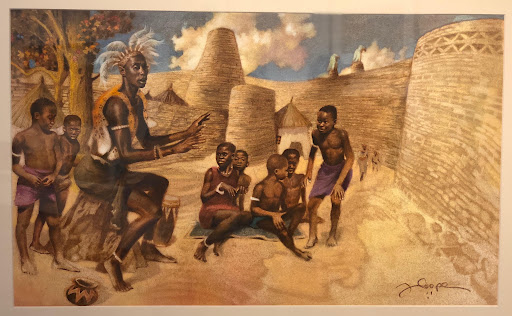
Artists from the African diaspora, at times, may draw on ancestral traditions such as oral storytelling or textile patterns, which were shaped by centuries of resistance to colonialism and slavery.
The dynamic of path dependency is particularly poignant for diaspora artists, whose work often grapples with the tension between inherited cultural legacies and the need to forge new identities in contemporary contexts. Historical migrations, whether forced or voluntary, create path-dependent cultural narratives that artists must navigate. For example, artists from the African diaspora may draw on ancestral traditions such as oral storytelling or textile patterns, which were shaped by centuries of resistance to colonialism and slavery. These traditions, while rich, carry the weight of historical trauma, and their integration into modern art can be constrained by expectations from both their communities and the broader art world. The inertia of these cultural paths, where certain symbols, motifs, or narratives become codified as “authentic,” can limit creative freedom, as artists risk being pigeonholeed or misunderstood when they deviate from expected forms.
Yinka Shonibare’s vibrant, thought-provoking works, often featuring “Dutch Wax” fabric, challenge path dependency by reimagining historical narratives through a postcolonial lens. His sculptures, paintings, and installations disrupt conventional Eurocentric stories, blending African and Western cultural elements to highlight hybrid identities and question rigid historical trajectories. By doing so, Shonibare reframes how people perceive cultural interdependence, urging a reevaluation of fixed historical and societal paths.
Diaspora artists also demonstrate the potential to subvert path dependence by reclaiming and redefining their narratives. Consider the work of artists such as Yinka Shonibare, whose use of Dutch wax fabric, often mistaken as quintessentially African but a product of colonial trade routes, challenges assumptions about authenticity and cultural purity. By engaging with the historical paths that shaped these materials, Shonibare reimagines their meaning, turning a symbol of colonial exchange into a commentary on hybridity and globalization. Similarly, contemporary Indigenous artists like Kent Monkman use traditional forms like beadwork or painting alongside subversive, campy aesthetics to confront colonial legacies, breaking free from the path-dependent expectation that Indigenous art must adhere to romanticized notions of pre-colonial purity. These artists illustrate how path dependence can be both a constraint and a creative springboard, as they navigate the inertia of historical narratives while carving out new trajectories.
The promotion of Windows operating systems and programs optimized for Windows exemplifies path dependency, as Microsoft’s early dominance in personal computing created a self-reinforcing cycle. Widespread adoption led to more software development for Windows, locking in users and developers to its ecosystem. This entrenched compatibility and familiarity, making it challenging for alternative systems to gain traction, illustrating how initial choices shape long-term technological trajectories.
Technology offers another lens for understanding path dependence, where early standards shape entire industries. The dominance of Microsoft Windows in personal computing, for example, stems from decisions in the 1980s to license the operating system widely, creating a feedback loop where software developers prioritized Windows-compatible programs, which in turn attracted more users. This ecosystem became so entrenched that even superior alternatives struggled to gain traction. The legacy of these technological choices extends to cultural practices, as seen in the art world’s shift toward digital platforms. The rise of NFTs, for example, builds on the path-dependent infrastructure of blockchain technology, which prioritizes decentralization and market-driven valuation. While this has democratized access for some artists, it also constrains others who lack the resources or inclination to engage with digital markets, highlighting how technological paths can both enable and exclude.
The Western historical art canon, epitomized by Renaissance art, reflects path dependency by prioritizing linear perspective and naturalistic representation, choices that have long shaped artistic standards. This focus marginalizes non-Western and non-linear art forms, such as Aboriginal dot painting or Islamic calligraphy, which emphasize symbolic abstraction and cultural storytelling, reinforcing a Eurocentric narrative that sidelines diverse artistic traditions.
In art, path dependency manifests in the canonization of certain styles or movements, which can overshadow alternative voices. The Western art historical canon, for instance, privileges Renaissance perspective and modernist abstraction, paths established through centuries of patronage and institutional support. These choices marginalize non-Western or non-linear art forms, such as Aboriginal dot painting or Islamic calligraphy, which follow distinct historical trajectories. Diaspora artists often find themselves navigating this tension, balancing the expectations of global art markets with the desire to honor their cultural roots. The inertia of the canon can make it difficult for these artists to gain recognition without conforming to established norms. Yet, their work also challenges the canon by introducing hybrid forms that defy traditional categorization.
The concept of path dependence also resonates with the broader theme of legacy in contemporary society. Historical decisions, whether in policy, culture, or art, create frameworks that are difficult to escape, yet they also provide the raw material for reinvention. Diaspora artists, in particular, embody this duality, as they inherit cultural identities shaped by migration, colonialism, and adaptation while forging new paths in globalized contexts. Their work highlights the challenges of reimagining cultural identities when history exerts such a powerful pull. By engaging with retronyms, whether linguistic or conceptual, these artists reveal how the past is never truly fixed but is constantly redefined by the present.
Path dependency offers a powerful framework for understanding how historical choices shape modern trajectories while also illuminating the possibilities for change. It reminds us that the present is not a blank slate but a tapestry woven from countless prior decisions, each thread reinforcing or challenging the ones before it. For diaspora artists, this lens underscores the complexity of their task: to honor the legacy of their histories while breaking free from the constraints of inertia, redefining their narratives in a world that is both bound by the past and open to reinvention.
The ways in which the West perceives and represents the Middle East and other non-Western regions have long influenced political decisions, cultural attitudes, and international relations. These representations often go beyond simple misunderstandings or stereotypes; they form complex, deeply rooted narratives that shape policies and justify actions on the global stage. Understanding these narratives, and how they have evolved, is essential to unpacking the persistent power dynamics between the West and the so-called “Orient.”
What is Orientalism and Neo-Orientalism
Orientalism refers to the historically entrenched framework through which the West has constructed an image of the East as exotic, backward, and fundamentally different, often to justify colonial domination. Neo-Orientalism is a contemporary evolution of this discourse, adapting traditional stereotypes to modern geopolitical contexts, particularly through media, politics, and diaspora voices, to sustain influence and legitimize intervention in the region.
Orientalism and Neo-Orientalism: From Colonial Gaze to Contemporary Narratives
The intertwined concepts of Orientalism and Neo-Orientalism are not just academic abstractions; they are frameworks that have shaped how the West sees, talks about, and interacts with the Middle East, North Africa, and broader “Eastern” societies for centuries.
Edward Said’s seminal 1978 book Orientalism brought the ideas behind the concept of Orientalism to the forefront of scholarly discourse on how the West views the Middle East and other non-Western regions of the world.
Orientalism, a 1978 book written by the renowned Palestinian-American political activist and literary critic Edward Said, fundamentally changed the conversation about cultural representation. He argued that the West’s depictions of the “Orient” were never neutral, but part of a system of domination in which knowledge production served political and military power.
In Orientalism, Said said that “the Orient was almost a European invention, and had been since antiquity a place of romance, exotic beings, haunting memories and landscapes, remarkable experiences. The Orient has helped to define Europe (or the West) as its contrasting image, idea, personality, experience.” This “invention,” according to Said, was not just a matter of stereotypes; it was a form of political technology. By defining the East as mysterious, decadent, irrational, or dangerous, the West justified colonization, intervention, and control, according to Said.
Orientalism: The Original Framework
The European fascination with “the Orient” stretches back centuries, with early expressions found in medieval Crusader chronicles, travelogues, and Renaissance trade accounts. However, it was during the 18th and 19th centuries, the height of European imperial expansion, that Orientalism evolved into a fully institutionalized framework. This transformation occurred across multiple arenas: academia produced scholarly studies and translations that framed Eastern cultures as objects of knowledge, museums collected and displayed artifacts that emphasized the exotic and timeless nature of the East, literature romanticized and mystified Eastern peoples and places, and political discourse used these portrayals to legitimize colonial and imperial ambitions.
At the heart of Orientalism was a set of enduring characteristics that shaped Western perceptions of Eastern societies in reductive and essentialist ways. One such trait was timelessness—the notion that Eastern societies were frozen in a static past, resistant to change or modernization. Unlike the West, which was cast as dynamic and progressive, the Orient was portrayed as trapped in antiquity, as if centuries of social, political, and economic development had passed it by. This assumption erased the complexity and evolution of these societies, rendering them objects to be dominated rather than partners in global exchange.
This painting exemplifies 18th and 19th-century Orientalism, depicting the Middle East through a Western lens filled with culturally specific markers like harems, minarets, bustling bazaars, and intricate decorative arts. Such imagery reinforced exoticized and often stereotyped views of the region, shaping Western perceptions with a mix of fascination and otherness.
Closely related was exoticism, the fascination with culturally specific markers such as harems, minarets, bazaars, and ornate decorative arts. These images served a dual purpose: they evoked beauty and mystery that captivated Western audiences, yet simultaneously suggested irrationality, sensuality, and otherness. This framing rendered Eastern peoples as fundamentally different, alien, and sometimes dangerous, fueling fantasies and fears alike.
Another cornerstone was despotism. Orientalist discourse frequently reduced political life in Eastern societies to the absolute rule of tyrannical leaders over passive, submissive populations. This simplification erased the presence of complex governance systems, resistance movements, intellectual debates, and vibrant civil societies that existed historically and contemporaneously. By portraying Eastern polities as inherently despotic, Orientalism justified Western intervention as a civilizing mission necessary to bring order and progress.
Finally, Orientalism constructed a clear moral hierarchy in which the West occupied the position of modernity, rationality, and democracy, while the East was depicted as pre-modern, emotional, and authoritarian. This hierarchy not only naturalized Western superiority but also delegitimized Eastern knowledge, values, and political systems. It created a dichotomy that made Western domination appear benevolent and inevitable, reinforcing the structures of colonial power.
Together, these characteristics created a pervasive worldview that shaped cultural attitudes, scholarship, and policy for generations. They provided the ideological underpinnings for colonial rule and continue to influence how the West perceives the Middle East and other non-Western regions to this day.
Neo-Orientalism: Updating the Script for the 21st Century
In the decades after formal colonialism’s decline, Western powers found new ways to sustain influence in the Middle East. Neo-Orientalism is not simply “modern Orientalism,” it is a recalibration for the era of
counterterrorism, globalization, and human rights discourse.
The core shifts from Orientalism to Neo-Orientalism include moving from colonies to client states that the west no longer rules directly, but maintains influence through military bases, arms sales, aid packages, sanctions, and covert operations
The core shifts from Orientalism to Neo-Orientalism include moving from colonies to client states that the West no longer rules directly, but maintains influence through military bases, arms sales, aid packages, sanctions, and covert operations. The focus also shifted from exotic to pathological. For example, 19th-century Orientalism romanticized the East’s “sensuality,” while Neo-Orientalism focuses on dysfunction in the region, such as terrorism, civil war, and religious extremism. Additionally, Neo-Orientalism is shaped not only by Western scholars but also by journalists, think-tank analysts, and members of Middle Eastern diasporas who speak to Western audiences in ways that can align with state priorities.
The Role of Middle Eastern Diaspora Groups In Neo-Orientalist Discourse
Diaspora politics also plays a significant role in Neo-Orientalist discourse. Many exiled activists fight for democracy, human rights, and dignity in their homelands. But their positioning in Western societies, especially those closely tied to US foreign policy, means their advocacy is often co-opted into Neo-Orientalist narratives.
The National Iranian American Council (NIAC) is an example of a Middle Eastern diaspora organization at the forefront of challenging neo-Orientalist narratives about Iran. However, it is frequently criticized by more conservative members of the Iranian diaspora, some of whom perpetuate the very neo-Orientalist ideals NIAC seeks to dismantle.
Among Iranian diaspora groups, the National Iranian American Council (NIAC) advocates diplomacy over war between the US and Iran, pushing back against the reduction of Iran to a monolithic “rogue state.” Its founder, Trita Parsi, has warned against “the dangerous simplicity of a caricatured Iran” in US media. However, NIAC is often targeted by more hardline factions in the Iranian diaspora who lobby for maximum pressure policies, sanctions, and even military action, positions that frequently rely on Neo-Orientalist portrayals of Iran as a theocratic government incapable of reform without forced regime change. Some Iranian exile figures, particularly in satellite TV outlets like Iran International, adopt highly simplified narratives that present the Iranian state as an irredeemable regime and dismiss all nuance around the humanitarian impact of Western sanctions. While they often speak from personal grievance, their language sometimes echoes the pathologizing tone of Western security discourse.
Organizations such as the Jewish Voice for Peace also work to challenge the dominant Neo-Orientalist discourse regarding the Israeli-Palestinian confict.
The Role of Media in Perpetuating Neo-Orientalist Ideas
Media coverage of recent Middle East conflicts reveals how Neo-Orientalist narratives continue to shape perceptions and public discourse, often simplifying complex political realities into cultural stereotypes that serve strategic interests.
The coverage by Western media of the ongoing Israeli actions in Gaza generally portrays the Palestinian people as the instigastor of the conflict and minimizes the human cost of the confict on the Palestinian people.
Western media often framed the 2020s escalation in the Israel–Gaza conflict as a humanitarian crisis caused largely by Hamas’ intransigence, with Israel portrayed as a reluctant actor forced into action. The decades-long siege of Gaza, asymmetry of firepower, and structural conditions imposed by occupation were minimized or omitted. The Orientalist roots are clear: Palestinians were depicted either as irrational aggressors or as passive dependents on Western aid, but rarely as political agents with their own strategies and visions for liberation.
In the 12-Day Iran–Israel conflict, US and European outlets frequently described Iran’s actions as the product of religious extremism and ideological hatred. Israeli military strikes, by contrast, were framed as “surgical” and “defensive.” The impact of the war on Iranian civilians received limited coverage compared to narratives about “crippling” Iran’s military infrastructure. This selective moral framing echoes the old Orientalist assumption that Eastern actors are driven by passion and zealotry, while Western allies act with reason and restraint.
In both cases, the pattern is clear: political disputes are reframed as cultural deficiencies, and local voices that challenge this framing are marginalized.
Neo-Orientalist Narratives and Western Policy
Over the past two decades, Neo-Orientalist frameworks have deeply influenced policymaking and public justification for interventions in Iran, Palestine, Iraq, and Afghanistan. These narratives, repeated in government statements, congressional hearings, and official reports, have helped legitimize military actions, economic sanctions, and political isolation.
Regarding Iran, US President George W. Bush famously labeled Iran as part of an “Axis of Evil” in 2002, framing it as a rogue state bent on nuclear weapons development and sponsoring terrorism. This rhetoric echoed Neo-Orientalist tropes of Iran as an irrational, fanatical theocracy. This framing justified the 2006–2015 sanctions regime, covert cyber operations such as Stuxnet, and continued military posturing in the Persian Gulf. The European Union largely followed the lead of the US, incorporating similar language in parliamentary debates and European Union policy papers that emphasized Iran’s “destabilizing” role and “repressive” government. Such discourse ignored Iran’s legitimate security concerns, its role in regional diplomacy, and domestic reformist movements. The Neo-Orientalist caricature made dialogue appear naïve and dangerous.
In Iraq and Afghanistan, post-9/11, the US and the UK framed Afghanistan as a lawless, Taliban-controlled “tribal” backwater harboring terrorists. Iraq was portrayed as a dictatorship hiding weapons of mass destruction and oppressing its people with brutal tribal and sectarian divisions. These portrayals drew directly on Orientalist ideas of stagnant, irrational Eastern societies.
Neo-Orientalist discorse often frames the Israeli-Palestinian conflict through a security lens that centers on the Israeli perspective, often portraying Palestinian resistance as terrorism as opposed to a legitimate polticial struggle.
Regarding Palestine, the US and the European Union have frequently framed the Israeli-Palestinian conflict through a security lens that centers Israeli perspectives, portraying Palestinian resistance primarily as terrorism rather than legitimate political struggle. Such framing delegitimizes Palestinian political aspirations and underplays the effects of occupation and settlement expansion. This perspective also aligns with Neo-Orientalist depictions of Palestinians as irrationally violent, while Israeli policies are often portrayed as defensive. European Union foreign policy statements have echoed these concerns but often emphasize a “two-state solution” without critically addressing power imbalances or structural violence.
Orientalism and its neo-form are not simply about representation; they influence war, diplomacy, immigration policy, and public empathy. A public conditioned to see Iran as a theocracy incapable of reform or Gaza as a chaotic warzone will be more likely to support sanctions, arms sales, or military interventions.
Recognizing the mechanics of these narratives allows us to ask deeper questions: who gets to speak for a country or a people? Which voices are amplified, and which are ignored? How does “expertise” get constructed in ways that serve existing power structures?
The persistence of Orientalism, whether in the romanticized paintings made in 19th Century Europe or in contemporary op-eds calling to “save” Muslim women from their culture, shows that the gaze has evolved, not disappeared. The challenge is to disrupt this gaze, to insist on seeing the East not as a mirror for Western self-image, but as a collection of diverse societies with their own histories, agency, and futures.
One of the essential tools used in the research and documentation of recorded sounds is the Discography. The main purpose of any discography is to document information related to sound recordings and make the information available to both researchers and recorded sound collectors alike. In its simplest form, a discography is a document that attempts to list all sound recordings made by a recording artist, of a given composer’s music, or in a specific musical genre. The information included in a discography varies depending on its size and scope, but an entry for a specific recording in a discography typically includes: title of the work, artist name, names of additional personnel on the recording, recording date, recording location, and release date. Some discographies also include sales information, reissued versions of a given recording (across formats), and playing time. Discographies themselves have appeared in a variety of formats, beginning with journal articles and books, but now including e-books, websites and databases.
RCA-Victor is one of the many examples of record labels that are documented in discographies (this 78 RPM record was released in June of 1959).
Individual entries in discographies have several different unique identifiers. The first identifier in a discographic entry typically is the label that the recording was originally issued on. This identifier allows researchers and collectors alike to know who originally produced the recording. Additionally, the inclusion of the record label as an identifier in a discography also allows one to gain a better understanding of the history of the recorded sound industry by having a chance to see the output of a particular label and how the recordings that were issued on it changed over time. Examples of record labels often found in discographies include RCA–Victor, Columbia, Decca, Capitol, Sony Music, EMI, Supraphon, and many others.
Example of a matrix number as shown on a Decca 78 RPM record issued in the US in September of 1958 (the matrix number is located on the left side of the record label next to the spindle hole)
Another important identifier for sound recordings is the matrix number. A matrix number is an alphanumeric code (that often includes other symbols related to the pressing plant the record was manufactured in) either stamped or handwritten (or both) into the run-out groove area of a phonograph record. A matrix number is intended for the internal use of the record manufacturing plant but often provides useful information for record collectors and researchers. The purpose of the matrix number is to assign a filing number to the stamper and to ensure each side receives the proper label, by visually comparing the number on the label to the inscribed number. The first label to utilize matrix numbers was Victor (which became RCA-Victor in 1929) in 1903, shortly followed by Columbia, Zon-o-phone, and many others 1901. On the other hand, cylinder recordings typically do not utilize matrix numbers, with the only cylinders that were assigned matrix numbers being most Edison Blue Amberol cylinders made between 1914 and 1929. The reason why Edison Blue Amberol cylinders during this period have matrix numbers is that they were primarily dubbed from Edison Diamond Disc records (which utilized matrix numbers), which were introduced in November of 1912.
A catalog number (shown on the bottom of this Chess 78 RPM record recorded in July of 1956 and released in November of 1959) is another important identifier of discographic entries
The catalog number is another example of an identifier for sound recordings in a discography. A catalog number is assigned to every release by the record company to identify that particular release. The number is used to track sales through distributors and for the label’s in-house accounting purposes. Catalog numbers are used on nearly all recorded sound formats (78s, cylinders, LPs, 45s CDs, etc.) and is another important tool that allows researchers to document and catalog recordings. The first catalog numbering system was introduced by Edison Records for their numerical series of cylinder recordings in April of 1892 and soon became the norm for all record companies by the beginning of the 20th Century.
Example of a discography including identifiers such as the date (in the “day, month, year format”) and locations in which a series of recordings were made.
Another identifier used
in discographies is the title, which refers to the name of the work included in
a discography. In addition to the title of the work, discographies also include
the names of the artists and composers of the individual entry, names of
personnel on the recordings, and the engineers who originally produced and
mastered the recordings. The recording date and location where the recording
was made are also important identifiers in discographic entries. Dates for
recordings are typically formatted as either “day, month, year” (ex. 5 December
1958), “month, day, year” (ex. December 5, 1958), or month only (ex. December
1958). Generally speaking, the recording date and location(s) that a recording
was produced are not specifically mentioned on the label of the recording
(Brooks, 2000). As such, collectors and researchers typically rely on
discographic entries and recording ledgers to determine this information. Take
numbers are also an example of a discographic identifier. A take number tells
an individual which recording made in a session by a particular artist was used
on the final issued recording. Take numbers are usually found in the matrix
number of the recording and can either be in numerical or alphabetic form.
Example of a print discography, The Sousa Band: A discography (Smart, 1970).
Example from the German national discography, Discographie der deutschen Kleinkunst (Büttner et al. 2002).
National discographies are another variation of a discography. As opposed to label or genre discographies, national discographies include all the recordings issued and produced in a defined national or cultural area regardless of label, genre, artist, or composer. National discographies are of importance and value to recorded sound researchers for several distinct reasons. The first reason is that it informs the collection of new acquisitions by institutions in specific countries. The second factor is that it sustains and promotes scholarly research by stimulating the reissue of historic sound recordings and encouraging recorded sound institutions to acquire new and relevant sound recordings for their libraries. Finally, the idea of a national discography allows both researchers and private collectors to find out which recordings were recorded and released in specific countries.
History of Discographies
This logbook, used by Edison Records between 1889 and 1892, contains numerous attributes that would define later discographic publications.
The earliest known document that can be considered a forerunner to the modern discography is the logbook used by Edison Records from May of 1889 to April of 1892, which was recently made available under the title The First Book of Phonograph Records. Shortly after the commercial production of sound recordings began in 1889, Edison began keeping a log of phonographic performances for future reference. The First Book of Phonograph Records includes several attributes that have become standard in nearly all subsequent discographical publications including recording dates, song titles, artist’s names, and the number of copies made during a recording session. Even though many attributes that are commonplace in contemporary discographies are not present in this document such as take numbers, catalog numbers, and composer names, one can argue that The First Book of Phonograph Records is the first discography in the proper sense of the word, as it seeks to catalog and document the sound recordings made by Edison during the first few years of the industry and established a standard for documenting certain attributes of recordings.
Early efforts to document and categorize sound recordings using unique and easily defined attributes were hampered in part by the fact that no suitable duplication process existed during the earliest days of the recording industry. For example, many of the earliest recordings were recorded as many as eight times in each respective session to keep up with the ever-growing demand for recordings. Additionally, many of the earliest recording artists recorded on an unpredictable and ad-hoc basis due to sudden changes in demand for their recordings, as well as some reluctance to lend their services to a primitive and unprofitable medium. As such, the nature of the early recording industry prevented the establishment of unique catalog numbers for commercial recordings. This, in turn, makes it difficult at best for modern researchers to determine the total output of the earliest recording artists.
Edison recording studios, c. 1889-1893.
Over the next decade and a half, improved duplication methods were developed for both the cylinder and disc record formats that permitted the assignment of unique attributes such as catalog numbers, take numbers, and more detailed artist information. Edison was the first to implement a catalog numbering system with the establishment of its numerical series of cylinders in April of 1892. Other cylinder labels soon followed with their own catalog numbering systems as the 1890s progressed. In contrast, Emile Berliner implemented a block numbering system for his E. Berliner’s Gramophone disc record label in which specific segments dedicated to individual musical categories. This system was implemented when the first Berliner records were issued in the US in mid-1892 and lasted until the label folded in early 1900. Victor Records followed a similar system shortly after it was established in late 1900, but eventually switched over to a sequential catalog numbering system by mid-1901.
Advertisement for Paramount Records, a label whose unsystematic cataloging practices, make research difficult for discographers and collectors.
Despite the establishment of more sophisticated cataloging methods, many record companies (smaller record labels in particular) were unsystematic in their cataloging practices. An example of a record label known for its unsystematic cataloging practices was Paramount, a Wisconsin-based label active from 1917-1933 and best known by modern collectors and recorded sound archivists for its series of Blues, Jazz, and Country 78 RPM records. Due to both a lack of resources, as well as minimal foresight regarding the future interest in recordings belonging to such genres, Paramount barely kept any recordings logs (particularly during the last few years of the label’s existence) and the few logs that remain are incomplete and leave out even the most basic information pertaining to the recordings. Additionally, many of the major record labels often ignored recordings of less popular and mainstream musical genres such as Jazz and Blues music and did not properly keep track of the information behind them.
Rhythm on Record (1935) is considered one of the first modern discographic publications.
The idea of “discography,” as we know it today, came into being during the 1930s. Much of the early efforts to create discographic methods were led by Jazz and Blues record collectors, who noted that the efforts by record labels to document recordings in such musical genres were haphazard at best. The first two published discographies were “Hot Discography” by Charles Delauney and “Rhythm on Record: Who’s Who and Register of Recorded Dance Music” by Hilton Schelman. Schelman’s work focused on the wider spread of popular music over the first few decades of the 20th Century, whereas Delauney took a more detail-oriented approach mostly focusing on Jazz recordings. The methods used by Delauney in his pioneering work were soon adopted by recorded sound researchers and continue to be present in current discographical works. As the decades ensued, discographies expanded in both their scope and complexity with the emergence of new music genres, different sound storage formats, and diverse recording artists.
Ever since he first announced his candidacy for the Republican nomination in June of 2015, US President Donald Trump has given the world a new term: Trumpism. Though Trumpism is linked to the person Donald Trump himself, its roots run much deeper and share similarities with political ideologies ranging from Neo-conservatism to populism, to Christofascism. Here are the main characteristics of President Donald Trump’s political ideology:
1. Populism
Right-wing populism is one of the major components of President Donald Trump’s political ideology
Trumpism appeals to a large group of anti-intellectual, conspiracy-minded, and alienated malcontents, the same type of voter that backed third-party Presidential candidates Ross Perot and George Wallace as well as Senator Joseph McCarthy (R-WI) during the “Red Scare.” Trumpism embodies a particular kind of populism composed of overt patriotism, and economic nationalism, along with a vague commitment to the middle class and an aggressive foreign policy.
Like all forms of populism, Trumpism relies on the rhetoric of resentment but is thin on specifics. To the thorny issue of race and police brutality, President Donald Trump responds to the chant “Black Lives Matter” by saying “All Lives Matter,” an easy applause line on the campaign trail. Unrestrained by any ideological limitations, President Trump is also able to defend some form of universal healthcare. “Because the insurance companies are making a fortune because they have control of the politicians,” Trump was quoted as saying on the campaign trail. Additionally, President Trump has repeatedly cited President Andrew Jackson during his time in office and claimed that a majority of his policies are inspired by the ones carried out by Jackson. Attacks by the mainstream media, his political opponents, and traditional conservatives only serve the narrative that Trumpism threatens the established power structure, further framing Trump as the savior of the disenfranchised.
2. Xenophobia
Aggressive xenophobia is another hallmark of President Donald Trump’s political agenda
Following in the same tradition, Trumpism first emerged as part of the birther movement. While already debunked in the mainstream, Donald Trump’s 2011 public and calculated demand that then-President Barack Obama release his full birth certificate, kept him in the media spotlight for well over a year and helped him to develop an initial base of support. Most notably, Public Policy Polling released a national survey that showed 61 percent of Trump supporters still identified as birthers as late as 2016. Under the banner of “Mak[ing] America Great Again,” this same conspiratorial fear of foreigners explains the broad approval for President Donald Trump’s impractical, illogical, and callous pledges to build a wall along the Mexican border and deport all illegal immigrants and to ban Muslim immigration to the US.
Although President Donald Trump often lacks the will to push his xenophobic, unrealistic proposals due to the current Congressional makeup, there has been a dramatic increase in the number of hate crimes over the past few years. For example, statistics show that US counties that hosted rallies for President Trump have seen a 226 percent increase in hate crimes since 2016. Additionally, President Trump’s racist rhetoric and acceptance of support from white supremacists such as Richard Spencer and David Duke have directly contributed to events including the 2017 Charlottesville massacre, the October 2018 Pittsburgh Synagogue shooting, and most recently, the March 2019 New Zealand Mosque Shooting. In all three of these incidents, the perpetrators have cited the rhetoric and policies of President Trump as the underlying factors that motivated them in carrying out their crimes.
3. Militarism
Aggressive, unrestrained militarism plays a major role in President Donald Trump’s political ideology.
Another hallmark of Trumpism is an emphasis on the military and unrestrained, unilateral interventionism. Despite President Donald Trump’s proclamations on the campaign trail in 2016 that the US will be reducing its role in policing the world, the US military footprint has increased at an alarming rate during his Presidency. On the 2016 US presidential campaign trail, then-candidate Trump promised a return to the era of American isolationism, pledging to put “America first,” and end costly foreign wars. Trump attacked his rival Republican candidates from the left, and blamed the party’s previous president, George W. Bush, for adding trillions to the national debt in the pursuit of remaking the Middle East in America’s image. “The world must know we do [not] go abroad in search of enemies,” Trump thundered in what was billed as his signature foreign policy speech in April of 2016. In taking direct aim at Bush, war hawks, and neo-conservatives, Trump blamed their “foolishness and arrogance” for throwing “the region into chaos.”
The Trump Administration’s embrace of the military is as much, if not more, about creating an ethos than making new policy. President Donald Trump frequently hails “his” generals, fixates on the projection of muscular, unilateral American power on the world stage, and has sneered at the supposedly equivocating diplomacy of his predecessor. This is all an extension of the ultra-nationalist politics of his key advisers, ideologues who see the world in stark, terrifying, and straightforward terms. For example, cabinet members such as former Defense Secretary James Mattis, Secretary of State Mike Pompeo, and National Security Advisor John Bolton are major followers of Neo-conservative ideology and have repeatedly sought to frame American foreign policy as an “us-vs-them” type of situation. According to President Trump and his advisors, the entire world is against the US and the only way to address that perceived imbalance of power is to implement an aggressive interventionist foreign policy.
The aggressive militarism promoted by the Trump Administration was a major part of the geopolitics of the early 20th Century, when nationalist powers (including the US, UK, Germany, France, and Japan), unchecked by the systems built after World War II, embarked on arms races and entered into devastating, cataclysmic conflict. Observers now see a return to the politics of that era, when a period of “liberal” free trade and proto-globalization gave way to destabilizing struggle and the collapse of empires. “Trump’s sense of abuse and humiliation is potent,” writes Stephen Wertheim of Columbia University. “‘The world is laughing at us,’ [Trump] endlessly repeats. It’s a cry more common to revolutionary states and movements than to the world’s sole superpower. Imperial Japan and Nazi Germany did not conquer territory for the thrill of it; their leaders acted out of perceived desperation, believing that they were losing a ruthless competition for power and status.”
4. Hyperpartisanism
The partisan rhetoric of President Donald Trump has noticeably increased the divide between both political parties in recent years.
President Donald Trump has encouraged this increase in partisanship dramatically. For example, Trump has repeatedly targeted his political opponents (both Democrats as well as Republicans who disagree with his vision) in his public comments, calling for them to be arrested (for imaginary crimes), investigated, and voted out of office just due to their party identification. Additionally, during his campaign for President in 2016, Trump stated that he would refuse to concede to Hillary Clinton if she defeated him and called upon his supporters to take up arms and protest against the Democrats he lost the election. This partisan rhetoric has continued to this day. For example, President Trump often calls the Democratic Party the “enemy of the people” and refuses to even work with them on legislation that enjoys strong bipartisan support.
5. Direct & Personal Discourse With The American People
As opposed to previous President, President Donald Trump has sought to develop a personal, direct relationsip with the American people to pass controverial legislation.
Trumpism is unique in that it focuses on direct communication between the President and the American people. This shift in the relationship between the President and the American people first began with the launch of public Radio broadcasting in 1920 and public TV broadcasting in 1939 and expanded with the rise of online political blogs and social media outlets in recent years. President Donald Trump has made effective use of social media from the moment he launched his Presidential campaign and has used it to directly appeal to the American people to support his proposed legislation and controversial opinions on a whole host of political issues. Although this personalized and direct discourse between President Trump and the American people has served to increase individual involvement in the political process, it has also resulted in an increasing level of political branding.
The new relationship between the President and the American people promoted by Trumpism has resulted in President Donald Trump relying less on Congress and more on his own public approval to put forward his agenda. This has resulted in a weaker relationship between the executive and legislative branches and causes less legislation to be passed efficiently. Because Congress is less willing to work with the President, the President has to rely more on executive action. This situation has played out numerous times over the course of the Trump Presidency. For example, Congress has been reluctant to pass a vast majority of President Donald Trump’s legislative program and the few pieces of legislation were passed by narrow margins at best. Due to this protracted impasse, President Trump has utilized more executive actions than any other President in recent memory and sought to justify these acts through direct and personal appeals to the American people through social media sources such as Twitter.
One of the major debates within the American Criminal Law system is what for of punishment will do the most to deter crime and rehabilitate criminal defendants. This issue has been at the forefront of policymakers and legal scholars alike and has changed throughout the decades. During the heyday of liberalism between the 1930s and mid-1960s, the judicial and executive branches wielded power in sentencing. Legislators designed sentencing laws with rehabilitation in mind. More recently, during the increase in support for conservative policies the late 1960s legislators seized power over sentencing, and a combination of theories, deterrence, retribution, and incapacitation, have influenced sentencing laws. Here is a list of all the main theories of punishment in criminal law
1. Incarceration
Incarceration is the most commonly used form of punishment in the US.
An argument in favor of mass incarceration is that it gets criminals off the streets and protects the public. The idea is to remove an offender from society, making it physically impossible (or at least very difficult) for him or her to commit further crimes against the public while serving a sentence. Incapacitation works as long as the offenders remain locked up. There is no question that incapacitation reduces crime rates by some unknown degree. The problem is that it is costly. Incapacitation carries high costs not only in terms of building and operating prisons but also in terms of disrupting families when family members are locked up.
Incarceration is the typical form of punishment meted out today in the US for serious crimes. According to the International Centre for Prison Studies, the US has the second highest rate of incarceration, behind the small country of Seychelles. Even authoritarian regimes such as Saudi Arabia, Israel, and China have lower incarceration rates than the US. The rapid increase in the rate of imprisonment after 1970 has produced an era of “mass incarceration” in the US. Although the incarceration rate has declined from a high of 506 per 100,000 in 2007 to 480 per 100,000 in 2012, state and federal prisons still house over 1.5 million people.
The causes of mass incarceration in the US are numerous, ranging from the rise of the Prison Industrial Complex since the 1980s, draconian anti-crime laws that were passed in 1984 and 1994, and the federal War on Drugs, which was first implemented by President Woodrow Wilson in 1914 with the Harrison Narcotics Tax Act and expanded by President Franklin Roosevelt in 1937, President Richard Nixon in 1971, President Ronald Reagan in 1982, President Bill Clinton in 1994, and President Donald Trump in 2017. Additionally, a vast majority of Americans support mass incarceration in spite of its costs and have called upon their elected officials to expand incarceration rates despite the fact that crime in the US is at its lowest level since the late 1950s.
2. Utilitarian Theory
The utilitarian theory of punishment seeks to punish offenders to discourage, or “deter,” future wrongdoing. The retributive theory seeks to punish offenders because they deserve to be punished. Under the utilitarian philosophy, laws should be used to maximize the happiness of society. Because crime and punishment are inconsistent with societal happiness, they should be kept to a minimum. Utilitarians understand that a crime-free society does not exist, but they endeavor to inflict only as much punishment as is required to prevent future crimes.
The utilitarian theory is “consequentialist” in nature. It recognizes that punishment has consequences for both the offender and society and holds that the total welfare produced by the punishment should exceed the total evil. In other words, the punishment should not be unlimited. One illustration of consequentialism in punishment is the release of a prison inmate suffering from a debilitating illness. If the prisoner’s death is imminent, society is not served by his continued confinement because he is no longer capable of committing crimes.
Under the utilitarian philosophy, laws that specify punishment for criminal conduct should be designed to deter future criminal conduct. Deterrence operates on a specific and a general level. General deterrence means that punishment should prevent other people from committing criminal acts. The punishment serves as an example to the rest of society, and it puts others on notice that criminal behavior will be punished.
3. Retribution Theory
“Let the punishment fit the crime” captures the essence of the retributivist theory of punishment. Proponents of this theory advocate just deserts, which defines justice in terms of fairness and proportionality. Retributivists aim to dispense punishment according to an offender’s moral blameworthiness (as measured by the severity of crimes of which the offender was convicted). Ideally, the harshness of punishments should be proportionate to the seriousness of crimes. In reality, it is difficult to match punishments and crimes, since there is no way to objectively calibrate the moral depravity of particular crimes and the painfulness of specific punishments. Retribution is a backward‐looking theory of punishment. It looks to the past to determine what to do in the present. The retributionist theory is constrained in part by the Eighth Amendment to the US Constitution, which forbids “cruel and unusual punishments.”
4. Deterrence Theory (Can Fear Prevent Crime?)
Deterrence is another theory of punishment that is often debated.
Crime deterrence is simply the action of discouraging an activity through instilling doubt or fear of its consequences in the minds of the perpetrator. There has been much debate over whether deterrence works. Proponents assert that punishment deters if it is administered with swiftness, certainty, and severity. There are two different forms of deterrence, general deterrence, and specific deterrence. General deterrence uses the person sentenced for a crime as an example to induce the public to refrain from criminal conduct, while specific deterrence punishes an offender to dissuade that offender from committing crimes in the future.
Critics point to the high recidivism rates of persons sentenced to prison as evidence of the lack of effectiveness of specific deterrence. Critics also note that there are limits to the impact of general deterrence. Some crimes, such as crimes of passion and crimes committed while under the influence of drugs, cannot be deterred because their perpetrators don’t rationally weigh the benefits versus the costs (which include punishment) before breaking the law. Research evidence suggests that the deterrent effect of punishment is much weaker than its proponents suggest.
5. Reintegrative Shaming
The reintegrative shaming theory emphasizes the importance of shame in criminal punishment. The theory holds that punishments should focus on the offender’s behavior rather than the characteristics of the offender or the actual crime committed. Australian criminologist John Braithwaite developed this theory at Australian National University in 1989. An example of reintegrative shaming is in the 2004 case United States v. Gementera, wherein a 24-year-old mail thief was sentenced to wear a sandwich board sign stating, “I stole mail; this is my punishment” while standing outside of a San Francisco postal facility. The main strength of this theory is that it consists of a humane way to punish someone who committed a crime and places the onus of responsibility on themselves. On the other hand, opponents of the reintegrative shaming theory argue that it does not strongly punish a criminal defendant and may result in them committing more crimes in the future.
1)Property law is the area of law that governs the various forms of ownership and tenancy in both real and personal property. In the civil law system, there is a division between movable and immovable property. Movable property roughly corresponds to personal property (computers, cars, widgets, etc.), while immovable property corresponds to real estate (real property) and the associated rights, and obligations thereon.
The American property law system is based on the concept that property is a human invention, not the result of a divine gift or natural right (social construct). Thus, property exists only to the extent that it is recognized by the government, an approach called legal positivism. Because property is a human invention, it is necessarily based on reason. The justification of property is important because it determines the scope and extent of legally recognized property rights. Accordingly, natural law theory (the idea that certain rights naturally existed as a matter of fundamental justice regardless of government action) has little impact on modern property law.
Within the study of property law, there exist five distinctive theories explaining how or why things become property, as well as why the concept of property is necessary
Protect First Possession:
This theory offers a practical explanation of how unowned things become property. In settings where resources are plentiful, but where people are few (i.e. the early US), this first-in-time approach accurately describes how unowned property came to be owned. Particularly during the 19th Century, property rights in water, oil and gas, wild animals, and other natural resources were often allocated to the first possessor. Additionally, US laws such as the Homestead Act of 1862 are examples of the first-in-time approach towards property law.
The first-in-time approach has less relevance today because almost every tangible thing is already owned by someone, but its influence lingers in cases. For example, all of use this principle in everyday life. A parking lot on the street, a seat in a movie theater, or a spot in a long line, are all allocated through an implicit first-in-time system. Yet most scholars conclude that the first possession approach does not adequately justify property as a general matter. It describes how property rights arose, but not why it makes sense for society to recognize those rights.
Encouraging Labor
Writing in the late 1600s, John Locke reasoned that each person was entitled to the property produced through their labor. Assuming an unlimited supply of natural resources, Locke argued that when a person mixed their labor (which they owned) with natural resources (which they did not own), they acquired property rights through this mixture.
Labor theory has profoundly influenced American property law over the past 200 years. A problem with this theory is that there are no unlimited resources today (perhaps only oxygen is the only infinite resource), this theory is applied less to real property and more towards tangible personal property and intellectual property.
Maximizing Societal Happiness
This theory states that individuals recognize property in order to maximize the overall happiness of society (utilitarianism theory). We distribute and define property rights in a manner that best promotes the welfare of all citizens – not simply those who own property. A division between clear rules and equitable rules (tension between clarity and equity) is highlighted in this theory, which may not always lead to a result that is considered fair. Clear rules also minimize transaction costs, which may benefit society and reduce litigation.
Law & Economics Theory
Property is seen as an efficient method of allocating valuable resources in order to maximize one particular facet of societal happiness: wealth, typically measured in dollars.
Ensure Democracy
Civic republican theory states that property facilitates democracy. Idea is that one who has his own private property should feel free to challenge governmental actions that are abusive or unfair. Gives independence.
Personhood Theory
Property is necessary for an individual’s personal development. Each person has a close emotional connection to certain tangible things, which virtually become part of one’s self.
All of these theories help form the foundation of American property law. It is important to understand that no one theory is accepted as the only justification for property. Our property system reflects a blend of different approaches which often overlap with each other.
Wahhabism is a Sunni Islamic doctrine and religious movement that originated in Saudi Arabia in the 18th Century. Religious scholars have described Wahhabism as an “ultraconservative,” “austere,” “fundamentalist,” and “puritanical” form of Islam meant to restore pure monotheistic worship (tawhid) by devotees. Additionally, opponents of Wahabism have characterized the movement as a distortion of Islamic doctrine and as a deviant sectarian movement that goes directly against the teachings of Muhammed. The term Wahhabism is generally used in a critical tone, and its adherents commonly reject its use, preferring to be called Salafi or muwahhid. Wahhabism follows the Ibn Taymiyyah and Hanbali schools of thought, though Hanbali leaders renounced Abd al-Wahhab’s views. In recent years, opposition to Wahhabism has grown exponentially due to the growing alliance between Saudi Arabia and Israel, human rights abuses (on the scale of genocide) committed against Shi’a Muslims in Yemen, Bahrain, Syria, Afghanistan, and Pakistan by followers of Wahhabism, and American support for Middle Eastern governments that support extremist groups who justify their actions through Wahhabi theology.
Muhammad ibn Abd al-Wahhab, an 18th Century Saudi religious leader, is widely considered as the founder of Wahhabi theology.
The founder of Wahhabism, Muhammad ibn Abd-al-Wahhab (1703–1792 C.E.) was born in Najd, a city located in central Saudi Arabia, and was influenced by Ibn Taymiyyah, a fourteenth-century Hanbali theologian. Ibn Taymiyya endorsed the Hanbali school of thought, one of four schools in Sunni Islam. The school was named after Ibn Hanbal (780–855 C.E.), who espoused a literal interpretation of the Qur’an. Ibn Taymiyyah emphasized the values of solidarity and justice, and condemned both Shi’a and Sufi Muslims, claiming that both sects strayed away from the path of doctrines and rituals set out in the Qur’an.
Following travels through the Middle East in his early adulthood, Ibn Abd al-Wahhab returned to Najd to announce that Muslims everywhere should surrender to his vision of the authentic Islam as practiced during Prophet Muhammad’s time. Wahhab’s teachings are summarized into three points:
Ritual action is more important than intentions
Muslims should not revere the dead
Muslims should not make intercessory prayers to God through the Prophet or saints.
Ibn Abd al-Wahhab condemned honoring anyone other than God as idolatry, including Prophet Muhammad. He opposed the practice of reciting blessings on the Prophet during congregational prayers. Additionally, Ibn Abd al-Wahhab fought all forms of worship to the Prophet, ranging from the Hajj pilgrimage, the celebration of the Prophet’s birthday, and the inscription of the Prophet’s name in mosques.
While some Muslim scholars see Ibn Abd al-Wahhab as one of many Muslim reformers who sought to clarify the teachings of Islam, the vast majority of Islamic scholars (in both the Sunni and Shi’a sects) do not support his views and note that his behavior went directly against the teachings of the Qur’an. Ibn Abd al-Wahhab responded to critics by urging his followers to abandon the four traditional schools. He stated that all Muslims had fallen into unbelief and that if they did not follow the path of redemption he had laid out, they should be killed, their women kin beaten, and their possessions taken from them. He further believed the lives of Shia’s, Sufis, and other less mainstream Muslims should be extinguished and that all other faiths should be eliminated.
Muhammad Ibn Sa’ud worked to create an alliance with Muhammad Ibn Abd al-Wahhab during the 18th Century.
In 1744, Ibn Abd al-Wahhab sought refuge in the village of Dariyah, which was ruled by Muhammad ibn Sa’ud and his family, Al Sa’ud, which was responsible for organized banditry in Najd. The family ruled Dariyah according to its own whims and the village had a reputation as a lawless place. In 1747, Wahhab made a power-sharing agreement with the family, in which Ibn Abd al-Wahhab would become Dariyah’s religious authority, while the Al Sa’ud family would be responsible for the village’s political leadership. The Al Sa’ud family benefited immensely from the pact, as the Wahhabi movement and its extreme religious fervor helped to legitimize their rule. With this new power arrangement, Ibn Abd al-Wahhab and his followers began a campaign of expansion and domination in Saudi Arabia
In 1801, followers of Wahhabism began a campaign to gain control over the two holy cities of Islam, Mecca and Medina. During their campaign, they raided both cities and stole numerous holy books, works of arts, and cultural artifacts that the cities accumulated over the past millennia. During their control of the two holy cities, they imposed Wahhabism upon the populace, destroyed shrines and cemeteries, closed off the entrance to the holy city to Shi’a and Sufi pilgrims, barred pilgrims from performing the hajj, and murdered respected citizens. From the 1820s until the 1860s, the Wahhabis launched attacks upon both the Ottoman and Qajar Empires, urged on by Great Britain, which was eager to see the collapse of both the Turkish and Iranian empires.
Tha Al-Saud dynasty gained control of the holy cities of Mecca and Medina in 1924, cementing their control over Saudi Arabia.
The Wahhabis’ power and influence shrank throughout the 19th Century, culminating with the Ottoman recapture of Mecca and Medina in 1891. Despite the decline in Wahhabi influence, the collapse of the Ottoman Empire in 1918 encouraged the growth and spread of the movement once again. By 1924, the al-Saud dynasty was able to gain full and lasting control over Mecca and Medina. This gave them control over the Hajj pilgrimage and the opportunity to preach their version of Islam to the assembled pilgrims. Wahhabism remained a minor current within Islam until the discovery of oil in Saudi Arabia in 1938. Vast oil revenues gave the government of Saudi Arabia much wealth and international support, which encouraged the spread of their conservative Islamic theology. Wahhabi doctrine continues to be firmly rooted within the kingdom of Saudi Arabia today. All students are taught religion from the beginning of primary school, with the curriculum based only on Wahhabism, and libraries consist exclusively of Wahhabi texts. The Wahhabi clerics issue strict guidelines for sex, prohibit the ownership of certain pets such as dogs and cats, and place limits on women’s rights.
Wahhabi ideas began to spread to other countries through pilgrims who came to the Hajj and returned to their countries of origin. Wahhabi theology first spread into Oman during the eighteenth century where it played a role in the internal disputes and succession struggles of the country. Eventually, Wahhabi ideology spread to other countries in the Middle East such as Qatar, The United Arab Emirates, Kuwait, Afghanistan, and Pakistan.
Despite the growing support for Wahhabism, many traditional clerics have expressed opposition to Wahabism. These clerics defend the tribal Islam deeply rooted in their respective communities and argue that Wahhabis are little more than foreigners who sacrificed the true vision of Islam for wealth and acceptance by Western imperialist powers. Additionally, many traditional clerics take issue with the misinterpretation of the meaning of “Jihad” by Wahhabi followers. Even though Wahhabis view Jihad as a forceful struggle against those who threaten Islamic tradition, a vast majority of clerics note that Jihad instead refers to the struggle to come closer with God through devotion and piety.
Events such as the Saudi war in Yemen have increased criticism of Wahhabism and raised attention to the plight that Shi’a Muslims face at the hands of Wahhabi groups.
In addition to the criticism by Islamic scholars and clerics, many observers argue that Wahhabism ideology is the root cause of many of the human rights abuses and conflicts that are currently underway in the Middle East, and that Wahhabi ideology is used by governments such as the United States, Israel, and Great Britain to assert their influence and power in the Middle East. For example, groups that are sympathetic to Wahabism are currently taking part in massacres of Shi’a Muslims, Christians, and other religious minorities in countries such as Syria, Bahrain, Afghanistan, Pakistan, and Yemen. Many of the oppressed groups (particularly Shi’a Muslims) have been highly critical of Wahhabism and note the hypocrisy of Western powers who claim to support human rights reform, but continually support violent extremist groups. Critics also point out that the ideology of violent extremist groups such as Al-Qaeda and ISIS has been heavily influenced by Wahhabism. In response to these claims, the Saudi government has sought to distance itself from these groups, especially after the 9/11 Attacks and the 2003 attack on the Saudi capital Riyadh.
One of the more interesting concepts found in Philosophy is the Socratic Method, a teaching method typically utilized by professors in American law schools, as well as in some undergraduate philosophy courses. The Socratic Method is a form of cooperative argumentative dialogue between individuals, based on asking and answering questions. In college classes that employ the Socratic method, a professor usually ask a student a series of questions about a particular topic that are designed to stimulate critical thought. At times, the result of the questioning is to demonstrate that a rule cannot be applied in a uniform manner to all situations or to reveal the judicial challenge in crafting appropriate rules and legal decisions. Through this process, the student gains a deeper understanding of the material and the nuances involved.
History of the Socratic Method
Masters of oratory and persuasion known as Sophists were prevalent in Greek society during the 5th Century BCE.
The concept of the Socratic Method originated with the Greek Philosopher Socrates (469-399 BCE), who (along with Plato and Aristotle) is considered one of the founders of Western philosophical thought. During his youth, Socrates studied music, gymnastics, and grammar and worked as a sculptor alongside his father. Additionally, Socrates served with distinction in the army and saved the life of the General Alcibiades during the Battle of Potidaea. During the period in which Socrates completed his formal education, orators known as Sophists, who specialized in using the tools of rhetoric to entertain, impress, or persuade an audience to accept the speaker’s point of view, gained prominence throughout Greek society. The use of such tactics in Greek society negatively impacted critical thinking, as well as encouraging the spread of cultural biases and ignorance regarding even the most basic facts.
During one heated exchange, Socrates’ friend Chaerephon asked a sophist based in the Oracle at Delphi if there was anyone wiser than Socrates. The sophist then answered that there was no one wiser than Socrates. Bewildered by this answer and hoping to prove that the sophist used logical fallacies to inform his opinion, Socrates went about questioning people who considered themselves to have a high level of intelligence, as well as ordinary people. Much to his dismay, Socrates found that people who were viewed by society as intellectual giants and as having much wisdom most often lacked both traits. On the contrary, Socrates found that people who were looked down upon as common people were typically far more intelligent and wise. The youth of Athens delighted in watching Socrates question their elders and soon, he had a following of young people who would go on to abandon their early aspirations and devote themselves to philosophy due to his example and teachings. Among Socrates’ most notable followers were Antisthenes, Aristippus, Xenophon, and Plato. Additionally, many of the major philosophical school mentioned by ancient writers following Socrates’ death were founded by his followers.
How Does Socratic Dialogue Work?
In a typical Socratic dialogue, Socrates will ask a person to define a generalized and ambiguous concept. After the answer is given, Socrates will follow up with another question meant to reveal a logical fallacy in the individual’s response. The questioning and answering then continue until one has the impression that there are no clear answers.
Socrates usually applied this method of examination to concepts that seem to lack any concrete definition. Such an examination challenged the moral beliefs of the sophists, bringing out inadequacies and inconsistencies in their beliefs, and usually resulting in an expression of doubt. In view of such inadequacies, Socrates professed ignorance, but others still claimed to have knowledge about every imaginable subject. Socrates believed that his awareness of his own ignorance made him wiser than individuals who still claimed knowledge. While this belief seems paradoxical at first glance, it allowed Socrates to discover his own errors where others might assume he was correct. Socrates used this claim of wisdom as the basis of his moral persuasion. He claimed that the chief goodness consists in the caring of the soul concerned with moral truth and moral understanding, that “wealth does not bring goodness, but goodness brings wealth and every other blessing, both to the individual and to the state”, and that a “life without examination is not worth living”. It is with this in mind that the Socratic method is employed.
Philosophy (literally meaning “love of wisdom” in Greek) is the study of general and fundamental queries concerning matters such as existence, knowledge, values, reason, mind, and language. The term was coined by Pythagoras of Samos (570–495 BCE), an early Greek philosopher known for his founding of the Pythagoreanism movement. Philosophical methods include questioning, critical thinking, rational argument, and systematic presentation of the evidence to back up any and all arguments. Classic philosophical questions include “is it possible to know anything and to prove it? and “what is most real? Philosophers also devise practical and concrete answers pertaining to questions such as the proper way to live one’s life, the nature and extent of free will, and how to be a moral and virtuous person.
Metaphysics (Study of Existence)
Metaphysics is the branch of philosophy responsible for the study of existence. It is the foundation of a worldview. It answers the question “What is?” It encompasses everything that exists, as well as the nature of existence itself. It says whether the world is real, or merely an illusion. It is a fundamental view of the world around us.
One can argue that Metaphysics is the foundation of philosophy and critical thinking. Without an explanation or an interpretation of the world around us, we would be helpless to deal with reality. We could not feed ourselves, or act to preserve our lives. The degree to which our metaphysical worldview is correct is the degree to which we are able to comprehend the world and act accordingly. Without this firm foundation, all knowledge becomes suspect. Any flaw in our view of reality will make it more difficult to live.
Ethics (Study of Action)
Ethics is the branch of study dealing with what is the proper course of action for a person to take. It answers the question, “What do I do?” It is the study of right and wrong in human endeavors. At a more fundamental level, it is the method by which we categorize our values and pursue them. Do we pursue our own happiness, or do we sacrifice ourselves to a greater cause? Is that foundation of ethics based on the Bible, or on the very nature of man himself, or neither?
Ethics is a requirement for human life. It is our means of deciding a course of action. Without it, our actions would be random and aimless. There would be no way to work towards a goal because there would be no way to pick between a limitless number of goals. Even with an ethical standard, we may be unable to pursue our goals with the possibility of success. To the degree in which a rational ethical standard is taken, we are able to correctly organize our goals and actions to accomplish our most important values. Any flaw in our ethics will reduce our ability to be successful in our endeavors.
Aesthetics (Study of Art)
Aesthetics is the study of art. It includes what art consists of, as well as the purpose behind it. Does art consist of music, literature, and painting? Or does it include a good engineering solution or a beautiful sunset? These are the questions that are asked in Aesthetics. It also studies methods of evaluating art and allows individuals to make judgments of the piece of art in question. Is art in the eye of the beholder? Does anything that appeals to an individual fit under the umbrella of art? Or does it have a specific nature? Does it accomplish a goal?
Aesthetics is important because art in some form or another has existed through most of recorded human history. It is unique to humans because of our unique form of thinking. Its importance is based on this nature, specifically, man’s ability to abstract. Art is a little-understood tool of Man to bring meaning to abstract concepts. Aesthetics is important because it delves into the reason why art has always existed, the burning need of mankind through the ages to see the world in a different, clear way. It further evaluates art by the standard of human life, and whether it accomplishes the job of satisfying man’s intellectual needs, or whether it tends to hurt or make worse those needs.
Epistemology (Study of Knowledge)
Epistemology is the study of our method of acquiring knowledge. It answers the question, “How do we know?” It encompasses the nature of concepts, the construction of concepts, the validity of the senses, logical reasoning, as well as thoughts, ideas, memories, emotions, and all things mental. It is concerned with how our minds are related to reality, and whether these relationships are valid or invalid.
Epistemology is an explanation of how we think. It is required in order to be able to differentiate the true from the false, by determining a proper method of evaluation. It is needed in order to use and obtain knowledge of the world around us. Without epistemology, we could not think. More specifically, we would have no reason to believe our thinking was productive or correct, as opposed to random images flashing before our minds. With an incorrect understanding of epistemology, we would not be able to distinguish truth from error. The consequences are obvious. The degree to which our epistemology is correct is the degree to which we could understand reality and the degree to which we could use that knowledge to promote our lives and goals. Flaws in epistemology will make it harder to accomplish anything.
Logic (Study of Reasoning)
Logic is the study of reasoning or the study of the principles and criteria of valid inference and demonstration. It attempts to distinguish good reasoning from bad reasoning. Logic investigates and classifies the structure of statements and arguments, both through the study of formal systems of inference and through the study of arguments in natural language. It deals only with propositions (declarative sentences) that are capable of being true and false. It is not concerned with the psychological processes connected with thought, or with emotions, images, and the like. It covers core topics such as the study of fallacies and paradoxes, as well as specialized analysis of reasoning using probability and arguments involving causality and argumentation theory.
Any logical argument or statement should contain three of the following things:
consistency (none of the theorems of the system contradict one another);
soundness (the system’s rules of proof will never allow a false inference from a true premise); and
completeness (which means that there are no true sentences in the system that cannot, at least in principle, be proved in the system).
Logic can be divided into Formal Logic, Informal Logic, Symbolic Logic, and Mathematical Logic. Formal Logic is what we think of as traditional logic or philosophical logic, namely the study of inference with purely formal and explicit content Informal Logic is a recent discipline which studies natural language arguments and attempts to develop a logic to assess, analyze and improve ordinary language (every day) reasoning. Symbolic Logic is the study of symbolic abstractions that capture the formal features of logical inference. It deals with the relations of symbols to each other, often using complex mathematical calculus, in an attempt to solve intractable problems that traditional formal logic is not able to address. Mathematical Logic is a type of formal logic that seeks to apply the principles of formal logic into the field of mathematics and mathematical reasoning.
Philosophy itself can also be described as a sort of intellectual activity. As opposed to biology, political science, math, and history, philosophy itself does not consist of theories and information. Instead, philosophers came up with different theories that are the products of their unique perspectives on society and the nature of reality. The main point of understanding these theories is to facilitate students on their philosophical journey and learn to think critically about the world around them.
The study of philosophy and pursuit of knowledge amounts to hard work. The pursuit of knowledge is considered hard work because it involves individuals questioning their long-held beliefs and leading someone into a direction that society generally does not support. Additionally, philosophy also requires individuals to think critically, consistently, and thoughtfully about their fundamental beliefs. Thinking critically about one’s own beliefs may result in an individual taking note of inconsistent thoughts that may be difficult to rationalize. Usually, the difficulties of understanding philosophy can also be made easier by the assistance of a teacher.
The main goal of teaching philosophy is described as that of freedom. Due to the exposure to new ideas and beliefs, philosophy serves to eliminate narrow points of view and expand open-mindedness. Once an individual gains insight into different ideas and viewpoints, they will indeed be able to gain intellectual freedom and liberation from intellectual oppression. Philosophy is finally described as a tool that enables individuals to examine the most basic assumptions about life that they hold. On a daily basis, individuals make assumptions about the world around them and hold onto beliefs that they have held their entire life without even questioning them. However, the study of philosophy allows an individual to examine the assumptions that they held throughout their life. An examination of even the most basic of these assumptions can serve to open up a different perspective on life and allow individuals to understand how life works.
Politics (meaning “affairs of the cities” in Greek) is the process of making decisions that apply to members of a group. It refers to achieving and exercising positions of governance and is the study or practice of the distribution of power and resources within a given community. The idea of politics dates back to the Hellenistic period and has undergone many different interpretations over the ensuing centuries.
Aristotle
The Greek philosopher Aristotle was one of the founders of political theory and Western philosophy and felt that every action an individual takes is innately political in nature.
Perhaps the earliest contributor to political theory was Aristotle (384-322 BCE), a Greek philosopher, logician, and scientist. Along with Plato, Aristotle is generally regarded as one of the founders of both Western philosophy and political science. Aristotle was born on the border between Greece and Albania to a family with close connections to the King of Macedon. As a young man, Aristotle studied in Plato’s Academy in Athens. After Plato’s death, he left Athens to conduct philosophical research and was eventually invited by King Philip II of Macedon to tutor his young son, Alexander the Great. Soon after Alexander succeeded his father, consolidated the conquest of the Greek city-states, and launched the invasion of the Persian Empire, Aristotle returned as a resident alien to Athens. During his time in Athens, he wrote, many different works including Politicsand Nicomachean Ethics.
In both Politicsand Nicomachean Ethics, Aristotle described politics essentially as the study of values and ethics, what is right and wrong, and the study of what should be and what could be. He argued that any communication between two people revolves around those subjects and is thus political in nature. Additionally, Aristotle felt that politics is the master science because mankind is an innately political animal that engaged in politics through all of their actions, however unimportant or insignificant they may seem.
Niccolò Machiavelli
The 16th Century Italian philosopher Machiavelli believed that the government needed to use whatever means to ensure political peace and stability.
The 16th Century Italian philosopher Niccolò Machiavelli (widely considered to be the founder of modern political theory) put forward an entirely different interpretation of the nature of political power. Born in the Italian city-state of Florence in 1469, Machiavelli witnesses the French Invasion of Italy in 1494 and the decline of the Medici family’s political power. Machiavelli became secretary of the Ten of War (the body that governed the military of Florence at the time) a post he held until 1512. In that capacity, he was employed in a great variety of missions and his dispatches during these journeys, and his treatises on the Affairs of France and Germany helped to shape his views on government. In 1519, Machiavelli was commissioned by Leo X to draw up his report on a reform of the state of Florence. In 1521-25 he was employed in diplomatic services and as historiographer. After the defeat of the French at Pavia (1525), Italy was helpless before the advancing forces of the Emperor Charles V and Machiavelli strove to avert from Florence the invading army on its way to Rome. In May 1527 the Florentines again drove out the Medici and proclaimed the republic, but Machiavelli, bitterly disappointed that he was to be allowed no part in the movement for liberty, died at the age of 58.
The political theory of Macchiaveli is put forward in the book The Prince, which was published posthumously in 1532. Throughout The Prince, Machiavelli argued that politics is nothing more complicated than the study of power and that all means may be resorted to by political leaders to strengthen the political establishment and preserve authority. Without such authority and established order, Machiavelli argued that society would be weakened and that political peace and stability could never be established and maintained. Additionally, Macchiaveli noted that throughout history, organized religion and religious leaders such as the Pope tended to get in the way of political peace and stability and hindered the development of strong and stable societies. In order to address this predicament, Macchiaveli felt that there needed to be a separation of church and state and that secularism needed to be promoted by governments throughout the world.
Harold Lasswell
Harold Lasswell felt that politics was no more complicated than figuring out who gains what and what someone else loses.
Harold Lasswell (1902-1978) was a leading American political scientist and communications theorist. He received his Ph.D. from the University of Chicago in 1926 and studied at the Universities of London, Geneva, Paris, and Berlin during the 1920s. Lasswell taught political science at the University of Chicago for 16 years (1922-1938) and was director of war communications research for Library of Congress from 1939-1945. After World War II, he went to Yale University, where he served until the 1970s in various capacities such as professor of law, professor of political science, and Ford Foundation Professor of Law and Social Sciences. He was also a professor of law at John Jay College of the City University of New York and at Temple University and was president of the American Political Science Association (APSA), the American Society of International Law, and the World Academy of Art and Science (WAAS). Lasswell is described as a “one-man university” whose “competence in, and contributions to, anthropology, communications, economics, law, philosophy, psychology, psychiatry, and sociology are enough to make him a political scientist in the model of classical Greece.”
Harold Lasswell viewed political science as the study of changes in the distribution of value patterns in society, and, because distribution depends on power, the focal point of his analysis was power dynamics. He defined values as desired goals and power as the ability to participate in decisions, and he conceived political power as the ability to produce intended effects on other people. In his 1936 book Politics: Who Gets What, When, and How, Lasswell viewed the power elite as the primary holders of power and nearly all political systems and that their opinions and actions influenced nearly all forms of public policy implemented at all levels of government.
Jeff Stonecash
Jeff Stonecash argued that politics is an all-encompassing term that includes the study of opportunities, individual responsibilities, beliefs and the role of government in making those things possible.
Jeff Stonecash (1946-Present) is the Emeritus Maxwell Professor of Political Science at Syracuse University and one of the foremost experts on the American political system. Some of the topics that Stonecash has written about over the past four decades include the history of American political parties, the realignment of their electoral bases, the causes of political polarization, and the impact of changing alignments on the nature of policy debates. Stonecash argued that politics is simply the study of opportunities, individual responsibilities, beliefs and the role of government at all levels in making such things possible.
Is Politics a Science?
One of the main debates amongst scholars is whether or not political science can be considered an actual form of science much like biology, chemistry, or physics. Some argue that political science is not an actual form of science because it deals with concepts that are not tangible and relies on theoretical assumptions that are oftentimes difficult to measure and record. Despite this view, the case can be made that Political science is indeed a form of science because every new political theory involves testing, measuring, and repetition (key components of the scientific method) in order to test its validity.
Political Scientist Vs. Politicians
Politicians tend to seek quick answers in order to appeal to their votes prior to the next election, while political scientists tend to put forward measured and well-thought-out answers to policy questions. Additionally, Politicians usually hold firm in their views in order to appeal to their voter base and keep in tune with their ideologies. Political scientists, on the other hand, reach tentative conclusions once they gain an understanding of the facts behind a political issue. Politicians also seek out ways to expand their popularity and improve their chances of getting re-elected, while political scientists seek accuracy and measured responses in their works.
Feminism is a range of political movements, ideologies, and social movements that share the common goal to achieve political, economic, personal, and social equality of sexes. Feminist movements have campaigned for women’s rights, including the right to vote, freedom to hold public office, to work, to earn equal pay, to own property, to receive education, to enter contracts, and equality in both marriage and divorce. Feminists also worked to protect women and girls from rape, sexual harassment, and domestic violence. Feminism is considered to be the primary force behind many positive societal changes for women’s rights, particularly in the West such as women’s suffrage and reproductive rights. Numerous Feminist Political Philosophies have developed over the years and represent different viewpoints and aims.
Liberal Feminism is an individualistic form of feminist theory that focuses on women’s ability to maintain their equality through their own actions and choices. The main emphasis of liberal feminism is on making the legal and political rights of women equal to men and the removal of legal and institutional barriers. Liberal feminists argue that society holds the erroneous belief that women are less intellectually and physically capable than men and that this view encourages continued and unjust discrimination against women in nearly every facet of life.
Mary Wollstonecraft explored the ideas of liberal feminism in the book “A Vindication of the Rights of Woman.”
Mary Wollstonecraft was one of the leading proponents of the liberal feminist political theory. In her book Vindication of the Rights of Women (1792), Wollstonecraft argued that documents such as France’s Declaration of the Rights of Man should include protection for women as well and linked the idea of marriage to that of slavery and divorce as that of liberation/freedom.
Marxist feminism is a variant of feminism focused on investigating and explaining how and why women are continually oppressed through the systems of capitalism and private property ownership and distribution. According to Marxist feminists, women’s liberation can only be achieved through the radical restructuring of the contemporary capitalist economy, in which they contend much of women’s labor is uncompensated and unrecognized for the vital role that it plays in all facets of society.
Friedrich Engels sought to apply Marxist political thought to feminism.
In “Origin of the Family, Private Property, and the State,” Karl Marx and Friedrich Engels drew on the work of early anthropologists to show how women’s oppression developed in pre-history when matrilineal societies were violently replaced with patriarchal societies in which individual wealth and private property were vital. From a position of early leadership and respect, women became powerless domestic slaves, which Engels as “the world historical defeat of the female sex.” Marx and Engels viewed women’s entry into the paid labor force as a step toward liberating women from dependence on men, though it does little to free them from the class oppression they share with male workers. To achieve the complete liberation of women and the multi-racial, working class of all nations, Marx and Engels argue that international socialism is necessary, which is a return in modern form to the cooperative, egalitarian foundations of early human existence.
Radical feminism calls for a fundamental reordering of society in which male supremacy is eliminated in all contexts. Radical feminists seek to abolish the idea of patriarchy by challenging existing social norms and institutions. These efforts include questioning traditional gender roles, opposing sexual objectification of women, and raising public awareness towards issues such issues as rape and violence against women. Radical feminists consider the root cause of women’s oppression in patriarchal gender relations instead of through the legal system or class conflict.
Separatist Feminism is an offshoot of radical feminism that believes that opposition to the patriarchal system is best done through focusing exclusively on women and girls and improving their life situations. Some separatist feminists feel that men cannot make positive contributions to the feminist movement and that even well-intentioned men replicate the dynamics of patriarchy based on their instinct and past habits.
Libertarianism is a political theory that upholds individual liberty as the key to a good and proper society. Libertarianism seeks to highlight the importance of political freedom and autonomy, freedom of choice, and self-ownership. Libertarians share a skepticism of authority and state power. However, they diverge on the scope of their opposition to existing political and economic systems. Various schools of libertarian thought offer a range of views regarding the legitimate functions of state and private power, often calling to restrict or to entirely eliminate coercive social institutions.
Regarding political proposals, libertarians believe that most of the activities currently undertaken by the government should be either abandoned or shifted to private individuals. The most well-known version of this conclusion finds expression in the “minimal state” theories of Robert Nozick and Ayn Rand, who believed that the government should only manage law enforcement, legal systems, and the military. Any further actions on the part of the state such as regulating the use of drugs, conscripting individuals for military service, providing support to the poor, or building and maintaining infrastructure is itself a violation of individual rights.
The economist Murray Rothbard (1926-1995) is widely considered to be one of the major figures behind the development of right-libertarianism.
Libertarian advocates of a strictly minimal state are known as Right Libertarians. As a philosophy, Right-libertarianism developed in the US during the mid-1950s in response to the increasing economic liberalism of both the Republican and Democratic parties and proponents of this theory are divided into two categories. On one side are the anarcho-capitalists, who believe that even a minimal state is too large and that respect for individual rights requires the abolition of government altogether and the provision of protective services by the private sector. On the other hand, some identify themselves as supporters of classical liberalism, known as the minimalists. Minimalists value the social institutions that enforce and promote the capitalist economic system while rejecting institutions that limit the effectiveness of capitalism. Some of the major proponents of right-libertarianism included Ayn Rand, Murray Rothbard, John Hospers, and Robert Nozick.
The non-aggression principle is the foundation of right-libertarian philosophies. It is a moral stance that prohibits actions that are inconsistent with capitalist property rights. The non-aggression principle defines “aggression” and “initiation of force” as the violation of these rights. The non-aggression principle and property rights are closely linked, as what constitutes aggression depends on what libertarians consider to be one’s property.
The American philosopher and linguist Noam Chomsky is a major proponent of the ideas and principles surrounding left-libertarianism
Left-libertarianism, on the contrary, takes a somewhat different approach. While maintaining full respect for personal property, Left- Libertarians are skeptical of the notion of private property, arguing that neither claiming nor mixing one’s labor with natural resources is enough to create full individual property rights and believe that any natural resources should be held in an egalitarian manner. Left-Libertarians who support private property only do so under the condition that repayment is offered to the community Many left-libertarian schools of thought align with contemporary socialist and Marxist political theory and support the eventual replacement of money with labor vouchers or some form of decentralized planning. On the other hand, left-wing market anarchism appeals to leftist concerns such as egalitarianism, gender equality, sexuality, social class, immigration, and environmentalism within the paradigm of a socialist free market. Some of the main contributors to left-libertarian political thought include Noam Chomsky, Henry George, Peter Kropotkin, and Benjamin Tucker.
Social Contract Theory is a concept that dates back to the Age of Enlightenment that explores the origins of society and the legitimacy of the authority of the state over the individual. Social contract arguments assert that individuals have consented in some form or the other to abandon some of their freedoms and obey to the authority of a ruler in exchange for protection of essential rights such as safety and security. The question of the relation between natural and legal rights is often an aspect of social contract theory. The term takes its name from The Social Contract, a 1762 book by Jean-Jacques Rousseau.
The ancient Greek philosopher Socrates is considered to be the founder of social contract theory.
One of the earliest political theorists that explored the idea of the social contract was Socrates, a Greek philosopher active in the 4th Century BC. In the book, Crito, Socrates makes an argument as to why he must stay in prison and accept the death penalty rather than escape to a different city. He personifies the Laws of Athens and explains that he has acquired an overwhelming obligation to obey the Laws because they have made his entire way of life possible. For example, such laws made it possible for his mother and father to marry, and therefore to give birth to him. Having been born there, the city of Athens (through its laws) required that his father care for and educate him. Socrates’ life and the way in which that life has flourished in Athens are thus dependent upon the existing legal system.
Socrates notes that this relationship between citizens and the Laws of the city is not coerced. Residents can freely choose whether to leave, taking their property with them, or stay. Staying implies an agreement to abide by the Laws and accept the punishments that they administer. And, having made an agreement that is itself just, Socrates asserts that he must keep to this agreement and obey the Laws, in this case, by staying and accepting the death penalty. Importantly, the contract described by Socrates is an implicit one: it is implied by his choice to stay in Athens, even though he is free to leave.
Thomas Hobbes is the founder of modern-day social contract theory and was a defender of the ideas promoted by absolute monarchy systems of government.
Thomas Hobbes
Thomas Hobbes is widely considered to be the founder of modern Social Contract theory. Thomas Hobbes was born in England in 1588. Hobbes’ father was a clergyman in the Anglican church (and a hardened alcoholic) who ultimately abandoned his family within a few short years. Hobbes learned to read and write by age 4 and was fluent in both Greek and Latin by age 6. After studying at Oxford for 5 years, Hobbes gained employment by the Duke of Cavendish as a tutor for their children. Through that capacity, Hobbes was able to meet numerous thinkers of the Enlightenment and his views developed even further in several areas. Additionally, events such as the Thirty Years War (1618-48) helped to shape Hobbes’ worldviews and encouraged him to become a defender of the English monarchy and the ideals promoted by monarchical systems of government. In 1642, Hobbes fled from England as a result of the English Civil War and remained abroad until 1651. Upon returning to England in 1651, Hobbes published Leviathan, his most important work. Leviathan is an eloquent defense of the English monarchy and puts forward the ideas surrounding Social Contract Theory.
Throughout his life, Hobbes believed that the ideal form of government was an absolute monarchy. This belief stemmed from the central tenet of Hobbes’ natural philosophy that human beings are selfish and immoral at their core. According to Hobbes, if humans are put in a state of nature (without any form of government whatsoever), they would be in an eternal state of warfare with one another. In this natural state, Hobbes said, the life of a man was “solitary, poor, nasty, brutish, and short” (a bit ironic considering that Hobbes himself lived to be 91 years old at a time when the average person in England only lived about 35 years if they were lucky).
The government of Iraq under the leadership of Saddam Hussien (in power from 1968 to 2003) is considered to be an embodiment of the Hobbesian social contract theory.
Because of Hobbes’ pessimistic view of human nature, he believed the only form of government strong enough to hold humanity’s cruel whims in check was an absolute monarchy, where a king wields supreme and unchecked power over all of his subjects. While Hobbes believed in social contract theory, he ascribed nearly total power to the monarch and did not believe the people had any right to rebel whatsoever. The Hobbesian view of social contract theory can be applied to several different governments and regimes throughout history such as Iraq under Saddam Hussien, Iran under the Pahlavi monarchy, and many of the governments in power in Latin America between the 1950s and 1980s.
John Locke
John Locke’s notion of the social contract differed from that of Thomas Hobbes in several different respects. Locke believed that individuals in the state of nature would be bound morally (by the Law of Nature) not to harm each other, but without government to defend them against those seeking to injure or enslave them, people would have no security and would live in perpetual fear. Locke argued that individuals would agree to form a state that would provide a “neutral judge,” acting to protect the lives, liberty, and property of those who lived within it.
John Locke based his social contract theory on Hobbes’, but felt that government had a right to protect individual property and the fruits of their citizen’s labor as well.
While Hobbes argued for near-absolute authority, Locke argued for inviolate freedom under law in his Second Treatise of Government. Locke argued that governmental legitimacy comes from the citizens’ delegation to the government of their absolute right to violence (keeping the right of self-defense), along with elements of other rights (such as property rights) as necessary to achieve the goal of security through granting the state a monopoly of violence, whereby the government, as an impartial judge, may use the collective force of the populace to enforce the law, rather than each man acting to enforce the laws (the condition in the state of nature). Some of the countries that follow the Lockian view on social contract theory include the US, the UK, and many of the European countries.
Jean-Jacques Rousseau
Jean-Jacques Rousseau (1712–1778), outlined a different version of social contract theory, as the foundations of political rights based on unlimited popular sovereignty. Rousseau held that liberty was possible where there was direct rule by the people as a whole in lawmaking, where popular sovereignty was inseparable. But he also affirmed that the people often did not know their “real will,” and that an ideal society would not occur until a great leader arose to change the values and customs of the people (likely through the use of organized religion).
Jean Jacques Rousseau also saw that there is a contractual agreement between people and government, but said that the contractual agreement between people and government is about general will and the common good.
Rousseau’s political theory differs in substantial ways from that of Locke and Hobbes. Rousseau’s collectivism is most evident in his development of the “luminous conception” of the general will. Rousseau argues that a citizen cannot pursue their interests by being an egoist but instead subordinate himself to the laws created by the citizenry.
Rousseau’s phrase that man must “be forced to be free” should be understood in this way. Since the indivisible and inalienable popular sovereignty decides what is good for the whole, then if a person lapses back into his ordinary egoism and disobeys the law, he will be forced to listen to what was decided when the people collaborate. As such, the law (since it is created by individuals working together) is not a limitation of personal freedom, but an expression of liberty.
As such, the enforcement of laws is not a restriction on individual liberty: the person, as a citizen, explicitly agreed to be constrained if, as a private individual, he did not respect his own will as formulated in the general will. Because laws represent the restraints of civil freedom, they represent the leap made from humans from the state of nature into civil society. In this sense, the law is a civilizing force and Rousseau believed that the laws that govern the individual helped to mold their character and makes them ideal and model citizens.
Zionism is an international movement that supports the establishment of a Jewish homeland in the territory defined as the historic Land of Israel (known as Palestine) and continues primarily to support the modern state of Israel. The term “Zionism” is derived from the word Zion, referring to Mount Zion, a small mountain near Jerusalem. Zionism arose in the late 19th century in Europe as a national revival movement in reaction to anti-Semitism and exclusionary nationalist movements in European countries such as France, Germany, and Russia.
Theodor Herzl was one of the founders of Zionist political thought during the late 19th Century.
One of the principal founders of Zionist political thought was Leon Pinsker, a Russian political activist, and physician. In the 1882 book, Auto-Emancipation, Pinsker held that not an emancipation granted by others, but a territorial concentration of Jewish people could solve the problems facing the Jewish people within Europe. “A land of our own whether it be on the banks of the Jordan or the Mississippi” was an ideal solution according to Pinsker. Another contributor to Zionist political thought was Theodor Herzl, an Austrian-Hungarian political activist, and playwright. Herzl wrote Der Judenstaat (“The Jewish State”) in 1896 and founded the World Zionist Organization at the first Zionist Congress in 1897. The initial goal of the Zionist movement was to establish a sovereign Jewish-dominated state in the region known as Palestine.
The ruling power of Palestinian territory area at the turn of the century was the Ottoman Empire, followed by Great Britain after the collapse of the Ottoman Empire in 1920. Lobbying by Chaim Weizmann and others culminated in the Balfour Declaration of 1917 by the British government. This declaration endorsed the creation of a Jewish homeland in Palestine. In 1922, the League of Nations approved the notion of a Jewish State in the region. Despite the support by the League of Nations, the Palestinian people resisted Zionist migration to their long-held territory. In the Palestinian Territory during this period, there were numerous revolts against Zionist immigration, the most notable of which being the 1936-39 Arab Revolt, which resulted in the decimation of the Palestinian Christian community and was a serious setback for the Palestinian nationalist movement.
The Zionist political movement has recently sought to gain increased levels of support from countries such as the US and Saudi Arabia and has played a role in determining US foreign policy in the Middle East.
After World War II and the Holocaust, support for Zionism increased exponentially in the Western world. The Zionist movement eventually succeeded in establishing the state of Israel in 1948, as the world’s first and only Jewish nation. Since the establishment of Israel in 1948, Zionism continues to advocate on behalf of right-wing Israeli politicians and to address threats to Israeli national security. Some supporters of Zionism including current Israeli Prime Minister Benjamin Netanyahu feel that Israel has the right to gain control over the entire Palestinian territory and eliminate any threats to the Jewish people at both the regional and global level. Additionally, Zionist political organizations have formed alliances with political groups in both the US and countries in the Middle East such as Saudi Arabia and have recently sought to increase their influence in world affairs.
Despite the success of Zionism in establishing a Jewish state, there has emerged a movement in direct opposition to Zionism and the human rights abuses committed by Israel. Opponents of Zionism view the ideology as neo-colonialist, racist, and advocating the genocide and disenfranchisement of the Palestinian people. At the international level, countries such as Iran are the primary opponents of Zionism and support resistance efforts to the Israeli occupation of the Palestinian territories. The opposition to Zionism within Iran stems from a need by the Iranian government to create scapegoat that can be used by the Iranian leadership to deflect blame for governmental problems and to repress anti-government forces. Other countries critical of the notion of Zionism and supportive of efforts meant to raise attention to the human rights abuses that stem from the application of its most important principles include Syria, Lebanon, and Yemen.
Yisroel Dovid Weiss is one of the leaders of the Jewish anti-Zionist movement.
The anti-Zionist movement is primarily led by Christians and Muslims from both the Middle East and Western nations. In particular, the Catholic Church and Palestinian Christian organizations in both the Middle East and the US are persistent critics of Zionism and the current policies of the Israeli government. Opposition to Zionism is also common in some sects of Judaism. Neturei Karta, a sect of ultra-Orthodox Judaism led by Yisroel Dovid Weiss is also opposed to Zionism and argues that Jews should advocate a two-state solution to the Israeli-Palestinian conflict.
The ideology that is identified as Classic Liberalism came out of the thinking of an economist and political philosopher named Adam Smith. Adam Smith was born in Scotland in 1723 and established a reputation as a “peculiar” person who had an anxiety disorder, never married, and still lived at home. At the times of Smith’s birth, Scotland was one of the most backward societies in Western Europe and was still a feudal society with an economy equivalent to where most of Europe was during the 13th Century. At age 14, Smith began to attend Glasgow University and transferred to Oxford University a few years later. In his first book “The Theory of Moral Sentiments,” Smith looked at the moral relevancy of the world around him as opposed to economics. Smith figured that emotions were more plausible sources of action than reason (moral sense theory in ethics) and that they enabled a person to come to decide things based on reason, which was a rejection of Thomas Hobbes and Social Contract Ethics.
In his studies of philosophy, Adam Smith spent a lot of time looking at the lack of progress in the world and felt that the world was operating at a Zero-sum philosophy, which meant that at a certain time, one part of the world is doing well, while another part was doing poorly and vice-versa over time. At the beginning of his studies, Smith looked at ancient Greek society, studying the fact that the society did quite well until the rise of the Roman Empire. Smith then concluded that people connect power and prestige to what each society possesses in terms of military strength, economic strength, and resources. That belief is known as Mercantilism. Smith said that societies lose their power and prestige through war and divisions in their societies that occur over time. Smith felt that society needed to stop recognizing strength by what someone had to what someone can produce to add to society. By Smith’s rationale, the societies that added more are stronger than the ones that added very little.
To further illustrate his theory, Smith said that there existed an “Invisible Hand”, or a supply-demand curve, meaning that if an economic system was left alone, a demand would be existent throughout the world and there would be people there to meet the demands. The great industrialists argued that a capitalist economic system works best through the ideas proposed by Adam Smith. Smith went a step further, saying that government intervention altered the supply-and-demand belief, reducing the desire for goods and reducing the incentives for the production of goods. Smith’s 1776 book, The Wealth of Nations, helped to illustrate the belief of free market economics and the need for free enterprise economic systems.
Thomas Hill-Green is considered to be one of the major figures behind Contemporary Liberalism.
Roughly 90 years after Adam Smith came up with his theory, an English philosopher named Thomas-Hill Green looked into Adam Smith’s theory and came to the conclusion that while Adam Smith’s theory was valid, it assumed that people were generally rational and good-natured, which was not the case during the Industrial Revolution. Green illustrated the dishonest nature of big businesses and the exploitation of workers in the U.S. and England as part of the fact that the supply-and-demand theory will lead to inefficiencies regarding wealth inequality and the quality of goods produced by laborers. Green argued that government was needed to protect the rights of workers and ensure the regulation of the economy in order to help solve the inefficiencies created by the supply-and-demand theory. Green’s theory became known as Contemporary Liberalism. For example, the government regulates things such as safety features in automobiles and certain health care requirements because the private sector does not have the desire to do so due to their inherent nature. Prior to the introduction of government regulations, the private sector and industries had the power to do whatever they wanted to do so, which sometimes led to severe consequences such as the production of unsafe and inferior goods and the employment of children in unsafe industries. A Contemporary Liberal would also argue that the private sector does not have the incentives to help improve the lives of the poor and rebuild devastated communities due to the inherent human nature and feel that the government has a role to do those things.
President Ronald Reagan was a major promoter of Neo-Liberal economic policy in the US during the 1980s.
Neo-Liberalism refers to the late 20th-century resurgence of the ideas of laissez-faire Classic Liberalism and is based in part on Modern Conservativism. The main goals promoted by Neo-Liberalism include economic liberalization policies such as privatization, fiscal austerity, deregulation, free trade, and reductions in government spending in order to increase the role of the private sector in the economy and society. These market-based ideas and the policies they inspired constitute a major shift away from the Keynesian consensus on economics, which lasted from the early 1930s until the election of Margaret Thacher as UK Prime Minister in 1979 and Ronald Reagan as US President in 1980. Despite the popularity of Neo-Liberal economic policies, events such as the 2007-2010 Financial Crisis partially discredited Neo-Liberalism as an ideology and led to a resurgence in some of the ideas promoted by Modern Liberalism such as increased government intervention in the economy in times of economic decline.
Traditional Conservatism is based on the belief in a limited role for the federal government, traditional values such as religion and morality, and the implementation of gradual as opposed to radical changes within the confines of society. Edmund Burke is widely considered to be the founder of modern conservative thought. The concept of conservatism and conservative thought originated in reaction to the rise of radical left-wing movements during the late 18th Century such as Jacobinism in France, a revolutionary political organization that emerged to oppose the French monarchy and establish a strong, yet liberal government. Conservatism emerged as a reaction to such political ideas and emphasized a reverence for traditions in society and opposition to abrupt change in society.
Supporters of Traditional Conservatism promote the belief that the traditions established by society over the past few centuries have created a stable society and allowed mankind to progress. For a traditional Conservative, order signifies the performance of certain duties and the enjoyment of certain rights within a community. To preserve societal stability, Traditional Conservatives argue that traditions need to be continually upheld. If traditions are rejected by society collectively, a degree of disorder will emerge and society will thus be weakened at its core.
For Traditional Conservatives, the main foundation of the state and civil society is based on religious tradition. Therefore, religion is one of the main values that defines a society. Incremental reform is also another key part of Classical Conservatism. Incrementalism holds that society needs to solve problems on a step-by-step basis as opposed to solving problems all at once. For example, a proponent of Classical Conservatism would argue that the best way to solve the problems with access to healthcare would be to go over each part of the problem incrementally, as opposed to attempting to solve it in one step with a massive federal initiative.
If traditions are rejected by society collectively, a degree of disorder will emerge and society will thus be weakened at its core.
Traditional Conservative theory also promotes the principle of localism. As opposed to regionalism and a centralized governmental role, localism supports the ideas of local control of government and policy decisions and the promotion of a local political identity. With a combination of limited government, localism, and a free market economic system, Traditional Conservatives feel that the proper type of society will emerge and that the major issues facing society will ultimately be solved.
Traditional Conservative theory argues that free will is a force that can be either destructive or beneficial and that its value depends on its use in a particular society. Traditional Conservatism holds the belief that there are no abstract rights possessed by all people and that rights are always concrete and never universal (relativism). The idea of a right to liberty is considered to be too abstract to be a fundamental right under Traditional Conservative thought. Furthermore, Traditional Conservatism promotes the idea that the rights of people vary between each society and between different individuals within each society.
Milton Freidman was one of the major figures behind Modern Conservative political theory and felt that the role of government in society needed to be limited.
Modern Conservatism, as exemplified by Milton Friedman and Ayn Rand, is similar to Classical Conservatism, but is more reactionary in some ways. A Modern Conservative often takes the position that government is too inefficient to handle societal problems and should not be relied upon in society. While no Modern Conservative would argue that government should be eliminated and take the position that there should be a basic social safety net, they argue that government should not get overly involved in societal problems and that the private sector should take a larger role in society.
Neo-Conservatism is a political movement born in the United States during the late 1970s among conservative-leaning Democrats who became disenchanted with the party’s foreign policy in the aftermath of the Vietnam War and the rise of the “New Left” movements within the Democratic Party establishment beginning in the early 1970s. Neoconservatives peaked in influence during the Republican administrations of Ronald Reagan, George H.W. Bush, and George W. Bush and have played a major role in determining US policy towards the Soviet Union, and countries in the Middle East such as Afghanistan, Iraq, Iran, Israel, Syria, and Yemen.
Senator Henry M. “Scoop” Jackson (1912-1983) is considered to be one of the originators of Neo-Conservative political thought.
One of the major figures behind Neo-Conservative political thought was Senator Henry M. “Scoop” Jackson of Washington, a member of the Democratic Party in the mold of Presidents Franklin Roosevelt, Harry Truman, John F. Kennedy, and Lyndon Johnson. Jackson served in the House of Representatives from 1940-1952 and as US Senator from 1952 until he died in 1983 in addition to being a candidate in the Democratic Presidential primaries in 1972 and 1976. During his time in Congress, Jackson earned a reputation as one of the most liberal members of Congress in terms of domestic policy issues (for example, Jackson boasted one of the strongest records in favor of civil rights during the civil rights movement and was the author of the National Environmental Policy Act of 1970) and as a staunch anti-communist and proponent of a strong American presence on the world stage. Jackson was a strong supporter of the Vietnam War, opposed detente with the Soviet Union as promoted by Presidents Nixon, Ford, and Carter, and strongly supported the defense spending increases by the Reagan Administration during the early 1980s (arguing that such policies would allow the US to roll-back communism worldwide). Additionally, Jackson was a major supporter of political Zionism and the State of Israel. the next few decades, many of Jackson’s followers such as Richard Perle and Paul Wolfowitz would gain a high level of influence in Republican Administrations and seek to apply the ideas of Neo-Conservatism to American foreign policy.
In the book “The development of underdevelopment,” Andre Gunder Frank discusses the factors that have resulted in underdevelopment in certain areas of the world and rapid development in others.
Dependency Theory is a concept based on the global relation of economic domination and exploitation by the more economically powerful countries over the less economically powerful countries. As a result of the unequal distribution of power and resources, some countries have developed at a faster pace than others. Frank further argues that we cannot formulate an adequate development policy for a majority of the world’s population without knowing how their past economic and social history influenced their current underdevelopment. Additionally, he states that we tend to believe that their history tends to resemble the history of the more developed countries and that such assumptions lead to misconceptions about contemporary development and underdevelopment.
The ideas regarding development that Frank expresses in “The development of underdevelopment” go directly against the ideas that Rostow explored in “The Stages of Growth.” Frank rejects the idea that underdevelopment stems from an individual country’s isolation from the larger world and due to the influence of more traditional societies. On the contrary, Frank believes that underdevelopment results from the unequal distribution of resources and exploitation of the less developed and emerging countries by the more developed countries through the so-called “metropolis-satellite relations” theory. Additionally, Frank rejects the development belief promoted by Rostow that an accurate way to explain development is to look at the past experiences of countries in North America and Europe. On the other hand, Frank believes that holding such views creates numerous misconceptions and prevents an accurate view of contemporary development from emerging.
Dependency Theory is the idea that resources flow from a “periphery” of poor and underdeveloped states to a “core” of wealthy states, enriching the latter at the expense of the former.
Additionally, it can be argued that the development theory proposed by Andre Gunder Frank is dissimilarly promoted by Seymour Lipsett in “Some Social Requisites of Democracy: Economic Development and Political Legitimacy.” In his work, Lipsett argues that economic development and the level of democracy go hand in hand and that increased economic development will, in turn, result in increased democracy and political freedom. Furthermore, Lipsett requires that studying democracy requires the scholar to look at the conditions that caused democracy to emerge in specific countries. Much like with Rostow’s theories, Frank would reject this view because it requires looking at past experiences in certain countries as a way to generalize the belief of economic development and democracy. Moreover, Lipsett’s theory ignores the relationship between powerful (core countries) and the less developed (periphery) countries and the fact that the developed countries taking advantage of the less developed ones resulted in an unequal balance of power on the international stage.
Andre Gunder Frank asserts that Latin America experiences its highest rates of industrialization during the period between the end of World War 1 and the beginning of World War II. As a case study, Frank focuses on the economy of Brazil and describes how its capital, Sao Paulo, became one of the largest and most developed industrial hubs in Latin America. Despite the rapid development of Brazil, Frank argues that Brazil will not break out of the cycle of underdevelopment due to its continued reliance on the more developed nations as a way to export its resources.