Tag: philosophy

  • George Herbert Mead & Pragmatic Philosophy

    George Herbert Mead & Pragmatic Philosophy

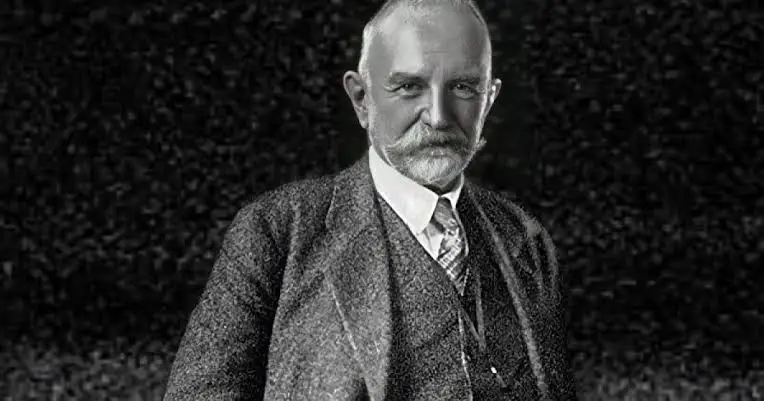
    George Herbert Mead (1863-1931) is a major figure in Philosophy and (along with Willam James and John Dewey), is one of the founders of Pragmatism, a philosophical approach based on experimentation. Mead published numerous articles during his lifetime and several of his students produced four books in his name from his unpublished notes and stenographic records of his courses at the University of Chicago. Through his teaching, writing, and posthumous publications, Mead has exercised a significant influence in 20th Century social theory. Mead’s theory of the emergence of mind and self out of the social process of significant communication has become the foundation of the symbolic interactionist school of thought in philosophy.

    George Herbert Mead is most well known for his theory of the self, which was presented in the 1934 book Mind, Self, and Society (published posthumously and edited by Charles W. Morris). Mead’s theory of personal identity maintains that the conception a person holds of themselves in their mind emerges from social interaction with others. This concept goes directly against the concept of biological determinism because it holds that an individual’s traits are not present at birth or fully present at the beginning of a social interaction, but are constructed and reconstructed in the process of social experience and activity.

    George Herbert Mead believed in interaction based on symbols and hypothesized that we do not know who we are until we interact with other people

    The self, according to Mead, is made of two components: the “I” and the “me.” The “me” represents the expectations and attitudes of others (the “generalized other”) organized into a social self. From this point, the individual defines their own behavior with reference to the generalized attitude of the social groups they occupy. When the individual can view himself or herself from the standpoint of the generalized other, self-consciousness in the full sense of the term is attained. From this standpoint, the generalized other (internalized in the “me”) is the major instrument of social control, for it is the mechanism by which the community exercises control over the conduct of its individual members. On the other hand, the “I” is the response to the “me,” or the person’s individuality.

    Within Mead’s theory, there are three activities through which the self is developed (language, play, and game). Language allows individuals to take on the “role of the other” and allows people to respond to his or her own gestures in terms of the symbolized attitudes of others. During play, individuals take on the roles of other people and pretend to be those other people in order to express the expectations of significant others. This process of role-playing is key to the generation of self-consciousness and to the general development of the self. In the game, the individual is required to internalize the roles of all others who are involved with him or her in the game and must comprehend the rules of the game.

    Mead theorized that human beings begin their understanding of the social world through “play” and “game”. The “play” stage comes first in the child’s development. The child takes different roles they observe in society and play them out to gain an understanding of the different social roles. As a result, the child learns to become both subject and object and begins to become able to build a self. However, this is a limited self because the child can only take the role of distinct and separate others and still lack a more general and organized sense of themselves. In the game stage, a person is required to develop a full sense of self. Whereas in the play stage the child takes on the role of distinct others, in the game stage, the child must take the role of everyone else involved in the game. Furthermore, these roles must have a definite relationship to one another.

    In the game stage, some form of social organization begins and defined personalities start to emerge. Individuals begin to become able to function in organized groups and determine what they will do within a specific group. Mead calls this the child’s first encounter with the “generalized other.” The “generalized other” can be thought of as understanding the given activity and the actors’ place within the activity from the perspective of all the others engaged in the activity. Through understanding the “generalized other” the individual understands what kind of behavior is expected and appropriate in different social settings.

    It has been argued that social acts (such as games and routine forms of social interaction) enable perspective taking through ‘position exchange’ Assuming that games and routine social acts have differentiated social positions and that these positions create our cognitive perspectives, then it might be that by moving between roles in a game, we come to learn about the perspective of the other. This new interpretation of Mead’s account of taking the perspective of the other has experimental support.

    In addition to his contributions in the realm of social philosophy, Mead is well known for his work on the philosophy of science. Mead sought to find the psychological origin of science in the efforts of individuals to attain power over their environment. The notion of a physical object arises out of a manipulatory experience. There is a social relation to inanimate objects, for the organism takes the role of things that it manipulates directly, or that it manipulates indirectly in perception. For example, in taking the resistant role of a solid object, an individual obtains cognition of what makes up nonliving things. Historically, the concept of the physical object arose from an animistic conception of the universe.

    Contact experience includes experiences of position, balance, and support, and these are used by the organism when it creates its conceptions of the physical world. Our scientific concepts of space, time, and mass are abstracted from manipulatory experience. Such concepts as that of the electron are also derived from manipulation. In developing a science we construct hypothetical objects in order to assist ourselves in controlling nature. The conception of the present as a distinct unit of experience, rather than as a process of becoming and disappearing, is devised to facilitate exact measurement. In the scientific worldview, immediate experience is replaced by theoretical constructs. The ultimate in experience, however, is the manipulation and contact at the completion of an act.

  • Immanuel Kant & Dentological Ethics

    Immanuel Kant & Dentological Ethics

    One of the most influential figures on Western philosophical thought was Immanuel Kant (1724-1804), a German philosopher active during the 18th Century. Kant’s contributions to the fields of metaphysics, epistemology, ethics, and aesthetics (four of the main branches of philosophy) have had a profound impact on almost every philosophical movement that followed him. Throughout his works, Kant argued that

    • the human mind creates the structure of human experience,
    • that reason is the source of morality,
    • that aesthetics arises from a faculty of disinterested judgment,
    • that space and time are forms of human sensibility,
    • and that the world as it is “in-itself” is independent of humanity’s concepts of it.

    In terms of politics, Kant was one of the earliest proponents of the idea that political peace and stability could be achieved through international cooperation and worldwide democracy and believed that such a situation would be the eventual outcome of universal history.

    One of the main areas in which Immanuel Kant left his mark on was in the realm of Deontological Ethics. Derived from the word deon (“duty” in Greek), this ethical theory holds that there is an innate aspect to a given moral rule that makes it either good or bad. Thus, Kantian/Deontological ethical theory is based on established definitions of morality. The main aspect of Kant’s theory was the Categorical Imperative.

    Immanuel Kant defined an imperative as any proposition that declares a certain action (or inaction) to be necessary. A hypothetical imperative would compel action in a given circumstance (if I wish to satisfy my thirst, then I must drink something). A categorical imperative would denote an absolute, unconditional requirement that exerts its authority in all circumstances, both required and justified as an end in itself.

    He argued that the “highest good” must be both intrinsically good (good “in itself”), and good without qualification (when the addition of that thing never makes a situation ethically worse). He concluded that there is only one thing that is truly good: a goodwill chosen out of a feeling of moral duty. From this concept of duty, Kant derived what he called a categorical imperative, a principle that is intrinsically valid (good in and of itself), and that must be obeyed in all situations and circumstances if our behavior is to observe moral laws. He considered it an unconditional obligation, regardless of our will or desires, and regardless of any consequences which might arise from the action. He also believed that if an action is not done with the motive of duty, then it is without moral value and therefore meaningless.

    Kant developed his moral philosophy in three works: “Groundwork of the Metaphysic of Morals” (1785), “Critique of Practical Reason” (1788) and “Metaphysics of Morals” (1797) and formulated it in three different ways :

    1. Act only in such a way that you would want your actions to become a universal law, applicable to everyone in a similar situation.
    2. Act in such a way that you always treat humanity (whether oneself or other), as both the means of an action, but also as an end.
    3. Act as though you were a law-making member (and also the king) of a hypothetical “kingdom of ends”, and therefore only in such a way that would harmonize with such a kingdom if those laws were binding on all others.

    The idea of Deontological Ethics as proposed by Immanuel Kant is not without its share of critics, in particular, proponents of Libertarian philosophy, as well as the idea of Utilitarianism are opposed to the theory. The Libertarian philosopher Robert Nozick points out that Deontology forbids some acts that maximize welfare overall. The example used is that of a trolley hurtling towards five innocent and immobile people at the end of a track, where the only way to stop the trolley and save the five is to throw one innocent bystander in front of the trolley. The Principle of Permissible Harm in Deontology rules out deliberately throwing a person in front of the trolley, but the consequence of that is that five innocent bystanders die (which also contravenes the Principle of Permissible Harm).

    Proponents of Utilitarianism such as Jeremy Bentham have criticized Deontology on the grounds that it a  version of popular morality, and that the objective and unchanging principles that deontologists attribute to natural law or universal reason are really just a matter of subjective opinion. John Stuart Mill argued that deontologists usually fail to specify which principles should take priority when rights and duties conflict, so that Deontology cannot offer complete moral guidance. Mill also criticized Kant’s claims for his Categorical Imperative, arguing that it is really just another way of saying that the ends justify the means, which is essentially a consequentialist argument.

  • What Is Philosophy?

    What Is Philosophy?

    Philosophy (literally meaning “love of wisdom” in Greek) is the study of general and fundamental queries concerning matters such as existence, knowledge, values, reason, mind, and language. The term was coined by Pythagoras of Samos (570–495 BCE), an early Greek philosopher known for his founding of the Pythagoreanism movement. Philosophical methods include questioning, critical thinking, rational argument, and systematic presentation of the evidence to back up any and all arguments. Classic philosophical questions include “is it possible to know anything and to prove it? and “what is most real? Philosophers also devise practical and concrete answers pertaining to questions such as the proper way to live one’s life, the nature and extent of free will, and how to be a moral and virtuous person.

    Metaphysics (Study of Existence)

    Metaphysics is the branch of philosophy responsible for the study of existence. It is the foundation of a worldview. It answers the question “What is?” It encompasses everything that exists, as well as the nature of existence itself. It says whether the world is real, or merely an illusion. It is a fundamental view of the world around us.

    One can argue that Metaphysics is the foundation of philosophy and critical thinking. Without an explanation or an interpretation of the world around us, we would be helpless to deal with reality. We could not feed ourselves, or act to preserve our lives. The degree to which our metaphysical worldview is correct is the degree to which we are able to comprehend the world and act accordingly. Without this firm foundation, all knowledge becomes suspect. Any flaw in our view of reality will make it more difficult to live.

    Ethics (Study of Action)

    Ethics is the branch of study dealing with what is the proper course of action for a person to take. It answers the question, “What do I do?” It is the study of right and wrong in human endeavors. At a more fundamental level, it is the method by which we categorize our values and pursue them. Do we pursue our own happiness, or do we sacrifice ourselves to a greater cause? Is that foundation of ethics based on the Bible, or on the very nature of man himself, or neither?

    Ethics is a requirement for human life. It is our means of deciding a course of action. Without it, our actions would be random and aimless. There would be no way to work towards a goal because there would be no way to pick between a limitless number of goals. Even with an ethical standard, we may be unable to pursue our goals with the possibility of success. To the degree in which a rational ethical standard is taken, we are able to correctly organize our goals and actions to accomplish our most important values. Any flaw in our ethics will reduce our ability to be successful in our endeavors.

    Aesthetics (Study of Art)

    Aesthetics is the study of art. It includes what art consists of, as well as the purpose behind it. Does art consist of music, literature, and painting? Or does it include a good engineering solution or a beautiful sunset? These are the questions that are asked in Aesthetics. It also studies methods of evaluating art and allows individuals to make judgments of the piece of art in question. Is art in the eye of the beholder? Does anything that appeals to an individual fit under the umbrella of art? Or does it have a specific nature? Does it accomplish a goal?

    Aesthetics is important because art in some form or another has existed through most of recorded human history. It is unique to humans because of our unique form of thinking. Its importance is based on this nature, specifically, man’s ability to abstract. Art is a little-understood tool of Man to bring meaning to abstract concepts. Aesthetics is important because it delves into the reason why art has always existed, the burning need of mankind through the ages to see the world in a different, clear way. It further evaluates art by the standard of human life, and whether it accomplishes the job of satisfying man’s intellectual needs, or whether it tends to hurt or make worse those needs.

    Epistemology (Study of Knowledge)

    Epistemology is the study of our method of acquiring knowledge. It answers the question, “How do we know?” It encompasses the nature of concepts, the construction of concepts, the validity of the senses, logical reasoning, as well as thoughts, ideas, memories, emotions, and all things mental. It is concerned with how our minds are related to reality, and whether these relationships are valid or invalid.

    Epistemology is an explanation of how we think. It is required in order to be able to differentiate the true from the false, by determining a proper method of evaluation. It is needed in order to use and obtain knowledge of the world around us. Without epistemology, we could not think. More specifically, we would have no reason to believe our thinking was productive or correct, as opposed to random images flashing before our minds. With an incorrect understanding of epistemology, we would not be able to distinguish truth from error. The consequences are obvious. The degree to which our epistemology is correct is the degree to which we could understand reality and the degree to which we could use that knowledge to promote our lives and goals. Flaws in epistemology will make it harder to accomplish anything.

    Logic (Study of Reasoning)

    Logic is the study of reasoning or the study of the principles and criteria of valid inference and demonstration. It attempts to distinguish good reasoning from bad reasoning. Logic investigates and classifies the structure of statements and arguments, both through the study of formal systems of inference and through the study of arguments in natural language. It deals only with propositions (declarative sentences) that are capable of being true and false. It is not concerned with the psychological processes connected with thought, or with emotions, images, and the like. It covers core topics such as the study of fallacies and paradoxes, as well as specialized analysis of reasoning using probability and arguments involving causality and argumentation theory.

    Any logical argument or statement should contain three of the following things:

    • consistency  (none of the theorems of the system contradict one another);
    • soundness (the system’s rules of proof will never allow a false inference from a true premise); and
    • completeness (which means that there are no true sentences in the system that cannot, at least in principle, be proved in the system).

    Logic can be divided into Formal Logic, Informal Logic, Symbolic Logic, and Mathematical Logic. Formal Logic is what we think of as traditional logic or philosophical logic, namely the study of inference with purely formal and explicit content  Informal Logic is a recent discipline which studies natural language arguments and attempts to develop a logic to assess, analyze and improve ordinary language (every day) reasoning. Symbolic Logic is the study of symbolic abstractions that capture the formal features of logical inference. It deals with the relations of symbols to each other, often using complex mathematical calculus, in an attempt to solve intractable problems that traditional formal logic is not able to address. Mathematical Logic is a type of formal logic that seeks to apply the principles of formal logic into the field of mathematics and mathematical reasoning.

    Philosophy itself can also be described as a sort of intellectual activity. As opposed to biology, political science, math, and history, philosophy itself does not consist of theories and information. Instead, philosophers came up with different theories that are the products of their unique perspectives on society and the nature of reality. The main point of understanding these theories is to facilitate students on their philosophical journey and learn to think critically about the world around them.

    The study of philosophy and pursuit of knowledge amounts to hard work. The pursuit of knowledge is considered hard work because it involves individuals questioning their long-held beliefs and leading someone into a direction that society generally does not support. Additionally, philosophy also requires individuals to think critically, consistently, and thoughtfully about their fundamental beliefs. Thinking critically about one’s own beliefs may result in an individual taking note of inconsistent thoughts that may be difficult to rationalize. Usually, the difficulties of understanding philosophy can also be made easier by the assistance of a teacher.

    The main goal of teaching philosophy is described as that of freedom. Due to the exposure to new ideas and beliefs, philosophy serves to eliminate narrow points of view and expand open-mindedness. Once an individual gains insight into different ideas and viewpoints, they will indeed be able to gain intellectual freedom and liberation from intellectual oppression. Philosophy is finally described as a tool that enables individuals to examine the most basic assumptions about life that they hold. On a daily basis, individuals make assumptions about the world around them and hold onto beliefs that they have held their entire life without even questioning them. However, the study of philosophy allows an individual to examine the assumptions that they held throughout their life. An examination of even the most basic of these assumptions can serve to open up a different perspective on life and allow individuals to understand how life works.

  • What is Politics?

    What is Politics?

    Politics (meaning “affairs of the cities” in Greek) is the process of making decisions that apply to members of a group. It refers to achieving and exercising positions of governance and is the study or practice of the distribution of power and resources within a given community. The idea of politics dates back to the Hellenistic period and has undergone many different interpretations over the ensuing centuries.

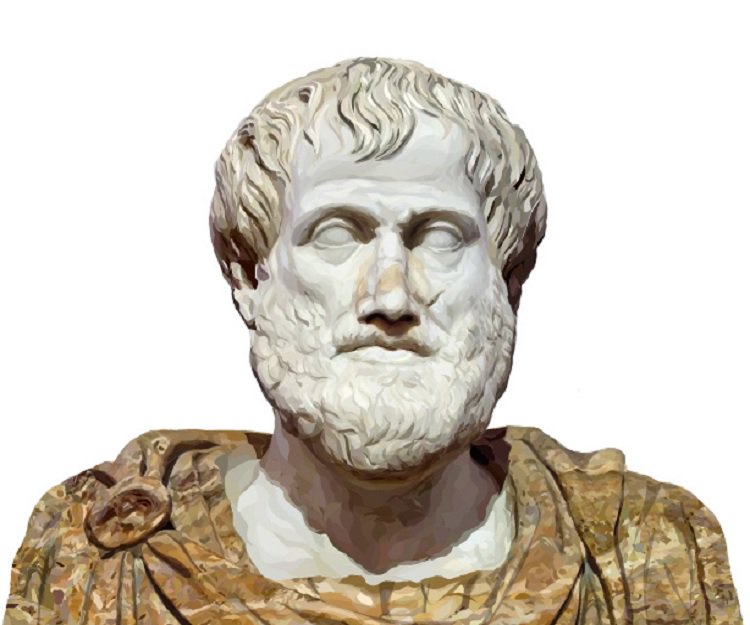
    Aristotle

    The Greek philosopher Aristotle was one of the founders of political theory and Western philosophy and felt that every action an individual takes is innately political in nature.

    Perhaps the earliest contributor to political theory was Aristotle (384-322 BCE),  a Greek philosopher, logician, and scientist. Along with  Plato, Aristotle is generally regarded as one of the founders of both Western philosophy and political science. Aristotle was born on the border between Greece and Albania to a family with close connections to the King of Macedon. As a young man, Aristotle studied in Plato’s Academy in Athens. After Plato’s death, he left Athens to conduct philosophical research and was eventually invited by King Philip II of Macedon to tutor his young son, Alexander the Great. Soon after Alexander succeeded his father, consolidated the conquest of the Greek city-states, and launched the invasion of the Persian Empire, Aristotle returned as a resident alien to Athens. During his time in Athens, he wrote, many different works including Politics and Nicomachean Ethics.

    In both Politics and Nicomachean Ethics, Aristotle described politics essentially as the study of values and ethics, what is right and wrong, and the study of what should be and what could be. He argued that any communication between two people revolves around those subjects and is thus political in nature. Additionally, Aristotle felt that politics is the master science because mankind is an innately political animal that engaged in politics through all of their actions, however unimportant or insignificant they may seem.

    Niccolò Machiavelli

    The 16th Century Italian philosopher Machiavelli believed that the government needed to use whatever means to ensure political peace and stability.

    The 16th Century Italian philosopher Niccolò Machiavelli (widely considered to be the founder of modern political theory) put forward an entirely different interpretation of the nature of political power. Born in the Italian city-state of Florence in 1469, Machiavelli witnesses the French Invasion of Italy in 1494 and the decline of the Medici family’s political power. Machiavelli became secretary of the Ten of War (the body that governed the military of Florence at the time) a post he held until 1512. In that capacity, he was employed in a great variety of missions and his dispatches during these journeys, and his treatises on the Affairs of France and Germany helped to shape his views on government. In 1519, Machiavelli was commissioned by Leo X to draw up his report on a reform of the state of Florence. In 1521-25 he was employed in diplomatic services and as historiographer. After the defeat of the French at Pavia (1525), Italy was helpless before the advancing forces of the Emperor Charles V and Machiavelli strove to avert from Florence the invading army on its way to Rome. In May 1527 the Florentines again drove out the Medici and proclaimed the republic, but Machiavelli, bitterly disappointed that he was to be allowed no part in the movement for liberty, died at the age of 58.

    The political theory of Macchiaveli is put forward in the book The Prince, which was published posthumously in 1532. Throughout The Prince, Machiavelli argued that politics is nothing more complicated than the study of power and that all means may be resorted to by political leaders to strengthen the political establishment and preserve authority. Without such authority and established order, Machiavelli argued that society would be weakened and that political peace and stability could never be established and maintained. Additionally, Macchiaveli noted that throughout history, organized religion and religious leaders such as the Pope tended to get in the way of political peace and stability and hindered the development of strong and stable societies. In order to address this predicament, Macchiaveli felt that there needed to be a separation of church and state and that secularism needed to be promoted by governments throughout the world.

    Harold Lasswell

    Harold Lasswell felt that politics was no more complicated than figuring out who gains what and what someone else loses.

    Harold Lasswell (1902-1978) was a leading American political scientist and communications theorist. He received his Ph.D. from the University of Chicago in 1926 and studied at the Universities of London, Geneva, Paris, and Berlin during the 1920s. Lasswell taught political science at the University of Chicago for 16 years (1922-1938) and was director of war communications research for Library of Congress from 1939-1945. After World War II, he went to Yale University, where he served until the 1970s in various capacities such as professor of law, professor of political science, and Ford Foundation Professor of Law and Social Sciences. He was also a professor of law at John Jay College of the City University of New York and at Temple University and was president of the American Political Science Association (APSA), the American Society of International Law, and the World Academy of Art and Science (WAAS). Lasswell is described as a “one-man university” whose “competence in, and contributions to, anthropology, communications, economics, law, philosophy, psychology, psychiatry, and sociology are enough to make him a political scientist in the model of classical Greece.”

    Harold Lasswell viewed political science as the study of changes in the distribution of value patterns in society, and, because distribution depends on power, the focal point of his analysis was power dynamics. He defined values as desired goals and power as the ability to participate in decisions, and he conceived political power as the ability to produce intended effects on other people. In his 1936 book Politics: Who Gets What, When, and How, Lasswell viewed the power elite as the primary holders of power and nearly all political systems and that their opinions and actions influenced nearly all forms of public policy implemented at all levels of government.

    Jeff Stonecash

    Jeff Stonecash argued that politics is an all-encompassing term that includes the study of opportunities, individual responsibilities, beliefs and the role of government in making those things possible.

    Jeff Stonecash (1946-Present) is the Emeritus Maxwell Professor of Political Science at Syracuse University and one of the foremost experts on the American political system. Some of the topics that Stonecash has written about over the past four decades include the history of American political parties, the realignment of their electoral bases, the causes of political polarization, and the impact of changing alignments on the nature of policy debates. Stonecash argued that politics is simply the study of opportunities, individual responsibilities, beliefs and the role of government at all levels in making such things possible.

    Is Politics a Science?
    One of the main debates amongst scholars is whether or not political science can be considered an actual form of science much like biology, chemistry, or physics. Some argue that political science is not an actual form of science because it deals with concepts that are not tangible and relies on theoretical assumptions that are oftentimes difficult to measure and record. Despite this view, the case can be made that Political science is indeed a form of science because every new political theory involves testing, measuring, and repetition (key components of the scientific method) in order to test its validity.

    Political Scientist Vs. Politicians
    Politicians tend to seek quick answers in order to appeal to their votes prior to the next election, while political scientists tend to put forward measured and well-thought-out answers to policy questions. Additionally, Politicians usually hold firm in their views in order to appeal to their voter base and keep in tune with their ideologies. Political scientists, on the other hand, reach tentative conclusions once they gain an understanding of the facts behind a political issue. Politicians also seek out ways to expand their popularity and improve their chances of getting re-elected, while political scientists seek accuracy and measured responses in their works.

  • Bertrand Russell & “Appearance and Reality”

    Bertrand Russell & “Appearance and Reality”

    One of the most well-known and influential philosophers of the 20th Century was Bertrand Russell (1872-1970). Bertrand Russell was a British philosopher, logician, essayist and social critic best known for his work in mathematical logic and analytic philosophy. His most influential contributions include his championing of logicism, refining Gottlob Frege’s predicate calculus, a strong defense of neutral monism, and his theories of definite descriptions, logical atomism and logical types. Russell is recognized as one of the main founders of modern analytic philosophy. His works on Type Theory and contributions with A.N. Whitehead on Principia Mathematica reinvigorated the study of logic throughout the twentieth century. Over the course of a long career, Russell made significant contributions to a broad range of topics such as ethics, politics, educational theory, the history of ideas, and the philosophy of religion. Russell was awarded the Order of Merit in 1949 and the Nobel Prize for Literature in 1950. Noted for anti-nuclear protests and for campaigns against western involvement in the Vietnam War, Russell remained a prominent public figure in both the philosophical and peace movements until his death at the age of 98.

    In his 1912 book “The Problems of Philosophy,” Bertrand Russell attempts to create a brief and accessible guide to problems found within philosophy. Focusing on problems he believes will lead to constructive discussion, Russell concentrates on knowledge rather than metaphysics and explores philosophical questions from a logical position. Russell begins by asking the reader to consider what knowledge exists that can be known beyond reasonable doubt. His purpose is to produce the realization that radical doubt brings even the most self-evident assumptions in our everyday lives under reconsideration. Russell describes a scene in which he is sitting in a chair at a table on which are papers with writing on them. All of these “facts” are easily called into question. Russell engages in this discussion to find out how knowledge of such things is possible at all.

    In order examine the issue in question, Russell concentrates on the table before him. Walking around the table, he notes different colors from different points of view. Russell notes the difference in color throughout the table, the change in color when lighting is removed or adjusted, the alteration of color as one move around the table, or the different color reported by a color-blind person. The same could be done with the claims about a table’s texture. If one asserts the table is smooth, one could look through a microscope and see the hills and valleys in the grain and rough textures caused by variations in the composition of the wood.

    For Russell, as one digs down and tests these statements, one becomes aware of the difference between appearance (how things seemed), and reality (how things are discovered to be). As one continues to dig and discredit appearances, the questions arise is there a table at all, and if there is, what sort of object it is. Russell suggests that our common existential assertions about the table are really about sense-data. Our immediate awareness of the data is formed through our senses. While this data is sensed, we might doubt whether there is something, a reality or “matter” behind the data that we sense. While mainstream science during the height of Bertrand Russel’s career viewed matter as “a vast collection of electric charges in violent motion,” Russell treats matter in a more general way, which is anything that is “behind” the sense-data.

    For if matter is treated as something opposed to mind that occupies space, there have been several parties that historically have disagreed. For example, the Irish philosopher George Berkely (1685-1753) maintained that the sense-data does stand for some outside reality. Berkely believed this is necessary to explain how we know the outside world. Berkely supposed that if the reality of the table was drastically different from its appearance it could not be known. The ideas responsible for our sensation of sense-datum linger even when we are not present.

    Russell observes that in absolute idealism Berkeley’s concept of the all-perceiving mind of God is secularized into the collective mind of the universe. Russell summarizes the general idealist argument for an exclusively mental reality as “‘Whatever can be thought of is an idea in a thinker’s mind; therefore nothing can be thought of except ideas in minds; therefore anything else is inconceivable, and what is inconceivable cannot exist.” Russell rejects this argument but points out that idealism is not so radical about the question between appearance and reality. We can doubt the existence of a non-mental reality outside of appearance, but we might also doubt any sort of reality altogether (matter in the more general sense). Russell’s argument also begs the question of if reality is not the same as appearance, do we have any means of knowing whether there is an independent reality? And if so, are there any means of knowing what that reality is actually like?
  • Ockham’s Razor

    Ockham’s Razor

    Ockham’s Razor is a well-known concept within philosophy and logic. It stipulates that in trying to understand something and to determine the solution to a given problem, getting any unnecessary information out of the way is the fastest way to determine the truth or to find out the best explanation.

    The originator of the concept was William of Ockham (1285-1349), an English Franciscan friar, philosopher, and theologian. Ockham spent most of his life developing a philosophical concept that reconciled religious belief with demonstratable, generally experienced truth, mainly by separating the two from each other.

    Getting any unnecessary information out of the way is the fastest way to determine the truth or to find out the best explanation.

    Where earlier philosophers attempted to justify God’s existence with physical proof, Ockham declared religious belief to be incapable of such proof and a matter of faith. He rejected the notions preserved from Classical times of the independent existence of qualities such as truth, hardness, and durability and said these ideas had value only as descriptions of particular objects and were really characteristics of human cognition.

  • Ayn Rand: Capitalism and Objectivism Manifested in Atlas Shrugged

    Ayn Rand: Capitalism and Objectivism Manifested in Atlas Shrugged

    One of the most significant political theories of the 20th Century is Ayn Rands Objectivism. Rand is known for promoting the philosophical idea of objectivism. She defines objectivism as a philosophy that emphasizes personal freedom, individuality, and rational egoism. Her anthology of fiction books describes the political theory of Objectivism through the actions and speeches of the main characters. Her additional non-fiction works continue to explore that political and social philosophy. Rand was influenced by a number of theorists such as Aristotle and writers including Victor Hugo and Edmond Rostand. Objectivism is a controversial political theory and has been criticized by academic philosophers due to its view on the role of government and human nature. On the other hand, the popularity of Rand’s work continues to grow and has an influence on political thought to this very day. Rand was born as Alissa Rosenbaum in 1905 in St. Petersburg to a middle-class Jewish family. From a young age, she expressed great ambition and an interest in pursuing a career in writing. A singular event that occurred in her early years was the 1917 Russian Revolution, in which the country transitioned almost immediately from a monarchy into a Communist state. She had numerous experiences in Soviet Russia that helped to mold her sociopolitical beliefs. For example, the nationalization of her father’s chemistry shop transitioned her family from relative affluence to poverty. Despite the loss of her family’s assets under the Soviet regime, she was able to attend university and graduate with a degree in history. Changing her name from Alissa Rosenbaum to Ayn Rand, she left the Soviet Union for the United States in 1926 to pursue her dream of becoming a screenwriter. Over the succeeding years, Rand found success first as a screenwriter, and eventually as a playwright and author.
    d08bdddb63a8ab305bd8aa8174d5f6d2
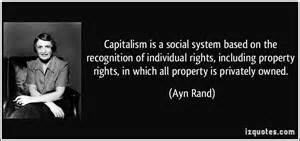
    Ayn Rand c. 1930s
    An important factor that influenced Rand’s writings over the course of her life was her personal experience in numerous political eras. From monarchy in Russia, to the transition to the Soviet Union, to Great Depression era America, her youth was characterized by many stark contrasts in political and economic systems. Rand’s writings against communism were influenced by what she observed and she wrote numerous works outlining Objectivist theory throughout World War II and the early Cold War era. In response to the Cold War and the threat of Communism spreading worldwide, Rand cautioned against the belief of collectivism in books such as The Fountainhead and Atlas Shrugged. Both The Fountainhead and Atlas Shrugged are fictional works that promote the belief in personal freedom and rationality, and speak out against the spread of Communism and Socialism. Ayn Rand personally cites Aristotle as one of her primary influences. Aristotle was a Greek logician, philosopher, and scientist as well as one of the founders of western political theory. Rand explains, “it is not the special sciences that teach man to think; it is philosophy that lays down the epistemological criteria of all special sciences.” Just as Ayn Rand believed that science was one of the most important values of society, Aristotle argued that politics is the master science because mankind is a political animal. As Aristotle believed in “biology expressed in the naturalism of politics,” his concept of morality and the world aligned with Rand’s concepts of philosophy and politics being inextricably tied to science. Similarly, Aristotle argued that mankind engaged in politics through all of its actions. Rand believed that each person acts as an individual to create the political society that exists. If each individual acts according to the principles and morals of Objectivism, such as those of rational thought and the execution of free will, sociopolitical order will naturally emerge. Aristotle contends that politics is the study of values, ethics, what is right and wrong, what should be, and what could be. Despite the fact that Rand cited Aristotle as one of her primary influences, their views on the ideal form of government were dissimilar. For example, Aristotle viewed democracy as flawed because it resulted in competition between social classes and felt that the proper form of government consisted of its leaders governing with the common interest of all its people in mind as opposed to governing based on individual interests. Additionally, Aristotle felt that a key role of the government would be to provide for and promote the public good and explored the idea of the organic theory of the state throughout his works. The organic theory of the state theory stipulates that the power and authority of the state transcends the power of the individual. On the contrary, Rand believed that the role of government would be limited to protecting individual rights and serving as an agent for people’s self-defense. A government that promoted the opposite values, according to Rand, has no justification and is the primary threat to the structure and nature of human society. One of the major values of Objectivism is a belief in rational egoism. Objectivism believes in the “concept of man as a heroic being, with his own happiness as the moral purpose of his life, with productive achievement as his noblest activity, and reason as his only absolute.” With this, Ayn Rand is saying there is no more important moral goal in Objectivism than that of achieving happiness. Achieving happiness, according to Objectivists, requires rational respect for the facts of reality, including those regarding human nature and our own needs. In order to achieve such goals, Rand argues that people must behave in a way that conforms to “rational egoism,” in which the promotion of one’s self-interest is in accordance with that of reason. Rand further promotes the logic of this theory in The Virtues of Selfishness. Rand argues that selfishness is a proper value to pursue and rejects the idea of altruism, the belief that self-sacrifice is a moral ideal to pursue. Additionally, Rand rejects the idea of “selfless selfishness” of irrationally acting individuals and instead argues that to be ethically selfish entails a commitment to reason rather than to emotionally driven whims and instincts. writer-ayn-rand-quotes-sayings-wise-deep-reality In addition, Objectivism promotes a unique view on the nature of reality and views knowledge and reason as important aspects in society. Objectivism holds that “reality exists as an objective absolute—facts are facts, independent of man’s feelings, wishes, hopes or fears.” Rand’s Objectivism begins with three self-evident concepts: existence, consciousness, and identity. All three truths are interconnected and exist simultaneously. Ayn Rand goes on to further explain that anything that is metaphysically given is absolute and cannot be changed. Objectivism holds that all knowledge is reached through reason, the “faculty that identifies and integrates the material provided by man’s senses.” This view of reason in an Objectivist society was further exhibited by the main characters and themes in Rand’s 1957 novel Atlas Shrugged. The work dramatizes the idea that the reasoning mind is the basic source of the values on which human life depends. Furthermore, Rand supported a belief in secularism through Objectivism and also promoted a distinct purpose of morality. Objectivism is a purely secular ideology that views the role of religion as having a negative influence on reason and capitalism. The purpose of morality under Objectivist thought is to allow people to enjoy their own lives. This belief is further exemplified by John Galt, the embodiment of Objectivism in Rand’s Atlas Shrugged, when he said, “The purpose of morality is to teach you, not to suffer and die, but to enjoy yourself and live.” Rand felt that religion is an “ideology that opposes man’s enjoyment of his life on earth” and thus, in violation of the key principles expressed though Objectivism. Objectivism rejects both mysticism (the idea that knowledge can be acquired through non-rational means) and skepticism (the belief that knowledge is impossible and cannot be acquired by any means). Objectivism also teaches us that a harmony of interests exists among rational individuals, so that no one’s benefit will come at the expense of another’s. As such, a life of mutual respect and benevolent independence is possible through Objectivism. Objectivism includes several suggestions as to what constitutes a proper society. One such element is the support for individual rights and freedom from coercion. The ethics of Objectivism hold that each person can live and flourish through the free exercise of his or her rational mind. Unless faced with threats of coercion or force, it is essential for people to exercise their own free will. The threat of force makes people accept someone else’s dictates, rather than follow their own judgment. Rand argues that certain societies, such as that of the Soviet Union, and certain ideologies, such as communism, are doomed to failure due to the lack of individual rights and the use of coercion to limit freedoms. Rand further argues that “freedom, in a political context, has only one meaning: the absence of physical coercion” and that societies must secure the principle that no one has the right to use physical force or coercion against any other. In “Capitalism: An Unknown Ideal,” Rand states, “government is the most dangerous threat to man’s rights: it holds a legal monopoly on the use of physical force against legally disarmed victims.” Objectivism calls for a limited form of government and promotes the belief that an excessive government is a threat to individual freedom. Additionally, Rand argues that the government also has a role in defending its people from foreign enemies, providing a system for arbitration of disputes, and developing a system for enforcement of the law. Objectivism also argues that the main source of government power comes from “the consent of the governed,” which means that the only rights that the government has are delegated to it by the citizens for a specific purpose. th Objectivism considers Capitalism to be a proper political economy. Rand considered capitalism in its purest form to be a social system characterized by individual freedom and diversity. Additionally, she felt that Capitalism was an egalitarian system that treated all people as individuals with no regard to ethnic, religious, or other collective principles enshrined by law. Moreover, Objectivism, like Capitalism, is a social system based on the recognition of individual private property rights. Objectivism expresses the belief that respect for property rights is key in the development of a capitalist economic system and as a way to ensure the upholding of individual rights and economic freedoms. Property rights are important to Objectivists because they ensure that people can keep what they earn. As Objectivism emphasizes production and creation, the property acquired through hard work is the most essential representation of the exercise of free will. Rand states that, “without property rights, there is no way to solve or to avoid a hopeless chaos of clashing views, interests, demands, desires, and whims.” Not everyone, however, is fully receptive to Rand’s ideas on morality. While she does have a large following, there are numerous critics of her somewhat rigid interpretation of social values. One of the main points of criticism is her influence as a moral and political philosopher. For example, it has been claimed that the ideas expressed by Rand throughout her works are not important in the realm of philosophy and did not constitute and groundbreaking ideas. Furthermore, Rand’s view on ethics is also criticized, in particular, her defense of the morality of selfishness. The view on politics that Rand expressed in Objectivist theory is also criticized by some of ignoring the central role that government often plays in society. In conclusion, Ayn Rand is one of the most influential political theorists of the 20th Century. Rand is known for developing the philosophy of Objectivism, which promotes the ideals of rational egoism, individual liberty, reason and knowledge, and secular values. Rand has expressed the idea of Objectivism through numerous writings, in fiction and non-fiction alike. Moreover, Rand’s views on sociopolitical issues were influenced by past experiences growing up in Soviet Russia and her early adult years in Depression-era America. Rand’s political philosophy still remains significant to this very day and her works continue to retain mainstream popularity. Sources: Ayn Rand , “Introducing Objectivism,” The Objectivist Newsletter Vol. 1 No. 8, August 1962, p. 35 Ayn Rand “Faith and Force: The Destroyers of the Modern World,” in Philosophy, Who Needs It? p. 62. Bell-Villad, Gene H. “Who Was Ayn Rand?” Salmagundi 141/142 (n.d.): 227-42. Miller, Fred. “Aristotle’s Political Theory.” Stanford University. 1998. Accessed February 24, 2016. Biddle, Craig. “Atlas Shrugged and Ayn Rand’s Morality of Egoism.” The Objective Standard 7, no. 2 (Summer 2012).