Tag: obamacare

  • OurWeek in Politics (March 19, 2019-March 26, 2019)

    Here are the main events that occurred in Politics this week:

    1. The Long-Awaited Mueller Report Is Released, Finding No Direct Evidence of Trump-Russia Collusion in the 2016 Election

    The log-awaited Mueller report was released this week, finding no direct evidence of collusion between President Donald Trump’s 2016 Campaign and the Russian government.

    The two-year long investigation led by Robert Mueller found no evidence that President Donald Trump or any of his aides coordinated with the Russian government’s 2016 election interference, according to a summary of the special counsel’s key findings made public on March 24. Mueller, who spent nearly two years investigating Russia’s effort to sabotage the 2016 Presidential Election, found no conspiracy “despite multiple offers from Russian-affiliated individuals to assist the Trump campaign,” Barr wrote in a letter to lawmakers. Mueller’s team drew no conclusions about whether President Trump illegally obstructed justice, Barr said, so he made his own decision. The Attorney General and his deputy, Rod Rosenstein, determined that the special counsel’s investigators had insufficient evidence to establish that the president committed that offense. Attorney General Barr cautioned, however, that Mueller’s report states that “while this report does not conclude that the president committed a crime, it also does not exonerate him” on the obstruction of justice issue.

    The release of the findings was a significant political victory for President Donald Trump and lifted a cloud that has hung over his Presidency since before he took the oath of office. It is also likely to alter discussion in Congress about the fate of the Trump presidency, as some Democrats had pledged to wait until the special counsel finished his work before deciding whether to initiate impeachment proceedings. President Trump and his supporters trumpeted the news almost immediately, even as they mischaracterized the special counsel’s findings. “It was a complete and total exoneration,” Trump told reporters in Florida before boarding Air Force One. “It’s a shame that our country had to go through this. To be honest, it’s a shame that your president has had to go through this.” Trump added, “This was an illegal takedown that failed.”

    Attorney General William Barr’s letter was the culmination of a tense two days since Robert Mueller delivered his report to the Justice Department. Barr spent the weekend poring over the special counsel’s work, as President Donald Trump strategized with lawyers and political aides. Hours later, Barr delivered his letter describing the special counsel’s findings to Congress. Barr’s letter said that his “goal and intent” was to release as much of the Mueller report as possible, but warned that some of the reports were based on grand jury material that “by law cannot be made public.” Barr planned at a later date to send lawmakers the detailed summary of Mueller’s full report that the attorney general is required under law to deliver to Capitol Hill. Despite the comprehensive nature of the report on the Mueller investigation, many Congressional Democrats expressed concern regarding its findings. For example, shortly after the release of the Mueller findings, Congressman Jerrold Nadler (D-NY), the chairman of the House Judiciary Committee, said in a Twitter post that he planned to call Barr to testify about what he said were “very concerning discrepancies and final decision making at the Justice Department.”

    2. Trump recognizes Golan Heights as Israeli Territory
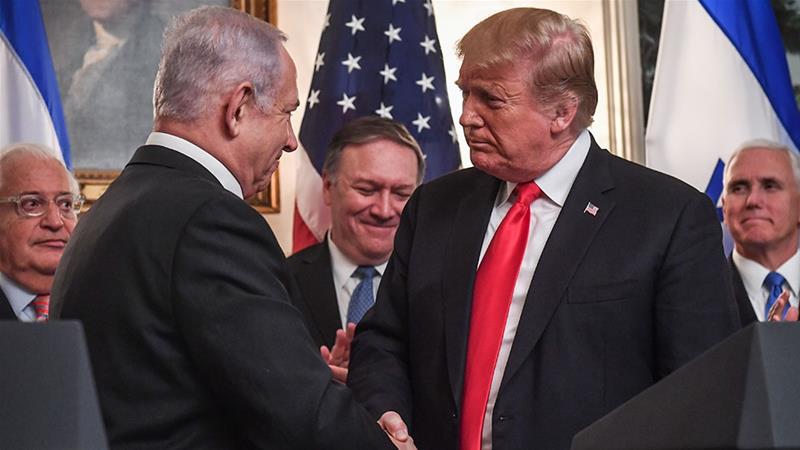
    In a widely-denounced move, President Donald Trump recognized Israeli control over the Golan Heights on March 25.

    On March 25, US President Donald Trump recognized Israel’s 1981 annexation of the Golan Heights in an election boost for Israeli Prime Minister Benjamin Netanyahu, prompting a sharp response from Syria and Lebanon, which once held the strategic land. With Netanyahu looking over his shoulder at the White House, President Trump signed a proclamation officially granting US recognition of the Golan Heights as Israeli territory, a dramatic shift from decades of US policy. The move, which Trump announced in a Twitter post last Thursday, appeared to be the most overt gesture by the Republican Party to help Netanyahu, who had been pressing Trump for the move since February 2017. Israel captured the Golan in the 1967 Six-Day War and annexed it in 1981 in a move condemned by the UN. In signing the proclamation, President Donald Trump said that, “This was a long time in the making.” Netanyahu welcomed Trump’s action and said Israel had never had a better friend as US President. Additionally, Netanyahu harkened back to the 1967 Six-Day War and the 1973 Yom Kippur War in justifying Israel’s need to hang on to the Golan. “Just as Israel stood tall in 1967, just as it stood tall in 1973, Israel stands tall today. We hold the high ground and we should never give it up,” he said.

    Overall, the international reaction to President Donald Trump’s recognition of the Golan Heights as Israeli Territory was overwlmingly negative. Both Syria and Lebanon reacted swiftly to Trump’s proclamation, calling it a “blatant attack” on their sovereignty and territorial integrity and saying it had a right to reclaim the Golan. Palestinian President Mahmoud Abbas, who has refused to talk to the United States since Trump ordered the U.S. embassy moved from Tel Aviv to Jerusalem, expressed his “absolute rejection” of the Golan move in a statement issued by the Palestinian Authority news service Wafa. “The presidency reaffirmed that sovereignty is not decided by either the US or Israel no matter how long the occupation lasts,” the statement said. Moreover, Iranian President Hassan Rouhani harshly criticized President Donald Trump for recognizing the Golan Heights as part of Israel and said the move was against international law. “No one could imagine that a person in America comes and gives the land of a nation to another occupying country, against international laws and conventions. Such action is unprecedented in the current century,” Rouhani said in a statement. Additionally, several staunch allies of the US and Israel including France, the UK, Germany, and Saudi Arabia similarly condemned President Trump’s Actions.

    3. Trump Administration Announces Support for Judicial Efforts to Overturn Obamacare

    The Trump Administration announced its intention to convince the courts to overturn the Affordable Car Act (“Obamacare”) on March 25.

    In a significant shift, the Trump Administration says that it backs a full invalidation of the Affordable Care Act (“Obamacare“), the signature Obama-era health law. The Justice Department presented its position in a legal filing on March 25 with the US Court of Appeals for the 5th Circuit in New Orleans, where an appeal is pending in a case challenging the measure’s constitutionality. A federal judge in Texas ruled in December that the law’s individual mandate “can no longer be sustained as an exercise of Congress’s tax power” and further found that the remaining portions of the law are void. He based his judgment on changes to the nation’s tax laws made by Congressional Republicans in 2017.

    If the Trump Administration’s position prevails, it would potentially eliminate health care for millions of people and disrupt the US health-care system, from removing no-charge preventive services for older Americans on Medicare to voiding the expansion of Medicaid in most states. A court victory would also fulfill Republican promises to undo a prized domestic accomplishment of the previous administration but leave no substitute in place.

    The change comes as newly empowered Democrats in the House have vowed to protect Obamacare from Republican attacks. In midterm races last fall that restored their majority in the House of Representatives, Democrats hammered their rivals for pursuing an eight-year crusade against the law, commonly known as Obamacare. House Speaker Nancy Pelosi (D-CA) pledged in a Twitter post on March 25 that Democrats would “fight relentlessly” to preserve “affordable, dependable health care.” “Trump and his administration are trying to take health care away from tens of millions of Americans,” warned Senator Kamala Harris (D-CA), who is among the Democratic aspirants who have signaled support for a Medicare-for-all system. In 2020, Harris added, “we need to elect a president who will make health care a right.”

    4. Senate Blocks “Green New Deal” in Partisan Vote

    The Senate this week blocked a vote on the “Green New Deal,” a progressive climate change legislative program championed by Congresswoman Alexandra Ocasio-Cortes and Senator Ed Markey

    On March 26, the Senate blocked the Green New Deal, a progressive climate change resolution that Republicans view as prime fodder heading into the 2020 presidential election. The Senate voted 0-57 on taking up the resolution, with 43 Democrats voting present. The measure was widely expected to fall short of the 60 votes needed to overcome the procedural hurdle. Most Democrats were expected to vote present, a move that allowed them to avoid taking a formal position. Senators Joe Manchin (D-WV), Kyrsten Sinema (D-AZ), Doug Jones (D-AL) and Angus King (I-ME) voted with Republicans against the measure. Republicans have seized on the measure as an example of Democrats shifting to the left ahead of next year’s presidential election. Every Democratic senator running for the party’s nomination in 2020 has co-sponsored the Senate Green New Deal resolution.

    Senate Majority Leader Mitch McConnell (R-KY) lashed out at the proposal ahead of the vote on Tuesday, calling it an item on the “far-left wish list that many of our Democratic colleagues have rushed to embrace.” “The American people will see, they will see which of their senators can do the common sense thing and vote no on this destructive socialist daydream. And they will see which senators are so fully committed to a radical left-wing ideology that they can’t even vote no on self-inflicted economic ruin,” he said. The resolution, introduced last month by Congressman Alexandria Ocasio-Cortez (D-NY) and Senator Ed Markey (D-MA), strives for net-zero greenhouse gas emissions in the United States while creating millions of “good, high-wage jobs.” It faced pushback from conservatives as well as some Democrats for being too broad and including wishlist items not directly related to climate change, like expanding family farming and transitioning away from air travel.

    Leading into March 26’s vote, Democrats accused Senate Majority Leader Mitch McConnell of trying to set up a “gotcha” vote since no hearings were held on the fast-tracked legislation, which was widely expected to fail to get the 60 votes needed to ultimately pass the Senate. Speaking at a rally early on March 26, Senator Markey blasted Republicans for putting on a “sham vote.” “They are calling a vote without hearings, without expert testimony, without any true discussion of the costs of climate inaction and the massive potential for clean energy job creation in our country. And that is because Senator McConnell wants to sabotage the call for climate action,” Markey said. Senate Minority Leader Chuck Schumer (D-NY) added that Republicans were making “a mockery of the legislative process” by bringing the Green New Deal resolution up for a vote just to have the Senate vote it down. “Republicans want to force this political stunt to distract from the fact that they neither have a plan nor a sense of urgency to deal with the threat of climate change. … It’s a political act. It’s a political stunt,” Schumer said.

  • Analysis of the Patient Protection and Affordable Care Act (“Obamacare”)

    Analysis of the Patient Protection and Affordable Care Act (“Obamacare”)

    One of the most influential pieces of legislation in recent memory is the Patient Protection and Affordable Care Act, colloquially known as “Obamacare.” Ever since President Obama signed the PPACA into law in 2010, there has been much debate over the planning and execution of the law as well as controversy about its effectiveness. Proponents of the PPACA argue that it will gradually lower health care costs, expand preventative health care measures, make health care coverage more universal and improve the economy in the long term. On the other hand, opponents of the PPACA contend that the law will instead increase healthcare costs, negatively affect economic growth, eliminate patient choice and also be proven unconstitutional. In addition, some opponents feel the law is not comprehensive enough and will do little to create any lasting reform in a broken healthcare system. Support for the Act is also divided on the political spectrum, with Democrats generally backing the Act and Republicans nearly universal in their skepticism towards it. This controversy between the two sides has provoked both support and backlash, but the effectiveness of the Act is still being measured.

    Before the PPACA was enacted, the U.S. healthcare system had numerous flaws. Insurance providers were almost universally privatized. Healthcare premiums were rising exponentially. There existed frequent discrimination and restrictions on people with preexisting conditions, as well as a lack of oversight and regulation in the healthcare industry overall. In response to those issues, President Obama campaigned on a platform of reform of the healthcare system. In a speech before Congress in February 2009, Obama cited the issue of the “crushing costs of healthcare” and the effects of this problem on individual Americans, including bankruptcy and the loss of property. Additionally, Obama stated the issue of rising healthcare costs result in small businesses closing, increased outsourcing of jobs and the stagnation of wages. The Act was initially proposed with a “public option” that would address these issues. Numerous reactions immediately took place with protesters denouncing the Act as “socialized medicine” and supporters likewise embracing its potential. After much debate, the bill was finally passed on December 24, 2009, and signed into law on March 23, 2010.

    The PPACA is relatively large in scope and contains several different provisions.
    The PPACA is relatively large in scope and contains several different provisions.

    The scope and size of the Act are wide-reaching and it has several major provisions. One major requirement of the PPACA is the implementation of health insurance exchanges that are meant to allow people without health insurance provided by their employers to purchase plans from a wide array of providers. This also allows for employers with 100 or fewer workers to purchase plans. These health insurance exchanges are either run by the individual states, the federal government, or by state-federal partnerships. In addition, the federal government provides subsidies and tax credits in order to reduce premiums and out-of-pocket expenses for lower and middle-income individuals. The rationale behind the establishment of these health insurance exchanges is to reduce the overall cost of health insurance and increase the number of individuals with coverage.

    Another key provision in the PPACA is the banning of discrimination by insurance companies on patients with pre-existing medical conditions. At first, the provisions only covered children with pre-existing conditions, but the requirements came into effect for adults in 2014. Prior to the passage of the Act, insurance providers routinely discriminated against individuals with pre-existing conditions and either denied them insurance coverage or charged them higher premiums. In addition, all existing or new insurance plans have to cover dependent children of policyholders until the age of 26.

    The loosening of medicaid eligibility requirements is a another key aspect of the PPACA.
    The loosening of medicaid eligibility requirements is a another key aspect of the PPACA.

    Another provision of the PPACA is the loosening of Medicaid eligibility requirements and the reduction and ultimate closing of the Medicare prescription drug coverage gap. Under the current policy, Medicare patients have to pay out of pocket for a portion of the cost of their prescription drugs. The eligibility provisions for the Medicaid program were revised to cover anyone who earns less than 133% of the poverty line. The Act also stipulates that the federal government would pay 100% of the cost of the new enrollees until 2016 and then gradually shift more of the cost onto the states. In addition, the Act reduces the coverage gap in the Medicare part D prescription drug plan (known as the “donut hole”) gradually by 2020.

    A major aspect of the PPACA is the individual mandate component of the law. The individual mandate requires all U.S. citizens to purchase basic health care coverage or face fines and additional penalties. The main penalty, if one does not purchase health care insurance, is a tax that can vary from $695 to $2,085 per year, per family. The tax is to be gradually phased in over a 3 year period and is to be increased annually due to the cost-of-living adjustment. In addition, businesses with 50 or more employees will be charged a penalty beginning in 2014 if they do not offer healthcare benefits to their employees.

    Federal funding finances the PPACA through several payment systems. The Act mandates that an excise tax will be levied on the most expensive employer-sponsored healthcare plans and the Medicare payroll tax for higher-income workers will be increased. The PPACA has imposed several restrictions as to what is covered as well. Federal funding of all abortions with the exception of rape or incest are prevented through the inclusion of the Stupak–Pitts Amendment. In addition, illegal immigrants are prohibited from purchasing coverage through the health care exchange programs.

    President Obama is a major proponent of the PPACA and argues that it will result in lower healthcare costs and increased healthcare access.
    President Obama is a major proponent of the PPACA and argues that it will result in lower healthcare costs and increased health care access.

    Proponents of the PPACA argue that the law will help to reduce healthcare costs overall. In a November 5, 2014, press conference, President Obama indicated that “health care inflation has gone down each year since the Affordable Care Act was passed” and that “we now have the lowest healthcare costs in 50 years.” Some articles have found this claim to be exaggerated, as in reality, healthcare spending growth rates have slowed down but not actually decreased. A recent study by the Centers for Medicare and Medicaid services stated that U.S. healthcare spending will be $500 Billion less in 2019 than was originally projected by the Congressional Budget Authority (CBO) in 2010. In addition, the study also stated that the lowering of total healthcare spending would have a positive effect on the U.S. fiscal situation and would prolong the life of the Medicare trust fund for an additional 4 years. The data gathered by both agencies gives credence to the original claim that the Act would be cost-effective and help to slow down the ever-increasing growth in the overall cost of healthcare.

    Another argument used by Proponents of the PPACA is that the law will increase the number of people who have basic health insurance and, in turn, make coverage more universal. One of the major provisions of the Act is to increase the access to healthcare insurance and reduce the number of uninsured citizens. According to the Urban Institute’s Health Reform Monitoring Survey, the number of uninsured Americans declined by 2.7 percent from the time the first enrollment period into the healthcare exchange began in September 2013 through March 2014. In addition, the percentage of people who are uninsured is higher in states that had rejected the Medicaid expansion provisions of the Act as opposed to states that accepted the expansion.

    The PPACA increases funding for preventative health care measures.
    The PPACA increases funding for preventative health care measures.

    Proponents of the PPACA also argue that the law will increase the number of people with access to preventative healthcare. Prior to the passage of the Act, many insurers did not cover preventative care measures. Due to the fact that insurance companies are now required to cover basic healthcare measures, the number of people taking advantage of preventative healthcare is increasing, especially among people between the ages of 19 and 25. According to a study by the New England Journal of Medicine, the number of 19-25-year-olds receiving routine checkups has increased 5 percent since the main provisions of the Act came into effect. In addition, the number of young adults with private dental coverage increased from 37 to 42 percent during the same time period. A possible reason as to why the number of young adults receiving preventative healthcare has increased is due to the provision in the Act that allows them the option to remain on their parent’s insurance plans until they are 26.

    Another argument from supporters of the PPACA is the possibility that the law will benefit economic growth over the long run. In a 2012 article, Jonathan Gruber, one of the main figures behind the development of the Act, stated that he believes this legislation will improve economic growth. Gruber held that the Act will result in greater economic security for uninsured families due to the lower cost and increased accessibility of care. Gruber also expressed that the Act could potentially increase consumer spending, as uninsured people who previously set aside money to cover medical expense would now be able to free up that money for consumer spending. Gruber further cites that, when the federal government expanded the Medicaid program during the 1990s, consumer spending increased amongst the newly-insured. In addition, Gruber feels that as demand for medical care grows, job opportunities for doctors, nurses and technicians will rise, thus improving the job market.

    In the debate regarding the PPACA, opponents criticize the provisions of the Act, saying it will result in negative consequences. Critics take the position that the Act will increase healthcare costs, negatively affect the economy and say the law itself is unconstitutional. In addition, some critics believe that the Act will not go far enough to increase coverage and will not result in any lasting changes in the healthcare system.

    House Speaker John Boehner and Senate Majority Leader Mitch McConnell are the two leading opponents of the PPACA
    House Speaker John Boehner and Senate Majority Leader Mitch McConnell are the two leading opponents of the PPACA

    One of the major points that opponents of the PPACA argue that the Act will harm economic growth and competitiveness. Two major opponents of the Act that believe it will harm job growth are House Speaker John Boehner and Senate Majority Leader Mitch McConnell. In an op-ed published in the Wall Street Journal on November 5, 2014, both Boehner and McConnell spoke of their intentions to repeal the Act which “is hurting the job market along with America’s healthcare.” A survey by the Federal Reserve Bank of Philadelphia stated that roughly 18 percent of U.S. businesses have either stopped hiring or reduced their staff due to concerns about the expenses and provisions of the Act. Business who have 50 or more employees are the most reluctant to expand due to the new regulations and requirements that have been pushed onto them due to the Act.

    Opponents of the PPACA say that the law will ultimately reduce quality of care and patient choice. According to report by the National Center for Public Policy, the quality of health insurance declined prior to the Act’s implementation. The study found that the health insurance plans offered by the healthcare exchanges provided a less comprehensive quality of care than comparable plans on the private market. The study also found that the average deductibles for the bronze-tiered plan (the least costly plan) in 2014 were about 42 percent higher than those in plans from the individual market in 2013. In addition, patient choice may be limited under some of the healthcare plans on the exchange. In order to reduce costs and lower premiums, many of the insurance providers have opted to only cover certain doctors under some plans, restricting patient choice.

    Opponents of the PPACA also question of the constitutionality of such a law, specifically the individual mandate provisions in the law. Despite that fact that the Supreme Court had ruled that the individual mandate was constitutional in a 5-4 decision in 2012, there are still some arguments against its constitutionality. Opponents argue the Act itself will result in an unchecked expansion of Congressional and executive power beyond the limits of the Constitution and that the individual mandate is a violation of an individual’s right to choose. In addition, George Washington University law professor Jonathan Turley wrote that the individual mandate is “the greatest challenge to states’ rights in U.S. history” and that “it is an assertion of federal power that is inherently at odds with the original vision of the Framers.”

    Senator Bernie Sanders feels that the PPACA doesn't go far enough in providing universal healthcare.
    Senator Bernie Sanders feels that the PPACA doesn’t go far enough in providing universal healthcare.

    Challengers of the PPACA further argue that the law itself does not go far enough in providing universal healthcare coverage. An example of someone who feels that the Act is not comprehensive enough is Senator Bernie Sanders of Vermont. While arguing that the Act has resulted in some improvements to the healthcare system overall, Sanders stated that the law will do little to foster long-term change to the healthcare system. In addition, Sanders feels that the U.S. healthcare system should be modeled after a single-payer system similar to the ones that are present in Europe. He believes that a single-payer healthcare system would reduce the feelings of insecurity that individuals and small businesses have regarding the availability of health insurance and result in more cost-effectiveness in healthcare In addition, a single-payer healthcare system would have a positive benefit on the economy, as small business owners and entrepreneurs would have more freedom to develop their business plans without the worry and cost of providing healthcare to their employers. Sanders cited the Medicare and Medicaid programs as models of an effective single-payer healthcare system.

    Though the PPACA has received a good deal of negative press from opponents who question the constitutionality of the law, the potential for effectiveness, and the general far-reaching implications of the Act, I myself remain cautiously optimistic about the long-term ability of the law to meet the objectives of those who initiated it. As stated, the Act is dependent on many factors such as enrollment and its acceptance by those who are still opposed. Some downsides include the slow rollout of the program, difficulties in accessing the Internet framework of the exchanges, legal challenges presented against the program, and questions about its overall effects on a still-weak economy. Of course, the measurable success of the program will be directly correlated to enrollment of those previously uninsured, good revenue growth within the program, the attraction of qualified physicians and practices who will embrace the program and confidence in the quality of care in the selections available for coverage.

    In conclusion, reform of the healthcare system is long overdue and has been proposed often throughout the past century. The last real healthcare reform was the Social Security Act of 1965. The most recent attempt to reform the healthcare system occurred during the Clinton Administration in 1993, but this did not pass. Restructuring is imperative in order to remedy the unbridled spending, bureaucracy, waste and inequities in the current healthcare system. The divide between critics and supporters is indicative of a lack of clarity and transparency in the current healthcare system. In addition, the divide in opinions on the Act is segregated on ideological and political-party lines, with Republicans mostly opposed to it and Democrats in favor. The Act attempts to reform the healthcare system by setting up an exchange network and regulating the accessibility of healthcare for Americans. While opponents are skeptical of the effectiveness of the Act, we do not know for certain how successful the PPACA will be.

  • Does Media Bias Exist?

    Does Media Bias Exist?

    Elite Media is defined as reporting of news and political events in as narrow a focus as possible, presumably to influence the political agenda of other mass media. The Elite Media presents biased information that is tweaked to garner ratings and can be defined as sensational, manipulative or provocative. Mass media may be defined by the technology in which it is conveyed. Some examples are internet (web pages, internet sites, and blogs), television, print media (newspapers, magazines), radio shows, music, film and billboard. Mass media is just another way of saying “mainstream media”, which is defined by point-of-view and content. Mass media uses technology at hand to convey its message quickly as well as in a deeply penetrating way. It is quick, decisive and relentless in its broad effect and connection to a large amount of people.

    Both Elite and Mass Media cover stories that are considered newsworthy due to their relevancy to the public (Mass Media) or to a special audience (Elite Media). Of special consideration the emphasis on “gossip” and “celebrity news” tends to distance any audience from political and local news issues and helps to dilute the social and moral impact of news on the population. The selling of advertising for companies and products has driven the Media into a nearly trillion dollar industry. In our society competition for news, air time and advertising has reached a frenzied peak. News reporting in the United States has become a multi-billion dollar enterprise.
    Two examples of Elite Media networks in the U.S. are the Fox News Chanel and MSNBC. Both take on their own sides and present the news in a way that might be considered by some to be one-sided or biased. Programs from both networks were analyzed in order to see the differences in reporting styles and political viewpoints of both networks.

    The programs that were analyzed were on Fox News were America’s New Headquarters and the Fox Report, as originally broadcasted on October 26, 2013. Topics discussed included the roll-out of the Affordable Care Act, the protests in Washington DC regarding the allegations that the NSA engaged in spying on world leaders, and the recent ban on women from driving and Saudi Arabia. The programs analyzed from MSNBC were Politics Nation and Hardball with Chris Matthews, as broadcasted on October 28, 2013. Some of the topics discussed on both shows were the efforts of Senator Ted Cruz to derail the Affordable Care Act, the fact that the anti-abortion law passed by the Texas state legislature in June 2013 was blocked by a federal judge, the fact that there is still a great deal of controversy regarding the attack on the US embassy in Benghazi, Libya in September of 2012, and the differences in the campaign styles of Republican gubernatorial candidates such as Chris Christie in New Jersey and Ken Cuccinelli in Virginia.

    Overall, both news sources exhibited several instances of bias. For example, the hosts of Fox News tended to ask Democratic commentator more difficult questions than the Republican commentators and tended to portray the Affordable Care Act in a more negative way by highlighting its potential problems. Additionally, MSNBC expressed bias by having the hosts of its programming only interviewing more liberal pundits and by its hosts expressing openly-liberal viewpoints. Additionally, the topics discussed on the Fox News programming was presented in a reltively straightforward and superficial manner, whereas the topics discussed on MSNBC were preseted in a more in depth and detailed manner.

    To sum it up, the two methods of media reporting in the U.S. served to highlight the way that reporting influences cultural, political and sociological beliefs systems. Furthermore, an analysis of specific news programs on different networks and news events reported on in different styles helps us to understand the way that people perceived politics based on those reporting styles.