
Politics (meaning “affairs of the cities” in Greek) is the process of making decisions that apply to members of a group. It refers to achieving and exercising positions of governance and is the study or practice of the distribution of power and resources within a given community. The idea of politics dates back to the Hellenistic period and has undergone many different interpretations over the ensuing centuries.
Aristotle
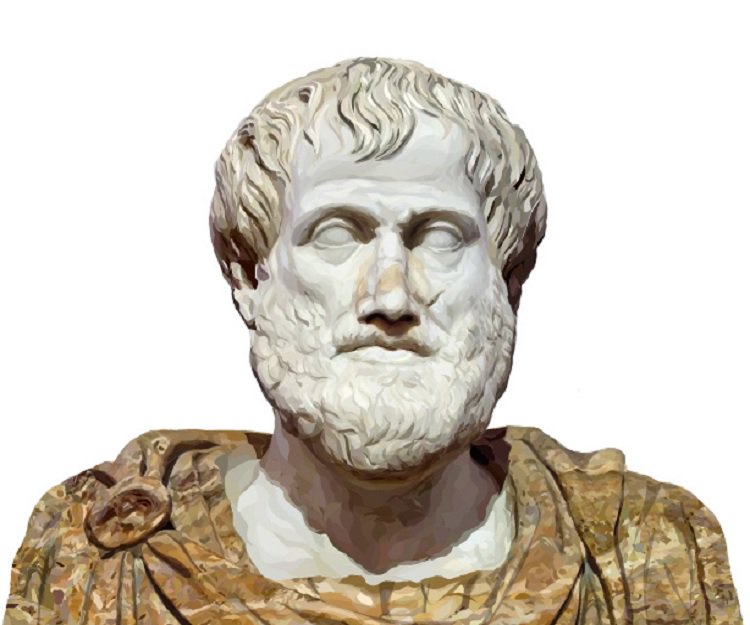
Perhaps the earliest contributor to political theory was Aristotle (384-322 BCE), a Greek philosopher, logician, and scientist. Along with Plato, Aristotle is generally regarded as one of the founders of both Western philosophy and political science. Aristotle was born on the border between Greece and Albania to a family with close connections to the King of Macedon. As a young man, Aristotle studied in Plato’s Academy in Athens. After Plato’s death, he left Athens to conduct philosophical research and was eventually invited by King Philip II of Macedon to tutor his young son, Alexander the Great. Soon after Alexander succeeded his father, consolidated the conquest of the Greek city-states, and launched the invasion of the Persian Empire, Aristotle returned as a resident alien to Athens. During his time in Athens, he wrote, many different works including Politics and Nicomachean Ethics.
In both Politics and Nicomachean Ethics, Aristotle described politics essentially as the study of values and ethics, what is right and wrong, and the study of what should be and what could be. He argued that any communication between two people revolves around those subjects and is thus political in nature. Additionally, Aristotle felt that politics is the master science because mankind is an innately political animal that engaged in politics through all of their actions, however unimportant or insignificant they may seem.
Niccolò Machiavelli

The 16th Century Italian philosopher Niccolò Machiavelli (widely considered to be the founder of modern political theory) put forward an entirely different interpretation of the nature of political power. Born in the Italian city-state of Florence in 1469, Machiavelli witnesses the French Invasion of Italy in 1494 and the decline of the Medici family’s political power. Machiavelli became secretary of the Ten of War (the body that governed the military of Florence at the time) a post he held until 1512. In that capacity, he was employed in a great variety of missions and his dispatches during these journeys, and his treatises on the Affairs of France and Germany helped to shape his views on government. In 1519, Machiavelli was commissioned by Leo X to draw up his report on a reform of the state of Florence. In 1521-25 he was employed in diplomatic services and as historiographer. After the defeat of the French at Pavia (1525), Italy was helpless before the advancing forces of the Emperor Charles V and Machiavelli strove to avert from Florence the invading army on its way to Rome. In May 1527 the Florentines again drove out the Medici and proclaimed the republic, but Machiavelli, bitterly disappointed that he was to be allowed no part in the movement for liberty, died at the age of 58.
The political theory of Macchiaveli is put forward in the book The Prince, which was published posthumously in 1532. Throughout The Prince, Machiavelli argued that politics is nothing more complicated than the study of power and that all means may be resorted to by political leaders to strengthen the political establishment and preserve authority. Without such authority and established order, Machiavelli argued that society would be weakened and that political peace and stability could never be established and maintained. Additionally, Macchiaveli noted that throughout history, organized religion and religious leaders such as the Pope tended to get in the way of political peace and stability and hindered the development of strong and stable societies. In order to address this predicament, Macchiaveli felt that there needed to be a separation of church and state and that secularism needed to be promoted by governments throughout the world.
Harold Lasswell

Harold Lasswell (1902-1978) was a leading American political scientist and communications theorist. He received his Ph.D. from the University of Chicago in 1926 and studied at the Universities of London, Geneva, Paris, and Berlin during the 1920s. Lasswell taught political science at the University of Chicago for 16 years (1922-1938) and was director of war communications research for Library of Congress from 1939-1945. After World War II, he went to Yale University, where he served until the 1970s in various capacities such as professor of law, professor of political science, and Ford Foundation Professor of Law and Social Sciences. He was also a professor of law at John Jay College of the City University of New York and at Temple University and was president of the American Political Science Association (APSA), the American Society of International Law, and the World Academy of Art and Science (WAAS). Lasswell is described as a “one-man university” whose “competence in, and contributions to, anthropology, communications, economics, law, philosophy, psychology, psychiatry, and sociology are enough to make him a political scientist in the model of classical Greece.”
Harold Lasswell viewed political science as the study of changes in the distribution of value patterns in society, and, because distribution depends on power, the focal point of his analysis was power dynamics. He defined values as desired goals and power as the ability to participate in decisions, and he conceived political power as the ability to produce intended effects on other people. In his 1936 book Politics: Who Gets What, When, and How, Lasswell viewed the power elite as the primary holders of power and nearly all political systems and that their opinions and actions influenced nearly all forms of public policy implemented at all levels of government.
Jeff Stonecash

Jeff Stonecash (1946-Present) is the Emeritus Maxwell Professor of Political Science at Syracuse University and one of the foremost experts on the American political system. Some of the topics that Stonecash has written about over the past four decades include the history of American political parties, the realignment of their electoral bases, the causes of political polarization, and the impact of changing alignments on the nature of policy debates. Stonecash argued that politics is simply the study of opportunities, individual responsibilities, beliefs and the role of government at all levels in making such things possible.
Is Politics a Science?
One of the main debates amongst scholars is whether or not political science can be considered an actual form of science much like biology, chemistry, or physics. Some argue that political science is not an actual form of science because it deals with concepts that are not tangible and relies on theoretical assumptions that are oftentimes difficult to measure and record. Despite this view, the case can be made that Political science is indeed a form of science because every new political theory involves testing, measuring, and repetition (key components of the scientific method) in order to test its validity.
Political Scientist Vs. Politicians
Politicians tend to seek quick answers in order to appeal to their votes prior to the next election, while political scientists tend to put forward measured and well-thought-out answers to policy questions. Additionally, Politicians usually hold firm in their views in order to appeal to their voter base and keep in tune with their ideologies. Political scientists, on the other hand, reach tentative conclusions once they gain an understanding of the facts behind a political issue. Politicians also seek out ways to expand their popularity and improve their chances of getting re-elected, while political scientists seek accuracy and measured responses in their works.

