Category: New Jersey Politics

  • Mikie Sherrill Wins New Jersey Governor’s Race in Decisive Victory Over Jack Ciattarelli

    Mikie Sherrill Wins New Jersey Governor’s Race in Decisive Victory Over Jack Ciattarelli

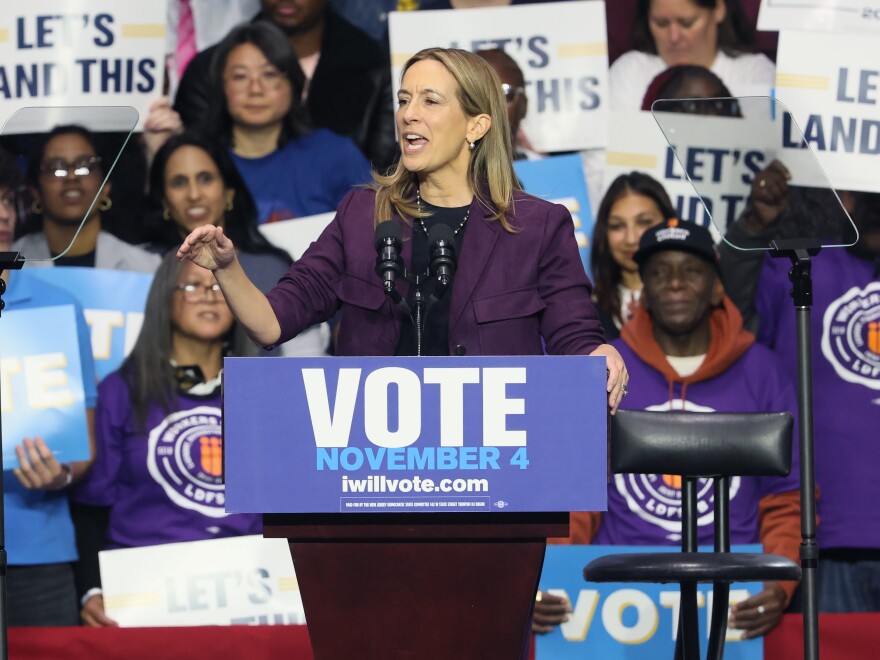
    Congresswoman Mikie Sherrill, the Democratic candidate for governor of New Jersey, catapulted to victory on November 4 on the strength of her opposition to President Dona;d Trump after a hard-fought race against Jack Ciattarelli, a Republican whose energetic campaign could not outrun national politics in a liberal-leaning state. Congresswoman Sherrill, a former Navy helicopter pilot and federal prosecutor, will become New Jersey’s 57th governor and its second female leader. She was leading Ciattarelli, a former state lawmaker running his third race for governor, by a resounding 13 points with more than 95 percent of the vote counted, according to a tally by The Associated Press.

    “Good government doesn’t just manage problems, it solves them,” Governor-elect Mikie Sherrill told supporters gathered in East Brunswick for a victory party. “I know not everyone voted for me,” she added, “but I’m working for everyone — every single one of you.” She said Jack Ciattarelli called her soon after the results were announced, and she recognized him for “stepping up.” Ciattarelli, in a brief concession speech, told his supporters that “life is not always fair.” “Nobody is more disappointed than I am in the result,” he said. “It is my hope that Mikie Sherrill has heard us, in terms of what needs to be done to make New Jersey that place where everybody wants to be to achieve their dreams again.” The race was largely defined by President Donald Trump, who made surprising inroads last November in New Jersey and who had endorsed Jack Ciattarelli. But in a state where Democrats outnumber Republicans by roughly 850,000 voters, the alliance always carried risk.

    Senator Cory Booker predicted that Mike Sherrill’s win would ripple far beyond New Jersey. “The whole nation will see,” said Booker, the state’s senior senator, “that we can’t stop the momentum.” Governor-elect Sherrill will now have to at least coexist with the president, who has shown a willingness to punish his foes. That was an argument President Donald Trump raised in the final weeks of the campaign, in a telephone rally he held for Jack Ciattarelli. “He’s got a friend in the White House,” the President said during the call, “where she certainly doesn’t.”

    Governor-elect Mikie Sherrill has pledged to freeze the state’s high electricity costs by declaring a state of emergency on her first day in office in January. She plans to get cellphones out of classrooms and hire more mental health counselors for schools. Using data gathered through a new “social media addiction observatory,” she has said, her administration will take on digital platforms that use algorithms to lure in children and teenagers.

    In the 2021 campaign, Jack Ciattarelli lost by three points to Governor Phil Murphy, a Democrat barred by term limits from running for re-election. He tried hard during this race to capitalize on the stunning gains President Donald Trump made in Black and Latino communities, campaigning aggressively in churches and at cultural events. Ciattarelli develped a reputation as a moderate Republican during his time on the Somerset County board of Freeholders (2007-2011) and in the New Jersey General Assembly (2012-2018), and until this campaign he had kept President Trump at arm’s length. But after the president’s stronger-than-expected showing last year in some of New Jersey’s most diverse communities, Ciattarelli pivoted, embracing the president and some of his policies, even giving Trump an “A” grade in the final debate.

    Jack Ciattarelli’a platform was focused heavily on pocketbook issues like taxes and energy costs. But Ciattarelli also leaned into issues popular with the far-right flank of the party, including publicly funded school vouchers, opposition to transgender rights, vaccine skepticism and the deportation of migrants. On the stump and in ads, Mikie Sherrill’s campaign regularly reminded voters of Ciattarelli’s cozy relationship with President Donald Trump. Then, last month, President Donald Trump said he was terminating funding for the construction of a $16 billion train tunnel considered vital to the country and to New Jersey’s 200,000 commuters, handing the Sherrill campaign an unexpected gift. “With less than 19 days until this election, the president’s punched him in the face like this. That’s pretty telling,” Sherrill said the next day, highlighting the ephemeral value of Ciattarelli’s partnership with a mercurial president. It also gave her a way to change the subject from a controversy centered on why she had been barred from participating in her 1994 graduation ceremony at the US Naval Academy. She has said that she could not participate because she had failed to “turn in” classmates caught up in a cheating scandal. But polls began to narrow as Ciattarelli publicly challenged that explanation and sought to undermine her credibility, denting a central pillar of her campaign: that nine years in the Navy had prepared her to lead the state.

    Polls proved largely inaccurate. Most showed Mikie Sherrill leading throughout the race, but few had her winning by a double-digit margin. Only New Jersey and Virginia hold races for governor the year after a presidential contest, and the results are considered bellwethers heading into next year’s pivotal midterm elections, which will determine party control of Congress. In Virginia, former Congresswoman Abigail Spanberger beat her Republican opponent, Lt. Governor Winsome Earle-Sears, by 15 points; Spanberger will be the first woman to serve as governor of the state.

    Ken Martin, the chairman of the Democratic National Committee who came to New Jersey repeatedly during the campaign, said victories in both states represent “the beginning of our Democratic resurgence” and proved that voters are “tired of watching the G.O.P. turn our beloved country into a playground for billionaires.” “Tonight isn’t only a warning sign to Republicans,” he said in a statement, “it’s an affirmation of the vision that Democrats have presented to voters in New Jersey and across the country.”

    New Jersey’s race was always seen as far more competitive. And Mikie Sherrill’s campaign had become a cause célèbre for Democrat-aligned national groups, which committed roughly $25 million to help her win. An array of prominent Democratic leaders also traveled to New Jersey to campaign with Sherrill in the final weeks of the race. On November 1, an appearance by former President Barack Obama drew thousands of party faithful to a large gymnasium at a community college in Newark. He energized the crowd by warning, as Sherrill has, about the threat posed by President Donald Trump. “We’ve got a commander in chief who has fired decorated military officers because he thinks they might be more loyal to the Constitution than they are to him,” Obama said. “He’s deployed the National Guard in American cities and claimed to be stopping crime waves that don’t actually exist,” he added. “We’ve got masked ICE agents pulling up in unmarked vans and grabbing people off the streets.” “Don’t boo,” Obama said repeatedly as the crowd roared. “Go vote.”

    More than 3.1 million New Jersey voters cast ballots, 500,000 more than in 2021. Jack Ciattarelli’s level of support this year actually exceeded his performance in 2021 by more than 100,000 votes, but he still fell short as far more voters beat a path to the polls. “I’m not retiring to Florida. We fight for another day,” Ciattarelli said to loud cheers. “You’ll find me right here on the streets of Central Jersey, or maybe at one of my favorite places on the beach in Surf City.”

    The contest was the most competitive race for governor of New Jersey since 2009, when Chris Christie, a Republican, unseated the incumbent governor, Jon Corzine, a wealthy Democrat. It was also extraordinarily expensive. Mikie Sherrill and Jack Ciattarelli won their party’s nominations after spirited primaries. The state’s Election Law Enforcement Commission reported last week that spending by the two candidates and groups supporting their candidacies had already exceeded $82 million. In winning, Sherrill bucked a six-decade historical trend. Not since 1961 had either party held onto the governor’s office for three consecutive terms.

  • New York, New Jersey, & Several Other States Rollback Mask Mandates, Other COVID Mandates as Omicron Surge Recedes

    New York, New Jersey, & Several Other States Rollback Mask Mandates, Other COVID Mandates as Omicron Surge Recedes

    Governor Kathy Hochul will drop New York’s stringent indoor mask mandate on February 9, ending a requirement that businesses ask customers for proof of full vaccination or require mask-wearing at all times, and marking a turning point in the state’s Coronavirus response, according to three people briefed on her decision. The decision will eliminate a rule that prompted legal and interpersonal clashes over mask-wearing, especially in conservative parts of New York. It was set to expire on February 10 and would have required renewing. Governor Hochul is expected to let the mask mandate lapse just as a crushing winter surge in coronavirus cases is finally receding. But it was as yet unclear whether the Governor would renew or drop a separate mask mandate in New York schools that expires in two weeks.

    Still, the easing of New York’s pandemic restrictions on businesses comes as Democratic-led states from New Jersey to California have announced similar moves this week, in a loosely coordinated effort that is the result of months of public-health planning, back-channel discussions, and political focus groups that began in the weeks after the November election. The moves highlight how even local officials who installed sweeping safety measures early in the pandemic are now considering shifting to an endemic response to COVID. “This is not a declaration of victory as much as an acknowledgment that we can responsibly live with this thing,” said New Jersey Democratic Governor Phil Muphy, who imposed some of the countries strictest COVID-related mandates in the earliest days of the pandemic. Under Governor Murphy’s new policies, which will come into effect on March 7, students and school employees in the state will no longer be required to wear masks.

    Shortly after the New Jersey announcement on February 7, the Democratic Governors of California, Connecticut, Delaware, and Oregon separately said they would also end some mask mandates. Connecticut will permit students and staff members to stop wearing masks in schools by no later than Feb. 28 and Delaware will end mask mandates in schools by March 31. Oregon and California announced the end to mask mandates at indoor public spaces. Governor Gavin Newsom of California wrote on Twitter on February 7 that cases had dropped, hospitalizations had stabilized, and the state’s indoor mask mandate for vaccinated people would expire on February 15. Governor Kate Brown of Oregon on Twitter said on Monday that the state would “lift mask requirements no later than March 31.” The moves to eliminate mask mandates in these states come as the number of reported cases has dipped to its lowest level since the highly contagious Omicron variant touched off a wave of cases in December.

    As of February 8, the daily average of new cases in the United States dropped to around 240,000, the lowest that figure has been since late December. Though the daily average of hospitalizations has steadily declined since its peak on January 20, the daily average of deaths linked to the virus has hovered at nearly 2,600 since January 27. The rollbacks also highlight the patchwork nature of health protocols that have yet to be synchronized from county to county within many states, let alone between states, since the pandemic began in early 2020. New Mexico and Illinois have statewide mask mandates for schools and many indoor settings. Idaho, Louisiana, and Mississippi recommend indoor mask-wearing, and Republican-led states like Texas and Florida have banned mandates. Whether to mandate mask-wearing in schools is up to local officials in most states. The mask rollbacks announced on February 7 appear to undercut messaging coming from federal officials.

    Asked on February 7 about the lifting of mask mandates in New Jersey, Jen Psaki, the White House press secretary, pointed to federal guidance from the Centers for Disease Control and Prevention that says masks can reduce transmission of coronavirus. “Our responsibility as the federal government is to rely on the data and the science that is being analyzed by our public health experts,” Psaki said at a news conference.

  • Democratic Governor Phil Murphy Narrowly Wins Re-Election In New Jersey

    Democratic Governor Phil Murphy Narrowly Wins Re-Election In New Jersey

    Democratic New Jersey Governor Phil Murphy narrowly fended off an election challenge from Republican former State Senator Jack Ciattarelli, returns showed on November 3, a day after voting ended in an unexpected nail-biter for the incumbent. Murphy became the first Democratic governor since Brendan Byrne in 1977 to win re-election in New Jersey, even though registered Democratic voters outnumber Republicans by more than 1 million in the densely populated northeastern coastal US state. The incumbent struck a triumphant but politically inclusive tone in a brief victory speech he delivered at an Asbury Park convention hall to supporters chanting, “Four more years!””If you want to be governor of all of New Jersey, you must listen to all of New Jersey. And New Jersey, I hear you,” he told the crowd

    Unofficial returns posted by the Associated Press and cited by the New York Times and other media outlets pronouncing the victory for Governor Phil Murphy showed him clinching 50.03% of the vote, compared with 49.22% for Jack Ciattarelli, with 90% of ballots counted. There was no immediate word from Ciattarelli conceding defeat, and his campaign spokesperson, Sami Williams, posted a tweet criticizing the media for calling the race when it did. “With the candidates separated by a fraction of a percent out of 2.4 million ballots cast, it’s irresponsible of the media to make this call when the New Jersey Secretary of State doesn’t even know how many ballots are left to be counted,” she wrote.

    Governor Phil Murphy has presided over a political shift to the left in the state, including new taxes on millionaires, tougher firearms restrictions, marijuna legalization, a higher minimum wage, and paid sick leave. He has also defended his robust public health measures aimed at curtailing the coronavirus pandemic, which emerged as a key point of contention in the race. Jack Ciattarelli, who had trailed Murphy by up to 10 percentage points in some opinion polls, capitalized on widespread unpopularity with Murphy’s aggressive mask requirements for schoolchildren. The Republicans also focused much of their campaign on the state’s high taxes, while accusing Murphy, a wealthy former Goldman Sachs executive, of being out of touch with the electorate.

    New Jersey has trended steadily Democratic in recent years. The party won 10 of the state’s 12 House of Representatives seats in 2020, and President Joe Biden carried the state over then-President Donald Trump last year by more than 15 percentage points. Still, Jack Ciattarelli’s unexpectedly strong performance in New Jersey, and a Republican victory in Virginia’s hard-fought gubernatorial race spelled trouble for Biden’s party heading into next year’s congressional elections. Murphy trailed overnight in the returns but squeaked into the lead as the tabulation of the vote unfolded in several heavily Democratic counties.

  • Despite Decline In Coronavirus Cases, New Jersey Struggling To Manage Pandemic

    Despite Decline In Coronavirus Cases, New Jersey Struggling To Manage Pandemic

    New Jersey Health officials say the state is still “struggling” to manage the pandemic since the latest data shows New Jersey remains wedged inside a Coronavirus hot zone, and it is currently ranked first in the US in Coronavirus deaths per capita over the past week, according to the US Centers for Disease Control and Prevention. Health Commissioner Judith Persichilli told the state Assembly Budget Committee on April 22 that the trend could continue to slow the pace of reopenings or capacity expansions while the state continues to address problems at long-term care facilities and nursing homes. The state says it has conducted 1,000 infection control inspections and 520 regular surveys as well as investigated 758 complaints at long-term care facilities. Out of that, 613 deficiencies have been cited and $2.2 million in penalties have been imposed against 79 facilities since the pandemic began, Persichilli said. Still, around 8,000 of the state’s 22,000 deaths have been at long-term care facilities and one in 500 New Jerseyans have died from the disease, she said.”Unfortunately, the one thing we’re struggling with is that our death rate from COVID has not decreased,” Persichilli said. “This is not a position to be proud of.”

    Health Commissioner Judith Persichilli told the committee on April 22 that New Jersey has the second-highest death rate in the nation, behind only Michigan. But on April 23, the state jumped to the top position. According to the CDC, New Jersey is reporting a Coronavirus fatality rate of 2.9 per 100,000 population over the past seven days. By comparison, Michigan is 2.6, Georgia and Montana are 2.4 and Pennsylvania and West Virginia are 2.3 per 100,000 people. New Jersey still ranks high in cases, too, ranking second in the nation per capita. The state is reporting a Coronavirus infection rate of 269.7 cases per 100,000 population over the past seven days. By comparison, Michigan is 483, Pennsylvania is 248.5, Minnesota is 238.4 and Maine is 230 per 100,000 population.

    Health Commissioner Judith Persichilli took heat from some lawmakers during the hearing who could not understand why the state could not do more to prevent deaths at long-term care facilities. “Somebody has to be responsible for those losses of lives,” said Assemblyman Harold J. “Hal” Wirths (R-Sussex County). Assemblyman Wirths’ district includes Andover Subacute & Rehab Center II, which made headlines a year ago after stacking more than a dozen bodies in a temporary facility. It was referred to as a “makeshift morgue” by officials. Persichilli said the “virus is at fault,” but she also said that multigenerational housing and New Jersey’s status as having the densest population in the county are also to blame. Given those close quarters, the virus was able to spread too easily and health officials were initially told that the disease was “symptomatic spread,” she said. “I stand by what we did,” she said. “There were people walking around and into our long-term care facilities without a symptom and spreading the disease.” She also said 35 percent of the deaths involved communities of color and three times as many Hispanic men between the ages of 35 and 60 are dying compared to whites. That last statistic compelled the state to up its vaccinations in Hispanic communities, she said. Nineteen percent of the population last week who were vaccinated were Hispanic people.

    Assemblyman Harold J. “Hal” Withs said he was also disappointed that Governor Phil Murphy is taking incremental steps in reopening while Connecticut, which is similar in size and population density, is not. He said the high death is “what’s baffled me a bit because we have had the strictest lockdowns and I don’t see what’s working.” Health Commissioner Judith Persichilli said reopening decisions are based on health department data, saying the Murphy administration looks at community spread, hospital capacity and the death rate per 100,000 people. If the state did not take the lockdown steps it needed to take, she said, as many as 1 out of every 250 New Jersey residents could have died

    New Jersey Governor Phil Murphy has echoed Health Commissioner Judith Persichilli’s statements, saying he believes the spread of the Coronavirus variants has kept the state’s cases high, even though New Jersey just had a four-day streak of fewer than 3,000 new cases for the first time in five months. Governor Murphy said that there are around 2,000 variant cases. The data comes two weeks after the results of a new analysis by UC Berkeley placed New Jersey’s and America’s coronavirus response among the worst. The state’s vaccination program, on the other hand, has made progress. Murphy has announced that vaccines will be available to everyone 16 years old and over beginning on April 19. 

  • New Jersey Governor Phil Murphy Announces School Reopening Plan

    New Jersey Governor Phil Murphy Announces School Reopening Plan

    New Jersey Governor Phil Murphy urged more New Jersey schools to return to in-person learning on March 17, just days after rallying parents placed blame for lingering closures squarely at the Governor’s feet. “Now is the time for all of our schools to meaningfully move forward with a return to in-person instruction, whether it be full-time or with a hybrid schedule,” Governor Murphy said during his regular coronavirus briefing in Trenton. The Governor pointed to billions in federal funding headed to schools from the American Rescue Plan and said his administration is doing everything in its power “to get as many kids back safely and responsibly into a classroom.”

    New Jersey Governor Phil Murphy’s comments come as the number of students with the opportunity to attend classes in person continues to grow. Governor Murphy reported 142 school districts, serving 107,498 kids, are now providing in-person instruction. Another 534 districts, representing 843,394 students, are operating under hybrid schedules. However, 317,044 students across 98 districts remain in all-remote instruction a full year after most schools initially closed due to the Coronavirus pandemic. Parent frustration in many of those communities has long since boiled over, leading to parent rallieslegal battles, and even a police investigation into the suggestion of “physical violence” against those keeping schools closed.

    On March 13, about 100 parents from across the state gathered in Montclair to demand action, not just from local school leaders but Governor Phil Murphy himself. “Aside from our (superintendents) and our board of ed, the person that I blame ultimately for this is Governor Murphy,” said rally organizer Danielle Wildstein, a parent in the Scotch Plains-Fanwood School District. She added: “It has come down to (Murphy), who gave the responsibility to the superintendents back in August, gave them a very gray blueprint and then stepped aside… It’s really about him stepping up now.”

    New Jersey Governor Phil Murphy initially announced last June that all schools would be required to offer in-person instruction this academic year. However, he amended that mandate in August, citing increasing health concerns and logistical challenges brought forward by schools. Murphy said districts could begin the year with all-remote instruction as long as they provided the state Department of Education with documented challenges, such as poor ventilation or a lack of protective equipment, and were working toward set reopening dates. Those dates, however, have been routinely pushed back, including at least one district that said in January it does not plan to open at all this school year. “We know there are students across our state who have fallen behind due to the burden and stress of remote learning, and it is time to stem this tide before more students fall away,” Murphy said on March 17.

    According to the state’s dashboard, New Jersey has reported 188 in-school Coronavirus outbreaks, which have resulted in 890 cases among students, teachers, and school staff this academic year. The outbreak numbers only include cases in which contact tracers concluded people likely gave each other the virus on school grounds. The numbers do not include those who caught the virus during school sports practices, games, or extracurricular activities inside or outside school.

  • New Jersey Ratifies Legislation Legalizing Marijuana

    New Jersey Ratifies Legislation Legalizing Marijuana

    New Jersey Governor Phil Murphy signed legislation on February 22 making New Jersey the latest state to legalize marijuana for recreational use, but it is expected to take up to a year before dispensaries will begin selling cannabis to the public. The Democratic governor signed a package of three bills after voters overwhelmingly approved a ballot question in November to legalize adult use of the drug. The enactment came more than three years after Murphy campaigned for governor on the promise to make recreational use legal in the state. Legalization was delayed by political opposition within the state legislature, even though members of Murphy’s own party control both houses.“New Jersey’s broken & indefensible marijuana laws are no more,” Murphy said on Twitter.

    New Jersey Governor Murphy signed into law bills that allow possession of up to six ounces of marijuana by people age 21 or older. Distribution and growing cannabis without a license remains illegal. The legislation, passed earlier on Monday by the Assembly and Senate, also eased penalties for minors’ possession of marijuana. New Jersey now joins more than a dozen other states, including other East Coast states of Maine, Vermont and Massachusetts, in legalizing cannabis for recreational use. Dozens of states permit marijuana to be used by patients suffering a variety of medical conditions.

    The move is expected to boost New Jersey’s pandemic-stricken economy by launching a for-profit cannabis industry that should generate millions of tax dollars for the state. Recreational sales at state-licensed dispensaries, however, may be as much as a year away. “We can get down to the business of establishing a responsible, sustainable, profitable and diverse adult-use and expanded medical cannabis market in New Jersey,” Edmund DeVeaux, head of the New Jersey CannaBusiness Association, said in a statement. “We can stop the senseless arrests for possession and use of a product that should have never been criminalized in the first place, and the voters approved over three months ago,” he said.

    New Jersey Governor Phil Murphy and legislators in the State Senate for months stood at an impasse over underage penalties. While the legalization bill made youth possession of marijuana purchased on the legal market a petty disorderly person’s offense, the decriminalization bill provided no penalties for possession of marijuana purchased on the black market. The cleanup measure subjects all underage users to a graduated system of written warnings that would see users’ parents notified on a second offense and see them referred to community-based treatment or counseling groups on the third violation. Underage alcohol offenses would be subject to those same penalties. “Although this process has taken longer than anticipated, I believe it is ending in the right place and will ultimately serve as a national model,” the governor said.

    The standstill threatened political fallout over one of the governor’s chief 2017 campaign promises just as he moved into his re-election campaign. It is still likely to play a part in this year’s gubernatorial race, despite legalization winning overwhelming support at the polls last November. “Raising children these days is hard enough without politicians making it even harder,” Republican gubernatorial candidate Jack Ciattarelli said on Twitter. “Today’s decision by Trenton Democrats to prohibit police officers from even asking questions to a car full of underage kids who appear to be smoking weed is outrageous.”

    The cleanup bill, which cleared the Senate in a 22-9 vote with some opposition from democratic lawmakers, including Legislative Black Caucus Chairman Ron Rice (D-Newark) who voted against the bill because it did not eliminate qualified immunity related to marijuana offenses, lowers the bar to criminally charge police who illegally search minors for marijuana by removing a requirement that the search is predicated on an individual’s protected class, like race, religion or age, among others. The measure also bars local governments from enacting their own civil penalties for marijuana offenses and requires the state Attorney General to review police body camera footage from marijuana incidents, including underage users.

    The standstill upended other legislative business as the Assembly was forced to cancel a February 8 quorum and a February 17 voting session that would have made the legalization and decriminalization bills law without Governor Phil Murphy’s signature. Those postponements prevented lawmakers in the lower chamber from introducing new legislation and effectively canceled a slew of committee meetings on unrelated legislation over the past two weeks. Marijuana arrests continued in the interim, despite guidance from Attorney General Gurbir Grewal that directed prosecutors to halt all cases solely involving marijuana charges, but those will stop now that marijuana use is decriminalized.

  • Monmouth County, NJ 2021 Scorecard

    Monmouth County, NJ 2021 Scorecard

    The results are in! Local politics affects us all. For greater transparency in county politics, we will analyze New Jersey’s County System and score the functional groups of each county. Below, let’s review Monmouth County as of 2021:

    Monmouth County is the second-largest county in the state of New Jersey, with a population of ~600,000.

    Leadership

    Counties in New Jersey are governed by a so-called Board of Chosen Freeholders, who are either elected at-large for three-year terms of office on a staggered basis or by concurrent elections. The Board of Chosen Freeholders either has 3,5,7, or 9 members depending n the county. Each January, the freeholders select one of their members to serve as the board director for the year to preside over the board’s meetings and activities. County Freeholders have both administrative and policy-making powers. The freeholders oversee the five mandatory functions of the county government delegated to it by the state. Each freeholder is assigned responsibility for one of the five functional areas: Administration and Special Services; Public Works and Engineering; Human Services, Health, and Transportation; Finance and Administration of Justice, overseeing more than 70 county departments in total.

    Monmouth County has a five-member Board of Chosen Freeholders in which its members are subjected to three-year terms, and are elected on a staggered basis.

    In Monmouth County, Administrator Teri O’Connor serves as the county’s chief executive officer and is responsible for carrying out the policies and directives established by the Board of Chosen Freeholders and managing the daily operations of the county’s more than 3,000 employees. This position is appointed by the Freeholder Director.

    As of 2021, Monmouth County’s Freeholders are:

    Freeholder Director Thomas A. Arnone (R, Neptune City)

    Freeholder Deputy Director Susan M. Kiley (R, Hazlet)

    Ross F. Licitra (R, Marlboro Township)

    Lillian G. Burry (R, Colts Neck Township)

    Dominick DiRocco (R, Wall Township

    Constitutional Sheriffs

    According to Article VII Section II of the New Jersey State Constitution, each county in New Jersey is required to have three elected administrative officials known as “constitutional officers.” These officers are the County Clerk and County Surrogate (both elected for five-year terms of office) and the County Sheriff (elected for a three-year term). 

    Monmouth county’s constitutional officers are:

    County Clerk Christine Giordano Hanlon

    Sheriff Shaun Golden

    Surrogate Rosemarie D. Peters 

    Christopher Gramiccioni of Wall Township is the county’s prosecutor, having been formally nominated to the position by Governor of New Jersey Chris Christie in May 2016. Gramiccioni had been serving on an acting basis for almost four years since being appointed to the post in July 2012 by Attorney General of New Jersey Jeffrey S. Chiesa.

    Monmouth County constitutes Vicinage 9 of the New Jersey Superior Court and is seated at the Monmouth County Courthouse in Freehold Borough, with additional facilities in Freehold and Ocean Township; the Assignment Judge for Vicinage 9 is Lisa P. Thornton.

    The 4th and 6th Congressional Districts cover the county. For the 116th United States Congress, New Jersey’s Fourth Congressional District is represented by Chris Smith (R, Hamilton Township). For the 116th United States Congress, New Jersey’s Sixth Congressional District is represented by Frank Pallone (D, Long Branch).

    Partisanship

    Political Preferences & Election Results

    Monmouth County generally leans Republican in federal, state, and local races, though registered Democrats very narrowly outnumber registered Republicans. Al Gore in 2000 and Bill Clinton in 1996 are the only two Democratic presidential candidates to have won it since 1964, when Lyndon B. Johnson won a national landslide and carried every county in New Jersey. All five county Freeholders, all three constitutional officers, and the majority of state legislators are Republicans.

    As of October 1, 2020, there were a total of 482,595 registered voters in Monmouth County, of whom 139,874 (28.9%) were registered as Democrats, 137,292 (28.4%) were registered as Republicans, and 199,621 (41.3%) were registered as Unaffiliated. There were 5,808 (1.2%) voters registered to other parties. Among the county’s 2010 Census population, 89% of residents of age 18 and over were registered to vote.

    The control of the Board of Chosen Freeholders has changed hands multiple times but has been controlled by the Republican Party by a unanimous margin since 2010.

    Here are the Presidential, Gubernatorial, and Senate election results for Monmouth County Since 2000:

    2000 U.S. Presidential Election: Al Gore (50%-46%)

    2000 U.S. Senatorial Election: Bob Franks (50%-48%)

    2001 N.J. Gubernatorial Election: Jim McGreevey (50%-49%)

    2002 U.S. Senatorial Election: Doug Forrester (50%-47%)

    2004 U.S. Presidential Election: George W. Bush (54%-44%)

    2005 N.J. Gubernatorial Election: Doug Forrester (52%-44%)

    2006 U.S. Senatorial Election: Tom Kean Jr. (52%-44%)

    2008 U.S. Presidential Election: John McCain (51%-48%)

    2008 U.S. Senatorial Election: Dick Zimmer (R) (53%-47%)

    2009 N.J. Gubernatorial Election: Chris Christie (R) (62%-31%)

    2012 U.S. Presidential Election: Mitt Romney (51%-47%)

    2012 U.S. Senatorial Election: Joe Kyrillos (54%-45%

    2013 N.J. Gubernatorial Election: Chris Christie (R) (73%-26%)

    2014 U.S. Senatorial Election: Jeffery Bell (R) (60%-40%)

    2016 U.S. Presidential Election: Donald Trump (53%-44%)

    2017 N.J. Gubernatorial Election: Kim Guadagno (R) (55%-43%)

    2018 U.S. Senatorial Election: Bob Hugin (R) (53%-43%)

    2020 U.S. Presidential Election: Donald Trump (51%-48%)

    2020 U.S. Senatorial Election: Rikin ‘Rik’ Mehta(R) (52%-47%)

    MONMOUTH COUNTY SCORECARD

    1 -5 (poor, below average, average, above average, excellent)

    Public Safety – average / below average (2.5)

    Adequate funding (~$98,000,000 as per most recent data), but mostly focused on salaries on personel as opposed to police officer training.

    SCHOOL SYSTEM – above average (4)

    Well-funded relative to county population, sufficient focus on higher education, vocational schools, and cooperative educational resources. Some issues with

    INFRASTRUCTURE & PUBLIC WORKS – below average (2)

    Road neglect and minimal traffic management

    “Beach Town” Reliance on Seasonal funding from beach tourism 

    TAX SYSTEM – below average (2)

    High (vs state average?) %

    Distributed in favor of School System & Law Enforcement, less priority on Infrastructure 

    COURT SYSTEM  – average / above-average (3.5)

    Experienced Judges & Attorneys

    Efficient Administrative Staff / Paralegals

    Family law and municipal cases are handled less effectively

  • 2020 Election: Trump Campaign Sues New Jersey Over Vote By Mail Plan

    2020 Election: Trump Campaign Sues New Jersey Over Vote By Mail Plan

    Accusing New Jersey Governor Phil Murphy of a “brazen power grab,” President Donald Trump’s re-election campaign has asked a federal judge to overturn New Jersey’s plan to send ballots to all 6.2 million registered voters this fall. The suit was filed in US District Court by the Trump campaign, joined by the Republican National Committee and the New Jersey Republican State Committee. Among their lawyers is state Senator Michael Testa (R-Cumberland County), a frequent critic of Governor Phil Murphy. “In the state of New Jersey, where their universal vote-by-mail system has already resulted in fraud and disenfranchisement, Governor Murphy continues to remove safeguards against abuse,” Trump campaign counsel Matt Morgan said. “With a stroke of his pen, the governor told his people their votes may not count – they may even be stolen – and that’s fine by him.”

    New Jersey Governor Phil Murphy has sought to expand mail voting due to the coronavirus pandemic, and New Jersey Attorney General Gurbir Grewal said the state will sue the US Postal Service over concerns the Trump administration is purposely crippling the agency ahead of the surge in mail-in ballots. Postmaster General Louis Dejoy on August 18 backed off on making changes blamed for delaying mail delivery, but Grewal said the lawsuit would proceed and the House is to vote on August 22 to rescind the adjustments to mail operations already made. “Governor Murphy has consistently put people ahead of politics and protected the health and safety of New Jersey residents throughout the pandemic, and his decision to allow universal mail in voting in the November election is no different,” state Democratic chairman John Currie said. “President Trump’s lawsuit is another clear attack on our democracy and on our voting rights, just like his efforts to destroy the Post Office and delegitimize the electoral process.” President Donald Trump and other Republicans, though, claimed that more absentee balloting would lead to more vote fraud. “We said every option was on the table,” New Jersey Republican Party Chairman Doug Steinhardt said. “We picked one. Governor Murphy, we’ll see you in court, again.” The Trump campaign also has sued Pennsylvania, Nevada, and Iowa, which also have sought to expand vote by mail, according to Rick Hasen a professor of law and political science at the University of California, Irvine, and author of a blog on election law.

    Studies have shown vote by mail has not prompted widespread fraud, as Republicans have claimed. A 2017 study by the Brennan Center for Justice at New York University found that the rate of voter fraud for mail-in ballots was 0.00004% to 0.0009%. And the Washington Post found possible double voting or voting on behalf of dead people in just 372 of 14.6 million ballots cast in Colorado, Oregon, and Washington, which send ballots to all registered voters as New Jersey plans to do this fall. Still, there were cases of voter fraud in Paterson’s municipal elections in May, where 800 ballots were thrown out and state Attorney General Gurbir Grewal brought charges against four individuals. “In New Jersey’s primary election, dead people voted, a mail truck carrying ballots actually caught fire, countless voters saw their ballots rejected, and the Democrat attorney general is prosecuting multiple people for fraud, yet Democrats still want to implement a rushed transition to an all-mail election,” Republican National Chairwoman Ronna McDaniel said. Governor Phil Murphy acknowledged some problems with the July 7 primary, the first election conducted primarily by mail but said that the system overall worked well and county clerks will have a lot more time to prepare for the general election.

    Primary turnout was 26% of New Jersey’s registered voters, the same percentage as the presidential primary four years ago. Both recorded the highest percentage turnout since 2008 when 35% of New Jersey voters cast ballots. “We think largely it was a very good result, particularly balancing the sacred right to vote at the center of democracy along with public health and respecting people’s health and the combination of vote-by-mail and in-person,” Governor Phil Murphy said August 10 at his coronavirus press briefing. He also contended that the fact that the Paterson voter fraud was easily found showed that systems are in place to prevent ballots from being cast illegally. “I view that data point in Paterson as a positive one,” Murphy said during his coronavirus press briefing. “People tried to mess with the system and they got caught and they’ve been indicted, and that’s the way it should be.”

    President Donald Trump and other Republicans have cited fear of fraud in fighting efforts across the country by states to send out ballots to all registered voters or count votes postmarked by Election Day but received later. They have been been able to be so active because this is the first presidential election in almost four decades where the Republican National Committee’s voter activities are not encumbered by court-ordered restrictions stemming from the 1981 New Jersey gubernatorial election. Those activities had been limited by a court decree after the state Republican Party was accused of targeting heavily minority communities that tend to support Democratic candidates.

  • Analysis of the 2017 New Jersey Gubernatorial Election

    The 2017 New Jersey Gubernatorial Election is set to be held on November 7. Incumbent Republican Governor Chris Christie (who was first elected in 2009 with 49% of the vote and re-elected in 2013 with 60% of the vote) is term-limited and cannot run for a third term. Despite coming into office with an ambitious agenda for political reform, Governor Christie is leaving office with a 15% approval rating and a legacy marked by scandal, continued fiscal decline, and failure to address long-standing structural issues facing the state.

    Here is an overview of the candidates and a preliminary prediction of the election results:

    Lieutenant Governor Kim Guadagno is the Republican candidate for New Jersey governor and has proposed a center-right platform.
    Lieutenant Governor Kim Guadagno is the Republican candidate for New Jersey governor and has proposed a center-right platform.

    Lieutenant Governor Kim Guadagno
    Lieutenant Governor Kim Guadagno is the Republican candidate for governor, having won the June 7th primary with ~47% of the vote. Guadagno was born in Waterloo, Iowa on April 13, 1959, and earned a Law Degree from American University Washington College of Law in 1983. After graduation, Guadagno took a job as a federal law clerk in New York City and developed a reputation as an effective prosecutor in cases involving political corruption. Prior to serving as Lieutenant Governor, Guadagno was Assistant New Jersey Attorney General from 1999 to 2001 and was elected Monmouth County Sherrif in 2007, serving for two years.

    Kim Guadagno has developed several different policy positions that have helped her to stand out as a candidate. Guadagno has pledged to veto any new tax increases and supports placing a cap the school portion of a homeowner’s property tax bill, arguing that such a measure will save a family making New Jersey’s median income of $72,000 an average of $895 annually. Guadagno is opposed to increasing the minimum wage to $15 per hour, arguing that such a policy will harm the economy of the state. Guadagno supports reform to the New Jersey antiquated school funding formula and expanded school choice. Guadagno is opposed to the current House Republican plan to cut Medicaid and has called on lawmakers to find a “more sustainable way to replace the services to some of the neediest Americans.” Additionally, Guadagno is opposed to marijuana legalization (but backs its decriminalization) and supports bringing public health insurance plans in line with the private sector as a way to reduce state expenses.

    Phil Murphy is the Democratic candidate for New Jersey Governor.
    Phil Murphy is the Democratic candidate for New Jersey Governor.

    Former Ambassador Phil Murphy
    Phil Murphy is the Democratic candidate for governor, having won the Democratic primary with 48% of the vote. Murphy was born on August 16, 1957, to a middle-class family in Boston, Massachusetts. Both of his parents were politically active, having campaigned for future President John F. Kennedy in his successful Senate campaigns in 1952 and 1958. Murphy received a Bachelor’s Degree in Finance from Harvard University in 1979 and an MBA from the University of Pennsylvania in 1983. After graduation, Murphy began a 23-year career at Goldman Sachs and established a reputation as an effective deal-maker. After retiring from Goldman Sachs, Murphy served from 2006 to 2009 as the National Finance Chair of the Democratic National Committee and was subsequently appointed Ambassador to Germany by President Barack Obama and served from 2009 to 2013. In 2014, Murphy created New Start New Jersey, a progressive policy think tank. One of the goals of the organization was to help displaced workers back into the workforce and improve the economic climate in New Jersey.

    Phil Murphy has proposed an ambitious agenda for moving New Jersey forward. Murphy supports the creation of a statewide investment bank as a way to improve the New Jersey economy. Such a bank would supply loans to both businesses in the state and college students and would have the effect of limiting Wall Street firms from participating in state financial activities. Murphy supports increasing state investment in infrastructure as a way to both attract workers and promote economic advancements. Murphy is also a major proponent of raising the minimum wage to $15 an hour, mandating earned sick leave, and expanding the Earned Income Tax Credits for New Jersey residents. Murphy has thus far been vague on how to address the state’s troubled pension system but has stated that New Jersey has a need to follow through on its obligations to its workers. Murphy also supports the legalization and decriminalization of marijuana and guaranteed paid sick leave for New Jersey workers.

    The New Jersey Libertairan Party selected Peter Rohrman as its gubernatorial nominee.
    The New Jersey Libertarian Party selected Peter Rohrman as its gubernatorial nominee.

    Peter Rohrman
    Former Marine and candidate for Bergen County Freeholder in 2015 and 2016 Peter Rohrman is the Libertarian nominee for Governor. Rohrman is the grandson of Italian and German immigrants and grew up in a blue-collar family. After a stint in the Marine Corps, Rohrman earned a degree in Computer Science at Rutgers University and was subsequently employed as an operations director for an Internet service provider.

    Peter Rohrman has mostly focused on economic issues during his campaign for Governor. Rohrman supports eliminating the gas tax, sales tax, and state income tax in addition to reducing state spending by as much as 30%. Rohrman favors making the public pensions system voluntary, improving the state’s business climate, and reform to prevailing wage laws. On social issues, Rohrman supports the legalization and decriminalization of marijuana, criminal justice reform, and a loosening of firearms regulations in New Jersey.

    Pastor Seth Kaper-Dale is the Green Party candidate and proposes a progressive platform to the left of Phil Murphy.
    Pastor Seth Kaper-Dale is the Green Party candidate and proposes a progressive platform to the left of Phil Murphy.

    Seth Kaper-Dale
    Pastor Seth Kaper-Dale is the Green Party nominee for governor. Kaper-Dale and his wife Stephanie both graduated from Princeton Theological Seminary in 2001 and soon after became co-pastors at the Reformed Church of Highland Park. Dring his service as a pastor, he and his wife have emerged as progressive voices for social justice and have led efforts to raise awareness regarding issues such as affordable housing and immigration reform, and has worked to end Solitary Confinement and torture in the New Jersey prison system.

    Seth Kaper-Dale supports increasing the state income tax rate as a way to reduce income inequality and favors the implementation of a single-payer Medicare-for-All healthcare system. Kaper-Dale also supports the legalization and decriminalization of marijuana and increased measures preventing police brutality within minority communities. Kaper-Dale is a major backer of reforming the New Jersey criminal justice system, arguing for a ban on Solitary Confinement, reopening the Office of the Public Advocate, and implementing meaningful re-entry services for inmates.

    Overall, the candidates running in the New Jersey gubernatorial election have a variety of different views covering all parts of the political spectrum. Based on current polling, it seems that Phil Murphy will likely win with around 55% of the vote, with 43% going to Lieutenant Governor Kim Guadagno and 2% going to the minor candidates. Even though he is far from a perfect candidate, there are several factors going in Murphy’s favor going into the election. The first is the overall national trend against the Republican Party and President Donald Trump. Currently, President Trump has a 37% approval rating nationally, thus dampening Republican chances in local, state, and national elections (Trump’s low approval rating may even be enough for the Democratic Party to retake both House of Congress, a majority of state governorships, and many state legislatures in the mid-term elections next year). The next factor is the overall economic situation in New Jersey. Even though the unemployment rate in New Jersey is 4.1%, the economic outlook in the state remains bleak and job growth remains stagnant. Because of these factors, it can be argued that Phil Murphy has an edge in the Gubernatorial election barring any drastic improvement of Republican prospects both nationally and statewide.

    Here is a list of polling places in New Jersey and information on how to register to vote:

    https://voter.njsvrs.com/elections/polling-lookup-orig.html

    http://www.state.nj.us/mvc/Licenses/VoterRegistration.htm

  • Legalization of Marijuana in New Jersey: Recent Policy Proposals

    Although Governor Chris Christie (R) is strongly opposed to legalizing Marijuana (arguing that it is a “gateway” drug despite the fact that it has been scientifically proven that Marijuana usage has health benefits) the State Senate has begun discussions on how to regulate the Marijuana industry in New Jersey provided that it is legalized. State Senator Nicholas Scutari (D-Union) has recently sponsored a bill that legalizes marijuana possession and sale by adults 21 and older. Scutari’s bill includes several other provisions such as decriminalizing Marijuana possession of up to 50 grams immediately, creates a Division of Marijuana Enforcement in the state Attorney General’s Office which would create the rules used to govern the legal market of growers and sellers, and imposes a tax on Marijuana sales at 7% for the first year.

    Democratic gubernatorial nominee Phil Murphy is a supporter of efforts to legalize Marijuana in New Jersey.
    Democratic gubernatorial nominee Phil Murphy is a supporter of efforts to legalize Marijuana in New Jersey.

    Thus far, the bill legalizing Marijuana has attracted its share of both supporters and opponents. Organizations supporting the bill include New Jersey United for Marijuana Reform and various civil rights leaders who argue that existing drug enforcement laws are draconian and disproportionately affect minorities and the most vulnerable members of society. Additionally, Democratic Gubernatorial nominee Phil Murphy supports legalization of Marijuana. Opponents to the change in New Jersey drug policy have been relatively silent, though it is expected that most opposition comes from the pharmaceutical industry and drug and alcohol rehabilitation centers. Because of the fact that a majority of New Jersey residents support the legalization of Marijuana, it is expected that the Senate bill will likely be passed and signed into law assuming that the Democratic Party wins this year’s gubernatorial election.